Batman: Black and White volume 1


By Ted McKeever, Bruce Timm, Klaus Janson, Archie Goodwin & Gary Gianni, Katsuhiro Otomo, Joe Kubert, Howard Chaykin, Walter Simonson, José Muñoz, Jan Strnad & Richard Corben, Kent Williams, Chuck Dixon & Jorge Zaffino, Neil Gaiman & Simon Bisley, Andrew Helfer & Liberatore, Bill Sienkiewicz, Matt Wagner, Dennis O’Neil & Teddy Kristiansen, Brian Bolland, Kevin Nowlan, Brian Stelfreeze, Michael Allred, Moebius, Michael Kaluta, Tony Salmons, P. Craig Russell, Marc Silvestri, Alex Ross, Neal Adams & various (DC Comics)
ISBN: 978-1-4012-1589-7 (TPB/Digital edition)

Batman is a creature of the night. Batman is the world’s greatest detective, escapologist and master of disguise. Batman fights criminals, mad men and bad women, aliens and monsters. Batman is all this and more. In a world of fabulous eerily distorted hues and constantly shifting blinding colour (mostly red) he sees in black and white… and now so will you…

As recapped in a sagacious Introduction, in the early 1990s Batman: Black and White was originally envisioned as an experimental limited series, with editors Marl Chiarello & Scott Peterson inviting the world’s greatest comics creators – whether new to the character or long-time veterans – to tell “their” story of the Gotham Gangbuster. They would be free of all continuity constraints but operating under the sole proviso that the result should be designed to work in stark monochrome.

Results were astounding, challenging and inevitably, multi-award winning. If you are any sort of Bat-fan or aficionado of the art form there will be something in this wonderful tome to blow your socks off. Just don’t read it in front of your Nan – she spent hours knitting them.

Here is a spectacular showing from some of our world’s greatest talents, producing short complete tales without benefit or hindrance of colour. Moreover, the experiment was such a success that despite some company resistance to its very concept, the miniseries won much acclaim and many awards. Its success led to a regular black-&-white “out-continuity” slot in monthly anthology comic Gotham Knights. Those stories were collected in two subsequent B:BAW volumes. The experiment even evolved a subgenre of monochrome books starring many four-colour superstars from different companies: most of them exploiting the cultural label of “Noir”…

The groundbreaking enigmatic variations open with Ted McKeever’s ‘Perpetual Mourning’ wherein a quiet visit to the morgue opens a small dark window into the hero’s mind after which a panoply of assorted treats unfold, ranging from Archie Goodwin & Gary Gianni’s period piece ‘Heroes’ to poignant Good Evening, Midnight’ written & illustrated by Klaus Janson with the hero scrutinised by the one who knows him best.

Steeped in the animated show’s trappings, Bruce Timm’s tragic ‘Two of a Kind’ interrogates Harvey Dent and Two Face’s life whereas just plain wild and weird declamatory epics The Third Mask’ (by Katsuhiro Otomo) and Joe Kubert’s deeply symbolic ‘The Hunt’ are highly personal takes from major league creators showing why The Batman continues to grip public consciousness in almost any permutation or milieu.

As much thematic metaphor as artistic exercise, stories were not restricted to current DC continuity, but encouraged exploration of the character via impressionistic, personal forays such as ‘Petty Crimes’ by Howard Chaykin, with Archie Goodwin returning to script eerily memorable Jazz thriller ‘The Devil’s Trumpet’ for the astounding stylist José Muñoz.

Walter Simonson crafts future science myth ‘Legend’ whilst Jan Strnad & Richard Corben collaborate on bleak urban fable ‘Monster Maker’, even as Kent Williams revisits the night the Waynes died in ‘Dead Boys Eyes’, whilst Chuck Dixon & Jorge Zaffino’s ‘The Devil’s Children’ examines GCPD’s unique attitude to the Gotham Guardian…

Neil Gaiman & Simon Bisley’s ‘A Black and White World’ is arguably the weakest entry in the book, relying on “Fourth Wall cleverness” rather than actual plot, whereas Andrew Helfer & Liberatore’s insightful kidnap tale ‘In Dreams’ delivers a powerful punch, as does Matt Wagner’s fabulously stylish action romp ‘Heist’, before ‘Bent Twig’ delivers intense whimsy and deep, challenging philosophical questioning from Bill Sienkiewicz – and all shrouded under an ostensibly seasonal theme.

The same setting plays ‘A Slaying Song Tonight’ by Dennis O’Neil & Teddy Kristiansen, whilst Brian Bolland produces the beautifully disturbing ‘An Innocent Guy’. Strnad encores by scripting ‘Monsters in the Closet’ for forensically brilliant Kevin Nowlan, as does O’Neil for Brian Stelfreeze in chilling y introspective ‘Leavetaking’.

Chiarello’s Introduction explains how the project began and acknowledges its conceptual debt to Archie Goodwin’s tenure as writer/editor of Eerie and Warren Publication’s other groundbreaking monochrome magazines, but the collection is also superbly supplemented with background and developmental material, pin-ups and sketch pages from the likes of Michael Allred, Moebius, Michael Kaluta, Tony Salmons, P. Craig Russell, Marc Silvestri, Alex Ross and Neal Adams.

These are uncompromising visions of The Dark Knight that reshaped the medium, returning noir style and themes by offering mayhem in moody monochrome. They are Batman at his most primal and should be on every fan’s radar…
© 2000 DC Comics. All Rights Reserved.

Showcase Presents World’s Finest volume 3


By Edmond Hamilton, Cary Bates, Jim Shooter, Leo Dorfman, Bill Finger, Curt Swan, George Klein, Sheldon Moldoff, Al Plastino & various (DC Comics)
ISBN: 978-1-84856-585-2 (TPB)

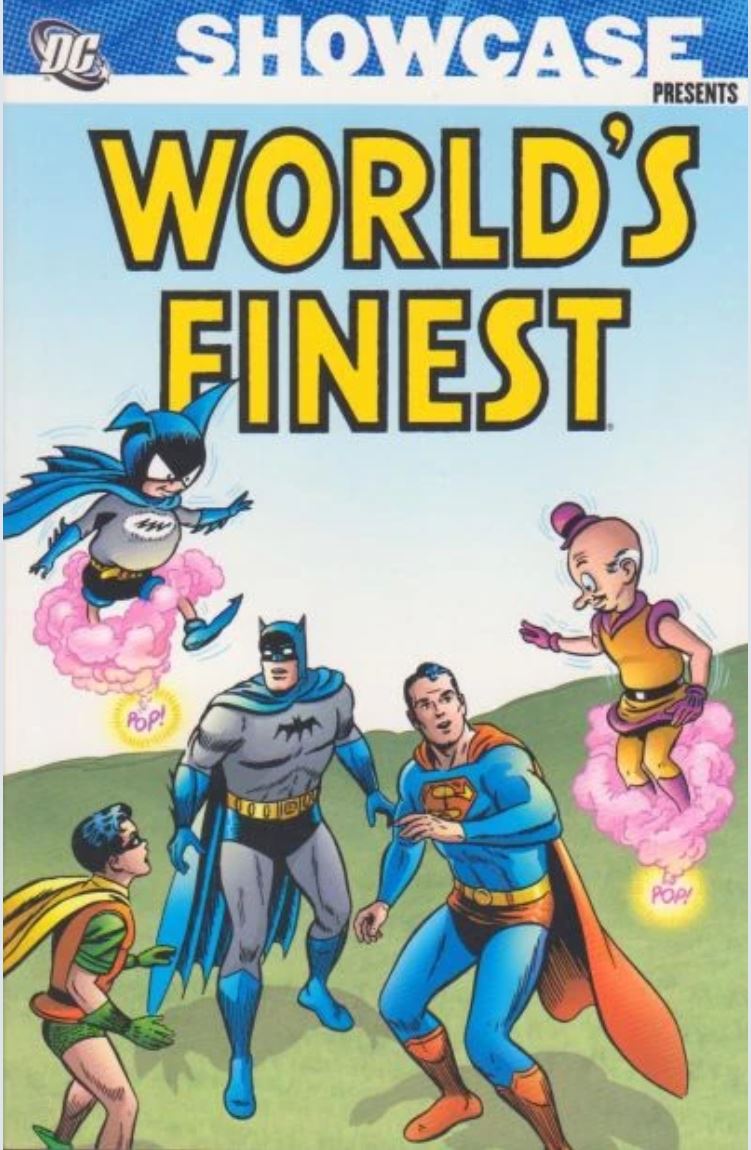
For decades Superman and Batman were quintessential superhero partners: the “World’s Finest” team. Friends as well as colleagues, their pairing made sound financial sense since DC’s top heroes could cross-pollinate and cross-sell their combined readerships. This third magnificent monochrome compendium gathers their cataclysmic collaborations from the glory days of the mid-1960’s: specifically World’s Finest Comics #146-173 – with the exception of reprint 80-Page Giant issues #161 &170 – and cumulatively covering cover-dates December 1964 through February 1968). This was a time when the entire Free World went superhero gaga in response to Batman’s live action and Superman’s animated TV shows…

A new era had begun in World’s Finest Comics #141 when author Edmond Hamilton and artists Curt Swan & George Klein (who illustrate the bulk of tales in this collection) ushered in a more dramatic, realistic and far less whimsical tone. That titanic creative trio continue their rationalist run in this volume starting with #146’s Batman, Son of Krypton!’ wherein uncovered evidence from the Bottle City of Kandor and bizarre recovered memories seemed to indicate the Caped Crusader is in fact an amnesiac, de-powered, Kryptonian. Moreover, as our heroes dig deeper, Superman thinks he’s found the Earthman responsible for Krypton’s destruction and becomes crazed with a hunger for vengeance…

WFC #147’s saw the sidekicks step up in a stirring blend of science fiction thriller and crime caper, all masquerading as an engaging drama of youth-in-revolt when ‘The New Terrific Team!’ (February 1965 Hamilton, Swan & Klein) saw Jimmy Olsen and Robin quit their underappreciated assistant roles to strike out on their disgruntled own. Naturally there was a perfectly rational, if incredible, reason. In #148 ‘Superman and Batman – Outlaws!’ (with Sheldon Moldoff temporarily replacing Klein) saw the Cape & Cowl Crimebusters sent to another dimension where arch-villains Lex Luthor and Clayface were heroes and the Dark Knight and Action Ace ruthless hunted criminals, after which World’s Finest Comics #149 (May 1965 and also inked by Moldoff) dealt out ‘The Game of Secret Identities!’ with Superman locked into an increasingly obsessive battle of wits with Batman that seemed likely to break up the partnership and even lead to violent disaster…

‘The Super-Gamble with Doom!’ (#150) introduced manipulative aliens Rokk and Sorban, whose addictive and staggeringly spectacular wagering almost gets Batman killed and Earth destroyed, before ‘The Infinite Evolutions of Batman and Superman!’ in #151 introduces junior writer Cary Bates, pairing with Hamilton to produce a beguiling sci fi thriller as the Gotham Guardian transforms into a callous future-man and the Metropolis Marvel is reduced to a brutish Neanderthal…

Hamilton solo-scripted #152’s ‘The Colossal Kids!’ wherein a brace of incomprehensibly super-powered brats outmatch, outdo but never outwit Batman or Superman (and of course there are old antagonists behind the challenging campaign of humiliation) after which Bates rejoins his writing mentor for a taut and dramatic “Imaginary Story” in #153.

When Editor Mort Weisinger was expanding Superman continuity and building the legend, he knew that each new tale was an event adding to a nigh-sacred canon and that what was written and drawn mattered to readers. But as an ideas man he wasn’t going to let that aggregated “consensus history” stifle a good idea, nor would he allow his eager yet sophisticated audience to endure clichéd deus ex machina cop-outs to mar the sheer enjoyment of a captivating concept. The mantra known to every baby-boomer fan was “Not a Dream! Not a Hoax! Not a Robot!” boldly emblazoned covers depicting scenes that couldn’t possibly be true… even if it was only a comic book.

Imaginary Stories were conceived as a way of exploring non-continuity plots and scenarios devised at a time when editors believed entertainment trumped consistency and knew that every comic read was somebody’s first – or potentially last. Illustrated by as ever by Swan & Klein, ‘The Clash of Cape and Cowl!’ posited a situation where brilliant young Bruce Wayne grew up believing Superboy had murdered his father, thereafter dedicating his life to crushing all criminals as a Bat Man awaiting the day when he could expose Superman as a killer and sanctimonious fraud…

WFC #154’s ‘The Sons of Superman and Batman’ (by Hamilton) opened doors to a far less tragic Imaginary world: one where the crime fighters finally found time to marry Lois Lane and Kathy Kane and have kids. Unfortunately, their lads proved to be both a trial and initially a huge disappointment…

‘Exit Batman – Enter Nightman!’ is a canny psychological thriller with the World’s Finest Team on the cusp of their 1,000th successful shared case when a new costumed crusader threatens to break up the partnership and replace burned out Batman, after which ‘The Federation of Bizarro Idiots!’ in #156 sees well-meaning but imbecilic imperfect duplicates of Superman and Batman set up shop on Earth. They end up as pawns of the duplicitous Joker, and it does not end well…

In #157’s ‘The Abominable Brats’ – drawn with inevitable brilliance by Swan and inked by both Klein & Moldoff – featured an Imaginary Story sequel as the wayward sons of heroes return to cause even more mischief, although once more there are other insidious influences in play…

‘The Invulnerable Super-Enemy!’ (#158 by Hamilton, Swan & Klein), has the Olsen-Robin Team stumble upon three Bottled Cities and inadvertently draw their mentors into a terrifying odyssey of evil. At first it appears to be the work of Brainiac but is in fact far from it, and is followed by ‘The Cape and Cowl Crooks!’ (WFC #159), dealing with foes possessing far mightier powers than our heroes – apparently a major concern for readers of those times.

To this day whenever fans gather a cry soon echoes out, “Who’s the strongest/fastest/better dressed…?” but this canny conundrum took the theme to superbly suspenseful heights as Anti-Superman and Anti-Batman continually outwit and outmanoeuvre the heroes, seemingly possessed of impossible knowledge of their antagonists…

Leo Dorfman debuted as scripter in#160 as the heroes struggled to discredit ‘The Fatal Forecasts of Dr. Zodiac’, a scurrilous Swami who appears to control fate itself. World’s Finest Comics #161 was an 80-Page Giant reprinting past tales and not included in this collection, so we jump to #162’s ‘Pawns of the Jousting Master!’: by another fresh scripting face. Teenager Jim Shooter produced an engaging time travel romp wherein Superman and Batman are defeated in combat and compelled to travel back to Camelot in a beguiling tale of King Arthur, super-powered knights and invading aliens…

‘The Duel of the Super-Duo!’ (#163, by Shooter, Swan & Klein) pits Superman against a brainwashed Batman on a world where his mighty powers are negated and other heroes of the galaxy are imprisoned by a master manipulator, after which Dorfman delivers an engaging thriller wherein a girl who is more powerful than Superman and smarter than Batman proves to be ‘Brainiac’s Super Brain-Child!’ Bill Finger & Al Plastino step in to craft WFC #165’s ‘The Crown of Crime’ (March 1967), depicting the last days of dying mega-gangster King Wolff. His plan to go out with a bang sets the underworld ablaze and almost stymies both heroes, after which Shooter, Swan & Klein depict ‘The Danger of the Deadly Duo!’ in which the 20th generation of Batman and Superman unite to battle The Joker of 2967 and his uncanny ally Muto: a superb flight of fantasy that was sequel to a brief series of stories starring Superman’s heroic descendent in a fantastic far future world.

WFC #167 saw Bates solo script ‘The New Superman and Batman Team!’: an Imaginary Story wherein boy scientist Lex Luthor gives himself super-powers and a Kal-El who had landed on Earth without Kryptonian abilities trains himself to become an avenging Batman after his foster-father Jonathan Kent was murdered. The Smallville Stalwarts briefly united in a crime-fighting partnership, but destiny has other plans for the fore-doomed friends…

In World’s Finest #142 a lowly, embittered janitor suddenly gained all the powers of the Legion of Super-Heroes and attacked Caped Crusader and Action Ace out of frustration and jealousy. Revived by Bates for #168’s ‘The Return of the Composite Superman!’ he is actually the pawn of a truly evil villain but gloriously triumphs over his own venal nature, after which #169 hosts ‘The Supergirl-Batgirl Plot’: a whimsical fantasy feast from Bates, Swan & Klein wherein the uppity lasses apparently toil tirelessly to supplant and replace Batman and Superman before it’s revealed that the Dynamic Damsels are mere pawns of an extremely duplicitous team of female felons and a brace of old WF antagonists are actually behind the Byzantine scheme…

Issue #170 is another unincluded mammoth reprint edition, after which #171 reveals ‘The Executioner’s List!’ (script by Dorfman): an intriguing, tense murder-mystery with a mysterious sniper seemingly targeting friends of Superman and Batman, before stirring, hard-hitting Imaginary Story ‘Superman and Batman… Brothers!’ (#172, December 1967) posits a grim scenario wherein orphaned Bruce Wayne is adopted by the Kents, but cannot escape a destiny of tragedy and darkness. Written by Shooter and brilliantly interpreted by Swan & Klein, this moody thriller in many ways signalled the end of angst-free days and beginning of a darker, edgier and more cohesive DC universe for a less casual readership, thereby surrendering the mythology to an increasingly devout fan-based audience.

This stunning compendium closes with World’s Finest Comics #173 and ‘The Jekyll-Hyde Heroes!’ (Shooter, Swan & Klein) as a criminal scientist devises a way to literally transform the Cape & Cowl Crusaders into their own worst enemies…

These are gloriously clever yet uncomplicated tales whose timeless style has returned to inform if not dictate the form for much of DC’s modern television animation. The stories here are a veritable feast of witty, gritty thrillers packing as much punch and wonder now as they always have: unmissable adventure for fans of all ages!
© 1964-1968, 2010 DC Comics. All Rights Reserved.

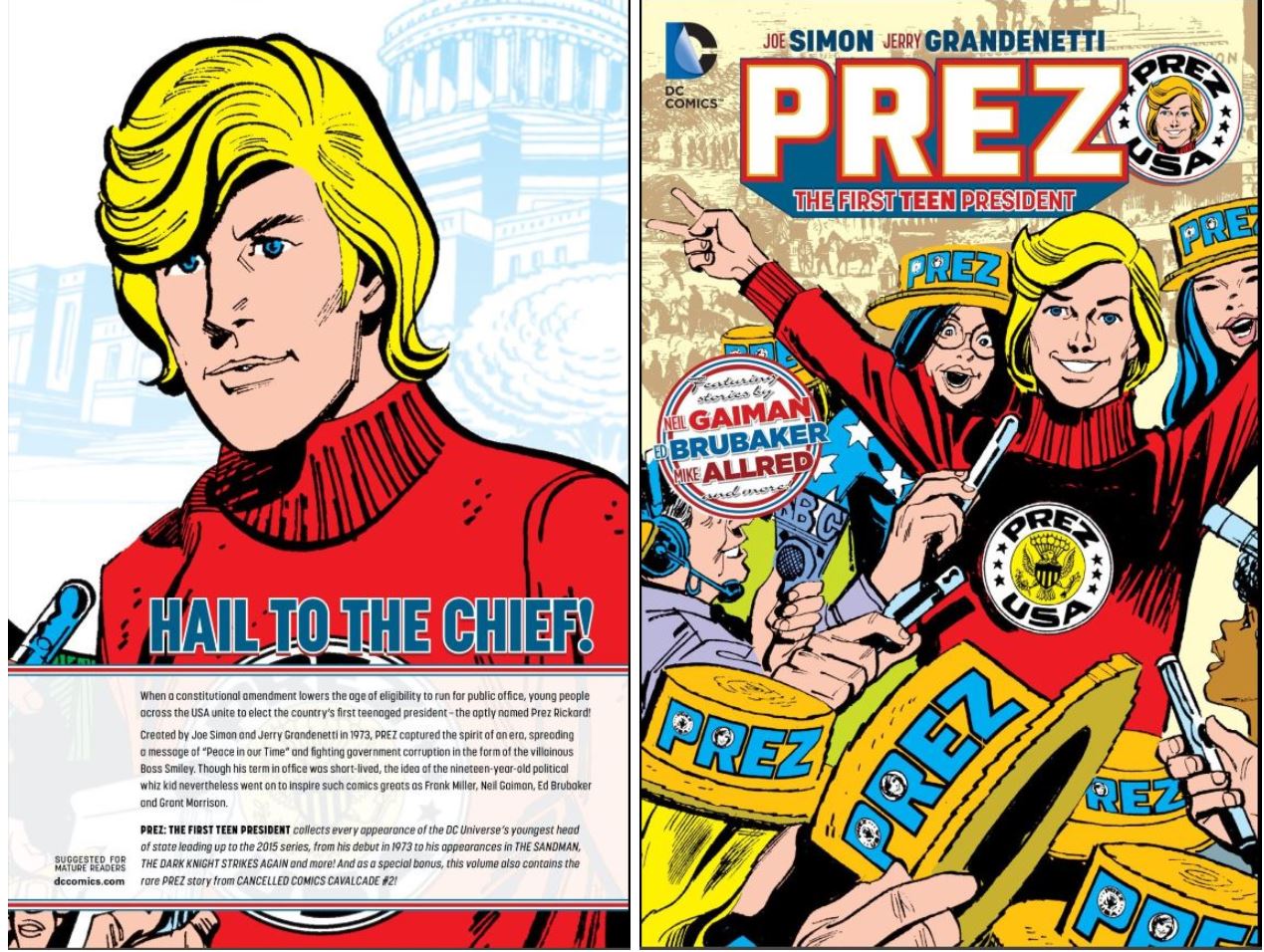
Prez: The First Teen President


By Joe Simon, Jerry Grandenetti & Creig Flessel, with Cary Bates, Neil Gaiman, Ed Brubaker, Frank Miller, Grant Morrison, Art Saaf, Mike Allred, Bryan Talbot, Mark Buckingham, Eric Shanower & various (DC Comics)
ISBN: 978-1-4012-6317-1 (TPB/Digital edition)

At a time when American comic books were just coming into their adolescence – but not maturity – Prez was a hippie teenager created by industry royalty. In the early 1970s, Joe Simon made one of his irregular yet always eccentrically fruitful sojourns back to DC Comics, managing to sneak a bevy of exceedingly strange concepts right past the usually-conservative powers-that-be and onto the spinner racks and newsstands of the world.

Possibly the most anarchic and subversive of these postulated a time (approximately 20 minutes into the future) when US teenagers had the vote. The first-time electorate – idealists all – elected a diligent, honest young man every inch the hardworking, honest patriot every American politician claimed to be.

In 2015 that concept was given a devilishly adroit makeover for post-millennial generations. The result was a superbly outrageous cartoon assessment of the State of the Nation – Prez: Corndog-in-Chief. Once you’re done here, you should read that too and then ferociously lobby DC to release the concluding chapters in that saga…

Back here, however, and still in 1972, Simon (Captain America, Fighting American, The Fly, Black Magic, Young Romance) was passionately doing what he always did: devising ways for ever-broader audiences to enjoy comics. This carefully curated compilation gathers every incidence of the best leader they never had, from original run Prez #1-4 (September 1973 – March 1974), through unpublished tales from Cancelled Comics Cavalcade #2, guest cameos and revivals in Supergirl #10, The Sandman #54, Vertigo Visions: Prez #1, The Dark Knight Strikes Again and The Multiversity Guidebook #1.

It all begins in the little town of Steadfast where average teen Prez Rickard makes a minor splash by fixing all the clocks and making them run on time. Throughout the rest of the USA, dissent, moral decay and civil breakdown terrify the populace in an election year. Corrupt businessman and political influencer Boss Smiley wants to capitalise on a new amendment allowing 18-year-olds to vote. He picks Rickard as a perfect patsy, but his chicanery comes awry when newly-elected Prez turns out to have a mind, backbone and agenda of his own…

With early – if heavy-handed – salutes to ecological and native rights movements, ‘Oh Say Does That Star Spangled Banner Yet Wave?’ by Simon, veteran illustrator Jerry Grandenetti set the scene for a wild ride unlike any seen in kids’ comics. Equal parts hallucinogenic political satire, topical commentary and sci-fi romp, the mandate mayhem expanded in ‘Invasion of the Chessmen’, as a global goodwill tour threatens to bring worldwide peace and reconciliation… until America’s grandmaster provokes an international incident with the chess-loving Soviet Union. Cue killer robots in assorted chess shapes and a sexy Russian Queen and watch the fireworks…

‘Invasion of America’ tackles political assassination and social repercussions after Prez decides to outlaw guns. I think no more need be said…

The original run ended with the fourth episode, spoofing international diplomacy as Transylvania dispatches its new Ambassador to Washington DC: an actual werewolf paving the way to devious conquest which led briefly to a ‘Vampire in the White House’ (inked by Creig Flessel).

Although the series was cancelled if not impeached, a fifth tale was in production when the axe fell. It eventually appeared with other prematurely curtailed stories in 1978’s Cancelled Comics Cavalcade #2 and appears here in monochrome as ‘The Devil’s Exterminator!’ with a bug infestation in DC tackled by a mythical madman. When Congress refuses to pay his sky-high bill ($5 million or three lunches in today’s money!), Clyde Piper abducts all the children, and PotUS is forced into outrageous executive action…

There was one final 1970s appearance. Supergirl #10 (October 1974 by Cary Bates, Art Saaf & Vince Colletta) featured ‘Death of a Prez!’ wherein the Commander in Chief was targeted for assassination by killer witch Hepzibah, using an ensorcelled Girl of Steel to do her dirty work – with predictable results…

Prez Rickard vanished in a welter of superhero angst and science fiction spectacle after that, but made a quiet cameo in Neil Gaiman’s Sandman story arc World’s End. Illustrated by Michael Allred, Bryan Talbot & Mark Buckingham, ‘The Golden Boy’ (The Sandman #54 October 1993) offers a typically askance view of the boy leader’s origins, his enemies, the temptations of power and the ends of his story. It generated enough interest to spark follow-up one-shot Vertigo Visions: Prez #1 (September 1995) as Ed Brubaker & Eric Shanower crafted ‘Smells Like Teen President’. After being missing for years, America’ youngest President is being trailed by a young hitchhiker who might well be his son…

The moving search for family, identity, belonging and purpose is followed by a typically iconoclastic vignette by Frank Miller & Lynn Varley taken from The Dark Knight Strikes Again (December 2001) with the Leader of the Free(ish) World exposed as a computer simulation after which the history lesson concludes with Grant Morrison, Scott Hepburn & Nathan Fairbairn’s page on Hippie-dippy ‘Earth 47’ and its comic book landmarks (Prez, Brother Power, The Geek, Sunshine Superman and others) as first seen in The Multiversity Guidebook #1 (January 2015).

I used to think comics were the sharpest reflection of popular culture from any given era. That’s certainly the case here, and maybe there are lessons to be learned from re-examining them with eyes of experience. What is irrefutable, and in no way fake news, is that they’re still fun and enjoyable if read in a historical context. So read this, vote if you can and get ready. I can guarantee not even funnybook creators can predict what’s coming next.
© 1973, 1974, 1978, 1993, 1995, 2001, 2002, 2015, 2016 DC Comics. All Rights Reserved.

Batman: Year One – The Deluxe Edition


By Frank Miller & David Mazzucchelli with Richmond Lewis, Todd Klein & various (DC Comics)
ISBN: 978-1-4012-3342-6 (HB/Digital edition) (978-0-29020-489-0 TPB)

Happy Bat-Anniversary!

Batman’s first ever origin moment came in Detective Comics #33 (November 1939, on sale from September 30th). Scripted by Gardner F. Fox and Bill Finger, ‘The Batman Wars Against the Dirigible of Doom’ included 2-page prologue ‘The Batman and How He Came to Be’ which first revealed how a young boy witnessed his parents’ hold-up and murder by a petty thug and dedicated his life to becoming a perfect human specimen to avenge them and punish all criminals. Those 12 panels were reprinted at the beginning of Batman #1 (Spring 1940) and – with occasional minor tweaking – stayed the official version for 50 years.

However, comic book heroes are all about fashion and revisionism, and on the back of DC’s multiversal continuity adjustment Crisis on Infinite Earths the hero voted Best Comic Book Character of the 20th Century completed a long-enacted but gradual readjustment: completely reverting to his gothic noir roots. The process actually started almost immediately after the Batman TV show was cancelled, and hit its pivot point in two 1980s’ tales: Alan Moore & Brian Bolland’s Batman: The Killing Joke and the revolutionary series-within-a-series here.

This classic tale is available in a variety of editions. Batman: Year One is a joy to read and its pulp fiction fuelled reinterpretation of the hallowed origin literally changed the way Batman was produced – much more so than Frank Miller’s apocalyptic “Imaginary story” The Dark Knight Returns. The effects of the revisualisation still echo through Bat-titles and every single screen iteration from animated cartoons to box office blockbusters.

When Superman and Wonder Woman were similarly re-tooled, each got to start fresh with a new number #1s, but Batman’s evolution simply crept up on fans in the regular run of comics. The tale radically reimagined Catwoman and Jim Gordon, introduced believable human-scaled villains with organised crime figures such as Carmine Falcone and comprehensively rebuilt Gotham City as a hopeless hellhole of endemic corruption.

It began in Batman #404 – cover-dated February 1987 and on sale from October 21st 1986. Over four issues the bleak serial utterly altered the comic landscape as scripter Frank Miller and illustrator David Mazzucchelli (fresh from an astounding collaboration resurrecting Daredevil in Born Again please link to Daredevil: Born Again July 26th 2016) made Bruce Wayne and Batman simultaneously more human, vulnerable, formidable and credible.

With art based on the stylisations of Alex Toth and a story lensed through iron-hard detective and crime procedural dramas ‘Chapter One: Who I Am. How I Come to Be’ opens on January 4th and focuses on Wayne and recent transfer Lieutenant James Gordon as both arrive in Gotham ahead of personal scandals. Gordon is joining the crookedest constabulary in America, and the young heir to one of the City’s biggest fortunes has a desperate wish, a poorly formed plan and no method of getting what he wants.

By March, both have almost died but found their own way to hit back…

‘Chapter Two: War is Declared’ opens in April with Gordon hailed an honest-to-goodness hero cop. It’s the only thing saving him from being murdered by his own corrupt colleagues and mob-owned Police Commissioner Gillian B. Loeb: that and his high-profile hunt for a costumed vigilante who dresses like a bat…

When the masked maniac graduates from thugs, pushers and burglars by declaring war on Gotham’s criminal aristocracy, Gordon’s hunger to catch him falters. Isn’t the Bat doing exactly what Gordon would do if he didn’t have a pregnant wife, secret mistress and pitiful career to protect?

His conflicted quandaries are put into sharp perspective in ‘Chapter Three: Black Dawn’ when Loeb submits to pressure from Falcone and unleashes Gotham’s brutally gung-ho SWAT forces on the vigilante: a move costing countless civilian lives when they raid a tenement in hot pursuit of “The Bat”. The assault is live televised, triggering one witness to begin her own costumed career, plundering Falcone’s shaking empire even as the mystery man categorically proves he’s no urban myth but a force to be feared…

Spanning September to December 3rd, ‘Chapter Four: Friend in Need’ finds our mismatched heroes finally joining forces after Gordon at last sees the kind of man The Bat is. That comes when GCPD attempt to destroy the by-the-book cop by targeting his wife and newborn baby and leads to the beginning of a major clean up in Gotham’s government…

The sequence was heavily promoted from the start and immediately reset The Dark Night’s monthly continuity. From this point on this was what Batman was ALWAYS like…

A high design style was created from the start – by Chip Kidd – to match the fully immersive impressionist reworking. This story was treating the material like a grownup book not a kid’s throwaway pamphlet: boldly declaring “less is more. Less is enough. Less is what you get. Work with what’s here.” The whole point of the exercise was to give creators that followed plenty of raw material to work with and it paid off big-time as the Dark Knight began his second Golden Age.

Various collected editions include up to 40 pages of extras such as mood setting preface ‘The Crime Blotter by Slam Bradley’, an Introduction by Denny O’Neil, Afterword by Miller and Mazzucchelli’s wonderfully drawn ‘Afterword(s)’ – a comic strip commentary on Batman. There is a wealth of development material, promotional art and selection of script pages, thumbnail sketches and layouts providing a fascinating intro into the artistic process. Colourist Richmond Lewis completely reworked the printed newsprint pages for the higher quality graphic novel and examples of her process are here, plus a full comics cover gallery and large selection of book cover designs.

Batman: Year One is a story every comic fan should own, and if you are and you don’t, fix that situation now, Now, NOW!
© 1986, 1987, 2005, 2007, 2012, 2017, DC Comics. All Rights Reserved.

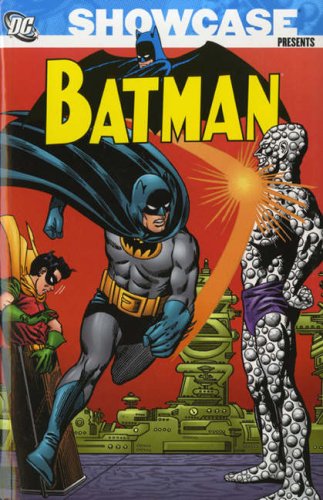
Showcase Presents Batman volume 2


By John Broome, Gardner F. Fox, Robert Kanigher, Carmine Infantino, Sheldon Moldoff, Joe Giella, Sid Greene, Chic Stone, Murphy Anderson and with covers from Gil Kane and Joe Kubert & various (DC Comics)
ISBN 978-1-84576-661-0 (TPB)

This volume from the wonderfully cheap & cheerful, crushingly much-missed Showcase Presents… line serves up in sharp, crisp monochrome 36 more Bat-stories from September 1965 to December 1966 as originally seen in Batman #175-188 and Detective Comics #343-358. Other than covers it excludes Batman #176, 182, 185 & 187, which were all-reprint 80-Page Giants.

These tales were produced in the months leading up to the launch of and throughout year one of the blockbuster Batman television show (premiering January 12th 1966 and running 3 seasons of 120 episodes in total). The show aired twice weekly in its first two seasons, resulting in vast amounts of Bat-awareness, no end of spin-offs and merchandise, a movie and the overkill phenomenon of “Batmania”. No matter how much we might squeal and foam about it, to a huge portion of this planet’s population Batman will always be that “Zap! Biff! Pow!” buffoonish costumed Boy Scout…

Regrettably this means the comic stories published during that period have been similarly excoriated and maligned by many ever since. It is true some tales were crafted with overtones of the “camp” comedy fad – presumably to accommodate newer readers seduced by the arch silliness and coy irony of the show – but no editor of Julius Schwartz’s calibre would ever deviate far from characterisation that had sustained Batman for nearly three decades, or the then-recent relaunch which had revitalised the character sufficiently for television to take an interest at all.

Nor would such brilliant writers as John Broome, Bill Finger, Gardner Fox or Bob Kanigher ever produce work which didn’t resonate on all the Batman’s complex levels just for a quick laugh and cheap thrill. The artists tasked with sustaining the visual intensity included such greats as Carmine Infantino, Sheldon Moldoff, Chic Stone, Joe Giella, Murphy Anderson and Sid Greene, with covers from Gil Kane and Joe Kubert supplementing the stunning and trend-setting, fine-line Infantino masterpieces.

Most stories in this compendium reflect those gentler times and an editorial policy to focus on Batman’s reputation as “The World’s Greatest Detective”, so colourfully costumed, psychotic veteran supervillains are in a minority, but there are first appearances for a number of exotic foes who would become regular menaces for the Dynamic Duo in later years.

The mayhem and mystery begin with book-length epic ‘The Secret War of the Phantom General!’ from Detective Comics #343 (September 1965). Written by John Broome and limned by Carmine Infantino & Joe Giella, it incorporates back up star Elongated Man: a costumed sleuth blending the charm of Nick “The Thin Man” Charles with the outré hero antics of Plastic Man

This tense thriller pits hard-pressed heroes against a hidden army of gangsters and Nazi war criminals, before #344 introduces intellectual bandit Johnny Witts, ‘The Crime-Boss Who Was Always One Step Ahead of Batman!’ in a sharp duel of mentalities from Gardner Fox, Sheldon Moldoff & Giella. The same creative team produced epic shocker ‘The Decline and Fall of Batman’ in the 175th issue of his own titular magazine, wherein fringe scientist Eddie Repp almost ends the Caped Crusaders’ careers by assaulting them with electronic ghosts, after which Detective #345 debuts a terrifying and tragic new villain in ‘The Blockbuster Invasion of Gotham City!’ (Fox, Infantino & Giella), as a monstrous giant with the mind of a child and raw, physical power of a tank is constantly driven to madness at sight of Batman and only placated by the sight of Bruce Wayne

Batman #177 opens with Bill Finger, Moldoff & Giella’s puzzler, ‘Two Batmen Too Many’ complete with a brace of superhero guest-stars, after which ‘The Art Gallery of Rogues!’ (Broome, Moldoff & Sid Greene) combines good-natured matchmaking with murderous burglary before ‘Batman’s Inescapable Doom-Trap!’ (Detective #346, Broome, Moldoff & Giella) highlights the Gotham Gangbuster’s escapology skills when a magician-turned-thief alpha-tests his latest stunt on the unwilling, unwitting hero.

Fox, Infantino & Giella reveal ‘The Strange Death of Batman!’ in Detective # 347, launching habitual B-list villain The Bouncer in a bizarre experimental yarn which must be seen to be believed, whereas it’s all-action business as usual in Batman #178 when the ‘Raid of the Rocketeers!’ (Kanigher, Moldoff & Giella) set the Caped Champions on the trail of jet-packed super-thugs after which Broome, Moldoff & Greene start referencing the TV series’ tone in light-hearted caper ‘The Loan Shark’s Hidden Horde!’

Whilst ‘The Birdmaster of Bedlam!’ (Kanigher, Moldoff & Giella) who hatched his first sinister scheme in Detective #349 proves ultimately incapable of containing the heroes, Batman #179 provides more of a challenge with ‘Clay Pigeon for a Killer!’ Kanigher, Moldoff & Greene (erroneously credited as Giella here) see Batman using television’s “Most Wanted” show to trap a murderer beyond reach of the law whilst ‘The Riddle-less Robberies of The Riddler!’ (Broome Moldoff & Giella), fully reinvents the Prince of Puzzlers as the felon discovers he cannot escape or defy an obsessive psychological compulsion preventing him from committing crimes unless he sends clues to Batman first! Sadly, even when Eddie Nigma cheats, the Masked Manhunter keeps solving the clues…

The microcephalic man-brute who hates Batman returns as ‘The Blockbuster Breaks Loose!’ in a blistering, action-fuelled thriller by Fox, Infantino & Giella (Detective #349) which also hints at the return of a long-forgotten foe, whilst ‘The Monarch of Menace!’ (#350 by Kanigher, Moldoff & Giella) introduces the greatest criminal in the world, who starts well but inevitably falls to the Gotham Guardian’s indomitable persistence.

Illustrated by Moldoff & Giella, Batman #180 debuts the uncanny Death-Man in ‘Death Knocks Three Times!’ – Kanigher’s best tale of this era and an early indication of the Caped Crusader’s eerie potential, after which Detective #351 premieres game-show host turned felonious impresario Arthur Brown in ‘The Cluemaster’s Topsy-Turvy Crimes!’ courtesy of Fox, Infantino & Greene.

‘Beware of… Poison Ivy!’ in Batman #181 introduces the deadly damsel to the Caped Crusader’s Rogues Gallery, but in this tale she’s only a criminal boss using sex as her weapon to split up the Dynamic Duo and defeat rival villainesses in a sly tale from Kanigher, Moldoff & Giella. Following an iconic pin-up courtesy of Infantino & Murphy Anderson comes a superb Mystery Analysts of Gotham City shocker. Fox, Moldoff & Greene detail ‘The Perfect Crime… Slightly Imperfect!’, before Detective #352 sees Broome, Moldoff & Giella explore ‘Batman’s Crime Hunt A-Go-Go!’ wherein Batman hits an incredible hot-streak, repeatedly catching criminals in the act with incredible hunches. Of course, it’s no such thing and sinister stage mentalist Mr. Esper is manipulating the crime campaign for his own sinister ends…

After another stunning Infantino & Anderson Bat pin-up, narrative action resumes with ‘The Weather Wizard’s Triple-Treasure Thefts!’ (Fox, Infantino & Giella) in #353, pitting the Dynamic Duo in spectacular opposition to The Flash’s archenemy: one of the first times a DC villain moved out of his usual stamping grounds. Batman #183 opens with ‘A Touch of Poison Ivy!’ (Kanigher, Moldoff & Giella) as the seductive siren tries again to turn the Caped Crusader’s head before excellent “fair-play” mystery ‘Batman’s Baffling Turnabout!’ sees Gardner Fox challenge readers to deduce what turns the hero against a baffled Boy Wonder…

‘No Exit for Batman’ (Detective #354, by Broome Moldoff & Giella) introduces bloodthirsty oriental fiend Dr. Tzin-Tzin and gives me another excellent opportunity to remind you just how far we’ve all come in confronting all those pernicious stereotypes that underpinned so much popular fiction…

The tale itself is a bruising all-action battle with the hero targeted by a Chinese ganglord seeking to break him down by fighting an army of foes, followed by Fox’s ‘Mystery of the Missing Manhunters!’ which generated one of the most memorable covers of the decade for Batman #184 and a back-up Robin solo tale: ‘The Boy Wonder’s Boo-Boo Patrol!’ (Fox, Chic Stone & Greene) showing the kid’s potential in a smart tale of thespian skulduggery and clever conundrum solving.

Detective #355 again highlights our hero’s physical prowess and deductive capabilities in blistering yarn ‘Hate of the Hooded Hangman!’ (Broome, Infantino & Giella), after which an extended duel with a mutated mastermind culminates in ‘The Inside story of the Outsider!’ and the miraculous resurrection of faithful retainer Alfred in a landmark, game-changing, classic confrontation by Fox, Moldoff & Giella from Detective Comics #356.

Batman #186 sees the Clown Prince of Crime in possibly his most innocuous exploit ‘The Joker’s Original Robberies’ as Broome, Moldoff & Giella sought to out-Camp the TV show, whereas ‘Commissioner Gordon’s Death-Threat!’ (written by Fox) put the artists’ talents to far better use in a terse and compelling kidnap thriller. Broome redeems himself in Detective #357 with sharp secret identity saving puzzler Bruce Wayne Unmasks Batman!’ (limned by Infantino & Giella).

Batman #188 featured ‘The Eraser Who Tried to Rub Out Batman!’ (Broome, Moldoff & Giella) and Fox, Moldoff & Greene’s decidedly sharper and less silly murder-mystery ‘The Ten Best-Dressed Corpses in Gotham City!’ after which this collection concludes on a note of psychological intrigue as Broome, Moldoff & Giella use Detective #358 to outline ‘The Circle of Terror’, wherein the Masked Manhunter is progressively driven to the edge of madness by Op Art maestro The Spellbinder.

With covers by Infantino, Gil Kane, Murphy Anderson and Joe Kubert, pin-up extras, frequent reprint compendiums and lots of cross-pollination with the TV series, DC were pulling out all the stops to capitalise on the screen exposure and ensure the comic buying public got their 12¢ worth, but the most effective tool in the arsenal was always the sheer scope and variety of the stories. The bulk of the yarns reprinted here are thefts, capers and sinister schemes by heist men, murderers, would-be world-conquerors or mad scientists and I must say it’s a joy to see such once-common staples of comic books in play again. Call me radical or reactionary but I say you can have too much psycho-killing, and just how many alien races really and truly can be bothered with our poxy planet – or our women?

…And yes, there are one or two utterly daft escapades included here, but overall this book is a magical window onto a simpler time but not burdened by simpler fare. These Batman adventures are tense, thrilling, engrossing, engaging and even amusing and I’d have no qualms giving them to my niece or my granny. It’s such a shame DC seems to disagree but at least by seeking this out you can Tune In and become a proper Bat-Fan.
© 1965, 1966, 2007 DC Comics. All Rights Reserved.

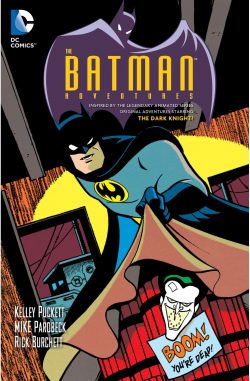
The Batman Adventures volume 2


By Kelley Puckett, Mike Parobeck & Rick Burchett & various (DC Comics)
ISBN: 978-1-4012-5463-6 (TPB/Digital edition)

As conceived and delivered by Eric Radomski, Bruce Timm & latterly Paul Dini, Batman: The Animated Series began airing in the US on September 5th 1992, running to September 15th 1995 before being rebooted for a second bite at the cherry. The shows – ostensibly for kids – revolutionised everybody’s image of the Dark Knight and happily fed back into a print iteration, introducing characters like Harley Quinn to the comics canon and leading to some of the absolute best comic book tales in the hero’s decades of existence.

Employing a timeless visual style dubbed “Dark Deco”, the show mixed elements from all iterations of the character and, without diluting the power, tone or mood of the premise, re-honed the grim avenger, his team, allies and enemies into gleefully accessible, thematically memorable forms that the youngest of readers could enjoy, whilst adding dark shades of exuberance and panache only most devout and obsessive Batmaniac could possibly object to.

The comic book iteration was prime material for collection in an emergent trade paperback market, but only the first year was released, plus miniseries such as Batman: Gotham Adventures and Batman Adventures: the Lost Years.

This second compendium gathers issues #11-20 of The Batman Adventures (originally published from August 1993 to May 1994) in a scintillating, no-nonsense frenzy of family-friendly Fights ‘n’ Tights fantasy from Kelly Puckett, Mike Parobeck & Rick Burchett.

Puckett is a writer who truly grasps the visual nature of the medium and his stories are always fast-paced, action-packed and stripped down to the barest of essential dialogue. That gift has never been better exploited than by Parobeck who was at that time a rising star, especially when graced by Burchett’s slick, clean inking.

Although his professional comics career was tragically short (1989-1996 when he died, aged 31, from complications of Type 1 Diabetes) Mike Parobeck’s gracefully fluid, exuberantly kinetic, fun-fuelled animation-inspired drawing style revolutionised superhero depiction and sparked a renaissance in kid-friendly comics – and merchandise – at DC and everywhere else.

Like the show, each story is treated as a 3-act play, and kicking off events here is moodily magnificent thriller ‘The Beast Within!’ as obsessed scientist Kirk Langstrom agonises. He believes he is somehow uncontrollably transforming into the monstrous Man-Bat whenever ‘The Sleeper Awakens!’ The truth is far more sinister, but incarcerated in ‘G.C.P.D.H.Q!’ neither the troubled chemist nor his beloved wife Francine can discern ‘The Awful Truth!’ Happily, ever-watchful Batman plays by his own rules…

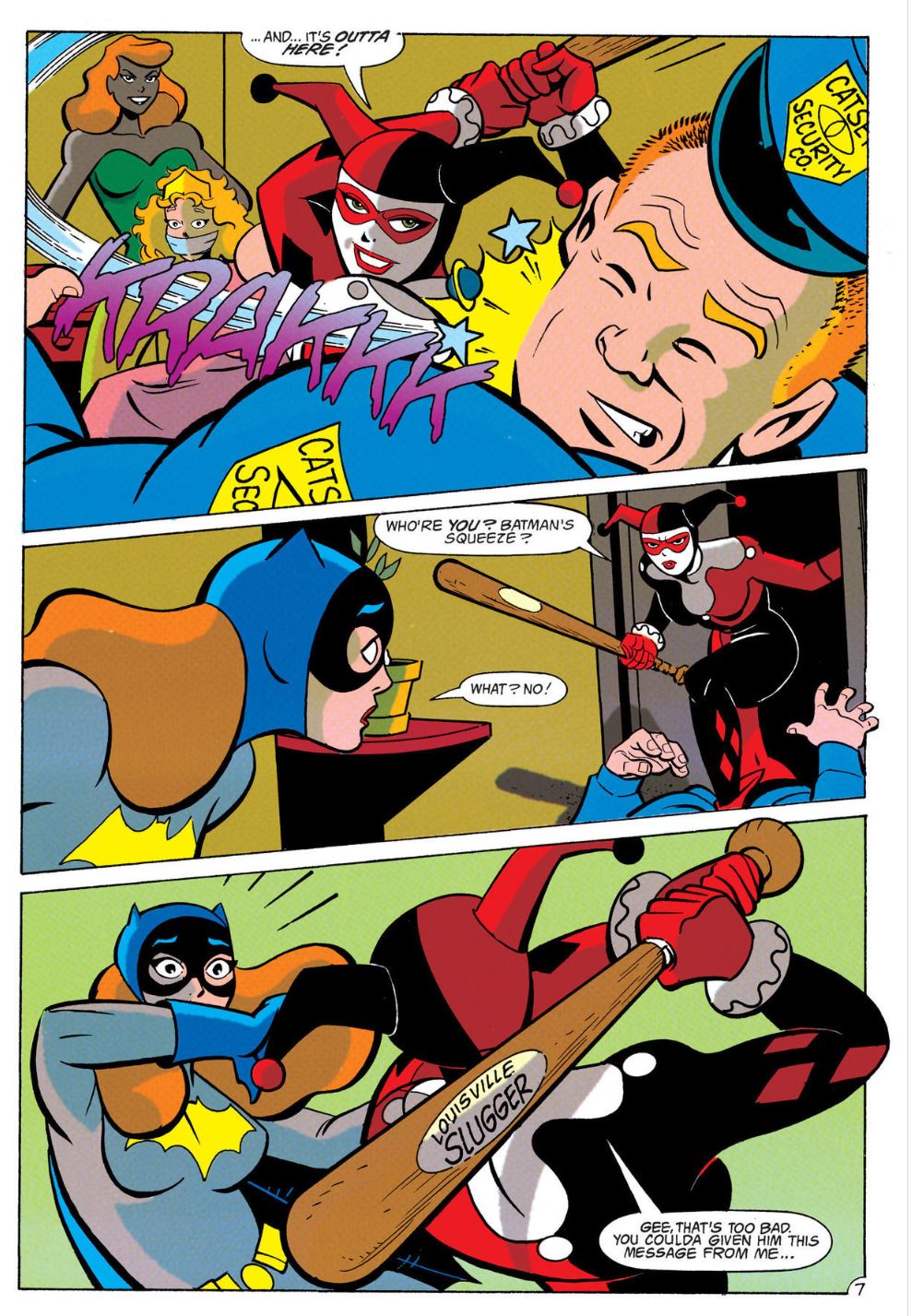
Following in with a stunning shift of focus, young Barbara Gordon makes a superhero costume for a party on ‘Batgirl: Day One!’ and subsequently stumbles into a larcenous ‘Ladies Night’ when the High Society bash is crashed by rejected Joker groupie Harley Quinn and plant-based plunderer Poison Ivy. With no professional help on hand, Babs must act as ‘If the Suit Fits!’ and tackle the bad girls herself… and then Catwoman shows up for frantic ferocious finale ‘Out of the Frying Pan!’

The troubled relationship of Batman and Talia, Daughter of The Demon was tackled with surprising sophistication in ‘Last Tango in Paris’ with the sometime-lovers teaming up to recover a statue stolen from her diabolical eco-terrorist dad Ra’s Al Ghul.

‘Act 1: Old Flame’ sees them stumble into a trap set by one of The Demon’s rivals, but turn the tables in ‘Act 2: Paris is Burning’ before each of the trysting couple’s true motivations are exposed in heartbreaking ‘Act 3: Where there’s Smoke’

Despite being a series to be read one glorious tale at a time, the creators had laid groundwork for an epic sequence to come, but whilst Bruce is occupied in Europe, the spotlight shifts to Dick Grayson as the Teen Wonder worries about how to break to his mentor news of a game-changing decision, even as ‘Public Enemy’ sees the latest incomprehensible rampage of  deranged bandit by The Ventriloquist

‘Act 1: Greakout!’ finds the cunningly carved crook and his silently screaming stooge escaping clink to orchestrate a massive heist in ‘Act 2: The Grinks Jog’, only to ultimately have the limelight stolen by Robin in ‘Act 3: The Gig Glock!’

Police Commissioner Jim Gordon teams with Batman in ‘Badge of Honor’, united to save a undercover cop held hostage by Boss Rupert Thorne in ‘Act 1: Officer Down!’ before ‘Act 2: Cop Killer!’ tracks the seemingly unstoppable duo hunting down the fallen hero only to face their greatest obstacle in ‘Act 3: Code Dead!’ That’s when slick operator Thorne finally himself gets his hands dirty…

In ‘The Killing Book’ the Harlequin of Hate takes offence at his “unflattering” portrayal in comics with ‘Act 1: Seduction of the Innocent!’ seeing The Joker kidnap the publisher’s latest overnight sensation in order to show in ‘Act 2: How to Draw Comics the Joker Way!’ Naturally ‘Act 3: Comics and Sequential Death!’ only prove Batman is not a guy to tolerate funnybooks or artistic upstarts.

The seeds planted in Paris flourish and bloom in ‘The Tangled Web’ as The Demon’s latest act of genocide begins with ‘Act 1: Into the Shadows!’ However ‘Act 2: New World Order’ proves yet again Ra’s has critically underestimated his enemy, as a different masked stranger saves Earth from catastrophe in ‘Act 3: What Doth it Profit a Man?’

Following that epic victory Robin meets the baffling and mysterious Batgirl for the first time on ‘Decision Day’ when conflicted Barbara Gordon again succumbs to the addictive lure of costumed crimefighting. Thwarting a bomb plot in ‘Act 1: Eyewitness!’ the feisty but untutored firebrand opts to catch the culprit herself in ‘Act 2: Smoking Gun’, even if she does grudgingly accept a little assistance from the Teen Wonder in ‘Act 3: No Justice, No Peace!’

Gotham’s Master of Terror turns up inside Batman’s head sparking ‘Troubled Dreams’ as the Dark Knight becomes just one of many sufferers of ‘Act 1: Nightmare over Gotham!’ Just for once, however, there’s another instigator of panic in the mix, enquiring in ‘Act 2: Who Scares The Scarecrow?’ until the Caped Crusader catches the real dream-invader in ‘Act 3: Beneath the Mask’…

The fabulous foray into classic four-colour fun concludes with another spectacular yet hilarious outing for a Terrible Trio of criminals who bear a remarkable resemblance to DC editors Dennis O’Neil, Mike Carlin and Archie Goodwin. ‘Smells Like Black Sunday’ opens with ‘Act 1: And a Perfesser Shall Lead Them!’ as the Triumvirate of Terror bust out of the big house, hotly pursued by the Gotham Gangbuster in ‘Act 2: Flying Blind with Mastermind’.

Sadly their scheme to become a 3-man nuclear power falters as ‘Act 3: Legend of the Dark Nice’ finds the evil geniuses underestimating the sheer cuteness of guard dogs and their cataclysmic comrade’s innately gentle disposition…

Breathtakingly written and iconically illustrated, these stripped-down rollercoaster-romps are impeccable Bat-magic and this is a compendium every fan of any age and vintage will adore.
© 1993, 1994, 2015 DC Comics. All Rights Reserved.

Showcase Presents World’s Finest volume 2


By Jerry Coleman, Bill Finger, Edmond Hamilton, Ed Herron, Dave Wood, Curt Swan, Jim Mooney, Dick Sprang, Sheldon Moldoff, Stan Kaye, John Forte, George Klein & various (DC Comics)
ISBN: 978-1-84856-053-6 (TPB)

For decades Superman and Batman were the quintessential superhero partners: the “World’s Finest” team. They were friends as well as colleagues and the pairing made sound financial sense since DC’s top heroes could cross-pollinate and cross-sell their combined readerships. This most inevitable of Paladin Pairings first occurred on the Superman radio show in 1945, whilst in comics the pair briefly met whilst on a Justice Society of America adventure (in All-Star Comics #36, August/September 1947) and perhaps even there they missed each other in the gaudy hubbub…

They heroic headliners had shared the covers of World’s Finest Comics from the outset, but never crossed paths inside, sticking firmly to solo adventures within. Once that Rubicon was crossed due to spiralling costs and dwindling page-counts, the industry never looked back…

This blockbusting monochrome chronicle gathers their cataclysmic collaborations from WFC #112-145, spanning September 1960 to November 1964, just prior to the entire planet going superhero crazy and Batman mad. Jerry Coleman, Dick Sprang & Sheldon Moldoff  crafted #112, featuring a unique and tragic warning in ‘The Menace of Superman’s Pet’, as a phenomenally cute teddy bear from space proved to be an unbelievably dangerous menace and unforgettable true friend. Bring tissues, you big baby…

In an era when disturbing menace was frowned upon, many tales featured intellectual dilemmas and unavoidable pests. Both Gotham Guardian and Man of Steel had their own magical 5th dimensional gadflies and it was therefore only a matter of time until ‘Bat-Mite Meets Mr. Mxyzptlk’ in a madcap duel to see whose hero was best with America caught in the metamorphic middle. WFC #114 saw Superman, Batman & Robin shanghaied to distant planet Zoron as ‘Captives of the Space Globes’ where their abilities were reversed but justice was still served in the end, after which ‘The Curse that Doomed Superman’ saw the Action Ace consistently outfoxed by a scurrilous Swami with Batman helpless to assist him. Curt Swan & Stan Kaye illustrated #116’s thrilling monster mash ‘The Creature From Beyond’ as a criminal alien out-powers Superman whilst concealing an incredible secret, and all the formula bases were covered as Lex Luthor used ‘Super-Batwoman and the Super-Creature’ to execute his most sinister scheme against the heroes.

For #118 Sprang & Moldoff illustrated ‘The Creature That was Exchanged for Superman’ as the Action Ace is hijacked to another world so a transplanted monster can undertake a sinister search with the Dynamic Duo fighting a desperate holding action, after which ‘The Secret of Tigerman’ (#119 and inked by Stan Kaye) reveals a dashing new hero in charge as the valiant trio attempt to outwit a sinister criminal mastermind. Veteran artist Jim Mooney began illustrating Coleman’s scripts in #120, starting with ‘The Challenge of the Faceless Creatures’ as amorphous monsters repeatedly siphon off Superman’s powers for nefarious purposes before the Gotham Gangbuster is eerily transformed into a destructive horror in trans-dimensional thriller ‘The Mirror Batman’ and #122 (Kaye inks) sees an alien lawman cause a seeming betrayal by the Dark Knight, leading to ‘The Capture of Superman’

Zany frustration and magical pranks were the order of the day in #123 as ‘The Incredible Team of Bat-Mite and Mr. Mxyzptlk’ (Sprang & Moldoff) returned to again determine whose hero was greatest, whilst ‘The Mystery of the Alien Super-Boy’ (#124, art by Swan & Moldoff) pits our heroes against a titanic teenager with awesome powers and a hidden agenda whilst ‘The Hostages of the Island of Doom’ (Mooney & John Forte) has Batman & Robin used as pawns to force Superman’s assistance in a fantastic criminal’s play for power.

Luthor’s eternal vendetta inadvertently created an immensely destructive threat in ‘The Negative Superman’ (#126, by Ed Herron, Mooney & Moldoff) stretching Batman and Robin’s ingenuity to the limit, after which ‘The Sorcerer From the Stars’ (Coleman) challenges the heroes to stop his plundering of Earth’s mystic secrets and ‘The Power that Transformed Batman’ (#128, Coleman & Mooney) briefly makes the hero a deadly menace.

Dave Wood, Mooney & Moldoff pitted the World’s Finest team against their greatest enemies in #129’s ‘Joker-Luthor, Incorporated!’ whilst Coleman & Mooney posed an intergalactic puzzle with devastating consequences for the heroes in ‘Riddle of the Four Planets!’ and Bill Finger, Sprang & Moldoff present a stirring action thriller when the team inexplicably add a surplus and incompetent fourth hero to the partnership in #131’s ‘The Mystery of the Crimson Avenger’.

With Finger as regular scripter, tense mysteries played a stronger part, such as when Superman was forced to travel back in time to rescue ‘Batman and Robin, Medieval Bandits’ (art by Mooney) and clear their names of historical ignominy, whilst #133 sees ‘The Beasts of the Supernatural’ (Mooney & Moldoff) leeching the Man of Steel’s power. The Gotham Guardian is hard-pressed to fool the mastermind behind those attacks after which the heroes battle for their lives against an alien dictator and ‘The Band of Super-Villains’ (Mooney)…

World’s Finest Comics #135 (August 1963, inked by Moldoff) was Sprang’s last pencil job on the series and a superb swansong as ‘Menace of the Future Man’ has the heroes valiantly and vainly battling a time-tossed foe who knows their every tactic and secret, after which ‘The Batman Nobody Remembered’ (Mooney & Moldoff) pitches a paranoid nightmare wherein the Dark Detective faces a hostile world which thinks him mad, before ‘Superman’s Secret Master!’ (#137, Finger & Mooney) seemingly turns the Action Ace into a servant of crime… until Batman deduces the true state of affairs.

Finger bowed out in #138 with ‘Secret of the Captive Cavemen’ as an alien spy’s suicide leads the heroes back 50,000 years to foil a plot to conquer Earth, after which Dave Wood, Mooney & Moldoff provide eerie sci fi thriller ‘The Ghost of Batman’ and a classic clash of powers in #140’s ‘The Clayface Superman!’ (Mooney) as the shape-shifting bandit duplicates the Metropolis Marvel’s unstoppable abilities…

A new era dawned in World’s Finest Comics #141 (May 1964) as author Edmond Hamilton and artists Curt Swan & George Klein ushered in more realistic and less whimsical tales beginning with ‘The Olsen-Robin Team vs. “the Superman-Batman Team!”’, wherein the junior partners rebel and set up their own crime-fighting enterprise. Of course, there’s a hidden meaning to their increasingly wild escapades…

In #142 an embittered janitor suddenly gains all the powers of the Legion of Super-Heroes and attacked the heroes out of frustration and jealousy in ‘The Composite Superman!’ after which the Gotham Knight suffers a near-fatal wound and nervous breakdown in ‘The Feud Between Batman and Superman!’: a condition cured only after a deadly and disastrous recuperative trip to the Bottle City of Kandor. Super-villains were growing in popularity and #144 highlighted two of the worst when ‘The 1,000 Tricks of Clayface and Brainiac!’ almost destroy the World’s Finest Team forever before this stellar selection ends on an enthralling high note as Batman is pressganged to an alien ‘Prison For Heroes!’: not as a cellmate for Superman and other interplanetary champions, but as their sadistic jailer…

These are gloriously clever yet uncomplicated tales whose dazzling style has returned to inform if not dictate the form of DC’s modern television animation – especially Batman: the Brave and the Bold series – and the contents of this tome are a veritable feast of witty, charming thrillers packing as much punch and wonder now as they always have.
© 1960-1964, 2008 DC Comics. All Rights Reserved.

Batman: The Strange Deaths of Batman


By Gardner F. Fox, Cary Bates, Cary Bates, Bob Haney, David V. Reed, Gerry Conway, John Stanisci, Chuck Dixon, Carmine Infantino & Joe Giella, Curt Swan & Jack Abel, Jim Aparo, John Calnan & Tex Blaisdell, Rich Buckler & Frank McLaughlin, Sal Buscema, Greg Land, Drew Geraci & various (DC Comics)
ISBN: 978-1-4012-2174-4 (TPB)

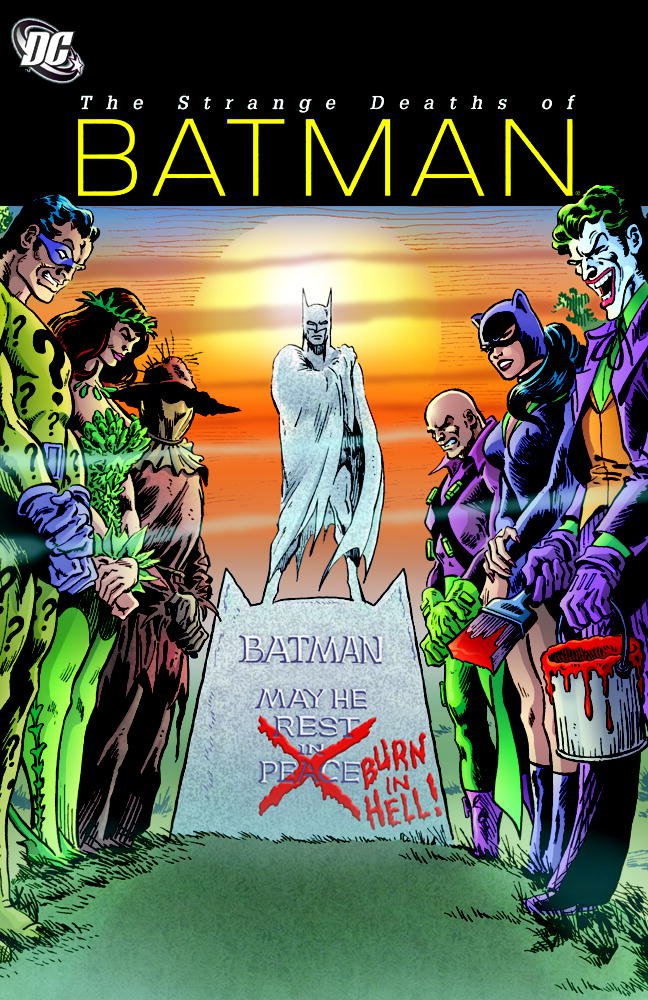
Compiled on the coat-tails of DC’s Batman R.I.P. publishing event (which ran May to November 2008, and with repercussions inspiring recent events in the ongoing mythology), this delightfully eccentric collection celebrates the recurrent demise of the Gotham Guardian by digging up a few oddments and some genuine valuable artifacts to amuse, enthral and amaze.

The wonderment begins with the quirkily eponymous ‘The Strange Death of Batman!’: a highly experimental mystery originating in Detective Comics #347 (January 1966) literally moments before the Dynamic Duo became household names all over the globe thanks to an incredibly popular TV show. Crafted by Gardner Fox, Carmine Infantino & Joe Giella, it features a major contender for the title of Batman’s daftest super-foe – The Bouncer – but still delivers action, drama and an intriguing conundrum to challenge the reader…

It’s followed by ‘Robin’s Revenge’ (World’s Finest Comics #184. May 1969) wherein Cary Bates and artists Curt Swan & Jack Abel recount the Imaginary Story (see DC’s Greatest Imaginary Stories for a definition if the term is somehow unknown to you) of Batman’s murder and the dark path that loss takes the Boy Wonder down. Hapless Superman acts as stand-in guardian but is helpless to forestall inevitable further tragedy…

‘The Corpse that Wouldn’t Die!’ is a superb tale guest-starring The Atom taken from team-up title The Brave and the Bold #115 (October/November 1974). Written by Bob Haney and magnificently drawn by Jim Aparo, it details how the Gotham Guardian is killed in the line of duty and how the Tiny Titan occupies his brain to reanimate his corpse and conclude the case that finished him…

Next is an extended saga from Batman #291-294 (cover dates September through December 1977) written by author David V. Reed and illustrated by John Calnan & Tex Blaisdell. Over four deviously clever issues ‘Where Were You the Night Batman Was Killed?’ sees hordes of costumed foes the Caped Crusader has crushed assemble to verify the stories of various felons claiming to have done the deed. This thematic partial inspiration for Neil Gaiman’s “Last Batman Story” kicks off with ‘The Testimony of the Catwoman’ followed by testimony from The Riddler, Lex Luthor and The Joker before satisfactorily concluding in a spectacular grand manner.

‘Buried Alive!’ by Gerry Conway, Rick Buckler & Frank McLaughlin (World’s Finest Comics #269 June/July1981) finds Superman and Robin desperately racing against time: hunting for a madman who entombed the Batman, after which ‘The Prison’ written and inked by John Stanisci, with Sal Buscema pencils, is a moody character piece featuring post-mortem reflections of Talia, Daughter of the Demon Ra’s Al Ghul as originally seen in Batman Chronicles #8, Spring 1997. This odd yet engaging tome terminates with a frilly, fluffy fantasy from Nightwing #52, (February 2001) as Catwoman imagines a morbidly mirthful ‘Modern Romance’ courtesy of Chuck Dixon, Greg Land & Drew Geraci.

Themed collections can be a rather hit-or-miss proposition, but the quality and variety of these inspired selections makes for a highly enjoyable read and the only regret I can express is that room couldn’t be found to include the various covers that fronted these tales. Include those in a new expanded edition and you’d have a book to die for…
© 1966, 1969, 1974, 1977, 1981, 1997, 2001, 2009 DC Comics. All Rights Reserved.

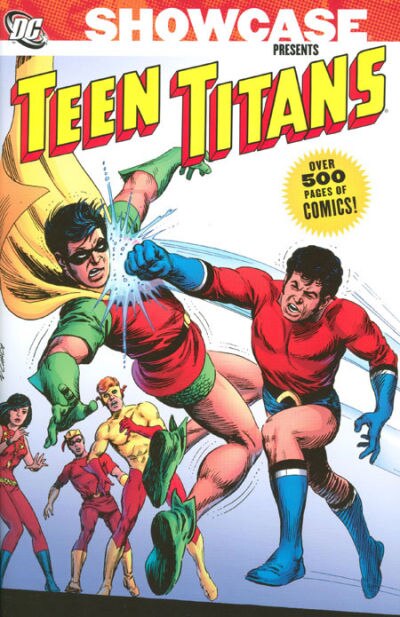
Showcase Presents Teen Titans volume 2


By Mike Friedrich, Bob Haney, Neal Adams, Marv Wolfman, Robert Kanigher, Steve Skeates, Gil Kane, Wally Wood, Nick Cardy, Sal Amendola, George Tuska, Carmine Infantino, Dick Dillin, Joe Giella, Jim Aparo & various (DC Comics)
ISBN: 978-1-84576-677-1 (TPB)

Hey, Super Kids! Happy 60th Anniversary!

It’s perhaps hard to grasp these days that once kid heroes were a rarity and at the beginning of the Silver Age, often considered a liability. Now the massive Teen Titans brand – with numerous comic book iterations, assorted TV shows, movies and even an award-winning early reading version (Aw, Yeaah! Tiny Titans!) their continuance as assured as anything in our biz. Nevertheless, during the tumultuous 1960s the series – never a top seller – courted controversy and actual teenage readers by confronting controversial issues head on.

I must have been just lucky, because these stories of lost youth searching for great truths and meaning were released just as I turned Teen. They resonated especially because they were talking directly to me. It didn’t hurt that they were brilliantly written, fantastically illustrated and staggeringly fresh and contemporary. I’m delighted to declare that age hasn’t diminished their quality or impact either, merely cemented their worth and importance.

The concept of underage hero-teams was not a new one when the Batman TV show fuelled DC’s move to entrust big heroes’ assorted sidekicks with their own regular comic as a hip and groovy ensemble as dedicated to helping kids as they were to stamping out insidious evil.

The biggest difference between wartime groups like The Young Allies, Boy Commandos or Newsboy Legion and such 1950s holdovers as The Little Wise Guys or Boys Ranch and the DC’s new team was quite simply the burgeoning phenomena of “The Teenager” as a discrete social and commercial power bloc. These were kids who could be allowed to do things themselves (within reason) without constant adult aid or supervision. As early as spring 1964, Brave and the Bold #54 had tested the waters in a gripping tale by Bob Haney & Bruno Premiani in which Kid Flash, Aqualad and Robin foiled a modern-day Pied Piper.

What had been a straight team-up was formalised a year later when the heroes reunited and included Wonder Girl in a proper super-group with a team-name: Teen Titans. With the stories in this second merely monochrome print-only relic of a collected volume of those early exploits the series had hit a creative peak, with spectacular, groundbreaking artwork and fresh, different stories that increasingly showed youngsters had opinions and attitudes of their own – and often that they could be at odds with those of their mystery-men mentors…

Spanning cover-dated January 1969 to December 1971 and collecting Teen Titans #19-36, and team-up appearances from Brave and the Bold #83 & 94 and World’s Finest Comics #205, these tales cover the most significant period of social and political unrest in American history and do it from the perspective of the underdogs, the seekers, the rebels…

The wonderment begins with a beautifully realised comedy-thriller as boy bowman Speedy enlists. ‘Teen Titans: Stepping Stones for a Giant Killer!’ (#19, January/February 1969), by Mike Friedrich, Gil Kane & Wally Wood, pitted the team against youthful evil mastermind Punch who planned to kill the Justice League of America and thought a trial run against the junior division a smart idea…

Brave and the Bold # 83 (April/May 1969) took a radical turn as the Titans (sans Aqualad, who was dropped from the squad to appear in Aquaman and because there just ain’t that much sub-sea skulduggery) tried to save Bruce Wayne’s latest foster-son from his own inner demons in a tense thriller about trust and betrayal in the Haney & Neal Adams epic ‘Punish Not my Evil Son!’. TT #20 took a long running plot-thread about extra-dimensional invaders and gave it a counterculture twist in ‘Titans Fit the Battle of Jericho’, a rollicking romp written by Neal Adams, pencilled by him & Sal Amendola and inked by brush-maestro Nick Cardy – one of the all-out prettiest illustration jobs of that decade.

Exemplars of the era/symbolic super-teens Hawk and Dove join proceedings for #21’s ‘Citadel of Fear’ (Adams & Cardy): chasing smugglers, finding aliens and ramping up the surly teen rebellion quotient whilst moving the invaders story-arc towards its stunning conclusion. ‘Halfway to Holocaust’ is only half of #22, the abduction of Kid Flash & Robin leading to a cross-planar climax as Wonder Girl, Speedy and a radical new ally quash the invasion threat forever, but still leaving enough room for a long overdue makeover in ‘The Origin of Wonder Girl’ by Marv Wolfman, Kane & Cardy. For years the series – and DC editors in general – had fudged the fact the younger Amazon Princess was not actually human, a sidekick, or even a person, but rather an incarnation of Wonder Woman as a child. As continuity backwriting strengthened its stranglehold on the industry, it was finally felt that the team’s distaff member needed a fuller background of her own.

This moving tale revealed she was in fact a human foundling rescued by Princess Diana and raised on Paradise Island where super-science gave her all the powers of a true Amazon. They even found her a name – Donna Troy – and an apartment, complete with hot roommate. All Donna had to do was sew herself a glitzy new figure-hugging costume…

Now thoroughly grounded, the team jetted south in #23’s fast-paced yarn ‘The Rock ‘n’ Roll Rogue’ (by Haney, Kane & Cardy), trying to rescue musical rebel Sammy Soul from his grasping family and – by extension – his lost dad from Amazonian headhunters. ‘Skis of Death!’ (#24, November/December) by the same creative crew has the quartet holidaying in the mountains and uncovering a scam to defraud Native Americans of their lands. It was a terrific old-style tale, but with the next issue the most radical change in DC’s cautious publishing history made Teen Titans a comic which had thrown out the rulebook…

For a series which spoke so directly to young people, it’s remarkable to think that ‘The Titans Kill a Saint?’ and its radical departure from traditional superhero stories was crafted by Bob Kanigher & Nick Cardy – two of the most senior creators in the business. The emotion-charged thriller set the scene for a different type of human-scaled adventures that were truly gripping and bravely innovative. For the relatively short time the experiment continued, readers had no idea what might happen next…

While on a night out in their civilian identities, Robin, Kid Flash, Speedy, Wonder Girl, Hawk and Dove meet telepathic go-go dancer Lilith who warns them of impending trouble. Cassandra-like, they ignore her warnings and a direct result a globally revered Nobel Laureate is gunned down. Coming so soon after the deaths of John F. and Robert Kennedy, Dr. Martin Luther King Jr. and Malcolm X, this was stunning stuff and in traumatised response all but Robin abandon their costumed personas and – with the help of mysterious millionaire philanthropist and mentor Mr. Jupiter – dedicate their unique abilities to exploring humanity’s flaws and graces: seeking fundamentally human ways to atone and make a difference in the world…

With Lilith beside them, they undertake different sorts of missions, beginning with ‘A Penny For a Black Star’ in which they attempt to live in a poverty-wracked inner city ghetto, where they find Mal Duncan, a street kid who becomes the first African-American in space…although it’s a one-way trip.

TT #27 reintroduced eerie elements of fantasy as ‘Nightmare in Space’ (Kanigher, George Tuska, Carmine Infantino & Cardy) sees the Titans en route to the Moon to rescue Mal, before encountering something far beyond the ken of mortal imagining. Meanwhile on Earth, Donna’s roommate Sharon stumbles upon an alien incursion. ‘Blindspot’ by Steve Skeates & Cardy was tangentially linked to another innovative saga then playing out in Aquaman’s comic book. You’ll need to see Aquaman: The Search For Mera and Aquaman: Deadly Waters for that extended delight. Both were edited by fresh-faced Dick Giordano, who was at this time responsible for the majority of innovative new material coming out of DC, even whilst proving himself one of the best inkers in the field.

Suffice to say that the Sea King’s foe Ocean Master had allied himself with aliens and Sharon became involved just as Aqualad returned looking for help. Unable to understand the Titan’s reluctance to get involved, Garth tries to go it alone but hits a snag only the original team can fix, which they do in Skeates & Cardy’s concluding chapter ‘Captives!’ However, once the alien threat is thwarted our heroes once more lay down their powers and costumes, but they have much to ponder after seeing what benefits their unique gifts can bring…

Teen Titans #30 featured three short tales, written by Skeates. Illustrated by Cardy, ‘Greed… Kills!’ is a cunning mystery exploring street and white-collar crime, whereas ‘Whirlwind’ is a Kid Flash prose novelette with art by Amendola before ‘Some Call it Noise’ (Infantino & Cardy) delivers an Aqualad solo tale in which his girlfriend Tula – AKA Aquagirl – takes a near-fatal wrong turn at a surface world rock concert.

Student politics took centre-stage in #31’s lead feature ‘To Order is to Destroy’ (Skeates, Tuska & Cardy) as the young heroes investigate a totally trouble-free campus where unhappy or difficult scholars are given a small brain operation to help them “concentrate”, whilst Hawk & Dove solo strip ‘From One to Twenty’ pits quarrelsome Don and Hank Hall against a band of murderous counterfeiters in a deft crime-caper from Skeates, Tuska & Cardy.

The creators then open up the fantasy element again with a time-travelling, parallel universe epic beginning in #32 with ‘A Mystical Realm, A World Gone Mad’ as Mal and Kid Flash accidentally change the past, turning Earth into a magical mad-scape. However, undoing their error results in a Neanderthal teenager being trapped in our time, presenting the group with their greatest challenge: educating a savage primitive and making him into a civilised modern man. Illustrated by Tuska & Cardy, ‘Less Than Human’ signalled the return of Bob Haney as main writer and triggered a gradual return of powers and costumes as the author picked up the pace of Jupiter’s grand experiment, restating it in terms that looked less harshly on comics’ bread & butter fights ‘n’ tights scenarios.

Brave and the Bold #94 (February-March 1971, by Haney & Cardy) offered potent counter-culture thrills as the team infiltrate an inner city commune to negate a nuclear bomb-plot in ‘Rebels in the Streets’, before the exigencies of publishing moved the series into the world of the supernatural as costumed heroes temporarily faded away in favour of tales of mystery and imagination. Haney, Tuska & Cardy’s ‘The Demon of Dog Island’ sees the team – including Robin who had quietly rejoined during the civilisation of cave-boy Gnarrk – desperately battling to prevent Wonder Girl’s possession by a gypsy ghost.

Skeates, Dick Dillin & Joe Giella crated ‘The Computer That Captured a Town’ in World’s Finest Comics #205 (September 1971), slyly examining racism and sexism as Superman finds the Titans trapped in a small town that had mysteriously re-adopted the values of the 1890s – a lot like middle America today but with culprits a lot easier to punch in the face…

Teen Titans #35 reiterated supernatural themes as the team travels to Verona in ‘Intruders of the Forbidden Crypt’ (Haney, Tuska & Cardy) wherein Lilith and the son of Mr. Jupiter’s business rival are drawn into a mesmerising web of tragedy: compelled to relive the doomed love of Romeo and Juliet despite all the rationalisations of modern science and the best efforts of the young heroes…

By the same creators, ‘A Titan is Born’ is a rite of passage for Mal as the everyman “token black guy” faces and defeats the murderous Gargoyle alone and unaided, before the reincarnation tragedy concludes with fate foiled in ‘The Tomb Be their Destiny’: the cover feature of #36. Filling out that issue and this book are two brief vignettes: Aqualad 3-page teaser ‘The Girl of the Shadows’ by Skeates & Jim Aparo and Haney & Cardy’s beguiling opening episode in the origin of Lilith ‘The Teen-Ager From Nowhere’. This showed a 10-year-old orphan’s first prescient exploit and the distrust it engendered, promising much more to come: a perfect place to end this second monochrome masterpiece of graphic literature.

Although perhaps dated in delivery now, these tales were a liberating experience for kids when first released. They truly betokened new empathy with independent youth and tried to address problems that were more relevant to and generated by that specific audience. That they are so captivating in execution is a wonderful bonus. This is absolute escapism and absolutely delightful and demand a fresh edition as soon as possible.
© 1969, 1970, 1971, 1972, 2007 DC Comics. All Rights Reserved.

Batman Beyond!


By Hilary J. Bader, Rich Burchett, Joe Staton, Terry Beatty & various (DC comics)
ISBN: 978-1-56389-604-0 (TPB)

The Batman Animated TV series masterminded by Eric Radomski, Bruce Timm, Paul Dini and others in the 1990s revolutionised The Dark Knight and led – with a tie-in monthly printed series – to some of the absolute best comic book tales in his 85-year publishing history. With the hero’s small screen credentials firmly re-established, follow-up series began (and are still coming), eventually feeding back into the overarching multiversal DCU continuity.

Following those award-winning animated sagas, in 1999 came a new incarnation set one generation into the future, following Bruce Wayne in the twilight of his life reluctantly mentoring a new teen hero picking up his eerily-scalloped mantle. In Britain the series was inspirationally re-titled Batman of the Future but for most of the impressed cognoscenti and awestruck kids worldwide it was Batman Beyond!

Again the show was augmented by a cool kids’ comic book. This inexplicably out-of-print collection re-presents the first 6-issue miniseries in a hip and trendy, immensely entertaining package suitable for fans and aficionados of all ages. Although not necessary to a reader’s enjoyment, passing familiarity with the TV episodes will enhance the overall experience. All stories were written by Hilary J. Bader and we open with a 2-part adaptation of the pilot, illustrated by Rick Burchett & Terry Beatty.

‘Not On My Watch!’ serves up glimpses of the last days of Batman’s crusade against crime before age, infirmity and injury slowed him down to the point of compromising his principles and endangering the citizens he’d sworn to protect…

Years later, Gotham City in the mid-21st century (notionally accepted as 2039 AD – 100 years after the Dark Knight’s debut in Detective Comics #27) is a dystopian urban jungle where angry, rebellious schoolkid Terry McGinnis strikes a blow against pernicious pimped-up street punks The Jokerz and is chased out of town all the way to the gates of a ramshackle mansion. Meanwhile, his research scientist dad has discovered a little too much about how the company he works for operates.

Wayne-Powers used to be a decent place to work before old man Wayne became a recluse. Now Derek Powers runs the show and is ruthless enough to do anything to increase profits… Outside town, Terry is saved from a potentially fatal Jokerz encounter by a burly old man who then collapses. Helping aged Bruce Wayne inside the mansion, Terry discovers the long neglected Batcave before being chased away by the surly saviour. McGinnis but doesn’t really care… until he gets home to find his father has been murdered…

In a storm of emotion, he returns to Wayne Manor as concluding chapter ‘I Am Batman’ sees McGinnis attempting to force Wayne to act before giving up in frustration and stealing the hero’s greatest weapon: a cybernetic Bat-suit that enhances strength, speed, durability and perception. Alone, untrained and unaided, a new Batman sets to enact justice and exact revenge…

In the ensuing clash with Powers the unscrupulous entrepreneur is mutated into a radioactive monster – dubbed Blight – before Wayne and Terry negotiate a tenuous truce and grudging understanding. For now, Terry will continue to clean up Gotham City as an apprentice- and strictly probationary-hero…

With #3, Bader, Burchett & Beatty began crafting original stories of future Gotham, commencing with ‘Never Mix, Never Worry’ wherein Blight returns to steal a selection of man-made radioactive elements which can only be used to cause harm… or can they?

Joe Staton took over pencilling with #4 as a schoolboy nerd frees a devil from limbo and old man Wayne introduces the cocksure Terry to parapsychologist Jason Blood and his eldritch alter ego Etrigan the Demon in spooky shocker ‘Magic Is Everywhere’. That sentiment is repeated and reinforced when a school-trip to a museum unleashes ancient lovers to feed on the students’ life energy in delightfully comical tragedy ‘Mummy, Oh! and Juliet’…

This captivating compendium concludes in another compellingly edgy thriller as Terry stumbles into a return bout with a shapeshifting super-thief in ‘Permanent Inque Stains’, only to find there are worse crimes and far more evil villains haunting his city…

In 2000 Titan Books released a British edition re-titled Batman of the Future (to comply with the renamed UK TV series) and this version is a little easier to locate by those eager to enjoy the stories rather than own an artefact. Fun, thrilling and surprisingly moving, these tales are magnificent examples of comics that appeal to young and old alike and are well overdue for re-issue. They also prove the foundation concepts of Batman can travel far and riff wildly, but always deliver maximum wonderment.
© 1999 DC Comics. All Rights Reserved.