
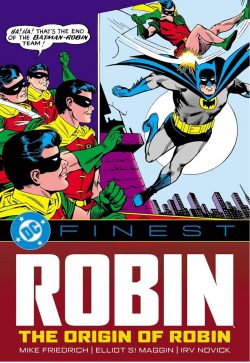
By Ed Hamilton, John Broome, Gardner F. Fox, Cary Bates, Mike Friedrich, E. Nelson Bridwell, Frank Robbins, Dennis O’Neil, Bob Haney, Elliot Maggin, Bob Rozakis, Ross Andru, Curt Swan, Sheldon Moldoff, Pete Costanza, Chic Stone, Gil Kane, Irv Novick, Murphy Anderson, Dick Dillin, Rich Buckler, Bob Brown, Mike Grell, A. Martinez, Al Milgrom, José Delbo, Bill Draut, George Klein, Joe Giella, Sid Greene, Murphy Mike Esposito, Anderson, Vince Colletta, Dick Giordano, Frank McLaughlin, José Mazzaroli, Terry Austin, José Luis García-López, Ernie Chan & various (DC Comics)
ISBN: 978-1-79950-829-8 (TPB)
This book includes Discriminatory Content produced in less enlightened times.
Robin the Boy Wonder debuted in Detective Comics #38 (cover dated April 1940 and on sale from March 6th). Co-created by Bob Kane, Bill Finger & Jerry Robinson, he was a juvenile circus acrobat whose parents were murdered by a mob boss. The story of how Batman took the orphaned Dick Grayson under his scalloped wing and trained him to fight crime has been told, retold and revised many times over the decades and still regularly undergoes tweaking to this day. Grayson fought beside Batman until 1970 when, as an indicator of those turbulent times, he flew the nest, becoming a Teen Wonder college student. His creation as a junior hero for younger readers to identify with inspired countless costumed sidekicks and kid crusaders, and Grayson continued in similar innovative vein for the older, more worldly-wise readership of America’s increasingly rebellious youth culture.
The first Robin even had his own solo series in Star Spangled Comics from 1947 to 1952, a solo spot in the back of Detective Comics from the end of the 1960s as covered here (but a position he alternated and shared with Batgirl) and a starring feature in anthology comic Batman Family. In the 1980s he led the New Teen Titans, initially in his original costumed identity but eventually in the reinvigorated guise of Nightwing, all while re-establishing a (somewhat turbulent) working relationship with his masked mentor.
This broad-ranging full colour but strictly non-digital compilation covers the period from Julie Schwartz’s captivating reinvigoration of the Dynamic Duo in 1964 until 1975 with Robin-related stories and material from Batman #184, 192, 202, 213, 217, 227, 229-231, 234-236, 239-242, 244-246, 248-250, 252, 254 & 259; Detective Comics #342, 386, 390-391, 394-395, 398-403, 445, 447, 450-251; World’s Finest Comics #141, 147, 195, & 200; Superman’s Pal Jimmy Olsen #111, 130 and Batman Family #1 & 3-5, spanning cover-dates May 1964 to May/June 1976.
With covers by Curt Swan, George Klein, Carmine Infantino, Joe Giella, Bill Draut & Vince Colletta, Neal Adams, Murphy Anderson, Mike Grell, Ernie Chan & Tatiana Wood, the developmental wonderment and rocky road from boys to men begins with ‘The Olsen-Robin Team versus… the Superman-Batman Team!’ Taken from World’s Finest #141, May 1964, by Edmond Hamilton, Curt Swan & George Klein, it’s a stirring blend of sci fi thriller and crime caper, wherein the underappreciated sidekicks fake their own deaths to undertake a secret mission even their adult partners must remain unaware of… for the very best of reasons of course.
The sequel (WFC #147, February 1965) delivers an engaging drama of youth-in-revolt as ‘The Doomed Boy Heroes!’ quit their assistant roles to strike out on their disgruntled own. Naturally there’s a perfectly reasonable – if incredible – reason here, too. Then in Detective Comics #342 (August 1965) cover-featured ‘The Midnight Raid of the Robin Gang!’ (John Broome, Sheldon Moldoff & Joe Giella) sees the Boy Wonder defy his mentor’s orders to infiltrate a youthful gang of costumed criminals. Following that, ‘The Boy Wonder’s Boo-Boo Patrol!’ (originally a back-up in Batman #184; September 1966 by Gardner Fox, Chic Stone & Sid Greene), shows the daring lad’s star-potential in a clever tale of thespian skulduggery and classic conundrum solving, before ‘Dick Grayson’s Secret Guardian!’ (Batman #192, June 1967, Fox, Moldoff & Giella) showcases his physical prowess in one of comic books’ first instances of the exoskeletal augmentation gimmick.
Superman’s Pal Jimmy Olsen #111 (June 1968) brought ‘Jimmy Olsen, Boy Wonder!’ by Cary Bates & Pete Costanza, which finds the cub reporter trying to prove his covert skills by convincing the Gotham Guardian that he was actually Robin (!), whilst that same month in Batman #202 the genuine article tackles the ‘Menace of the Motorcycle Marauders!’ (Mike Friedrich, Stone & Giella), consequently learning a salutary lesson in the price of responsibility. Then April 1969’s Detective Comics #386 featured the Boy Wonder’s first solo back-up in what was to become his semi-regular spot for years.
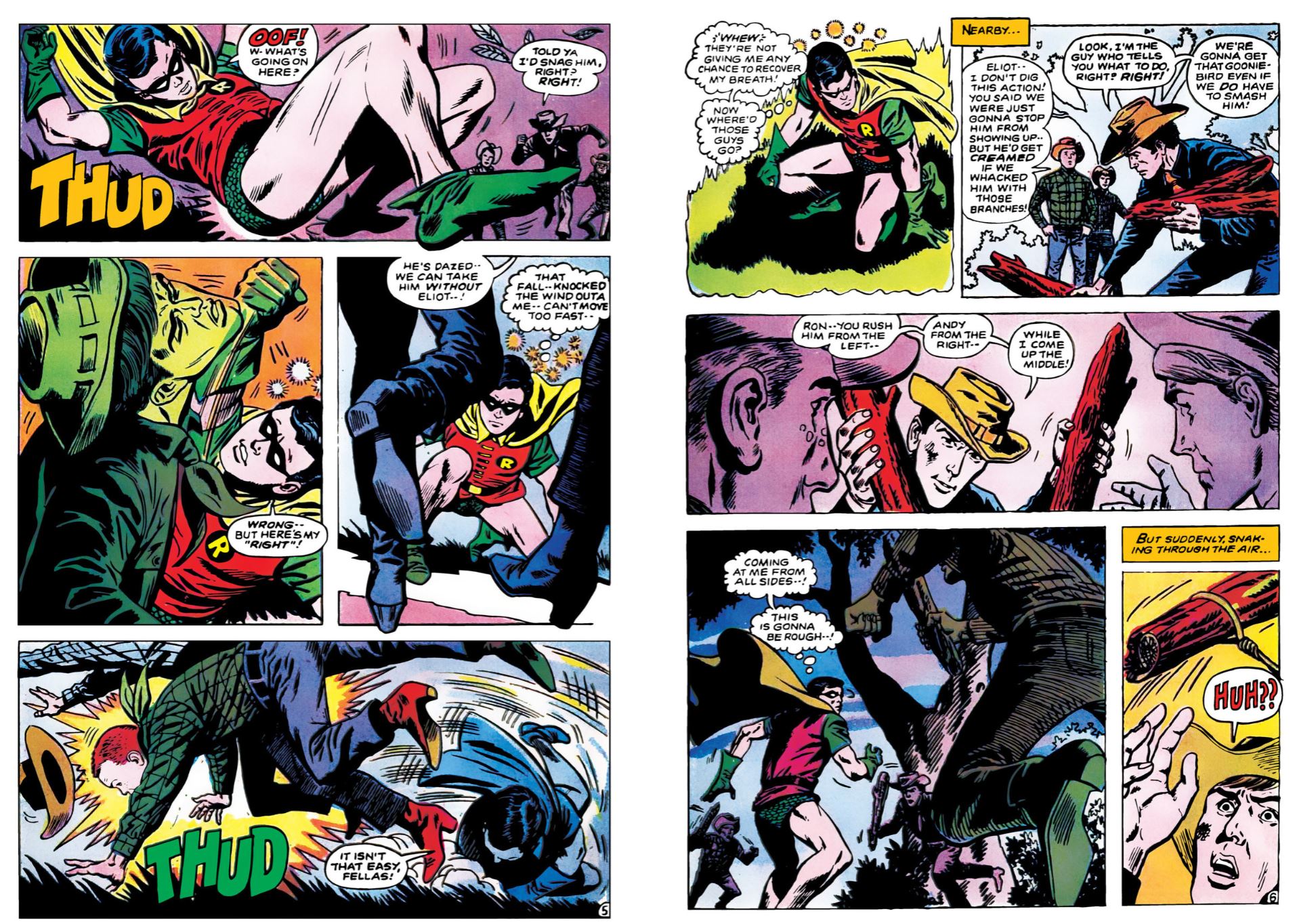
‘The Teen-Age Gap!’ as described by Friedrich, Ross Andru & Mike Esposito depicts a High School Barn Dance which only narrowly escapes becoming a riot thanks to Grayson’s diligent intervention. Its followed by an all new story from reprint collection Batman #213 (July/August 1969 and a 30th Anniversary reprint Giant) which offers an updated retelling of ‘The Origin of Robin’ courtesy of E. Nelson Bridwell, Andru & Esposito, reinterpreting those epochal events for the Vietnam generation. Gil Kane & Murphy Anderson assume the art-chores with Detective #390’s ‘Countdown to Chaos!’ (August 1969), bringing the support-series stunningly alive for the unfolding “Relevancy era” with Friedrich concocting a canny tale of corruption and kidnapping, leading to a paralysing city ‘Strike!’ for the Caped kid to spectacularly expose and foil in the following issue.
Next up is a modern landmark in the character’s long history as Batman #217’s ‘One Bullet Too Many!’ (December 1969, by Frank Robbins, Irv Novick & Dick Giordano) sees Dick leaves home to attend Hudson University. With the boy gone, Alfred and Bruce move with the times, shuttering both Mansion and Batcave and relocating to the penthouse of the Wayne Foundation Building in the heart of Gotham. It too offers subterranean lair extras and acts as base as Bruce sets up his Victims Inc. Program to aid the suffering survivors of crime. He also formally rededicates Batman to terrifying evildoers whether they be thugs, masterminds, or the new breed of semi-respectable “legitimate” businessmen who are little more than bandits with lawyers. His first mission is to solve the seemingly senseless murder of paediatrician Jonah Feilding. Although not really a Robin tale, it is included here, and is closely followed by all of Detective #394 from the same month, with lead Batman feature finding ‘A Victim’s Victim!’ (Robbins, Bob Brown & Giella) in the crime-infested race car scene. This neatly segues into back up yarn ‘Strike… Whilst the Campus is Hot!’ (Robbins, Kane & Anderson) as callow freshman Dick Grayson stumbles into a campus riot organised by criminals backing radical activists, forcing the Teen Wonder to ‘Drop Out… or Drop Dead!’ to stop the seditious scheme. DC #398-399 (April & May 1970) then ran a 2-part spy-thriller with Vince Colletta replacing Anderson as inker. ‘Moon-Struck’ has lunar rock samples borrowed from NASA apparently causing a plague among Hudson’s students until Robin exposes a Soviet scheme to sabotage the Space Program in ‘Panic by Moonglow’.
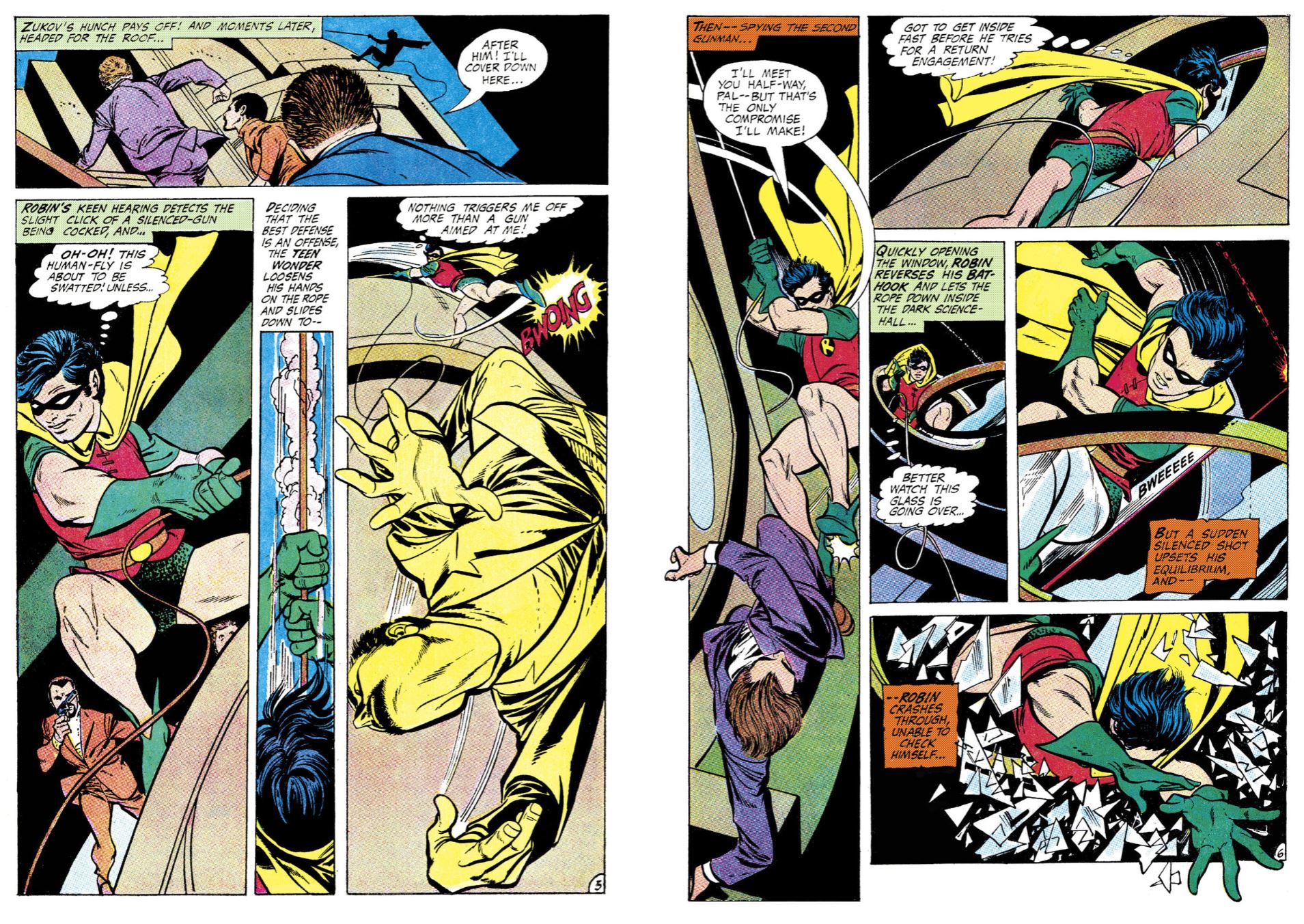
The 400th anniversary issue (June 1970) finally teamed the Teen Wonder with his alternating back-up star in ‘A Burial For Batgirl!’ (Denny O’Neil, Kane & Colletta): a college-based murder mystery which again heavily references political and social unrest then plaguing US campuses, but which still finds space to be smart and action-packed as well as topical, before chilling conclusion ‘Midnight is the Dying Hour!’ wraps up the saga. Never afraid to repeat a good idea, Superman’s Pal Jimmy Olsen #130 (July 1970, by Bob Haney & Anderson) details the exploits of ‘Olsen the Teen Wonder!’ with the junior reporter again aping Batman’s buddy to infiltrate an underworld newspaper.
World’s Finest #195 (August 1970) sees Jimmy & Robin targeted for murder by the Mafia in ‘Dig Now, Die Later!’ (Haney, Andru & Esposito, whilst simultaneously in DC #402 ‘My Place in the Sun’ (Friedrich, Kane & Colletta), embroils Grayson and fellow Teen Titan Roy Harper Speedy in a crisis of social conscience, before our scarce-bearded hero wraps up his Detective run with corking crimebusting caper ‘Break-Out’ in the September issue. From #227 (December 1970) Robin’s romps transferred to the back of Batman, beginning with ‘Help Me – I Think I’m Dead!’ (Friedrich, Novick & Esposito) as ecological awareness catastrophically collides with penny-pinching Big Business on campus, launching an extended epic tracking the Teen Thunderbolt’s exploration of communes, alternative cultures and the burgeoning spiritual New Age fads of the day.
Inked by Frank Giacoia ‘Temperature Boiling… and Rising!’ (#229, February 1971) continues the politically-charged drama, albeit uncomfortably interrupted by a trenchant fantasy team-up with Superman sparked when the Man of Steel attempts to halt a violent campus clash between students and National Guard. The tale shifts to WFC #200 (February 1971) – crafted by Friedrich, Dick Dillin & Giella – where ‘Prisoners of the Immortal World!’ has brothers on opposite sides of the teen scene abducted with Robin & Superman to a distant planet where undying vampiric aliens wage eternal war on each other. A return to more pedestrian perils follows in Batman #230 (March 1971) sees ‘Danger Comes A-Looking!’ for our young hero in the form of a gang of right-wing, anti-protester jocks and a deluded friend who prefers bombs to brotherhood, courtesy of Friedrich, Novick & Giordano. ‘Wiped Out!’ (#231, May 1971) then offers an eye-popping end to the jock squad whilst #234 sees a clever road-trip tale in ‘Vengeance for a Cop!’, when a campus guard is gunned down forcing Robin to track the only suspect to a commune. ‘The Outcast Society’ has its own unique system of justice, but eventually the shooter is apprehended in cataclysmic closing ‘Rain Fire!’ (#235 & 236 respectively).
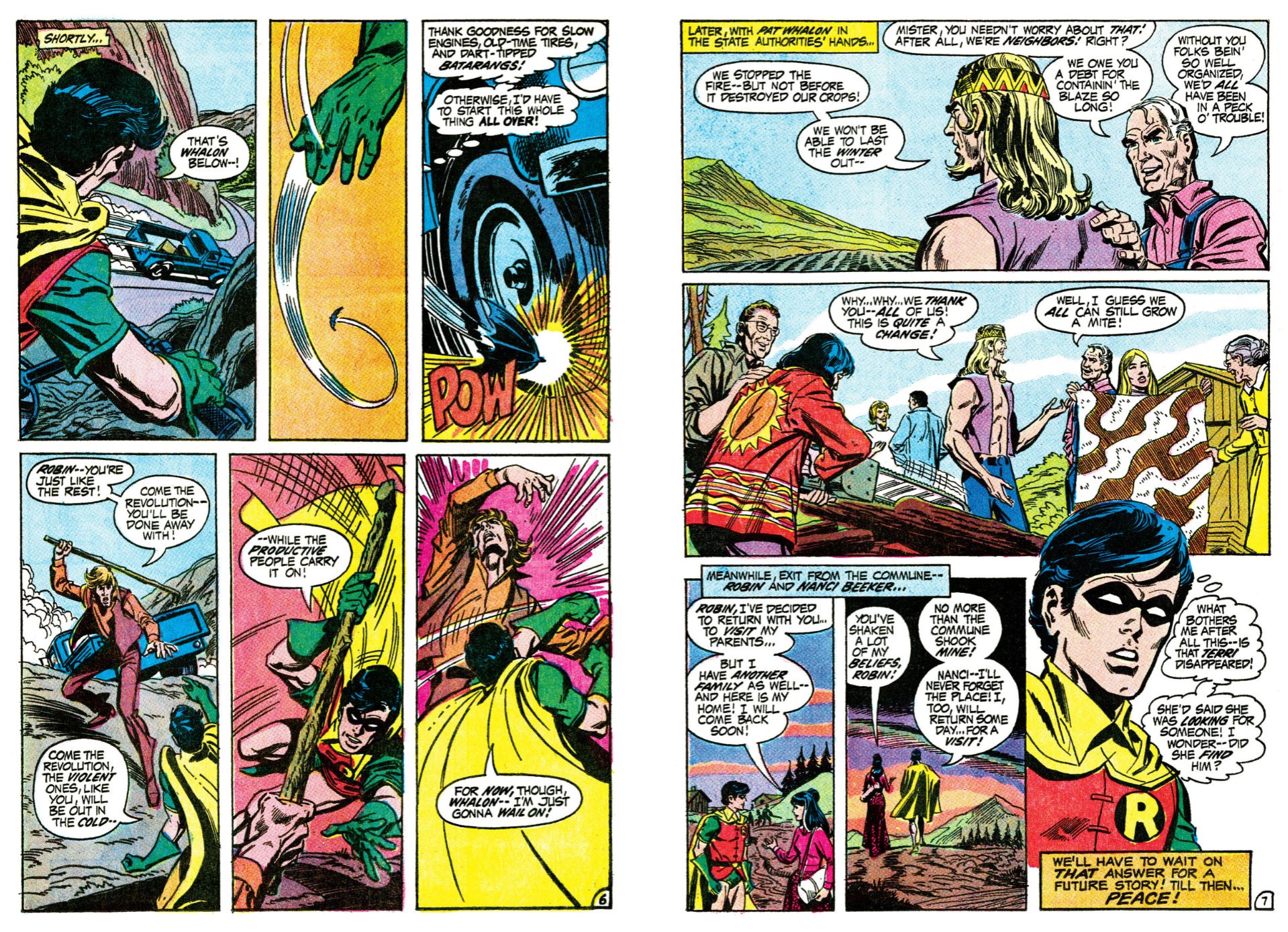
The Collective experience blooms into psychedelic and psionic strangeness in #239 as ‘Soul-Pit’ (illustrated by new penciller Rich Buckler) finds Grayson’s would-be girlfriend, “Jesus-freaks” and runaway kids all sucked into a telepathic duel between a father and son, played out in the ‘Theatre of the Mind!’ before exposing the ‘Secret of the Psychic Siren!’ and culminating in a lethal clash with a clandestine cult in ‘Death-Point!’ (Batman#242, June 1972). Elliot Maggin, Novick & Giordano then open an age of cosy-mystery capers by setting ‘The Teen-Age Trap!’ (Batman #244, September 1972), with Grayson mentoring troubled kids and finding plenty of troublemakers his own age, before ‘Who Stole the Gift from Nowhere!’ is a delightful old-fashioned change-of-pace yarn where our hero seeks out a hidden wealthy benefactor. Batman #248 offers ‘The Immortals of Usen Castle’ (Maggin, Novick & Frank McLaughlin) wherein another deprived-kids day trip turns into an episode of Scooby-Doo, Where are You?
Pencilled by Brown, the ‘Case of the Kidnapped Crusader!’ then puts the Student Centurion on the trail of an abducted consumer advocate prior to ‘Return of the Flying Grayson!’ (Maggin, Novick & McLaughlin from #250) painfully reminding the hero of his Circus past after tracking down pop-art thieves. Batman #252 (October 1973) sees Maggin, Dillin & Giordano’s light-hearted pairing of Robin with a Danny Kaye pastiche/avatar for charming romp ‘The King from Canarsie!’, before ‘The Phenomenal Memory of Luke Graham!’ (#254 January/February 1974 and inked by Anderson) causes nothing but trouble for the hero, his college professors and a gang of robbers. Issue #259 provides a fashion spread of new costumes suggested by readers in ‘A New Look for Robin’ before the next tale as year-long adventure drought ends with ‘The Touchdown Trap’ in Detective #445 (February/March 1975) as new scripter Bob Rozakis and artist Mike Grell catapult our hero into a 50-year-old college football feud that refused to die, after which ‘The Puzzle of the Pyramids’ (#447, illustrated by A. Martinez & José Mazzaroli) offers another cunning crime conundrum. Action-packed, chase-heavy human drama ‘The Parking Lot Bandit!’ & ‘The Parking Lot Bandit Strikes Again!’ (DC #450-451, August & September 1975, by Al Milgrom & Terry Austin) gives the titanic teen one last chance to strike a bit of terror into the hearts of evil-doers in his titular home before the next big change comes.
In the midst of another expansion, DC launched a line of double-length titles with Batman Family as possibly its strongest contender. A supersized anthology of new and vintage Bat-fare highlighting a vast themed cast, it paired Robin & Batgirl as a semi-official crimebusting duo. On sale from June 5th 1975, the first issue led with Maggin & Grell’s ‘The Invader from Hell!’ as the ghost of Benedict Arnold attacks Washington DC in a Satan-sponsored sortie to clear his name and rehabilitate his reputation.
With #2 all-reprint, we return for #3 as Maggin, José Luis García-López & Colletta bring the pair to Princetown and a fantastic clash with dinosaurs, future-men and the Spanish Inquisition in thrilling but deceptively peril-free lark ‘Isle of a Thousand Thrills!’ before seasonal shocker ‘Robin’s (Very) White Christmas!’ ( #4, Rozakis, José Delbo & & Colletta) sees Batgirl, Robin and Gotham Police Commissioner Jim Gordon unite to keep Syndicate snitch Tad Wolfe alive and out of the hands of infallible assassin Diamond Lilly.
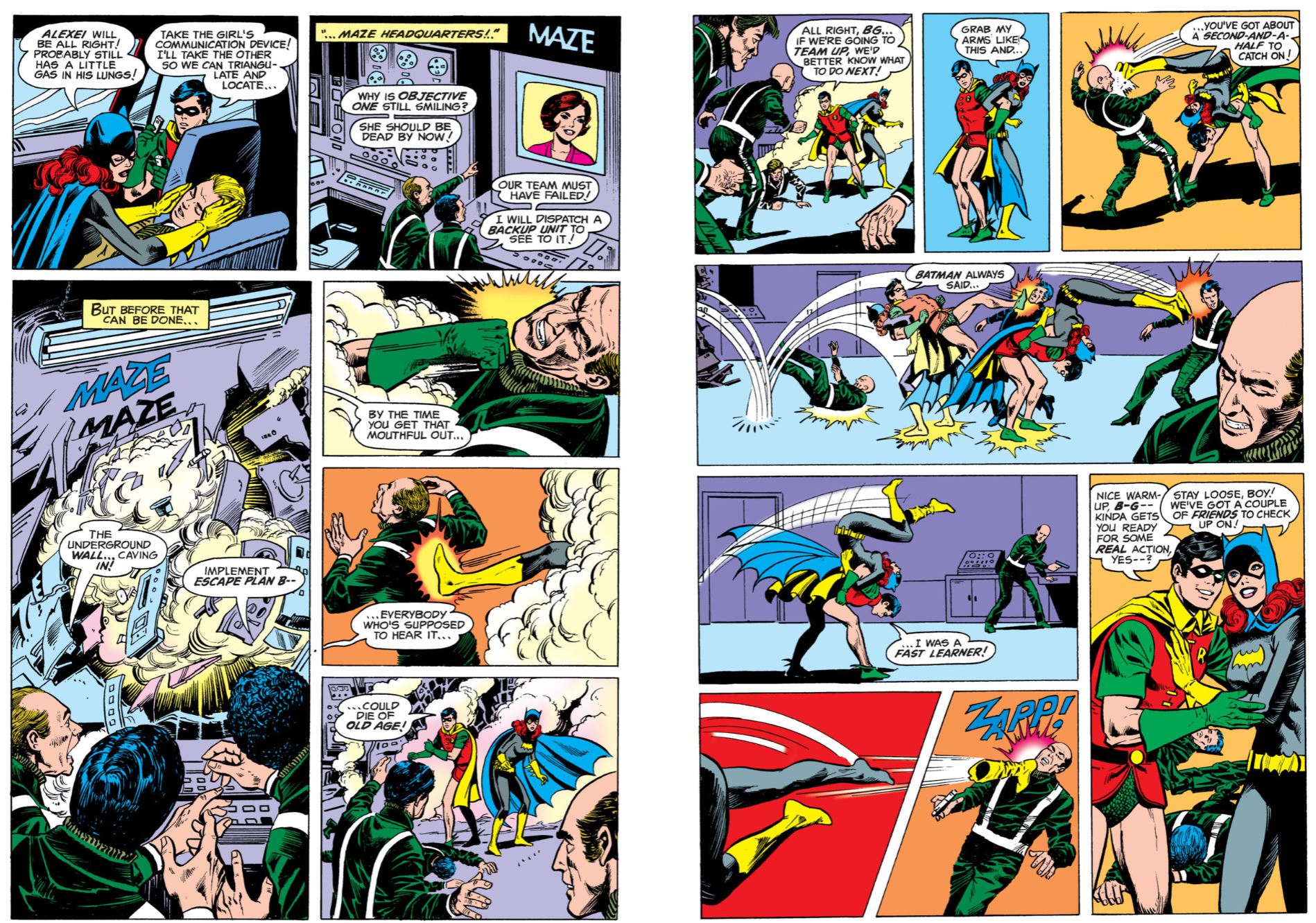
The eccentrically eclectic collected collation of Teen Wonderments concludes with BF #5’s ‘The Princess and the Vagabond!’ by Maggin, Cary Bates, Swan & Colletta, wherein whilst babysitting foreign dignitary Princess Evalina, Congresswoman Barbara Gordon, her alter ego Batgirl, student guide Dick Grayson and Robin collectively inspire a mismatched romance by foiling the murder plot of sinister agency MAZE…
These stories span a turbulent and chaotic period for comic books: perfectly encapsulating and describing the vicissitudes of the superhero genre’s premier juvenile lead: complex yet uncomplicated adventures drenched in charm and wit, moody tales of rebellion and self-discovery, and rollercoaster, all-fun romps. Action is always paramount, and angst-free satisfaction is pretty much guaranteed. These cracking yarns are something no fan of old-fashioned Fights ‘n’ Tights fiction should miss.
© 1964, 1965, 1966, 1967, 1968, 1969, 1970, 1971, 1972, 1973, 1974, 1975, 1976, 2026 DC Comics. All Rights Reserved.
Today in 1926 saw the birth of American cartoonist George Booth (Spot, Local Item), with artist/inker Mike Royer (Magnus, Robot Fighter, Silver Star, Jack Kirby’s Fourth World, Kamandi) arriving in 1941 and iconic groundbreaking French fantasist Philippe Druillet (Lone Sloane saga, Yragaël, La Nuit, Salammbô, Nosferatu) in 1944. Romanian artist Sandu Florea (Batman: Battle for the Cowl, Justice Society of America, X-Men, Dou? palo?e) came along in 1946 and abstract expressionist/Underground Commix pioneer David Geiser (Demented Pervert, Uncle Sham, Edge City) one year later; colourist Adrienne Roy in 1953 and Belgian stylist Benoît Sokal (Inspector Canardo, Syberia) in 1954.
In 2007 we lost American cartoonist, sculptor, author and illustrator Howie Schneider (Eek & Meek, Chewy Louie).