
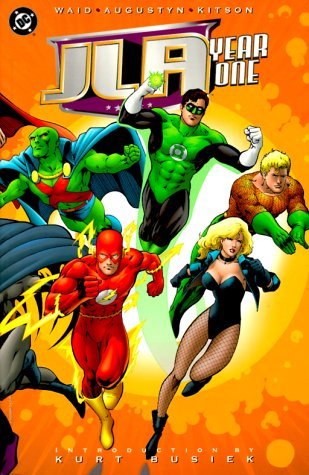
JLA: Year One


By Mark Waid, Brian Augustyn & Barry Kitson with Michael Bair, John Stokes, Mark Propst, & various (DC Comics)
ISBN: 978-1-56389-512-8 (TPB)

If the chop-and-change continuity gymnastics DC have undergone in recent years gives you a headache, but you still love reading excellent superhero team stories, you could just take my word that this is one of the best of that breed and move on to the next review. If you’re okay with the confusion or still need convincing, though, please read on.

With then-partner All-American Publishing, in 1940 DC published the Justice Society of America in All-Star Comics from #3. Cover-dated “Winter Issue”, it spanned the year end and was on sale from November 22nd until January. The JSA were the first superhero team in comics.

In 1960 after a decade largely devoid of superheroes, the now fully-amalgamated publisher sagely revived the team concept as the Justice League of America, and gradually reintroduced the JSA ancestors as heroes of an alternative Earth to a fresh new caped and cowled world. By 1985, the continuity had become saturated and overcrowded with so many heroic multiples and close duplicates that DC’s editorial Powers-That-Be deemed it all too confusing and a deterrent to new readers, and decreed total change. It resulted in maxi-series Crisis on Infinite Earths and the events of the groundbreaking, earth-shattering saga led to a winnowing and restructuring of the DC universe…

With all the best bits from past stories (for which one could read “least charming or daft”) having now occurred on one Earth, and with many major heroes remade and re-launched (Superman, Wonder Woman, Flash et al.), one of the newest curses to readers – and writers – was keeping definitive track of what was now DC “History” and what had now never actually happened.

Thus 12-issue maxi-series JLA: Year One presented the absolute, definitive, real story of the formation and early days of the Justice League, the World’s Greatest – but no longer first – Superheroes…

Of course, since Zero Hour, Infinite Crisis and all the other subsequent publishing course-correcting extravaganzas (such as 52, Countdown, Dark Nights: Death Metal and so on) it’s not strictly true anymore. Still. Again…

None of which impacts upon the superb quality of the tale told here. Way back then – January to December 1998 and in the wake of Grant Morrison & Howard Porter’s spectacular re-reboot of the team – Mark Waid, Brian Augustyn & illustrator Barry Kitson (plus assorted assisting inkers) produced a superb version of that iteration’s earliest days. It’s still one of the best and most readable variations on the theme, even if DC have inexplicably let it slide out of print…

It begins “ten years ago” in ‘Justice League of America: Year One’ as a hidden observer gathers files on an emergent generation of new costumed heroes. When an alien invasion from Appellax brings inexperienced neophyte heroes Flash, Green Lantern, Black Canary, Aquaman and Martian Manhunter together to save Earth from colonisation, the media scents a news sensation, but the real story is the hidden forces hovering in the background of the event…

The Canary was reimagined as the rebellious daughter of the JSA original who had been active during WWII, and the others, like the Sea King and J’onn J’onzz, had undergone recent origin revisions too…

The main action begins after that initial victory, as the heroes – novices all, remember – opt to stick together as a team, only to be targeted by secret super-science society Locus, who begin snatching up alien invader corpses for genetic experimentation…

The second issue sees the new kids as media sensations overwhelmed and out of their depth, with everyone wanting a piece of them. Older outfits like the Blackhawks, Challengers of the Unknown and even officially-retired JSA veterans are watching with apprehension whilst Bruce Wayne wants them far away from Gotham City as they establish their ‘Group Dynamic’. Even trick archer Green Arrow is constantly hanging around, clearly angling for an invitation to join, but that’s never gonna happen…

Immortal villain Vandal Savage targets the inexperienced heroes with a squad of veteran supervillains – the Thorn, Solomon Grundy, Clayface and Eclipso – as everywhere, more new superheroes are emerging. Savage is resolved to stop this second Heroic Age before it begins…

In #3, Locus’ bio advancements lead to alliance with Savage, but their schemes are sidelined as the team struggle to work together. Every man there seems distracted by Black Canary, but their “chivalrous impulses” in combat are not only insulting but will get someone killed – if not by enemies, then by her…

The team is fully occupied playing ‘Guess Who?’ after accepting funding and resources from a mystery billionaire. The influx of cash results in a purpose-built secret mountain HQ, a covert personal communications network, live-in custodian/valet/tech support Snapper Carr and a security system designed by maverick teen genius Ted Kord.

At least the heroes are starting to bond, sharing jokes, origins and trade secrets, but tensions are still high and trust in each other is fragile…

Inker Michael Bair joins with #4 as ‘While You Were Out…’ sees Locus at last launch their campaign of conquest: picking off lone hero Dan Garrett, whose mystic Blue Beetle scarab proves no match for alien-enhanced bio-weaponry, even as the heroes are all singled out for close observation by mystery operatives…

The merciless Brotherhood of Evil unleash Locus-designed horrors on Manchester, Alabama in #5, leading to a tenuous team-up of Justice League and Doom Patrol that ends in disaster and defeat. Maimed and deprived of their abilities, they are ‘A League Divided’ until the DP’s resident genius Niles Caulder provides stopgap powers and weapons in ‘Sum of Their Parts’ (inked by Bair & John Stokes), enabling the heroes to rally and restore themselves…

In ‘The American Way’ the JLA suffer a shock after their greatest inspiration – Superman – declines an offer to join, even as Locus’ endgame begins.

The dispirited heroes barely notice, as ‘Loose Ends’ exposes treachery in the ranks, further distracting the heroes who discover a trusted ally has been spying on them in their private lives. They have no idea what’s really going on…

With unity shattered, the JLA turns on itself, missing Locus’ attempt to terraform Earth and literally ‘Change the World’…

‘Heaven and Earth’ (inked by Bair & Mark Propst) finds all humanity’s helpless and all its many heroes subdued in a superpowered blitzkrieg that catches the planet napping. Crushed, defeated and interned in ‘Stalag Earth’ all hope is lost until the reunited Justice League lead a counter-offensive, turning tragedy into triumph and ensuring ‘Justice for All’…

A brilliantly addictive plot, superbly sharp dialogue and wonderfully underplayed art suck the reader into an enthralling climax that makes you proud to be human… or at least terrestrially-based. This saga of our champions’ bonding and feuding under extended threat of rogue geneticists, planetary upheaval, and the mystery of who actually bankrolls the team, all added to continual, usual, everyday threats in a superhero’s life, is both enchanting and gripping.

When it’s done right there’s nothing wrong with being made – and allowed – to be feel ten years old again. In-the-know fans will delight at the clever incorporation of classic comics moments, in-jokes and guest-shots from beloved contemporaneous heroes and villains such as the Sea Devils, Metal Men, Atom and such, but the creators of this revised history never forget their new audience and nothing here is unclear for first-timers. The finale is a fan’s all-action dream with every hero on Earth united to combat all-out alien invasion! …And of course, the rookie JLA save the day again in glorious style.
© 1998 DC Comics. All Rights Reserved.
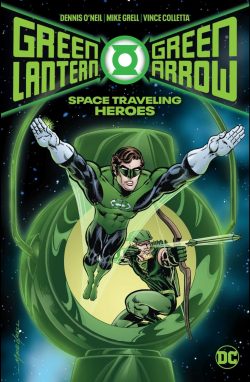
Green Lantern/Green Arrow: Space Traveling Heroes


By Denny O’Neil, Frank McGinty, Elliot S! Maggin, Mike Grell, Alex Saviuk, Vince Colletta & various (DC Comics)
ISBN: 978-1401295530 (HB)

After their hugely successful revival and reworking of The Flash, DC were keen to build on a resurgent superhero trend. Showcase #22 hit newsstands at the same time as the fourth issue of the new Flash comic book (#108) and once again the guiding lights were Editor Julie Schwartz and writer John Broome. Assigned as illustrator was action ace Gil Kane – usually inked by Joe Giella – and the issue revealed a Space Age reconfiguration of the Golden Age superhero with magic replaced by super-science.

Hal Jordan was a young test pilot in California when an alien policeman crashed his spaceship on Earth. Mortally wounded, Abin Sur commanded his power ring – a device for materialising thoughts – to seek out a replacement officer, honest and without fear.

Scanning the planet, it selected Jordan and brought him to the crash site. The dying alien bequeaths his ring, lantern-shaped Battery of Power and professional vocation to the astonished Earthman.

Having established characters, scenario and narrative thrust of a series that would become the spine of all DC continuity, the editors were confident of their ground. Unlike the years-long, practically glacial debut of The Flash, the next two Showcase issues carried the new costumed champion to even greater exploits, and six months later Green Lantern #1 was released.

In this iteration the Emerald Gladiators are a universal police force (Jordan’s “beat” is Space Sector 2814), and over many traumatic years, he grew into one of the greatest members of the serried band of law-enforcers. The Green Lantern Corps has safeguarded the cosmos from all evil and disaster for billions of years, policing countless sentient beings under the severe but benevolent auspices of immortal super-beings who consider themselves the Guardians of the Universe.

These undying patrons of Order were one of the first races to evolve and dwelt in sublime, emotionless security and tranquillity on the world of Oa at the very centre of creation.

Green Lanterns are chosen for their capacity to overcome fear and are equipped with a ring that creates solid constructs out of emerald light. The miracle weapon is fuelled by the strength of the user’s willpower, making it – in the right hands – one of the mightiest tools imaginable…

For eons, a single individual from each of the 3600 sectors of known space was selected to patrol his, her or its own beat, but being cautious and meticulous masters, the Guardians laid contingency plans as appointing designated reserve officers.

The series a ran for a decade before changing tastes pushed it into radical territory as a soap box for social injustice and environmental issues. The “relevancy period” generated landmark groundbreaking tales from Denny O’Neil & Neal Adams that revolutionised the industry, whilst registering such poor sales that the book was cancelled and the twinned heroes (a cost-cutting concept had seen GL paired with liberal firebrand Green Arrow as a walking, rip-roaring conscious for the conservative ring-wielder) unceremoniously shipped into the back of another comic book – the marginally more successful Flash.

The Flash #217-246 saw the transition from Adams to new art sensation Mike Grell: a run that precipitated the viridian vigilantes back into their own title. With the emphasis shifting back to crime, adventure and space opera, Green Lantern was again popular enough for his own book and he naturally brought the boisterous bowman along for the ride….

Collecting Green Lantern #90-106 (August/September 1976-July 1978) this hardback and digital compendium sees them (mostly) return to the starry firmament for cosmic duties beginning with #90 (August/September 1976) as ‘Those who Worship Evil’s Might’ – by Denny O’Neil & Mike Grell – finds the Green Gladiators investigating a starship buried in the Las Vegas desert for countless years. When it disgorges an ancient evil the heroes also meet the freshly awakened officers of a force used by the Guardians of the Universe before green rings were invented…

Issue #91 depicts the return of arch-nemesis Sinestro who inflicts ‘The Revenge of the Renegade’ upon his foes after taking over a poverty-stricken third world monarchy. When the tables are turned, he flees into space and across dimensions, arriving with the green team on a primitive world in dire need of champions legendarily saved via ‘The Legend of the Green Arrow’ (inked by Robert “Bob” Smith).

Inked by Terry Austin, #93’s ‘War Against The World-Builders’ finds aliens abducting homeless people to build a colony world. As GL interrupts his Thanksgiving dinner to play saviour, however, his lover Carol Ferris, Black Canary and Green Arrow are ambushed by government spooks and the archer is abducted. Rogue agents need him to kill someone and believe they have the perfect inducement in #94’s ‘Lure for an Assassin’ (Austin & Dick Giordano inks) but didn’t count on his ingenuity and the return of substitute GL John Stewart, culminating in a political scandal barely averted in concluding chapter ‘Terminal for a Tragedy’ with Vince Colletta signing on as regular inker.

Bouncing back to the big black yonder, #96’s ‘How Can an Immortal Die?‘ sees the reappearance of alien Lantern Katma Tui, crashing to Earth and bringing warning of a terrible threat that has infiltrated the Guardians. Rushing rashly to the rescue, Jordan battles his comrades and patrons to solve and defuse ‘The Mystery of the Mocker’ in a spectacular romp that marks the series’ restoration to monthly status.

The plan doesn’t end well and #98 finds the mind monster loose on Earth and tormenting Black Canary with visions of the dead in ‘Listen to the Mocking Bird’. Tracing the abominable mocker Ffa’rzz to an antediluvian and impossibly distant space station, Jordan Katma Tui, the Arrow and enigmatic space critter Itty infiltrate the monolith and face constant nightmare as they realise ‘We Are on the Edge of the Ultimate Ending!’ Thankfully, devious plotter Ollie Queen has a plan to save everything…

Double-sized Green Lantern/Green Arrow #100 carried a January 1978 cover-date and two tales, beginning with O’Neil, Alex Saviuk & Colletta’s ‘Rider of the Air Waves’ which expanded the Jordan family by introducing a distant cousin. Also called Hal Jordan, this kid had inherited his father Larry‘s title as Air Wave (a Golden Age Great using the power of radio to crush crooks) but got trapped in energy form by debuting dastard Master-Tek. It didn’t take long to sort things out and find little Hal a tutor after which Elliot S! Maggin, Grell & Colletta took Ollie, the Canary and former sidekick Roy “Speedy” Harper back to Star City in ‘Beware the Blazing Inferno!’ the task of stopping a ring of bombers opened old wounds however, and the archer again opted to try fixing things from within by running for Mayor…

Frank McGinty, Saviuk & Colletta deconstructed ‘The Big Braintrust Boom’ in #101 as freewheeling trucker Hal – the elder – Jordan uncovers a mind-bending, potentially world-dominating cult run by old enemies Hector Hammond and Bill Baggett, before O’Neil, Saviuk & Colletta reveal a cunning alien plot to shanghai humans as batteries in ‘Sign Up… and See the Universe’ which intensifies into a full blown invasion in #103’s ‘Earth – Asylum for an Alien’ with David Hunt stepping in to ink. Happily our heroes are up to the challenge, but when a valued comrade suddenly dies the consequences are not just tragic but simply catastrophic in #104’s ‘Proof of the Peril’ by O’Neil, Saviuk, Colletta. Even this is not the end, however, as the bizarre events herald the vengeful assault of old enemy Sonar in follow-up yarn ‘Thunder Doom’leading to a close call with an all-consuming atrocity and revelatory conclusion  ‘Panic… in High Places and Low’ by O’Neil, Grell & Bruce Patterson in last inclusion #106.

Although still laced with satire and political barbs, this tome sees challenging tales of rebellion give way to plot-driven sagas of wit and courage, packed with a less shining, less optimistic sense of wonder albeit still bristling with high-octane action. Here are evergreen adventures that confirmed the end of the Silver Age of Comics and the birth of something new. Illustrated by some of the most revered names in the business, the exploits in this volume closed one chapter in the life of Green Lantern and opened the doors to today’s sleek and stellar sentinels of the stars.
© 1976, 1977, 1978, 2020 DC Comics. All Rights Reserved.