
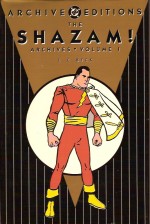
By Bill Parker, C. C. Beck & Pete Costanza (DC Comics)
ISBN: 1-56389-053-4
One of the most venerated and beloved characters of America’s Golden Age of comics was created by Bill Parker and Charles Clarence Beck as part of the wave of opportunistic creativity which followed the stunning success of Superman in 1938. Although there were many similarities in the early years, the Fawcett character quickly moved squarely into the area of light entertainment and even straight comedy, whilst as the 1940s progressed the Man of Steel increasingly left whimsy behind in favour of action, drama and suspense.
Homeless orphan and good kid Billy Batson was selected by an ancient wizard to be given the powers of six gods and heroes to battle injustice. He transforms from scrawny precocious kid to brawny (adult) hero Captain Marvel by speaking aloud the wizard’s name – an acronym for the six legendary patrons Solomon, Hercules, Atlas, Zeus, Achilles and Mercury.
This magnificent full-colour, deluxe hardback compendium re-presents the first 15 adventures from Whiz Comics #2 to 15 (February 1940 to March 1941 – there was no #1, two issue #5’s and two editions in March but I’ll try to explain all that as we go along) to cash in on the sales phenomenon of Superman and his many imitators and descendents.
Publisher Fawcett had first gained prominence through an immensely well-received light entertainment magazine for WWI veterans named Captain Billy’s Whiz-Bang, before branching out into books and general interest magazines. Their most successful publication – at least until the Good Captain hit his stride – was the ubiquitous boy’s building bible Mechanix Illustrated and, as the decade unfolded, the scientific and engineering discipline and can-do demeanour underpinning MI suffused and informed both the art and plots of the Marvel Family titles.
The series was the brainchild of writer/editor Bill Parker and brilliant young illustrator Charles Clarence Beck who, with his assistant Pete Costanza, handled all the art in this book, and in this quirky first volume the adult hero is a serious, bluff and rather characterless powerhouse his whilst his junior alter ego Billy is the true star: a Horatio Alger archetype of impoverished, bold, self-reliant and resourceful youth overcoming impossible odds by pluck, grit and sheer determination…
Author, journalist and fan Richard A. Lupoff covers in great detail the torturous beginnings of the feature in his Foreword before the magic proper starts with a rare and priceless glimpse at the hero’s nigh-cursed design stage and the book also contains biographical details on all the creators.
To establish copyright, publishers used to legally register truncated black and white facsimile editions called “Ash-can Editions†in advance of their launch issues. For Fawcett, the production of their first comicbook proved an aggravating process since this registration twice uncovered costly snags which forced the editors to redesign both character and publication.
Contained herein are cover reproductions of Flash Comics #1 starring Captain Thunder (obliviously scheduled for release mere days after DC’s own Flash title hit the stands), Thrill Comics #1 which repeated the accident just as Standard’s Thrilling Comics launched, and the uncoloured art for the first half of the story of Captain Thunder which would eventually be re-lettered and released as the lead in anthology title Whiz Comics #2 cover-dated February 1940.
Like many Golden Age series the stories collected here never had individual titles and DC’s compilers have cleverly elected to use the original comics’ strap-lines or cover blurbs to differentiate the tales…
‘Gangway for Captain Marvel!’, drawn in style reminiscent of early Hergé, saw homeless orphan newsboy Billy Batson lured into an abandoned subway tunnel to a meeting with the many millennia-old wizard Shazam. At the end of a long life fighting evil, the white-bearded figure grants the lad the powers and signature gifts of six gods and heroes; bidding him to continue the good fight.
In thirteen delightfully clean and simple pages Billy gets his powers, has his secret origin revealed (he’s heir to a fortune embezzled by his crooked uncle Ebenezer), wins a job as a roaming radio reporter for Amalgamated Broadcasting and defeats the demonic schemes of Doctor Thaddeus Bodog Sivana who is holding the airwaves of America hostage, with the mighty, taciturn and not yet invulnerable Marvel only sparingly used to do the heavy lifting.
It is sheer comicbook poetry…
The March issue had no cover number but was listed as #3 in the indicia and featured ‘The Return of Sivana’ as the insane inventor unleashed a mercenary army equipped with his super-weapons upon the nation, attempting to become Emperor of America. His plan was thwarted by Billy acting as a war correspondent and the mighty muscles of Marvel…
The third (April) Whiz Comics had “Number 3†on the cover but #4 inside and proudly proclaimed ‘Make Way for Captain Marvel!’ before bolding leaping into full science fiction mode as Billy was shanghaied to Venus in Sivana’s mighty rocket-ship. The boy was forced to reveal his amazing secret to the demented inventor whilst battling incredible monsters and the giant frog-men dubbed “Glompers†but the magnificently guileless and gallant Marvel was seemingly helpless against the savant’s new ally Queen Beautia as the deadly duo prepared to invade Earth.
Only seemingly though…
‘Captain Marvel Crashes Through’ (4 on the cover, #5 inside) detailed how the bewitching Beautia, aided by Sivana’s technology, ran for President. However the sinister siren had a soft heart and when Billy was captured (and faced the first of a multitude of clever gadgets designed to stop him saying his magic word) she freed him, thus falling foul of the gangsters who were backing her. Luckily Captain Marvel was there to save the day…
An inexplicable crime-wave shook the country in ‘Captain Marvel Scores Again!’ (5 on the cover and #5 inside: the wild numbers game finally ending here) as a different sinister scientist used a ray to turn children into thieves and even young Billy was not immune, whilst in ‘Captain Marvel and the Circus of Death’ (July 1940) Sivana returned with fantastic Venusian dino-monsters which the Good Captain was hard-pressed to handle. Incidentally, this was the first issue where the Big Red Cheese was seen definitely flying as opposed to leaping – something Superman is not acknowledged as doing until late 1941…
In ‘Captain Marvel and the Squadron of Doom’ young Billy travelled to the North Pole for a radio story and discovered a secret organisation thawing out frozen cavemen to act as an army of conquest, after which he and his mature magical avatar foiled a murderous spiritualist causing mass-drownings to bolster his reputation and fortune in ‘Saved by Captain Marvel!’
Whiz #9’s ‘Captain Marvel on the Job!’ saw the man and boy foil a revolution, recover foreign crown jewels and defeat a madman with a shrinking ray after which Sivana and Beautia returned in ‘Captain Marvel Battles the Winged Death’ a blistering yarn involving espionage and America’s latest secret weapon. In this tale the Empress of Venus finally reformed and became a solid citizen…
‘Hurrah for Captain Marvel!’ found Batson investigating college hazing and corrupt sporting events whilst in #12 (January 1941) the World War loomed large as “Gnatzi†maritime outrages brought Billy to London where he uncovered the spy responsible for sinking refugee ships in ‘Captain Marvel Rides the Engine of Doom!’
‘Captain Marvel – World’s Most Powerful Man!’ featured Sivana’s latest atrocity as the madman disrupted hockey matches, blitzed banks and incapacitated the US army with a formula that turned men into babies. Even Billy wasn’t immune but at least Beautia was there to help him…
War looked increasingly inescapable and many heroes jumped the gun and started fighting before America officially entered the fray. ‘Captain Marvel Boomerangs the Torpedo!’ was a superb patriotic cover for Whiz #14 (March 1941) but the actual story involved Sivana’s capture and subsequent discovery of a thought process which allowed him to walk through walls and bars. Happily the World’s Mightiest Mortal possessed the Wisdom of Solomon and deduced a solution to the unstoppable menace…
This superb collection concludes after another stirring cover ‘With the British Plane Streaking to a Fiery Doom, Captain Marvel Dives to the Rescue!’ (issue #15 and also cover-dated March) and an unrelated adventure which revealed the incredible origin of Dr. Sivana, his astounding connection to Beautia, and also introduced her brother Magnificus – almost as mighty a fighter as Marvel – when Billy was kidnapped and trapped once again on Venus…
DC/National Periodical Publications had filed suit against Fawcett for copyright infringement as soon as Whiz Comics #2 was released and the companies slugged it out in court until 1953, when, with the sales of superhero comics decimated by changing tastes, Captain Marvel’s publishers decided to capitulate. The name lay unclaimed until 1967 when M.F. Enterprises released six issues of an unrelated android hero before folding after which Marvel Comics secured rights to the name in 1968.
DC eventually acquired the Fawcett properties and characters and in 1973 revived the Captain for a new generation to see if his unique charm would work another sales miracle during one of comics’ periodic downturns. Retitled Shazam! due to the incontestable power of lawyers and copyright convention, the revived heroic ideal enjoyed mixed success before being subsumed into the company’s vast stable of characters…
Nevertheless Captain Marvel is a true icon of American comic history and a brilliantly conceived superhero for all ages. This collection only scratches the surface of the canon of delights produced over the years and is an ideal introduction to the world of adventure comics: one that will appeal to readers of any age and temperament.
© 1940, 1941, 1992 DC Comics. All Rights Reserved.
 Â
  Â
Â