
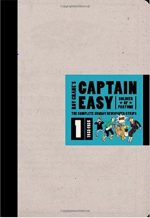
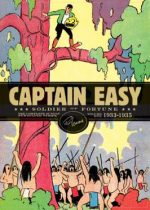
By Roy Crane, Les Turner & various (Fantagraphics Books)
ISBN: 978-1-60699-161-9 (Album HC)
This book includes Discriminatory Content produced in less enlightened times.
Amongst the many cartoon and comics anniversaries this year there are household names still with us (albeit in exceedingly altered forms) and tragically masterpieces of the form that have faded from popular memory, even though their influence remains in every panel we might peruse…
Modern comics evolved from newspaper gag and comic strips. These pictorial features were, until relatively recently, utterly ubiquitous and hugely popular with the public and highly prized by publishers who used them as an irresistible sales weapon to guarantee and increase circulation and profits. It’s virtually impossible for us today to understand the overwhelming power of the comic strip in America (and wider world) from the Great Depression to the end of World War II. With no television, broadcast radio far from universal, and movie shows at best a weekly treat for most folk, household entertainment was mostly derived from the strip sections of daily and especially Sunday Newspapers. “The Funnies” were the most common recreation for millions who were well served by a fantastic variety and incredible quality of adventures and exploits.
From the very start humour was paramount; hence the terms Funnies and “Comics”, and from these gag and stunt beginnings – a blend of silent movie slapstick, outrageous fantasy and the vaudeville shows – evolved a thoroughly entertaining mutant hybrid: Roy Crane’s Wash Tubbs. Debuting on April 14th 1924, Washington Tubbs II was a comedic gag-a-day vehicle not much different from family favourite Harold Teen (by Crane’s friend and contemporary Carl Ed). Depiction of pretty girls was a key component of the daily show, and when it launched, Tubbs was a diminutive yet ambitious young store-clerk. However, gradually the strip moved into mock-heroics, then through cosy, non-confrontational action, to become a full-blown, light-hearted, rip-roaring adventure series… after the introduction of ancestral he-man and prototype moody swashbuckler Captain Easy in the landmark episode for 6th May, 1929. Incidentally Wash Tubbs ran until 1949, at which time it merged into Crane’s spin-off feature: the previously Sunday-only Captain Easy, Soldier of Fortune.
As the daily episodes had become ever-more exotic and thrill-packed, the globetrotting little dynamo had shown a clear need for a sidekick who could believably handle the strenuous combat side of things, and thus – in the middle of a Europe-set war yarn – Wash liberated a mysterious fellow American from a jail cell and history was made…
Before long the mismatched pair were travelling companions, hunting treasure, fighting thugs and rescuing a bevy of startlingly comely maidens in distress. The bluff, two-fisted, surly, comprehensively capable, utterly dependable, down-on-his-luck “Southern Gen’leman” was something not seen before in comics: a raw, square-jawed hunk played completely straight rather than as the buffoon or music hall foil of such classic serials as Hairsbreadth Harry or Desperate Desmond.
Moreover, Crane’s seductively simple blend of cartoon exuberance and stylish design was a far more accessible. exuberant and powerful medium for action storytelling than the rather static illustrative style favoured by artists like Hal Foster: just beginning to make waves on the groundbreaking new Tarzan Sunday page. Tubbs & Easy were as exotic and thrilling as the Ape-Man, but rattled along like the surreal and tempestuous Popeye, full of vim, vigour and vinegar, as attested to by a close look at the early work of the would-be cartoonists who followed the strip with avid intensity: Floyd Gottfredson, Milton Caniff, Jack Kirby, Will Eisner and especially young Joe Shuster…
After a couple of abortive attempts starring his little hero, Crane bowed to the inevitable and created instead a full-colour Sunday page dedicated to his increasingly popular hero-for-hire.
Captain Easy debuted on 30th July 1933 (Heppy Buthday, Suh!), in wild-&-woolly escapades set prior to his first fateful rendezvous with Tubbs.
This first sublime archival volume (long-overdue for rerelease and a digital edition) begins with the sullen mercenary undertaking a mission for the Chinese government… spying on the city of ‘Gungshi.’ In that heyday of popular exploration and dashing-aviator exploits, the bold solo flight over the Himalayas to Chinese Turkestan was stirring enough, but when Easy then infiltrates a hidden citadel, it heralds the beginning of a rollercoaster romp with sword-wielding Mongols, sultry houris, helpless dancing girls, fabulous beasts and wicked bandits. The heady, intoxicating dramatic brew captivated entire families across the planet, week after addictive week…
With an entire page and vibrant colours to play with, Crane’s imagination ran wild and his fabulous visual concoctions achieved a timeless immediacy that made each page a unified piece of sequential art.
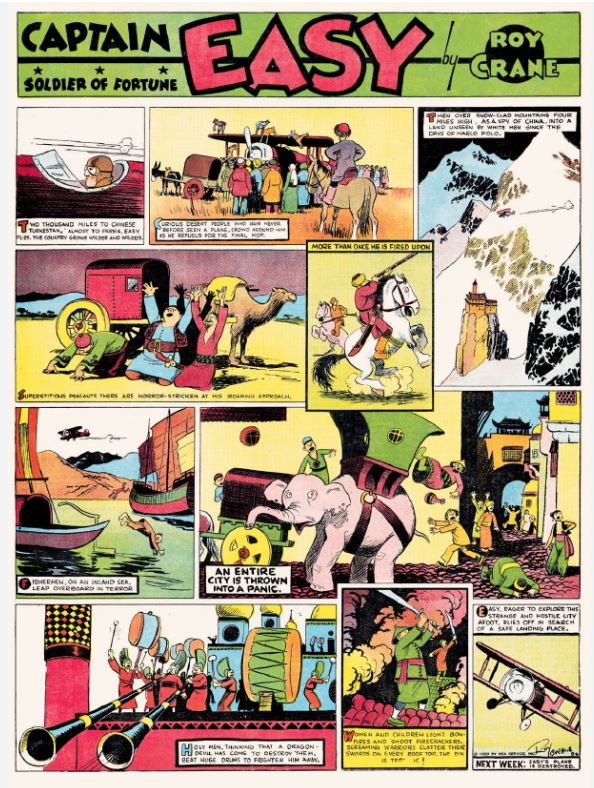
The effect and influence of Crane’s pages can be seen in so many strips since; especially the works of close-contemporaries such as Hergé and giants-in-waiting like Charles Schulz.
These pages were a clearly as much of joy to create as to read. In fact, the cited reason for Crane surrendering the Sunday strip to his assistant Les Turner in 1937 was controlling NEA Syndicate’s abrupt and arbitrary demand that all its strips be henceforward produced in a rigid panel-structure to facilitate them being cut up and re-pasted as local editors dictated.
Crane simply walked away, concentrating on the daily feature. In 1943, he quit the Syndicate to create aviation adventure strip Buz Sawyer.
At the end of the initial blockbuster, cinematic epic Easy is a hero to the people of Gungshi, if not its aristocracy, who plot to oust him via the subtlest of means. The second adventure ‘The Slave Girl’ opened on 21st January 1934, depicting the occidental hero bankrupted in saving the beautiful Rose Petal from the auction block: a chivalrous gesture leading to war with the rival city of Kashno, and a brutally hilarious encounter with South Sea pirates…
In an era where ethnic stereotyping and casual racism were commonplace and acceptable – if not actually the mandatory shortcuts of social interaction – the introduction of a vile, unscrupulous Yank as the exploitative villain was – and remains – a surprising delight.
Rambling Jack is every inch the greedy “ugly American” of later, more informed decades, and by contrasting Easy’s wholesome quest to make his fortune with the venal explorer’s rapacious ruthlessness, Crane makes a telling point for the folks back home. It also makes for great reading, as Chinese bandits also enter the fray, determined to plunder both cities and everybody else in their path. Nevertheless, with the help of a lost British flyer Easy is finally victorious, but on returning to his Chinese employers he spots something whilst flying over the Himalayas that radically derails his plans…
‘The Sunken City’ is an early masterpiece of comics fiction, with Easy recruiting cockney comedy stooge ‘Arry Pippy, a demobbed British Army cook, to help reconnoitre a drowned metropolis submerged for centuries in a hidden inland sea, and one he had he had spotted from the air only through sheer chance. Of course, simply to get there the pair must trek through rampant jungles, survive blowpipe-wielding cannibals and avoid the greatest threat our valiant rogue has ever faced…
If I’ve given the impression that this has all been grim-‘n’-gritty turmoil & tension thus far, please forgive me: Roy Crane was an utterly irrepressible gag-man and his enchanting chapter-play serial abounds with breezy light-hearted banter, hilarious situations and outright farce… a sure-fire formula cinema directors still plunder to this day. Easy is the Indiana Jones, Flynn (The Librarian) Carsen and Jack (Romancing the Stone) Cotton of his day and inarguably blazed the trail for all of them and whoever I’ve left out… even Lara Croft…
In a deep-sea diver’s suit, Easy & ‘Arry examine piscine wonders and trace the submerged grandeur of the lost city, encountering some of the most magical and fanciful sea beasts ever recorded in comics, before literally striking gold. Typically, when more cannibals attack those dredged up treasures are lost and Easy finds himself captive and betrothed to the most hideous witch-hag imaginable…
Risking everything, the desperate treasure-seekers make a break for it only to re-encounter ‘The Pirates’ (April 14th – July 7th 1935), but before they get too far the husband-hungry sorceress and her faithful person-eaters come after Easy, leading to a brutal, murderous conclusion…
After years in the Orient, Easy & Pippy succumb to a hankering for less dangerous company and make their way to Constantinople and Europe. Sadly, trouble is never far from the moody mercenary and in ‘The Princess’ (14th July – December 1st 1935), his gentlemanly instincts compel him to rescue a beautiful woman from the unwelcome attentions of munitions magnate Count Heyloff, a gallant gesture that embroils our hero in a manufactured war between two minor nations. This tale addressed contemporary American sentiments that another world conflict was brewing, and it’s obvious that Crane’s opinion was the deeply held common conviction that the whole international unrest was the result of rich men’s greedy manipulations and machinations. Just like today…
Dark, bittersweet and painfully foreboding, this yarn sees Easy become the focus of Heyloff’s vengeance, and the sum total Airforce for tiny underdog nation Nikkateena in their bitter struggle for survival against the equally-duped and deceived country of Woopsydasia. Crane kept the combat chronicle light but on occasion his true feelings showed through in some of the most trenchant anti-war art ever seen.
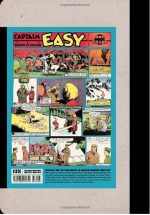
This superb hardback and colossal initial collection is the perfect means of discovering or rediscovering Roy Crane’s rip-snorting, pulse-pounding, exotically racy adventure pioneer. The huge pages in this volume (almost 14½ inches by 10½ inches, or 210 x 140 mm for the metric crowd dominating global measuring these days) also offer a fascinating, informative introductory biography of Crane by historian Jeet Heer; a glowing testimonial from Charles Schulz; contemporary promotional material, extra drawings and sketches, plus a fascinating feature explaining how pages were coloured in those long-ago days before computers and other jumped-up adding machines…
This is primal comics storytelling of the very highest quality: unforgettable, spectacular and utterly irresistible. These tales rank alongside the best of Hergé, Tezuka, Eisner and Kirby, and led inexorably to the greatest creations of all of them. You have the chance to experience the strips that inspired the giants of our art form, and celebrate the achievements, so how can you possibly resist?
Captain Easy Strips © 2010 United Features Syndicate, Inc. This edition © 2010 Fantagraphics Books, all other material © the respective copyright holders. All rights reserved.
Today in 1892 Alfred Harmsworth launched landmark British comics storypaper The Wonder, sharing the date with DC Thomson’s The Beano, debuting in 1938. In 1955, Ken Reid’s hilarious timeless feature Grandpa began in The Beano. Of course you already know Captain Easy launched on July 30th 1933.
Births on this day include colourist Tom Ziuko in 1955; Turkish cartoonist Turhan Selçuk and French author/artist Hervé Darmenton AKA “Achde” (Fort Braillard, Woker, Les Damnés de la route, CRS=Détresse, Lucky Luke ) in 1961 and illustrator Chris Sprouse (Tom Strong, Supreme, Hammerlocke, The Rocketeer, Legion of Super-Heroes) in 1966.
Today in 1992 Joe Shuster died.