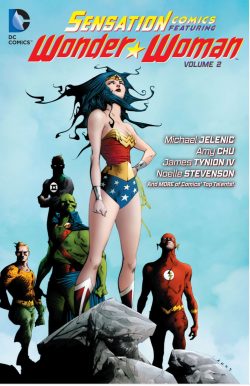
Sensation Comics Featuring Wonder Woman volume 2


By Michael Jelenic, Adam P. Knave, Alex De Campi, Amy Chu, James Tynion IV, Heather Nuhfer, Lauren Beukes, Cecil Castelucci, Sara Ryan, Aaron Lopresti, Drew Johnson, Matthew Dow Smith, Ray Snyder, Neil Googe, Bernard Chang, Noelle Stevenson, Ryan Benjamin, Mike Maihack, Chris Sprouse & Karl Story, Christian Duce & various (DC Comics)
ISBN: 978-1-4012-5862-7 (TPB/Digital edition)

Time to start planning for a Big Comics Anniversary later this year…

The Princess of Paradise Island originally debuted as a special feature in All Star Comics #8, cover-dated December 1941, but actually on sale from October 21st of that year). She was officially conceived by psychologist/polygraph pioneer William Moulton Marston and illustrated by Harry G. Peter, in a calculated attempt to offer girls a positive and forceful role model and, on forward-thinking Editor M.C. Gaines’ part, to sell more funnybooks to girls. Later research has since disclosed much of her genesis was due to Moulton’s wife – attorney turned psychologist Sarah Elizabeth Marston (née Holloway) who had worked with him to create the systolic lie detector process – and their live-in partner Olive Byrne.

Despite all the complexities and confusion surrounding her genesis, Wonder Woman was an instant hit and catapulted from the try-out into her own series as the cover-feature character of new anthology title Sensation Comics one month later. The Amazing Amazon then won her own eponymous supplemental title a few months after that, cover-dated summer 1942…

You already know the story: Once upon a time on a hidden island of immortal super-women, American aviator Steve Trevor of US Army Intelligence crashed to Earth. Near death, he was nursed back to health by young, impressionable Princess Diana. Fearful of her besotted child’s growing obsession with the creature from a long-forgotten and madly violent world, Diana’s mother Queen Hippolyte revealed the hidden history of the Amazons: how they were seduced and betrayed by men but rescued by the goddess Aphrodite on condition they forever isolate themselves from the mortal world and devote their eternal lives to becoming ideal, perfect creatures.

However, with the planet in crisis, goddesses Aphrodite and her sister Athena instructed Hippolyte to send an Amazon back with the American to fight for global freedom and liberty. Although forbidden to compete, closeted, cosseted Diana clandestinely overcame all other candidates to become their emissary: Wonder Woman.

On arriving in the Land of the Free she purchased the identity and credentials of lovelorn Army nurse Diana Prince, which elegantly allowed the unregistered immigrant to stay close to Steve whilst enabling the heartsick care-worker to join her own fiancé in South America.

The new Diana soon gained a position with Army Intelligence as secretary to General Darnell, further ensuring she would always be able to watch over her beloved. She little suspected that, although the painfully shallow Steve only had eyes for the dazzling Amazon superwoman, the General had fallen for the mousy but supremely competent Lt. Prince…

That set up enabled the Star-Spangled Sentinel to weather the notoriously transient comic book marketplace, surviving the end of costumed heroes’ Golden Age beside Superman, Batman and a few lucky hangers-on who inhabited the backs of their titles. She soldiered on well into the Silver Age revival under the auspices of Robert Kanigher, Ross Andru & Mike Esposito, but by 1968 superhero comics were in decline again and publishers sought new ways to keep audiences interested as tastes – and American society – changed.

Back then, as her sales withered during the mid-1960’s, the entire industry depended on newsstand sales and if you weren’t popular, you died. Jack Miller, Denny O’Neill & Mike Sekowsky stepped up with a radical depowering and made comic book history with the only female superhero to still have her own title in that marketplace. Eventually, however, merely mortal trouble-shooter gave way to a reinvigorated Amazing Amazon who battled declining sales (thanks to a TV-inspired boost) until DC’s groundbreaking Crisis on Infinite Earths after which she was once again fundamentally reimagined.

Minor tweaks in her continuity accommodated different creators’ tenures until 2011 when DC rebooted their entire comics line again and Wonder Woman once more underwent a drastic, fan-infuriating root-and-branch refit. Possibly to mitigate the fallout the publishers okayed a number of fall-back options such as this intriguing package…

Sensation Comics Featuring Wonder Woman began as a “digital first” series online before collecting chapters into a new standard comic book. Crafted by a fluctuating roster of artists and writers, the contents highlighted every previous era and incarnation of the character – and even a few wildly innovative alternative visions – offering a wide variety of thrilling, engaging and sincerely fun-filled moments to remember. The physical iteration was enough to warrant a series of trade paperback compilations which – in the fullness of time and nature of circularity – gained their own digital avatars as eBooks too.

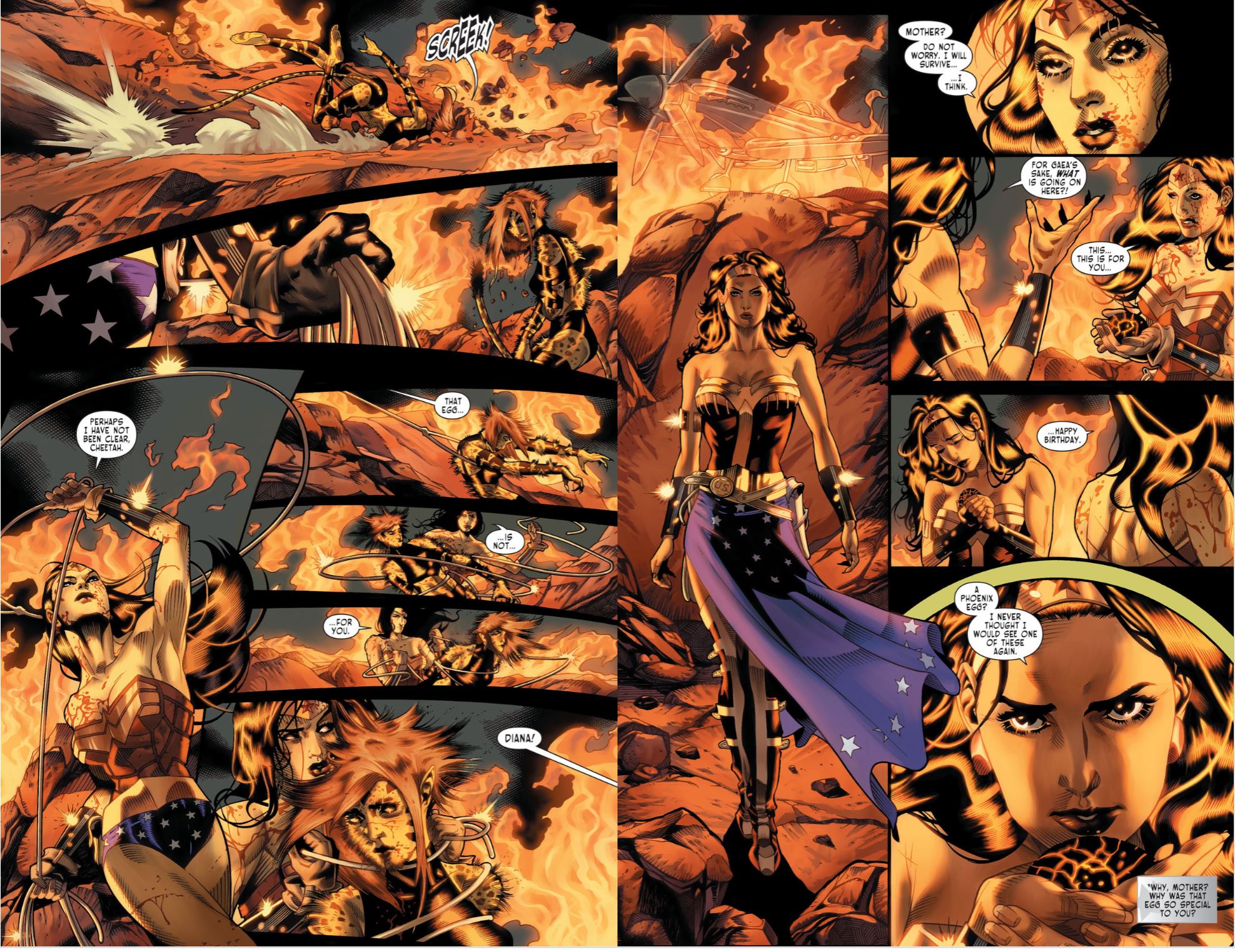
This second of three full-colour treasuries gathered Sensation Comics Featuring Wonder Woman #6-10 (March-July 2015) and offered another legion of talent and multitude of different visions, beginning with ‘Generations’ by Michael Jelenic & Drew Johnson, wherein an annual odyssey for the perfect gift for Amazon Queen – and rather forbidding mother – Hippolyta leads Diana into battle with mythical monsters, an old enemy and her own obsessive drive to overachieve…

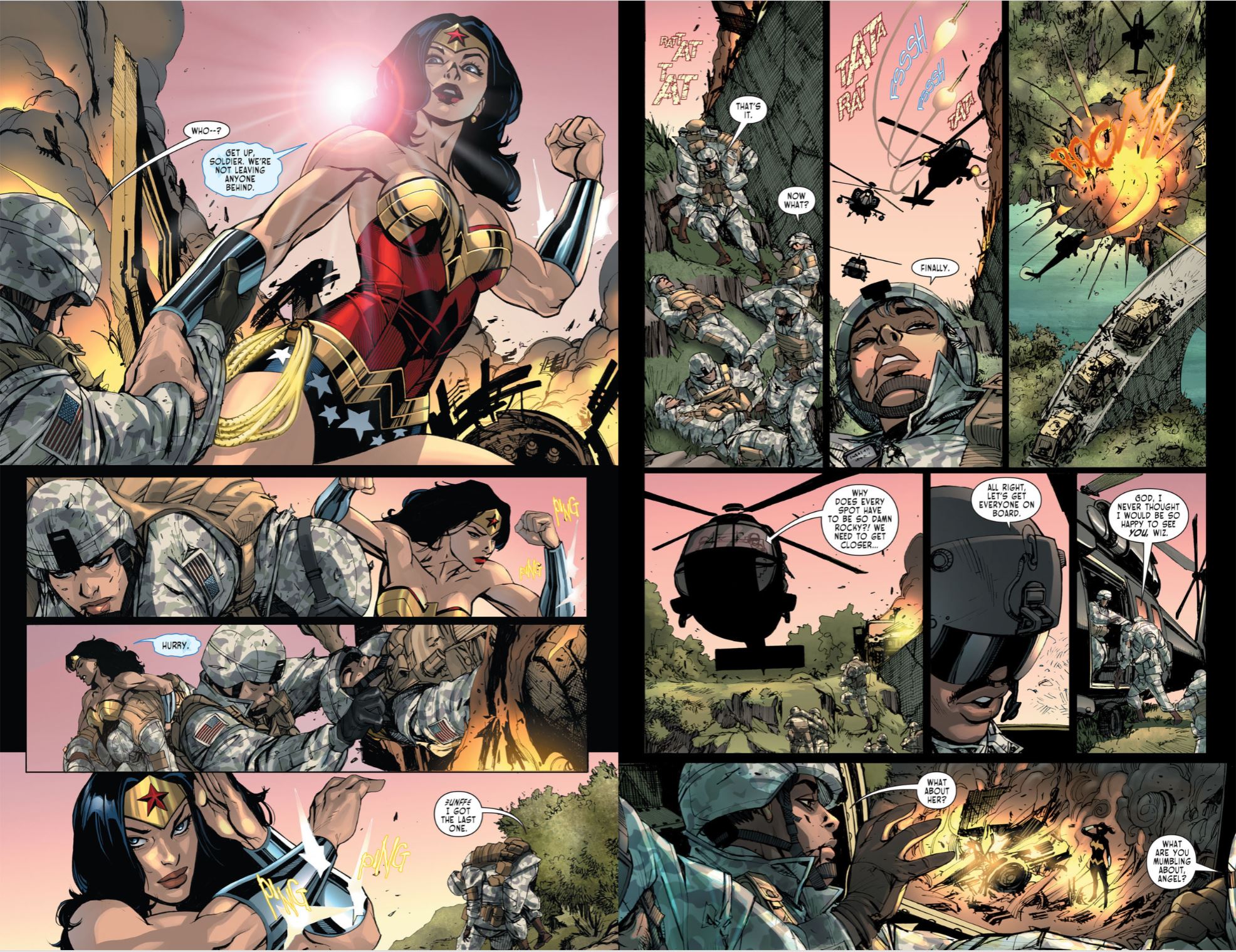
Adam P. Knave & Matthew Dow Smith’s ‘Not Included’ pairs the potent Paradise Islander with Apokolyptian New God Big Barda against evil super-science and robotic hordes of The Brain and M’sieu Mallah, after which a decidedly different take by Alex De Campi & Neil Googe has Wonder Woman coming to the rescue of a commercial space station above the Second Rock from the Sun in ‘Venus Rising’. Amy Chu & Bernard Chang then go out-world to celebrate the core concept of Wonder Woman in ‘Rescue Angel’, as soldiers pinned down in Afghanistan are saved by Lt. Angel Santiago. The wounded warrior claims her outstanding actions under fire are the result of a vision from her beloved, long-cherished comic books…

Spectacular action and sinister skulduggery inform Heather Nuhfer & Ryan Benjamin’s clash between the Amazing Amazon and Lex Luthor, who triggers ‘Sabotage is in the Stars’ when the Indian government’s space program starts impacting Lexcorp’s projected profits. James Tynion IV & Noelle Stevenson introduce feisty teen Riley as guide to a culture-shocked young Diana in ‘Wonder World’ next, but as they bond over stupid boys and cheesy beachside entertainments, the girls are blithely unaware the foreign newcomer’s Amazon bodyguards are frantically searching for their AWOL charge…

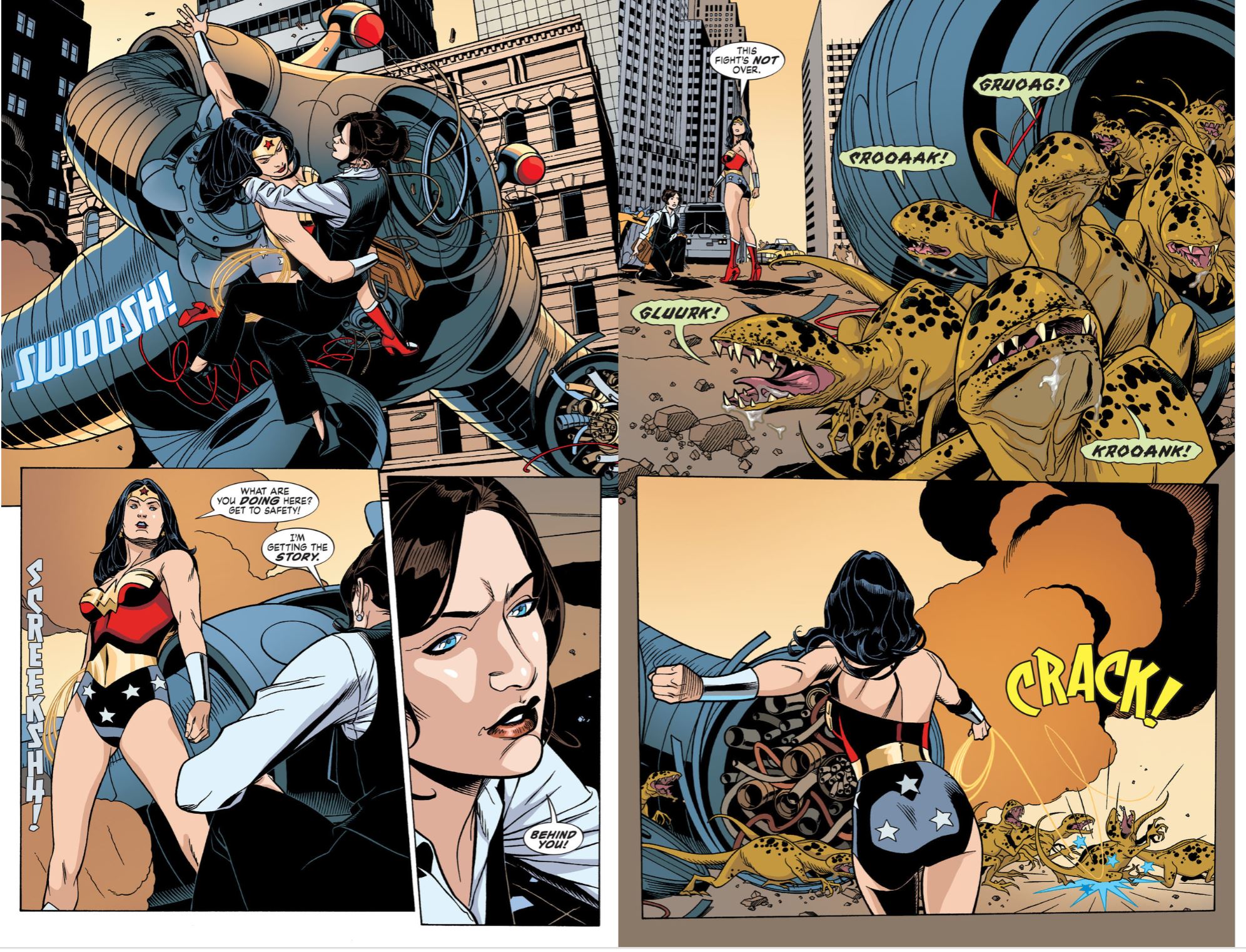
‘The Problem with Cats’ by Lauren Beukes & Mike Maihack takes a light-hearted look at sisterhood and the rivalry between Wonder Woman and The Cheetah – or is it all in the over-active imagination of frustrated. grounded little African girl Zozo? Possibly the best yarn this go-round comes as frosty, testy and possibly hostile Daily Planet journalist Lois Lane is ordered to interview Wonder Woman.

The ice is only broken after an monster invasion leads to a splendid ‘Girl’s Day Out’, courtesy of Cecil Castelucci, Chris Sprouse & Karl Story before Sara Ryan & Christian Duce reveal a timely intervention that saves the life and emotional stability of ‘VIP’ pop star Esperanza, before Aaron Lopresti wraps up this parade of pulse-pounding peril and imago of insightful episodes with a brutal dragonslaying clash as ‘Casualties of War’ shows Diana’s abiding reluctance to engage in battle, but how sometimes there is just no other choice…

Augmented by a spectacular covers-&-variants gallery from Paul Davey, Shane Davis, Michelle & Alex Sinclair, Ben Caldwell & Francesco Francavilla, this is a scintillating snapshot of the astounding variety of visions Wonder Woman has inspired in her decades of existence, and one to delight fans old and new alike.
© 2015 DC Comics. All Rights Reserved.

Today in 1928 DC star artist/inker Joe Giella (Hopalong Cassidy, Flash, Adam Strange, Justice League of America, DC Comics Presents, Flash Gordon, The Phantom, Mary Worth) was born, with creator Dan Jurgens (Booster Gold, Superman, Captain America, Thor) arriving in 1959 and Jackson Guice (Micronauts, Action Comics, The Flash, Ruse) and Canadian cartoonist Bernie Mireault (Grendel, The Jam, Dr. Robot, McKenzie Queen) sharing a 1961 birthday.

In 20005, Atsushi Suzumi’s manga Venus Versus Virus began, as did Seinen anthology magazine Monthly Comic Alive one year later. In 2001 Tove Jansson died, predeceasing co-founder of The School of Visual Arts (AKA the Cartoonists and Illustrators School, NYC) Silas Rhodes in 2007, and Belgian creator, comics historian and Spirou editor Thierry Martens/Yves Varende.

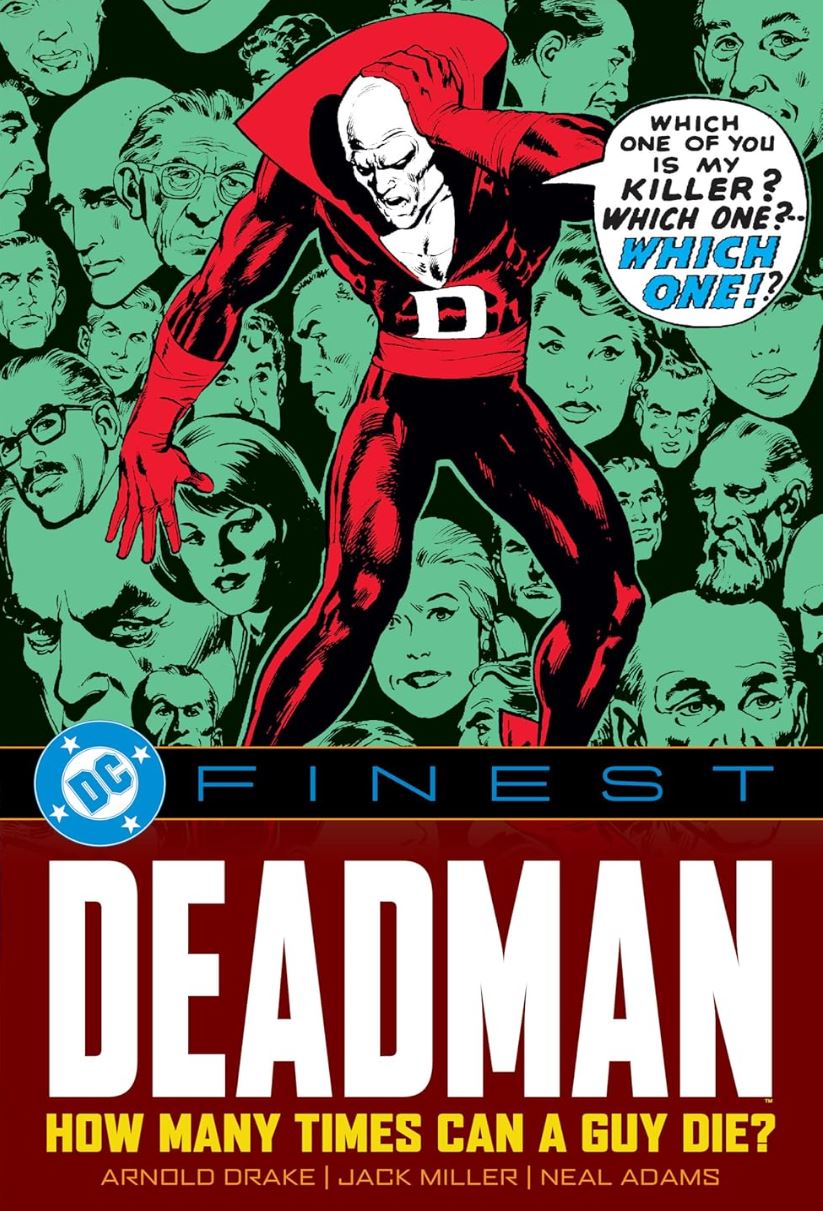
DC Finest: Deadman – How Many Times Can a Guy Die?


By Arnold Drake, Neal Adams, Jack Miller, Bob Haney, Robert Kanigher, Dennis O’Neil, Mike Friedrich, Jack Kirby, Paul Levitz, Cary Bates, Carmine Infantino, Dick Dillin, George Tuska, Jim Aparo, Mike Grell, Fred Carillo, Kurt Schaffenberger, George Roussos, Joe Giella, Mike Royer, Vince Colletta, Tex Blaisdell & various (DC Comics)
ISBN: 978-1-79950-771-0 (TPB)

This book includes Discriminatory Content produced in less enlightened times.

As the 1960s ended, a massive superhero boom became a slow, inescapable bust, with (formerly) major draws no longer able to find enough readers to keep them alive. The appetite for superheroes was diminishing in favour of more traditional genres, and rational editorial response was to reshape costumed characters to fit evolving contemporary tastes.

Publishers swiftly changed gears and even staid, cautious DC reacted rapidly to make masked adventurers fit the new reality. Newly revised and revived costumed features included roving mystic troubleshooter Phantom Stranger and golden age titan The Spectre, whilst resurgent traditional genres spawned atrocity-faced WWII spy Unknown Soldier and cowboy bounty hunter Jonah Hex, spectral western avenger El Diablo and game changing monster hero Swamp Thing, all spearheading a torrent of new formats, anthologies and concepts.

Crucially, supernatural themes and horror-tinged plots were shoehorned into those superhero titles that weathered the trend-storm. Arguably, the moment of surrender and change had already arrived in 1967 with the creation of Boston Brand in the autumn of “The Summer of Love”, as venerable sci fi anthology Strange Adventures was abruptly reconditioned as the haunted home of an angry ghost…

Without fanfare or warning, Deadman debuted in #205 with this collection re-presenting that origin event and thereafter, pertinent contents from #206-216 and crossovers and guest shots from Aquaman #50-52; The Brave and the Bold #79, 86, 104, 133, Justice League of America #94; The Phantom Stranger #33, 39-41; World’s Finest Comics #223 & 227, Challengers of the Unknown #74; Forever People #9-10 and Superman Family #183, all cumulatively spanning cover-dates October 1967 to May/June 1977.

Crafted by Arnold Drake, Carmine Infantino & George Roussos, SA #205’s ‘Who Has Been Lying in My Grave?’ opens at the funeral of high wire acrobat Boston Brand: a rough, tough, jaded performer who had seen everything and masked his decent human heart behind an obnoxious exterior and cynical demeanour. As “Deadman”, Brand had been the star attraction of Hills Circus and lover of its reluctant owner Lorna Carling. He also acted as a secret guardian for the misfits it employed and sheltered. That makeshift “family” includes simple-minded strongman Tiny and Asian mystic Vashnu, but also had some bad eggs too, like alcoholic animal trainer Heldrich and chiselling carnival Barker Leary. The aerialist kept them in line… with his fists, whenever necessary…
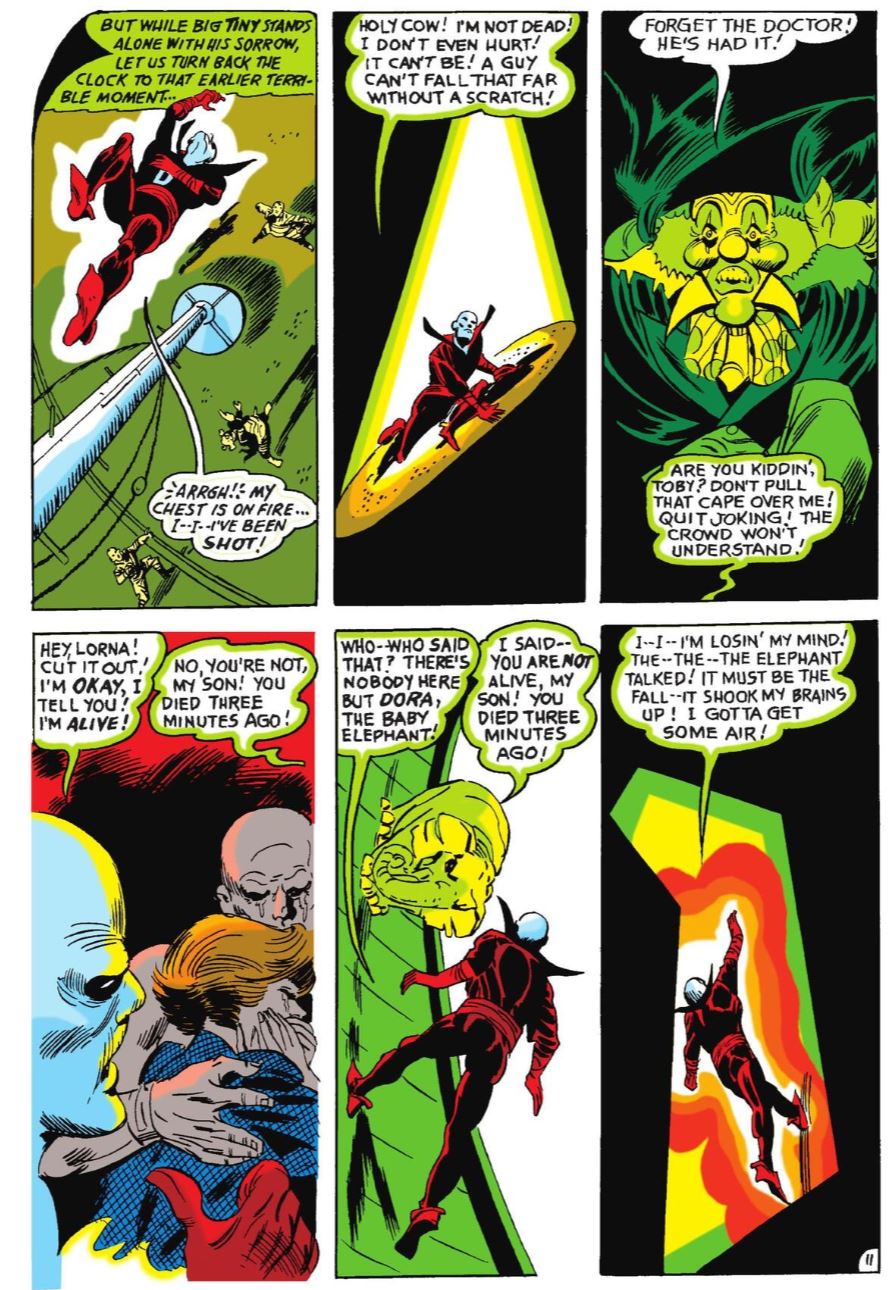
One fateful night, Brand almost missed his cue because of Leary and Heldrich’ antics, but also because he had to stop local cop Ramsey harassing Vashnu. It would have better if Brand had been late, because as soon as he started his act – 40 feet up and without a net – someone put a rifle slug into his heart. Despite being dead before he hit the ground, Brand was scared and furious. Nobody could see or hear him screaming, although Vashnu kept babbling on that he was the chosen of Rama Kushna – “the spirit of the universe”. The hokum all came horribly true when that entity astonishingly made contact, telling Boston that he would walk among men until he found his killer.

The gig came with some advantages. He was invisible, untouchable, immune to the laws of physics and able to take possession of the living and drive them like a meat car. His only clue was witnesses in the audience who claimed that a man with a hook had shot him…

Outraged, still disbelieving and seemingly stuck forever in the ghastly make-up and outfit of his performing persona, Deadman’s first posthumous act is to possess Tiny and check out key suspects. Soon the dormant Hercules finds that the cop Ramsey and Heydrich are involved in a criminal conspiracy, but they definitely are not Brand’s murderers. Eventually, the ghost learns a shocking fact: his desperation is not worth the life of anyone else and he must not let his anger put his “vessels” in harm’s way…

Scripted by Drake and inked by Roussos, second episode ‘An Eye for An Eye!’ was Neal Adams’ illustrative debut. He was born on June 15th 1941 at Governors Island, New York City. The family were career military and Neal grew up on bases across the world. In the late 1950s, he studied at the High School of Industrial Art in Manhattan, and graduated in 1959.

As the turbulent Sixties began, he was a budding illustrator working in advertising, ghosting newspaper strips and seeking to break into comics. Whilst pursuing a career in “real” and “commercial” art, Adams did pages for Joe Simon at Archie Comics (The Fly and that red-headed kid, too) before becoming one of the youngest artists to co-create/illustrate a major licensed newspaper strip (Ben Casey, based on a popular TV medical drama). The neophyte’s attempts to break in at DC were not so successful…

Comic book fascination never faded, and as the decade progressed, Adams drifted back to National/DC, creating covers as inker or penciller. His chance came via anthological war comics and he eventually found himself at the vanguard of a revolution in pictorial storytelling. He made such a mark that decades later, DC celebrated his contributions by reprinting every piece of work Adams ever did for them in commemorative collections. Sadly, we’re still awaiting a definitive book of his horror comics and covers, and will probably never see his sterling efforts on licensed titles like Hot Wheels, The Adventures of Bob Hope and The Adventures of Jerry Lewis. That’s a real shame: they all display his wry facility for gag staging and personal drama…

Most importantly, Adams was a tireless campaigner for creators’ rights, whose efforts finally secured some long-ignored liberties and rewards for the formerly invisible stars of comic books.

Back with Deadman, however, the tale is a strong one and indicates a sea change in narrative style as Deadman expedites his hunt for justice. The stories henceforth focus on those who are temporarily occupied by Brand: a string of episodic encounters mirroring the protagonist of contemporary hit TV show The Fugitive (and by extension, Victor Hugo’s Les Misérables), with an unfairly accused victim searching for personal justice across America, to the benefit of many people in crisis.

Here, that’s young Jeff  Carling, who’s fallen in with a dangerous biker gang and is set up to pay for their crimes. He’s also Lorna’s brother, which is how Deadman gets involved in the mess, after learning the cash-strapped kid had taken out a life insurance policy on circus star Deadman just before the Hook struck…

Having saved the kid from a perfect frame, Brand resumes his search and, as Jack Miller took over scripting in #207, is forced to ask ‘What Makes a Corpse Cry? The hunt leads him to revisit the night he saved bar girl Liz Martin from a drunken assault by her boss Rocky Manzel, but when the spook checks in, he finds Liz and boyfriend Paul being terrorised by Rocky, who coldly implies he caused the death of her last protector…

Even after using his ghost gifts to disqualify Manzel, Deadman is compelled to help the young lovers, and exposes the club owner’s criminal secret, but once again almost causes the death of his human host.

Miller & Adams were providing a very different reading experience with mature tales delivered via innovative, staggeringly powerful art, but they struggled with deadlines, and ‘How Many Ways Can a Guy Die?’ was delivered in 4 parts across Strange Adventures #208 and 209. The revelatory tale introduces Brand’s trapeze artist rival Eagle, who had tried to kill him years before, and now seeks to replace him in the big top and Lorna’s bed… whether she wants him or not. When Deadman again borrows Tiny to dissuade the thug, Eagle threatens the gentle strongman with the “same thing Brand got” and the ghost is convinced his quest is almost over.

However, the truth is far crueller, and when Deadman uncovers his rival’s actual scheme, the cost to Tiny and alternate vessel Pete is far too high…

His hunt stalled again, Brand finally thinks to check the official police investigation in #210’s ‘Hide and Seek’ (cover-dated March 1968). To his disgust, he finds the case is cold, with assigned detective Michael Riley dishonourably discharged from the force due to the testimony of a man with a hook. Sensing a breakthrough, Deadman possesses Riley and, visiting the other “witness” to the former cop’s reported use of excessive force, uncovers a devious plot. Sadly, despite clearing Riley’s name, Brand misses The Hook who flees to Mexico but not before coldly disposing of the only man who could describe him…

Hot on the trail, Deadman arrives in El Campo in #211, and endures a shocking surprise in ‘How Close to Me My Killer?’ as Miller’s last story introduces wayward twin brother Cleveland Brand. Flashbacks show the lost sibling had plenty of motive to murder his showbiz brother, but as the tale unfolds, Boston learns he has an unsuspected niece and his people-trafficking but repentant brother needs haunted help to save smuggled “wetback” labourers from a Texan businessman looking to whitewash his criminal endeavours…

Adams took over scripting with #212 and ‘The Fatal Call of Vengeance’ sees another change of direction, adding more conventional fantasy elements to the mix as Cleveland and his daughter Lita head north to the Hills Circus. Wearing his brother’s costume, Cleve revives the Deadman act and, in Mexico, a man with a hook sees a headline and rushes back to the USA. Faster than any jet, Boston is already there and watches helplessly as his brother makes himself a target of the unknown killer. The phantom is also completely spooked by new lion tamer Kleigman who is rude, unfriendly and missing his right hand…

With everyone at odds, both Boston’s returned killer and the circus family set traps with disastrous results, but in the end the Hook escapes again and it’s Tiny who’s left bleeding out from a gunshot…

‘The Call from Beyond!’ then tests Deadman’s abilities to the limit as he enters Tiny’s consciousness to expedite his recovery and break an assumed-fatal coma. Following that miracle, the restless revenant repays his debt by saving the reputation and life of Tiny’s surgeon Dr. Shasti after the medical savant is duped by murderous con artist/medium Madam Pegeen

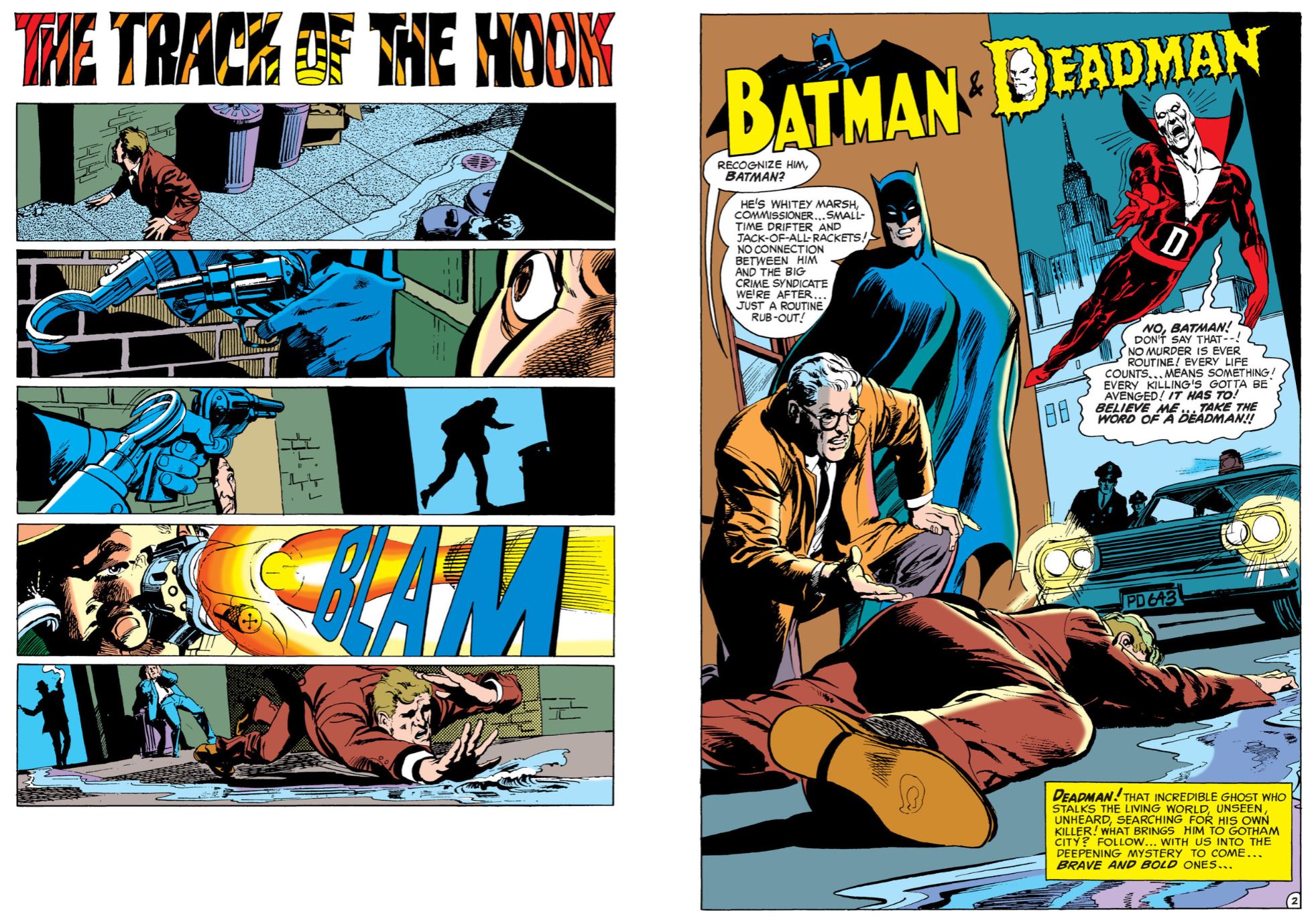
The afterlife of a reluctant and selfish spectral stalwart then continues in The Brave & Bold #79 (August/September 1968): heralding Adams’ assumption of interior art duties on that title and launching a groundbreaking run rewriting the rulebook for strip illustration. Penned by Bob Haney, ‘The Track of the Hook’ paired the Gotham Guardian with the justice-obsessed ghost as a false trail led Boston to Gotham. After clearing up the confusions and dethroning millionaire crime-lord Carleton “Kubla” Kaine, Deadman returned to finding own killer. However his earthy human tragedy elevated Batman’s costume theatrics into deeper, more mature realms of drama and action. It was probably mainstream superhero fandom’s first glimpse of the ghost. During this period, Adams was writing and illustrating Brand’s solo stories in Strange Adventures and although his consultation of the World’s Greatest Detective bore little useful progress, it had provided the lonely ghost with a first genuine point of human contact…

Back in Strange Adventures # 214 (cover-dated September/October 1968), Robert Kanigher scripted To Haunt a Killer’ as Brand is seduced by loneliness into sharing the romantic experiences of Phil and his girlfriend Ruth. That salacious intrusion sours once Brand discovers his new meat suit is a hitman and his overreaction almost costs innocent Ruth everything…

When Adams returns to full control in #215, the narrative arc takes a huge leap forward as ‘A New Lease on Death’ accidentally drops his killer right in his lap. Witnessing a murder, Deadman trails the shooter all the way to Hong Kong where he finds an ancient, super-advanced League of Assassins and discovers the truly trivial reason for his own extinction…

Furiously questioning ‘Can Vengeance Be So Hollow?’, Brand meets for the first time killer mystic The Sensei – a master murderer who has dealt with ghosts before – and helplessly, frustratingly, experiences the end of the Hook. When the sinister sage executes Boston’s death-long quarry, Rama Kushna asks if a balance has been struck and capitalises on Brand’s furious negative response. Brand demands true justice for everyone and inadvertently elects himself the agent of its enactment in ‘But I Still Exist’

The drama abruptly concluded in Strange Adventures #216 (January/February 1969), as the grim ghost seeks to disrupt the Sensei’s next scheme: the violent erasure of a Tibetan spiritual paradise. Nanda Parbat is a sanctuary for the wicked where the ancient villain’s murderous recruits and other fallen folk live in inexplicable peace, harmony and safety. Such a benevolent Shangri La is bad for the business of murder, but Deadman’s efforts to save the city from invasion initially falter when he flies in and suddenly becomes a living, breathing person again.

… And that’s where the story ended as his Strange Adventures run ended without warning. The next issue began reprints of Adam Strange and The Atomic Knights as the title reverted to its space opera roots. Although his own series had stalled, Deadman stuck around as a perennial walk-on (float-on?) star in many titles, beginning with a return engagement with Batman as the year ended. The Brave & the Bold #86 (October/November 1969) found Brand back in Gotham City, where a string of civilian strangers inexplicably targeted the Caped Crimebuster. The “World’s Greatest Detective” deduced that they were possessed by his former ally and that ‘You Can’t Hide from a Deadman!’

Scripted by Haney, the captivating epic of death, redemption and resurrection pulled together all the floating strands from Deadman’s anticlimactic last issue in a classic clash that became a cornerstone of Bat-mythology forever after. Here, Adams’ concepts and art revealed how Nanda Parbat was under attack by the Sensei’s forces, and how Brand had been briefly brainwashed to attack the Gotham Guardian, in advance of a last-ditch defence of the holy city by the Dark Knight and Deadman’s possessed twin brother Cleveland.

Deadman rematerialised mere months later in a triptych of back-up tales interwoven into a larger but no-less-revolutionary Aquaman storyline (for the full story see Aquaman: Deadly Waters Deluxe edition wherein the Sea King is despatched to a Microverse by aliens working with super villain Ocean Master: a plot accidentally uncovered by Brand, when guilt drags him from a life of solid recuperation back to the intangible quest for cosmic justice…

Here, from Aquaman #50-52 (March/April to July/August 1970), ‘Deadman Rides Again!’ in supplemental tales written and illustrated by Adams: a complex braided crossover as the Sea King endures bizarre threats and incomprehensible rituals in a subatomic realm, whilst Brand acts invisibly and intangibly to save the hero and prevent an alien invasion.

‘The World Cannot Wait for a Deadman’ sees the spirit flitting between dimensions with shapeshifting enigma Tatsinda, before parallel plots converge and complete when ‘Never Underestimate a Deadman’ exhibits the extraterrestrials beaten by the ghost and his pal…
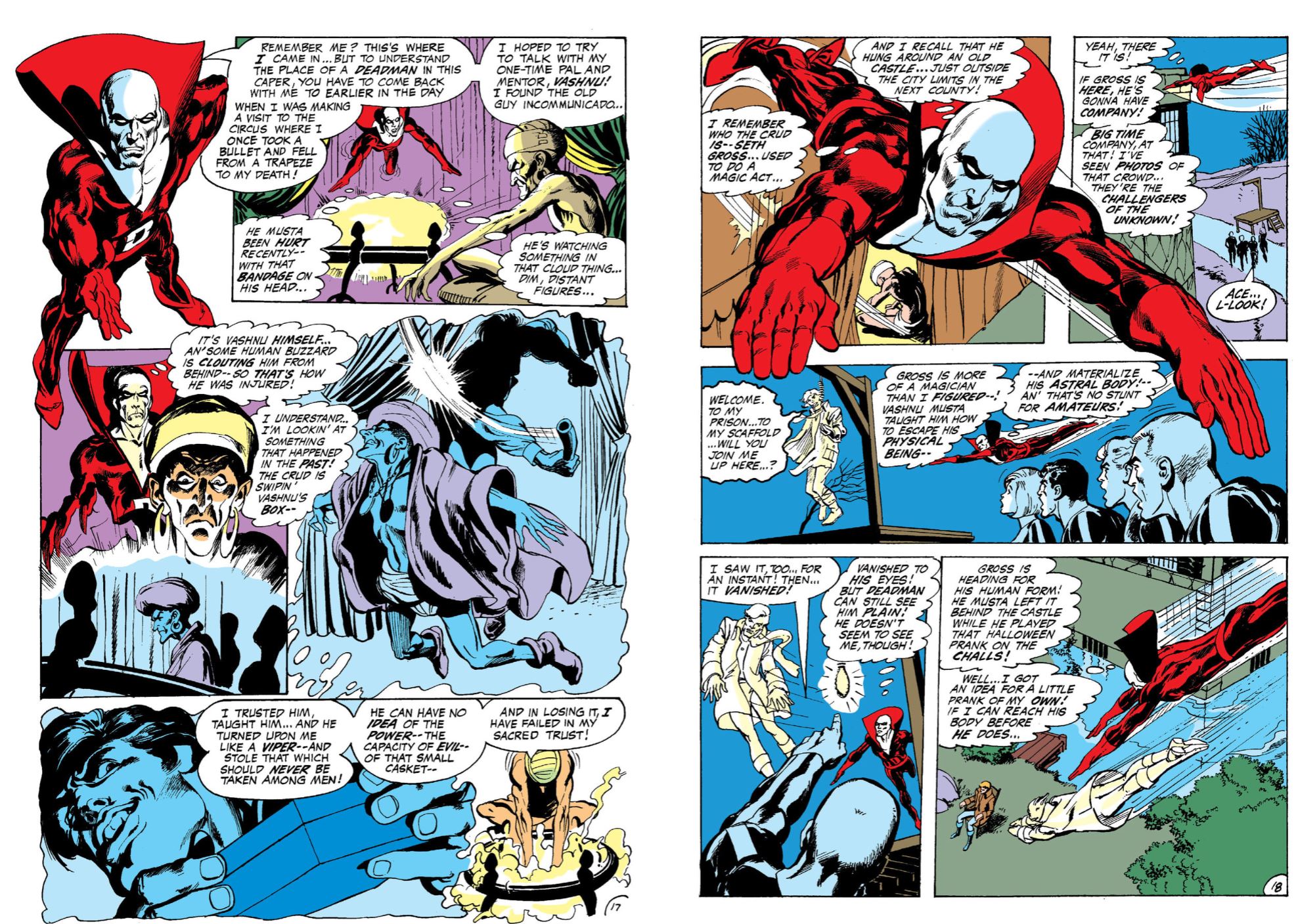
Deadman’s haunting wandering dramas lead to another non-team-up in Challengers of the Unknown #74 (June/July 1970): a far eerier affair tailored to the rise in supernatural terror tales. ‘To Call a Deadman’ is written by Dennis O’Neil, with George Tuska limning scenes featuring the still-breathing “Death-Cheaters”, whilst Adams illustrated those portions focussed on Brand as he imperceptibly aids them in thwarting an ethereal psychic kidnapper seeking to steal a little girl’s soul. The chilling thriller also guest-stars hardboiled private eye Jonny Double and every one of them is needed to defeat the ghastly menace behind the astral abduction.

The same separate artist trick worked supremely well in his next manifestation as Justice League of America #94’s ‘Where Strikes Demonfang?’ by Mike Friedrich, Dick Dillin, Adams & Joe Giella, as the ghostly guardian helps Batman, Aquaman & Green Arrow foil a murder mission by The Sensei’s previously infallible archer Merlyn and the League of Assassins.

The period was one of constant desperate experimentation. Jack Kirby’s Fourth World was a huge risk and massive gamble for an industry and company that was a watchword for conservatism and it was probably incredibly tough for editors and publishers to stop themselves interfering… and they often didn’t.

With sales low, spooky stories proliferating everywhere and popular wisdom saying character crossovers boosted sales, Kirby eventually caved to pressure and agreed to guest another creator’s star in his stand-apart unfolding epic. Thus Forever People #9 hosted homeless horror hero Deadman who was made marginally manifest by a seance and a New Genesis Cosmic Cartridge. The vengeance hunter then accepted an artificial body to pursue the man who killed him (already dead remember?) in an intriguing, action-packed but ultimately ridiculous aside that began by introducing a ‘Monster in the Morgue!’ It rampaged through town before tech bandits ‘The Scavengers’ sought to steal Brand’s new “mobile home”, and drew the wrath of ghost and teen godlings. The yarn actually ended with a plug for Kirby’s forthcoming series The Demon and we don’t talk about the divergent yarn at all around here…

A far more coherent crossover came in Brave and the Bold #104 as Haney & Jim Aparo detailed a poignant story of love from beyond the grave in the enigmatically entitled ‘Second Chance for a Deadman?’ wherein the ghost helps Batman take down murderous mobster Lilly Lang, wrongly assuming he can redeem her only to learn that even a corpse can be crushed by heartbreak…

In World’s Finest Comics #223, while hunting a serial killer, Superman & Batman recruit Brand to help. Shocks abound when evidence points to the culprit being the brain-damaged, secretly institutionalised, unsuspected older brother of Bruce Wayne but when the total truth emerges in ‘Wipe the Blood off My Name’ (Haney, Dillin & Vince Colletta), the lonely, isolated ghost goes off the rails and decides to keep possession of Thomas Wayne Jr.

Batman has other ideas though…

Ignoring these events, Deadman then clashes with The Phantom Stranger (#33, November 1974 by Drake & Mike Grell) during the Man with No Name’s war against spiritual mad scientist Dr Zorn. In ‘Deadman’s Bluff!’, the ghost’s protracted, apparently obsessively pointless hunt for his own murderer is exploited by the villain and, as ever, the chase ends in frustration and fury, even though Zorn fails to spark war between the ethereal avengers, and instead causes an antagonistic partnership to be established for the future…
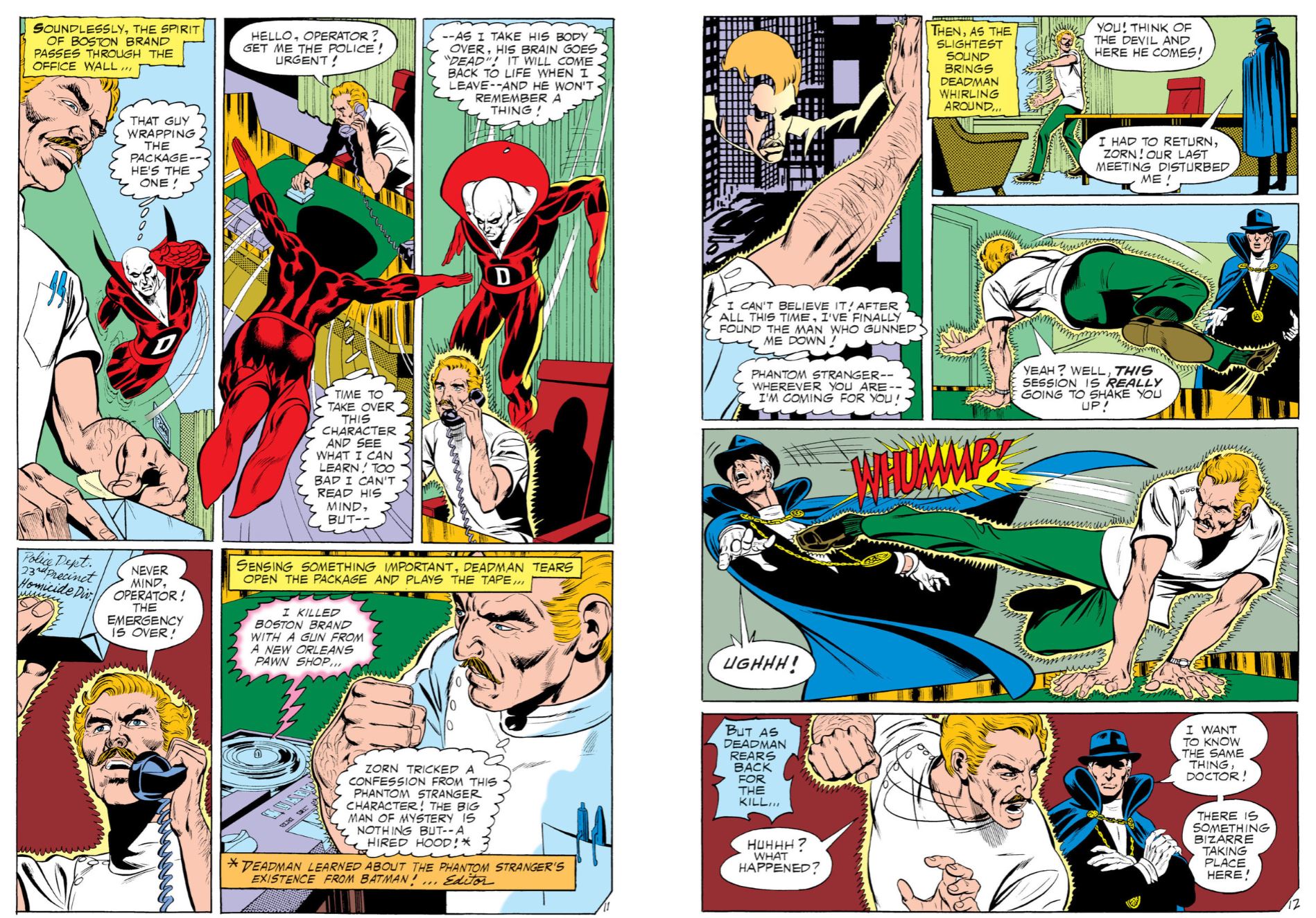
After months of manhunting, Batman’s search for Thomas Wayne culminates in ‘Death Flaunts its Golden Grin’ (World’s Finest Comics #227, February 1975 by Haney, Dillin & Tex Blaisdell), as the caped crusaders find the fugitives whilst tracking global smugglers. The moment of triumph is brief and ends in tragedy for all concerned, after which the guy in the hat gets reacquainted with the spectre in skin-tights for Phantom Stranger #39’s ‘Death Calls Twice for a Deadman’: a last-ditch effort to revive dwindling sales as horror stories faced their own decline. Guest-starring The Sensei, it signalled a belated return to the company’s over-arching continuity, but was too little, too late. Deadman also co-starred in PS #40’s ‘In the Kingdom of the Blind’ and #41’s concluding chapter (February-March 1976 and both by Levitz & Carillo) ‘A Time for Endings’ as modern mage Dr Nathan Seine sought to bring Elder Gods to Earth using blind psychic Cassandra Craft as a medium. With that tale’s finish the series ended and the Stranger all-but-vanished until the winter of 1978 and a giant-sized Deadman team-up tale from DC Super-Stars #18 that is regrettably omitted here…

Instead Deadman – and Haney & Aparo – remanifested in B&B #133 to deliver ‘Another Kind of Justice!’ to rum-runner Turk Bannion when his heir and murderer turn to a more modern form of smuggling and Dark Knight and Wandering Wraith object…

The uncanny explorations end on a lighter note as Cary Bates, Kurt Schaffenberger & Colletta explore uncanny excursions on ‘The Day Lois Lane Walked All Over Superman!’ (Superman Family #183, May June 1977) with Brand invisibly aiding all concerned when a deadly. monomaniacal psychic begins messing with mind-control and body-borrowing…

With stunning covers by Infantino, Sekowsky, Roussos, Adams, Nick Cardy, Aparo, Tatjana Wood, Kirby & Royer, this graphic grimoire perfectly captures the tone of an era in transition through a delirious run of comics masterpieces no ardent art lover or fanatical fear aficionado can do without.
© 1967, 1968, 1969, 1970, 1971, 1972, 1974, 1975, 1976, 1977, 2026 DC Comics. All Rights Reserved.

Born today in 1927, both Hugo (Sergeant Kirk, Ernie Pike, Corto Maltese) Pratt and Ross (Metal Men, Wonder Woman, Spider-Man, The Punisher) Andru made major contributions to comics, as did animation historian, author, critic, and founding editor of Funnyworld Michael Barrier who arrived in 1940.

Today in 1941 Neal Adams (Batman, Superman, Deadman, X-Men, Avengers, Inhumans, Ms. Mystic) was born, followed four years later by iconoclastic author Don Macgregor (Sabre, Black Panther, Killraven, Morbius, Detectives Inc., Ragamuffins, Nathaniel Dusk, James Bond, Zorro); in 1955 by artist Brent Anderson (Ka-Zar the Savage, X-Men: God Loves, Man Kills, Astro City) and in 1976 Dustin Nguyen (Ascender, Descender, The Authority, Batman: Streets of Gotham, Batman: Lil Gotham).

In 1958 today Cliff Sterrett’s Polly and her Pals appeared for the last time, and in 1999 Scottish cartoonist and playwright John Glashan (Genius, Lilliput, The Spectator, Punch, Private Eye, The New Yorker) died this day.

Mister Miracle by Jack Kirby


By Jack Kirby, Mike Royer, Vince Colletta, Don Heck, D. Bruce Berry, Greg Theakston, Mike Thibodeaux, Dick Giordano, Mike Machlan, Bill Wray, Steve Rude & various (DC Comics)
ISBN: 978-1-4012-7717-8 (TPB/Digital edition)

This book includes Discriminatory Content produced in less enlightened times.

Today in 1971 American comic books again changed forever with the third component of a graphic masterpiece. On December 1st 1970 newsstands saw Superman meet counterculture head-on courtesy of Jack Kirby in a title like no other ever before. It was only one strand of a bold experiment that quite honestly failed, but still undid and remade everything. That was Forever People #1 and it was followed on December 22nd with New Gods #1. Then on January 14th 1971 comic books delivered a NEW new world that just kept on changing…

When Jack Kirby returned to the home of Superman in 1970 he was working on one of the most powerful concepts in comic book history. The expansive grandeur of his Fourth World saga grafted a complete new mythology onto and over the existing DC universe and blew the developing minds of a generation of readers. If only there had been a few more of them…

Superman’s Pal Jimmy Olsen, where Kirby revived his 1940s kid-team The Newsboy Legion, introduced large-scale cloning in the form of The Project and hinted that the city’s gangsters had extraterrestrial connections. He then moved on to a main course beginning with The Forever People, intersecting where appropriate with New Gods and Mister Miracle to form an interlinked triptych of finite-length titles that together presented an epic mosaic. Those three groundbreaking titles collectively introduced rival races of gods, dark and light, risen from the ashes of a previous Armageddon to battle forever… and then their conflict spreads to Earth…

Kirby’s concepts, as always, fired and inspired contemporaries and successors. Gods of Apokolips & New Genesis became a crucial keystone of DC continuity and integral foundation of that entire fictional universe, surviving the numerous revisions and retcons which periodically bedevil long-lived comics fans. Many major talents dabbled with the concept over decades and a host of titles have come and gone starring Kirby’s creations. That’s happening now even as I type this…

As previously stated, the herald of all this innovation had been Superman’s Pal Jimmy Olsen, which Kirby had used to lay groundwork since taking it over with #133. There readers first met Darkseid, The Evil Project, Intergang and so much more, but it was also used as an emotional setup for a fascinating notion that had seldom if ever previously troubled the mighty, generally satisfied and well situated Man of Tomorrow…

After The Forever People #1, crossovers with DC mainstays were largely sidelined in favour of a tense and relatively isolated new normal. Those kids were Kirby’s way of depicting how conflict affected peripheral players and dragged them in and down, and the next (and most important) component was seeing seasoned soldiers do their work. New Gods would focus on the war itself…

With that all going on, next came something utterly unexpected: a non-hero who reflected a changing world and sought to capture the turbulent era’s zeitgeist by also looking out for himself and breaking loose of expectations and societal shackles…

Cover-dated February/March 1971 and on sale 55 years ago today, the premiere issue of Mister Miracle – Super Escape Artist sprang the last piece of the puzzle on readers by opening with a sedate set of mysteries balanced with emotional tension and explosive action. The star – notoriously based on Jack & Roz Kirby’s friend (comics genius, magician and escapologist) Jim Steranko – was a fugitive and runaway avoiding (perhaps dodging?) his responsibilities and searching for deeper truths. No matter how wild things got, that set-up was pure reportage…

Inked by Vince Colletta with Kirby doing most of the rest, ‘Murder Missile Trap!’ introduces aging entertainer Thaddeus Brown, an old war horse trying to get back in the saddle, and practicing his old escapology act to win an unwise wager with Metropolis’ Intergang boss Steel Hand. A terrifying test run is interrupted by a young stranger who observes with shock Brown’s apparent suicide and the panic of equally aged assistant Oberon before rushing in to help them.

That act of getting involved leads to orphan Scott Free inheriting the identity and stage persona of Mister Miracle after Steel Hand cheats and has Thaddeus shot and killed. Angry, intrigued and ready to settle down at last (or for a while at least), the wanderer – who has an astounding carpet bag of high tech tricks – wins justice for his predecessor by beating a spectacular rocket trap and decides to try something strange but substantial, for a change.

However, the coils of his past prepare to ensnare him…

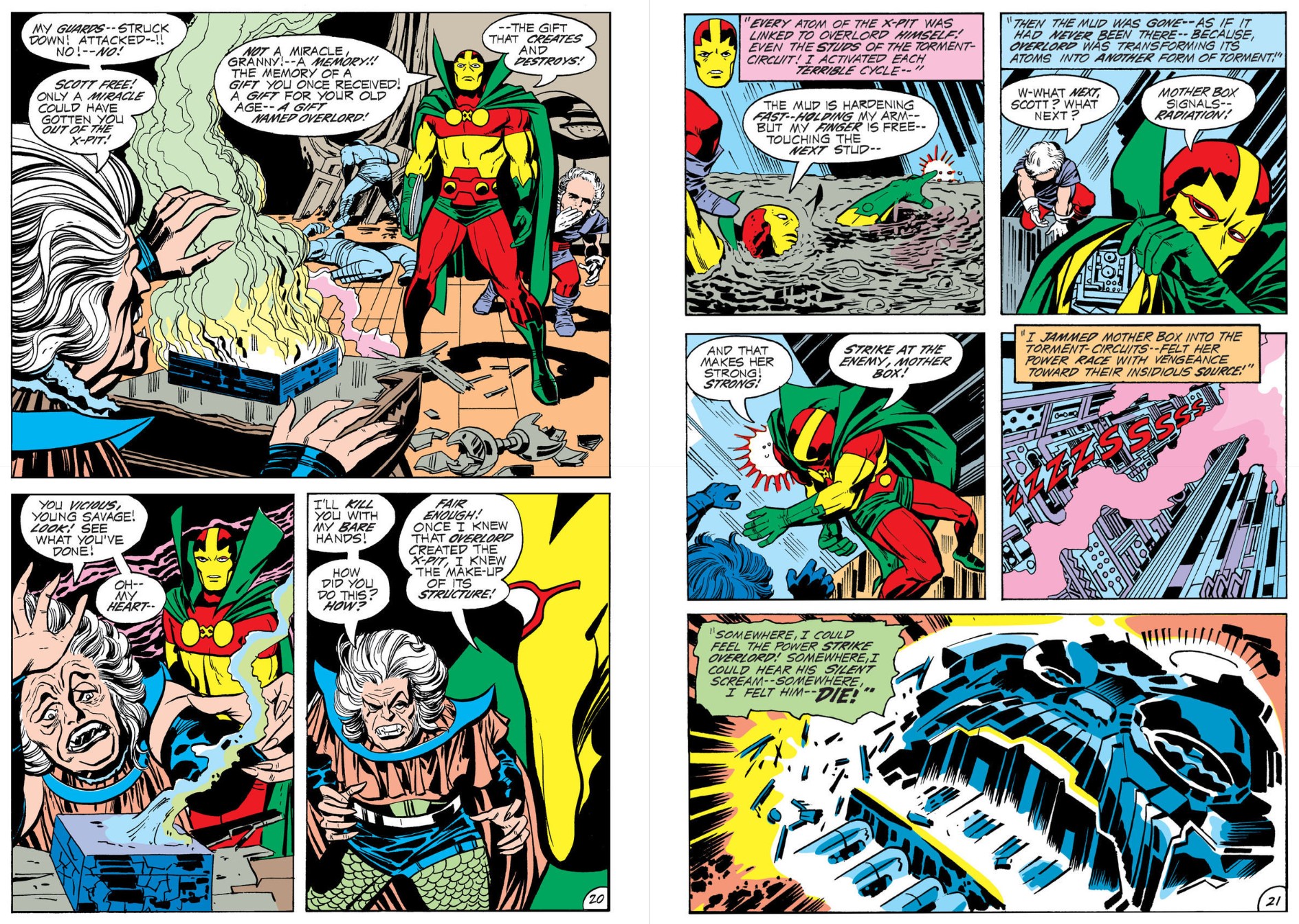
The prosaic life of a showman was a beguiling setting as Scott and Oberon planned a comeback and the beloved old stagehand learned just how different the new kid really was. His suspicions of a wider, wilder side were confirmed as the orphanage Scott fled came looking for him and vicious Apokolyptian virago Granny Goodness unleashed the techno-terrors of matter-warping monster Overlord before trapping the targets in the insidious, infernal ‘X-Pit!’

Because comics fans were always abstruse, Mister Miracle regularly outsold its companion titles, but Kirby felt no compunction to explain his expanding pantheon and universe – or indeed space to do so. Here, though, please allow me to lay out some groundwork…

Soon after creation began, gods were born, thrived and perished – primarily by warring with each other. When the Old Gods died in a cosmos-shaking conflagration their perfect primal world was split into two. Eventually cooling fragments congealed into two new yet lesser worlds: the dark vicious globe of Apokolips and gleaming noble orb New Genesis. Over millennia, generations of superior beings of might and majesty populated the spinning spheres. Sadly, a tragic trait New Gods shared with their progenitors was the capacity for destruction and taste for conflict. Denizens of both planets always and inevitably found fresh ways to end each other’s immortal lives.

The tale proper began on joyous, spiritual New Genesis years after the latest all-out war with Apokolips ended. Mighty Orion arrived in paradisical Supertown where deific patriarch Highfather communes with cosmic mystery The Source. The metaphysical conduit despatched the turbulent wolf in their fold to its antithetical hell-world, only to find despot Darkseid gone. Against all treaties, captive humans from Earth had been abducted and probed for signs of the tyrant’s dream.

The lord of Apokolips wanted to do away with free will and rule personally over all that lived, employing an irresistible, intangible ultimate weapon. The “Anti-Life Equation” is a cheat code for totalitarianism: instant negation of choice, and command of all thought. Darkseid’s obsessive search for it led him to Earth where finding it would guarantee total triumph and dispense with his need for Parademons, Dog Cavalry, assorted terror weapons, and his elite inner circle of monstrous minions. Powerful and technologically advanced, for both races the basic tool is Mother Box: sentient circuitry connected to The Source and a lifelong cyber-symbiotic companion, able to communicate, advise and manipulate the physical world…

Mister Miracle #3 opens a bravura double-issue imbroglio as Scott agrees to an honourable duel with dishonourable disembodied robot-wearing intelligence Doctor Bedlam. Darkseid’s war code is strict and binding and finds the escape artist challenged to make his way out of a packed 50-storey skyscraper. The problems comes because the edifice is sealed tight and every person inside it is a raving homicidal maniac thanks to mental murderer Bedlam’s administering of ‘The Paranoid Pill!’

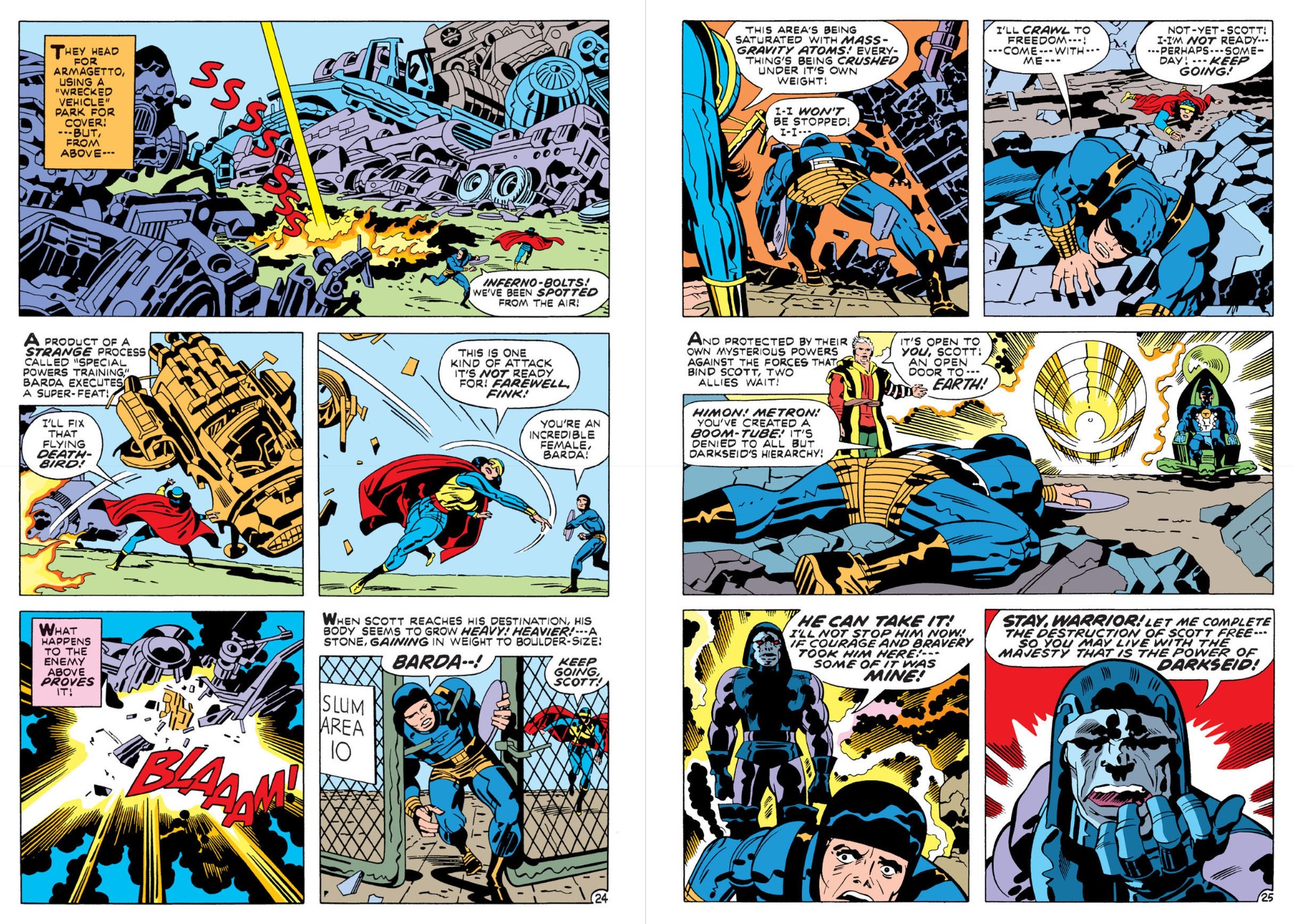
As Oberon frets back at the Brown mansion, he is visited by an old friend of Scott’s, but master warrior Big Barda is not out to assassinate the runaway. She seems more interested in his wellbeing and fate and teleports to the trap site in time to watch Mister Miracle avoid ‘The Closing Jaws of Death!’  Barda is another abstention from the Apokolips method and a rowdy runaway like no other…

With Mike Royer taking over inking, Kirby’s twin loves – history and movies – are happily exercised and expressed in the next yarn as a manic military martinet (based on James Mason’s Rupert of Hentzau in The Prisoner of Zenda) attempts to humiliate and destroy the rebel in MM #5. Another stiff-necked clash of Codes of Honour, it sees elite Apokolips soldiers rendition and reclaim Barda, making her freedom contingent on Scott surviving the Wile E. Coyote-like inventions of ‘Doctor Vundabar and his Murder Machine!’ Of course he does just that, and the issue continues with the first episode in an occasional backstory featurette. Inked by Colletta, ‘Young Scott Free!!’ shares boyhood exploits of Granny’s appalling orphanage/war college where cadet Free just doesn’t fit in. He complains, he has ideas and, when no one’s looking, has extra lessons from New Genesis in the form of emotionless even-handed God of Scientific Curiosity Metron

Humour and a heaping pile of unleashed agita underpin the wry tale of a sharp-talking conman seeking to profit off a creative star’s efforts when obnoxious, dissolute ‘Funky Flashman!’ (MM #6) seeks to monetise Scott’s act, only to run full on into “debt-collectors” from Apokolips. Happily settled in with Scott, Barda is targeted by old squadmates Stompa, Lashina, Bernadeth and Mad Harriet who have come to take her home to the Female Furies battalion she used to lead. They don’t like Flashman either and really resent missing her and taking him thanks to some sneaky sleight-of-hand…

Another brief Royer-inked ‘Young Scott Free!!’ episode finds the daily drugged & programmed dissident becoming more brazen and noticeable in his rebellions, prior to #7 opening an ‘Apokolips Trap!!’ Done with constant ambushes Scott resolves to return to the hell planet and win his right to permanent life-long liberty from Granny’s reprisals, but it all goes awry when battle-hungry Barda comes along, forcing the duo to fight the length of the evil kingdom against “Lowlies”, soldiers, war-machines and even Darkseid’s chief assassin Kanto before this duel of honour can even begin…

‘Young Scott Free!!’ adds nuance with the tale of that time the boot camp pariah somehow trashed deadly Parademons in a training exercise, after which the main event concludes in MM#8 as Scott surrenders to his nemeses and becomes a showpiece execution event against an unbeatable psychic horror during ‘The Battle of the Id!’ Unwilling to let her lover languish or die, Big Barda organises a Female Fury foray that rocks the joint, but as always, she needn’t have bothered…

In New Gods #7 Kirby revealed the origins of the current war and how Darkseid’s son Orion was traded for Highfather’s infant to become tokens of intent and hostage princes to assure a ceasefire. Now Mister Miracle #9 concludes the history lesson with the tragic how and why young man Scott Free breaks the truce, escapes the chains of expectation and chooses his own path after meeting outlaw philosopher ‘Himon!’ Cover-dated July 1972, the tale uses the last exploit ‘Young Scott Free!’ to show how, with rising-star soldier/covert rebel Lieutenant Barda, Scott challenged and dodged the system, no matter the cost…

Kirby’s intention for his Fourth World trilogy was three 12-chapter finite series working in tandem, but fate and sale demanded otherwise. Forever People and New Gods both ceased abruptly and without those intended conclusions, but something else happened for the Super Escape Artist…

The entire notion was a huge risk and massive gamble for an industry and company that was a watchword for conservatism. It was probably incredibly tough for editors and publishers to stop themselves interfering, and they often didn’t. With numbers low, and spooky stories proliferating everywhere, Kirby was pressured to drop the weird stuff and concentrate on old standards. Despite promises of support and complete autonomy, the King had already surrendered much to get his dream rolling. Crushing deadlines and ridiculous expected monthly page counts were one thing, but management had no understanding of what he was planning and promotion was non-existent. Thus, inevitably these series failed to find sufficient sales to keep on until that planned and promised conclusion. Nobody in comics argued with numbers so Forever People and New Gods #11 were the last, cancelled before Kirby could complete his grand experiment.

… Except Mister Miracle carried on. Its sales warranted continuation so with a sharp change of emphasis anticipated and accommodated by Kirby and Co, #10 saw Scott, Barda and AWOL ringleader Stompa, Lashina, Bernadeth & Mad Harriet move to Earth in a tense pause and apparent détente. With time on their hands the squad became an entertainment troupe as ‘The Mister Miracle to Be!’ finally explored showbiz and touring. Sadly, they regularly encountered outlandish human-scaled foes, such as high-tech racketeers the World Protective League and their deranged boss The Head, who mistook the wild wonders for international agents sent to derail a bio-weapon blackmail plot…

With Thaddeus’ son Ted and Oberon filling out the roster, #11 promised ‘The Greatest Show Off Earth!’ and delivered once Doctor Bedlam momentarily trapped Scott aboard an exploding spaceship before the extended run carried on with the death-cheaters challenged by an ancient artefact that stacked the odds during a deadly wager. The truth behind ‘Mystevac!’ was cruel, shocking and transient…

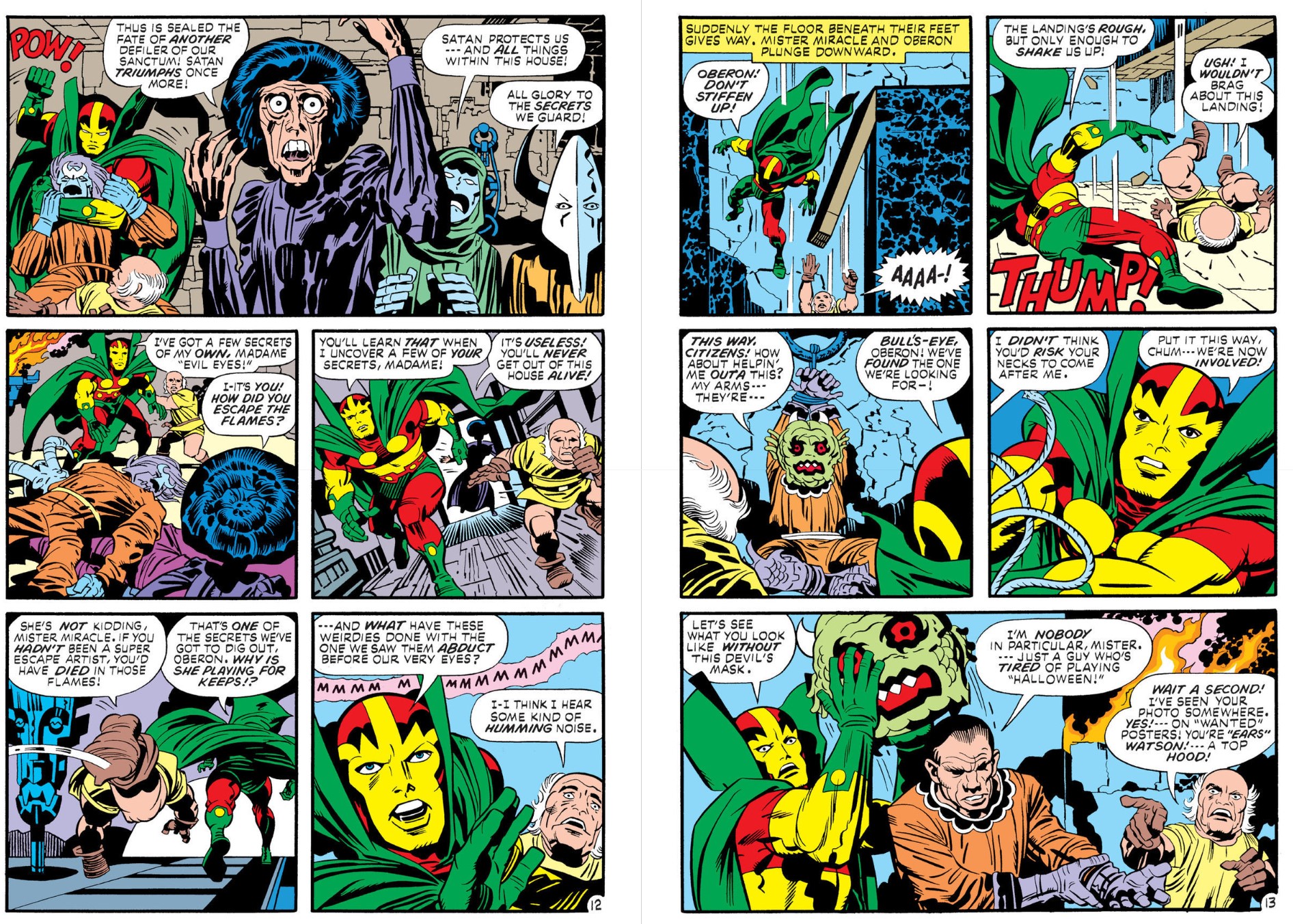
Next the hardworking stiffs were hijacked by a deranged fascist sect and dumped in ‘The Dictator’s Dungeon!’ (obviously not for long!) after which the growing horror trend saw them stumble over Satanists with an even more sinister secret in #14’s ‘The Quick and the Dead!

The tone of those troubled turbulent times was then acknowledged by the introduction of a smart, capable black kid. ‘The Secret Gun!’ found Mister Miracle and friends fostering a witness to murder and eventually hiring him as the next big thing in escapology as seen in follow-up yarn ‘Shilo Norman, Super Trouble!’ as the team clash with invasive “insecto-sapiens” created by Professor Egg – a shrinking savant set on conquest and consumption. Then crime-busting returns with Scott, Barda and Shilo mistaken for hitmen when they inadvertently book in at ‘Murder Lodge!’ and are extravagantly earmarked for execution…

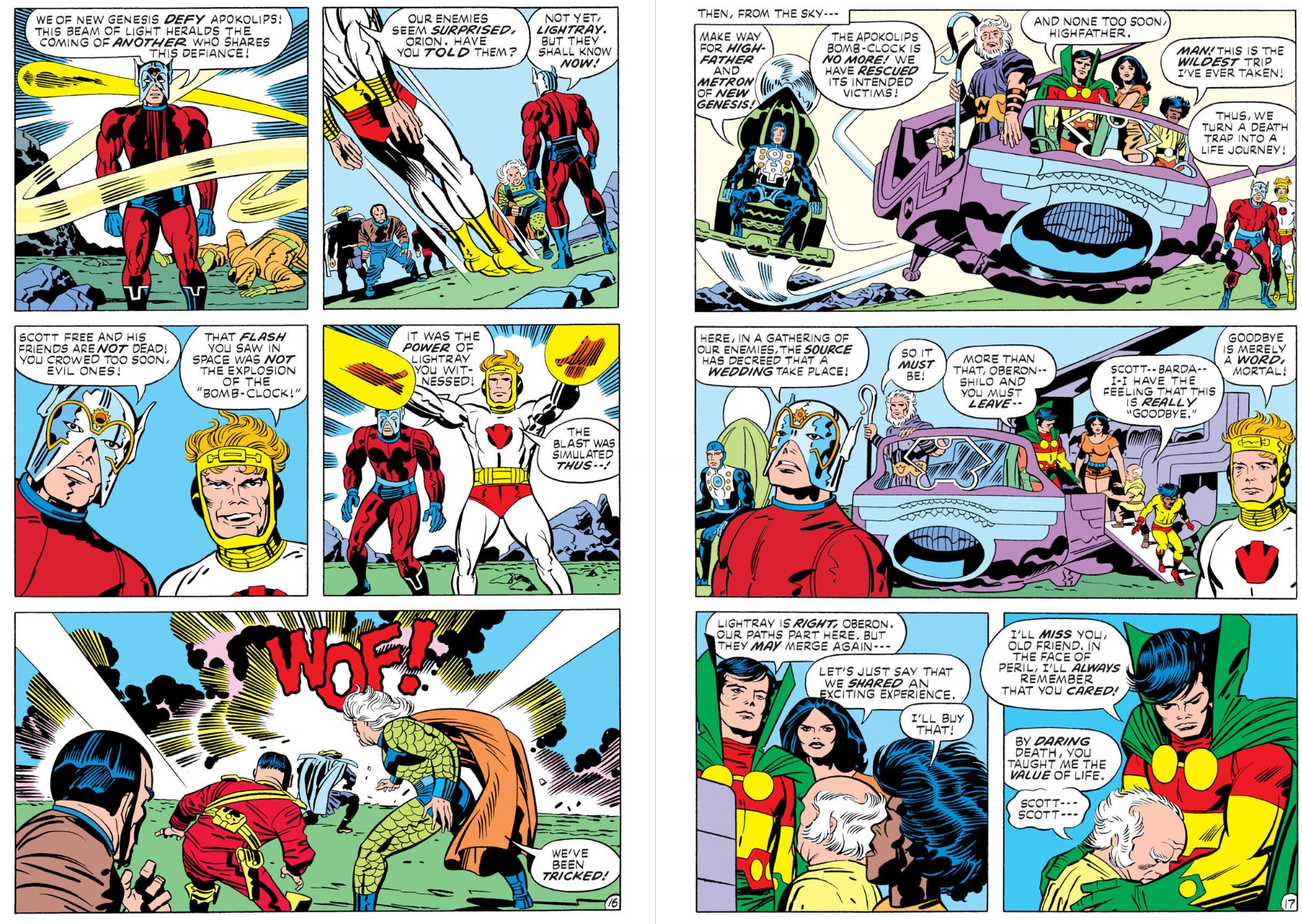
Eventually the encore came to a conclusion as – cover dated March 1974 – Mister Miracle #18 saw all the New God players become ‘Wild, Wild Wedding Guests!’ as Scott and Barda tied the one knot they couldn’t defy before moving in with his dad on New Genesis.

That followed one last all-out assault by Darkseid’s minions which went some way to finally looping readers back to the overarching spectacle as lovers from warring worlds decided to wed in the face of impending doom.

With that the saga was paused but time and changing tastes soon brought sequels and, at long last, Kirby’s return to craft a proper ending… of sorts. We’ll get to those in the fullness of time-space…

Mister Miracle remained a uniquely reusable concept for decades with Scott, Barda and the crew regularly getting guest gigs and new shots at the limelight in Fourth World revivals, DC titles ranging from Action Comics to Brave and the Bold to Justice League, and in solo comeback series.

This cosmic compendium offers bonus ‘Mother Box Files’ material comprising pertinent Kirby characters as revisited by himself, and select inkers from assorted DC Who’s Who fact files. Here a tremendous group treatment of The Female Furies, inked by Greg Theakston, backs up a clutch of solo entries for ‘Mister Miracle’ (Giordano), ‘Big Barda’ and ‘Granny Goodness’ (Theakston), ‘Doctor Bedlam’ (Mike Machlan), ‘Funky Flashman’ (Bill Wray) & ‘Virman Vundabar’ embellished by Steve Rude. Closing the wonderment are more delights in ‘The Art of Jack Kirby’, including an unused cover for MM #7 plus a selection of stunning pencilled pages from the original run.

That metaphor for freedom and a hero who chooses to stop running, to turn and to fight is a fundamental aspect of fiction, and one that will always deliver the goods. You know what to do so what’s holding you back?
© 1971, 1972, 1973, 1974, 2017 DC Comics. All Rights Reserved.

Today in 1863 Richard F. Outcault was born as were Golden Age artists Vince Alascia in 1914 and John Tartaglione in 1921. Filipino artist Rudy Nebres joined the crowd in 1937.

Fictionally, Elzie Segar’s Thimble Theatre debuted Castor Oyl today in 1920 and British standby Comet launched in our smoggy foggy newsagents today in 1950.

On a sad note, the deeply underappreciated Pat Boyette (Flash Gordon, The Phantom, Peacemaker, Blackhawk) passed on today in 2000.