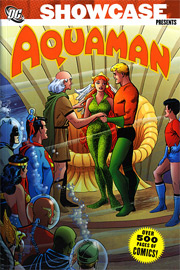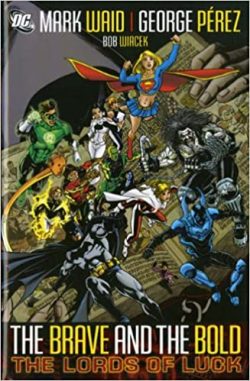
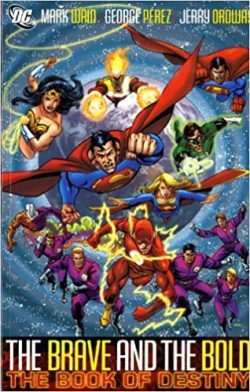
The Brave and the Bold volumes 1 & 2: The Lords of Luck and The Book of Destiny


The Lords of Luck By Mark Waid & George Pérez & various (DC Comics)
ISBN: 978-1-84576-649-8 (US HB) 978-1-84576-649-8 (TPB)

There are so many great graphic novels and compilations available these days that it’s always a shock when I realise how many more are still out of print. Here’s a classic example just begging for revival and digital editions…

The Brave and the Bold: The Lords of Luck collects the first 6 issues of another revival of a venerable DC title (technically volume 3 and spanning April -September 2007): returning it not only to the fitting team-up format we all enjoyed, but doing so with such style, enthusiasm and outright joy that I’m reduced to a gawping, drooling nine-year-old again.

Here Mark Waid, George Pérez and inkers Bob Wiacek & Scott Koblish crafted an intergalactic romp through time and nether dimensions, ripping across the DC Universe in a funny, thrilling and immensely satisfying murder-mystery-come-universal-conquest saga.

When Batman and Green Lantern (in part one ‘Roulette’ and concluding episode ‘The Girl Who Knew Too Much’) discover absolutely identical corpses hundreds of miles apart it sets them on the trail of probability-warping aliens and the missing Book of Destiny – a mystical chronicle of everything that ever was, is, and will be!

And yes, that makes this a notional tie-in to The Sandman series by Neil Gaiman and his coterie of classy creatives…

Each issue/chapter highlights a different team-up and eventually the hunt by Adam Strange, Blue Beetle (‘The Lord of Time’), Destiny (of the Endless, no less in chapter 4 ‘The Garden of Destiny’), the Legion of Super Heroes (‘The Batman of Tomorrow’), Lobo, Supergirl (‘Ventura’) and a mystery favourite from long-ago (you’ll thank me for not blowing the secret, honestly!) plus an incredible assortment of cameo stars coalesces into a fabulous free-for-all that affirms and reinforces all the reasons I love this medium.

With the value-added bonus of an annotated exploration of Waid & Pérez’s creative process to entrance the aspiring creator-of-tomorrow, this is a great story with great art, and is perfect for all ages to read and re-read over and over again. So let’s hope that happens soon…

© 2006, 2007 DC Comics. All Rights Reserved.


The Book of Destiny

By Mark Waid, George Pérez, Jerry Ordway, Bob Wiacek & Scott Koblish (DC Comics)

ISBN: 978-1-4012-1838-6 (HB) 978-1-4012-1861-4 (TPB)

The Book of Destiny is a mystical ledger which charts the history, progress and fate of all Reality and everything in it – except for the four mortals entrusted with its care at the end of The Brave and the Bold: The Lords of Luck. The death-defying Challengers of the Unknown – cool pilot Ace Morgan, indomitable strongman Rocky Davis, intellectual aquanaut Prof. Haley and daredevil acrobat Red Ryan – live on borrowed time and were bequeathed the terrifying tome by Destiny of the Endless since their lives are no longer included within its horrifying pages…

After the staggering spectacle of the previous Brave and the Bold story-arc, here Waid & Pérez, with inkers Bob Wiacek & Scott Koblish are joined by co-penciller Jerry Ordway for a stunning sequel featuring most of the DC universe…

This compilation collects issues #7-12 (volume 3 from December 2007-June 2008) of the high-energy, all-star revival of the venerable DC title: playing novel games with traditional team-up format as a mysterious mage begins manipulating heroes and villains in a diabolical alchemical scheme to transform the cosmos fundamentally and forever…

Beginning with ‘Scalpels and Chainsaws’ – wherein Wonder Woman and the ever-abrasive Power Girl rub each other the wrong way (oh please, what are you, ten!?) whilst tackling an undead invasion, the case takes a stranger turn and Kara-Zor-L accidentally discovers the Caped Kryptonian has been brainwashed into trying to murder her cousin Superman

Their ill-tempered investigations lead to the fabled Lost Library of Alexandria and a disastrous confrontation with the deranged Dr. Alchemy, but he too is only a pre-programmed pawn – of a sinister presence called Megistus – who needs Power Girl to use the mystical artefact known as the Philosopher’s Stone to turn the Fortress of Solitude into pure Red Kryptonite…

Thanks to Wonder Woman’s battle savvy, the plot is frustrated and the stone thrown into the sun… just as Megistus intended…

All this has been perused in the mystic chronicle by the Challengers and their fifth member Dr. June Robbins – whose merely mortal existence and eventual doom are tragically recorded in the Book. They rush off to investigate a universe-rending menace even as ‘Wally’s Choice’ brings The Flash and his rapidly aging children Jai and Iris West into unwelcome contact with manipulative genius Niles Caulder and his valiant Doom Patrol. “The Chief” claims he can cure the twins’ hyper-velocity malady, but Caulder never does anything for selfless reasons…

With no other hope, Wally and wife Linda acquiescence to the mad genius’ scheme – which relies on using elemental hero Rex Mason to stabilise their kids’ critical conditions. It might have worked, had not Metamorpho been mystically abducted mid-process – consequently transforming the children into bizarre amalgams of Negative Man and Robot Man

Worst of all, Flash is almost forced to choose which child to save and which should die…

Thinking faster than ever, the Scarlet Speedster beats the odds and pulls off a miracle but, in a distant place, the pages of the Book are suddenly possessed and abruptly attack the Challengers…

‘Changing Times’ features a triptych of short team-up tales which play out as the Men that History Forgot battle a monster made of Destiny’s pages, beginning as the robotic Metal Men joined forces with young Robby Reed who could become a legion of champions whenever he needs to Dial H for Hero.

Sadly not even genius Will Magnus could have predicted the unfortunate result when crushingly shy robot Tin stuck his shiny digit in the arcane Dial…

Next, during WWII the combative Boy Commandos are joined by The Blackhawks in battling animated mummies intent on purloining the immensely powerful Orb of Ra from a lost pyramid, after which perpetually reincarnating warrior Hawkman joined All-New Atom Ryan Choi in defending Palaeolithic star-charts from the marauding Warlock of Ys.

None of them are aware that they are doing the work of malignly omnipresent Megistus…

The fourth chapter paralleled the Challengers’ incredible victory over the parchment peril with a brace of tales seeing the Man of Steel travel to ancient Britain to join heroic squire Brian of Kent (secretly the oppression-crushing Silent Knight) in bombastic battle against a deadly dragon, whilst the Teen Titan’s untold second ever case finds Robin, Wonder Girl and Kid Flash in Atlantis for the marriage of Aquaman and Mera.

Unfortunately Megistus’ drone Oceanus crashes the party, intent on turning Aqualad into an enslaved route map to the future…

And in California, the Challengers attempted to save Green Lantern’s Power Battery from being stolen only to find it in the possession of an ensorcelled Metamorpho…

As the Element Man easily overwhelms Destiny’s Deputies, Jerry Ordway assumed the penciller’s role for issues #11-12.

‘Superman and Ultraman’ saw the natural enemies initially clash and then collaborate at the behest of an alternate universe’s Mr. Mixyezpitelik, who reveals the appalling scope and nature of Megistus’ supernal transformational ambitions, leading to a gathering of the heroic clans and a blistering Battle Royale in the roaring heart of the Sun…

With the fate of reality at stake and featuring a veritable army of guest stars ‘The Brave and the Bold’ concludes the saga with a terrible, tragic sacrifice from the noblest hero of all, whilst subtly setting the scene for the then-upcoming Final Crisis

With fascinating designs and pencil drawings from Ordway to tantalise the art lovers, this second captivating collection superbly embodies all the bravura flash’n’dazzle thrills superhero comics so perfectly excel at. This is a gripping fanciful epic with many engaging strands perfectly coalescing into a frantic and fabulous free-for-all overflowing with all the style, enthusiasm and exuberant joy you’d expect from top costumed drama talents.

The Brave and the Bold: The Book of Destiny is another great story with great art, ideal for kids of all ages to read and re-read over and over again.
© 2007, 2008 DC Comics. All Rights Reserved.
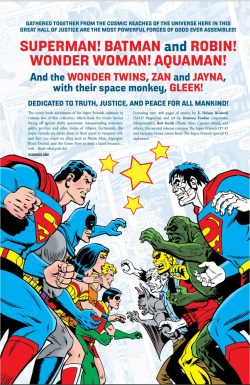
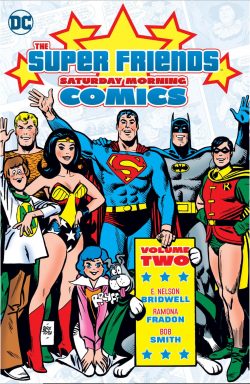
Super-Friends: Saturday Morning Comics volume 2


By E. Nelson Bridwell, Bob Rozakis, Martin Pasko, Bob Oksner, Ramona Fradon, Kurt Schaffenberger, Romeo Tanghal, Joe Staton, Bob Smith, Vince Colletta & Kim DeMulder with Alex Toth & various (DC Comics)
ISBN: 978-1-7795-0592-7 (HB/Digital edition)

Win’s Christmas Gift Recommendation: Absolute Entertainment Perfection… 9/10

Once upon a time comics were primarily created with kids in mind and, whilst I’d never advocate exclusively going back to those days, the modern industry has for the longest time sinned by not properly addressing the needs and tastes of younger fans these days. Happily, DC has latterly been rectifying the situation with a number of new and – most importantly for old geeks like me – remastered, repackaged age-appropriate gems from their vast back catalogue.

A superb case in point of all-ages comics done right is this massive tome. And don’t stress the title: it may celebrate the joys of past childhood shows but this is definitely a great big Sunday “settle back and luxuriate” treat…

The Super Friends: Saturday Morning Comics gathers comic book tales spun off from a popular Saturday Morning TV Cartoon show of the 1970s: one that – thanks to the canny craftsmanship and loving invention of primary scripter E. Nelson Bridwell – became an integral and unmissable component of the greater DC Universe, as a well a key supplier of fresh fodder to enhance its all-encompassing omniverse. So very many of his supporting characters became superstars in their own right and trappings such as the junior characters, villains and the Hall of Justice are now key components of today’s overarching continuity…

The Super Friends was also one of the most universally thrilling and satisfying superhero titles of the period for older fans: featuring the type of smart and witty, straightforward adventures people my age grew up with, produced during a period when the entire industry was increasingly losing itself in colossal continued storylines and bombastic, convoluted, soap opera melodrama.

It’s something all creators should have tattooed on their foreheads: sometimes all you really want is a smart plot well illustrated, sinister villains well-smacked, a solid resolution and early bed…

Under various guises, the TV show Super Friends ran from 1973 to 1986: a vehicle for established television-alumni Superman, Batman and Robin, Aquaman and Wonder Woman, supplemented by a succession of studio-originated kids as student crimebusters. The show also offered airtime to occasional guest stars from the DCU on a case by case basis. The animated show made a hugely successful transition to print as part of the publisher’s 1976 foray into “boutiqued” comics which saw titles with television connections cross-marketed as “DC TV Comics”.

Child-friendly Golden Age revival Shazam! – the Original Captain Marvel had been adapted into a popular live action series and its Saturday Morning silver screen stablemate The Secrets of Isis consequently reversed the process by becoming a comic book. With the additions of hit comedy show Welcome Back Kotter and animated blockbuster Super Friends’ four-colour format, DC had a neat little outreach imprimatur tailor-made to draw viewers into the magic word of funnybooks.

At least, that was the plan: with the exception of Super Friends, none of the titles lasted more than 10 issues…

This massive mega-extravaganza (the second of 2) gathers Super Friends #27-47, The Super Friends Special #1, The Best of DC: Blur Ribbon Digest #3, Limited Collectors’ Edition C-41 and Super Friends!: Truth Justice and Peace! (collectively spanning December 1979 to August 1981), ending the initial run whilst sharing material from assorted reprints and one-shots.

The majority of stories were by E. Nelson Bridwell & Ramona Fradon (Aquaman; Batman; Metamorpho the Element Man; The Brave and the Bold; Brenda Starr, Reporter). Bridwell (Secret Six; Inferior Five; Batman; Superman; The Flash; Batman and Robin newspaper strip; Legion of Super-Heroes; Captain Marvel/Shazam!) had been one of the art form’s earliest mega-fans, turning his hobby into a career in the 1950s.

He was justly renowned as DC’s Keeper of Lore and Continuity Cop – thanks to an astoundingly encyclopaedic knowledge of publishing minutiae and ability to instantly recall every damn thing about anything! Thankfully, he was also an ingenious and supremely witty writer. Fradon was a pioneering artist who also got her start in the 1950s, graced with a uniquely smooth and accessible style. She became one of comics’ earliest (acknowledged!) female artists and was a fan-favourite for generations.

Neither Bridwell or Fradon considered working at the junior end of the market as in any way less important or prestigious than the auteur/adult drama sector just starting to manifest in the American industry…

When Super Friends first aired, the costumed champions were mentors to two kids and their pet: tasked with training the next generation of superheroes. Without warning or explanation, Wendy, Marvin and Wonderdog were replaced for the second television season by alien shapeshifters Zan and Jayna and their elastic-tailed space monkey Gleek. In the comics – with more room to extrapolate and far more consideration for the fans – Bridwell turned the cast change into an extended epic.

When two siblings from distant planet Exor – a girl able to transform into animals and a boy who can become any form of water from steam to ice – came to Earth with an urgent warning they saved the world and were marooned here.

Their integration became an ongoing plot strand with the adults (and Robin) not only training Zan and Jayna, but also jointly acclimating them and introducing them into human society…

This concluding compilation of thrilling fun resumes with The Super Friends #27 and ‘The Spacemen Who Stole Atlantis!’ (Bridwell, Fradon & inker Bob Smith) sees domed undersea city Poseidonis stolen away by ruthlessly curious alien scientists who had not factored in Earth’s greatest defenders.

Inked by Vince Colletta, the next issue detailed a ‘Masquerade of Madness!’ in a Halloween yarn packed with guest stars (including Etrigan the Demon, Solomon Grundy, Man-Bat, Swamp Thing and Jimmy “wolfboy” Olsen) as mystic malcontent Felix Faust crashes a costume ball, trapping attendees in their outfits until Bruce Wayne hands over a certain magical gem… And that’s when the other – untransformed – Super Friends step in…

Another extraterrestrial invasion by colonising invaders seeking to evict humanity manifests in #29, with the new bosses wielding technology that seems to make all resistance futile. However, Wonder Woman and the Wonder Twins find a work-around meaning the war can be won by the heroes making themselves ‘Invisible Defenders of Earth!’

The issue also offers an adventure of the Wonder Twins, who now have secret identities and live in the home of guardian Professor Carter Nichols – Bruce Wayne’s science advisor/time travel expert who debuted in Batman #24, August 1944.

Here Bridwell, Kurt Schaffenberger & Smith establish the ‘Scholars from the Stars’ as transfer students at Gotham Central High, but John and Joanna Fleming are soon being stalked by curious classmates eager to learn all they can about the strange newcomers…

Nichols plays a major role in #30 as Fradon-illustrated ‘Gorilla Warfare Against the Humans!’ sees the heroes battle super-primate Grodd and his ally Giganta as they deploy their new tech to transform men into apes…

Guest stars were always a big draw and #31’s ‘How to Trap an Orchid!’ (inked by Colletta) saw DC’s most enigmatic hero targeted and framed by a ruthless enemy and helped by the Friends before Schaffenberger pencilled and Smith inked #32’s ‘The Scarecrow Fights with Fear!’ as the Tyrant of Terror afflicts the heroes with crippling weaponised personal phobias that only teamwork and determination can overcome

Fradon & Colletta combine for ‘The Secret of the Stolen Solitaire!’ as obsessive old enemy Menagerie Man returns, still using trained animals to commit spectacular robberies. His schemes are derailed when Jayna becomes a famously extinct creature and is “captured”, leading the heroes and visiting VIP Hawkman to his lair and the Winged Wonder’s captive sidekick Big Red

With #34, two stories per issue became the norm, leading with Bridwell, Fradon & Colletta’s ‘The Creature That Slept a Million Years!’, in which a hibernating beast awakened on Earth causes inadvertent chaos, balanced by ‘The Boss and the Beast’ as John and Joanna Fleming help their favourite teacher by saving her husband from a crooked boss fitting him up for a life of crime…

Romeo Tanghal & Smith illustrate full-length spectacle ‘Circus of the Super-Stars’ as the Super Friends and their showbiz impersonators trade places to outwit crooks targeting a massive charity event, before #36 bifurcates with a brace of tales limned by Tanghal & Colletta. First up is ‘Warhead Strikes at Gotham’ with Plastic Man and Woozy Winks tracking a war-mongering maniac and overlapping with the Super Friends battle to stop a paramilitary criminal force, after which The Wonder Twins visit a museum in their school personas and discover the shocking truth about ‘The Dinosaur Demon!’

Fradon & Colletta depict #37’s ‘Bad Weather for Supergirl!’ as the Kryptonian Crime-crusher (in her then-current day job as teacher) brings a class to Gotham just as the Weather Wizard goes on a rampage. Kara’s problem is not the villain’s outrages but that her kids seem far more impressed by the late-arriving superteam than their own hometown hero…

Drama is balanced by rampant fantasy in support story ‘The Giant Who Shrunk Ireland!’, with Bridwell’s creation Jack O’Lantern using his magical gifts to save the Celtic fairy realms from an awakened Fomorean Giant.

Jack was one of a number of international heroes Bridwell and Fradon devised, who grew in popularity and were eventually retrofitted into a team dubbed the Global Guardians. Another debuted in a solo spot at the back of #38, after ‘The Fate of the Phantom Super Friends’ (art by Fradon & Colletta), which saw alien tyrant Grax recruit and arm Earth gangsters to take revenge on his enemies. Then Bob Oksner & DeMulder illustrate ‘The Seraph’s Day of Atonement’ as Bridwell relocates his Israeli holy warrior to a new Jewish settlement in disputed territory just in time to save it from bandits pretending to be Arab terrorists. When, in his righteous anger, he goes too far in punishing the evildoers, he faces divine consequences…

Another former foe resurfaces in #39 with a sinister scheme to create hyper-evolved clones of the only being he trusts… himself. However, ‘The ‘Future’ Son of Overlord!’ (Fradon & Colletta) proves insufficient to the demands and the demise of “Futurio” only results in Overlord cruelly retrenching, after which the human-seeming Wonder Twins discover nightclubs are another place crazy crime can occur in ‘The Boogie Mania Will Get You’ (Tanghal & Collett)…

Inked by Kim DeMulder, #40’s lead tale ‘Menace of the Mixed-Up Senses!’ pits the heroes against a vindictive scientist creating disasters by scrambling perceptions, before Jack O’Lantern returns to teach a smooth-talking conman a life lesson in ‘Blarney for Sale!’ (Bridwell, Tanghal & DeMulder)

Bob Rozakis joins Fradon & Colletta in detailing ‘The Toyman’s Tricky Thefts!’ as the veteran villain attacks a Christmas toy convention as prelude to his true diabolical plan, whilst the rear guard of #41 witnesses Oksner write & illustrate ‘Dry Earth… Stolen Waters’ as The Seraph foils an industrial spy stealing the secrets of an experimental desalination device…

In Seasonal Special #42, Bridwell, Tanghal & Colletta debut Brazilian hero Beatriz Da Costa (AKA Green Fury, Green Flame and/or Fire) who joins the Wayne Foundation just in time to help the Super Friends defeat a vegetation-controlling villain in ‘How Green Was My Gotham!’ and still leave room for the Wonder Twins to enjoy ‘A Christmas with Everything!’ in a heartwarming tale of family and little miracles…

Overlord tries again in #43, unleashing ‘Futurio Times Ten!’ to destroy the collegiate heroes, (and Green Fury) but fails when the over-evolved clone develops an unholy fascination with potential mate Wonder Woman, after which Plastic Man bounces back in ‘Mouth-Trap!’ by Pasko, Staton & Smith, taking down thieving shock jock Lou Kwashus – AKA Chatterbox

Issue #44 leads with Bridwell, Tanghal & Colletta’s ‘Peril of the Forgotten Identities!’ as a menace from the Wonder Twins’ homeworld warps the memories of the team leaving Zan, Jayna & Beatriz to save the day. As counterpoint, Jack O’Lantern then solves a snag in the (super)natural order by ensuring ‘The Death-Cry of the Banshee!’ is heard by the right person…

The “International Heroes” who would become Global Guardians (Rising Sun, Bushmaster, Olympian, Wild Huntsman, Godiva and Little Mermaid) were formally gathered by immortal wizard Doctor Mist in #45 and united with the Super Friends to defeat ‘The Man Who Collected Villains!’

Another classic by Bridwell, Tanghal & Colletta, it pits the merged squads against uber-baddie The Conqueror and his personal Doom Legion – Hector Hammond, Kanjar Ro, Queen Bee, Sinestro, Time Trapper and World-Beater – in a brutal clash that concludes in the next issue.

Before that though, courtesy of Pasko, Staton & Smith, Plastic Man & Woozy discover ‘One of Our Barbarians Is Missing!’ and must halt the rampage of a temporarily-deranged movie swordsman being manipulated by devious crooks…

The frantic Fights ‘n’ Tights clash then results in ‘The Conqueror’s Greatest Conquest!’ (Bridwell, Tanghal & Colletta) – and ultimate downfall before The Seraph battles an ‘Echo of Evil’ and the ghosts of Masada (look it up) in an all-Oksner thriller.

The comic book Super Friends ended with #47: a 25-page epic by Bridwell, Tanghal & Colletta detailing the origin of Green Fury, a plane of animal spirits and ‘The Demons from the Green Hell!’ whose actions sought to unmake the world until the team stepped up…

Times and tastes were changing and it would be years until superheroes – and not toy tie-ins – for kids were a viable option again: when once again TV led that march with breakthrough adaptations of Batman, Superman and Justice League Animated Series…

Here and now, this epic collation closes with series designer Alex Toth’s 1976 cover for Limited Collectors’ Edition C-41 and The Best of DC: Blur Ribbon Digest #3 (January-February 1980) cover by José Luis García-López & Bob Smith. Also on view is Ross Andru & Dick Giordano’s cover from The Super Friends Special #1 1981 and Toth’s frontage from the 2003 Super Friends!: Truth Justice and Peace! trade paperback collection.

Sublimely resplendent in the rich flavours and simple joys of DC’s Silver Age boom, and with covers by Fradon, Smith, Schaffenberger, Tanghal, & Colletta, this concluding compendium is superbly entertaining, masterfully crafted and utterly engaging. It offers stories of pure comics gold to delight children and adults in equal proportion. Truly generational in appeal, they are probably the closest thing to an American answer to the magic of Tintin or Asterix and no family home should be without this tome.
© 1976, 1979, 1980, 1981, 2003, 2020 DC Comics, Inc. All Rights Reserved.

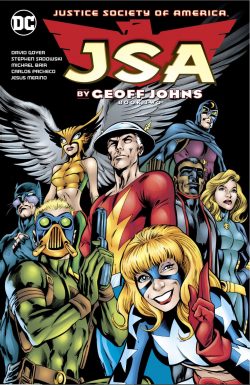
JSA by Geoff Johns Book Two


By Geoff Johns, David S. Goyer, Stephen Sadowski, Michael Bair, Carlos Pacheco, Jesus Merino, Phil Winslade, Mike Perkins, Steve Yeowell, Keith Champagne, Buzz, Rags Morales, Dave Meikis, Paul Neary, Rob Leigh, Javier Saltares, Ray Kryssing, Andrew Pepoy & various (DC Comics)
ISBN: 978-1-4012-8154-0 (TPB/Digital edition)

Win’s Christmas Gift Recommendation: Pure Perfection for Superhero Connoisseurs… 9/10

After the actual invention of the comic book superhero – for which read the creation of Superman in 1938 – the most significant event in the genre, and indeed industry’s progress, was the combination of individual sales-points into a group. Thus, what seems blindingly obvious to us with the benefit of four-colour hindsight was proven – a number of popular characters could multiply readership by combining forces and readerships. Plus of course, a whole bunch of superheroes is a lot cooler than just one – or even one and a sidekick.

The Justice Society of America was created in the third issue of All-Star Comics (Winter 1940/1941), an anthology title featuring established characters from various All-American Comics publications, by the simple expedient of having the heroes gather around a table and tell each other their latest adventure. From this low-key collaboration, it wasn’t long before the guys – and they were all white guys (except the original Red Tornado, who only pretended to be one) until Wonder Woman premiered in the eighth issue – regularly joined forces to defeat the greatest villains and social ills of their generation.

Within months the concept had spread far and wide…

And thus, the Justice Society of America is rightly revered as a true landmark in the development of comics and, when Julius Schwartz revived the superhero genre in the late 1950s, a key moment would come with the inevitable teaming of the reconfigured mystery men into a Justice League of America.

From there it wasn’t long until the original and genuine returned. Since then we’ve enjoyed many attempts to formally revive the team’s fortunes but it wasn’t until 1999, on the back of both the highly successful revamping of the JLA by Grant Morrison & Howard Porter and the seminal but critically favoured new Starman by Golden Age devotee James Robinson, that the multi-generational team found a concept and fan-base big enough to support them.

It didn’t hurt that the writers – all with strong Hollywood connections – adored the original concept, but also knew what mass-market action audiences liked. And now that the JSA have cracked the large and small screen markets, my cup – at least – truly runneth over…

Their highly successful revival began as the last survivors of the original team reconvened after losing most of their membership to old age, infirmity or enemy action. Following the death of founding comrade Wesley Dodds/The Sandman, Wildcat, Flash and Green Lantern/Sentinel united with youthful inheritors of the old team’s legacy. These included members’ children and former Infinity Inc members Atom Smasher, Obsidian and Hourman, Dodds’ sidekick Sand, Stargirl (then called Star Spangled Kid), the third Dr. Mid-Nite, Starman and Mister Terrific plus new Hawkgirl Kendra Saunders, Black Canary and Wonder Woman (in actuality, her mother Hippolyta who was an active Nazi crusher during WWII).They all united to rescue three babies; one of which became the next incarnation of magical hero Doctor Fate. Once they were successful most of the squad stuck together to continue the traditions and train a new generation of heroes…

Shortly thereafter, as old guard Flash, Sentinel and Wildcat assumed the role of mentors for both current and future champions, the multi-generational unit was attacked by demented super-human (and current Man of the Moment) Black Adam: a magically empowered superman, who usually harassed agents of do-gooding wizard Shazam!. The bombastic battle served to introduce more very far-reaching plot threads and led to a fearsome clash with a new iteration old enemy outfit the Injustice Society

Officially concentrating on the efforts of Geoff Johns, this second volume re-presents in whole or in part Secret Origins of Super-Villains File 80-Page Giant #1, JSA #16-25, Our Worlds at War #1, JLA/JSA: Secret Files & Origins #1 and JLA/JSA: Virtue and Vice: bringing the revered, revived and very legendary Justice Society of America into DC’s modern pantheon and continuing the writer’s campaign to restore and re-induct all the classic stars by resurrecting the biggest name and most visually arresting of the originals – Hawkman.

It begins with a prelude from December 1999’s Secret Origins of Super-Villains File 80-Page Giant #1. Crafted by Johns & Goyer and illustrated by Phil Winslade & Mike Perkins, ‘Sorrow Ever More!’ sees demonically-tainted gang boss Johnny Sorrow break veteran villain Cameron Makent – AKA legacy JSA foe The Icicle – out of super penitentiary The Slab. The lachrymose liberator has connections with the original Icicle and expects the successor to join his war on modern heroes. He also knows an awful lot about the Makent family…

Major storyline Injustice be done opens with ‘Divide and Conquer’ (JSA #16, illustrated by Stephen Sadowski & Michael Bair) wherein an expanded Injustice Society – including Black Adam and in possession of the heroes’ most intimate secrets – ambushes them and fellow Golden Age champion Scarab whilst they’re off guard…

The blitz attack meets with significant success, and in ‘Cold Comfort’ mastermind Johnny Sorrow reveals his plans as the heroes begin their fight back, and we see his horrific origins in ‘Sorrow’s Story’ (with additional art Steve Yeowell), before the World goes to Hell with ‘Into the Labyrinth’ (extra inks by Keith Champagne) and the ghostly Spectre returns to save the day from Sorrow’s patron master The King of Tears.

And spectacularly fails…

The saga concludes in cataclysmic fashion with ‘Godspeed’ as Black Adam and Jakeem “J.J.” Thunder (heir of genie-wielding Johnny Thunder) join the team, but not before first Flash Jay Garrick is lost in time and space…

Compelling as it was, that entire saga was just a set-up for the eponymous ‘Return of Hawkman’ which I’ll get to after this necessary diversion…

One of the oldest and most revered heroes in comics, Hawkman premiered right behind Jay Garrick in Flash Comics #1 (January 1940). He was created by Gardner Fox & Dennis Neville, although the most celebrated artists to have drawn the Winged Wonder are Sheldon Moldoff and Joe Kubert, whilst young Robert Kanigher was justifiably proud of his later run as writer.

Carter Hall was a playboy archaeologist until he found a crystal knife that unlocked his memories. He knew that once he had been Prince Khufu of ancient Egypt, and that he and his lover Shayera had been murdered by High Priest Hath-Set. Moreover, with returned lives came the knowledge that his love and his killer were also nearby.

Using the restored knowledge of his past life, Hall fashioned a costume and flying harness, hunting his past and future murderer as the Hawkman. Inevitably triumphant, he and modern-day amour Shiera Saunders maintained their “Mystery-Man” roles: warring on modern crime and tyranny with weapons of the past.

Lost as the Golden Age ended, they were revived by Julie Schwartz’s crack creative cohort in the early 1960s (specifically Fox, Joe Kubert & Murphy Anderson) and – after a long career involving numerous revamps and retcons – “died” during the Zero Hour crisis.

Now in JSA #21 after the race of his life, lost Jay Garrick awakens in old Egypt: greeted by a pantheon of that era’s super champions. Nabu, the Lord of Order who created Doctor Fate, the original incarnation of Black Adam and Prince Khufu himself reveal the true origins of Hawkman whilst in the 21st century the JLA’s heavenly hero Zauriel informs the modern Hawkgirl just who and what she really is in ‘Guardian Angels’

The epic further unfolds as a major connection to the alien Hawkworld of Thanagar is clarified and explored in ‘Lost Friends’ and as Garrick returns to his home era, Hawkgirl is abducted to Thanagar by its last survivors, desperate to thwart the schemes of the insane death-demon Onimar Synn who has reduced the entire planet to a zombie charnel house.

As the JSA frantically follow their abducted member to distant Polaris in ‘Ascension’ Carter Hall makes his dramatic return from beyond and saves the day in ‘Icarus Fell’, before leading the team to magnificent victory in spectacular conclusion ‘Seven Devils

Illustrated by Buzz, Rags Morales, Sadowski, Bair, David Meikis and Paul Neary, this latest return not only led to Hawkman regaining his own title (more graphic novel magic to review ASAP) but also stands as one of the most cosmic and grand-scaled of all the JSA’s adventures.

The cosmic calamity continued as current DC Crossover Event “Worlds At War” – wherein an alien doomsday device/inimical manifested concept Imperiex almost destroyed the planet and unravelled the universe – tragically impacted the team. JSA: Our Worlds at War #1 saw the embattled planet calling on all its metahuman resources with Society members past, present – 28 in all – and simply affiliated gather as ‘The All-Stars’ (Johns, Javier Saltares & Ray Kryssing). Their mission is to take the war to Imperiex, assaulting its Jupiter-sized base-ship and even American President Lex Luthor is astounded by the result of the raid…

Billy Batson/Captain Marvel makes his troubled debut with the team via an introductory prelude in JLA/JSA: Secret Files & Origins #1 (January 2003). ‘The Day Before’, by Johns, Goyer, Sadowski & Andrew Pepoy, has the teen hero warned by his wizard mentor that an indiscernible threat menaces both teams of heroes. That conference leads directly into the last item on this agenda: JLA/JSA: Virtue and Vice (February 2003).

Once upon a time the Justice Society was Earth’s premiere super-team: formed to crush oppression and injustice while raising morale during World War II. When the Justice League debuted in 1960, their success led to the reintroduction of the originals – albeit now revealed to have worked on the alternate reality dubbed Earth-Two. After many years of annual team-ups, the heroes of both – and indeed other worlds – were merged in mega event Crisis on Infinite Earths.

A reordered history reduced the JSA to the role of elder statesmen of metahumanity and they became an organisation regularly saving the world whilst mentoring the next generation of superheroes.

Their inspired successors, the Justice League of America were currently the World’s Greatest Superheroes – and have all the characters who until very recently appeared on TV and in cartoons and movies. You now have all the background you need to read this superb Original Graphic Novel.

As they have done for years, the JLA and JSA have gotten together to celebrate Thanksgiving when suddenly alien conqueror Despero attacks them and the entire world by releasing the Seven Deadly Sins. These deadly demons promptly possess Batman, Power Girl, Mister Terrific, Dr. Fate, Green Lantern, Plastic Man and Captain Marvel (as today’s Shazam! was called back then)…

Can the remaining heroes defeat the Sins without killing their friends, and save humanity from total destruction at the hands of a hidden malign mastermind?

Of course they can; that’s the point. But seldom have they done it in such a spectacularly, well written and beautifully illustrated manner.

Crafted by Johns, Goyer, the much-missed Carlos Pacheco & Jesús Merino, this is the perfect conclusion to this sublime collection: a pure, iconic genre “Fights ‘n’ Tights bravura action romp that hits every target and pushes every button it should. If you love superhero comics, you will treasure this magnificent tale.

Complex and enthralling, these super shenanigans are the very best of their type: filled with wicked villains and shining, triumphant heroes, cosmic disaster and human tragedies, yet always leavening the doom and destruction with optimism and humour. Enticing, thrilling and stuffed with the biggest and best sort of superhero hijinks, if costume drama is your meat, this JSA compilation should be your prey…
© 1999, 2000, 2001, 2002, 2003, 2018 DC Comics. All Rights Reserved.

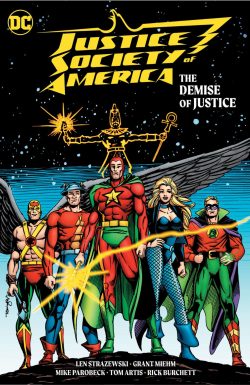
Justice Society of America: The Demise of Justice


By Len Strazewski, John Broome, Paul Levitz, Rick Burchett, Grant Miehm, Mike Parobeck, Tom Artis, Frank McLaughlin, Frank Giacoia, Arthur Peddy, Bernard Sachs, Joe Staton & various (DC Comics)
ISBN: 978-1-7795-0744-0 (HB/Digital edition)

Win’s Christmas Gift Recommendation: Golden Ageist Evergreen Enjoyment… 8/10

Released in 2021 to celebrate their 80th anniversary, here’s yet another DC core concept given fresh wings by a modern movie. If you can find it, this hardback/digital delight is good old fashioned fun and will make a perfect present for you or yours…

After the actual invention of the comic book superhero – the Action Comics debut of Superman in 1938 – the most significant event in the industry’s history was the combination of individual sales-points into a group.

Thus what seems blindingly obvious to us with the benefit of four-colour hindsight was proven: consumers couldn’t get enough of garishly-hued mystery men, and combining many characters inevitably increased readership. Plus, of course, a mob of superheroes is just so much cooler than one – or one-and-a-half if there’s a sidekick involved…

The creation of the Justice Society of America utterly changed the shape of the budding business and – technically – All Star Comics #3 (cover-dated Winter 1940-1941, released in December 1940) was the kick-off. However, in that landmark, the assembled heroes merely had dinner whilst recounting recent cases and didn’t actually go on a mission together until #4 (cover-dated April 1941).

With the simple notion that mighty mystery men hung out together, history was made and it wasn’t long before they started working together…

However, when WWII ended, superheroes gradually declined, and most companies had shelved them by 1950. The plunge in popularity led to a revival in genre-themed titles and characters, and it was a stripped-down team (Flash, Green Lantern, Hawkman, The Atom, Black Canary, Dr. Mid-Nite and Wonder Woman) who battled on in contemporarily tailored crime and science fiction sagas before the title abruptly changed into All Star Western with #58.

It would take a second age of superheroes to revive them, this time as the champions of a parallel universe dubbed Earth Two…

Gathered here is a near-forgotten limited series concerning the latter days of the team’s Golden Age that originally ran in Justice Society of America #1-8 (April to November 1991), augmented by the last tale of the original era as seen in All-Star Comics #57, (February/March 1951), plus a turning point tale from Adventures Comics #466 (December 1979). They are preceded a sparkling, informative and appreciative Foreword by Golden Age aficionado and super scripter Mark Waid.

The miniseries – subtitled Vengeance from the Stars! – that comprises the majority of this tome was scripted by journalist and educator Len Strazewski (Speed Racer, The Flash, Phantom Lady, Starman, The Fly, The Web, Prime, Prototype, Elven) and illustrated by a rotating team of artists, opening as Rick Burchett illustrates ‘Beware the Savage Skies’. Here recently-retired mystery man Ted Knight – AKA Starman – is attacked in his private New Mexico observatory by incredible astral energy beings. Broken and dispirited, he is then enslaved by an old enemy who purloins his wondrous gravity rod before luring Jay (Flash) Garrick into a deathtrap that results in power outages across America…

The plot thickens with ‘The Sack of Gotham’ (art by Grant Miehm) as radio and television executive Alan Scott seeks to keep the lights on in his city whilst Black Canary prowls the darkened streets deterring looters and career criminals. Distracted by a museum break-in, she finds herself punching way, way up as undead monster/moron Solomon Grundy and a gang of determined bandits help themselves to ancient Egyptian artefacts at the behest of a hidden client. By the time Scott arrives as Green Lantern, the Canary has been thrashed and captured, leaving him to battle an animated star constellation dubbed Sagittarius

Burchett inks the astoundingly talented Mike Parobeck in #3’s ‘Dead Air’, as the star thing blacks out Gotham and Scott struggles to stop it. Complications occur when Grundy – afflicted with an obsessive hatred of Green Lantern – forgets the orders from the mystery Machiavelli to attack his emerald enemy. Far away, Ted Knight learns that his gleeful foe intends to conquer Earth by eradicating modern technologies and attitudes and replace them with primordial magic and tyranny…

Tom Artis & Frank McLaughlin limn #4 as ‘Evil of the Ancients’ sees reincarnating Egyptian warrior Hawkman uncovering star-themed neolithic treasures in his day job as archaeologist Carter Hall. These findings expose the history and provenance of the constellation creatures, but also trigger the arrival of another…

Despite aerial valour and the US Army’s best efforts, deadly colossus Andromeda storms off with a clutch of atom bombs and only the sudden arrival of The Flash prevents utter disaster. The clash resumes in ‘Double Star Rising!’ by Parobeck & Burchett, as arcane knowledge and modern tech savvy combine to trace the stellar plunderer and the incredible pyramid of power it is constructing. When the heroes try to destroy it they are confronted with a second energy horror but find a way to defeat both at once, compelling the man behind the plot to finally take a personal hand in the fight…

Far across the country the Lantern and the Canary escape captivity in ‘Danger Flies the Skies’ (Artis & McLaughlin), thanks to some timely aid from valiant sidekick Doiby Dickles, and track west after the museum artefacts in time to reinforce Flash and Hawkman in ‘The Return of the Justice Society’ (art by Miehm & Burchett). Redeemed and reinspired, Knight once more takes up his costumed identity to end the villain’s plot in ‘Battle of the Stars!’

In the heady aftermath, the JSA ponder what the next decade will bring, unaware that political conspiracies, public paranoia and a wave of intolerance masquerading as social conformity was waiting to change the world in ways no one could anticipate…

In continuity terms, this was technically the antepenultimate adventure of the JSA, with the rousing romp slyly heralding mood swings in the heartland of Democracy. It is thus smartly supplemented by the team’s final appearance of the Golden Age (in All-Star Comics #57) and a chilling, thematically-aligned codicil from Adventures Comics #466.

Written by John Broome and illustrated by Frank Giacoia, Arthur Peddy & Bernard Sachs, All-Star Comics #57 was the JSA’s last hurrah as ‘The Mystery of the Vanishing Detectives!’ pitted them against criminal mastermind The Key. When he abducted Earth’s greatest criminologists in advance of a spectacular robbery spree, the superheroes were called in to solve the case and prevent an impending catastrophe. It took a lot of time and effort, but the JSA never fail…

The fallow period and gradual return of the JSA was a major success of fan power in the 1960s, but that decade too ended with superheroes on the wane. During the torrid and turbulent 1970s, many of the comics industry’s oldest publishing ideas were finally laid to rest. The belief that characters could be “over-exposed” was one of the most pernicious and long-lasting (although it never hurt Superman, Batman or the original Captain Marvel), garnered from years of experience in an industry which lived or died on that fractional portion of pennies derived each month from the pocket-money and allowances of children which wasn’t spent on candy, toys or movies.

By the end of the 1960s, comic book costs and retail prices were inexorably rising and a proportion of titles – especially the newly revived horror stories – were consciously being produced for older readerships. Nearly a decade of organised fan publications and letter writing crusades had finally convinced publishing bean-counters what editors already knew: grown-ups avidly read comics too. Moreover, they happily spent more than kids and craved more, more, more of what they loved.

Explicitly: If one appearance per month was popular, extras, specials and second series would be more so. By the time Marvel Comics Wunderkind Gerry Conway left The House of Ideas, DC was willing and ready to expand its variegated line-up with some oft-requested fan-favourite characters. Paramount among these was the Justice Society of America, the first comic book super-team and a perennial gem whose annual guest-appearances in the Justice League of America and other superhero titles had become a beloved tradition and treat.

Thus in 1976 writer/editor Conway marked his second DC tenure (he had first broken into the game writing horror shorts for Joe Orlando) by reviving All Star Comics with #58.

In 1951, the original title transformed overnight into All Star Western with the numbering running for a further decade for the home of cowboy crusaders like Strong Bow, The Trigger Twins, Johnny Thunder and Super-Chief. Now, set on Earth-Two, and in keeping with the editorial sense of ensuring a series be relevant to young readers too, Conway reintroduced the veteran team, leavened with a smattering of teen heroes forming a contentious, generation gap-fuelled “Super Squad”…

Augmented by Robin (a JSA-er since the mid-1960s in Justice League of America #55), Sylvester Pemberton/Star-Spangled Kid and a busty young thing who rapidly became the feisty favourite of a generation of growing boys: Kara Zor-L Power Girl. Closing this collection is a short piece as she and fellow newcomer Huntress discuss how the Golden Age ended…

Taken from massive 68-page anthology title Adventure Comics 466 where Paul Levitz & Joe Staton delivered a pithy history lesson exposing the reason why the team vanished at the beginning of the 1950s, ‘The Defeat of the Justice Society!’ shows how the American Government cravenly betrayed their greatest champions. Set during early days of the McCarthy era anti-communist witch-hunts, a sham trial provoked the mystery men into voluntarily withdrawing from public, heroic life. There they stayed until the costumed stalwarts of Earth-One started the whole Fights ‘n’ Tights scene all over again…

These exuberant, rapid-paced and imaginative yarns perfectly blend the naive charm of Golden Age derring-do with cynically hopeful modern sensibilities. Here you will be reassured that no matter what, in the end our heroes will always find a way to save the day. These are classic tales from simpler times and a glorious example of traditional superhero storytelling at its finest: fun, furious and ferociously engaging, excitingly written and beguilingly illustrated. No Fights ‘n’ Tights fan should miss these marvellous sagas.
© 1951, 1979,1991, 2020 DC Comics. All Rights Reserved.

The All-New Batman – the Brave and the Bold volume 3: Small Miracles


By Sholly Fisch, Rick Burchett, Dan Davis, Robert Pope, Scott McRae, Stewart McKenny & various (DC Comics)
ISBN: 978-1-4012-3852-0 (TPB/Digital edition)

The Brave and the Bold premiered in 1955 as an anthology adventure comic featuring short complete tales about a variety of period heroes: a format reflecting the era’s filmic fascination with flamboyantly fanciful historical dramas. Devised and written by Bob Kanigher, #1 led with Roman epic Golden Gladiator, feudal mystery-man The Silent Knight and Joe Kubert’s Viking Prince. Soon the Gladiator was alternated with Robin Hood, but the adventure theme carried the title until the end of the decade when the burgeoning costumed character revival saw B&B transform into a try-out vehicle like Showcase.

Used to premiere concepts and characters such as Task Force X: The Suicide Squad, Cave Carson, Hawkman and Strange Sports Stories as well as the epochal Justice League of America, the comic soldiered on until issue #50 when it found another innovative new direction which once again caught the public’s imagination.

That issue paired two super heroes – Green Arrow and Martian Manhunter – in a one-off team-up and was followed by more of the same: Aquaman with Hawkman in #51, WWII “Battle Stars” Sgt. Rock, Mme. Marie, Captain Cloud & The Haunted Tank in #52 and The Atom & Flash in #53.

The next instant union – Robin, Aqualad and Kid Flash – evolved into The Teen Titans and after Metal Men/The Atom and Flash/Martian Manhunter appeared, a new hero debuted in #57-58: Metamorpho, the Element Man.

From then it was back to the proven popular power pairings with #59. Although no one realised it at the time, that particular conjunction – Batman with Green Lantern – would be particularly significant….

A return engagement for the Teen Titans, issues spotlighting Earth-Two stalwarts Starman and Black Canary and Earth-One’s Wonder Woman and Supergirl soon gave way to an indication of things to come when Batman returned to duel hero/villain Eclipso in #64: an early acknowledgement of the brewing TV-induced mania mere months away.

Within two issues (following Flash/Doom Patrol and Metamorpho/Metal Men), B&B #67 saw the Caped Crusader take de facto control of the title and a lion’s share of team-ups. With the late exception of #72-73 (Spectre/Flash and Aquaman/Atom), it was thereafter where the Gotham Gangbuster invited the rest of DC’s heroic pantheon to come and play…

Even after the title finally folded, its mighty heritage inspired returns as assorted miniseries and as a second dramatic on-going run in the 2000s.

Meanwhile elsewhere over a few decades, Batman: The Animated Series – masterminded by Bruce Timm & Paul Dini in the 1990s – revolutionised the Dark Knight and subsequently led to some of the absolute best comic book adventures in his 80-year publishing history. It also led to a spin-off print title…

With constant comics tie-ins to a succession of TV animation series, Batman has remained immensely popular and a sublime introducer of kids to the magic of sequential narrative and the printed page. One fun-filled incarnation was Batman: The Brave and the Bold, which gloriously celebrated the team-up in both its all-ages small-screen and comicbook spin-off.

Shamelessly and superbly plundering decades of continuity arcana and the comic book inspirations and legacy of power-pairings in a profusion of alliances between the Dark Knight and DC’s lesser creations, the show was supplemented by a cool kids’ periodical full of fun, verve and swashbuckling dash, cunningly crafted to appeal as much to the parents and grandparents as those fresh-faced little TV-fed tykes…

This stellar collection re-presents issues #15 and 17 of original spinoff series Batman: The Brave and the Bold and #13-16 The All-New Batman: The Brave and the Bold in an immensely entertaining all-ages ensemble suitable for newcomers, fans and aficionados of various vintages. Although absolutely unnecessary to the reader’s enjoyment, a passing familiarity with the TV episodes will enhance the overall experience, but not as much as will knowledge of the bizarre minutiae and lore of DC down the years…

Scripted throughout by Sholly Fisch, and following the TV show format, each tale opens with a brief prequel adventure before telling a longer tale.

We start with a run from the second series. TA-NB:TB&TB #13 was cover-dated January 2012 with Rick Burchett & Dan Davis illustrating ‘…Batman Dies at Dawn!’, as Nightwing leaves his Teen Titan ally Speedy to answer a call from the eerie Phantom Stranger. The enigmatic envoy of the unknown has assembled an army of Robins from the past, present and alternate histories (such as Frank Miller’s Carrie Kelley from The Dark Night Returns) to save a fatally wounded Batman, and their fractious trail leads ultimately to the grandfather of Damien (Robin) Wayne: Ra’s Al Ghul…

Issue #14 (February 2012) sees the Gotham Gangbuster and Blue Beetle wipe out colour coordinated crooks Crazy Quilt, Doctor Spectro and Rainbow Raider before Batman shares a moving and appropriately wonder-packed seasonal fable with Ragman in ‘Small Miracles’. Jewish Rory Regan is very much a minor-league hero working in the poorest part of Gotham, and sees nothing to celebrate until he eventually finds his own miracle after exposing a land-grabbing corporation trying to shut down the local synagogue…

Mister Miracle steals the spotlight in #15’s ‘No Exit’ (illustrated by Stewart McKenny & Davis) as he and Batman are caught in the most inescapable trap of all, but still find their way back to freedom, after which things get really silly and soppy as #16 (April 2012, Burchett & Davis) sees Batman’s battle against the Mad Mod interrupted by 5th dimensional imp and premier stalker/fan Bat-Mite.

Sadly, Batgirl also shows up and for the pesky pixie it’s ‘Love at First Mite’. Cue a whacky wander down the daftest miles of DC’s memory lane and a truly hilarious brief and so-very-doomed romantic encounter…

Wrapping up the comic craziness is a brace of tales from the first series. Batman: The Brave and the Bold #15 (May 2010) saw Fisch, Robert Pope & Scott McRae piling on the weird as Batman joined seminal swinging sixties stalwarts Super-Hip and Brother Power, The Geek in their own eccentric era to stop Mad Mod taking over the Mother of Parliaments (that’s Britain, OK? London, Eng-er-land?) before teaching third Flash Wally West a thing or two about patience and diligence in main feature ‘Minute Mystery’. It all began when someone stole something from the Flash Museum and the superheroes made a contest of finding out what, who, how, and why…

We draw to a close with #17 (July 2010) of that series, with Fisch, Pope & McRae proving ‘A Batman’s Work is Never Done’: tracing one week of standard crimebusting capers with cameo appearances from Metamorpho, Mr. Element, Mongul, the Green Lantern Corps,  Toyman, Merry, Girl of Thousand Gimmicks, Jonah Hex, Bat Lash, Hawkman, the Gentleman Ghost, Etrigan the Demon, the Inferior Five, The Creeper, The Scarecrow and Doomsday.

Despite being ostensibly aimed at TV-addicted kids, these mini-sagas are also wonderful, traditional comics romps no self-respecting fun-fan should miss: accessible, well-rendered yarns for the broadest range of excitement-seeking readers. This is a fabulously full-on thrill-fest confirming the seamless link between animated features and comic books. After all, it’s just adventure entertainment in the end; really unmissable entertainment…
© 2010, 2012, 2013 DC Comics. All Rights Reserved.

Adam Strange Archives volume 3 


By Gardner F. Fox, Carmine Infantino, Murphy Anderson, John Giunta, Sid Greene, Joe Giella & various (DC Comics) 
ISBN: 978-1-4012-1661-0 (HB) 

For me and so many more aging Baby-Boomer brats, Adam Strange, more than any other character, epitomises the Silver Age of Comics. An Earth archaeologist who, whilst fleeing from enraged “ jungle natives” in Peru, jumped a 25 foot chasm, only to be hit by a stray teleport beam from a planet orbiting Alpha Centauri. He materialised on another world, filled with monsters, fabulous marvels and non-stop peril for which brains, not brawn, were the only solution. 

Witty, sophisticated, gloriously illustrated and fantastically imaginative: and there was always the woman named Alanna, beautiful, brilliant and not so much unattainable as frequently out-of-reach. The star-parted lovers happy-ever-after was always just in reach, but only after one more adventure… 

Pristine paragon of the latter age of “thinking man’s heroes”, Strange was an interplanetary ambassador who was very much of his era. However, as his elegant adventures gave way to a superhero avalanche, the creative dream team of Gardner F. Fox, Carmine Infantino, Murphy Anderson, (latterly aided and abetted by Sid Greene, and Joe Giella) were called away for more urgent creations elsewhere. From Mystery in Space #92 (June 1964) Editor Jack Schiff supervised Adam’s exploits until his final appearance in #102 (September 1965). Space Ranger had joined the book’s line-up with Adam and Allana’s last forays crafted by Dave Wood, Fox, Jerry Siegel, Lee Elias and Dick Dillin, until they were ousted by incoming experiment Ultra, the Multi-Alien… 

This third and final hardback outing gathers the last vestiges of that Silver Age excellence – comprising Mystery in Space #81-91, plus a team-up from Hawkman #18 and a pertinent short story from Strange Adventures #157. 

Jim Starlin’s introduction ‘Adam Strange: The Coolest Dude Around’ is followed by a barrage of delights from Fox, Infantino & Anderson, beginning with MIS #81 and testing our hero to his limits as the dictator who caused Rann’s nuclear armageddon returns after 1000 years to threaten both Adam’s homeworlds in ‘The Cloud-Creature that Menaced Two Worlds!’  

Then a terrestrial criminal’s scheme to conquer Earth is thwarted as a result of Adam ending a ‘World War on Earth – and Rann!’ whilst #83 pits the Star man  against a desperate ‘Emotion Master of Space!’ before relentless Dust-Devil Jakarta returns, shrugging off ‘The Powerless Weapons of Adam Strange!’ (inked by Joe Giella). Triumphing anyway, strange and Alanna are almost annihilated by the ‘Riddle of the Runaway Rockets!’ which sees a revived primordial robot rampage under the vivid veridian skies before ‘Attack of the Underworld Giants!’ (inked by John Giunta) foreshadows big changes to come via a fantastic vision… 

An intriguing diversion from sci fi sister publication Strange Adventures #157 follows. ‘Rescue by Moonlight!’ (Fox, Infantino Giunta & Anderson) is a Space Museum yarn (anthological done-in-one tales centred around Earth’s official interstellar knowledge repository) wherein 25th century descendent Alan Strange foils the theft of exotic mineral “parastil”. 

Mystery in Space had starred Strange since #53, but with #87 (November 1963) Schwartz capitulated to and capitalized on the growing superhero boom: adding Hawkman (and Hawkgirl!) in a back-up slot that included full cover-privileges. Not included here, initial yarn ‘The Amazing Thefts of the I.Q. Gang! subtly impacted our hero’s lead tale as ‘The Super-Brain of Adam Strange!’ (with Sid Greene as final regular inker) sees the Earthman hyper-evolved by Zeta-radiation and an unlikely menace to all… 

An ethereal do-gooder goes astray as ‘The Robot-Wraith of Rann!’ and Adam proves irresistible to the ‘Siren of the Space Ark!’ before Infantino & Anderson reunited for Fox’s extra-length length End-of the-World(s) epic ‘Planets in Peril!’ in #90 but after teaming Adam and the Hawks to save two worlds, the glory days concluded quietly with ‘Puzzle of the Perilous Prisons!’ (MIS #91, May 1964), offering a return engagement with archfoe Mortan and a nasty case of evil duplicate girlfriend…  

Strange’s later divergent direction was ignored by Fox & Anderson in early 1967 when Hawkman #18 saw the Winged Wonder join Strange against malevolent Manhawks to locate the ‘World That Vanished!’ The planet in question was Thanagar and when it went, it took Hawkman’s beloved wife  Shayera with it… 

This volume concludes with biographies of the creators, but not sadly the conclusion of that fable as Adam wasn’t in it. If you hate to be kept hanging you’ll need to find a different reprint edition carrying that… 

Available in a monumental omnibus edition, but not in any format ordinary earthlings can lift or afford, these tales are desperately in need of a digital age refit. 
© 1963, 1964, 1967, 2008 DC Comics. All Rights Reserved. 
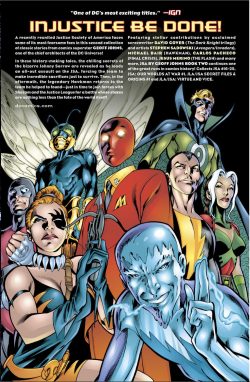
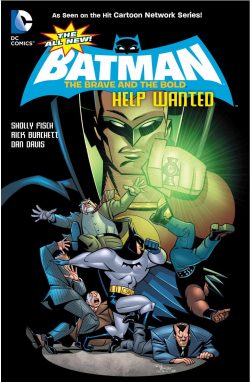
The All-New Batman: The Brave and the Bold volume 2: Help Wanted


By Sholly Fisch, Rick Burchett, Dan Davis, Dario Brizuela, Ethen Beavers & various (DC Comics)
ISBN: 978-1-4012-3524-6 (TPB/Digital edition)

The Brave and the Bold premiered in 1955 as an anthology adventure comic featuring short complete tales about a variety of period heroes: a format reflecting the era’s filmic fascination with flamboyantly fanciful historical dramas. Devised and written by Bob Kanigher, #1 led with Roman epic Golden Gladiator, feudal mystery-man The Silent Knight and Joe Kubert’s Viking Prince. Soon the Gladiator was alternated with Robin Hood, but the adventure theme carried the title until the end of the decade when the burgeoning costumed character revival saw B&B transform into a try-out vehicle like Showcase.

Used to premiere concepts and characters such as Task Force X: The Suicide Squad, Cave Carson, Hawkman and Strange Sports Stories as well as the epochal Justice League of America, the comic soldiered on until issue #50 when it found another innovative new direction which once again caught the public’s imagination. That issue paired two super heroes – Green Arrow and Martian Manhunter – in a one-off team-up. It was followed by more of the same: Aquaman with Hawkman in #51, WWII “Battle Stars” Sgt. Rock, Mme. Marie, Captain Cloud & The Haunted Tank in #52 and The Atom & Flash in #53.

The next instant union – Robin, Aqualad and Kid Flash – evolved into The Teen Titans and after Metal Men/The Atom and FlashbMartian Manhunter appeared, a new hero debuted in #57-58: Metamorpho, the Element Man.

From then it was back to the increasingly popular power pairings with #59. Although no one realised it at the time, that particular conjunction – Batman with Green Lantern – would be particularly significant….

A return engagement for the Teen Titans, issues spotlighting Earth-Two stalwarts Starman and Black Canary and Earth-One’s Wonder Woman and Supergirl soon gave way to an indication of things to come when Batman returned to duel hero/villain Eclipso in #64: an early acknowledgement of the brewing TV-induced mania mere months away.

Within two issues (following Flash/Doom Patrol and Metamorpho/Metal Men), B&B #67 saw the Caped Crusader take de facto control of the title and a lion’s share of team-ups. With the late exception of #72 and 73 (Spectre/Flash and Aquaman/Atom), it was thereafter where the Gotham Gangbuster invited the rest of DC’s heroic pantheon to come and play…

Decades later, Batman: The Animated Series – masterminded by Bruce Timm and Paul Dini in the 1990s – revolutionised the Dark Knight and subsequently led to some of the absolute best comic book adventures in his 80-year publishing history. It also led to a spin-off print title…
With constant comics iterations and tie-ins to a succession of TV animation series, Batman has remained immensely popular and a sublime introducer of kids to the magical world of the printed page. One fun-filled incarnation was Batman: The Brave and the Bold, which gloriously celebrated the team-up in both its all-ages small-screen and comicbook spin-off.

Shamelessly and superbly plundering decades of continuity arcana in a profusion of alliances between the Dark Knight and DC’s lesser creations, the show was supplemented by a cool kid’s periodical full of fun, verve and swashbuckling dash, cunningly crafted to appeal as much to the parents and grandparents as those fresh-faced neophyte kids…

This stellar trade paperback and digital collection re-presents issues #7-12 of the second series – The All-New Batman: The Brave and the Bold – in an immensely entertaining all-ages ensemble suitable for newcomers, fans and aficionados of all ages originally seen between July and December 2011. Although absolutely unnecessary to the reader’s enjoyment, a passing familiarity with the TV episodes will enhance the overall experience as will knowledge of the bizarre minutiae of 1960s and 1970s DC lore…

Scripted throughout by Sholly Fisch, and following the TV format, each tale opens with a brief prequel adventure before telling a longer tale. TA-NB:TB&TB #7 opens with the Caped Crimebuster and aforementioned 1960s Teen Titans triumphing over the Time Trapper as prelude to main feature ‘‘Shadows & Light’. Illustrated by Rich Burchett & Dan Davis, it reveals Batman’s earliest days and a momentous meeting with Gotham’s original guardian. Golden Age Green Lantern Alan Scott wanted to see what the new kid could do offered a teaching experience beside his JSA colleagues…

Aquaman leads off in ‘Under the Sea!’ but soon he and the Dark Knight are on a quest to liberate accursed ghost Captain Fear: battling mythological sea perils and sinister super bandit Black Manta.

‘3:10 to Thanagar’ co-stars Hawkman and begins with them and The Atom defeating shapeshifter Byth, with the majority of the yarn detailing how transporting him back to interplanetary jail is derailed by an armada of evil allies trying – and failing – to break him free.

‘Help Wanted’ offers a delightful and truly heartwarming deviation from standard form as a professional henchman details the tribulations of the gig economy as tenures with Toyman, Clock King and Ocean Master end early, thanks to Superman, Green Arrow, Aquaman and others. What the reformed family man will never know is how his own wife, son and Batman colluded to redeem him…

With art from Dario Brizuela, ‘Out of Time’ finds the Caped Crusader, Geo-Force and Cave Carson unearth an ancient earthquake machine under Gotham, compelling Batman to head back to 1879 to destroy it before it starts eating bedrock. The case brings him into partnership with bounty hunter Jonah Hex and into contention with immortal maniac Ra’s Al Ghul before the day and all those tomorrows are saved…

Wrapping up this jaunty journal of joint ventures, ‘Trick or Treat’ – with art by Ethen Beavers – offers a Halloween appetiser as Batman and Zatanna investigate a break-in at the House of Mystery. After freeing Cain & Abel, the heroes track clues and deal with Doctor Destiny and Mr. Mxyzptlk before deducing the only possible culprit and getting dragged into a colossal clash of mystic heroes and villains…

Despite being ostensibly aimed at TV-addicted kids, these mini-sagas are also wonderful, traditional comics thrillers no self-respecting fun-fan should miss: accessible, well-rendered yarns for the broadest range of excitement-seeking readers. This is a fabulously full-on thrill-fest confirming the seamless link between animated features and comic books. After all, it’s just adventure entertainment in the end; really unmissable entertainment…

What more do you need to know?
© 2011, 2012 DC Comics. All Rights Reserved.
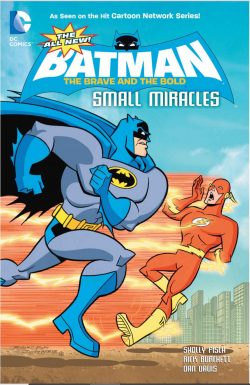
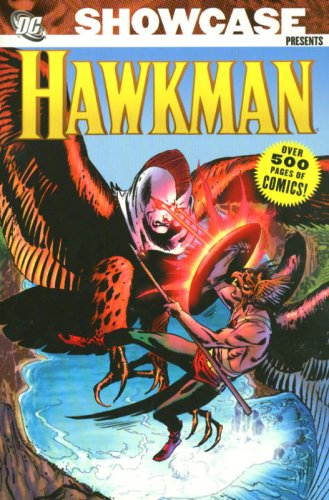
Showcase Presents Hawkman volume 1


By Gardner F. Fox, Bob Haney, Joe Kubert, Gil Kane, Murphy Anderson, Howard Purcell, Carmine Infantino & various (DC Comics)
ISBN: 978-1-4012-1280-3 (TPB)

Not all passions are romantic: mine is to finally have all old comics forever available in curated editions. These astoundingly engaging Silver Age tales are another treat inexplicably unavailable in modern, full-colour editions, either physically or digitally.

On a timely note, however, this book does highlight one of the most effective and enduring romantic crime-busting, world-saving partnerships in comics…

With the superhero revival in full swing by 1961, Editorial genius Julius Schwartz turned to resurrecting one of DC’s most visually arresting and iconic Golden Age characters. Once again eschewing mysticism for science fiction (the original Hawkman was a reincarnated Egyptian prince murdered by a villainous priest), Schwartz picked scripter Gardner F. Fox – who created the Golden Age great – and artist Joe Kubert to construct a new hero for the Space Age.

This titanic tome is still readily available from online retailers and packs a big punch, gathering the works of the Winged Wonders from The Brave and the Bold #34-36, #42-44 and #51; The Atom #7; Mystery in Space #87-90 and Hawkman #1-11: cumulatively spanning February/March 1961 to December 1965/January 1966.

Katar Hol and his wife Shayera Thal are police officers on their own planet of Thanagar. They’ve travelled to Earth from the star system Polaris in pursuit of a spree-thief named Byth who assaulted a scientist and stole a drug bestowing the ability to change into anything. Thus the scene was set in ‘Creature of a Thousand Shapes’ which graced The Brave and the Bold #34 (cover-dated February/March 1961): a spectacular work of graphic magic, with the otherworldly nature of the premise rendered captivatingly human by the passionate, moody expressiveness of Kubert’s art. It is a minor masterpiece of comic storytelling, and still a darned good read.

The high-flying heroes returned in the next issue, now stationed on Earth to study Terran police methods. In ‘Menace of the Matter Master’ they defeat a plundering scientist who has discovered a means to control elements, before ‘Valley of Vanishing Men’ takes the strange visitors from another world to the Himalayas to discover the astounding and ironic secret of the Abominable Snowmen.

Last chance in the try-out session, B&B #36 then sees them defeat a modern day wizard in ‘Strange Spells of the Sorcerer’ and after, save Earth from another Ice Age whilst defeating ‘The Shadow Thief of Midway City’.

With the three-issue audition over, the publishers sat back and waited for the fan letters and sales figures… and something odd happened: fans were vocal and enthusiastic, but the huge sales figures just weren’t there. It was inexplicable. The quality of the work was plain to see on every page, but somehow not enough people had plunked down their dimes to justify an ongoing Hawkman series

A year later DC tried again. The Brave and the Bold #42 (June/July 1962) featured ‘The Menace of the Dragonfly Raiders’ and found Katar and Shayera returning to Thanagar just in time to encounter a bizarre band of alien thieves. Here was superhero action in a fabulous alien locale and the next issue maintained the exoticism – at least initially – before Hawkman and Hawkgirl returned to Midway City to defeat a threat to both worlds – ‘The Masked Marauders of Earth’.

One last B&B issue followed – #44, October-November 1962 – with two splendid short tales. ‘Earth’s Impossible Day’focused on Shayera’s desire to celebrate a holiday tradition of Thanagar whilst eerie doomsday thriller ‘The Men who Moved the World’ explored lost civilisations and the return of Earth’s original owners… and then the Hawks vanished again. It certainly looked like this time the magic had faltered.

That, however, was not the end of the saga. Convinced he was right, Schwartz retrenched. Enjoying some success with the new Atom title and mindful of the response when he had teamed the Flash and Green Lantern in the summer of 1962, the editor had writer Fox include the Winged Wonder in ‘The Case of the Cosmic Camera’ (The Atom #7, June/July 1963): an interplanetary thriller illustrated by Gil Kane and Murphy Anderson. This invasion rollercoaster ranged from the depths of space to Earth’s most distant past.

This new clean-limbed version clearly found fan-favour and in 1963 Hawkman returned! Again!

Mystery in Space had been the home of Adam Strange since issue #53 and with #87 (November 1963) Schwartz moved the Winged Wonders into a back-up slot; even granting them occasional cover-privileges. Still written by Fox, Kubert’s moody art had been superseded by the clean, graceful illustration of Anderson. ‘The Amazing Thefts of the I.Q. Gang!’ was followed a month later by ‘Topsy-Turvy Day in Midway City!’

With the management now on board, guest appearances to maximise profile were easier to find. Hawkman briefly returned to The Brave and the Bold with #51 (December 1963/ January 1964) to team with Aquaman and face the ‘Fury of the Exiled Creature!’

This quirky tale of monsters, magic and mayhem in sunken Atlantis was written by Bob Haney and illustrated by the criminally neglected Howard Purcell, and then it was back to Mystery in Space #89 and the ‘Super-Motorized Menace!’the month after that.

These were brief, engaging action pieces, before issue #90 offered a full length story teaming the Hawks and Adam Strange in a legendary End-of the-World(s) epic. ‘Planets in Peril!’ – illustrated by Carmine Infantino & Murphy Anderson – was the last Hawkman back-up. From the next month, and after three years of trying, Hawkman would soar in his own title.

Cover-dated April/May 1964, Hawkman #1 is a gem of an issue by Fox & Anderson. Two of the most visually arresting characters in comics, the Hawks had one of the most subtle and sophisticated relationships in the business. Like Sue and Ralph Dibney (Elongated Man and wife) Katar and Shayera are equal partners, and both couples were influenced by the Nick and Nora Charles characters of the Thin Man movies. Like those progenitors, the interplay of the Hols at home or at work is always rich in humour and warmth.

In ‘Rivalry of the Winged Wonders’, and whilst accommodatingly recapping their origins for newcomers, the couple decide to turn their latest case into a contest. Hawkgirl (eventually and more appropriately Hawkwoman) would use Thanagarian super-science to track and catch a band of thieves whilst Hawkman limited himself to Earth techniques and tools in solving the crime.

This charmingly witty yarn is balanced by action thriller ‘Master of the Sky Weapons’ as ancient Mayan warrior Chacthreatens the world with unearthed alien super weapons whilst the second issue featured the ‘Secret of the Sizzling Sparklers!’ – an action-packed thriller concerning trans-dimensional invaders – and closed with ‘Wings across Time’: a mystery revolving around the discovery of the flying harness of the legendary Icarus.

Another brain-teaser opened the third issue. Scientific bandits proved less of a menace than ‘The Fear that Haunted Hawkman’ whilst ordinary thugs and an extraordinary alien owl converged to make our heroes ‘Birds in a Gilded Cage’.

Issue #4 opened with a tale that would revolutionise DC comics. ‘The Girl who Split in Two!’ introduced Zatanna, daughter of a magician who had fought crime in the 1940s only to “mysteriously disappear”.

From the very first issue, and for over a decade, Zatarra was a hero in the Mandrake mould who fought evil in the pages of Action Comics. During the Silver Age, Gardner Fox had Zatarra’s young and equally gifted daughter search for the missing mage by teaming up with a selection of superheroes he was currently scripting (if you’re counting, these tales appeared in Hawkman #4, The Atom #19, Green Lantern #42, and in the Elongated Man back-up strip in Detective Comics #355. A very slick piece of backwriting latterly included the high-profile Caped Crusader via Detective #336 – ‘Batman’s Bewitched Nightmare’.

The saga concluded in Justice League of America #51 and ‘Z – As in Zatanna – and Zero Hour!’)…

This wide, long-running experiment in continuity proved that there was a dedicated fan-base out there with a voracious appetite for experimentation and relatively deep pockets. Most importantly, it finally signalled the end of the period where DC heroes largely lived and battled in self-imposed worlds of their own.

Back-up ‘The Machine that Magnetized Men!’ is another fine tale, as the Pinioned Paladins use reason and deduction to defeat thieves who are impossible to touch.

‘Steal, Shadow – Steal!’ in number #5 is the first full-length thriller, as the ruthless Shadow Thief returns seeking revenge, and believing that causing the next Ice Age is an acceptable consequence of his schemes. Issue #6 is another epic, and one that turned DC’s peculiar obsession with gorillas into a classic adventure.

‘World Where Evolution Ran Wild!’ draws our heroes to fabled Illoral, where a scientist’s explorations and interventions have stretched Natural Selection to un-natural limits. Bold, brash and daft in equal proportions, this is a fabulous romp and seeing again the cover where Hawkman struggles for his life against a winged gorilla makes the adult me realise those DC chaps might have known what they were doing with all those anthropoid covers!

By issue #7 (April-May 1965) the world was gripped in secret agent fever as the likes of James Bond, the Man from U.N.C.L.E., and a host of others sashayed across our TV screens. Comics were not immune, though spies had been a staple threat there for decades. Before Hawkman joined the gang however, he had to deal with the rather mediocre threat posed by ‘The Amazing Return of the I.Q. Gang!’

They were quickly returned to prison and the Hawks moved on to face the ‘Attack of the Crocodile-Men!’: a high-octane super-science thriller that introduced C.A.W. – the Criminal Alliance of the World…

Another supremely captivating cover adorned #8, as the Hawks fought an ancient Roman artificial intelligence built by the not-so mythical Vulcan himself in ‘Giant in the Golden Mask!’, before defeating an alien Harpy who’d been buried for half a million years in ‘Battle of the Bird-Man Bandits’.

Hawkman #9 saw The Atom as guest star when an old villain returned with a seemingly perfect revenge plan for full-length super-thriller ‘Master Trap of the Matter Master!’, after which #10 saw a playful Fox at his best in both ‘Hawkman Clips the Claws of C.A.W!’ – another espionage drama with a delicious subplot as the Winged Wonder aids a sexy CIA agent with a big secret of her own, before solving ‘The Magic Mirror Mystery’: a fair-play tale brainteaser with lots of high-flying action to balance the smart stuff.

This glorious first volume closes with another superb full-length epic as ‘The Shrike Strikes at Midnight!’ and our heroes trail a super-powered, winged bandit all over the world and on to the star system Mizar, in a gripping tale of crime, super-villainy, aliens, revolutions and even dinosaurs.

Hawkman grew to be one of the most iconic characters of the second superhero boom, not just for the superb art but also because of a brilliant, subtle writer with a huge imagination. These tales are comfortably familiar but somehow grippingly timeless. Yet comics are a funny business; circumstances, tastes and fashions often mean that wonderful works are missed and unappreciated. Don’t make the same mistake readers did in the 1960s. Whatever your age, read these astounding adventures and become a fan. It’s never too late.
© 1961-1966, 2007 DC Comics. All Rights Reserved.
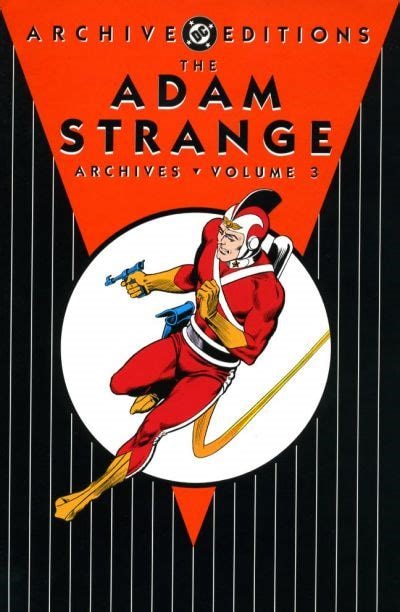
DC’s Wanted: The World’s Most Dangerous Villains


By Jerry Siegel, Bill Finger, Jack Kirby, Joe Simon, William Woolfolk, Ed Herron, John Broome, Gardner F. Fox, Alfred Bester, Don Cameron, Joe Samachson, Mort Weisinger, Ken Fitch, David Vern Reed, Sheldon Moldoff, Jack Burnley, Carmine Infantino, Gil Kane, Lee Elias, Mort Meskin, Joe Kubert, Howard Sherman, Pete Riss, Paul Reinman, Alex Kotzky, Bernard Baily, Jon Sikela, Harry G. Peter, Murphy Anderson, Nick Cardy & various (DC Comics)
ISBN: 978-1-7795-0173-8 (HB)

We talk of Gold and Silver Ages in comics and latterly for the sake of expediency have added other mineral markers like a Bronze Age, but no ever talks about the period between 1964 and 1977 as a specific and crucial time in funnybook history. But it was…

During that period, economic pressure compelled DC and Marvel to increasingly plunder their own archives and fill expensive pages in their primary product to maintain hard-won spaces on newsstands and magazine spinners. Some readers moaned about reprints. Some didn’t notice and most didn’t care. But for all those little proto-geeks like me, it was being given the keys to the greatest kingdom of all.

Once you grasped that the differently drawn stuff with clunkier buildings and cars – and more men in hats – was from the past, and not something happening “now”, it simply added to the scope and scale of what you were reading: hinting of a grand unknown past you were now party to. Moreover, the sheer quality of most twice-printed tales was astounding.

I wasn’t around for Lou Fine or Basil Wolverton or Jack Burnley the first time, but reprints made me a devotee. You young whippersnappers with your interwebs and archive collections don’t know how lucky you are.

Marvel especially made a service out of a necessity: keeping their older material in print via big packages like Marvel Collectors’ Items Classics and Marvel Tales to ensure reader awareness of their unfolding universe. Those and DC’s 80-Page Giant specials were true gateway series for comics junkies who wanted a peek at the past… particularly the mysterious and alluring “Golden Age” where all the really incredible stuff must have happened…

In 1968 DC started taking reprints seriously by creating a specific title. DC Special began a succession of themed and carefully curated issues at a time when superheroes had entered another decline. In its first run – from fall 1968 to November/December 1971 – it featured issues dedicated to the careers of Carmine Infantino and Joe Kubert, horror stories, teen comedy, western, crime, and two issues featuring Strange Sports Stories, as well as an “all-girl” superhero volume, the Viking Prince and Plastic Man. Issues #8 (Summer1970) and #14 (September/October 1972) were both entitled Wanted! The World’s Most Dangerous Villains: an unrepentant, unashamed celebration of costumed good guys thrashing costumed bad guys…

This spiffy hardback and digital collection sadly excludes those try-out experiments but does collect all the subsequent contents of the spin-off title that followed – #1-9 spanning July/August 1972 to September 1973 – and adds a tenth issue just for thrills and giggles.

It kicks off with a gloriously outré debut as #1 reintroduced ‘The Signalman of Crime’ who used signs and symbols to baffle lawmen. He came – and went – in Batman #112 (December 1957) courtesy of Bill Finger, Sheldon Moldoff & Charles Paris and is followed by a classy Green Arrow yarn from Ed Herron & Lee Elias. ‘The Crimes of the Clock King’ were first found and foiled in World’s Finest Comics (#111 July 1960). Rounding out the first sally is ‘Menace of the Giant Puppet’ by John Broome, Gil Kane & Joe Giella (Green Lantern volume 2 #1, August 1960) wherein the Emerald Gladiator faced the superscience-wielding Puppeteer.

Gold was struck in #2 as Batman #25 (October/November 1944) yielded Don Cameron, Jack Burnley & Jerry Robinson’s‘Knights of Knavery’: an epic clash which saw crime rivals The Penguin and Joker – temporarily – join forces against the Dynamic Duo, after which John Broome, Infantino & Giella detail how ‘The Trickster Strikes Back’. The air-walking felon plunders Central City until the Scarlet Speedster finally outwits him, as first seen in The Flash #121 (June 1961).

Wanted #3 provided exclusively Golden Age greatness, beginning with The Vigilante yarn from Action Comics #69 (February 1944). Devised by Joe Samachson, Mort Meskin & Joe Kubert, ‘The Little Men Who Were There!’ pitted the Prairie Troubadour against diabolical Napoleon of Crime The Dummy, after which warrior wizard Doctor Fate frustrated an invasion by ‘The Fish-Men of Nyarl-Amen’ (More Fun Comics #65 March 1941, by Gardner F. Fox & Howard Sherman) and Hawkman crushed ‘The Human Fly Bandits’ thanks to creators Broome & Kubert as seen in Flash Comics #100 (October 1948).

Original Green Lantern Alan Scott headlined in #4, replaying his epic first clash with Solomon Grundy from All-American Comics #61 (October 1944) as related by Alfred Bester & Paul Reinman in ‘Fighters Never Quit!’, whilst the follow-up featured Kid Eternity – who died before his time and was rewarded by Higher Powers with the power to summon figures from history, myth and literature to fight for justice. ‘Master Man’ came from Kid Eternity #15 (May 1949) wherein writer William Woolfolk and illustrator Pete Riss created the hero’s ultimate nemesis and set them duelling by proxy via resuurected heroes and villains…

Contemporary Green Gladiator Hal Jordan returned in #5, battling Doctor Light in Gardner F. Fox, Kane & Sid Greene’s ‘Wizard of the Light-Wave Weapons!’ (Green Lantern volume 2 #33, December 1964), before the original Tiny Titan faced ‘The Man in the Iron Mask!’ in an epic clash by Woolfolk & Alex Kotzky from Doll Man Quarterly #15 (Winter 1948).

Starman opened #6, in a grudge match against arch foe The Mist. Fox & Burnley’s ‘Finders Keepers!’ – from Adventure Comics #77, August 1942 – saw the see-through fiend use found treasure to mesmerise his victims, and is followed by a saga of Sargon the Sorcerer, battling Blue Lama as ‘The Man Who Met Himself’ (Sensation Comics #71, November 1947 by Broome & Reinman). The drama ends on a spectacular high in the Kubert-illustrated Wildcat thriller ‘The Wasp’s Nest!’ from (Sensation Comics #66, June 1947).

Wanted #7 exhumed more Gold, beginning with speedster Johnny Quick‘s duel with satanic scientist Dr. Clever who gleans the secret of hyper-velocity in ‘The Adventure of the Human Streak’ (More Fun Comics #76 February 1942 and illustrated by Mort Weisinger & Mort Meskin) after which the 1940’s Hawkman battles spectral nemesis The Gentleman Ghost in Robert Kanigher & Kubert’s ‘The Crimes That Couldn’t Have Happened!’ (Flash Comics #90, December 1947) before Ken Fitch & Bernard Baily reveal how Hourman crushes ‘Dr. Glisten’s Submarine Pirates’ as originally seen inAdventure Comics #72, March 1942.

The Silver Age Flash faces ‘The Big Freeze!’ in Broome, Infantino & Murphy Anderson’s furious fight against Captain Cold (The Flash #114 August 1960) before Fox & Sherman pit a depowered Doctor Fate against transformative terror ‘Mr. Who’ in a stirring saga from More Fun Comics #73 (November 1941).

The original run concluded with #9, which opened with Jerry Siegel & Jon Sikela’s epic and absurdist Superman clash against the diabolical Prankster who claimed to be ‘Crime’s Comedy King!’ in Action Comics #57 (February 1943) after which the adventure peaked in a classic Jack Kirby & Joe Simon Sandman thriller. First found in World’s Finest Comics #6 (Summer 1942) ‘The Adventure of the Magic Forest!’ saw the Master of Dreams and Sandy the Golden Boy crush murderous, nefarious hijacker Nightshade…

The fun continues with a virtual 10th issue compiled in recent times and prompted by a letter from Wanted #9 requesting an all-female outing. It took long enough but the wish is finally granted in ‘A Modern Take: Wanted: The World’s Most Dangerous Villains #10! which begins with a Catwoman classic.

The Sleeping Beauties of Gotham City!’ debuted in Batman #84 (June 1954), scripted by David Vern Reed and limned by Sheldon Moldoff & Stan Kaye, wherein notorious Selina Kyle subverts a beauty contest, not for vanity but for glittering profit, after which Flash Comics #86 (August 1947) provides the first adventure of ‘The Black Canary’ in a swansong for bumbling hero Johnny Thunder by Kanigher, Infantino & Giella.

Wrapping up this sublime “Wants” list is a late clash between the Amazing Amazon and war god Mars by Kanigher & Harry G. Peter. ‘The Girl Who saved Paradise Island!’ comes from Wonder Woman #36, July/August 1949 and features interplanetary conflict and the truly terrifying warriors of Infanta, so be warned…

With covers by Murphy Anderson and Nick Cardy, this tome celebrates the primal simplicity of Superhero comics: no angst, no grey areas and no continued epics, just a whole bunch of done-in-one delights for fans of history and simplicity.
© 1941, 1942, 1943, 1944, 1945, 1947, 1948, 1949, 1954, 1960, 1961, 1964, 1972, 1973, 2020 DC Comics. All Rights Reserved.
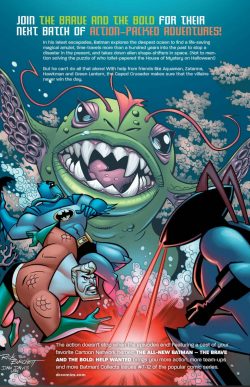
Showcase Presents Aquaman volume 2


By Jack Miller, Bob Haney, Dave Wood, Ramona Fradon, Nick Cardy & various (DC Comics)
ISBN: 978-1-4012-1712-9 (TPB)

Win’s Christmas Gift Recommendation: Festive Fluid Fun and Thrills… 8/10

Aquaman was another rare superheroes to survive the collapse at the end of the Golden Age: a rather nondescript and generally bland looking guy who solved maritime crimes and mysteries when not rescuing fish and people from sub-sea disasters.

He was created by Mort Weisinger & Paul Norris in the wake of Timely Comics’ Sub-Mariner, launching in More Fun Comics #73 (1941). Strictly a second stringer for most of his career, he nevertheless continued long beyond many stronger features, illustrated by Norris, Louis Cazaneuve and Charles Paris, until young Ramona Fradon took over the art chores in 1954, by which time Aquaman had moved to a regular back-up slot in Adventure Comics. She was to draw every single adventure until 1960.

In 1956, Showcase #4 rekindled the public’s imagination and zest for costumed crime-fighters and, as well as re-imagining many departed Golden Age stalwarts, DC also updated its isolated survivors. Records are incomplete, sadly, so often we don’t know who wrote what, but after the initial revamp better records survive and this second collection of the King of the Seven Seas poses far fewer creative credit conundrums.

Although now the star of his own title, Aquaman continued as a back-up feature in World’s Finest Comics until 1964 and this monochrome chronological compilation includes those tales (issues #130-133, 135, 137, 139), his Brave and the Bold team-up with Hawkman (#51) and the contents of Aquaman #7-23, comprehensively covering December 1962 through September-October 1965: a period that led directly into the King of the Seven Seas becoming one of DC’s earliest TV stars as part of the animated Superman/Aquaman Hour of Adventure.

The major writers from those years were Jack Miller and Bob Haney and – although some records are lost and a few later scripts remain unattributed – recognizing artists is far less troubling. The World’s Finest yarns were Fradon’s last: captivatingly clean, economical lines bringing to unique life charming little adventure and mystery vignettes which always were and still are a joy to behold.

Thereafter, apart from a memorable and brief return to co-create Metamorpho the Element Man, she left comics until 1972 to raise her daughter.

We begin with ‘King of the Land Beasts’ (WFC #130, by Haney & Fradon) is a typically high-quality teaser about an alien Aquaman whilst ‘The Sea Beasts from Atlantis’ (Aquaman #7 by Miller & Nick Cardy) pitted the Sea Lord and Aqualad against sub-sea monsters and a plot to overthrow the government of the lost city, abetted if not quite aided by mystical sea imp Quisp.

‘The Man Who Controlled Water’ (World’s Finest # 131, Miller & Fradon) saw them tackle a scientist who could solidify liquids into fearsome weapons, whilst in issue #8 of their own magazine, Miller & Cardy revealed ‘The Plot to Steal the Seas’ with the oceanic adventurers battling far out of their comfort zone to thwart marauding aliens.

Dave Wood scripted quirky thriller ‘The Fish in the Iron Mask’ (WFC #132) wherein faithful octopus Topo is possessed by a sinister helmet and ‘The Secret Mission of King Neptune’ (Aquaman #9, Miller & Cardy) seemingly brings the heroes into bombastic contention with the God of the Oceans – but is he all he seems?

World’s Finest Comics #133 briefly introduces ‘Aquaman’s New Partner – Aqua-Girl’, but Miller & Fradon’s creation was strictly a one shot deal, whereas ‘War of the Water Sprites’ (Aquaman #10, Miller & Cardy) introduced an evil band of Quisp’s fellow imps who eerily presaged a tale of the JSA decades later…

Miller & Fradon’s ‘The Creatures that Conquered Aquaman’ (WFC #135) is another alien invasion extravaganza whilst Aquaman #11 features the landmark introduction of the Sea King’s future wife Mera in Miller & Cardy’s extravaganza ‘The Doom from Dimension Aqua’, whilst #12 present two shorter thrillers from Haney, ‘The Menace of the Land-Sea Beasts’ – with mutated jungle animals wreaking sub-sea havoc – and ‘The Cosmic Gladiators!’, wherein the seaborne sentinels are press-ganged into an intergalactic cage-fight contest.

Miller provided the penultimate World’s Finest outing ‘The Day Aquaman Lost his Powers’ in #137 and Haney scripted a manic tale of team-up terror for superb veteran artist Howard Purcell in ‘Fury of the Exiled Creature’ (The Brave and the Bold #51, December 1963-January 1964) in which the fearsome Outcast of Atlantis turns mutational powers against not just Aquaman but also new DC superstars Hawkman and Hawkgirl.

Aquaman #13 then sees Mera return in the Miller-penned ‘Invasion of the Giant Reptiles’ as the tide-crossed lovers unite to defeat criminals from the future. Fradon & Miller wrap up his World’s Finest tenure in high style with #139’s taut thriller ‘The Doom Hunters’, leaving Cardy as sole Aquaman artist. His work gradually became more representational and realistic, although Miller’s ‘Aquaman’s Secret Powers!’ still held plenty of fantastic fantasy as a dying derelict curses the Sea King with incredible new abilities, whilst the second tale in #14 – ‘The Tyrant Ruler of Atlantis’ – finds the temporarily deranged hero seizing the throne of the sunken city. Within scant months he would be legitimately offered the crown…

Miller wrote the next four issues, beginning with sinister scientific tragedy ‘Menace of the Man-Fish’, #16’s ‘The Duel of the Sea Queens!’ – as Mera battled an alien siren who set her tentacled cap for Aquaman – and #17’s ‘The Man who Vanquished Aquaman’, wherein the god Poseidon abducted Mera.

All this romantic tension and concentration was for a purpose. The next issue featured ‘The Wife of Aquaman’ wherein the Sea King marries his extra-dimensional beloved in one of the first superhero weddings of the Silver Age. Talk about instant responsibilities…

None of the remaining tales have a credited scripter, but that doesn’t affect their wonderful readability nor Cardy’s better-every-panel artwork, beginning with #19’s ‘Atlanteans For Sale’ as new bride Mera slowly goes bonkers due to her husband’s neglectful super-hero schedule. Cue the arrival of merman man-candy Nikkor who insinuates himself into her affections… and the throne!

This surprisingly adult tale is followed by #20’s ‘The Sea King’s Double Doom’, as an old friend and shape-changing monster both hit Atlantis at the same time. Coincidence? We think not…

Super-villain the Fisherman debuts in #21’s ‘The Fearful Freak from Atlantis’ with the Sea King transformed into a sea monster, whilst ‘The Trap of the Sinister Sea Nymphs’ introduces Mera’s wicked twin sister before this splendidly engaging volume concludes on another groundbreaking high-note with issue #23’s ‘The Birth of Aquababy’. Unfortunately, the happy couple’s newborn child displays uncanny powers (and yes, you nit-picking gossips, it was nine months later… exactly nine months).

One of the greatest advantages of these big value black-&-white compendiums was the opportunity they provided whilst chronologically collecting a character’s adventures to include crossovers and guest spots from other titles. When the star is as long-lived and incredibly peripatetic as DC’s King of the Seven Seas, that’s an awful lot of extra appearances for a fan to find…

DC has a long and comforting history of gentle, innocuous yarn-spinning with quality artwork. Ramona Fradon’s Aquaman is one of the most neglected runs of such accessible material, and it’s a pleasure to discover just how readable they still are. When the opportunity arises to compare her wonderful work to the exponentially improving superhero work of such a stellar talent as Nick Cardy, this book becomes another fan’s must-have item. More so when all the stories are still suitable for kids of all ages.

Hopefully the current editorial administration will soon get around to revisiting them in new archival chronicles and digital editions, but until then why not treat yourself and your youngsters to a timeless dose of whimsy and adventure? You won’t regret it.
© 1962, 1963, 1964, 1965, 2008 DC Comics. All Rights Reserved.