
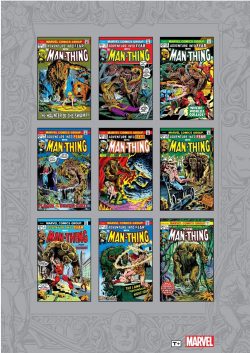
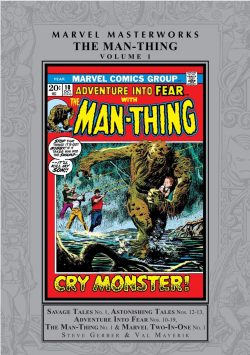
By Steve Gerber, Roy Thomas, Len Wein, Gerry Conway, Val Mayerik, Gray Morrow, Rich Buckler, John Buscema, Neal Adams, Howard Chaykin, Jim Starlin, Gil Kane, Dan Adkins, Jim Mooney, Frank Bolle, Chic Stone, Frank McLaughlin, Sal Trapani, Joe Sinnott, Frank Brunner, Mike Ploog & various (MARVEL)
ISBN: 978-1-3029-5547-2 (HB/digital edition)
This book includes Discriminatory Content produced in less enlightened times. This book also includes some Discriminatory Content included for dramatic and literary effect.
Win’s Christmas Gift Recommendation: Timeless, Remorseless, Evergreen Scary Stuff to Make You Think… 9/10
At the end of the 1960s American comic books were in turmoil, much like the youth of the nation they targeted. Superheroes had dominated for much of the decade; peaking globally before explosively falling to ennui and overkill. Older genres such as horror, westerns and science fiction returned, fed by radical trends in movie-making, where the kids who had grown up with Marvel now fulfilled the bulk of their young adult entertainment needs.
Inspiration isn’t everything. In fact as Marvel slowly grew to a position of market dominance in the wake of the losing their two most innovative and inspirational creators, they did so less by experimentation and more by expanding proven concepts and properties. The only real exception to this was the hasty hyper-generation of multiple horror titles in response to the industry down-turn in super-hero sales – a move vastly expedited by a rapid revision in the wordings of the increasingly ineffectual Comics Code Authority rules.
The switch to supernatural stars had many benefits. Crucially it brought a new readership to Marvel comics, one attuned to the global revival in spiritualism, Satanism and all things sinisterly spooky. Almost as important, it gave the reprint-crazy company an opportunity to finally recycle old 1950s horror stories that had been rendered unprintable and useless since the Code’s inception in 1954.
A scant 15 years later the Comics Code prohibition against horror was hastily rewritten – amazing how plunging sales can affect ethics – and scary comics came back in a big way with a new crop of supernatural heroes and monsters popping up on the newsstands to supplement the ghosts, ghoulies and goblins already infiltrating the once science-only scenarios of the surviving mystery men titles. In fact lifting of the Code ban resulted in such an en masse creation of horror titles (both new characters and reprints from the massive boom of the early 1950s) that it probably caused a few more venerable costumed crusaders to (temporarily, at least) bite the dust.
Almost overnight nasty monsters (and narcotics – but that’s another story) became acceptable fare on four-colour pages and whilst a parade of pre-code reprints made sound business sense, the creative aspect of the contemporary buzz for bizarre themes was catered to by adapting popular cultural icons before risking whole new concepts on an untested public. As always in entertainment, the watch-world was fashion: what was hitting big outside comics was to be incorporated into the mix as soon as possible.
The first fan-sensation of the modern era, (now officially enshrined as the Bronze Age of US comic books) Swamp Thing had powerful popular fiction antecedents and in 1972 it was seemingly a concept whose time had come again. Prime evidence was the fact that Marvel were also working on a man-into-mucky, muddy mess character at the very same time. Both Swampy and the Macabre Man-Thing were thematic revisions of Theodore Sturgeon’s classic novella It, and bore notable resemblances to a hugely popular Hillman Comics star dubbed The Heap.
He/it sloshed through the back of Airboy Comics (née Air Fighters Comics) from 1943 until the end of the Golden Age, and my fanboy radar suspects Roy Thomas’ marsh-monster The Glob (Incredible Hulk #121-November 1969 & #129-June 1970) either inspired both DC and Marvel’s creative teams, or was part of that same zeitgeist. It must also be remembered that in the autumn of 1971 Skywald – a very minor player with big aspirations – released a monochrome magazine in their Warren knock-off line entitled The Heap.
For whatever reason, by the end of the 1960s superhero comics were in another steep sales decline, again succumbing to a genre boom led by a horror/mystery resurgence. A swift rewriting of the Comics Code Authority augmented the changeover and at National/DC, veteran EC comics star Joe Orlando became editor of House of Mystery and sister title House of Secrets. These were short story anthologies embracing gothic mystery scenarios, taking their lead from TV triumphs like Twilight Zone and Rod Serling’s Night Gallery, but a horror themed lead meant a focus on character not plot, tragedy and empathy over twist endings and most precious of all, continuity…
No one was expecting satire and social commentary but that came along for the ride too!
Remarkably soon after the Comics Code prohibition against horror being amended, scary comics returned in force and a fresh crop of supernatural superheroes and monsters began appearing on newsstands to supplement the ghosts, ghoulies and goblins already infiltrating the once science-only scenarios of the surviving Fights ‘n’ Tights titles.
In fact, the lifting of the Code ban resulted in such an avalanche of horror titles in response to the industry-wide downturn in superhero sales, that it probably caused a few more venerable costumed crusaders to – albeit temporarily – bite the dust.
When proto-horror Morbius, the Living Vampire debuted in Amazing Spider-Man #101 (cover-dated October 1971) and the sky failed to fall in, Marvel moved ahead with a line of shocking superstars. They began with a traditional werewolf and a vampire before chancing something new: a haunted biker who tapped into both Easy Rider’s freewheeling motorcycling chic and the prevailing supernatural zeitgeist: the all-new Ghost Rider (in Marvel Spotlight #5, August 1972). He had been preceded by western hero Red Wolf in #1 and the aforementioned Werewolf by Night in #2-4. From these beginnings spooky floodgates opened to such an extent there was even room for non-white stars like The Living Mummy and ultimately today’s star turn…
This quirky compendium collects the earliest exploits of Marvel’s muck monster, and not at all coincidentally traces the rise of a unique comics voice. Steve Gerber was a sublimely gifted writer with a ferocious social conscience who combined a deep love of Marvel’s continuity minutiae with dark irrepressible wit, incisive introspection, barbed cultural criticism, a barely reigned-in imagination and boundless bizarre surrealism. His stories were always at the extreme edge of the company’s intellectual canon and never failed to deliver surprise and satisfaction, especially when he couched his sardonic sorties as thinly veiled attacks on burgeoning cultural homogenisation and commercial barbarity. Via material from Savage Tales #1, Astonishing Tales, #12-13, Adventure into Fear #10-19, The Man-Thing #1 & Marvel Two-In-One #1 (communally spanning May 1971 to January 1974) we’ll see how Marvel increasing became the voice of a lost and dissatisfied liberality…
The revolution begins after an erudite Introduction by authorial everyman Steve Orlando (Scarlet Witch, Wonder Woman, Ben 10, Heavy Metal Magazine), before we trudge back to very different times and the beginning of a new kind of comics experience and Marvel’s continued experiments with the monochrome, mature reader marketplace…
Ranged amidst the grittier-than-usual adult-oriented material (that meant partial nudity and more explicit violence back then) Savage Tales #1 (cover-dated May 1971) was a mixed bag of sword & sorcery, sci fi, crime and horror stories featuring Conan, Ka-Zar and more. That line-up included a powerfully enthralling horror yarn entitled ‘Man Thing!’ Scripted by Gerry Conway & Roy Thomas, it offered a fairly traditional spooky story elevated to sublime heights by Gray Morrow’s artwork. It related how government biochemist Ted Sallis was hiding out in the swamps whilst finishing a new/recreated iteration of the much-prized Super-soldier formula that had created Captain America…
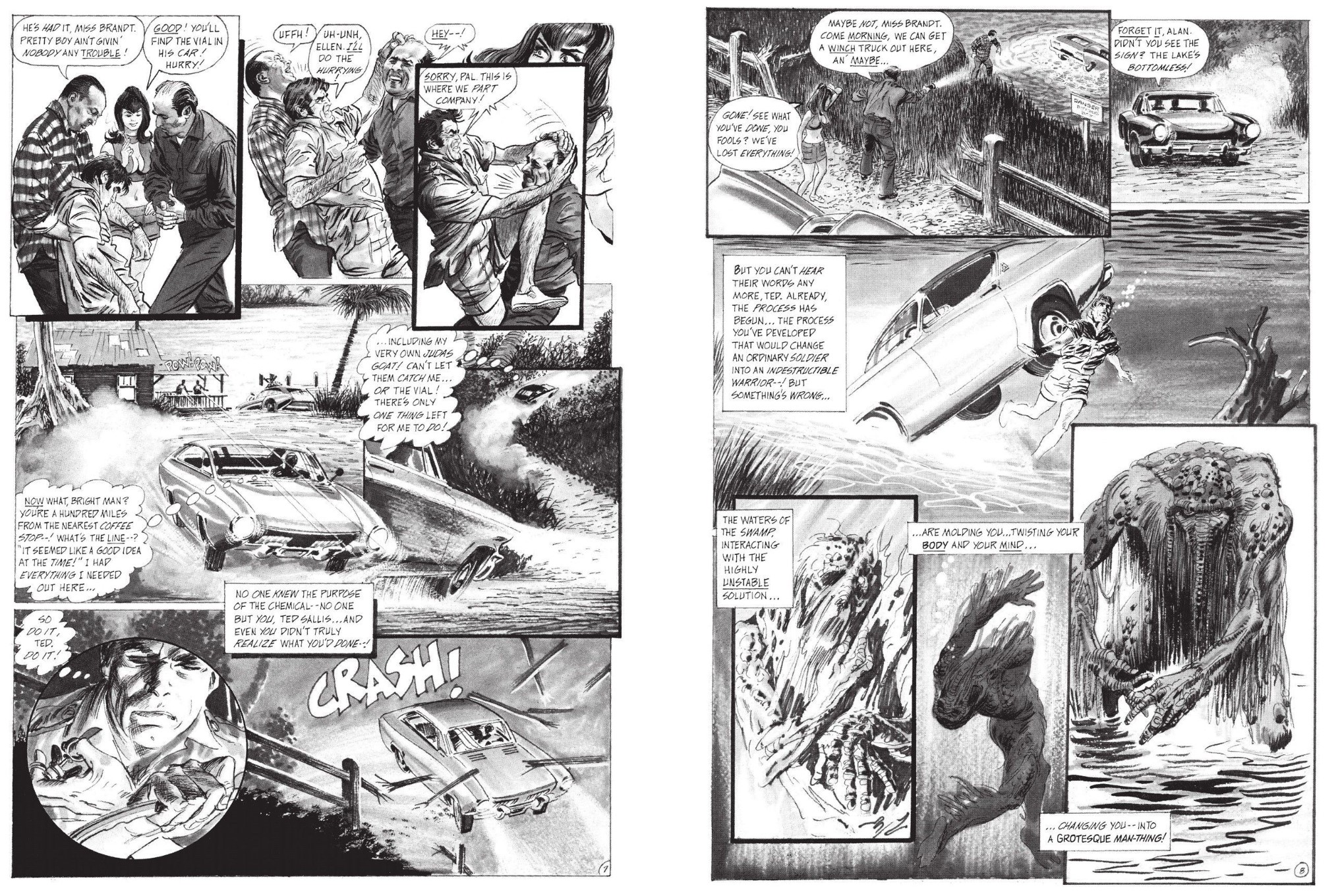
Sadly, his live-in lover Ellen is an agent for the opposition and when she and her minions made a play for the formula, Ted is wounded and flees into the murky mire. To preserve the only sample of his life’s work, the desperate, possibly dying boffin injects himself with it… and the bog mingles with the mix to spawn something tragic and uncanny…
Barely conscious or sentient, a shambling muck-monster emerges, apparently set on justice or vengeance…
Savage Tales was not a success and who knows how many manic Marvelites actually saw the anthology, but creators are stubborn brutes who can’t let things lie, so some months later the muck monster shambled back via a tenuous mainstream comic book connection…
Cover-dated June 1972, Astonishing Tales #12 sees the Savage Land’s self-appointed Sovereign Ka-Zar – and morphologically unsubstantiated primaeval saber-cat Zabu – abruptly relocating to Florida in pursuit of S.H.I.E.L.D. agent Barbra “Bobbi” Morse only to find that ‘Terror Stalks the Everglades!’ Here Thomas, John Buscema & Dan Adkins deftly recast the Jungle King as a freelance “consultant” for the superspy network, assisting aging biologist Dr. Wilma Calvin – who just happens to be Morse’s mentor – in tracking down a missing scientist named Ted Sallis.
What Ka-Zar doesn’t know is that the project all of them are working on is the recreation of the super-soldier serum that created Captain America and what nobody (technically) alive knows is that Sallis succeeded before he vanished. However, when Advanced Idea Mechanic agents tried to steal it. Sallis had injected himself and the chemicals reacted with the swamp’s magical energies to create a mindless shambling monster.
Readers are clued in thanks to a lovely unused interlude intended for Savage Tales #2, with Wein & Neal Adams providing a chilling recap sequence detailing the macabre Man-Thing’s previous relationship with Calvin, before back in the now, AIM attacks, trapping Ka-Zar with the bog-beast…
In AT #13 (Thomas, J. Buscema, Rich Buckler & Adkins), the mystery grows as the Jungle Lord escapes the ‘Man-Thing!’ to focus on the real monsters, subsequently routing out a traitor and defeating AIM… for now. With the attention-grabbing overlap with mainstream Marvel done for the moment the path was clear if muddy for a new horror hero to forge ahead, but what was needed was the right tone of voice…
Steve Gerber was a uniquely gifted writer who combined a deep love of Marvel’s continuity minutiae with dark irrepressible wit, incisive introspection, barbed socio-cultural criticism, a barely reigned-in imagination and boundless bizarre surrealism. His stories were always at the extreme edge of the company’s intellectual canon and never failed to deliver surprise and satisfaction, especially when he couched his sardonic sorties as thinly veiled attacks on burgeoning cultural homogenisation and commercial barbarity. With Man-Thing he held up a peculiarly scummy mirror to many cordoned-off and taboo subjects and made history – and enemies – over and over again. However before him, Conway & Morrow returned, aided by Howard Chaykin as the bog beast won its own series, beginning in (Adventure into) Fear #10. Cover-dated October 1972, ‘Man Thing!’ (Say it again! Again!) saw the monster defy all odds to return an abandoned baby to a daddy who just did not want him… and would not take no for an answer…
After that conceptual interlude Gerber, Buckler & Jim Mooney opened an extended mystic parable in Fear #11 on the ‘Night of the Nether-Spawn!’ Gerber’s take was that the beast was empathic and all-but-mindless, reacting and responding to those in its vicinity, but having practically no personal volition. Here that relationship draws in teenagers Jennifer Kale and her little brother Andy who are about to get into all sorts of trouble because they stole something from their grandpa. Sadly, when you play with a magical tome belonging to an ancient cult, handed down over eons to the latest in a long line of guardian wizards, sinister stuff is likely to happen…
The upshot is that a demonic force comes looking for little Miss Kale and its evil emanations make it a painful intrusion the maddened muck monster cannot abide. With diabolical Thog the Nether-Spawn thus preoccupied battling the bonkers bog-brute all through small-town Citrusville, Andy & Jennifer are free to try to fix what they broke. All appearances and happy endings to the contrary, it’s too little, too late…
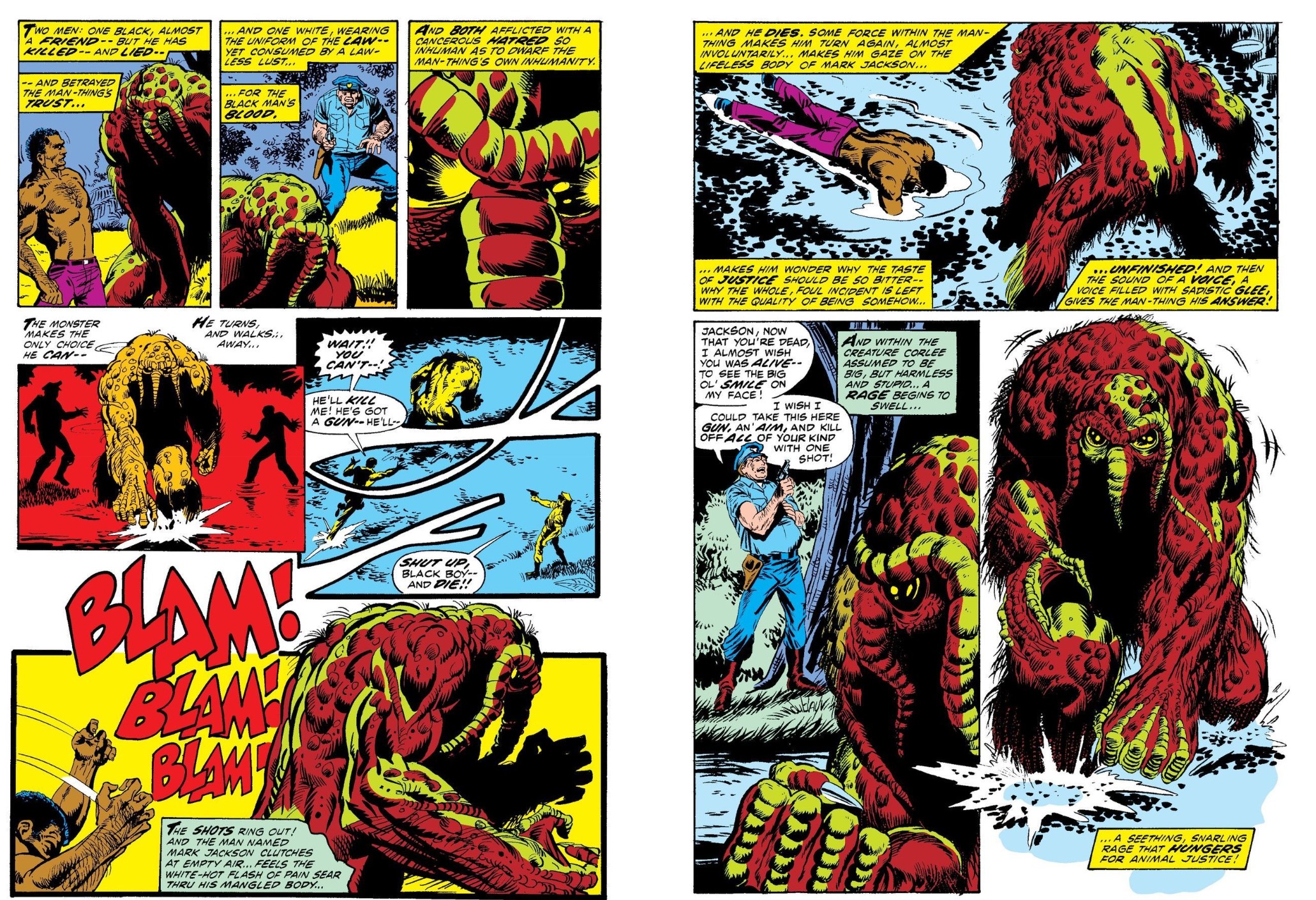
The nation’s racial tensions boiled over into Fear #12 as Gerber, Jim Starlin & Buckler discovered ‘No Choice of Colors!’ after the moss-heap slurped into a far-too-personal vendetta linking racist white sheriff Wallace Corlee and fugitive black murder suspect Mark Jackson. After initially and instinctively saving the wounded runner, Man-Thing is helpless against the literally paralysing hatred of both men: one condemned for loving the wrong shade of woman and the just other happy to have a legal reason to kill another “coloured man”…
Only after one of the enraged obsessives is no more can the swamp beast freely act against the other…
In #13, Val Mayerik begins his fruitful association with the series as – inked by Frank Bolle – ‘Where Worlds Collide!’ finds Gerber in universe-building mode: introducing Jennifer Kale’s Grandpa Joshua as high priest of a cult that has thrived secretly since Atlantis sank beneath the waves. They have safeguarded the world for eons, handing down the sacred Tome of Zhered-Na, but now Jennifer’s meddling as she innocently answered the call of her heritage has opened a portal to infernal terror that begins by taking Jen’s not-boyfriend Jaxon and opening pathways to devil-infested dimensions. When the Man-Thing follows, he finds a place where Ted Sallis is made manifest again and where Thog offers to make it permanent if the human will betray his world…
Ted’s violent refusal coincides with Joshua and the grandkids showing up and, in the flush of frantic battle and escape to consensus reality, the Kales discover Jennifer’s uncanny link to the mindless (again) monster…
Veteran Chic Stone inks #14’s ‘The Demon Plague!’ as, all over America, hate and insanity blossom. Everywhere, humans attack those nearest, dearest or even largely indifferent to them; and the deluge of violence even affects the wildlife in Florida’s swamps with Man-Thing pitilessly assaulted by everything that walks or hops or crawls or swims…
Joshua Kale soon determines that the not properly sealed dimensional portal is permitting demons to pass and possess mortals, and convenes a cult ceremony to close it from within the swamp – which just happens to be the Nexus of All Realities…
Despite best efforts the ritual goes awry and, curiously spying on them, Jennifer and the bog-beast are abducted from existence by a major mage dubbed Dakimh the Enchanter. Forced into gladiatorial actions to retain the sacred tome that only Jennifer knows no longer exists, everybody underestimates the shambling compost heap with flamethrower hands, and the Earthlings are promptly returned without giving away any more arcane secrets…
With Frank McLaughkin as guest inker this time, Gerber & Mayerik probe ‘From Here to Infinity!’ in Fear #15. With chaos gripping the entire planet, the Man-Thing seemingly killed by invading demons and no sacred tome to consult, Joshua Kale visits ancient Atlantis, seeing how mystic Zhered-Na personally dealt with the last such incursion, learning of an eternal war between divine realms – shining Therea and dark Sominus…
As the current cult leader views how his inspiration met her end, elsewhere Dakimh recruits promising potential sorceress Jennifer, revives the bog-beast and takes them both an a trans-dimensional voyage to save reality and stop the sorcerous shooting war…cat least for now and at the cost of the link to the swamp totem…
Abruptly switching tack and tone, Fear #16 ‘Cry of the Native!’ (inked by Sal Trapani) explores themes of Native American rights, ecological barbarism and callous capitalism run amok, when developer F A Schist attempts to drain the swamp and relocate its Indian occupants to facilitate his new airport complex. Complex issues of new jobs versus already broken treaties and promises lead to sabotage, riots and civil unrest, but what concerns the Kales most is how the disruption might affect the shaky barriers holding back the hungry hordes of Sominus…
This time, however, simply human pride, greed, bigotry and love of violence – all agonising felt by mindless, empathic Man-Thing – is enough to spark riot and butchery, and stall the project. In the aftermath (and with Trapani sticking around as inker) #17’s ‘It Came Out of the Sky!’ offers dark, wry parody as the bog-beast curiously opens a long-submerged space capsule buried in the hidden mire. Within is a super-powered baby sent from a world believed by one scientist/loving father to be on the imminent edge of extinction due to environmental collapse…
The capsule had fed and sustained the godlike being within for 22 years, but when Wundarr emerged to immediately imprint on the Man-Thing, nothing could convince the educationally and emotionally challenged – and fully-grown – waif that the unthinking moss-mass was not his mother. The rejection and indifference proved unbearable and the violent tantrums that resulted almost destroy the airport construction site and Citrusville…
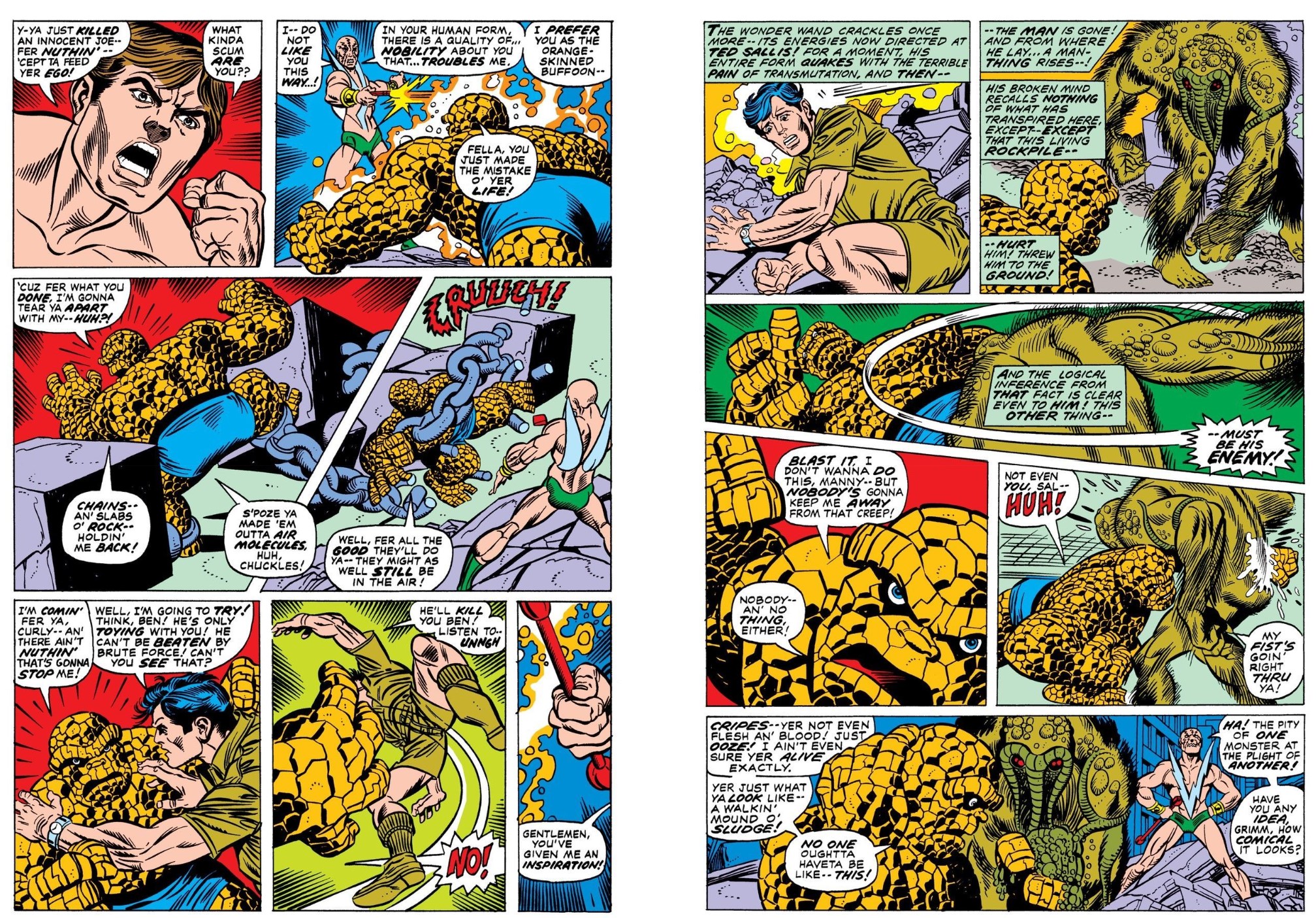
The story notionally carries over into debuting superhero team-up book Marvel Two-In-One #1 (cover-dated January 1974) where, after a desert clash with Thanos, Fantastic Four stalwart Ben Grimm accidentally and improbably ends up in Florida for the premier issue of his own title. Crafted by Gerber, Gil Kane & Joe Sinnott, the ‘Vengeance of the Molecule Man!’ sees The Thing learn some horrifying home truths about what constitutes being a monster when battling with and beside ghastly, grotesque anti-hero Man-Thing after the essence of the reality-warping villain starts possessing bodies in the swamps
Back in Fear #18, Gerber, Mayerik & Trapani resume straight terror tropes and real-world controversy in ‘A Question of Survival!’ as a bus load of ordinary people and a drunk driver catastrophically intersect on a highway through the Everglades. Drawn to the emotional turmoil, the mire monster becomes unwilling witness and unintentional guide as the survivors learn about each other (this at a time when women and minorities were still legally second-class citizens, and pacifists & warhawks violently clashed over Vietnam) whilst trekking back to civilisation and medical treatment. Sadly, one of them really needs to be the only survivor and is not averse to more killing…
The series truly hit its innovative stride with its final appearance in (Adventure into) Fear #19 – cover-dated December 1973 – wherein Thog makes his grand move to conquer all realities and destroy the benign over-gods of Therea. That’s when Jennifer Kale officially becomes ‘The Enchanter’s Apprentice!’ (Gerber, Mayerik & Trapani) and joins another trans-planar trek as the formerly regulated realms of existence begin to collide, clash and combine. First task is to gather the heroes needful to the task and her far-from-united party rapidly expands to include tutor Dakimh, the mindless Man-Thing, a burly barbarian (Korrek, Warrior Prince of Katharta!) and a brusquely cynical talking mallard who calls himself Howard…
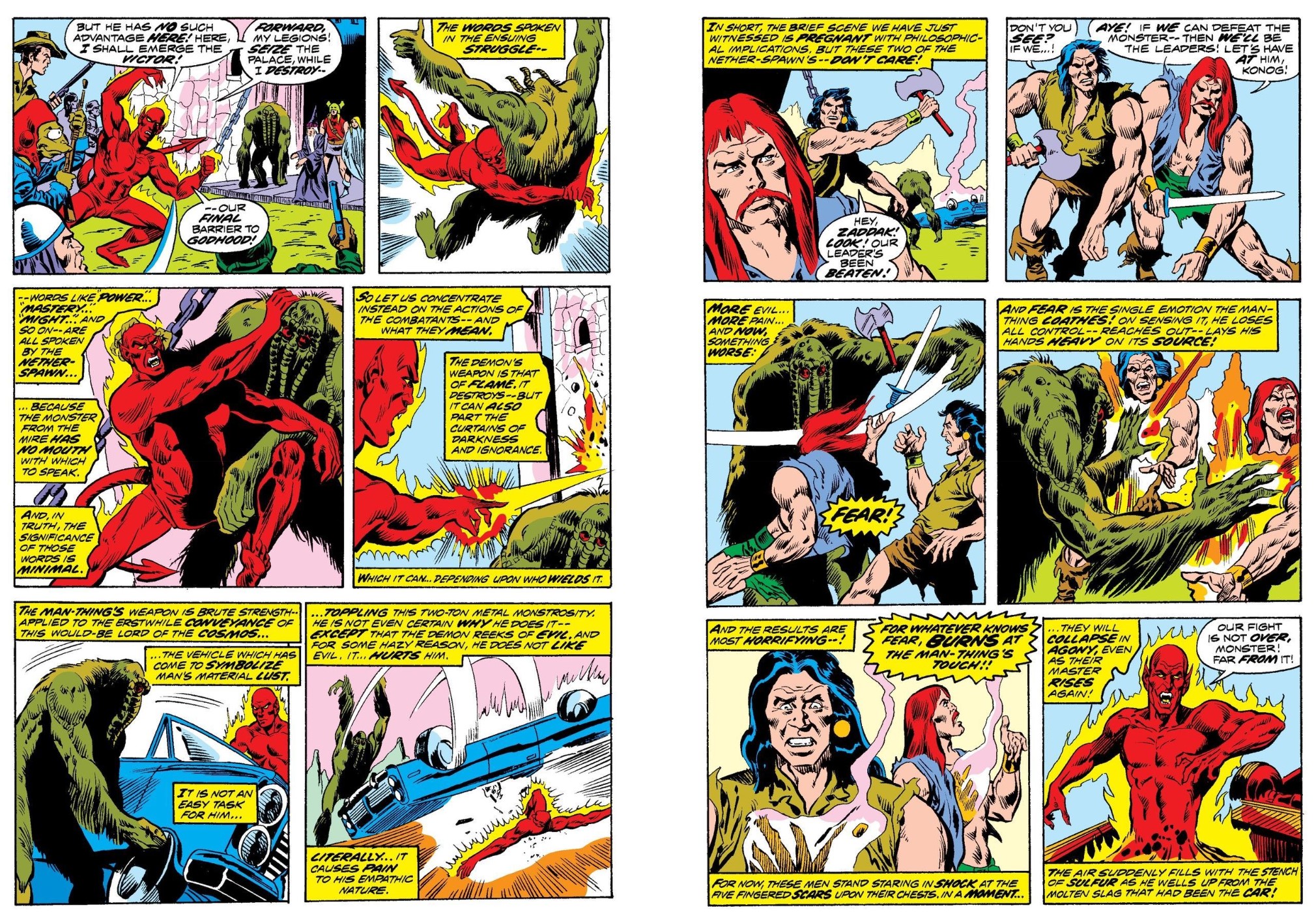
Hounded by Thog’s forces, their task is to traverse the twisting paths of existence and save the gods with the chase leading directly into The Man-Thing #1 (January 1974) and a world-shattering ‘Battle for the Palace of the Gods!’ Along the way, Howard is an early casualty, lost in a plunge through cascading universes and the chaos even briefly encompasses baffled heroes Daredevil and Black Widow; and all seems lost when the malign Congress of Realities smashes into seemingly undefended Therea. However, there are forces at play that are beyond even demons and devils, and the mysterious Man-Thing is their unknowing yet willing tool; and ultimately realties are rebalanced and life goes on…
With covers by John Buscema, Buckler, Morrow, Adams, Starlin, Kane, John Romita Snr., Alan Weiss, Frank Brunner, Sinnott, Frank Giacoia, Herb Trimpe & Ernie Chan, the extras in this moody tome of terror and extrospection also include – from November 1970 – Thomas’ original plot for the short story in Savage Tales #1; an original grey-toned art page by Morrow; more by Buscema & Adkins, Buckler, Mooney, Weiss, Brunner, Mayerik & McLaughlin. For your perusal, Gerber’s plot for Fear #16 follows, with lettering notes and Brunner’s cover for #17. More original art includes Romita’s cover for #18 plus interior art by Mayerik & Trapani. The cover art for #19 by Kane & Chan opens another gallery before segueing into house ads, Adams’ cover for Monsters Unleashed #3 and a cover gallery for reprint title Book of the Dead #1-3 (1993-1994) by Tennyson Smith & Morrow, and Ariel Olivetti’s cover to the 2012 Man-Thing Omnibus.
We – me especially – apply the terms milestone, landmark and groundbreaking as guarantors of quality that change the way comics are perceived and even created. It has never been more true or accurate than with these game-changing, socially aware horror yarns. These are stories you must not miss…
© 2024 MARVEL.
Today in 1894 the magnificent Elzie Segar was born. Go read some Popeye or even Thimble Theatre if you can find it.
In 1980 Berke Breathed chose the day to begin his almost-as-magnificent Bloom County strip, as we last saw in Bloom County: Real, Classy, & Compleat 1980-1989. Some of that last factoid is made up by me, but it could have happened…