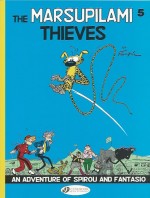
Spirou & Fantasio: The Marsupilami Thieves


By André Franquin,translated by Jerome Saincantin (Cinebook)
ISBN: 978-1-84918-167-9

Spirou (whose name translates as both “squirrel” and “mischievous” in the Walloon language) was created by French cartoonist François Robert Velter AKA Rob-Vel for Belgian publisher Éditions Dupuisin response to the phenomenal success of Hergé’s Tintin for rival outfit Casterman.

The legendary anthology was launched on April 21st 1938 with this other red-headed lad as the lead of the anthology weekly comic which bears his name to this day.

He began life as a plucky bellboy/lift operator employed by the Moustique Hotel (a reference to publisher’s premier periodical Le Moustique) whose improbable adventures with his pet squirrel Spip eventually evolved into high-flying surreal comedy dramas.

Spirou and his pals have spearheaded the magazine for most of its life, with a phalanx of truly impressive creators carrying on Velter’s work, beginning with his wife Blanche “Davine” Dumoulin who took over the strip when her husband enlisted in 1939.

She was aided by Belgian artist Luc Lafnet until 1943 when Dupuis purchased all rights to the feature, after which comic-strip prodigy Joseph Gillain (“Jijé”) took over.

In 1946 Jijé‘sassistant André Franquin assumed the reins, slowly sidelining the short, gag-like vignettes in favour of longer epic adventure serials, introducing a wide and engaging cast of regulars and eventually creating a phenomenally popular magic animal dubbed Marsupilami to the mix (first seen in Spirou et les héritiers in 1952 and now a spin-off star of screen, plush toy store, console games and albums all his own), crafting increasingly fantastic tales until he resigned in 1969.

He was succeeded by Jean-Claude Fournier who updated the feature over the course of nine stirring adventures that tapped into the rebellious, relevant zeitgeist of the times with tales of environmental concern, nuclear energy, drug cartels and repressive regimes.

By the 1980s the series seemed outdated and without direction: three different creative teams alternated on the serial, until it was at last revitalised by Philippe Vandevelde writing as Tome and artist Jean-Richard Geurts best known as Janry, who adapted, referenced and in many ways returned to the beloved Franquin era. Their sterling efforts consequently revived the floundering feature’s fortunes and resulted in fourteen wonderful albums between 1984 and 1998.

As the strip diversified into parallel strands (Spirou’s Childhood/Little Spirou and guest-creator specials A Spirou Story By…) the team on the main vehicle were succeeded by Jean-David Morvan & José-Luis Munuera, and in 2010 Yoann and Vehlmann took over the never-ending procession of amazing adventures…

Cinebook have been publishing Spirou and Fantasio’s exploits since October 2009, concentrating on translating Tome & Janry’s superb pastiche/homages of Franquin, but for this fifth edition (originally entitled Les voleurs du Marsupilami or ‘The Marsupilami Robbers’), they’ve reached back all the way to 1952 and translated the second appearance of the adorable wonder-beast by the great man himself.

On January 3rd 1924, Belgian superstar creator André Franquin was born in Etterbeek. Drawing from an early age the lad began formal art training at École Saint-Luc in 1943. When the war forced the school’s closure a year later, Franquin found animation work at Compagnie Belge d’Animation in Brussels where he met Maurice de Bevere (Lucky Luke creator “Morris”), Pierre Culliford (Peyo, creator of The Smurfs) and Eddy Paape (Valhardi, Luc Orient).

In 1945 all but Culliford signed on with Dupuis, and Franquin began his career as a jobbing cartoonist and illustrator, producing covers for Le Moustique and scouting magazine Plein Jeu.

All during those early days Franquin and Morris were being trained by Jijé who was the main illustrator at Spirou. He turned the youngsters and fellow neophyte Willy Maltaite AKA Will (Tif et Tondu, Isabelle, Le jardin des désirs) into a perfect creative bullpen known as the La bande des quatre or “Gang of Four” who revolutionised Belgian comics with their prolific and engaging “Marcinelle school” style of graphic storytelling.

Jijé handed Franquin all responsibilities for the flagship strip part-way through Spirou et la maison préfabriquée, (Spirou #427, June 20th 1946) and the eager lad ran with it for two decades, enlarging the scope and horizons until it became purely his own.

Almost every week fans would meet startling new characters such as comrade and rival Fantasio and crackpot inventor the Count of Champignac. Along the way Spirou and Fantasio became globe-trotting journalists, continuing their weekly exploits in unbroken four-colour glory.

The heroes travelled to exotic places, uncovering crimes, revealing the fantastic and clashing with a coterie of exotic arch-enemies such as Zorglub and Zantafio as well as one of the first strong female characters in European comics, rival journalist Seccotine (renamed Cellophine in this current English translation).

In a splendid example of good practise, Franquin mentored his own band of apprentice cartoonists during the 1950s. These included Jean Roba (La Ribambelle,Boule et Bill), Jidéhem (Sophie, Starter, Gaston Lagaffe) and Greg (Bruno Brazil, Bernard Prince, Achille Talon, Zig et Puce), who all worked with him on Spirou et Fantasio.

In 1955 a contractual spat with Dupuis saw Franquin sign up with rivals Casterman on Tintin, where he collaborated with René Goscinny and old pal Peyo whilst creating the raucous gag strip Modeste et Pompon.

He soon patched things up with Dupuis and returned to Spirou, subsequently co-creating Gaston Lagaffe in 1957 but was obliged to carry on his Tintin work too…

From 1959, writer Greg and background artist Jidéhem assisted Franquin but by 1969 the artist had reached his Spirou limit and resigned, taking his mystic yellow monkey with him…

His later creations include fantasy series Isabelle,illustration sequence Monsters and bleak adult conceptual series Idées Noires,but his greatest creation – and one he retained all rights to on his departure – is Marsupilami, which in addition to comics tales has become a star of screen, plush toy store, console and albums.

Franquin, plagued in later life by bouts of depression, passed away on January 5th 1997 but his legacy remains, a vast body of work that reshaped the landscape of European comics.

The Marsupilami Thieves was originally serialised in Spirou #729-761 (collected into an album in 1954); a sequel to previous adventure Spirou et les héritiers in which the valiant lad and his inseparable companion colleague encountered an incredible elastic-tailed anthropoid in the jungles of Palombia and brought the fabulous, affable creature back to civilisation.

Franquin’s follow-up tale – crafted from an idea by fellow cartoonist Jo Almo (Geo Salmon) – sees the triumphant journalists visit the big City Zoo where their latest headline has ended up, only to be stricken with guilt and remorse at the poor creature’s sorry state of incarceration.

Resolving to free the poor thing and return him to his rainforest home, their plan is foiled when the poor thing suddenly dies in its cage. Distraught and suspicious, the boys muscle their way in to see the vet and discover the corpse has gone missing…

Acting quickly Spirou and Fantasio rouse the authorities and the commotion prevents the body thief from escaping. All through the night the keepers and our heroes scour the institution and in the dark of night finally spook the mysterious malefactor from his cosy hiding place…

There follows a spectacular and hilarious midnight chase through the zoo, with the lads harrying a dark figure who must be some kind of athlete past a panoply of angry animals, hindered more than helped by inept keepers…

They almost catch the intruder, but a last burst of furious energy propels the bandit over a back wall, but not before Spirou snatches a paper clue from him…

The precious scrap takes the determined investigators to the flat of Victor Shanks, where his wife Clementine provides further information. Her man is flying off to the city of Magnana for his new job and to deliver a package…

The boys’ frantic chase to the airport is plagued by manic misfortune and they miss Victor by mere moments, but undeterred borrow a neighbour’s car and attempt to follow overland.

This leads to a fractious episode of fisticuffs with striking Customs Officers. After a night in jail, the undeterred duo and the kvetching Spip eventually fetch up in Magnana and the search begins.

A month later they are frustrated and ready to throw in the towel when Spirou literally runs into Clementine Shanks and tracks her to a football stadium where formerly unemployed desperate Victor is now a star of the local soccer team…

Confronting the essentially good-hearted rogue Fantasio and Spirou force the truth from him. In return for his new job Victor drugged and swiped the Marsupilami for ruthless showman The Great Zabaglione as a star attraction for his circus and travelling menagerie…

Determined to see the little creature free, the boys attempt to infiltrate the show but are quickly discovered and forcefully expelled, but after a chance meeting with weird science master Count of Champignac try once more disguised as miraculous magic act Cam and Leon…

This time the ruse works but after a phenomenally outrageous opening performance the brutal Zabaglione rumbles the reporters and things look bleak for the lads and the Marsupilami until guilt-wracked Victor steps in to save the day.

…And once the dust settles the wondrous beast is free, but happily opts to stay with the boys and share their fun-filled, exciting exploits…

Soaked in superb slapstick comedy and with gallons of gags throughout, this exuberant yarn is packed with angst-free action, thrills and spills and also offers an early ecological message and an always-timely moral regarding the humane treatment of animals. There is even a fascinating history and creative overview of the timeless wandering heroes in the back-up feature ‘Spirou & Fantasio’s Stories Last Through Generations’.

The Marsupilami Thieves is the kind of lightly-barbed, comedy-thriller to delight readers who are fed of a marketplace far too full of adults-only carnage, testosterone-fuelled breast-beating, teen-romance monsters or sickly sweet fantasy.

Easily accessible to readers of all ages and drawn with all the beguiling style and seductive but wholesome élan which makes Asterix, Lucky Luke, The Bluecoats and Iznogoud so compelling, this is a true and enduring landmark tale from a long line of superb exploits, certain to be as much a household name as those series – and even that other kid with the white dog…
Original edition © Dupuis, 1954 by Franquin. All rights reserved. English translation 2013 © Cinebook Ltd.

Usagi Yojimbo book 9: Daisho


By Stan Sakai (Dark Horse Comics)
ISBN: 978-1-56971-259-7

Despite changing publishers a few times the Roaming Rabbit has been in continuous publication since 1987, with more than 30 collections and books to date. He has guest-starred in many other series (most notably Teenage Mutant Ninja Turtles and its TV incarnation) and even almost made it into his own small-screen show.

There are high-end collectibles, art prints, computer games and RPGs, a spin-off sci-fi comics serial and lots of toys. Author Sakai and his creation have won numerous awards both within the Comics community and amongst the greater reading public.

Usagi Yojimbo (which translates as “rabbit bodyguard”) first appeared as an extra in anthropomorphic comedy The Adventures of Nilson Groundthumper and Hermy which premiered in 1984 amongst assorted furry ‘n’ fuzzy folk in Albedo Anthropomorphics #1.

He subsequently graduated to a solo-starring act in Critters, Amazing Heroes, Furrlough and the Munden’s Bar back-up series in Grimjack.

In 1955, when Stan Sakai was two years old, his family moved to Hawaii from Kyoto, Japan. He left the University of Hawaii with a BA in Fine Arts, and pursued further studies at Pasadena’s Art Center College of Design in California.

His early forays into comics were as a letterer – most famously for the inimitable Groo the Wanderer – before his nimble pens and brushes found a way to express his passion for Japanese history, legend and the works of Akira Kurosawa and his peers, after which Sakai transformed a work-in-progress about a human historical hero into one of the most enticing and impressive fantasy sagas of all time.

Its engaging protagonist is a Bushido bunny and it’s still more educational, informative and authentic than any dozen Samurai sagas you can name…

Although the deliriously peripatetic and expansive period epic stars sentient animals and details the life of a wandering Samurai eking out as honourable a living as possible by selling his sword as a Yojimbo (bodyguard-for-hire), the milieu and scenarios all scrupulously mirror the Feudal Edo Period of Japan (roughly the 17th century AD by our Christian reckoning) whilst simultaneously referencing other cultural icons from sources from Zatoichi to Godzilla.

Miyamoto Usagi is brave, noble, industrious, honest, sentimental, gentle, artistic, empathetic, long-suffering and conscientious: a born soldier whose master has been murdered, now devoted to the spiritual tenets of Bushido. He simply cannot turn down any request for help or ignore the slightest evidence of injustice. As such, his destiny is to be perpetually drawn into an unending panorama of incredible situations.

The title was as much a nomad as its star. This guest-star-stuffed eighth monochrome masterpiece marshals yarns released by Mirage Publishing as Usagi Yojimbo volume 2, #7-14, and comes with an Introduction from writer James Robinson, after which the medieval mystery play resumes with ‘The Music of Heaven’ wherein Miyamoto and a wandering flock of tokagé lizards (ubiquitous, omnivorous reptiles that populate the anthropomorphic world, replacing scavenger species like rats, cats and dogs in the fictitious ecosystem) encounter a gentle, pious priest whose life is dedicated to peace, music and enlightenment…

When their paths cross again later, the ronin is almost murdered by a ruthless assassin who has killed and impersonated the holy man Komuso in an attempt to catch Usagi off guard…

Evocative and movingly spiritual, this classic of casual tragedy perfectly displays the vast range of storytelling Sakai can pack into the most innocuous of tales.

More menaces from the wanderer’s past reconnect in ‘The Gambler, The Widow and the Ronin’ as a professional gambler who fleeces villagers with rigged samurai duels plies his shabby trade in just another little hamlet.

Unfortunately this one is home to his last stooge’s wife, and whilst his latest hired killer Kedamono is attempting to take over the business, to make matters worse the long-eared nomad who so deftly dispatched his predecessor Shubo has just strolled into town looking for refreshments…

Again forced into a fight he doesn’t want, Miyamoto makes short work of blustering Kedamono, leaving the smug gambler to safely flee with the entire take. Slurping back celebratory servings of Saké, the villain has no idea that the inn where he relaxes employs a vengeful widow and mother who knows just who really caused her man’s death…

‘Slavers’ then begins a particularly dark journey for the ronin as Usagi stumbles across a boy in chains escaping from a bandit horde. Little Hiro explains how the ragtag rogues of wily “General” Fujii have captured an entire town and are making the inhabitants harvest all their crops for the scum to steal…

Resolved to save them the rabbit infiltrates the captive town as a mercenary seeking work, but is soon exposed and taken prisoner.

‘Slavers Part 2’ finds Miyamoto stoically enduring the General’s tortures until the boy he saved bravely returns the favour, after which the Yojimbo’s vengeance is awesome and terrible.

However even as the villagers rebel and take back their homes and property, chief bandit Fujii escapes, taking Usagi’s daishō (matched long and short swords) with him.

As previously seen, to take a samurai’s swords is to steal his soul, and the monster not only has them but continually dishonours them by slaughtering innocents as he flees the ronin’s relentless pursuit.

‘Daisho – Part One’ opens with a hallowed sword-maker undertaking the holy methodical process of crafting blades and the harder task of selecting the right person to buy them. Three hundred years later, Usagi is on the brink of madness as he follows the bloody trail of Fujii, remorselessly picking off the General’s remaining killers whilst attempting to redeem those sacred dispensers of death…

The chase leads him to another town pillaged by Fujii where he almost refuses to aid a wounded man until one of the women accuses him of being no better than the beast he hunts…

Shocked back to his senses Miyamoto saves the elder’s life and in gratitude the girl Hanako offers to lead him to where Fuji was heading…

‘Mongrels’ then changes tack as erstwhile ally and hard-to-love friend Gennosuké enters the picture. The irascibly bombastic, money-mad bounty-hunter and conniving thief-taker is on the prowl for suitably profitable prospects when he meets the Stray Dog: his greatest rival in the unpopular profession of cop-for-hire.

After some posturing and double-dealing wherein each tries to edge out the other in the hunt for Fujii they inevitably come to blows and are only stopped by the fortuitous intervention of the rabbit ronin…

‘Daisho – Part Two’ sees the rugged individualists come to a shaky truce in their overweening hunger to tackle the General. Mistrustful of each other they nevertheless cut a swathe of destruction through Fujii’s regrouped band, but even after the furious ronin regains his honour swords there is one last betrayal in store…

Older, wiser and generally unharmed, Gen and Usagi then part company again as ‘Runaways’ once more takes a peek into Usagi’s past. Stopping in a town he hasn’t visited in years, the rabbit hears a name called out and his mind goes back to a time when he was a fresh young warrior in the service of Great Lord MifunÄ—.

Young princess Takani Kinuko had been promised as bride to trustworthy ally Lord Hirano and the rabbit had been a last-minute replacement as leader of the “babysitting” escort column to her impending nuptials.

When an overwhelming ambush destroyed the party, Usagi was forced to flee with the stuck-up brat, both masquerading as carefree, unencumbered peasants as he strove to bring her safely to her husband-to-be through a seeming army of ninjas killers.

The poignant reverie concludes in ‘Runaways – Part 2’ as valiant hero and spotless maid fell in love whilst fleeing from the pitiless, unrelenting marauders on their heels. Successful at last, their positions naturally forced them apart once she was safely delivered.

Shaken from his memories the ronin moves on, tragically unaware that he was not the only one recalling those moments and pondering what might have been…

This emotional rollercoaster ends on a note of portentous foreboding with ‘The Nature of the Viper’, opening a year previously when a boisterous, good-hearted fisherman pulled a body out of the river and nursed his amazingly not dead catch slowly back to health. If he expected gratitude or mercy the peasant was sadly mistaken, as the victim explained whilst killing as soon as he was able.

Jei is a veritable devil in mortal form, believing himself a “Blade of the Gods”; singled out by the Lords of Heaven to kill the wicked. The maniac makes a convincing case: when he stalked Usagi the monster was struck by a fortuitous – or possibly divinely sent – lightning bolt and is still keen to continue his quest…

This medieval monochrome masterwork also includes a gallery of covers to charm and delight one and all.

Fast-paced yet lyrical, informative and funny, and always astoundingly action-packed, Usagi Yojimbo alternately bristles with tension and thrills and frequently breaks your heart with irresistible tales of pride, triumph and tragedy.

Simply bursting with veracity and verve, this is a perfect comics experience: monolithic, magical tales of irresistible appeal that will delight devotees and make converts of the most hardened hater of “funny animal” stories.
Text and illustrations © 1994, 1995, 1998 Stan Sakai. All other material and registered characters are © and™ their respective owners. Usagi Yojimbo and all other prominently featured characters are registered trademarks of Stan Sakai. All rights reserved.

All-New X-Men: One Down


By Brian Michael Bendis, Stuart Immonen, Wade Von Grawbadger and many and& various (Marvel/Panini UK)
ISBN: 978-1-84653-626-7

When bestial mutant Henry McCoy learned he was dying, he indulged in a spot of time-travel in a last-ditch attempt to give his life meaning. Seeking to prevent a species war, he brought the young, naive X-Men of his own youth into the future to reason with his radicalised former comrade Scott Summers, praying the still idealistic and hopeful teens could reason with Mutant Enemy Terrorist No. 1 and divert him from a path of doctrinaire madness…

The gamble paid off in all the wrong ways. Rather than shocking Cyclops back to his senses, the confrontation hardened the renegade’s heart and strengthened his resolve. Moreover, even after the younger McCoy miraculously cured his older self, boy-Henry and the rest of the X-Kids were trapped in their own future and began gradually defecting to the radicalised team…

Scripted by Brian Michael Bendis, this stellar saga collects All-New X-Men #25-29 (published from June to August 2014), taking the time-displaced teens to the ends of the universe and even further into uncharted temporal territory…

The mind-shattering rematch commences in All-New X-Men #25 (illustrated by Stuart Immonen & Wade Von Grawbadger and a host of guest-artists) and follows a dramatic change in young Jean Grey’s status as the team catches their collective breath after being shanghaied to the ends of the universe by Gladiator and the Shi’ar who sought to exterminate the timelost telepotent before she could become a host vessel for the Phoenix…

Already the teen quintet have been reduced to four as the younger Cyclops elected to remain in space with Corsair of the Starjammers– the father he believed dead and gone for most of his young life…

The future-locked Angel, Iceman, Beast, and Jean are stretched to their emotional breaking point. Since an attack by Evil Mutants masquerading as X-Men from the future (X-Men: Children of the Atom) they have faced the very real prospect of never returning to their own time; risking destroying all reality with every moment they aren’t back there and, worst of all, watching Jean go slowly crazy trying not to become the impossibly perfect superwoman everybody keeps talking about in such hushed tones…

The celebratory 25th issue is something of a visual tour de force as the elder Beast has a dreamlike visitation showing him the alternate futures and realities that have been eradicated because of his precipitate act of bringing the teen heroes into today…

Short on plot but fascinating fans with tantalising glimpses of rosters both familiar and fantastic, what follows is a feast of vignettes, scary, dramatic and even funny, illustrated by David Marquez, Bruce Timm, Arthur Adams, David Mack, Robbi Rodriguez, Lee Bermejo, Kent Williams, J.G. Jones, Maris Wicks, Jason Shiga, Dan Hipp, Jill Thompson, Paul M. Smith, Skottie Young, Ronnie del Carmen, J. Scott Campbell, Max Wittert, Jake Parker and Bob Wiacek; some of which, I’m sure, we’ll be seeing again one day…

The narrative resumes with Immonen & Wade Von Grawbadger at the artistic helm again with #26 and Jean’s own nightmares regarding the change in her power-set brought on by the Shi’ar confrontation and her brush with the Phoenix force. She finds a measure of solace in the unsuspected solicitude of the older Cyclops…

Meanwhile outside in the Canadian wilderness surrounding the fortress-like New Charles Xavier School, Angel is trying to explain to X-23 (a teenage female clone of Wolverine) that young Scott has dumped her for a life of adventure with his dad. When she storms off she is ambushed by the last person she expected to see…

Later, when Professor Kitty Pryde sends out search parties, they find her near-dead form and rush her back to safety inside the citadel… but it isn’t her…

The duplicity is the first gambit in a second attack by the future Brotherhood – hulking monster Ice-Thing, Deadpool, a Hank McCoy somehow consecrated to evil, psychotic shapeshifter Raze, super-strong Molly Hayes (from the Runaways) and Marvel Girl’s psionic remnant Xorn – led by the son of Charles Xavier…

Chapter three reveals the uncanny origins of the wicked Xavier and his crusade to destroy his father’s legacy. As the invaders storm the facility, Xorn turns the psychically conjoined Stepford Sisters – Celeste, Mindee and Phoebe – into a telepathic torture engine to torment and take out the students…

In the melee one casualty discovers a new superpower and the tables turn when the real X-23 bursts in, eager to pay back her recent murder in kind…

Xavier’s objective is Jean and, as he psychically engages her, his insane true motivations are revealed for the first time, as is a fortuitous secret – not all of his team are volunteers…

He is also completely unaware of and unprepared for the changes wrought by her ordeal in outer space and soon the battle goes catastrophically against him. The one good thing about time travel, however, is that that you can try, try, try again…

To Be Continued…

Dark, moody, chronally complex, convoluted and explosively cathartic, One Down blends brooding tension and sinister suspense with staggering all-out action and comes with a stunning 10 covers-&-variants gallery by Immonen, Von Grawbadger, Rafael Grampa, Frank Cho, Alex Ross and Matthieu Forichon as well as AR icon sections (Marvel Augmented Reality App) for access to story bonuses once you download the free code from marvel.com onto your smartphone or Android-enabled tablet.
™ and © 2014 Marvel & Subs. Licensed by Marvel Characters B.V. through Panini S.p.A. All rights reserved. A British Edition published by Panini Publishing, a division of Panini UK, Ltd.

Uncanny Avengers: Avenge the Earth


By Rick Remender, Daniel Acuña & various (Marvel/Panini UK)
ISBN: 978-1-84653-627-4

If you haven’t read the Avengers for a while then you’ve got lots of catching up to do.

What You Need to Know: Once upon a time mutant hero Wanda Maximoff – daughter of arch-villain Magneto and known to the world as the Scarlet Witch – married android warrior The Vision and they had (through the agency of magic and her unsuspected chaos-energy fuelled ability to reshape Reality) twin boys. Over the course of time it was revealed that her beloved sons were mere magical constructs which subsequently vanished (for further details see Marvel Platinum: the Definitive Avengers).

Years passed and the loss drove Wanda mad. When she finally slipped over the edge her resultant slaughter-spree destroyed many of her Avenger comrades. The effects of her actions spread to reshape the entire Marvel Universe, resulting in the team’s dissolution and climactic reboot (Avengers Disassembled and New Avengers: Breakout).

The team had barely recovered from that catastrophe before she overwrote Reality again, altering recent Earth history such that mutants ruled over a society where humans were an evolutionary dead-end, living out their lives and destined for extinction within two generations.

It took a legion of champions and a huge helping of luck to put that genie back in a bottle (see House of M), but in the aftermath less only 198 mutants existed on Earth…

The Witch was partially rehabilitated and began her quest for redemption during Avengers versus X-Men where the World’s Mightiest Heroes strove against the remaining mutants for control of Hope Summers: a girl born to be the mortal host of implacable force of cosmic destruction and creation known as The Phoenix.

However the primal phenomenon instead possessed a quintet of X-Men, corrupting them by manifesting their dream of making Earth a paradise for besieged, beleaguered Homo Superior and hell for humanity.

At the height of the clash mankind was briefly enslaved by resurgent mutants before the appetites of the omnipotent Phoenix Force caused those possessed by it to turn upon each other. Soon its transcendent power transformed rallying figurehead and mutant freedom-fighter Cyclops into another apparently unstoppable, insatiable “Dark Phoenix”.

At that crossroads moment his beloved mentor Charles Xavier, founder of the X-Men and formulator of the aspiration of peaceful mutant/human co-existence, returned – only to be killed by his most devoted disciple…

Professor X’s death united X-Men and Avengers in a joint effort which overthrew the cosmic avatar but, in the days following the departure of the Phoenix Force, progress and reconciliation stalled. The mostly human world festered with fresh resentment even as new mutants began to manifest, and it wasn’t long before mankind fell into its old habits of intolerance, violence and bigoted, vigilante outrages…

When undying über-Nazi Red Skull stole Xavier’s brain and appropriated the deceased mutant’s awesome telepathic abilities, his terrorist outrages were halted by a new team of Avengers: one formed by Captain America and S.H.I.E.L.D. to counter the rising tide of inter-species hostility…

Having been born out of one wave of genocidal race-wars, the Sentinel of Liberty was painfully aware that America’s mutant minority had been poorly served – when not actively institutionally discriminated against – and sought to make amends by publicly adopting Xavier’s utopian vision. To that end he convened the high-profile, affirmatively-active Avengers Unity Division, comprising human and mutant heroes working together.

The quintessential Avenger chose former government agent Havok (Cyclops’ brother Alex Summers) to lead the team, which consisted of himself, Thor, Scarlet Witch, Rogue, Wolverine, Sunfire, Wonder Man and the Wasp.

Later, at a press conference inducting the latter two, the group was ambushed by the Grim Reaper and the clash ended with Rogue killing the psychopath in full view of the watching world. In one shocking instant the entire enterprise seemed utterly undermined with all that hard-won pro-mutant progress wasted…

Still reeling from that setback the Unity Division were then blasted into universal overdrive as the eternal rivalry between arch-nemesis Kang the Conqueror and his elder self Immortus resurfaced with the attack of future-reared mutant Dark Messiahs The Apocalypse Twins…

Through temporal manipulation they appropriated mystic Asgardian war-axe JarnBjorn – a weapon capable of killing even space god Celestials – and set about reordering our present where all-powerful scourge Apocalypse had recently been killed.

Many attempted to replace him as mutant messiah and exterminator of humanity. On solar-orbiting Starcore Station his son Genocide petitioned the terrifying Celestials to accept him as their new agent.

Celestials are a crucial component in the mechanics of the cosmos; their only interest being the raw, unstoppable processes of evolution. The Apocalypse Twins exercised their claim by using JarnBjorn to murder the supposedly-omnipotent Celestial Gardener: framing humanity for the blasphemy and thereby endangering the very fabric of existence…

The Scarlet Witch’s relationship with Wonder Man had been strained ever since she killed and resurrected him, and the traumatised energy being had reacted in many odd ways. For one thing he became a pacifist, willing to help the Avengers in every way possible – except by fighting – and eventually declared himself Wanda’s devoted lover…

The Avengers could not stop the Twins crashing the space-station on Rio de Janeiro, although Thor and Sunfire did save the city from utter obliteration.

The Twins were reacting to years of cruel deceit. Raised by Kang in time-warped isolation in a private concentration camp in 4145AD, Eimin and Uriel eventually deduced their patron’s motives were self-serving and resolved only to trust each other whilst saving their own embattled species…

To that end they constituted their own squad of Four Horsemen of Apocalypse to winnow humanity and its heroes. These latest heralds of mutant Rapture and human Armageddon were not the bio-engineered living creatures their predecessor preferred, though. Instead Eimin and Uriel opted for a quartet of dead apostles – Sentry, Banshee, Daken and Grim Reaper – to pave their way to mutant ascendancy…

When Immortus informed Captain America of the plot and the ghastly consequences should the Twins win the war to control all times, spaces and realities, he also included undisclosed details of Wolverine’s murderous past, and the Unity team split over issues of philosophy and pragmatism…

Thus Havok was hard-pressed to keep the Avengers focused before the onslaught of the Twins’ zombie Horsemen, and their attack failed…

The Twins were actually enacting a secret agenda: tricking Wanda and her lover into using her world-warping powers to bring about the long-desired Mutant Rapture…

Despite destroying Uriel, the Uncanny Avengers could not stop Eimin from altering the timeline. Earth was obliterated by Celestial Executioner Exitar and Planet X became the homeworld of the entire mutant race.

Six years later, Havok, his wife The Wasp and time-travel expert The Beast work as a resistance cell, trying to unmake the new history and restore a reality they feel to be the right one…

Collecting Uncanny Avengers #18-22 (published May-September 2014), this time-rending confection kicks everything into chaotic overload as Alex Summers battles old mutant foes and even former friends on a world which is a literal paradise for Homo Superior. Despite the best efforts of Magneto and his fanatical followers they eventually succeed but reality does not immediately revert.

Instead Kang appears with an army of the multiverse’s greatest villains – and even a few future heroes – with some bad news…

Although the Dam is down, this reality will persist unless Havoc can gather the survivors of the Uncanny Avengers and send their consciousnesses back in time to prevent the key events from ever transpiring.

To ensure Alex complies, Kang then steals his daughter Katie, promising to keep her safe from all the necessary time-alterations, but the grizzled mutant knows a veiled threat and extortion when he sees them…

Eimin is also aware of the temporal manipulations and rouses the mutant defenders of Planet X to stop Havok, Wasp and Beast. Amongst the hit-squad sent to foil them are their oldest friends and even Alex’s brother Cyclops.

Amidst the spectacular clashes, another scheme is being played out and the resistors’ hopeless cause is successful due to a last-minute switching of allegiances by a mutant high in the hierarchy of power of the X-World…

Soon the minds of Alex, Wasp, Sunfire, Wolverine and Thor are back in their younger bodies just as Earth is facing its final moments. Some heroes warn Wanda and Wonder Man that they are being tricked by Eimin whilst others intercept Tony Stark and the Vision as they obliviously prepare to lead a coalition of Avengers, Doctor Doom plus an army of metahumans – good and evil – against the planet-sized Exitar: the outraged Celestials’ official executioner and sentient Extinction Event.

Forearmed with future knowledge, the humans destroy the lethal Celestial, but this only leaves the duplicitous and Machiavellian Kang and his Chronos Corp in control of the miraculously saved and restored world. The entire campaign has been orchestrated by the Conqueror to place him in ultimate control of the universe…

Kang, however, has not reckoned on the determination and outrage of grieving father Havok, nor the last ditch heroics of his ultimate rival Immortus and a hastily convened Infinity Watch of cosmic champions including The Guardians of the Galaxy, Silver Surfer, Nova, the Phoenix, Starfox and Universal Protector Captain Mar-Vell…

In the shattering aftermath of that final all-out confrontation, most – but not all – Avengers are restored to life, and many who have been resurrected will never be the same, physically or emotionally.

And the thought occurs… what will the Celestials do when they learn of their punishing agent’s death?

Scripted by Rick Remender, gloriously illustrated by Daniel Acuña, and offering a covers-&-variants by Acuña, Greg Land, Frank D’Armata, Lee Weeks, Paul Mounts, Katie Cook, In-Hyuk Lee, Agustin Alessio, Rob Guillory and John Tyler Christopher, here is pure superhero adventure at its most apocalyptic.

This bombastic, bewildering, breathtaking, utterly compulsive and convoluted saga may be a bit daunting for casual readers, but dedicated followers of high-octane Costumed Dramas will no doubt adore the fantastic premise, incredible action and staggering scope of events.
™ & © 2014 Marvel & Subs. Licensed by Marvel Characters B.V. through Panini S.p.A. All rights reserved. A British Edition published by Panini Publishing, a division of Panini UK, Ltd.

Deadpool vs. Carnage


By Cullen Bunn, Salvador Espin, Mike Henderson, Aaron Kim Jacinto & various (Marvel/Panini UK)
ISBN: 978-1-84653-613-7

Stylish killers and mercenaries craving something more than money have long made popular fiction protagonists and light-hearted, exuberant bloodbath comics will always find an appreciative audience…

Deadpool is Wade Wilson (yes, a thinly disguised knockoff of Slade Wilson AKA Deathstroke the Terminator: get over it – DC did), a hired killer and survivor of genetics experiments that have left him a grotesque bundle of scabs, scars and physical abnormalities but practically immortal, invulnerable and capable of regenerating from any wound.

He is also a certifiable loon…

The wisecracking high-tech “Merc with a Mouth” was created by Rob Liefeld & Fabian Nicieza, debuting in New Mutants #97, another product of the Canadian “Weapon X” project which created Wolverine and so many other mutant/cyborg super-doers. He got his first shot at solo stardom with a couple of miniseries in 1993 (Deadpool: the Circle Chase & Sins of the Past) but it wasn’t until 1997 that he finally won his own title, which blended 4th-wall-busting absurdist humour (a la Ambush Bug) into the mix and secured his place in Marvel history.

Since then he has become one of Marvel’s iconic, nigh-inescapable characters, perennially undergoing radical rethinks, identity changes, reboots and more before always, inevitably, reverting to irascible, irreverent, intoxicating type in the end…

Back in the anything goes, desperate hurly-burly of the late 1980s-early1990s, fad-fever and spin-off madness gripped the superhero genre in America as publishers hungrily exploited every trick to bolster flagging sales.

In the melee Spider-Man spawned an intractable archenemy called Venom: deranged, disgraced reporter Eddie Brock who bonded with Peter Parker’s Secret Wars costume (a semi-sentient alien parasite dubbed the Symbiote) to become a savage, shape-changing dark-side version of the Webspinner.

Eventually the arachnid adversaries reached a brooding détente and Venom became the “Lethal Protector”, dispensing his own highly individualistic brand of justice anywhere but New York City.

However, when the symbiote went into breeding mode it spawned a junior version which merged with serial psycho-killer Cletus Kasady. Utterly amoral, murderously twisted and addicted to both pain and excitement, they became the terrifying metamorphic Carnage: a death-crazed monster tearing a bloody swathe through the Big Apple before an army of superheroes caught him and his equally lethal “family” (as seen in the crossover epic Maximum Carnage).

One of the most dangerous beings on Earth, eventually Kasady was executed and his remains dumped safely into high-Earth orbit. Of course “safe” is an extremely relative term and eventually the crimson killer returned…

Following a clash between The Superior Spider-Man (Otto Octavius‘ mind in Peter Parker’s body) and the Wizard, Kasady was resurrected but separated from his increasingly self-aware symbiote…

Written throughout by Cullen Bunn, this sublimely continuity-light and baggage-free bloody kill spree collects Superior Carnage Annual (April 2014) and the subsequent 4-part miniseries Deadpool vs. Carnage (June-August 2014), gorily repositioning the scarlet slaughterer for his next assault on the cowering Marvel Universe.

The all-action abattoir-fest opens with Superior Carnage Annual (illustrated by Kim Jacinto, Mike Henderson and colourist Jay David Ramos) as the recently recaptured Kasady – lobotomised in a clash with the Scarlet Spider – awaits medical assessment in Kramer Penitentiary. Psychologist Dr. Jenner is interviewing the unrepentant but clearly cognitively recovered felon to see if he is mentally competent to be tried for his crimes, but the headshrinker also has a secret agenda…

In New York City, the symbiote is barely contained in an unbreakable tube on Spider Island (fortress base of the Superior Spider-Man), raging in destructive fury against imprisonment and terrifying the mercenaries guarding it.

When an inmate at far-distant Kramer tries to kill Kasady the captive creature goes instantly berserk before apparently expiring.

Meanwhile at Morse Laboratories in New Mexico, researcher Carla Unger is working late, examining a few scrapings taken from the symbiote. Despite the risks, it’s way better than cooking dinner for her abusive husband Will, but when the seemingly-dormant scarlet shreds suddenly possess her, she heads home for a final family meal…

The symbiote is going to find Cletus, and is soon hopping from body to body, gaining strength whilst leaving a trail of corpses across America, but it is all too late. Power-mad Dr. Jenner, hungry to be the symbiote’s permanent host and exasperated that his first attempt to kill Kasady failed, stifles the dying inmate in the prison infirmary, but when the thing from another world final arrives it rejects him before reanimating its preferred host’s corpse…

Reunited and resurgent, the component parts that comprise the revitalised Carnage then begin taking an awful vengeance on everybody at the institution…

Some time later Deadpool vs. Carnage opens with the scarlet slayer still enjoying an extended if motiveless murder spree throughout the Midwest.

In his apartment and own world, Wade Wilson is channel surfing TV stations and suddenly divines a personal message from the universe telling him to stop Carnage…

After a few false starts and more nudging from everyday objects like billboards, video games and comics, the Manic Merc finally stumbles across Kasady in an abandoned housing development in Tulsa, Oklahoma and the two unkillable kooks start fighting.

It seems to be pretty even until Cletus’ homicidal old squeeze Shriek turns up and ambushes Deadpool…

This really isn’t the kind of tale that depends on plot, but if you’re a fan of hyperkinetic Warner Brothers cartoons where two protagonists try increasingly outrageous and escalating methods of mass destruction to destroy each other then you’ll adore the frantic, blackly hilarious duel which only ends after Deadpool picks up a bunch of symbiotes of his own – and a cool shape-changing dog – from a secret military base where the government has been trying to weaponise the alien parasites for the army…

Sharp, fast-paced and excessively, addictively action-packed, this wry and sanguine rollercoaster romp also includes a covers-&-variants gallery by Rafa Garres, Glenn Fabry & Adam Brown and Leinil Francis Yu: offering a complication free riot of gratuitous gory fun and thrills that will delight the appetites for graphic destruction of Fights ‘n’ Tights fans everywhere.
™ & © 2014 Marvel & Subs. Licensed by Marvel Characters B.V. through Panini S.p.A. Italy. All rights reserved. A British Edition published by Panini Publishing, a division of Panini UK, Ltd.

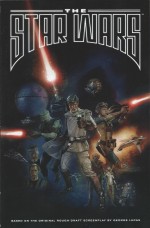
The Star Wars


By George Lucas, J.W. Rinzler, Mike Mayhew & Rain Beredo (Titan Books)
ISBN: 978-1-78329-498-5

I’m sure we all know the modern mythology of Star Wars and its mindbendingly expansive continuity to a greater or lesser extent. The problem with any such monolithic achievement is an eventual loss of spontaneity and freshness, but now true disciples and occasional dabblers alike have another, new-old strand to follow…

In September 2013 Dark Horse Comics began a 9-issue adaptation (#0-8) of George Lucas’ 1974 original draft for a science fiction movie romp of epic scope, expanded and interpreted by scripter Jonathan W. Rinzler, illustrator Mike Mayhew and colour-artist Rain Beredo, which offered fans of both the franchise and action comics another bite from a very different cherry.

Sadly, what most die-hards will want is to seek out the similarities and differences but, as tempting as that is, I’d like to concentrate on what makes this a good graphic novel and leave the cinematic nitpicking to those more adept and so inclined…

If you had somehow come from another planet and picked up The Star Wars, what you would have is a grandiose space-opera thriller with quite a few similarities to Frank Hebert’s epochal Dune saga and redolent of Alex Raymond’s Flash Gordon, jam-packed with valiant champions fighting a last-ditch rearguard action against an oppressive, tyrannical Empire which wants to run everything…

The warriors called Jedi-Bendu whose martial skills carved out a benevolent galactic coalition are in decline, hunted near to extinction by a rival cult known as the Knights of Sith. As the martial sects waged their war, the nature of politics changed and a new, rapacious government sought to consolidate a league of voluntarily participant systems into an overweening monument to iron-handed control.

On the fourth moon of Utapau aged, ravaged Kane Starkiller is training his sons in the all-but lost martial arts of Jedi-Bendu when the hunters who have eradicated almost all of his kind appear. When the family heroes finally escape the trap they are reduced to only Kane and his elder son Annikin…

Heartbroken, they head for Aquilae, unaware that their homeworld has been targeted by the New Empire. The autonomous system is the last free star kingdom, all others having capitulated to pressure and been absorbed into the burgeoning governmental/commercial juggernaut.

The Emperor, Governor Hoedaack and taciturn General Vader don’t expect too much trouble with this last campaign, but tribunal member Vantoss Coll believes otherwise. He knows Aquilae’s planetary defences are commanded by the mythic Jedi-Bendu Luke Skywalker…

It won’t be enough. Skywalker has the ears of King Kayos and Queen Breha but their parliament is riddled with cowards, appeasers and outright traitors like Count Sandage…

When the attack comes it is in the form of a colossal, moon-sized space-station and Skywalker’s forces are overwhelmed, even with the help of the recently returned Kane and Annikin and a desperate warning from Aquilae’s top agent Clieg Whitsun who arrives moments before the first shattering assault.

With hell about to rain down Skywalker orders Annikin to collect and protect wayward heir Princess Leia whilst he leads the planet’s space forces against the encroaching death star. During the battle two argumentative imperial droids, Artwo and Threepio, eject from the station and meet up with Annikin and Leia in the deep deserts below.

With Kayos murdered, Sandage happily capitulates and orders Skywalker to surrender, but the old soldier refuses…

With Captain Whitsun in tow he absonds, choosing to save the young Princes Biggs and Windy by getting them off-planet. Intending to link up with Annikin at distant Gordon Spaceport where his old alien smuggler pal Han Solo lurks, their flight is harried by faceless waves of white armoured troopers but the real trouble starts when despicable Vader reluctantly accepts the advice and aid of formidable Sith legend Prince Valorum…

After a stunning and non-stop procession of increasingly brutal fights – and with their numbers tragically reduced by the death of two valiant stars – the surviving fugitives get off-planet and make it to primitive frontier world Yavin where Skywalker and Annikin find not only danger and betrayal but an unlikely turncoat ally and a potential game-changing army of bellicose giant beasts called Wookies…

Of course it’s all far more complex and intriguing than that, with young love, dastardly betrayals, tragic sacrifice, plentiful comedy moments and above all astounding, rocket-paced action to carry readers along, and lovers of blaster-blazing action will be well served by the raw energy and lovely artwork.

It would appear that there is an inexhaustible demand for stories from “A Galaxy Far, Far Away…” but this time as another tale of noble rebels and dastardly Empires unfolds the big difference is that you don’t really know what’s coming next. If you’re a movie maven you could call it an alternate universe yarn if you wanted to, but this is a book no lover of great comics will want to miss.
The Star Wars and Star Wars © 2014 Lucasfilm Ltd. & ™. All rights reserved. Used under authorisation. Text and illustrations for Star Wars are ©, 2013, 2014 Lucasfilm

Amazing Spider-Man: The Gauntlet volume 1 – Electro and Sandman


By Mark Waid, Dan Slott, Fred Van Lente, Joe Kelly, Adam Kubert, Barry Kitson, Paul Azaceta, JM Ken Niimura, Javier Pulido & Stefano Gaudiano (Marvel)
ISBN: 978-0-7851-3871-6

Nerdy school kid Peter Parker was bitten by a radioactive spider and, whilst seeking to cash-in on the astonishing abilities he’d developed, suffered an irreconcilable personal tragedy.

His beloved guardian Uncle Ben was murdered, and the traumatised boy determined henceforward to always use his powers to help those in need. For years the brilliant young champion suffered privation and travail in his domestic situation, whilst his heroic alter ego endured public condemnation and mistrust as he valiantly battled all manner of threat and foe…

During a particularly hellish period a multitude of disasters seemed to ride hard on his heels and a veritable army of old enemies simultaneously resurfaced to attack him (an overlapping series of stories comprising and defined as “The Gauntlet”), before Parker’s recent tidal wave of woes was revealed to be the culmination of a sinister, slow-building scheme by the surviving family of one of his most implacable foes – and one who had long been despatched to his final reward.

Spanning January and February 2010, the first skirmishes in that campaign of terror are collected here, having originated in Dark Reign: The List – Amazing Spider-Man, Amazing Spider-Man #612-616 and as pertinent extracts from Web of Spider-Man #2, as old foes returned to trouble a hero already reeling from the fact that his most despised and crazy enemy has just been made the second most powerful man in America…

Officially psychotic Norman Osborn has bedevilled both Spider-Man and Peter for years. His abused son Harry was the misunderstood hero’s greatest friend but the stress and strain, over time, turned the Osborn heir into a drug addict, a costumed carbon copy of his old man and, latterly, a certifiable basket case.

Callously oblivious, Norman – through various machinations – became America’s Security Czar: the “top-cop” in sole charge of the beleaguered nation’s defence and freedom, especially in regard to the USA’s costumed community.

Capitalising on the Skrull Secret Invasion he rose to power on a tidal wave of public popularity but soon instituted an oppressive Dark Reign, driving the Earth’s Mightiest Heroes underground and forming his own team of deadly Dark Avengers, all in the grossly debased name of “national security”…

Not content with commanding all the covert and military resources of the USA, Osborn personally led the team, wearing a formidable suit of “requisitioned” Iron Man armour and calling himself the Iron Patriot, even whilst covertly conspiring with a coalition of major super-villains to divvy up the world between them.

From Dark Reign: The List – Amazing Spider-Man, ‘The Last Name’ by Dan Slott, Adam Kubert & Mark Morales finds the whiny media liberals of digital news-source Front Line (populated and staffed by all the ethical reporters from the former Daily Bugle) searching for ways to expose Osborn’s true nature and plans.

When Joe Robertson reminds Parker that no narcissist egomaniac ever destroyed anything he was in, the Astounding Arachnid invades the high tech Oscorp Tower and makes off with incriminating recordings of the former Green Goblin torturing prisoners and testing weapons on human subjects.

With his new position imperilled, Osborn dons the Iron Patriot Armour and gives chase, consequently devastating much of Midtown as he exultantly thrashes his greatest foe. However he’s too late to stop Parker from uploading the films to the world wide web and his brutal behaviour in front of the gathered witnesses is his first big mistake. Now the public are talking, wondering and starting to remember what he used to be…

‘Gauntlet Origins: Electro’ (written by Fred Van Lente and illustrated by Barry Kitson from Web of Spider-Man #2) then discloses just how blue collar electrical lineman Max Dillon came to grips with the power he developed after being hit by lightning. Stealing components from Stark Industries, being disdained and rejected by Magneto and the Brotherhood of Evil Mutants all fostered his determination to be a big shot one day and make everybody pay…

Amazing Spider-Man #612-614 cumulatively bring ‘Power to the People’ (Mark Waid & Paul Azaceta) as, against a backdrop of rolling power outages and an economic downturn, Dillon makes his move after hiring the Mad Thinker to stabilise and augment his famously erratic electrical abilities.

Unfortunately that calls for more cash than he’s got and soon Electro is looking to make more – and quickly…

Rather than robbery, however, he cunningly opts for a very public crusade against skeevy and controversial publisher Dexter Bennett who has just been deemed too big to fail. Awarded a huge government bailout to keep his trashy newspaper The DB (nee Daily Bugle) open, the billionaire is clearly living large even as decent, hard working Americans are suffering the biggest recession in history…

The campaign leads to riots in the streets and Electro makes his move, offering Bennett the chance to buy off the electrical agitator with a quick cash injection.

…And that’s when Spider-Man tracks down the Thinker’s lair and spoils the perfect plan…

With his scheme in ruins, all that’s left for Dillon is revenge and destruction and death…

As the dust finally settles after a spectacular clash which demolishes a New York landmark, Dillon is visited in jail by an old ally who offers another chance for payback…

A backup in Amazing Spider-Man #612, ‘The Other Woman’ by Joe Kelly & JM Ken Niimura then cheekily examines the odd relationship of Spider-Man and amoral adventuress Black Cat, contrasting their commitment-free flings to Peter’s ongoing problems with old flames like Mary Jane Watson and intriguing new co-worker Norah Winters before ‘Keemia’s Castle’ (Amazing Spider-Man #615-616 by Van Lente & Javier Pulido) sees the start of another baffling mystery…

Carlie Cooper is a CI for the police and when robbery and murder evidence in her custody goes missing she turns to science whiz Peter Parker to clear her name. The trail leads the unlikely sleuth to the South Bronx and a missing girl named Keemia Alvarado.

Keemia’s mother was something of a prison groupie and her relationship with metamorphic felon Flint Marko – the Sandman – apparently resulted in a child. After fact – and suspicion – checking with journalist Betty Brant, Spider-Man puts a few together and heads out to closed-for-the-winter Governors Island where he finds his reformed former foe and the missing girl.

Marko denies all knowledge of the crimes. All he wants is to spend time with his little princess and he uses his new power to create autonomous sandy doppelgangers to emphatically press home his point.

It’s only after defeating the outnumbered arachnid that the stunned Sandman realises that some of his duplicates are more autonomous – and bloodthirstily evil – than others…

Fast, furious, and easily combining frantic action with moving character vignettes and ferociously addictive soap opera melodrama, these tales are offbeat even by Spider-Man’s standards – which is no bad thing – but sometimes suffer from a surfeit of unaddressed backstory… which rather is.

Nonetheless, the stories here are clever, compelling and beautifully illustrated throughout, so art lovers and established fans have plenty to enjoy. Moreover the explosive, if occasionally confusing, Fights ‘n’ Tights rollercoaster is graced with an expansive gallery of covers-&-variants by Adam Kubert, Jelena Kevic Djurdjevic, Marko Djurdjevic, Paolo Rivera, Frank Cho, Adi Granov, Ed McGuiness and Joe Quinones

All in all, this is that oddest and most disappointing of beasts: a great story but an unsatisfactory book…
© 2009, 2010, Marvel Characters, Inc. All rights reserved.

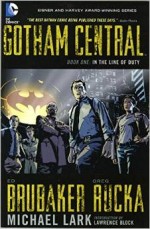
Gotham Central book 1: In the Line of Duty


By Ed Brubaker, Greg Rucka & Michael Lark & Stephen Gaudiano (DC Comics)
ISBN: 978-1-4012-1923-9 (HC)        : 978-1-4012-2037-2 (SC)

One of the great joys of long-lasting, legendary comics characters is their potential for innovation and reinterpretation. There always seems to be another facet or corner to develop. Such a case was Gotham Central, wherein modern television sensibilities cannily combined with the deadly drudgery of the long-suffering boys in blue of the world’s most famous four-colour city.

Owing as much to shows such as Hill Street Blues, Homicide: Life on the Streets and Law & Order as it did to the baroque continuity of Batman, the series mixed gritty, authentic police action with a soft-underbelly peek at what the merely mortal guardians and peacekeepers had to put up with in a world of psychotic clowns, flying aliens and scumbag hairballs who just won’t stay dead.

This compilation – collecting Gotham Central #1-10 (February – October 2003, by writers Ed Brubaker and Greg Rucka and sublimely illustrated by Michael Lark) – revisits those much-missed stories in either standard paperback or lavish hardcover format and starts off with an erudite and informative Introduction on ‘The Mean Streets of Gotham’ by celebrated crime author Lawrence Block.

Brubaker and Rucka co-wrote the eponymous two-part premier tale ‘In the Line of Duty’ wherein a desperate child-kidnap investigation by detectives Marcus Driver and Charlie Fields of ex-Commissioner Gordon‘s hand-picked Major Crimes Unit leads them all unawares to the temporary hideout of murderous superfreak Mr Freeze.

The cold killer horrifically destroys Charlie and sadistically leaves Driver injured but alive as an object lesson.

The GCPD have a strange relationship with the Dark Knight. They all know he’s out there, but the official line is that he’s an urban myth and the Administration refuses to acknowledge his existence. Thus a civilian is employed to turn on the bat-signal on the roof when crises occur and the public are told the eerie light is simply used to keep the cowardly, superstitious underworld cowed…

In such circumstances all real cops are loath to ask for The Bat’s help so Driver and his grieving, angry colleagues pull out all the stops to find and capture Freeze before the masked vigilante insultingly finishes their job for them.

However, as night falls and the frozen bodycount rises, Marcus deduces what Freeze is planning and has no choice but to ask new Police Commissioner Akins to suspend his embargo and call in the whacko expert before hundreds more die…

From an era when comicbook noir was enjoying a superb renaissance, this classic take on the theme of the hunt for a cop-killer is a masterpiece of edgy and fast-paced tension whilst simultaneously perfectly introducing a large cast of splendidly realised new and very individual players…

Brubaker scripts the second story solo as ‘Motive’ finds the again fit-for-duty Driver and his temporary partner Romy Chandler using solid police work to solve the outstanding kidnap case, all the while under the gun as arson villain The Firebug dances on the horizon burning down the city one building at a time.

Fourteen year old babysitter Bonnie Lewis vanished while walking home from her yuppie client’s house and a subsequent ransom demand later proved to be a fake. Now, after her body is found, Driver and Chandler carefully re-examine the facts and discover that almost everybody involved has been lying…

As they methodically sift evidence, alibis and possible motives, they begin to realise that even this tragically normal crime has its roots in both common greed and the gaudy madness of Gotham’s metahuman menaces…

The gripping procedural drama then segues back to the city’s aristocracy of maniacs as Greg Rucka scripts ‘Half a Life’ with focus switching to Renee Montoya: a solid cop with too many secrets.

After her former partner Harvey Bullock was fired with extreme prejudice, tongues started wagging, but now an old case threatens to destroy her career and end her life…

When arresting rapist Marty Lipari, he tried to stab her, and she subdued him. Now her morning is ruined when the skel sues her for ten million dollars in damages.

It only gets worse when she and partner Crispus Allen get a bogus case dumped on them by the corrupt, lazy meatheads in Robbery Division, but the capper is dinner with her traditional, devout Catholic parents who still want her to settle down and have kids…

Her life begins to truly unravel when a photo of her kissing another woman does the round of colleagues, friends and family. Not all her fellow cops are homophobic bigots: but just enough that’s she kept her life private for years. Now, apparently outed by Lipari’s hired gumshoe Brian Selker, she is targeted by Internal Affairs when first the PI and then Lipari himself are shot to death.

With her lover Darla threatened, her gun identified as the murder weapon and a huge amount of illicit drugs found in her apartment, Renee is soon on her way to jail – another bad egg just like Bullock.

Nobody in MCU thinks she’s guilty but the evidence is overwhelming, and the crisis comes when en route she’s busted out by masked men and taken to the hidden citadel of one of Batman’s most nightmarish nemeses…

Utterly alone, in the unfriendliest job in the world, in the nastiest town on Earth, Montoya has to deal alone with a crazed maniac who’s destroyed her life just so he can be with her forever.

As a Major Crimes Detective she’s seen how bad The Bat’s enemies can get, but this time she’s the target, not the hunter or witness, and it’s not just her life at stake…

This engrossing drama never steps outside of human bounds irrespective of the nature of evil in Gotham, and the original comic presentation (from issues #6-10) won Eisner, Harvey, Eagle and Prism awards for Best Story in 2003.

Sadly not included in this volume are the two earlier tales from Renee’s past (Batman Chronicles #16 – Two Down, by Rucka & Jason Pearson & Cam Smith, and Detective Comics #747 – Happy Birthday Two You, by Rucka, William Rosado & Steve Mitchell) which explained that oblique connection to her obsessive suitor – although you can find then in the original 2005 trade paperback Gotham Central: Half a Life.

The appropriate quota of human drama, tension, stress and machismo all play well under Michael Lark’s deftly understated illustrations, adding a grimy patina of pseudo-reality to good old fashioned cops ‘n’ robbers stories, played out in what can only be described as the urban city of the damned.

The procedural cop thriller on the edge of hell is a stunning study in genre-crossing storytelling, and this edition includes a full cover gallery by Lark as well as a fulsome section of designs and character sketches in ‘Staffing the GCPD’.

Dark, suspenseful and so very addictive, this is a book no batfreak or crime buff can afford to miss.
© 2004, 2005, 2008 DC Comics. All Rights Reserved.

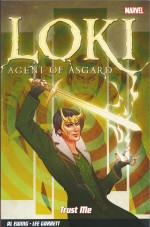
Loki Agent of Asgard: Trust Me


By Al Ewing, Lee Garbett & Nolan Woodard (Marvel/Panini UK)
ISBN: 978-1-84653-600-7

One of Marvel’s richest seams of pure imagination, the Nine Realms impacted by the mighty races of Asgard and its satellites have always offered stirring, expansive tales of a non-traditional nature to comicbook readers.

As iconic a character as his adoptive sibling Thor, God of Evil Loki has worked his vile, self-serving machinations for millennia and was rightly deemed one of the most diabolical villains in creation.

Things are different now.

What you need to know: after millennia of doctrinaire double-dealing and abusive micro-management All-Father Odin is gone, and the governance of his puissant kingdom, having been briefly misruled by his sons Thor and Balder, has been left to his wife Freyja and sister goddesses Idunn and Gaea who act in concert as a co-operative “All-Mother”.

The city they rule from now resides on Earth a few paltry feet above the ground of Broxton, Oklahoma and has been renamed Asgardia…

Moreover the eternally capricious and malign Loki has undergone some shocking changes too. Resurrected from death and hell by his eternally optimistic half-brother Thor, the trickster has recently endured life as a woman and been reborn again as an (ostensibly) innocent boy-child whilst his long-suffering and constantly betrayed family attempt one final gambit to reform the villain and raise a true and decent scion of Asgard.

Collecting Loki Agent of Asgard issues #1-5, published between April and August 2014 and captivatingly concocted by scripter Al Ewing, illustrator Lee Garbett and colour artist Nolan Woodard, this initial compilation traces the latest career path of the apparently reformed great trickster.

Now, after mooching around being generally benevolent and non-threatening as one of the Young Avengers, the former menace is approaching physical maturity and discovers that the All-Mother of Asgardia have a use for a smart young man who is still at heart the wily, devious God of Mischief – nor will they take nay for an answer…

Asgardians all understand the overwhelming, inescapable force and power generated by Stories, and the triumvirate have an intriguing proposition for Loki. In ‘Trust Me’, as payment for his performing certain tasks as a one-man Asgardian Secret Service, they will delete select portions of his appalling life history from every record in the Nine Realms, one insidious exploit per mission.

It’s a most tempting deal. For as long as that fearsome history remains it will always pull at him, dragging him back to what he once was, so the reincarnated godling is keen to diminish the temptations of his past, escape the heavy chains of reputation and prophecy and be his own man at last…

With the promise of becoming less potentially evil through each successive task, Loki sets out on his first case. Over the years there has been a slow, steady bleed of gods and artefacts from Asgard to the lesser realms and now the All-Mother wants those things back where they belong.

Thus the callow trickster invades Avengers Tower and battles Earth’s Mightiest Heroes, messing with their extensive database on him whilst extracting a horrific Asgardian monster secretly possessing noble Thor.

However, as always with the Trickster, things are not quite what they seem…

In ‘Loki and Lorelei, Sitting in a Tree’ he is despatched to retrieve the seductively wanton sorceress who has been preying on humans, gods and monsters for years and, during an unlikely night of Speed Dating, makes the charming acquaintance of Verity Willis, a mortal with the unfortunate gift of being able to see through any lie, subterfuge of illusion…

Lorelei’s trail leads to Monte Carlo and a monumental heist – which the Asgardian agent takes for his own – but he subsequently lets the witch go. The mischief-maker has a plan brewing and is putting together select crew. He might be working for the authorities now and trying to modify his behaviour, but he is still Loki…

Nobody is playing a straight game. In ‘Your Life is a Story I’ve Already Written’ the shocking identity of the vile spirit that possessed Thor is revealed. Despite being a prisoner of the All-Mother, the most wicked creature in the Nine Realms reveals thus how in ages past he deviously implicated the boy Odin in senseless murder and orchestrated the conditions whereby proto-god Sigurd the Ever-Glorious came to possess the unrelenting, unstoppable, truth-rending sword Gram.

As a result of many Machiavellian machinations, young Odin became Lord of all the Realms years before his time, Gram was safely locked away until Loki could claim it and Asgard grew to be mighty and all-conquering… but now the devil in his dungeon waits for the final pieces in his astoundingly long game to fall into place…

The saga returns to the present where ‘Lets You & Him Fight’ finds the long absent Sigurd attempting to reclaim the irresistible Gram from young Loki but subsequently press-ganged into the trickster’s secret service.

These diversions are also starting to gain the unwelcome attention of the All-Mother who have also tasked their Earthly Agent with bringing back in the millennially truant Sigurd.

To expedite matters they have cited the ferocious Exdesir as back-up, but a bunch of short-tempered Valkyries is the last thing Loki needs watching him at this fragile juncture.

…And that’s before arch tempter Mephisto involves himself in the scheme, seeking to gull a few unwary gods into signing infernal contracts of damnation by flaunting hidden truths like jewels…

All the crafty conniving results in a cosmic confrontation in Asgardia with ‘This Mission Will Self-Destruct in Five Seconds’ as Loki’s crew breach the mythical city-state in search of answers to the All-Mother’s increasingly off-kilter behaviour and the truth about the creature not so safely locked in the citadel’s deepest dungeon…

Sly, cool and witty, exceedingly engaging, fast and funny – like all the very best caper stories – this canny, time-bending chronicle succeeds in deftly delineating the reborn Loki as a sharp operator doing good deeds whilst never actually proving whether he’s really reformed or is still a subtle and beguiling Master of Evil…

This delicious Costumed Drama also offers digitally-diverting extra content for tech-savvy consumers courtesy of AR icon sections all accessible through a free digital code and the Marvel Comics app for iPhone®, iPad®, iPad Touch® & Android devices at Marvel’s Digital Comics Shop as well as a glorious covers-and-variants gallery by Jenny Frison, Frank Cho, Mike Del Mundo & Olivier Coipel.
™ and © 2014 Marvel & Subs. Licensed by Marvel Characters B.V. through Panini S.p.A. All rights reserved. A British Edition published by Panini Publishing, a division of Panini UK, Ltd.

X-Factor volume 8: Overtime


By Peter David, Valentine De Landro, Andrew Hennessey, Pat Davidson & various (Marvel)
ISBN: 978-0-7851-3837-2

Since its debut in 1982, X-Factor has been a splendidly effective umbrella title for many uniquely off-kilter iterations of Marvel’s mutant phenomena. Undoubtedly the most impressive and enduring assemblage was created by writer Peter David in 2006; mixing starkly violent suspense with cool detective mystery, laugh-out-loud comedy and fantastic Fights ‘n’ Tights action – and even slyly addressing social issues in a regular riot of superbly adult Costumed Drama.

The premise saw Jamie Madrox, the Multiple Man – veteran of a formerly government-sponsored (and controlled) team – appropriating the name for his own specialist metahuman private detective agency: X-Factor Investigations.

Setting up shop in the wake of “The Decimation”, which had reduced the world’s mutant population to a couple of hundred empowered individuals and millions of distressingly humanised (ex) Homo Superior, he and a perpetually fluctuating team set out to discover why and how it had happened…

What Happened Was: crossover event House of M saw reality overwritten when mutant Avenger Scarlet Witch had a mental breakdown, changing history and reality so that mutantkind out-competed base-line humans, driving “sapiens” to the brink of extinction.

It took every hero on Earth, a huge helping of luck and a strange little girl named Layla Miller to correct that situation, but in the aftermath, the abhorred inheritor species had been winnowed to less than 200 super-powered souls …

Madrox later expanded his brief to specialise in strange cases and metahuman mysteries, but spent an awful lot of unprofitable time dealing with the machinations of insidious menaces like the Karma Project and scheming immortal Damian Tryp…

This temporally-twisted tome collects X-Factor volume 3 #46-50 and X-Factor Special: Layla Miller (September 2009-December 2009), wrapping up a few long-running plot threads whilst answering some pertinent questions about the team’s most enigmatic member.

Madrox and Co. had relocated to scenic Detroit to avoid interference from old boss and Office of National Emergency bureaucrat Valerie Cooper but she and her Federal flunkies had pursued, and continued with attempts to put the team under government control.

Following the tragic loss of Madrox and TheresaRourke Cassidy‘s (AKA Siryn) baby, the multiple man went off the deep end and on a monolithic bender which might have ended in his suicide or murder, if not for somehow fully-grown Layla Miller who suddenly popped up to drag him into a furious future where humans and mutants were engaged in a vicious struggle for survival dubbed The Summers Rebellion.

The detective had been summoned by the formidable Ruby Summers and her elderly but still scary dad Cyclops to find out why key members of their mutant army kept winking out of existence, but for Madrox it just felt like being abused and exploited by a different bunch of supposed friends…

Abandoned in the present, Theresa took charge at X-Factor Investigations, assigning de-powered Julio Richter (AKA Rictor) and astoundingly attractive Longshot as bodyguards for frightened former-mutant Lenore Wilkinson who was having problems with a stalker.

However, as Guido “Strong Guy” Carosella, super-woman Monet St. Croix – AKA “M” – Armando “Darwin” Muñoz and Shatterstar are subsequently called in to help protect the perpetually endangered Lenore, a new menace surfaces.

Psychic assassin Cortex is capable of dominating and warping even the most determined minds and before long the teammates are battling each other to the death even as, eighty years up-time, the nature of physical existence is failing and the embattled mutants are forced to consult a big brain to save everything else before they can save their species.

With few choices available Layla takes Madrox and Ruby to aged, senile Victor Von Doom who already knows quite a lot about their recurring reality problems, whilst in the past crafty, craven Cortex overextends himself trying to simultaneously mentally manipulate Shatterstar and Monet into killing their comrades.

Despite his diminished condition Doom knows the cause of the disappearances and tantalises his visitors with possible solutions to the a time-crisis, even as elsewhere, Future America’s Presidential Special Advisor Dr. Anthony Falcone ponders the expense of sending Cortex back to eradicate the ancestors of current Summers Rebellion mutants.

Somehow that simple covert task has morphed into pre-emptively dealing with X-Factor and the inexplicably pivotal Madrox…

Falcone’s ill timed and ill-advised intervention distracts his technologically-augmented chronal killer just as he is completing the mission, giving Shatterstar an opportunity to shrug off Cortex’s mind-lock and save the day…

Scripted throughout by David and illustrated by Valentine De Landro & Pat Davidson, the adventure continues with ‘X-It Strategies’ as the President loses confidence in Falcone’s plan to end America’s Mutant problem and tries to remove his now-unnecessary stooge.

The anti-mutant fanatic has been long-prepared for such a move and activates a contingency plan, taking personal control of the nation’s vast army of Sentinels, whilst in The Now Cortex regains the advantage, using his psychic slave Monet to press his attack.

In the future Doom discloses how he built the device used to alter history and gave it to Falcone, also letting slip that he has had a decades-long relationship with Layla, but the revelation is quickly sidelined when a trio of Omeganoid Sentinels blast in…

Cortex/M’s assault founders in old Detroit when Siryn arrives, but the spirited resistance falters when Sentinels materialise and – as per their programming – attack all the mutants in front of them…

In the future Madrox is experiencing relief and horror in equal amounts. They have just been saved by Ruby’s boyfriend Trevor Fitzroy whose portal-power has sent the trio of murderous mechanoids who knows where. Until this moment the Multiple Man only knew the charmingly cocky teen as a malevolent and rapacious – adult – evil mutant vampire who tried to destroy the X-Men numerous times…

Whilst Falcone uses battalions of Sentinel to secure his own ascension, in the past three that he no longer controls are blasting every mutant in sight. Unable to complete his mission in the growing chaos, Cortex is jumped by the miraculously lucky Longshot and their battle gives Monet the chance to forever throw off his technoid infection and influence…

Enraged beyond endurance she smashes into the killer and discovers he’s Madrox in a hoodie…

With the fabric of time unravelling ‘The Cortex Equation’ reveals a few secrets as the old enemy behind so many of Jamie’s problems is shown to be the power behind Falcone even as demented old Doom has a surprising confrontation with Cyclops.

In the present Siryn and Monet are still battling the apparently unbeatable Cortex who is exposed as one of Jamie’s “dupes”.

Madrox’s duplicates are autonomous facsimiles of him. Often displaying one particular aspect of his emotional makeup they can live their own lives for years until he touches them and they are reabsorbed – whether he or they want to. Being self-aware, some abscond, never wanting to come back and “die”. This one went to the future and fell into the hand of a truly evil genius…

Beaten but seemingly unkillable, Cortex teleports away from the furious women and goes after original target Lenore, but is interrupted by Darwin and the late arriving Guido, Rictor and Shatterstar who have just experienced a most elucidating (and sophisticatedly hilarious) road trip which encompassed angry priests, love-sick suicides, and some frank revelations about gender – and species – orientations.

After such a journey, they’re in the mood for some palate-cleansing violence…

Eighty years from then in Philadelphia, Falcone’s Sentinel brigade is ravaging the population – mutant and otherwise. When the Summers’ Army counterattack they are greeted as heroes by humanity.

However, even decrepit and out of his mind Doom is still Doom, and he betrays the alliance, plucking Cortex back to the future, overriding his command systems and ordering him to “kill all the mutants”…

X-Factor #50 (with additional art by Craig Yeung) spectacularly wraps up everything as Falcone and his sinister sponsor track Cortex and despatch Sentinels to wipe out the despised Homo Superior. They might not have time, though, as Doom’s new puppet is wreaking havoc amongst the mutant warriors.

First to die is Fitzroy, and the situation worsens when Doom takes control of Cyclops too…

Cortex meanwhile is stalking the apparently ineffectual Layla, but she takes off when Jamie appears for a final confrontation with his rogue appendage…

Distraught Ruby pleads with Layla to use her real power, and after much deliberation – and to save the time line – she finally acquiesces.

Although everyone thinks she’s some kind of prescient or precog, Miller’s actual mutant power is to raise the dead. It doesn’t matter much when she reanimates cats or butterflies, since nobody really notices when they come back without soul or conscience, but when someone like Fitzroy is resurrected as a being of selfish evil all humanity might suffer…

At that moment the Sentinels arrive and terrifyingly merge into one colossal unit designed to carry out Falcone’s long-planned mutant extinction. With everybody dying Fitzroy fatally drains Cortex and uses the stolen energies to open a portal sending the amalgamated Armageddon-Sentinel to where it can do the most harm…

In the shell-shocked aftermath Madrox and Layla use Doom’s time machine to rejoin X-Factor in the present, sensibly leaving the future to fend for itself.

A little later she tracks down her younger self and reveals just how the enigmatic young lady learned how to “know stuff”, starting the cycle again, for the first time…

Although intricate, action-packed, beguiling, cathartic and immensely enjoyable, X-Factor: Overtime is utterly impenetrable on its own and if you read it (and you really should) make sure it’s in conjunction with its immediate predecessor X-Factor: Time and a Half.

This supremely entertaining Fights ‘n’ Tights delight also includes the chillingly effective X-Factor Special: Layla Miller, which covers the beginning of the Summers Rebellion in that turbulent tomorrow, where a mute girl named Layla escapes from a mutant “Containment Centre” to link up with fugitive Homo Superior and begin the toppling of an oppressive totalitarian American in the powerfully evocative ‘Stuff Happens’ by David, De Landro, Andrew Hennessy & Davidson.

Augmented by a covers-&-variants gallery by David Yardin, Nathan Fairbairn, Paolo Raimondi, Brian Reber and Boo Cook, this volume is complex, compelling, compulsive and supremely funny in a way most adult comics just aren’t. X-Factor is a splendid example of mature Costume Dramas for everyone who needs wit to underpin their superhero soap opera shenanigans.
© 2008, 2009, 2010 Marvel Characters, Inc. All rights reserved.