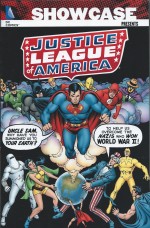
Showcase Presents Justice League of America volume 5


By Len Wein, Gerry Conway, Cary Bates, Elliot S! Maggin, Marty Pasko, Denny O’Neil, Dick Dillin, Frank McLaughlin & various (DC Comics)
ISBN: 978-0-85768-195-9

After the actual invention of the comicbook superhero – for which read the Action Comics debut of Superman in 1938 – the most significant event in the industry’s history was the combination of individual sales-points into a group. Thus what seems blindingly obvious to us with the benefit of four-colour hindsight was proven: a number of popular characters could multiply readership by combining forces. Plus, of course, a mob of superheroes is just so much cooler than one (…or even one-and-a-half if there’s a sidekick in situ…).

The Justice Society of America is rightly revered as a true landmark in the development of comicbooks and when Julius Schwartz revived the superhero genre in the late 1950s, it was inevitable that there would be a new banding together of the latest reconfigured mystery men.

That moment came with The Brave and the Bold #28, a classical adventure title that had recently transformed into a try-out magazine like Showcase. Just before Christmas 1959 the ads began running. “Just Imagine! The mightiest heroes of our time… have banded together as the Justice League of America to stamp out the forces of evil wherever and whenever they appear!”

The rest was history: the JLA captivated the youth of a nation, further reinvigorated an industry and even inspired a small family publishing concern to create the Fantastic Four, inspiring a whole new way of telling comics stories.

Following a meteoric rise, TV spin-offs brought trendy international awareness of costumed crusaders which in turn led to catastrophic overexposure. By 1968 the superhero boom looked to be dying just as its predecessor had at the end of the 1940s.

Sales were down generally and production costs beginning to spiral. More importantly “free” entertainments, such as television, were now found in even the poorest household. If you were a kid in the sixties, think just how many brilliant cartoon shows were created during that decade, when comics artists such as Alex Toth and Doug Wildey moved into West Coast animation studios.

Moreover, many comicbook heroes were now appearing on that ubiquitous small screen. As well as wholly original characters, the Marvel heroes, Superman, Aquaman, Batman, and even the JLA were there every Saturday in your own living room – even after that global bubble had burst…

It was also a time of great political and social upheaval. Change was everywhere and unrest even reached the corridors of DC. When a number of creators agitated for increased work benefits the request was not looked upon kindly. Many left the company – not always voluntarily – for other outfits. Some quit the business altogether.

Of course the greatest threat was the insatiable appetite for supernatural themes which decimated the industry’s pantheons of gaudily-clad mystery men…

This fifth monochrome Justice League Showcase volume compellingly reflects the signs of the times as the next generation of writers fostered a “new wave” and saw the title’s lowest ebb. Publication slowed to six issues a year before the tide slowly turned and the World’s Greatest Superheroes began climbing again to the top of the gradually recovering, tried-and-tested Fights ‘n’ Tights arena…

Collecting Justice League of America #107-132 from the era when superheroes were in the direst doldrums and looked like disappearing forever, this tome covers the period September/October 1973 to June 1976, during which the market changed forever from mass market to niche-industry and comicbooks stopped being casual, cheap or disposable entertainment.

By the end of this book the stories reflected the harsh facts, and publishers had accepted the conceptual and commercial transition from a broad-appeal medium slavishly following outside trends and fashions to increasingly become a targeted service making only what their most dedicated fans wanted…

The dramas begin here with Justice League of America #107 and ‘Crisis on Earth-X’ by Len Wein, Dick Dillin & Dick Giordano, the first chapter of another landmark crossover with their Earth-2 counterparts and antecedents in the JSA.

Following the popular revival of a forgotten team during their previous get-together (The Seven Soldiers of Victory as seen in Showcase Presents Justice League of America volume 4), this time the annual team-up reintroduced another band of Golden Age warriors – from corporate acquisition Quality Comics and newly rechristened The Freedom Fighters…

It began when a recreational trip across the dimensional barrier was accidentally sabotaged by android stowaway Red Tornado, depositing Batman, Green Arrow and Elongated Man from Earth-1 and Superman, Sandman and Doctor Fate from Earth-2 into another alternate universe – one where the Nazis had won World War II.

Trapped and outnumbered, the seven displaced heroes were rescued by the last liberty-loving champions of a world dominated by fascist super-science and a secret dictator. Joining forces with embattled champions Uncle Sam, The Ray, Doll Man, Phantom Lady, Black Condor and the Human Bomb the newcomers ended the Nazi threat forever in the sinister sequel ‘Thirteen Against the Earth!’…

With everybody returned to their home planes #109 then brought back a cultish guest star as ‘The Doom of the Divided Man!’ revived the dormant career of 1960’s hero/villain Eclipso, who harboured another cunning plan to conquer the world. However the real focus of this tale was the unexpected resignation of Hawkman following his recall to home planet Thanagar…

Wein, Dillin & Giordano then got to deliver a delightful and potent seasonal present in #110 as Superman, Batman, Green Arrow, Black Canary and Red Tornado had to adapt to abrasive substitute Green Lantern John Stewart (a controversial “angry black man” conceived at a time when non-Caucasian heroes could be counted on the fingers of one hand) mid-mission, when the League gathered to hunt down ‘The Man Who Murdered Santa Claus!’

Murderous psychopath The Key had set up the heroes for ambush with the callous assassination of an actor hired to cheer orphaned kids, but his horrific deeper scheme was only foiled thanks to the supernatural intervention of an almost forgotten League member…

JLA #111 introduced a seminal villain who became, decades later, a pivotal player in The Final Crisis. Here however the enigmatic Libra merely used his incredible abilities to revive the dormant Injustice Gang of the World.

Although his stated goal was to imbue Chronos, Mirror Master, Poison Ivy, Scarecrow, Shadow Thief and Tattooed Man with energies stolen from Aquaman, Superman, Batman, Flash, Elongated Man and the fully recovered GL Hal Jordan, the ‘Balance of Power!’ he was really seeking meant keeping all the purloined might for his own unimaginable use…

Those stolen super-powers featured in #112’s follow-up ‘War with the One-Man Justice League!’ as the entire team gathered to help restore their diminished comrades. The high risk solution was to resurrect power-stealing android Amazo to collect the stolen energies and abilities – but nobody considered what the mechanoid might do after it absorbed Batman’s vast intellect and suspicious mind…

Justice League of America #113 (September/October 1974) proved how desperate were the times for the spandex set as the epic annual collaboration with the JSA was restricted to a single issue. Nevertheless ‘The Creature in the Velvet Cage!’ proved to be one of the very best team-up tales as a JLA visiting party to Earth-2 (Batman, Superman, Green Lantern and Elongated Man) shared the shame and horror of The Sandman, when his greatest secret was catastrophically revealed.

Years ago the Master of Dreams had accidentally transformed his sidekick Sandy, the Golden Boy into a ravening silicoid monster and been compelled to sedate and imprison his best friend.

Now after three decades the beast was awake and free, seemingly intent on destroying the world. At least that’s what Hourman and the Golden Age Flash and Wonder Woman believed when they joined their old comrade on his tragic manhunt…

Wein, with the plotting assistance of Mark Hanerfeld, ended his run as scripter with a smart and decidedly effective little thriller in #114 – ‘The Return of Anakronus!’ During a League-sponsored telethon an enigmatic time-bending villain took disgraced old team mascot Snapper Carr and his family hostage. Although definitely dangerous, the crazed felon’s ranting didn’t make much sense: after all, why would a man who had repeatedly defeated the JLA stoop to demanding a mere cash ransom…?

The tone turned cosmic in #115 as Denny O’Neil provided a fill-in script which brought back retired hero J’onn J’onzz, Manhunter from Mars who begged his former comrades to save the dying remnants of his people from ‘The Last Angry God!’ who had imprisoned them on a far-distant world.

Cary Bates then contributed ‘The Kid Who Won Hawkman’s Wings!’ in #116 as sightings of Hawkman in Midway City led Elongated Man, Green Arrow, Aquaman, Flash and Batman into a deadly duel against the Matter Master. Closer inspection revealed the Pinioned Paladin to be a baffled kid named Charley Parker who had no idea why he changed into a Golden Eagle, whilst the actual mastermind behind the plot was a shock to everybody concerned…

After just over a year’s absence the true winged Wonder returned in JLA #117. ‘I Have No Wings and I Must Fly!’ – scripted by Elliot S! Maggin and with Giordano’s protégé Frank McLaughlin assuming the role of regular inker over Dick Dillin’s sleek and effective pencils – saw alien cop Katar Hol resurface to warn Earth of a deadly extraterrestrial menace dubbed The Equalizer.

This ineffable menace was driven to achieve pure balance in the universe, and to achieve this he somehow homogenised entire civilisations, making life forms exactly identical to each other.

His Equalizer plague weapon was overwhelmingly contagious and – after reducing the population of Thanagar to imbecilic, four foot tall clones of each other, including Hol’s beloved wife Shayera – the unfathomable voyager had turned his single eye upon Earth…

With his homeworld quarantined and after defeating the appalling threat beside the JLA, Hawkman had no other refuge than our planet and promptly joined Aquaman, Black Canary, Flash Red Tornado and Superman in resisting the ‘Takeover of the Earth-Masters!’ (#118 by Maggin, Dillin & McLaughlin). This saw a misguided attempt by trans-dimensional beings who sought to save our world from super beings by despatching eerie hyper-evolving Adaptoid organisms.

With even the Man of Steel unable to face the ghastly invaders, Hawkman devised a risky strategy involving his Equalization-infected wife, which fortunately turned out in Humanity’s favour in #119’s ‘Winner Takes the Earth!’

Another old friend reappeared in #120 as ‘The Parallel Perils of Adam Strange!’ (written by Bates) saw the Earth-born champion of Planet Rann forced to re-fight his greatest battles after despotic Kanjar Ro murdered his fiancée Alanna.

Even though Ro had cruelly stacked the deck, Strange – and his newly arrived Justice League allies – triumphed and even pulled a rabbit out of the hat to restore the Rannian heroine in time for her own magical wedding in the blistering conclusion ‘The Hero Who Jinxed the Justice League!’

In issue #122 Marty Pasko delved into the team’s private lives and revealed why the JLA shared their civilian secrets with each other in ‘The Great Identity Crisis!’ as old enemy Dr. Light used photonic super-science and the too-good-to-be-true mineral Amnesium (guess what it causes?) to mess with the heroes’ minds and lure them into what should have been inescapable death-traps…

Another year gone, it was then time for the annual JLA/JSA yarn and Bates, Maggin, Dillin & McLaughlin stepped far off the reservation with ‘Where on Earth Am I?’ and ‘Avenging Ghosts of the Justice Society!’ from issues #123 and 124.

In Flash #179 (‘The Flash – Fact of Fiction?, May 1968) Bates and Gardner Fox first took the multiple Earths concept to its illogical conclusion by trapping the Monarch of Motion in “our” Reality of Earth-Prime, where the Sultan of Speed was just a comic-book character.

Here Bates and co-scripter Maggin returned to the idea as a story conference in Editor Julie Schwartz’s office led to the oafish goons playing with the Flash’s hastily-constructed Cosmic Treadmill, sending one of them hurtling between dimensions.

Transformed and empowered by the journey, Cary Bates became the most dangerous villain alive, leading Earth-2 criminals The Wizard, Shade, Sportsmaster, Huntress, Icicle and The Gambler in a lethal assault on JSA heroes Robin, Hourman, Wildcat, Wonder Woman, Johnny Thunder and Dr. Mid-Nite.

Maggin, meanwhile, had followed his friend but ended up on Earth-1. Undaunted, he recruited Batman, Black Canary, Aquaman, Hawkman, Green Arrow and Flash to save three imperilled universes but it took the Divine Might of the supernal Spectre to truly set every thing back to its assigned place and time…

Gerry Conway began his long association with the Justice League in #125 with a clever 2-parter concerning the dumping of toxic energy from an outer dimension onto Earth. ‘The Men Who Sold Destruction!’ craftily employed schizophrenic villain Two-Face as their wily broker to expend the deadly forces, but the super-minds of Dronndar completely underestimated the double-dealing Harvey Dent‘s capacity for betrayal. Almost as bad was that the opportunistic Weaponers of Qward and the JLA were as easily fooled by the Machiavellian maniac in #126’s Byzantine conclusion ‘The Evil Connection!’

JLA #127 confirmed that ‘The Command is “Chaos”!’ when new menace The Anarchist discovered a means of tapping Green Lantern’s power battery and desperate Hal Jordan begged his fellow champions to stop him recharging his ring at any cost, after which Pasko popped back to author a sharp, smart reintroduction for the Earth-1 Amazing Amazon in #128’s ‘Death-Visions of the Justice League!’

For a period “our” Wonder Woman had lost her powers and fought crime as a martial artist (see Diana Prince: Wonder Woman volumes 1-4), but once her supernatural gifts returned she underwent a self-imposed set of trials before rejoining the team.

Sadly her readmission coincided with the team disbanding following a cataclysmic, psychologically punishing assault by alien fear-eater Nekron, and even the Princess of Power seemed unable to galvanise the Leaguers before ‘The Earth Dies Screaming!’ in #129.

The next issue explored the revelatory early days of the team’s orbiting satellite headquarters as ‘Skyjack at 22,300 Miles!’ (scripted by Pasko) disclosed how an intergalactic interloper attempted to turn the space base into a spawning ground and put the nonplussed heroes through a gamut of ghastly trials before order and equilibrium were unconventionally restored.

This mammoth tome ends with a clever mystery double-bill from Conway, Dillin & McLaughlin. Issue #131 featured ‘The Beasts Who Thought Like Men!’ wherein a new credit card currency for America somehow enhanced the minds of animals and insects, simultaneously decreasing human brainpower to such a low point that bugs could enslave deadly villains like Sonar and Queen Bee…

The tale took a strange turn in #132 as Superman vanished and Supergirl stepped in to help against animals organised enough to conquer the country. Even then there was still one more tangled twist in the tale of ‘The Beasts Who Fought Like Men!…’

The Justice League of America has become a keystone of American comics and these tales are still among the most thought-provoking, controversial and purely entertaining episodes in their half-century history.

With captivating covers provided by Nick Cardy, Mike Grell, Giordano, Ernie Chan (née Chua) & José Luis García-López, this captivating transition tome shows the unalloyed appeal of the Fights ‘n’ Tights Crowd at their most innovative and inspiring.

Just Imagine…
© 1973, 1974, 1975, 1976, 2013 DC Comics. All Rights Reserved.
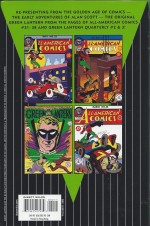
Golden Age Green Lantern Archives volume 2


By Bill Finger, Martin Nodell & Irwin Hasen (DC Comics)
ISBN: 978-1-56389-794-8

Following the invention of the superhero genre and the early innovations in Superman and Batman at DC/National Comics, an avalanche of costumed crusaders erupted onto the nation’s newsstands. At the head of that gaudy tidal wave, thanks to innovative publisher Max Gaines and his comics mastermind Editor Sheldon Mayer, All American Comics (who co-published in association with and were eventually absorbed by DC) produced many of the new industry’s greatest and most memorable characters.

Most prominent was the first comicbook super-speedster who took off in Flash Comics (which also featured Hawkman and Johnny Thunder), followed a few months later by evergreen, immortal Green Lantern, the world’s original superhero coalition in the Justice Society of America, capped by the creation of the greatest female hero of all time – Wonder Woman.

Superman started the ball rolling and was the undisputed star of the medium, but the editors at All American truly understood it and the wide-eyed readership…

The Emerald Avenger debuted in the sixteenth issue of the company’s flagship title All-American Comics, just as superheroes started to dominate, supplanting newspaper strip reprints and stock genre characters in the still primarily-anthologised comicbooks.

For the duration of the war and a few years beyond it, GL and his mystery man amigos Red Tornado, The Atom, Sargon the Sorcerer and Doctor Mid-Nite stole the show with only celebrated gag-strip Mutt and Jeff or exceptional military strips Hop Harrigan and Red, White and Blue remaining to represent merely mortal stars.

All too soon, however, they would vanish as tastes changed and costumed champions were superseded by cowboys, cops and private detectives…

Devised by up-and-coming cartoonist Martin Nodell (and fleshed out by the incredible Bill Finger in the same way he had contributed to the success of Batman), Green Lantern became AA’s second smash sensation six months after The Flash and preceding by a year and a half the unprecedented success of the Amazing Amazon.

He won his own solo-starring title less than a year after his premiere and feature-starred in many anthologies such as Comics Cavalcade and All Star Comics for just over a decade, before he too faded away in the early1950s, having first suffered the humiliating fate of being edged out of his own comicbook by his pet, Streak the Wonder Dog…

This second engagingly impressive hardcover Archive edition – collecting the Viridian Vigilante’s appearances from Green Lantern Quarterly #2-3 (Winter and Spring 1942) and All-American Comics #31-38, from October 1941 to May 1942 – opens with rousing reminiscences, intriguing comparisons and tantalising trivia titbits, courtesy of the Foreword by godfather of American fandom Dr. Jerry Bails, before the procession of pictorial peril begins…

Ambitious young engineer Alan Scott survived the sabotage and destruction of a passenger-packed train due only to the intervention of a battered old railway lantern. Bathed in its eerie verdant glow, he was regaled by a mysterious green voice with the legend of how a meteor fell in ancient China and spoke to the people: predicting Death, Life and Power.

After bringing doom to the mystic who reshaped it into a lamp and, centuries later, sanity to a madman, it now promised incredible might to bestow justice to the innocent. Instructing the engineer to fashion a ring from its metal and draw a charge of power from the lantern every 24 hours, the ancient artefact urged the engineer to use his formidable willpower to end all evil – a mission Scott eagerly embraced…

The ring made him immune to all minerals and metals, and enabled him to fly and pass through solid matter amongst many other miracles, but was powerless against certain organic materials such as wood or rubber which could penetrate his jade defences and cause him mortal harm…

After wandering the country for months, Scott eventually settled in Capitol City and took a job as first engineer and eventually radio announcer at the APEX Broadcasting System whilst he fruitlessly pursued feisty reporter Irene Miller. Before long he even had a trusted sidekick in the flabby form of Doiby Dickles, a rotund, middle-aged Brooklyn-born cab driver originally intended as a light foil for the grim, poker-faced Emerald Avenger.

Soon, however, the bumbling buddy grew to be one of the most popular and beloved comedy stooges of the era; sharing covers and even by-lines with the star who, thanks to scripter Finger (who wrote all the stories in this volume), was a grim, brooding and spookily mysterious figure of vengeance weeding out criminals and gangsters. Moreover, just as with the early Batman sagas, there was always a strong undercurrent of social realism, ballsy sentimentality and human drama.

The action starts with All-American Comics #31’s ‘The Adventure of the Underfed Orphans!’ illustrated by Martin Nodell, wherein Alan and Irene investigate food poisoning at a municipal children’s home, and uncover a shocking web of abuse and graft leading to the upper echelons of City Hall and the grimiest gutters of the underworld…

Most of the All-American GL tales were untitled such as #32, drawn by Irwin Hasen, which revealed how a veteran beat cop’s son fell in with the wrong crowd. Framed by his boss and arrested by his own dad, vengeful Danny was only stopped from ruining his life forever by the Emerald Avenger and Doiby who helped him get the goods on Gardenia and reconcile with his grateful dad.

The next issue (by Nodell) struck close to home as gangster Pug Deagan tried to take over the Taxicab Drivers’ union and Doiby called on his Grim Green friend to clean up the racket and expose the real brain behind the operation, whilst in All-American #34, the Dynamic Trio of Alan, Irene and Mr. Dickles investigated a collapsing building and were drawn into a colossal construction scandal involving the Mayor, culminating in the horrific failure of Capitol City’s biggest and busiest bridge.

Always one of the most powerful characters in comics, this tale especially demonstrated the sheer scope of Green Lantern’s might…

All-American Comics #35 found Doiby wracked by toothache and haplessly stumbling into a grisly murder at the dentist’s office. Once again racketeers were trying to take over a union and only GL and Dickles could stop them. That tale concluded with the cabbie having that tooth punched out and learning the secret of Alan Scott – an even bigger shock!

A huge hit from the start, the Emerald Crusader was fast-tracked into his own solo title, where the creators were encouraged to experiment with format. Green Lantern Quarterly #2 was cover-dated Winter 1942 and offered ‘The Tycoon’s Legacy’ by Finger & Nodell: a 4-chapter “novel-length story” which saw radio engineer Scott promoted to roving man-with-a-microphone, promptly rushing to the assistance of a poor but honest lawyer and a porter swindled out of a five million dollar bequest. Both cases deliciously intertwined like a movie melodrama, and also saw a framed man freed from the asylum to challenge the swindling estate executors who had trapped him there.

Events took a murderous turn just as Alan’s emerald alter ego got involved, and before long Green Lantern was cracking heads and taking names in the hunt for the mastermind behind it all – a man known only as ‘Baldy’…

Bill Finger was a master of this type of socially redeeming mystery thriller, and the unrepentant fan in me can’t help but wonder what he could have accomplished with such a prodigious page count on his other “Dark Avenger” assignment Batman and Robin…

Hasen illustrated the remaining All-American yarns in this collection, beginning with #36 (March 1942) which took GL and Doiby to the motor racing circuit to foil the machinations of mobsters murdering drivers of a new type of car. With no clue as to how the killings were accomplished, Doiby volunteered to drive the ill-fated Benson Comet himself, trusting in his pal “Da Lantrin” to save the day as usual…

Issue #37 found the heroes helping a disgraced pilot whose crashed plane cost America its greatest scientific minds. A closer investigation revealed not only Fog Blake‘s innocence but that the Brain Trust had been cunningly abducted by Nazi agents… but not for long, after which issue #38 pitted the Emerald Guardian against a diminutive criminal strategist who organised America’s gangs like ‘Another Napoleon’ before facing his own Waterloo in a blaze of green light…

With America freshly put on an all-encompassing war-footing, superheroes at last tackled the world’s latest monsters full-on, and with great verve and enthusiasm this blistering compilation concludes in another novel-length epic from the third Green Lantern Quarterly deliciously crafted by Finger & Nodell.

It begins with ‘The Living Graveyard of the Sea’ as Alan and Irene (and stowaway Doiby) take ship for Australia only to be torpedoed by a gigantic German super U-Boat. Although Green Lantern fights off the air and sea assault the liner is lost. The survivors take to life boats and the one with Doiby, Irene and Alan is drawn into a vast impenetrable fog-bank…

The clouds conceal an ancient wonder: a Sargasso Sea enclave of mariners from many eras who have, over the centuries, evolved into a truly egalitarian, pacifist society. However the lifeboat contains a cross-section of modern America, all horribly infected with greed, pride, arrogance and prejudice and, although welcomed, the newcomers soon disrupt the idyllic microcosm.

Things take an even worse turn when another U-Boat surfaces within the sea city and fanatical Kapitan Schmidt attempts to annexe the realm and convert the ancients to ‘The Nazi Dream’. The stakes are raised even further when he finally gets a message through to Berlin and Hitler himself demands that the strategically crucial secret island be taken at all costs…

The fantastic finale comes as Irene and Doiby redeem their selfish fellow Americans and rouse the calmly neutral Sargasso citizens to fight for freedom and liberty in ‘Utopia vs. Totalitarianism’ whilst all Green Lantern has to do is sink the entire Nazi naval and aerial armada tasked with taking the hidden sea world…

I sometimes think – like many others I know – that superhero comics were never more apt or effective than when they were whole-heartedly combating fascism with explosive, improbable excitement and mysterious masked marvel men.

The most satisfyingly evocative and visceral moments of the genre all seem to come when gaudy gladiators soundly thrashed – and please forgive the contemporary offensive colloquialism – “Nips and Nazis”, and the staggering denouement depicted here is one of the most expansive and breathtaking ever seen…

Complete with the stellar covers by Nodell & Hasen, this riotous vintage assembly of classic Fights ‘n’ Tights fare is enthralling, engrossing and overwhelmingly addictive – even if not to every modern fan’s taste – and no lover of Costumed Dramas can afford to miss out on the fun …
© 1941, 1942, 2002 DC Comics. All Rights Reserved.
Man of Steel – Inside the Legendary World of Superman


By Daniel Wallace with photographs by Clay Enos (Insight Studios/Titan Books)
ISBN: 978-178116-817-2

Always foremost amongst the fascinating publishing add-ons to accompany major fantasy motion picture releases are the “Art of…” compendiums, and the terrific oversized (286 x 240 x 22mm) hardcover tome which supports the new Man of Steel film is both gloriously enticing and genuinely informative.

Author Daniel Wallace has compiled an eye-popping mix of production art, panoramic stills, pre-production designs and concept paintings gleaned from the various art departments and combined them with behind-the-scenes interviews, commentary and colour to produce a celebratory coffee-table art-book that is absolutely breathtaking.

After a Foreword by producer Christopher Nolan and Introduction from director Zack Snyder, ‘Modern Day Mythmaking’ reveals how the project came about with ‘Making it Happen’ and ‘Making it Real’, further disclosing the secrets of ‘The Suit’ before closing with the film’s philosophical mission statement in ‘Superman Vérité’.

The all-important ‘Casting Man of Steel’ explores and examines the actors, roles and thinking of the vast and stellar cast over nearly thirty electrifying pages, paying great attention to the costumes and designs of a scenario and society such as Superman fans have never seen before.

That imagination overload continues into ‘Welcome to Krypton’, highlighting ‘Kandor’ and ‘The Kryptonian Chamber’ before digressing onto a page dedicated to ‘Speaking Kryptonian’ (in my day it was “Kryptonese” but that’s my own personal digression-lite), after which the visual secrets of ‘The Ruling Council’, ‘Crafted Technology’ and ‘Automated Helpmates’ bring the planet’s robotic excesses to astounding life.

Now a ravaged, worn-torn world, Krypton’s martial advances are spotlighted in ‘Armed for Battle’ whilst ‘The House of El’, ‘Flora and Fauna’ and ‘The Genesis Chamber’ readily inform and expand on the unworldly realities of the lost planet and Superman’s history.

Further visualisations and revelations depict ‘Last Hope’, the awesomely appalling ‘Black Zero’, ‘The Dead Colonies’ long-abandoned by Krypton, and explain how the film designers attempted ‘Communicating with Contours’ before concluding with views of the pivotal ‘Scout Ship’ that changed Clark Kent’s life forever…

Locations and sets star in ‘Welcome to Earth’, with specific attention paid to the hero-in-waiting’s ‘Northern Journeys’, ‘Smallville’, Earth’s military bastion ‘U.S. Northcom’ and of course, ‘Metropolis’ before the epic exploration ends with a heartfelt appreciation of ‘The Heart of the Legend’…

Admittedly Inside the Legendary World of Superman was released to cash-in on the long-awaited movie, but this utterly engrossing picture-treat is such a superb slice of sheer imaginative indulgence no fan of film or funnybooks will want to miss out on such a marvellously magical experience.
© 2013 DC Comics. MAN OF STEEL, SUPERMAN and all related characters and elements ™ and © DC Comics. All Rights Reserved.
Man of Steel – the Official Movie Novelization


By Greg Cox (Titan Books)
ISBN: 978-1-78116-599-7                  E-book edition ISBN: 978-1-78116-600-0

As you might have noticed, there’s another Superman movie hitting big screens at the moment and, as is the norm, the movie blockbuster comes with all the usual attendant extras.

Released a week after the premiere of Man of Steel, the Official Movie Novelization recapitulates that tale in an absorbing 320 page paperback – sadly sans any illustrations – for fans of a literary bent, duly expanding the breathtaking visual experience in the adroit, incisive way specialist author Greg Cox has made his own.

Don’t take my word for it: check his adaptations of films such as the Underworld trilogy, Daredevil, Ghost Rider or The Dark Knight Rises, comics series such as Infinite Crisis, Countdown, Final Crisis amongst others, as well as his legion of cult media tie-ins and comics-related books…

Spoiler Alert: since almost everybody alive knows the mythos of Superman by now and the whole point of this latest movie is to reinterpret, reinvigorate and reinstate that legend, I’m going to manfully restrain myself from outlining the plot of this engaging prose package in anything but the vaguest detail, in case you haven’t seen the stunning visual tour de force yet.

Krypton dies and scientific rebels Jor-El and Lara Lor-Van send their newborn son to another world to escape its destruction. However a goodly portion of film and book concentrate on the fabulous, uncanny and war-torn planet where Jor-El struggles with former friend and desperate terrorist General Zod as each strives to preserve Krypton in their diametrically opposed ways, so you won’t be reading about the child of two worlds until chapter seven…

A ship lands in Kansas, years pass and strange, anonymous miracles occur…

A young reporter begins to chart these odd occurrences.

Another star-craft is found, buried millennia-deep in polar ice…

And one day a ghastly extraterrestrial war-craft comes to Earth, full of deadly super-beings hunting someone called Kal-El…

Full of sly in-joke nods to previous comics, film and TV iterations and littered with those arcane snippets of lore beloved by seasoned fans, this engaging yarn, based on the original screenplay by David S. Goyer and Christopher Nolan, adds some depth to the frantic on-screen spectacle and will delight every Superman that loves to curl up with a good book.

© 2013 DC Comics. MAN OF STEEL and all related characters and elements ™ and © DC Comics.

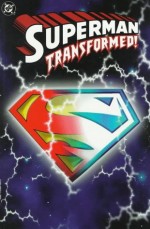
Superman: Transformed!


By Dan Jurgens, Karl Kesel, David Michelinie, Louise Simonson, Jon Bogdanove, Scott Eaton, Ron Frenz, Tom Grummett, Ron Lim, Paul Ryan, Dennis Janke, José Marzán Jr, Denis Rodier & Josef Rubinstein (DC Comics)
ISBN: 978-1-56389-406-0

The Man of Steel has proven to be all things to most fans during his 75-year existence so, with the character currently undertaking his latest radical shake-up, what better time to spotlight one of the strangest and most controversial refits of Superman ever conceived?  Although largely out of favour these days as all the myriad decades of accrued mythology are inexorably re-assimilated into an overarching all-inclusive multi-media film-favoured continuity, the stripped-down, gritty post-Crisis on Infinite Earths Man of Tomorrow as re-imagined by John Byrne, and marvellously built upon by a succession of immensely talented comics craftsmen, resulted in some stunning highs and lows.

The fan in me loathed this “stunt” at the time, but the seemingly desperate attempt to keep reader attention high at all costs now reads rather well and offers genuine moments of sheer Fight’s ‘n’ Tights magic – especially in the stunning combat sequences….

Almost as soon as the Byrne restart had stripped away much of the mythology and iconography which had grown up around the Strange Visitor from Another World over fifty glorious years, successive creative teams spent a great deal of time and ingenuity putting much of it back, albeit in terms more accessible to a cynical and well-informed audience far more sophisticated than their grandparents ever were.

Thus as a notional tip of the hat to the legendary imaginary story ‘The Amazing Story of SupermanRed and SupermanBlue’! from Superman volume 1, #162, July 1963 this strange transformation occurred…

Collecting Superman volume 2, #119, 122-123, Adventures of Superman #542, 545, Action Comics #729, 732 and Superman: Man of Steel # 64 and 67 (from January and April 1997) this hyper-charged thriller reads best if taken in conjunction with a working knowledge of the characters, but newcomers can soon get up to speed by paying attention to the carefully administered snatches of expository dialogue and the handy “Previously” prose page…

When an inter-cosmic Sun Eater devoured our life-giving star, Earth was plunged into a sudden and catastrophic Big Freeze. The ultimate sacrifice by a hero-turned-villain ended the “Final Night” by reigniting Sol, but not before Superman, unceasingly battling to the limits of his strength, utterly exhausted his body’s solar-charged power and became no more than merely mortal…

Now as ‘Sunburned!’ (Superman #119 by Dan Jurgens, Ron Frenz & Joe Rubenstein) opens, the all-too human Clark Kent at last admits that his abilities are not returning, even as a squad of time-displaced teenagers from a millennium away also struggle to find their proper place…

Man of Tomorrow and Legion of Super-Heroes stumble over each other whilst breaking into Lex Luthor‘s citadel of science and, with the cautious consequence-drenched assistance of the Wickedest Man in the World, borrow a spaceship to take Superman to the Sun and – hopefully – a massive solar booster shot.

The attempt fails and the Metropolis Marvel, forced to fight crime as a powerless mortal, is compelled to take even more drastic measures in Adventures of Superman #542. ‘Power Trip!’ (Karl Kesel, Paul Ryan & José Marzán Jr.) has him turn his secret problem over to the scientists of clandestine Genetic Research Project Cadmus. Unfortunately their facility is in trouble too as spoiled, fun-loving, bratty metahuman genius Misa has infiltrated the factory of wonders with her incredible gadgets, looking to make a little mean-spirited mischief…

After the Project barely survives her devastating pranks, all Security supremo Guardian can do is offer Superman transport to the Antarctic Fortress of Solitude where the former Man of Steel has stored many super-scientific devices from shattered Krypton…

Action Comics #729 follows that voyage to its disastrous conclusion as a massive electrical disturbance brings Superman crashing into the polar vastness far short of his goal. ‘Generator X!’ by David Michelinie, Tom Grummett & Denis Rodier, sees him rescued by research scientists who expected help with their own dilemma – a real job for Superman…

Whilst probing the Earth’s mantle they had unleashed a semi-sentient energy force which was periodically ravaging their base, and even though powerless, Kal-El valiantly led the battle to get rid of it. Tragically the only thing that could hold the ephemeral entity was Superman’s depleted Kryptonian body…

After eventually expelling the energy-beast into space, Superman arrived at his Fortress and rendezvoused with friend and technical advisor Professor Emil Hamilton, but even alien science was unable to fix his power-problems. Moreover, odd electrical anomalies kept occurring. Appliances short-circuited and even the trans-dimensional barrier around the Bottle City of Kandor flickered in un-Superman’s presence…

Suddenly the despondent defender was urgently summoned by New Gods Mister Miracle and Big Barda with a crisis of cosmic proportions that only Superman could handle…

‘Into the Fire!’ (by Louise Simonson, Ron Lim & Dennis Janke from Superman: Man of Steel #64) saw Kal-El help to investigate an uncanny mystery which had smashed the antithetical worlds of Apokolips and New Genesis together and stolen the memories of Metron, God of Knowledge. The incredible solution involved a deadly trip into the heart of our sun which inexplicably restored Superman’s full powers.

Those odd electrical events kept happening though…

The second section of this collection features tales from a few months later – most of the intervening events having been separately collected in Superman vs. The Revenge Squad! – as the annoying sparks and short circuits around the Man of Steel slowly intensify…

Superman #122 revealed ‘The Kandor Connection’ (Jurgens, Frenz & Rubenstein) wherein hyper-powered rebel Ceritak agonises and acts out against his imprisonment. This version of Kandor was an enclave of thousands of alien captives, enslaved by a marauding tyrant named Tolos and penned in a pocket-dimension. Although Superman had liberated Kandor from the intergalactic body-snatcher, he was unable to restore the inhabitants and, after establishing the container in his Fortress, left them alone to forge their own multi-species society in enforced isolation…

Now however as Ceritak’s petulant rages become a menace to everybody, in the outer universe Superman and Lois have come to the Fortress to assess the Man of Steel’s latest symptoms. During a fight against thugs in Metropolis, Superman became intangible and a bystander was wounded by a bullet that passed through, rather than bounced off him…

When it happens again in the Fortress, Superman phases through the impenetrable dimensional walls of Kandor, and Ceritak – seizing a chance in billion – latches on to his energy wake as the hero struggles back to Earth…

Oblivious to the fact, Lois and Clark return to America only to discover something is terribly wrong: Superman is turning into an explosive, out of control generator of deadly lightning…

The calamity continues in ‘Power Crisis!’ (Adventures of Superman #545 by Kesel, Scot Eaton & Marzán Jr.) with the horrified hero blinking in and about of existence, emitting shattering blasts of radiation, materialising all over Earth and agonisingly bombarded by new senses, perceptions and sensations.

Barely able to move without causing disasters, Clark is helpless when delusional maniac Atomic Skull kidnaps Lois. The embattled hero then suffers another terrifying transfiguration – into a blazing being of blue white energy.

Battling the nuclear madman in this state, Superman loses and is apparently dispersed into nothingness…

He recondenses in Antarctica in Action Comics #732, gaining enough control to teleport back to Metropolis in time to team-up with his former adversary and prevent a radioactive catastrophe in ‘The Saving Skull’ (Michelinie, Grummett & Rodier).

Meanwhile the blockbusting Ceritak slowly makes his way towards the city and an inevitable showdown…

The clash came in Superman: Man of Steel #67 and ‘Say Goodbye to That Costume…’ (Simonson, Jon Bogdanove & Janke) as the ferocious fight pits Ceritak – dubbed Scorn by the uncomprehending journalists on the scene – against a blazing energy avatar that used to be Superman.

The monster’s immense strength and speed are easily the equal of the bizarre battery of new abilities exhibited by the mutated Man of Power – electrical blasts, intangibility, magnetic bursts and much more. The pointless, futile fight ultimately leaves Scorn crushed and the Metropolis Marvel on the edge of a final, fatal dispersal…

In Superman #123, with her husband on the verge of extinction, Lois rallies friends and foes alike for a last-ditch attempt to save the valiant voltaic hero. In a desperate race against time and with only Clark’s indomitable willpower holding him together, Hamilton and S.T.A.R. Labs’ chief Kitty Faulkner – suspiciously assisted by Lex Luthor – build a suit to contain and channel those volatile forces.

This allows a ‘Superman… Reborn!’ Jurgens, Frenz & Rubenstein) to begin a new phase in his “Never-ending Struggle” and begin a year of astounding adventures the likes of which fans had never seen.

Clever drama, spectacular action and rollercoaster pace, coupled with the usual high standard of character interplay, all underscore this much-maligned but hugely enjoyable diversion in the amazing life of Superman and this saga is truly deserving of a second look and honest reappraisal.

A British Titan Books edition is also readily available from on-line sellers.
© 1997, 1998 DC Comics. All Rights Reserved.
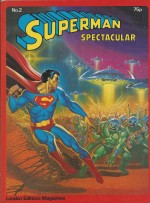
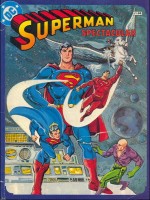
Superman Spectacular No. 2


By Cary Bates, Alex Saviuk & Vince Colletta (DC/London Editions)
ISBN: 0-86173-042-9

The Superman album clearly made some impact in Britain (or at least the editors thought it would) and a second volume – also sporting a lushly airbrushed Alan Craddock cover – was produced. Also celebrating the sharp, plot-driven costumed dramas which predominated in the pre-Crisis on Infinite Earths DC universe, this cosmic mystery revenge saga ideally shows how old stories could and should be reinvigorated rather than overwritten…

‘Superman Meets the Zod Squad’ was created by cobbling together Action Comics #548-549 (October and November 1983) into one improbable saga of cosmic vengeance as a race of primordial reivers discovered the remains of Argo City and realised that there was at least one Kryptonian left in the cosmos…

Superman’s cousin Kara Zor-El had been born on a city-sized fragment of Krypton, hurled intact into space when the planet exploded. Eventually Argo City turned to Kryptonite like the rest of the detonated world’s debris, and her dying parents, observing Earth through their scopes, sent their daughter to safety as they perished. Landing on Earth, she met the Man of Steel who created for her the identities of Linda Lee and Supergirl, hiding her from the world whilst she learned about her new home and to use astounding abilities in secrecy and safety.

The aliens were Vrangs – savage slavers who had conquered Krypton in ages past: brutally using the primitive populace to mine minerals too toxic for the aliens to handle. The planet’s greatest hero was Val-Lor who died instigating the rebellion which drove the Vrang from Krypton and prompted the birth and rise of the super-scientific civilisation.

All Kryptonians developed an inbred hatred of the Vrang, and when Phantom Zone prisoners Jax-Ur, Professor Va-Kox, Faora Hu-Ul and General Dru-Zod observed their ancestral oppressors from the stark and silent realm of nullity that had been their drearily, unchanging, timeless jail since before Krypton perished, they swore to destroy them.

If their ‘Escape from the Phantom Zone!’ also allowed the Kryptonian outcasts to kill the hated son of the discoverer of the eerie dimension of stultifying intangibility so much the better…

Using the psycho-active properties of Jewel Kryptonite – a post-cataclysm isotope of the very element so poisonous to Vrangs – a quartet of Zoners perpetrate a mass break-out and head to Earth for vengeance… but who is their primary target?

Not long after, Clark Kent, still blithely unaware of his peril, is investigating a new citizens’ defence group that has sprung up in Metropolis in response to a city-wide rash of petty crimes. Even as Zod, Faora, Tyb-Ol and Murkk infiltrate human society and bide their time, the Man of Steel and Lois are most concerned with how the grassroots White Wildcats can afford to police their neighbourhoods with jet-packs and martial arts skills unknown on Earth…

Uncovering militarist order-freak Zod behind the scheme, Superman is astounded when the Kryptonian criminals surrender, offering a truce until their ancient common foes are defeated.

…And that’s when the Vrang teleport the Man of Steel into their ship, exultant that they now possess the mightiest slave in existence. Moreover, there are four more potentially priceless victims hurtling up to attack them, utterly unaware in their blind rage and hatred that the Vrangs have weapon even Kryptonians cannot survive…

This clever, compulsive thriller of cross, double and even triple-cross is a fabulously intoxicating, tension-drenched treat from scripter Cary Bates and illustrated by Alex Saviuk & Colletta that still blends human foible with notions of honour, and shows that even the most reprehensible villains understand the value of sacrifice and the principle of something worth dying for…

Superman has proven to be all things to all fans over his decades of existence, and with the character again undergoing another radical overhaul, these timeless tales of charm and joy and wholesome wit are more necessary than ever: not just as a reminder of great tales of the past but as an all-ages primer of the wonders still to come…
© 1982 DC Comics Inc. This edition © 1982 London Editions Magazines (formerly Egmont Publishing). All Rights Reserved.

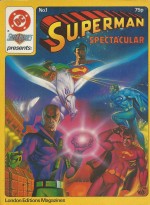
DC Superheroes Presents Superman Spectacular No. 1


By Bob Rozakis, Paul Kupperberg, Adrian Gonzales & Vince Colletta (DC/London Editions)
ISBN: 0-86173-041-0

These days, when maintaining a faux-historical cloak of rational integrity for the made-up worlds comicbooks inhabit is paramount, the saddest casualty of those periodic sweeping changes, upgrades, rationalisations and reboots is the great stories that suddenly “never happened”.

The most painful example of this – for me at least – was the wholesale loss of the entire bizarre and charm-drenched mythology that had evolved around Superman’s birthworld in the wonder years between 1948 and 1985.

Here then, in response to the new Superman film is something not every Kryptonian Kompletist may be treasuring in his vault: a canonical pre-Crisis on Infinite Earths Man of Steel yarn which didn’t appear in the regular runs of Superman or Action Comics, packed with all the gloriously convoluted lore, wry wit and all-ages thrills which for decades made the Man of Tomorrow indisputably the most recognisable comics character on Earth.

This extra-sized tale was actually devised by American creators for the European market as Superman Album series #1 (cover-dated Januar 1982 und pronounzed mit ein deutsche achzent, iff you pliss), printed in what was then West Germany by Ehapa Verlag.

It subsequently appeared in the USA as an English-language edition in a large (212 x 397mm) one-off paperback album in American convenience chains like 7-11 later that year. In Britain, where London Editions then held a DC reprint license, producing a wonderfully eclectic black-&-white anthology The Superheroes Monthly (with painted covers by the likes of Alan Craddock, David Jackson, Bryan Talbot and Brian Bolland), the tale was released as a similarly sized, full-colour edition to rack beside such beloved European imports as Asterix and Tintin.

In case you’re wondering: it was printed in Germany, presumably by simply replacing the black plate of the four-colour print process with one that had the lettering in English.

The ‘Startling Saga of Superman-Red & Superman-Blue!’ was scripted by Paul Kupperberg from a Bob Rozakis plot and illustrated by Adrian Gonzales & Vince Colletta, with the legendary Julius Schwartz in editorial command as always.

The bombastic battle royale was based on a much-beloved imaginary story by Leo Dorfman, Curt Swan & George Klein from Superman #162, July 1963, adroitly co-opted into the mainstream continuity to beef up the ominous if ill-starred alliance of arch nemesis Lex Luthor with space owlhoot Terra-Man.

(This last was conceived during the period when costumed heroes were in decline during the early 1970s. The Deep Space Desperado resembled a space-age Clint Eastwood in Spaghetti Western mode. He was a Wild West bandit’s son shanghaied into space. After eventually killing his kidnapper, the young man returned to Earth only to discover a century had passed. The furious outcast of infinity had already adapted his purloined extraterrestrial technology to accommodate his childhood antecedents and decided to drive aliens such as Superman off “his” planet forever…)

This intergalactic grudge match opens as Luthor invades a Daily Planet story conference to challenge Superman to another fight. The resulting clash goes badly for the criminal genius, however, even though he has devised an entirely new form of energy weapon to destroy his alien antithesis…

Meanwhile in space, solitary star rider Terra-Man has finally found a chunk of Kryptonite. He had long heard stories that the rare radioactive remnant was fatal to Superman, and now believes the end of his vendetta against the extraterrestrial squatter on his home range is near.

He should have listened more closely to the stories, though, as the shard he holds is red, not green…

Wary of being beaten again, Terra-Man contacts Luthor and proposes a combined attack, but doesn’t trust his new partner enough to hand over the radioactive space rock…

On Earth Superman is renewing his oft-postponed romance with Lois Lane when Terra-Man attacks, and after deflecting the initial assault is lured into orbit where the menacing mineral is secreted.

From his hiding place Luthor can only watch in horror as the Red K (which produced not radiation poisoning and death but temporary mutagenic effects on Kryptonians) divided the Man of Steel into twins in primarily blue or red uniforms…

It wasn’t a complete disaster, however, as each of the pair seemed to be missing some of Superman’s vast array of powers…

Frantically regrouping, Luthor and Terra-Man deduced what had happened, and as Clark Kent endured confusion at work with a brace of himself tripping over each other, the vile villains plotted to use their conventional resources and Lex’s new discovery to destroy their foe(s).

With double the super manpower, “Red” and “Blue” begin cleaning all the trouble spots on Earth and discover a new crisis: an inter-dimensional rift threatening to consume the world. The mystery of Luthor’s new energy source is revealed – the madman has tapped magical forces from another plane of existence and weaponised it to kill his arch foe, regardless of the potential for universal cataclysm…

As Supermans Red and Blue move to quell the threat, they find one more quandary confronting them: each is only half as powerful as the whole hero. When the divided defenders split up to battle Terra-Man and Luthor, this tragic deficiency causes the Crimson Crusader’s “death” with the collateral catastrophe of Lois felled by Luthor’s lethal magic weapon…

And at that very moment the Red K effect faded and the one true Man of Tomorrow was reborn…

Once upon a time smart, affecting absorbing drama and wild-eyed adventure such as this was the bread-and-butter of comics. For decades, new exploits and dangers were created – sometime three of four times a month – with characters operating seamlessly in a shared milieu that wasn’t obsessed with incessantly mining and refining the hero’s origin or shockingly revealing lost or evil relatives like some spandex-bedecked cheap soap opera. And they frequently began and ended in one issue…

This tale is a delicious example from the dying days of that era and perfectly shows us what we’re missing today…
© 1982 DC Comics Inc. This edition © 1982 London Editions Magazines (formerly Egmont Publishing). All Rights Reserved.

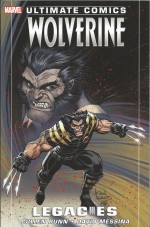
Ultimate Comics Wolverine: Legacies


By Cullen Bunn, David Messina, Gary Erskine & Gaetano Carlucci (Marvel/Panini UK)
ISBN: 978-1-84653-546-8

The Marvel Ultimates project started in 2000 with a thoroughly contemporary remodelling of major characters and concepts to bring them into line with a generation of potential readers separated by more than three decades from the starry-eyed, idealistic kids who were the primary buyers of “the House that Stan & Jack (and Steve) Built”.

Eventually even this streamlined new universe became as crowded and continuity-constricted as its predecessor, and in 2008 the publishing event “Ultimatum” culminated in a reign of terror which wiped out loads of heroes and villains as well as millions of ordinary mortals in a vast Tsunami triggered by mutant terrorist Magneto.

After dramatically rebuilding this darker, grimmer continuum, Armageddon happened again in 2012 as a perilously destabilised world sank into international metahuman anarchy. America succumbed to a mass-secession of states resulting in a second Civil War before the remaining heroes, surviving mutants and a new Spider-Man brought a measure of peace and stability to the planet…

From this latest aftermath comes a canny thriller (collecting the 4-issue miniseries Ultimate Comics Wolverine from March to May 2013, deftly written by Cullen Bunn and illustrated by David Messina, Gary Erskine & Gaetano Carlucci) which simultaneously explores the past and outlines the future of Jimmy Hudson: troubled offspring of the mutant legend who gave his life to end Magneto…

But first, a little more background: sixteen year-old Hudson only discovered who his real father was when fugitive Kitty Pride turned up bearing a hologram message from the fabled mutant-hero Wolverine. The device also explained the boy’s incredible healing ability and the claws which keep inconveniently popping out of his knuckles whenever he got stressed…

Civilisation had been shakily stumbling from crisis to catastrophe since the Deluge. That progress ended when the world learned that the super-powered mutants proliferating around the globe were not a product of inexorable evolution but rather the result of a 50-year old American program of genetic manipulation. Unfortunately, the experiment had slipped from their control when their initial test subject escaped.

Now, as the news spread, humanity went crazy. A wave of prejudice sparked violent protests around the globe and, as atrocities mounted, the attacks threatened the very existence of the feared and despised human lab-rats. In the political furore following the disclosure, the bloodshed grew into planetary panic and a genetic arms-race in Asia (see Ultimate Comics: Hawkeye and The Ultimates: The Republic is Burning), resulted in the near-eradication of the homo Superior strain and consequent creation of new superhuman subspecies.

In response the US President unexpectedly sidelined S.H.I.E.L.D. director Nick Fury in favour of co-operation with Magneto’s son Pietro Lensherr – who had inherited control of the mutant-terrorist group the Brotherhood of Mutants. The super-swift manipulator dubbed Quicksilver struck a Faustian Bargain with the Leader of the Free World, but their plans were subverted by fundamentalist preacher Reverend William Stryker who seized control of the government’s Sentinel technology and used it to attack mutants all over America as part of his genocidal crusade to purify humanity…

Pietro had intended to co-opt America’s Nimrod Sentinels to his own purposes but Stryker struck first, taking personal control of the program and unleashing every killer robot in the USA’s arsenal to hunt down mutants wherever they might be hiding.

The pogrom turned a large part of the southwest into a killing zone where the unholy freaks were held in camps, just waiting to die…

In Mutant Internment Camp Angel, the guards and Sentinels were overthrown by former X-Men Colossus and Storm, and once the younger prisoners discovered what atrocities the humans had been secretly perpetrating against the captives the entire facility erupted into open rebellion.

When WashingtonDC, the President and his Cabinet were wiped out in a nuclear attack, Texas seceded from the Union, provoking a series of similar rebellions by right-wing militias and libertarian hate-groups throughout the nation. Hopelessly out of his depth, Acting President Howard declared martial law and the second American Civil War began…

In New York former X-Man Karen Grant (nee Jean Grey) had been secretly furthering Charles Xavier‘s dream of fostering Human/Mutant co-existence, gathering young mutants and hiding them together for safety. When she vanished during the burgeoning Asian conflict her mission had been taken up by Kitty Pryde…

Jimmy Hudson – whose father Wolverine had been the Military’s “Mutant Zero” and reviled or celebrated as progenitor of mutantkind – was one of Pryde’s flock of refugees hiding beneath New York when the war began.

With news seeping in of wholesale mutant-cleansing in the west, Pryde, Jimmy and a number of others travelled across their hostile homeland to Camp Angel to join the Last Stand of their race.

When they arrived the long-undercover Nick Fury resurfaced, training mutants and working with them to establish a separate, safe homeland. As war wracked America the tiny outcast force faced its greatest martial threat to emerge as an independent Mutant Nation…

Set in the days following that incredible victory, Legacies actually begins with a flashback to earlier times long before The Deluge when S.H.I.E.L.D. agent Wolverine and his support team closed in on an assassin targeting Senator Gregory Lee.

Intel was scarce. All they knew was that something or someone called “Mothervine” wanted the crusading politician dead…

When a bystander apparently turned a little girl into a mutant to slaughter the Senator and his Secret Service detail, Wolverine’s frustrated team gave chase only to find the instigator’s freshly killed corpse…

Back in the present, Jimmy is again watching the recorded messages on his father’s hologram disc when mutant technopath Black Box bursts in. The kid’s uncanny affinity with machines has detected a hidden message underneath the transmission. Soon Hudson and Black Box have left the Mutant Nation far behind and gone in search of Wolverine’s final bequest – a coded message concerning something called Project: Mothervine…

Meanwhile, across the continent, human agents tasked with monitoring the long-dormant Mothervine are suddenly, sadistically despatched by mutant Machiavelli Quicksilver…

Years ago Wolverine and his crew had relentlessly tracked the elusive enigma, uncovering a conspiracy to create a means of mass-producing and weaponising mutants. But when they raided the Human Engineering Life Laboratories and ostensibly ended the threat, Wolverine again encountered an old adversary also hunting for the secret: Magda, ex-wife of Magneto and under her codename “The Witch” one of the deadliest freelance secret agents on Earth…

In the now, before following the old trail of Wolverine and Mothervine, Jimmy and Black Box waste precious time checking on Hudson’s foster parents. Unfortunately this sentimental side trip also brings them to the attention of psychotic freelancer Wildchild – another special services killer hired by an unknown party to clean up all traces of and links to Mothervine…

As Box’s gifts track down and interrogate old computer records, Wildchild’s gang attack and – despite Jimmy’s best efforts – the mutant kids are overpowered. They would have died if Quicksilver hadn’t turned up to revoltingly end the lives of the filthy humans…

As another flashback reveals the origins of Jimmy and the reasons his mother and father abandoned him, Pietro admits that he is Hudson’s half-brother, before disclosing the horrific truth about Mothervine and his plans for Jimmy.

Apparently his newly found sibling’s blood is apparently the only surviving source of the mutant-making concoction…

The family reunion isn’t a happy one however and, as Quicksilver explains his vision, Jimmy realises exactly what kind of monster his brother is. Pietro wants to build a mutant army to eradicate mankind and he’s perfectly willing to bleed the appalled Hudson dry to accomplish his goals…

It is only after their fast, furious final battle to decide the fate of humanity that Jimmy at last accepts his destiny is to be the new Wolverine…

There is a delicious covers-&-variants gallery by Arthur Adams & Axel Torvenius and no high-tech Marvel Augmented Reality App inclusions here; but frankly you won’t need them for this superbly sinister drama of spooks and monsters which perfectly sets up the replacement Feral Fury as defender of mutants and mankind alike. Moreover, as with all great spy stories, Legacies ends with portentous foreshadowing and the promise of more mayhem to come…

This is a craftily wry, cynical yet revelatory shocker and one more breathtakingly effective yarn only possible outside the Marvel Universe: and one which will resonate with readers who love the darkest side of science fiction and superheroes as well as casual readers more au fait with the company’s movies than the comics lore.

© 2013 Marvel. All rights reserved. Licensed by Marvel Characters B.V. A British Edition published by Panini Publishing, a division of Panini UK, Ltd.

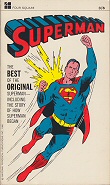
Superman


By Otto Binder, Jerry Coleman, Bill Finger, Edmond Hamilton, Wayne Boring & Stan Kaye (Four Square/New English Library)
ISBN: 1757

I’ve often bored anyone who would listen about the mini-publishing revolution during the “Camp” superhero-crazed 1960s, which first saw previously denigrated four-colour comic stories migrate from cheap, flimsy pamphlet to the stiffened covers and relative respectability of paperback bookshelves.

I can’t express the sheer nostalgic elation these mostly forgotten fancies still afford (to me at least) so, just because I want to, here’s one that probably qualifies as one of my absolute top three, just in time to cash in on the new Superman film.

Silver Age readers – we just thought of ourselves as “kids” – buying Superman, Action Comics, Superman’s Girlfriend Lois Lane, World’s Finest Comics and Superman’s Pal Jimmy Olsen (not forgetting Superboy, Adventure Comics and Justice League of America) would delight every time some fascinating snippet of information leaked out. We spent our days filling in the impossible blanks about incredible alien worlds (America as much as Krypton) through the enthralling, thrilling yarns in those halcyon treasures. But somehow when the tales appeared in proper books it made the dream realms a little more substantial; and perhaps even real…

The Man of Steel has proven to be all things to all fans over his 75-year existence and, with the character currently undergoing yet another radical overhaul, these fabulous gems of charm and joy and wholesome wit are more welcome than ever: not just as a reminder of grand times past but also as an all-ages primer for wonders still to come…

At the time this British edition of the New American Library edition was published, the Action Ace was enjoying a youthful swell of revived interest. Thanks to the TV Batman-led boom in superheroes generally and a highly efficient global licensing push, Superman was starring in a new television cartoon show, enjoying a rampant merchandising wave and had even secured his own Broadway musical: all working to keep the Last Son of Krypton a vibrant icon of modern, Space-Age America.

Although we might think of Jerry Siegel & Joe Shuster’s iconic invention as the epitome of comicbook chic, the plain truth is that within months of his landmark 1938 launch in Action Comics #1, Superman had already grown into a multimedia star. Far more people have enjoyed the Man of Steel than have ever read his illustrated exploits and yes, that does include the globally syndicated newspaper strips which have existed since 1939.

By the time his 25th anniversary rolled around he had been a regular on radio, appeared in an eponymous novel by George Lowther and stunned audiences in a series of astounding animated cartoons.

In 1948 and 1950 he starred in a brace of live-action movie serials (Superman and Atom Man vs. Superman) before graduating to a full-length feature in 1951’s Superman and the Mole Men which led in turn to a groundbreaking and long-running television series.

He was a perennial success for toy and puzzle manufacturers and, after six seasons of The Adventures of Superman, an almost seamless succession of TV cartoons began with The New Adventures of Superman in 1966.

In his future were more TV shows (Superboy, Lois & Clark and Smallville), a franchise of stellar movies and, once they’d been invented, computer and video game incarnations. Even super-dog Krypto got in on the small-screen act…

This terrific little black and white paperback pocket book – part of National Periodical Publications’ on-going efforts to reach wider reading audiences – surfaced in 1967 during the “Camp” superhero craze, re-presenting five reformatted Superman stories culled from the archives illustrated by signature illustrator Wayne Boring and all inked by regular collaborator Stan Kaye.

At this time many American comics publishers used the “Batman Bounce” to get out of their ghetto and onto “proper” bookshelves, however understandably DC concentrated most of their efforts on comics compilations and prose novels starring the Dynamic Duo…

The wholesome intrigue and breathtaking fantasy commence here with ‘The Invulnerable Enemy’ written by Otto Binder, and originally seen in Action Comics #226 (March 1957) wherein archaeologists uncovered the statue of a giant gladiator. Further excavation revealed the colossus to be a petrified alien crashed to Earth in ages past. When the Man of Steel brought the unmoving artefact to Metropolis an incredible accident caused by Lex Luthor brought the giant back to life.

The revived relic went on a rampage of destruction with powers even Superman could not cope with until, forced to use wits instead of muscles, the harried hero solved his dilemma and returned the marooned monolith to his proper place…

During the 1950s, even as his comicbook back-story was expanded and elaborated, the Metropolis Marvel had settled into a remarkably ordered existence. Nothing could really hurt him, nothing ever changed, and sheer excitement seemed in short supply. With the TV show concentrating on action, DC’s Comics Code-hamstrung scripters increasingly concentrated on supplying wonder, intrigue, imagination, a few laughs and, whenever possible, drama and pathos…

‘Superman’s 3 Mistakes!’ (by Edmond Hamilton from Superman #105, May 1956) provided both personal revelation and tense suspense when ClarkKent received an anonymous letter which declared that the writer knew his secret. Forced to review his past for cases which might expose evidence of his alter ego, Kent carefully excised all errors but could not learn the identity of his potential blackmailer until a second post-dated letter surfaced…

Superman #127 (February 1959) saw the debut of a hugely popular returning menace in ‘Titano the Super-Ape!’ The chimpanzee had mutated into a gigantic ape with Kryptonite vision after being shot into space, and upon his return caused massive destruction with only Lois Lane able to sooth savage ravages.

Again the Man of Might had to resort to brains not brawn to solve the crisis in a true classic of the period, courtesy of Binder, Boring & Kaye’s sublime treatment which combined action and sentiment to superb effect in a memorable homage to King Kong.

‘The Menace of Cosmic Man’ was a sharp mystery with political overtones written by Bill Finger (Action Comics #258, November 1959) wherein an impoverished European dictatorship improbably announced it had its own all-powerful costumed champion; drawing Lois and Clark into a potentially deadly covert investigation, after which this riot of reformatted revels concludes with ‘The Menace of Red-Green Kryptonite!’ (Jerry Coleman, Action #275, April 1961).

Guest-starring Supergirl, this uncanny conundrum featured a bizarre battle between Superman and alien marauder Brainiac, whose latest weapon combined two isotopes of the deadly radioactive remnants of Krypton to produce a truly weird transformation and inexplicable behavioural changes in the embattled Man of Tomorrow…

Superman has proven to be all things to all fans over his decades of existence and, with the character currently undergoing another overhaul, these peerless parables of power and glory are more welcome than ever: not just as memorial to what has been but also as a benchmark for future tales to aspire to…

This book is probably impossible to find today – even though entirely worth the effort – but whatever format or collection you happen upon, such forgotten stories of the immortal Superman are part of our cultural comics heritage and should never be lost.

You owe it to yourself to know them…
© 1956, 1959, 1960, 1961, 1966 National Periodical Publications. All rights reserved.

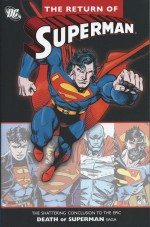
Superman: The Return of Superman


By Dan Jurgens, Karl Kesel, Jerry Ordway, Louise Simonson, Roger Stern & various (DC Comics)
ISBN: 978-2-56289-149-6

Although largely out of favour these days as all the myriad decades of Superman mythology are inexorably re-assimilated into one overarching all-inclusive multi-media Film-favoured DC continuity, the stripped-down, gritty post-Crisis on Infinite Earths Man of Steel as re-imagined by John Byrne, and marvellously built upon by a succession of immensely talented comics craftsmen, resulted in some genuine comics classics.

Most significant of them was a three-pronged story-arc which saw the martyrdom, loss, replacement and inevitable resurrection of the World’s Greatest Superhero in a stellar saga which broke all records and proved that a jaded general public still cared about the venerable, veteran icon of Truth, Justice and the American Way.

The dramatic events also provided a spectacular springboard for a resurgent burst of new characters who revitalised and reinvigorated more than one ailing franchise over the next decade…

This final landmark collection features material which originally appeared in Action Comics #687-691, Superman: the Man of Steel #22-26, Superman #78-82 and Adventures of Superman #500-505, plus Green Lantern volume 3 #46, spanning cover-dates June-October 1993 and originally published as the braided mega-saga “Reign of the Supermen”.

Written by Dan Jurgens, Karl Kesel, Louise Simonson & Roger Stern with art by Jon Bogdanove, Tom Grummett, Jackson Guice, Jurgens, Brett Breeding, Doug Hazlewood, Dennis Janke & Denis Rodier, it details the stunning events which led up to the resurrection and return of the one and only Man of Tomorrow – although just who that might be was the subject of much debate at the time…

After a brutal rampage across Middle America a mysterious monster dubbed Doomsday had only been stopped in the heart of Metropolis by an overwhelming and fatal effort on Superman’s part.

Dying at the scene, the fallen hero’s body was the subject of many legal battles before it was ostensibly laid to rest in a tomb in Metropolis’ Centennial Park. However as Earth adjusted to a World Without a Superman rumours began to circulate that, like Elvis, the Man of Tomorrow was not dead…

It all began with a series of teaser ‘First Sightings’ (from Adventures of Superman #500) as, across America, four very different individuals appeared, saving lives and performing good deeds as only the departed defender could.

Then events start to properly unfold in ‘Born Again’ (Action #687 by Stern, Guice & Rodier) as scientists in Antarctica experienced unnatural power manifestations whilst, deep below the polar crust in the Fortress of Solitude, a confused creature more energy than matter manifested.

The bizarre being remembered dying in battle against Doomsday and, after flicking across the world in an eye-blink to explore an empty tomb in Metropolis, it reasonably concluded he was Superman reborn through Kryptonian technology…

He was however much reduced and changed. Unable to covert solar radiation into strength, he was so painfully sensitive to light he had to wear a protective visor. This Man of Tomorrow only manipulated energy and, after returning to Metropolis to resume his “never-ending battle” against chaos and injustice, soon displayed a callous disregard for the humans he protected when he executed a rapist and crippled a car-jacker…

The “Dirty Harry with a cape” soon attracted the attention of apparently benevolent billionaire Lex Luthor II (actually the wicked original in a cloned body) and Supergirl, but received his most telling confirmation when he met Lois Lane and disclosed things only Clark Kent could know…

In Man of Steel #22, ordinary construction worker John Henry Irons – who had been saved by Superman in the past – felt compelled to carry on the hero’s mission and built a high-tech suit of armour to facilitate his crusade. ‘Steel’, by Simonson, Bogdanove & Janke, found the urban inventor cleaning up the streets of Metropolis and searching for a gang who used a deadly new form of super-gun dubbed “toastmasters” – a weapon Irons had designed in another life…

Tracking the munitions enabled him to save the life of a fortune-teller and brought him into savage conflict with White Rabbit – a new criminal major player in the city – but life only got more complicated the morning after, when Psychic Rosie went on TV claiming Steel was possessed by the unquiet soul of Superman…

Superman # 78 (by Jurgens & Breeding) offered another apparent pretender. ‘Alive’ saw a Superman grotesquely bonded with mechanical appendages raid the top-secret genetics lab Cadmus Project to take the comatose Doomsday from rogue Director Paul Westfield, before dispatching the deadly mystery monster into deep space where no Earthly agency could exploit it.

When the partially amnesiac Cyborg-Superman subsequently met Lois, her suspicions were shockingly quelled by the few facts he could recall: the name Kent, a farm in Kansas, his feelings for her…

And when she took him to see maverick inventor Emil Hamilton, the Action Ace’s personal scientific advisor pronounced the bionic additions to be Kryptonian machines whilst the fleshly parts of the modern Prometheus comprised Superman’s unique DNA…

The final contender for the S-shield cropped up in Adventures of Superman #501 as ‘…When He Was a Boy!’ by Kesel, Grummett & Hazlewood revealed the secret history of a brash and cocky kid who wore an adaptation of the Man of Tomorrow’s outfit and claimed to be a clone of the deceased hero, escaped from Cadmus.

After alienating everybody at the Daily Planet the horny, inexperienced juvenile latched onto ambitious journalist – and hottie – Tana Moon and fell under the spell of corrupt media mogul Vinnie Edge. Soon the kid was fighting crime live on TV to boost ratings…

As the world reeled from news that their defender was back, the fallen champion’s intimates and enemies were forced to wonder which – if any – of the newcomers was the real deal…

After hard-line hero Guy Gardner clashed with the visored energy Superman in Action #688, the former Green Lantern determined that the Kryptonian vigilante’s brutal treatment of offenders in ‘An Eye for an Eye’ (Stern, Guice & Rodier) proved that, even if he wasn’t exactly like the old guy, he was the kind of champion criminals deserved to meet.

In Man of Steel #22 (Simonson, Bogdanove & Janke), the spiritual successor of Superman barely survived an insidious ‘Ambush!’ Even with Toastmasters, street-gang the Sharks proved no match for Steel’s armoured might, but after a contentious clash of wills with the juvenile Krypton clone, Irons met White Rabbit and discovered she was an old flame from his Army weapons building days.

Caught off-guard he almost perished until “Don’t-call-me-Super BOY” flashed in to rescue him…

Jurgens & Breeding took an experimental tack in Superman #79 as Daily Planet reporter Ronald Troupe reviewed all the facts on the quartet of newcomers in ‘Prove It.’ After the Cyborg crusader spectacularly saved President Clinton from assassination he – and the Federal Government – could reach only one conclusion…

Meanwhile in Adventures of Superman #502, ‘Boy Meets Girl’ (Kesel, Grummett & Hazlewood) followed the impetuous clone as he clashed with – and perved over – Supergirl before tangling with hired gun Stinger, commissioned by Vinnie Edge to perk up the viewing figures whatever the collateral costs…

Action and mystery expanded exponentially in #689’s ‘Who is the True Hero?’ by Stern, Guice & Rodier. Metropolis reeled from the devastation caused by the clone’s clash with Stinger, with Supergirl and the horrified kid frantically saving survivors, whilst in the Antarctic Fortress a fifth Superman emerged from a Kryptonian regeneration matrix…

Although barely stronger than an ordinary human, the reborn Kal-El quickly began catching up on what had happened since his demise, courtesy of the battery of alien machines in the icy citadel…

Back in Metropolis the merciless avenging Superman cataclysmically clashed with his ethical opposite Steel with Lois and Jimmy Olsen utterly unable to calm them down.

The combat carried over into Man of Steel #23, but the furious heroes were blithely unaware that an horrific alien conqueror was approaching Earth in ‘Impact!’ by Simonson, Bogdanove & Janke. Also oblivious to the impending disaster, the forces of Luthor and White Rabbit bloodily battled for control of the city…

‘Deadly Alliance’ (Jurgens & Breeding) in Superman #80 found Earth’s authorities made too-suddenly aware of the alien intruder. They responded by sending the Caped Cyborg to intercept it.

En route the officially recognised hero joined forces with his energy-based alternate – only to kill him and allow 77,000 space mines to explosively erase Coast City and its seven million inhabitants from the face of the planet.

As the planet shuddered the invader was revealed as cosmic conqueror Mongul – but nobody on Earth knew he was simply a pawn and the devoted servant of the Cyborg…

The drama kicked into overdrive in Adventures of Superman #503, with ‘Line of Fire!’ (Kesel, Grummett & Hazlewood) showing the bionic betrayer eradicating survivors before luring the clone to ground zero and disposing of him as he had the Avenger, whilst in Antarctica the merely mortal Kal-El climbed into a Kryptonian war-suit and headed for the disaster zone…

‘Lies & Revelations’ (Action #690, by Stern, Guice & Rodier) saw the visored vigilante framed for the mass destruction by Cyborg Superman and Mogul as they sought to divert the attention of the Justice League and Earth’s other heroes.

The allies-in-atrocity had a plan and a timetable. Planning to raze Metropolis too, they would construct colossal world-moving engines in the craters and turn the planet into a War-World capable of dominating the galaxy and populated by the army of extraterrestrial soldiers they had amassed…

As Kal-El approached his hometown and the site of the next horrific Engine City, in Antarctica the swiftly-fading visored vigilante learned his true origins at last and, re-energised, headed back to the remains of Coast City…

Man of Steel #24 featured ‘The Return!’ (Simonson, Bogdanove & Janke) as Super-clone broke free and attempted to warn the world, even as Steel and Supergirl intercepted the war-suited warrior and discovered that the one true Metropolis Marvel was back …

Superman #81 ‘Resurrections’ (Jurgens & Breeding) revealed the secret origin of the Cyborg and his pact with Mongul, as Kal-El, Steel, Supergirl and the Superboy rocketed to California and a desperate ‘Assault on Engine City!’ (Adventures of Superman #504 Kesel, Grummett & Hazlewood)

It all culminated in a cross-continental chase and the clone kid seemingly sacrificing himself to destroy the city-smashing space-ordinance in the skies above Metropolis…

Action #691 revealed the heroes’ late-arriving and extremely angry ‘Secret Weapon’ (Stern, Guice & Rodier) just as the war in Engine City roared to a blockbusting climax, after which ‘Blast Off!’ (Man of Steel #25, Simonson, Bogdanove & Janke) saw Kal fall to the merciless fists of Mongul as John Henry used his own armoured body to wreck the heart of Engine City…

Such an epic storyline naturally had repercussions outside Superman continuity and Green Lantern #46 intersected with the ongoing epic. GL Hal Jordan was a Coast City native and his inability to save his home, family and friends shattered him. (In fact these events would lead to his becoming manic mad mass-murderer Parallax and destroying the entire Green Lantern Corps – but that’s a tale for another tome…)

Arriving in ‘Death City’ (by Gerard Jones, M.D. Bright & Romeo Tanghal) just as Mongul prepared to deliver a killing blow, the Emerald Avenger saved Kal before venting all his wrath on the genocidal monster.

This savage assault allowed the restored Caped Kryptonian to reclaim his name and save the world once again in Superman #82’s ‘Back for Good’ (Jurgens & Breeding)… but only after one of his well-meaning pretenders surrendered everything he was…

This Earth-shattering epic winds down with a brace of excepts designed to re-establish the natural order, beginning with the first two pages of ‘Reign of the Superman’ (from Adventures of Superman #505 by Kesel, Grummett & Hazlewood) as the one and only Superman at last returns to his grieving widow, before ‘Epilog: …And Who, Disguised as Clark Kent’ (from Action #692 courtesy of Stern, Guice & Rodier) clears up the last little details by “finding” the mild-mannered reporter in the subterranean basement he had been trapped in since Doomsday’s rampage through Metropolis months previously.

This powerful if ponderous epic perfectly embodies all the human drama and cosmic spectacle of the Superman mythology: evocative, tense, drenched in action and spilling over with great ideas and characters

This enthralling classic served as a valuable and necessary expansion of the legend, introducing a plethora of Supermen in a bold and long-term push to revitalise the venerable franchise, whilst the positively manic public interest beyond the world of comics took everyone by surprise and made the Man of Tomorrow as vital and vibrant a sensation as he was in the earliest days of his creation.

Best of all, it looks beautiful and reads great.

Together with the previous two volumes in this truly magnificent triptych, this saga is possibly the greatest Superman story ever told. What more do you need to know?
© 1993 DC Comics, Inc. All Rights Reserved.