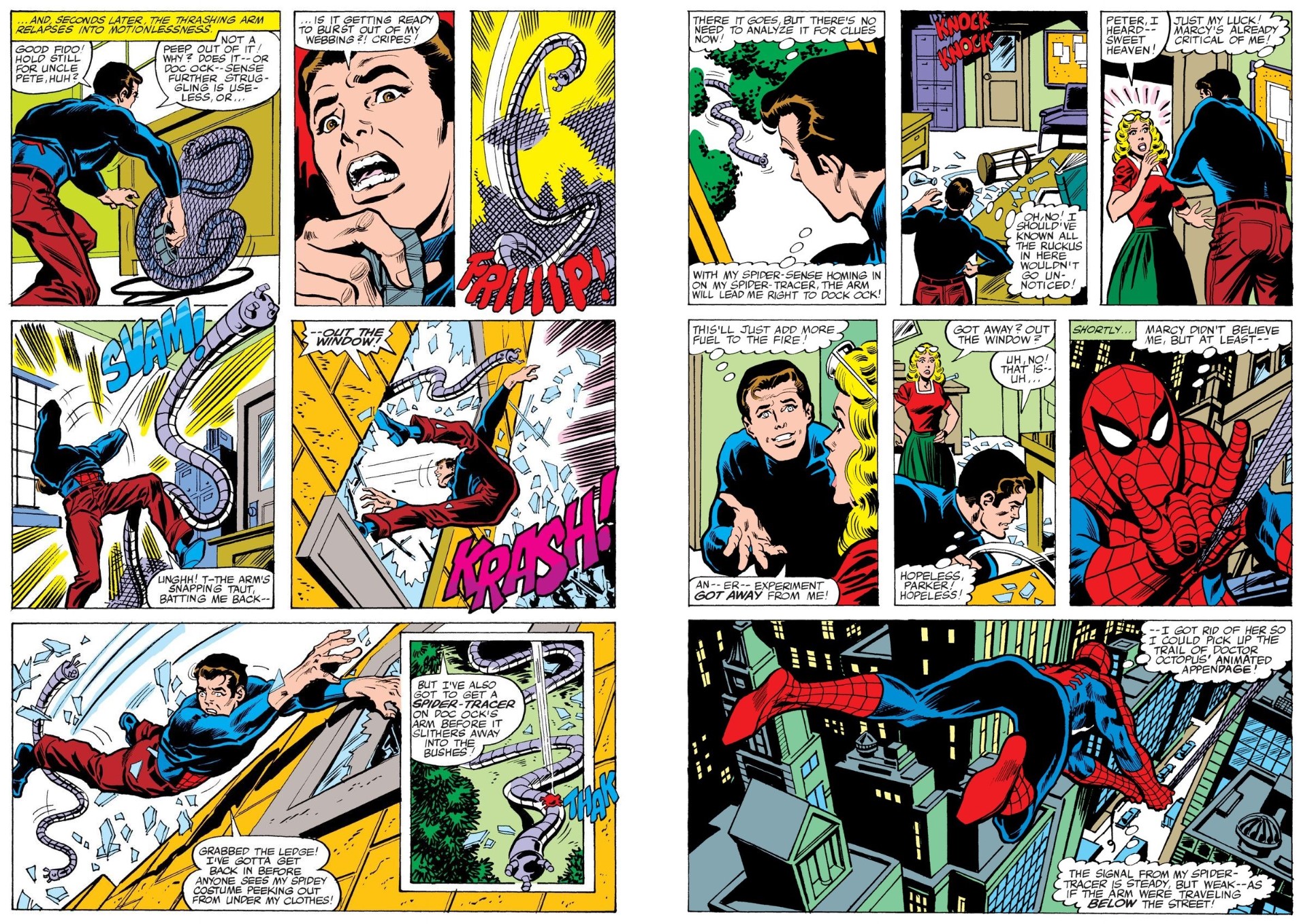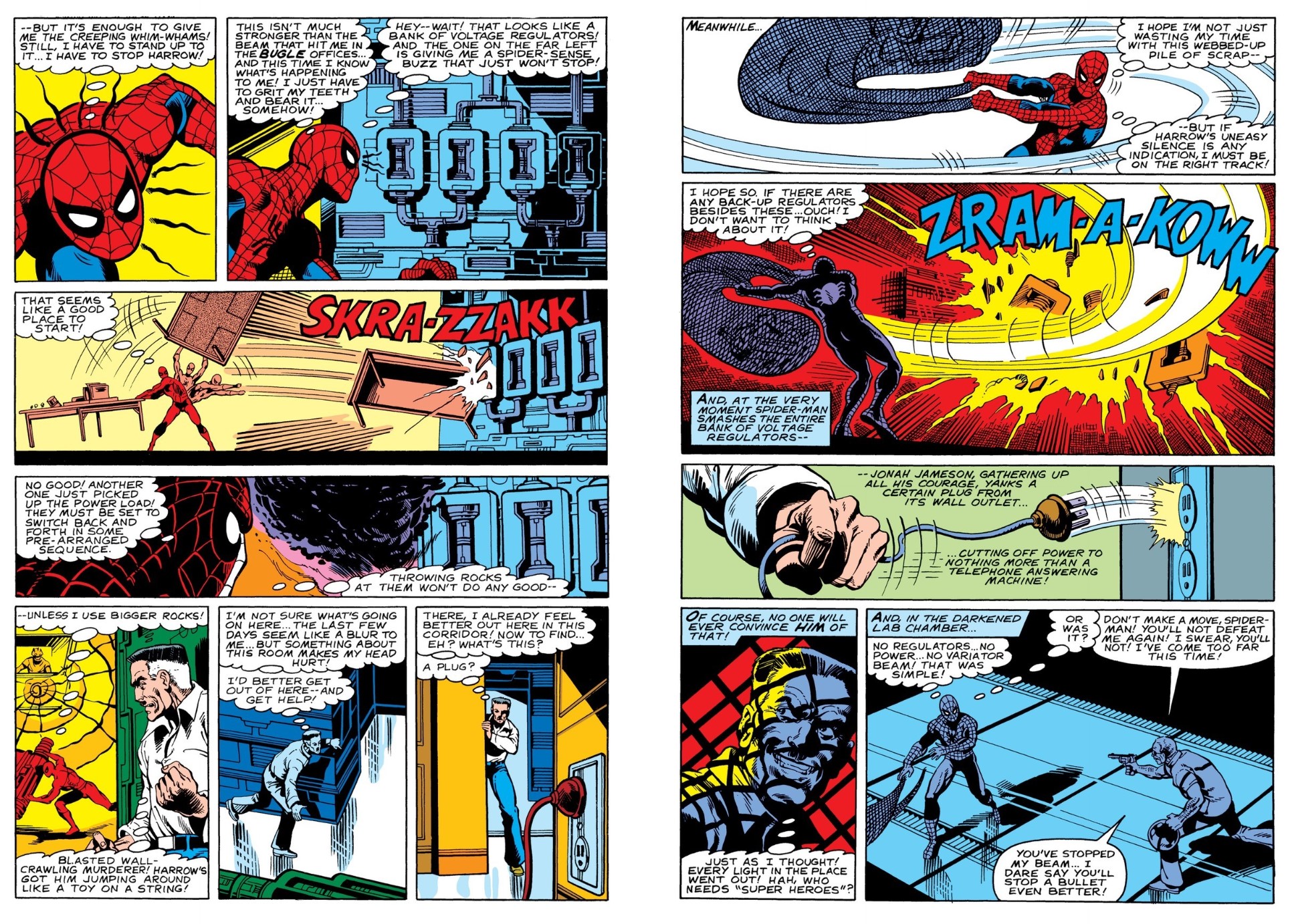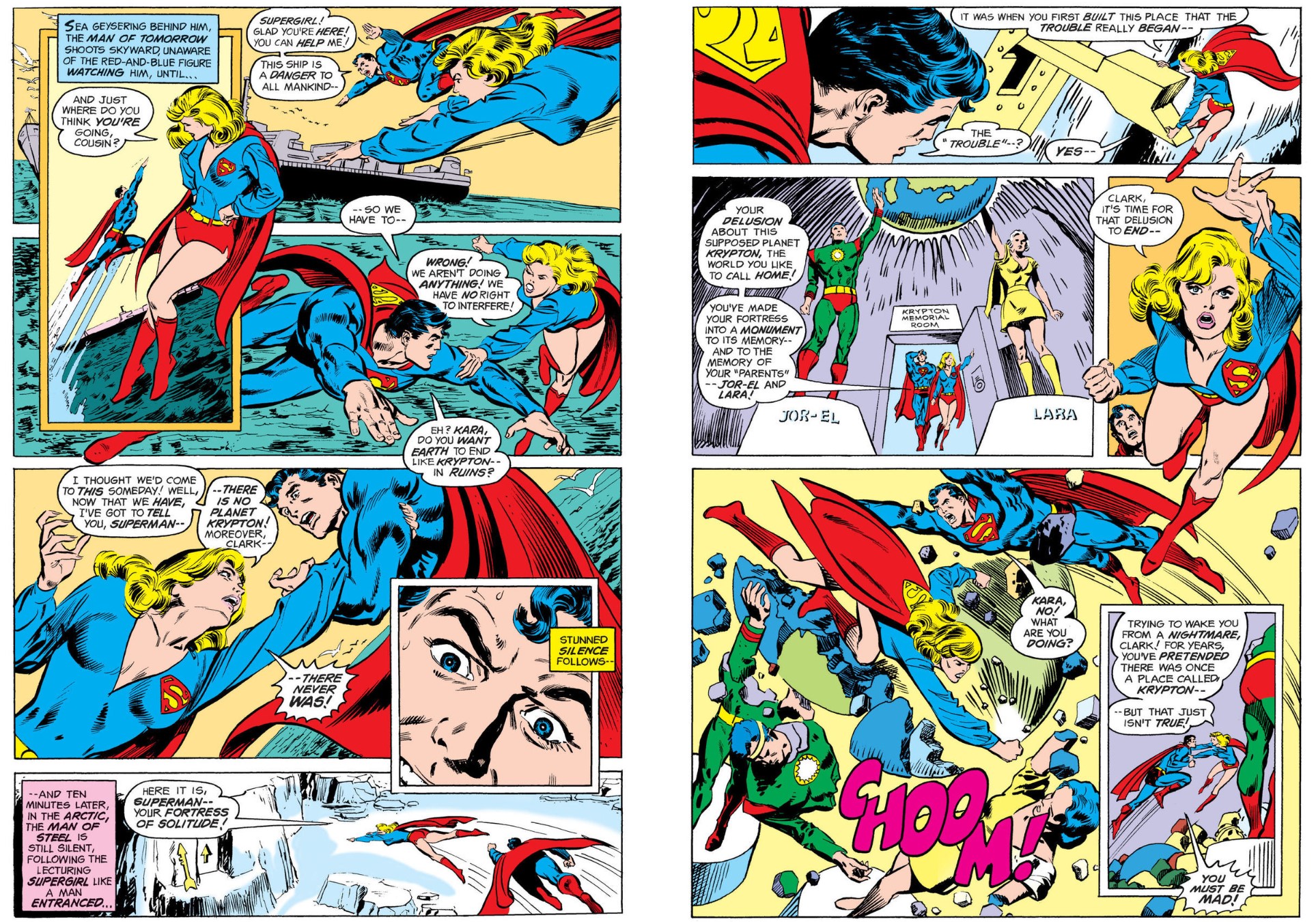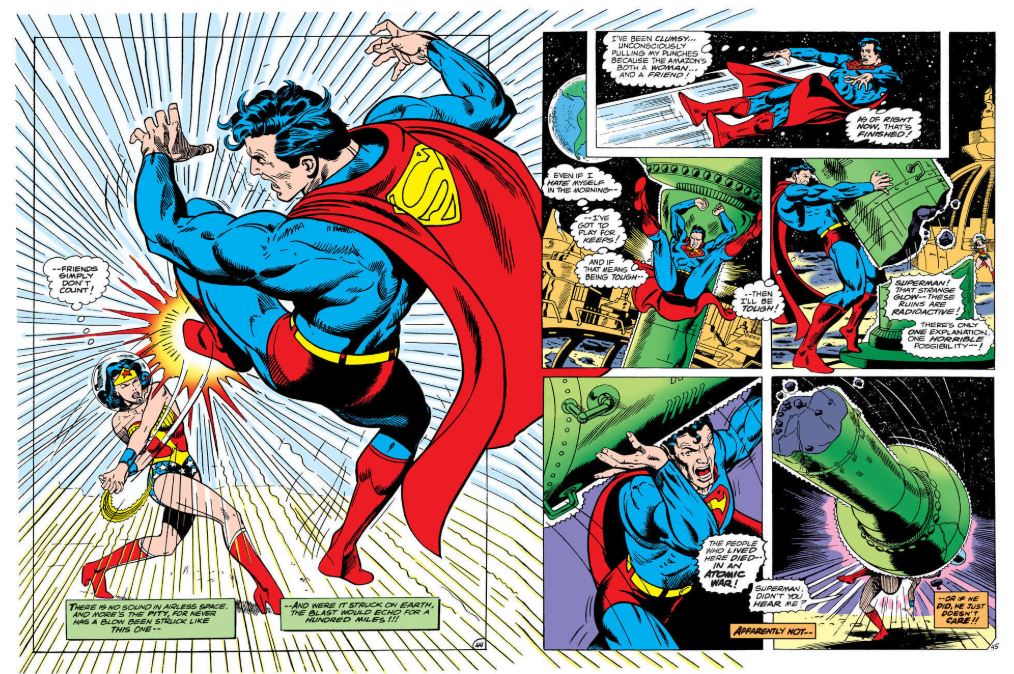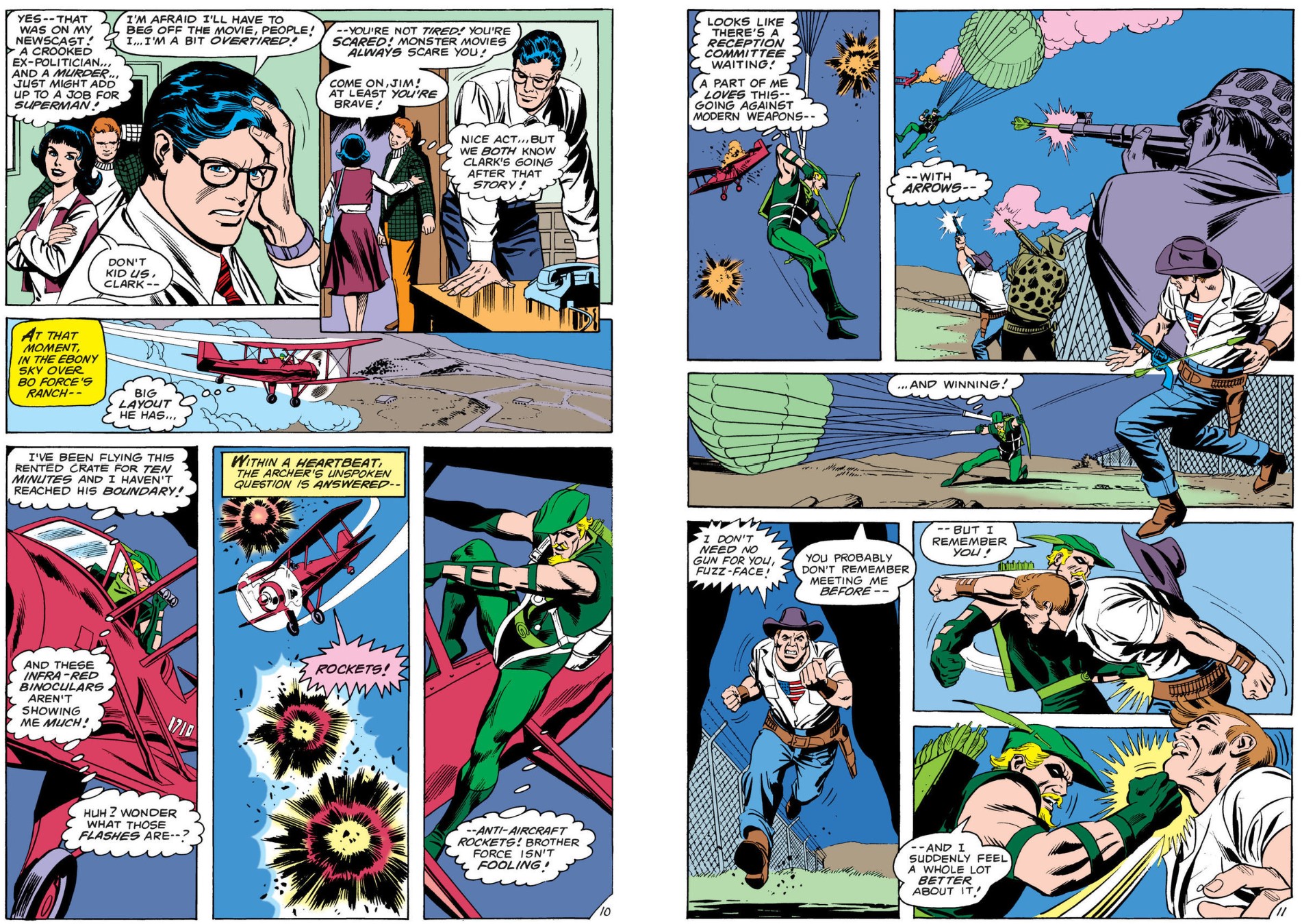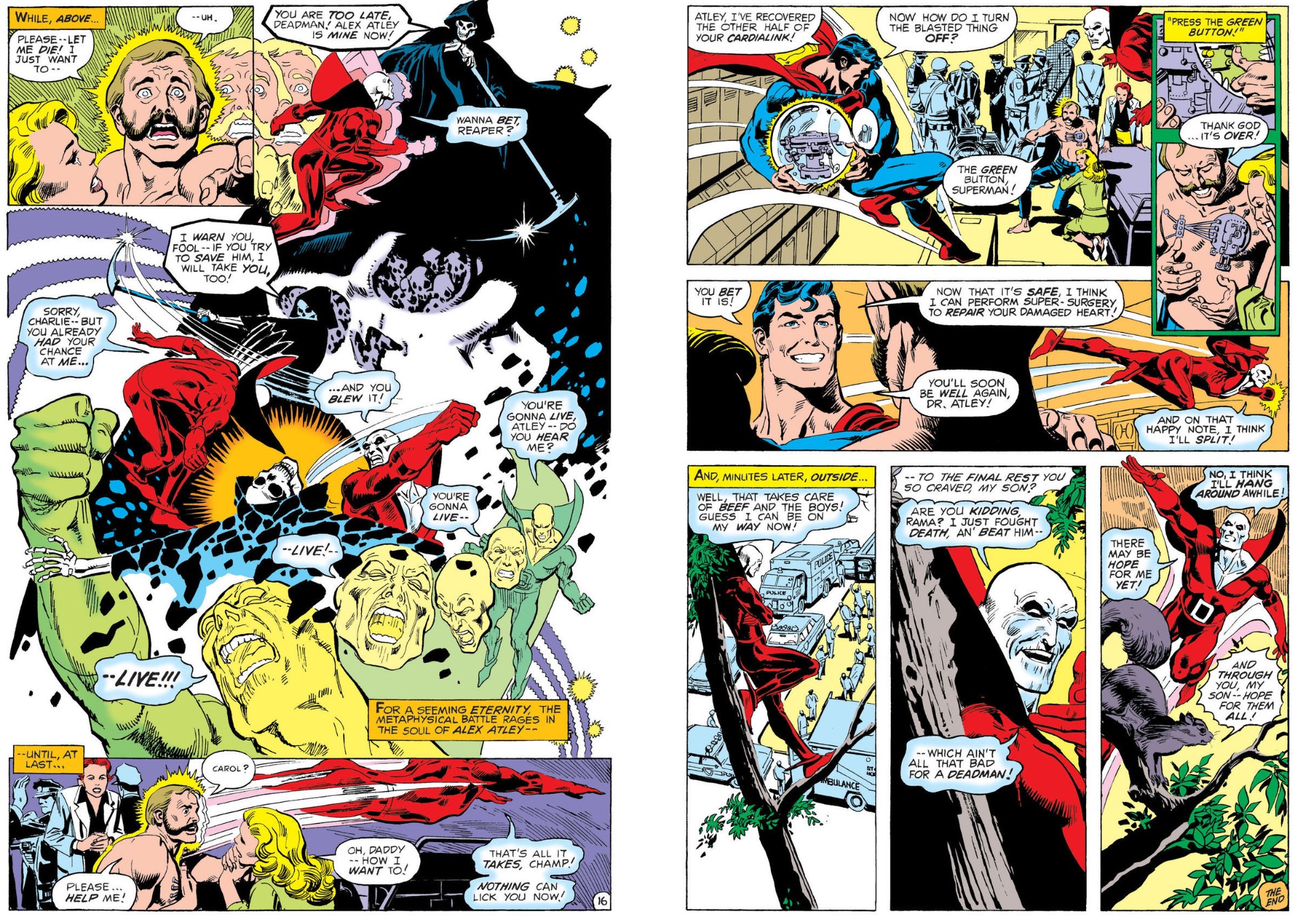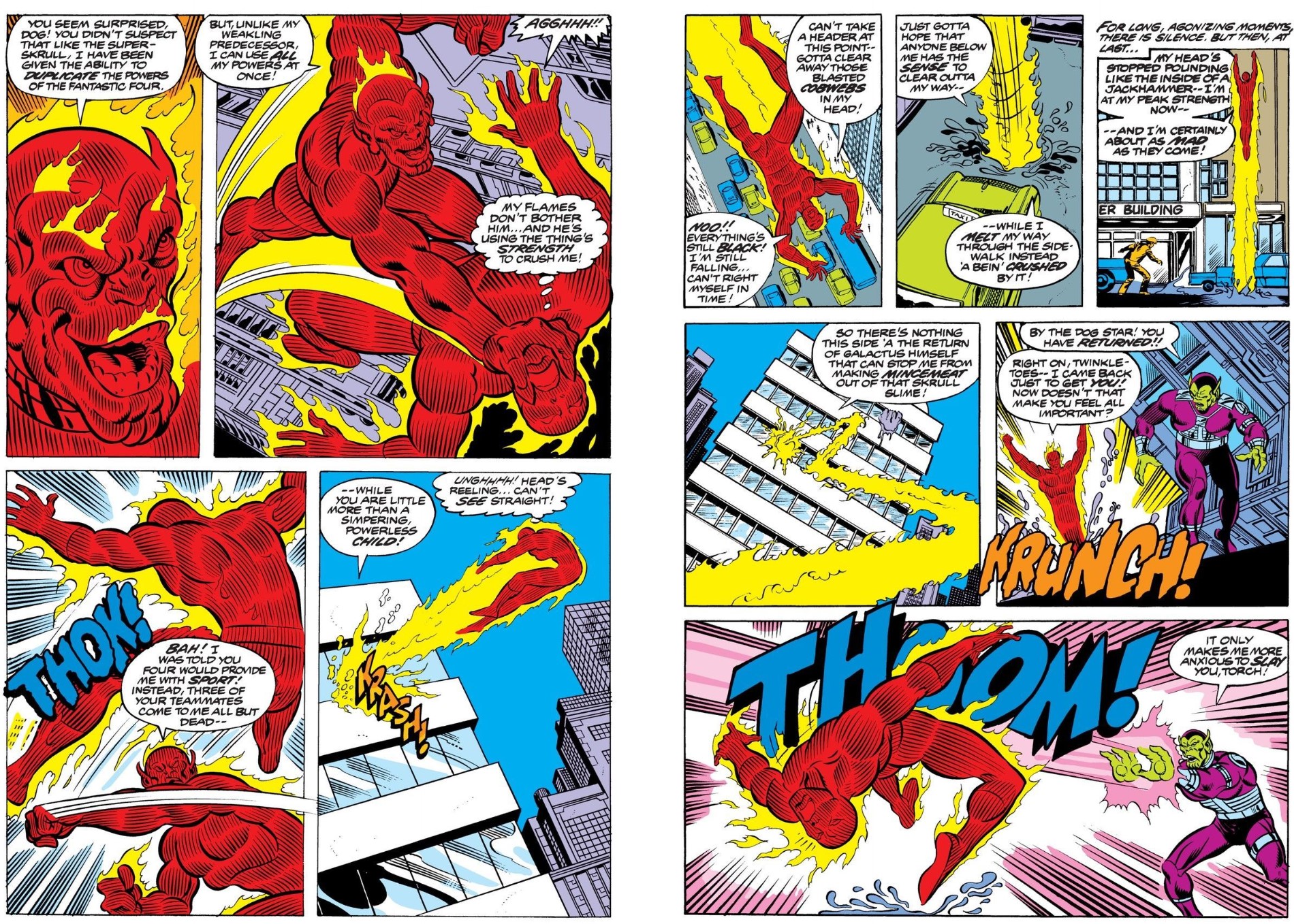
The Golden Age Green Lantern Archives volumes 1 & 2


By Bill Finger, Martin Nodell, E.E. Hibbard, Irwin Hasen & various (DC Comics)
ISBN: 978-1-56389-507-4 (HB vol 1), 978-1-56389-794-8 (HB vol 2)

This book includes Discriminatory Content produced in less enlightened times.

Time for another Birthday briefing as we exploit the month of renewal and fresh starts by celebrating 85 glorious years for another Golden Age stalwart: someone who has gained a modern cachet as probably DC’s most venerably proud gay icon…

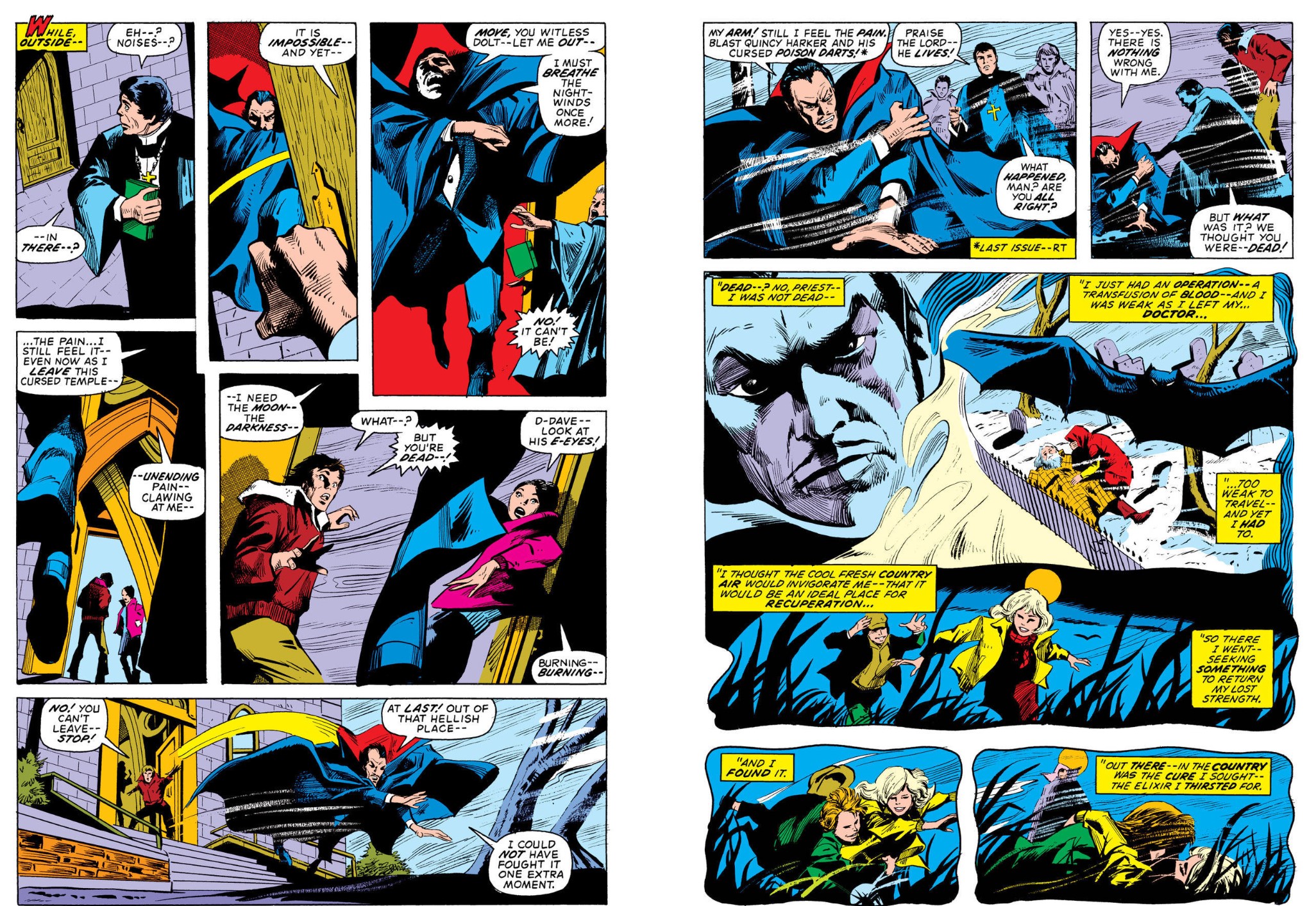
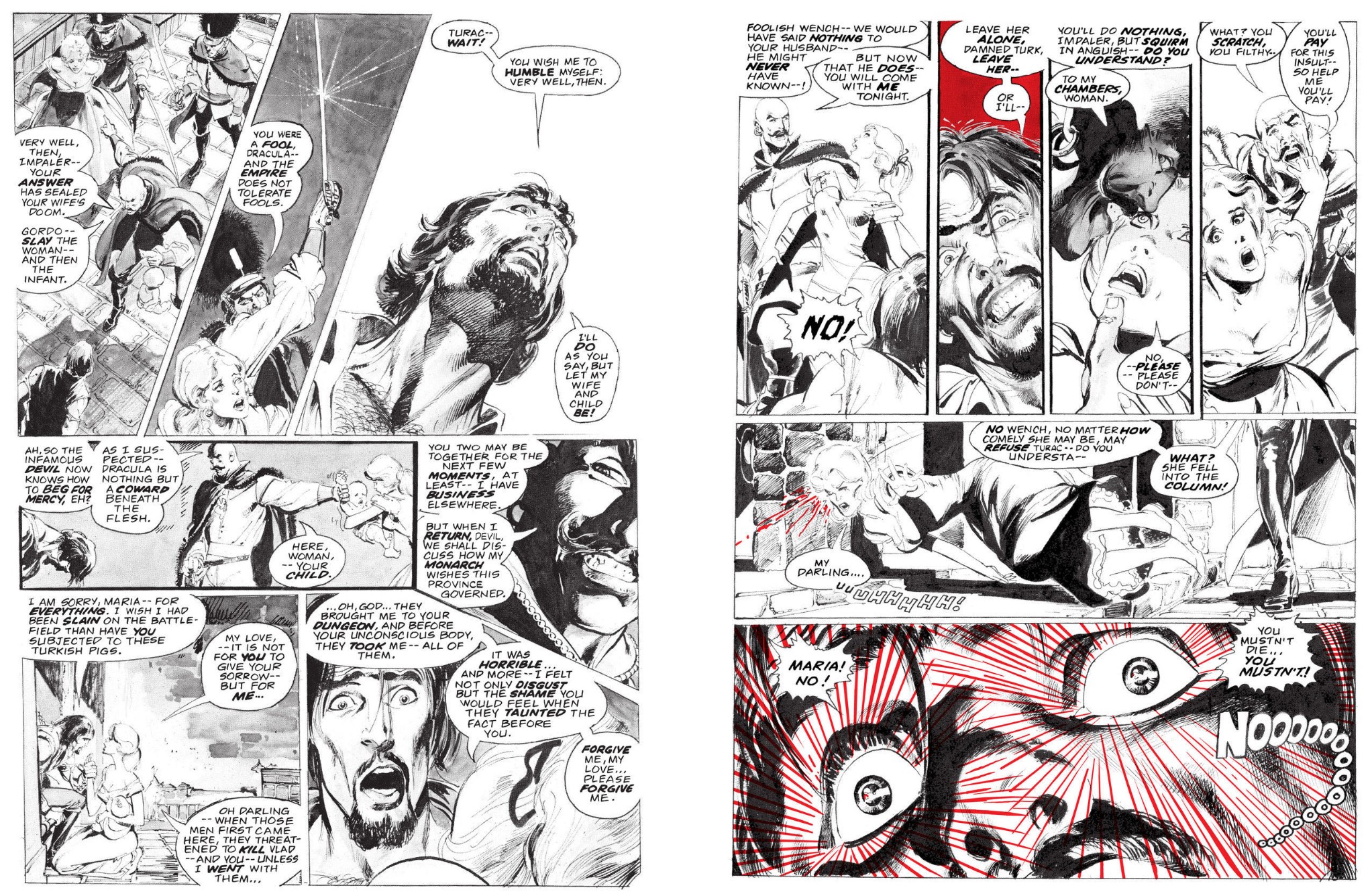
The ever-expanding array of companies that became DC published many iconic “Firsts” in the early years of the industry. Associated outfit All-American Publications (co-publishers until bought out by National/DC in 1946) originated the first comic book super-speedster as well as the monumentally groundbreaking Wonder Woman, The Atom, Hawkman, Johnny Thunder and so many others who became mainstays of DC’s pantheon of stars.
Thanks to comics genius and editorial wunderkind Sheldon Mayer, All-American Comics  published the first comic book super-speedster in Flash Comics. They followed up a few months later with another evergreen and immortal all-star.

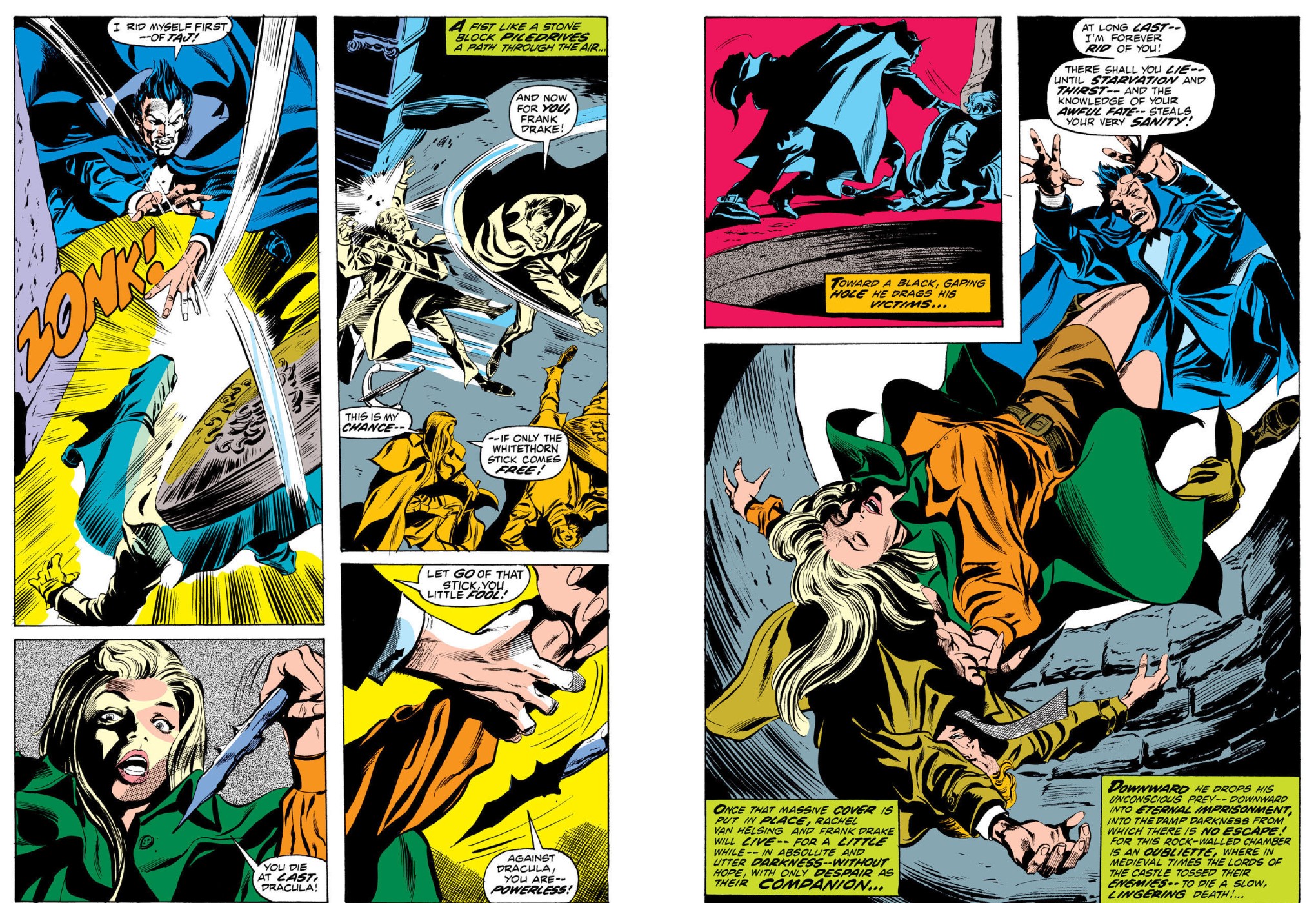
Lighting up newsstands from May 17th 1940, The Green Lantern debuted in anthological All-American Comics #16 (cover-dated July of that auspicious year). It was the company’s flagship title just as superheroes began to truly dominate the market, supplanting newspaper strip reprints and stock genre characters in the still primarily anthology-based industry.

The Emerald Gladiator would be swiftly joined in A-AC by The Atom, Red Tornado, Sargon the Sorcerer and Doctor Mid-Nite, until eventually only gag strips such Mutt and Jeff and exceptional topical tough-guy military strips Hop Harrigan (Ace of the Airwaves) and Red, White and Blue remained to represent mere mortal heroes. And then, tastes shifted after the war and costumed crusaders faded away, to be replaced by cowboys, cops, clowns and private eyes…

Devised by up-and-coming cartoonist Martin Nodell (and fleshed out by Bill Finger in the same generally unsung way he had contributed to the success of Batman), GL soon became AA’s second smash sensation.

The arcane avenger gained his own solo-starring title little more than a year after his premiere and also appeared in other anthologies including Comics Cavalcade and All Star Comics for just over a decade before, like most first-generation superheroes, he faded away in the early1950s. However, GL first suffered the uniquely humiliating fate of being edged out of his own strip and comic book by his pet, Streak the Wonder Dog

However, that’s the stuff of other reviews. This spectacular, quirkily beguiling deluxe Archive edition (collecting the Sentinel of Justice’s appearances from All-American Comics #16-30 – covering July 1940 to September 1941 as well as the Fall 1941cover-dated Green Lantern#1) opens with a rousing reminiscence from Nodell in a Foreword discussing the origins of the character before the parade of raw enchantment starts with the incredible history of The Green Flame of Life

Ambitious young engineer Alan Scott only survives the sabotage and destruction of a passenger-packed train due to the occult intervention of a battered old railway lantern. Bathed in its eerie emerald light, he is regaled by a mysterious green voice with the legend of how a meteor once fell in ancient China. It spoke to the people, predicting Death, Life and Power.

The star-stone’s viridian glow brought doom to the savant who reshaped it into a lamp, sanity to a madman centuries later and now promised incredible power to bring justice to wronged innocents.

Instructing Scott to fashion a ring from its metal and draw a charge of power from the lantern every 24 hours, the ancient artefact urges the engineer to use his formidable willpower to end all evil: a mission Scott eagerly takes up by promptly crushing corrupt industrialist Dekker – who had callously caused wholesale death just to secure a lucrative rail contract…

The ring makes Scott immune to all minerals and metals, enables him to fly and pass through walls, but as he battles Dekker’s thugs the grim avenger painfully discovers that living – arguably “organic” – materials such as wood or rubber can penetrate his jade defences and cause him mortal harm. The saboteurs duly punished, Scott resolves to carry on the fight and devises a “bizarre costume” to conceal his identity and strike fear and awe into wrongdoers.

Most of the stories at this time were untitled, and A-AC #17 (August 1940) finds Scott in Metropolis (long before it became the fictional home of Superman) where his new employer is squeezed out of a building contract by a crooked City Commissioner in bed with racketeers. With lives at risk from shoddy construction, the Green Lantern moves to stop the gangsters but nearly loses his life to overconfidence before finally triumphing, after which #18 finds Scott visiting the 1940 New York World’s Fair. This yarn (which I suspect was devised for DC’s legendary comic book premium New York World’s Fair Comics #2 but shelved at the last moment) introduces feisty romantic interest Irene Miller as she attempts to shoot the gangster who framed her brother.

Naturally, gallant he-man Scott had to get involved, promptly discovering untouchable gang-boss Murdock owns his own Judge, by the simple expedient of holding the lawman’s daughter captive…

However, once Alan applies keen wits and ruthless mystic might to the problem, Murdock’s power – and life – are forfeit, after which, in #19, Scott saves a man from an attempted hit-&-run and finds himself ferreting out a deadly ring of insurance scammers collecting big pay-outs through inflicting “accidents” upon unsuspecting citizens.

All-American Comics #20 opened with a quick recap of GL’s origin before instituting a major change in the young engineer’s life. Following the gunning down of a roving radio announcer and assassination of that reporter’s wife, our hero investigates APEX Broadcasting System in Capitol City and again meets Irene Miller. She works at APEX and, with Alan’s help, uncovers a scheme whereby broadcasts are used to transmit coded instructions to smugglers. Once the Ring-wielder mops up the gang and their inside man, engineer Scott takes a job at the company and begins a hapless romantic pursuit of capable, valiant Irene.

Thanks to scripter Bill Finger, Green Lantern was initially a grim, mysterious and spookily implacable figure of vengeance, weeding out criminals and gangsterism but, just as with early Batman sagas, there was always a strong undercurrent of social issues, ballsy sentimentality and human drama. All-American #21 sees the hero expose a cruel con wherein a crooked lawyer presses young criminal Cub Brenner into posing as the long-lost son of a wealthy couple to steal their fortune. Of course, the kid has a change of heart and everything ends happily, but not before stupendous skulduggery and atrocious violence ensue…

In #22, when prize-fighter Kid McKay refuses to throw a bout, mobsters abduct his wife and even temporarily overcome the fighting-mad Emerald Guardian. Moreover, when one brutal thug puts on the magic ring, he swiftly suffers a ghastly punishment allowing GL to emerge victorious. Slick veteran Everett E. Hibbard provided the art for A-AC #23, and his famed light touch frames GL’s development into a less fearsome and more public spirited and approachable champion. As Irene continues to rebuff Alan’s advances – in vain hopes of landing his magnificent mystery man alter ego – the engineer accompanies her to interview movie star Delia Day and stumbles into a cruel blackmail racket. Despite their best efforts the net result is heartbreak, tragedy and many deaths.

Issue #24 then sees the Man of Light going undercover to expose philanthropist tycoon R.J. Karns, who maintains his vast fortune by trafficking unemployed Americans into slavery on a tropical Devil’s Island, and #25 finds Irene uncovering sabotage at a steel mill. With GL’s unsuspected help she then exposes purported enemy mastermind The Leader as no more than an unscrupulous American insider trader trying to force prices down for a simple Capitalist coup…

Celebrated strip cartoonist Irwin Hasen began his long association with Green Lantern in #26 when the hero aids swindled citizens whose lending agreements with a loan shark are being imperceptibly altered by a forger to keep them paying in perpetuity, after which the artist illustrated the debut appearance of overnight sensation Doiby Dickles in All-American #27 (June 1941). The rotund, middle-aged Brooklyn-born cab driver was simply intended as light foil and occasional sidekick for the poker-faced Emerald Avenger, but rapidly grew to be one of the most popular and beloved comedy stooges of the era; soon sharing covers and even by-lines with the star.

In this initial dramatic outing, he bravely defends fare Irene (sorry: irresistible – awful, but irresistible) from assailants as she carries plans for a new radio receiver device. For his noble efforts, Doiby is sought out and thanked by Green Lantern. After the verdant vigilante investigates further, he discovers enemy agents at the root of the problem, but when Irene is again targeted, the Emerald Avenger is apparently killed. This time, to save Miss Miller, Doiby disguises himself as “de Lantrin” and confronts the killers alone before the real deal turns up to end things. As a reward, the Brooklyn bravo is offered an unofficial partnership…

In #28 the convenient death of millionaire Cyrus Brand and a suspicious bequest to a wastrel nephew lead Irene, Doiby & Alan to sinister gangster The Spider, who manufactures deaths by natural causes, after which #29 finds GL and the corpulent cabbie hunting mobster Mitch Hogan, who forces pharmacies to buy his counterfeit drugs and products. The brute utilises strongarm tactics to ensure even the courts carry out his wishes – at least until the Lantern and his wrench-wielding buddy give him a dose of his own medicine…

The last All-American yarn here is from issue #30 (cover-dated September 1941) and again sees Irene sticking her nose into other peoples’ business. This time she exposes a brace of crooked bail bondsmen exploiting former criminals trying to go straight, before being again kidnapped. This high-energy compilation concludes with the rousing contents of Green Lantern #1 from Fall 1941, scripted by Finger and exclusively illustrated by Nodell, who had by this time dropped his potentially face-saving pseudonym Mart “Dellon”. The magic begins with a 2-page origin recap in ‘Green Lantern – His Personal History’, before ‘The Masquerading Mare!’ sees GL & Doiby smash the schemes of racketeer Scar Jorgis… who goes to quite extraordinary lengths to obtain a racehorse inherited by Irene.

Following an article by Dr. William Moulton Marston (an eminent psychologist familiar to us as the creator of Wonder Woman) discussing the topic of ‘Will Power’, comic thrills resume when a city official is accused of mishandling funds allocated to buy pneumonia serum in ‘Disease!!’ Although GL & Doiby spearhead a campaign raising money to prevent an epidemic, events take a dark turn when untouchable, unimpeachable Boss Filch experiences personal tragedy and exposes his grafting silent partners high in the city’s government hierarchy…

Blistering spectacle is the focus of ‘Arson in the Slums’, as Alan and Irene are entangled in a crusading publisher’s strident campaign to renovate a ghetto. Of course, philanthropic Barton and his real estate pal Murker have only altruistic reasons for their drive to re-house the city’s poorest citizens. Sure, they do…

Doiby is absent from that high octane thriller but guest-stars with the Emerald Ace in prose tale ‘Hop Harrigan in “Trailers of Treachery” – by an unknown scripter and probably illustrated by Sheldon Mayer: a ripping yarn starring AA’s aviation ace (and radio star) after which ‘Green Lantern’ & Doiby travel South of the Border to scenic Landavo to investigate tampering with APEX’s short-wave station and end up in a civil war. They soon discover the entire affair has been fomented by foreign agents intent on destroying democracy on the continent…

With the threat of involvement in the “European War” a constant subject of US headlines, this type of spy story was gradually superseding general gangster yarns, and as Green Lantern displayed his full bombastic might against tanks, fighter planes and invading armies, nobody realised that within mere months America and the entire comic book industry were to be refitted and reconfigured beyond all recognition. Soon mystery men would be patriotic morale boosters parading and sermonising ad infinitum in every corner of the industry’s output as the real world brutally intruded on the hearts and minds of the nation…

Including a breathtaking selection of stunning and powerfully evocative covers by Sheldon Moldoff, Hasen & Howard Purcell, this magnificent book is a sheer delight for lovers of the early Fights ‘n’ Tights genre: gripping, imaginative and exuberantly exciting – but yet again remains out of print and unavailable in digital formats. One day, though…


Golden Age Green Lantern Archives volume 2

This second engagingly impressive hardcover Archive edition spans October 1941 to May 1942, collecting the Viridian Vigilante’s appearances from Green Lantern Quarterly #2-3 (Winter & Spring 1942) and the leads tales from All-American Comics #31-38. It opens with rousing reminiscences, intriguing comparisons and tantalising trivia titbits, in a Foreword by godfather of American fandom Dr. Jerry Bails, prior to the procession of pictorial peril begins…

Ambitious young engineer Alan Scott survived the sabotage and destruction of a passenger-packed train due only to the intervention of a battered old railway lantern. Bathed in its eerie verdant glow, he was regaled by a mysterious “green voice” with the legend of how a meteor fell in ancient China and spoke to the people: predicting Death, Life and Power.

After bringing doom to the mystic who reshaped it into a lamp and, centuries later, sanity to a madman, it now promised incredible might to bestow justice to the innocent. Instructing the engineer to fashion a ring from its metal and draw a charge of power from the lantern every 24 hours, the ancient artefact urged the engineer to use his formidable willpower to end all evil – a mission Scott eagerly embraced. The ring made him immune to all minerals and metals, and enabled him to fly and pass through solid matter amongst many other miracles, but was powerless against certain organic materials such as wood or rubber which could penetrate his jade defences and cause him mortal harm…

After wandering the country for months, Scott eventually settled in Capitol City, taking a job as first engineer and eventually radio announcer at APEX Broadcasting System. He also fruitlessly pursued feisty reporter Irene Miller. Before long he had a trusted sidekick in the flabby form of Doiby Dickles, a rotund, middle-aged Brooklyn-born cab driver. Originally intended as a light foil for the grim, poker-faced Emerald Avenger, the bumbling buddy grew to be one of the most popular and beloved sidekicks of the era. Thanks to scripter Bill Finger – who wrote all the stories in this volume – GL was a grim, brooding, spookily mysterious figure of vengeance weeding out evil in tales strongly highlighting social realism, ballsy sentimentality and human drama.

Illustrated by Nodell, the comics action starts in All-American Comics #31’s ‘The Adventure of the Underfed Orphans!’ as Alan & Irene probe food poisoning at a municipal children’s home, and uncover a shocking web of abuse and graft leading to the upper echelons of City Hall and the grimiest gutters of the underworld…

Most of the All-American GL tales were untitled, such as Hasen’s effort in #32, revealing how a veteran beat cop’s son falls in with the wrong crowd. Framed by his boss and arrested by his own dad, vengeful Danny is only saved from ruining his life forever by the Emerald Avenger & Doiby who help him get the goods on Gardenia and reconcile with his grateful dad. The next story (limned by Nodell) strikes close to home as gangster Pug Deagan tries to take over the Taxicab Drivers’ union and Doiby calls on his Grim Green pal to clean up the racket and expose the real brain behind the operation, whilst in A-AC #34, the Dynamic Trio of Alan, Irene & Mr. Dickles investigate a collapsing building and are drawn into a colossal construction scandal involving the Mayor, and culminating in the horrific failure of Capitol City’s biggest and busiest bridge. Always one of the most powerful characters in comics, this tale especially demonstrates the sheer scope and scale of Green Lantern’s might.

All-American Comics #35 sees Doiby wracked by toothache and haplessly stumbling into a grisly murder at the dentist’s office. Once again racketeers are trying to take over a union and only GL & Dickles can stop them. The tale concludes with the cabbie having that tooth punched out and learning the secret of Alan Scott – an even bigger shock!

A huge hit from the off, the Emerald Crusader was fast-tracked into his own solo title, where creators were encouraged to experiment with format. Green Lantern Quarterly #2 (cover-dated Winter 1942) offered ‘The Tycoon’s Legacy’ by Finger & Nodell: a 4-chapter “novel-length story” seeing radio engineer Scott promoted to roving man-with-a-microphone, and promptly rushing to the assistance of a poor but honest lawyer and a porter swindled out of a $5,000,000 bequest. Both cases deliciously intertwine like a movie melodrama, and also see a framed man freed from the asylum to challenge the swindling estate executors who had trapped him there…

Events take a murderous turn just as Alan’s emerald alter ego gets involved, and before long Green Lantern is cracking heads and taking names in the hunt for the mastermind behind it all – a man known only as ‘Baldy’

Finger was a master of such socially redeeming mystery thrillers, and the unrepentant fan in me can’t help but wonder what he could have accomplished with such a prodigious page count on his other “Dark Avenger” assignment Batman and Robin

Hasen illustrated the remaining All-American yarns in this collection, beginning with #36 (March 1942), taking GL & Doiby to the motor racing circuit to foil the machinations of mobsters murdering drivers of a new kind of car. With no clue as to how the killings are accomplished, Doiby volunteers to drive the ill-fated Benson Comet, trusting in his pal “Da Lantrin” to save the day as usual…

A-AC #37 has the heroes helping a disgraced pilot whose crashed plane cost America its greatest scientific minds. Closer investigation reveals not only Fog Blake’s innocence but that the Brain Trust had actually been cunningly abducted by Nazi agents – but not for long, after which #38 pits the Emerald Avenger against a diminutive criminal strategist organising American gangs like ‘Another Napoleon’ before facing his own Waterloo in a blaze of verdant light…

With America freshly put on an all-encompassing war-footing, superheroes at last tackled the world’s latest monsters full-on, and with great verve and enthusiasm this stunning selection concludes with another novel-length epic from the third Green Lantern Quarterly and deliciously crafted by Finger & Nodell.

It begins with ‘The Living Graveyard of the Sea’ as Alan & Irene (plus stowaway Doiby) take ship for Australia, only to be torpedoed by a gigantic German super U-Boat. Although Green Lantern fights off the air and sea assault, the liner is lost. Survivors take to lifeboats and the one with Doiby, Irene & Alan is drawn into a vast impenetrable fog-bank. The vapours conceal an ancient wonder: a Sargasso Sea enclave of mariners from many eras who have, over centuries, evolved into a truly egalitarian, pacifist society. Sadly, the lifeboat contains a cross section of modern America, all horribly infected with greed, arrogance, prejudice and pride, so – although welcomed – the newcomers soon disrupt the idyllic microcosm.

Things take an even worse turn as another U-Boat surfaces within the sea city and fanatical Kapitan Schmidt attempts to annexe the realm and convert the ancients to ‘The Nazi Dream’. Stakes are raised even further when he finally gets a message through to Berlin and Hitler himself demands that the strategically crucial secret island be taken at all costs…

The fantastic finale comes as Irene & Doiby redeem their selfish fellow Americans and even convince the calmly neutral Sargasso citizens to fight for freedom and liberty in ‘Utopia vs. Totalitarianism’ whilst all Green Lantern has to do is sink an entire Nazi naval and aerial armada tasked with taking the hidden sea world…

I believe – like so many others – that superhero comics are never more apt or effective than when they wholeheartedly combat fascism with explosive, improbable excitement and mysterious masked marvel men. The most satisfyingly evocative and visceral moments of the genre all seem to come when gaudy gladiators soundly thrash bigots, supremacists and agents of organised intolerance, and the staggering denouement depicted here is one of the most expansive and breathtaking ever seen…

Complete with stellar covers by Nodell & Hasen, this riotous vintage assembly of classic Fights ‘n’ Tights fare is enthralling, engrossing and overwhelmingly addictive – even if not to every modern fan’s taste – and no lover of Costumed Dramas can afford to miss out on the fun…
© 1940, 1941, 1942, 1999, 2002 DC Comics. All Rights Reserved.

Silver Surfer Epic Collection volume 1: When Calls Galactus (1966-1968)


By Stan Lee & Jack Kirby, Marie Severin, Joe Sinnott, Frank Giacoia & various (MARVEL)
ISBN: 978-0-7851-9002-8 (TPB/Digital edition)

This book includes Discriminatory Content produced in less enlightened times.

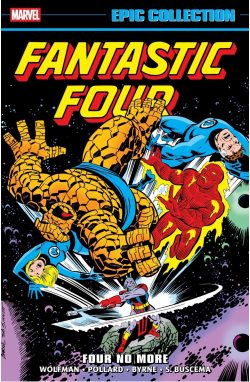
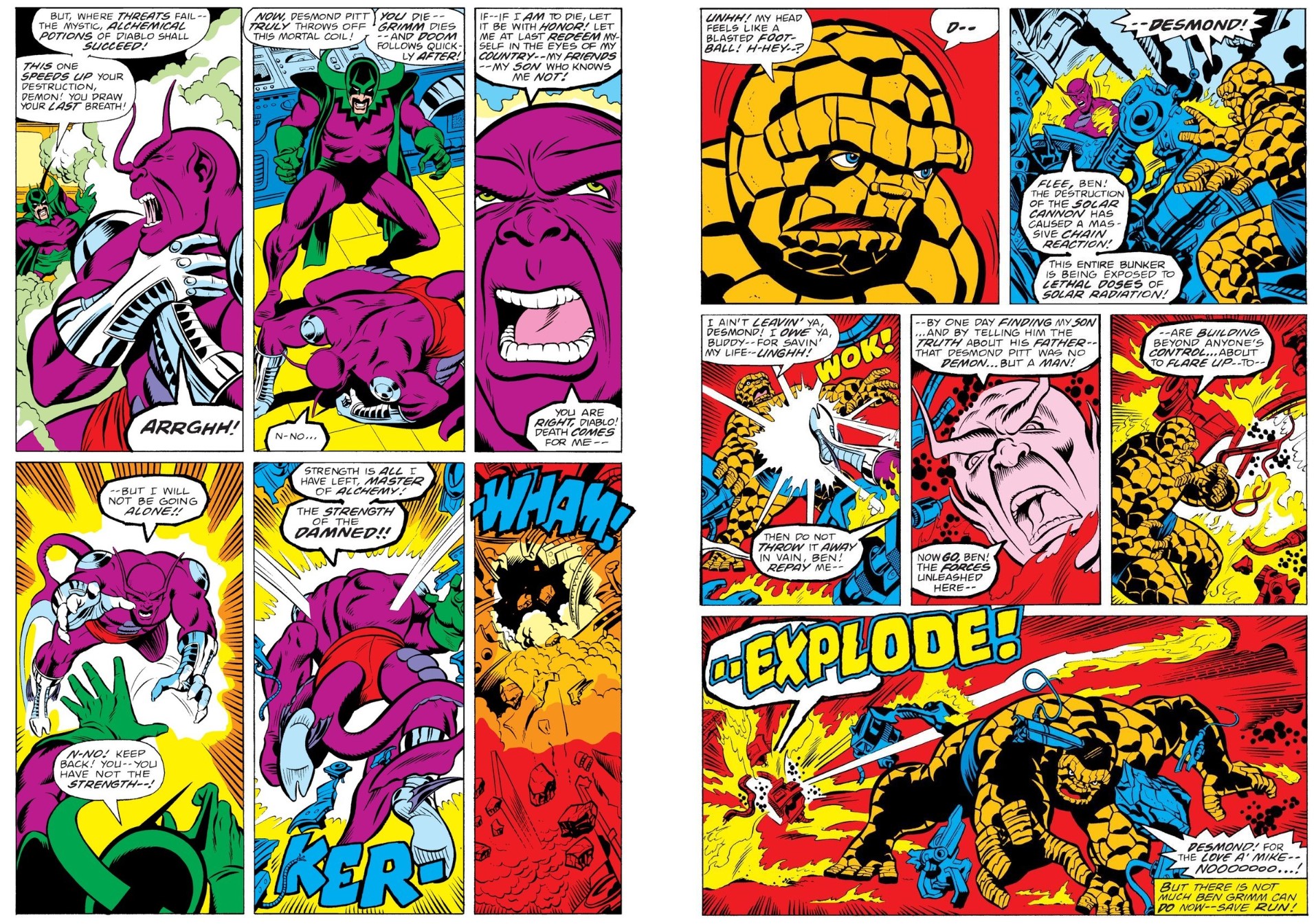
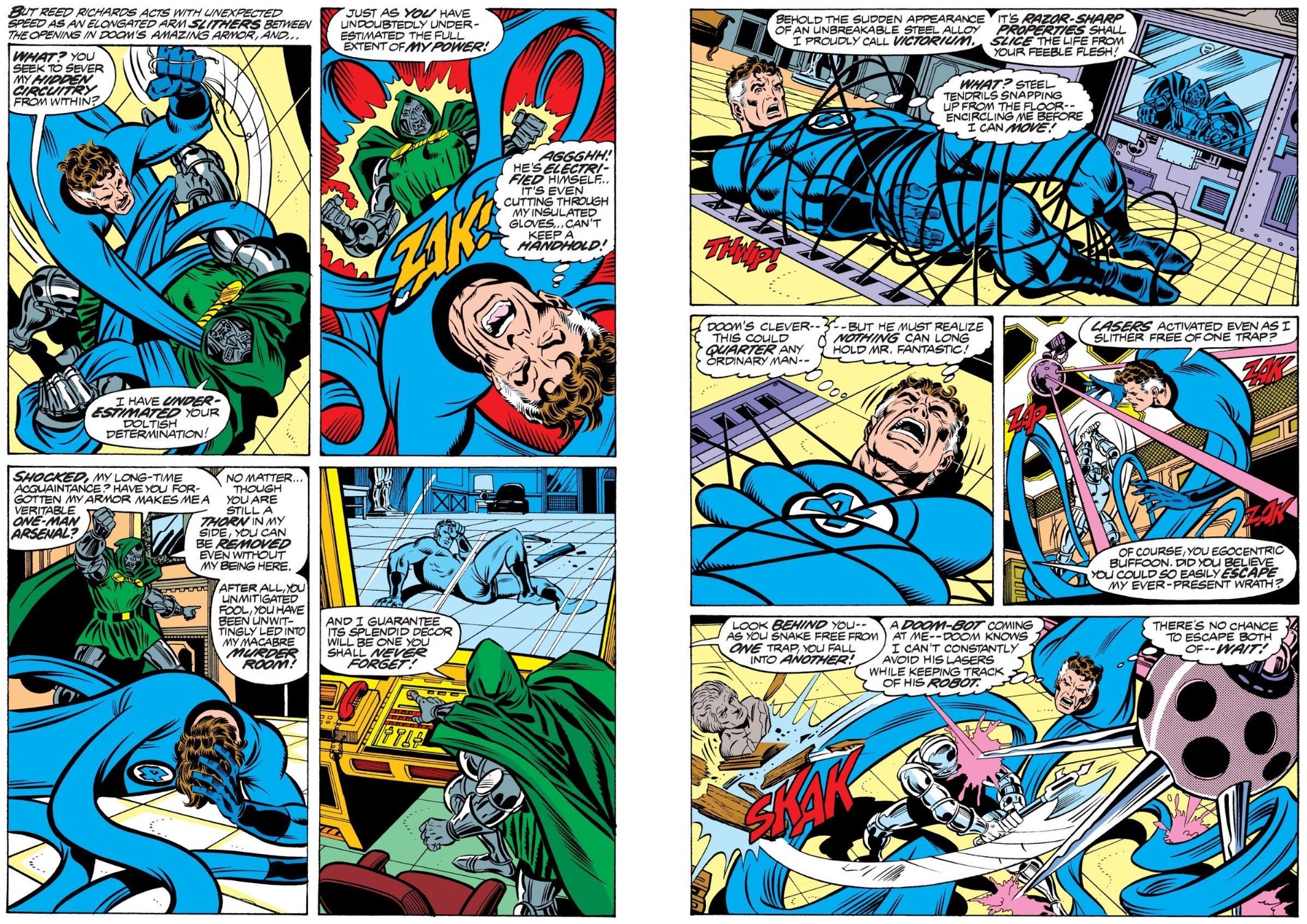
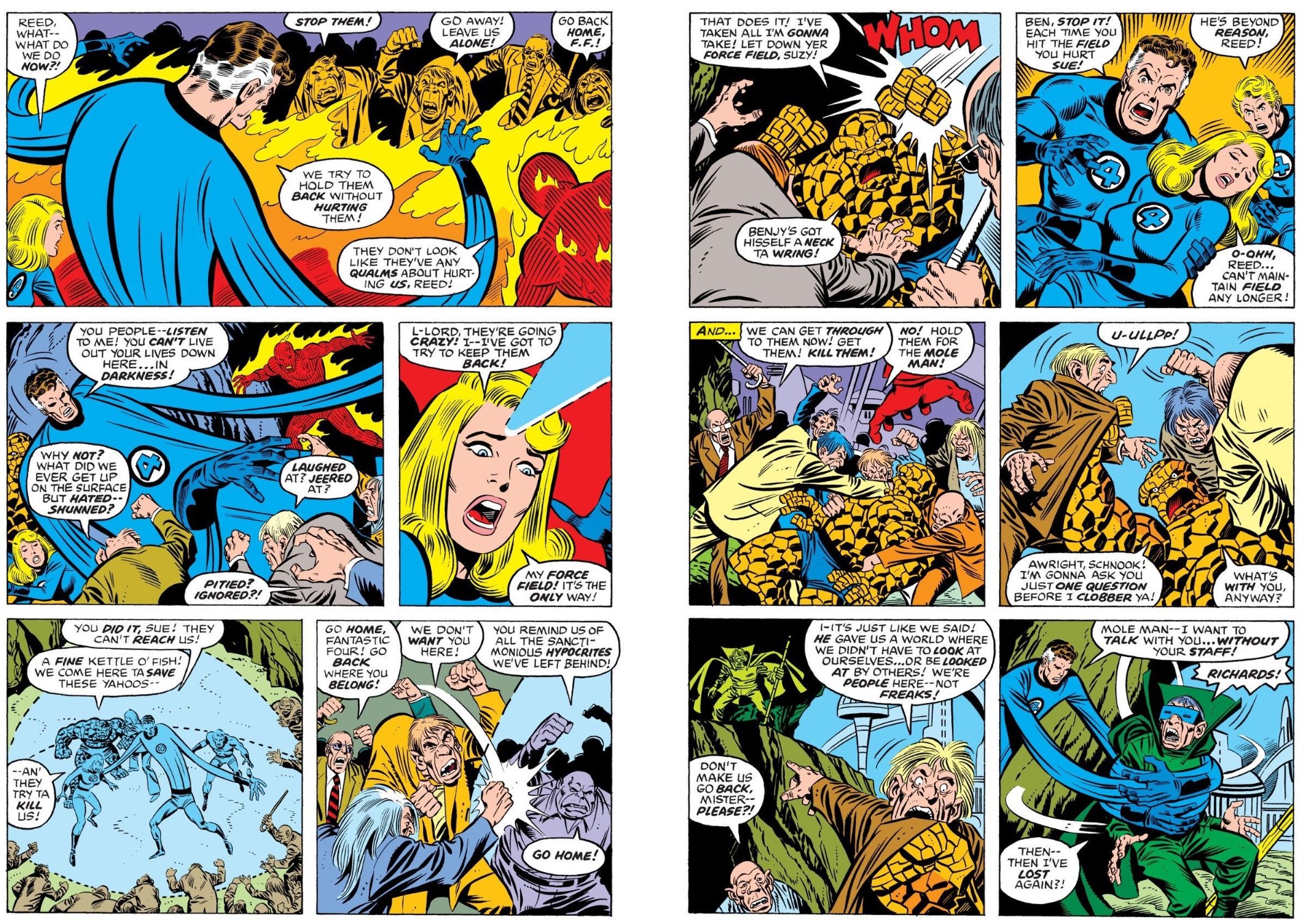
I gather there’s a degree of pre-condemnation in the usual quarters regarding the upcoming Fantastic Four film regarding the gender of one of the imaginary alien characters in it. Guys – and it is of course guys – it’s NOT REAL. It’s not even the comics you purport to love. It’s just another movie designed to appeal to the largest number of movie fans possessing only rudimentary knowledge of what involved. If you genuinely want to uphold the purity of the comics incarnations, buy a book like this one. Heck, buy a bunch and hand them out to people you’d like to impress and convert.

Or you could lurk in your mancave whining and trying to be relevant to people who just don’t care…

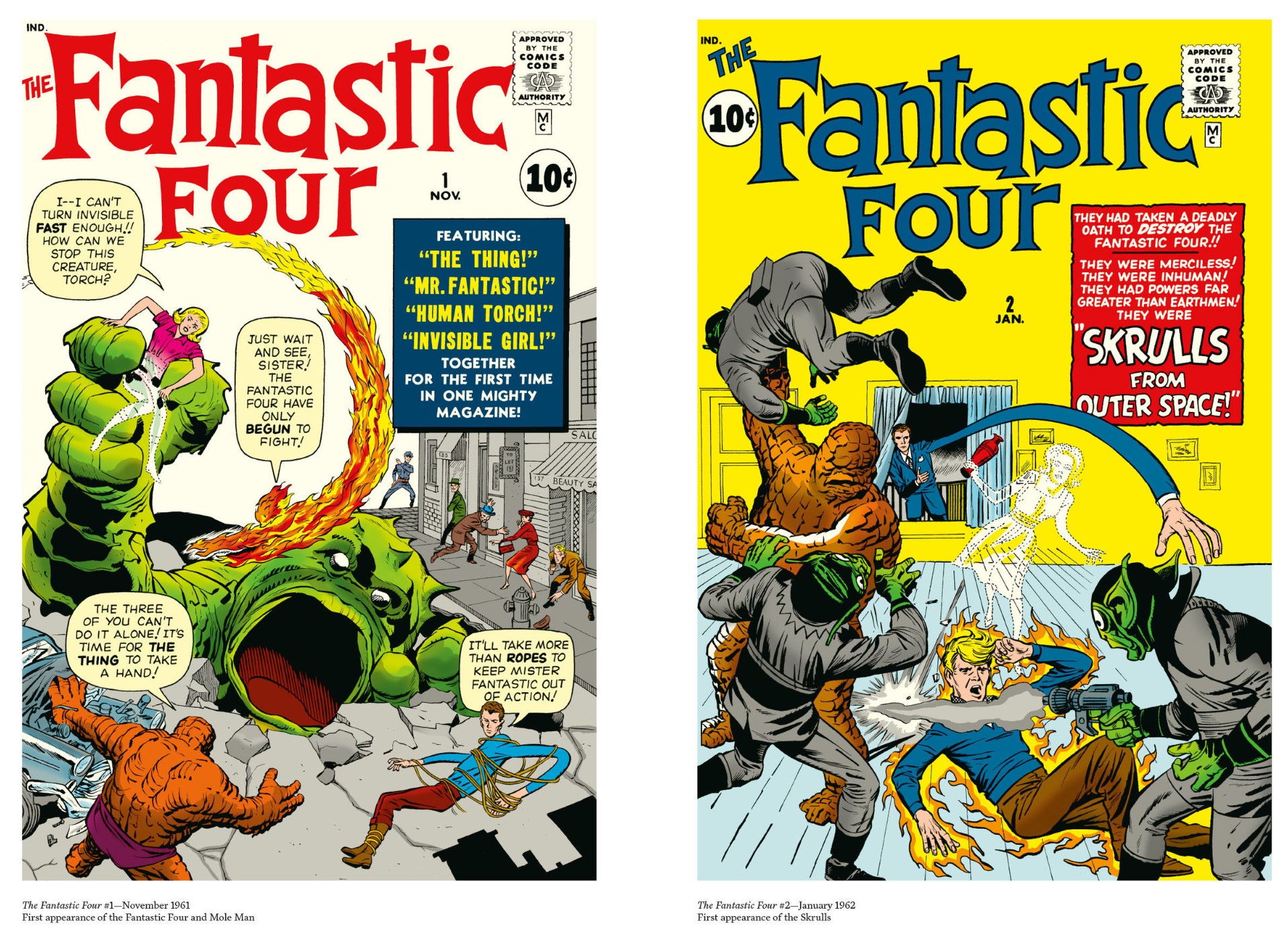
Cautiously bi-monthly and cover-dated November 1961, Fantastic Four #1 (by Stan Lee, Jack Kirby, George Klein & Christopher Rule) was crude: rough, passionate and uncontrolled excitement. Thrill-hungry readers pounced on it and the raw storytelling caught a wave of change starting to build in America. It and succeeding issues changed comicbooks forever.

In eight short years FF became the indisputable core and most consistently groundbreaking series of Marvel’s ever-unfolding web of cosmic creation: bombarding readers with a ceaseless salvo of new concepts and characters. Kirby was in his conceptual prime, unleashing his vast imagination on plot after spectacular plot. Clearly inspired, Lee scripted some of the most passionate superhero sagas that Marvel – or any publisher – had or has ever seen. Both were on an unstoppable roll, at the height of their creative powers, and full of the confidence only success brings. The King was particularly eager to see how far the genre and medium could be pushed. A forge of stunning creativity and endless excitement, Fantastic Four was the forge and proving ground for dozens of future stars and mesmerising concepts, none more timely or apt than freewheeling cosmic wanderer and moral barometer The Silver Surfer.

Collecting every scrap of pertinent material from Fantastic Four #48-50, 55-61, 72, 74-77 FF Annual #5 and Tales to Astonish #92-93, this compendium reprints all appearances of the Starry-eyed Sentinel spanning March 1966 to August 1968 (admittedly some only in excerpt): a chronological countdown to the outcast winning his own landmark title.

Although pretty much a last-minute addition to Fantastic Four #48-50’s Galactus Trilogy, Jack’s scintillating creation quickly became a watchword for depth and subtext in the Marvel Universe, one Stan Lee kept as his own personal toy for many years to come. The debut was a creative highlight from a period where the Lee/Kirby partnership was utterly on fire. The tale is all power and epic grandeur and has never been surpassed for drama, thrills and sheer entertainment, so you should really read it in all its glory.

Here, however, and without preamble the wonderment commences with a mere portion of ‘The Coming of Galactus!’ (by Lee, Kirby & Joe Sinnott from FF #48) as halfway through a storyline, the origins of The Inhumans saga is swiftly wrapped up (by page 6!) with the entire clandestine race sealed behind an impenetrable dome called the Negative Zone (later retitled Negative Barrier to avoid confusion with the gateway to subspace Reed Richards worked on for years).

Meanwhile, a cosmic entity approaches Earth, preceded by a gleaming herald on a surfboard of pure, shining cosmic energy…

I suspect this experimental – and uncomfortable – approach to narrative mechanics was calculated and deliberate, mirroring the way TV soap operas were increasingly delivering interwoven storylines, and used as a means to keep readers glued to the series. They needn’t have bothered. The stories and concepts were enough…

Issue #49 declares ‘If this be Doomsday!’ and sees planet-eating Galactus setting up shop over the Baxter Building despite the team’s best efforts, whilst his coldly gleaming herald has his humanity accidentally rekindled by simply conversing with The Thing’s blind girlfriend Alicia Masters. The first 13 pages of FF #50 concludes ‘The Startling Saga of the Silver Surfer!’ as the reawakened ethical core of the Surfer and gallantry of the human heroes buys enough time for Richards and the Human Torch to literally save the world with a boldly-borrowed Deus ex Machina gadget…
Once again, the tale ends mid-issue, with the remainder concentrating on the team getting back to “normal”, but that’s the work of a different review. Here, we resume with FF #55 as ‘When Strikes the Silver Surfer!’ sees the naive alien exiled on Earth by his former master and uncomprehendingly locked in brutal battle with the Thing, whose insecurities over his relationship with Alicia explode into searing jealousy when the soaring skyrider pays a purely platonic visit…

A portentous excerpt from #56 then tantalisingly teases another forthcoming epic. Fantastic Four #57-60 is Lee & Kirby at their utmost best; with unbearable tension, incredible drama and breathtaking action on all fronts as the most dangerous man on Earth steals the Surfer’s Power Cosmic, even as the Inhumans finally win their freedom and we discover the tragic secret of mighty mute Black Bolt in all its awesome fury.

It begins with a jailbreak by The Sandman in #57’s ‘Enter… Dr. Doom!’; escalates in ‘The Dismal Dregs of Defeat!’ as Doom tests his limitless stolen power in acts of random cruelty and destruction; builds to a crescendo in ‘Doomsday!’ with the heroes’ utter defeat and abject humiliation, before culminating in brains and valour saving the day – and all humanity – in truly magnificent manner with ‘The Peril and the Power!’

A 2-page postscript from #61 then shows the return to the Silver Surfer of his purloined life-energies, but there was never really a dull moment: no sooner had the exile returned to solitary wandering than he encounters another of Earth’s incredible denizens. It coincided with a new narrative tone for The Hulk in his solo feature in split-book Tales to Astonish. After months on the run, fugitive Bruce Banner reached a ‘Turning Point!’ (TtA #92, June 1967, by Lee and superb, criminally underrated Marie Severin & Frank Giacoia), wherein the Jade Giant – hunted through a terrified New York City – has a close encounter with a gleaming light in the sky…

Back then, the Hulk didn’t really team-up with visiting stars, he just got mad and smashed them. Such was certainly the case when he became ‘He Who Strikes the Silver Surfer!’, ironically battling with and driving off a fellow outcast who held the power to cure him of his atomic affliction…

The skyrider was only driven as far as November’s Fantastic Four Annual #5, where – after a Kirby & Giacoia pin-up depicting a colossal group shot of Galactus, The Watcher, Silver Surfer and others – the rapidly rising star-in-the-making enjoyed his first solo appearance. ‘The Peerless Power of the Silver Surfer’ (Lee, Kirby & Giacoia) is a pithily potent fable of ambition and ingratitude, reintroducing and upgrading the threat-level of The Mad Thinker’s lethal AI murder-machine Quasimodo

Things went quiet until FF #72 (March 1968) and ‘Where Soars the Silver Surfer!’, as the cruelly imprisoned wanderer goes cage-crazy and attacks humanity, forcing the quarrelsome quartet to make a valiant but violent intervention. Slightly calmer, the skyrider returns in #74 ‘When Calls Galactus!’ as the world-eater revisits Terra, demanding his former herald once more become a food-finding slave. However, despite his increasingly aggressive world-shaking probes and the FF’s holding action against the ravenous invader’s robotic Punisher, mighty Galactus cannot locate his target.

That’s because the Surfer has already – and utterly obliviously – departed for ‘World Within Worlds!’, forcing Reed, Ben & Johnny’s pursuit to save humanity from consumption. When the pioneering micronauts are subsequently attacked by sadistic alien empath Psycho Man, our heroes are subsequently ‘Stranded in Sub-Atomica!’

As they struggle to survive, Galactus applies ever-more pressure in ‘Shall Earth Endure?’, until a now-fully-apprised Surfer turns himself in to save humanity by finding the great Devourer an alternative snack. His reward is to be summarily slapped back into captivity here as soon as ungrateful Galactus finishes feeding, just in time to begin his own landmark series – but that’s also the subject of another review, another time…

Art lovers and history buffs can also enjoy a bountiful bonanza at the back of this volume: fascinating freebies including pages of original Kirby art, cover reproduction of earlier collection Silver Surfer: The Coming of Galactus! (by Ron Lim, Dan Panosian & Paul Mounts), composite cover art for Wizard Ace Edition: Fantastic Four (2002) #48 by Mike Wieringo, Karl Kesel & Mounts, José Ladrönn’s cover for The Fantastic Four Omnibus volume 2 and Dean White’s painted cover based on FF #49 (for Marvel Masterworks: The Fantastic Four volume 5). Also on show is a gallery of new covers crafted for 1970s reprint series Marvel’s Greatest Comics (#35-7 by John Buscema & Sinnott, Sal Buscema, Gil Kane & Giacoia) and Marvel Triple Action #1-4 (John B & Giacoia, Kane & John Romita, Vince Colletta and Sal B & Sinnott) which previously reprinted the material contained herein.

Epic, revolutionary and unutterably unmissable, these stories made Marvel the unassailable leaders in fantasy entertainment and remain some of the most important superhero comics ever crafted. The verve, conceptual scope and sheer enthusiasm shines through on every page and the wonder is there for you to share. If you’ve never thrilled to these spectacular sagas then this book of marvels is the perfect key to another – far brighter – world and time.
© 2019 MARVEL. All rights reserved.

DC Finest: Legion of Super-Heroes – Zap Goes the Legion


By James Shooter, E. Nelson Bridwell, Cary Bates, Curt Swan, J. Winslow “Win” Mortimer, Jack Abel, Ross Andru & Mike Esposito, George Tuska, Vince Colletta, Dave Cockrum, Murphy Anderson, Mike Grell, Carmine Infantino, Neal Adams, Nick Cardy & various (DC Comics)
ISBN: 978-1-77952-849-0 (TPB)

This book includes Discriminatory Content produced in less enlightened times.

This stunning compilation is another of the first wave of long-awaited DC Finest editions: full colour continuations of their chronologically curated but monochrome Showcase Presents line. The line delivers“affordably priced, large-size (comic book dimensions and generally around 600 pages) paperback collections” highlighting past DC glories. Whilst primarily concentrating on the superhero pantheon, there will also be genre selections like horror and war books, and themed compendia. Sadly, they’re not yet available digitally, as were the last decade’s Bronze, Silver and Golden Age collections, but we live in hope…

Once upon a time, a thousand years from now, super-powered kids from many worlds took inspiration from the greatest legend of all time and formed a club of heroes. One day those Children of Tomorrow came back in time and invited their inspiration to join them…

Thus began the vast and epic saga of the Legion of Super-Heroes, as first envisioned by writer Otto Binder & artist Al Plastino when the many-handed mob of juvenile universe-savers debuted in Adventure Comics #247 (April 1958). That was just as a revived taste for superheroes was gathering an inexorable head of steam in the US. Since then, the fortunes and popularity of the Legion have perpetually waxed and waned, with their future history tweaked and overwritten, retconned and rebooted over and over again to comply with editorial diktat and fickle fashion.

This sturdy, cosmically-captivating compendium gathers the chronological parade of futuristic delights from Adventure Comics #374-380 & 403, Action Comics #378-387 & 389-392, Superboy #172-173, 176, 183-184, 188, 190-191,193, 195 and Superboy Starring the Legion of Super-Heroes #197-203, cumulatively spanning cover-dates November 1968 through July/August 1974.

During this time the superhero again went into recession, briefly supplanted by horror and other traditional genre entertainment, but was slowly recovering to another peak. That plunge in costumed character caper saw the team lose a long-held lead spot in Adventure Comics and relegated to a back-up slot in Action… and even vanish completely for a time. Legion fans, however, are the most passionate of an already fanatical breed…

No sooner had the LSH faded than agitation to revive them began. Following a few tentative forays as an alternating back-up feature in Superboy, the game-changing, sleekly futuristic artwork of newcomer Dave Cockrum inspired a fresh influx of fans. Soon the back-ups took over the book – exactly as they had done in the 1960s when the Tomorrow Teens took Adventure from The Boy of Steel to make it uniquely their own…

At this time the youthful, generally fun-loving and carefree Club of Champions hit top form, having only just evolved into a dedicated and driven dramatic action series starring a grittily realistic combat force in constant, galaxy-threatening peril. Although now an overwhelming force of valiant warriors ready and willing to pay the ultimate price for their courage and dedication, science itself, science fiction and costumed crusaders all increasingly struggled against a global resurgence in spiritual questioning and supernatural fiction…

The main architect of the transformation was teen sensation Jim Shooter, whose scripts and layouts (generally finished and pencilled by the astoundingly talented and understated Curt Swan) made the series accessible to a generation of fans growing up with their heads in the Future. However once fashions shifted, the series was unceremoniously ousted from its ancestral home and full-length escapades to become a truncated back-up feature. Typically, that shift occurred just as the stories were getting really, really good and truly mature…

With covers by Curt Swan, Mike Esposito, Carmine Infantino, Neal Adams, Nick Cardy and Dave Cockrum throughout, the tense suspense begins with Adventure #374 and ‘Mission: Diabolical!’ (by Shooter & Golden Age veteran Win Mortimer) and a peep at the future equivalent of organised crime when most of the Legionnaires are ambushed and held hostage by the insidious Scorpius gang. Hard-pressed by rival outfit Taurus, the mobsters have decided to “recruit” a team of heroes to equal their enemies’ squad of hyper-powered goons – Rogarth, Mystelor, Shagrek, Quanto and Black Mace. Of course, after defeating their targets, the pressganged kids – Supergirl, Element Lad, Dream Girl, Ultra Boy and Matter-Eater Lad – are double-crossed by Scorpius and would have died if not for a fortuitous intervention by the Legion of Substitute Heroes

Next #375 & 376 comprises a powerful and devious 2-part thriller introducing galaxy-roving heroes The Wanderers and seeing those temporarily-insane-&-currently-evil alien champions battle the United Planets’ metahuman marvels – who are distracted by an interdimensional conundrum and far more concerned with determining who amongst them will be crowned ‘The King of the Legion!’  The matter was only relevant because a trans-reality challenger has demanded a duel with the “mightiest Legionnaire”…

However, when the dust settles the only hero left standing is chubby comic relief Bouncing Boy

After the triumphant winner is spirited away to another cosmos, he materialises in a feudal wonderland complete with comely princess menaced by a terrifying invader. Unfortunately our hero is soon exposed as shapeshifting Durlan Legionnaire Reep Daggle, not obese-but-Human Chuck Taine, and he manfully overcomes his abductors’ initial prejudices and defeats evil usurping threat Kodar. The freakish victor even wins the heart of Princess Elwinda before being tragically rescued and whisked back across a permanently sealed dimensional barrier by his ignorant legion buddies who mistake a Royal Wedding for ‘The Execution of Chameleon Boy!’

A welcome edge of dark and bitter cynicism was creeping into Shooter’s stories, and ‘Heroes for Hire!’ (pencilled by Mortimer and inked by Jack Abel) sees the team begin charging for their unique services, but it’s only a brilliant ploy to derail the criminal career of Modulus, an avatar of sentient living planet Modo who had turned that world into an unassailable haven for the worst villains of the galaxy…

Adventure #378 opened another tense and moving two-parter which began when Superboy, Duo Damsel, Karate Kid, Princess Projectra and Brainiac 5 are poisoned and find themselves with ‘Twelve Hours to Live!’  With no cure possible the quintet separate to spend their last day in the most personally satisfying ways they can – from sharing precious moments with soon-to-be bereaved family to K-Kid’s one-man assault on major league supervillain team the Fatal Five – only to reunite in their final moments and die together…

The incredible conclusion begins when a hyper-advanced being calling itself a Seeron freezes time and offers to cure the barely walking dead victims… but only if new arrivals Ultra Boy, Phantom Girl, Chameleon Boy, Timber Wolf, Star Boy, Lightning Lad & Chemical King return to his universe and defeat an invasion by brutes invulnerable to the mighty mental powers of the intellectual overlords. However, even as the shanghaied Legionnaires triumph and return, their comrades had been found and afforded the honour of ‘Burial in Space!’

Happily, a brilliant last-second solution enables the dead to rise just in time to lose their long-held position in Adventure Comics as changing tastes and shrinking sales prompted an abrupt change of venue. ‘The Legion’s Space Odyssey!’ (# 380, May 1969 by Shooter, Mortimer & Abel) sees a select band of Legionnaires teleported to the barren ends of the universe only to laboriously battle their way home against impossible odds, which include the “death” of Superboy and persistent sabotage by the Legion of Super-Pets. Of course there’s a perfectly rational, reasonable excuse for the devious scheme, so the tale is best remembered by fans for being the mission on which Duo Damsel and Bouncing Boy first get together…

From #381 onwards Adventure was filled with the 20th century exploits of Supergirl, whilst the Legion occupied her secondary spot in Action Comics, beginning with a reprint in #377 not included here. All new short Tales of the Legion of Super-Heroes began in #378 (July 1969) with Shooter, Mortimer & Esposito’s ‘The Forbidden Fruit!’ wherein Timber Wolf is deliberately addicted to a hyper-narcotic lotus in a vile scheme to turn the team into pliable junkies. Fortunately, the hero’s love for Light Lass allows him to overcome his awful burden, before #379’s ‘One of us is an Impostor!’ by E. Nelson Bridwell, Mortimer & Murphy Anderson offers a sharp mystery yarn to baffle Mon-El, Dream Girl, Element Lad, Shadow Lass and Lightning Lad once thermal thug Sunburst and a clever infiltrator threaten to tear the team apart from within…

Duo Damsel declares war on herself in #380 when her other body falls under the sway of an alien Superboy and turns to crime, leaving Bouncing Boy to clean up the psychological mess of ‘Half a Legionnaire?’ (Shooter, Mortimer & Abel) and in #381, Matter-Eater Lad reveals his lowly origins and dysfunctional family to lonely Shrinking Violet and ends up ‘The Hapless Hero!’ battling her absurdly jealous absentee boyfriend Duplicate Boy… the mightiest hero in the universe…

In #382 covert sub-team Ultra Boy, Karate Kid, Light Lass, Violet & Timber Wolf attempt to quell a potential super-robot arms-race and find that to succeed they might ‘Kill a Friend to Save a World!’, after which our still-heartbroken Durlan finds an Earthly double of his lost love Elwinda. However, when he morphs into her ideal man, he soon sees the folly of ‘Chameleon Boy’s Secret Identity!’ – a true tear-jerker with the hint of a happy ending from Bridwell, Mortimer & Abel… and a worrisome glimpse into how lonely guys think…

Shooter left his dream job with #384, but signed off in style with his landmark ‘Lament for a Legionnaire!’ which offers a welcome fill-in job by the superb Curt Swan under Abel’s inks, relating how Dream Girl’s infallible prophecy of Mon-El’s demise comes true, whilst his shocking resurrection introduces a whole new thrilling strand to the Lore of the Legion.

Bridwell, Mortimer & Abel depicts the failure of a vengeance-crazed killer’s quest for ultimate retribution in ‘The Fallen Starboy!’ prior to crafting Action Comics #386’s ‘Zap Goes the Legion!’, wherein cunning Uli Algor believes she has out-thought and outfought the juvenile agents of justice but has overlooked one crucial detail…

In #387 the creators delightfully add a touch of wry social commentary when the organisation must downsize and lay off a Legionnaire (for tax purposes!) after the government declares the team has ‘One Hero Too Many!’ before Action #389 (#388 being an all-reprint Supergirl giant), sees a now revenue-compliant Club of Heroes face ‘The Mystery Legionnaire!’ Here Cary Bates, Mortimer & Abel detail how robot dictator Klim is defeated by a hero who doesn’t exist, before Bridwell’s ‘The Tyrant and the Traitor’ (#390) reflects 1970’s political turmoil with a tale of guerrilla atrocity, destabilising civil war and covert regime change.

The Legion Espionage Squad is tasked with doing the dirty work, but even Chameleon Boy, Timber Wolf, Karate Kid, Brainiac 5 & Saturn Girl are out of their depth. Only ‘The Ordeal of Element Lad!’ in #391 saves the undercover unit from ignominious failure and certain death. Action #392 (September 1970) temporarily ended the feature’s unbroken run with a low-key but gripping yarn from Bates, Mortimer & Abel including alternate dimensions and some preposterous testing of ‘The Legionnaires that Never Were!’

The Frantic Futurians weren’t gone too long. In 1971 a concerted push to revive the Teen Warriors of Tomorrow culminated in a giant reprint issue of Adventure Comics. Cover dated April 1971, #403’s classic yarns were supplemented by new ‘Fashions from Fans’ as reinterpreted by Bridwell, Ross Andru & Esposito and also included a comprehensive ‘Diagram of Legion Headquarters Complex’, included here for your delight and delectation…


Then, March cover-dated Superboy #172 began an occasional series of new Legion exploits, beginning with ‘Brotherly Hate!’ by Bridwell & George Tuska. The sharp, smart sibling saga detailed the convoluted origins of twins Garth and Ayla Ranzz – AKA Lightning Lad & Light Lass – and their troubled relationship with older brother Mekt; lethal outlaw Lightning Lord

Some of those fan-costumes – generally the skimpier ones designed for the girl heroes produced in an era when underwear passed for combat attire – were adopted for the ongoing backups, which continued the comeback trail in ‘Trust Me or Kill Me!’ (#173 by Bates & Tuska), with the Boy of Steel compelled to devise a way to determine which Cosmic Boy is his friend and which a magical duplicate wrought by malefic mage Mordru

The origin of Invisible Kid and the secrets of his powers are explored when a thief duplicates the boy genius’ fadeaway gifts in #176’s ‘Invisible Invader!’, whilst Bates, Tuska & Vince Colletta report on the ‘War of the Wraith-Mates!’ in #183 as energy entities renew an eons-old war of the sexes after possessing Mon-El, Shadow Lass, Karate Kid & Princess Projectra.

Superboy #184 hints at days of greatness to come in ‘One Legionnaire Must Go!’ when Matter-Eater Lad is framed and replaced by his own little brother in a tasty tale by Bates. However, the big advance is the inking of LSH fan-fanatic Dave Cockrum over Murphy Anderson’s pencils. The neophyte artist would transform the look, feel and fortunes of the Legion before moving to Marvel and doing the same with a nigh-forgotten series: X-Men

With #188’s Bates scripted ‘Curse of the Blood-Crystals!’ (July 1972), Anderson started inking Cockrum in the sixth stunning tale of a now unstoppable Legion revival that would eventually lead to their taking over the comic book. A diabolical yarn of cross-&-double-cross sees a Legionnaire possessed by a magical booby-trap and forced to murder Superboy – but which of the two dozen heroes is actually the prospective killer? Issue #190 then featured ‘Murder the Leader!’ as the Fatal Five attack during the election of a new Legion head and rival candidates Saturn Girl and Mon-El must work together if either is to take the top job, after which Bates & Cockrum’s stunning thriller ‘Attack of the Sun-Scavenger!’ offers a staggering burst of comics brilliance, as manic solar scoundrel Dr. Regulus uses his own death as the key to ultimate victory after again attacking Sun Boy and his Legion comrades…

In Superboy #193, Bates & Cockrum’s back-up sees Chameleon Boy, Duo Damsel, Chemical King & Karate Kid undercover on a distant world to prevent atomic Armageddon in ‘War Between the Nights and the Days!’, followed by #195’s ‘The One-Shot Hero!’ telling the tale of ERG-1 – a human converted to sentient energy in an antimatter accident. The character had been mentioned in a 1960’s tale of the Adult Legion, with Bates & Cockrum at last fleshing out his only mission and heroic sacrifice with passion and overwhelming style…

The really big change came with the July issue as the long-lived title (which had premiered in 1949 just as the Golden Age was ending) transformed into Superboy Starring the Legion of Super-Heroes with #197. The relaunch kicked off with full-length extravaganza ‘Timber Wolf: Dead Hero, Live Executioner!’ as the Boy of Steel is summoned to the future to be greeted by a hero he believed had died in the line of duty. Somehow, Timber Wolf had survived and triumphantly greets his old comrade, but astute Legion leader MonEl fears some kind of trick in play. He’s proved right when the miraculous survivor goes berserk at an awards ceremony, seeking to assassinate the President of Earth.

Wolf is restrained before any harm can be done and a thorough deprogramming soon gives him a clean bill of mental health. Unfortunately, that’s exactly what the team’s hidden enemy had planned and when a deeper layer of brainwashing kicks in, the helpless mind-slave sabotages security systems, allowing militaristic alien warlord Tyr to invade Legion HQ. Happily, telepath Saturn Girl is on hand to free the mental vassal and scupper the assault, but in the scuffle Tyr’s computerised gun hand escapes, swearing vengeance…

The organisation’s greatest foes resurface with a seemingly infallible plan in #198’s ‘The Fatal Five Who Twisted Time!’: travelling back to 1950s Smallville and planting a device to edit the next thousand years and prevent the Legion ever forming. Second chapter ‘Prisoners of the Time Lock’ reveals how a squad comprising Brainiac 5, Element Lad, Chameleon Boy, Karate Kid, Princess Projectra and Mon-El has already slipped into the relative safety of the time stream, resolved to restore history or die with a resultant clash concluding in ‘Countdown to Catastrophe’

With an entire issue to play with but short stories still popular with readers, the format settled on alternating epics with a double dose of vignettes. Thus #199 opened with ‘The Gun That Mastered Men!’ as Tyr’s computerised wonder weapon sought to liberate its creator, only to rebel at the last moment and try taking over Superboy instead. When that threat is comprehensively crushed, Bouncing Boy takes centre stage to relate his solo battle against Orion the Hunter in ‘The Impossible Target’ It’s mere prelude to anniversary issue #200 wherein he loses his power to hyper-inflate and must resign. However, it does allow the Bounding Bravo to propose to Duo Damsel, unaware that she had been targeted and designated ‘The Legionnaire Bride of Starfinger’. The marriage is an event tinged with grandeur and tragedy as the supervillain kidnaps her in ‘This Wife is Condemned’, attempting to emulate her powers and make an army of doppelgangers, but ‘The Secret of the Starfinger Split!’ is never revealed once Superboy enacts a cunning counter-ploy…

SsLSH #201 featured the resurrection of ERG-1 as the energy-being reconstitutes himself to save the team from treachery in ‘The Betrayer From Beyond!’ whilst ‘The Silent Death’ sees precognitive Dream Girl infallibly predict a comrade’s imminent demise – even though no hero anywhere appears to be endangered. The next issue was a 100-Page Giant but only two tales were new. They were also Cockrum’s final forays in the 30th century and saw the debut of his equally impressive successor Mike Grell as inker on ‘Lost a Million Miles from Home!’ Here Colossal Boy & Shrinking Violet face perplexing mystery in deep space: an inexplicable loss of ship’s power which compels them to abandon ship in the worst possible place imaginable. This is followed by ‘The Lore of the Legion’ as Bridwell & Cockrum detail the facts and figures on 16 Legionnaires…

Closing that issue was Bates & Cockrum’s ‘Wrath of the Devil-Fish!’ It was the artist’s swan song, featuring the debut of the re-designated ERG-1 as Wildfire when an eerie amphibian creature attacks a pollution-cleansing automated Sea-Station. Of course, the monster is not what he seems and the Legion hope they might have found a unique new recruit…

Having utterly transformed the look, feel and fortunes of the Legion, Cockrum moved to Marvel where he would perform the same service for another defunct and almost forgotten series called the X-Men. With Grell now handling full art, the youthful Club of Champions were still on the meteoric rise, depicted as a dedicated, driven, combat force in constant, cosmos-threatening peril. However, our super-science stalwarts still struggled against a real-world resurgence in spiritual soul-searching and supernatural dramas, with most of the comics industry churning out a myriad of monster and magic tales. The dominant genre even invaded the bastions of graphic futurism in #203’s ‘Massacre by Remote Control’ (Bates & Grell) when increasing indifference and neglect prompt veteran Invisible Kid to sacrifice his life to save his comrades. Sadness is tinged with arcane joy, however, as this was a twist on gothic ghost stories with the fallen hero united with a lover from the far side of the Veil of Tears…

The Legion of Super-Heroes is one of the most beloved but bewildering creations in funnybook history and largely responsible for the growth of the groundswell movement that became Comics Fandom. Moreover, these scintillating and seductively addictive stories – as much as Julie Schwartz’s Justice League or Marvel’s Fantastic Four – fired up the interest and imaginations of generations of readers and underpinned the industry we all know today.

If you love comics and haven’t read this stuff, you are the poorer for it and need to enrich your future days as soon as possible.
© 1968, 1969, 1970, 1971, 1972, 1973, 1974, 2024 DC Comics. All Rights Reserved.

JLA Classified: New Maps of Hell


By Warren Ellis, Jackson Guice, David Baron, Phil Balsman & various (DC Comics)
ISBN: 978-1-4012-0944-5 (TPB/Digital edition)

Once again, we’re saddened by news of the passing of another comics stalwart who died too young and at the height of his powers. Jackson “Butch” Guice was born in Chattanooga Tennessee died on June 27th 1961 and worked in comics for most of his life, beginning on fanzines, small press and independent titles such as The Crusaders, and after making waves on The Micronauts went on to stellar career illustrating the industry’s top titles and characters (including X-Men, X-Factor, Doctor Strange, Captain America, Nick Fury, Winter Soldier, Superman, Supergirl, Wonder Woman, The Flash, Aquaman, Birds of Prey, Resurrection Man and more), independent hits (like Swords of The Swashbucklers, Badger, Nexus, Chronicles of Corum, Eternal Warrior, Storming Paradise, Ruse, Mandalay, Olympus) with his hyper realistic style particular effective in licensed properties and adaptions like Indiana Jones and the Temple of Doom, Wild Cards, Aliens, Terminator and Predator. He died on May 1st 2025.

For a fuller epitaph and gallery of Butch’s astounding ability and variety please check out In Memoriam: Comic Artist Jackson “Butch” Guice.

Butch was very much an in-demand collaborator and switched titles swiftly and often, making finding a book fully focussed on his work rather rare. We will cover more idiosyncratic collections – like Mandalay and Swords of the Swashbucklers – later, but for now let’s revisit a short sharp superhero feast showing him in all his solo glory.

JLA Classified: New Maps of Hell

Here’s a grand, old-fashioned, straightforward, no-strings-attached superhero blockbuster: one any old punter can pick up with no worry over continuity or identification and where good guys and bad guys are clearly defined. That’s due in large part to the fact that nobody really does those anymore, but at least it gives me the opportunity to take another look at a slow burner from 2006, which definitely grows on you with every re-read.

Produced at a time when the Justice League of America was enjoying immense popularity and benefiting from a major reboot courtesy of Grant Morrison, this politically-barbed, end-of-the-world epic starring Superman, Batman, Wonder Woman, Flash, Green Lantern, Oracle and Martian Manhunter first ran in #10-15 of supplemental title JLA Classified (cover-dates September 2005 to February 2006), with gritty futurist scribe Warren Ellis upping the angst-quotient on a hoary old plot whilst illustrator Jackson Guice adds a terrifying veracity to events via his gifts for realism and authenticity.

It begins as Clark Kent and wife Lois Lane stumble onto a dirty little secret. Assorted, and one would assume unconnected, scientists and bean counters at President Lex Luthor’s Lexcorp conglomerate have been committing suicide in large numbers and the intrepid reporters suspect something very nasty is going on…

In Gotham City, Batman learns police and authorities have been turned away from an extremely unconventional crime-scene by Feds and a private security company, and he too starts digging…

In the Bermuda Triangle, a researcher team is invited to the Amazon’s ancient library of knowledge, only to die when the sky-floating island explodes in a horrendous detonation.

Legacy Flash Wally West has terrible dreams of his beloved predecessor Barry Allen (dead and venerated at this juncture) which lead him to a similar catastrophic conflagration, whilst Green Lantern Kyle Rayner ruminates on a primordial legend of the Corps’ origins until a wave of explosions rouse him to action…

In the ruins of each disaster the scattered, hard-pressed heroes find an ancient parchment of alien hieroglyphs, and when Superman recovers another page of the same from the shredded remnants of a plummeting space station, the call goes out to activate the League…

Tasking cyber-savant Oracle and aged Martian sole survivor J’onn J’onzz with uncovering information, the team learn of an antediluvian scourge that had wracked the red planet millions of years past: A God/Devil testing a species’ right to survive and which heralded its coming through a written code. Apparently, Luthor’s scientists have found such writings in remnants of ancient Sumeria and begun deciphering the text…

Mobilising to stop the summoning, our heroes confront Luthor in the White House but are too late. In Las Vegas the bowels of Hell vomit horrors into the streets and as the frantic super squad rush to battle they are snatched up, separated by the malign entity.

It has spent eons traversing the universe testing the worth of intelligent races and individually putting them to their sorest tests. However, the monstrous terror has never faced beings like the JLA before, or a mind like the Batman’s, and soon the horror’s own darkest secret is exposed and its fatal weakness exploited to devastating effect…

With a painted cover gallery by Michael Stribling, this tale offers simple, solid Fights ‘n’ Tights fun gilded with a cynically sly post-modern edge: a sound example of costumed action blockbuster comics at their best.
© 2005, 2006 DC Comics. All Rights Reserved.

This Land is Our Land: A Blue Beetle Story


By Julio Anta, Jacoby Salcedo, Francesco Segala, Hassan Otsmane-Elhaou & various (DC Comics)
ISBN: ?978-1-77952-282-5 (TPB/Digital edition)

¡Hola! Feliz Cinco de Mayo. And a happy Early May Bank Holiday to the rest of us too…

Published by Fox Comics and cover-dated August 1939, The Blue Beetle first appeared in Mystery Men Comics #1. The character was mostly created by Charles Nicholas (AKA Charles Wojtkowski, in the collaborative shop environment of that era) as a pulp-style mystery man, but clearly had adaptability, evolution and change hardwired into his chain-mailed manly torso. He was also a born survivor and habitual nomad. Over years and crafted by a Who’s Who of creators, the Beetle was inexplicably popular and hard to kill: surviving the collapse of numerous publishers before ending up as a Charlton Comics property in the mid-1950s.

After a few issues sporadically published over years, the changing tastes and his latest company shelved him until the superhero revival of the early 1960s when Joe Gill, Roy Thomas, Bill Fraccio & Tony Tallarico revised and revived the character in a 10-issue run (June 1964-February 1966). Cop-turned-adventurer Dan Garrett was reinvented becoming an archaeologist, educator and scientist who gained superpowers whenever he activated a magic scarab and uttered the trigger phrase “Khaji Da!” (Those stories are slated to be reprinted in August of this year in a DC Finest TPB collection and you’ll get my verdict pretty soon after that)…

Months later, Steve Ditko (with scripter Gary Friedrich) utterly reimagined Blue Beetle. Ted Kord was an earnest and brilliant researcher who’d been a student and friend of Professor Garrett. When his mentor seemingly died in action, Kord trained himself to replace his hero: acting as a purely human inventor/combat acrobat, bolstered by advanced technology. This version joined DC’s pantheon in 1985 during Crisis on Infinite Earths, winning a solo series before gaining quirky immortality after partnering with Booster Gold in Justice League International and beyond…

When Kord was murdered in the run up to Infinite Crisis, it heralded all-out war across realities and at the height of the linked catastrophes El Paso high schooler Jaime Reyes found a weird blue jewel shaped like a bug. That night, as he slept, it crawled inside him, turning him into a bizarre insectoid warrior. Suddenly, shockingly granted incredible powers, his perilous Hero’s Journey revealed how some are remade, not born – especially when a sentient scarab jewel affixes itself to your spine to transform you into an armoured bio-weapon and fifth column for alien invaders. Almost instantly, Jaime was swept up in the chaos, joining Batman and other super stars in a climactic space battle to save Earth.

When inexplicably returned home, Jaime revealed his secret to his family and tried to do some good in his hometown, but had to rapidly adjust to huge changes. Best bud Paco had joined a gang of super-powered freaks, the hero learned the local crime mastermind was the foster-mom of his other best bud Brenda, and scary military dude named Christopher Smith (The Peacemaker) started hanging around. He claimed the thing in Jaime was malfunctioning alien tech, not life-affirming Egyptian magic…

That led to a secret war against an alien collective of colonizing conquerors called the Reach whose shady dealings and defeat have been covered in Blue Beetle: Jaime Reyes volumes 1 & 2. You should get those. They’re very good.

Here however, we’re exploring a fresh permutation of the unfolding legend, incorporating much of the Reyes/Latinx flavoured iteration (as well as the recent movie), whilst very much going its own way: exploring contemporary themes of pressing immediacy and toxic nature, not just in America but across the entire planet.

In El Paso, high schooler Jaime Reyes is a dutiful son deeply concerned about the growing hostility facing his family, people and culture. Unlike his fiery friend and classmate Brenda he’s no firebrand, just an astronomy geek who would far rather spend his time watching the skies than defending the streets and fighting for his community’s rights. However, once the President closes the border and very publicly scapegoats refugees and immigrants – and by inference non-whites – for the nation’s woes, tensions rise across the city. All over the usual troublemakers exploit the situation to target anyone they don’t consider to be “Real Americans”. As they are so fond of screaming “This Land is Our Land!!”…

Opportunistic trouble seekers apparently have particular problems with the local native American and Hispanic peoples whose cultures predate the coming of the white colonisers, rather than the immigrants they purportedly protest against…

Distracted from his true passion – following a fascinating asteroid that behaves in ways no stellar object should – Jaime is increasingly burdened by the difficulties the border closure causes his father’s auto repair business and rise of hate-speak, vandalism and intolerance all around him. When an old pal from elementary school returns to the area and joins his high school class Jaime’s initial joy gradually sours once he learns former BFF Riley is being radicalised by online hate groups. Brenda and Paco are all for confrontation and direct action, but Reyes just can’t believe his old friend is truly beyond redemption…

Just when everything seems utterly unbearable Jaime’s situation overloads after a strange bug fossil he finds in an alley is revealed as alien and intelligent when it attaches itself to his spine and starts talking to him. The scarab is a means for the mighty Reach and their unctuous Ambassador to prepare Earth for first contact and what comes after, but every conversation with Jaime feels more dubious and untrustworthy to the troubled teen…

However, Reyes and the power-bestowing bug itself – which calls itself Khaji Da – quickly form a close bond. The scarab is meant to make Jaime an intermediary and agent of the extraterrestrials rapidly approaching Earth: the face of their promise to fix all humanity’s problems. Only, Jaime’s suspicions cannot equate all the facts. After all, if their intentions are honourable, beneficial and peaceful why are all their gifts deadly weapons?

As the interstellar voyagers draw closer and steer Reyes through early attempts to master his new abilities, the bug in his back switches sides. Unaware – and probably uncaring – of the potential doom from the skies, human-on-human tensions escalate and erupt into more violence. Concerned citizens Brenda, Paco and Jaime lead a street protest where locals hope to confront the race hate instigators, who have converged from all over America to make their own “statement”. As a bloodbath seems inevitable in the streets, disaster is abruptly forestalled by the appearance of a mighty bug-winged figure seeking to separate the rioting parties, but can even he be enough when that struggle is interrupted by the spectacular arrival of the Reach…?

Cherry picking the very best elements of traditional continuity to reinforce a timely tale affecting All Americans right now, This Land is Our Land is a powerful, sensitive, brave remarkably even-handed and desperately needed exploration of big issues aimed at readers of 13 and up that could teach most adults a better way to deal with hostility, aggression and intolerance. Blending important issues with compelling characters and a surprising degree of fun, author Julio Anta (Frontera, Si, Se Puede) and illustrator Jacoby Salcedo (Frontera, It’s Only Teenage Wasteland, Legion of Bloom, Young Men in Love) – along with colourist Francesco Segala, and letterer Hassan Otsmane-Elhaou have crafted a must-read modern classic.

This glorious celebration of youthful passion and growing agency is supplemented by an extract from edgy sister release, The Strange Case of Harleen & Harley by Melissa Marr & Jenn St-Onge.
© 2024 DC Comics. All Rights Reserved.

DC Finest: Superman Family – The Giant Turtle Man


By Jerry Siegel, Otto Binder, Robert Bernstein, Jerry Coleman, Leo Dorfman, Curt Swan, Jim Mooney, Kurt Schaffenberger, George Papp, Al Plastino, John Forte, Sheldon Moldoff, Stan Kaye & various (DC Comics)
ISBN: 978-1-79950-110-7 (TPB)

This book includes Discriminatory Content produced in less enlightened times.

On April 18th 1938 when the Man of Tomorrow debuted in Action Comics #1, he was instantly the centre of attention. However, even then the need for a solid supporting cast was apparent and cleverly catered for. Glamorous daredevil reporter Lois Lane premiered right beside Clark Kent and was his constant companion and foil from the outset. Although unnamed, a plucky red-headed, freckled kid started working alongside Lois & Clark from issue #6 (November 1938) onwards.

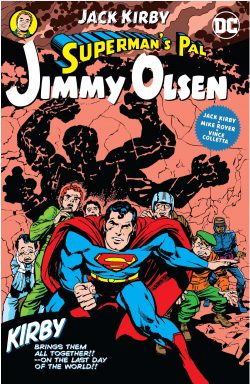
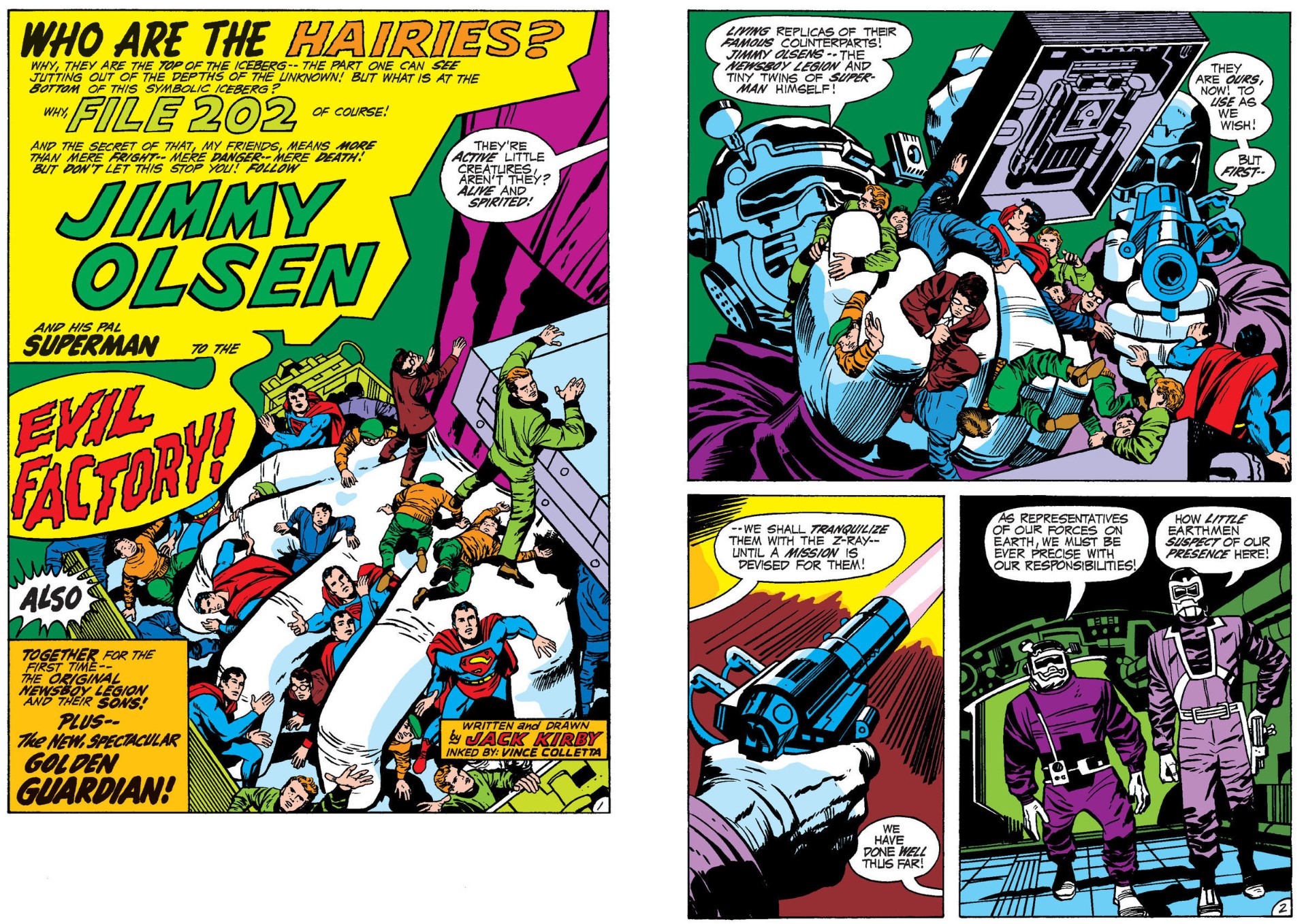
His first name was disclosed in Superman #13 (November-December 1941), having already been revealed as Jimmy Olsen to radio fans as he was a major player in The Adventures of Superman show from its debut on April 15th 1940. As someone the same age as the target audience: on hand for the hero to explain stuff to (all for the listener’s benefit), Jimmy was the closest thing to a sidekick the Action Ace ever needed. He’s remained a sporadic yet amazingly popular one ever since.

When the similarly titled TV show launched in the autumn of 1952, it was again an overnight sensation and National Periodical Publications began cautiously expanding their revitalised franchise with new characters and titles. First to get a promotion to solo-star status was the Daily Planet’s impetuously capable if occasionally conveniently naive “cub reporter”. His addictively charming, light-hearted escapades began in Superman’s Pal Jimmy Olsen #1 (September/October 1954): only one of many spin-off stars in the Caped Kryptonian’s ever-expanding entourage.

Nevertheless, despite characters burgeoning on the pages of Superman’s titles it took three years for cautious Editors to tentatively extend the franchise again. In 1957, just as the Silver Age of Comics was getting underway, try-out title Showcase – which had already launched The Flash in #4 and Challengers of the Unknown in #6 – followed up with two issues entitled Superman’s Girl Friend Lois Lane (#9 & 10). Also conveniently naïve when a story demanded it, the “plucky News-hen” was awarded a series of her own. Technically it was her second, since in the 1940s she had commanded a regular solo-spot in Superman.

In previous reviews I’ve banged on about the patronising, parochial – and to at least some of us – potentially offensive portrayals of kids and most especially women during this period, and although some fairer, more affirmative instances were starting to appear, those warnings still bear repeating. Read with eyes open and social conscience primed please…

At that time, hers was one of precious few titles with a female lead, and, in the context of today, one that causes many 21st century fans understandable qualms of conscience. Within the confines of her series the valiant, capable and determined working woman careered crazily from man-hungry, unscrupulous paranoid bitch through ditzy simpleton to indomitable and brilliant troubleshooter – often all in the same issue. The comic book was clearly intended to appeal to the family demographic that made I Love Lucy a national phenomenon, and many stories were played for laughs in the same patriarchal, parochial manner: a “gosh, aren’t ladies funny?” tone that appals me today – but not as much as the fact that I still love them to bits.

That they’re mostly sublimely illustrated by the wonderfully whimsical Kurt Schaffenberger softens the repeated blows, but really, at my age I should know better…

For the close Superman Family and extended cast the tone of the times dictated a highly strictured code of conduct and parameters: Daily Planet Editor Perry White was a stern, shouty, elder statesman with a heart of gold, Cub Reporter Jimmy was a brave, impulsive, unseasoned fool – with a heart of gold – and Lois was brash, impetuous, unscrupulous and nosy, obsessed with marrying Superman, despite being – deep down – another possessor of an auric aorta. There were also more people with blue or green skin than brown or other human shades, but as I’m trying to plug this book’s virtues I’m just shutting up now.

While I’m at it though, this stunning compilation is another DC Finest editions: full colour extensions of their monochrome Showcase Presents line, delivering “affordably priced, large-size (comic book dimensions generally around 600 pages) paperback collections” highlighting past glories. Sadly, as yet they’re unavailable digitally but we live in hope…

Somehow, even with such byzantine editorial mandates in place the talented writers and artists assigned to detail these wholesomely uncanny exploits crafted tales both beguiling and breathtakingly memorable… and usually as funny as they were thrilling.

By today’s standards, Superman’s Pal Jimmy Olsen wasn’t quite as contentious, but still far too often stories meant to amuse portrayed the bright, bold boy in demeaning if not downright cruel situations and experiencing humiliating physical transformations. Even so, a winning blend of slapstick adventure, action, fantasy and science fiction (in the gentle, insidiously charming manner scripter Otto Binder had perfected 15 years previously at Fawcett Comics on Captain Marvel) made the series one of the most popular of the era. Again, originally most yarns were played for laughs in a father-knows-best manner and tone which can again appal me today, even though I still count them amongst some of my very favourite comics. Confusing, ain’t it?

This cinematically timely, intriguingly chronologically comprehensive compendium collects exploits starring the Man of Steel’s mates and kin (and pets) as first seen in Action Comics #266, 277 & 278, Adventure Comics #287, Superman #142,143 & 147, Superboy #87, 90 & 92, Superman’s Girlfriend, Lois Lane #19-28, and Superman’s Pal Jimmy Olsen #47-56, cumulatively spanning July 1960 to October 1961: a period of infinite wackiness and outrageous absurdity, but heralding the inevitable dawning of a more serious milieu for the Action Ace and those close to him.

This particular series of ethical conundrums commence with ‘The World’s Mightiest Cat!’ by Jerry Siegel & Jim Mooney, as the Supergirl story in back of Action Comics #266 finds her secret identity of foundling Linda Lee endangered by a fellow orphan at Midvale Orphanage who thinks her ginger cat Streaky has super powers…

Our perpetual lady-in-waiting follows in 3 yarns limned by Schaffenberger as Superman’s Girlfriend, Lois Lane #19 (August 1960) opens with Robert Bernstein’s ‘The Day Lois Lane Forgot Superman!’ Here, devoted sister Lucy convinces her perennially heartbroken elder sibling to try hypnosis and get past her destructive obsession. Sadly, when it works, Lois finds time to pester Clark so much he has no time to save the world…

When an accident seemingly catapults Lois into history she becomes enamoured of Samson, a hero with a secret identity and ‘The Superman of the Past!’ This quirky yarn by Binder segues into a new occasional series from Siegel & Schaffenberger. ‘Mr. and Mrs. Clark (Superman) Kent!’ was the first of a poignant tragi-comedy feature depicting the laughter and tears that might result if Lois secretly married the Man of Steel. Although seemingly having achieved her heart’s desire, she is officially only married to dull, safe Clark, and must keep her relationship with Superman secret: unable to brag or show pride and forced to swallow the rage she feels whenever another woman throws herself at the still eligible bachelor hero…

For an artefact of an era uncomfortably dismissive of women, there’s actually genuine heart and understanding in this tale, and a minimum of snide sniping about “silly, empty-headed girls”. Perhaps it was the influence of the tailored-for-adults Superman newspaper strip Siegel was simultaneously scripting leaking into the funnybook line….

Superman’s Pal Jimmy Olsen #47 sees Jimmy in over his head, impersonating escaped convict Winky McCoy and trapped as ‘The King of Crime!’ in a cracking thriller by Bernstein, Curt Swan & John Forte, before the impatiently underage lad transforms into a husky 30-something thanks to another Professor Phineas Potter potion in ‘Jimmy Grows Up!’  Here Binder sagely proves maturity isn’t everything, before Siegel wraps up the issue with a rousing romp as alien producers who previously made horror movies starring Superman & Jimmy return to Earth seeking sequels. It soon transpires that the robot reporter they use to replace Jimmy doesn’t like the prospect of being junked at shooting’s end, and tries to do away with the original in ‘The Monsters from Earth!’

SGLL #20 (October 1960) opens whimsically with ‘Superman’s Flight from Lois Lane’ (Siegel & Schaffenberger), as the Man of Steel escapes into his own past to see if a different life-path might result in a civilian existence unencumbered by “nosy snooping females”. Disc jockey Clark soon learns his inquisitive assistant Liza Landis makes Lois look positively disinterested and gladly ends the experiment, after which ‘The Luckiest Girl in Metropolis!’ (Bernstein & Al Plastino) finds Lois targeted by a Machiavellian mobster seeking to destroy her credibility as a witness, prior to Siegel & Schaffenberger revisiting the Imaginary Mr. & Mrs. scenario with ‘Lois Lane’s Super-Daughter!’ wherein attempts to adopt Linda Lee lead to heartbreak and disaster…

That same month in all-Swan & Forte Jimmy Olsen #48, anonymously scripted ‘The Story of Camp Superman!’ presents heartwarming mystery as the cub works as counsellor to troubled kids – one of whom knows entirely too much about Superman – whilst ‘The Disguises of Danger!’ revisits undercover Jimmy’s acting gifts to get close to a cunning crook. Binder’s ‘The Mystery of the Tiny Supermen!’ sees the Kryptonian Bottled City Kandor’s miniscule Superman Emergency Squad harass Olsen in a devious ploy to prevent his accidentally exposing the Man of Steel’s civilian identity…

All-Schaffenberger Lois Lane #21 delivers a double length epic by author unknown wherein the Anti-Superman Gang utilise explosive toys to endanger the pesky reporter in ‘The Lois Lane Doll!’ It compels the Action Ace to hide her in his Fortress of Solitude, but even that proves insufficient and she finds refuge – and unlikely romance – ‘Trapped in Kandor!’ Siegel then pens a classic yarn of bitter rivalry as the two women most dear to Superman gain incredible abilities and duke it out like men in ‘The Battle Between Super-Lois and Super-Lana!’

SPJO #49 leads with ‘Jimmy’s Gorilla Identity!’ as the luckless lad meets DC stalwart Congo Bill and gets his personality trapped in the hunter’s occasional alter ego – giant golden ape Congorilla. Next, Prof. Potter is blamed for – but entirely innocent of – turning the kid into ‘The Fat Boy of Metropolis!’ in a daft but clever crime caper, prior to Siegel playing with contemporary trends as Jimmy impersonates a rock ‘n’ roll star to impress Lucy Lane in ‘Alias, Chip O’Doole!’…

In Superman #142 (January 1961), Schaffenberger limns Binder’s ‘Lois Lane’s Secret Helper!’ wherein faithful super dog Krypto cunningly plays matchmaker to secure a comfy future for himself, before SGLL #22 – another all Schaffenberger affair – starts with a Red Kryptonite experiment afflicting the Metropolis Marvel with a compulsion to repeatedly pop the question to dubious and suspicious Lois in Siegel’s ‘The Day When Superman Proposed!’

Bernstein’s ‘Lois Lane’s X-Ray Vision!’ sees irradiated sunglasses create a tidal wave of problems for Superman, before making her the ‘Sweetheart of Robin Hood!’ in another time-shift dream seeing the reporter courted by a very familiar-seeming Defender of Truth, Justice and the Nottinghamshire Way…

In SPJO #50, Siegel, Swan & Sheldon Moldoff’s ‘The Lord of Olsen Castle!’ sees Jimmy as potential heir to a Swedish castle and title. All he must do is accomplish a slew of fantastic feats and defeat an ogre, utterly unaware Superman and a host of Kryptonians are secretly pitching in. ‘The Weirdest Asteroid in Space’ (Binder, Swan & Moldoff) then offers a bold monster mystery before another Potter experiment shifts all Superman’s might into his teen pal in ‘The Super-Life of Jimmy Olsen!’ (by an unknown author and illustrated by Plastino).

Superman #143 (February 1961 by Siegel & Forte) celebrates ‘Lois Lane’s Lucky Day!’ as the courageous reporter busts up a crooked carnival with some unsuspected Kryptonian help, before Lois Lane #23 opens with Binder & Schaffenberger’s riotous romp ‘The 10 Feats of Elastic Lass!’  Here our impetuous journalist borrows Jimmy’s stretching serum to track down mad bomber The Wrecker, before debunking ‘The Curse of Lena Thorul!’ (Siegel): exposing a bewitching beauty’s incredible connection to Lex Luthor and leading into another Seigel Imaginary visit to a possible future wherein ‘The Wife of Superman!’ is worn to a frazzle by twin super-toddlers and yearns for her old job at the Daily Planet…

Jimmy Olsen #51 discloses ‘Jimmy Olsen’s 1000th Scoop!’ (Bernstein, Swan & Forte), with the prospective milestone repeatedly delayed by Superman for the best possible reasons, after which a sultry alien takes an unlikely shine to the lad. Unfortunately, ‘The Girl with Green Hair’ (Binder, Swan & Forte) is the result of a scheme by a well-meaning third party to get Lucy to be nicer to Jimmy and it all goes painfully, horribly wrong before ‘The Dream Detective!’ (Swan & Kaye) finds the callow cub inexplicably develop psychometric abilities and unravel mysteries in his sleep…

In Superboy #87, Bernstein & George Papp reveal ‘When Lana Lang First Suspected Clark Kent!’ proving that even when he was a kid, pesky smart girls kept trying to expose his secret identity even as ‘Krypto’s First Romance!’ (Siegel & Papp) finds the star -spanning superdog falling for Kolli – a comely canine shot into space by nasty humanoids on planet Mogar as part of their war preparations. Tragically, Krypto’s brief fling is doomed from the start and he has to make an appalling decision and sacrifice…

‘The Super-Surprise!’ opens Lois Lane #24: an anonymously scripted thriller sending Lois undercover as a platinum blonde, to scupper a plot against Superman, and superbly rendered by Schaffenberger, as is Bernstein’s ‘The Perfect Husband!’, wherein a TV dating show leads Lois into a doomed affair with a he-man hunk almost the spitting image of Clark. Almost…

The issue closes on Bernstein & Forte’s ‘Lois Lane… Traitor!’ with her in the frame for murdering the King of Pahla… until the incredible, unbelievable true culprit comes forward. Also available that month, Superman’s Pal Jimmy Olsen #52 featured Leo Dorfman, Swan & Kaye’s ‘The Specter of the Haunted House!’ as a gang of cunning thieves use supernatural sceptic Olsen as a patsy for a robbery scheme, before ‘The Perils of Jimmy Olsen!’ (Swan & Forte art) sees the laid-up apprentice scribe use a robot double to perform feats of escalating daring… and stupidity. ‘Jimmy Olsen, Wolfman!’ (Siegel, Swan & Kaye) then delivers a welcome sequel to an earlier tale wherein Superman’s Pal is again afflicted by lycanthropy thanks to the pranks of 5th dimensional imp Mr. Mxyzptlk

In Lois Lane #25 Siegel & Schaffenberger’s Imaginary series reaches a bittersweet high point in ‘Lois Lane and Superman, Newlyweds!’ as the severely sidelined spouse convinces hubby to announce their relationship to the world… and faces shocking consequences. The brilliant reporter side is highlighted in Bernstein’s diabolical thriller ‘Lois Lane’s Darkest Secret!’ with the daring investigator risking her life to draw out a mesmeric master criminal before ‘The Three Lives of Lois Lane!’ (uncredited, with Forte illustrating) sees her surviving a car crash, only to be subsumed into the personalities of dead historical figures Florence Nightingale, Betsy Ross and Queen Isabella of Spain. Here, Superman can only stay near and try to limit the damage her episodes create…

SPJO #53 opens with Siegel, Swan & Kaye’s ‘The Boy in the Bottle!’ as Jimmy suffers future shock whilst trapped in Kandor, after which sheer medical mischance results in Siegel, Swan & Forte’s now-legendary saga of ‘The Giant Turtle Man!’ and an oddly casualty-free monster rampage before ‘The Black Magician!’ (unknown writer, Swan & Forte) finds Olsen banished to King Arthur’s court by spiteful Mr. Mxyzptlk. Action Comics #277 then offers a truly delightful Supergirl yarn crafted by Siegel & Mooney. ‘The Battle of the Super-Pets!’ finds Streaky typically envious after she pays attention to shameless ingratiating mutt Krypto. When Superman suggests they compete for her attentions to prove who’s best (no, really!), they select the most unlucky locale of all for their arena…

Superman’s Girlfriend, Lois Lane #26 delivers three more Schaffenberger classics, starting with Siegel’s ‘The Day Superman Married Lana Lang!’  In this imaginary tragedy, the Action Ace finally settles down with his childhood sweetheart, but lives to regret it, whilst ‘Lois Lane’s Childhood!’ (Siegel) reveals how the lives of Kal-El on doomed Krypton and baby Lois on Earth were intertwined by fate and providence, before Bernstein’s ‘The Mad Woman of Metropolis’ closes the comics cavalcade on a stunning high. Here, Lois foils a diabolical plot by criminals to murder Clark and drive her insane, whilst for SPJO #54, Bernstein, Swan & Kaye’s ‘Elastic Lad’s Wrestling Match!’ finds Jimmy incensed after deducing that the grappling game is fixed and fake (shocking, no?).  The outraged fan uses his occasionally empowered alter ego to expose the institutionalised shenanigans, after which he comes into possession of Mr. Mxyzptlk’s magic wishing hat and – through a succession of whacky happenstances – saves Superman as ‘King of the Giant Ants!’ An unrecorded writer then employs Swan & Kaye’s gift for comedy to catalogue the horrors of literal infantilisation after the impetuous boy reporter accidentally transforms himself into ‘Baby Jimmy Olsen!’

Action Comics #278 exposed ‘The Super Powers of Perry White!’ (Jerry Coleman, Swan & Kaye) with the senescent editor suddenly gaining incredible abilities and an inexplicable urge to conquer the world, whilst in Superboy #90 another uncredited script – this time delineated by Papp – shares ‘Pete Ross’ Super-Secret!’ as Clark’s best friend discovers his alien alter ego. SGLL #27 follows, opening with Bernstein & Schaffenberger’s ‘Lois Lane’s Super-Brain!’ When Lois accidentally mutates herself into a creature with a colossal cranium she spends all her time and boosted intellect trying to hide it from Superman, before baffling mystery ‘The Battle of the Sisters!’ (Siegel Swan & Kaye) seemingly sees the Man of Steel ditch Lois for hot, blonde, younger sibling Lucy, prior to Bernstein & Schaffenberger relating ‘The Last Days of Lois Lane!’ as – believing herself fatally irradiated – the dedicated journalist resolves to risk what time she has left scoring the most dangerous scoops ever…

One of the most consistent motifs in fiction is the “Dark Opposite” or “player on the other side”: a complete antithesis of the protagonist often bearing many apparent similarities. Rock yourself to sleep at night if you wish, listing such deadly doppelgangers from Professor Moriarty to Gladstone Gander

“Imperfect” Superman duplicate Bizarro either debuted as a misunderstood freak/unwilling monster in Binder & Papp’s captivatingly tragic ‘The Battle with Bizarro’ (Superboy #68, October 1958 and not included here) or in the similarly titled Superman newspaper strip sequence written by Alvin Schwartz (episode 105, pages #6147-6242, spanning August 25th -December 13th 1958), with the latter scribe claiming he’d thought up the idea months earlier. The newsprint version was certainly first to employ those eccentric reversed-logic thought-patterns and idiomatic speech impediment…

Although later played primarily for laughs, such as in his tenure in Tales of The Bizarro World (Adventure Comics #285-299 June 1961 – August 1962), most early comic book appearances of the dippy double were generally moving, child-appropriate tragedies, unlike here – Adventure Comics #287 – as ‘Jimmy Olsen’s Kookie Scoops!’ reveal the backwards-living artificial beings kidnapping him to run their newspaper on their square planet Htrae…

Next ‘Krypto Battles Titano’ (Superman #147, by Siegel & Plastino) after the Dog of Steel voyages back to the Age of Dinosaurs to romp, inadvertently saving humanity from alien invasion beside the Kryptonite-mutated giant ape. Then, SPJO #55 and Plastino plus unknown author introduce ‘The Monster That Loved Aqua-Jimmy!’ The odd coupling occurs after Olsen gains the powers of Aquaman and stands (swims?) in for him in the world’s oceans. The rest of the issue offers tales from Bernstein, Swan & Kaye, beginning withJimmy the Red, Thor’s Best Pal!’ wherein a magic tablet hurls the lucky lad back to ancient Scandinavia to befriend the god of thunder and help defeat Loki, after which ‘Jimmy Olsen’s Secret Power!’ exposes seeming betrayal as a strange new talent literally repels his best pal…

Pausing women’s business for now, Superman’s Girlfriend, Lois Lane #28 begins with ‘The Lois Lane of the Future!’ as Siegel & Forte supervise the Man of Tomorrow being banished to the far future by Lex Luthor. There he meets – and is incredibly annoyed by – super-powered possible descendent Lois 4XR until he finds his way home, prior to Schaffenberger & Siegel’s ‘Lois Lane’s Super-Lesson!’ with Superman secretly aiding billionaire Rajah Bandhi win her hand in marriage after she cruelly scorns and spurns him (!!) and concluding with Bill Finger & Schaffenberger’s ‘Lois Lane, Gun Moll!’ as another Luthor scheme apparently turns her into the most vicious criminal in Metropolis…

Cover-dated October 1961, Superman’s Pal Jimmy Olsen #56 leads with Imaginary Story ‘The Son of Jimmy Olsen!’ by Siegel & Schaffenberger, as Superman & Lois’ daughter elopes with the rash child of Jimmy & Lucy, culminating in catastrophic consequences. It’s followed by a return to consensual Continuity and Siegel & Forte’s mystery tale ‘The Jinx of Metropolis!’ as Jimmy suddenly becomes sudden death to anything metallic. This ushers us into Bernstein & Plastino’s Hollywood glamour-soaked yarn ‘Jimmy Olsen’s Sweethearts’, wherein Lucy is outraged – and utterly baffled – to find Jimmy apparently two-timing her with every starlet in Tinseltown. Of course, all is not what it seems…

This monumental memento to simpler, weirder times concludes with a shaggy dog tale from Superboy #92, where Coleman & Papp debuted ‘Krypto’s Arch-Enemy!’ after teenaged Lex Luthor’s canine companion Destructo stumbles into a lab experiment and gains superpowers. Obviously, the Bad Boy (and his mighty dog) seek to settle old scores, but happily Krypto is too smart for them…

As well as containing some of the most delightful episodes of the pre-angst, cosmically catastrophic DC, these fun, thrilling, deeply peculiar and, yes, occasionally offensive tales perfectly capture the changing tone and tastes reshaping comics moving from the smug, safe 1950s to the seditious, rebellious 1960s, all the while keeping to the prime directive of the industry: “keep them entertained and keep them wanting more.”

Despite all the well-intentioned quibbles from my high horse here in the 21st century, I think these stories still have a huge amount to offer funnybook fun-seekers and strongly urge you to check them out for yourselves. You won’t be sorry…
© 1960, 1961, 2025 DC Comics. All Rights Reserved.

Thunderbolts Epic Collection volume 1: Justice, Like Lightning (1997-1998)


By Kurt Busiek, Roger Stern, Peter David, John Ostrander, Mark Bagley, Mark Deodato Jr., Sal Buscema, Steve Epting, Jeff Johnson, Pasqual Ferry, Bob McLeod, Tom Grummett, Ron Randall, Gene Colan, Darick Robertson, George Pérez, Chris Marrinan, Ron Frenz & various (MARVEL)
ISBN: 978-1-3029-5205-1 (TPB/Digital edition)

This book includes Discriminatory Content produced in less enlightened times.

It’s going to be a busy year for comics-based movies, so let’s properly start the ball rolling with some context and a look at a Thunderbolts team definitely not coming anywhere close to a cinema near you soon…

At the end of 1996, Marvel’s Onslaught publishing event removed the Fantastic Four, Captain America, Iron Man and the Avengers from the Marvel Universe and its long-established shared continuity. The House of Ideas ceded creative control to Rob Liefeld and Jim Lee for a year and at first the iconoclastic Image style comics got all the attention. However, a new title created to fill the gap in the “old” universe proved to be the true star sensation of the period. Thunderbolts was initially promoted as a replacement team book: brand new, untried heroes pitching in because the beloved big guns were dead and gone. Chronologically, they debuted in Incredible Hulk # 449 (cover-dated January 1997), a standard exhibition of “heroes-stomp-monster”, but the seemingly mediocre tale is perhaps excusable in retrospect…

With judicious teaser guest-shots abounding, Thunderbolts #1 premiered with an April cover-date and was an instant mega-hit, with a second print and rapid-reprint collection of the first two issues also selling out in days. This classy compendium gathers all those early appearances of the neophyte team between from January 1997 to March 1998: introductory teaser tale in Incredible Hulk #449 and parts of 450; Thunderbolts #1-12, Thunderbolts: Distant Rumblings #-1 special, Annual ‘97, plus their portion of Tales of the Marvel Universe, Spider-Man Team-Up Featuring… #7 and Heroes for Hire #7. Sadly although the stories are still immensely enjoyable this book simply won’t be able to recapture the furore the series caused in its early periodical days, because Thunderbolts was a sneakily high-concept series with a big twist: one which – almost unprecedentedly for comics – didn’t get spilled before the carefully calculated “big reveal”.

Here the action starts with issue #1 (cover-dated April 1997) and ‘Justice… Like Lightning’ as Kurt Busiek, Mark Bagley & Vince Russell introduce a new superhero team to a world which has lost its champions. The mysterious Thunderbolts begin to clear New York’s devastated, post-Onslaught streets of resurgent supervillains and thugs making the most of the hero-free environment. Amongst their triumphs is the resounding defeat of scavenger gang The Rat Pack, but although the looters are routed and rounded up, their leader escapes with his real prize: homeless children…

Golden Age Captain America tribute/knock off Citizen V leads these valiant newcomers – size-shifting Atlas, super-armoured Mach-1, beam-throwing amazon Meteorite, sonic siren Songbird and human toybox Techno – and the terrified, traumatised citizenry instantly take them to their hearts. But these heroes share a huge secret: they’re all supervillains from the sinister Masters of Evil in disguise, and Citizen V – or Baron Helmut Zemo as he truly prefers – has major Machiavellian long-term plans…

When unsuspecting readers got to the end of that first story the reaction was instantaneous shock and jubilation.

Anachronistically, the aforementioned Hulk teaser tale (cover-dated January 1997, but on sale at the end of 1996) appears next, as Peter David, Mike Deodato Jr. & Tom Wegrzyn pit a neophyte super-team against the Jade Juggernaut in ‘Introducing the Thunderbolts!’: the opening step of their campaign to win the hearts and minds of the World. That clash spilled over into the next issue and the pertinent section is also included here, promptly followed by Tales of the Marvel Universe tale ‘The Dawn of a New Age of Heroes!’ as the team continue doing good deeds for bad reasons, readily winning the approval of cynical New Yorkers.

Thunderbolts #2 (May 1997 by Busiek, Bagley & Russell) offers ‘Deceiving Appearances’ as they garner official recognition and their first tangible reward. After defeating The Mad Thinker at an FF/Avengers memorial service and rescuing “orphan” Franklin Richards, the Mayor hands over the FF’s Baxter Building HQ for the T-Bolts’ new base of operations…

Busiek, Sal Buscema & Dick Giordano’s Spider-Man Team-Up Featuring… #7 yarn ‘Old Scores’ sees them even fool the spider-senses of everybody’s favourite wallcrawler whilst clearing him of a fiendish frame-up and taking down the super-scientific Enclave. However the first cracks in the plan begin to appear as Mach-1 and Songbird (AKA The Beetle and Screaming Mimi) begin falling for each other and dare to dream of a better life, even as Atlas/ Goliath starts to enjoy the delights and rewards of actually doing good deeds.

… And whilst Techno (The Fixer) is content to follow orders for the moment, Meteorite – or Moonstone – is laying plans to further her own personal agenda…

Thunderbolts #3 finds the team facing ‘Too Many Masters’ (Bagley & Russell art) as dissension creeps into the ranks. The action comes from rounding up old allies and potential rivals Klaw, Flying Tiger, Cyclone, Man-Killer and Tiger-Shark, who were arrogant enough to trade on the un-earned reputation as new Masters of Evil.

One of the abducted kids in Thunderbolts #1 resurfaces in #4’s ‘A Shock to the System’. Hallie Takahama was taken by the Rat Pack, and her new owner has since subjected her to assorted procedures which resulted in her gaining superpowers. Her subsequent escape leads to her joining the Thunderbolts as they invade Dr. Doom’s apparently vacant castle to save the other captives from the monstrous creations and scientific depredations of rogue geneticist Arnim Zola. However, the highly publicised victory forces Citizen V to grudgingly accept the utterly oblivious and innocent Hallie onto the team as trainee recruit Jolt

Thunderbolts Annual 1997 follows: a massive revelatory jam session written by Busiek with art from Bagley, Bob McLeod, Tom Grummett, Ron Randall, Gene Colan, Darick Robertson, George Pérez, Chris Marrinan, Al Milgrom, Will Blyberg, Scott Koblish, Jim Sanders, Tom Palmer, Bruce Patterson, Karl Kesel & Andrew Pepoy, which could only be called ‘The Origin of the Thunderbolts!’ In brief instalments Jolt asks ‘Awkward Questions’ of V and Zemo offers a tissue of lies regarding the member’s individual origins…

Beginning with V’s ostensible intentions in ‘The Search Begins’, gaining ‘Technical Support’ from Fixer, examining Songbird’s past in  ‘Screams of Anguish’, obscuring the Beetle’s ‘Shell-Shocked!’ transformation and revealing how ‘Onslaught’ brought them all together, the fabrications continue as ‘To Defy a Kosmos’ discloses to everyone but Jolt how ionic colossus Goliath was snatched from incarceration in another dimension before ‘Showdown at the Vault’ brought Moonstone into the mix with untrustworthy and dangerous men she had previously betrayed…

The revelatory events also includes the Annual’s Thunderbolts Fact File text feature.

Thunderbolts: Distant Rumblings #-1 (July 1997) was part of a company-wide event detailing the lives of heroes and villains before they started their costumed careers. Illustrated by Steve Epting & Bob Wiacek, ‘Distant Rumblings!’, examines key events in the lives of two Baron Zemos, mercenary Erik (Atlas) Josten, corrupt psychiatrist Karla (Moonstone) Sofen, trailer-trash kid and future Songbird Melissa Gold, frustrated engineer Abner Jenkins AKA Beetle and gadgeteering psychopath P. Norbert Ebersol, who parleyed a clash with an amnesiac Sub-Mariner into a thrilling life as Hydra’s prime technician and Fixer…

Back in the now, Thunderbolts #5 delivers more ‘Growing Pains’ as the team take a personal day as civvies in Manhattan, only to be targeted and attacked by Baron Strucker of Hydra, employing one of Kang the Conqueror’s Growing Man AI automatons…

By this stage the grand plan was truly unravelling and in #6 ‘Unstable Elements’ sees Citizen V/Zemo incensed that his team still don’t have the security clearances the Avengers and FF used to enjoy. Unable to further his plans without them, he tidies up details, seeking to quash a budding romance between Atlas and their Mayor’s Liaison/former cop Dallas Riordan whilst “suggesting” Meteorite might arrange an accident for increasing prying, questioning and just plain annoying Jolt…

Opportunity arises and tensions escalate when a sentient and malign periodic table of elemental beings attack New York. Requesting help, the Mayor’s office is refused and rebuffed by Citizen V before his own minions reject him and rush off to save lives beside the city’s remaining superheroes such as Daredevil, Power Man & Iron Fist, Darkhawk and the New Warriors. ‘The Revolt Within’ (Busiek & Roger Stern, limned by Jeff Johnson, Will Blyberg, Eric Cannon, Larry Mahlstadt, Greg Adams & Keith Williams) signals the beginning of the end as the rebel Thunderbolts are quickly captured by the “Elements of Doom” and Zemo refuses to save them, leaving ‘Songbird: Alone!’ to save the day in #8 (Busiek, Stern, Bagley & Russell). Although Zemo manages to finagle his way back into the ’Bolts’ good books, he has what he wants: access to all the world’s secrets after SHIELD chief G.W. Bridge grants him top security clearance…

A brief diversion follows in Heroes for Hire #7 (January 1998 by John Ostrander, Pasqual Ferry & Jaime Mendoza) as the troubled team stumble into an ongoing clash between Luke Cage, Iron Fist, Black Knight and Ant-Man, The Eternals and assorted monstrous Deviants, before ‘The Thunderbolts Take Over!’, uniting with the HFH squad to save the shrinking man’s daughter Cassie Lang from a Super-Adaptoid. In Thunderbolts #9 (Busiek, Bagley & Russell) the Black Widow comes calling with advice and ‘Life Lessons’ for Songbird and Mach-1, delivered as an untold tale of “Cap’s Kookie Quartet” – Captain America, Hawkeye, Quicksilver and the Scarlet Witch – and related via a flashback crafted by Stern, Ron Frenz, Blyberg & Milgrom, before the main event commences…

After more than a year away, company publishing event Heroes Reborn/Heroes Return restored the martyrs believed killed by Onslaught to the Marvel Universe. That happy miracle sparked a new beginning for The FF and Avengers’ stars and titles and began in an extended epic covering Thunderbolts #10-12: scripted as ever by Busiek and illustrated by Bagley, Russell, Scott Hanna, Larry Mahlstadt & Greg Adams.

It opens with ‘Heroes Reward’ as whilst the Thunderbolts are being officially honoured, their greatest enemies – real superheroes – start reappearing. When G.W. Bridge raids the press briefing, having divined that Citizen V is wanted criminal Helmut Zemo, suddenly the aspiring (semi) reformed squad are fugitives all over again, hunted by every real hero in town…

Fleeing into space and occupying an abandoned AIM space station, the Thunderbolts finally learn what Zemo’s been after all along in ‘The High Ground’ and face a shattering decision to go along or pursue new redeemed lives. However, as the former allies deliberate, prevaricate, and inevitably clash, the choice becomes even harder as the base is invaded by an army of extremely angry Superheroes, including Avengers, Fantastic Four and every recent ally they so callously fooled…

It all concludes in ‘Endgame’, but not the way anyone anticipates, especially once Zemo mind controls and enslaves all the incoming champions before turning them on his outraged dupes. The conclusion is spectacular and rewarding but only promises more and better to come…

Bonus features here include a full gallery of covers and variants – including second printings and the many collected editions the series spawned in its first year – by Bagley & Russell, Deodato Jr., Carlos Pacheco & Scott Koblish, Steve Lightle, Sott Hanna, original art, a golden Age ad for the original Citizen V, promotional pieces, retailer solicitation art, text essays and introductions from earlier editions as well as 12 pages of Bagley’s character designs tracing the metamorphosis from second-string villains into first rung heroes, and even faux ads. Also included are articles from in-house promotional magazine Marvel Vision #13, 14, 18, 19 & 27 providing context and behind the scenes insights for fans who just couldn’t get enough.

This is a solid superhero romp that managed to briefly revitalise a lot of jaded old fan-boys, but more importantly this remains a strong set of tales that still pushes all the buttons it’s meant to nearly 3 decades after all the hoopla has faded. Well worth a moment of your time and a bit of your hard-earned cash. Be warned though, if you’re reading this because of the new movie, these ARE NOT Your Thunderbolts
© 2023 MARVEL.

Fantastic Four Marvel Masterworks volume 18


By Marv Wolfman, Len Wein, Roger Slifer, Keith Pollard, Bill Mantlo, George Pérez, John Buscema, Bob Hall, Sal Buscema, Joe Sinnott, Dave Hunt, Pablo Marcos, Bob Wiacek, Marie Severin & various (MARVEL)
ISBN: 978-1-3029-0009-0 (HB/Digital edition)

This book includes Discriminatory Content produced in less enlightened times.

As Marvel’s cinematic arm tries once again to get it right with their founding concept, expect to see a selection of fabulous FF material here culled from their prodigious paginated days…

For Marvel everything started with The Fantastic Four.

Monolithic modern Marvel truly began with the eccentric monsyer ‘n’ alien filled adventures of a compact superteam as much squabbling family as coolly capable costumed champions. Everything the company and brand is now stems from that quirky quartet and the inspired, inspirational, groundbreaking efforts of Stan Lee & Jack Kirby…

Cautiously bi-monthly and cover-dated November 1961, Fantastic Four #1 – by Stan, Jack, George Klein & Christopher Rule – was raw and crude even by the ailing outfit’s standards; but it seethed with rough, passionate, uncontrolled excitement. Thrill-hungry kids pounced on its dynamic storytelling and caught a wave of change beginning to build in America. It and every succeeding issue changed comics a little bit more… and forever. As seen in the premier issue, maverick scientist Reed Richards, his fiancée Sue Storm, their close friend Ben Grimm and Sue’s bratty teenaged brother survived an ill-starred private spaceshot after cosmic rays penetrated their ship’s inadequate shielding.

All four permanently mutated: Richards’ body became elastic, diffident Sue became (even more) invisible, Johnny Storm burst into living flame and tragic Ben shockingly devolved into a shambling, rocky freak. After the initial revulsion and trauma passed, they solemnly agreed to use their abilities to benefit mankind. Thus was born The Fantastic Four.

Throughout the 1960s it was indisputably the key title and most consistently groundbreaking series of Marvel’s ever-unfolding web of cosmic creation: a forge for new concepts and characters. Kirby was approaching his creative peak: unleashing his vast imagination on plot after spectacular plot, and intense, incredible new characters whilst Lee scripted some of the most passionate superhero sagas ever seen. Both were on an unstoppable roll, at the height of their powers and full of the confidence only success brings, with The King particularly eager to see how far the genre and the medium could be pushed… which is rather ironic since it was the company’s reticence to give the artist more creative freedom that led to Kirby’s moving to National/DC in the 1970s.

Without Kirby’s soaring imagination the rollercoaster of mindbending High Concepts gave way to more traditional tales of characters in conflict, with soap opera leanings and supervillain-dominated Fights ‘n’ Tights dramas. With Lee & Kirby long gone but their mark very much still stamped onto every page of the still-prestigious title, this full-colour luxury compendium collects Fantastic Four #192-203 and Annuals #12-13, spanning March 1978 to February 1979.

What You Should Know: After facing his own Counter Earth counterpart Reed Richards lost his stretching powers. With menaces like Salem’s Seven, Klaw and Molecule Man still coming for him and his family, weary and devoid of solutions, Richards made the only logical decision and called it a day for the team…

Following Introduction ‘The Fantastics’ by then-incoming scribe Marv Wolfman, a new direction closely referencig the good ol’ days begins with #192 and ‘He Who Soweth the Wind…!’ by Wolfman, George Pérez & Joe Sinnott, as Johnny heads west to revisit his childhood dream of being a race car driver and unexpectedly meets old pal Wyatt Wingfoot.

Back East, Ben and girlfriend Alicia Masters ponder their options as Reed gets a pretty spectacular job offer from a mystery backer, even as Johnny’s race career is upended when superpowered mercenary Texas Twister attacks at the behest of a sinister but unspecified employer with a grudge to settle…

The admittedly half-hearted assault fails but when Ben offers his services to NASA a pattern begins to emerge when he and Alicia are ambushed by old foe Darkoth in ‘Day of the Death-Demon!’ (plotted by Len Wein & Keith Pollard, scripted by Bill Mantlo, and illustrated by Pollard & Sinnott). The cyborg terror is determined to destroy an experimental solar shuttle, but doesn’t really know why, and as Ben ponders the inexplicable incident, in Hollywood, Susan Storm-Richards’ return to acting is inadvetantly paused when shapeshifting loon Impossible Man pays a visit. The delay gives Sue a little time to consider just how she got such a prestigious dream-fulfilling offer completely out of the blue…

Back at NASA, when Darkoth strikes again his silent patrner is exposed as scheming alchemist Diablo, whilst in upstae New York, Reed slowly discovers his dreams of umlimited research time and facilities is nothing like he imagined…

Finally, launch day comes and The Ting pilots the Solar Shuttle into space, only to have it catastrophically crash in the desert…

Joined by additional inker Dave Hunt, the creative pinch-hitters conclude the saga in ‘Vengeance is Mine!’ as Ben survives impact and searing sandstorms, tracks down his foes and delivers a crushing defeat to Diablo and Darkoth. In FF #195 Sue learns who sponsored her revived Hollywood ambitions when Prince Namor, The Sub-Mariner renews his amorous pursuit of her. Embittered and lonely, he has fully forsaken Atlantis and the overwhelming demands of his people and the state, but they have not done with him and despatch robotic warriors to drag him back to his eternal duties in ‘Beware the Ravaging Retrievers!’ (Wolfman, Pollard & Pablo Marcos). Like everybody else, the metal myrmidons have utterly underestimated the Invisible Girl and pay the price, allowing the once-&-future prince to reassess his position and make a momentous decision…

As Johnny links up with Ben and Alicia, the strands of a complex scheme begin to appear and in #196 gel for self-decieving Reed Richards as ‘Who in the World is the Invincible Man?’ (Wolfman, Pollard & Marcos) depicts the enigmatic Man with the Plan secretly subjecting Reed to the mindbensding powers of the Pyscho-Man, just as Sue rejoins Ben and Johnny in New York City before being impossibly ambushed by former FF foe The Invincible Man.

This time the man under the hood is not her father, but someone she loves even more…

Reunited with Reed, the horrified heroes are confronted by their greatest, most implacable enemy (it’s not a spoiler as he’s right there on the cover of this book…) and the complicated plot to restore Reed’s powers finally unfolds. Victor Von Doom wants revenge but refuses to triumph over a diminished foe, but his efforts to re-expose Richards to cosmic rays is secretly hijacked by a rival madman in ‘The Riotous Return of the Red Ghost!’ (Wolfman, Pollard & Sinnott). Of course there’s more at stake, as Doom seeks to legitimise his rule through a proxy son: planning to abodicate in his favour and have junior take Latveria into the UN and inevitably to the forefront of nations…

Fully restored and invigorated, Mister Fantastic defeats the equally resurgent Red Ghost before linking up with Nick Fury (senior) and S.H.I.E.L.D., and leading an ‘Invasion!’ of Doom’s kingdom. Beside Latverian freedom fighter and legal heir to the throne Prince Zorba Fortunov, Richards storms into Doomstadt, defeating all in his path, foiling the secondary scheme of imbuing the ‘The Son of Doctor Doom!’ with the powers of the (now) entire Fantastic Four and exposing the incredible secret of Victor von Doom II

Months of deft planning (from Wolfman, Pollard & Sinnott) culminate in an epic confrontation ‘When Titans Clash!’, Doom and Richards indulge in their ultimate battle (thus far), with the result that the villain is destroyed and the kingdom liberated. For now…

The post-Doom era opens in FF #201 (December 1978) as the celebrated and honored foursome return to America and take possession of empty former HQ the Baxter Building. Unfortunately so does something else, attacking the family through their own electronic installations and turning the towering “des res” into ‘Home Sweet Deadly Home!’: a mystery solved in the next isue when it subsequently seizes control of Tony Stark’s armour to attack the FF again in ‘There’s One Iron Man Too Many!’ with John Buscema filling in for penciller Pollard.

The monthly mayhem pauses after #203’s ‘…And a Child Shall Slay Them!’ wherein Wolfman, Pollard & Sinnott reveal the incredible powers possessed by dying cosmic ray-mutated child Willie Evans Jr. When the foremost authority on the phenomenon is called in to consult, Dr. Reed Richards and his associates – and all of Manhattan – face savage duplicates of themselves manifested from FF fan Willie’s fevered imagination…

Although the regular fun stops here, two chronologically adrift King Size specials finish up the thrill-fest, beginning with Fantastic Four Annual #12’s ‘The End of the Inhumans… and the Fantastic Four’ by Wolfman, Bob Hall, Pollard, Bob Wiacek & Marie Severin. When Johnny’s former flame Crystal – and gigantic Good Boi Lockjaw – teleport in seeking aid in finding the abducted Inhuman Royal Family, the team battle ruthless Inhuman supremacist Thraxon the Schemer before exposing that megalomaniac’s secret master: the immortal unconquerable Sphinx. Despite his god-like, the united force of the FF plus Blackbolt, Medusa, Gorgon, Triton, Crystal and ex-Avenger Quicksilver proves sufficient to temporarily defeat their foe… or does it?

A year later, Annual #13 offered a more intimate and human tale from Mantlo, Sal Buscema & Sinnott as ‘Nightlife’ revealed how New York’s lost underclass was systematically being disappeared from the hovels and streets they frequented. With guest appearances from Daredevil and witch queen Agatha Harkness, the tale reveals a softer side to the FF’s oldest enemy and a return to addressing social issues for the team.

To Be Continued…

With covers by Pérez, Sinnott, Frank Giacoia, Pollard, Marcos John Buscema, Steve Leiloha and Kirby, this power-packed package also includes a wealth of original art pages and sketches from Dave Cockrum, Kirby & Sinnott, Pollard, Marcos, Hunt, and enthralling house ads of the period.

Although the “World’s Greatest Comics Magazine” never quite returned to the stratospheric heights of the Kirby era, this collection offers an appreciative and tantalising taste-echo of those heady heights. These extremely capable efforts are probably most welcome to dedicated superhero fans and continuity freaks like me, but will still thrill and delight the generous and forgiving casual browser looking for an undemanding slice of graphic narrative excitement – especially if this time theupcoming movie delivers on its promise…
© 2016 Marvel Characters, Inc. All rights reserved.

DC Finest: Green Lantern – The Defeat of Green Lantern


By Gardner F. Fox, John Broome, Bob Haney, Gil Kane, Carmine Infantino, Ramona Fradon & Charles Paris, Murphy Anderson, Joe Giella, Frank Giacoia, Sid Greene & various (DC Comics)
ISBN: 978-1-77952-848-3 (TPB)

This book includes Discriminatory Content produced in less enlightened times

This stunning compilation is another of the initial batch of DC Finest editions: full colour extentions of their chronolgically curated monochrome Showcase Presents line, delivering “affordably priced, large-size (comic book dimensions and generally around 600 pages) paperback collections” highlighting past glories.Whilst primarily and understandably concentrating on the superhero character pantheon, there will also be genre selections like horror and war books, and themed compendia.

Sadly, they’re not yet available digitally, as were the last decade’s Bronze, Silver & Golden Age collections, but we live in hope…

After a hugely successful revival and reworking of Golden Age all star The Flash, DC (National Periodical Publications as they were then) built on a resurgent superhero trend. Cover dated October 1959 and on sale from July 28th, Showcase #22 hit newsstands at the same time as the fourth issue of the new Flash comic book (#108) and once again the guiding lights were Editor Julie Schwartz and writer John Broome. Assigned as illustrator was action ace Gil Kane, generally inked by Joe Giella.

Hal Jordan was a brash and cocky young test pilot in California when an alien policeman crashed his spaceship on Earth. Mortally wounded, Abin Sur commanded his ring – a device which could materialise thoughts – to find a replacement officer: one both honest and without fear. Scanning the planet, the wonder weapon selected Jordan, whisking him to the crash-site. The dying alien bequeathed his ring, the lantern-shaped Battery of Power and his profession to the astonished Earthman.

In 6 pages ‘S.O.S Green Lantern!’ established characters, scenario and narrative thrust of a series that would become the spine of all DC continuity. With the concept of the superhero being re-established among the buying public, there was no shortage of gaudily clad competition. The better books thrived by having something a little “extra”. With Green Lantern that was primarily the superb scripts of John Broome & Gardner Fox and astounding ever-evolving drawing of Gil Kane (ably abetted by a string of top inkers) whose dynamic anatomy and dramatic action scenes were maturing with every page he drew. Happily, the concept itself was also a provider of boundless opportunity.

Other heroes had extraterrestrial, other-dimensional and even trans-temporal adventures, but the valiant champion of this series was also a cop: a lawman working for the biggest police force in the entire universe.

This fabulous compilation gathers Green Lantern #19-39 (March 1963 – September1965) plus his guest shots in The Flash #143 and The Brave and the Bold #59, and opens with a return match for sound-weaponising radical Modoran ultranationalist Sonar in ‘The Defeat of Green Lantern!’ (Broome, Kane & Joe Giella): a high-energy super-powered duel neatly counterpointed by whimsical crime-caper ‘The Trail of the Horse-and-Buggy Bandits!’ by the same team, wherein a little old lady’s crossed phone line led the Emerald Gladiator into conflict with a passel of crafty crooks. Issue #20’s ‘Parasite Planet Peril!’ (Broome, Kane & Murphy Anderson) then triumphantly reunites GL with new best buddy The Flash in a full-length epic to foil a plot to kidnap human geniuses.

One of the DCU’s greatest menaces debuted in #21’s ‘The Man Who Mastered Magnetism’. Broome created a worldbeater in dual-personality villain Doctor Polaris for Kane & Giella to limn, whilst ‘Hal Jordan Betrays Green Lantern!’ is the kind of action-packed, devilishly baffling puzzle-yarn ex-lawyer Fox excelled at, especially with Anderson’s stellar inks to lift the art to a delightful high. Fox also scripted the encore of diabolical futurist villain Hector Hammond in ‘Master of the Power Ring!’ (Giella inks) before Broome turned his hand to a human-interest story in the Anderson-inked ‘Dual Masquerade of the Jordan Brothers!’ Here, Hal plays mischievous matchmaker, trying to convince his future sister-in-law that her intended is in fact Green Lantern!

These costumed drama romps are in themselves a great read for most ages, but when also considered as the building blocks of all DC continuity they become vital fare for any fan keen to make sense of the modern superhero experience. In #23 our hero tackles the ‘Threat of the Tattooed Man!’ in the first all Fox scripted issue and the start of Giella’s tenure as sole inker, as the Ring-Slinger tackles a second-rate thief who lucks into the eerie power to animate his skin-ink, after which ‘The Green Lantern Disasters’ take the interplanetary lawman offworld to rescue missing comrade Xax of Xaos: an insectoid member of the GL Corps. Broome scripted #24, heralding the first appearance of ‘The Shark that Hunted Human Prey!’ after an atomic accident hyper-evolves the ocean’s deadliest predator into a psychic fear-feeder, whilst ‘The Strange World Named Green Lantern!’ (inks by Frank Giacoia & Giella) finds the Emerald Gladiator trapped on a sentient lonely planet craving his constant presence…

GL #25 featured Fox’s full-length thriller. ‘War of the Weapon Wizards!’ sees GL fall foul of lethally persistent Sonar and his silent partner-in-crime Hector Hammond, whilst in the next issue Hal’s girlfriend Carol Ferris is again transformed into a man-hating space queen determined to beat him into marital submission in ‘Star Sapphire Unmasks Green Lantern!’ This wry and witty cracker by Fox is supplemented by his superb fantasy ‘World Within the Power Ring!’ wherein the Viridian Avenger battles an extraterrestrial sorcerer imprisoned inside his ring by deceased predecessor Abin Sur…

Fox’s super-science crime thriller ‘Mystery of the Deserted City!’ led in GL #27, before Broome charmed and alarmed with ‘The Amazing Transformation of Horace Tolliver!’, as Hal learns a lesson in who to help – and how. An appearance in The Flash #143 (March 1964 by Fox, Carmine Infantino & Giella) delivered another full-length team-up with for ‘Trail of the False Green Lanterns!’ as a bizarre string of multiple manifestations lead the baffled heroes to a new nemesis – future-gazing mad scientist Thomas Oscar Morrow.

There’s no prize for guessing who – or what – menace returns in #28’s ‘The Shark Goes on the Prowl Again!’, but kudos all round if you can solve the enigma of ‘The House that Fought Green Lantern!’: both engaging romps courtesy of writer Fox, whereas Broome adds to his tally of memorable creations with the debut of “Cliché Criminal” Black Hand – who purloins a portion of GL’s power in ‘Half a Green Lantern is Better than None!’, as well as penning a brilliant back-up alien invader tale in ‘This World is Mine!’

This issue, #29, is doubly memorable as not only does it feature a rare – for the times – Justice League cameo (soon to be inevitable – if not interminable – as comics continuity grew into an unstoppable force in all companies’ output) but also because the incredibly talented Sid Greene signed on as regular inker.

Issue #30 offered two more Broome tales: dinosaur attack thriller ‘The Tunnel Through Time!’ and a compelling epic of duty and love as Katma Tui – who replaced the renegade GL Sinestro as the Guardians’ operative – learns to her eternal regret ‘Once a Green Lantern… Always a Green Lantern!’ The same writer provided baffling mystery ‘Power Rings for Sale!’ and tense Jordan Brothers thriller ‘Pay Up – or Blow Up!’ whilst Fox handled all of #32: tantalizing crime caper ‘Green Lantern’s Wedding Day!’ and transgalactic Battle Royale ‘Power Battery Peril!’, in which Jordan comes to the initially involuntary assistance of an alien superhero team…

Nefarious villain Dr. Light opted to pick off his enemies one by one after his debut defeat in Justice League of America #12, and his follow-up attempts in various member’s home titles reached GL with #33, but here too he gets a damned good thrashing in ‘Wizard of the Light Wave Weapons!’, whereas thugs in the back-up yarn, as well as giving artist Gil Kane another excuse to show his love of and facility with movie gangster caricatures, come far too close to ending the Emerald Gladiator’s life in ‘The Disarming of Green Lantern!’

Fox had by this time become lead writer. ‘Three-Way Attack against Green Lantern!’ in #34 was another extended cosmic extravaganza as Hector Hammond learns the secrets of the Guardians of the Universe and launches an all-out assault on our hero, after which both scripts in #35 – costumed villain drama ‘Prisoner of the Golden Mask!’ and brain-swop spy-saga ‘The Eagle Crusader of Earth!’ – look much closer to home for their abundance of thrills, chills and spills.

Next up is a guest shot with resurgent star Batman from The Brave and the Bold #59 (April/May 1965) which became the prototype of that title’s next 20 years. Scripted by Bob Haney and illustrated by Ramona Fradon & Charles Paris it saw Gotham Gangbuster and Emerald Crusader reliving the The Count of Monte Cristo as they sought to foil ‘The Tick-Tock Traps of the Time Commander!’ after devious criminal scientist John Starr tricked Bruce Wayne into clearing his name. The liberated rogue then stole the green energy to fuel a chronal assault on Gotham but had severely underestimated his foes’ resilience and ingenuity.

Firmly established as a major star of the company firmament, Green Lantern increasingly became the series to provide conceptual highpoints and “big picture” foundations. These, successive creators would use to build the tight-knit history and continuity of the DC universe. At this time there was also a turning away from the simple imaginative wonder of a ring that could do anything in favour of a hero who increasingly ignored easy solutions in preference to employing his mighty fists. What a happy coincidence then, that at this time Gil Kane was reaching an artistic peak, his dynamic full-body anatomical triumphs bursting with energy and crashing out of every page…

Scripted by Fox Green Lantern #36 cover-featured bizarre mystery ‘Secret of the Power-Ringed Robot!’ (how can you resist a tale that is tag-lined “I’ve been turned into a robot… and didn’t even know it!”?) and trumped that all-action conundrum with the incredible tale of Dorine Clay – a young lady who was the last hope of her race against the machinations of the dread alien Headmen in John Broome’s ‘Green Lantern’s Explosive Week-End!’

As previously stated, physical combat was steadily overtaking ring magic on the pages of the series and all-Fox #37’s‘The Spies Who “Owned” Green Lantern!’ – despite being a twist-heavy drama of espionage and intrigue – was no exception, whilst second story ‘The Plot to Conquer the Universe!’ pitted the Emerald Crusader against Evil Star, an alien foe both immortal and invulnerable, who gave Jordan plenty of reasons to lash out in spectacular, eye-popping manner.

For #38 (another all-Fox scripted affair), Jordan re-teamed with fellow GL Tomar Re to battle ‘The Menace of the Atomic Changeling!’ in a brilliant alien menace escapade counterpointed by ‘The Elixir of Immortality!’ wherein criminal mastermind Keith Kenyon consumes a gold-based serum to become a veritable superman. He might be immune to Ring Energy (which can’t affect anything yellow, as eny old Fule kno) but eventually our hero’s flashing fists bring him low – a fact he will never forget on the many occasions he returns as merciless master criminal Goldface

Closing this outing is Green Lantern #39 (September 1965), featuring two tales by world-traveller John Broome, Kane & Green: opening with a return engagement for Black Hand, entitled ‘Practice Makes the Perfect Crime!’ and ending in a bombastic slugfest with an alien prize fighter named Bru Tusfors in ‘The Fight for the Championship of the Universe!’ They were mere warm-ups for the next issue and even more cosmic excitement…

These costumed romps are in themselves a great read for most ages, but when also considered as the building blocks of all DC continuity they become vital fare for any fan keen to make sense of the modern superhero experience. This blockbusting book showcases Broome, Fox & Kane’s imaginative and creative peak: a plot driven plethora of adventure sagas and compelling thrillers that literally reshaped a Universe. Action lovers and fans of fantasy fiction couldn’t find a better example of everything that defines superhero comics.

This fresh and evergreen collection is a must-read item for anybody in love with comics and especially anyone just now encountering the hero for the first time through his movie and TV incarnations.
© 1963, 1964, 1965, 2024 DC Comics. All Rights Reserved.

Gorilla-Man


By Jeff Parker, Jason Aaron, Stan Lee, Larry Lieber, Giancarlo Caracuzzo, Jack Kirby, Bob Powell, Bob Q. Sale, Dick Ayers & various (MARVEL)
ISBN: 978-0-7851-4911-8 (TPB/Digital edition)

This book includes Discriminatory Content produced in less enlightened times.

Apes have long fascinated comics audiences, and although Marvel never reached the giddy heights of DC’s slavish and nigh ubiquitous exploitation of the Anthropoid X-factor, the House of Ideas also dabbled in monkey business over its many years of existence.

This slim mixed-bag of a tome gathers newer adventures of happily hirsute occasional hero Ken Hale – gregarious Gorilla-Man of resurrected 1950s super-group pioneers Agents of Atlas – culled from an eponymous 2010 3-issue miniseries and supplemented with pertinent material from Avengers vs. Atlas #4, X-Men First Class #8, plus a splendid grab bag of assorted earlier interpretations culled from the company’s back catalogue of anthology horror and mystery titles: specifically Men’s Adventures #26, Tales to Astonish #28 & 30 and Weird Wonder Tales #7.

What you need to know: the Agents of Atlas comprise rejuvenated 1950s super-spy Jimmy Woo and similarly vintaged superhuman crusaders Namora (Sub-Mariner’s cousin), spurious love-goddess Venus, a deeply disturbing, extremely unhuman Marvel Boy from Uranus, primitive wonder-robot M11 and the aforementioned anthropoid avenger. As the Atlas Foundation, these veterans surreptitiously fight for justice and a free world as the nominal leaders of a clandestine crime-cult which still thinks it’s being patiently guided towards the overthrow of all governments. The real power behind the organisation however is a terrible mystical dragon named Lao

The modern mainstream saga concentrates on ‘Ken Hale, the Gorilla-Man: The Serpent and the Hawk’ by Jeff Parker & Giancarlo Caracuzzo: exploring the anthropoid adventurer’s origins following a particularly bizarre battle against spidery cyborg Borgia Omega. In search of another action-packed mission, Hale spots a familiar face on an Atlas “wanted poster” and heads for Africa, flashbacking his past for us along the way.

It all began in Missouri in 1930 as a visiting big-shot spots something in a poor orphan kid holding his own against seven bigger boys who picked the wrong dirt-grubber to bully…

  1. Avery Wolward was a millionaire man-of-intrigue with interests all over the globe and for the next decade little Kenny became his companion and partner in a series of non-stop escapades that would make Indiana Jones green with envy. Ken learned a lot about life and loyalty, eventually discovering that Wolward owed much of his success to a mystical snake walking stick. Now that cane is in the hands of an African crime-lord calling himself Mustafa Kazun who’s well on the way to stealing an entire country and building an empire of blood…

Each miniseries issue was augmented by comedic faux email conversations between Hale and his social networking fans, and here delightfully act to buffer transitions between modern menace and reprinted monkey mystery vignettes. The first of these is ‘It Walks Erect!’, taken from 1974’s Weird Wonder Tales #7 which itself rescued the yarn from pre-Comics Code Mystery Tales #21 (cover-dated September 1954).

The story – by an unknown author but illustrated by the magnificent Bob Powell – concerns compulsive rogue surgeon Arthur Nagan whose obsession with brain transplants took a decidedly outré turn when his gorilla test subjects rebelled and wreaked a darkly ironic revenge upon him…

Slavish fanboys like me might remember Nagan as the eventual leader of arcane villain alliance The Headmen… but probably not…

Hale’s origin resumes as he and local agent Ji Banda are attacked by Kazun’s enslaved army, but that doesn’t stop the suave simian superman describing how a clash with Wolward’s arch rival Bastoc to recover an ancient bird talisman in Polynesia led the then-full-grown soldier-of-fortune to split with his mentor and enlist in the US military just before Pearl Harbor…

By the time the war ended Wolward was gone and the magnate’s daughter Lily had inherited both the family business and the walking stick…

After another message-board break, the classic ‘I Am the Gorilla Man’ (Tales to Astonish #28, February 1962, by Stan Lee, Larry Lieber, Jack Kirby & Dick Ayers) reveals how criminal genius Franz Radzik developed a mind-swapping process so that he could use a mighty ape body to commit robberies. Sadly the big brain forgot that, with its personality in a human body, the anthropoid might have its own agenda and unbridled opportunity…

The conclusion of ‘The Serpent and the Hawk’ sees Hale unite with a gorilla clan to overturn Kazun’s schemes and unlock the secret of the stick, even as his mind is firmly replaying his bad marriage to Lily, subsequent decline into drunken dissolution, recruitment by the arcane Mr. Lao, and eventual confrontation with a previous Immortal Gorilla-Man.

The role is an inherited one and a curse. To kill the undying Gorilla is to become him, and the previous victim had by this time had more than enough. Even after Hale refused to end the creature’s torment, it relentlessly followed him until it could trick the drunken mercenary into taking on the curse. However, after linking up with 1950s heroes such as Jimmy Woo and Venus, Hale found it truly liberating and grew to accept his new status…

Thus when Kazun’s true identity is revealed and the weary adventurer is offered a permanent if Faustian cure, Gorilla-Man makes the only choice a true champion can…

A final text presentation precedes Lee, Lieber, Kirby & Ayers’ ‘The Return of the Gorilla Man’ (Tales to Astonish #30, April 1962) wherein Radzik – still locked in a gorilla’s body – escapes captivity and frantically attempts to prove to scientists how smart he is.

Big mistake…

Fresh insight into Hale is provided by Jason Aaron & Caracuzzo’s ‘My Dinner with Gorilla-Man’ from Avengers vs. Atlas #4, wherein a desperate man with nothing to lose hunts down the ageless anthropoid, intent on fulfilling the ageless equation: “Kill the Gorilla and live forever”…

This is followed by a gleefully glorious romp from X-Men: First Class #8. ‘Treasure Hunters’ by Jeff Parker & Roger Cruz, finds the debut generation of Xavier’s mutants – Cyclops, Angel, Beast, Iceman & Marvel Girl – in the Congo and hunting for their missing teacher. Along the way they encounter a talking gorilla who becomes their guide, which inadvertently pulls reclusive hermit Hale out of a decades-long funk…

The collection concludes with the seminal supernatural suspense thriller that first introduced ‘Gorilla Man’ to the world. Again by an anonymous writer (possibly Hank Chapman) and limned by unique stylist Robert “Bob Q.” Sale, this evocative chiller from Men’s Adventures #26 (March 1954) offers a much grittier take on the origin, as a man terrified of dying and plagued by nightmares of fighting apes hears a crazy legend and heads for Kenya and an inescapable, horrific destiny…

Also included is a selection of 21st century covers by Dave Johnson, Leonard Kirk, Dave McCaig, Gabrielle Dell’Otto, Humberto Ramos, Edgar Delgado & Marko Djurdjevic, with the vintage frontages represented by Kirby, Lieber & Ayers.

Outrageous, over the top and never taking itself seriously, this is a riot of hairy scary fun-filled frolics and a perfect antidote to all those po-faced Costumed Dramas. I wonder if there’s a movie in this stuff?
© 1954, 2007, 2010 Marvel Characters, Inc. All rights reserved.