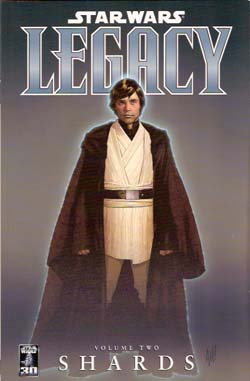
Star Wars: Legacy, Vol 2 – Shards

Star Wars: Legacy — Shards

By John Ostrander & various (Dark Horse Books)
ISBN: 978-1-84576-699-3

The second volume of tales set in the Star Wars universe about 125 years after the events seen in Return of the Jedi, this is the tale of Cade, a disenchanted mercenary thug and the last of the Skywalker bloodline. With the Sith resurgent and the uneasy peace between the New Republic, the remnants of the Empire and the Extra-galactic Yuuzhan Vong in tatters (see Star Wars: Legacy Book 1 Broken, ISBN 1-84576-461-7) the last Skywalker returns at last to the planet where his family were slaughtered in a volume of as-yet unconnected story-strands.

Collecting issues #8, 4, 9, 10 13, 11 and 12 of the Star Wars: Legacy comic, this volume advances the story by filling in background and concentrating on peripheral characters. All stories are written by the excellent John Ostrander, and the edition begins with ‘Allies’ illustrated by Adam DeKraker in which the formidable and traitorous Moff Nyna Calixte realises her plans to replace Emperor Fel with her lover run afoul of the deadly Sith Lords Darth Krayt and Lady Maladi.

This is followed by the superb ‘Noob’ drawn by Travel Foreman, which introduces Anson Trask, a green Stormtrooper joining a crack unit ordered to eradicate Troopers who have switched sides. Dark and powerful, this uses the winning secret weapon of the Star Wars franchise; clever use of a strong genre story – in this instance a terse war tale – wearing science fiction clothing.

‘Trust Issues’ is a two-part tale with art from the legendary Colin Wilson. Rivals Nyna Calixte and Maladi both move to “acquire” the renegade Cade Skywalker, but nobody could have guessed the secret kept by the Imperial agent Morrigan Corde and the effect it would have on the mission… Wilson also applies his wonderful illustrative skills to ‘Ready to Die’ when Lady Maladi makes a seemingly precipitate move to assassinate Emperor Fel, and the book closes with ‘Ghosts’ by Ostrander and long-time collaborator Jan Duursema.

Cade Skywalker escaped the destruction of the new Jedi on Ossus and became a drug-addled mercenary years ago. Now he awakes on that dead planet with the spirits of his ancestors – from Mara Jade to Darth Vader – confronting him. Soon though, very real enemies and allies join them and Cade is forced into a life-altering decision. This psychological essay reveals deep insights into the troubled lead character and advances the greater plot to the point where the main action can begin. But that’s a tale for another book…

This is a mature and meticulously constructed saga tinged with darkness that builds with an epic feel into something quite special. Where many licensed spin-offs are content to coast on the popularity of the major property, Ostrander has crafted a genuine multi-layered saga with the conceptual tools of the Star Wars franchise. This is definitely an epic to follow for any fan of great storytelling…

Star Wars © 2007 Lucasfilm Ltd. & ™. All Rights Reserved.
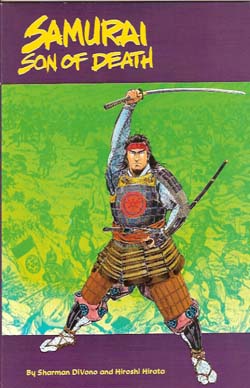
Samurai, Son of Death

Samurai, Son of Death

By Sharman Devono & Hiroshi Hirata (Eclipse Books)
ISBN: 0-913035-30-0

Holding a strong claim to be the first ever collaboration between an American comicbook writer and a Japanese Manga artist this slim but impressive little gem is still readily available through many online retailers.

Eclipse was one of the first publishers to get into the trans-Pacific translation business with such seminal serials as Area 88, Legend of Kamui and Mai, the Psychic Girl. Finding an audience eager for a fresh graphic experience they soon branched out into new material. This terse black and white tale combines real events from a turbulent period in Japan’s troubled history and combines them with supernatural elements for a tense, foreboding drama with the accent on human interaction rather than simple swordplay.

The Kyushu Campaign occurred during a period when Toyotomi Hideyoshi was attempting to make himself Dictator of Japan. In June 1587 he sought to consolidate his power on the island of KyÅ«shÅ« where the rebel Daimyō (Lords) of Satsuma resisted him. Into this hotbed of intrigue a Nō Actor and samurai named Okubo Nagayasu became an unstoppable secret agent for Tokugawa Ieyasu – Lord of the Five Provinces, second most powerful man in the Empire, and a wily campaigner who sought to maintain his own position through stealth, rather than by siding with either faction.

Nothing could prevent the war that occurred, especially as Jesuit missionaries were manipulating newly converted nobles for their own ends. As usual the real casualties in such affairs are the honest soldiery, but when the samurai Harada Sadayasu falls during the inevitable battle, he reluctantly returns from the dead as Shiko, a Son of Death. An unclean thing, he wants only the peace of the grave, but is ordered by his Daimyō to continue in his duty. Killing his Lord’s enemies…

The structure of this tale is a little odd and I suspect it was originally intended to be a longer work, but it’s an engrossing and exotic yarn for all that. Seminal artist Hirata is actually a gekiga exponent (which means he produces “dramatic pictures” rather than the more frivolous manga or “irresponsible pictures” – a sophism equivalent to our own western debate over “High” and “Low” art). He has had few of his works translated into English and the most well known is probably Satsuma Gishiden, a gritty historical saga in the manner of the legendary Lone Wolf and Cub. His other series include ‘Jaken Yaburetari’, ‘Tsunde ha Kazushi’, ‘Mosû Ogidachi’ and ‘Shikon’.

If you’re a fan of oriental fiction or would just like to try something a little different this is definitely a book worth hunting down

© 1987 Sharman Devono & Hiroshi Hirata. All Rights Reserved.

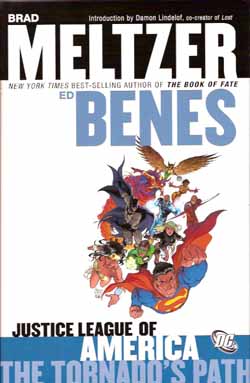
JLA: The Tornado’s Path

JLA: The Tornado's Path

By Brad Meltzer & Ed Benes (DC Comics)
ISBN: 978-1-84576-555-2

Comics must finally have come “of age” when the creator names on the dust-jacket are actually larger than the character logo or even the illustration. Still and all, this latest reboot of such perennial favourites as the “World’s Greatest Superhero Team” is a very impressive package, thanks in no small part to the meticulous efforts of scripter Brad Meltzer and Ed Benes.

A welcome innovation this time around is the inclusive nature of the restructuring as more than mere lip-service is paid to all the previous incarnations of the comic and the creators provide a nostalgic subtext that should appease all the dizzy, weary fans that have endured so many bewildering changes and incarnations.

Following the events of Infinite Crisis, One Year Later and 52, Superman, Batman and Wonder Woman convene as a star-chamber to reform the Justice League of America as a force for good, only to discover that events have escaped them and a new team has already congealed (I really can’t think of a better term) to defeat the imminent menace of Professor Ivo, Felix Faust and the lethal android Amazo, plus a fearsome mystery mastermind and a few classic villains as well.

Told through the heartbreaking personal tragedy of the Red Tornado, who achieves his deepest desire only to have it torn from him, this is an enjoyable if complex dramatic tale that hides well its true purpose – that of repositioning the company’s core team in the expanded DC universe: one which encompasses all media. Therefore, there’s a tacit acceptance of influences from the various TV shows, movies and even animated cartoons underpinning everything here – even to the new Super Friends and Justice League Unlimited inspired headquarters. So whichever media experience brought you here, this is a new Justice League that should feel fresh yet comfortingly familiar.

© 2006, 2007 DC Comics. All Rights Reserved.

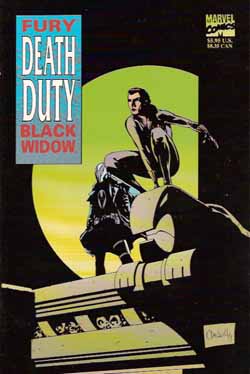
Fury/Black Widow: Death Duty

Fury/Black Widow

By Cefn Ridout & Charlie Adlard (Marvel)
ISBN: 0-7851-0156-X

Don’t be fooled by the title and brace yourself for a disappointment if you’re a huge fan of the World War II Howling Commando and irascible leader of the planet’s most advanced espionage agency. Although he gets top billing, Nick Fury is largely absent from the post-Cold War proceedings in this well-intentioned if erratic thriller that is in actuality the spiritual conclusion to the sage of the mysterious Night Raven.

As seen in Night Raven: the Collected Stories (ISBN13: 978-1-85400-557-3), Night Raven: House Of Cards (ISBN13: 978-1-85400-288-4) and as yet un-collected illustrated prose adventures from various British Marvel publications, Night Raven was a masked vigilante who fought crime in New York and Chicago in the years between World Wars I and II. In later years he became locked in a bloody, relentless vendetta with the immortal villainess Yi Yang, Queen of the Dragon Tong.

When a S.H.I.E.L.D. asset is murdered inside the US embassy in Moscow soon after the fall of the Soviet system, expatriate Russian super agent and Avenger Natasha Romanoff is dispatched to unravel the secrets the new rulers don’t want revealed.

What she discovers is the incredible fate of the fearsome urban legend now known as Black Bird as he slaughters his way through bureaucrats and Russian Mafia alike in his single-minded mission to destroy the woman who kept him from a peaceful grave.

Superbly illustrated by Charlie Adlard this is nonetheless an uncomfortable blending of genres, with a strange pace to it: almost as if there’s been some savage trimming and pruning with no thought to narrative cohesion. Pretty and adventurous, it’s probably only of real interest to real aficionados.

© 1995 Marvel Entertainment Group/Marvel Characters, Inc. All Rights Reserved.

Superman: Infinite Crisis

Superman: Infinite Crisis

By various (DC Comics)
ISBN: 978-1-84576-342-8

One of the major sub-storylines of Infinite Crisis (ISBN: 978-1-4012-0959-9) involves the Superman who debuted in 1938, and who for years was designated as first the Golden Age and latterly the Earth 2 Man of Steel. This slim addendum to the main event collects material from Infinite Crisis Secret Files and Origins 2006, Infinite Crisis #5, Superman #226, Action Comics #836 and Adventures of Superman #649, and details the poignant and tragic end of the characters that in so many ways birthed the DC Universe.

By detailing what became of Superman and Lois Lane of Earth 2, Earth 3’s Alexander Luthor and Superboy from Earth Prime after Crisis on Infinite Earths (ISBN: 978-1-5638-9750-4) writers Marv Wolfman, Joe Kelly, Geoff Johns and Jeph Loeb have added tone and texture that is noticeably, if not painfully lacking from the parent blockbuster, and the quiet moments reviewing and commemorating the phenomenal life of the original Mr and Mrs Superman are more powerful than the inevitable battle of the superpowers that follows.

In many ways superior to the parent tale the only quibble is that the events of this book conclude before the end of Infinite Crisis meaning that you really need to read this simultaneously. Annotated Absolute Edition, anyone?

A huge number of artists worked on this book so I’ve saved them for the end in case you’re the type that likes to leave before the national anthem (and I suspect most of you are too young for that gag as well). They are Dan Jurgens, Jerry Ordway, Cam Smith, Art Thibert, Nelson, Ed Benes, Howard Chaykin, Renato Guedes, Kevin Conrad, Dick Giordano, Jose Marzan Jr., Ian Churchill, Norm Rapmund, Phil Jimenez, Andy Lanning, Lee Bermejo, Doug Mahnke, Tim Sale, Tom Derenick, Wayne Faucher, Karl Kerschl, Duncan Rouleau, Dale Eaglesham, Drew Geraci, Ed McGuinness, Dexter Vines, George Pérez, Ivan Reis, Dave Bullock and Kalman Andrasofszky.

The colouring was by Jeromy Cox, Guy Major, Renato Guedes, Dave Stewart, Tanya & Richard Horrie, Rod Reis, Tom Smith, Michelle Madsen, Kalman Andrasofszky and Dave Bullock with lettering by Travis Lanham, Pat Brosseau, Nick J. Napolitano and Comicraft.

© 2006 DC Comics. All Rights Reserved.

Infinite Crisis Companion

Infinite Crisis Companion

By Geoff Johns, Phil Jimenez & various (DC Comics)
ISBN: 978-1-48576-378-7

In the build-up to the universe-altering Infinite Crisis (ISBN: 978-1-4012-0959-9), DC released a number of themed miniseries, each of which was designed to set scenes, generate storylines, and generally warm up the audience for the Big Event. Each of these miniseries ended on a whopping cliffhanger and was then swiftly rushed out as a trade paperback collection. These ice-breakers were Day of Vengeance (ISBN 1-84576-230-4) The Omac Project (ISBN 1-84576-229-0) Rann-Thanagar War (ISBN 1-84576-231-2) and Villains United (ISBN 1-84576-232-0) – and you should probably lump in the Clip-book compilation Prelude to Infinite Crisis (ISBN 1-84576-209-6) which extracted pertinent snippets from a host of DC comics and the much more readable Identity Crisis (ISBN 1-34576-126-X) for a full set. (See separate reviews via the Archive)

The problem with the first four series/collections is that even as teaser tales and set-ups they were somewhat incomplete and inconclusive, necessitating the creation of intermediate one-shot Specials to bridge the gap between the individual storylines and Infinite Crisis itself (ISBN: 978-1-4012-0959-9 or ISBN: 978-1-84576-404-3 for the trade paperback). Those bridging specials are collected in this volume.

Day of Vengeance: The Ninth Age of Magic is by Bill Willingham, Justiniano and Walden Wong and deals with a last-ditch attempt by Earth’s magical practitioners to pacify a crazed and apocalyptic Spectre, whilst Rann-Thanagar War: Hands of Fate is written by Dave Gibbons with art by Ivan Reis, Joe Prado, Marc Campos, Oclair Albert and Michael Bair finds a group of superheroes discovering the real causes of the war during a brutal battle in the depths of intergalactic space.

The Omac Project: the Lazarus Protocol is by Greg Rucka and Jesus Saiz and has Checkmate and a rag-tag bunch of superheroes deal with the deadly remnants of the rogue Brother Eye satellite as it crashes to Earth, and Gail Simone, Dale Eaglesham, Art Thibert and Drew Geraci bring the six super-villains who wouldn’t join Luthor’s Bad-guy Society into final conflict with the mastermind’s forces before everybody gets reconstructed by the final act of Infinite Crisis in Villains United: A Hero Dies but One.

If I’ve seemed a little disparaging here it’s not that the material is deficient or mediocre. These are good, strong stories, well told and wonderfully illustrated, but they are floating about without context in this compendium of middle-bits from a bigger story. The ineptitude of this sort of production and packaging utterly galls me. Could it have hurt so much to wait until these tales were published before rushing out the collections laboriously detailed above?

The best place for these adventures is in those books, not here as a separate volume. A big event like Infinite Crisis generates a lot of outside interest and – hopefully – new readers. To send them scurrying all over the landscape for the complete story is bad enough, but when the collections aren’t even complete all you have is a disgruntled purchaser who won’t come back. And it’s also not fair for dedicated fans – who we all know have already bought the original comics – to have yet another expensive book to add to their monthly bill.

Let’s hope for a little more joined-up thinking for those inevitable future publishing events.

© 2005, 2006 DC Comics. All Rights Reserved.

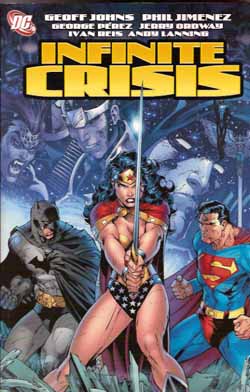
Infinite Crisis

Infinite Crisis

By Geoff Johns, Phil Jimenez & various (DC Comics)
ISBN: 978-1-4012-0959-9

If you’re not a fan or follower of superheroes or extreme continuity comics, you might want to just skip this book: Otherwise be prepared for some fairly complex fight-in-tights interplay. Also, don’t even think about attempting this without first reading Crisis on Infinite Earths (ISBN: 978-1-5638-9750-4)!

Still with us? Okay, then…

To celebrate the anniversary of the biggest comics event of the 1980s, DC decided to revisit Crisis on Infinite Earths and boost sales and media exposure with another End-of-Everything mega-crossover. Out of this premise would come a cascade of tie-in titles, entwined storylines and a continuous high level of follow-up events, One Year Later, 52, Countdown, etcetera ad nauseum. Every character in the DCU must be permanently tanked on tranquilisers these days…

Spoiler Alert: I’m about to blow the ending of Crisis on Infinite Earths so if you still haven’t read it, do it now or deal with the consequences.

After a cataclysmic battle at the dawn of time all the remaining alternate universes were combined into one. Barring some continuity after-shocks, life itself was saved and reality was returned to its natural progress. Four remnants from worlds that had now never existed – Superman and Lois Lane from Earth 2, Alexander Luthor from Earth 3 and Superboy from Earth Prime, departed Reality itself for a nebulous, paradisiacal other place and the universe continued on.

As DC restarted its heroic history disquieting anomalies occasionally manifested, but generally everything progressed smoothly – as much as it can in superhero comics. But as the years passed the stories and events became grimmer, grittier, altogether darker and nastier. Superman was killed by Doomsday and came back (The Death and Return of Superman Omnibus ISBN: 978-1-4012-1550-7), opening the doorway of death for other returnees. The Justice League lobotomised Dr. Light (see Identity Crisis ISBN: 1-34576-126-X), Wonder Woman executed the telepathic despot Maxwell Lord (Superman: Sacrifice ISBN: 1-84576-243-6) and Batman had become a paranoid sociopath.

Heroes had become indistinguishable from villains, and in a place beyond space and time four survivors of a different kind of Reality looked on in horror and despair. Observing such events the last denizens of the multiverse realised that a dreadful mistake had been made and it was up to them to rectify it…

The seven issues of Infinite Crisis brought together all the various threads of various DCU titles as young Luthor, Superboy Prime and Mr and Mrs Superman tried in their own ways to unpick and reweave the fabric of a universe they deemed faulty. The attendant books Day of Vengeance (ISBN 1-84576-230-4) The Omac Project (ISBN 1-84576-229-0) Rann-Thanagar War (ISBN 1-84576-231-2) and Villains United (ISBN 1-84576-232-0) iterate their earliest clandestine efforts, funnelling into and culminating in this rather messy, unwieldy epic (as do storylines from a host of other individual titles) and after cataclysmic events a reality is salvaged if not actually saved.

For safety’s sake you’d best also include the Infinite Crisis Companion (ISBN: 978-1-48576-378-7) and Superman: Infinite Crisis (ISBN: 978-1-84576-342-8) on your shopping list if you’re going to attempt this ambitious but unnecessarily complex magnum opus which aims so very high and nearly achieves all it set out to.

Concocted by Geoff Johns and Phil Jimenez, assisted by George Pérez, Jerry Ordway, Ivan Reis and Andy Lanning, this is tantalisingly close to being a classic, but the muddle and bombast are only really accessible to the already conversant hardened fan whilst the new readers that came in the wake of the hype, (unlike the better structured Crisis on Infinite Earths) must have been left reeling by the overwhelming intricacy here, not to mention the frankly boggling number of characters in play without any seeming purpose or narrative contribution.

Like its predecessor this story will inform all DC adventures for years to come so it’s pretty much compulsory reading for fans, and to be fair, it is beautiful and impressive to look upon, but my major concern – as always – is getting more people reading comics and this one is just too much like hard work for the fresh and inexperienced punter.

© 2005, 2006 DC Comics. All Rights Reserved.

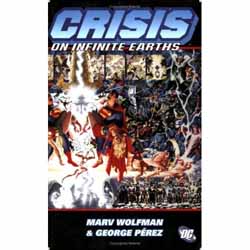
Crisis on Infinite Earths

Crisis on Infinite Earths

By Marv Wolfman & George Pérez & various (DC Comics)
ISBN: 978-1-5638-9750-4

There are a number of books I’ve held off reviewing for – I thought – obvious reasons. If a reader comfortable with the superhero genre hasn’t read certain landmarks like Watchmen or The Dark Knight Returns by now then surely I’ve been largely wasting yours and my time here. Nevertheless I’m reliably informed that many readers, new and old alike, have “never got around to” some of the most significant graphic narratives ever produced so here I am metaphorically poking the negligent with a stick until they do…

In 1985 the Editorial Powers-That-Be at DC Comics were celebrating fifty years of publishing, and on a creative upswing that had been a long time coming. As part of the festivities, and in a purported attempt to simplify five decades of often conflicting stories, a decision was made to concoct a truly epic, year-long saga that would impact every single DC title and reconstruct the entire landscape and history of the DC Universe, with an appearance – however brief – by every character the company had ever published. Easy-peasy, Huh?

Additionally, this new start would end the apparent confusion of multiple Earths with similarly named and themed heroes that had been deterring (sic) new readers. The hefty result of these good intentions was a huge success, both critically and commercially, and enabled the company to reinvigorate many of their most cherished – if moribund – properties. They’ve been trying to change it back ever since.

Plotted long in advance of launch, threads and portents appeared for months in DC’s regular titles, mostly to do with a mysterious arms-and-information broker known as The Monitor. With his beautiful assistant Harbinger he had been gauging each and every being on every Earth with a view to saving all Reality. At this time that Reality consisted of uncountable variations of universes existing “side-by-side”, each with differences varying from slight to monumental. It transpires that at the very beginning of time an influence from the future caused Reality to fracture…

Now a wave of anti-matter was scything through the Cosmic All destroying these separate universes. And before each Armageddon a tormented immortal named Pariah materialised. As the book opens he arrives on an Earth, as its closest dimensional neighbours are experiencing monumental geo-physical disruptions. It’s the end of the World…

Just in case you haven’t experienced this phenomenal example of superhero spectacle by Marv Wolfman and George Pérez, aided and abetted by Dick Giordano, Mike DeCarlo and Jerry Ordway, suffice to say that there is villainy behind the catastrophe and the action is tinged with tragedy – as many major heroic figures, from the grand to the nondescript die valiantly – fall in the struggle to preserve some measure of life in the doomed multiverse.

Full of plot twists and intrigue this Cosmic Spectacle set the benchmark for all future crossover publishing events, not just DC’s, and is still a qualitative high point seldom reached and never yet surpassed. As well as being a superb blockbuster in its own right and accessible to even the greenest neophyte reader, it is the foundation of all DC stories since 1985 and absolutely vital reading before attempting such modern epics as Infinite Crisis.

© 1985, 2001, 2008 DC Comics. All Rights Reserved.

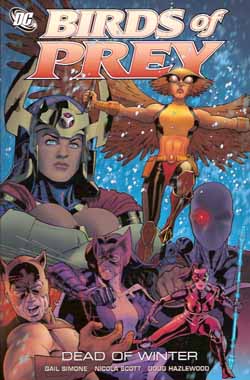
Birds of Prey: Dead of Winter

Birds of Prey: Dead of Winter

By Gail Simone, Nicola Scott & Doug Hazlewood (DC Comics)
ISBN: 978-1-84576-773-0

Gail Simone ended her spectacular and compelling run as writer on this wonderful series with this volume, which collects Birds of Prey #104-108. In it her new team of rotating women adventurers must travel to post-Soviet Azerbaijan at the behest of Uber-Spook Spy Smasher who has wrested control of the team from Oracle, the wheelchair-bound super-hacker who used to be Batgirl. By blackmail and Federal intimidation (see Birds of Prey: Blood and Circuits, ISBN: 1-84576-564-8) an old College rival now controls the most effective, pro-active superhuman task force on Earth.

Thinking they’re intercepting a clandestine super-weapon, the Birds team, consisting here of Big Barda, Hawkgirl, Huntress, Lady Blackhawk, the new Manhunter and an eccentric and troubled teen teleporter named Misfit, run afoul of the newly named criminal mercenaries Secret Six (best known to regular readers as the ambiguous super-criminals of Villains United (ISBN 1-84576-232-0). Hip-deep in snow and psychopaths, it’s only then that the ladies realise there’s a deeper, more dangerous scheme in play.

As usual the best laid plans go awry, resulting in deliciously gratuitous combat action, before the volume concludes satisfactorily, if a little precipitously, in a guest-star packed final showdown with the obnoxious Spy-Smasher. Gail Simone moved on to tackle the troubled Wonder Woman series, but the body of work she’s produced on Birds of Prey ranks as some of the best and certainly most accessible superhero comics of the past thirty years. If you crave sassy, clever, glamorous action-adventure grab this book – and all the others too.

© 2007 DC Comics. All Rights Reserved

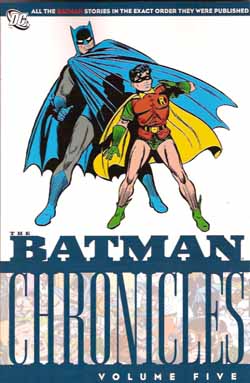
Batman Chronicles, Volume 5

Batman Chronicles 5

By Bob Kane & various (DC Comics)
ISBN13: 978-1-84576-719-8

The history of the American comicbook industry in most ways stems from the raw, vital and still compelling tales of two iconic creations published by DC/National Comics: Superman and Batman. It’s only fair and fitting that both those characters are still going strong and that their earliest adventures can be relived in chronological order in relatively cheap, and gloriously cheerful, compilations.

The latest Batman edition sees the Dynamic Duo fully developed and storming ahead of all competition in these stories originally published in 1941and 1942. As the characters’ popularity grew, new talent joined the stable of creators. Jerry Robinson had already joined writer Bill Finger and penciller Bob Kane, and during this period two further scripters joined the team.

Detective Comics #57 featured ‘Twenty-Four Hours to Live’, a tale of poisonings and Crimes of Passion whilst the Perfidious Penguin returned in the next issue to make our heroes the victims of ‘One of the Most Perfect Frame-Ups’. A few weeks later Batman #8 (now Bi-Monthly!) came out, cover dated December 1941-January 1942. Such a meteoric rise and expansion during a time of extreme paper shortages gives heady evidence to the burgeoning popularity of the characters. Behind a superbly evocative “Infinity” cover by Fred Ray and Jerry Robinson lurked four striking tales of bravura adventure.

‘Stone Walls Do Not A Prison Make’ is a brooding prison drama, followed by a rare foray into science fiction as a scientist abused by money-grubbing financial backers turns himself into a deadly radioactive marauder in ‘The Strange Case of Professor Radium’ (this tale was radically revised and recycled by Finger and Kane as a sequence of the Batman daily newspaper strip from September 23rd to November 2nd 1946). ‘The Superstition Murders’ is a gripping example of the “ABC Murders”-style plot and ‘The Cross Country Crimes’ sees the Joker rampage across America in a classic blend of larceny and lunacy.

The Batman tale from Detective Comics #59 was written by Joseph Greene and sees the Penguin turn his formidable talents to bounty-hunting his fellow criminals in ‘The King of the Jungle’, followed by the rip-roaring modern cowboy yarn ‘The Ghost Gang Goes West’ which first appeared in the winter issue of World’s Finest Comics (#4). Jack Schiff, who had a long and auspicious career as an editor at DC, scripted ‘The Case of the Costume-Clad Killers’ from Detective Comics #60, another excursion into mania starring the Joker, leaving Bill Finger free to concentrate on the four fabulous tales in Batman #9 (Feb-March 1942), one of the greatest single issues of the Golden Age and still a cracking parcel of joy today.

Behind possibly the most reproduced cover ever crafted by the brilliant Jack Burnley are ‘The Four Fates’: a dark and moving human interest drama featuring a quartet of fore-doomed mobsters, a maritime saga based on the classic Moby Dick, entitled ‘The White Whale’, another unforgettable Joker yarn ‘The Case of the Lucky Law-Breakers’, and the birth of a venerable tradition in an untitled story called here for expediency’s sake ‘Christmas’.

Over the decades many of the Dynamic Duo’s best and finest adventures have had a Christmas theme (and why there’s never been a Greatest Christmas Batman Stories is a mystery I’ve pondered for years!) and this touching – even heart-warming – story of petty skulduggery and little miracles is where it all really began. There’s not a comic fan alive who won’t dab away a tear…

This volume ends with another much-reprinted classic (aren’t they all?) from Detective Comics #61. ‘The Three Racketeers’ is the perfect example of a Batman short story where a trio of crime big-shots swap stories of the Gotham Guardians over a quiet game of cards, and has a sting-in-the-tail that still hits home more than fifty years later.

These are the stories that cemented the popularity of Batman and Robin and brought temporary relief to millions during a time of tremendous hardship and crisis. Even if these days aren’t nearly as perilous or desperate, the power of such work to rouse and charm is still potent and just as necessary. You owe it to yourself and your family and even your hamster to buy the Batman Chronicles (great fun, great value; why are you waiting…)

© 1941, 2008 DC Comics. All Rights Reserved.