Hairy Mary in Fun Fur

Hairy Mary in Fun Fur

By Craig Conlan (Slab-O-Concrete)
ISBN: 1-899866-22-1

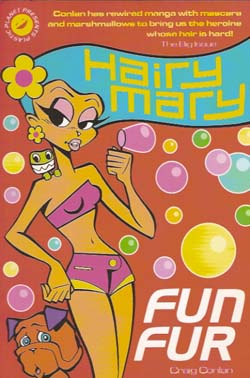
The so-groovy chick with the abundant, animated coiffure returns for another collection of saucy, surreal and superbly stylish adventures which reference and glorify everything important to the modern Man or Miss in this second collection from Craig Conlan.

Within this slim tome you will find Hairy Mary pursuing a new career as a Spokes-Model, nearly marrying a vampire, spoofing Japanese Rubber Monster Movies and pursuing her latest One-True-Love to the Sushi-Bar and the Plastic Babylon Zoo.

In a dazzling variety of formats (including an illustrated prose novella and activity pages) the hirsute heroine and her fabulous cast of eccentrics enjoy the kind of sassy exploits that other comics characters can only dream of, and provide the reader with a breathless and captivating riot of graphic euphoria that is sadly missing from modern storytelling.

Fun, and proud of it!

© 1998-1999 Craig Conlan. All Rights Reserved.

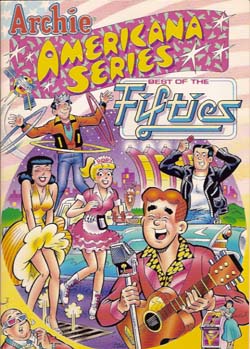
Archie: Best of the Fifties

Archie: Best of the Fifties

By various (Archie Comics)
ISBN: 1-879794-01-2

Adapting seamlessly to every trend and fad of youth culture, the creators who’ve crafted Archie Comics over the decades have made the “everyteens” of Riverdale a touchstone of American childhood and a visual barometer of growing up.

After initially jumping on the superhero/mystery-man bandwagon in 1939, Maurice Coyne, Louis Silberkleit and John Goldwater (MLJ) were quick to spot a gap in their blossoming market. In December 1941 the costumed heroes and two-fisted adventure strips were supplemented by a wholesome ordinary hero, an “average teen” who would have ordinary adventures like the readers, but with the laughs and slapstick emphasised.

Pep Comics #22 introduced ‘Archie’ a gap-toothed, freckle-faced red-headed goof showing off to pretty blonde Betty next door. Taking his lead from the popular “Andy Hardy” movies starring Mickey Rooney, Goldwater developed the concept, tasking writer Vic Bloom and artist Bob Montana with the job of making it work.

The strip was an instant hit. By the winter of 1942 Archie had his own title, the company’s first non-anthology magazine and with it began the transformation of the entire company. When rich, black-haired Veronica Lodge arrived all the pieces were in play for the industry’s second Phenomenon (Superman being the first). By May 1946 the kids had taken over, so the company renamed itself ‘Archie Comics’, retiring its heroic characters years before the end of the Golden Age and becoming to all intents and purposes a publisher of family comedies. Its success, like the Man of Steel’s, changed the content of every other publisher’s titles, and led to a multi-media industry including TV, movies, pop-songs and even a chain of restaurants.

Archie is a well-meaning boy who lacks common sense. Betty is the pretty, sensible girl next door, with all that entails. She loves Archie. Veronica is rich, exotic and glamorous; she only settles for our boy if there’s nobody better around. She might actually love him though. Archie can’t decide who he wants…

Archie’s unconventional best friend Jughead Jones is Mercutio to Archie’s Romeo, providing rationality and a reader’s voice, as well as being a powerful catalyst of events in his own right. The wholesome eternal triangle (+ one) has been the basis of more than sixty-five years of charming, raucous, gentle, frenetic, chiding and even heart-rending comedy ranging from surreal wit to frantic slapstick, as the kids and an increasing cast of friends grew into an American institution. So pervasive is the imagery that it’s a part of Americana itself. When you watch Happy Days, that’s the 1950s Riverdale crowd you’re tuning in to, and that’s never more apparent than in this second volume containing some of the best stories of that iconic decade.

According to many fans and purists it’s also the absolute zenith of quality material. That mythical America of Drive-Ins, Bobbysocks, Big Cars with Fins, Men in Hats and Malt-Shops was the ideal environment to perfect the strip and blend innocence, innuendo and ingenuity (all fine teen-ager qualities) with raucous knockabout comedy that ranked with the best that Hollywood and the new medium of Television could offer.

In this volume the kids of Riverdale deal with everything from the threat of Atomic War, to Hula Hoops, fads and fashions and the timeless struggles of Boy Vs Girl, Boy Vs Rival Boy, Boy Vs Alarm-Clock, Boy Vs Girl’s Father and every permutation in between.

With such writers as Frank Doyle, George Gladir, Sy Reit, Tom Moore and artists like Bob Montana, Bob Bolling, Dan DeCarlo, Joe Edwards, Samm Schwartz, Bill Vigoda and the legendary Harry Lucey (who famously only drew clothes on the first page of his stories – leaving production assistant Terry Szenics to cover up those hormone-crazed teens) these tales are timeless masterpieces of their type, and still capable of splitting sides and charming the pants off most readers today.

© 1953-1959, 1992, 2007 Archie Publications Inc. All Rights Reserved.

Nick Fury vs. S.H.I.E.L.D.

Nick Fury vs. S.H.I.E.L.D.

By Bob Harras, Paul Neary, Kim DeMulder & Bernie Jaye (Marvel)
ISBN: 0-87135-554-X

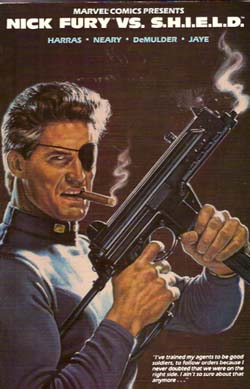
Nick Fury the spy debuted at the height of the 1960s espionage fad, following on the heels of James Bond, Danger Man, The Man from U.N.C.L.E. and so very many others. He was also already the star of Marvel’s only war comic Sgt. Fury and his Howling Commandos, an improbable and decidedly over-the-top WWII series similar to The Dirty Dozen. For a few brief years with Jim Steranko in charge the S.H.I.E.L.D. series was one of the best strips in America if not the world, but when the writer/artist left and the spy-fad ended the whole concept faded into the background architecture of the Marvel Universe.

In 1989 a six issue prestige format miniseries reinvigorated the concept. As a company targeting the youth-oriented markets Marvel had experienced problems with their in-house clandestine organisation. In most of their other titles US agents and “the Feds” were more often than not the bad guys, and here Bob Harras used this theme as well as the oddly quirky self-referential fact that nobody aged in comic continuity to play games with the readers.

When Fury discovers that everybody in the organisation has been “turned” and is now a threat to freedom and democracy he goes on the run, hunted with all the resources of the world’s most powerful covert agency. Can he turn the tables on the edifice he created with every friend against him and reclaim S.H.I.E.L.D. for the forces of Good? Can he even survive until morning?

Crafted to blend Invasion of the Body-Snatchers with The Spy Who Came in From the Cold this is a frantic all-out thriller that pays little attention to common-sense or the meticulous and stifling minutiae of continuity but concentrates on momentum to tell an entertaining tale. Daft, fast-paced and as paranoid as a bag of monkeys on goof-balls – as any decent spy-thriller should be – there’s lot’s of fun to be had here for readers not too tied in to pedantry or history.

© 1989 Marvel Entertainment Group, Inc. All Rights Reserved.

A Nightmare on Elm Street

A Nightmare on Elm Street

By Chuck Dixon, Kevin West & Bob Almond (WildStorm)
ISBN13: 978-1-0-84576-634-4

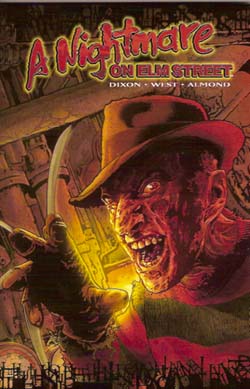
Here’s a rare treat for readers other than dyed-in-the-wool teen-slasher fanatics as the two tales in this compilation (collecting issues #1-3 and #5-7 of the comic-book) offer at least the possibility that the victims can escape an inevitable fate in a far above average example of how to write a licensed horror property.

First is ‘Freddy’s War’, the tale of army brat Jade Arnstrum who moves into the accursed suburban backwater of Springwood with her brother Brad and retired Marine dad. Even before she’s unpacked she’s having weird dreams. A little girl nobody sees gives her vague warnings and there’s a sense of menace…

When her brother burns to death she finally finds a kid willing to tell her the story of Freddy Krueger, but unlike the beaten sheep of the town she decides to include her dad in the secret and together they take the fight into the dreamworld. This time Freddy’s got a battle on his hands. Drawn in a powerfully underplayed manner by Kevin West and inked by Bob Almond, Chuck Dixon’s taut script even provides an unexpected conclusion for we jaded know-it-alls.

‘The Demon of Sleep’ by the same creative team is another welcome variation on the theme. Every school has its outsiders and the smart nerdy outcasts of Springwood know that as well as the Jocks and the Popular cliques making their lives hell, eventually so will the spectral monster that kills in dreams. Unlike normal kids though, these bright sparks know how to cooperate, and they have a plan…

This dark, sardonic tale has plenty of shocks and twists in a nasty little adventure that mirrors supernatural trauma with the true horror of High School life and once again the story provides enough surprises to provide some genuine moments of tension.

In a genre that swims in predictability these gory yarns prove that a little thought can still work miracles. This book is a rare treat for all horror fans.

© & ™ MMVII New Line Productions, Inc. A Nightmare on Elm Street is ™ New Line Productions, Inc, (so7). © 2006, 2007 New Line Productions, Inc. All Rights Reserved.

Transformers: Time Wars

Transformers: Time Wars

By Simon Furman & various (Titan Books)
ISBN 1-84023-647-7

The shape-changing Transformers took the world by storm in the 1980’s and a monthly US Marvel comic book was a smash hit. Marvel’s UK branch produced their own weekly comic reprinting the American material but the scheduling disparity quickly necessitated the creation of original material.

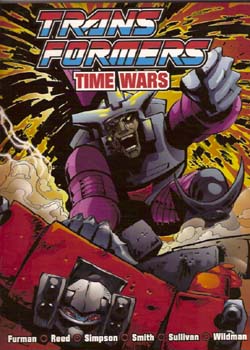
After a truly colossal series of interlocking tales – previously collected as Transformers: Target 2006 (ISBN: 1-84023-510-1), Fallen Angel (ISBN: 1-84023-511-X), Legacy of Unicron (ISBN: 1-84023-578-0) and Space Pirates (ISBN: 1-84023-619-1), the epic time-busting saga of paradox and predestination exploded to a climax in this volume reprinting material from issues #130-131, #189 and #199-205 of the weekly Transformers comic, plus two tales from the 1988 Transformers Annual.

In the animated film Transformers: The Movie (released in 1985) Optimus Prime and Megatron fall in a climactic battle to be replaced by the heroic Ultra Magnus and the devilish Galvatron. Set in 2005 (remember, this was set 20 years in the future at that time…) the Autobots were almost completely defeated by the Decepticons when a huge new horror threatened to destroy all the robots and even the Earth itself. A giant sentient planet-eating robot, Unicron is pure evil, and saves the fallen Megatron for his own sinister purposes.

Spinning off from the film’s dramatic conclusion, in the comic series Galvatron travels back twenty years from 2006 with his two cohorts Cyclonus and Scourge to unmake his own unwanted reality and free himself from bondage to Unicron by judiciously altering events, but once here he finds that the Autobots are not the only alien shape-changing robots that want to stop him.

The time-tossed Transformers encounter spirited resistance from friend and foe alike and by the time of this concluding volume the very fabric of time itself is unravelling, threatening to unmake the universe. In 2009 the surviving Autobots and Decepticons decide to risk everything by sending rescue parties back to the 1980s in hope of saving reality – and producing a timeline more favourable to their particular needs.

Fast-paced and furious in intensity, this cosmic drama for all ages still carries a punch today and the early work of contemporary luminaries Robin Smith, Will Simpson, Lee Sullivan, Andrew Wildman and especially Dan Reed is a distinct pleasure for modern fans to see.

Good, solid action and a great starter for kids thinking of picking up the comic bug.

© 2002 Hasbro. All Rights Reserved.

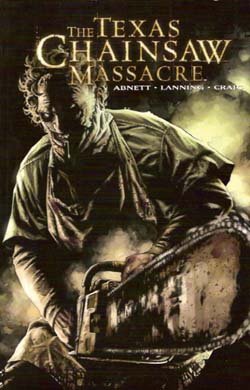
The Texas Chainsaw Massacre

The Texas Chainsaw Massacre

By Dan Abnett, Andy Lanning & Wes Craig (WildStorm)
ISBN13: 978-1-0-84576-638-2

I’ve already mentioned that I have aesthetic reasons for disliking a lot of generic “Teen-Slasher” fiction, so I’ll only briefly recapitulate here. If an evil is unstoppable, and the humans/victims have no chance of escape or survival then all narrative tension is lost and all you have is a body-count and an exercise in grotesque imagination, not a story. That said I have to admit that this sequel to the remake of the legendary cannibal gore-fest wherein a slaughterhouse worker uses his chainsaw to gut hapless kids is… unfortunately just another one of those.

A follow-up FBI team arrives in the town of Fuller, Texas in 1974 to gather evidence on the greatest mass-murderer in American history – and who is still at large – just ahead of a mobile TV news crew, only to discover that not only have the killings not stopped, but the killer had a large family with the same tastes. Moreover the entire town was complicit in the deaths. This daft plot rapidly degenerates into the ever-escalating bloodbath the target audience is waiting for and it all ends as you’d expect – with nothing resolved and another sequel on the cards.

Dan Abnett, Andy Lanning and artist Wes Craig work at the best of their capabilities and I’m sure dedicated fans will be happy enough but I fear there’s nothing here for the casual or more discerning reader.

© MMVII New Line Productions, Inc. The Texas Chainsaw Massacre (1974) © 1974 Vortex, Inc. The Texas Chainsaw Massacre (2003) © MMIII New Line Productions, Inc. The Texas Chainsaw Massacre: The Beginning © MMVI New Line Productions, Inc. Leatherface and The Texas Chainsaw Massacre are ™ Kuhn/Henkel. All Rights Reserved. © 2006, 2007 New Line Productions, Inc.

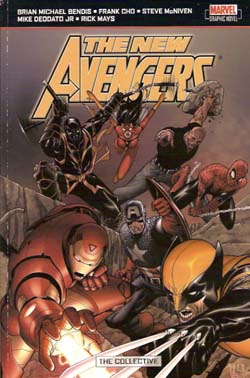
New Avengers: The Collective

UK EDITION

New Avengers: The Collective

By Brian Michael Bendis & various (Panini Publishing UK)
ISBN13: 978-1-905239-68-9

Although wearing the trappings of the new, darker, more in-your-face Marvel Universe, this tale is at heart an old fashioned “Who Can Save the World?” tale featuring the latest – possibly most sales-savvy – team of superheroes to carry the fabled Avengers ID card.

Reprinted from Giant-Size Spider-Woman #1 and issues #14-20 of the monthly New Avengers comic book, illustrated by Frank Cho, Steve McNiven, Mike Deodato Jr., Rick Mays, Jason Martin, Dexter Vines and Joe Pimentel this story by Brian Michael Bendis clarifies – or perhaps further muddies the true allegiances of double-agent Jessica Drew who, as the Avenger Spider-Woman is also an agent of S.H.I.E.L.D. and the terrorist organisation Hydra.

As if that’s not grief enough Captain America and Iron Man go public with possibly the least popular roster in history comprising the mutant Wolverine, Spider-Man, Luke Cage and the mysterious all-powerful basket-case known as the Sentry. At least Carol Danvers (Ms. Marvel, Binary, Warbird and probably a bunch more code-names by the time you read this) is on hand to pitch in when necessary…

Couple all that with a positively hostile US Government and a new S.H.I.E.L.D. boss who’s ruthless when defied, then the unstoppable threat from space that is cutting a swath of death and destruction across the planet seems almost the least of the team’s worries.

Sharp, entertaining, competent if a little complex for the newcomer or returning fan, this disaster-movie style follow-up to the House of M crossover event is an unassuming and amiable read for fans of the “fights ‘n’ tights” scene.

© 2006, 2007 Marvel Characters Inc. All Rights Reserved.

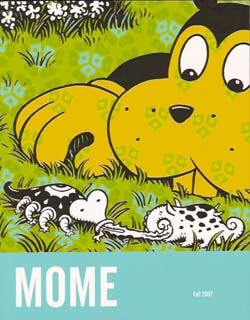
MOME 9: Fall 2007

Mome 9: Fall 2007

By various (Fantagraphics Books)
ISBN: 978-1-56097-872-5

The latest volume of the alternative cartooning and graphic arts series is truly autumnal in tone despite the addition of many more brightly coloured pages. The experimental nature of the features is often challenging but the rewards are great for the devotee prepared to work with the material rather than slavishly absorb. It also helps to let go of style preconceptions.

This volume features a fantastic variety of work by Ray Fenwick, Tim Hensley, Al Columbia, Eleanor Davis, Gabrielle Bell, Andrice Arp, Joe Kimball, Tom Kaczynski, Kurt Wolfgang, Brian Evenson, Zak Sally, Paul Hornschemeier and Sophie Crumb. There’s also a frankly astounding art feature on the multi-media illustrator Mike Scheer, but the real gem is the first instalment of a wordless and surreal epic ‘The Lute String’ by Jim Woodring.

Mome is as much magazine as book and each one is a graphic event. The earnest and dedicated creators make intense and often hard to read comics which are then reproduced to the highest print standards. It is well on the way to achieving its goal of becoming the twenty-first century successor to Art Spiegelman’s seminal Raw. This one, as always, is challenging, diverting, pretentious, absorbing, compelling, annoying and wonderful.

If you love our art form and think without moving your lips you need to see this series.

Mome © 2007 Fantagraphics Books. Individual stories are © the respective creator. All Rights Reserved.

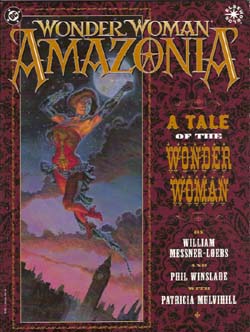
Wonder Woman: Amazonia

Wonder Woman: Amazonia

By William Messner-Loebs & Phil Winslade with Patricia Mulvihill (DC Comics)
ISBN: 1-56389-301-0

This slim oversized all-original tale was produced under DC’s Elseworlds imprint wherein characters are freed from their regular continuity’s shackles for adventures that test the limits of credibility and imagination.

Amazonia posits a world where a tragic fire destroys the entire British Royal Family in the 1890s and a very distant cousin becomes ruler of Victoria’s Empire. Under this aggressively male sovereign the Empire goes from strength to strength and the rights of women wither and die. Once more and forever they are playthings and possessions, to the point of having to wear chains in public.

Enter Steven Trevor, late of His Majesty’s Air-Marines, and trying to make a living as a music-hall impresario. His actress-wife is a foreign beauty, dark, tall, statuesque, able to jump huge distances and strong enough to wrestle lions. When she saves the royal heir from an assassin it begins an inexorable and bloody series of events that will liberate half the Empire and end half a century of cruelty, abuse and atrocity.

This is a powerful and challenging fable of sexual equality, blending the Wonder Woman mythology with Steam-punk fantasy and the legend of Jack the Ripper with cracking effect. William Messner-Loebs writes with convincing authenticity and Phil Winslade’s Victoriana-style artwork, beautifully reminiscent of both penny-dreadful engravings and the lovely sweeping line of Charles Dana Gibson is utterly captivating.

Often the Elseworlds variations come off as ill-conceived or poorly executed, but when it all comes together as it does in Wonder Woman: Amazonia the result is pure gold.

© 1997 DC Comics. All Rights Reserved.

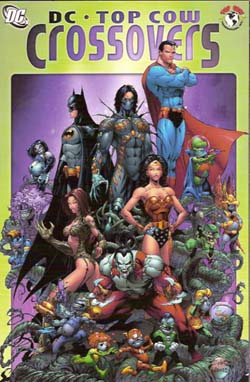
DC/Top Cow: Crossovers

DC/Top Cow: Crossovers

By various (DC Comics)
ISBN13: 978-1-84576-585-9

Most comics these days – at least from the larger publishers – have artwork of good to great quality. It’s no surprise, as there are a lot of artists, new and experienced, chasing relatively few jobs. Unfortunately it’s not so easy to drive up the quality of writing, and often people who can draw are just assumed to have the equivalent skills necessary to tell a tale well.

A sobering case-in-point is this collection of tales combining the biggest-guns of the oldest surviving comic book empire and one of the newest successes, which originally saw print as The Darkness/Batman, JLA/Witchblade, The Darkness/Superman #1-2 and JLA/Cyberforce between released in 1999 and 2005 and in which plot and character were continually sacrificed to the sales potential of empty fights and posturing.

The Darkness is Jackie Estacado, a Mafia hit man who has complete control of a supernatural force that manifests as demons who carry out his every wish and command. He’s in Gotham City to expand the Organisation’s power-base. And of course, Batman is not going to let him. Irrespective of Estacado’s self-doubts and avowed desire to change, there is no way on Earth an obsessive like Batman would allow him to leave without being sure that he would never kill again. But he does…

This is the responsibility of a huge cast of contributors including scripters Scott Lobdell and Jeph Loeb and artists Marc Silvestri, Dave Finch, Clarence Lansang, Joe Weems V, Danny Miki, Victor Llamas, Batt and Livesay but despite looking glitzy this is rushed and vacuous fare.

Written by Len Kaminski and illustrated by Mark Pajarillo and Walden Wong, JLA/Witchblade is a tale of Sara Pezzini, a New York cop bonded against her will to a supernatural, semi-sentient ultimate weapon. The Witchblade is as much her prisoner as her tool but when it escapes her control and possesses Wonder Woman, not even the Justice League can stop it from destroying the Universe.

Still looking for new territory Jackie Estacado hits Metropolis (are they really telling us that Superman’s home-town is more tempting than any other US city? Seriously?) where he starts killing mobsters, causing a gang-war. The second-rate threats of Metallo and Lois and Jimmy as hostages (because that’s never happened before) are enough to convince the Man of Steel to join forces with The Darkness and once again the mass-murderer gets off with a warning to leave town. The Darkness/Superman is written by Ron Marz with art by Tyler Kirkham and Matt “Batt” Banning, who should know better: I certainly do.

JLA/Cyberforce by Joe Kelly, Doug Mahnke and Norm Rapmund is by far the best of these unlikely team-ups. Here a team of cybernetically augmented individuals, once corporate mercenaries, wander the world looking for their lost leader, now possessed by an awesome alien force and a foe of all life. Their search leads them to a lost tomb deep below Budapest where the dead walk again, a threat certain to catch the attention of the Justice League.

This is a tale with some thought behind it for the fans of both series, a credible use of the characters and even some welcome and plausible character interaction. It’s nice to know that some one still recognises the value of a Story as well as a Property.

There will always be inter-company team-up comics as long as there’s more than one publisher. Let us hope future commercial exploitations realise the difference between comic strip art and comic strip-mining. One for collection completists only I fear.

© 1999, 2000, 2005, 2007 DC Comics. All Rights Reserved.