Lucifer: Morningstar

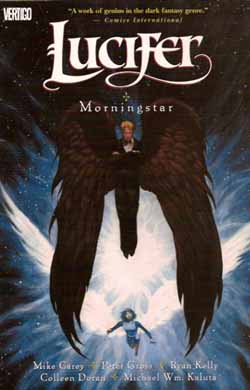
Lucifer: Morningstar 

By Mike Carey & various

(Vertigo)  ISBN 1-84576-293-2

The penultimate volume of this supernatural saga begins with another Earthly digression as a grim agent of the Angelic Host moves through Hamburg to deliver retribution to some of the mortals touched by this affair. The Wheels of God is drawn by Colleen Doran and the story originally saw print in issue 62 of the monthly comic.

Morningstar (from issues 63-65), illustrated by Peter Gross and Ryan Kelly, returns to the main storyline as the war of Heaven inches closer to the flashpoint and Lucifer battles the thing that has been hiding in Jill Presto’s womb. Acquiring allies in the strangest places, he then goes to Christopher Rudd to recruit the new warden of Hell and his remaining Damned, as the war starts and both sides begin to take casualties.

Michael Wm. Kaluta illustrates a second interlude, The Beast Can’t Take Your Call Right Now (issue 66). With all the demons and monsters battling at the end of creation, who is answering when mortals summon infernal powers to make those legendary deals? This much needed and wonderful light relief serves to brace you for the carnage to come as Morningstar resumes (issues 67-69) with a severely wounded Lucifer fending off Fenris, the Avatar of Destruction, who is determined to unmake everything and return the universe to primal chaos.

This is a classic and remarkable end to a spectacular comic series, delivering the emotional pay-off that it promised and more besides. And there’s still one more volume to go…

© 2006 DC Comics. All Rights Reserved.

Lucifer: Crux

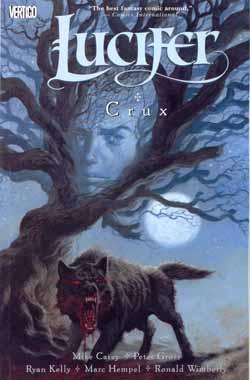
Lucifer: Crux 

By Mike Carey & various

(Vertigo)  ISBN 1-84576-23811-X

The war of Heaven is going badly for all concerned. God has vanished and, despite the machinations of each being of power, a rank outsider has assumed his position and responsibilities. Many disparate factions have aligned and realigned and final battle lines have been drawn. When the battle for everything begins it will affect all reality — and not all the combatants expect, or even plan, to survive.

The sides broadly coalesce into Lilith (the woman Adam and God replaced with Eve – and look how well that turned out!) and every creature that feels wronged or slighted by Heaven, ranged against the Host of Angels and Powers besieged in their Silver City. The first story, The Eighth Sin (issue #55 of the monthly comic), by Carey and artist Marc Hempel, concentrates on events in Hell as the Angels caretaking the fell domain cede control to medieval philosopher Christopher Rudd. Following is the eponymous Crux (issues #56-57), with art from Peter Gross and Ryan Kelly as Lilith recounts her meeting with a band of sinister beings at the fringes of creation and what she sacrificed to join their alliance to destroy Heaven.

The Yahweh Dance (drawn by Ronald Wimberly, from #58) depicts the first stumbling steps of the Replacement Creator and the amount of guidance one can honestly expect from the arch-rebel Lucifer. Gross and Kelly return to end the volume with The Breach (issues #59-61). As the preparations for all-out war accelerate and the implications are felt throughout the universe by all of the truly huge cast that populate this epic, the human Jill Presto must reach some accommodation with the supernatural force in her womb that intends to be born before it kills her — or she it.

Lucifer is a true epic that reaches beyond the cosmos by concentrating on the actions of small characters as well as mighty forces. It does the work no favours to parcel it up into broken portions, even if those portions are entire Graphic Novels.

Read in one continuous flow, it becomes a masterpiece.

© 2006 DC Comics. All Rights Reserved.

Lucifer: The Wolf Beneath the Tree

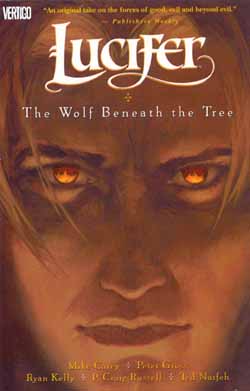
Lucifer: The Wolf Beneath the Tree 

By Mike Carey, Peter Gross, Ryan Kelly, P. Craig Russell & Ted Naifeh

(DC/Vertigo)  ISBN 1-84576-164-2

This would be a terrible book for a first time reader. The eighth collection of Mike Carey’s compelling new adventures of the devil collects the stories from issues #50, 45 and 51 – 54 of the monthly mature fantasy comic, and frankly, they’re all absolute crackers.

The first of these, Lilith, is a 40 page, self-contained delight illustrated by the magnificent P. Craig Russell, revealing not only the origins of Lucifer’s charismatic supernatural assistant Mazikeen, but also the building of the Silver City of the Host (where the Angels live) and the events leading to the Angel Samael’s defection from Heaven.

Another single issue tale, Neutral Ground, follows, with art by Ted Naifeh, relating the grim and cosmically unjust end of John Sewell, a poor working stiff who has the tragic misfortune to be selected as the venue for a board meeting of disaffected demons plotting to overthrow the current rulers of Hell. Either of these would be a wonderful introduction to a great series, so it’s a real pity that the main body of the collection recounts a pivotal tale in the seventy-five episodes (plus mini-series and one-shots) that tell the adventures of Lucifer since he abdicated his position as Lord of Hell in the Sandman volume Season of Mists.

Now, after many trials and tribulations, God has abandoned the universe and his disappearance has triggered the entropic end of Creation. Lucifer, who has made his own, separate, Universe, has reached a tense accommodation with his former peers and manoeuvres to survive and/or assume control. All the characters and sub-plots have to jockey for position in an outrageous coming together of disparate story-strands stretching back to the original mini-series and even the Sandman comics this title originally spun off from, when the Norse Deity Fenris attempts to bring Creation to a premature close on his own terms.

This is gripping reading, stylishly depicted by Peter Gross and Ryan Kelly, but you absolutely have to see what comes before if you want a cat in Hell’s chance of understanding what’s going on. So, why oh why waste two little gems, tailor made as “jump-on” stories, by cramming them into the equivalent of the middle reel of Citizen Kane or the last ten minutes of Fight Club?

© 2005 DC Comics. All Rights Reserved.

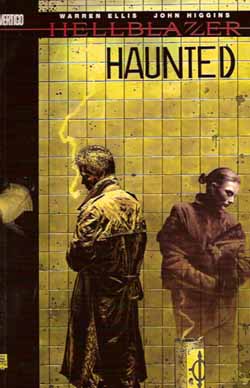
Hellblazer: Haunted, & Setting Sun

Hellblazer: Haunted 

HELLBLAZER: HAUNTED
ISBN 1-84023-362-1-

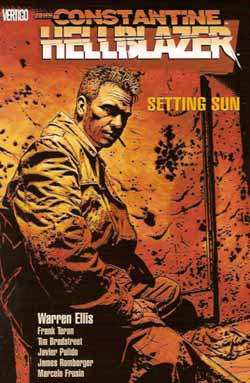
Hellblazer: Setting Sun

HELLBLAZER: SETTING SUN
ISBN 1-84023-923-9

By Warren Ellis & various (Vertigo)

Warren Ellis is an iconoclastic writer and very much a “big draw” at the moment and his short run on this venerable, not to say inconsistent, horror standby was long overdue for collection. It can’t have hurt to see the tag “major motion picture” finally applied to the guy either – Constantine that is, not Ellis.

Of the film I shall say nothing, but these two slim volumes, reprinting issues #134 – 143, show the character at his best. By turns sardonic and pathetic, vicious and vulnerable, John Constantine is perhaps comics’ most human hero, and in Haunted he returns to London to find one of his few fond memories destroyed and desecrated by an upstart wizard who has a nasty line in Sex Magic. A brand new cast of “old friends” come and go in a bloody welter before the world is put to rights, Constantine-fashion. The art is by the splendid, and always impressive, John Higgins.

Setting Sun is a series of single issue stories that highlight different aspects of a very, very complex character. Locked, illustrated by Frank Terhan, gives new meaning to the phrase ‘locked room mystery’, as well as initiating a new relationship for Constantine and the police, whilst The Crib, drawn by Tim Bradstreet, looks at a different kind of magic.

Javier Pulido handles the art on Setting Sun, a grisly exorcism tale. James Romberger draws a bittersweet romantic recollection, Hellblazer –style in One Last Love Song, and Telling Tales concludes the fear-fest, as Marcelo Frusin depicts a tense night’s drinking for Constantine and a new, if temporary, friend. For fans, these must represent Hellblazer at its gruesome best, but as an introduction to new readers brought in by the magic of celluloid, they are an invaluable insight into how the character should be played.

Both volumes © 1999, 2004 DC Comics

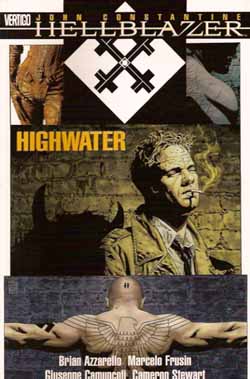
Hellblazer: Highwater

Hellblazer: Highwater

By Brian Azzarello, Marcelo Frusin, Guiseppe Camuncoli and Cameron Stuart

(Vertigo)  ISBN 1-84023-861-5

Highwater completes an epic comic strip road-trip across America by the trickster magician and thorough-going bastard John Constantine, as scripted by Brian Azzarello and previously seen in issues #164-174 of the monthly comic. For the beginnings of this US adventure the interested reader should seek out the trade paperbacks Hard Time (ISBN 1-84023-255-2), Good Intentions (ISBN 1-84023-433-4) and Freezes Over (ISBN 1-84023-531-4).

Here, the Scouser from Hell settles some old and justifiable scores with American Nazis, religious zealots, morally bankrupt billionaires and the USA’s covert government agencies, and still finds time for smoking, drinking and high-octane – not to mention often disturbingly graphic – sexual debauchery. It also depicts some of the nastiest violence seen in the series to date, from the likes of long-time 100 Bullets associate Marcelo Frusin, as well as Guiseppe Carmuncoli and Cameron Stewart, so be warned.

Hellblazer has consistently surprised everyone with its adaptability and longevity, and John Constantine is well on the way to becoming an iconic comics character. This volume, however, might not best serve as a first introduction to the old sod.

© 2001, 2002 DC Comics. All Rights Reserved

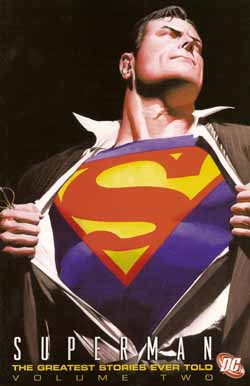
Superman: The Greatest Stories Ever Told, Vol Two

Superman: The Greatest Stories Ever Told, Vol Two 

By various

(DC Comics)  ISBN 1-84576-391-2

Here’s another collection of tales tracing the Man of Steel’s history and development, this time seemingly concentrating on character rather than physical achievement. First off is the much-reprinted, but always glorious, The Mysterious Mr. Mxyztplk (which was later Anglicised to Mxyzptlk, presumably to make it easier to spell) from Superman #30 (1944). Jerry Siegel and artist Ira Yarbrough created a cornerstone of the Superman myth with this screwball other-dimensional pixie, against whom all Superman’s strength and power are useless. From then on brains were going to be as important as brawn as they introduced frustration as the Big Guy’s first real weakness.

By the mid-1950s Superman had settled into an ordered existence. Nothing could really hurt him, nothing would ever change, and thrills seemed in short supply. With the TV show cementing the action, writers increasingly concentrated on supplying wonder instead. Superman’s Other Life by Otto Binder, Wayne Boring and Stan Kaye (Superman #132, 1959) shows what might have happened if Superman had grown up on an unexploded Krypton, courtesy of Batman and the projections of a super-computer.

Superman’s Return to Krypton (Superman #141, 1960) by Siegel, Boring and Kaye shoots successfully for Grand Tragedy as Kal-El is trapped in the past on his doomed home-world. Reconciled to dying there, he finds love with his ideal soul-mate, only to be torn from her side and returned to Earth against his will. This tale was a fan favourite for decades thereafter, and it’s truly deserving of a place in this volume, as is The Team of Luthor and Brainiac (Superman #167, 1964), a kid’s dream of an adventure by Edmond Hamilton (from a Cary Bates plot), Curt Swan and George Klein – possibly the most effective art team ever to work on the Man of Steel.

When Julie Schwartz took over the editorial duties, he decided to shake things up — with spectacular results. Superman Breaks Loose (Superman #233, 1971) by Denny O’Neil, Swan and Murphy Anderson, revitalised the Man of Tomorrow and began a period of superb stories that made him a ‘must-buy’ character all over again.

The Legend from Earth-Prime (Superman #400, 1984) is a clever little pastiche by Elliot S. Maggin and Frank Miller, and The Secret Revealed by John Byrne and Terry Austin comes from the second issue of the remodelled, Post-Crisis, Superman (1987), and reveals just how differently the new Luthor thinks and works. Following that is Life after Death (Adventures of Superman #500, 1993), by Jerry Ordway, Tom Grummett and Doug Hazlewood, the concluding episode of the infamous Death of Superman story-arc.

After a pin-up by Scott McDaniel and Andy Owens the volume concludes, symmetrically, with a recent, and absolutely hilarious, Mxyzptlk tale from Greg Rucka, Matthew Clark and Andy Lanning (Adventures of Superman #638, 2005).

Every generation has its own favourite Superman. This selection has the potential to make a fan reconsider just which one that might be. It’s probably wiser to just love them all.

© 1944, 1959, 1960, 1964, 1971, 1984, 1987, 1993, 2005 DC Comics. All Rights Reserved.

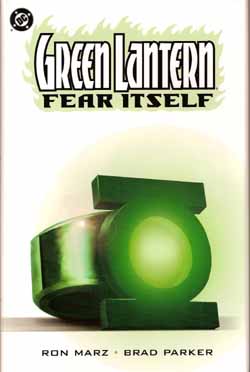
GREEN LANTERN: FEAR ITSELF

Green Lantern: Fear Itself 

By Ron Marz & Brad Parker

(DC Comics)  ISBN 1-56389-310-X

Comics has a rich history of successful character redesigns, and probably none more so than Green Lantern, whose backstory has now become the very fabric of the DC Universe. Therefore an epic tale featuring three generations of Emerald Crusader would seem like a fan’s dream come true.

At the beginning of World War II a team of Nazi occultists break in to a Washington DC museum and release a C’thulu-like monster. After a rampage where it defeats the mighty Justice Society by afflicting them with their deepest fears, only Alan Scott, the original Green Lantern, can throw off its attack and ‘destroy’ it.

During the height of the Cold War, test pilot and Green Lantern Hal Jordan thwarts a KGB attempt to retrieve the monster’s remains and inadvertently reactivates it himself. Although aided by the Justice League of America, it ultimately falls to Jordan himself to defeat the beast.

Kyle Rayner is (at this time at least) the last Green Lantern. A freelance artist and a more introspective type of hero, it’s up to him to find a final solution when the fear-monster returns for a last assault upon humanity.

This is not a particularly unique story, but the decision to use a computer-illustrator for the artwork did make it note-worthy at the time. To what degree that was a good decision is largely a matter of personal taste, but I suspect that this is a book that will only appeal to die-hard fans.

© 1999 DC Comics. All Rights Reserved.

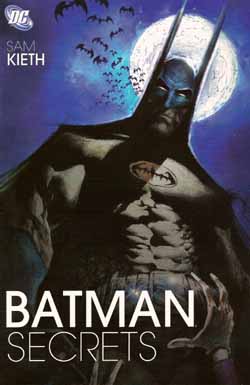
Batman: Secrets

Batman: Secrets

By Sam Kieth

(DC Comics) ISBN 1-84576-425-0

Fan favourite Sam Kieth returns to the caped crusader for an exploration of media tactics and exploitation in this dark, daft and slightly overblown psycho-drama. Somehow the Joker has convinced a parole–board to release him (and no, there’s no explanation as to how such a body can rule on someone under psychiatric detention, so just let it go) and is doing the chat show rounds, plugging his new book.

He hasn’t actually reformed though: Having seduced and enthralled the truly disturbed assistant D.A. handling his case, Joker plans more mischief — beginning with the murder of her boss. When Batman intervenes, two bystanders photograph the fight and a picture that seems to show our hero torturing the villain gets picked up by all the news services.

This is the spark for a media-storm as the jackals of the fourth estate smell a scoop. One of the news-barons, a childhood friend of Bruce Wayne (they share a bloody youthful secret), is blackmailed by the Joker to lead a witch-hunt to harass Batman whilst the mad clown fuels the media frenzy with fraud and slaughter in semi-successful attempts to frame the Dark Knight.

Batman must conquer his own secret past, save lives, and turn the tables on his manic foe’s most insidious scheme under the corrupt glare of a biased media that no longer has the will to assess or the time to judge the facts and actions it purports to report…

This is an oddly dissatisfying concoction. Kieth is a talented creator, and has some good points to make regarding the “if it bleeds, it leads, one picture is worth a thousand thoughts” mentality behind modern news-gathering. He should also be admired for attempting a slightly different style of story, but hasn’t quite pulled it off here. There are plot holes you could drive the Batmobile through, far too many manic head shots and too few backgrounds, establishing shots or even mid-, medium- and full-body long-shots. Visually, it’s as if he’s fallen for the very philosophical and aesthetic trap he decries in newsmen. Is a dramatic picture more worthy than context or narrative? You decide, obviously, but I’ll stick to style AND substance, if you don’t mind.

© 2006 DC Comics. All Rights Reserved

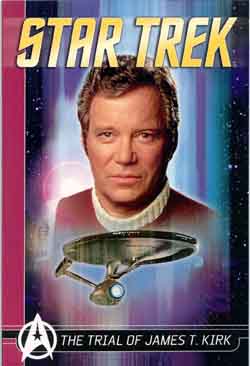
Star Trek: The Trial of James T. Kirk

Star Trek: The Trial of James T. Kirk

By Peter David, James W. Fry & Gordon Purcell

(Titan Books) ISBN 1-94576- 315-7

This edition of Titan’s Star Trek series of graphic novels collects issues #7-12 of the DC comics series from the 1990s. Here the creators try for tense rather than action packed, with a tale of political intrigue as a coalition of alien races (the Klingons and an uncomfortably Iranian-esque fundamentalist species called Nasguls) attempt to have Captain Kirk thrown into prison.

Things come to a head when the price on the Captain’s head leads the universe’s greatest bounty-hunter to attempt his capture — almost destroying the Enterprise in the process. Kirk voluntarily surrenders himself to end the constant disruption and naturally pulls a stunt that turns all those stacked tables against his foes. This stuff is pure classic Trek. The fans loved it then and will now. It’s also a very good example of how to do a licensed property in comic form and readers and wannabe creators should buy and take note.

™ & © 2006 CBS Studios Inc. All Rights Reserved.

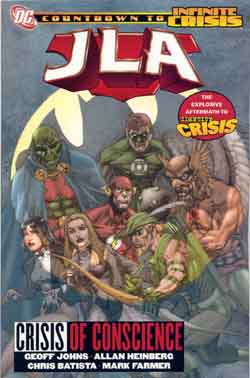
JLA: Crisis of Conscience

JLA: Crisis of Conscience

By Geoff Johns, Allan Heinberg, Chris Batista & Mark Farmer

(DC Comics)  ISBN 1-84576-279-7

Following on from the events of Identity Crisis, which revealed that some members of the JLA used inhumane, if not illegal, mind altering methods on their defeated foes, the once heroic team was divided and in turmoil. Not only had the erring heroes monkeyed with the villains’ minds, they had also tinkered with the brains of fellow heroes who objected to the measure.

Now those guilt-racked heroes are reaping the consequences as the villains return, with restored faculties and murderous intent, seeking their own kind of justice. So do Batman and Catwoman, who now also know what was done to them. Doing the wrong thing for the right reason has all but destroyed the League, and now they face destruction for their mistake. And who hates them enough, and is powerful enough, to have restored those doctored memories in the first place?

Although convoluted and a little histrionic in places, there’s still plenty of action and intrigue for super-hero lovers to enjoy here, but casual readers might be well advised to re-read Identity Crisis first.

This story first appeared in the monthly JLA comic, issues #115-119.

© 2005, 2006 DC Comics. All Rights Reserved.