Marvel Two-In-One Masterworks volume 8


By Tom DeFalco, David Anthony Kraft, Jan Strnad, John Byrne, Doug Moench, Ron Wilson, Alan Kupperberg, Chic Stone, Jim Mooney, Jon D’Agostino, “A. Sorted” & various (MARVEL)

This book includes Discriminatory Content produced in less enlightened times.

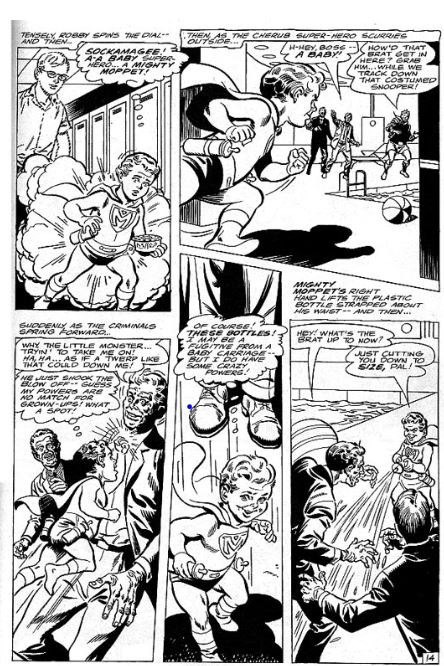
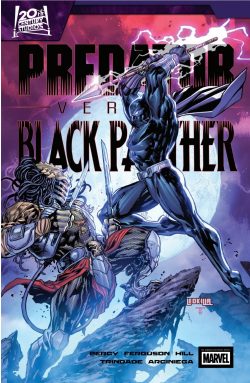
Above all else, Marvel has always been about team-ups. The concept of an established star pairing, or battling (often both) with less well-selling company characters was not new when Marvel awarded their most popular hero the same deal DC had with Batman in The Brave and the Bold since the early 1960s. Although confident in their new title, they wisely left options open by allocating an occasional substitute lead in The Human Torch. In those distant days, editors were acutely conscious of potential over-exposure – and as superheroes were actually in a sales decline, they might well have been right.

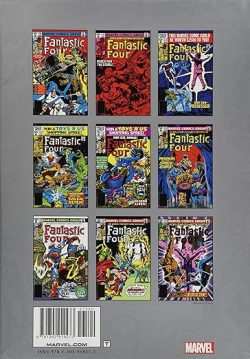
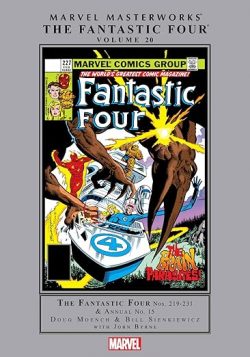
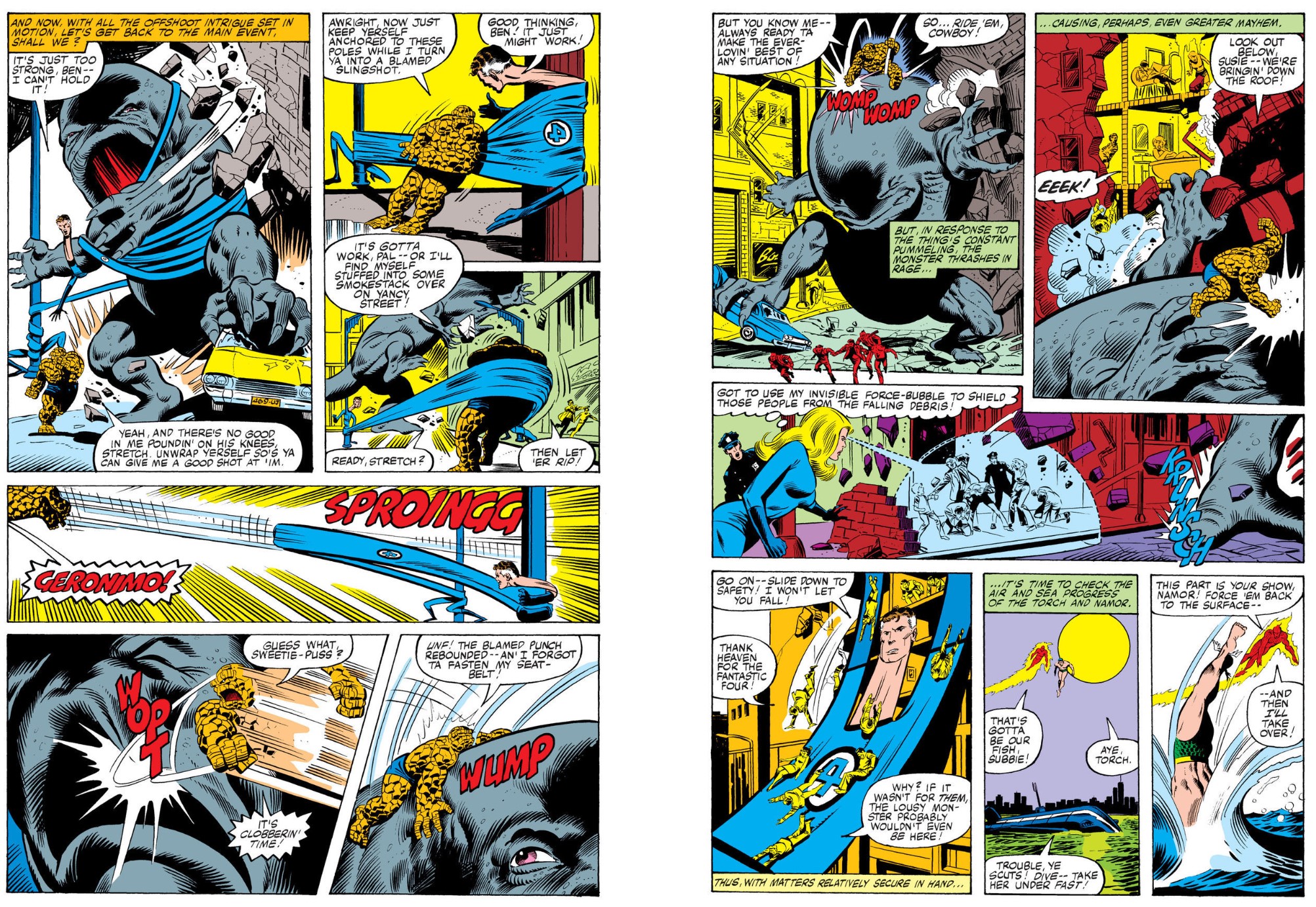
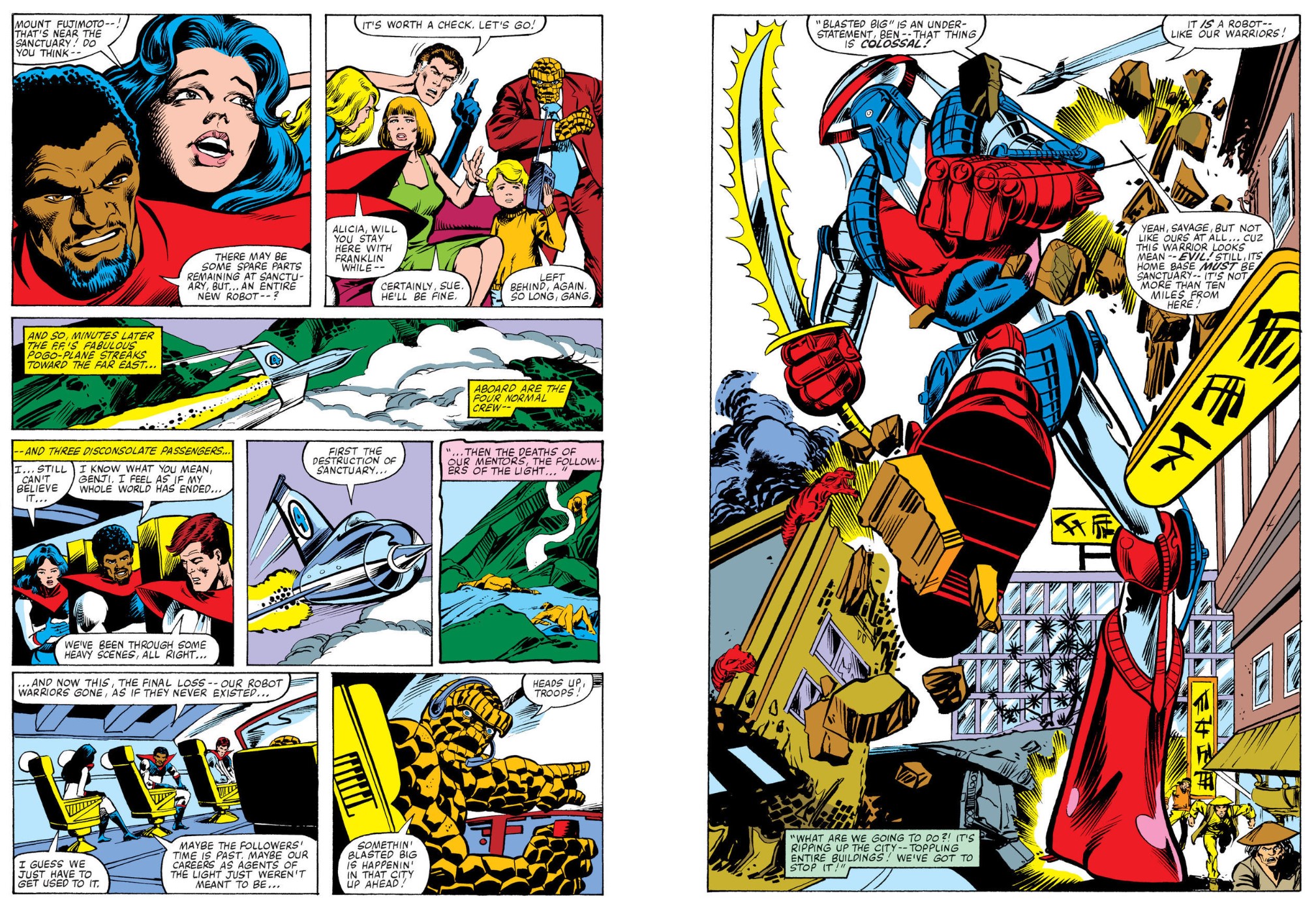
Nevertheless, after the runaway success of Spider-Man’s guest vehicle Marvel Team-Up, the House of Ideas ran with the trend with a series starring bashful, blue-eyed Ben Grimm – the Fantastic Four’s most popular character. They began with a brace of test runs in Marvel Feature #11-12 before awarding him his own team-up title, with this 8th rousing & rowdy round-up gathering the contents of Marvel Two-In-One #83-93 covering January 1980 through November 1982.

Preceded by another comprehensive, informative contextual reverie via editor Jim Salicrup’s Introduction ‘It’s Introducin’ Time or Two Marvel Introductions in One!’, a late-running annual event anachronistically opens the fun. Although released in summer 1980, steadfast stalwarts Tom DeFalco, Ron Wilson & Chic Stone counter the perennial problem of team-up tales – a lack of continuity (something Marvel always prided itself upon) – by returning to an extended subplot.

Previously Bill (Giant-Man) Foster had entered the final stages of his lingering death from radiation exposure, before a combination of heroes and villains had found a potential solution. Their success leads here to supergenius Reed Richards taking over Foster’s treatment, resulting in the Thing heading north in #83 to ‘Where Stalks the Sasquatch!’

The most monstrous member of Alpha Flight is actually radiation researcher Dr. Walter Langkowski, but his impromptu medical consultation obliquely leads to the release of malign Native American spirit Ranark the Ravager and a Battle Royale which quickly escalates to include the entire team in ‘Cry for Beloved Canada!’

‘The Final Fate of Giant-Man!’ came in Marvel Two-In-One #85 wherein Spider-Woman joined the Thing to tackle Foster’s arch-nemesis Atom-Smasher, after which ‘Time Runs Like Sand!’ offered an astoundingly low key landmark as Ben and the sinister Sandman had a few bevvies in a bar and turned the felon’s life around. Also included was a short, sharp comedy vignette wherein Ben and godson Franklin Richards deal with a bored Impossible Man and his equally obnoxious kids in ‘Farewell, My Lummox!’

When Ben is kidnapped in #87, the FF call in Ant-Man Scott Lang who helps our rocky rogue defeat a duplicitous queen in the ‘Menace of the Microworld!’ after which David Anthony Kraft & Alan Kupperberg join inker Chic Stone in detailing a ‘Disaster at Diablo Reactor!’, with Ben and the Savage She-Hulk countering the nefarious Negator’s plans to turn Los Angeles into a cloud of radioactive vapour…

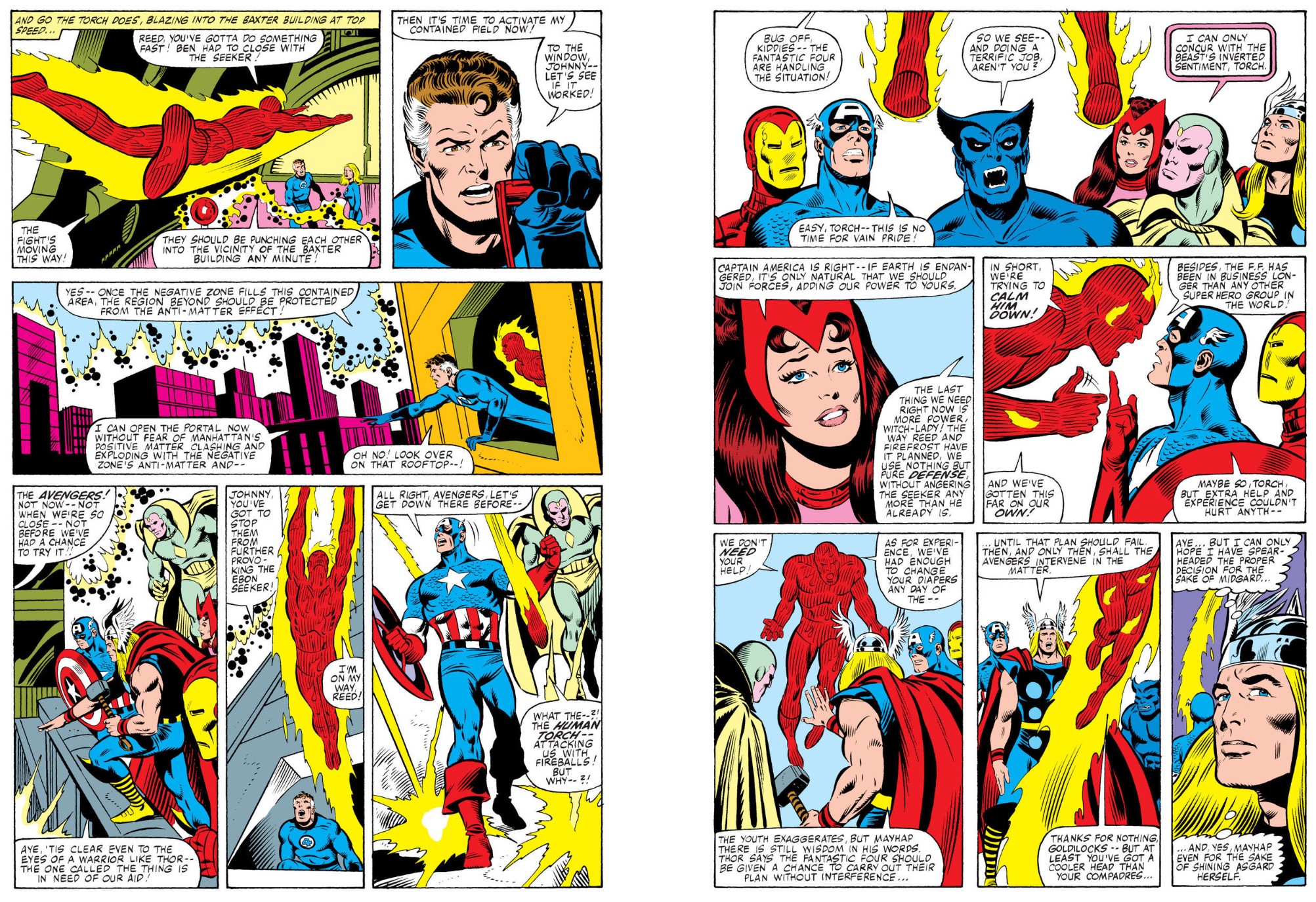
They then pit Ben and gadfly buddy the Human Torch against deranged demagogues seeking to stamp out extremes of beauty, ugliness, weakness and strength in ‘The Last Word!’ before Jan Strnad, Kupperberg & Jim Mooney pit Spider-Man and big Ben against time-bending chaos in ‘Eyes of the Sorcerer’. A new extended epic opened as DeFalco, Wilson & Jon D’Agostino reveal what lurks in ‘In the Shadow of the Sphinx!’ When mystic master Doctor Strange asks the thing to investigate a vision of Egypt, the bold battler falls into the clutches of immortal wizard The Sphinx who obsessively seeks to recover his power-providing Ka-stone. On the voyage back home after beating the bad guy, Ben encounters robotic Avenger Jocasta, but not in time to stop her helplessly reviving Ultron who has foresightedly pre-programmed the benighted mechanoid in DeFalco, Wilson & “A. Sorted” inkers’ ‘This Evil Returning…!’

When handmade hero Machine Man and his human assistants insert themselves into the crisis, they unexpectedly score a narrow win, but not before ‘And One Shall Die…!’

Closing with an original art gallery featuring pages and covers by Wilson, Stone, Al Milgrom, Kupperberg, Mooney, & “A. Sorted”, this penultimate character cohort compendium is packed with simple, straightforward Fights ‘n’ Tights meet, greet & defeat episodes: entertaining and exciting with no hint of pretension and no need to swot up on superfluous backstory.

Even if artistically the work varies from only adequate to truly top-notch, most fans of Costumed Dramas will find little to complain about and there’s plenty of fun to be found for young and old readers. So why not lower your critical guard and have an honest blast of pure warts-and-all comics craziness? You’ll almost certainly grow to like it…
© 2025 MARVEL.

Today in 1938 Jean-Claude Mézières was born. Have you seen his Valerian: The Complete Collection volume 1?

In 1956, the much-missed Peter David arrived. If you check out Star Trek Classics volume 5: Who Killed Captain Kirk? you’ll see that he left us far too soon.

Today in 1967 IPC (International Publishing Company) launched upscale UK girls comic Princess Tina.

Crucially, today is my 30-somethingth wedding anniversary. Hah! Can’t call me forgetful anymore! Rather surprised “Hi!” to anybody at the ceremony who is still alive after the last 36 years!

Justice League Hereby Elects…


By Gardner Fox, Denny O’Neil, Len Wein, Steve Englehart, Gerry Conway, Mike Sekowsky, Dick Dillin, Bernard Sachs, Joe Giella, Dick Giordano, Frank McLaughlin & various (DC Comics)
ISBN: 978-1-4012-1267-4 TPB/Digital edition

This book includes Discriminatory Content produced in less enlightened times.

“Just Imagine! The mightiest heroes of our time… have banded together as the Justice League of America to stamp out the forces of evil wherever and whenever they appear!”

The moment the Justice League of America was published marks the moment when superheroes truly made comic books their own particular preserve. Even though the popularity of masked champions has waxed and waned many times since 1960 and other genres have re-won their places on published pages, in the minds of America – and the world – Comics means Superheroes.

The JLA signalled that men – and even a few women and some alien migrants – in capes and masks were back for good…

When Julius Schwartz began reviving and revitalising the nigh-defunct superhero genre in 1956, his Rubicon move came a few years later with the uniting of these reconfigured mystery men into a team. The band of heroes debuted in The Brave and the Bold #28 (cover-dated March 1960 and on sale from February 24th) almost instantly cementing the growth and validity of the revived sub-genre, consequently triggering an explosion of new characters at every company producing comic books and spreading to the rest of the world as the decade progressed.

Originally – although Superman & Batman were included in the membership – participation had been strictly limited as editorial policy at the start was to avoid possible reader ennui and saturation from over-exposure. That ended with the lead story in this collection as they joined regulars Flash, Green Lantern, Wonder Woman, Aquaman and J’onn J’onzz: Manhunter from Mars to invite expansions to the roster. Spanning June 1961 to September 1980, this compelling compendium of classics compiles and re-presents Justice League of America volume 1, #4, 75, 105-106, 146, 161 and 173-174: issues that signalled the admission of many – but not all – new members…

First addition to the team since it’s premier, Green Arrow stormed into pride of place in ‘Doom of the Star Diamond’ (cover-dated May 1961 by Gardner Fox, Mike Sekowsky & Bernard Sachs), saving the day in a science-fiction thriller wherein a well-meaning alien exile threatens earth with destruction as part of a cunning plan to return to his own planet. Happily, when the whole scheme goes lethally awry the Emerald Archer is on hand to sort it all out…

Black Canary enlists after a tragedy on her own world (Earth-Two) resulted in the death of her husband during the annual JLA/JSA team-up. As a consequence, Dinah Drake-Lance emigrated to Earth-One, handily becoming the JLA’s resident Girl Superhero, and picking up a new – if somewhat unreliable – power in the process. The repercussions of her move and Green Arrow losing all his wealth made Justice League of America #75 (November 1969) one of Denny O’Neil’s best, and artists Dick Dillin & Joe Giella were on top form illustrating ‘In Each Man there is a Demon!’ Here the fallout of the trans-dimensional bout saw the hero-team literally fighting their own worst aspects in a battle they couldn’t win…

Crafted by Len Wein, Dillin & Dick Giordano, the “More-the-Merrier” recruitment drive continued in #105 (April 1973) wherein ductile detective Elongated Man signed up to save the day against marauding, malignant putty-men in ‘Specter in the Shadows!’ He was anonymously aided by a miraculously resurrected robotic Red Tornado who joined up in #106 (July 1973), utterly unaware he had been reprogrammed into becoming a ‘Wolf in the Fold!’ by his malign creator and future-tech plunderer Thomas Oscar Morrow. Nevertheless, the Amazing Android circumvents his malignant code to save the day and join the team…

Between that triumph and the next tale, the Tornado sacrificed himself to save his comrades, so they are rather surprised when he resurrects at the beginning of JLA #146 (September 1977), as Hawkgirl is finally invited to fight beside her husband Hawkman as a full-fledged member in full standing.

Steve Englehart, Dillin & Frank McLaughlin’s ‘Inner Mission’ details how electronic AI entity the Construct attempts to destroy the League from within and seals the growing tradition of making the team a multi-hued army of heroes. Long-term associate Zatanna was finally given the nod in #161 (December 1978) via ‘The Reverse-Spells of Zatanna’s Magic-Cigam’ by Gerry Conway, Dillin & McLaughlin. She seemingly turns them at first, but it’s just a ploy to expose a sinister magical infiltrator…

Wrapping up these narrative delights is a smart two-parter with a twist as the League seek to induct mysterious vigilante Black Lightning (JLA #173-174; December 1979 and January 1980). After much fervent debate, they decide to set the unsuspecting candidate a little task, but as a vermin-controlling maniac unleashes terror upon Metropolis, the ‘Testing of a Hero’ and subsequently ‘A Plague of Monsters’ (Conway, Dillin & McLaughlin) takes the old recruitment drive into a very fresh direction…

Bulking out this catalogue of Crisis challengers are assorted extra features including ‘JLA: Incarnations’, listing every League iteration and every member thereof; a poster by Ed Benes depicting the team in its entirety and a blank certificate affirming your personal membership in the ranks (don’t use ballpoint pen if you’re reading the eBook edition!)

These classical compendia are a dedicated fan’s delight: an absolute gift for modern readers who desperately need to catch up without going bankrupt. They are also perfect to give to youngsters as an introduction into a fabulous world of adventure and magic…
© 1961, 1969, 1973, 1977, 1978, 1979, 1980, 2006 DC Comics. All Rights Reserved.

On this day in 1922, DC Thomson’s legendary boys story paper The Wizard went on sale for the first time.

Today in 1931, E. Nelson Bridwell was born. His unique style can be enjoyed in books like Shazam!: The World’s Mightiest Mortal vol 3. One year later British illustration wizard Ian Kennedy was born. The last of his grand endeavours we covered was Battle of Britain War Picture Library.

Superman: Phantom Zone


By Steve Gerber, Gene Colan, Rick Veitch, Tony DeZuñiga & Bob Smith (DC Comics)
ISBN: 978-1-4012-4051-6 (TPB/Digital edition)

This book includes Discriminatory Content produced in less enlightened times.

Today would have been Steve Gerber’s 78th birthday. For no appreciable reason, he would have found that to be quite funny. You should go read more comics by him. Here’s some many people don’t immediately think of when listing his so-many sublime star turns…

Once upon a time for fans and comics creators alike continuity could be a harsh mistress. When maintaining a faux-historical cloak of rational integrity for made-up worlds we inhabited was paramount, the greatest casualty of semi-regular reboots and sweeping changes, often meant some terrific tales suddenly never happened. Everything goes now of course, thanks to parallel world-ery, but way back whenever, it was a most painful time for me…

Many examples of this wholesale binning of entire charm-drenched mythologies happened but the convergent growth of graphic novels fortunately provided a sanctuary of sorts, such as this paean of pictorial praise for the mythology had evolved around Superman in the wonder years between 1948 and 1986.

Thankfully DC has always understood that a good story is worth cherishing. This slim, trim spectral selection gathers superb 4-issue miniseries The Phantom Zone (originally appearing from January to April 1982) and includes the very last pre-Crisis on Infinite Earths Zone yarn as first seen in DC Comics Presents #97 (September 1986). It also simultaneously celebrates the stylish and enthralling scripting of unique comics voice Steve Gerber and his most ardent collaborator Gene (Howard the Duck, Stewart the Rat) Colan.

Gerber was a uniquely gifted writer who combined a deep love of comic book continuity minutiae with dark, irrepressible wit, incisive introspection, barbed socio-cultural criticism, a barely reigned-in imagination and boundless bizarre surrealism. His stories were always at the extreme edge of any mainstream company’s intellectual canon and never failed to deliver surprise and satisfaction, especially when he couched his sardonic sorties as thinly-veiled attacks on burgeoning cultural homogenisation and commercial barbarity.

This riotous recapitulation of all that lost Man of Tomorrow ficto-history begins in ‘The Haunting of Charlie Kweskill!’ as the eponymous Daily Planet paste-up artist collapses at work. The solitary little dweeb has been sleeping badly, plagued by nightmares of a life on long-gone planet Krypton. His dreams detail how brilliant scientist Jor-El devised a non-lethal way to deal with Krypton’s most incorrigible criminals: human monsters such as Jax-Ur, Professor Va-Kox, Dr. Xadu, sadistic psycho-killer Faora Hu-Ul, potential dictator General Dru-Zod, and even Jor’s own bad & crazy cousin Kru-El

Many lesser menaces like psionic aberrants Az-Rel and Nadira were also banished to the misty twilit realm, as well as stranger outcasts like callous biological experimenter Nam-Ek, but the one who most catches Charlie’s attention is fraudster Quex-Ul; a Kryptonian who appears to be Charlie’s doppelganger…

Of course, the dreams are all true: telepathic broadcasts beamed at Charlie by Zone inmates from within the plane of timeless intangibility. Quex-Ul had been one of them, surviving long after Krypton died, but was innocent of his crimes. He had been framed and mind-controlled by a mastermind who had deservedly perished when the Red Sun world detonated. Once Superman corrected the injustice and released the poor dupe, Qwex-Ul had saved the Man of Steel from a Gold Kryptonite trap, thereby losing his inherent Kryptonian abilities and memory in the process. The grateful, heartsick Action Ace had found the amnesiac a job at the Planet and almost forgot his alien origins in the years since. Charlie’s former fellow inmates had not…

Their telepathic onslaught turns Kweskill into a somnambulistic slave, unknowingly spending his nights breaking into labs and stealing high-tech components. Superman, slowly putting the puzzle pieces together, is just too late to thwart the stealthy scheme, and as he bursts into Charlie’s apartment a hastily cobbled together Phantom Zone projector hurls him and the hapless mind-slave into the ghostly region, whilst simultaneously freeing a legion of the cruellest and most bored criminals in existence…

The saga expands with ‘Earth Under Siege!’ as Superman and Charlie helplessly watch Zod, Jax-Ur, Va-Kox, Faora and Kru-El immediately undertake the next stage of their plan, leaving passively nihilistic Az-Rel and Nadira to negligently torture monstrous Nam-Ek with their psychic talents when not mocking the ranting liturgies of religious zealot Jer-Em, whose manic bigotry and fundamentalist isolationism caused the death of every person in Argo City

Superman’s cousin Kara Zor-El had been born on the city-sized fragment of Krypton, hurled intact into space when the doomed world detonated. Eventually, Argo turned to Green Kryptonite like most of Krypton’s detonated debris, and her dying parents, observing Earth through their scopes, sent their daughter to safety as they perished. On Earth, the teenager met the Man of Steel who created for her the identities of Linda Lee and Supergirl, concealing her from the wider world whilst she learned all about her new home… and how to use her astounding new abilities in secrecy and safety.

As the emotionally disconnected, disaffected and doubly alienated youths laconically saunter through Metropolis; casually slaughtering cops and citizens, Zod’s more motivated cronies have reached Superman’s Fortress of Solitude and destroyed the only means of returning them to their extra-dimensional dungeon.

The next move is attacking the Justice League satellite, hurling it and occupants Flash, Red Tornado, Zatanna, Black Canary, Elongated Man, Firestorm & Aquaman on a non-stop trajectory out of the Solar System. Rampant Kryptonians destroy Earth’s communications satellites and trigger a mass launch of nuclear missiles, leaving Wonder Woman and Supergirl to narrowly avert atomic Armageddon whilst the frantic Man of Tomorrow can only watch in horror…

Not every Zone inhabitant is a criminal. For instance, Daxamite Mon-El was exposed to common lead in ‘Superboy’s Big Brother’ (by Robert Bernstein & Papp in June 1961’s Superboy #89) when his lingering, inexorable death was only forestalled by depositing the dying alien in the Zone until a cure could be found. Now, as Green Lantern faces the Zod Squad on Earth only to be soundly beaten and have his Power Battery stolen, Mon-El informs Charlie and Superman of a possible back way out of the realm of hellish nullity…

On Earth, as Wonder Woman subdues Nam-Ek, Supergirl checks in with Batman, desperately trying to ascertain where Superman has gone. As the Dark Knight heads to Metropolis to investigate, Kara returns to the Fortress and is ambushed by Kryptonian escapees and beaten near to death…

With no other choice, Charlie and Superman reluctantly pass through a dimensional portal even the obsessed villains were too scared to risk, encountering surreal madness in ‘The Terror Beyond Twilight!’

Back in the physical world of touch and time, Supergirl saves herself from ghastly atomic disintegration as Charlie and Superman pass through stormy turbulence and a tedious waiting-room-realm before arriving on a peculiar plane where they are confronted by luscious sirens with impossible riddles and exploding heads. Their narrow escape from the Priestesses of the Crimson Sun only leads to Kryptonian wizard Thul-Kar who magicked himself into the Zone in ages past and now slavishly serves an erratic, malevolent sentient universe named Aethyr. It wants to consume Charlie and Superman but only by passing through it can they reach the physical world again…

On Earth, chaos reigns. Batman is utterly unable to pacify extremist Jer-Em, who deems the planet impure, unclean and unholy. He would rather die than soil his Kryptonian purity here.

… And high above the world, other freed villains have their own plan to fix the situation: a gigantic Phantom Zone Cannon to inexorably and eternally banish Earth into the twilight dimension in the course of one full rotation…

The drama comes to a tragic conclusion in ‘The Phantom Planet!’ as Az-Rel and Nadira, having found kindred spirits amongst Metropolis’ disenfranchised Punk Rock counterculture – before killing them – encounter Jer-Em in martyr mode. The now-suicidal cleric is quite keen on taking the rest of the apostate Kryptonians with him…

As the world turns into intangibility, in France, Faora has briefly resumed her passion for murdering males (before they’re all gone) whilst in Aethyr’s universe an appalling sacrifice enables Superman to return to physicality just in time to lead a last desperate charge, saving the day and putting the villains back where they belong… those still alive, that is…

The remainder of this fantastic collection recounts the tying up of all those intriguing concepts and loose ends in a spectacular sidebar to the end of DC’s original universe.

In 1986 the company celebrated its 50th year with groundbreaking Crisis on Infinite Earths: radically overhauling a convoluted multiversal continuity and starting afresh. All Superman titles were cancelled or suspended pending a back-to-basics reboot courtesy of John Byrne, allowing for a number of very special farewells to the old mythology. One of the most intriguing and challenging came in the last issue of DC Comics Presents (#97) wherein ‘Phantom Zone: the Final Chapter’ by Gerber, Rick Veitch & Bob Smith offered a creepy adieu to a number of Superman’s greatest foes.

Tracing Jor-El’s discovery of the Phantom Zone through to imminent multiversal annihilation, this dark yarn built on Gerber’s landmark miniseries and revealed that the dread region of nothingness was in fact a sentient echo of a dead universe which had always regarded the creatures deposited within it as irritants and agonising intruders.

Now as cosmic carnage reigns Aethyr, still served by Kryptonian mage Thul-Kar, causes the destruction of the Bizarro World “Htrae” and the deification/corruption of Fifth Dimensional pest Mr. Mxyzptlk, as well as the subsequent crashing of Argo City on Metropolis. As a result Zod and fellow immaterial inmates are freed to wreak havoc upon Earth – but only until the now-crystalline pocket dimension merges with and absorbs the felons, before implausibly abandoning Superman to face his uncertain future as the very Last Son of Krypton…

Superman has proven to be all things to all fans over his decades of existence and Gerber’s takes on these timeless tales of charm, joy and wholesome wit are unique and more necessary than ever: not just as a reminder of great tales of the past but as an all-ages primer of wonders still to come…
© 1982, 1986, 2013 DC Comics. All Rights Reserved.

Uncanny X-Men Marvel Masterworks volume 1


By Len Wein, Chris Claremont, Bill Mantlo, Dave Cockrum, Bob McLeod, Sam Grainger, Frank Chiaramonte & various (MARVEL)
ISBN: 978-0-7851-3702-3 (TPB) 978-0-7851-1192-4 (HB/Digital edition)

This book includes Discriminatory Content produced in less enlightened times.

Win’s Christmas Gift Recommendation: Timeless Mutant Masterpieces for all Blockbuster Comics Addicts… 9/10

In the autumn of 1963 The X-Men #1 introduced Scott (Cyclops) Summers, Bobby (Iceman) Drake, Warren (Angel) Worthington, Jean (Marvel Girl) Grey and Hank (The Beast) McCoy: very special students of Professor Charles Xavier. The teacher was a wheelchair-bound telepath dedicated to brokering peace and integration between the masses of humanity and the emergent off-shoot race of mutants dubbed Homo Superior; considered by many who knew him as a living saint.

After nearly eight years of eccentrically spectacular adventures the mutant misfits virtually disappeared at the beginning of 1970, during another periodic downturn in superhero comics sales. Just like the closing years of the 1940s, mystery men again faded away as supernatural mysteries and traditional genre themes once more dominated the world’s entertainment fields.

Although their title returned at the end of the year as a cheap reprint vehicle, the missing mutants were reduced to guest-stars and bit-players throughout the ongoing Marvel universe, whilst the bludgeoning Beast was opportunistically transformed into a scary monster to cash in on the horror boom. Then, as sales of the spooky stuff subsequently waned in 1975, Marvel Editor-in-Chief Roy Thomas green-lighted a bold one-shot as part of the company’s line of Giant-Size specials and history was made…

This fabulous compendium collection (available in luxurious hardcover, trade paperback and eBook editions) is perfect for newbies, neophytes and even old lags nervous about reading such splendid yarns on fragile but extremely valuable pulp paper. It celebrates the revival and unstoppable march to market dominance through the exuberant and pivotal early stories: specifically, collectively and cumulatively spanning May 1975 to August 1976 via Giant Size X-Men #1, and issues #94-100 of the definitely “All-New, All-Different” X-Men.

Tracing the reinvigorated merry mutants from young, fresh and delightfully underexposed innovations to the beginnings of their unstoppable ascendancy to ultimate comic book icons, in their own title and through an increasingly broad clutch of guest shots, the epic voyage begins with a classic mystery monster mash from Giant Size X-Men #1.

Len Wein & Dave Cockrum (the much-missed latter then a very red-hot property following his stint reviving DC’s equally eclectic fan-fave super-team Legion of Super-Heroes) detail in ‘Second Genesis!’ how the original squad -all but then-new Avengers recruit The Beast – have been lost in action. With no other choice Xavier is forced to scour Earth and the Marvel Universe for replacements…

To occasional foes-turned-friends Banshee and Sunfire is added a one-shot Incredible Hulk adversary dubbed The Wolverine, but the bulk of time and attention is lavished upon original creations Kurt Wagner, a demonic-seeming German teleporter codenamed Nightcrawler; African weather “goddess” Ororo Monroe – AKA Storm; Russian farm boy Peter Rasputin who turns into a living steel Colossus and bitter, disillusioned Apache superman John Proudstar who is cajoled into joining the makeshift squad as Thunderbird. The second epic introductory chapter ‘….And Then There Was One!’ reintroduces battered, depleted but unbowed team-leader Cyclops who swiftly drills the newcomers to a semblance of readiness before leading them into primordial danger against monolithic threat ‘Krakoa… the Island That Walks Like a Man!’

Overcoming the phenomenal terror of a rampaging rapacious mutant eco-system and rescuing the “real” team should have led to a quarterly Giant-Size sequel, but so great was fan response that the follow-up adventure was swiftly reworked into a 2-issue tale for a rapidly reconfigured comic book which became a bimonthly home to the new team. X-Men #94 (August 1975) began ‘The Doomsmith Scenario!’ – plotted by editor Wein, scripted by Chris Claremont and with Bob McLeod inking man-on-fire Cockrum – in a smart Armageddon-thriller with a newly pared-down strike-squad deprived of Sunfire and still-recuperating Marvel Girl, Angel, Iceman, Havok (Scott’s brother Alex) and magnetic Lorna Dane.

The neophytes are called in by Beast to stop criminal terrorist Count Nefaria starting an atomic war. The insidious mastermind has seized control of the US Norad citadel with a gang of artificial superhumans and accidentally escalated a nuclear blackmail scheme into an inescapable countdown to holocaust. Thus, the untrained, unprepared mutants are the only hope of saving the world in epic conclusion ‘Warhunt!’ (inked by Sam Grainger).

One of the new team doesn’t make it back…

X-Men #96 saw Claremont take full charge of the writing (albeit with plotting input from Bill Mantlo) for ‘Night of the Demon!’ Here, guilt-wracked Cyclops blames himself for the loss of his teammate, and in his explosive rage accidentally unleashes a demonic antediluvian horror from Earth’s primordial prehistory for the heroes-in-training to thrash. The infernal Nagarai would periodically return to bedevil mankind, but the biggest innovation in this issue was the introduction of gun-toting biologist/housekeeper Moira MacTaggert and the first inklings of the return of implacable old adversaries…

A long-running, cosmically-widescreen storyline began in #97 with ‘My Brother, My Enemy!’ as Xavier – tormented by visions of interstellar war – tries to take a vacation, just as Havok and Lorna (finally settling on superhero nom de guerre Polaris) attack: apparently willing servants of a mysterious madman using Cyclops’ old undercover alter ego Eric the Red. The devastating conflict segues into a spectacular 3-part yarn, as pitiless robotic killers return under the hate-filled auspices of mutant-phobic Steven Lang (and his mysterious backers in Project Armageddon). The action opens with #98’s ‘Merry Christmas, X-Men… the Sentinels Have Returned!’

With coordinated attacks capturing semi-retired Marvel Girl plus Wolverine, Banshee and Xavier, Cyclops and the remaining mutant heroes co-opt a space shuttle and storm Lang’s orbital HQ to rescue them in ‘Deathstar Rising!’ (inked by Frank Chiaramonte): another phenomenal all-action episode. The saga concludes on an agonising cliffhanger with the 100th issue anniversary tale. ‘Greater Love Hath No X-Man…’ (with Cockrum inking his own pencils) sees new X-Men apparently battle the original team before overturning Lang’s monstrous schemes forever. However, their catastrophic clash destroys the only means of escape and, as a gigantic solar flare threatens to eradicate the satellite-station, their only chance of survival means certain death for another X-Man…

To Be Continued…

With even greater excitement and innovation to follow in succeeding issues, these superb comics classics revolutionised a moribund genre and led directly to today’s ubiquitous popular cultural landscape where superheroes are as common as cops, cowboys, monsters or rom-com Romeos. They even made it into movies without looking ridiculous…

Extras include an introduction by Claremont; issue covers by Gil Kane, Cockrum, Marie Severin, Sal Buscema & Rich Buckler; Kane’s cover for eventual all-reprint Giant-Size X-Men #2; Cockrum’s designs for The Outsiders (a Legion of Super-Heroes 5-page spin-off pitch rejected by DC); character designs for Phoenix, Colossus & Nightcrawler; the cover to F.O.O.M.  #10 and caricatures of the X-Men creative team by Marie Severin; House ads and original art pages, roughs and covers by Kane & Cockrum completing the perfect primer/introduction to the New X-Men phenomenon.

The immortal epics compiled here are available in numerous formats but for a selection that will survive the continual re-readings of the serious, incurable fan there’s nothing to beat the sturdy and substantial full-colour feel of these Marvellous Masterwork editions.
© 2016 Marvel Characters, Inc. All rights reserved.

JSA vs. Kobra


By Eric S. Trautmann, Don Kramer & Michael Babinski, with Neil Edwards & various (DC Comics)
ISBN: 978-1-84856-955-3 (TPB)

This book includes some Discriminatory Content produced during less enlightened times.

After the actual invention of the comic book superhero – for which read Superman’s debut in 1938 – the most significant event in the genre – and indeed industry’s – progress was the combination of individual attention-getters into a group. Thus what seems blindingly obvious to us with the benefit of four-colour hindsight was proven: a number of popular characters could multiply readership by combining forces and readerships. Plus of course, a whole bunch of superheroes is a lot cooler than just one – or even one and a sidekick.

The Justice Society of America was created in the third issue (Winter 1940/1941) of All-Star Comics, an anthology title featuring established characters from various All-American Comics publications. The magic was instigated by the simple expedient of having the assorted heroes gather around a table and tell each other their latest adventure. From this low-key collaborative conference it wasn’t long before the guys – and they were all white guys (except Red Tornado who merely pretended to be one) – regularly joined forces to defeat the greatest villains and social ills of their generation. Within months the concept had spread far and wide…

And so the Justice Society of America is rightly revered as a landmark in the development of comic books and, when Julius Schwartz revived the superhero genre in the late 1950s, the game-changing moment came with the inevitable teaming of the reconfigured mystery men into a Justice League of America. From there it wasn’t long until the original and genuine article returned. There were many attempts to formally revive the team’s fortunes but it wasn’t until 1999, on the back of both a highly successful reboot of the JLA by Grant Morrison & Howard Porter, and a seminal but critically favoured new Starman by Golden Age devotee James Robinson, that the multi-generational team found a concept and fanbase big enough to support them. In 1999, the original super-team returned and have been with us in one form or another ever since. In this anniversary year there have numerous excellent efforts to revamp the original OG, and we’ll be getting to those in the months to come…

On sale from November 13th 1975 but cover-dated February 1976, Kobra originated in his own short-lived title during a period of desperate experimentation, whilst traditional superhero sales were plummeting and the industry feared its inevitable extinction. Credited to Martin Pasko, Steve Sherman, Jack Kirby & Pablo Marcos, the saga was a radical updating of Alexandre Dumas’ 1844 novel Les Frères CorsesThe Corsican Brothers

When conjoined twins Jeffrey and Jason Burr were surgically separated soon after birth, Jeffrey was abducted by disciples of the Cult of Kobra and raised to be their Dark Messiah: a deadly warrior, scientist and strategist dedicated to bringing about the end of civilisation and initiating a cleansing “Age of Chaos”. The peculiar circumstances of their birth meant that Jeffrey and Jason maintained an uncanny psychic connection wherein one would experience the hurts and harms inflicted upon the other. Over the years this led Jason to become the ultimate weapon in a war waged by numerous DC heroes against his serpentine terrorist sibling.

Eventually Jason was safely murdered by Kobra, but later resurrected as an even greater evil, assuming his brother’s position as head of the World’s most dangerous death-cult. The new Kobra was an utterly dedicated fanatic who wedded the cult’s technological resources to hideous, sacrificial blood-magic and preferred faith-driven disciples to the disaffected proto-thugs employed by his predecessor (for further details you should see Checkmate: Pawn Breaks or wait for me to finally review the new edition or just buy the book and take a chance…)

The JSA battled the first Kobra many times (most notably in JSA: Darkness Falls and JSA: Savage Times) but were utterly unprepared for the sheer horrors in store when they swung into action against the inheritor of the Snake cult…

This terse, tense collection re-presents 6-issue JSA vs. Kobra ‘Engines of Faith’ miniseries which, informed by the actions of real-world terrorism of fundamentalist factions around the globe, finally elevated Kobra to the first rank of villains: the deadly herald of the World’s End who plays a lethal game of cat-&-mouse with the Planet’s Smartest Man and some of the most experienced heroes of all time…

The Serpent Lord begins his campaign of terror in ‘Bad Religion’, dispatching suicide bombers to destroy the Justice Society in their own home and thereby confronting logic and superpowers with pure faith and high-tech explosives. Caught off guard by foes actually happy to die if they can strike a blow against their master’s enemies, the JSA are further wrong-footed by seemingly random attacks against civilians and institutions, all orchestrated by field commander and fanatical bride of death Ariadne Persakis.

The sheer scale of the bloodletting and illogical nature of the attacks soon has our heroes fighting amongst themselves as they strive to find some rhyme or reason behind such senseless, murderous assaults… so why then does Persakis abruptly surrender herself to their custody?

‘Strange Days’ finds the team seething but still unable to fathom the terrorist’s game plan… until Ariadne breaks free of Checkmate custody. Apparently the covert international spy-force has been hopelessly infiltrated and compromised. The senseless death-toll mounts exponentially and as, the team narrowly thwart an assault on a giant particle accelerator that could split the Earth in two, masked genius Mr. Terrific begins to discern a pattern to the random madness in ‘Misdirection’

Brutal attacks intensify and, although it appears the good guys are slowly gaining the upper hand, Terrific perceives the hidden agenda behind the unceasing ghastly blows against decency and civilisation. ‘Lightning in a Bottle’ sees Kobra make his ultimate move and apparently fail, leading to a gathering of champions ‘Beating the Grass’ and taking the war to the relentless foe, but even after stunning climax ‘Shedding Skin’ the weary heroes cannot be sure if they have won the day or somehow lost the war entirely…

This is a stunning piece of Fights ‘n’ Tights fiction: dark, dramatic and intensely compelling. Writer Eric S. Trautmann melded shiny superheroics, grim realpolitik and genuine cultural zeitgeists into a splendidly mature costumed drama, and the effective underplayed art of Don Kramer, Neil Edwards and inker Michael Babinski is chillingly effective at capturing the tone as well as the events.

If you think you’ve grown beyond gaudy mystery men and “goodies” against “baddies” this graphic novel is more than likely to make you think again.
© 2009, 2010 DC Comics. All rights reserved.

Star Trek: Gold Key Archives volume 1


By Dick Wood, Nevio Zaccara, Alfredo Giolitti & various (IDW)
ISBN: 978-1-61377-922-4 (HB/Digital edition)

This book includes Discriminatory Content produced in less enlightened times.

Star Trek debuted on American televisions on September 8th 1966 and ran until June 3rd 1969: three seasons comprising 79 episodes. A moderate success, it only really became popular after going into syndication, running constantly throughout the 1970s. It was also sold all over the world, popping up seemingly everywhere and developing quite a devoted fanbase.

Being a third world country, Britain didn’t see the show until July 12th 1969 during the rocket fever surrounding the Apollo moon landings, when BBC One screened “Where No Man Has Gone Before” in black-&-white before proceeding to broadcast the rest of the series in the wrong order. “Arena” was the first episode screened in colour (November 15th 1969), but viewers didn’t care. We were all hooked anyway and many of the show’s catchphrases – many erroneous and some entirely fictitious – quickly entered the popular lexicon of the nation.

The series spawned a licensed, British-originated comic strip which ran in Joe 90, TV21 and TV21 and Valiant from the late 1960s into the 1970s. These have also been collected and I’ll get to them in the fullness of time and space.

In the USA, although there was some merchandising, things were a little less enthusiastically embraced. Even though there was a comic book – from “properties magnate” Gold Key and running for almost a decade after the show’s cancellation – authenticity at the start wasn’t really a watchword. Nor was immediacy or urgency an issue. In fact, only six issues were released during the show’s entire three-season run. Published between July 1967 and December 1968, they are all gathered in this first archive Star Trek

Printing giant Whitman Publishing had been producing their own books and comics for decades through their Dell and Gold Key imprints, rivalling and often surpassing DC and Timely/Marvel at the height of their powers in sales and popularity. Famously Whitman never capitulated to the wave of anti-comics hysteria resulting in the crippling self-censorship of the 1950s and Dell Comics never displayed a Comics Code Authority symbol on their covers.

They never needed to: their canny blend of media and entertainment licensed titles were always produced with a family market in mind and the creative staff took their editorial stance from the mores of the filmic Hayes Code and the burgeoning television industry.

Just like the big and little screen, the product enticed but never shocked and kept contentious social issues implicit instead of tacit. It was a case of “violence and murder are fine, but never titillate”…

Moreover, the vast majority of their adventure comics’ covers were high quality photos or paintings – adding a stunning degree of veracity and verisimilitude to even the most outlandish of concepts for us wide-eyed waifs in need of awesome entertainment. The company seemed the only logical choice for a licensed comic book, and to be honest, these stories are cracking space opera yarns, even if they occupy an odd position in the hearts of older screen-dominant fans. In the UK, distribution of US comics was haphazard at best, but Gold Key Trek yarns were reprinted in our beloved and trusted hardback Christmas annuals. Nevertheless, the earliest ones bore little resemblance to what we’d seen on TV.

Our little minds were perplexed and we did wonder, but as the tales offered plenty of action and big sci fi concepts we just enjoyed them anyway.

Original British Star Trek yarns came in serialised comic-strip form, superbly illustrated and bearing a close resemblance to the source material. The feature only appeared as 2 or 3-page instalments in weekly anthologies, but was at least instantly familiar to TV viewers.

I discovered the answer to the jarring discrepancy, years later. Apparently scripter Dick Wood (a veteran writer who had worked on hundreds of series from Batman and the original Daredevil to Crime Does Not Pay and Doctor Solar, Man of the Atom) had not seen the show when commissioned to write the comic book iteration, and both he and Italian artists Nevio Zaccara – and latterly Alberto Giolitti – received only the briefest of outlines and scant reference materials from the show’s producers. They were working almost in the dark…

When you read these stories, you’ll see some strange sights and apparent contradictions to Trek canon lore, but they were all derived from sensible assumptions by creators doing the very best with what meagre information they had. If you’re likely to have your nostalgic fun spoiled by wrong-coloured shirts or Lasers rather than Phasers, think alternate universe or read something else. Ultimately, you are the only one missing out…

That’s enough unnecessary apologising. These splendidly conceived all-ages tales don’t deserve or need it, and even the TV wellspring was a constantly developing work-in-progress, as fan and occasional Trek scripter Tony Isabella reveals in his Introduction ‘These Are the Voyages…’

Accompanied by the stunning photo-collage covers and endpapers (an expensive rarity at the time outside Gold Key titles) the quirky collation of cosmic questing commences with ‘The Planet of No Return’ (by Wood & Zaccaria, from #1, July 1967) as the Enterprise enters a region of space oddly devoid of life and encounters predatory spores from a planet designated Kelly-Green. This is a world of horror where vegetative life contaminates and transforms flesh whilst mindlessly seeking to constantly consume and conquer. After the survivors of the landing party escape deadly doom and return to the safety of space, there is only one course of action Captain Kirk can take…

‘The Devil’s Isle of Space’ was released with a March 1968 cover-date and found the ever-advancing Enterprise trapped in a space-wide electronic net. The technology was part of a system used by an alien race to pen death-row criminals on asteroids, where they would be (eventually) executed in a truly barbarous manner. Sadly, it’s hard not to interfere in a sovereign culture’s private affairs when the doomed criminals hold Federation citizens hostage and want Kirk to hand his ship over to them…

Bombastic. beguiling and spectacular, ‘Invasion of the City Builders’ (#3, December 1968) saw legendary Alberto Giolitti take the artistic reigns. Prolific, gifted and truly international, his work and the studio he founded produced a wealth of material for three continents; everything from Le Avventure di Italo Nurago, Tarzan, The Phantom, Mandrake, Flash Gordon, Zorro, Cisco Kid, Turok, Gunsmoke, King Kong, Cinque anni dopo, Tex Willer and dozens more. In England, the Giolitti effect enhanced many magazines and age ranges; everything from Flame of the Forest in Lion to Enchanted Isle in Tammy. His textural adeptness and gritty line-work added visual terseness and tension to the mix, as seen in his first outing here, as Enterprise crewmembers land on a planet where automated machines originally programmed to build new homes and roads have been out of control for a century. Forcing the organic population to the edge of extinction, the mechs build cities no one can live in over the soil they need to grow food. The machines seem utterly indestructible, but Mr. Spock has an idea…

Social commentary gave way to action and suspense when ‘The Peril of Planet Quick Change’ (June 1969) finds the explorers investigating a world of chimerical geological instability, only to see Spock possessed by beings made of light. These creatures use him to finally stabilise their unruly world, but once the crisis is averted, one of the luminous spirits refuses to exit the Vulcan and plans to make the body its own…

‘The Ghost Planet’ (September 1969) was fast approaching parity with the TV incarnation as Enterprise reaches a world ravaged by radiation rings. Its twin rulers are eager for the star men’s help in removing the rings, but don’t want them hanging around to help rebuild the devastated civilisation. A little quiet investigation reveals that most of the carnage is due to eternal warfare which the devious despots plan to resume as soon as the Federation ship destroys the radiation rings and leaves…

Wrapping up this initial TV treasure-trove is ‘When Planets Collide’ (December 1969): a classic conundrum involving two runaway worlds inexorably drawn to each other and mutual destruction. What might have been a simple observable astronomical event becomes fraught with peril when the Enterprise’s crew discover civilisations within each world: both of which would rather die than evacuate their ancient homes…

With time running out and lives at stake there’s only one incredible chance to save both worlds, but it will take all Spock’s brains and Kirk’s piloting skill to avert cosmic catastrophe…

Bold, expansive and epic, these are great stories to delight young and old alike and well worth making time and space for. Why not explore lost worlds and sagas of guaranteed merit via the comics wayback machine? You know the one: it’s the comic shop located on the Edge of Forever?

® and © 2014 CBS Studios, Inc. Star Trek and related marks are trademarks of CBS Studios, Inc. All Rights Reserved.

Today Finnish cartoonist Lars Jansson was born today in 1926. You can see his work in Moomin Volume 9.

Today in 1937, Archie Goodwin was born: a gentle genius and still the Nicest Man in Comics, of whom you can learn more and appreciate his subtle mastery by checking Tales of the Batman: Archie Goodwin.

Superboy: A Celebration of 75 Years


By Jerry Siegel & Joe Shuster, Bill Finger, Otto Binder, Robert Bernstein, Jim Shooter, Paul Levitz, Gerry Conway, Elliot S! Maggin, Geoff Johns, Karl Kesel, Brian Michael Bendis, Peter J. Tomasi, Patrick Gleason, John Sikela, Curt Swan, Al Plastino, George Papp, James Sherman, Joe Staton, Phil Jimenez, Jerry Ordway, George Pérez, Ivan Reis, Tom Grummett, Dusty Abell, Matthew Clark, Francis Manapul, Viktor Bogdanovic, Jonathan Glapion & various (DC Comics)
ISBN: 978-1-4012-9951-4 (HB/Digital edition)

This book includes Discriminatory Content produced in less enlightened times.

Superman was the initiating spark that created the superhero genre. Without him we would have no modern gods to worship. However, within a decade of his launch, creators Jerry Siegel & Joe Shuster had evolved a revised a concept nearly as powerful and persistent: the sheer delight of a child no adult could dominate or control…

Ever-innovating DC’s Universe has hosted many key entertainment concepts that have done much to bring about the vibrant comics industry of today. This stunning compilation – part of a series reintroducing and exploiting the comics pedigree of veteran DC icons and concepts – is available in hardback and digital formats and offers an all-too-brief sequence of snapshots detailing how one of the most beguiling came to be, and be and be again.

Gathering material from More Fun Comics #101; Superboy #10, 89; Adventure Comics #210, 247, 271, 369-370; DC Comics Presents #87; Infinite Crisis #6; Superboy and the Legion of Super-Heroes #233, 259; Adventures of Superman #501; Superboy (volume 2) #59; Teen Titans (vol. 3) #24, Adventure Comics (vol. 2) #2; Young Justice (vol. 3) #3 and Superman (vol. 4) #6, 10-11, it reintroduces the many heroes – and villains – who have earned the soubriquet of the Boy of Steel,. Moreover, the landmark moments are all preceded by brief critical analyses by Karl Kesel, outlining the significant stages in their development.

It begins with Part I – 1945-1961: A Boy and His Dog

After the Man of Tomorrow made his mark as Earth’s premier champion, his originators took a long look and reasoned that a different tone could offer a fresh look. What would it be like for a fun-loving lad who could do literally anything?

The answer came in More Fun Comics #101 (cover-dated January/February 1945 but on sale from November 18th 1944) wherein Jerry Siegel & Joe Shuster shared ‘The Origin of Superboy!’ This fleshed out fabled and fabulous doomed Krypton and baby Kal-El’s flight: thereby giving him accessible foster parents and a childhood full of fun and incident…

The experiment was a monster hit. The lad swiftly claimed the lead slot of Adventure Comics and – in 1949 – his own title, living a life locked 20 years behind his adult counterpart. Cover-dated October 1950, Superboy #10 originated ‘The Girl in Superboy’s Life’, with Bill Finger & John Sikela introducing Smallville newcomer Lana Lang, who instantly sees resemblances between Clark Kent and the Boy of Steel and sets out to confirm her suspicions…

Despite battling crooks, monsters, aliens, scandal and the girl next door, Superboy enjoyed a charmed and wonderful life which only got better in Adventure Comics #210 (March 1955), as Otto Binder, Curt Swan & Sy Barry introduced ‘The Super-Dog from Krypton!’ Although waywardly mischievous and dangerously playful, Krypto heralded a wave of survivors from the dead world and made the Kid From Krypton feel less lonely and unique. Every boy needs a dog…

The next tale is a certified landmark. Adventure Comics #247 (April 1958) was at the cusp of the Silver Age costumed character revival, when Otto Binder & Al Plastino introduced a concept that would reshape comics fandom: ‘The Legion of Super-Heroes!’ The many-handed mob of juvenile universe-savers debuted in a Superboy tale wherein three mysterious kids invited the Smallville Sensation to the future to join a team of metahuman champions inspired by his historic feats. The throwaway concept inflamed public imagination and after a slew of further appearances throughout Superman Family titles, the LSH eventually took over Superboy’s lead spot in Adventure for their own far-flung, quirkily future-set escapades, with the Caped Kryptonian reduced to one of the crowd…

Before then, though, Adventure Comics #271 (April 1960) revealed ‘How Luthor Met Superboy!’ as Siegel & Plastino united to depict how teenaged scientist Lex Luthor and Superboy became fast friends, before the genius became deranged after a laboratory fire extinguished by the Boy of Steel caused Lex to lose his hair. Enraged beyond limit, the youthful inventor turned his talents to crime, evil and vengeance…

Robert Bernstein & George Papp introduced ‘Superboy’s Big Brother!’ in Superboy #89 (June 1961) in which an amnesiac, super-powered space traveller crashes in Smallville, speaking Kryptonese and carrying star-maps written by the Boy of Steel’s long-dead father Jor-El

Jubilant, baffled and suspicious in equal amounts, Superboy eventually, tragically discovers ‘The Secret of Mon-El’ by accidentally exposing the stranger to a lingering, inexorable death, before desperately providing critical life-support by depositing the dying alien in the Phantom Zone until a cure could be found.

Anybody who regularly reads these reviews know how crotchety and hard-to-please I can be. Brace yourself…

The following section – Part II – 1968-1980: The Space Age – concentrates on Superboy’s Legion career. That’s not the problem because those are great stories, well deserving of their own book, but they’re wasted here while the Boy of Steel’s adventures from this period are completely neglected. That’s work by the likes of Frank Robbins, Binder, Jim Shooter, Curt Swan, Bob Brown, Wally Wood and others we don’t get to see. Poor editorial decision, that…

Calm again, so let’s see how the Boy of Tomorrow fares one thousand years from now. During this period the youthful, generally fun-loving and carefree Club of Champions peaked; having only just evolved into a dedicated and driven dramatic action series starring a grittily realistic combat force in constant, galaxy-threatening peril. Although now an overwhelming force of valiant warriors ready and willing to pay the ultimate price for their courage and dedication, science itself, science fiction and costumed crusaders all increasingly struggled against a global resurgence in spiritual questioning and supernatural fiction…

The main architect of the transformation was teenaged sensation Jim Shooter, whose Legion of Super-Heroes scripts and layouts (generally finished and pencilled by the astoundingly talented and understated Curt Swan) made the series accessible to a generation of fans growing up with their heads in the Future. Ultimately, however, as tastes and fashions shifted, the series was unceremoniously ousted from its ancestral home and full-length adventures to become a truncated back-up feature in Action Comics. Typically, that shift occurred just as the stories were getting really, really good and truly mature…

Here, tense suspense begins with Adventure Comics #369’s (June 1968) and ‘Mordru the Merciless!’ (Shooter, Swan & Jack Abel) as the Legion are attacked by their most powerful enemy, a nigh-omnipotent sorcerer the entire assemblage only narrowly defeated once before.

A sneak attack shatters the team and only four escape, using a time bubble to flee to the remote and archaic time-period where Superboy lived. With him come Mon-El (freed from the Phantom Zone after 1,000 years to become a Legion stalwart), Shadow Lass and Duo Damsel – the last remnants of a once-unbeatable team.

Mordru’s magic is stronger, though, and even the time-barrier cannot daunt him…

Disguised as mere mortals, the fugitive Legionnaires’ courage shines through. When petty gangsters take over Smallville, the teen heroes quash the parochial plunderers and opt to return to the 30th century and confront Mordru, only to discover he’s found them first. The saga concludes in #370 with ‘The Devil’s Jury!’ wherein the kids escape and hide in plain sight by temporarily wiping their own memories to thwart the Dark Lord’s probes. Against appalling odds and with only Clark’s best friend Pete Ross and Insect Queen Lana Lang to aid them, the heroes’ doomed last stand only succeeds because Mordru’s overbearing arrogance causes his own downfall. Then, when the exhausted fugitives got back to the future, they joyously learn Dream Girl and benign sorceress White Witch have undone the deluded Dark Lord’s worst atrocities…

Since that time the fortunes and popularity of the Legion have perpetually waxed and waned, with their future history tweaked and overwritten, retconned and rebooted over and over again to comply with editorial diktat and popular fashion. After disappearing from the newsstands, the team returned as Guests in Superboy, before eventually taking over the title. Deju Vu, much?

November 1977’s Superboy and the Legion of Super-Heroes #233 sees the Krypton Kid join his teammates to thwart ‘The Infinite Man Who Conquered the Legion!’: an extra-long blockbuster battle by Paul Levitz, James Sherman & Bob Wiacek, after which issue #259 (January 1980) drops Superboy and the… to become Legion of Super-Heroes #259, subsequently ending an era. ‘Psycho War!’ by Gerry Conway, Joe Staton & Dave Hunt then sees the time-lost teen targeted by a deranged war veteran using futuristic trauma weapons, forcing his legion chums to mindwipe Kal-El and return him to his original time forever…

In the mid-1980s, DC’s editorial hierarchy felt their vast 50-year continuity was stopping them winning new readers. The solution was a colossal braided-mega series to streamline, redefine and even add new characters to the mix.

The worlds-shattering, reality-altering bombast of Crisis on Infinite Earths resulted in such spectacular commercial success, those movers-&-shakers must have felt more than justified in revamping a number of their hoariest icons for their next 50 years of publishing. As well as Superman, Flash, & Wonder Woman, many moribund and directionless titles were reconsidered for a radical revision. It didn’t all go to plan…

The background on a new Boy of Steel is covered in the essay and stories comprising Part III 1985-2006: Dark Reflection, opening with twinned tales from DC Comics Presents #87 (November 1985) by Elliot S! Maggin, Swan & Al Williamson. In ‘Year of the Comet’ Superman of Earth-1 meets and mentors teen Clark from an alternate world: one previously devoid of superheroes and alien invaders, after which ‘The Origin of Superboy-Prime’ exposes crucial differences that would make Earth Prime’s Last Son of Krypton so memorable. Events culminated in ‘Touchdown’ by Geoff Johns, Phil Jimenez, Jerry Ordway, George Pérez, Ivan Reis, inkers Andy Lanning, Oclair Albert Marc Campos, Drew Geraci, Sean Parsons, Norm Rapmund & Art Thibert, from #6 of Infinite Crisis (May 2006). Teen Clark had evolved into Superboy-Prime: one of the most sadistic, unstoppable monsters in DCU history… but here he met his end battling another kid calling himself Superboy.

That hero gets his own out-of-chronology section: Part IV 1993-2019: The New Kid detailing how he grew out of another different publishing landmark. Post-Crisis on Infinite Earths, Superman was stripped-down and pared back to basics, grittily re-imagined by John Byrne, and marvellously built upon by a succession of immensely talented comics craftsmen, resulted in some genuine comics classics. Most significant was a 3-pronged story-arc which saw the martyrdom, loss, replacement and inevitable resurrection of the World’s Greatest Superhero in a stellar saga which broke all records and proved that a jaded general public still cared about the venerable, veteran icon of Truth, Justice and the American Way.

The dramatic events also provided a spectacular springboard for a resurgent burst of new characters who revitalised and reinvigorated more than one ailing franchise over the next decade, all exploding from braided mega-saga “Reign of the Supermen” which introduced a quartet of heroes each claiming the mantle of Superman (Don’t panic: the Real Deal Man of Steel returned too!).

The final contender for the S-shield cropped up in Adventures of Superman #501. ‘…When He Was a Boy!’ (by Kesel, Tom Grummett & Doug Hazlewood) reveals the secret history of a brash, cocky kid wearing an adaptation of the Man of Tomorrow’s outfit and claiming to be the deceased hero’s clone, recently escaped from top secret bio-factory Cadmus. After alienating everybody at the Daily Planet, the horny, inexperienced juvenile latches onto ambitious young journalist Tana Moon and falls under the spell of corrupt media mogul Vinnie Edge. Soon the kid is fighting crime live on TV to boost ratings…

Blending fast action with smart sassy humour, the clone Superboy was a breakout hit that ran for years, even infiltrating the established Superman Family. A key moment came in Superboy (volume 2) #59 by Kesel, Dusty Abell, Dexter Vines as a virtual ‘Mission to Krypton’ results in the clone finally earning a family name as Kon-El of the House of El…

In the build-up to DC’s Infinite Crisis crossover event, many long-running story-threads were pulled together ready for the big bang. Crafted by Geoff Johns, Matthew Clark & Art Thibert, ‘The Insiders Part 1’ (Teen Titans #24, July 2005) reveals how Kon-El’s belief that he was Superman’s clone is shattered after learning that half of his DNA comes courtesy of Luthor. Just as the traumatised kid is about to share the revelation with his Teen Titan team-mates, Lex activates deep psychological programming to override Superboy’s consciousness and make him evil and murderous…

From November 2009, ‘The Boy of Steel Part Two’ (Adventure Comics vol 2 #2, by Johns & Francis Manapul) offers a gentler moment as Kon-El, now living in Smallville as Conner Kent, enjoys a potentially romantic interlude with team mate Wonder Girl before jumping to May 2019 and ‘Seven Crises Part Three’ from Young Justice volume 3 #3, by Brian Michael Bendis, Patrick Gleason, Viktor Bogdanovic & Jonathan Glapion. Having skipped two universe-altering events (Flashpoint and Rebirth) the formerly erased-from-continuity Impulse has found old friend Conner living in a mystic realm as part of his quest to put his old band back together. It’s fast, furious, heart-warming and hilarious. You should really get all of this tale in its own compilation – Young Justice: Gemworld – even before I review it next year…

Wrapping up this saunter in Super-kids’ shoes is the freshest take on the concept in decades. Part V 2016 and Beyond: Like Father, Like Son offers a too short glimpse at Jon Kent, the child of Superman and Lois Lane, inserted into mainstream continuity after the New 52 Superman died. If this is making your brain hurt, don’t fret. It’s only unnecessary background for some truly exemplary comics yarns…

Superman (volume 4) #6, 10, 11 are by Peter J. Tomasi, Patrick Gleason, Mick Gray, Mark Morales & Christian Alamy, and firstly depict the ‘Son of Superman’ helping Dad defeat evil Kryptonian mechanoid The Eradicator before settling into outrageous action comedy beside, with and frequently against Damian Wayne: son of Bruce and the latest, most psychotic Robin yet. ‘In the Name of the Father: World’s Smallest Parts One and Two’ pits the junior odd couple against aliens, monsters and girls, but mostly each other. It’s unmissable stuff and you should expect me to wax delirious about the new Super Sons in the New Year…

Adding immeasurably to the wonderment is a superb gallery of covers by Swan with Stan Kaye & Abel, Neal Adams, Mike Grell, Dick Giordano, Eduardo Barreto, Jim Lee & Sandra Hope, Grummett, Kesel & Hazlewood, Mike McKone & Marlo Alquiza, Manapul, Doug Mahnke & Wil Quintana & Gleason with Alejandro Sanchez, Gray & John Kalisz.

Superboy has a long, proud history of shaking things up and providing off-kilter fun to offset the general angst level of superhero storytelling. Even with my petty caveats, this compelling primer of snapshots is staggeringly entertaining and a monolithic testament to the inestimable value of a strong core concept matured over decades of innovation.
© 1960, 1964, 1969, 1977, 1982, 1984, 1987, 1997, 2000, 2006, 2005, 2011, 2018, 2020 DC Comics. All Rights Reserved.

Today in 1945 Go Nagai was born. You can meet him in our truly ancient review of Mazinger.

In 1956 Alex Raymond died today. We covered Flash Gordon on the Planet Mongo volume 1: Sundays 1934-1937 recently, but this master also triumphed with Secret Agent X-9, Jungle Jim, Blondie and Rip Kirby.

The Amazing Spider-Man Epic Collection volume 11: Nine Lives Has the Black Cat (1978-1980)


By Marv Wolfman, Bill Mantlo, Roger Stern, David Michelinie, Jim Starlin, Keith Pollard, John Byrne, Rich Buckler, Sal Buscema, Al Milgrom, Jim Mooney, Mike Esposito, Frank Giacoia, Terry Austin, Gene Day, Pablo Marcos, Bob McLeod, Frank Springer, Marie Severin, Alan Kupperberg & various (MARVEL)
ISBN: 978-1-3029-5641-7 (TPB/Digital edition)

Win’s Christmas Gift Recommendation: Spectacular Seasonal Spider Sensationalism … 8/10

This book includes Discriminatory Content produced in less enlightened times.

Peter Parker was a smart yet alienated kid when he was bitten by a radioactive spider during a school science trip. Developing astonishing arachnid abilities – which he augmented with his own natural chemistry, physics and engineering genius – the boy did what any lonely, geeky nerd would do with such newfound prowess: he tried to cash in for girls, fame and money.

Making a costume to hide his identity in case he made a fool of himself, Parker became a minor media celebrity – and a criminally self-important one. To his eternal regret, when a thief fled past him one night, the cocky teen didn’t lift a finger to stop him. When Parker returned home he learned that his beloved guardian uncle Ben Parker had been murdered.

Crazed with a need for vengeance, Peter hunted the assailant who had made his beloved Aunt May a widow and killed the only father he had ever known, finding, to his horror, that it was the self-same felon he had neglected to stop. His irresponsibility had resulted in the death of the man who raised him, and the traumatised boy swore to forevermore use his powers to help others…

Since that night he has tirelessly battled miscreants, monsters and madmen, with a fickle, ungrateful public usually baying for his blood even as he perpetually saves them, and by the time of the tales in this full-colour compendium of web-spinning adventures the wondrous wallcrawler was a global figure and prime contender for the title of the World’s Most Misunderstood Hero. Spanning November 1978 to July 1980, chronologically re-presenting Amazing Spider-Man #186-206, Annual #13 & Spectacular Spider-Man Annual #1 the transformative tales are an attempt to reconcile the tragic, ill-fated young man with the changing world of the fast-approaching, take-no-prisoners 1980s; and regrettably they don’t always succeed in our hindsight-equipped 21st century eyes…

Previously: old girlfriend and current neurotic stranger Betty Brant-Leeds returned after fleeing a dying marriage. She was absorbed with nostalgic notions to rekindle old flames with first love Peter Parker, but that mature-&-moved-on, almost-college-graduate’s social life was already deeply out of control. For his arachnid alter ego life involved constant attacks especially from increasing out-of-whack J. Jonah Jameson who funds yet another fringe science secret scheme to trap Spider-Man…

At this time a star of (1970s) television, the webslinger’s adventures were downplaying traditional fantasy elements as Keith Pollard became penciller for #186. Now, ‘Chaos is… the Chameleon!’ sees the devious disguise artist seeking to discredit the webslinger, even as District Attorney Blake Tower works to dismiss all charges against him, and is followed by a moody tale of lockdowns and plague as Spider-Man and Captain America unite to stop a voltaic villain inadvertently using ‘The Power of Electro!’ (Marv Wolfman, Jim Starlin & Bob McLeod) to trigger a biological time bomb…

Ruthlessly violent thugs are on the rampage next as ASM #188 depicts ‘The Jigsaw is Up!’ (illustrated by Pollard & Mike Esposito) after the river party cruise Peter, his pals and increasingly insistent Betty are enjoying is hijacked. Jameson’s secret then gets out to inflict ‘Mayhem by Moonlight!’ in a sharp two-part shocker limned by John Byrne & Jim Mooney. Exploited by malign and dying science rogue Spencer Smythe, Jonah is abducted by his own monster-marked son John leaving the wallcrawler ‘In Search of the Man-Wolf!’ Forced to witness the (presumed) death of his child at his worst enemy’s hands leads to a savage confrontation with Smythe’s Spider-Slayer robots in ‘Wanted for Murder: Spider-Man!’ (#191 by Pollard & Esposito) before all Jonah’s debts are paid and another death results after Spidey & Jonah are bound to the same bomb and given ‘24 hours Till Doomsday!’

Eluding doom by the skin of their shackled wrists, a new phase in the Jonah’s psychotic enmity begins in ASM #193’s ‘The Wings of the Fearsome Fly!’ with Wolfman, penciller Keith Pollard and inker Jim Mooney recapping how would-be Spider-Slayer Spencer Smythe had handcuffed JJJ to his despised bête noir Spider-Man in an explosive deathtrap and how that drew mutual old enemy The Fly as well as causing the death of John Jameson in his monster form of the ferociously feral Man-Wolf

Peter is most disturbed by a half-remembered moment. In that clash Jonah might have peeked under the arachnid’s mask whilst the wallcrawler was briefly unconscious, and not knowing is driving Parker crazy. The loss of his son has absolutely unhinged the publisher, however, and, after firing Peter, Jonah swears to destroy Spider-Man, even as Peter dutifully hunts down the Fly. He finally finds him robbing the Metropolitan Museum of Art and succumbs to an opportunity to release his pent-up anger. It ends badly…

In the aftermath, another plot strand resurfaces as Ned Leeds show up and punches Parker out. The incensed reporter thinks its justifiable as his (recently estranged) wife Betty has been nostalgically and aggressively pursuing old flame Peter. Meanwhile at May Parker’s empty house, a strangely familiar figure is tearing walls down hunting for something. After eventually giving up, he moves on to the Restwell Nursing Home where the widow Parker currently resides… and finds a situation he can readily exploit…

With life in turmoil Peter is poorly prepared for the major change that begins in #194, painfully learning ‘Never Let the Black Cat Cross Your Path!’ after encountering a svelte femme fatale costumed jewel thief with luck always on her side. However, she seems to have forsaken profit for a new, darker agenda. Inked by Frank Giacoia, the tale sees her recruit a crew to break someone out of jail, and – despite an obvious (and mutual) attraction to sexy Spidey – she will let nothing stop her…

Now working as a photographer for rival paper the Daily Globe where he immediately sparks the curiosity of reporter April Maye, Peter continues to pursue the feline felon in a chase to disaster, quickly realising ‘Nine Lives Has the Black Cat!’ (collectively inked by “M. Hands” Mooney, Mike Esposito & Al Milgrom). This affords an origin for the curvaceous crook and culminates in shocking news for Peter…

I’d normally give lip service here to “spoilers” and indeed back then, the death of Aunt May was – for a brief moment – a big deal, but it wasn’t real and didn’t last long. In-world though, Peter is crushed by the loss of his last relative and only family, with ‘Requiem!’ – limned by Milgrom, Mooney & Frank Giacoia – seeing him shattered by her “peaceful passing” whilst he was elsewhere, and at this moment still blithely unaware of a plot by unctuous home director Dr. Rinehart. Many older fans had already clocked who he really was…

Dazed and reeling, the hero is just starting to suspect something isn’t right as he’s ambushed by thugs and dragged to ‘The Kingpin’s Midnight Massacre!’ in ASM #197. Here Wolfman, Pollard & Mooney show the soon-to-be-retired crime lord packing to leave and up against an immovable deadline. To please his beloved wife Vanessa, the villain will cease his illegal activities at the witching hour. All that’s left on his to-do list is to kill Spider-Man, but the clock’s ticking and the wallcrawler just won’t die…

Building up to the anniversary spectacular and illustrated by Sal Buscema & Mooney, most dangling plot threads start cleaving together when Peter realises who Rinehart actually is and bursts into the Restwell Home in ‘Mysterio is Deadlier by the Dozen!’ to find the master of illusion preying on sundowning oldsters and teamed up with the burglar who shot Uncle Ben. Out of jail and desperate to retrieve something long hidden in the Parker house, the long-discarded thug has hijacked Mysterio’s comfortably risk-free scam and attracted the wrath of a really, really angry Spider-Man…

Despite fighting back fiercely in ‘Now You See Me! Now You Die!’ the writing is truly on the wall for the now-at-odds bad guys who meet their fates in The Amazing Spider-Man #200’s extra-length conclusion ‘The Spider and the Burglar… A Sequel!’ – cover dated January 1980 and courtesy of Wolfman, Pollard & Mooney.

With the truth out and May restored, Peter is ready for whatever the future holds as we segue into The Amazing Spider-Man Annual #13 where Wolfman, Byrne & Terry Austin occupy ‘The Arms of Doctor Octopus’ with a murderous scheme to regain his underworld reputation and dominance. The plot is brought to Spider-Man’s attention by murdered federal agent Kent Blake, who blackmails the hero into going undercover in the gang to recover stolen plans and ends with a catastrophic clash that sees the villain maimed…

Although momentarily defeated, Ock isn’t finished with New York or Spider-Man, and the saga continues and concludes in the first annual of a companion Spider-title. Before that, though, Annual traditions are upheld by additions to ongoing feature ‘A Gallery of Spider-Man’s Most Famous Foes’. Rendered by Pollard, the roster expands for The Molten Man, The Looter, The Rhino, The Shocker, The Kingpin, Silverman and Man-Mountain Marko, The Prowler and The Kangaroo before ending on ‘A Mighty Marvel Bonus’ offering updated locations and floorplans for ‘Peter Parker’s Pad!’, The Daily Bugle & Daily Globe offices and Empire State University Campus – and Peter’s colleagues.

The Spectacular Spider-Man Annual #1 details the denouement in ‘And Men Shall Call Him… Octopus!’ as Bill Mantlo, Rich Buckler & Mooney follow a furious and confused webslinger who uses Ock’s severed metal tentacle to lure the near-insane-with-pain-&-shock villain into a cataclysmic showdown aboard a ship’s graveyard in the East River and apparently final clash in an undersea base…

Dried out and back to business basics, the hero’s journey resumes in ASM 201’s ‘Man-Hunt!’ as Wolfman, Pollard & Mooney reunite the hero with The Punisher, whose hunt for a gang boss turns up a suspicious connection between photo seller Parker and his star subject Spider-Man…

Further muddying the waters is the latest woe to befall Jonah, whose nervous collapse devolves into pure mania, prompting his escape into delusion and the city’s back alleys. Guilt-ridden Parker can’t do much for his favourite gadfly, but can send Frank Castle on an identity-saving wild goose chase, before helping to deal with his latest target in concluding chapter ‘One For Those Long Gone!’

More infomercial than adventure – and probably a deadline-busting fill-in – Amazing Spider-Man #203 is one huge plug for Marvel’s disco sensation as Wolfman, Pollard, Esposito & Friends introduce Spider-Man to mutant musician Dazzler. The siren songstress is being hunted by old arachnid foe Lightmaster who needs her energies to bust him free of the light dimension that holds him captive but fails again in ‘Bewitched, Bothered and B-Dazzled!’

Another strong independent woman (re)appears in Pablo Marcos inked #204, as Wolfman signs off with ‘The Black Cat Always Lands on her Feet!’ Here the presumed-dead super thief returns to steal a selection of romance-themed art, and Spidey’s pursuit is the bandit’s actual goal. As seen in #205’s David Michelinie, Pollard & Mooney conclusion ‘…In Love and War!’, second generation purloiner Felicia Hardy has become fixated on the enigmatic masked man and stealing these items is her way of wooing the wallcrawler. Just for a change, this is a challenge requiring Parker’s mind and empathy, not Spider-Man’s might…

With an increasingly angry and unstable Joe Robertson replacing a lost amnesiac Jameson at the Daily Bugle, ASM #206 sees Roger Stern, John Byrne & Gene Day resolve the saga of his breakdown in closing inclusion ‘A Method in his Madness!’ Here it’s revealed that rogue scientist Dr. Jonas Harrow (who remade sundry second-rate thugs into super-foes like Will-O’the-Wisp, Kangaroo and Hammerhead) had turned the publisher’s office into a testing ground for his fringe science. Now that his Mental Attitude-Response Variator ray has driven Jonah to the edge of madness, Harrow plans to turn it on Spider-Man himself, but one last test on the entire Bugle staff gives our hero a heads-up and leads to the devil doctor’s defeat…

With covers throughout from Milgrom, Pollard, John Romita Sr., Buckler, McLeod & Josef Rubinstein, this tome also offers a selection of original art by Pollard with Mooney, Frank Giacoia and Byrne & Austin; Carmine Infantino & Steve Leialoha’s unused cover to Spider-Woman #9 where Wolfman originally intended Black Cat to debut, and Dave Cockrum’s revamped design for her as well as an unused Pollard & McLeod cover for ASM #194 and Cockrum’s rough for the cover they finally used. Completing the extras are House ads for forthcoming landmark ASM #200.

These yarns confirmed Spider-Man’s growth into a global multi-media brand. Blending cultural veracity with superb art, and making a dramatic virtue of the awkwardness, confusion and imputed powerlessness most of the readership experienced daily, resulted in an irresistibly intoxicating read, especially when delivered in addictive soap-styled instalments, but none of that would be relevant if Spider-Man’s stories weren’t so utterly entertaining. This action-packed collection relives many momentous and crucial periods in the wallcrawler’s astounding life and is one all Fights ‘n’ Tights fanatics must see…
© 2025 MARVEL.

Adventures of Superman: José Luis García-López volume 1


By José Luis García-López, Martin Pasko, Gerry Conway, Elliot S. Maggin, David Michelinie, Len Wein, Denny O’Neil, Bob Oksner, Frank Springer, Vince Colletta, Dan Adkins, Joe Giella, Steve Mitchell, Dick Giordano & various (DC Comics)
ISBN: 978-1-4012-3856-8 (HB/Digital edition)

This book includes Discriminatory Content produced in less enlightened times.

The American comic book industry would be utterly unrecognisable if Superman had never been born. His unprecedented adoption by a desperate and joy-starved generation quite literally gave birth to a genre if not an actual art form. Within three years of his June 1938 debut, the intoxicating blend of eye-popping action and social wish-fulfilment which hallmarked the early Man of Steel had grown to encompass cops-and-robbers crime-busting, socially reforming dramas, science fiction, fantasy, whimsical comedy and, once the war in Europe and the East embroiled America, patriotic relevance.

In many ways Superman is still master of the world, having utterly changed the shape of a fledgling industry and modern entertainment in general. There have been newspaper strips, radio and TV shows, cartoons games, toys, merchandise and blockbusting movies. Everyone on Earth gets a picture in their heads when they hear the name. Moreover, he is a character endlessly revitalised by the creators who work on his never-ending exploits. One the most gifted and intoxicating is José Luis García-López. An industry professional since he was 13 years old, the master illustrator was born in Pontevedra, Spain on 26th March 1948. By age three he was living in Argentina, and reared on a steady diet of comics: especially the works of Alex Raymond, Hal Foster, Alberto Breccia, Milt Caniff and José Luis Salinas.

During the late 1960s, García-López broke into the US comics world, with anthological romance work and anodyne horror tales for Charlton Comics which led to mystery-suspense yarns for Gold Key. In 1974 he moved to New York City where Joe Orlando got him a crucial intro meeting with DC Comics. That turned into a near-exclusive 40-year association which not only generated astounding comics sagas, but also saw the artist become the corporation’s official reference artist: the fount of all style guides and merchandising materials. His art was DC’s interface with the wider world.

After a few tentative inking jobs, García-López debuted as a DC penciller and inker on a Hawkman back-up in Detective Comics #452 in October 1975, and a month later was illustrating post-apocalyptic doomsday thriller Hercules Unbound. His sumptuous art could also encompass grim & gritty and he was drafted in to end the run on the company’s Tarzan title, and was afterwards handed western antihero Jonah Hex when the gunslinger – bucking all industry sales trends – graduated to his own solo title in early 1977.

The artist’s star was on the rise. While filling in all across the DCU – his assorted Superman tales are all in this stunning hardback/digital compilation – García-López was increasingly first choice for major publishing projects and events, such as the Marvel-DC Batman/Hulk tabloid crossover, prestige specials such the Superman/Wonder Woman clash included here and such breakthrough/breakout miniseries and graphic novels as Cinder & Ashe, Atari Force, Twilight, Star Raiders, Road to Perdition and many more. Paradoxically, he remains one of the company’s greatest artists and yet largely unknown and under-appreciated.

This splendid tome gathers the contents of Superman #294, 301-302, 307-309, 347; All-New Collectors’ Edition C-54 and DC Comics Presents #1-4, 17, 20, 24, 31: collectively spanning December 1975 through March 1981. Hopefully by the time I get to the sequel Superman and companion Batman volumes there will also be a DC Universe of… edition…

What we have here, though, is a boldly exuberant celebration of the Man of Steel, many with guest stars and all splendidly accessible to veteran fans and casual acquaintances alike.

The wonderment opens with a short back-up from Superman #294. Scripted by Martin Pasko and inked by Vince Colletta, ‘The Tattoo Switcheroo!’ details how Clark Kent escapes secret identity exposure after being nabbed by gangsters. Such pedestrian concerns are forgotten in Superman #301 (July 76) where Gerry Conway & Bob Oksner help prove ‘Solomon Grundy Wins on a Monday!’, as Earth-2’s monstrous zombie horror sideslips to Earth-1 to wreak havoc in Metropolis, thereby forcing the Action Ace to use brains rather than brawn to win the day.

An issue later, Elliot S. Maggin scripted ‘Seven-Foot-Two… and Still Growing!’ as fiendish scientist Lex Luthor finds a way to diminish the hero’s intellect by enlarging him to the point where his brain no longer efficiently connects to his dinosaur-dimensioned body. Thankfully, size-shifting hero The Atom is only a phone call away…

Curt Swan was Superman’s premiere artist for decades: a supremely gifted and conscientious illustrator who made the character his own. He was not, however, superhuman and while he was drawing what was then billed as “the longest Superman story ever” for DC Special Series #5 (Superman Spectacular 1977) García-López united with Conway and inker Frank Springer for issues #307-309 (January – March 1977), wherein the Man of Steel was deceived and deluded into believing his alien origins to be a comfortable fabrication to ease a human mutant’s twisted mind. In ‘Krypton – No More!’ Kal-El waged a war to save the environment from big business and their multipowered minions Radion & Protector, even battling his cousin Supergirl to disprove ‘This Planet is Mine!’ before the true story is revealed, just in time to tackle an alien invasion in ‘Blind Hero’s Bluff!’ as the Girl of Steel joined the now clear-headed hero and his faithful dog Krypto

Following that is one of the most impressive and fun comics sagas of the era. Written by Conway and inked by Dan Adkins, All-New Collectors’ Edition C-54 (January 1978) sees ‘Superman vs. Wonder Woman’ take us back to World War II, as Man of Steel and Amazing Amazon meet for the first time after Nazi Übermensch Baron Blitzkrieg and Japan’s infallible assassin Sumo the Samurai unite to steal a prototype atomic device. Although they should be allies, the heroes are quickly and cataclysmically at odds over the dispensation of the nuke so, once they stop fighting, they still must defeat the Axis Powers’ most fanatical operatives…

From the moment a kid first sees his second superhero the only thing they want is to see how the new gaudy gladiator stacks up against the first. From the earliest days of comic books (and according to DC Comics Presents editor Julie Schwartz it was the same with the pulps and dime novels that preceded it), we’ve wanted our idols to meet, associate, battle together – and if you follow the Timely/Marvel model, that means against each other – far more than we want to see them trounce archenemies in a united front…

The concept of team-up books – an established star pairing or battling (usually both) with less well-selling company characters – was far from new when DC awarded their then-biggest gun a regular arena to have adventures with other stars of their firmament, just as Batman had been doing since the middle of the 1960s in The Brave and the Bold. It was the publicity-drenched weeks before release of Superman: The Movie and Tim Burton’s Batman (which, BTW, García-López also provided designs for) was over a decade away…

The Metropolis Marvel had already enjoyed the serial sharing experience, when World’s Finest Comics briefly ejected the Caped Crusader and Superman battled beside a coterie of heroes including Flash, Robin, Teen Titans, Vigilante, Dr. Fate and others (issues #198-214: November 1970 to October/November 1972) before a proper status quo was re-established.

Star-studded new monthly DC Comics Presents was a big deal at the time, so only the utterly astounding and series-unattached José Luis García-López (inked by Adkins) could conceivably open the show. Silver Age Flash Barry Allen had been Superman’s first co-star in that aforementioned World’s Finest Comics run and he reprised his role in ‘Chase to the End of Time!’ and ‘Race to the End of Time!’ (DCCP #1 & 2: July/August & September/October 1978), with scripter Marty Pasko detailing how warring alien races trick both heroes into speeding relentlessly through the timestream to prevent Earth’s history being erased. As if that isn’t dangerous enough, nobody could predict the deadly intervention of the Scarlet Speedster’s most dangerous foe, Professor Zoom, the Reverse-Flash, who tries to turn the race against time to his own advantage.

David Michelinie wrote a tantalising pastiche of classic Adam Strange/Mystery in Space thrillers for García-López to draw and ink in ‘The Riddle of Little Earth Lost’, wherein the Man of Two Worlds and Man of Tomorrow foil the diabolical cosmic catastrophe scheme of deranged military genius Kaskor who intended to transpose and subjugate or destroy Earth and light-years-distant planet Rann.

Len Wein wrote the superb ‘Sun-Stroke!’ as the Man of Steel and madly-malleable Metal Men joined forces to thwart solar-fuelled genius I.Q. and toxic elemental menace Chemo after an ill-considered plan to enhance Earth’s solar radiation exposure provoked cataclysmic solar flares. With the title on solid ground the artist moved on, but returned with Gerry Conway and inker Steve Mitchell to herald the return of Firestorm in DCCP #17’s ‘The Ice Slaves of Killer Frost!’: a bombastic, saves-the-day epic returning the Nuclear Man to active DC pantheon service after a long hiatus.

In DCCP #20, Green Arrow steals the show in gripping, Big Business-busting eco-thriller ‘Inferno from the Sky!’ (Denny O’Neil, García-López & Joe Giella), after which the artist filled in with Conway on Superman #347 (May 1980) as the Last Son of Krypton clashes with a mythic cosmic courier in ‘The Sleeper Out of Time!’

In his peregrinations around the DCU, García-López had particularly distinguished himself with numerous episodes and fill-ins starring murdered aerialist Deadman. One of the very best came in DC Comics Presents #24 (August 1980) wherein scripter Wein reveals the tragic, chilling story of ‘The Man Who Was the World!’ as the grim ghost is forced to possess Superman and save the Earth… but fouls up badly…

Wrapping up this superb Fights ‘n’ Tights festival is ‘The Deadliest Show on Earth!’ (DCCP #31); written by Conway and inked by Dick Giordano, teaming Man of Steel and original Robin, the Teen Wonder Dick Grayson to conclusively crush a perfidious psychic vampire predating on the performers at the troubled Sterling Circus…

These tales are gripping fare elevated to epic heights by the magnificent art of one of the world’s finest artists. How could any fan possibly resist?
© 1975, 1976, 1977, 1978, 1979, 1980, 1981, 2013 DC Comics. All Rights Reserved.

The Tomb of Dracula Marvel Masterworks volume 1


By Marv Wolfman & Gene Colan, Gerry Conway, Archie Goodwin, Gardner F. Fox, Roy Thomas, Vince Colletta, Tom Palmer, Ernie Chan, Jack Abel, Steve Gerber, Rich Buckler & Pablo Marcos, Neal Adams & various (MARVEL)
ISBN: 978-1-3029-2947-3 (HB/Digital edition)

This book includes Discriminatory Content produced in less enlightened times.

Today in 1926 Eugene Jules Colan was born. In a long and illustrious career, this is what most people remember him for, and rightly so as it was always his baby…

At the end of the 1960s American comic books were in turmoil, much like the youth of the nation they targeted. Superheroes had dominated the market and zeitgeist for most of the decade; peaking globally before explosively falling to ennui and overkill. Familiar, trusted genres like horror, westerns and science fiction were resurgent, and fed back into comics thanks to radical trends in moviemaking, where the kids who had grown up with Marvel now pursued the bulk of their young adult entertainment needs.

Inspiration isn’t everything. In fact, as Marvel slowly grew to a position of market dominance in the wake of the losing their two most innovative and inspirational creators, they did so less by experimentation and more by returning to and expanding proven concepts and properties. The only real exception to this was the en masse creation of horror titles: an initial response to that industry downturn in super-hero sales – and a move vastly aided and expedited by a rapid revision in the wordings of the increasingly ineffectual Comics Code Authority rules.

The switch to supernatural stars had many benefits. Crucially, it particularly brought a new readership to Marvel comics, one attuned to the global revival in spiritualism, Satanism and all things sinisterly spooky. Almost as important, it gave the reprint-crazy company opportunity to finally recycle old 1950s horror stories that had been rendered unprintable and useless since the code’s inception in 1954.

A scant 15 years later Comics Code prohibitions against horror were hastily rewritten – amazing how plunging sales can affect ethics – and scary comics came back in a big way. A fresh crop of supernatural heroes and monsters popped up on newsstands to supplement the ghosts, ghoulies and goblins already infiltrating the once science-only scenarios of the surviving mystery men titles. Crucially, lifting the Code ban resulted in so many horror titles (both new characters and reprints from the massive, multi company horror-boom of 1949-1955) that it undoubtedly caused a few more venerable costumed crusaders to (temporarily, at least) bite the dust.

Almost overnight nasty monsters (and narcotics, but that’s another story) became acceptable fare on four-colour pages and – whilst a parade of pre-code reprints made sound business sense – the creative aspect of the contemporary buzz for bizarre themes was catered to by adapting or incorporating established and still-popular cultural icons before risking whole new concepts on an untested public. As always in entertainment, the watchword was fashion: what was hitting big outside comics must be incorporated into the mix as soon as possible. When science-backed proto-horror Morbius debuted in Amazing Spider-Man #101 (cover-dated October 1971) and the sky failed to fall in, Marvel moved ahead with a line of shocking superstars.

They began with a traditional werewolf and then an already infamous vampire before chancing something new with a haunted biker who tapped into both Easy Rider’s freewheeling motorcycling chic and the prevailing supernatural zeitgeist. Recycling an old western’s title, an all-new Ghost Rider debuted in Marvel Spotlight #5, August 1972. He had been preceded by western hero Red Wolf in #1 and the aforementioned Werewolf by Night in #2-4. From these beginnings, spooky floodgates opened to such an extent there was even room for non-white stars such The Living Mummy, Brother Voodoo and zombie Simon Garth

This momentously mean & moody compendium collects the neck-nuzzling dark lord’s earliest exploits from a time when he was regarded as an implacable outsider and murderous conquest-obsessed predator. They come from The Tomb of Dracula #1-11, April 1972 – August 1973, and are supported by material from mature-themed, monochrome magazine iteration Dracula Lives! #1-3 which – confusingly for the era – were constantly referenced in the colour comics even if us kids weren’t supposed to have them…

Thus they all lurk at the back of this grimoire of gore rather than unfold chronologically in-world.

Opening with a brace of revelatory, reminiscing Introductions from Roy Thomas and Marv Wolfman we learn the convoluted details and twisty path that led to disinterring the Count for his landmark debut in The Tomb of Dracula #1 cover dated April 1972 but actually on sale from November 16th 1971. By all accounts the simple use of a public domain character was an idea with many owners. Publisher Martin Goodman apparently pushed editor Stan Lee and never originally considered the project as a Marvel colour comic book. Nor was Gene Colan in the frame to draw it. The illustrator thought otherwise and aggressively and successfully campaigned for the job…

Eugene Jules Colan – sometimes AKA Adam Austin – was born in the Bronx and drew comics for almost his entire life. They included countless genre shorts in every conceivable field, plus character s like Daredevil, Batman, Superman, Wonder Woman, Howard the Duck, Iron Man, Sub-Mariner, Captain America, The Spectre, Hulk, Avengers, Kid Colt. Outlaw, Brother Voodoo, Star-Lord, Wolverine and more. His co-creations include first African-American superhero The Falcon, Guardians of the Galaxy, two Captain Marvels (Mar-Vell & Carol Danvers), Blade the Vampire Hunter, Dracula’s daughter Lilith, Night Force, Nathaniel Dusk, Silverblade, Detective Inc., Jemm, Son of Saturn, Jughead’s Time Police, Ragamuffins, and much work for Archie, Bongo, Comico, CrossGen, Disney, Fiction House, IDW & and Ziff-Davis Comics.

He also worked on franchises such as Unknown Worlds of Science Fiction, Jaws, Meteor, Elvira’s House of Mystery, Little Shop Of Horrors, DC Science Fiction Graphic Novel (#2, 1986 – Robert Silverberg’s Nightwings co-adapted with Cary Bates), Predator, Clive Barker’s The Harrowers: Raiders of the Abyss, Teenage Mutant Ninja Turtles Adventures, Buffy the Vampire Slayer and To Riverdale and Back Again.

Very much the Native New Yorker, Colan was schooled at George Washington High School, Washington Heights before attending the Art Students League of New York and being caught trying to enlist underage in the US Marines. Gene began drawing for pay in 1944 (for Wings Comics). Legitimate military service came quickly enough and he joined the Army Air Corps, but served on the ground in the Philippines until 1946. Thereafter, as a demobbed corporal he quickly found work drawing and lettering for Timely Comics: primarily crime, horror and war shorts… and the last few issues of Captain America Comics.

When the company imploded in 1948, Colan began freelancing for National/DC and Timely’s successor Atlas comics until their subsequent demise. His meticulous, authentic humanist style made him the go-to guy for the surging war comics genre at both companies and led to his first regular gig, illustrating DC licensed property Hopalong Cassidy from 1954-1957. From there he moved into National’s lucrative romance division, contributing regularly to all seven of their titles. Like fellow comics master John Romita and so many others, Colan was lured to Stan Lee’s latest enterprise when the Marvel Phenomenon properly took hold, and became a mainstay on the Man without Fear and literally dozens of other titles. Hedging his bets, at the time of his move he also began working on mature monochrome magazine horror tales for Archie Goodwin at Warren publications, contributing to Eerie and Creepy.

His unique artistic style of fluid motion and moody shadows meant he was always first choice when Marvel tried something off the beaten superhero track, such as Medusa, Doctor Doom and especially Doctor Strange, Howard the Duck (with comics “soulmate” Steve Gerber) and Dracula, but in 1981 increasing tensions between Colan and Editor-in-chief Jim Shooter led to the artist’s return to DC, experiments with the burgeoning Direct Sales marketplace and the most productive and expansive period of his comics career.

He periodically returned to Marvel with an award winning Captain America yarn, a fresh stint on Daredevil, further Tomb of Dracula tales with Marv Wolfman (as well as different Dracula series for Dark Horse) and an epic, revelatory anti-apartheid Black Panther saga penned by preferred collaborator Don McGregor Panthers Quest please link to Black Panther Marvel Masterworks volume 3, 9th August 2021.

In 2009 Captain America #601’s anniversary tale ‘Red, White and Blue-Blood’ (with scripter Ed Brubaker and inker Dave Gutierrez) won Colan an Eisner Award to add to his lifetime of prizes. Despite severe and escalating eyesight problems, Colan worked constantly and – as he had since the 1980s – still found time for gallery shows and teaching the next generation of pictorial storytellers at Manhattan’s School of Visual Arts and Fashion Institute of Technology. He died from complications of cancer and liver failure on June 23rd 2011.

For many afficionados, his work on Tomb of Dracula is probably his finest. Colan’s enthusiasm for the character and project were limitless and he survived a merry-go-round of early writers before the series found its feet. It also survived the crash of horror titles as the 1970s closed and carved a unique space for itself in Marvel continuity. It was revived many, many times, treating classic horror themes and tropes with deference, generating new stars and even wedging the Count into superhero crossovers that should not have worked but did. ToD deftly evolved from classic horror comics into a dark soap opera of character-based terror whilst seeking to get inside the mind of a protagonist who literally thought of humanity as food…

Extra-long, inked by Colan himself, and with the illustrator basing his star on the movie star Jack Palance, ‘Dracula’ stemmed from an idea by Lee, and was plotted by Roy Thomas with the final script coming via Gerry Conway & Colan. It introduces bankrupt wastrel Frank Drake, a bone fide descendent of the legendary literary icon. On learning he has inherited the family castle, Drake heads for Transylvania accompanied his new girlfriend Jeanie Ovington. Distressingly they also bring her last boyfriend Clifton Graves along. He’s convinced Frank to turn the foreboding fortress into a theme park and not-so-secretly seeks to reclaim Jeanie…

The villagers are divided between modernity and genuine fear of their “fictitious” Overlord who clearly hasn’t been dead very long…

Marooned in the village, the Americans take refuge in Castle Dracula where an attack by bats, ill-disguised jealousy and mounting tensions force bitter Clifton to explore. When he finds Count Dracula’s actual tomb, he inevitably pulls a stake out of the skeleton’s chest, and the fate of the world is sealed…

Before travelling from London, Frank had “researched” the project by studying Bram Stoker’s novel, but is utterly unprepared for the very real Lord of Vampires who reconstitutes, disposes of Clifton and hungrily attacks Jeanie. The monster is only driven off by his human relative’s new-found knowledge and unanticipated courage. Still weak and ravenous the Count instead descends upon to the village for much-needed liquid sustenance. With another blood-drained corpse in the street and the thought of a renewed campaign of terror, the villagers rise and attack the castle, but not in time to save Jeannie from Dracula’s assault…

Vince Colletta inks second issue continuation ‘The Fear Within!’ as heartbroken Drake explores his fire-gutted inheritance with new companion Gort. When their search uncovers Clifton still alive, they return to London with the monster’s coffin, blithely unaware that the vampire has already begun reactivating his widespread network of slaves and servants. Within a fortnight Dracula stalks the metropolis again, and sets his hungry thrall Jeanie on Drake and Graves whilst he recovers his dissipated energies in slaughter and feeding. However, when he finally attacks the interfering mortals it is Jeanie who pays the price…

Suicidal after losing his fiancée twice, Drake is saved from plunging off Westminster Bridge in ToD #3 by unsuspected allies. Written by Archie Goodwin and inked by Tom Palmer, ‘Who Stalks the Vampire?’ introduces Rachel van Helsing and mute Indian/Sikh Taj Nital, as well as Scotland Yard’s Inspector George Chelm. The lifelong vampire fighters have followed Drake’s actions and now recruit the despondent descendent, but are unable to prevent the undead devil enslaving Clifton, who then helps Dracula recover his much-needed coffin.

The foray is foiled by both police and thieves and the vampire is driven off, leaving behind not only his desperately needed bier but also the millions in gold bullion secreted within it: operating capital that could have helped the undead disappear from official scrutiny. Now forced to ignominiously flee, Dracula arrives at the isolated mansion of mystical collector Ilsa Strangway

A faded fashion model obsessed with regaining her beauty, Strangway has obtained Dracula’s journal and bargains with him to “turn” her in return for a mystical looking-glass that can open portals into time. However, his voyaging ‘Through a Mirror Darkly!’ (Goodwin, Colan & Palmer) only occurs after a cruel trick played on the decrepit ingenue, one she fully reciprocates before Frank, Rachel and Taj ambush the plotters and in the melee, Dracula slips into the mirror taking Taj with him…

Pulp stylist Gardner F. Fox signed on for two issues beginning with #5 as ‘Death to a Vampire-Slayer!’ found the Count consigned to a demon-dimension and protecting his human companion as his only viable food supply. Eventually another mirror takes them to 19th century Transylvania affording Dracula an opportunity to assassinate Rachel’s grandfather Abraham van Helsing decades before she was conceived…

His plans and veritable orgy of bloodletting are ruined however, when Rachel & Frank solve the mystery of the Strangway’s mirror and arrive in time to drive him off. Frustrated and furious Dracula returns to 1972 with his age-old vampire bride Lenore in tow…

Hotly pursued by Rachel, Frank and Taj, the chase returns them all to the heaths around the Strangway house where the vampire couple’s first kill is saved by ‘The Moorlands Monster!’ This misunderstood, shambling hulk is a family shame and secret covered up by the manorial Deering clan, who are currently hosting Inspector Chelm after he arrived to investigate more blood-loss killings…

The tragic brute also plays a crucial part in saving the vampire fighters when the Count and Lenore ambush them. After turning the tables on the vampires, Dracula is forced to sacrifice his returned love just to save himself…

Following months of fast paced rapidly changing uncertainty, a degree of stability arrived as Marv Wolfman took over scripting with #7’s ‘Night of the Death-Stalkers!’ When Dracula returns to modern-day London, he attacks young Edith Harker but is driven off her wheelchair-bound father and his dog Saint. He is Rachel’s mentor Quincy Harker (son of one of the original 19th century vampire hunters cited in Stoker’s novel) and a man merging knowledge with high tech innovation. After he summons van Helsing, Taj Nital & Drake, Quincy shares his history of battling Dracula, even as the undead lord further abuses Clifton Graves. Done with his foes’ interference Dracula hypnotically recruits an army of children and rats to destroy them but the attack goes wrong and the Count is poisoned by a wooden dart…

With Ernie Chua/Chan inking, the tale steps into high gear as ‘The Hell-Crawlers’ sees the wounded fiend head for another of his sleeper agents even as the vampire-fighters are surrounded by homicidal knife-wielding children. Although the adults initially escape, the kids’ programming is unshakable and pursuit relentless. However, Dracula’s long absence has weakened his control of clandestine bloodsucker Dr Heinrich Mortte – who has faithfully safeguarded a devilish device to raise the dead as vampires – and his servant rebels, battling his master for the doomsday ray.

Although triumphant, Dracula is severely wounded by the clash and loses control of his child death squad. He also falls into the ocean, and – with Colletta inking – resurfaces in quiet fishing village Littlepool which is soon blighted by ‘Death From the Sea!’ after local priest Father William exploits “Mr. Drake”’s miraculous survival to drive a local religious revival. However, as locals – such as biker/future vampiric archfoe Lucas Brand, goodtime girl Gladys and petty thug Corker continue to die, the remaining villagers are forced into the same kind of response that drove Dracula from Transylvania…

The colour chapters of our journey conclude with the introduction of what was frankly a daft idea but which was transformed by later writers in a mega-selling character-concept. Not here but soon, readers discovered a mouthy Jazz musician was immune to vampire bites (yes, I know, how feasible is it to be immune to bleeding to death?) whose mother was killed by a vampire whilst he was being born…

Released at the height of the movie “Blacksploitation” phenomenon, The Tomb of Dracula #10 was cover-dated July 1973 and introduced a hip, cool dude who played sax in nightclubs when not butchering Vamps and Fangers. Inked by Jack Abel, ‘His Name is… Blade!’ sees the wooden-knived wonder save dockside teens from Dracula’s ever-growing legions before rejecting a team-up plea from Harker. The rude refusal is a waste of breath as the object of their lethal desires is long gone, having already joined the sybaritic cruise of billionaire Garbiel Trulaine who has spiced up his voyage of Showing Off To Rival One-percenters with a unique guest and showpiece.

To their horror they all soon realise that money isn’t everything…

All but too late, Blade arrives to destroy Dracula but must settle for Clifton Graves and scuttling the Count’s scheme to swell his ranks and coffers, before we neatly segue into the Abel-embellished tale of ‘The Voodoo-Man!’ wherein Dracula’s desperate attempt to outfly the rising sun and reach a coffin stashed in Surrey Forest(!) gives way to some plot thread laying. Safely ensconced on native soil again, the Count considers further punishing the biker gang of Lucas Brand who had the temerity to attack his betters…

That thug is currently employed by iron-lung-entombed grudge-holder Jason Faust, tasked with torturing and killing three people who thwarted the paralysed potentate. The method is what is most important: Brand must use a hex doll and long sharp needle. However, Fate throws Brand to his own unsuspected tormentor when the proxy-killer attacks Faust’s third and final target… Quincy Harker. Dracula chooses to defer vengeance on his oldest enemy and instead play a cruel jest on the pawn he already has plans for…

Although painfully dated in places and cripplingly afflicted with what Americans thought British (and Transylvanian!) people sounded like, the power of the tales and especially Colan’s clearly inspired visualisations make these early exploits unmissable comics. Fans clearly agreed as the title spawned many, spin-off and guest-shots. Once Colan & Co completed the 70-issue series (plus all those extras) Comics Bulletin (2010) judged the result as #5 on the Top Ten List of 1970s Marvel comics…

As previously stated, an adult-oriented adjunct iteration was launched to capitalise on the comic book’s success. Dracula Lives! #1 coincided with the release of ToD #8, sporting a cover by Boris Vallejo and comprised of articles, photos, new comics and horror reprints.

The Contents page and editorial ‘Dracula is Alive and Well and Living on Madison Avenue!’ here join with house ads, recaptioned monochrome classic movie stills prior to black, white & red comics novella ‘To Walk in Daylight!’ as Steve Gerber, Rich Buckler & Pablo Marcos probe the Count’s past. The result finds Dracula prowling 19th century Vienna in search of an alchemist who claims to have a cure for the Undead’s fatal aversion to sunshine…

A grisly next issue ad precedes a selection from Dracula Lives! #2 with a cover by Penalva.

A Contents page, more funny photos precede a stunning historical yarn by Wolfman & Neal Adams. Set in 1459, ‘That Dracula May Live Again!’ observes how heroic Prince Vlad of Wallachia falls to Turkish invaders and why all-conquering Lord Turac came to regret leaving his broken trophy with vampiric gypsy Lianda. Origin done, more ads herald the contents of Dracula Lives! #3 (October 1973) where another Adams cover, Contents page and Movie Still continues the origin saga, as bereft of family, newborn vampire Vlad meets current king of the Undead Nimrod. Crafted by Wolfman, John Buscema & Syd Shores, ‘Lord of Death… Lord of Hell!’ reveals exactly how the proud noble became ruler of the dark legions, after which one last next issue ad brings the comics to a conclusion.

However, more treasure lies in store. As well as covers throughout by Adams, John Severin, Gil Kane, Palmer, John Romita, John Buscema & Frank Brunner, bonus materials include Thomas’s original plot synopsis for ToD #1; Colan’s try-out submission, 13 pages of original art, covers by Colan and Adams, Kane & Palmer cover #5, plus editorial alterations on this always contentious and worrisome title. There’s also Colan’s 1992 cover for The Savage Return of Dracula and a truly massive biographies section.

Beginning in a rather muddled, undirected and opportunistic manner The Tomb of Dracula developed under the guidance of scripter Wolfman and sublime artist Colan – especially when inked by Tom Palmer – into one the most celebrated and popular comics series of all time: one able to be subtracted from its conjoined continuity to stand alone as a classic of horror fiction. By today’s standards these are oddly coy horror stories for a generation born before “video nasties” and teen-slasher movies, so it’s unlikely that you’ll need a sofa to hide behind…
© 2021 MARVEL.

Win’s Christmas Gift Recommendation: Magical unrealism… 9/10

Comics master José Ortiz was also born today, in 1932. For more of us on him, you can go to The 10,000 Disasters of Dort or The Thirteenth Floor volume 01.