Marvel Platinum: The Definitive Iron Man Reloaded


By Stan Lee, Archie Goodwin, Mike Friedrich, Tony Isabella, Len Kaminski, Matt Fraction, Don Heck, George Tuska, Greg LaRocque, Kev Hopgood, Salvador Larroca, Carmine di Giandomenico, Nathan Fox, Haim Kano & various (Marvel/Panini UK)
ISBN: 978-1-84653-529-1 (TPB)

It’s hard to encapsulate six decades of excellence but as the Golden Avenger celebrates his anniversary, here’s a rare old gem from ten years gone, still readily available, that has a pretty good go at just that…

Produced under the always intriguing Marvel Platinum/Definitive Editions umbrella, this treasury of tales gathers a some of the more impressive but happily less obvious landmarks from the Steel Sentinel’s extensive canon; this time cannily focusing on sinister mastermind, ultimate arch-enemy The Mandarin.

Contained herein are high-tech hi-jinks from Tales of Suspense #50, Iron Man volume 1, #21-22, 68-71, 291 & 500, Marvel Team-Up #146 and Iron Man volume 5 #19, (listed on Marvel’s Database as Invincible Iron Man volume 1 #19), cumulatively spanning 1964 to 2011, and offering a fair representation of what is quite frankly an over-abundance of riches to pick from…

Arch-technocrat and supreme survivor Tony Stark has changed his profile many times since debuting in Tales of Suspense #39 (cover-dated March 1963) when, as a VIP visitor in Vietnam observing the efficacy of the munitions he had designed, he was critically wounded and captured by sinister, cruel Communists.

Put to work building weapons with the dubious promise of medical assistance on completion, Stark instead created the first Iron Man suit to keep himself alive and deliver him from his oppressors. From there it was a simple jump to full time superheroics as a modern Knight in Shining Armour…

Since then the inventor/armaments manufacturer has been a liberal capitalist, eco-warrior, space pioneer, Federal politician, affirmed Futurist, Statesman and even Director of the world’s most scientifically advanced spy agency, the Strategic Hazard Intervention Espionage Logistics Directorate, and, of course, one of Earth’s most prominent superheroes with The Mighty Avengers…

For a popular character/concept lumbered with a decades-long pedigree, radical reboots were and are a painful but vital periodic necessity. To keep contemporary, Stark’s origin and Iron Man’s continuity have been drastically revised every so often with the crucible trigger event perpetually leapfrogging to America’s most recent conflicts. As always, change is everything but, remember, these aren’t just alterations, these are upgrades…

After a mandatory introduction from co-originator Stan Lee, the star-studded action begins with ‘The Hands of the Mandarin!’ from Tales of Suspense #50 wherein the wonderful Don Heck returned as regular penciller and occasional inker after a brief absence, and Lee introduced The Golden Avenger’s first major menace. This was a contemporary Fu Manchu who terrified the Red Chinese so much they manoeuvred him into attacking America in the hope that one threat would destroy the other. Please, if you can, remember that these were simpler, less evolved and far more casually racist times than today…

In response, the Golden Avenger invades the mastermind’s Chinese citadel where, after a ferocious but futilely inconclusive fight, he simply goes back home to the Land of the Free. The furious Mandarin holds a grudge, however, and would make himself arguably Iron Man’s greatest foe.

Of course, whilst Stark was the acceptable face of 1960s Capitalism – a glamorous millionaire industrialist, scientist and a benevolent all-conquering hero when clad in the super-scientific armour of his alter-ego – the turbulent tone of the 1970s soon relegated his suave, “can-do” image to the dustbin of history. With ecological disaster and social catastrophe from the myriad abuses of big business manifestly the new zeitgeists of the young (and how right they were!), the Metal Marvel and Stark International were soon confronting tricky questions from their increasingly politically savvy readership. With glamour, money and fancy gadgetry not quite so cool anymore, the questing voices of a new generation of writers began posing uncomfortable questions in the pages of a series that was once the bastion of militarised America…

Iron Man #21-22 (January & February 1970, by Archie Goodwin, George Tuska & Mike Esposito-as-Joe Gaudioso) found the multi-zillionaire trying to get out of the arms business and – following a heart transplant – looking to retire from the superhero biz. African-American boxer Eddie March became ‘The Replacement!’ as Stark, free from the heart-stimulating chest-plate which had preserved him for years, was briefly tempted by a life without strife. Unknown to all, Eddie had a major health problem of his own…

As Stark pursued a romantic future with business rival Janice Cord, her chief researcher and would-be lover Alex Niven was revealed as a Russian fugitive using her resources to rebuild the deadly armour of the Crimson Dynamo. Niven easily overcame the ailing substitute Avenger and, when Soviet heavy metal super-enforcer Titanium Man resurfaced with orders to arrest the defector, a 3-way clash ensued. Stark was forced to take up his metal burden again – but not before Eddie was grievously injured and Janice killed in #22’s classic tragedy ‘From this Conflict… Death!’

Stark’s romantic liaisons always ended badly. Four years later he was ardently pursuing Roxie Gilbert, a radical pacifist and sister of his old enemy Firebrand. She, of course, had no time for a man with so much blood on his hands…

Iron Man #68-71 (June to November 1974) was the opening sortie in a multi-part epic which saw mystic menace The Black Lama foment a war amongst the World’s greatest villains with ultimate power and inner peace as the promised prize. Crafted by Mike Friedrich, Tuska & Esposito, it began in Vietnam on the ‘Night of the Rising Sun!’ as the Mandarin struggled to free his mind (at that time trapped in the dying body of Russian villain the Unicorn).

Roxie had dragged Stark to the recently “liberated” People’s Republic in search of Eddie March’s lost brother: a POW missing since the last days of the war. The Americans were soon separated when Japanese ultra-nationalist, ambulatory atomic inferno and sometime X-Man Sunfire was tricked into attacking the Yankee Imperialists. The attack abruptly ended when Mandarin shanghaied the Solar Samurai and used his mutant energies to power a mind-transfer back into his own body.

Reborn in his original form, the deranged dictator began his campaign in earnest, eager to regain his castle from rival “oriental overlord” Yellow Claw. First, though, he had to crush Iron Man who – in ‘Confrontation!’ – had tracked him down and freed Sunfire A bombastic battle ended when the Golden Avenger was rendered unconscious and thrown into space…

‘Who Shall Stop… Ultimo?’ found the reactivated giant robot-monster attacking Mandarin’s castle even as the tyrant duelled the Claw to the death, with Iron Man and Sunfire arriving too late and left to mop up the contest’s survivor in ‘Battle: Tooth and Yellow Claw!’

‘Hometown Boy’ (September 1984, by Tony Isabella, Greg LaRocque & Esposito) comes from the period when Stark again succumbed to alcoholism and lost everything, whilst friend and bodyguard Jim Rhodes took over the role of Golden Avenger. As Stark tried to make good with a new start-up company, this engaging yarn from Marvel Team-Up #146 sees the substitute hero still finding his ferrous feet whilst battling oft-failed assassin Blacklash at a trade fair in Cleveland, as much hindered as helped by visiting hero Spider-Man

Despite successfully rebuilding his company, Stark’s woes actually increased. Iron Man #291 (April 1993) found the turbulent technocrat trapped in total body paralysis: using a neural interface to pilot the armour like a telemetric telepresence drone. He had also utterly alienated Rhodes who had been acting as his proxy in a tailored battle suit dubbed War Machine

Concluding an extended epic saga, ‘Judgment Day’ by Len Kaminski & Kev Hopgood explosively revealed how the feuding friends achieved a tentative rapprochement whilst battling a legion of killer robots and death dealing devices programmed to hunt down Rhodes at all costs…

From December 2009 comes Invincible Iron Man #19, courtesy of Matt Fraction & Salvador Larroca. At this time, Federal initiative the Superhuman Registration Act led to Civil War between costumed heroes and Stark was appointed the American government’s Security Czar: “top cop” in sole charge of a beleaguered nation’s defence and freedom. As Director of high-tech enforcement agency S.H.I.E.L.D., he was also the last word in all matters involving metahumans and the USA’s vast costumed community…

However, his heavy-handed mismanagement of various crises led to the arrest and the assassination of Captain America and an unimaginable escalation of global tension and destruction, culminating in an almost-successful Secret Invasion by shape-shifting alien Skrulls.

Discredited and ostracised, Stark was replaced by rehabilitated villain and recovering split-personality Norman Osborn (the original Green Goblin), who assumed full control of the USA’s covert agencies and military resources. He disbanded S.H.I.E.L.D. and placed the nation under the aegis of his new umbrella organisation H.A.M.M.E.R.

Osborn was still a monster at heart, however, and wanted total power. Intending to appropriate all Stark’s technological assets, the “reformed” villain began hunting the fugitive former Avenger. Terrified that not only his weaponry but also the secret identities of most of Earth’s heroes would fall into a ruthless maniac’s hands, Stark began to systematically erase all his memories, effectively lobotomising himself to save everything…

‘Into the White (Einstein on the Beach)’ delivers the conclusion of that quest as Stark, little more than an animated vegetable wearing his very first suit of armour, faced his merciless adversary in pointless futile battle, whilst in America faithful aide Pepper Potts, The Black Widow and S.H.I.E.L.D.’s last deputy director Maria Hill raided Osborn’s base to retrieve a disc with Tony’s last hope on it and simultaneously engineer the maniac’s ultimate defeat…

The comics portion of this winning compilation concludes with the lead tale from Iron Man #500 (March 2011) wherein a mostly recovered Stark is plagued by gaps in his mostly restored memory.

‘The New Iron Age’ by Matt Fraction, Carmine di Giandomenico, Nathan Fox, Haim Kano & Salvador Larroca, is a clever, twice-told tale beginning when Stark approaches sometime ally and employee Peter Parker in an effort to regain more of his lost past. Stark is plagued by dreams of a super-weapon he may or may not have designed, and together they track down the stolen plans for the ultimate Stark-tech atrocity which has fallen into the hands of murderous anti-progress fanatics resulting in a spectacular showdown of men versus machines…

Contiguously and interlaced throughout the tale are dark scenes of the near future where the Mandarin has conquered the world, enslaved Tony Stark and his son Howard and, with the ruthless deployment of Iron Man troopers and that long-ago-designed super weapon, all but eradicated humanity.

With Earth dying, rebel leader Ginny Stark leads the suicidal Black Widows armed with primitive weapons in one last charge against the dictator, aided by two traitors within the Mandarin’s household and guided by a message and mantra from the far forgotten past…

The book concludes with covers from Jack Kirby, Tuska, Esposito, Jim Starlin, Dave Cockrum, Ron Wilson, John Romita Sr., LaRoque, Bob Layton, Hopgood & Larroca, plus a dense and hefty 21 pages of text features, including ‘The Origin of the Mandarin’ by Mike Conroy and history, background and technical secrets of Crimson Dynamo, Justin Hammer, Happy Hogan, Mandarin, Pepper Potts, Stark Industries, Titanium Man and War Machine.

A thoroughly entertaining accompaniment tailored to the cinematic Marvel Fan, this is also a splendid device to make curious movie-goers converts to the comic incarnation: another solid sampling to entice the newcomers and charm the veteran Ferro-phile.
© 2013 Marvel. Licensed by Marvel Characters B.V. through Panini S.p.A. All rights reserved. A British Edition published by Panini Publishing, a division of Panini UK, Ltd.

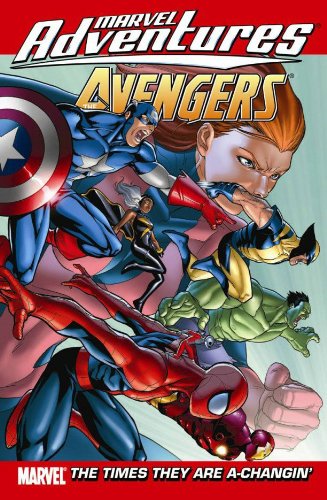
Marvel Adventures Avengers volume 9: The Times They Are A‘Changin’


By Paul Tobin, Matteo Lolli, Ig Guara, Casey Jones, Christian Vecchia & Sandro Ribeiro (Marvel)
ISBN: 978-0-7851-3832-7 (PB/Digital edition)

Time for another anniversary shout-out, so let’s celebrate the fact that The Avengers #1 (cover-dated September 1963 but on sale from July 2nd) was sold out on newsstands all over America by today’s date…

In 2003, the House of Ideas created a Marvel Age line updating classic original tales by Stan Lee, Jack Kirby and Steve Ditko before merging it with remnants of its failed manga-based Tsunami imprint, which was also intended for a junior demographic.

The experiment was tweaked in 2005, becoming Marvel Adventures with core titles Marvel Adventures: Fantastic Four and Marvel Adventures: Spider-Man carrying all-original yarns. Additional titles included Marvel Adventures: Super Heroes, Power Pack, Hulk and The Avengers, which ran until 2010 when they were cancelled and replaced by new volumes of Marvel Adventures: Super Heroes and Marvel Adventures: Spider-Man.

This particularly light-hearted digest-sized collection re-presents issues #32-35 of Marvel Adventures Avengers (from 2009), offering stand-alone yarns to delight fans with a sense of humour and iota of wit…

What You Need To Know: this incarnation of the World’s Mightiest Superheroes operates an “open-door” policy where almost every metahuman marvel might turn up for duty. However – presumably because of their TV cartoon popularity – the Wondrous Wallcrawler and Jade Juggernaut are on scene in almost every episode…

Written throughout by Paul Tobin (No Romance in Hell, Plants vs Zombies), an avalanche of fast-paced fun begins with ‘The Big Payoff’ illustrated by Matteo Lolli & Christian Vecchia, wherein the team gets a most unpleasant visit from Special Agent Clark Harvey of the Internal Revenue Service.

This weaselling civil servant is ostensibly there to collect individual Avengers’ taxes, but it’s all a ploy to blackmail the team into forcing a bunch of defaulting villains into paying up…

Smart and deviously hilarious, the clashes between Giant-Girl, Spider-Man and Luke Cage against Whirlwind, the web-spinner and erudite philosophical monster/political activist Oog or Man-Bull versus Iron Man are entertainment enough, but Iron Man and Giant-Girl overmatched against the Absorbing Man and the childlike Hulk convincing assassin Bullseye to do his patriotic duty are utterly priceless…

When jungle king Ka-Zar visits from the Antarctic lost world, all he can think about is learning how to use a car. Sadly Wolverine, Storm, Giant-Girl, Hulk and Spidey all feel safer battling an invasion of super-saurians unleashed by Stegron the Dinosaur Man than sitting in the same vehicle as the Lord of the Savage Land in ‘You’re Driving Me Crazy’, with art by Ig Guara & Sandro Ribeiro…

When ancient Egyptian magicians turn time into an out-of-control merry-go-round, ‘Sgt. Fury and his Howling Commandos!’ (Lolli & Vecchia) are caught up in the assorted eras of chaos, with Ant-Man, Giant-Girl, Tigra, Storm, the wallcrawler and Hulk frantically fighting just to keep up…

Rendered by Casey Jones, this titanic tiny tome concludes on a romantic note in ‘Lovers Leaper’ when all the female Avengers head off for a vacation break. They foolishly thought Captain America, Cage, Spider-Man, Hawkeye and Wolverine could handle things for a while, but boys will be slobs and soon the HQ is a ghastly mess of “man-cave” madness…

Moreover, since Hawkeye now needs a date for the Annual Archer Awards, he tries an on-line dating service, and uploads not just his but all his buddies’ information onto the site…

With seemingly every eligible lady – super-powered and not – in New York City subscribing to the Lovers Leap site, our unsuspecting heroes are soon being bombarded by an army of annoyed women who think they’ve been stood up by the utterly oblivious Avengers.

… And when they try to get the owner to remove their details, the heroes discover French former bad-guy Batroc the Leaper is in charge and unwilling to do them any favours…

Smart and fun on many levels, bright, breezy and bursting with light-hearted action and loads of solid laughs, this book offers a fabulous alternative to regular Marvel Universe angst and agony. Even with the violence toned down and “cartooned-up” these stories are superbly thrilling and beautifully depicted: a perfect introduction for kids and adults alike to the vast realm of adventure we all love…

These collected stories present an intriguing and perhaps more culturally accessible means of introducing character and concepts to kids born generations away from those far-distant 1960s originating events.
© 2010, 2011 Marvel Characters, Inc. All rights reserved.

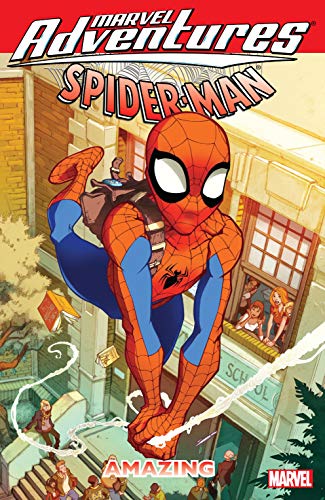
Marvel Adventures Spider-Man volume 1: Amazing


By Paul Tobin, Matteo Lolli, Scott Koblish & various (Marvel)
ISBN: 978-0-7851-4118-1 (Digest PB/Digital edition)

Since its earliest days Marvel always courted the youngest audiences. Whether animated tie-ins such as Terrytoons Comics, Mighty Mouse, Super Rabbit Comics, Duckula, assorted Hanna-Barbera and Disney licenses and a myriad others, or original creations such as Tessie the Typist, Millie the Model, Homer the Happy Ghost, Li’l Kids or Calvin, the House of Ideas always understood the necessity of cultivating the next generation of readers.

These days, however, general kids’ interest titles are on the wane and with Marvel’s proprietary characters all over screens large, small, and even portable, the company prefers to create child-friendly versions of its own pantheon, making an eventual hoped-for transition to more mature comics as painless as possible.

In 2003 the company established a Marvel Age line which updated and retold classic original tales by Stan Lee, Jack Kirby & Steve Ditko all mixed in with remnants of their manga-based Tsunami imprint, also intended for a younger readership. The experiment was tweaked in 2005, becoming Marvel Adventures with the core titles transformed in Marvel Adventures: Fantastic Four and Marvel Adventures: Spider-Man with reconstituted classics replaced by all new stories. Additional series included Marvel Adventures series Super Heroes, The Avengers and Hulk. These ran until 2010 when all were cancelled and replaced by new – continuity-continuing -volumes of Marvel Adventures: Super Heroes and Marvel Adventures: Spider-Man.

This digest-sized collection gathers the first four stories from the 2010 iteration and actually starts in the middle of the action – although writer Paul Tobin and artists Matteo Lolli and Scott Koblish (with inkers Christian Dalla Vecchia, Terry Pallot Koblish & Andrew Hennessy) take great pains to keep the stories as clear as possible.

Sixteen year old Peter Parker has been the mysterious Spider-Man for about six months. In that time he has constantly prowled the streets and skyscrapers of New York, driven to fight injustice. However, as a kid just learning the ropes, he’s pretty much always in over his head…

The opening tale finds him on a crusade against the all-pervasive Torino crime-family, attempting to expose their bought-and-paid-for Judge Clive Baraby, whilst ex-girlfriend and wannabe journalist Gwen dogs his webbed heels and her father Police Captain George Stacy – who knows the boy’s secret but allows him to continue his vigilante antics – picks up all the well-thumped thugs the incensed wall-crawler leaves in his wake.

Even though Spidey can’t touch corrupt Baraby, his campaign of attrition has the Torinos on the ropes, so the Mafioso engage the services of super-assassin Bullseye to kill the Web-spinner. However, the Man who Never Misses is infuriatingly slow to act and soon there’s an open contract on the kid crusader…

Peter’s civilian life is pretty complicated too. Since he and Gwen split, the lad has taken up with schoolmate Sophia Sanduval – an extremely talented lass nicknamed Chat – who also knows Pete’s secret, can communicate with animals and has a part-time job with the Blonde Phantom Detective Agency

She also pays attention in class and suggests how what they learned in history can be used to trap the untouchable Baraby.

The second story opens with a brutal dognapping and leads inexorably to a clash with merciless mercenary Midnight when the villain invades Peter’s school during a martial arts exhibition by Shang Chi, Master of Kung Fu. Along the way, Chat introduces Pete to new buddy Flapper – a very wise owl indeed – and new kid Carter Torino enrols at the school. How does this troubled new boy know the constantly watching Bullseye?

Before the subplots get too intens,e however, Midnight and his ninjas attack Shang-Chi and Spider-Man joins the fracas, subsequently learning some things from the combat expert – including who to return that stolen dog to…

Whilst close-mouthed gang-prince Carter gets closer to Gwen, Wolverine guest-stars in an third untitled tale as Chat asks her bug-boy beau to help hunt down the wild-haired mutant for a client who wants Logan to model their hair gel. Typically, whenever the Clawed Canadian appears trouble isn’t far behind, and when a gang of Torino goons jumps Wolverine, Spidey is forced to join the carnage. And that’s when Bullseye makes his move…

As conflicted Carter Torino confronts his criminal family, the volume concludes with a savage showdown between Bullseye and the sorely outmatched Spider-Man …and sees the death of one of the supporting cast…

Never the success the company hoped, the Marvel Adventures project was superseded in 2012 by specific comics tied to those Disney XD television shows designated as Marvel Universe Cartoons, but these tales are still an intriguing and more culturally accessible means of introducing character and concepts to kids born generations away from the originating events.

Fast-paced and impressive, these Spidey tales are extremely enjoyable yarns but parents should note that some of the themes and certainly the violence might not be what everybody considers “All-Ages Super Hero Action”…
© 2010 Marvel Characters, Inc. All rights reserved.

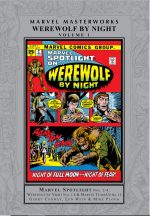
Werewolf by Night Marvel Masterworks volume 1


By Gerry Conway, Len Wein, Roy & Jean Thomas, Mike Ploog, Werner Roth, Ross Andru, & various (MARVEL)
ISBN: 978-1-3029-3346-3 (HB/Digital edition)

Now a star of page and screen, Werewolf by Night could be described as the true start of the Marvel Age of Horror. Now technically supplanted by modern Hopi/Latino lycanthrope Jake Gomez – who’s shared the designation since 2020 – these trials of a turbulent teen wolf opened the floodgates to a stream of Marvel monster stars and horror antiheroes.

Inspiration isn’t everything. In 1970, as Marvel consolidated its new position of market dominance – even after losing their two most innovative and inspirational creators, Steve Ditko and Jack Kirby – they did so employing a wave of new young talent, but less by experimentation and more by expanding proven concepts and properties. The only real exception to this was a mass-move into horror titles (or more accurately “monster titles” – the CCA still vetoed “horror”): a response to an industry down-turn in superhero sales, and a move expedited by a rapid revision in the wordings of the increasingly ineffectual Comics Code Authority rules.

Almost overnight scary monsters became again acceptable fare on four-colour pages and whilst a parade of 1950s pre-code reprints made sound business sense (so they repackaged a bunch of those too), the creative aspect of the revived fascination in supernatural themes was catered to by adapting popular cultural icons before risking whole new concepts on an untested public.

As always, the watchword was fashion: what was hitting big outside comics would be incorporated into the print mix and shared universe mix as readily as possible. When proto-monster Morbius, the Living Vampire debuted in Amazing Spider-Man #101 (October 1971) and the sky failed to fall in, Marvel launched a line of sinister superstars – beginning with a werewolf and a vampire…

Werewolf by Night debuted in Marvel Spotlight #2 (preceded by western-era hero Red Wolf in #1, and followed by Ghost Rider). In actuality, the series title, if not the actual character, was recycled from a classic pre-Comics Code short suspense-thriller from Marvel Tales #116, July 1953. Marvel always favoured using old (presumably already copyrighted) names and titles when creating new series and characters. The Hulk, Thor, Magneto, Doctor Strange and many others all got nominal starts as hairy underpants monsters or throwaways in some anthology or other.

Accompanied by an introductory reminiscence from Roy Thomas, this copious compendium collects the early adventures of a young West Coast wild one by re-presenting the contents of Marvel Spotlight #2-4, Werewolf by Night volume 1 #1-8 and a guest-shot from Marvel Team-Up #12 cumulatively covering February 1972 to August 1973.

The moonlit madness begins with that landmark first appearance, introducing teenager Jack Russell, who is suffering some sleepless nights…

Cover-dated February 1972 and on sale as 1971 closed, ‘Werewolf by Night!’ (Marvel Spotlight #2) was written by Gerry Conway and moodily, magnificently illustrated by Mike Ploog in the manner of his old mentor Will Eisner. The character concept came from an outline by Roy & Jeanie Thomas, describing the worst day of Jack’s life – his 18th birthday – which began with nightmares and ends in something far worse.

Jack’s mother and little sister Lissa are everything a fatherless boy could hope for, but new stepdad Philip and creepy chauffeur Grant are another matter. Try as he might, Jack can’t help but see them as self-serving and with hidden agendas…

At his party that evening, Jack has an agonising seizure and flees into the Malibu night, transforming for the first time into a ravening vulpine man-beast. At dawn, he awakes wasted on a beach to learn his mother has been gravely injured in a car crash. Something had happened to her brakes…

Sneaking into her hospital room, the distraught teen hears her relate the story of his birth-father: an Eastern European noble who loved her deeply, but locked himself away three nights every month…

The Russoff line is cursed by the taint of Lycanthropy: every child doomed to become a wolf-thing under the full-moon from the moment they reach 18 years of age. Jack is horrified on realising how soon his sister will reach her own majority…

With her dying breath Laura Russell makes her son promise never to harm his stepfather, no matter what…

Scenario set, with the traumatised wolf-boy uncontrollably transforming three nights every month, the weird, wild wonderment begins in earnest with the beast attacking the creepy chauffeur – who had doctored those car-brakes – but refraining – even in vulpine form – from attacking Philip Russell…

The second chapter sees the reluctant nocturnal predator rescue Lissa from a rowdy biker gang (they were everywhere back then) and narrowly escape the cops, only to be abducted by a sinister dowager seeking knowledge of a magical tome dubbed the Darkhold. This legendary spell-book is the apparent basis of the Russoff curse, but when Jack can’t produce the goods, he’s left to the mercies of ‘The Thing in the Cellar!’

Surviving more by luck than power, Jack’s third try-out issue fetches him up on an ‘Island of the Damned!’: introducing aging Hollywood screenwriter Buck Cowan, who will become Jack’s best friend and affirming father-figure as they jointly investigate the wolf-boy’s evil stepdad.

Russell had apparently sold off Jack’s inheritance, leaving the kid nothing but an old book. Following a paper trail to find proof Philip had Laura Russell killed leads them to an offshore fortress, a dungeon full of horrors and a ruthless mutant seductress…

The episode ended on a cliffhanger, presumably as an added incentive to buy Werewolf by Night #1 (cover-dated September 1972), wherein Frank Chiaramonte assumed inking duties with ‘Eye of the Beholder!…

Merciless biological freak Marlene Blackgar and her monstrous posse abduct the entire Russell family whilst looking for the Book of Sins, until – once more – a fearsome force of supernature awakes to accidentally save the day as night falls…

With ‘The Hunter… and the Hunted!’ Jack and Buck deposit the trouble-magnet grimoire with Father Joquez, a Christian monk and scholar of ancient texts, but are still hunted because of it. Jack quits the rural wastes of Malibu for a new home in Los Angeles, trading forests and surf for concrete canyons but life is no easier.

In #2, dying scientist Cephalos seeks to harness Jack’s feral life-force to extend his own existence, living just long enough to regret it. Meanwhile, Joquez successfully translates the Darkhold: an accomplishment allowing an ancient horror to possess him in WbN #3, in ‘The Mystery of the Mad Monk!’

Whilst the werewolf is saddened to end such a noble life, he feels far happier dealing with millionaire sportsman Joshua Kane, who craves a truly unique head mounted on the wall of his den in the Franke Bolle inked ‘The Danger Game’. Half-naked, exhausted and soaked to his now hairless skin, Jack must then deal with Kane’s deranged brother, who wants the werewolf for his pet assassin in ‘A Life for a Death!’ (by Len Wein & Ploog) after which ‘Carnival of Fear!’ (Bolle inks again) finds the beast – and Jack, once the sun rises – a pitiful captive of seedy mystic Swami Calliope and his deadly circus of freaks.

The wolf was now the subject of an obsessive police detective too. “Old-school cop” Lou Hackett is an old buddy of trophy-hunter Joshua Kane – and every bit as cruelly savage – but his off-the-books investigation hardly begins before the Swami’s plans fall apart in concluding part ‘Ritual of Blood!’ (inked by Jim Mooney).

The beast is safely(?) roaming loose in the backwoods for #8’s quirky and penultimate monster-mash when an ancient demon possesses a cute little bunny in Wein, Werner Roth & Paul Reinman’s ‘The Lurker Behind the Door!’, after we which we pause for now with a slight but stirring engagement in Marvel Team-Up #12, where Wein, Conway, Ross Andru & Don Perlin expose a ‘Wolf at Bay!’

As webspinning wallcrawler meets wily werewolf, they initially battle each other – and ultimately malevolent mage Moondark – in foggy, fearful San Francisco before Jack heads back to LA for more feral fury in a future issue…

With covers by Neal Adams& Tom Palmer, Ploog, Gil Kane and John Romita, this collection is supplemented with an unused Ploog cover for Marvel Spotlight#4; a gallery of original Ploog art pages and a previous collection cover by Arthur Adams & Jason Keith. A moody masterpiece of macabre menace and all-out animal action, this tome shares some of the most under-appreciated magic moments in Marvel history: tense, suspenseful and solidly compelling chillers to delight any fear fan or drama addict. If you crave a few fun frightmares, go get your paws on this.
© 2022 MARVEL.

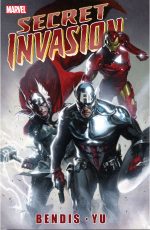
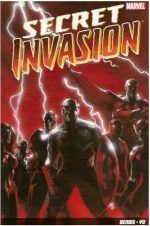
Secret Invasion


By Brian Michael Bendis, Leinil Francis Yu, Mark Morales & various (Marvel)
ISBN: 978-0-7851-3297-4 (TPB/Digital edition Marvel) 978-1-84653-405-8 (TPB Panini/Marvel UK)

The Skrulls are shape-shifting aliens who have threatened Earth since the second issue of Fantastic Four, and have long been a cornerstone of the Marvel Universe. After decades of use and misuse the insidious invaders were made the stars of a colossal braided mega-crossover event beginning in April 2008 and running through all the company’s titles until Christmas. That landmark worlds-shaking epic has since been adapted to the company’s burgeoning, blockbuster Marvel Cinematic Universe. If you were a real fan, you’d have already seen the first episode…

We, however, are all about the comics so let’s revisit the stunning and all-pervasive source material. The premise is simple enough: the everchanging, corruptive would-be conquerors have undergone a mass religious conversion and are now utterly, fanatically dedicated to taking Earth as their new homeworld. To this end they have replaced over an unspecified time a number of key Earth denizens – including many of the world’s superheroes.

When the lid is lifted on the simmering plot, no defender of the Earth truly knows who is on their side…

Moreover the cosmic charlatans have also unravelled the secrets of humanity’s magical and genetic superpowers, creating amped-up equivalents to Earth’s mightiest. They are now primed and able to destroy the heroic defenders in face-to-face confrontations.

With the conquest primed to launch, everything starts to unravel when Elektra dies in battle and is discovered to be an alien, not a ninja. Soon, two teams of Avengers (Iron Man, The Sentry, Wonder Man, Daredevil, Ms. Marvel, Spider-Woman, Wolverine, Luke Cage, Iron Fist, Ronin, Echo, Cloak and Black Widow) and certain agents of S.H.I.E.L.D.  are covertly investigating in discrete operations. All are painfully aware that they have no way of telling friend from foe…

Crisis and confusion are compounded when a Skrull ship crashes in the primordial Savage Land, releasing a band of missing heroes claiming to have been abducted and experimented on. Among them are another Spider-Man, Luke Cage, recently killed Captain America Steve Rogers, Phoenix/Jean Grey and Thor, plus other heroes believed gone forever. Some must be Skrull duplicates but are they the newcomers or the ones facing them…?

As the champions second guess each other, the second strand triggers. Earths space defence station S.W.O.R.D. is blown up and a virus rips through the internet shutting down crucial systems including the Starktech comprising the operating systems of S.H.I.E.L.D. and Iron Man’s armour…

Now all over Earth, Skrulls attack and heroes – and even villains such as Norman (Green Goblin) Osborn – respond and retaliate in a last ditch effort to survive: a war of survival that ends in shock, horror and unforeseen disaster…

Rather than give any more away, let me just say that if you like this sort of blockbuster saga you’ll be in seventh heaven, and a detailed familiarity is not vital to your understanding. However, for a fuller understanding, amongst the other Secret Invasion volumes accompanying this, you should particularly seek out Secret Invasion: the Infiltration, Secret War (2004), Avengers Disassembled, and Annihilation volumes 1-3, as well as the Avengers: Illuminati compilation.

This American volume contains all 8 issues of the core miniseries plus a monumental covers-&-variants gallery (31 in total) by Gabriele Dell’Otto, Steve McNiven, Leinil Yu, Mel Rubi, Frank Cho, Laura Martin and Greg Horn, and a series of chilling house ads imploring us to ‘Embrace Change’, but is just one of 22 volumes comprising the vast number of episodes in convergent storylines of the saga.

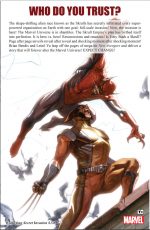
Fast-paced, complex, superbly illustrated and suitably spectacular, this twisty-turny tale and its long-term repercussions reshaped the Marvel Universe, heralding a “Dark Reign” that pushed all the envelopes. If you are a comics newcomer, and can find the British edition from Panini, it also includes one-shot spin-off Who Do You Trust? and illustrated data-book Skrulls which claims to provide a listing and biography for every shapeshifter yet encountered in the Marvel Universe (but if they left any out, could you tell?).
© 2017 Marvel Characters, Inc. All rights reserved.

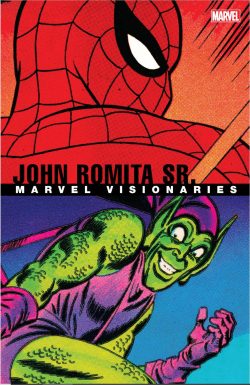
Marvel Visionaries: John Romita, Sr.


By John Romita Sr., with Stan Lee, Roger Stern & various (MARVEL)
ISBN: 978-1-3029-1806-4 (TPB/Digital edition)

We lost one of last giants of the industry this week when John Romita died on Monday. He was 93 and his work is inextricably woven into the Marvel canon: permeating and supporting the entire company’s output from top to tail and from the Sixties to right now… and even before the beginning of the House of Ideas actually began. 

One of the industry’s most polished stylists and a true cornerstone of the Marvel Comics phenomenon, the elder John Romita began his comics career in the late 1940s (ghosting for other artists) before striking out under his own colours. eventually illustrating horror and other anthology tales for Stan Lee at Timely/Atlas.

John Victor Romita was born and bred in Brooklyn, entering the world on January 24th 1930. From Brooklyn Junior High School he moved to the famed Manhattan School of Industrial Art, graduating in 1947. After spending six months creating a medical exhibit for Manhattan General Hospital he moved into comics, in 1949, with work for Famous Funnies. A “day job” working with Forbes Lithograph was abandoned when a friend found him inking and ghosting assignments, until he was drafted in 1951. Showing his portfolio to a US army art director, after boot camp at Fort Dix New Jersey, Romita was promoted to corporal, stationed on Governors Island in New York Bay doing recruitment posters and allowed to live off-base… in Brooklyn. During that period he started doing the rounds and struck up a freelancing acquaintance with Stan Lee at Atlas Comics…

He illustrated horror, science fiction, war stories, westerns, Waku, Prince of the Bantu (in Jungle Tales), a fine run of cowboy adventures starring The Western Kid and 1954’s abortive revival of Captain America, and more, before an industry implosion derailed his – and many other – budding careers. Romita eventually found himself trapped in DC’s romance comics division – a job he hated – before making the reluctant jump again to the resurgent House of Ideas in 1965. As well as steering the career of the wallcrawler and so many other Marvel stars, his greatest influence was felt when he became Art Director in 197. He had a definitive hand in creating or shaping many key characters, such as Mary Jane Watson, Peggy Carter, The Kingpin, The Punisher, Luke Cage, Wolverine, Satana ad infinitum.

This celebratory volume from 2019 re-presents Amazing Spider-Man #39, 40, 42, 50, 108, 109, 365; Captain America & The Falcon #138; Daredevil #16-17; Fantastic Four #105-106; Untold Tales Of Spider-Man #-1; Vampire Tales #2; and material from Strange Tales #4; Menace #6, #11; Young Men #24, 26; Western Kid 12; Tales To Astonish #77; Tales Of Suspense #77 spanning cover-dates December 1951 to July 1997. It opens with a loving Introduction from John Romita Jr., sharing the golden days and anecdotal insights on the “family business”. Not only the second son but also his mother Virginia Romita were key Marvel employees: she was the highly efficient and utterly adored company Traffic Manager for decades.

A chronological cavalcade of wonders begins with official first Marvel masterwork ‘It!’. Possibly scripted by Lee and taken from Strange Tales #4 (December 1951), we share a moment of sheer terror as an alien presence tales over the newest member of a typical suburban family…

Next is verifiable Lee & Romita shocker ‘Flying Saucer!’ (Menace #6, August 1953) and a sneaky invasion attack preceding the first Romita superhero saga as seen in Young Men #24, December 1953.

In the mid-1950s Atlas tried to revive their Timely-era “Big Three” (and super-hero comics in general) on the back of a putative Sub-Mariner television series intended to cash in on the success of The Adventures of Superman show. This led to some impressively creative comics, but no appreciable results or rival in costumed dramas.

Eschewing here the Human Torch and Sub-Mariner segments – and with additional art from Mort Lawrence – ‘Captain America: Back From the Dead’ features a communist Red Skull attacking the UN, with school teacher Steve Rogers and top student Bucky coming out of retirement to tackle the crisis. The Star-Spangled Avenger gets another bite of the cherry in ‘Captain America Turns Traitor(Young Men Comics #26, March 1954) with guest shots for Subby and the Torch as the Sentinel of Liberty apparently goes from True Blue to a deadly shade of Red…

Latterly reimagined as one of the modern Agents of Atlas, ‘I, the Robot!’ began as a deadly threat to humanity in Menace #11, and is followed here by a yarn from Romita’s first residency as the wandering hero Tex Dawson and his dauntless dog Lightning and super steed Whirlwind survive sudden stampedes and tackle vile horse butchering killers in a tale from his own eponymous title (Western Kid #12, October 1956)…

Atlas collapsed soon after, due to market conditions when a disastrous distribution decision resulted in their output being reduced to 16 titles per month, distributed by arch rival National Comics/DC. Under those harsh conditions the Marvel revolution started small but soon snowballed, drawing Romita back from ad work and drawing romances for DC.

Romita’s return began with inking and a few short pencilling jobs for the little powerhouse publisher’s split books. Tales To Astonish #77 revealed ‘Bruce Banner is the Hulk!’ (March 1966, written by Lee, laid out by Jack Kirby and finished by the returning prodigal) with the gamma goliath trapped in the future and battling the Asgardian Executioner, whilst in his home era, Rick Jones is pressured into revealing his awful secret…

The Captain America story for May 1966’s Tales of Suspense # 77 added inker Frank Giacoia/Frank Ray to the creative mix for ‘If a Hostage Should Die!’: recounting a moment from the hero’s wartime exploits with a woman he loved and lost. These days we know her as Captain Peggy Carter

After a brief stint in his preferred role as inker, Romita took over illustrating Daredevil with #12, following a stunning run by Wally Wood & Bob Powell. Initially Kirby provided page layouts to help Romita assimilate the style and pacing of Marvel tales, but soon “Jazzy Johnny” was in full control of his pages. He drew DD until #19, by which time he had been handed the assignment of a lifetime… The Amazing Spider-Man!

A backdoor pilot for that jump came in Daredevil #16-17 (May and June 1996) with ‘Enter… Spider-Man’ wherein criminal mastermind Masked Marauder manipulates the amazing arachnid into attacking the Man Without Fear. The schemer had big plans, the first of which was having DD and the wallcrawler kill each other, but after Spidey almost exposes Matt Murdock’s secret in ‘None are so Blind!’ they mend fences and go after the real foe…

By 1966 Stan Lee and Steve Ditko could no longer work together on their greatest creation. After increasingly fraught months Ditko resigned, leaving Marvel’s second best-selling title without an illustrator. Nervous new guy Romita was handed the ball and told to run. ‘How Green Was My Goblin!’ and ‘Spidey Saves the Day!’ – “Featuring the End of the Green Goblin!” – as it so dubiously proclaimed) was the climactic battle fans had been clamouring for since the viridian villain’s debut. It didn’t disappoint – and still doesn’t today.

Reprinted from issues #39 and 40 (August & September 1966 and inked by old DC colleague Mike Esposito as “Mickey Demeo”), this remains one of the best Spider-Man yarns ever, and heralded a run of classic sagas from the Lee/Romita team that actually saw sales rise, even after the departure of the seemingly irreplaceable Ditko. If you need further convincing, it sees the villain learn Peter Parker’s identity, capture and torture our hero and share his own origins before falling in the first of many final clashes…

Amazing Spider-Man #42 heralded ‘The Birth of a Super-Hero!, with John Jameson (Jonah’s astronaut son) mutated by space-spores and going on a Manhattan rampage. It’s a solid, entertaining yarn that is only really remembered for the last panel of the final page.

Mary Jane Watson had been a running gag in the series for years: a prospective blind-date arranged by Aunt May who Peter had avoided – and Ditko skilfully never depicted – for the duration of time that our hero had been involved with Betty Brant, Liz Allen, and latterly Gwen Stacy.

Now, in that last frame the gobsmacked young man finally realises that for years he’s been ducking the “hottest chick in New York”! I’m sure we all know how MJ has built her place in the Marvel Universe…

Issue #50 (July 1967) featured the debut of one of Marvel’s greatest villains in the first chapter of a 3-part yarn that saw the first stirrings of romance between Parker and Gwen, the death of a cast regular, and re-established the webslinger’s war on cheap thugs and common criminals. Here it all begins with a crisis of conscience that compels him to quit in ‘Spider-Man No More!

Romita was clearly considered a safe pair of hands and “go-to-guy” by Stan Lee. When Jack Kirby left to create his incredible Fourth World for DC, Romita was handed the company’s other flagship title – in the middle of an on-going storyline. Here we focus on Fantastic Four #105-106 (December 1970 and January 1971 and both inked with angular, brittle brilliance by John Verpoorten). and ‘The Monster’s Secret’.

Scripted by Lee, they comprise a low-key yet extremely effective suspense thriller played against a resuming subplot of Johnny Storm’s failing romance. When his Inhuman girlfriend Crystal is taken ill – preparatory to writing her out of the series – Reed Richards’ diligent examination reveals a potential method of curing the misshapen Thing of his rocky curse.

Tragically, as Ben Grimm is prepped for the radical process in ‘The Monster in the Streets!’ a mysterious energy-beast begins tearing up Manhattan. By the time ‘The Monster’s Secret!is exposed, the team strongman is almost dead and Crystal is gone… seemingly forever.

Romita briefly and regularly returned to the Star-Spangled Avenger in the 1970s and June 1971’s Captain America & The Falcon #138 reveals how ‘It Happens in Harlem!’ sporting a full art job by Romita, Lee’s tale sees new hero The Falcon foolishly try to prove himself by capturing the outlaw Spider-Man, only to be himself kidnapped by gang lord Stoneface. Cue a spectacular three-way team up and just desserts all round…

The Amazing Spider-Man was never far from Romita’s drawing board and in #108 the secret of high school bully Flash Thompson – freshly returned from the ongoing war in Indochina – finally unfolds ‘Vengeance from Vietnam!’ With Romita inking his own pencils, it details how our troubled war hero was connected to an American war atrocity that left a peaceful village devastated and a benign wise man comatose and near-dead. The events consequently set a vengeful cult upon the saddened soldier’s guilt-ridden heels, which all the Arachnid’s best efforts could not deflect or deter.

The campaign of terror is only concluded in #109 as ‘Enter: Dr. Strange!sees the Master of the Mystic Arts divine the truth and set things right… but only after an extraordinary amount of unnecessary violence…

Marvel was expanding and experimenting as always and a horror boom saw them move into mature reader monochrome magazines. In Vampire Tales #2 (October 1973), Roy Thomas scripted a short vignette of a woman apparently imperilled who turned out to be anything but. Delivered in moody line and wash, Devil’s Daughter Satana began her predations via Romita before joining the Macabre Marvel Universe. Her debut is supplanted by a house ad…

Commemorating the hero’s 30th anniversary, Amazing Spider-Man 365 (August 1992) carried a bunch of extras including sentimental reverie ‘I Remember Gwen’ (Tom DeFalco, Lee & Romita) before we close with a wild ride from Roger Stern, inked by Al Milgrom.

‘There’s a Man Who Leads a Life of Danger’ comes from July 1997’s Untold Tales Of Spider-Man #minus 1: an adventure of Peter Parker’s parents and part of the Flashback publishing event. It pits the married secret agents against deadly Baroness Adelicia von Krupp and guest-stars a pre-Weapon-X Logan/Wolverine in a delightful spy-romp.

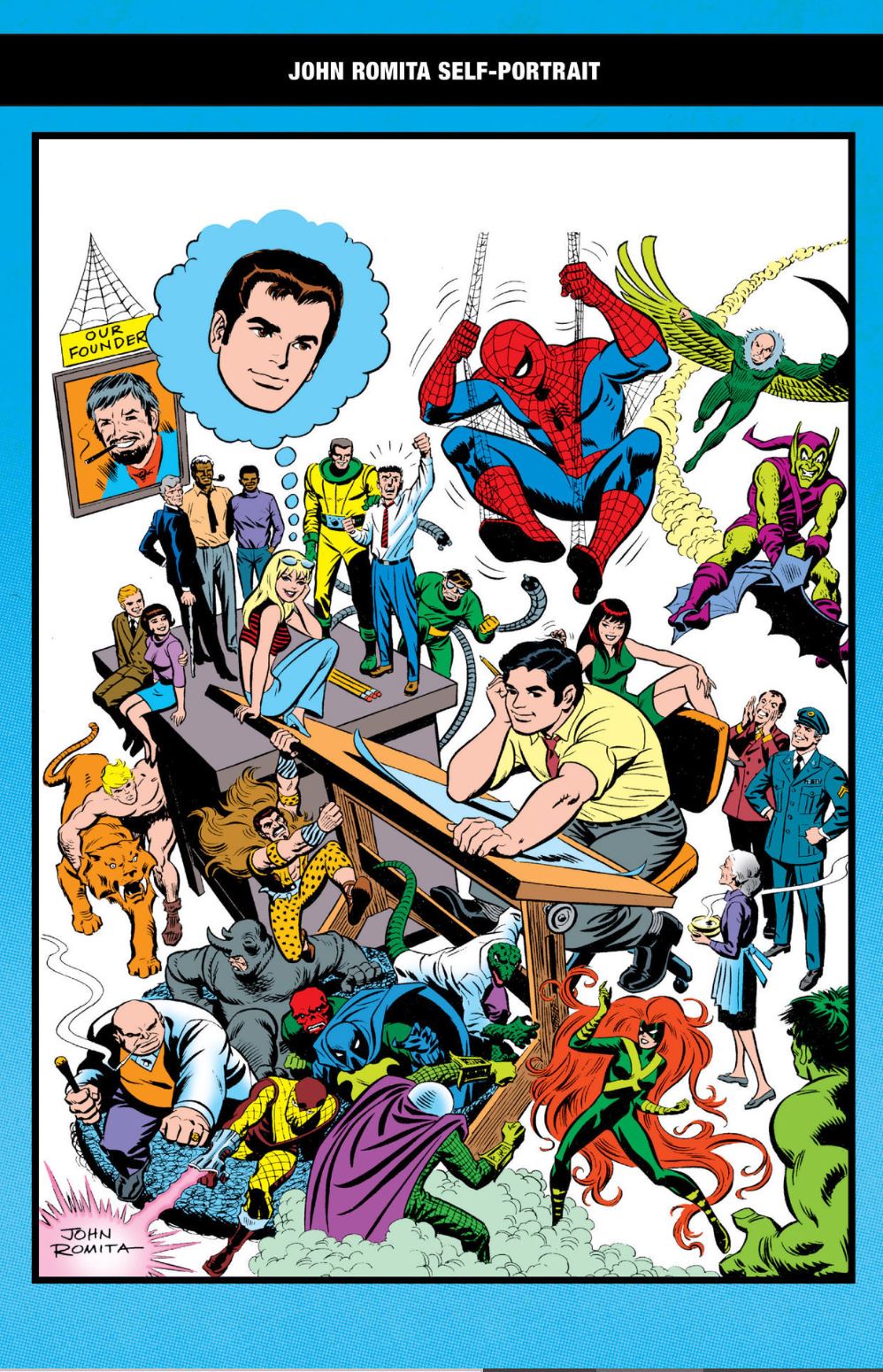
Added extras here include Romita’s unused splash page from Young Men Comics #24, character designs for Robbie Robertson, Mary Jane, Captain Stacy and his daughter Gwen, John Jameson, The Prowler, Wolverine and The Punisher; Fan sketches and doodles; an Amazing Spider-Man poster (painted); the covers of Spectacular Spider-Man Magazine #1 & 2 (ditto) plus original proposal art for the Amazing Spider-Man newspaper strip. There are also covers for F.O.O.M. #18, Amazing Spider-Man Annual #21 (1987), New Avengers #8 and Mighty Marvel Heroes & Villains (with Alex Ross) and a vintage self-portrait.

This is absolutely one of the most cohesive and satisfactory career compilations available and one no fan should miss.
© 2019 MARVEL.

For a slightly different selection, I’d advise also tracking down Marvel Masters: The art of John Romita Sr (ISBN: 978-1-84653-403-4), although that’s not available in digital formats.

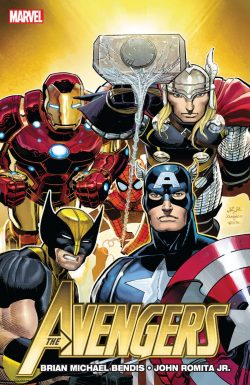
Avengers by Brian Michael Bendis volume 1


By Brian Michael Bendis, John Romita Jr., Klaus Janson, Tom Palmer& various (MARVEL)
ISBN: 978-0-7851-4500-4 (HB/Digital Edition) 978-0-7851-4501-1 (TPB/ Digital Edition)

Probably Marvel’s biggest global franchising success, The Avengers celebrate their 60th anniversary in September 2023, so let’s again acknowledge and anticipate that landmark event with another glorious past triumph…

Once upon a time Norman Osborn was America’s Security Czar: an untouchable “top-cop” in sole charge of a beleaguered nation’s defence and freedom, especially in regard to the USA’s costumed and metahuman community.

When the former-but-still-deranged Green Goblin at last but inevitably overplayed his hand, a coalition of outlawed champions united to defeat him, and his fall from grace was staggering and total.

The chaos and carnage led to a new Age of Heroes, and as part of that resurgence, original Captain America Steve Rogers was appointed Supreme Commander of US metahuman resources. He promptly set about redefining the what, who and how of the World’s Mightiest Heroes which launched a flotilla of new teams and titles, with Avengers volume 4 being the official spine of the comic book franchise.

Available in a number of formats, this initial collection gathers issues #1-6 as written by Brian Michael Bendis and illustrated by John Romita Jr. with inkers Klaus Janson & Tom Palmer colourist Dean White and letterer (VC’s) Cory Petit adding to the spectacle and wonderment. The book spans cover-dates July to December 2010) and opens with a peek at a terrifying future before skipping back to Now where a triumphant, reunited army of heroes is trying to democratically decide just who goes where and does what…

Those deliberations are rudely interrupted in ‘Next Avengers Part One’ when time-tyrant Kang the Conqueror beams in with a frantic warning. He barely opens his mouth before he’s blasted across the city by the wary, twice-shy heroes, but as they converge to press their attack the Conqueror stops all hostilities by brandishing an ultimate weapon.

Iron Man Tony Stark prevents his comrades from finishing off Kang as he recognises the Dark Matter Accelerator. It’s something he thought up and swore never to build. The only way the future Fuhrer can have it is if Stark made it and gave it to him…

In the cautious ceasefire that follows, Kang explains he’s come to beg the aid of the Avengers. In his current future he is one of a team that includes the children of the Avengers, united to stop life-loathing Artificial Intelligence Ultron from exterminating humanity.

They have at last succeeded in destroying the mechanoid marauder but the children are now an even greater menace. Moreover, Kang’s attempts to stop them have resulted in time itself shredding… and all of reality is now collapsing…

The arrogant time-terrorist expects the Avengers to stop their errant offspring, but as Rogers heads off all debate to arbitrarily assemble teams, back in the future Kang and his hidden allies make preparations to carry out their true scheme…

Not every past Avenger is keen to answer the call to reassemble. Simon Williams has come to believe the team has done more harm than good and threatens to stop them if they start up again. ‘Wonder Man Attacks?!!’ sees him make good on his warning whilst a small squad locate Kree outcast Noh-Varr The Protector to request his expertise in time travel.

As the alien and Stark’s efforts finally bear fruit, Wonder Man brutally engages the entire team. In the resultant blockbusting battle, something goes terribly wrong, and an alternate Apocalypse and his horrendous Horsemen materialise, intent on ending mankind.

As the embattled titans swiftly mobilise to tackle the next crisis, a ‘Menace from Beyond Time’ manifests as various time-streams and realities begin to coalesce and overlap in New York City. With All of Everything endangered, a unit of heroes heads into the unhappy future leaving their harried comrades to hold back a tidal wave of time-tossed menaces – and the occasional misplaced hero such as Killraven and Devil Dinosaur

Far away from now, Iron Man, Wolverine, replacement Captain America James “Bucky” Barnes and Noh-Varr witness first-hand the cataclysmic war against Ultron before being ambushed by the next generation in ‘Only the Good Die Young’.

Back in their home era, a multitude of past menaces – from cavemen to cowboys to cosmic devourer Galactus – are keeping the majority of Avengers busy, whilst in the foredoomed tomorrow the questing quartet are painfully discovering they’ve been played by Kang yet again…

Full explanations are promised by an incredibly aged Tony Stark and the architect of the chronal rescue plan: Bruce Banner in his gamma-charged arch-villain persona of ‘The Maestro’

With two Starks, an incredibly sagacious and experienced Banner and new element Noh-Varr all intent on fixing the problem, the sorry story soon comes out. All of creation’s future is stuck in a temporal loop: a cosmic “Groundhog Day” with Kang interminably trapped battling Ultron. Now, with the odds altered by the historical Avengers, there’s a real chance to make things right in one final ‘Battle for the Future’

Tragically, as Thor’s clash with Galactus escalates and the assembled Avengers resolutely resist Apocalypse and his minions in the now, there may not be a past to return to…

Layers of murderous duplicity are peeled back in ‘Next Avengers Part 6: Conclusion’ as a cunning solution to the Ultron-Kang impasse is conceived. However, even as reality reasserts itself and four weary heroes return home, old man Stark takes the risky chance of giving his younger self a deadly device and a portentous warning from the future…

Epic in scale, vast in scope and overflowing with action, this a magnificently rendered tale that might bewilder new readers looking for a post-movie fix, but will delight dyed-in-the-wool Fights ‘n’ Tights fanatics. It comes with a gallery of covers-&-variants by Romita Jr., Janson & Dean White, John Romita Sr., Greg Land & Morry Hollowell, Jim Cheung & Justin Ponsor, Alan Aldridge, Phil Jimenez & D’Armata, plus a massive combined variant cover by Marko Djurdjevic.
© 2018 MARVEL.

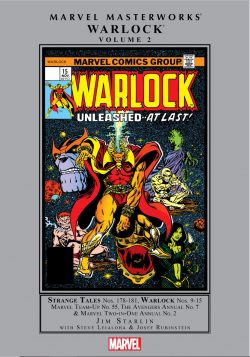
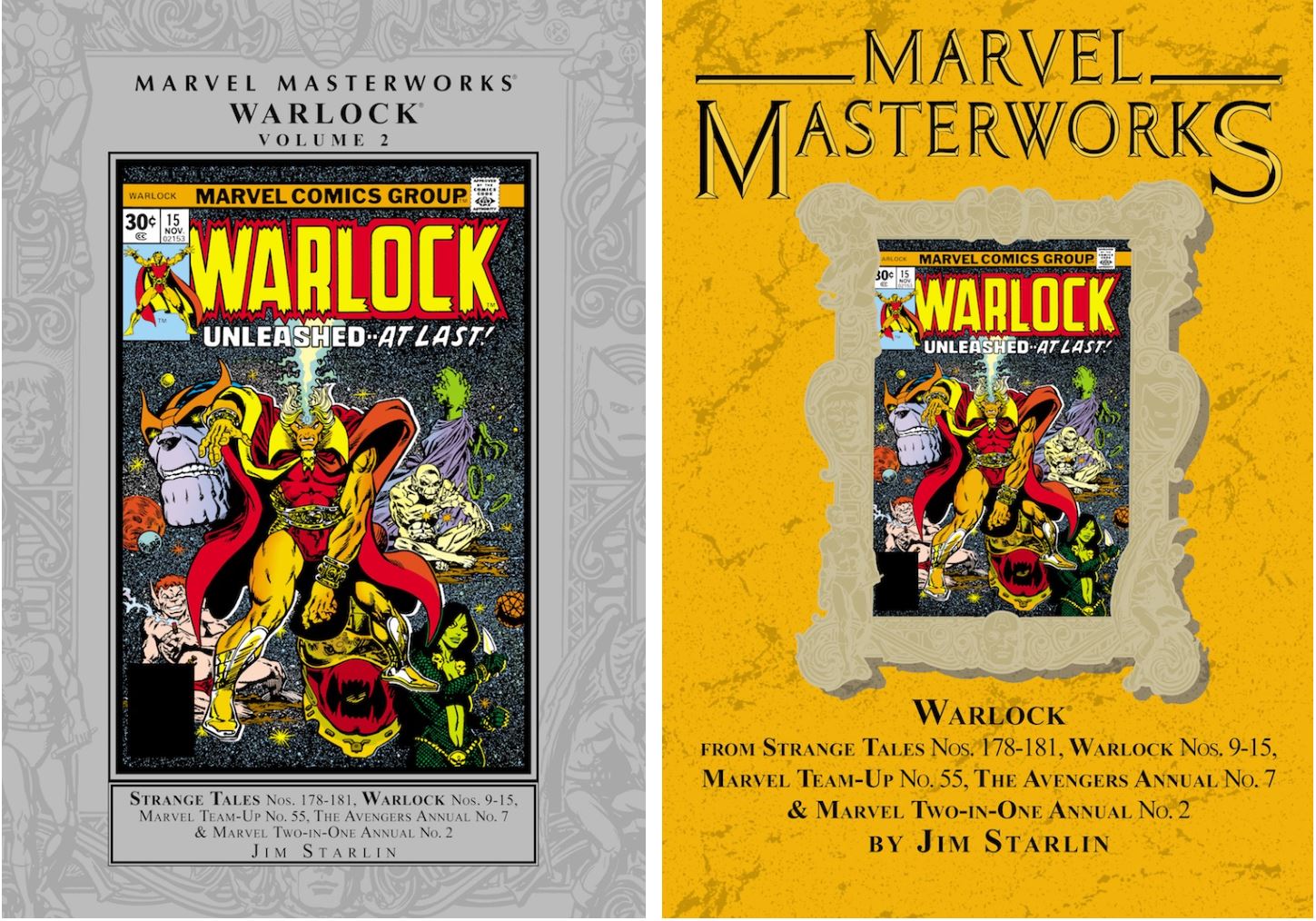
Warlock Marvel Masterworks volume 2


By Jim Starlin, with Bill Mantlo, John Byrne, Steve Leialoha, Josef Rubinstein, Al Milgrom, Alan Weiss, Dave Hunt & various (Marvel)
ISBN: 978-0-7851-3511-1 (HB/Digital edition)

During the early 1970s the first inklings of wider public respect for the medium of graphic narratives began to blossom in English-speaking lands. This followed avid response to pioneering stories such as Denny O’Neil & Neal Adams’ “relevancy” Green Lantern run, Stan Lee & John Buscema’s biblically allegorical Silver Surfer or Roy Thomas’ ecologically strident antihero Sub-Mariner. These all led a procession of thoughtfully-delivered attacks on drugs in many titles, and a long running undeclared campaign to support positive racial role models and include characters of colour everywhere on four-colour pages.

Part of a movement and situation mirrored in Europe and Japan, our comics were inexorably developing into a vibrant platform of diversity and forum for debate, engaging youngsters in real world issues germane and relevant to them.

In 1972, Thomas had taken the next logical step: transubstantiating an old Lee & Kirby Fantastic Four throwaway foe into a potent political and religious metaphor for the Questioning Generation…

Debuting in FF #66 (September 1967) mystery menace Him was re-imagined by Thomas & Gil Kane as a modern interpretation of the Christ myth: stationed on an alternate Earth far more like our own than that of Marvel’s fantastic universe.

Re-presenting Strange Tales #178-181, Warlock #9-15, Marvel Team-Up #55, Avengers Annual #7 and Marvel Two-in-One Annual #2 – collectively spanning cover-dates February 1975 to the end of 1977, this epic astral adventure also offers a context-soaked Introduction from comics historian/documentarian Jon B. Cook.

For latecomers and those informed only by movies…

It all began with The Power of… Warlock as the artificial man’s origin story – a lab experiment concocted by rogue geneticists – was goosed up after meeting man-made and self-created god The High Evolutionary. He was wrapped up in a bold new experiment to replicate planet Earth on the opposite side of the sun. He replayed – on fast-forward – the development of life, intent on creating humanity without the taint of cruelty and greed and deprived of the lust to kill…

It might well have worked, but when the Evolutionary wearied, his greatest mistake cruelly intervened. Man-Beast was a hyper-evolved wolf with mighty powers, ferocious savagery and ruthless wickedness. He despoiled humanity’s rise, and ensuring the Counter-Earth’s development exactly mirrored its template – with the critical exception of the superheroic ideal. This beleaguered world suffered all mankind’s woes but had no extraordinary beings to save or inspire them.

A helpless witness to desecration, Him crashed free of his life-supporting cocoon to save the Evolutionary and rout Man-Beast and his bestial cronies -a legion of similarly evolved rogue animal-humanoids dubbed “New-Men”). When the despondent, furious science god recovered, he wanted to erase his failed experiment but was stopped by his rescuer.

As a powerless observer, Him had seen the potential and value of embattled humanity. For all their flaws, he believed he could save them from the many imminent dooms caused by their own unthinking actions – pollution, over-population, wars and intolerance. His pleas convinced the Evolutionary to give this mankind one last chance…

The wanderer was hurled down to Counter-Earth, equipped with a strange gem to focus his powers, a mission to find the best in the fallen and a name of his own – Adam Warlock

He battled long and hard and even gathered a band of faithful followers, but was constantly defeated and frustrated by human intransigence and Man-Beast’s forces, who had infiltrated and corrupted all aspects of society – especially America’s political hierarchy and the Military/Industrial complex.

After 8 issues of his struggle and a couple of interventions by Earth’s Incredible Hulk, the saga apparently ended when messianic Adam Warlock died and was reborn, thwarting Satan-analogue Man-Beast with the aid of the Jade Juggernaut: delivering a karmic coup de grace before ascending from Counter-Earth to the beckoning stars…

When the feature returned at the end of 1974 the tone, just like the times, had hugely changed. In the wake of Vietnam and Watergate, hopeful positivity and comfortable naivety had turned to world-weary cynicism and the character was draped in precepts of inescapable doom in the manner of doomed warrior Elric. It was a harbinger of things to come…

The story continues in Strange Tales #178 as ultra-imaginative morbid maverick Jim Starlin (Captain Marvel, Master of Kung Fu, Infinity Gauntlet, Dreadstar, Batman, Kid Kosmos) turns the astral wanderer into a Michael Moorcock-inspired death-obsessed, constantly outraged but exceedingly reluctant and cynical cosmic champion.

The slow spiral to oblivion begins in February cover-dated Strange Tales #178, where Starlin introduces alien Greek Chorus Sphinxor of Pegasus to recap the past by asking and answering ‘Who is Adam Warlock?’

Handling everything but lettering – that’s left to Annette Kawecki – Starlin has solitary wanderer Warlock brooding on a desolate asteroid in the Hercules star cluster just as a trio of brutes attack a frightened girl. Despite his best efforts they execute her, proud of their status as Grand Inquisitors of the Universal Church of Truth and ecstatic to remove one more heathen unbeliever…

Appalled to have failed another innocent, Warlock employs the Soul Gem at his brow to briefly resurrect her and learns of an all-conquering ruthless militant religion intent on converting or eradicating all life. His search triggers a chilling confrontation as ‘Enter The Magus!’ sees the living god of the UCT attack him and crushingly reveal an awful truth: the being who has subjugated countless worlds, exterminated trillions and fostered every dark desire of sentient beings is his own future self.

Adam Warlock than swears that he will battle this impossible situation and do whatever is necessary to prevent himself becoming his worst nightmare…

With Tom Orzechowski on words and Glynis Oliver-Wein doing colours, Starlin’s pilgrimage continues as Warlock attacks an UCT war vessel transporting rebels, “degenerates” and “unproductives” from many converted worlds. The church only deems basic humanoids as sacred and saveable, with most other shapes useful only as fodder or fuel. They make an exception for the universally deplored, vulgar and proudly reprobate race called “Trolls”. In the dungeon-brig of the ship Great Divide, Adam finds his gloomy mood irresistibly lifted by disgusting lout Pip: a troll revelling in his “independent manner and cavalier ways” and not frightened by the imminent death awaiting them all.

Meanwhile, mighty, enhanced true believer Captain Autolycus has received a message from the Temporal Leader of the Faithful. The Matriarch has decided to ignore The Magus’ instruction to capture Warlock and keep him unharmed.

As Adam instructs his fellow prisoners in the nature of rule, Autolycus acts on her command, losing his entire crew and perishing when Warlock breaks loose. After escaping the ‘Death Ship!’, Adam realises Pip has stowed away, keen to share a new adventure, but lets it go. He has a bigger problem: in the climactic final battle, the Soul Gem refused his commands, acting on its own to consume Autolycus’ memories and persona, locking them inside the twisted champion’s head…

In ST #180’s ‘Judgment!’ (with additional inking by Alan Weiss), Pip and Warlock have submerged themselves in the heaving masses of Homeworld whilst hunting the living god they oppose. Terrified of the uncontrollable spiritual vampire on his brow, Adam tries to remove it and discovers it has already stolen him: without it he will perish in seconds…

Pushed into precipitate action and living on borrowed time, Warlock invades the Sacred Palace and is offered a curious deal by the Matriarch and is captured when he refuses. Subjected to ‘The Trial of Adam Warlock’, the appalled adventurer endures a twisted view of the universe courtesy of Grand Inquisitor Kray-Tor, even as in the city, Pip thinks he scored with a hot chick. In truth, he’s been targeted by public enemy number one. Gamora is called “the deadliest woman in the whole galaxy” and has plans for Adam, which include him being alive and free…

Back in court, the golden man has rejected Kray-Tor’s verdict and, disgusted and revolted by the proceedings, foolishly lets his Soul Gem feed. The carnage he triggers and subsequent guilt leaves him catatonic and in the hands of the Matriarch’s cerebral reprogrammers…

Starlin was always an outspoken and driven creator with opinions he struggled to suppress. His problems with Marvel’s working practises underpin ST #181’s ‘1000 Clowns!’ as old pal Al Milgrom inks a fantastic recap and psychological road trip inside the hero’s mind. None of the subtext is germane if you’re just looking for a great story however, and – in-world – Warlock’s resistance to mind-control is mirrored by Pip and Gamora’s advance through the UCT citadel to his side.

Embattled by the psychic propaganda assaulting him, Warlock retreats into the safety of madness, and learns to his horror that this has been what The Magus wanted all along. Now the dark messiah’s victory and genesis are assured…

The triumph was celebrated by the resurrection of the hero’s own title and – cover-dated October 1975 – Warlock #9 revealed the master plan of Adam’s future self. Inked by Steve Leialoha ‘The Infinity Effect!’ saw the mirror images in stark confrontation with evil ascendent, unaware that Gamora was an agent of a hidden third party and that all the chaos and calamity was part of a war of cosmically conceptual forces.

The saga heads into the Endgame as the Magus explains in cruel detail how he came to power and that Adam’s coming days are merely his past, before summoning abstract terror The In-Betweener to usher in their inevitable transformation. There is one problem however: the first time around Adam/Magus was never attacked and almost thwarted by an invisible green warrior woman.

Crushed by the realisation that he will become a mass-murdering spiritual vampire, Warlock reels as the hidden third element arrives to save everything…

‘How Strange My Destiny!’ (#10, inked by Leialoha) finds Pip, Gamora, Adam and mad Titan Thanos battling 25,000 cyborg Black Knights of the Church rapturously paying ‘The Price!’ of devotion in a stalling tactic until the In-Betweener arrives…

Kree Captain Mar-Vell narrates a handy catch-up chapter detailing ‘Who is Thanos?’ as the beleaguered champions escape, before ‘Enter the Redemption Principle!’ explores some of the Titan’s scheme and why he opposes the Magus and his Church, even as the victorious dark deity realises that Thanos’ time probe is the only thing that can upset his existence…

How Strange My Destiny – with finished art by Leialoha from Starlin’s layouts – continues and concludes in #11 as ‘Escape into the Inner Prison!’ sees the Magus and his Black Knight death squads brutally board Thanos’ space ark. A combination of raw power and the Soul Gem buy enough time for Warlock and the troll to use the time probe, which dumps them in the future, just as In-Betweener arrives to convert the hero and supervise ‘The Strange Death of Adam Warlock!’, resulting in a reshuffling of chronal reality and Thanos’ triumph…

After months of encroaching and overlapping Armageddons, Warlock #12 diverts and digresses in ‘A Trollish Tale!’ as Pip’s addiction to hedonism and debauchery entraps him in professional harlot Heater Delight’s plan to escape a life on (non)human sexual trafficking in a star-roaming pleasure cruiser. He’s happy with the promised reward for his efforts, but hadn’t considered that her pimp might object to losing his meal ticket…

Drama returns with a bang in #13 as ‘…Here Dwells the Star Thief!’ introduces a threat to the entire universe stemming from a hospital bed on Earth. New England’s Wildwood Hospital houses Barry Bauman, whose life is blighted by a total lack of connection between his brain and nerve functions. Isolated and turned inward for his entire life, Barry has discovered astounding psychic abilities, the first of which was to possess his nurse and navigate an unsuspected outer world. His intellect also roams the endless universe and brooding, doomed Warlock is there when Barry consumes an entire star just for fun…

Outraged at the wilful destruction, Warlock uses his own powers to trace the psionic force and resolves to follow it back to the planet of his original conception and construction even as ‘The Bizarre Brain of Barry Bauman’ explores the Star Thief’s origins and motivations before formally challenging Adam to a game of “stop me if you can”…

Spitefully erasing stars and terrorising the Earth as Warlock traverses galaxies at top speed, Bauman knows a secret about his foe that makes his victory assured, but still lays traps in his interstellar path. The ‘Homecoming!’ is accelerated by a shortcut through a black hole but when Adam arrives at the Sol system, he receives a staggering shock: his journeys and simple physics have wrought physical changes making it impossible to ever go home again…

Sadly for Barry, his gleeful frustration of his foe distracts him just when he should be paying close attention to his physical body…

As the series abruptly ended again (November 1976), Starlin returned to full art & story chores in #15’s ‘Just a Series of Events!’ Exiled from Earth, Adam rants as elsewhere, Thanos moves on his long-term plans. Without the threat of The Magus, his desire for total stellar genocide can proceed, but he worries that his adopted daughter Gamora might be a problem. He should be more concerned about his own nemesis-by-design Drax the Destroyer

The saga then pauses with Adam, confronting a host of plebian injustices and seemingly gaining dominance over his Soul Gem…

Vanished again, Adam Warlock only languished in limbo for a few months. In mid-December 1976, Marvel Team-Up #55 (cover-dated March 1977) addressed his altered state as Bill Mantlo, John Byrne & Dave Hunt crafted ‘Spider, Spider on the Moon!’

For reason too complicated to explain here, Spider-Man had been trapped in a rocket and blasted into space and was happily intercepted and left in the oxygenated-and heated Blue Area. Warlock then assisted the Arachnid and mysterious alien The Gardener against overbearing ephemera collector The Stranger. He sought possession of the Golden Gladiator’s life-sustaining Soul Gem, but soon discovered an equally fascinating alternate choice…

Despite his sporadic and frankly messy publishing career, Warlock has been at the heart of many of Marvel’s most epochal and well-regarded cosmic comic classics, and ending this compendium is probably the very best: an extended epic spanning two summer annuals and seemingly signalling the end on an era…

‘The Final Threat’ (by Starlin & Joe Rubinstein) comes from Avengers Annual #7, which sees Protector of the Universe Mar-Vell AKA Captain Marvel and Titanian ultra-mentat Moondragon return to Earth with vague anticipations of impending catastrophe. Their premonitions are confirmed when galactic wanderer Adam Warlock arrives with news that death-obsessed Thanos has amassed an alien armada and built a soul gem-fuelled weapon to snuff out stars like candles…

Spanning interstellar space to stop the scheme, the united heroes forestall alien invasion and prevent the Dark Titan from destroying the Sun, but only at the cost of Warlock’s life…

Then ‘Death Watch!’ (Starlin & Rubinstein, Marvel Two-in-One Annual #2) finds Peter Parker plagued by prophetic nightmares. These disclose how Thanos had snatched victory from defeat and now holds the Avengers captive whilst again preparing to extinguish Sol.

With nowhere else to turn, the anguished, disbelieving webspinner heads for the Baxter Building, hoping to borrow a spacecraft, and unaware that The Thing also has a history with the terrifying Titan.

Although utterly overmatched, the mismatched Champions of Life subsequently upset Thanos’ plans for long enough to free the Avengers before the Universe’s true agent of retribution ends the Titan’s threat forever… at least until next time…

The sidereal saga seemingly done, this collection also offers bonus treats in the form of 16 pages of unused pencils by Alan Weiss. The photostats come from an issue lost in transit, and are supplemented by before-&-after panels judged unsuitable by the Comics Code Authority, the various production stages of Starlin & Weiss’ cover art for Warlock #9, with sketches, designs, frontispieces and full pages of original art.

Also on view are Starlin’s wraparound covers from 1983 reprint series Warlock Special Edition #1-6 and 1992-1993’s Warlock reruns (#1-6) in support of the Infinity Gauntlet, plus pertinent house ads and full biographies.

Ambitious, unconventional and beautiful to behold, Warlock’s adventures are very much a product of their tempestuous, socially divisive times. For many, they proved how mature comics might become, but for others they were simply pretty pictures and epic fights with little lasting relevance. What they unquestionably remain is a series of crucial stepping stones to greater epics: unmissable appetisers to Marvel Magic at its finest.
© 2017 Marvel Characters, Inc. All rights reserved.

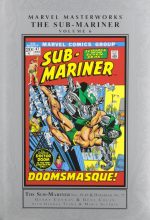
Sub-Mariner Marvel Masterworks volume 6


By Gerry Conway, Roy Thomas, Gene Colan, George Tuska, Marie Severin, Ross Andru & various (Marvel)
ISBN: 978-0-7851-9184-1 (HB/Digital edition)

In his most primal incarnation (other origins are available but may differ due to timeslips, circumstance and screen dimensions) Prince Namor, the Sub-Mariner is the proud, noble and generally bellicose offspring of the union of a water-breathing Atlantean princess and an American polar explorer.

That doomed romance resulted in a hybrid being of immense strength and extreme resistance to physical harm, able to fly and thrive above and below the waves. Over the years, a wealth of creators have played with the fishy tale and today’s Namor is frequently hailed as Marvel’s First Mutant. What remains unchallenged is that he was created by young, talented Bill Everett, for non-starter cinema premium Motion Picture Weekly Funnies: #1 (October 1939) so – technically – Namor predates Marvel, Atlas and Timely Comics.

The Marine Miracleman first caught the public’s avid attention as part of an elementally appealing fire vs. water headlining team-up in the October 1939 Marvel Comics #1 (which renamed itself Marvel Mystery Comics from #2 onwards. The amphibian antihero shared honours and top billing with The Human Torch, having debuted (albeit in a truncated, monochrome version) in the aforementioned promotional booklet which had been designed to be handed out to moviegoers earlier in the year.

The late-starter antihero rapidly emerged as one of the industry’s biggest draws, and won his own title at the end of 1940 (cover-dated Spring 1941). His appeal was baffling but solid and he was one of the last super-characters to vanish at the end of the first heroic age.

In 1954, when Atlas (as the company then was) briefly revived its “Big Three” line-up – the Torch and Captain America being the other two – Everett returned for an extended run of superbly dark, mordantly moody and creepily contemporary fantasy fables. Even so, his input wasn’t sufficient to keep the title afloat and eventually Sub-Mariner sank again.

In 1961, as Stan Lee & Jack Kirby were reinventing superheroes with the Fantastic Four, they revived the awesome, all-but-forgotten aquanaut as a troubled, semi-amnesiac antihero. Decidedly more bombastic, regal and grandiose, this returnee despised humanity: embittered and broken by the loss of his sub-sea kingdom which had been (seemingly) destroyed by American atomic testing. His rightful revenge became infinitely complicated after he became utterly besotted with the FF’s Susan Storm.

Namor knocked around the budding Marvel universe for some years, squabbling with other star turns such as The Hulk, Avengers, X-Men and Daredevil before securing his own series as one half of Tales to Astonish. From there he graduated in 1968 to his own solo title.

This sixth subsea selection trawls The Sub-Mariner #39-49, and includes a crossover confrontation from Daredevil #77. The subsea sagas cumulatively span cover-dates July 1971 to May 1972 and are preceded by heartfelt appreciation and more creative secret-sharing from incoming scripter Gerry Conway in his Introduction ‘See the Sea’ before the (now) dry land dramas recommence…

Previously, Namor had endured months of escalating horror as old enemies like Prince Byrrah, Warlord Krang, Attuma and Dr. Dorcas continuously assaulted his sunken kingdom. They were soundly defeated, and, in the throes of triumph, the Prince announced his marriage to lifelong companion Lady Dorma. He was then betrayed by his most trusted ally whilst sinister shapeshifter Llyra murdered his bride and sought to replace her…

Heartsick, angry and despondent, Namor abdicated the throne: choosing to henceforth pursue the human half of his hybrid heritage as a surface dweller…

The tragedy instantly intensifies in Sub-Mariner #39 as seasoned scripter Roy Thomas bows out with ‘…And Here I’ll Stand!’ Illustrated by Ross Andru & Jim Mooney, it sees the former royal arrive in New York City and move onto abandoned, desolate Prison Island.

However, the intrusion is taken for invasion by the curmudgeonly human authorities who mobilise the military to drive him out. A tense stand-off soon escalates and a typically bombastic response all round reduces Sub-Mariner’s sanctuary to shards and rubble.

In the aftermath, human friends Diane Arliss and Walt Newell (who operates parttime as undersea Avenger Stingray) bring the twice-exiled Prince staggering news…

Meanwhile in Manhattan – and depicted in Daredevil #77 – Conway, Gene Colan & Tom Palmer embroil Namor in a 3-way clash after a strange vehicle materialises in Central Park. Irresistibly summoned by telepathic force, Namor arrives just in time for the Sightless Swashbuckler to jump to a wrong conclusion and attack… Then a late-arriving third hero butts in…

Guest stars abound in ‘…And So Enters the Amazing Spider-Man!’ and when the uncanny alien artefact explodes, a mysterious woman ominously invites DD, the webspinner and Namor to participate in a fantastic battle in a far-flung, dimensionally-adrift lost world. Exhausted by the traditional misunderstanding and subsequent fight, Daredevil begs off and goes home, leaving the wallcrawler to join now-nomadic Namor on a fantastic voyage and bizarre adventure that concludes in the Atlantean’s own comic…

Sub-Mariner #40 sees Conway, Colan & Sam Grainger detail how Spider-Man and Namor are compelled ‘…Under the Name of Ritual…’ to save The People of the Black Sea from murderous usurper Turalla. The telepathic subspecies has undisclosed links to Atlantis and a claim on Namor’s honour: demanding he fight on their behalf since their true king has been missing for decades…

In distant Boston, angry and reclusive elder Stephan Tuval is somehow aware of what’s transpiring and – just when arachnid and amphibian are about to fall in the brutal duel – strikes with all the terrifying power of his mind…

Returned to Manhattan, the weary heroes part, and Sub-Mariner #41 finds Namor following up the revelations shared by Diane and Walt. Illustrated by George Tuska & Grainger, ‘Whom the Sky Would Destroy!’ sees the sea lord struck down over rural New York by mutants artificially created by deranged scientist Aunt Serr.

Her son Rock is terrifying, but the real threat is meek, gentle, deceptive Lucile and before long Namor has fallen to the demonic clan. Seen as raw material, the former prince barely escapes destruction in #42’s ‘…And a House Whose Name…is Death!’ as Conway, Tuska & Mooney briskly build to larger epic featuring Tuval…

If you’re a completist, this issue also offers a brief Mr. Kline interlude, as Conway continued an early experiment in close-linked crossover continuity. Issue #42 contributes to a convoluted storyline involving the mystery mastermind from the future, twisting human lives and events. For the full story you should also track down contemporaneous Daredevil and Iron Man issues: you won’t be any the wiser, but at least you’ll have a complete set…

For one month, Marvel experimented with double-sized comic books (whereas DC’s switch to 52-page issues lasted almost a year: August 1971 to June 1972 cover-dates). November’s Sub-Mariner #43 held an immense, 3-chapter blockbuster beginning with ‘Mindquake!’ as Namor reaches Boston. He has come in search of his father Leonard McKenzie, whom he believed had been killed by Atlanteans in the 1920s. Instead he finds Tuval, driven mad by his re-emerging psychic abilities and now a danger to all.

Crafted throughout by Conway, Colan & Mike Esposito, the tale of the aged tele-potent reveals how he has built a cult around himself ‘…And the Power of the Mind!’, before his increasingly belligerent acts trigger ‘The Changeling War!’ and cause his own downfall…

Cruelly unaware how close he is to his father, Sub-Mariner is then distracted by the return of Llyra and new consort Tiger Shark in #44’s ‘Namor Betrayed!’ With art by the magnificent Marie Severin & Mooney, the story reviews the antihero’s love-hate relationship with Human Torch Johnny Storm, just in time for the shapeshifter to orchestrate a heated clash with the teen hero.

The blistering battle concludes in #45 with McKenzie’s abduction, and ‘…And Fire Stalks the Skies!’ sees Namor surrender himself to save his sire…

Conway, Colan & Esposito then pile on the trauma in #46 as ‘And Always Men Will Cry: Even the Noble Die!’ sees the son’s quest end in death and disaster, despite the best – if badly mismanaged – interventions of the Torch and Stingray.

Doubly orphaned and traumatised, Namor loses his memory again, and is easily gulled by ultimate manipulator Victor Von Doom in #47’s ‘Doomsmasque!’: duly deployed as cannon fodder in the Demon Doctor’s duel with M.O.D.O.K. and AIM to control a reality-warping Cosmic Cube.

The war is dirty and many-sided, with a frontal assault in #48’s ‘Twilight of the Hunted!’ leaving Namor to a pyrrhic triumph in concluding chapter ‘The Dream Stone!’ (inked by Frank Giacoia) before retrenching in confusion to ponder his obscured future…

To Be Continued…

Sunken treasures salvaged here include Everett’s cover to all-reprint Sub-Mariner Annual #2 (January 1972, reprising the underwater portions of Tales to Astonish #74-76); a covers gallery by Sal Buscema, Everett ,Tuska, Gil Kane & Giacoia; original art from Andru & Mooney, Sal B, Severin, Kane, Giacoia & Esposito plus a copious Biographies section.

Many early Marvel Comics are more exuberant than qualitative, but this volume, especially from an art-lover’s point of view, is a wonderful exception: historical treasures with narrative bite that fans will delight in forever. Moreover, as the Prince of Atlantis is now a bona fide big screen sensation, now might be the time to get wise and impress your friends with a sunken treasure…
© 2018 Marvel Characters, Inc. All rights reserved.
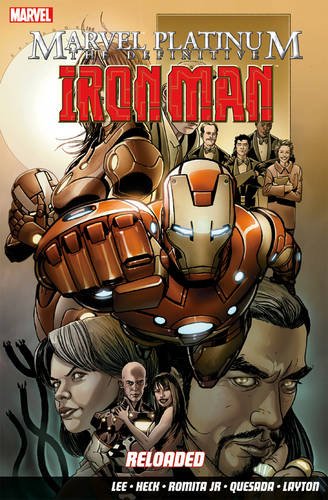
Mighty Marvel Masterworks Spider-Man volume 3: The Goblin and the Gangsters


By Stan Lee & Steve Ditko with Sam Rosen & Art Simek (MARVEL)
ISBN: 978-1-3029-4617-3 (TPB/Digital edition)

The Amazing Spider-Man celebrated his 60th anniversary in 2022. However, I’m one of those radicals who feel that 1963 was when he was really born, so let’s start the New Year with acknowledgement of that opinion and warning of many more of the same over the year…

These stories are timeless and have been gathered many times before but this one is part of The Mighty Marvel Masterworks line: designed with economy in mind and newcomers as target audience. These new books are far cheaper, on lower quality paper and smaller, about the dimensions of a paperback book. Your eyesight might be failing and your hands too big and shaky, but at 152 x 227mm, they’re perfect for kids. If you opt for the digital editions, that’s no issue at all.

Marvel is often termed “the House that Jack Built” and King Kirby’s contributions are undeniable and inescapable in the creation of a new kind of comic book storytelling. However, there was another unique visionary toiling at Atlas-Comics-as-was, one whose creativity and philosophy seemed diametrically opposed to the bludgeoning power, vast imaginative scope and clean, gleaming futurism that resulted from Kirby’s ever-expanding search for the external and infinite.

Steve Ditko was quiet and unassuming, diffident to the point of invisibility, but his work was both subtle and striking: innovative and meticulously polished. Always questing for affirming detail, he ever explored the man within. He saw heroism and humour and ultimate evil all contained within the frail but noble confines of humanity. His drawing could be oddly disquieting… and, when he wanted, decidedly creepy.

Crafting extremely well-received monster and mystery tales for and with Stan Lee, Ditko had been rewarded with his own title. Amazing Adventures/Amazing Adult Fantasy featured a subtler brand of yarn than Rampaging Aliens and Furry Underpants Monsters: an ilk which, though individually entertaining, had been slowly losing traction in the world of comics ever since National/DC had successfully reintroduced costumed heroes.

Lee & Kirby had responded with The Fantastic Four and so-ahead-of-its-time Incredible Hulk, but there was no indication of the renaissance ahead when officially just-cancelled Amazing Fantasy featured a brand new and rather eerie adventure character…

This compelling compilation re-presents the rise of the wallcrawler as originally seen in Amazing Spider-Man #20-28 and Amazing Spider-Man Annual #2 (spanning cover-dates January-September 1965) and is lettered throughout by unsung superstars Sam Rosen & Art Simek, allowing newcomers and veteran readers to comprehensively relive some of the greatest moments in sequential narrative.

The parable of Peter Parker began when a smart but alienated high schooler was bitten by a radioactive spider on a science trip. Discovering he’d developed arachnid abilities – which he augmented with his own ingenuity and engineering genius – Peter did what any lonely, geeky nerd would when given such a gift… he tried to cash in for girls, fame and money.

Creating a costume to hide his identity in case he made a fool of himself, Parker became a minor celebrity – and a vain, self-important one. To his eternal regret, when a thief fled past him, he didn’t lift a finger to stop the thug, and days later discovered that his Uncle Ben has been murdered by the same criminal…

Crazy for vengeance, Parker stalked and captured the assailant who made his beloved Aunt May a widow and killed the only father he had ever known. Since his social irresponsibility led to the death of the man who raised him, the boy swore to always use his powers to help others…

It wasn’t a new story, but the setting was familiar to every kid reading it and the artwork was downright spooky. no gleaming high-tech world of moon-rockets, mammoth monsters and flying cars here… this stuff could happen to anyone…

Amazing Fantasy #15 came out the same month as Tales to Astonish #35 – the first to feature the Astonishing Ant-Man in costume, but it was the last issue of Ditko’s Amazing playground. However, the tragic last-ditch tale struck a chord with the public and by year’s end a new comic book superstar launched in his own title, with Ditko eager to show what he could do with his first returning character since the demise of Charlton’s Captain Atom

Holding on to the “Amazing” prefix to jog reader’ memories, the Amazing Spider-Man #1 hit newsstands in December sporting a March 1963 cover-date and two complete stories.

Sans frills or extras, the ongoing saga resumes here with Amazing Spider-Man #20. Ditko’s preference for tales of gangersterism drove the stories, but his plots also found plenty of time and room for science fictional fun , supervillain frolics and subplots involving Peter Parker’s disastrous love life and poverty-fuelled medical dramas involving always-on-the-edge-of-death Aunt May…

The wallcrawler had inexplicably become the whipping boy of publicity-hungry – and eventually obsessed – publisher J. Jonah Jameson, who bombarded the hero with libellous print assaults in newspaper the Daily Bugle. He was blithely unaware that the photos Parker sold him for his print attacks were paying Spider-Man’s bills…

With Amazing Spider-Man #20 and ‘The Coming of the Scorpion!’, Jameson let his compulsive hatred get the better of him: paying scientist Farley Stillwell to endow a private detective with insectoid-based superpowers. Unfortunately, the process drove mercenary Mac Gargan (originally commissioned to trail Parker and discover how the kid got all those exclusive photos) completely mad before he could capture Spidey, leaving the webspinner with yet another lethally dangerous meta-nutcase to deal with…

The issue closed with a stunning Marvel Masterwork Pin-up of ‘Peter Parker and Ol’ Webhead’

A recurring humorous duel involved a rivalry between the Amazing Arachnid and fellow teen hero Johnny StormThe Human Torch which reached new heights of hilarity in #21. ‘Where Flies the Beetle…!’ features a hilarious love triangle as the Torch’s girlfriend Doris Evans uses Peter Parker to make her flaming beau jealous. Unfortunately, the Beetle – a villain with high-tech insect-themed armour – is simultaneously stalking her: seeking bait for a trap. As ever, Spider-Man is simply in the wrong place at the right time, resulting in a spectacular fight-fest…

This issue also offers a stunning and much reprinted Ditko Marvel Masterwork Pin-up of ‘Spider-Man’ before ASM #22 preeeeeeeesents… ‘The Clown, and his Masters of Menace!’: affording a return engagement for the Circus of Crime with splendidly outré action and a lot of hearty laughs provided by increasingly irreplaceable supporting stars Aunt May, Peter’s girlfriend Betty Brant and J. Jonah Jameson, before #23 delivers a superb thriller blending the mundane mobster and thugs that Ditko loved to depict with the more outlandish threat of a supervillain attempting to take over all the city’s gangs.

‘The Goblin and the Gangsters’ is both moody and explosive, the supervillain’s plot foiled by a cunning competitor and the driven hero’s ceaseless energy, and this tale is complemented by a Ditko Marvel Masterwork Pin-up of ‘Spidey’ that Amazingly features all the supporting cast and every extant villain in his rogues’ gallery…

Another recurring plot strand debuted in #24, as a dark brooding tale had the troubled boy question his own sanity in ‘Spider-Man Goes Mad!’. This psychological stunner finds a clearly delusional wallcrawler seeking psychiatric help, but there is more to the matter than simple insanity, as an insidious old foe makes an unexpected return and employs psychological warfare to destroy…

Amazing Spider-Man #25 once again sees the Bugle’s obsessed publisher take matters into his own hands. ‘Captured by J. Jonah Jameson!’ introduces Professor Smythe – whose dynasty of robotic Spider-Slayers would bedevil the webslinger for years to come – hired by the bellicose newsman to remove Spider-Man for good.

Issues #26 and 27 comprised a captivating 2-part mystery exposing a deadly duel between the Green Goblin and an enigmatic new masked criminal. ‘The Man in the Crime-Master’s Mask!’ and ‘Bring Back my Goblin to Me!’ together form a perfect arachnid epic, with soap-opera melodrama and screwball comedy leavening tense crime-busting thrills and all-out action.

‘The Menace of the Molten Man!’ in #28 is a tale of science gone bad and remains remarkable today not only for the spectacular action sequences – and possibly the most striking Spider-Man cover ever produced – but also as the story in which Peter Parker finally graduates from High School.

Ditko was on peak form and fast enough to handle two monthly strips. At this time he was also blowing away audiences with another oddly tangential superhero. Two extremely disparate crusaders met in ‘The Wondrous World of Dr. Strange!’: lead story in the second super-sized Spider-Man Annual (released in October 1965 filled out with vintage Spidey classics).

The entrancing fable unforgettably introduced the Amazing Arachnid to arcane other realities as he teamed up with the Master of the Mystic Arts to battle power-crazed mage Xandu in a phantasmagorical, dimension-hopping masterpiece involving ensorcelled zombie thugs and the stolen Wand of Watoomb. After this, it was clear that Spider-Man could work in any milieu and nothing could hold him back…

Also included here from that immensely impressive landmark are more Ditko pin-ups comprising ‘A Gallery of Spider-Man’s Most Famous Foes’ – highlighting such nefarious ne’er-do-wells as ‘The Circus of Crime’, The Scorpion’, ‘The Beetle’ ‘Jonah’s Robot’ and ‘The Crime-Master’. These delights are supplemented by a page of original art from ASM #27.

Full of energy, verve, pathos and laughs, gloriously short of post-modern angst and breast-beating, these immortal epics are something no serous fan can be without, and will make an ideal gift for any curious newcomer or nostalgic aficionado.

Happy Unbirthday Spidey and many, many more please…
© 2022 MARVEL.