Ant-Man/Giant-Man Epic Collection volume 2: Ant-Man No More (1964-1979)


By Stan Lee, Leon Lazarus, Al Hartley, Roy Thomas, Mike Friedrich, Chris Claremont, Bill Mantlo, Tony Isabella, David Micheline, Dick Ayers, Joe Orlando, Steve Ditko, Carl Burgos, Bob Powell, Ross Andru, Herb Trimpe, P. Craig Russell, Jim Starlin, Jimmy Janes, George Tuska, Ron Wilson, John Byrne, Rich Buckler, Keith Pollard & various (MARVEL)
ISBN: 978-1-3029-4965-5 (TPB/Digital edition)

This book includes Discriminatory Content produced in less enlightened times.

Marvel Comics built its fervent fan base through strong and contemporarily relevant stories and striking art, but most importantly by creating a shared continuity that closely followed the characters through not just their own titles but also through many guest appearances in other comics. Such an interweaving meant that even today completists and fans seek out extraneous stories to get a fuller picture of their favourite’s adventures.

In such an environment, archival series like this one are a priceless resource approaching the status of a public service for collectors, especially when you can now purchase and peruse them electronically from the comfort of your own couch, or the lesser luxury of your parents’ basement, garage or attic…

If you’re of a particularly picky nature – and what comic book superhero fan isn’t? – you may consider the Astonishing Ant-Man to be the second star of the Marvel Age of Comics. The unlikeliest of titans first appeared in Tales to Astonish #27 (cover-dated January 1962, on sale in the last months of 1961) in one of the splendidly addictive men-vs-monsters anthology titles that dominated in the heady days of Science Fiction Double-Feature B-Movies.

It was intended as nothing more than another here-today, gone-tomorrow filler in one of the company’s madly engaging pre-superhero “monster-mags”. However, the character struck a chord with someone, and as the DC Comics-inspired superhero boom blossomed, and Lee sprung The Hulk, Thor and Spider-Man on the unsuspecting kids of America, Henry Pym was economically retooled as a fully-fledged costumed do-gooder for TtA #35 (September 1962). You can read about his extremely eccentric career elsewhere, but suffice it to say Pym was never settled in his persona: changing name and modus operandi many times before junking his Ant-Man/Giant-Man identities for the reasonably more stable and more imposing role of Yellowjacket…

This episodic, eclectic and entomologically edifying compendium gathers the last initial outings of the original Ant-Man, plus the legacy of science adventurer Dr. Hank Pym as his size-shifting discoveries were employed by other champions. Contained herein are pertinent portions of Tales to Astonish #60-69, Marvel Feature #4-10; Invincible Iron Man #44; Power Man #24-25; Black Goliath #1-5, The Champions #11-13 and Marvel Premiere #47-48, convolutedly spanning cover-dates October 1964 to June 1979.

The first tale in this collection follows the beginning of the end after The Incredible Hulk became Giant-Man’s co-dependent in #59. With the next issue, the jade juggernaut began his second solo series and even featured on the covers whilst Giant-Man’s adventures shrank back to a dozen or so pages. Ten issues later Hank and partner Janet (The Wasp) Van Dyne retired, making way for amphibian antihero Namor, the Sub-Mariner. (Gi-)Ant-Man & the Wasp did not die, but instead joined the vast cast of characters which Marvel kept in relatively constant play through team books, via guest shots and in occasional re-launches and mini-series… just like the Hulk had.

Here, however, Tales to Astonish #60 delivers the first half-sized yarn. Stan Lee, Dick Ayers & Paul Reinman’s ‘The Beasts of Berlin!’ is a throwback to the daft old days, as the diminutive duo smuggle themselves over the infamous (then brand-new) Wall and into the Russian Sector to battle Commie primates (no, really!) behind the Iron Curtain.

The writing was on the wall by issue #61. With The Hulk already the most prominent on covers, hastily-executed stories and a rapid rotation of artists, it was obvious the appeal of the Masters of Many Sizes was waning. ‘Now Walks the Android’ was a fill-in rather rapidly illustrated by Steve Ditko & George (“Bell”) Roussos, featuring archnemesis Egghead and his latest technological terror-weapon, after which ‘Versus the Wonderful Wasp’ (by Golden Age icon Carl Burgos & Ayers) recycled an ancient plot wherein a thief steals Giant-Man’s costume and equipment, leaving the “mere girl” to save the day…

‘The Gangsters and the Giant’ by Lee, Burgos & Chic Stone in TtA #63 channelled the plot of #37 with the gem-stealing Protector here re-imagined as The Wrecker, but at least it came with a Marvel Masterwork pin-up of the Diminutive Duo by Chic Stone, after which ‘When Attuma Strikes’ – by Leon Lazarus, Burgos & Reinman – conjured up a happy crumb of imagination and wit as Hank & Jan split up! The heartbroken lass was then abducted with a plane full of air passengers by the undersea tyrant and was reunited with her man when he came to the rescue. This uncharacteristically mature-for-its-time romp was scripted by incredibly under-appreciated and nigh-anonymous comics veteran Leon Lazarus whose Pre-Marvel Age credits included genre stars like Black Rider, Arizona Kid and Kid Colt, Outlaw…

One last sustained attempt to resuscitate the series came with the addition of more Golden-Age greats beginning with Bob Powell (Cave Girl, Blackhawk, Jet Powers) who signed on as artist for issue #65’s ‘Presenting the New Giant-Man’ (scripted by Lee, inked by Don Heck) wherein the frustrated, uncomfortable hero built a better costume and greater powers, but almost died at in attacks by a spider and his own cat, accidentally enlarged in the testing process.

With a fresh new look, the last five tales were actually some of the best tales in the run, but it was too late. Frankie (Giacoia) Ray inked Powell on ‘The Menace of Madam Macabre’ with a murderous “oriental” seductress attempting to steal Pym’s secrets, with Chic Stone applying the brushes for ‘The Mystery of the Hidden Man and his Rays of Doom!’ – wherein a power-stealing alien removes Pym’s ability to shrink – before the series concluded with a powerfully impressive 2-parter in Tales to Astonish #68 and 69. ‘Peril from the Long-Dead Past!’ and ‘Oh, Wasp, Where is Thy Sting?’ were inked by Vince Colletta and John Giunta respectively. So far along was the decline that Al Hartley had to finish what Stan started: concisely concluding a tense, thrilling tale of the Wasp’s abduction by the Human Top and abrupt retirement of the weary, shell-shocked heroes at saga’s end.

Despite variable quality and treatment, the eclectic, eccentric and always fun exploits of Marvel’s premier “odd couple” these tales remain an intriguing, engaging reminder that the House of Ideas didn’t always get it right, but generally gave their all to entertaining the fans.

By turns superb, stupid, exciting and appalling this tome and these tales epitomise the best and worst of Early Marvel (with the delightful far outweighing the duff) and certainly won’t appeal to everybody, but if you’re a Fights ‘n’ Tights fan with a forgiving nature the good stuff here will charm, amaze and enthral you whilst the rest could just be considered as a garish garnish to provide added flavour…

In-world, those aforementioned guest shots from Limbo led to a lengthy stint as Avengers and a convoluted transformation from Giant-Man to Goliath to Yellowjacket, before retiring again. However, after a key role in the legendary Kree-Skrull war (yet not reprinted here!) he returned to his roots and got a second start…

The ball starts re-rolling here with a brief back-up vignette from Invincible Iron Man #44 with Roy Thomas, Ross Andru & Mike Esposito light-heartedly depicting ‘Armageddon on Avenue ‘A”, as Ant-Man Pym clashes again with the sinister creepy crawly the Scarlet Beetle. The evil arthropod stills seeks to eradicate humanity, but is kept too busy battling Pym to notice his secret citadel catching alight as part of a seedy insurance scam. Bah! Biped scum!

Marvel Feature #4 then opens a new series with ‘The Incredible Shrinking Doom!’ (by Mike Friedrich & Herb Trimpe) as a hero history recap segues into ‘The Beginning’ with Peter Parker interviewing Dr Pym before they team up to rescue a kidnapped boy. The son of Curt Conners (The Lizard) has been snatched to force the surrender of a valuable formula. However, whilst cleaning up M’Sieu Téte’s vicious underlings, Pym is injected with a bacterial enzyme that traps him at the size of an insect… and not even Spider-Man can help him…

Tension builds in #5’s ‘Fear’s the Way He Dies!’ as Egghead returns even as Ant-Man loses all that precious technology bolstering his powers. Deprived of his insect-controlling helmet, Pym is helpless until the maniac’s niece Trixie Starr makes him new duds and gear. It’s not quite enough to defeat the villain, but at least the shattering explosion of his mobile HQ seems to drive the killer away…

Janet Pym (née Van Dyne) resurfaces in Marvel Feature #6’s ‘Hellstorm!’ (inked by Mike Trimpe) as the beleaguered hero – thanks to trusty pet hound Orkie the dog – finally reaches his own home, only to be attacked by another old foe: Whirlwind. As a result the house is totally destroyed and Mr & Mrs Pym are officially declared dead. P. Craig Russell, Dan Adkins & Mark Kersey illustrate ‘Paranoia is the Para-Man!’ in MF #7 as a new android enemy captures Hank and Jan. Escape and the mechanoid’s inevitable defeat mutates the Wasp into a true insectoid predator for #8’s deadline-wracked ‘Prelude to Disaster!’

Russell, Jim Starlin & Jimmy Janes’ framing sequence here originally supported a Lee, Kirby & Don Heck origin flashback but you can just consult the first volume in this series if you’re feeling a little completist…

Here and now, however, Marvel Feature #9 revealed ‘…The Killer is My Wife!’ – limned by Russell & Frank Bolle, finally finding Hank battling his mutated. mindless spouse as Pym’s lab partner Bill Foster and Iron Man investigate their “deaths”. Tragically, not so far from them, the tiny terror is overwhelmed and temporarily cured by her husband just in time for both to fall victim to new nutcase Doctor Nemesis, before the saga and the series hastily wrapped up in Friedrich, Russell & Frank Chiaramonte’s concluding chapter ‘Ant-Man No More!’. With that Ant-Man faded from view, eventually replaced by Yellowjacket again, and one among many in The Avengers. Years passed and a new writer decided it was time to try size-shifting sagas again. It began as so often, with a try-out in an already established title…

While hiding in plain sight as a Hero for Hire in Times Square, escaped convict Luke Cage fell in love with doctor Claire Temple. When she abruptly vanished, Cage and buddy D.W. Griffiths scoured America looking for her. The trek fed directly into a 2-part premier for another African American superhero as the trail led to the Ringmaster’s Circus of Crime in Power Man #24 (January 1975, by Tony Isabella, George Tuska & Dave Hunt) for ‘Among Us Walks… a Black Goliath!’.

One of the earliest returning black characters in Marvel’s comics, the above-mentioned Bill Foster was a highly educated biochemist working for Tony Stark and with Henry Pym. Foster first appeared in The Avengers #32 (September 1966), working to find a cure when – as Goliath – Pym was trapped at a 10-foot height. Foster faded from view when Hank regained size-changing abilities. Having continued his own experiments in size-shifting, Foster was trapped as a freakish colossus, unable to shrink back to human proportions. Cage painfully learned he was also Claire’s former husband and when he too became trapped as a giant, she had rushed back to Foster’s substantial side to help find a cure.

When Luke shows up, passions are stoked, causing another classic heroes-clash moment until the mesmeric Ringmaster hypnotises all combatants, intent on using their strength to feather his own 3-ring nest. ‘Crime and Circuses’ (Isabella, Bill Mantlo, Ron Wilson & Fred Kida) sees the heroes helpless until Claire comes to the rescue, before making her choice and returning to New York with Luke. Foster gravitated to his own short-run series, becoming Marvel’s fourth African American costumed hero under a heavy-handed and rather uninspired sobriquet…

Cover-dated February 1976 and courtesy of Isabella, Tuska & Colletta, Black Goliath #1 reintroduced a far better hero. Foster was now in complete control of his powers and leading an exotic, eccentric Stark International Think Tank in Los Angeles. Sadly, his arrival coincides with high tech burglaries proving how out-of-depth ‘Black Goliath!’ was when the gang’s leader was exposed as living nuclear nightmare Atom-Smasher! He doled out ‘White Fire, Atomic Death!’ in #2 as scripter Chris Claremont joined Tuska & Colletta.

Barely surviving the first meeting, Foster brought in his team of maverick geniuses for the decisive second round, blissfully unaware the thermonuclear thug was working for a hidden mastermind. ‘Dance to the Murder!’ offers partial explanations as mystery man Vulcan leads multiple attacks on the Think Tank in his effort to secure an enigmatic alien artefact. The result is chaos and catastrophe, exacerbated in BG #4 when ‘Enter Stilt-Man… Exit Black Goliath!’ – with art from Rich Buckler & Heck – depicts the hero distracted by a supervillain hungry to upgrade his powers and status, whilst the mystery box is swiped from the rubble by a common looter…

The series came to an abrupt halt with #5 (November 1976), with Keith Pollard illustrating a tale of ‘Survival!’ as Foster and two bystanders are transported to a deadly alien world. Meanwhile on Earth, the Box begins to awaken…

The storyline was completed in LA-based team title The Champions (#11, February 1977 by Bill Mantlo, John Byrne & Bob Layton) as ‘The Shadow from the Stars’ saw Foster returned without explanation and building tech for the team (consisting then of Black Widow, Angel, Iceman, Hercules, Ghost Rider and soviet superhero Dark Star) as a side bar to the main event wherein Hawkeye and Two Gun Kid call for help in repelling an alien incursion by vintage villain/sentient shadow Warlord Kaa…

Back at the plot in #12, ‘Did Someone say… the Stranger?’ sees Black Goliath ambushed by Stilt-Man as that long-contested Box begins to activate. When universal Elder The Stranger comes to reclaim his planet-destroying Null-Life Bomb, he deems it too late once the device warps reality and dumps The Champions in the realm of former Thor foe Kamo Tharnn, leaving Foster on Earth to prevent ‘The Doom That Went on Forever!’

Arter the fireworks ended, the Big Guy again faded from sight until revived for 1980s classic the Project Pegasus Saga, where he reclaimed the name Giant-Man, but this collection concludes with arguably the most successful size-shifting centurion: solo superhero, security consultant single dad, Avenger, entrepreneur, comedy turn and screen superstar Scott Lang: a true legacy hero made good.

Comics creators are six parts meddler and five parts chronic nostalgia buff so eventually somebody convinced somebody else that the concept and properties of Ant-Man could be viable again, and thus we end here with the introduction of reformed thief Lang from his debut in Marvel Premiere #47 & 48 (cover-dated April & June 1979).

Those first somebodies were David Michelinie, John Byrne & Bob Layton who produced ‘To Steal an Ant-Man!’: disclosing how a former electronics engineer had turned to crime – more out of boredom than necessity – and, after being caught and serving his time, joined Stark International as a resolutely reformed character. Tragically, when his little daughter Cassie developed a heart condition that wiped out his savings, Scott reverted to his old methods to save her…

Desperate to find the wherewithal to hire experimental surgeon Dr. Erica Sondheim, he cases likely prospects, but is crushed when Sondheim is abducted by psychotic industrialist Darren Cross. The magnate is already using all the resources – legal and otherwise – of his mega-corporation Cross Technological Enterprises to keep himself alive. Needing cash just to broach the CTE complex, Lang goes back to Plan A, burgling the lab of retired superhero Henry Pym. The intruder discovers mothballed Ant-Man gear and size-changing gases and in a moment of madness, decides not to sell the stolen tech as planned but instead use it to break into Cross’ citadel and rescue Sondheim…

That plan doesn’t go so great either, as Lang discovers the dying billionaire – in his attempts to stay alive – has been harvesting the hearts of homeless people to power an experimental device which has subsequently mutated him into a monstrous brute. After learning with horror ‘The Price of a Heart!’ Lang eventually triumphs, unaware until the very last that Pym had allowed him to take the suit and was backstopping him every inch of the way. With Cassie saved, Yellowjacket then invites Lang to continue as the new Ant-Man. And so it begins. Again.

With rousing covers throughout by Jack Kirby, Gil Kane, Giacoia, Joe Sinnott, Trimpe, Starlin, John Romita & Sal Buscema, Russell & Adkins, Wilson, Rich Buckler, Lieber, Al Milgrom, Layton, Dave Cockrum and Bob McLeod, this triptych treat includes extras such as original art pages by Powell & Giacoia, Larry Lieber and Trimpe; lost art samples by mainstream illustrator Dick Rockwell; the unused ending to Marvel Feature #10 by Russell (compared in situ with what actually got published) and a brace of unused Layton covers to Marvel Premiere #48.

Seen here are three of the earliest heroes from a size shifting dynasty every true ant-ficionado (yes. I said that, and I’m not sorry!) will be delighted to see. These itty-bitty sagas range from lost oddities to true classics to dazzle Marvel Movie buffs as well as the redoubtable ranks of dedicated comic book readers all cheerfully celebrating this truly Astonishing phenomenon.
© 2023 MARVEL.

Fantastic Four Omnibus volume 2


By Stan Lee & Jack Kirby with Chic Stone, Frank Giacoia, Vince Colletta, Sam Rosen, Art Simek & various (MARVEL)
ISBN: ?978-0-7851-8567-3 (HB/Digital edition)

It’s not an international public holiday yet but August 28th is the birthday of Comics’ Greatest Imagineer…

Jacob Kurtzberg AKA Jack Curtiss, Curt Davis, Lance Kirby, Ted Grey, Charles Nicholas, Fred Sande, Teddy The King and others was born on this day in 1917 in New York City, U.S.A. Before dying on February 6th 1994 he did lots of stuff and inspired millions of people. This is some of the most inspirational stuff he did…

In my opinion Fantastic Four #1 is the third most important Silver Age comic book ever, behind Action Comics #1 – introducing Superman – and All Star Comics  #3, which invented superhero teams with the debut of The Justice Society of America. Feel free to disagree…

After a troubled period at DC Comics (National Periodicals as it then was) and a creatively productive but disheartening time on the poisoned chalice of the Sky Masters newspaper strip (see Complete Sky Masters of the Space Force), Jack Kirby settled into his job at a small outfit that used to be publishing powerhouse Timely/Marvel/Atlas Comics. He churned out high quality mystery, monster, romance and western material in a market he feared to be ultimately doomed, as always doing the best job possible. That generic fare is now considered some of the best of its kind ever seen. However, his fertile imagination couldn’t be suppressed for long and when the Justice League of America caught readers’ attention it gave him and writer/editor Stan Lee an opportunity to change our industry forever.

According to popular myth, a golfing afternoon led to ever-opportunistic publisher Martin Goodman ordering his nephew Stan to do a title about a group of super-characters like the DC crowd then dominating the marketplace.

The resultant team took those same fans by storm. It wasn’t the powers: they’d all been seen since the beginning of the medium. It wasn’t the costumes: they didn’t have any until the third issue. It was Kirby’s compelling art and the fact that these characters weren’t anodyne cardboard cut-outs. In a real and recognizable location – New York City – imperfect, raw-nerved, touchy outsider people banded together out of tragedy, disaster and necessity to face the incredible. In many ways, The Challengers of the Unknown (Jack’s prototype partners-in-peril for National/DC) had already laid all the groundwork for the wonders to come, but staid, nigh-hidebound editorial strictures of the market leader would never have allowed the undiluted energy of the concept to run all-but-unregulated.

Concocted by “Lee & Kirby”, with inks by George Klein & Christopher Rule, Fantastic Four #1 (bi-monthly and cover-dated November 1961) saw maverick scientist Dr. Reed Richards summon his fiancée Sue Storm, their close friend Ben Grimm and Sue’s teenaged brother before heading off on their first mission. They are all survivors of a private space-shot that went horribly wrong when Cosmic Rays penetrated their ship’s inadequate shielding and mutated them all.

Richards’ body became elastic, Sue gained the power to turn invisible, Johnny Storm could turn into living flame and tragic Ben devolved into a shambling, rocky freak. It was crude, rough, passionate and uncontrolled excitement unlike anything young fans had ever seen before. Thrill-hungry kids pounced on it and the raw storytelling caught a wave of change starting to build in America. It and succeeding issues changed comic books forever.

This second omnibus compendium collects Fantastic Four #31-60, double-sized Annuals #2-4 and and a tale from parody vehicle Not Brand Echh #1 (spanning September 1964 to August1967): issues of progressive landmarks cannily building on that early energy to consolidate the Fantastic Four as the leading title and most innovative series of the era.

Following typically effusive “found footage”, Foreword: A Universal Favorite from Stan – with two more to follow as these many pages turn – precedes the contents of Fantastic Four Annual #2 (September 1964) with Chic Stone inking ‘The Fantastic Origin of Doctor Doom!’ A short (12 page) scene-setter, it momentously details how brilliant Roma (called “gypsy” back then) boy Victor Von Doom remakes himself into the most deadly villain in creation. Ruthlessly surmounting obstacles such as ethnic oppression, crushing poverty and the shocking stigma of a sorceress mother, he rises to national dominance and global status…

Following a batch of villains in ‘A Gallery of the Fantastic Four’s Most Famous Foes!’ (Super-Skrull, Rama-Tut, Molecule Man, Hate-Monger, The Infant Terrible and Diablo) plus pin-ups of Johnny, Sue, Ben, Alicia Masters and Reed, Past informs Present as the ultimate villain believes he has achieved ‘The Final Victory of Dr. Doom!’ through guile, subterfuge and mind-control whereas he has in fact suffered his most ignominious defeat…

Monthly wonderment resumes with #31’s ‘The Mad Menace of the Macabre Mole Man!’ which precariously balances a loopy plan by the subterranean satrap to steal entire streets of New York City with a portentous subplot featuring a mysterious man from Sue’s past, as well as renewing the quartet’s somewhat fractious relationship with The Mighty Avengers…

After the first of every Fantastic 4 Fan Page letter column included for your delectation, the mystery man’s secret is revealed in ‘Death of a Hero!’: a powerful tale of tragedy and regret spanning two galaxies starring the uniquely villainous Invincible Man – who is not at all what he seems…

Supplemented by a glorious Kirby & Stone ‘Prince Namor Pin-up’ and adorned with an experimental photo montage cover from Kirby, FF #33’s ‘Side-by-Side with Sub-Mariner!’ follows, bringing the aquatic antihero one step closer to his own series as the quarrelsome quartet lend surreptitious aid to the embattled undersea monarch against deadly debuting barbarian Attuma after which ‘A House Divided!’ sees the team almost destroyed by power-hungry Mr. Gregory Hungerford Gideon, a Richest Man in the World who still can’t get all he wants…

Following a wry ‘Yancy Street Pin-Up’, #35’s ‘Calamity on the Campus!’ sees the fighting family visit Reed’s old Alma Mater in a tale designed to pander to a burgeoning college fan-base Marvel was then cultivating. Incorporating a cameo role for then-prospective college student Peter Parker, the rousing yarn brings back demon alchemist Diablo and introduces monstrous misunderstood homunculus Dragon Man.

Fantastic Four #36 premiered the team’s theoretical nemeses ‘The Frightful Four’: a group of villains comprising The Wizard, Sandman, Trapster (he was still Paste Pot-Pete here, but not for much longer) plus enigmatic new character Madame Medusa, whose origins were to have a huge impact on the heroes in months to come…

Most notable in this auspicious, action-packed, guest-star-stuffed (all the Avengers and X-Men) but inconclusive duel is the official announcement after so many months of Reed & Sue’s engagement – in itself a rare event in the realm of comic books at that time.

The team spectacularly travel to the homeworld of the shapeshifting Skrulls in #37, seeking justice or vengeance for Sue & Johnny’s recently-murdered father in ‘Behold! A Distant Star!’ They return only to be ‘Defeated by the Frightful Four!’ in #38: a sinister sneak attack and catastrophic clash of opposing forces with a startling cliffhanger that marked Chic Stone’s departure in suitably epic manner.

Frank Giacoia – under the pseudonym Frank Ray – stepped in to ink #39’s ‘A Blind Man Shall Lead Them!’ wherein a suddenly-powerless FF are targeted by an enraged and humiliated Doctor Doom, with only sightless vigilante Daredevil offering a chance to keep them alive.

The saga concludes in ‘The Battle of the Baxter Building’ as Vince Colletta assumes inking duties for a bombastic conclusion dramatically displaying the undeniable power, overwhelming pathos and indomitable heroism of the brutish Thing.

Pausing for another Lee Introduction – ‘When Inspiration Struck’ – a new era of fantastic suspense begins with the first chapter of a tensely traumatic trilogy in which the other (EVIL) FF brainwash the despondent and increasingly isolated Thing: turning him against his former team-mates. It starts with ‘The Brutal Betrayal of Ben Grimm!’, continues in rip-roaring fashion as ‘To Save You, Why Must I Kill You?’ pits the monster’s baffled former comrades against their best friend and the world’s most insidious villains, before concluding in bombastic glory with #44’s ‘Lo! There Shall be an Ending!’

After that Colletta signed off by inking the most crowded Marvel story yet conceived. Cover-dated November 1965, Fantastic Four Annual #3 famously features every hero, most of the villains and lots of ancillary characters from the company pantheon (such as teen-romance stars Patsy Walker & Hedy Wolf and even Stan & Jack themselves). ‘Bedlam at the Baxter Building!’ spectacularly celebrates the Richards-Storm nuptials, despite a massed attack by an army of baddies mesmerised by diabolical Doctor Doom. In its classical simplicity it signalled the end of one era and the start of another…

FF #44 was also a landmark in so many ways. Firstly, it saw the arrival of Joe Sinnott as regular inker: a skilled brush-man with a deft line and a superb grasp of anatomy and facial expression, and an artist prepared to match Kirby’s greatest efforts with his own. Some inkers had problems with just how much detail the King would pencil in; Sinnott relished it and the effort showed. What was wonderful now became incomparable…

‘The Gentleman’s Name is Gorgon!’ premieres a mysterious powerhouse with ponderous metal hooves instead of feet: a hunter implacably stalking Medusa. She then entangles the Human Torch – and thus the whole team – in her frantic bid to escape, and that’s before tmonstrous android Dragon Man shows up to complicate matters. All this is mere prelude, however: with the next issue we meet a hidden race of super-beings secretly sharing Earth for millennia. ‘Among Us Hide… The Inhumans’ reveals Medusa to be part of the Royal Family of Attilan, paranormal aristocrats on the run ever since a coup deposed the true king.

Black Bolt, Triton, Karnak and the rest would quickly become mainstays of the ever-expanding Marvel Universe, but their bewitching young cousin Crystal with her faithful giant teleporting dog Lockjaw (“who’s a Guh-hood chunky Boh-oy?”) were the real stars here. For young Johnny it is love at first sight, and Crystal’s eventual fate would finally season and mature his character, giving him a hint of angst-ridden tragedy to resonate greatly with the generation of young readers who were growing up with the comic…

‘Those Who Would Destroy Us!’ and ‘Beware the Hidden Land!’ (#46 – 47) see the team join the Inhumans as Black Bolt struggles to take back the throne from his bonkers brother Maximus the Mad, only to stumble into the usurper’s plan to wipe “inferior” humanity from the Earth.

Ideas just seem to explode from Kirby at this time. Despite being only halfway through one storyline, FF #48 trumpeted ‘The Coming of Galactus!’ so the Inhumans saga was swiftly but satisfyingly wrapped up (by page 6!) with the entire clandestine race sealed behind an impenetrable dome called the Negative Zone (later retitled Negative Barrier to avoid confusion with the sub-space gateway Reed worked on for years). Meanwhile, a cosmic entity approaches Earth, preceded by a gleaming herald on a board of pure cosmic energy…

I suspect this experimental – and vaguely uncomfortable – approach to narrative mechanics was calculated and deliberate, mirroring the way TV soap operas increasingly delivered their interwoven overlapped storylines, and used here as a means to keep readers glued to the series.

They needn’t have bothered. The stories and concepts were more than enough…

‘If this be Doomsday!’ sees planet-eating Galactus setting up shop over the Baxter Building despite the FF’s best efforts, whilst his coldly gleaming herald has his humanity accidentally rekindled by simply conversing with The Thing’s blind girlfriend Alicia. Issue #50’s ‘The Startling Saga of the Silver Surfer!’ concludes the epic in grand manner as the reawakened ethical core of the Surfer and heroism of the FF buy enough time for Richards to literally save the world with a boldly-borrowed Deus ex Machina gadget…

Once again, the tale ends in the middle of the issue, with the remaining half concentrating on the team getting back to “normal”. To that extent, Johnny finally enrols at Metro College, desperate to forget lost love Crystal and his unnerving jaunts to the ends of the universe. On his first day, the lad meets imposing and enigmatic Native American Wyatt Wingfoot, who is destined to become his greatest friend…

That would be a great place to stop but its only a final pause and third Lee Introduction ‘A Combo That’s Hard to Beat’ before moving on to a tale many fans consider the greatest single FF story ever. Illustrated by Kirby and inked by Sinnott, ‘This Man… This Monster!’ finds Ben’s grotesque body usurped and stolen by a vengeful, petty-minded scientist harbouring a grudge against Reed. The anonymous boffin subsequently discovers the true measure of his unsuspecting intellectual rival and willingly pays a fateful price for his envy…

By now the FF had become the most consistently groundbreaking and indisputable core title and series of Marvel’s ever-unfolding web of cosmic creation: a forge for new concepts and characters at a time when Kirby was in his conceptual prime and continually unleashing his vast imagination on plot after spectacular plot as Lee scripted some of the most passionate superhero sagas that Marvel – or any publisher for that matter – has ever seen.

Both were on an unstoppable roll, at the height of their creative powers, and full of the confidence that only success brings, with The King particularly eager to see how far the genre and the medium and even society could be pushed…

Without preamble the wonderment recommenced with an actual cultural revolution as a new unforgettable character debuted. ‘The Black Panther!’ (#52, cover-dated July 1966) was an enigmatic African monarch whose secretive kingdom was the only source of a vibration-absorbing alien metal. Mineral riches had enabled him to turn his country into a technological wonderland and – bold and confident – he lured the quartet into his savage super-scientific kingdom as part of an extended plan to gain vengeance on the murderer of his father. He was the first black superhero in American comics.

After battling the team to a standstill, King T’Challa reveals his tragic origin in ‘The Way it Began..!’, therby also introducing sonic supervillain Klaw. In the aftermath Johnny and tag-along college roommate Wyatt embark on a quest to rescue Crystal (still imprisoned with her people behind an impenetrable energy barrier in the Himalayas). The journey is paused when they discover the lost tomb of Prester John in #54’s‘Whosoever Finds the Evil Eye…!’ and almost perish in devastating, misguided combat…

For aiding the FF against Galactus, the Silver Surfer was imprisoned on Earth by the vengeful space-god. The brooding, perpetually moralising former herald had quickly become a fan-favourite and his regular appearances were always a guarantee of something special. ‘When Strikes the Silver Surfer!’ sees him in uncomprehending, brutal battle with Ben Grimm, whose insecurities over his sightless girlfriend explode into searing jealousy when the gleaming skyglider comes calling, before business as unusual resumes when ‘Klaw, the Murderous Master of Sound!’ ambushes the team in their own home in #56.

Throughout all the stories since their imprisonment, a running sub-plot with The Inhumans had been slowly building, with Johnny & Wyatt stuck on the other side of the Great Barrier: wandering the Himalayan wilds whilst seeking a way to liberate the Hidden City.

Their quest led directly into spectacular battle yarn ‘The Torch that Was!’: lead feature in the fourth FF Annual (November 1966) wherein The Mad Thinker recovers and resurrects the original Human Torch (in actuality world’s first android and a major star of Timely/Marvel’s Golden Age). The reawakened revanant is soon reprogrammed to destroy the flaming teenager who succeeded him and the blistering battle briefly reunites the entire team, leading into an epic clash with their greatest foe…

Fantastic Four #57-60 is Lee & Kirby at their sublime best, with unbearable tension, breathtaking drama and shattering action on all fronts as the most dangerous man on Earth steals and empowers himself with the Silver Surfer’s cosmic forces, even as The Inhumans at last win their freedom and we learn the tragic secret of mute Black Bolt in all its awesome fury.

It begins with a jailbreak by Sandman in #57’s ‘Enter… Dr. Doom!’, escalates in ‘The Dismal Dregs of Defeat!’ as Doom tests his limitless stolen power and crushes all earthly resistance; builds to a crescendo in ‘Doomsday’ with the heroes’ utter defeat and humiliation before culminating in brains and valour saving the day – and all humanity – in truly magnificent manner in ‘The Peril and the Power!’

After all the heartstopping action and suspense the affair ends for the present on a comedic note, with a pertinent parody from spoof title Not Brand Echh, opening with #1 (August 1967) and Lee, Kirby & Giacoia’s reassessment of Doom’s theft of the Power Cosmic in ‘The Silver Burper!’…

Art lovers and history buffs can also enjoy a boundless hidden bounty at the end of this volume as we close with fascinating freebies in the form of essays ‘Fantastic Four’s Golden Year’ by Roy Thomas, ‘From This Day Forward: How Marriage Changes Everything (Even for the FF)’ by Jon B. Cooke, ‘Wonderment Aplenty’ by Mark Evanier, ‘What’s in a Name’ by John Morrow and ‘The Start of a Revolution’ by Reginald Hudlin, all supported by visual treats including numerous house ads, initial designs for Coal Tiger (who evolved into the Black Panther), Kirby & Sinnott’s unused first cover for FF #52, an unmodified version of the cover for #38, bolstered by the covers for FF reprint titles Marvel Collectors’ Item Classics/Marvel’s Greatest Comics #1-43 and Marvel Triple Action #1-4 by Kirby, Gil Kane, John Buscema, Sal Buscema, Jim Starlin and Kirby augmented by original art pages and Ladrönn’s cover for the 2007 FF Omnibus #2 edition.

Epic, revolutionary and unutterably unmissable, these are the stories which made Marvel the unassailable leaders in comics fantasy entertainment and they remain some of the most important superhero stories ever crafted. The verve, conceptual scope and sheer enthusiasm shines through on every page and the wonder is there for you to share. If you’ve never thrilled to these spectacular sagas then this book of marvels is the perfect key to another – far brighter – world and time.
© 2022 MARVEL.

And since So Many Others are already talking of Yule fuel…
Win’s Christmas Gift Recommendation: Total Entertainment Perfection… 10/10

Mighty Marvel Masterworks Spider-Man volume 4: The Master Planner


By Stan Lee & Steve Ditko with Sam Rosen & Art Simek (MARVEL)
ISBN: 978-1-3029-4899-3 (TPB/Digital edition)

Today marks the 6th Anniversary of Steve Ditko’s death. Here’s a reminder of why he’s so revered, in possibly his greatest sequence of stories starring his most unforgettable character.

The Amazing Spider-Man’s founding stories are timeless and have been gathered many times before but this collection of Steve Dito’s greatest moment on the character is part of The Mighty Marvel Masterworks line: designed with economy in mind and newcomers as target audience. These new books are far cheaper, on lower quality paper and smaller, about the dimensions of a paperback book. Your eyesight might be failing and your hands too big and shaky, but at 152 x 227mm, they’re perfect for kids. If you opt for digital editions, that’s no issue at all.

Marvel is often termed “the House that Jack Built” and King Kirby’s contributions are undeniable and inescapable in the creation of a new kind of comic book storytelling. However, there was another unique visionary toiling at Atlas-Comics-as-was, one whose creativity and philosophy seemed diametrically opposed to the bludgeoning power, vast imaginative scope and clean, gleaming futurism that resulted from Kirby’s ever-expanding search for the external and infinite.

Steve Ditko was quiet and unassuming, diffident to the point of invisibility, but his work was both subtle and striking: innovative and meticulously polished. Always questing for affirming detail, he ever explored the man within. He saw heroism and humour and ultimate evil all contained within the frail but noble confines of humanity. His drawing could be oddly disquieting… and, when he wanted, decidedly creepy.

Crafting extremely well-received monster and mystery tales for and with Stan Lee, Ditko had been rewarded with his own title. Amazing Adventures/Amazing Adult Fantasy featured a subtler brand of yarn than Rampaging Aliens and Furry Underpants Monsters: an ilk which, though individually entertaining, had been slowly losing traction in the world of comics ever since National/DC had successfully reintroduced costumed heroes. Lee & Kirby had responded with The Fantastic Four and so-ahead-of-its-time Incredible Hulk, but there was no indication of the renaissance ahead when officially just-cancelled Amazing Fantasy featured a brand new and rather eerie adventure character…

This compelling compilation reprises the unstoppable climb of the wallcrawler as steered by Ditko and originally seen in Amazing Spider-Man #29-38 (spanning cover-dates October 1965-July 1966). The parable of Peter Parker began when a smart but alienated high schooler was bitten by a radioactive spider on a science trip. Discovering he’d developed arachnid abilities – which he augmented with his own ingenuity and engineering genius – Peter did what any lonely, geeky nerd would when given such a gift… he tried to cash in for girls, fame and money.

Creating a costume to hide his identity in case he made a fool of himself, Parker became a minor celebrity – and a vain, self-important one. To his eternal regret, when a thief fled past him, he didn’t lift a finger to stop the thug, and days later discovered that his Uncle Ben had been murdered by the same criminal…

Vengeance crazed, Parker stalked and captured the assailant who made his beloved Aunt May a widow and killed the only father he had ever known. Since his social irresponsibility led to the death of the man who raised him, the boy swore to always use his powers to help others…

It wasn’t a new story, but the setting was familiar to every kid reading it and the artwork was downright spooky. no gleaming high-tech world of moon-rockets, mammoth monsters and flying cars here… this stuff could happen to anyone…

Sans frills or extras – but graced with pre-edited cover art at the back – Ditko’s Spider-Man culminates herein stories plotted and rendered by the inspired artist/auteur. Although other artists have inked his narratives, Ditko handled all the art on Spider-Man and these glittering gems demonstrate his fluid mastery and just how much of the mesmerising magic came from his pens and brushes…

The potent parables are lettered throughout by unsung superstars Sam Rosen & Art Simek, allowing newcomers and veteran readers to comprehensively relive some of the greatest moments in sequential narrative.

Ditko’s preference for tales of gangersterism drove the stories, but his plots also found plenty of time and room for science fictional fun, compelling supervillain frolics and subplots involving Peter Parker’s disastrous love life and poverty-fuelled medical dramas involving always-on-the-edge-of-death Aunt May…

The wallcrawler was still the whipping boy of publicity-hungry – and eventually clinically obsessed – publisher J. Jonah Jameson, who bombarded the hero with libellous print assaults in his newspaper The Daily Bugle. “Ol’ JJ” was blithely unaware the photos Parker sold him for his scurrilous print attacks were paying Spider-Man’s bills…

In the ever-more popular monthly mag, ASM #29 warned ‘Never Step on a Scorpion!’ as the lab-made larcenous lunatic returned, seeking vengeance on not just the webspinner but also Jameson for initially paying to turn a disreputable seedy private eye into a super-powered monster. Once again, the ungrateful demagogue only lived because his despised target stepped up and stepped in…

That breathtaking Fights ‘n’ Tights clash was followed by #30’s off-beat crime-caper which cannily sowed seeds for future masterpieces. ‘The Claws of the Cat!’ grittily depicted a city-wide hunt for an extremely capable burglar (way more exciting than it sounds, trust me!), whilst introducing an organised gang of thieves working for mysterious menace The Master Planner.

Sadly, by this time of their greatest comics successes, Lee & Ditko were increasingly unable to work together on their greatest creations. Ditko’s off-beat plots and quirky art had reached an accommodation with the slickly potent superhero house-style Kirby had developed (at least as much as such a unique talent ever could). The illustration featured a marked reduction of signature line-feathering and moody backgrounds, plus a lessening of concentration on totemic villains, but – although still very much a Ditko baby – Amazing Spider-Man’s sleek pictorial gloss warred with Lee’s dialogue.

These efforts were comfortably in tune with the times if not his collaborator. Lee’s assessment of the readership was probably the correct one, and disagreements with the artist over editorial direction were still confined to the office and not the pages themselves. However, an indication of growing tensions could be seen once Ditko began being credited as plotter of the stories…

After a period where old-fashioned crime and gangsterism predominated, science fiction themes and costumed crazies returned full force. As the world went gaga for masked mystery men, the creators experimented with longer storylines and protracted subplots. When Ditko abruptly left, the company feared a drastic loss in quality and sales but it didn’t happen. John Romita (senior) considered himself a mere “safe pair of hands” keeping the momentum going until a better artist could be found, but instead blossomed into a major talent in his own right, and the wallcrawler continued his unstoppable rise at an accelerated pace.

Change was in the air everywhere. Included amongst the milestones for the ever-anxious Peter Parker collected here are graduating High School and starting college, meeting first love Gwen Stacy and tragic friend/foe Harry Osborn, plus the introduction of nemesis Norman Osborn. Old friends carried in Parker’s wake included Flash Thompson and Betty Brant who subsequently begin to drift out of his life…

‘If This Be My Destiny…!’ in #31 details a spate of high-tech robberies by the Master Planner, culminating in a spectacular confrontation with Spider-Man. Also on show is that aforementioned college debut, first sight of Harry and Gwen, with Aunt May on the edge of death due to an innocent blood transfusion from her mildly radioactive darling Peter…

This led to indisputably Ditko’s finest and most iconic moments on the series – and perhaps of his entire career. ‘Man on a Rampage!’ (ASM #32) sees Parker pushed to the edge of desperation when the Planner’s men make off with serums that could save May, resulting in an utterly driven, berserk wallcrawler ripping the town apart whilst trying to find them. At the last, trapped in an underwater fortress, pinned under tons of machinery, the hero faces his greatest failure as the clock ticks down the seconds of May’s life…

This in turn generates the most memorable visual sequence in Spidey history as the opening of ‘The Final Chapter!’ luxuriates in 5 full, glorious pages depicting the ultimate triumph of will over circumstance. Freeing himself from tons of fallen debris, Spider-Man gives his absolute all to deliver the medicine May needs, and is rewarded with a rare happy ending…

Russian exile Kraven returns in ‘The Thrill of the Hunt!’, seeking payback for past humiliations by impersonating the webspinner, after which #35 confirms that ‘The Molten Man Regrets…!’: a plot-light, astoundingly action-packed combat classic wherein the gleaming golden bandit foolishly resumes his career of pinching other people’s valuables…

Amazing Spider-Man #36 offers a deliciously off-beat, quasi-comedic turn in ‘When Falls the Meteor!’ with deranged, would-be scientist Norton G. Fester calling himself The Looter to steal extraterrestrial museum exhibits…

In retrospect, these brief, fight-oriented tales, coming after such an intricate, passionate epic as the Master Planner/Nam on a Rampage saga should have indicated something was amiss. However fans had no idea that ‘Once Upon a Time, There Was a Robot…!’ – featuring a beleaguered Norman Osborn targeted by his disgraced ex-partner Mendel Strom, and some eccentrically bizarre murder-machines in #37 and the tragic tale of ‘Just a Guy Named Joe!’ – (Amazing Spider-Man #38, July 1966 and on sale from April 12th) wherein a hapless sad-sack stumblebum boxer gains super-strength and a bad-temper – would be Ditko’s last arachnid adventures.

And thus an era ended…

Full of energy, verve, pathos and laughs, gloriously short of post-modern angst and breast-beating, these fun classics – also available in numerous formats including eBook editions – are quintessential comic book magic constituting the very foundation of everything Marvel became. This classy compendium is an unmissable opportunity for readers of all ages to celebrate the magic and myths of the modern heroic ideal: something no serious fan can be without, and an ideal gift for any curious newcomer or nostalgic aficionado.
© 2023 MARVEL.

Spider-Man Newspaper Strips volume 1: January 3rd 1977 – January 28th 1979

4 images (2 covers + 1 illo and a spare combined covers if the preferred don’t match up)


By Stan Lee & John Romita, with Frank Giacoia & various (Marvel)
ISBN: 978-0-7851-8561-1 (TPB/Digital edition)

It’s been a year since we lost genial giant John Romita. His work and life were inextricably woven into the Marvel canon: permeating and supporting the entire company’s output from top to tail, from before the House of Ideas even existed to the stellar Sixties to right now…

By 1977 Stan Lee had all but surrendered his role as editor and guiding light of Marvel Comics for that of a roving PR machine to hype-up the company he had turned into a powerhouse. In that year two events occurred that catapulted Marvel’s standout, signature character into the popular culture mainstream. One was the long-anticipated debut of The Amazing Spider-Man live action TV show (a mixed blessing and pyrrhic victory at best) whilst the other, and one much more in keeping with his humble origins, was the launch of a syndicated newspaper strip with the same hallowed title.

Both mass-audience outreach projects brought the character to a wider audience, but the latter offered at least a promise of editorial control – a crucial factor in keeping the wondrous wallcrawler’s identity and integrity intact. But even this closely-aligned creative medium dictated some tailoring of the Merry Marvel Madness before the hero was a suitable fit with the grown-up world of the “Funny Pages”.

Which is just my longwinded way of saying that completists, long-time fans and lovers of great artwork will absolutely enjoy this collection of periodical strips, as will any admirer of the stunning talents of the senior John Romita (latterly inked by the great Frank Giacoia) even though the stories are tame, bowdlerised and rather mediocre. Deprived of the support network of an overlapping Marvel Universe, they often struggled to find their wallcrawling feet and might feel a tad toned down and simplistic for readers familiar with the wider cast or long history. Those completists, however, might be keen on catching lost adventures featuring Wolverine, Doctor Strange and Daredevil, and it was always easier to import supervillains like Mysterio, The Kingpin and Doctor Doom into the alternate adventures of this Amazing Spider-Man.

Marvel Multiversal Continuity eventually caught up with the feature and it’s now designated Earth-77013 and a regular component of the “Spider-Verse” strand…

The strip was first posited and peddled around the papers in 1970 (Lee & Romita’s initial proposal and two weeks of trial continuities are included at the back of this book) but The Amazing Spider-Man only began on January 3rd 1977. It ran as a property of the Register and Tribune Syndicate until 1985, briefly switching to Cowles Media Company before becoming part of the King Features Syndicate in 1986. The strip went on hiatus following Lee’s death with the final new strip appearing on March 23rd 2019. Lee was still credited as writer even though Roy Thomas had been its ghost writer since 2000. It soon reappeared as reruns – until October 21st 2023 – before being replaced in syndicate packages by Flash Gordon.

One of the industry’s most polished stylists and a true cornerstone of the Marvel Comics phenomenon, the elder John Romita began his comics career in the late 1940s (ghosting for other artists) before striking out under his own colours, eventually illustrating horror and other anthology tales for Stan Lee at Timely/Atlas.

John Victor Romita was Brooklyn born and bred, entering the world on January 24th 1930. From Brooklyn Junior High School he moved to the famed if not legendary Manhattan School of Industrial Art, and graduated in 1947. After spending six months creating a medical exhibit for Manhattan General Hospital he moved into comics in 1949, working for Famous Funnies. A “day job” toiling at Forbes Lithograph was abandoned when a friend found him various inking and ghosting assignments, until he was drafted in 1951. Showing his portfolio to a US army art director, after boot camp at Fort Dix New Jersey, Romita was promoted to corporal, and stationed on Governors Island in New York Bay doing recruitment posters. He was allowed to live off-base in Brooklyn. During this period he started doing the rounds and struck up a freelancing acquaintance with Stan Lee at rapidly expanding genre factory Atlas Comics…

Romita illustrated horror, science fiction, war stories, westerns, Waku, Prince of the Bantu in Jungle Tales, a superb run of inviting cowboy adventures starring The Western Kid and was handed 1954’s abortive revival of Captain America and more, before an industry implosion derailed his – and many other – blossoming careers. He eventually found himself trapped in DC’s romance comics division – a job he hated – before – in 1965 – making a reluctant jump back to the resurgent House of Ideas. As well as steering the career of the wallcrawler and so many other Marvel stars, his greatest influence was felt when he became Art Director in July 1973 – a job he had been doing unofficially since 1968. He had a definitive hand in creating or shaping many key characters, such as Mary Jane Watson, Peggy Carter, The Kingpin, The Punisher, Luke Cage, Wolverine, Satana, ad infinitum. One story goes that it was Romita who suggested Gwen Stacy’s murder to Spidey scripter Gerry Conway…

Working from full scripts (not the acclaimed “Marvel Method”), Romita illustrated The Amazing Spider-Man newspaper strip for its first four years, after which Stan’s brother Larry Lieber (Rawhide Kid, Ant-Man, Iron Man, Thor) took on the pencilling. Unhappy with the deadline pressures, he soon left, and was replaced by Fred (Airboy, Captain Britain) Kida who soldiered on from August 1981 to July 1986. A brief interim with Dan (Flash Gordon, Airboy, Tarzan) Barry led to Leiber’s return, and he drew the feature for the next 32 years with a variety of inkers and ghosts such as Alex Saviuk.

Since 2015 the stories have also been collected in IDW’s The Library of American Comics as The Amazing Spider-Man: The Ultimate Newspaper Comics Collection with five lavish hardback volumes released to date. This collection – available in landscape paperback and digital formats – is a modified rerelease of a hardback tome from 2008, offering extra editorial and commentary as it re-presents the first two years of the strip, with traditional single tier monochrome dailies accompanied by full-colour, full page Sunday strips. If the reader is steeped in the established folklore of the comic book Spider-Man, the serials here – solidly emphasising Peter Parker‘s personal relationships in the grand manner of strip soap opera drama – begin by introducing Dr. Doom and Dr. Octopus in heavy-handed potboilers light on action but intrinsically riffing on what has gone before in comic books.

However, for the presumed millions of neophyte readers the yarns must have been a tad confusing: presented as if all participants are already fully-established, with no development or real explanation of backstory. After the full-on Marvel villains are successively trounced, serpentine new baddie The Rattler stalks the city in search of increased powers, followed in turn by the more appropriate and understandable (for strips at least) gangster The Kingpin, who combines seditious politics with gun-toting thuggery.

Only then do the creators finally get around to a retelling of the origin, albeit one now based on that aforementioned TV show rather than the classic Lee/Ditko masterpiece. It’s safe to say that in those early years television informed the strip much (too much) more than monthly comic books.

A suitably revised Kraven the Hunter debuts next, presenting an opportunity to remove glamourous but shallow good-time girl Mary Jane Watson from the strip in favour of a string of temporary girl-friends, more in line with the TV iteration. This also signalled a reining-in of super-menaces in favour of less-fantastic or far-fetched opponents such as a middle-Eastern terrorist.

The launch of a Spider-Man movie (surely the most improbable of events!) then takes photojournalist Peter Parker to Hollywood and into a clash with a new version of deranged special-effects genius Mysterio, before Dr. Doom returns, attempting to derange our hero with robot pigeons and duplicates of Parker’s associates..

This is followed by an exceptional, emotionally-stirring run of episodes as three street thugs terrorise senior citizen Aunt May for her social security money, after which Spider-Man must foil a crazed fashion-model who has discovered his identity and blackmails him…

These drama-framed and human-scaled threats are a far more fitting use of the hero in this ostensibly more grown-up milieu – which pauses here with a protection racket romp set in the (feel free to shudder) discotheque owned by young entrepreneurs Flash Thompson and Harry Osborn, courtesy of newly-returned corpulent crimelord Kingpin…

To Be Continued…

Adding to the time capsule of arachnid entertainment is that aforementioned proposal by Lee & Romita, archival interviews with both creators conducted by John Rhett Thomas and Alex Lear plus a gallery of six Sunday title panels (used to summarise events and set the tone for readers who only read the sabbath colour strips), as well as a classic Romita pin-up page starring the artist and his greatest co-creations…

Happily, although goofy stories predominate in this oddball collection, and time has not been gentle with much of the dialogue, the stunning artwork of John Romita in his prime helps to counteract the worst of the cultural excesses. Moreover, there remains a certain guilty pleasure to be derived from these tales if you don’t take your comics too seriously and are open to alternative existences…
© 1977, 1978, 2019 Marvel. All rights reserved.

Deadpool Epic Comics volume 1: The Circle Chase 1991-1994


By Rob Liefeld, Fabian Nicieza, Glenn Herdling, Gregory Wright, Tom Brevoort, Mike Kanterovich, Mark Waid, Dan Slott, Pat Olliffe, Mark Pacella, Greg Capullo, Mike Gustovich, Joe Madureira, Isaac Cordova, Jerry DeCaire, Bill Wylie, Ian Churchill, Sandu Florea, Terry Shoemaker, Al Milgrom, Scot Eaton, Ariane Lenshoek, Tony DeZuñiga, Lee Weeks, Don Hudson, Ken Lashley & various (MARVEL)
ISBN: 978-1-302-3205-3 (TPB/Digital edition)

With a long, LONG awaited cinematic combo clash finally headed our way this summer and in the year of a certain Canadian Canucklehead’s 50th Anniversary, expect a few cashing-in style commendations and reviews in our immediate future. Here’s a handy starter package to set the ball rolling…

Bloodthirsty killers and stylish mercenaries have long made for popular protagonists and this guy is probably one of the most popular. Deadpool is Wade Wilson: a survivor of sundry experiments that left him a scarred, grotesque bundle of scabs and physical unpleasantries – albeit functionally immortal, invulnerable and capable of regenerating from literally any wound.

Moreover, after his initial outings on the fringes of the X-Universe, his modern incarnation makes him either one of the few beings able to perceive the true nature of reality… or a total gibbering loon.

Chronologically collecting and curating cameos, guest shots and his early outrages from New Mutants #98, X-Force #2, 11 & 15, Deadpool: The Circle Chase #1-4, and Secret Defenders #15-17, as well as pertinent excerpted material from X-Force #4, 5 10, 14, 19-24; X-Force Annual #1, Nomad #4; Avengers #366 & Silver Sable & the Wild Pack #23 & 30, (spanning February 1991 to November 1994), this tome is merely the first in a series cataloguing his ever more outlandish escapades.

After Gail Simone’s joyous Foreword ‘He was always Deadpool’ justifies and confirms his fame, escalating antics and off-kilter appeal, his actual debut in New Mutants #98’s ‘The Beginning of the End, part one’ opens proceedings. The “merc with a mouth” was created as a villain du jour by Rob Liefeld & Fabian Nicieza, as that title wound down in advance of a major reboot/rebrand. He seemed a one-trick throwaway in a convoluted saga of mutant mayhem with little else to recommend it. An employee of enigmatic evildoer Mr. Tolliver, Deadpool was despatched to kill to kill future-warrior Cable and his teen acolytes… but spectacularly failed. The kids were soon after rebranded and relaunched as X-Force though, so he had a few encores and more tries…

With appropriate covers and text to precis events between excerpt moments, we learn Deadpool first popped back in September 1991’s X-Force #2’s ‘The Blood Hunters’ where he clashed with another product of Canada’s clandestine super-agent project (which had turned a mutant spy into feral, adamantium-augmented warrior Wolverine as well as unleashing so many other second-string cyborg super-doers). Gritty do-gooder Garrison Kane was dubbed Weapon X (first of many!) and the tale also included aging spymaster GW Bridge…

Still just a derivative costumed killer for hire popping up in bit part roles, the merc continued pushing Tolliver’s agenda and met Spider-Man until as seen here via snippets from X-Force Annual #1 (1991) before stumbling through Nicieza-scripted crossover Dead Man’s Hand. Illustrated by Pat Olliffe & Mark McKenna, ‘Neon Knights’ (Nomad #4, August 1992) finds Deadpool just one of a bunch of super-killers-for-hire convened by a group of lesser crime bosses seeking to fill a void created by the fall of The Kingpin. His mission is to remove troublemaking fellow hitman Bushwacker, but former super sidekick Jack “Bucky” Monroe has some objections…

Excerpts from X-Force #10 (May 1992) presage #11’s extended fight between Deadpool, the teen team, Cable and mutant luck-shaper Domino in ‘Friendly Reminders’ (Nicieza, Liefeld, Mark Pacella & Dan Panosian) before a clip from X-Force #14 (September 1992 limned by Terry Shoemaker & Al Milgrom) reveals a shocking truth about Domino and Deadpool’s relationship with her, prior to X-Force #15’s ‘To the Pain’ (October 1992 with art by Greg Capullo) wrapping up a long-running war between Cable’s kids, Tolliver and The Externals…

Excerpts from X-Force #19-23 – as first seen in 1993 – find the manic merc hunting Domino and/or Vanessa and sparking a mutant mega clash before Wade Wilson guests in Avengers #366 (September 1993 by Glenn Herdling, Mike Gustovich & Ariane Lenshoek). A tie-in to Deadpool’s first solo miniseries, ‘Swordplay³’ sees the merc and a group of meta-scavengers embroiled in battle with each other and new hero Blood Wraith with The Black Knight helpless to control the chaos…

That first taste of solo stardom came with 4-issue miniseries The Circle Chase: cover-dated August-November 1993 by Nicieza, Joe Madureira & Mark Farmer. A fast-paced but cluttered thriller, it sees Wilson doggedly pursuing an ultimate weapon: one of a large crowd of mutants and variously-enhanced ne’er-do-wells seeking the fabled legacy of arms dealer/fugitive from the future Mr. Tolliver. Among other (un)worthies bound for the boodle in ‘Ducks in a Row’, ‘Rabbit Season, Duck Season’, ‘…And Quacks Like a Duck…’ and ‘Duck Soup’ are mutant misfits Black Tom and The Juggernaut; the then-latest iteration of Weapon X; shape-shifter Copycat and a host of fashionably disposable cyborg loons with quirky media-buzzy names like Commcast and Slayback. If you can swallow any understandable nausea associated with the dreadful trappings of this low point in Marvel’s tempestuous history, there is a sharp and entertaining little thriller underneath…

A follow-up tale in Silver Sable & the Wild Pack #23 (April 1994, Gregory Wright, Isaac Cordova & Hon Hudson) pits Wilson against Daredevil and notional heroes-for-hire Paladin and Silver Sable before uniting to thwart fascist usurpers The Genesis Coalition, prior to a relatively heroic stance in Doctor Strange team-up title Secret Defenders.

Beginning in #15’s ‘Strange Changes Part the First: Strangers and Other Lovers’ (May 1994 by Tom Brevoort, Mike Kanterovich, Jerry Decaire & Tony DeZuñiga) the Sorcerer Supreme sends Doctor Druid, Shadowoman, Luke Cage and Deadpool to stop ancient life-sucking sorceress Malachi – a task fraught with peril that takes #16’s ‘Strange Changes Part the Second: Resurrection Tango’ (pencilled by Bill Wylie and debuting zombie hero Cadaver), and #17’s ‘Strange Changes Part the Third: On Borrowed Time’…

A moment from Silver Sable & the Wild Pack #30 (November 1994, by Wright, Scot Eaton & Jim Amash) depicting Wade’s reaction to his rival’s fall from grace segues into the second 4-part Deadpool miniseries (August – November 1994) which revolves around auld acquaintances Black Tom and Juggernaut. Collaboratively contrived by writer Mark Waid, pencillers Ian Churchill, Lee Weeks and Ken Lashley with inkers Jason Minor, Bob McLeod, Bub LaRosa, Tom Wegryzn, Philip Moy & W.C. Carani, ‘If Looks Could Kill!’, ‘Luck of the Irish’, ‘Deadpool, Sandwich’ and ‘Mano a Mano’ delivers a hyperkinetic race against time heavy on explosive action.

The previous miniseries revealed Irish archvillain Black Tom Cassidy was slowly turning into a tree (as you do). Desperate to save his meat-based life, the bad guy and best bud Cain “The Juggernaut” Marko manipulate Wade Wilson: exploiting the merc’s unconventional relationship with Siryn (a sonic mutant, Tom’s niece and X-Force member). Believing Deadpool’s regenerating factor holds a cure, the villains stir up a bucket-load of carnage at a time when Wade is at his lowest ebb. Packed with mutant guest stars, this is a shallow but immensely readable piece of eye-candy that reset Deadpool’s path and paved the way for a tonal change that would make the Merc with a Mouth a global superstar…

All Epic Collections offer bonus material bonanzas and here that comprises images from The Official Handbook of the Marvel Universe Master Edition, many cover reproductions (Deadpool Classic volume 1 by Liefeld & John Kalisz, Deadpool Classic Companion by Michael Bair & Matt Milla, Deadpool: Sins of the Past and The Circle Chase TPBs by Madureira, Farmer & Harry Canelario), pin-ups by Rob Haynes & John Lowe from X-Force Annual #2 and Annual #3 by Lashley & Matt “Batt” Banning, plus Sam Kieth’s Marvel Year-in-Review ’93 cover. That magazine’s parody ad by Dan Slott, Manny Galen, Scott Koblish & Wright, follows with Joe Quesada, Jimmy Palmiotti & Mark McNabb’s foldout cover to Wizard #22 and Liefeld’s “Marvel ‘92” variant cover for Deadpool #3 (2015).

Featuring a far darker villain evolving into an antihero in a frenetic blend of light-hearted, surreal, full-on fighting frolics these stories only hint at what is to come but remain truly compulsive reading for dyed-in-the-wool superhero fans who might be feeling just a little jaded with four-colour overload…
© 2021 MARVEL.

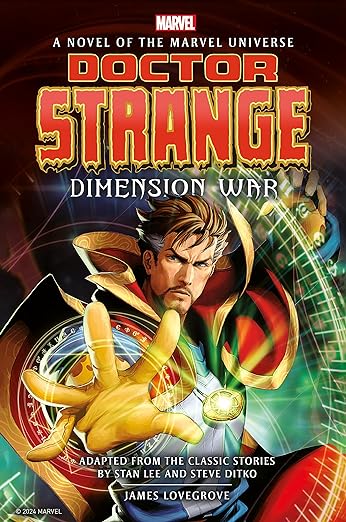
Doctor Strange: Dimension War


By James Lovegrove (MARVEL)
ISBN: 978-1-8033-6257-1 (HB/Digital edition/Audio book)

Modern Marvel is a multimedia entertainment colossus but all those multitudinous branches and subdivisions ultimately derive from stories in comic books. Thanks to recent on-screen exposure, ultimate Marvel outsider Stephen Strange is now a popular hot property, which no doubt inspired this prose reinterpretation based on his founding exploits as originally detailed by Steve Ditko and Stan Lee…

Marvel’s sustained presence on non-graphic bookshelves really began in the 1990s with a string of hardback novels. Since then, those who want to supply their own pictures to MU exploits have basked in a procession of text-based thrills in all book formats. Of late, Titan Books has been supplying powerhouse prose publications and here addresses the interests of fans brought in by the recent movies as well as those lifelong devotees of the ever-enlarging continuity who can’t bear to miss a single instance of their fave raves.

Written by British author/designer/illustrator James Lovegrove (Hope, Redlaw, Age of Odin, The Clouded World, Untied Kingdom, Pantheon series, Firefly), Dimension War takes Ditko & Lee’s early episodic exploits of the “Master of Black Magic”: tweaking and shuffling them into one cohesive story arc detailing the coming of the mage and his accession to the role of Sorcerer Supreme.

By downplaying more esoteric episodes – such as battling Asgardian god Loki and stealing Thor’s hammer, rescuing Queen Cleopatra, banishing a sentient predatory house, evicting body-stealing aliens, battling decadence demon Tiborro and saving human burglars from enslavement in the Purple Dimension – the author delineates and extrapolates an intriguing ongoing war from Strange’s frequent clashes with rival student Baron Karl Mordo.

The origin is included and expanded upon as morally bankrupt, crippled superstar surgeon Dr. Stephen Strange finds new purpose after losing everything he thought mattered. By saving aged Tibetan mystic The Ancient One from his ambitious murderous disciple Mordo Strange dedicates himself to become a magical adept: resolved to save humanity from diabolical and extradimensional threats.

Focussing on the many battles with dream demon Nightmare, implacable Mordo and his extradimensional tyrant god patron Dread Dormammu as well as the start of a prolonged but doomed romance with beguiling alien witch-with-a secret Clea, the saga traces a far hipper and less aloof mage than most comics fans will be used to: one who tirelessly strives to keep Earth safe and frustrate demonic schemes of monsters consumed by avarice and arrogance and who ultimately learn there’s always someone bigger and stronger and that pride invariably goes before a great fall…

Reprocessing material from Strange Tales #110, 111 and 114-146, spanning July 1963 to July 1966, as an added treat, the epic ends in an epilogue as first seen in pictures in Amazing Spider-Man Annual #2 (October 1965). There and then the Good Doctor first fully entered the glamourous, bright and shiny superhero universe, joining the wondrous wallcrawler to defeat thieving wizard Xandu who ensorcelled thugs to make invulnerable zombies and purloined the terrifying Wand of Watoomb…

Slick and fast paced at the cost of much of the mood of the comics, the tale will certainly please movie converts and apostles, and should you wish to see the way it all began and unfolded in pictorial terms, the basis for all this arcane armageddon action can be found in Doctor Strange Epic Collection volume 1 (1963-1966): Master of the Mystic Arts.
© 2024 MARVEL.

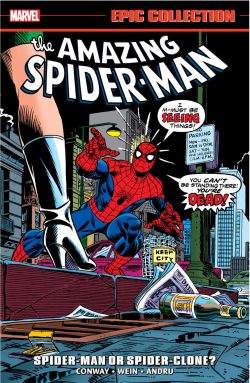
Amazing Spider-Man Epic Collection volumes 9: Spider-Man or Spider-Clone? 1975-1977


By Gerry Conway, Len Wein, Archie Goodwin, Ross Andru, Gil Kane, Sal Buscema, Mike Esposito, Frank Giacoia, Dave Hunt, John Romita & various (MARVEL)
ISBN: 978-1-3029-4874-0 (TPB/Digital edition)

Amazing Spider-Man was a comic book that matured with – or perhaps just slightly ahead of – its fan-base. This epic compendium of chronological webspinning wonderment sees the World’s Most Misunderstood Hero facing even greater and evermore complex challenges as he slowly recovers from the trauma of losing his true love and greatest enemy in the same horrific debacle. Here you will see all that slow recovery comes unstuck.

Once co-creator Stan Lee replaced himself with young Gerry Conway, the scripts acquired a far more contemporary tone (but feeling quite outdated from here in the 21st century): purportedly more in tune with the times whilst the emphatic use of soap opera subplots kept older readers glued to the series even when bombastic battle sequences didn’t. Moreover, as a sign of those times, a hint of cynical surrealism also began creeping in…

For newcomers – or those just visiting thanks to Spider-Man movies: super smart-yet-ultra-alienated orphan Peter Parker was bitten by a radioactive spider during a school outing. Discovering strange superhuman abilities which he augmented with his own natural chemistry, physics and engineering genius, the kid did what any lonely, geeky nerd would do with such newfound prowess: he tried to cash in for girls, fame and money. Making a costume to hide his identity in case he made a fool of himself, Parker became a minor media celebrity – and a criminally vainglorious one. To his eternal regret, when a thief fled past him one night he didn’t lift a finger to stop him, only to find when he returned home that his guardian uncle Ben Parker had been murdered.

Crazed and vengeful, Peter hunted the assailant who’d made his beloved Aunt May a widow and killed the only father he had ever known. He discovered to his horror it was the self-same felon he had neglected to stop. His irresponsibility resulted in the death of the man who raised him, and the traumatised boy swore to forevermore use his powers to help others. Since that night, the wallcrawler tirelessly battled miscreants, monsters and madmen with a fickle, ungrateful public usually baying for his blood even as he perpetually saves them.

The high school nerd grew up and went to college. Because of his guilt-fuelled double-life he struggles there too but found abiding love with cop’s daughter Gwen Stacy… until she was murdered by the Green Goblin. Now Parker must pick up the pieces of his life…

This compelling compilation reprints Amazing Spider-Man #143-164 and Annual #10: collectively covering cover-dates April 1975 to January 1977, and confirming an era of astounding introspective drama and captivating creativity wedded to growing science fictional thinking. Stan Lee’s hand-picked successor Gerry Conway moved on after reaching a creative plateau, giving way to fresh authorial guide Len Wein.  Thematically, tales moved away from sordid street crime as outlandish villains and monsters took centre stage, but the most sensational advance was an insidious scheme which would reshape the nature of the web-spinner’s adventures to this day.

For all that, the wallcrawler was still indisputably mainstream comics’ voice of youth, defining being a teen for young readers of the 1970s, tackling incredible hardships, fantastic foes and the most pedestrian and debilitating of frustrations. Now its later and still-grieving Parker is trying to move on as we open with Amazing Spider-Man #143 (by Conway, Ross Andru, Frank Giacoia & Dave Hunt) in ‘…And the Wind Cries: Cyclone!’ Peter is in Paris to deliver a ransom and save kidnapped publisher J. Jonah Jameson but resorts to his arachnid alter ego to deal with a hyper-fast French supervillain. The run-of-the-mill tale’s real kicker comes from an overly-fond farewell expressed by “casual chum” Mary Jane Watson: a kiss that finally shifts traumatised Peter’s thoughts from his recently murdered beloved.

The creative team capitalised on the situation after Spider-Man saves Jonah and clobbers the kidnappers before Pete returns to New York and his usual daily travails as #144 launches a shocking new worry. ‘The Delusion Conspiracy’ (ASM #145) builds the tension and focuses on a baffled girl’s confusion and terror at everyone’s reactions when she comes home and the entire world screams ‘Gwen Stacy is Alive… and, Well…?!’

With Gwen somehow resurrected and Peter on the edge of a mental breakdown, Aunt May is hospitalised just in time for another old foe to strike again in ‘Scorpion… Where is Thy Sting?’, but the real kick in the tale is irrefutable scientific and medical reports proving the increasingly bewildered Miss Stacy is not an impostor but the genuine article…

In Spider-Man #147 Peter finds some answers as further tests prove Gwen is actually a true human clone (remember, this was new, cutting-edge stuff in 1975) but all too soon he’s distracted by another bad-guy with a grudge and hungry to prove ‘The Tarantula is a Very Deadly Beast’ (inked by Mike Esposito & Dave Hunt). It’s all part of a convoluted, utterly byzantine revenge scheme conceived by a malign enemy. When the hero is ambushed by a mesmerised Gwen at the behest of the archfiend, ‘Jackal, Jackal, Who’s Got the Jackal?’ at last discloses shocking truths about one of Peter’s most trusted friends prior to the Delusion Conspiracy explosively concluding in #149’s ‘Even if I Live, I Die!’ (Andru & Esposito art).

Learning he and Gwen had been covertly cloned by their biology teacher Miles Warren, the Amazing Arachnid must defeat his alchemical double in a grim, no-holds-barred identity-duel, with neither sure who’s the real McCoy. The battle eventually results in the copy’s death. Maybe. Perhaps. Probably…

The moment of unshakeable doubt over who actually fell informs anniversary issue Amazing Spider-Man #150, with Archie Goodwin, Gil Kane, Esposito & Giacoia taking the hero down memory lane and up against a brigade of old antagonists to decide whether ‘Spider-Man… or Spider-Clone?’ survived that furious final fight, before debuting regular scripter Len Wein joins Andru & John Romita Sr. to launch a new era of adventure…

After disposing of his duplicate’s corpse in an incineration plant, Spider-Man finds time to let Peter reconnect with his long-neglected friends. However, a jolly party is soon disrupted as blackouts triggered by a super-menace lead the wallcrawler into the sewers for a ‘Skirmish Beneath the Streets!’ It results in his almost drowning and nearly being ‘Shattered by the Shocker!’ (Esposito & Giacoia inks) in a conclusive and decisive return engagement before a moving change-of-pace tale sees a blackmailed former football star giving his all to save a child in ‘The Longest Hundred Yards!’ (Andru & Esposito).

However, it’s left to Spider-Man to make the true computer-crook culprits pay, after which #154 reveals ‘The Sandman Always Strikes Twice!’ (with art by Sal Buscema & Esposito) – albeit with little lasting effect – until devious murder-mystery ‘Whodunnit!’ (Buscema & Esposito) cunningly links three seemingly unconnected cases in a masterful “Big Reveal”…

A long-running romance-thread culminates in the oft-delayed wedding of Pete’s old flame Betty Brant to reporter Ned Leeds, but the nuptials are sadly interrupted by a new costumed crook in ‘On a Clear Day, You Can See… the Mirage!’ (Wein, Andru & Esposito), even as a sinister hobo who was haunting the last few yarns strode fully into the spotlight…

In the past, a protracted struggle for control of New York between Dr Octopus and cyborg gangster Hammerhead escalated into a full-on gang war and small-scale nuclear near-disaster, with Spidey and his aunt caught in the middle. The devilish duel concluded with an atomic explosion and the seeming end of two major antagonists. However, #157 exposed ‘The Ghost Who Haunted Octopus!’ as the long-limbed loon turns again to May Parker for salvation.

With Peter in attendance, the many-handed menace seeks to escape a brutal ghostly stalker tormenting him, but their unified actions actually liberate a pitiless killer from inter-dimensional limbo in ‘Hammerhead is Out!’, leading to a savage three-way showdown with Spidey ‘Arm-in-Arm-in-Arm-in-Arm-in-Arm-in-Arm with Doctor Octopus!’ to save the horrified Widow Parker.

Courtesy of plotter Wein, scripter Bill Mantlo and Kane, Esposito & Giacoia, a new insectoid archfoe debuted in Amazing Spider-Man Annual #10, where ‘Step Into My Parlor…’ depicts obsessed Spider-hater J. Jonah Jameson hiring outcast, exceedingly fringe-science biologist Harlan Stilwell  to create yet another tailor-made nemesis to destroy the webslinger.

Meanwhile, the detested hero is ending a vicious hostage situation manufactured by psychotic Rick Deacon, but when the killer escapes and breaks into a certain lab he’s transformed into a winged wonder hungry for payback on the webspinner in ‘…Said the Spider to the Fly!’

In the monthly mag Wein, Andru & Esposito fired the opening shot of an extended epic as a criminal inventor – and one of the wallcrawler’s oldest enemies – recovers Spidey’s long-ditched, satisfactorily drowned “Spider-Mobile”, tricking it out to hunt down its original owner in #160’s ‘My Killer the Car!’…

Having narrowly escaped doom and debacle in equal measure Spidey met a new friend and clashed with an old one, although rising star Frank Castle was reduced to a bit-player in Amazing Spider-Man #161-162 (October & November 1976), as the All-Newly-Reformed X-Men were sales-boosted via a guest-clash in ‘…And the Nightcrawler Came Prowling, Prowling’, wherein the Amazing Arachnid jumps to a completely wrong conclusion after a sniper shoots a reveller at Coney Island. By the time moody mutant Nightcrawler explains himself – in tried-&-true Marvel manner by fighting the webspinner to a standstill – old skull-shirt has turned up to take them both on before mutual foe Jigsaw is exposed as the real assassin in concluding episode ‘Let the Punisher Fit the Crime!’

The mystery villain behind much of Spider-Man’s recent woes is at last exposed in ‘All the Kingpin’s Men!’ as a string of audacious tech-robberies lead the hero to another confrontation with the deadly crime lord. This time, however, the Machiavellian mobster is playing for personal stakes. His son has been on the verge of death for months and his remedy is to electronically transfer the Spider-Man’s life force into the ailing patient. Discarded after the process, Peter Parker’s impending ‘Deadline!’ is extended by old friend Curt Connors until they can explosively set things right…

To Be Continued…

As always the narrative delights are supplemented by added extras which this go-round include contemporary house ads, Romita & Joe Sinnott’s cover/back cover, frontispiece, contents page and double-page cast pin-up from 1975 tabloid edition Marvel Special Edition #1: The Spectacular Spider-Man, and the Andru- & Esposito-rendered entry for The Mighty Marvel Bicentennial Calendar 1976 (June) and Ronn Sutton’s cover for George Olshevsky’s 1982 The Marvel Comics Index: The Amazing Spider-Man and the 1985 Frontispiece by John Allison. Also on view are Andru’s prankish private joke pencils for the big reveal in ASM #144, editorial ‘Of Jackals and Juxtaposition’ from The Spider’s Web column in #153, and original art pages by Punisher design sketch by Romita and original art pages by Kane, Romita Andru & Esposito.

Blending cultural veracity with superb art, and making a dramatic virtue of the awkwardness, confusion and imputed powerlessness most of the readership experienced daily resulted in an irresistibly intoxicating read, especially when delivered in addictive soap-styled instalments, but none of that would be relevant if Spider-Man’s stories weren’t so utterly entertaining. This action-packed collection relives many momentous and crucial periods in the wallcrawler’s astounding life and is one all Fights ‘n’ Tights fanatics must see…
© 2023 MARVEL.

Adam Warlock Omnibus


By Stan Lee & Jack Kirby, Roy Thomas, Mike Friedrich, Ron Goulart, Gerry Conway, Tony Isabella, Jim Starlin, Bill Mantlo, David Anthony Kraft, Len Wein, Mark Gruenwald, Gil Kane, Bob Brown, Herb Trimpe, John Buscema, Tom Sutton, John Byrne, Steve Leialoha, Jerry Bingham, Joe Sinnott, Vince Colletta, Dan Adkins, Jack Abel, Josef Rubinstein, Al Milgrom, Alan Weiss, Dave Hunt, Frank Giacoia, Mike Esposito, Gene Day & various (MARVEL)
ISBN: 978-1-3029-4987-7 (HB/Digital edition)

And lo… there came another star to the firmament…

During the 1970s in America and Britain (the latter of which deemed newspaper cartoons and strips worthy of adult appreciation for centuries whilst fervently denying similar appreciation and potential for comics), the first inklings of wider public respect for the medium of graphic narratives began to blossom. This followed avid and favourable response to pioneering stories such as Denny O’Neil & Neal Adams’ “relevancy” Green Lantern run, Stan Lee & John Buscema’s biblically allegorical Silver Surfer or Roy Thomas’ ecologically strident antihero Sub-Mariner; a procession of thoughtfully-delivered depictions of drug crime in many titles, and the sustained use of positive racial role models everywhere on four-colour pages.

Comics were inexorably developing into a vibrant forum of debate (a situation also seen in Europe and Japan), engaging youngsters in real world issues relevant to them. As 1972 dawned, Thomas took the next logical step, transubstantiating an old Lee & Kirby Fantastic Four throwaway foe into a potent political and religious metaphor. As described in his Introduction ‘Rebirth’ the kernel of that character debuted as FF foe Him before being re-imagined by Thomas & Gil Kane as a modern interpretation of the Christ myth: stationed on an alternate Earth far more like our own than that of Marvel’s unique universe.

This massive epistle re-presents Fantastic Four #66-67, The Mighty Thor, #165-166, Marvel Premiere #1-2, Warlock #1-15, Strange Tales #178-181, Incredible Hulk #176-178 and Annual #6, Marvel Team-Up #55, Avengers Annual #7 and Marvel Two-in-One #61-63 and Annual #2 – collectively spanning cover-dates September 1967 to May 1980 – and starts with that cataclysmic clash as Ben Grimm and his friends search for The Thing’s true love Alicia Masters.

The mystery of her disappearance is revealed in ‘What Lurks Behind the Beehive?’ by Lee, Kirby & Joe Sinnott, as the outraged FF trail the seemingly helpless artisan to a man-made technological wonderland. Here a band of rogue geniuses have genetically engineered the next phase in evolution only to lose control of it even before it can be properly born…

Fantastic Four #67 exposes the secret of the creature known as Him in ‘When Opens the Cocoon!’ where only Alicia’s gentle nature is able to placate the nigh-omnipotent creature until the heroes save her and the creation deals with its squalid makers, before heading into the starry universe to mature…

‘Him!’ resurfaced in Thor #165 & 166 (June & July 1969), returned to earth in his gestation cocoon and stumbling into battle with a severely over-stressed Thunder God. The situation intensified when the creature created by evil scientists to conquer mankind sees Sif and decides it’s time he took a mate…

Conclusion ‘A God Berserk!’ sees Thor trailing the artificial superman across space and assorted dimensions with companion Balder who witnesses his gentle comrade’s descent into brutal “warrior-madness” resulting in a savage beating of naive childlike Him. By the time the Thunderer regains his equilibrium, he is a shaken, penitent and guilt-ridden hero eager to pay penance for his unaccustomed savagery whilst the modern homunculus has retreated to the chill depths of space again…

Jump forward to tumultuous turbulent 1971 where the story really begins with the April cover-dated Marvel Premiere #1 (on sale from November 1971) which boldly proclaimed on its cover The Power of… Warlock. Inside, the stunning fable by Thomas, Kane & Dan Adkins declared ‘And Men Shall Call Him… Warlock’: swiftly recapitulating the artificial man’s origins as a lab experiment concocted by rogue geneticists eager to create a superman they could control for conquest. Also on view is the manufactured man’s face off with the FF, and clash with Thor over the rights to a mate before returning to an all-encompassing cosmic cocoon to evolve a little more. Now the shell is plucked from the void thanks to the moon-sized ship of self-created god The High Evolutionary. Having artificially ascended to godhood, he is wrapped up in a bold new experiment…

Establishing contact with Him as he basks in his cocoon, the Evolutionary explains that he is constructing from space rubble a duplicate planet Earth on the opposite side of the sun. Here he will replay the development of life, intending that humanity on Counter-Earth will evolve without the taint of cruelty and greed and deprived of the lust to kill. It’s a magnificent scheme that might well have worked, but as the Evolutionary wearies, his greatest mistake intervenes…

Man-Beast was over-evolved from a wolf and gained mighty powers, but also ferocious savagery and ruthless wickedness. Now he invades the satellite, despoiling humanity’s rise and ensuring the new world’s development exactly mirrors True-Earth’s. The only exception is the meticulous exclusion of enhanced individuals. The beleaguered orb has all Earth’s woes but no superheroes to save or inspire its people.

A helpless witness to the desecration, the golden being furiously crashes free of his cocoon to save the High Evolutionary and rout Man-Beast and his bestial cronies (all similarly evolved animal-humanoids called “New-Men”). When the despondent, enraged science god recovers, he decides to erase his failed experiment but is stopped by his rescuer. As a helpless observer, Him saw the potential and value of embattled humanity. Despite all their flaws, he believes he can save them from imminent doom caused by their own unthinking actions, wars and intolerance. When his pleas convince the Evolutionary to give this mankind one last chance, the wanderer is hurled down to Counter-Earth, gifted and graced with a strange “Soul Gem” to focus his powers, on a divine mission to find the best in the fallen and a name of his own…

Marvel Premiere #2 (July 1972) sees the golden man-god crash down in America and immediately win over a small group of disciples: a quartet of disenchanted teen runaways fleeing The Man, The Establishment and their oppressive families. His cosmic nativity and transformation leave the newcomer briefly amnesiac, and as Warlock’s followers seek to help, all are unaware that Man-Beast has moved swiftly, insinuating himself and his bestial servants into the USA’s political hierarchy and Military/Industrial complex.

This devil knows the High Evolutionary is watching and breaks cover to introduce unnatural forces on a world previously devoid of superbeings or aliens. The result is an all-out attack by rat mutate Rhodan, who pounces on his prey at the very moment Colonel Barney Roberts, uber-capitalist Josiah Grey and Senator Nathan Carter track their missing kids to the desolate Southern Californian farm where they have been nursing a golden angel. Men of power and influence, they realise their world has changed forever after seeing Warlock destroy the monstrous beast and ‘The Hounds of Helios!’

Doctor Strange was revived to fill the space in MP #3, as the gleaming saviour catapulted into his own August cover-dated title. Inked by Tom Sutton, Warlock #1 decreed ‘The Day of the Prophet!’: recapping key events and seeing the High Evolutionary safeguard his failing project by masking Counter-Earth from the rest of the solar system behind a vibratory screen.

With his mistake securely isolated from further contamination, HE asks Adam if he’s had enough of this pointless mission, and is disappointed to see Warlock’s resolve is unshaken. That assessment is questioned when the disciples take the spaceman to his first human city. Senses reeling, Warlock is drawn to a bombastic street preacher and his psychic sister Astrella, both seemingly targeted by the Man-Beast. Of course, all is not as it seems…

This issue saw the first letter page ‘Comments from Counter-Earth’ and is included here as are all subsequent editorial columns.

Mike Friedrich scripted Thomas’s plot and John Buscema joins Sutton in #2’s illuminating ‘Count-Down for Counter-Earth!’: taking biblical allegory even further as Warlock is captured by his vile foes and tempted with power in partnership with evil, even as his young disciples are attacked and deny him. Counter-Earth has never been closer to damnation and doom, but once more the saviour’s determination overcomes the odds…

The epic expands with Friedrich in the hot seat and Kane & Sutton reunited to steer the redeemer’s path. ‘The Apollo Eclipse’ begins with Adam and his apostles harassed by the increasingly impatient High Evolutionary following a breaching of his vibratory barrier by the Incredible Hulk and the Rhino (in Hulk #158 and reprinted in many volumes… but not this one). That episode is soon forgotten when they are targeted by another Man-Beast crony, hiding his revolting origins and unstable psyche behind a pretty façade. The hirsute horror attacks a rocket base where Adam seeks to reconcile his youthful followers with their parents, but the subsequent clash turns to tragedy in #4’s ‘Come Sing a Searing Song of Vengeance!’ as the exposed monster takes the children hostage. Astrella senses that visiting Presidential candidate Rex Carpenter holds the key to the stalemate, but when he intervenes at her urging, unbridled escalation, death and disaster follow…

Although super-beings were excised from the world’s evolution, extraordinary beings still exist. Warlock #5 (April 1973) sees Ron Goulart write the anxious aftermath as the doubt-riddled redeemer emerges from another sojourn in a recuperative cocoon. In the intervening months Carpenter has become President and ordered increased weapons testing to combat the incredible new dangers he personally witnessed. Tragically, he also ignores warnings from government scientist Victor Von Doom, and when a military manoeuvre sparks ‘The Day of the Death-Birds!’ Adam helps when a dam is wrecked. His divine might is sufficient to halt autonomous robotic drones programmed to strafe ground-based beings, but cannot stop the grateful citizenry turning on him when Carter declares him a menace to society…

Friedrich scripts Goulart & Thomas’ plot and Bob Brown joins the team as penciller in #6 as Warlock battles the army and Doom contacts fellow genius Reed Richards for help. Sadly, the Latverian is unaware of a shocking change in his oldest friend who is now ‘The Brute!’: a mutated cosmic horror enthralled by the malign thing running the White House and now ordered to ambush Warlock as Astrella brings him to truce talks…

It’s a pack of lies and a trap. As the Golden Gladiator defeats Richards, enraged mobs egged on by PotUS attack Warlock’s growing band of supporters. Now, though, the alien’s very public life-saving heroics have swayed fickle opinion and Carter is forced to reverse his stance and exonerate Warlock. Even this is a ploy, though, allowing him to set the energy-absorbing Brute on the redeemer in ‘Doom: at the Earth’s Core!’ Beyond all control, Richards’ rampage threatens to explode Counter-Earth, and only the supreme sacrifice of one of Adams’s constantly dwindling band of supporters saves the planet…

Warlock’s rocky road paused with the next issue. Cancelled with #8, Friedrich, Brown & Sutton dutifully detailed ‘Confrontation’ in Washington DC as the supposed saviour’s supporters clashed with incensed cops. Intent on stopping a riot, Warlock’s work magnifies when Man-Beast’s New-Men minions join the battle. The saga ends on an eternal cliffhanger as Warlock finally exposes what Carpenter is… before vanishing from sight for 8 months.

The aforementioned Hulk #158 had seen the Jade Goliath dispatched to the far side of the Sun to clash on Counter-Earth with the messiah’s enemies. Although it is excluded here, the 3-issue sequel it spawned was concocted after the Golden Godling’s series ended. When the feature returned, the tone – like the times – had comprehensively changed. All the hopeful positivity and naivety had, post-Vietnam and Watergate, turned to world-weary cynicism in the manner of Moorcock’s doomed hero Elric. Maybe a harbinger of things to come…?

The cosmic codicil completing Warlock’s initial cosmic journey came after The Hulk’s encounter with the Uncanny Inhumans and a devastating duel with silent super-monarch Black Bolt. Following the usual collateral carnage, the bout ended with the monster hurtling in a rocket-ship to the far side of the sun for a date with allegory, if not destiny. Counter-Earth had seen messianic Adam Warlock futilely battle Satan-analogue Man-Beast: a struggle the Jade Juggernaut had learned of on his previous visit. Now he crashed there again to end the cruelly truncated metaphorical epic, beginning in ‘Crisis on Counter-Earth!’ (Incredible Hulk #176, June 1974) by Gerry Conway, Herb Trimpe & Jack Abel.

Since his last visit Man-Beast and his bestial flunkies had become America’s President and Cabinet. Moving deceptively but decisively, they had finally captured Warlock and led humanity to the brink of extinction, leaving the would-be messiah’s disciples in total confusion. With America reeling, Hulk’s shattering return gives Warlock’s faithful flock opportunity to save their saviour in ‘Peril of the Plural Planet!’ but the foray badly misfires and Adam is captured. Publicly crucified, humanity’s last hope perishes. The quasi-religious experience concludes with ‘Triumph on Terra-Two’ (Conway, Tony Isabella, Trimpe & Abel, Incredible Hulk #178). Whilst Hulk furiously battles Man-Beast, the expired redeemer resurrects in time to deliver a karmic coup de grace before ascending from Counter-Earth to the ever-beckoning stars.

The epic pauses here for Douglas Wolk’s critical appreciation of what happens next in ‘Unmistakable Talent’ before even more grandiose events are revealed…

The messianic saga apparently ended when Warlock died and was reborn, thwarting Satan-analogue Man-Beast with the aid of the Jade Juggernaut enacting a cosmic resurrection and ascending into the unknown. However, when the feature returned at the end of 1974 the tone, like the times, had hugely changed. In the wake of Vietnam and Watergate, hope, positivity and comfortable naivety had become world-weary cynicism. The new Adam had changed too, and was now draped in precepts of inescapable destiny in the manner of doomed warrior Elric. It was a harbinger of things to come…

The story resumed in Strange Tales #178 as ultra-imaginative morbid maverick Jim Starlin (Captain Marvel, Master of Kung Fu, Infinity Gauntlet, Dreadstar, Batman, Death in the Family, Kid Kosmos) turned the astral wanderer into a nihilistic, Michael Moorcock-inspired, death-obsessed, constantly outraged, exceedingly reluctant and cynical cosmic champion. The slow spiral to oblivion began in February cover-dated Strange Tales #178, wherein Starlin introduced alien Greek Chorus Sphinxor of Pegasus to recap the past by asking and answering ‘Who is Adam Warlock?’

Handling everything but lettering – that was left to Annette Kawecki – Starlin’s solitary stellar nomad Warlock is brooding on a desolate asteroid in the Hercules star cluster just as a trio of brutes attack a frightened girl. Despite his best efforts they execute her, proud of their status as Grand Inquisitors of the Universal Church of Truth who have ecstatically excised one more heathen unbeliever…

Appalled to have failed another innocent, Warlock employs the Soul Gem at his brow to briefly resurrect her and learns of an all-conquering ruthless militant religion dedicated to converting or eradicating all life. His search triggers a chilling confrontation as ‘Enter The Magus!’ manifests the living god of the UCT who attacks Warlock with a crushingly awful truth: the man who has subjugated worlds, exterminated trillions and fostered every dark desire of sentient beings is his own future self. Adam vows to end this perverse impossible situation, doing whatever is necessary to prevent becoming his own worst nightmare…

With Tom Orzechowski lettering and Glynis Oliver-Wein doing colours, Starlin’s pilgrimage sees Warlock attack a UCT warcraft transporting rebels, “degenerates” and “unproductives” from many converted worlds. The church only deems basic humanoids as sacred and worthy of salvation, with most other shapes useful only as fodder or fuel. However, despite their appearance as humanish, The Church does make an exception for the universally deplored, vulgar and proudly reprobate race called “Trolls” who are too salacious to exist…

In the dungeon-brig of the ship Great Divide, Adam’s gloomy mood is irresistibly lifted by disgusting troll Pip: a lout revelling in “independent manner and cavalier ways”, unphased or frightened by the imminent death awaiting them all. Meanwhile, enhanced true believer Captain Autolycus gets a message from Temporal Leader of the Faithful The Matriarch. She has decided to ignore her god’s instruction to capture Warlock and keep him unharmed…

As Adam instructs his fellow dregs in the nature of rule, Autolycus acts on her command, losing his entire crew and perishing when Warlock finally breaks loose. After escaping the ‘Death Ship!’, Adam realises Pip – keen to share a new adventure – has stowed away, but lets it go. He has a bigger problem: in the climactic final battle, the Soul Gem refused his wishes. Acting on its own, it consumed Autolycus’ memories and persona, binding them inside the twisted champion’s head…

With additional inking by Alan Weiss, ST #180’s ‘Judgment!’ finds Pip and Warlock submerged in the heaving masses of Homeworld whilst hunting the living god. Terrified of the uncontrollable spiritual vampire on his brow, Adam tries to remove it and discovers it has already stolen him: without it he will perish in seconds…

Living on borrowed time and pushed into precipitate action, the apostate avenger invades the Sacred Palace and is offered a curious deal by the Matriarch who imprisons him when he refuses. Subjected to ‘The Trial of Adam Warlock’, the appalled adventurer endures a twisted view of the universe courtesy of Grand Inquisitor Kray-Tor, even as in the city, Pip thinks he has scored with a hot chick when in fact he’s been targeted by public enemy number one. Called “the deadliest woman in the whole galaxy” Gamora has plans for Adam, which include him being alive and free…

Back in court, the golden man rejects Kray-Tor’s verdict and, revolted by the proceedings, foolishly lets his Soul Gem feed. The carnage it triggers and his subsequent guilt leaves Adam catatonic in the hands of the Matriarch’s cerebral re-programmers…

Starlin was always an outspoken, driven creator with opinions he struggled to suppress. His problems with Marvel’s working practises underpin ST #181’s ‘1000 Clowns!’ as old pal Al Milgrom inks a fantastic recap and psychological road trip inside the champion’s mind. None of the subtext is germane if you’re just looking for a great story however, and – in-world – Warlock’s resistance to mind-control is mirrored by Pip and Gamora’s advance through the UCT citadel to his side. Embattled by the psychic propaganda assaulting him, Warlock retreats into the safety of madness, learning to his horror that this is what The Magus wanted all along. Now the dark messiah’s victory and genesis are assured…

The triumph was celebrated by the resurrection of the hero’s own title. Cover-dated October 1975, Warlock #9 revealed the master plan of Adam’s future self. Inked by Steve Leialoha, ‘The Infinity Effect!’ depicted the mirror images in stark confrontation with evil ascendent, unaware Gamora was an agent of a hidden third party and that all the chaos and calamity was part of a war of cosmically conceptual forces. The saga heads into the Endgame as the Magus explains in cruel detail how he came to power and how warlock’s coming days are his past, before summoning abstract conceptual terror The In-Betweener to usher in their inevitable transfiguration. There is one problem however: the first time around Adam/Magus was never attacked and almost thwarted by an invisible green warrior woman…

Crushed by realisation that he will become a mass-murdering spiritual vampire, Adam reels as the hidden third element arrives to save everything. Inked by Leialoha, #10’s ‘How Strange My Destiny!’ finds Pip, Gamora, Adam and Thanos of Titan battling 25,000 cyborg Black Knights of the Church who rapturously pay ‘The Price!’ of devotion in a horrific stalling tactic until the In-Betweener comes…

Kree Captain Mar-Vell narrates a handy catch-up chapter detailing ‘Who is Thanos?’ as the beleaguered champions escape, before ‘Enter the Redemption Principle!’ explores some of the Titan’s scheme and why he opposes the Magus and his Church, even as the dark deity realises that Thanos’ time probe is the only thing that can upset his existence…

How Strange My Destiny – with finished art by Leialoha from Starlin’s layouts – continues and concludes in #11 as ‘Escape into the Inner Prison!’ sees the Magus and his Black Knight death squads brutally board Thanos’ space ark. A combination of raw power and the Soul Gem buy enough time for Warlock and Pip to use the time probe, which deposits them in the future, just as In-Betweener arrives to convert the hero and supervise ‘The Strange Death of Adam Warlock!’, resulting in a reshuffling of chronal reality and mad Thanos’ triumph…

After months of encroaching and overlapping Armageddons, Warlock #12 digresses and diverts with ‘A Trollish Tale!’ as Pip’s fondness for hedonism and debauchery entrap him in professional harlot Heater Delight’s plan to escape a life on (non)human sexual trafficking in a star-roaming pleasure cruiser. He’s happy with the promised reward for his efforts, but hasn’t considered that her pimp might object to losing his meal ticket…

Cosmic conflict returns in #13 as ‘…Here Dwells the Star Thief!’ introduces an existential threat to the entire universe lying in a hospital bed on Earth. New England’s Wildwood Hospital houses Barry Bauman, whose life is blighted by a total disconnection between his brain and nerve functions. Isolated, turned inward for his entire life, Barry has developed astounding psychic abilities, the first of which was to possess his nurse and navigate an unsuspecting outer world by proxy. Barry’s intellect also roams the endless universe and brooding, doomed Warlock is there when Barry consumes an entire star just for fun…

Outraged at such cruel wilful destruction, Warlock uses his own powers to trace the psionic force, resolved to follow it back to the planet of his original conception even as ‘The Bizarre Brain of Barry Bauman’ explores the Star Thief’s origins and motivations prior to the psionic savant formally challenging Adam to a game of “stop me if you can”…

Spitefully erasing stars and terrorising Earth as Warlock traverses galaxies at top speed, Bauman knows a secret about his foe that makes victory assured, but he still lays traps in the hero’s interstellar path. The ‘Homecoming!’ is accelerated by a shortcut through a black hole, but when Adam arrives in Sol system, he receives a staggering shock: his voyages and simple physics have wrought physical changes making it impossible to ever go home again. Sadly for gleeful Barry, the frustration of his foe distracts him just when he should be paying closer attention to his physical body…

The series abruptly ended again (November 1976), Starlin returned to full art & story chores in #15’s ‘Just a Series of Events!’ Exiled from Earth, Adam rants as elsewhere, Thanos expedites long-term plans. With The Magus removed, his desire for total stellar genocide can proceed, but the Titan worries that his adopted daughter Gamora might be a problem, when he really needs to be more concerned about his own nemesis-by-design Drax the Destroyer. The saga then pauses with Adam confronting a host of plebian injustices and seemingly regaining command of his Soul Gem at last…

Vanished again, Warlock only languished in limbo for a few months. In mid-December 1976, Marvel Team-Up #55 (cover-dated March 1977) addressed his physically altered state as Bill Mantlo, John Byrne & Dave Hunt crafted ‘Spider, Spider on the Moon!’ For reasons too complicated to explain here, Spider-Man had been trapped in a rocket and blasted into space before being happily intercepted and left by Warlock in Luna’s habitable “Blue Area”. The nomad then assisted the Arachnid and mysterious alien The Gardener against overbearing exotic ephemera collector The Stranger who sought possession of the Golden Gladiator’s life-sustaining Soul Gem, but soon discovered an equally fascinating alternate choice…

Despite his sporadic and frankly messy publishing career, Warlock has been at the heart of many of Marvel’s most epochal and well-regarded cosmic comic classics, and ending this compendium is probably the very best: an extended epic spanning two summer annuals and seemingly signalling the end on an era…

‘The Final Threat’ (by Starlin & Joe Rubinstein in Avengers Annual #70, sees Protector of the Universe Mar-Vell AKA Captain Marvel and Titanian ultra-mentalist Moondragon back on Earth with vague anticipations of impending catastrophe. The premonitions are confirmed when Warlock arrives with news that death-obsessed Thanos has amassed an alien armada and built a soul gem-fuelled weapon to snuff out stars like candles. Spanning interstellar space to stop the scheme, the assembled heroes forestall alien invasion and prevent the Dark Titan from destroying the Sun, but only at the cost of Warlock’s life…

‘Death Watch!’ (Starlin & Rubinstein, Marvel Two-in-One Annual #2) then finds Peter Parker plagued by prophetic nightmares. These disclose how Thanos had snatched victory from defeat and now holds The Avengers captive whilst again preparing to extinguish Sol. With nowhere else to turn, the anguished, disbelieving webspinner heads for the Baxter Building, hoping to borrow a spacecraft, and unaware that The Thing also has a history with the terrifying Titan. Utterly overmatched, the mismatched Champions of Life nevertheless upset Thanos’ plans for long enough to free the Avengers before the Universe’s true agent of retribution ends the Titan’s threat forever… at least until next time…

Meanwhile on Earth, events are unfolding that will impact the future. The Hulk, bereft by the death of his subatomic lover Jarella, joins Defender chief Doctor Stephen Strange in David Anthony Kraft, Herb Trimpe and inkers Frank Giacoia & Mike Esposito for Incredible Hulk King Size Annual #6’s ‘Beware the Beehive!’ Here three of the mad scientists who made Him attempt to recreate their greatest success and failure. Morlak, Shinsky and Zota of rogue science collective The Enclave reactivate their hidden “Beehive” for another go at building a compliant god they can control, and abduct Doctor Strange to replace their missing fourth. The undercover magician summons the Jade Juggernaut to extract him from the experiment’s inevitable consequences when a compassionless super-slave dubbed Paragon emerges from a cocoon.

Before The Hulk arrives the natal menace tries to eradicate Strange and subdue mankind, but happily, after a border-shattering, army-crunching global rampage, that’s when the Hulk kicks the wall in and goes to work, forcing Paragon to return to its chrysalis and pursue further growth…

The stellar epic continued in Marvel Two-In-One: a title that had become a clearing house for unfinished plotlines and sagas. In #61 (cover-dated March 1980), Mark Gruenwald, Jerry Bingham & Gene Day unveiled ‘The Coming of Her!’ as time-travelling space god and 31st century Guardian of the Galaxy Starhawk became entangled in the birth of a female counterpart to artificial superman Adam Warlock. Picking up threads of the Hulk tale as well as Warlock’s quest, the tale told how Paragon awoke fully empowered and in female form and configuration and instantly began searching Earth for her predecessor. The fading psychic trail led to Ben Grimm’s girlfriend Alicia and Moondragon, who were pressganged across the solar system, arriving by MTIO #62 in time to witness ‘The Taking of Counter-Earth!’

Hot on their heels, The Thing and Starhawk catch Her just as the women encounter a severely injured High Evolutionary, and discover the world the self-created science god so carefully built and casually discarded has been stolen. Now united in mystery, the strange grouping follow the lost planet’s trail out of the galaxy and uncover the incredible perpetrators, but Her’s desperate quest to secure her predestined mate ends in tragedy when she learns ‘Suffer Not a Warlock to Live!’

The sidereal saga seemingly done, this collection also offers a bonanza of bonus treats which include a gallery of covers by Kirby, Sinnott & Colletta, Kane & Adkins, Frank Giacoia, John Romita, John Buscema, Trimpe, Starlin, Weiss, George Pérez & Terry Austin, house ads, original art pages by Kirby, Sinnott & Colletta, the 1972 Marvel Bulletin Page announcing Adam Warlock’s debut, John Romita corner-box art for Marvel Premiere #1, unused and corrected page & panel art, 9 pages of Kane finished art and numerous pencil roughs, augmented by 16 pages by Starlin and the cover of F.O.O.M. #9 (March 1975 and a “Special Cosmic Issue”) plus Duffy Vohland’s illustrated essay ‘Man is the Father to Him’.

Also on view are Starlin & Alan Weiss’s contributions to The Mighty Marvel Bicentennial Calendar 1976, and 16 pages of unused pencils by Weiss. (The photostats come from an issue lost in transit, and are supplemented by before-&-after panels judged unsuitable by the Comics Code Authority, the various production stages of Starlin & Weiss’ cover art for Warlock #9, with sketches, designs, frontispieces and full pages of original art). More Starlin original art and Weiss’ ‘Thanos War’ plate for the Marvel Team-Up Portfolio (1982).

Fact-filled pages on Warlock, The Enclave, Drax the Destroyer, The Gardener, In-Betweener, Gamora, Her, High Evolutionary, Moondragon, Pip the Troll, Thanos and 8 Alien Races from The Official Handbook of the Marvel Universe (1983-1985) precede a comedic offering from August 1982’s What If? #34 and Bob Budiansky & Bob Wiacek’s cover for Marvel Treasury Edition #24: The Rampaging Hulk (reprinting the Warlock saga from #175-178). The Fantastic Four “Him” debut was reprinted in Marvel’s Greatest Comics #49 & 50 (May & June 1974) and the covers are included here, as are those of Fantasy Masterpieces volume 2 #8-14 (1980-1981 reprinting Starlin’s early Warlock stories). They are augmented by the wraparound covers from 1983’s Warlock Special Edition #1-6 reprint series – including additional bridging pages, text and cartoon editorials by Al Milgrom and Starlin pin-ups.

A Craig Hamiliton Warlock plate from 1986’s Marvel’s Comics Limited Edition Superhero Print Series is followed by covers for 1992-1993’s Warlock rerun series (#1-6 and released to support the Infinity Gauntlet miniseries) and 9 prior collection and omnibus covers by Kane, Adkins, Richard Isanove, Starlin, Tom Smith, Weiss, Thomas Mason, Dean White and InHyuk Lee.

Ambitious, unconventional and beautiful to behold, Warlock’s oft-reprinted adventures are very much a product of their tempestuous, socially divisive times. For many, they proved how mature comics might become, but for others they were simply pretty pictures and epic fights with little lasting relevance. What they unquestionably remain is a series of crucial stepping stones to greater epics: unmissable appetisers to Marvel Magic at its finest.
© 2023 MARVEL.

Ms. Marvel Epic Collection volume 1: This Woman, This Warrior 1977-1978


By Gerry Conway, Chris Claremont, John Buscema, Sal Buscema, Jim Mooney, John Byrne, Keith Pollard, Carmine Infantino, George Tuska & various (Marvel)
ISBN: 978-1-3029-1639-8 (TPB/Digital edition)

Until relatively recently American comics and especially Marvel had very little in the way of positive female role models and almost no viable solo stars. Although a woman starred in the very first comic of the Marvel Age, The Invisible Girl took decades to become a potent and independent character in her own right – or even just be called “woman”. The company’s very first starring heroine was Black Fury: a leather-clad, whip-wielding crimebuster imported from a newspaper strip created by Tarpe Mills in April 1941. The sultry sentinel was repackaged as a resized reprint for Timely’s funnybooks and renamed Miss Fury to enjoy a 4-year run (1942-1946) – although her tabloid incarnation fought on until 1952. Fury was actually predated by Silver Scorpion, who debuted in Daring Mystery Comics #7 (April 1941), but she was relegated to a minor position in the book’s line-up and endured a very short shelf-life.

Miss America premiered in anthological Marvel Mystery Comics (#49, November 1943), created by Otto Binder & artist Al Gabriele. After a few appearances, she won her own title in early 1944. Miss America Comics lasted, but the costumed cutie didn’t as – with the second issue (November1944) – the format changed, to become a combination of teen comedy, fashion feature and domestic tips magazine. Feisty take-charge superheroics were steadily squeezed out and the title is most famous now for introducing virginal evergreen teen ideal Patsy Walker. A few other woman warriors appeared immediately after the War, many as spin-offs and sidekicks of established male stars such as female Sub-Mariner Namora (debuting in Marvel Mystery Comics #82, May 1947 before graduating to her own 3-issue series in 1948).

She was soon joined by the Human Torch’s secretary Mary Mitchell who, as Sun Girl, helmed her own 3-issue 1948 series before becoming a wandering sidekick and guest star in Sub-Mariner and Captain America Comics. Draped in a ballgown and wearing high heels, masked detective Blonde Phantom was created by Stan Lee & Syd Shores for All Select Comics #11 (Fall 1946) whilst sort-of goddess Venus debuted in her own title in August 1948, becoming the gender’s biggest Timely-Atlas-Marvel success until the advent of the “Jungle Girl” fad in the mid-1950s. This was mostly by dint of the superb stories and art by the great Bill Everett and by ruthlessly changing genres from crime to romance to horror every five minutes…

Jann of the Jungle (by Don Rico & Jay Scott Pike) was just part of an anthology line-up in Jungle Tales #1 (September 1954), but she took over the title with the 8th issue (November 1955). Jann of the Jungle continued until June 1957 (#17), spawning a host of in-company imitators like Leopard Girl, Lorna the Jungle Queen and so on…

During the costumed hero boom of the 1960s, Marvel experimented with a title shot for Inhuman émigré Madame Medusa in Marvel Super-Heroes (#15, July 1968) and a solo series for the Black Widow in Amazing Adventures #1-8 (August 1970 to September 1971). Both were sexy, reformed villainesses, not wholesome girl-next-door heroes – and neither lasted solo for long.

When the costumed crazies craze began to subside in the 1970s, Stan Lee & Roy Thomas looked into creating a girl-friendly boutique of heroines written by women. Opening shots in this mini-liberation war were Claws of the Cat by Linda Fite, Marie Severin & Wally Wood and Night Nurse by Jean Thomas & Win Mortimer (both #1’s cover-dated November 1972).

Contemporary jungle queen Shanna the She-Devil #1 – by Carole Seuling & George Tuska – was out in December 1972; but despite impressive creative teams none of these fascinating experiments lasted beyond a fifth issue.

Red Sonja, She-Devil with a Sword, caught every one’s attention in Conan the Barbarian #23 (February 1973) and eventually won her own series, whilst The Cat mutated into Tigra, the Were-Woman in Giant-Size Creatures #1 (July 1974), but the general editorial position was “books starring chicks don’t sell”…

The company kept on plugging though, and eventually found the right mix at the right time with Ms. Marvel who launched in her own title cover-dated January 1977. She was followed by the equally copyright-protecting Spider-Woman (in Marvel Spotlight #32: February 1977), who secured her own title 15 months later) and Savage She-Hulk (#1, February 1980). She was supplemented by the music-biz sponsored Dazzler who premiered in Uncanny X-Men #130 the same month, before inevitably graduating to her own book.

Ms. Marvel was actually Carol Danvers, a US Air Force security officer first seen in Marvel Super-Heroes #13 (March 1968): the second episode of the unfolding tale of Kree warrior Mar-Vell, dispatched to Earth as a spy after the Fantastic Four repulsed the alien Kree twice in two months. In that series the immensely competent Carol seemed stalled, perpetually investigating Mar-Vell’s assumed and tenuous cover-identity of Walter Lawson for months. This was until Danvers was caught up in a devastating battle between the now-defecting alien and his nemesis Colonel Yon-Rogg in Captain Marvel #18 (November 1969).

Caught in a climactic explosion of alien technology, she pretty much vanished from sight until Gerry Conway, John Buscema & Joe Sinnott revived her in Ms. Marvel #1 (January 1977) where ‘This Woman, This Warrior!’ opened a new chapter for the company and the industry.

This sturdy economical tome collects Ms. Marvel #1-14 plus guest appearances in Marvel Team-Up #61-62 and The Defenders #57, cumulatively spanning cover-dates January 1977 – March 1978, diving straight into the ongoing mystery. The irrepressible but partially amnesiac Danvers has relocated to New York to become editor of “Woman”: a new magazine for modern misses published by Daily Bugle owner J. Jonah Jameson.

Never having fully recovered from her near-death experience, Danvers left the military and drifted into writing, slowly growing in confidence until the irascible publisher makes her an offer she can’t refuse. At the same time as Carol is getting her feet under a desk, a mysterious new masked hero begins appearing and as rapidly vanishing, such as when she pitches up to battle the sinister Scorpion as he perpetrates a brutal bank raid. The villain narrowly escapes to rendezvous with Professor Kerwin Korwin of AIM (high-tech secret society Advanced Idea Mechanics). The skeevy savant has promised to increase the Scorpion’s powers and allow him to take long-delayed revenge on Jameson – whom the demented thug blames for his freakish condition…

Danvers has been having premonitions and blackouts since her involvement in the final clash between Mar-Vell and Yon-Rogg and has no idea she is transforming into Ms. Marvel. Her latest vision-flash occurs too late to save Jameson from abduction, but her “Seventh Sense” does allow her to track the villain before her unwitting new boss is injured, whilst her incredible physical powers and knowledge of Kree combat techniques enable her to easily trounce the maniac.

The second issue announced an ‘Enigma of Fear!’ in a return engagement for the Scorpion as Korwin and AIM make Ms. Marvel their new science project. As he turns himself into armoured assassin Destructor, Carol’s therapist Mike Barnett achieves an analytical breakthrough with his patient and discovers she is a masked metahuman before she does…

Although again felling the Scorpion, Ms. Marvel is ambushed by the Destructor, but awakes in #3 (written by Chris Claremont) to turn the tables in ‘The Lady’s Not for Killing!’

Travelling to Cape Canaveral to interview old friend Salia Petrie for a women-astronauts feature, Danvers is soon battling an old Silver Surfer foe on the edge of space, where all her occluded memories explosively return just in time for a final confrontation with Destructor. In the midst of the devastating bout she nearly dies after painfully realising ‘Death is the Doomsday Man!’ (with Jim Mooney taking over pencils for Sinnott to embellish).

The Vision guest-stars in #5 as Ms. Marvel crosses a ‘Bridge of No Return’. When Dr. Barnett reveals he knows her secret, Carol is forced to fight the Android Avenger after AIM tricks the artificial hero into protecting a massive, mobile “dirty” bomb. ‘…And Grotesk Shall Slay Thee!’ then pits her against a subterranean menace determined to eradicate the human race, culminating in a waking ‘Nightmare!’ when she is captured by AIM’s leader Modok and all her secrets are exposed to his malign scientific scrutiny. Grotesk strikes again in #8 as ‘The Last Sunset…?’ almost dawns for the planet, whilst ‘Call Me Death-Bird!’ (art by Keith Pollard, Sinnott & Sam Grainger) introduces a mysterious, murderous avian alien who would figure heavily in many a future X-Men and Avengers saga, but who spends her early days allied to the unrelenting forces of AIM as they attack once more in ‘Cry Murder… Cry Modok!’ (Sal Buscema & Tom Palmer).

A push to achieve greater popularity saw the neophyte in consecutive issues of Marvel Team-Up (#61-62, September & October 1977). Claremont had actually begun scripting that title with issue #57 with a succession of espionage-flavoured heroes and villains battling for possession of a mysterious clay statuette. As illustrated by John Byrne & Dave Hunt, the secret of the artefact is revealed in #61 as Human Torch Johnny Storm joins his creepy-crawly frenemy Spider-Man in battle against Super-Skrull and learns ‘Not All Thy Powers Can Save Thee!’, before the furious clash calamitously escalates to include Ms. Marvel with follow-up ‘All This and the QE2’. Here, the Kree-human hybrid uses knowledge and power she didn’t know she had and comes away in possession of an ancient, alien power crystal…

Frank Giacoia inks Sal B in Ms. Marvel #11’s ‘Day of the Dark Angel!’, wherein supernal supernatural menaces Hecate, the Witch-Queen and The Elementals (a group formerly seen fighting The Living Mummy) attack the Cape, tragically preventing Carol from rescuing Salia and her space shuttle crew from an incredible inter-dimensional disaster…

With Sinnott inking, the astonishing action continues in ‘The Warrior… and the Witch-Queen!’ before ‘Homecoming!’ (Mooney pencils) explores Carol’s blue-collar origins in Boston as she crushes a couple of marauding aliens before the all-out action and tense suspense concludes when ‘Fear Stalks Floor 40’ (illustrated by Carmine Infantino & Steve Leialoha) with the battered and weary warrior confronting her construction worker, anti-feminist dad whilst saving his business from the sinister sabotage of The Steeplejack’.

Wrapping up the show is another guest shot – this time from The Defenders #57 (March 1978). Crafted by Claremont, George Tuska & Dave Cockrum, ‘And Along Came… Ms. Marvel’ sees the “non-team” of outsiders and antiheroes paid a visit after Carol’s prescient senses warn her of their imminent ambush by AIM. Cue cataclysmic combat…

This comprehensive chronicle includes ‘Ms. Prints’: Conway and David Anthony Kraft’s editorials on the hero’s origins from Ms. Marvel #1 & 2, original character sketches by John Romita Senior, a house ad, and unused cover sketches by John Buscema and Marie Severin and pages of original art by Sal Buscema, Giacoia & Sinnott and Infantino & Leialoha.

Always entertaining, frequently groundbreaking and painfully patronising (occasionally at the same time), the early Ms. Marvel, against all odds, grew into the modern Marvel icon of capable womanhood we see today in both comics and on screen as Captain Marvel. These exploits are a valuable grounding of the contemporary champion but also still stand on their own as intriguing examples of the inevitable fall of even the staunchest of male bastions: superhero sagas…
© 1977, 1978, 2018 Marvel Characters, Inc. All rights reserved.

Black Panther: The Saga of Shuri and T’Challa


By Reginald Hudlin, Jonathan Mayberry, Ta-Nehisi Coates, Aaron Covington, John Romita Jr., Ken Lashley, Gianlucca Gugliotti, Pepe Larraz, Brian Stelfreeze, Chris Sprouse, Mario Del Pennino, Klaus Janson, Paul Neary, Karl Story, Walden Wong, Goran Sudžuka, Roberto Poggi & various (MARVEL)
ISBN: 978-1302946005 (TPB/Digital edition)

The Black Panther rules over a fantastic African paradise which isolated itself from the rest of the world millennia ago. Blessed with unimaginable resources – both natural and not so much – the nation of Wakanda developed unhindered by European imperialism into the most technologically advanced human nation on Earth. It has never been conquered, with the main reason being an unbroken line of divinely-sponsored warrior kings who safeguard the nation. The other is a certain miraculous super-mineral found nowhere else on Earth…

In contemporary times that chieftain is (usually) T’Challa: an unbeatable, feline-empowered, strategic genius dividing his time between ruling at home and serving abroad in superhero teams such as The Avengers and The Ultimates beside costumed champions like Iron Man, Mr. Fantastic, Thor, Captain Marvel and Captain America…

Acclaimed as the first black superhero in American comics and one of the first to carry his own series, the Black Panther’s popularity and fortunes have waxed and waned since he first appeared in the summer of 1966. As originally created by Jack Kirby & Stan Lee T’Challa, son of T’Chaka, was an African monarch whose secretive kingdom is the only source of vibration-absorbing wonder mineral Vibranium. The miraculous alien metal – derived from a fallen meteor which struck the continent in lost antiquity – is the basis of Wakanda’s immense wealth, allowing that isolationist nation to become one of the wealthiest and most secretive on Earth. These riches enabled young king T’Challa to radically remake his country, even after he left Africa to fight as an Avenger.

For much of its history Wakanda was a phantom, utopian wonderland with tribal resources and people safeguarded and led since time immemorial by a warrior-king deriving cat-like physical advantages from secret ceremonies and a mysterious heart-shaped herb. This has ensured the generational dominance of the nation’s Panther Cult and Royal Family. The obsessively secured “Vibranium mound” guaranteed the nation’s status as a clandestine superpower for centuries, but recent times increasingly saw Wakanda a target of incursion, subversion and invasion as the world grew ever smaller. However, as crises arose, T’Challa was confident his system of Regents and his own kin could handle the load of governance.

This selective trawl highlights his interactions with his half-sister Shuri re-presenting Black Panther (volume 4/2005) #2, Black Panther (volume 5/2009) #1-6, Klaws of The Panther #1-4 (2010), Black Panther (volume 6/2016) #1 & 9, #8 & 10, 11, and Black Panther: Long Live the King (2018) #3-4: spanning cover-dates May 2005 to March 2018.

The reprise begins with ‘Who is The Black Panther: Part Two’ by Reginald Hudlin, John Romita Jr., Klaus Janson & Dean White as seen in Black Panther #2 (volume 4, May 2005) which reworked the classic origin and set-up for a new century. What began with Fantastic Four #52-53 (July & August 1966), as T’Challa launched himself on the world stage by ambushing the FF in his savage super-scientific kingdom as part of an extended plan to gain vengeance on the murderer of his father, was acknowledged but refined. Now lone mad scientist Ulysses Klaw was remodelled as a murderous agent of an international cabal, America’s NSA was acting against Wakanda, and the ritual of clan members duelling for the right to be Black Panther was reimagined to introduce an unsuspected younger sister for the King. In the war that inevitably erupted (and for which you’ll need to read a different collection – I suggest Black Panther: Who is the Black Panther?) headstrong Princess Shuri endured a hellish trail by combat all her own…

Increasingly, over decades of publishing, Vibranium made Wakanda a target for subversion and incursion. Volume 5 #1-6 (cover-dated April – September 2009) Black Panther: The Deadliest of the Species – by Hudlin, Ken Lashley & Paul Neary – confirmed changing global Realpolitik as T’Challa and his new bride Ororo embark on a goodwill tour. As a mutant – and far worse, an American – married to the king, the X-Men leader is keenly aware of her tenuous position and potential for disrupting an ancient social order. All thoughts of winning over the people are forgotten when her husband’s jet – gone for only hours on a diplomatic mission – catastrophically crashes in the heart of the city despite all the weather goddess’ efforts to slow it down…

Five hours previously the Black Panther had secretly met with regal rival Namor the Sub-Mariner to hear an invitational offer from a Cabal of world-conquerors led by former Green Goblin-turned government operative Norman Osborn. Now the adored sovereign is near death. His formidable Dora Milaje bodyguards are gone and, after being dragged from the wreckage burned and broken, T’Challa agonisingly reveals how he was ambushed before lapsing into a coma. As Queen Mother Ramonda and Shuri rush to the hospital, the ruling council are frantic: terrified the assassination attempt is prelude to invasion. Wakanda is always ready for such assaults, but that was with a healthy Black Panther. Right now, they are spiritually defenceless. Even though the king is not quite dead, his Ministers advocate activating protocols to create a new Panther warrior – but the question is who will succeed?

Hours ago, after Namor departed, a far less friendly potentate accosted T’Challa as he left the conference. Dr. Doom is also a member of the Cabal and took the Panther’s refusal to join the club very, very badly. Back in the now-desperate meetings and Ororo’s refusal to undertake the mystic rituals result in Shuri being reluctantly assigned – over her own mother’s strenuous protests – the role of Black Panther Apparent. As T’Challa’s sister it’s a role she was destined for, but one her brother seized decades ago. At that time, she was being schooled in the West when Ulysses Klaw claimed her father’s life. With cruel circumstance demanding nothing less, the boy took the initiative, the role and responsibility of defending the nation.

Thus, after years as an irrelevant spare, the flighty jet-setter is asked to take up a destiny she now neither wants nor feels capable of fulfilling. She is especially afraid of the part of the ceremony where she faces the Panther God and is judged…

T’Challa cannot reveal how the battle with Doom ended in brutal defeat and imminent death, or how his valiant Dora Milaje gave their lives to get his maimed body in the jet and home via auto-pilot. He is unable to even stay alive and, when the world’s greatest doctors abandon hope, Ramonda convinces Queen Ororo to try something terrible and very ancient instead…

Despite pervasive secrecy bad news travels fast. Across the continent adherents of the Panther Cult’s theological antitheses revel in Wakanda’s misfortune. Smug, gleeful worshippers of rival cults prepare arcane rituals to finally destroy their enemies and – in a place far removed from the world -T’Challa awakes to meet his dead bodyguards once more…

In an isolated hut Queen and Queen Mother bicker with sinister shaman Zawavari. The wizard claims to be able to bring T’Challa back but gleefully warns the price will be high. Thanks to years of constant training, Shuri has no problem with the physical rigours of the Panther Protocols and foolishly grows in confidence. Far away, Wakanda’s enemies succeed in summoning terrible Morlun, Devourer of Totems – wholly unprepared for the voracious horror to consume them before turning his attention to more distant theological fodder. In Limbo, a succession of dead friends and family subtly, seductively seek to convince T’Challa his time is past and that he must lay down his regal burdens…

As Morlun ponderously makes his way to Wakanda – stopping only to destroy other petty pantheons such as the master of the Man-Ape sect – Death continues her campaign to con T’Challa into surrendering to the inevitable and Shuri faces her final test.

It does not end well. The Panther God looks through her, declaring Shuri pitifully unworthy to wear the mantle or defend Wakandan worshippers. Despondent, she is ignominiously despatched back to the physical world just as her sister-in-law lands in Limbo, sent by Zawavari to retrieve her husband from Death’s clutches. Ororo doesn’t want to tell T’Challa it is their last meeting. The price of his safe passage back is her becoming his replacement…

In the world of the living, Morlun is at Wakanda’s borders, drawn inexorably to T’Challa’s (currently vacant) physical form. The beast is utterly invulnerable to everything in the nation’s arsenal and leaves a mountain of corpses behind him. With armageddon manifesting all about them, the Royal Family and Ruling Council are out of options until Zawavari points out an odd inconsistency. The price for failing to become Wakanda’s living totem has always been instant death, but Shuri, although rejected, still breathes…

Realising both she and her country have one last chance, the latest Black Panther goes out to battle the totem-eater whilst in the Country of the Dead T’Challa and Ororo resolve to ignore the devil’s bargain and fight their way back to life. And as both hopeless battles proceed, Ramonda and Zawavari engage in a last-ditch ploy which will win each war by bringing all combatants together…

After one all-out attack culminating in Doctor Doom seizing control, recuperating T’Challa was forced to render all Vibranium on Earth inert, defeating the invader but leaving Wakanda broken and economically shattered. During the cataclysmic clash, once-flighty, Shuri fully took on the role of Black Panther: clan and country’s champion whilst her predecessor recovered from post-fatal injuries and struggled with the disaster he had deliberately caused.

Packed with guest-stars, Klaws of the Panther was a 2010-2011 4-part fortnightly miniseries that traced her progress through the Marvel Universe: striving to outlive a wastrel reputation, serve her country and the world whilst – crucially – defeating a growing homicidal rage increasingly burning inside her. Written by Jonathan Mayberry, with art by Shawn Moll & Walden Wong, the story starts with ‘Honor’ as the Panther Champion brutally repels an invasion by soldiers of Advanced Idea Mechanics: simply the latest opportunist agency attempting to take over diminished Wakanda.

With her brother and Queen Storm absent, Shuri is also de facto ruler of the nation, but faces dissent from her own people as embarrassing reports and photos of her days as a billionaire good-time girl continually surface to stir popular antipathy to her and the Panther clan. When opportunist G’Tuga of the outlawed White Gorilla sect challenges for the role of national champion, Shuri treats the ritual combat as a welcome relief from insurmountable, intangible problems but has badly misjudged her opponent and the sentiment of the people…

That last bit was a prelude from Age of Heroes #4 and the Klaws of the Panther graphic novel. I’ve included it for context as it inexplicably is omitted here. This book opens with the main event by Mayberry, Gianluca Gugliotta & Pepe Larraz already underway with ‘Savage Tales’ as Shuri is lured to fantastic dinosaur preserve the Savage Land, in hope of purchasing a supply of anti-metal (a Vibranium isotope) but instead uncovering a deadly plot by AIM and sentient sound-wave Klaw. The incredible fauna of the lost world has been enslaved by the Master of Sound – who murdered Shuri and T’Challa’s father in an earlier attempt to seize ultimate power – and the villain has captured the region’s protector Ka-Zar whilst seeking to secure all Savage Land Vibranium for his nefarious schemes. Klaw, however, only thought he had fully compensated for the interference of Shuri and Ka-Zar’s formidable spouse Shanna the She-Devil…

Driven by lust for vengeance, Shuri almost allows Klaw to destroy the Savage Land with only the timely intervention of sister-in-law Storm preventing nuclear armageddon in ‘Sound and Fury’, after which the Panther seeks out Wolverine in outlaw haven Madripoor, looking for help with her anger management issues. Once again, AIM attacks, attempting to steal the rogue state’s stockpile of Savage Land Vibranium, but instead walks into a buzzsaw of angry retribution…

Shuri is extracting information from a surviving AIM agent in time-honoured Wakandan manner when Klaw appears, hinting at a world-shattering plan called “The Scream” which will use mystery device M.U.S.I.C. to utterly remake Earth…

Following another furious fight, the Panther gains the upper hand by using SLV dust, but squanders her hard-won advantage to save Wolverine from certain death. Knowing the planet is at stake, Shuri accepts the necessity for major-league assistance in ‘Music of the Spheres’ but sadly the only hero in Avengers Tower is relatively low-calibre Spider-Man. Reluctantly she takes the wisecracking half-wit on another raid on AIM, at last catching a break when one of Klaw’s AIM minions reveals the tragic secret of the horrific M.U.S.I.C. device…

All this time, Black Panther has had a hidden ally in the form of tech specialist Flea: providing intel from an orbiting spaceship. Now the full truth is revealed as the heroes find Klaw’s plans centre on an attack from space. The maniac intends to destroy humanity from an invulnerable station thousands of miles above the planet and nothing can broach the base’s incredible defences. Happily, Spider-Man and Captain America Steve Rogers know the world’s greatest infiltration expert and ‘Enter the Black Widow’ sees Earth’s fate turning on an all-or-nothing assault by the icily calm Panther and the world’s deadliest spy.

Cue tragic sacrifice, deadly combat, spectacular denouement, reaffirmed dedication and a new start for the ferociously inspired and determined Black Panther…

Despite initially being rejected by the Panther Spirit, Shuri proved a dedicated and ingenious protector, updating, innovating and serving with honour until she perished defending Wakanda from Thanos in crossover events Infinity and Time Runs Out. When T’Challa inevitably resumed his position as warrior-king, one of his earliest and most urgent tasks was resurrecting his sister: task made a little easier as he had gained the power to talk to his deceased predecessors as Wakanda’s King of the Dead.

He learned Shuri had passed into the Djalia (the people’s communal Spiritual Plane of Memories) and absorbed the entire history of the nation from ascended Elders. On her return to physicality, she gained mighty new powers as the Ascended Future…

Since then – thanks to the equally formidable magic of a bravura role in a blockbuster movie – a slightly reimagined Shuri starred in her own series, blending established comics mythology with the fresh characterisation of a spunky, savvy, youthful super-scientist. The start of that transition came with Black Panther volume 6. Here Wakanda’s status and its vibranium tech were fully restored in time for further immense changes instigated by correspondent turned author Ta-Nehisi Coates (Between the World and Me) and designer/illustrator Brian Stelfreeze (Batman: Shadow of the Bat, Day Men).Again reading complete collections for the full story will pay off best, but salient moments first seen in Black Panther (volume 6) #1 & 8-11 here reveal the next stage in the evolving sibling relationship. As ever, Vibranium has ensured the nation’s secret superpower status but makes Wakanda target for subversion and incursion. Addressing real world political unrest in Africa’s oldest surviving kingdom and Earth’s most advanced (human) nation, Coates & Stelfreeze see T’Challa reclaim the throne ceded to his sister before global catastrophe, economic collapse and consecutive invasions wrought havoc amongst the Wakandans.

As he strives to reassure his aggrieved subjects at the Great Mound, a moment of indiscipline from his guards sparks disaster. As T’Challa faces striking miners, a gesture is misinterpreted and his security team fires into the crowd. Only the Black Panther’s senses detect the presence of another influence shaping emotions and triggering an escalating clash that explosively erupts. Meanwhile, in Burnin Zana: The Golden City of Wakanda another crisis brews. A member of his elite Dora Milaje acts beyond her station; punishing a local chieftain’s abusive treatment of wives and daughters with uncompromising finality. Now, for taking the law into her own hands, Aneka must die…

Near the Nigandan Border, super-powered rebels take stock. “The People” are fomenting violent change in Wakanda using ancient sorcery, unsuspected connections to the palace and the fervent dream of a new nation. Aneka’s resolve to face her fate bravely is challenged and swiftly withers when comrade-in-arms and lover Ayo explosively breaks her out of jail. Wearing stolen Wakandan cybernetic war-armour, the women head into the wilds, seeking nothing but freedom but all too soon are diverted by the plight of abused women they continually encounter.

As the furious fugitives punish the awful ravages of malevolent bandits, rogue chiefs and typical husbands, emancipated women flock to their bloody banner. Wakanda’s growing civil war finds itself faced with a third passionate, deadly faction ready to die for their cause…

And in a place supposedly far removed from the cares of the world, recently deceased Queen Shuri is challenged by a mysterious stranger in The Djalia. Shuri is not destined for peace or rest but has a task to finish if the spirits of her ancestors are to be believed…

Tragically, as the opposing forces and ideologies converge in a very earthly hiding hole, the extremely rich white man funding much of the chaos gloats and further refines his grand scheme and T’Challa acts at last to resurrect his sister…

Jumping to #8 and following the defeat of the plotters – thanks to aid from Luke Cage, Misty Knight,  teleporting mutant Manifold and estranged wife/former queen Storm – the King completes his interrupted task, recalling Shuri back from ancestral heaven in time to jointly end the rebellions, crush the threat of The People and usher in a new era of democracy and constitutional monarchy. Of course, as deliciously delineated by Chris Sprouse, Karl Story, Walden Wong, Goran Sudžuka, Roberto Poggi & Laura Martin, that struggle for the heart soul and consensual governance of the reunited tribes of Wakanda is spectacular and costly…

Ending the mystery history tour is the last half of 2018 miniseries Black Panther: Long Live the King (2018), with #3-4  – ‘Keep Your Friend Close parts 1 & 2’ – spanning cover-dates May 2005 to March 2018. A revised peek at T’Challa’s formative years by Aaron Covington, illustrator Mario Del Pennino, and colourist Chris O’Halloran, it sees the siblings united and the nation endangered by old friends, rogue robots and the White Gorilla cult…

With covers by Esad Ribi?, J. Scott Campbell & Edgar Delgado, Mike Del Mundo, Brian Stelfreeze & Laura Martin, Khary Randolf & Emilio Lopez, plus variants by Ken Lashley, Paul Neary & Paul Mounts, Mitch Breitweiser, Stephanie Hans, Alex Ross, Olivier Coipel and Ryan Sook, this is a large but slight, immensely readable introduction to a rich, vast and complex world: a full-on rollercoaster ride no fan of Fights ‘n’ Tights fantasy can afford to be without.
© 2016 MARVEL. All rights reserved.