Frostbite


By Joshua Williamson, Jason Shawn Alexander, Luis NCT, Steve Wands & various (DC Comics)
ISBN: 978-1-4012-7134-3 (HB/Digital edition)

As you have probably noticed, Earth as we know it is doomed. It’s a tragedy of staggering proportions and a telling indictment of the suicidal greed and indifference afflicting so many humans. Ironically this fact does fuel an immense and growing genre of armageddon fiction…

Here’s a – brace yourselves! – truly chilling, utterly gripping yarn from writer Joshua Williamson (The Flash, Infinite Frontier, Justice League vs Suicide Squad, Birthright. Deathbed), illustrator Jason Shawn Alexander (Killadephia, Marvel Zombies, Empty Zone, Batman), colour-artist Luis NCT and letterer Steve Wands that superbly captures all the grim foreboding of the Last Days whilst still dangling cruel hopes of possible survival.

If you’re one of that strange breed of modern knight errant who just can’t stomach a woman – and a black one, too! – in the role as Last Action Hero, you won’t like this superb science-gone-bad, doom-watched dystopian drama, so you’ll want to go play somewhere else for validation…

Once upon a time, six scientists sought to save the world from destruction and humanity from itself. As inexorable climate change turned Earth into an uninhabitable tinderbox, they did something wondrous with cold fusion and eradicated the searing heat build-up.

However, as we all know, no good deed ever goes unpunished and their miraculous solution unleashed a new ice age that brought civilisation to its knees and human beings to the edge of extinction.

In the aftermath, as pockets of mankind sought to stay warm and eat on a desolate ice-ball world, it was revealed that the temperature inversion had brought another – even more terrifying – tribulation: a bizarre disease that slowly turned living creatures into ice. Terrified humans began isolating themselves in smaller groups, making pariahs of strangers, abhorring the blue stigma and dreading the inescapable death sentence that was “Frostbite”…

America 57 years after big freeze is an icy wind-wracked wilderness, with meagre population pockets occupying what used to be mega-cities. It’s a world of barter, exploitation and quick violence, with heating devices and drugs as the prime transferable resources. Criminals have scrambled to the top of the heap and dictate the way things are. Everyone is terrified that fraternisation also brings the cold contagion…

In Mexico City, freelance cargo-shippers Keaton and her partner Chuck Barlow accept a commission to transport a father and his daughter to what used to be Alcatraz Island. Both prospective passengers are science doctors and display obvious signs of great wealth, but broke as she is, Keaton can’t shake her suspicions of something bad in play…

Henry Bonham and his brilliant child Victoria clearly have the resources to travel in style and comfort, but instead want the secrecy of a lumbering tractor like Barlow’s pride-&-joy Icebreaker. Keaton would be even more upset if she knew who they were and who was chasing them…

When those pursuers attack, the Bonhams are separated and Keaton, on learning Henry’s secret, kills him herself. Only afterwards does she discover that it wasn’t him the pursuers wanted, but Victoria. The junior scientist has developed a cure for frostbite and is now the most valuable thing on earth…

Furious, guilt-ridden, repentant, hopeful and slowly dying, Keaton resolves to get the daughter to the Alcatraz lab before she expires, no matter who or what stands in their way. As she grows ever closer to her trek buddy, the hardest part is not confessing what she’s done and what’s she’s becoming. Although built on mutual lies, there’s a painfully doomed relationship growing that might be even more important to Keaton than saving the world or her own life…

Their voyage across the frozen south overflows with violent clashes as relentless pursuit constantly results in explosive violence, with Keaton’s prowess and ingenuity significantly reducing the numbers of humans in existence every time they are caught or intercepted.

Soon however, their only foe is Keaton’s secret and when that’s exposed, everything changes forever…

Fast-paced, smart, action-packed and tension-taut, Frostbite is a picture perfect action adventure with a flawed but indomitable hero in the same unstoppable yet fragile mould as Ripley or Sarah Connor.

Graced by a magnificent cover gallery by Alexander & NCT, this is the kind of chill affirmative action we should all enjoy.
© 2016, 2017 Joshua Williamson and Jason Shawn Alexander. All Rights Reserved.

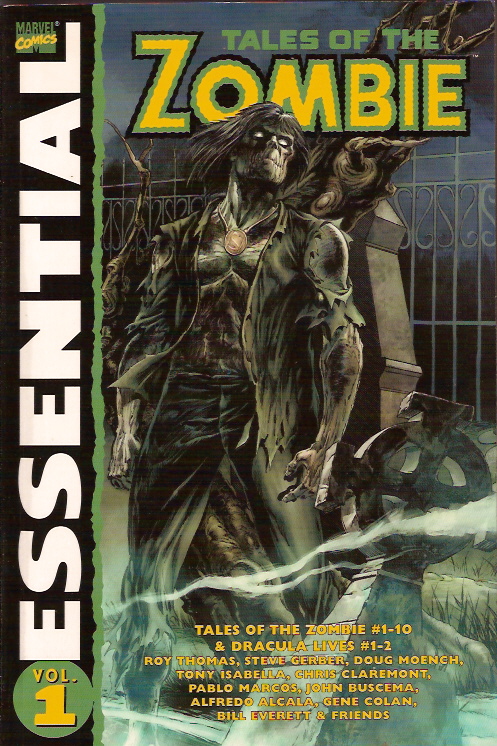
The Monster of Frankenstein


By Gary Friedrich, Doug Moench, Bill Mantlo, Gerry Conway, Mike Ploog, John Buscema, Bob Brown, Val Mayerik, Don Perlin, Sal Buscema & various (Marvel)
ISBN: 978-0-7851-9906-9 (TPB/Digital edition)

Whereas DC Comics capitalised on the early 1970s global boom in all things supernatural and mystic by creating a plethora of short-story anthologies and the occasional spooky star, Marvel Comics took the trend in another direction and created a small army of horror-heroes to headline their own series.

This particular collection reprints the House of Ideas’ interpretation of the Mary Shelley classic from a time when the censorious Comics Code Authority first loosened some of its strictures banning horror material from the pages of comics. That translates here to 18 issues of the colour comicbook; Giant-Sized Werewolf #2, Marvel Team-Up #36-37 and all the pertinent strips from adult-oriented Marvel magazines Monsters Unleashed #2, 4-7, 9-10 and one-shot Legion of Monsters (spanning January 1973-September 1975), all awaiting your rapt attentions.

Some comic artists work best in black-&-white. Such is certainly the case with Mike Ploog. A young find who had previously worked with Will Eisner, Ploog illustrated Gary Friedrich’s pithy adaptation of the original novel before moving on to groundbreaking new ventures as the strip graduated to in-house originated material. This monumental tome is presented mostly in colour, but if you are of a similar opinion you could try to lay your hands on the 2004 monochrome Essential Monster of Frankenstein edition…

Cover-dated January 1973, ‘Mary Shelley’s Frankenstein!’ introduced Robert Walton IV, great grandson of the sea-captain who had rescued scientist Victor Frankenstein from the polar ice and who was subsequently regaled with the incredible tale of “the Modern Prometheus”.

Now, in 1898 and leading a band of rogues, cutthroats and sullen Inuit, Walton finds the fabled monster interred in a frozen slab and brings it aboard his ice-breaker. He then recounts the story to his fascinated cabin-boy, unaware of the fear and discontent simmering below decks…

A bloody mutiny during a terrible gale opens the second issue as the burning ship founders. Meanwhile the flashbacked saga of tragic Victor reaches the terrible moment when the monster demanded a mate. The guilt-plagued scientist complied only to baulk at the last and destroy his second creation. ‘Bride of the Monster!’ concludes with the creature’s fearsome vengeance on his creator, paralleling the grim fate of the storm-tossed ship…

In The Monster of Frankenstein #3, ‘The Monster’s Revenge!’ has the reawakened creature freed from its ice-block to overhear the continuation of his life-story from Walton’s lips, even as the last survivors struggle to find safety in the Arctic wastes.

Thereafter ‘Death of the Monster!’ – with inker John Verpoorten taking some of the deadline pressure off hard-pressed Ploog – turns the tables as the monster reveals what happened after the polar showdown with his creator, leading to a new beginning as Walton reveals that not all the Frankensteins were eradicated by the Monster’s campaign of vengeance. Their warped blood-line lives on…

A new direction began with issue #5 in ‘The Monster Walks Among Us!’. Making his way south, the tragic creature arrives in a Scandinavian village in time to save a young woman from being burned at the stake on a blazing longboat, only to rediscover that when villagers pick up pitchforks and torches to go a-screamin’ and a-hollerin’ for blood, they generally have a good reason…

With issue #6 the comic book renamed itself The Frankenstein Monster as the undying creature reaches the village of Ingolstadt a century after he first wreaked bloody vengeance on his creator’s loved ones.

‘…In Search of the Last Frankenstein!’ is a mini-classic of vintage horrors scripted as usual by Friedrich but plotted, pencilled & inked by Ploog, who was reaching an early peak in his artistic career. It was also his last issue.

Ploog was followed by John Buscema & Bob Brown before Val Mayerik settled as regular artist whilst Friedrich gave way to Doug Moench, a writer once synonymous with Marvel’s horror line.

Issues #7, 8 and 9 bowed to the inevitable, pitting the Monster against Marvel’s top horror star (albeit 75-ish years prior to his contemporary adventures). Beginning with ‘The Fury of a Fiend!’ continuing in ‘My Name is… Dracula!’ and concluding with ‘The Vampire Killers!’, this is an extremely classy tribute to the old Universal movies and then-current Hammer Films in equal measure, wherein the misunderstood misanthrope battled an undying evil for ungrateful humanity, consequently losing the power of speech; and becoming more monstrous in the process.

Produced by Friedrich, Buscema and Verpoorten, this trilogy lacks the atmosphere of Ploog’s tenure, but the action is very much in the company’s house-style. With #10 (inked by Frank Giacoia and Mike Esposito) the creature finally found ‘The Last Frankenstein!’ …much to his regret.

With number #11’s ‘…And in the End…!?’ – illustrated by Brown & Vince Colletta – and #12’s ‘A Cold and Lasting Tomb’ (Moench, Mayerik and Colletta), the Monster wrapped up his historical adventures by falling into a glacial sea. Frozen once again into another block of ice he was revived, Captain America-style, in modern times: i.e. the swinging 1970s…

The epic account then switches to monochrome as more mature episodes from Monsters Unleashed begin, starting with #2 and ‘Frankenstein 1973’ by Friedrich, Buscema & Syd Shores. Here we see how an obsessive young man finds the Monster preserved as a carnival exhibit, only to see his jealous girlfriend revive it whilst trying to burn down the sideshow. The story continued in #4 as ‘Frankenstein 1973: Chapter TwoThe Classic Monster’ (Friedrich, Buscema & Win Mortimer), with a literal mad scientist actually putting his own brain in the monster’s skull. Happily, the unnatural order is restored in ‘Once a Monster…’

Monsters Unleashed #6 introduced new creative team Doug Moench & Val Mayerik who completed the introduction to modern times with a good old-fashioned monster hunt in ‘…Always a Monster!’

This leads directly to #7’s ‘A Tale of Two Monsters!’: a dark, socially relevant tale of the modern underclass and man-made horrors carried over into ‘Frankenstein 1974: Fever in the Freak House’ before concluding in #9’s ‘The Conscience of the Creature’.

The horror boom was fading by this time and Monsters Unleashed #10 was the Monster’s last outing there: a superbly dark and sardonic Christmas offering complete with elves, snow, terrorists and a Presidential assassination attempt.

One final monochrome tale from Moench, Mayerik, Dan Adkins & Pablo Marcos (accompanied by a chilling frontispiece by Marcos) appeared in 1975 one-shot The Legion of Monsters. ‘The Monster and the Masque’ was a bittersweet morality play seeing the creature accidentally accepted at a fancy dress party, which is ruined when a different sort of monster gets carried away…

Switching back to full-colour comics, next up is a rather tame team-up/clash from Giant-Size Werewolf #2 wherein ‘The Frankenstein Monster Meets Werewolf by Night’ (Moench, Don Perlin & Colletta) to collaterally combine and quash a band of run-of-the-mill West Coast Satanists.

Resuming his own series, The Frankenstein Monster #13 displays ‘All Pieces of Fear!’ (Moench, Mayerik & Jack Abel) as, shoe-horned into mid-1970s America, the Monster is drawn into a tale heavy with irony as men act like beasts and an obsessive father ignores his family whilst building his own abominations through the nascent science of cloning.

With a hip young teenager as sidekick/spokesperson, ‘Fury of the Night-Creature’ (Dan Green inks) extends the saga by introducing I.C.O.N. (International Crime Organizations Nexus): yet another secret organisation intent on conquest by merging corporate business practices with traditional gangsterism.

Issue #15’s ‘Tactics of Death’ (Klaus Janson inks) briefly concludes the acronym-agenda as the Monster and companion Ralph mop up the men in suits only to be shanghaied to Switzerland to meet the latest Last-of-the-Frankensteins in ‘Code-name: Berserker!’ (inked by Bob McLeod – who managed to handle the next issue too).

Veronica Frankenstein was still absorbed in the family business, but claimed to be fixing her ancestors’ mistakes when I.C.O.N. creeps showed up, demanding her biological techniques in ‘A Phoenix Beserk!’. Beautifully inked by Mayerik and Adkins, the last colour issue ended on a never-to-be completed cliffhanger (although scripter Bill Mantlo covered elements of the story in Iron Man some years later) as the Monster and his new friend met ‘The Lady of the House’ – the utterly bonkers creature-crafter dubbed Victoria Von Frankenstein

Perhaps the abrupt cancellation was a mercy-killing after all…

Rounding off the narrative wonderment is a 2-part tale from Gerry Conway, Sal Buscema & Colletta first seen in Marvel Team-Up #36-37 wherein Spider-Man is kidnapped and shipped off to Switzerland by the assuredly insane Baron Ludwig Von Shtupf, who proudly proclaims himself The Monster Maker

In ‘Once Upon a Time, in a Castle…’ the bonkers biologist wants to pick-&-mix creature traits – having already secured the Frankenstein Monster to practise on… After the webslinger busts them both out, they stumble upon sexy SHIELD Agent Klemmer, but a rapid counterattack goes badly wrong when Von Shtupf unleashes his other captive – the furiously feral Man-Wolf – and only big Frankie can prevent a wave of ‘Snow Death!’

This codex of comic creepiness concludes with a mammoth bonus section offering art lovers and funnybook historians additional treats such as Ploog’s very first design sketch of the monster from 1972, original art, illustrations and (finished but pre-editorial addition) painted covers by Boris Vallejo.

Also on show are assorted frontispieces, pencils, inks and previous collected editions, covers and original art by Tom Sutton, Gray Morrow, Vince Evans, Mayerik, Bernie Wrightson & Arthur Adams, making this compendium a perfect treat for fantasy fans and dedicated horrorists: one that should be a first choice for introducing scare-loving civilians to the world of comics.
© 1973, 1974, 1975, 2015 Marvel Characters, Inc. All Rights Reserved.

Jack Kirby’s Spirit World


By Jack Kirby with Mark Evanier, Steve Sherman, Sergio Aragonés, Vince Colletta, Mike Royer & various (DC Comics)
ISBN: 978-1-4012-3418-8 (HB)

Jack Kirby was – and remains long after his passing – the master imagineer of American comics. His collected works provide a vast rich trove of astounding narrative delights for any possible occasion. An ideal and seasonably timely tome is this magnificent compendium re-presenting the complete “King’s Canon” of one of his least known, most misunderstood and mishandled DC creations. Regrettably, it’s still not a book you can read digitally, but hope springs eternal…

Famed for larger than life characters and gigantic, cosmic imaginings, Kirby was an astute, spiritual man who had lived through poverty, gangsterism, the Depression, World War II and the rise and stall of the Space Age. He’d seen and survived Post-War optimism, Cold War paranoia, political cynicism and birth and death of peace-seeking counter-cultures. Above all else, he was open-minded and utterly wedded to the making of comics stories on every imaginable subject.

On returning from valiant service in World War II, Jack – reunited with long-term creative partner Joe Simon – began producing genre material for older audiences and famously invented the genre of Romance comics. Amongst the dynamic duo’s other concoctions for Prize/Crestwood/Essankay Publications was a noir-esque anthology, supernatural-themed and psychologically underscored, reflecting the tone and trends of those rapidly-changing, globally Post-Traumatic times.

Black Magic (and short-lived companion title Strange World of Your Dreams) eschewed traditionally gory, heavy-handed morality plays and simplistic cautionary tales seen in other comics and concentrated on deeper, stranger fare. They were – until EC comics hit their peak – far and away the best horror and mystery titles on the market.

Changing tastes and an anti-crime, anti-horror witch-hunt quashed the comics industry, so under a doctrinaire, self-inflicted conduct code, publishers stopped innovating and moved into more anodyne areas. This established holding pattern persisted until the rebirth of superheroes and triggered the demise of many smaller publishers…

From 1956, at a little outfit using the name “Atlas”, Kirby partnered with Stan Lee and, when superheroes were revived, changed the world with a salvo of new concepts and characters that revitalised if not actually saved the comics business. Kirby always understood the fundamentals of pleasing an audience and toiled diligently to combat the appalling prejudice about the word-&-picture medium – especially from insiders and professionals who despised the “kiddies’ world” they felt trapped in.

However, after a decade or so, costumed characters began to wane again as public interest in the supernatural grew. With books, television and movies all exploring The Unknown in gripping and stylish new ways, the Comics Code Authority sought to slacken its censorious choke-hold on horror titles, hoping to save the industry from implosion when the superhero boom busted…

Experiencing increasing editorial stonewalling and creative ennui at Marvel, in 1970 Kirby (after breaking ground with a few horror shorts for the House of Ideas’ new anthology titles) accepted a long-standing offer from arch rival DC Comics…

Promised freedom to innovate, one of the first projects he tackled was a new magazine format carrying material targeting adult readerships. For the full story of how that worked out, you can read Mark Evanier’s acerbic article at the centre of this glorious – but inexplicably still not available in digital editions – oversized (282 x 212 mm) hardback compilation. He was there and knows a lot of the secrets…

Reflecting and rechannelling the mature experimentation of Black Magic in a superb yet poorly received – and largely undistributed – monochrome magazine, Spirit World #1 and only launched in the summer of 1971, but, as happened all too often, editorial cowardice and back-sliding scuppered the project before it could get going. At least when the original 1940s-1950s Black Magic was revived as a DC reprint anthology in 1973, it got a few years to properly test the waters…

Material from a second, never-to-be published, Spirit World issue eventually appeared in various colour comic books, but with most of his ideas misunderstood, ignored or side-lined by the company, Kirby opted to return to more traditional formats.

Never truly defeated, he cannily blended his belief in the marketability of supernature with flamboyant super-heroics to create another unique and lasting mainstay for the DC universe: one that lesser talents later made a pivotal figure of the company’s continuity: Etrigan the Demon. There’s a complete Kirby compendium of the Hellish hero’s deeds out there too if you’re interested, as well as many subsequent reinterpretations by creators infernally inspired by the original…

The eerily eclectic Spirit World collection, however, eschews costume continuity in favour of plot and mood-driven tales, opening with the published premier issue: combining primarily comics tales (because DC wouldn’t spring for colour photography illustrations) with prose and black-&-white “Foto-Features”, all driven by the King’s voracious, questing imagination and unique perspectives…

Printed in spooky blue tones, the arcane explorations unfold with Jack & Vince Colletta’s pictorial investigation of the power of precognition. Preceded by a stunning 3-page Kirby photo-collage, ‘The President Must Die!’ – narrated by erudite host/parapsychologist Dr. E. Leopold Maas – recounts and interprets the chilling dreams of an unnamed woman in the days leading up to the assassination of JFK.

Again sporting a collage intro, ‘House of Horror!’ grippingly relates what happened when Dr. Maas was invited to visit the phantom-plagued Calder House…

Children of the Flaming Wheel!’ is a fumetti-work (photographic comic strips that were huge in Europe and an area of storytelling Jack was desperate to develop) depicting the astral journey of a supposed modern cultist, after which tireless Dr. Maas shares his discoveries on the nature of reincarnation by opening ‘The Lorca File!’

As “transcribed” by Kirby’s editorial assistants Steve Sherman & Mark Evanier, ‘The Spirit of Vengeance!’ relates in a terse prose piece Maas’ interaction with a most unquiet and petty revenant before Kirby & Colletta illuminate the astounding accomplishments and warnings of ‘Nostrodamus!’ – including all those predictions still pending confirmation…

The magazine concluded with a page of ‘Weird Humor’ strips by Sergio Aragonés (and possibly Dave Manak) and came with a free wallposter. It’s included here for veracity’s sake and because they’re still pretty damn cool…

Following that tell-all article from Evanier, the majority of the proposed second issue follows in standard monochrome. The strips are taken from their eventual last resting place in DC’s anthologies Forbidden Tales of Dark Mansion #6 and Weird Mystery Tales #1-3, and still have insets and copy from other hosts such as Destiny (yes!… latterly of the Endless!), but the art, plots and most of the scripting is pure Kirby…

With Mike Royer inking all these later yarns, ‘Horoscope Phenomenon or The Witch Queen of Ancient Sumeria’ opens the fearsome festivities as a bizarre regal apparition visits many modern men and women to change their fates forever, after which the lugubrious Dr. Maas probes a primordial artefact and speculates upon the barbaric life and cataclysmic demise of ‘Toxl, the World Killer’ – a rousing fantasy warrior yarn co-plotted and scripted by Evanier.

Accompanied by photomontage inserts, ‘The Burners’ confounds Maas with a spate of deaths by spontaneous combustion and possible alien incursion – before the mystery-&-imagination moments culminate with uncanny cases of ‘The Psychic Bloodhound’. Co-plotted by Evanier & Sherman, this graphic fictionalisation of a detective with extra-sensory perception is probably based on the exploits of controversial Dutch celebrity sleuth Peter Hurkos

Jack Kirby remains a unique and uncompromising artistic force of nature: his words and pictures an unparalleled, hearts-&-minds grabbing delight no comics lover could resist. If you’re not a fan or simply not prepared to see for yourself what all the fuss has been about then no words of mine will change your mind.

That doesn’t alter the fact that Kirby’s work from 1937 to his death in 1994 shaped the entire American scene and indeed the entire comics planet – affecting the lives of billions of readers and thousands of creators in all areas of artistic endeavour for generations. He’s still winning new fans and apostles, from the young and naive to the most cerebral of intellectuals. Jack’s work is instantly accessible, irresistibly visceral, deceptively deep whilst simultaneously mythic and human.

Wherever your tastes take you, his creations will be there ready and waiting. So, if fear and mystery are your meat, you can wonderfully upset your complacent equilibrium with this classy classic…
© 1971, 1972, 2012 DC Comics. All Rights Reserved.

Monsters! and Other Stories


By Gustavo Duarte (Dark Horse)
ISBN: 978-1-61655-309-8 (PB) eISBN: 978-1-62115-886-8

In comics, Less Is More.

You start with pictures. They should be clearly understood. Deathless prose so often just gets in the way…

This stunning breakthrough compilation from Brazilian graphic raconteur Gustavo (Bizarro; Guardians of the Galaxy; Dear Justice League) Duarte’s earliest works is a sublime masterclass in cartoon comedy: a trio of engrossing mini-epics each hallmarked by breakneck pace, captivating atmosphere and escalating conceptual insanity, all delivered via inspired sight-gags and superb drawing.

Following an effusive Introduction extolling the virtues of pantomimic comics and the sheer wonder of silent comedy from indisputable arch-maestro Sergio Aragonés, a twisted triptych of hilarious terror tales opens with ‘Có!’ (2009).

Here is a sardonically sinister saga of alien abductions, pig husbandry and commercial chicken-rearing practises, tinged with bizarre transformations, existential confrontations and the unmitigated horror of incomprehensible extraterrestrial agendas…

Anthropomorphically unfolding next, ‘Birds’ (2011) pecks at the cutthroat business world. One ordinary day a sinister murder mystery ensues, with two avian office workers having the worst day of their lives. A tense situation swiftly degenerates into a surreal bloodbath where only Death holds true dominion…

Concluding this soundless extravaganza is bombastic battle bout ‘Monsters!’ from 2012. This is a manic celebration of Kaiju (that’s city-stomping, rampaging giant beasties to old folk like you and me) as a jaded recreational angler reels in a big catch before becoming one as a colossal lizard wades ashore to tear up the town and literally sample the night life. As the creature inevitably attracts gargantuan rivals ashore for a showdown and the human populace panic, an elderly gentleman patiently gathers ingredients for a very ancient and special potion. He’s seen this all before and has the perfect solution…

This manic, mostly monochrome tome is the acme of artistic thrills and chills, perfectly capturing the addictive wonderment of monster stories and crafted by a master of fun and thrills.

Less is More. Silence is Golden. Get this Book.
© 2009, 2011, 2012, 2014 Gustavo Duarte Publications, Inc. All rights reserved.

Werewolf by Night – The Complete Collection volume 1


By Gerry Conway, Len Wein, Marv Wolfman, Roy & Jean Thomas, Mike Ploog, Werner Roth, Ross Andru, Tom Sutton, Gil Kane, Gene Colan & various (Marvel)
ISBN: 978-1-30290-839-3 (TPB/Digital edition)

Win’s Christmas Gift Recommendation: Utterly Uncanny and Irresistible Comics Chillers… 9/10

Now a star of page and screen, Werewolf by Night could be described as the true start of the Marvel Age of Horror. Although now technically supplanted by modern Hopi/Latino lycanthrope Jake Gomez – who’s shared the designation since 2020 – the trials of a teen wolf opened the floodgates to a stream of Marvel monster stars and horror antiheroes. Happy 50th anniversary, kid!

Inspiration isn’t everything. In 1970, as Marvel consolidated its new position of market dominance – even after losing their two most innovative and inspirational creators, Steve Ditko and Jack Kirby – they did so employing a wave of new young talent, but less by experimentation and more by expanding proven concepts and properties.

The only real exception to this was the mass-move into horror titles: a response to an industry down-turn in superhero sales, and a move expedited by a rapid revision in the wordings of the increasingly ineffectual Comics Code Authority rules.

Almost overnight scary monsters became acceptable fare on four-colour pages and whilst a parade of 1950s pre-code reprints made sound business sense (so they repackaged a bunch of those too), the creative aspect of the revived fascination in supernatural themes was catered to by adapting popular cultural icons before risking whole new concepts on an untested public.

As always, the watchword was fashion: what was hitting big outside comics would be incorporated into the print mix and shared universe mix as readily as possible. When proto-monster Morbius, the Living Vampire debuted in Amazing Spider-Man #101 (October 1971) and the sky failed to fall in, Marvel launched a line of sinister superstars – beginning with a werewolf and a vampire…

Werewolf By Night debuted in Marvel Spotlight #2 (preceded by western-era hero Red Wolf in #1, and followed by Ghost Rider). In actuality, the series title, if not the actual star character, was recycled from a classic pre-Comics Code short suspense-thriller from Marvel Tales #116, July 1953. Marvel always favoured a using old (presumably already copyrighted) names and titles when creating new series and characters. The Hulk, Thor, Magneto, Doctor Strange and many others all got nominal starts as hairy underpants monsters or throwaways in some anthology or other.

This copious compendium collects the early adventures of a young West Coast lycanthrope re-presenting the contents of Marvel Spotlight #2-4, Werewolf by Night volume 1 #1-15; a guest-shot from Marvel Team-Up #12 and material from the appropriate half of a horror crossover with Tomb of Dracula #18. These cumulatively span February 1972 through 1974.

Following an informative, scene-setting Introduction by long-term Marvel Editor Ralph Macchio, the moonlit madness begins with the landmark first appearance, introducing teenager Jack Russell, who is suffering some sleepless nights…

Cover-dated February 1972 ‘Werewolf by Night!’ (Marvel Spotlight #2), was written by Gerry Conway and moodily, magnificently illustrated by Mike Ploog – the manner of his old mentor Will Eisner. The character concept came from an outline by Roy & Jeanie Thomas, describing the worst day of Jack’s life – his 18th birthday – which begins with nightmares and ends in something far worse.

Jack’s mother and little sister Lissa are everything a fatherless boy could hope for, but new stepfather Philip and creepy chauffeur Grant are another matter. Try as he might, Jack can’t help but see them as self-serving and with hidden agendas…

At his party that evening, Jack has an agonising seizure and flees into the Malibu night to transform for the first time into a ravening vulpine man-beast. At dawn, he awakes wasted on a beach to learn that his mother has been gravely injured in a car crash. Something had happened to her brakes…

Sneaking into her hospital room, the distraught teen is astonished to hear her relate the story of his birth-father: an Eastern European noble who loved her deeply, but locked himself away three nights every month…

The Russoff line was cursed by the taint of Lycanthropy: every child doomed to become a wolf-thing under the full-moon from the moment they reach 18 years of age. Jack is horrified and then realises how soon his sister will reach her own majority…

With her dying breath Laura Russell makes her son promise never to harm his stepfather, no matter what…

Scenario set, with the traumatised wolf-boy uncontrollably transforming three nights every month, the weird, wild wonderment begins in earnest with the beast attacking the creepy chauffeur – who had doctored those car-brakes – but refraining, even in vulpine form, from attacking Philip Russell…

The second instalment sees the reluctant nocturnal predator rescue Lissa from a sick and rowdy biker gang (they were everywhere back then) and narrowly escape the cops only to be abducted by a sinister dowager seeking knowledge of a magical tome called the Darkhold. The legendary spell-book is the apparent basis of the Russoff curse, but when Jack can’t produce the goods he’s left to the mercies of ‘The Thing in the Cellar!’

Surviving more by luck than power, Jack’s third try-out issue fetches him up on an ‘Island of the Damned!’: introducing aging Hollywood writer Buck Cowan, who will become Jack’s best friend and affirming father-figure as they jointly investigate the wolf-boy’s evil stepdad.

Russell had apparently sold off Jack’s inheritance, leaving the boy nothing but an old book. Following a paper trail to find proof Philip had Laura Russell killed leads them to an offshore fortress, a dungeon full of horrors and a ruthless mutant seductress…

That episode ended on a cliffhanger, presumably as an added incentive to buy Werewolf by Night #1 (September 1972), wherein Frank Chiaramonte assumed inking duties with ‘Eye of the Beholder!…

Merciless biological freak Marlene Blackgar and her monstrous posse abduct the entire Russell family whilst looking for the Book of Sins, until – once more – a fearsome force of supernature awakes to accidentally save the day as night falls…

With ‘The Hunter… and the Hunted!’ Jack and Buck deposit the trouble-magnet grimoire with Father Joquez, a Christian monk and scholar of ancient texts, but are still hunted because of it. Jack quits the rural wastes of Malibu for a new home in Los Angeles, trading forests and surf for concrete canyons but life is no easier.

In #2, dying scientist Cephalos seeks to harness Jack’s feral life-force to extend his own existence, living only long enough to regret it. Meanwhile, Joquez successfully translates the Darkhold: an accomplishment allowing ancient horror to possess him in WbN #3, sparking ‘The Mystery of the Mad Monk!’

Whilst the werewolf is saddened to end such a noble life, he feels far happier dealing with millionaire sportsman Joshua Kane, who craves a truly unique head mounted on the wall of his den in the Franke Bolle inked ‘The Danger Game’. Half-naked, exhausted and soaked to his now hairless skin, Jack must then deal with Kane’s deranged brother, who wants the werewolf for his pet assassin in ‘A Life for a Death!’ (by Len Wein & Ploog) after which ‘Carnival of Fear!’ (Bolle inks again) finds the beast – and Jack, once the sun rises – a pitiful captive of seedy mystic Swami Calliope and his deadly circus of freaks.

The wolf was now the subject of an obsessive police detective too. “Old-school cop” Lou Hackett is an old buddy of trophy-hunter Joshua Kane – and every bit as savage – but his off-the-books investigation hardly begins before the Swami’s plans fall apart in concluding tale ‘Ritual of Blood!’ (inked by Jim Mooney).

The beast is safely(?) roaming loose in the backwoods for #8’s quirky monster-mash when an ancient demon possesses a cute little bunny in Wein, Werner Roth & Paul Reinman’s ‘The Lurker Behind the Door!’, before neatly segueing to a slight but stirring engagement in Marvel Team-Up #12 wherein Wein, Conway, Ross Andru & Don Perlin expose a ‘Wolf at Bay!’ As webspinning wallcrawler meets werewolf, they initially battle each other – and ultimately malevolent mage Moondark – in foggy, fearful San Francisco before Jack heads back to LA and ‘Terror Beneath the Earth!’

Here Conway, Tom Sutton & George Roussos dip into an impeding and thoroughly nefarious scheme by business cartel The Committee. These commercial gurus somehow possess a full dossier on Jack Russell’s night-life, and hire a maniac sewer-dwelling sound engineer to execute a radical plan to use monsters and derelicts to boost sales in a down-turned economy.

However, the bold scheme to promote “growth, Growth, GROWTH” by frightening folk into spending more is ended before it begins since the werewolf proves to be far from a team-player in the wrap up ‘The Sinister Secret of Sarnak!’

Issue #11 revelled in irony as Marv Wolfman signed on as scripter for ‘Comes the Hangman’ – illustrated by incredible action ace Gil Kane & Sutton – in something interesting about Philip Russell and the Committee is disclosed, even as Jack’s attention is distracted by a new apartment, a very odd neighbour and a serial kidnapper abducting young women to keep them safe from “corruption”. When the delusional hooded hero snatches Lissa, he soon finds himself hunted by a monster beyond his wildest dreams…

Concluding chapter ‘Cry Werewolf!’ brings in the criminally underappreciated Don Perlin as inker. In a few short months he would become the strip’s penciller, lasting for the rest of the run. Before that though, Ploog & Chiaramonte return for another session, introducing another maniac mystic and a new love-interest (but not the same person) for WbN #13’s ‘His Name is Taboo’.

An aged sorcerer coveting the werewolf’s energies for his own arcane purposes, the magician is stunned when his adopted daughter Topaz finds her loyalties divided and her psionic abilities more help than hindrance to the ravening moon-beast. ‘Lo, the Monster Strikes!’ then pits the wolf against Taboo’s undead-but-getting better son, delivering unexpected revelation and reconciliation between Philip and Jack Russell. As a result, the young man and new girlfriend Topaz set off for Transylvania, the ancestral Russoff estate and a crossover clash with the Lord of Vampires.

Tomb of Dracula #18 (March 1974) begins the battle with ‘Enter: Werewolf by Night’ (Wolfman, Gene Colan & Tom Palmer) as Jack and Topaz investigate a potential cure for lycanthropy, only to be attacked by rampant menace to humanity Count Dracula. Driven off by the girl’s psychic powers the undead aristocrat realises the threat she poses to him and resolves to end her…

The confrontation and this first tome conclude with Werewolf by Night #15 and the ‘Death of a Monster!’ (Wolfman, Ploog & Chiaramonte) as the demonic duel devolves into a messy stalemate… but only after Jack learns of his family’s long hidden connection to Dracula…

Supplemented with an unused Ploog cover for Marvel Spotlight#4; Kane’s pre-corrections cover to ToD #18 and previous collection covers by Ploog & Dan Kemp, this initial complete compendium also offers a wealth of original art pages (20 in total) by Ploog, Sutton & Andru.

A moody masterpiece of macabre menace and all-out animal action, this book covers some of the most under-appreciated magic moments in Marvel history: tense, suspenseful and solidly compelling chillers to delight any fright fan or drama addict. If you crave a mixed bag of lycanthropes, bloodsuckers and moody young misses, this is a far more entertaining mix than most modern movies, books or miscellaneous matter…
© 1972, 1973, 1974, 2017 Marvel Characters, Inc. All rights reserved.

The Grave Robber’s Daughter


By Richard Sala (Fantagraphics Books)
ISBN: 978-1-56097-773-5 (PB/Digital edition)

Richard Sala was a lauded and astonishingly gifted exponent and comics creator who deftly blended beloved pop culture artefacts and conventions – particularly cheesy comics and old horror films – with a hypnotically effective ability to tell a graphic tale.

A child who endured sustained paternal abuse, Sala grew up in West Chicago and Scottsdale, Arizona. Retreating into childish bastions of entertainment, he eventually escaped family traumas and as an adult earned a Masters’ Degree in Fine Arts. He became an illustrator after rediscovering a youthful love of the comic books and schlock films that had brightened his youth.

He started his metafictional, self-published Night Drive in 1984, which led to appearances in legendary 1980s anthologies Raw, Blab! and Prime Cuts, subsequently producing animated adaptations for Liquid Television.

He died in 2020 aged 65, but his work remains welcomingly atmospheric, dryly ironic, wittily quirky and mordantly funny; indulgently celebrating childhood terrors, gangsters, bizarre events, monsters and manic mysteries. His most well-known characters are a host of wonder women, like gloriously trenchant storybook investigator Peculia, gun toting mystery maid Violenza, disenchanted ex-cop Natalie Charms, and this particular femme so very fatale – girl sleuth Judy Drood

The Grave Robber’s Daughter is an irresistible tract of baroque pictorial enchantment, culled from Sala’s anthological series Evil Eye (#14) and sees the self-proclaimed sleuth Judy Drood abruptly stuck in a strange little town after her car suddenly breaks down. After venting some understandable spleen when the phonebooth she uses to call for assistance also dies, the irascible, potty-mouthed teen trudges to the bucolic, way-off-the-beaten-track and downright spooky backwater of Obidiah’s Glen: a sleepy hollow that seems at first glance completely deserted.

Walking on, Drood discovers an abandoned amusement park where a gang of extremely rude youths are insouciantly consuming booze and smoking. After being mocked in a snide manner only teenagers can attain, Judy plunges deeper into the sideshows, only to endure similar brusque treatment from a troupe of sketchy performers.

The carny has certainly seen better days, and the congregating clowns and delinquents make her nervous enough to leave in a dignified hurry. Eventually, back in town she bangs on a random door and learns the houses are all empty. Drood’s on the verge of another epic rage explosion when she hears a sound and finds a small girl sneaking around.

Outrunning the scared scamp, Drood quizzes little Nellie Kelly and hears a tales of supernal terror…

Everything was normal until the circus came to Obidiah’s Glen, but when the clowns paraded through town, the adults all followed and now are gone. Only a few high school kids seemed able to resist the call and they just mocked and laughed…

Drood accompanies Nellie to her own shack on the wrong side of the tracks and hears a tale of personal woe before falling asleep. She wakes up just as a clown attacks and – on brutally killing him – discovers something stomach churningly scary about the jolly invaders. Galvanised and furious, Judy tracks missing Nellie to the funfair and deals with a carnival of horrors in the Hall of Embalmed Abominations and other spooky funhouses. She has a bit more trouble discouraging the horny, potential teen rapists, but benefits from a brief distraction from Nellie…

All too soon the bad kids’ boastful ringleader Timothy reveals how many wrong assumptions Judy has jumped to, disclosing the truth about Nellie and her outlaw dad, the awful pact made with a dead witch and how Tim saw his chance to grab incredible ultimate power by getting rid of all the parents…

Sadly, as Judy knows there’s no reason or sense in the world, only chaos and opportunity, when the arcane armageddon she’s anticipated hits, she’s well on her way out of the frying pan and into the fire…

Delivered in manic and moody monochrome, this pacy chiller plays with a choice selection of contemporary Bêtes noir, mingling tropes and mixing memes with stunning audacity to craft a mash-up for the ages.

The Grave Robber’s Daughter amusingly exposes the seamy, scary underbelly of a darkly possible existences, blending nostalgic escapism with the frenetic frisson of children scaring themselves silly under the bedcovers at night: an ideal treat for the big kid in your life – whether they are just you, utterly imaginary or even relatively real…
© 2006 Richard Sala. All rights reserved.

Ghost Rider Epic Comics volume 1: Hell on Wheels 1972-1975


By Roy Thomas, Gary Friedrich, Tony Isabella, Marv Wolfman, Doug Moench, Len Wein, Mike Ploog, Tom Sutton, Jim Mooney, Herb Trimpe, Sal Buscema, Ross Andru  & various (Marvel)
ISBN: 978-1-3029-4611-1 (TPB/Digital edition)

Win’s Christmas Gift Recommendation: Rousing Redemptive Comic Classics… 8/10

At the end of the 1960s American comic books were in turmoil, much like the youth of the nation they targeted. Superheroes had dominated for most of the decade; peaking globally before explosively falling to ennui and overkill. Older genres such as horror, westerns and science fiction returned, fed by radical trends in movie-making where another, new(ish) wrinkle had also emerged: disenchanted, rebellious, unchained Youth on Motorbikes seeking a different way forward.

Green Lantern/Green Arrow, Jack Kirby’s Jimmy Olsen, Captain America and many others took the Easy Rider option to boost flagging sales – and if you’re interested the best of the bunch was Mike Sekowsky’s tragically unfinished mini-masterpiece of cool Jason’s Quest in Showcase. At Marvel – still reeling from The King’s defection to DC/National in 1970 – canny Roy Thomas green-lit a new character combining that freewheeling, adolescent-friendly biker-theme with the all-pervasive supernatural furore then gripping the globe.

Back in 1967, Marvel published a western masked hero named Ghost Rider: a shameless, whole-hearted appropriation of the cowboy hero creation of Vince Sullivan, Ray Krank & Dick Ayers for Magazine Enterprises from 1949 to 1955. They both utilised magician’s tricks to fight bandits by pretending to be an avenging phantom of justice.

Scant years later, with the Comics Code prohibition against horror hastily rewritten – amazing how plunging sales can affect ethics – scary comics came back in a big way. A new crop of supernatural superheroes and monsters began to appear on the newsstands, supplementing the ghosts, ghoulies and goblins already infiltrating the formerly science-only scenarios of the surviving mystery men titles.

In fact, the lifting of the Code ban resulted in such an avalanche of horror titles (new stories and reprints from the first boom of the 1950s), in response to the industry-wide down-turn in superhero sales, that it probably caused a few more venerable costumed crusaders to – albeit temporarily – bite the dust.

Almost overnight nasty monsters (and narcotics – but that’s another story) became acceptable fare on four-colour pages and with a parade of pre-code reprints making sound business sense, the creative aspect of contemporary fascination in supernatural themes was catered to by adapting popular cultural icons before risking whole new concepts on an untested public.

As always in entertainment, the watch-world was fashion: what was hitting big outside comics would be incorporated into the mix as soon as possible. When proto-monster Morbius, the Living Vampire debuted in Amazing Spider-Man #101 (October 1971) and the sky failed to fall in, Marvel moved ahead with a line of shocking superstars – beginning with a werewolf and a vampire – before chancing something new: a spectral biker who could tap into both Easy Rider’s motorcycling chic and the prevailing supernatural zeitgeist.

The all-new Ghost Rider peeled out in Marvel Spotlight #5 (August 1972 and following western hero Red Wolf in #1 and the afore-hinted Werewolf by Night in #2-4).

This canny compendium collects those earliest flame-filled exploits: adventures from Marvel Spotlight #5-12, Ghost Rider #1-11 and a terror-tinged guest shot in Marvel Team-Up (#15), spanning August 1972 to April 1975, and the comics thrills, spills and chills begin with that landmark first appearance: an eerie tale of double-dealing and desperation introducing stunt bike Johnny Blaze, his fatally flawed father-figure Crash Simpson and Johnny’s devout and devoted girlfriend, sweetly innocent Roxanne Simpson.

Plotted by Thomas, scripted by Gary Friedrich and stunningly illustrated by Ploog, ‘Ghost Rider’ sees carnival cyclist Blaze sell his soul to the devil in an attempt to save his foster-father Crash from cancer. As is the way of such things, Satan follows the letter but not spirit of the contract and Simpson dies anyway, but when the Dark Lord later comes for Johnny, his beloved virginal girlfriend Roxanne intervenes.

Her purity prevents the Devil claiming his due and, temporarily thwarted, Satan spitefully afflicts Johnny with a body that burns with the fires of Hell every time the sun goes down…

At first haunting the night and terrorising thugs and criminals, the traumatised biker soon leaves the Big City and heads for the solitary deserts where – in ‘Angels From Hell!’ – the flaming-skulled fugitive joins a biker gang led by enigmatic Curly Samuels: in actuality a resurrected agent of Satan attempting to destroy the protective Roxanne to claim Blaze’s soul.

No prizes for guessing Curly’s true identity then, since the next chapter (inked by Frank Chiaramonte) is entitled ‘Die, Die, My Daughter!’

The origin epic concludes with a monumental battle against ‘…The Hordes of Hell!’ (offering a rather uncomfortable artistic collaboration by Ploog & Jim Mooney), spawning a torturous Cold War détente between the still nightly-transforming Blaze and the Lord of Lies, as well as introducing a new eldritch enemy in Native American Witch Man Snake-Dance

With Marvel Spotlight #9 the tragically undervalued Tom Sutton took over pencilling – with inks by Chic Stone – for ‘The Snakes Crawl at Night…’ as Medicine Man magic and demonic devil-worship combine to torment Blaze just as Roxanne goes west looking for him. To further confound the accursed cyclist, Satan decrees that although he must feel the pain, no injury will end Johnny’s life until his soul resides in Hell – which comes in very handy when Roxanne is sacrificed by Snake-Dance and the Ghost Rider has to battle his entire deviant cult to rescue her…

In #10, ‘The Coming of… Witch-Woman!’ (Friedrich, Sutton & Mooney) opens with Blaze a fugitive from the police and rushing dying Roxanne to hospital. Meanwhile back on the Reservation, tensions remain high as Snake-Dance’s daughter Linda Littletrees reveals her own connection to Satan, culminating in a devastating eldritch assault on Blaze in #11’s ‘Season of the Witch-Woman!’ (inked by the incomparable Syd Shores).

That cataclysmic conflict continued into Ghost Rider #1 (cover-dated September 1973), further extending the escalating war between Blaze and the Devil and using the conflict to introduce a new horror-hero who would take over the biker’s vacant slot in Spotlight.

Linda Littletrees isn’t so much a Satan-worshipping witch as ‘A Woman Possessed!’, but when her father and fiancé Sam Silvercloud call in Boston-based exorcist Daimon Hellstrom, they are utterly unprepared for the kind of assistance the demonologist offers.

With Roxanne slowly recuperating and Blaze still on the run, Ghost Rider #2 depicts the bedevilled biker dragged down to Hell in ‘Shake Hands With Satan!’ (Mooney & Shores) before the saga concludes in Marvel Spotlight #12 with the official debut of ‘The Son of Satan!’ courtesy of Friedrich, Herb Trimpe & Frank Chiaramonte, revealing Hellstrom’s long-suppressed inner self is a brutal scion of the Infernal Realm eternally at war with his infernal father.

The liberated Prince of Hell swiftly rushes to Blaze’s aid – although more to spite his sire than succour the victim – and, with his own series off to a spectacular start – continues to take the pressure off the flaming-skulled hero. Ghost Rider #3’s ‘Wheels on Fire’ (by Friedrich, Mooney & John Tartaglione) sees fresh directions explored with more mundane menaces and contemporary antagonists like the outlaw gang of biker Big Daddy Dawson who kidnaps the still frail Roxanne…

Blaze also learns how to create a spectral motorcycle from the Hellfire that perpetually burns through his body: a most useful trick considering the way he treats conventional transport…

Eager to establish some kind of normal life, wanted fugitive Blaze accepts a pardon from the State Attorney General in GR #4’s ‘Death Stalks the Demolition Derby’ (Vince Colletta inks) in return for infiltrating a Las Vegas showman’s shady operation, leading to another supernatural encounter, this time against a demonic gambler dubbed Roulette in ‘And Vegas Writhes in Flame!’ by the transitional creative team of Marv Wolfman, Doug Moench, Mooney & Sal Trapani.

A rising star, Ghost Rider next joined Spider-Man to battle a demented biker bad-guy in Marvel Team-Up #15 (November 1973, by Len Wein, Ross Andru & Don Perlin) which introduced lame-duck villain The Orb. Maimed and disfigured years previously confronting Crash Simpson, he seeks belated revenge against his heirs in ‘If an Eye Offend Thee…’ but should have waited until Blaze’s travelling roadshow was far away from superhero-stuffed New York City and its overly protective friendly neighbourhood webslinger…

Back at Ghost Rider #6 Tony Isabella, Gary Friedrich, Mooney & Trapani hit the kickstart hard in a perhaps ill-considered attempt to convert the tragic haunted biker into a more conventional superhero. ‘Zodiac II’ sees Blaze stumble into a senseless fight with a man possessing all the powers of the Avengers’ arch-nemeses. However, there’s a hidden Hellish component to the mystery as Blaze discovers when reformed super-villain turned TV star Stunt-Master turns up to help close the case and watch helplessly as the one-man Zodiac falls foul of his own diabolical devil’s bargain in ‘…And Lose His Own Soul!’ (Isabella, Mooney & Jack Abel).

A final confrontation – of sorts – commences in #8 as ‘Satan Himself!’ comes looking for Johnny’s soul, enacting a foolproof scheme to force Roxanne to rescind her protection. She finally does so as the Hell-biker battles Inferno, the Fear-demon (and most of San Francisco) in game-changing epic ‘The Hell-Bound Hero!’

Here Blaze is finally freed from his satanic burden by the intervention of someone who appears to be Jesus Christ

The cover of issue #10 (by Ron Wilson & Joe Sinnott) featured GR battling The Hulk, but a deadline cock-up delayed that tale until #11 with the reprinted origin from Marvel Spotlight #5 filling those pages. Gil Kane & Tom Palmer reinterpreted the scene for their cover on #11 as the issue which closes this first tome finally details ‘The Desolation Run!’ (by Isabella, Sal Buscema, Tartaglione & George Roussos).

When Johnny joins a disparate band of dirt-bikers in a desert race, he collides with the legendarily solitary and short-tempered Green Goliath and learns who his true friends are…

I said “closes” but there’s always a few appetising extras on offer and this high-octane compendium compounds the chilling action with the August 1972 Marvel Bullpen Bulletins page announcing the debut of the Biker Ghost Rider plus house ads; design sketches by Ploog and John Romita; an eerie back-cover from FOOM #7 featuring early Ploog visualisations of the Blazing Biker and a stunning selection of original art pages by Ploog & Chiaramonte, Mooney & Shores, Gil Kane & Frank Giacoia, Romita, Kane & Palmer, and Andru & Perlin.

The 1990s saw these classics frequently reprinted and here Marvel Tales #254 provides 3 pin-ups by Jae Lee, Jan Harpes & Renee Witterstaeter plus a cover by Brian Stelfreeze, as well as The Original Ghost Rider reprint series cover gallery: offering art by Mark Teixeira, Jimmy Palmiotti, Javier Saltares, Andy Kubert, Joe Quesada, Jan Anton Harps, Kevin Maguire, Brad Vancata, Mark Pacella, Jeff Johnson, Dan Panosian, Ploog, Klaus Janson, Michael Bair, Darick Robertson, Chris Bachalo, Bill Wylie, Walter McDaniel, Andy Smith, Manny Galan & Scott Koblish, Gary Barker, Kris Renkewitz & Andrew Pepoy, bringing the fearsome fun to a close for now…

One final note: backwriting and retcons notwithstanding, the Christian boycotts and moral crusades of a later decade were what compelled the criticism-averse and commercially astute corporate Marvel to “translate” the biblical Satan of these tales into generic and presumably more palatable demonic creatures such as Mephisto, Satanish, Marduk Kurios and other equally naff downgrades. However, the original intent and adventures of Johnny Blaze – and spin-offs Daimon Hellstrom and Satana – respectively Son and Daughter of Satan – tapped into the period’s global fascination with Satanism, Devil-worship and all things Spookily Supernatural which had begun with such epochal breakthroughs as Rosemary’s Baby (Roman Polanski’s 1968 film more than Ira Levin’s novel) so remember these aren’t your feeble bowdlerised “Hell-lite” horrors.

These tales are about the real-deal Infernal Realm and a good man struggling to save his soul from the worst of all bargains – as much as the revised Comics Code would allow – so brace yourself, hold steady and accept no supernatural substitutes…
© 2022 MARVEL.

Mélusine volume 3: The Vampires Ball


By Clarke & Gilson, coloured by Cerise and translated by Jerome Saincantin (Cinebook)
ISBN: 978-1905460694 (Album PB/Digital edition)

Witches – especially cute and sassy teenage ones – have a long and distinguished pedigree in fiction. One of the most engaging first appeared in legendary Belgian magazine Le Journal de Spirou in 1992. Mélusine is actually a sprightly 119-years old and spends her days – and many nights – working as an au pair/general dogsbody to a most ungracious family of haunts and horrors inhabiting a vast monster-packed, ghost-afflicted chateau. It pays her bills whilst she diligently studies to perfect her craft at Witches’ School…

The long-lived much-loved feature is presented in every format from one-page gag strips to full-length comedy tales, all riffing wickedly on supernatural themes and detailing her rather fraught life, filled with the demands of the appallingly demanding master and mistress of the castle and even her large circle of exceedingly peculiar family and friends.

The strip was devised by writer François Gilson (Rebecca, Cactus Club, Garage Isidore) and cartoon humourist Frédéric Seron – AKA Clarke – whose many features for the all-ages LJdS and acerbic adult humour publication Fluide Glacial include Rebecca, Les Cambrioleurs, Durant les Travaux, l’Exposition Continue… and Le Miracle de la Vie.

Under pen name Valda, Seron also created Les Babysitters and as Bluttwurst Les Enquêtes de l’Inspecteur Archibaldo Massicotti, Château Montrachet, Mister President and P.38 et Bas Nylo.

A former fashion illustrator and nephew of comics veteran Pierre Seron, Clarke is one of those insufferable guys who just draws non-stop and is unremittingly funny. He also doubles up as a creator of historical and genre pieces such as Cosa Nostra, Les Histoires de France, Luna Almaden and Nocturnes – apparently he is free from the curse of having to sleep…

Collected editions began appearing annually or better from 1995, with the 27th published in 2019. Thus far five of those have transformed into English translations thanks to the fine folk at Cinebook.

Originally released on the Continent in 1996, Le bal des vampires was the second Mélusine album, setting the scene delightfully for newcomers as the majority of content is comprised of 1- or 2-page gags starring the sassy sorceress who makes excessive play with fairy tale and horror film icons, conventions and themes.

When brittle, moody Mélusine isn’t being bullied for her inept cleaning skills by the matriarchal ghost-duchess running the castle, ducking cat-eating monster Winston, dodging frisky vampire The Count or avoiding unwelcome and often hostile attentions of horny peasants and over-zealous witch-hunting priests, the domestic enchantress can usually be found practising spells or consoling and coaching inept, un-improvable and lethally unskilled classmate Cancrelune.

This sorry sorceress-in-training is a sad case: her transformation spells go awfully awry, she can’t remember incantations and her broomstick-riding makes her a menace to herself, any unfortunate observers and even the terrain and buildings around her…

At least Mel’s boyfriend is a werewolf, so he only troubles her a couple of nights each month…

This turbulent tome features the regular procession of slick sight gags and pun-ishing pranks but also features some longer jocular jaunts such as the fate of a rather rude knight in armour, a brush with what probably isn’t a poltergeist in the Library and Mel’s unfortunate experience with daunting dowager Aunt Adrezelle’s patented Elixir of Youth…

Wrapping up a barrage of ghostly gaffes, ghastly goofs and grisly goblin gaucheries is the sordid saga of the eternal elite at their most drunkenly degenerate, as poor Mélusine is not only expected to organise and cater ‘The Vampires’ Ball’ but has to stick around and handle the explosive clean-up for those especially intoxicated Nosferatus who tend to forget why the revelry has to die down before dawn…

Wry, sly, fast-paced and uproariously funny, this compendium of arcane antics is a great taste of the magic of European comics and a beguiling delight for all lovers of the cartoonist’s art. Read before bedtime and don’t eat any hairy sweets…
Original edition © Dupuis, 2000 by Clarke & Gilson. All rights reserved. English translation 2007 © Cinebook Ltd.

Showcase Presents The Phantom Stranger volume 2


By Bob Haney, Len Wein, Marv Wolfman, Arnold Drake, Michael J Pellowski, Steve Skeates, David Michelinie, Paul Levitz, Gerry Conway, Marty Pasko, Jim Aparo, Gerry Talaoc, Michael Kaluta, Mike Grell, Fred Carrillo, Bernard Baily, Ross Andru/Mike Esposito, Dick Dillin, Tony DeZuñiga, Bill Draut, Romeo Tanghal, Dick Giordano, Bob Layton & various (DC Comics)
ISBN: 978-1-4012-1722-8 (TPB)

The Phantom Stranger was also one of the earliest transitional heroes of the Golden Age of comics, created at the very end of the first superhero boom as readers moved from costumed crimefighters to other genres such as mystery, crime, war and western tales. A trench-coated, mysterious know-it-all, with shadowed eyes and hat pulled down low, he would appear, debunk a legend or foil a supernatural-seeming plot, and then vanish again.

He was coolly ambiguous, never conclusively revealed as man, mystic or personally paranormal. Created by John Broome & Carmine Infantino, who produced the first story in Phantom Stranger #1 (August/September 1952 – Happy Anniversary, Mystery Man!) and most of the others, the 6-issue run also boasted contributions from Jack Miller, Manny Stallman and John Giunta. The last issue was cover-dated June/July, 1953, after which he vanished.

Flash-forward to the end of 1968. The second superhero boom is rapidly becoming a bust, and traditional costumed heroes are dropping like flies. Suspense and mystery titles are the Coming Thing and somebody – probably unsung genius E. Nelson Bridwell – has the bright idea of reviving Phantom Stranger.

He was the last hero revival of DC’s Silver Age and the last to win his own title: another graduate of a star-studded later run in Showcase. After only one appearance in #80 (cover-dated January/February 1969) he returned in his own comic three months later. This time, he found an appreciative audience, running for 41 issues over seven years.

Rather than completely renovate the character, or simply run simple reprints as DC had when trying to revive espionage ace King Faraday (in Showcase #50-51), editor Joe Orlando had writer Mike Friedrich & artist Jerry Grandenetti craft a modern framing sequence around a partial reprint, and – in a masterstroke of print economy – reintroduced another lost 1950s mystery hero to pad out the comic, and provide a rationalist’s contemporary counterpoint.

Dr. Terrence Thirteen was a parapsychologist known as the Ghost Breaker. He predated the Stranger, with his own feature in Star-Spangled Comics (#122-130; November 1951-July 1952). With fiancée (later wife) Marie, the parapsychologist roamed America and the world, debunking supernatural hoaxes and catching mystic-themed fraudsters, a vocal and resolute cynic imported whole into the modern series as a foil for the Stranger.

(Follow Me… For I Am…) The Phantom Stranger launched with a May/June 1969 cover-date. By the end of 1972, the horror/mystery boom had stabilized, and was a key component of both DC and Marvel’s mainstream output, with fantasy and sword & sorcery adventurers also scoring well with fans. However, the glory days of huge comic book print-runs were gone forever. And yet, although a depleted force, superhero comics did not disappear as many older heads suspected they might, and an initially unwieldy amalgam, the horror-hero, soon became a useful crossover sales tool.

Never as common as Marvel’s burgeoning pantheon of spooky crusaders, the most successful and enduring of DC’s supernatural stalwarts were Swamp Thing and Phantom Stranger. This sequel mammoth monochrome tome concludes that impressive second incarnation, incorporating not only his crossover trips into the greater DCU, but also rare appearances that closed his career …until he was resurrected post Crisis on Infinite Earths.

Spanning April/May 1970 to Winter 1978, this collects The Brave and the Bold #89 & 98; Justice League of America #103; Phantom Stranger #22-41; DC Super-Stars #18 and House of Secrets #150, blending a popular taste for blood and horror with traditional mystery man derring-do…

The magic begins with an impressive chiller from Bob Haney, Ross Andru & Mike Esposito originally seen in Batman team-up vehicle The Brave and the Bold (#89, April/May 1970). ‘Arise Ye Ghosts of Gotham’ sees a religious sect return to the city that had driven them out two centuries previously, only to awaken the vengeful spirits of their banished ancestors until pacified by our initially squabbling heroes.

The Stranger’s rerise in Brave and the Bold (#98, October/November 1971) was a more recognisably spooky tale, superbly crafted by Haney & Jim Aparo. ‘Mansion of the Misbegotten!’ is a twist-ridden riot of demon-cults, scheming plots and contemporary-cinema styled possession carefully exploiting the global obsession with Satanism that began with Rosemary’s Baby and peaked with The Exorcist. Here the Gotham Guardian finds himself outwitted, outmatched and in dire need of assistance to foil a truly diabolical force threatening the life of his godson.

Following on is ‘A Stranger Walks Among Us!’ by Len Wein, Dick Dillin & Dick Giordano, as the haunted hero saves Halloween and the World’s Greatest Superheroes from a magical murder plot. He was consequently offered membership in the Justice League of America (in issue #103 of their comic, December 1972) but seldom made any meetings or took a turn on monitor duty…

In the same month, his solo adventures featured ‘Circle of Evil’ (Phantom Stranger #22, by Wein & Aparo), wherein a coalition of evil calling itself the Dark Circle initiates a master plan: attacking the hero through blind psychic – and notional love-interest – Cassandra Craft. At the back of the book, Ghost-Breaker Dr. Thirteen exposes another hoary hoax in Steve Skeates & Tony DeZuñiga’s ‘Creatures of the Night’. These counterpoints to eldritch adventure – although usually excellent – were rapidly reaching their sell-by date, and very soon Thirteen would be battling real monsters he couldn’t rationalize away…

‘Panic in the Night!’ in #23 saw the Stranger and Cassandra in Paris, battling analogues of the Phantom of the Opera and Hunchback of Notre Dame whilst gathering an unlikely ally for the imminent final clash with the Dark Circle. However, great as this yarn is, the real gem is the back-up feature which transformed Terry Thirteen.

‘The Spawn of Frankenstein!’ saw the discovery of an ice-entombed man-monster lead to dark personal tragedy. When Thirteen’s colleague Victor Adams attempted to revive the legendary literary beast, it resulted in his death and Thirteen’s wife Marie being beaten into a coma. Vengeance-crazed, the Ghost-Breaker resolved to hunt down and destroy the monster, utterly unaware – and perhaps uncaring – that the beast was both rational and wholly innocent of any misdeed.

Written by Marv Wolfman and illustrated by the unique talent of Michael Kaluta, this debut promised much, but the feature was plagued by inconsistency. Phantom Stranger #24 (March/April 1973) offered the epic conclusion of the Dark Circle war as the Stranger and Cassandra defrayed the ‘Apocalypse!’ in the shadow of Mount Corcovado (that’s the one with the Jesus statue “Christo Redentor” overlooking Rio de Janeiro) with old foes Tannarak and Tala, Queen of Darkness along for the spectacular and long-overdue ride…

Wolfman & Kaluta’s The Spawn of Frankenstein continued as the revived revenant opted to revenge itself upon Victor Adams for dragging him back to cruel, unwanted life by returning the favour and resurrecting the dead scientist.

A fresh tone and resumption of episodic, supernatural triage marked issue #25 as the Man in the Hat confronted a voodoo cult in ‘Dance of the Serpent’ (Wein – from an idea by Michael J Pellowski – & Aparo), whilst Kaluta ended his run on Frankenstein with another untitled tale wherein Rachel Adams (wife of the departed Victor) was kidnapped by Satanists before being rescued by the monster; leading into #26’s crossover ‘From Dust Thou Art…’

Here Wein, Wolfman & Aparo teamed the Monster and the Stranger against demons seeking earthly bodies.

The radical change was completed with the next issue as innovative horror-anthology artist Gerry Talaoc replaced the sleekly realistic Aparo (moved to The Brave and the Bold for a long career illustrating Batman), whilst journeyman mainstay Arnold Drake assumed the writer’s seat on the stranger. He introduced another long-term nemesis in deeply disturbed psychiatrist/parapsychologist ‘Dr. Zorn: Soul-Master!’

This driven meddler callously warped his patients and performed illicit experiments for the US Military-Industrialist Complex: a far more insidious and freshly contemporary threat in tune with modern mores. Thwarted but seldom defeated, he constantly returned to bedevil the Stranger.

Skeates and legendary veteran Bernard Baily (Golden Age co-creator of Hourman and The Spectre) now helmed Frankenstein, with ‘The Terror and the Compassion’ seeing the misunderstood beast stumble into a commune that is actually a demonic coven intent on blood sacrifice and raising the devil…

‘The Counterfeit Madman!’ by Drake & Talaoc saw the Stranger explore the mind of mad-dog killer Johnny Ganz. Was the young offender a true psychopath or a cunning crook pretending to be a multiple-personality sufferer? Was there another innocent victim trapped inside the killer’s skull with him? An element of moral ambiguity had been added by Drake, layering later adventures with enticing, challenging dilemmas absent from most comic fiction and only matched by Steve Gerber’s challenging work on Man-Thing.

Back-up ‘Night of the Snake God’ was a more traditional tale which continued Frankenstein’s battle against the hippie cult in a solid, if undemanding manner.

Zorn resumed his unscrupulous scientific explorations of the supernatural in PS #29’s ‘The Devil Dolls of Dr. Z!’, whilst matters barely progressed at all in ‘The Snake-God Revealed!’, which saw the Spawn of Frankenstein lose momentum – and story-space – as his strip was reduced to 6 pages. The next issue contained more contemporary chills in ‘The Children’s Crusade!’ as a modern Pied Piper lures a town’s youngsters into his charismatic cult whilst ‘Turn-about!’ concludes – and not before time – the Spawn of Frankenstein’s run.

Issue #31 (June-July 1974) offers an exotic yarn dealing with the aftermath of the Vietnam war as a disgraced US “general” smuggling drugs for a local warlord awakens a slumbering demon in ‘Sacred is the Monster Kang!’ The Stranger’s tales were usually 12-pages long at this period, but the back-up feature that originally filled up the comics – The Black Orchid – is not included in this volume.

Bill Draut, one of the Stranger’s earliest illustrators returned in #32’s ‘It Takes a Witch…!’: an old-fashioned scary whodunit, whilst superstar-in-waiting Mike Grell illustrated a Dr. Zorn vehicle guest-starring Boston Brand. In ‘Deadman’s Bluff!’, the ghost’s protracted hunt for his own murderer ended as usual in frustration, but an antagonistic partnership was established for the future…

Talaoc was back in #34 for ‘A Death in the Family!’ wherein a “clean” brother is compelled to assume control of the family business – running an organised crime mob. His guilt is further compounded when his dead sibling returns from the grave to give him some pointers. Increasingly, the Stranger was becoming a mere witness to supernatural events in his own series, so perhaps it’s no coincidence that this issue featured a return for the more hands-on Dr. Thirteen (wife Marie cured and both of them ignoring that brief stint of Frankensteinian tragedy).

‘…And the Dog Howls Through the Night!’ is another straightforward yet gripping adventure from Skeates & DeZuñiga, which had probably been sitting in a drawer for years before publication.

‘The Demon Gate’ was writer David Michelinie’s debut tale, with the Stranger targeted by derivative Dr. Nathan Seine – who wanted to siphon off the hero’s mystic energy and soul to cure his dying wife. Like ‘Crimson Gold’, a deadly African treasure hunt for Nazi treasure in #36, it briefly betokened a more active role for the immortal wanderer.

Drake & Paul Levitz scripted ‘Images of the Dead’ in Phantom Stranger #37: another highly charged moral quandary with a young artist forced to commit reprehensible crimes to earn money for his wife’s hospital bills…

Talaoc made way for fellow Filipino artist Fred Carrillo with issue #38, as Dr Seine sought to extract bitter vengeance in Levitz’s ‘The Curse of the Stalking Skull’. The new creative team brought back Boston Brand for ‘Death Calls Twice for a Deadman’: a last-ditch effort to revive dwindling sales. Also including Batman villain The Sensei, it signalled a belated return to the company’s over-arching continuity, but was too little, too late.

Deadman also co-starred in #40’s ‘In the Kingdom of the Blind’ and #41’s concluding chapter (February-March 1976) ‘A Time for Endings’ as Seine sought to bring Elder Gods to Earth using long-absent Cassandra Craft as a medium. With that tale’s finish the series ended and the Stranger all-but vanished until the winter of 1978 and a giant-sized tale from DC Super-Stars #18.

‘Phantom Stranger and Deadman’ (by Gerry Conway, Marty Pasko, Romeo Tanghal, Dick Giordano & Bob Layton) was an extended Halloween extravaganza with the supernatural champions – and Dr. Thirteen and Tala in attendance – attempting to eradicate an infestation of demons infiltrating the comic book Mecca of the season: Rutland, Vermont (long associated in both Marvel and DC titles as the only place to be on the Eve of All Hallows).

One final tale appeared a few months later in the 150th issue of House of Secrets (February-March 1978) wherein Conway & Talaoc related a generational tale of restless evil in ‘A God by any Other Name.’

Here, the Stranger and Dr. Thirteen united to complete the work of Rabbi Samuel Shulman and Father John Christian who, in the dire environs of London, 1892, had joined spiritual forces to destroy the World’s first malignant machine intellect Molloch. Sadly, those Satanic Mills had a habit of being rebuilt by greedy men…

More than most, The Phantom Stranger is a strong character and concept at the mercy of pitiless fashion. Revived as the 1960s closed on a wave of interest in the supernatural, and seemingly immune to harm, he struggled to find an audience in the general marketplace before direct sales techniques made publishing a less hit-or-miss proposition. However, blessed with a cohort of talented creators, the stories themselves have proved to be of lasting quality, and would so easily transfer to today’s television screens that I wonder why they haven’t yet (and no, that doesn’t mean animated appearances or cameos on the Swamp Thing series). Mystery, exotic locales, forbidden monsters spectacular effects, a medallion and a cool hat: C’mon, you know you’d watch it…

But until then you’ll have to thrill and scare yourselves with these fantastic tales.
© 1970, 1971, 1972, 1973, 1974, 1975, 1976, 1978, 2006 DC Comics. All Rights Reserved.

The House on the Borderland


By Simon Revelstroke, Richard Corben & various (Vertigo)
ISBN: 978-1-56389-545-6 (HB) 978-1-56389-860-8 (TPB)

So, what’s better, the book or the movie?

This is a highly charged question with only one answer: “It depends”.

Adapting works from one medium to another is always contentious, and often ill-advised – but the only fair response has to be both highly personal and broadly irrelevant. Just because I don’t like any X-Men films doesn’t make them bad, just as my deep love and admiration for the works of Oliver Postgate & Peter Firmin doesn’t make me six years old (no matter how much I’d like it to be true!).

The real issue is whether an adaptation treats the original fairly or callously exploits it – and make no mistake: 99.5 % of all reworkings are done with money in mind. Half of that other percent point is a genuine desire to proselytise: a mission to “bring the original to the masses” whilst the fractional remainder is an artist’s desire to interpret something that moved them in their own arena of expertise: for years I yearned to adapt Hodgson’s Carnacki the Ghost-Breaker/Ghost-Finder short stories into graphic novel format. I’m not dead yet and there might still be time unless someone more talented gets there first…

The author of those tales, as well as the source material for this excellent graphic novel from underground comix legends Simon Revelstroke & Richard Corben, is the brilliant William Hope Hodgson. Son of a poor parson, he was born in 1877, and took to sea at 14. In 1899 to make a living he turned to photography and writing. He was an early devote of physical culture (a bodybuilder) and patriot. Aged 40, he died in the Fourth Battle Ypres, sometime between the 17th and 19th of April 1918. Literature is the poorer for his premature departure.

Hodgson’s stories are dark and moody explorations of terrors internal and ghastly, against a backdrop of eternal, malignant forces beyond human comprehension ever waiting to take the incautious, unwary or overly-inquisitive. As Alan Moore describes in his Introduction here, Hodgson was the point-man for a new kind of story.

The gothic ghost-story writers and high fantasists of Victorian publishing gave way as the century turned to such cosmic horrorists as HP Lovecraft, Robert Bloch and Clive Barker, but with such epics as The Night Land and The House on the Borderland, Hodgson lit the way. His too-brief catalogue of works stands as a beacon of pervasive unease and outright terror and why he’s not a household name I simply can’t fathom. His career was cut tragically short in the trenches, but unlike so many of them he faded into relative obscurity and never bloomed into posthumous posterity…

Rather than religiously translate his masterpiece, Revelstroke & Corben truncated and marginally updated the novel, concentrating on what can actually be visualised – so much of Hodgson’s power comes from the ability to stir the subconscious brain – and in fairness, could be called a companion rather than adaptation of the original text.

October, 1952 in the rural hamlet of Kraighten in the Republic of Ireland. Two English students on a walking tour accidentally provoke the locals and must flee for their lives. They are chased to a ramshackle, desolate ruin on the edge of a crumbling abyss, a misty ravine which harks back to a long-forgotten time.

In the bracken they find an old journal. Scared and still hiding, they begin to read the words of Byron Gault, who in 1816 moved himself, his sister Mary and his faithful hound into the infamous but irresistibly inexpensive old house. Of horrors both physical and otherwise that attacked them and the incredible, infinity-spanning journey that resulted…

How this tale proceeds is a treat I’ll save for your own consumption. This adaptation was nominated for Best Graphic Novel of the Year by the International Horror Guild in 2003. It is not, Can Not be the original book. So get both if you can, read both and revel in what makes each unique to their own form, rather than where they can conveniently overlap and coincide.
© 2000 Simon Revelstroke and Richard Corben. All Rights Reserved.