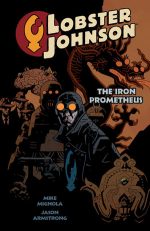
Lobster Johnson volume 1: The Iron Prometheus


By Mike Mignola, Jason Alexander, Dave Stewart & Clem Robbins (Dark Horse)
ISBN: 978-1-59307-975-8

Lobster Johnson started out as a moody maguffin in the gloriously expansive universe inhabited by Hellboy, the B.P.R.D. and other assorted marvels from the mind of Mike Mignola.

He was initially introduced after his death: the unquiet spirit of a lost and forgotten 1930s hero who solved his last case from beyond the grave. The character was created as an amalgam and analogue of Doc Savage, The Shadow, The Spider and all those other uncompromising, two-fisted pulp crusaders who smashed crime and slew monsters…

Whenever a really talented creator or team pay proper attention to little details, the result can generally stand on its own two feet and, after continuing to pop up in further tales, the craftily-conceived Lobster eventually proved popular enough to star in his own string of miniseries, fabulously celebrating the heyday of mass-literacy fiction and hard-core horror-heroes. This first collection gathers the 5-issue saga of Iron Prometheus with script by Mignola, art by Jason Alexander, colours courtesy of Dave Stewart and letters by Clem Robbins.

Leather-clad, gun-toting and implacably invincible, the Master of Justice and his small team of agents wade through a mountain of enemies malign, mystical and/or murderously mundane; delivering a mesmerising wild ride in the manner of a cliff-hanging movie-serial Chapter Play which opens in New York City in 1937…

A worried young man is being hunted by incredible creatures. However, as a brutal yeti attacks, the Lobster intervenes to save the kid but looks like he’s finally met his match. Happily Jim Sacks activates the incredible armoured suit he’s wearing and fries the beast…

Before the embattled Yanks can catch their breath, German agents move in and a pitched battle erupts with the bewildered Jim again displaying the suit’s incredible powers to great effect.

In a brief lull Johnson astounds the kid with his knowledge: somehow the leather-helmeted mystery man knows Jim was a tailor’s dummy and guinea pig for eccentric Professor Kyriakos Gallergas – but not that the inventor and his daughter Helena were recently attacked and made him flee with the outfit to keep it from unspecified enemies…

Before long Sacks is brought to the Lobster’s underground lair, even as in the city above the hero is in Chinatown consulting prophets. They warn of deadly danger, doom and dragons and offer a name to trace… Memnan Saa…

Back below Jim is telling all he knows about his mighty Vril Energy Suit – which isn’t much – when the Lobster returns with a lead to a warehouse downtown.

Inside it, a sinister mage is indulging in a spot of torture and suggesting to Gallergas that Helena might be next. After Jim, Johnson and his gang embark on their rescue mission, the VES is again the deciding factor in an uneven battle, but only until the inexperienced Sacks steps into a carefully prepared booby-trap.

This leaves Johnson at the mercy of old enemy Doctor Waxman and a terrifying cyborg thug even as Jim finds himself conversing with Helena in a spectral arctic landscape she calls the Grave of the Emperor of the World…

As the Lobster mops up his opponents, in that icy other-place Jim succumbs to arcane assault, but when the sagacious mage turns his attention to the masked man the wizard learns that high explosives carry their own extremely effective magic…

Jim comes to in a Hoboken warehouse and sees with horror what has been done to Professor Gallergas. The monstrously misused scientist reveals the secret of Vril and how his abductors plan to use the ancient energy to awaken an antediluvian evil. The traumatised boy also discovers what has been done to him too, just as Lobster and his team burst in…

As Jim struggles with a brute gradually transforming into a diabolical monster, deep inside that house of horrors Lobster battles a maniac to rescue Helena, but they are too late: the dragon has risen…

The mage wants 368 more just like it but the Vril has unleashed supernatural forces on the side of Good too, and Sacks and the Professor are ready to fight to save their world, even if they are no longer truly part of it…

Johnson is determined to deliver his own harsh brand of justice, but pursuit of the mage leads him into distracting clashes with monsters and zombies which are not nearly as devious as the Nazi agents coolly waiting to ambush him…

Knocked unconscious, the Lobster somehow confronts the mage on an eerie, icy plane before seemingly succumbing to dark rites and awakening in the custody of the German agents who have also been seeking the Vril suit since the beginning. They seem oblivious to the actions of the sinister sorcerer, however, and are far more concerned with taking what fragments of armour they have scavenged and covering their escape by eradicating New York City…

Lobster Johnson has one last play if he is to save himself and the unwitting millions residing in the sleeping city…

Interspersed with compelling faux magazine articles on ‘The True History of Lobster Johnson’ – detailing the various media incarnations of the macabre man of mystery – and topped off with a vast Lobster Johnson Sketchbook section displaying working drawings, roughs, model-sheets and layouts from Mignola, Armstrong and contributing designer Guy Davis; this is a potent and powerful supernaturally-tinged action romp to quicken the hearts of every aficionado of fantastic adventure.
™ & © 2007, 2008 Mike Mignola. Lobster Johnson™ and all other prominently featured characters are trademarks of Mike Mignola.

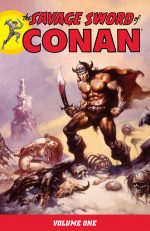
Savage Sword of Conan volume 1


By Robert E. Howard, Roy Thomas, Barry Windsor-Smith, John Buscema, Pablo Marcos, Gil Kane, Neal Adams, Alfredo Alcala, Alex Niño & various (Dark Horse Books)
ISBN: 978-1-59307-838-6

Win’s Christmas Gift Recommendation: A Rare Bird Well Worth Carving Up… 9/10

During the 1970’s the American comic book industry opened up after more than fifteen years of cautious and calcified publishing practises that had come about as a reaction to the censorious oversight of the self inflicted Comics Code Authority: a publishers’ oversight body created to keep the product wholesome after the industry suffered their very own McCarthy-style Witch-hunt during the 1950s.

One of the first literary hardy perennials to be revisited was Horror/Mystery comics and from them came the creation of a new comics genre. Sword & Sorcery stories had been undergoing a prose revival in the paperback marketplace since the release of softcover editions of Lord of the Rings in 1954 and, by the 1960s, revivals of the two-fisted fantasies of Edgar Rice Burroughs, Otis Adelbert Kline, Fritz Lieber and others were making huge inroads into buying patterns across the world.

The old masters had also been augmented by many modern writers. Michael Moorcock, Lin Carter and others kick-started their prose careers with contemporary versions of man against mage against monsters. The undisputed overlord of the genre was Robert E. Howard with his 1930s pulp masterpiece Conan of Cimmeria.

Gold Key had notionally opened the field in 1964 – and created a cult hit – with Mighty Samson. Then came Clawfang the Barbarian’ in Thrill-O-Rama #2 in 1966. Both steely warriors battled in post-apocalyptic technological wildernesses but in 1969 DC dabbled with previously code-proscribed mysticism in Nightmaster (Showcase #82 -84), following on from the example of CCA-exempt Warren horror anthologies Creepy, Eerie and Vampirella.

Marvel tested the waters with barbarian villain – and Conan prototype – Arkon in Avengers #76 (April 1970) and the same month went all-out with short supernatural thriller ‘The Sword and the Sorcerers’ in their own watered-down horror anthology Chamber of Darkness #4.

Written by Roy Thomas and drawn by fresh-faced Barry Smith (a recent Marvel find who was just breaking out of the company’s still-prevalent Kirby house-style) the tale introduced Starr the Slayer – who also bore no small resemblance to the Barbarian-in-waiting…

Conan the Barbarian debuted with an October 1970 cover-date and – despite some early teething problems, including being cancelled and reinstated in the same month – the comic-strip adventures of Howard’s primal hero were as big a success as the prose yarns they adapted. Conan became a huge hit: a pervasive brand that prompted new prose tales, movies, TV series, cartoon shows, a newspaper strip and all the other paraphernalia of global superstardom.

And American comics changed forever.

In May 1971, Marvel moved into Warren’s territory for a second time, after an abortive attempt in 1968 to create an older-readers, non-Comics Code Spectacular Spider-Man monochrome magazine.

Savage Tales offered stories with stronger tone, mature sexual themes, less bowdlerised violence and partial nudity. It was the perfect place to introduce Futuristic Femizon Thundra and the macabre Man-Thing whilst offering more visceral vignettes starring the company’s resident jungle-man Ka-Zar and red-handed slayer Conan…

The anthology had an eventful reception and the second issue didn’t materialise until October 1973 as part of Marvel’s parent company Curtis Distribution. Conan starred in the first five issues before spinning off into his own adult-oriented monochrome magazine which debuted in August 1974. Free of all Code-mandated restrictions, The Savage Sword of Conan became a haven for mature storytelling with top flight artists queuing up to flex their creative muscles.

In 2007, after winning the license to publish Conan comics, Dark Horse began gathering Marvel’s Savage Sword canon in a series of Essentials-style, 500+ page volumes.

This first titanic tome – also available as an eBook – collects pertinent material from Savage Tales #1-5 and Savage Sword of Conan #1-10: collectively covering May 1971 through February 1976; a period when the character was swiftly becoming the darling of the comics world and his chief scribe Roy Thomas was redefining what American comics could say, show and do…

It all starts here with a much-reprinted classic.

‘The Frost Giant’s Daughter’ is a haunting, racy tale written by Howard and originally adapted in line and tone by Barry Smith for Savage Tales #1. It was later coloured and adulterated for the all-ages comicbook (#16) as it detailed how a lusty young Cimmerian chased a naked nymph into the icy winter and found himself prey in a trap set by gods or monsters…

By the time Savage Tales returned after a two-year hiatus, Barry Windsor-Smith had pretty much left comics but agreed to illustrate ‘Red Nails’ if he could do it his way and at his own pace.

The result was an utter revelation, moody, gory, soaked in dark passion and entrancing in its savage beauty. With some all-but invisible art assistance from Pablo Marcos this journey into the brutal depths of obsession and the decline of empires is the perfect example of how to bow out at the top of one’s creative game.

The adaptation began in ST #2 as Conan and pirate queen Valeria survive a trek through scorching deserts to fetch up in a vast walled city. Stealing inside they find immense riches casually ignored as the last members of the tribes of Tecuhlti and Xotalanc pick each off or wait for the monsters infesting the place to take them…

Soon they are embroiled in a simmering, oppressive war of extinction…

The third issue completed the ghastly epic as the slow war between rival branches of a decadent race explodes into a paroxysm of gore and aroused monsters…

Savage Tales #4 (May 1974) held a brace of tales. ‘Night of the Dark God’ was limned by Gil Kane, Neal Adams, Marcos & Vince Colletta from Howard’s tale The Dark Man. It revealed how Conan came hunting the abductors of his childhood first love and found them just as a terrify mystery idol began exerting its own malefic influence on a hall full of already-enraged warriors…

‘Dweller in the Dark’ was Smith’s swan-song and saw the wandering warrior become a plaything for lascivious Queen Fatima of Corinthia. Her lusts were matched only by her jealousy, however, and it wasn’t long before she had turned against Conan and tried to feed him to the monster lurking below the city…

The fifth and final Conan appearance in Savage Tales was ‘Secret of Skull River’: a wry and laconic yarn Thomas adapted from a John Jakes plot, illustrated by Jim Starlin & Al Milgrom. The barbarian sell-sword is hired to remove a wizard whose experiments are polluting a town. The reward Conan claims for his murderous services surprises everybody…

From there it was only a short jump to his own mature-themed starring vehicle, but although Savage Sword starred Conan it was initially a vehicle for numerous barbarian themed yarns – such as a serialised reprinting of Gil Kane’s epic Blackmark – and other Howard properties such as Bran Mac Morn or Red Sonja. Those aren’t included here, but are well worth searching out too…

The SSOC experience opens with the first issue and ‘Curse of the Undead-Man’ by Thomas, John Buscema & Pablo Marcos, adapted from Howard’s short story Mistress of Death. Here Conan encounters old comrade Red Sonja amongst the fleshpots of The Maul in Zamora’s City of Thieves before falling foul of sorcerer Costranno: a mage for whom being chopped to mincemeat is only a minor inconvenience…

Thomas wrote all the SSOC Conan material included here: blending adaptations of Howard’s stories – Conan’s and his other two-fisted fighting men as well – and such successor authors as Lin Carter or L. Sprague de Camp with original tales.

A stunning visual tour de force, ‘Black Colossus’ in #2 was illustrated by Buscema & Alfredo Alcala; detailing how antediluvian priest Natohk returns from death to imperil the kingdom of Princess Yasmela until stalwart general Conan leads her armies to a victory against armed invaders, uncanny occultism and a legion of devils…

SSOC #3 held two tales, beginning with Buscema & Marcos’ ‘At the Mountain of the Moon-God’ with Conan high in Yasmela’s court and attempting to head off the kingdom’s annexation from encroaching neighbours and encountering mountain-dwelling bandits and a demon pterosaur…

The issue concluded with ‘Demons of the Summit’ – an adaptation of People of the Summit by Björn Nyberg & de Camp – turned into comics by Thomas & Tony DeZuniga as an encounter with more high-living brigands brings the Cimmerian into conflict with a dying race of wizards who want his latest curvy companion to mother their next generation…

Issue #4 features Howard’s ‘Iron Shadows on the Moon’ realised by Buscema & Alcala. Having lost a war whilst leading a Kozak horde, Conan flees into the Vilayet Sea with escaped slave Olivia after killing enemy general Shah Amurath.

On an uncharted island they then encounter ancient statues which come to life at the moon’s touch. The bloodthirsty horrors fall upon a band of pirates watering on the island and after leading them to victory against the supernatural fiends Conan manoeuvres himself into the captain’s role and begins a life of freebooting piracy…

Howard’s ‘A Witch Shall Be Born’ took up most of Savage Sword of Conan #5. Illustrated by Buscema and The Tribe (DeZuniga; Steve Gan; Rudy Mesina; Freddie Fernandez and others) it saw virtuous Queen Taramis replaced by her demonic twin sister Salome, who debauched and ravaged the kingdom of Kauran whilst her accomplice Constantius has her guard captain Conan crucified. After (almost) saving himself, the Cimmerian recuperates with the desert-raiding Zuagirs, and after ousting their brutal chieftain Olgerd Vladislav returns to save Taramis and revenge himself upon the witch…

The epic is balanced by two shorter tales in the next issue. ‘The Sleeper Beneath the Sands’ is a Thomas original with art by Sonny Trinidad and reveals how Olgerd encounters a caravan of clerics en route to pacify an elder god buried since time immemorial beneath the desert. The rejected bandit-lord senses a chance for revenge but soon regrets allowing the beast to wake and luring Conan into its path…

Howard’s Celtic thriller ‘People of the Dark’ is radically adapted by Thomas and stunningly illustrated by master stylist Alex Niño next as, in modern times, Jim O’Brien plots to kill rival Richard Brent to win the hand of Eleanor.

However, a fall into an ancient cavern transports the would-be killer into antediluvian prehistory where – as Conan – he battles the debased descendents of things which were once men. In that forgotten hell a burden is placed upon him and, once returned to the present, O’Brien faces another monster and pays a millennial debt…

‘The Citadel at the Center of Time’ by Thomas, Buscema & Alcala in #7 finds the Cimmerian leading his desert-raiding Zuagirs and attacking a caravan only to be confronted by a sabretooth tiger.

After despatching the wanton killer, Conan learns from the surviving merchants of a great ziggurat with vast riches and only attendant priests to guard them.

Ever-needful of loot to placate his greedy followers, Conan leads an expedition against the eerie edifice but soon finds himself captured and offered up as a sacrificial tool to time wizard Shamash-Shum-Ukin and battling dinosaurs, beasts and brutes from many ages before finally settling his score with the time-meddler…

SSOC #8 offered a wealth of short sharp shockers beginning with ‘The Forever Phial’, illustrated by Tim Conrad doing his best Windsor-Smith riff. Here immortal wizard Ranephi desires to end his interminable existence and manipulates a certain barbarian into helping him out…

The main part of the issue continues Thomas & Kane’s adaptation of Howard’s King Conan novel The Hour of the Dragon, which had begun in Giant-Size Conan but faltered when Marvel ended their oversized specials line.

‘Corsairs Against Stygia’ – inked by Yong Montano – resumes the tale with shanghaied King Conan leading a slave revolt on the ship he’s been abducted upon. Back in Aquilonia a cabal of nobles backed by Stygian wizard Thutothmes have usurped his throne… Having taking control of the ship Conan opts to infiltrates the evil empire to rescue the stolen talisman known as the Heart of Ahriman and end the conflict…

Wrapping up this segment is Lin Carter’s evocative poem ‘Death Song of Conan the Cimmerian’ adapted by Thomas and Jess Jodloman…

Issue #9 offered another new tale by Thomas & Marcos as Conan’s Zuagirs raid another priest-packed caravan and come under the diabolical influence of a small statue with great power. ‘The Curse of the Cat-Goddess’ corrupts, divides and promises many great things: causing the doom of many brothers in arm before the iron-willed Cimmerian ends its seductive threat…

The adaptation of The Hour of the Dragon finally concludes in this hefty tome’s final chapter as SSOC #10 reveals how ‘Conan the Conqueror’ (rendered by Buscema & The Tribe – a loose agglomeration of Marvel’s Filipino art contingent (Tony DeZuniga; Steve Gan; Rudy Mesina; Freddie Fernandez and others)) sneaks into Stygian capitol Khemi to defeat snake-worshipping priests, immortal vampire queen Akivasha and Thutothmes’ inner circle before stealing back the Heart of Ahriman and heading home to occupied Aquilonia to destroy wizard king Xaltotun and his human lackeys and reclaim his stolen throne…

With a painted covers gallery – reproduced only in black-&-white here – by Buscema, Marcos, John Romita, Adams, Boris Vallejo, Mike Kaluta, Niño, Frank Magsino, Frank Brunner and Bob Larkin, plus pin-up/frontispiece art by Marcos, Adams and Esteban Maroto, this weighty collection provides a truly epic experience for all fans of thundering mystic combat and esoteric adventure.

If the clash of arms, roar of monsters, gloating of connivers and destruction of empires sets your pulses racing and blood rushing, this titanic tome is certainly your cup of mead. There are plenty of Thrones in peril, but this all-action extravaganza of sex, slaughter, snow, sand and steel is no Game. Get it and see what real intrigue and barbarism are like…
Savage Sword of Conan® and© 2007 Conan Properties International, LLC. All Rights Reserved.

Through the Habitrails: Life Before and After My Career in the Cubicles


By Jeff Nicholson (Dover Comics & Graphic Novels)
ISBN: 978-0-486-80286-2

Win’s Christmas Gift Recommendation: Epic Self-Exploration and Terrifyingly Revelatory Erudition… 9/10

To cheekily hijack a common aphorism, Comics Will Eat Itself whenever an opportunity occurs. The way creators, readers, devotees and collectors respond to the medium is infinitely fascinating to us and has formed the basis of many stellar strips and novels: not just in the arena of Graphic Autobiography but also in other picture/prose genres…

For a brief while and every so often, Jeff Nicholson was a comicbook creator. His most well known works are probably 1980s self-published satirical parody series Ultra Klutz and the award-winning Colonia. After this last concluded in 2006, Nicholson quit comics.

Somewhere in between those two radically different creations, he produced one of the scariest yet most compelling ruminations on the experiences and compulsions of making picture stories and working as an artist-for-hire ever put to paper.

From 1990 to 1997 Through the Habitrails appeared episodically in Steve Bissette’s groundbreaking horror anthology Taboo and there has never been a better examination of an (extra)ordinary guy being creative on command, turning visual tricks and drafting wonders whilst under corporate pressure and an obsessive personal need to make art…

Moreover, he crafted the experience as a mesmerising blend of autobiography and toxic, paranoid terror-tale; rendered even more isolating and crushing by adopting a fiercely bleak science fictional tone and deeply symbolic method of illustration…

After Matt Fraction qualifies the vicissitudes of the modern work experience in his ‘Foreword’ Bissette’s Introduction offers history, context and untrammelled appreciation in ‘Never on Monday: Through the 21st Century Habitrails’ and ends by explaining how Nicholson was persuaded to return to his sinister seminal work to update – if not placate – his growing legion of (perhaps unwanted) admirers…

Lettered throughout by Chad Woody, the cartoon catharsis begins with ‘Increasing the Gerbils’ as a literally faceless wage slave – drawing to order in a corporate studio which is only a small division of a massive mercantile monolith – describes his increasingly intolerable life. The office is crammed and ponderously industrious and incorporates tubes and tunnels in the walls where creepy rodents run maze-like from room to room: a Byzantine and barely explicable connection with the serried, unknowable Powers That Be…

None too slowly, the line between employee and subject beast of burden begins to blur…

Another unwholesome aspect of the job is how Management wanders the halls, arbitrarily tapping the workers and consuming their vital spirit, as grimly revealed in ‘It’s Not Your Juice’…

The steps taken to remain an individual are touched on in ‘No End’ and pitifully laid out in ‘Jar Head’ as the worker describes the use and variety of intoxicants used by the not-quite-captive Creatives to maintain output before his attention shifts to describing the fate of ‘The Doomed One’: the worker who did not bend to an oppressive, self-selected yoke but instead tried to rebel. Her fate was incomprehensible and appalling but not unexpected…

Such pressure to perform can not be endured forever and our pictorial peon eventually found release in walking and wandering in his downtime. The shocking repercussions of ‘Escape #1: “El Muerte”’ were expansive but still tantalised him with a promise of better… once he returned to work…

Not all needs can be met by the benefits of being a corporate drudge. Nevertheless, it’s the most likely place to meet potential mates. When ‘Futile Love’ happens and goes horribly wrong, naturally it provokes another deviation from protocol and ‘Escape #2: “The Dry Creek Bed”’ quietly carries him far away but ultimately only back to where he started from…

The unshakable drive to resist only brings uncomfortable attention from the managers who simply demand ‘Be Creative’, but after another pointless close call the worker heads home and in a barren wasteland discovers a possible answer to all his problems: a weapon he secretes as a tiny, prospective notion of rebellion he chooses to call ‘Animal Control’…

With a glint of hope and a possible ally in reserve, the thought that one of his fellows might be untrustworthy begins to dominate, but the truth about and fate of ‘The Infiltrator’ leaves nobody wiser or happier…

The hunger for space and wish for clarity push the artist into ever-greater unsanctioned ventures but ‘Escape #3: “Concow”’ again proves that no matter how far you go, what awaits is never going to be a welcome surprise…

A near-escapee who was dragged back into the fold attempts to rationalise his twice-lost liberty with the suffocating security of wage slavery and constant draining by creating an exposé. Sadly his assumptions about the value and efficacy of his ‘Dark Spiral’ can only end one way and the artist must resort to collusion with his dark side as delineated by ever-encroaching sometime ally ‘The Gerbil King’…

With work and notional reality fully at war, a catastrophic climax approaches as ‘Jimmy’ enters his life and changes everything forever…

Was that all a little vague? I certainly hope so because this is something you really need to work your way through on your own. The tone fits though: don’t read this unless and until you’re psyched up and suitably apprehensive…

The material has been collected a number of times since it first appeared but this superb Dover Edition offers what we smart-arse cognoscenti never expected: a continuation of the tale and dialogue with the creator from a place and position far less dark than that animal-infested region of the 1990s.

Preceding an ‘Afterword by Jeff Nicholson’ and the now-mandatory ‘About the Author’ feature, the comics self-diagnosis concludes with ‘Epilogue 1: Beyond the Habitrails’ and ‘Epilogue 2: Ghost Town Studio’: bringing us up to date in an equally abstracted but far more upbeat manner and supposing that at the end of some tunnels – or tubes – there can be light, not darkness…

Barbed with allegory, using metaphor like a scalpel and employing all the darkly surreal glamour and oppressive verve of Terry Gilliam’s Brazil or Spike Jonze’s Being John Malkovich, this potent dose of exploratory surgery for the soul simultaneously dissects why comics are made and why some of us must make them whilst telling one of the scariest tales of modern times.

Although certainly an acquired taste, Through the Habitrails is a must-see, never-forget graphic novel for anybody with a vested of intellectual interest in the Ninth Art.
© 1994, 1996, 2016 by Jeff Nicholson. Foreword © 2016 Matt Fraction. Introduction © 1996 Stephen Russell Bissette. All rights reserved.

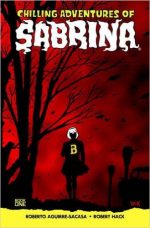
Chilling Adventures of Sabrina Book 1


By Roberto Aguirre-Sacasa, Robert Hack & various (Archie Comics)
ISBN: 978-1-62738-987-7

Win’s Christmas Gift Recommendation: A shockingly wicked spooky story… 9/10

For nearly three quarters of a century Archie Comics have epitomised good, safe, wholesome fun but the company has always been a surprisingly subversive one.

Family friendly – and not – iterations of superheroes, spooky chills, sci fi thrills and genre yarns have always been as much a part of the publisher’s varied portfolio as the romantic comedy capers of America’s cleanest-cut teens.

As you probably know by now, the eponymous Archie has been around since 1941, but the publisher has other wholesome stars in their stable almost as well known and just as prone to radical reinterpretation.

To keep all that accumulated attention riveted, the company has always looked to modern trends with which to expand upon their archetypal storytelling brief. In times past they have cross-fertilised their pantheon through such unlikely team-ups as Archie Meets the Punisher, Afterlife with Archie and Archie Vs Predator, whilst every type of fashion fad and youth culture sensation has invariably been accommodated into and explored within the pages of the regular titles.

Following-up the stunning success of their aforementioned zombie apocalypse outing, the publishers recently took another bold and controversial step by radically reinventing saccharine sweet teen witch Sabrina.

Thus, when playwright, screen scripter and comicbook scribe Roberto Aguirre-Sacasa (whose many comics hits include The Mystery Plays, 4: Marvel Knights Fantastic Four, Stephen King’s The Stand – and Afterlife with Archie amongst others) pitched the idea to re-imagine the saucy sorceress in terms of Rosemary’s Baby and The Exorcist, it wasn’t long before a strange new enterprise was hatched.

The writer’s other scripting credits include the 2013 Carrie remake and a new version of the horror musical Little Shop of Horrors.

Archie Comics is no stranger to such material. In the 1970s the company created the sub-imprint Red Circle for anthology terror tales during a supernatural boom time, before converting the line to superhero features as the decade progressed. They even had resident witch-girl Sabrina narrating Chilling Tales of Sorcery…

The Teenaged Witch debuted in Archie’s Madhouse #22 (October 1962), created by George Gladir & Dan de Carlo as a throwaway character in a quick-fire gag anthology which was simply one more venue for comics’ undisputed kings of kids’ comedy.

Almost instantly she became a regular in the burgeoning cast surrounding core stars Archie, Betty Cooper, Veronica Lodge and Jughead Jones.

By 1969 the little enchantress had grown popular enough for her own animated Filmation TV series (just like Archie and Josie and the Pussycats), thereafter graduating to lead feature in Archie’s TV Laugh Out and finally her own title in 1971.

The first volume ran 77 issues from 1971 to 1983 and, when a hugely successful live action TV series launched in 1996, a comicbook spin-off appeared in 1997. That version folded in 1999 after a further 32 issues.

Volume 3 – simple entitled Sabrina – was based on new TV show Sabrina the Animated Series. This ran from 2000-2002 for 37 issues before a back-to-basics reboot saw the comicbook revert to Sabrina the Teenage Witch with #38. This carefully blended elements from all the previous print and TV versions.

A creature of seemingly infinite variation and variety, the mystic maid continued in this vein until 2004 and issue #57 wherein – responding to the global craze for of Japanese comics – the company switched format, transforming the series into a manga-style high school comedy-romance in classic Shōjo manner.

That Sabrina is just a typical Greendale High School girl. She lives with her Aunts Hilda and Zelda Spellman, has a pet cat – Salem – and is tentatively dating childhood pal Harvey Kinkle. The cute but clueless boy reciprocates the affection but is far too scared to rock the boat by acting on his own desires.

Sabrina is an atypical witch: half-mortal (on her mother’s side), living in the mundane world and assiduously passing herself off as normal.

This first volume of the Chilling Adventures of Sabrina collects the shockingly adult and hard-hitting first five issues by Aguirre-Sacasa, artist and colourist Robert Hack (Doctor Who, Life with Archie, New Crusaders) and letterer Jack Morelli.

After a revelatory scene-setting Introduction from the author, the extremely nasty tale of ‘Something Wicked’ opens on October 31st 1951 in Westbridge, Massachusetts. Edward Spellman is celebrating the first birthday of his baby girl Sabrina by handing her over to a human-flesh eating, Satan-worshipping coven.

At least that was the plan: things go awry at the very last moment as his pathetic human wife Diana absconds with the infant. With dark magic at her pursuers’ command, she doesn’t get far…

By 1957 warlock Edward is out of the picture too and Sabrina is living with “aunts” Hilda and Zelda. Her birthday is a special occasion since Sabrina is given her first familiar. Salem is a very nasty cat who used to be a very nasty warlock. His current form is penance for unspoken but heinous past misdeeds…

All too soon, however, the other young witches at the secret school are bullying Sabrina over her halfbreed origins, so – after suitable reparations are set in motion – the family up stakes and move to a funeral home in bucolic Greendale. It’s 1962 and the move provides perfect cover. The little girl can refine her burgeoning powers in isolation and the constant flow of cadavers provides an income, raw materials and the occasional gustatory treat…

Life goes on and in 1964 the family grows larger as disgraced British teen warlock Cousin Ambrose moves in. He will become a dangerous, rebellious influence on the witch-in-training and when Sabrina starts human High School in September, he is constantly urging her use her powers to make life easier and more interesting…

Despite her uncanny origins Sabrina is still a girl and when she meets local hunk Harvey Kinkle, the hunky human works his own kind of magic on her, much to the dismay of mortal hottie Rosalind who claims “dibs” and doesn’t like to lose…

Sabrina’s aunts are also unhappy. She is only thirteen and must remain pure until she gives herself to Satan during her Baptism on her sixteenth birthday…

Nearby, in the deep woods, arcane events are spiralling out of control. Neophyte witches Betty Cooper and Veronica Lodge are dabbling in magic far beyond them. Horrifically they accidentally resurrect one of the most wicked of sorcerous sisters…

As seen in ‘The Secret History of Madame Satan’, unstable witch Iola was going to wed Edward Spellman, but he inexplicably dumped her for a mortal. In emotional turmoil Iola dramatically and spectacularly killed herself and her soul went to the Hell for Suicides. Now she has been accidentally called back and hungers for revenge…

She also has a natural gift for encountering nasty men and hurrying them on to their just reward…

After rebuilding her corrupted body from the flesh of innocents and vindictively divining the fates of Edward and Diana, Iola exults in learning they had a daughter. With malice in mind, “Madame Satan” turns towards Greendale and makes spiteful plans…

It’s October and as Sabrina’s birthday approaches she is more consumed with Harvey’s increasingly ardent attentions and her own theatrical ambitions and the upcoming dark Baptism…

Hilda and Zelda have been preparing Sabrina for her ‘Unholy Baptism’ for years. It will be the turning point of her life; resolving whether or not she will accede to her full powers and potential and serve the Evil One forever. Nothing must be allowed to impede or mar the crucial moment.

Sadly, it’s just not going to happen. Iola has hit town and, through arcane manipulation, inserted herself into Sabrina’s increasingly confused and conflicted life. As replacement teacher Evangeline Porter, Madame Satan even offers horny frustrated Harvey the delights Sabrina is denying him…

Culmination comes after she tricks the lad into interrupting the demon-drenched birthday Black Mass before leaves the horrified human boy to a ghastly fate…

So great is the power of witchcraft however that even death does not end the Harvey Horrors’. The repercussions of Iola’s plan reverberate throughout the town and the coven, even reaching as far as Riverdale and the witches hiding there…

Although she had nothing to do with the wrecking of the baptism ritual Sabrina is then summonsed to appear before a fearsome court of witches to endure ‘The Trial’. After surreptitiously aiding Selena to escape Satanic justice, Miss Porter then delivers her sadistic coup de grace, offering the distraught teen witch everything her heart desires… or so she thinks…

Happily this is a continuing series and there’s more malevolent magic to come…

This radical makeover also offers a host of ‘Special Features’ including a ‘Cover Gallery’, variants by Hack spoofing classic movie poster such as Rosemary’s Baby, Häxan, Carrie and Creepshow, assorted retailer incentive variants by Francesco Francavilla, J. Scott Campbell and Hack, an ‘Original Sketch Gallery’ and a text feature about original Golden Age Scream Queen Madame Satan and an original exploit by Joe Blair & Harry Lucey from Pep Comics #17 (July 1941).

Brooding, slow boiling and shockingly potent – beware of profanity, gore and nudity, Archie traditionalists! – Chilling Adventures of Sabrina is a classic grown up horror story to delight hardcore far fanatics.
© 2016 Archie Comics Publications, Inc.

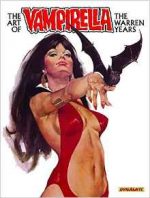
The Art of Vampirella: The Warren Years


By Frank Frazetta, Enrich, Sanjulián, Ken Kelly Vaughn Bodé & various artists, written by David Roach (Dynamite Entertainment)
ISBN: 978-1-60690-390-2

Jim Warren originally established himself in the American comics marketplace with monochrome B-Movie fan periodical Famous Monsters of Filmland and satire magazine Help! In 1965 he took his deep admiration of the legendary 1950s EC Comics to its logical conclusion: reviving anthology horror periodicals and pitching them at older fans.

Creepy was stuffed with clever strip chillers illustrated by the top artists in the field (many of them ex-EC stars) and Warren neatly sidestepped the all-powerful Comics Code Authority – which had ended EC’s glory days and eventually their entire comics line – by publishing his new venture as a newsstand magazine.

It was a no-lose proposition. Older readers didn’t care to be associated with “kid’s stuff” comicbooks whilst magazines already held tempting extra cachet (i.e. mild nudity and a little more explicit violence) for readers of a transitional age.

Best of all, the standard monochrome format cost a quarter of what colour periodicals did to print.

Creepy was a huge and influential hit, especially among the increasingly rebellious, Rock ‘n’ Roll crazed teen market; often cited as a source of inspiration for the nascent underground commix movement and now furiously feeding on the growing renewed public interest in the supernatural.

In true Darwinian “Grow or Die” mode, Warren looked around for new projects, following up with companion shocker Eerie and the controversial war title Blazing Combat.

As the decade closed he launched a third horror anthology, but Vampirella was a little bit different. Although it featured the traditional “host” to introduce and comment on stories, this narrator was a sexy starlet who occasionally participated in the stories: eventually becoming hero and crowd-pulling star of her own regular feature.

Another radical variation was that here female characters played a central role. They were still victims and targets but increasingly, whether name stars or bit players, were as likely to be the big menace or save the day. Whatever their role, though, they were still pretty much naked throughout. Some traditions must be protected at all costs…

Another beguiling Warren innovation and staple was the eye-catching painted covers on every issue…

The hidden story behind Warren’s introduction of Vampirella is fully disclosed in David Roach’s incisive history of the magazine whose covers are reprinted in their entirety – spanning September 1969 to March 1983 – in this pictorial treasury.

Accompanied by informative context and commentary, they are presented as both finished newsstand-ready product with all typography and logos and as full-page reproductions of the original artworks, denuded of all distracting text and editorial modification.

This magnificent oversized (234 x 307 mm) hardback proudly displays every cover from the run: 112 issues, the 1972 Annual and the Pantha Special – and even includes a series of photographic entries featuring Barbara Leigh in full costume. She was pegged to play the deliciously Deadly Drakulonne in a sadly-unrealised Hammer Horror movie.

Following a revelatory Introduction from Enric Torres-Prat who as “Enrich” painted dozens of astoundingly eye-catching covers, Roach’s ‘Vampirella: an Introduction’ traces her history and development as well as the company-saving arrival of the Spanish illustrators of Josep Tutain’s European S.I. agency.

The astonishing work of these astounding painters and draughtsmen turned Warren around and made them the most visually unique publisher on the American scene. Moreover this Introduction is illustrated not just with American material but also pages of comics and covers S.I. provided for the British market during the 1960s and 1970s.

The major portion of this beguiling tome is quite rightly all about the art, and the parade of painterly peril and pulchritude includes works by Aslan (Alain Gourdon), Frank Frazetta, Bill Hughes, Vaughn Bodé, Jeff Jones, Larry Todd, Ken Kelly, Boris Vallejo, Sanjulián (Manuel Pérez Clemente), Pepe Gonzalez, Luis Dominguez, Josep Marti Ripoll, Lluís Ribas, Hank Londoner (photographer for the Leigh covers), Bob Larkin, Kim McQuaite, Jordi Penalva, Esteban Maroto, Steve Harris, Paul Gulacy, Terrance Lindall, Jordi Longaron, Noly Panaligan, Albert Pujolar and Martin Hoffman.

This captivating, vibrant tome is as much a historical assessment as celebration of stellar talent: a beautiful, breathtaking and brilliantly inspirational compendium for the next generation of artists and illustrators.

If you are gripped by the drive to make pictures but want a little encouragement, this luxurious compendium offers all the encouragement you could possibly hope for – and is powerfully intoxicating too.
Vampirella ™ and © 2013 Dynamite Entertainment. All rights reserved.

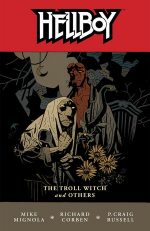
Hellboy volume 7: The Troll Witch and Others


By Mike Mignola, Richard Corben, P. Craig Russell, Dave Stewart & various (Dark Horse Books)
ISBN: 978-1-59307-860-7

Hellboy was first seen in San Diego Comic-Con Comics #2 (August 1993) before formally debuting. That launch was in miniseries Seed of Destruction with John Byrne scripting over Mignola’s plot and art.

As a baby Hellboy was taken – on December 23rd 1944 – from Nazi cultists by American superhero The Torch of Liberty and a squad of US Rangers. They had interrupted a satanic ritual predicted by Allied parapsychologist Professor Trevor Bruttenholm and his associates.

They were waiting at a ruined church in East Bromwich, England when the abominable infant with a huge stone right hand materialised in a fireball. Raised by Bruttenholm, the child grew into a mighty warrior fighting a never-ending secret war. The Professor trained the infernal foundling whilst forming an organisation to destroy supernatural threats – the Bureau for Paranormal Research and Defense.

After years of such devoted intervention, education and warm human interaction, in 1952 the neophyte hero began destroying unnatural threats and supernatural monsters as lead agent for the BPRD. “Hellboy” rapidly became its top operator… the world’s most successful paranormal investigator…

As the decades unfold, Hellboy gleans snatches of his origins, learning he is a supposedly corrupted creature of dark portent: born a demonic messiah, somehow destined to destroy the world and bring back ancient powers of evil. It is a fate he despises and utterly rejects…

This sinister seventh spellbinding compendium of graphic grotesquery and grave wit collects material from 2003 to 2007 as previously seen in The Dark Horse Book of Witchcraft, The Dark Horse Book of the Dead, The Dark Horse Book of Hauntings, The Dark Horse Book of Monsters, 2-issue miniseries Hellboy: Makoma, the Hellboy Premiere Edition and Hellboy: Wizard 1/2. Also included is an original story created especially for his trade paperback edition.

The format is a gathered scattering of short yarns and vignettes presenting exploits from Hellboy’s chequered career as a “weird-buster” and, following an engaging Introduction from fellow multi-talented tale-weaver Walter Simonson, Mignola briefly expounds on the folkloric influences and other antecedents of the uncanny yarns which follow before the eldritch enigmas at last unfold.

Coloured and lettered by regular support crew Dave Stewart and Clem Robins, ‘The Penanggalan’ (Hellboy Premiere Edition, 2004) is set in 1958 Malaysia with the already world-weary troubleshooter investigating a macabre vampiric creature with disgusting habits and a neat line in deceptive camouflage. Even though appearances are frequently deceiving, the veteran monster-hunter is not fooled by a pretty face or placid demeanour…

‘The Hydra and the Lion’ (The Dark Horse Book of Monsters) resulted from a collaboration between Mignola and his young daughter: subtly referencing Hercules’ legendary battles against the Nemean lion and a many-headed dragon. Hellboy’s frenetic clash occurred in Alaska in 1961 after the death of a circus strongman somehow led to recurring raids by monsters in the fog…

Eponymous lead feature ‘The Troll Witch’ came from The Dark Horse Book of Witchcraft and is set in Norway circa 1963. It opens with Hellboy quizzing a wizened crone whilst investigating a series of bizarre and unnaturally savage murders. She relates an old legend of a barren woman who sought magical aid to give her husband children. The successful outcome was two girls. One was beautiful and one was not…

When trolls took the lovely lass, her ugly sister responded with great fury and effect to save her… and therein lay the clue to Hellboy’s latest case… and its eventual solution…

‘The Vampire of Prague’ – written by Mignola, mischievously illustrated by P. Craig Russell, with colours by Lovern Kindzierski and the lettering of Galen Showman – was created especially for this compilation and was the result of the author’s trip to the Czech republic whilst scouting movie locations…

With sublime wit and sly joy, it details the depredations of an ancient gambling-addicted bloodsucker and how the reign of terror was finally ended in one night in August 1982 when a certain red-faced, stone-handed hero hit town…

Mignola, Stewart & Robins reunited for ‘Dr. Carp’s Experiment’ (The Dark Horse Book of Hauntings) with Hellboy embroiled in an atypical ghost story, confronting restless spirits in an old house on Long Island in 1991: a dank domicile blighted not just by gore-drenched phantoms but also malevolent time-travellers and killer-apes wielding electric harpoons…

‘The Ghoul or Reflections on Death and The Poetry of Worms’ by Mignola, Stewart & Robins is an experimental item from The Dark Horse Book of the Dead, taking place in London 1992 with our paranormal paragon hunting a predatory, verse-spouting cadaver consumer.

The narrative remainder of the book offers Mignola’s broad interpretation of African myth Makoma and the Giants, realised here by the one-and-only Richard Corben, with Stewart & Robins in dutiful attendance.

‘Makoma or, A Tale Told by a Mummy in the New York City Explorers Club on August 16 1993’ is a story within a story outlining how Hellboy’s visit to a venerable institution exposes an unsuspected connection to one of Earth’s earliest and most important champions who tackled terrible titans, tamed the wild places and faced devils and dragons whilst setting mankind in his rightful place in the world hierarchy…

The epic adventure is supplemented by a new Mignola pinup, a Corben cover gallery and sketchbook pages by Mignola and Russell.

Baroque, bombastic, suspenseful and explosively action-packed, this is another superbly scary rollercoaster ride to delight one and all.
™ and © 2007, 2006, 2005 2004 and 2003 Mike Mignola. Hellboy is ™ Mike Mignola. Introduction © 2006 Walter Simonson. All rights reserved.

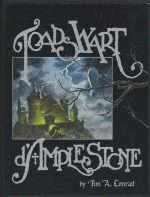
Toadswart d’Amplestone – A Gothic Tale of Horror and Magick


By Tim A. Conrad (Eclipse Books)
ISBN: 1-56060-012-8 (Limited Edition Hardcover);             978-1-56060-013-8 (PB)

It’s the season for baroque and whimsical terror tales and this lost gem is long overdue for a thorough re-investigation…

Toadswart d’Amplestone began life as a serial in Marvel’s creator-owned magazine Epic Illustrated (issues #25-28 and #30-32; spanning August 1984-October 1985).

Revelling in the compulsive mystique of grotesquery, the tale of medieval madness, magic and malevolence is a brilliantly rendered, slyly arch graphic pastiche and thematic marriage of black-&-white 1930s horror movies with later screen efforts from Roger Corman and the Hammer horror masters.

Sealing the deal for authenticity, it is painted in stunning black-&-white tones by the fabulously gifted Tim Conrad and was collected into a superb oversized (212 x 286 mm) monochrome tome by Eclipse Comics in 1990. Although still readily available, it is a prime candidate for revival and re-release.

Splendidly over the top, the tale comes from the pitiful lips of much-oppressed court dwarf Toadswart who recounts – after a philosophic ‘Prologue’ – how in ‘Children of the Storm’ itinerant artist Shamshadow rides into the castle of Amplestone, soaking wet and looking for work …

The manse is in a dire state. Prince Waxwroth has been increasing unstable since his father vanished three years previously: more and more convinced that the King of the First Dominion covets his lands and is perpetrating intrigues to seize them. Nevertheless, the painter is hired to craft grand portraits of the entire surviving clan…

Despite employing magician/astrologer Lacknose, Waxwroth incessantly dabbles in sorcery himself; convinced the horrific golem he has created will safeguard his possessions and ensure the succession of his young son Rupert…

Eventually, the unstable Waxwroth finally instils his creation with a ‘Heart of Fire’ and rapidly regrets his act…

In ‘And All the Kings Men…’ he unleashes his granite beast against the King’s never seen forces but it is uncontrollable and does more harm than good, returning to slay trusted servants and even family members in ‘Ashes to Ashes’.

Tension mounts as the Prince temporarily recaptures his monster but Toadswart can see that worse is to come. It inevitably breaks loose and roams the castle, pushing them all to the ‘Abyss’.

With his world and body falling apart, ‘Waxwroth Furioso’ finds the beleaguered Prince berserk and utterly lost, leaving Toadswart and Shamshadow to deal with the rampaging golem’s ‘Final Passage’ before a return of order and answers are found to dispel an inescapable tragedy…

There are no dragons but plenty of dank dungeons, dark deeds and dire, dirty plots to augment the monstrous mayhem and mystery, making this a glorious tribute to bygone times and classic movies seen from under he bedcovers or from behind a sofa, and if you’re a smug git like me and got the Limited Edition Hardcover you can also enjoy a full colour tipped-in art plate (which, on reflection, makes me wonder if the whole tale wasn’t actually fully painted and just shot and printed in black-&-white to enhance the spooky mood…)
©1990 Tim Conrad. All rights reserved.

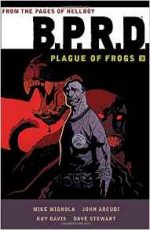
B.P.R.D.: Plague of Frogs volume 3


By Mike Mignola, John Arcudi, Guy Davis, Dave Stewart & Clem Robbins (Dark Horse Books)
ISBN: 978-1-59582-860-6 (HC):       978-1616556228 (PB)

Hellboy is a creature of vast depth and innate mystery; a demonic baby summoned to Earth by Nazi occultists at the end of Word War II but subsequently raised, educated and trained by parapsychologist Professor Trevor “Broom” Bruttenholm to destroy unnatural threats and supernatural monsters as the lead field-agent for the Bureau for Paranormal Research and Defense.

After decades of unfailing, faithful service, in 2001 he became mortally tired and resigned. Itinerantly roaming the world, he still managed to constantly encounter weird happenstances, never escaping trouble or his own sense of duty. He’s only a momentary guest star in this book.

This particular massive tome – available in hardback, paperback and digital formats – in fact stars his trusty comrades: valiant champions of varying shades of human-ness who police those occult occasions which typically fall under the remit of the Enhanced Talents task force of the B.P.R.D.

If you’re having trouble with the concept, think of a government-sanctioned and internationally co-sponsored Ghostbusters dealing with Buffy-style threats to humanity.

The B.P.R.D. rapidly established itself as a viable publishing premise in its own right through a succession of interlinked miniseries; confronting an ancient, arcane amphibian menace to humanity in an immense epic which spanned eight years of comicbook releases.

Previously collected as a series of trade paperbacks during that time, the entire supernatural saga – latterly dubbed Plague of Frogs – was remastered as a quartet of monumental full-colour volumes, of which this is the twisted third.

Gathering material from B.P.R.D. The Universal Machine; Garden of Souls and Killing Ground – volumes 6 through 8 respectively – this macabre masterpiece opens with a handy recap page identifying key personnel of the B.P.R.D.

Then an equally informative Introduction from series editor Scott Allie provides context and background in the organisation’s struggle against the eons-old supernal force mutating humans into terrifying frog-monsters as well as few behind-the-scenes production secrets…

At the end of the previous collection, the team had narrowly avoided the end of the world by finding the Frog citadel and defeating marauding Elder God-made-grisly-flesh Katha-Hem… but at great and tragic cost…

Crafted throughout by writers Mignola and John Arcudi, illustrated by Guy Davis, lettered by Clem Robins and coloured from Dave Stewart, ‘The Universal Machine’ (originally a 5-part miniseries spanning April to August 2006) takes up the story as amphibious Abe Sapien and undead marine Benjamin Daimio oversee the sterilising carpet-bombing of the city the Frog destroyed to summon their archaic eidolon.

Back at their new Colorado base, pyrokinetic Liz Sherman and disembodied psychic Johann Krauss discuss with historian Dr. Kate Corrigan how to resurrect their fallen comrade Roger the Homunculus from the pile of broken rubble he was reduced to…

Despite Roger’s mystical origins that prospect seems unlikely until the B.P.R.D. are offered a copy of legendary alchemical tome “A True Record of the Workings of the Universal Machine” by an enigmatic bookseller in France…

Soon Corrigan and trainee researcher Andrew Devon are in the picturesque village of Ableben, discussing the unnatural events of 1491 which shattered the castle of local lord Marquis Adoet de Fabre and scattered his celebrated collection of monsters, grotesques and magical artefacts…

The bookseller is a weird and difficult cove, clearly more intent on teasing his customers than selling his wares, and when Devon steps outside to report in, Corrigan’s suspicions are proved right.

The vendor is de Fabre himself, laying a trap to abduct her. Whisking Kate back in time, the sinister savant has the book she needs but what he wants in return is a price that cannot be paid…

As Devon quails in the present and in the clutches of a werewolf pack acting as the mage’s 21st century negotiators, back in Colorado the Enhanced Talents squad are sharing coffee and stories. Former Green Beret Daimio at last reveals how he came back from the dead three days after dying in the line of duty…

A covert mission in Central America resulted in the slaughter of him and his team by a jaguar monster. They stayed dead and he didn’t…

Moved by the confession, Johann shares a moment of his former, corporeal, life as a spirit medium: one that only emphasises his own loneliness and moral weakness whilst deeply harming both the living and dead clients he was striving to help…

Liz doesn’t share anything. She’s been acting strange for quite a while now and doesn’t want anyone to know that she’s seeing visions and getting messages from a mystery mage only she can see…

The late night chinwag moves on to pensive Abe, but rather than share his recent life-altering news he prefers to relate the old and sad tale of a family man lost in the Canadian wilderness. By the time he and Hellboy had found Daryl Tynon, the poor slob was well on the way to losing his mind. He had already tasted human flesh and physically transformed into a Wendigo…

Back in the past, the magical collector boasts, brags and bullies. Convinced he has the upper hand, de Fabre shares many of his secrets and displays his greatest prizes, but has grievously underestimated the perspicacity and sheer guts of his merely human hostage…

Victorious but without her prize, Corrigan survives the destruction of de Fabre’s castle and is unceremoniously dumped back in her own time. Although she has failed to find a way to restore Roger, the departed Homunculus has a message for them all, to be delivered by Krauss…

The next volume also started as a 5-issue miniseries. ‘Garden of Souls’ (March to July 2007) concentrates on Abe’s recently uncovered origins and opens in 1859 with psychical researcher Dr. Langdon Everett Caul as part of a group of like-minded men fascinated with arcane secrets. He is present when an Egyptian mummy is unwrapped at a grand soiree. Incredibly, the withered husk was still alive so he and his closest associates in the Oannes Society stole the astonished, outraged ancient Panya, convinced she is the sea goddess Naunet…

More than a century later Abe was found by the B.P.R.D. in a tank; a bizarre fish-human hybrid with no memory of his past. It’s all started coming back to him now, however, especially after being sent Caul’s old cigar case with a map neatly tucked inside…

With Daimio as back-up but still sharing nothing, Abe heads to Balikpapan, Indonesia, unaware that his taciturn companion is concealing a few secrets of his own or that best friend Liz is slowly succumbing to the poisonous whispers of someone no one can see and being driven insane by visions of impending Armageddon…

Despite the passage of time the men of the Oannes Society are still alive. Sustaining themselves through steampunk biomechanics, the sages have been building bio-mechanical monsters whilst growing themselves new superhuman flesh bodies to hold their corrupted minds. They have also been waiting for Caul to return and cannot understand his odd new notions of morality…

They have no idea why he should be so upset at what they did to his original body or their current scheme to catastrophically inundate all of South East Asia and harvest the souls of the millions who will drown.

Happily, Ben is on hand to help defuse the plot, assisted by the astounding psychic powers of the still-captive and extremely resentful living mummy Panya…

This all-action adventure then gives way to suspense and revelation in ‘Killing Ground’ (5 issues once spanning August-December 2007) with change in the air at B.P.R.D.’s Colorado HQ.  Johann has taken possession of the last super-body built by the Oannes Society and is becoming increasingly intoxicated by the fleshly sensations he believed denied him forever.

Daimyo is reeling from public revelations that his grandmother was a WWII war criminal, but has managed to keep secret the wizard he periodically sneaks into the base to deal with horrific body changes he doesn’t want his comrades to know about.

Liz is particularly happy. Without being told, new inductee Panya has confirmed the reality of the stranger haunting the harassed pyrokinetic and even offered some suggestions to counter his constant poisonous whispers.

Abe, now officially in charge of the Enhanced team, is overseeing the transfer of now-completely feral Daryl to a newly fortified cell, but cannot help noticing the affect the savage beast has on Daimio…

Trouble is never far away. Soon the base has been infiltrated by a deadly silent intruder whose actions kick off a cascade of disasters, beginning with the escape of Daryl and evisceration of Daimio’s secret wizard. With the base on lockdown and bodies piling up, it’s a time for all hands on deck, but super-strong Johann has vanished.

And then the blizzard hits…

As chaos mounts, the silent intruder finally provides some answers in the most agonising manner imaginable, two separate carnosaurs rip their way through the embattled soldiers on site, another Enhanced team member perishes, a ghostly hero returns and the truth about Daimyo’s death and resurrection are horrifically revealed, leading to a major changing of the guard…

Moreover, even though the War on Frogs seems to be over, the best and worst is yet to come…

Following an Afterword by Arcudi, a wealth of Bonus Features included here comprise comprehensive Sketchbook sections on The Universal Machine, Garden of Souls and Killing Ground – all dutifully annotated by Davis – offering roughs, designs and preliminary artwork from Davis and Mignola

With spectacular supernatural fantasy now a staple of TV and movie genre, these unlikely heroes must be a top pick for every production company out there. Until then, why not stay ahead of the rush by reading these chillingly compelling yarns?
B.P.R.D. ™: Plague of Frogs volume 3 © 2006, 2007, 2008, 2012, 2015 Mike Mignola. Abe Sapien™, Liz Sherman™, Hellboy™, Johann™, Lobster Johnson™ and all other prominently featured characters ™ Mike Mignola. All rights reserved.

Scary Godmother


By Jill Thompson (Dark Horse Books)
ISBN: 978-1-59582-589-6

The Eisner-Award winning Scary Godmother started life in 1997 as a full-colour, strip-format children’s book before evolving into a comicbook series, hit stage show and brace of Cartoon Network animated specials.

The original fully-painted picture book spawned three equally captivating annual sequels from Indie publisher Sirius Entertainment and all four of those astoundingly enthralling, wickedly hilarious books were resurrected in 2010 by Dark Horse as a stunning all-ages trade paperback collection just in time for Halloween.

And now it’s that time again…

Created by the terrifyingly multi-talented Jill Thompson (The Sandman, The Invisibles, Swamp Thing, Wonder Woman, The Little Endless Storybook) these stories offer comfortably spooky chills frosted with cracking comedy whilst proudly defending the inalienable right to be different…

Debut volume ‘The Scary Godmother’ introduced little Hannah Marie who is frantic to start her first ever Trick or Treat night, and only the teensiest bit disappointed that she has to go with her older, rather mean cousin Jimmy and his friends.

Naturally the big kids aren’t that keen on taking a baby along as they desperately try to score vast amounts of candy and cake, so as the evening progresses they try all they can think of to ditch the wide-eyed waif. It’s Jimmy who has the idea to scare Hannah by taking her to the old Spook House…

As they all nervously enter the ramshackle, abandoned old mansion, Jimmy tells Hannah Marie that the new kid has to give the monsters in the house some candy or they will eat all the children in the world, but he has severely underestimated his cousin’s grit. Although scared, she enters the dilapidated pile and the gang have no choice but to follow her inside…

As she looks for the horrible creatures Hannah Marie starts to cry and her sobs cause a strange thing to happen: someone joins in with sobs even louder than hers. And that’s how she meets the twisted fairy called Scary Godmother and befriends all the actual magic monsters who live in the weird midnight realm known as the Fright Side…

Scary Godmother is the Ambassador of Spooky and pretty much runs Halloween. After being introduced to the bats and beasts and boggles, Hannah Marie is no longer afraid and her new friend even has some ideas on how to teach Jimmy and his pals how to be less mean…

One year later ‘The Revenge of Jimmy’ finds the nasty boy deeply traumatised by his most memorable encounter with actual monsters last year. Now settled on the notion that if he sabotages Halloween, the horrors, haunts and horrible things won’t be able to come back to the real world for a second chance at him, Jimmy sets out on a mission of sabotage…

Across the dark divide the inhabitants are all gearing up for their night of fun in the real world and perplexed that something is gumming the works. The magic bridge that forms to carry them over is only half-formed, strange webs bar their path and other peculiar events temporarily hamper their preparations for the special night.

It’s all Jimmy’s fault but every time one of his cunning schemes looks like scuttling the town’s forthcoming festivities, some busybody or other finds a way to turn his sneaky dirty work into an exercise in ingenuity. With nothing apparently stopping Halloween coming and the Fright Siders crossing over, Jimmy steps up his campaign, unaware that all that meanness and loose magic is causing a rather strange transformation in Jimmy…

Nevertheless his most appalling act of sabotage almost succeeds until little Hannah Marie sees an upside to his horrible acts.

Halloween is saved but Jimmy almost isn’t… until one bold monster steps up to set things right…

Another year rolls by and Hannah Marie is preparing for a Halloween block party. As Mum and the other parents toil to make all the seasonal treats, the little girl is writing invitations to all the monsters in Fright Side. Hannah Marie has learned how to cross over to the nether realm, but when she gets there Scary Godmother is also busy, ensuring the night will be suitably spooky and wonderful.

As Hannah Marie distributes the invitations, a strange thing occurs: Scary Godmother gets a different invitation. It’s unsigned but from a Secret Admirer begging her attendance on ‘The Mystery Date’…

Captivated by the notion, Hannah Marie and little vampire Orson start canvassing all the likely candidates on the Fright Side – causing no end of trouble and embarrassment for Halloween’s startled and bemused Ambassador – before they all shamefully cross over to the real world where a real romantic surprise awaits the Scary Godmother…

The final book of the quartet was ‘The Boo Flu’ wherein our magical mystery madame succumbs to the worst of all eldritch aliments at the least favourable time, compelling Hannah Marie to step up, put on the big magic hat and ride the broomstick to marshal the monsters and take charge of all the necessary preparations if All Hallows Eve is to happen at all this year…

That’s a big ask for a little human girl, but help soon comes from all sorts of unexpected directions…

Almost as soon as the first book was released, Scary Godmother started popping up in comics too. Most of those tales are collected in a companion volume to this gleeful grimoire but there’s room here for one cheeky treat as ‘Tea for Orson’ (from Trilogy Tour Book) focuses on the vampire boy’s attempts to crash a girls-only soiree at Scary Godmother’s house. Harry the Werewolf also wants in – but more for the food than the company – and the banned boys’ combined, increasingly outrageous, efforts to gatecrash make for a captivating lesson in being careful what you wish for…

Wrapping up the tricks and treats is a liberal dose of ‘More Art’ in a huge and comprehensive ‘Scary Mother Sketch Book’ section; comprising roughs, designs, character development drawings, working paintings, promotional art and comic ads, design, background and model sheets and, for the animated specials, original book covers and rejected pages and scenes.

Still readily available – and now as a digital download too – Scary Godmother is a magical treat for youngsters of any vintage and would make a perfect alternative treat to candy and cakes…
Text and illustrations of Scary Godmother © 1997, 1998, 1999, 2000, 2010 Jill Thompson. All rights reserved.

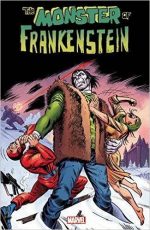
The Monster of Frankenstein


By Gary Friedrich, Doug Moench, Bill Mantlo, Gerry Conway, Mike Ploog, John Buscema, Bob Brown, Val Mayerik, Don Perlin, Sal Buscema & various (Marvel)
ISBN: 978-0-7851-9906-9

Whereas DC Comics capitalised on the early 1970s global boom in all things supernatural and mystic by creating a plethora of short-story anthologies and the occasional spooky star, Marvel Comics took the trend in another direction and created a small army of horror-heroes to headline their own series.

This particular collection reprints the House of Ideas’ interpretation of the Mary Shelley classic from a time when the censorious Comics Code Authority first loosened some of its strictures banning horror material from the pages of comics. That translates here to 18 issues of the colour comicbook; Giant-Sized Werewolf #2, Marvel Team-Up #36-37 and all the pertinent strips from adult-oriented Marvel magazines Monsters Unleashed #2, 4-7, 9-10 and one-shot Legion of Monsters (spanning January 1973 – September 1975), all awaiting your rapt attentions.

Some comic artists work best in black-&-white. Such is certainly the case with the groundbreaking Mike Ploog. A young find who had previously worked with Will Eisner, Ploog illustrated Gary Friedrich’s pithy adaptation of the original novel before moving on to new ventures as the strip graduated to in-house originated material. This monumental paperback tome is presented mostly in colour, but if you are of a similar opinion you could try to lay your hands on the 2004 monochrome Essential Monster of Frankenstein edition…

‘Mary Shelley’s Frankenstein!’ debuted with a January 1973 cover-date and introduced Robert Walton IV, great grandson of the sea-captain who had rescued scientist Victor Frankenstein from the polar ice and was subsequently regaled with the incredible tale of “the Modern Prometheus”.

In 1898, leading a band of rogues, cutthroats and sullen Inuit, Walton finds the fabled monster interred in a frozen slab and brings it aboard his ice-breaker. He then recounts the story to his fascinated cabin-boy, unaware of the fear and discontent simmering below decks…

A bloody mutiny during a terrible gale opens the second issue as the burning ship founders. Meanwhile the flashbacked tale of tragic Victor reaches the terrible moment when the monster demands a mate. The guilt-plagued scientist complies only to baulk at the last and destroy his second creation. ‘Bride of the Monster!’ concludes with the creature’s fearsome vengeance on his creator paralleling the grim fate of the storm-tossed ship…

In The Monster of Frankenstein #3, ‘The Monster’s Revenge!’ has the reawakened creature freed from its ice-block to overhear the continuation of his life-story from Walton’s lips, even as the last survivors struggle to find safety in the Arctic wastes.

Thereafter ‘Death of the Monster!’ – with inker John Verpoorten taking some of the deadline pressure off the hard-pressed Ploog – turns the tables as the monster reveals what happened after the polar showdown with his creator, leading to a new beginning when Walton reveals that not all the Frankensteins were eradicated by the Monster’s campaign of vengeance. Their warped  blood-line lives on…

A new direction began with issue #5 as ‘The Monster Walks Among Us!’. Making his way south, the tragic creature arrives in a Scandinavian village in time to save a young woman from being burned at the stake on a blazing longboat, only to rediscover that when villagers pick up pitchforks and torches to go a-screamin’ and a-hollerin’ for blood, they generally have a good reason…

With issue #6 the comic-book renamed itself The Frankenstein Monster as the undying creature reaches the village of Ingolstadt a century after he wreaked bloody vengeance on his creator’s loved ones.

‘…In Search of the Last Frankenstein!’ is a mini-classic of vintage horrors scripted as usual by Friedrich but plotted, pencilled and inked by Ploog who was reaching an early peak in his artistic career. It was also his last issue.

Ploog was followed by John Buscema and Bob Brown before Val Mayerik settled as regular artist and Friedrich gave way to Doug Moench, a writer once synonymous with Marvel’s horror line.

Issues #7, 8 and 9 bowed to the inevitable and pitted the Monster against Marvel’s top horror star (albeit 75-ish years prior to his contemporary adventures). Beginning with ‘The Fury of a Fiend!’ continuing in ‘My Name is… Dracula!’ and concluding with ‘The Vampire Killers!’, this is an extremely classy tribute to the old Universal movies and then-current Hammer Films in equal measure, wherein the misunderstood misanthrope battled an undying evil for ungrateful humanity, consequently losing the power of speech; and becoming more monstrous in the process.

Produced by Friedrich, John Buscema and John Verpoorten, this trilogy lacks the atmosphere of Ploog’s tenure, but the action is very much in the company’s house-style. With #10 (inked by Frank Giacoia and Mike Esposito) the creature finally found ‘The Last Frankenstein!’ …much to his regret.

With number #11’s ‘…And in the End…!?’ – illustrated by Bob Brown & Vince Colletta – and #12’s ‘A Cold and Lasting Tomb’ by Doug Moench, Val Mayerik and Colletta, the Monster wrapped his historical adventures by falling into a glacial sea. Frozen once again into another block of ice he was revived, Captain America-like, in modern times: i.e. the swinging 1970s…

The epic account then switches to monochrome as the more mature episodes from Monsters Unleashed begin, starting with #2 and ‘Frankenstein 1973’ by Friedrich, John Buscema & Syd Shores. Here we see how an obsessive young man finds the Monster preserved as a carnival exhibit, only to see his jealous girlfriend revive it whilst trying to burn down the sideshow. The story continued in #4 as ‘Frankenstein 1973: Chapter Two The Classic Monster’ (Friedrich, Buscema and Golden-Age Great Win Mortimer), with a literal mad scientist actually putting his own brain in the monster’s skull. Happily the unnatural order is restored in ‘Once a Monster…’

Monsters Unleashed #6 introduced new creative team Doug Moench and Val Mayerik who wrapped up the introduction to today’s storyline with a good old-fashioned monster hunt in ‘…Always a Monster!’ which leads directly to #7’s ‘A Tale of Two Monsters!’: a dark, socially relevant tale of the modern underclass and man-made horrors carried on in ‘Frankenstein 1974: Fever in the Freak House’ before concluding in #9’s ‘The Conscience of the Creature’.

The horror boom was fading by this time and Monsters Unleashed #10 was the Monster’s last outing there: a superbly dark and sardonic Christmas offering complete with elves, snow, terrorists and a Presidential assassination attempt.

One final tale ‘The Monster and the Masque’ appeared in the 1975 one-shot The Legion of Monsters, by Moench, Mayerik, Dan Adkins & Pablo Marcos (accompanied by a chilling frontispiece by Marcos). This bittersweet morality play sees the creature accidentally accepted at a fancy dress party which is ruined when a different sort of monster gets carried away…

Switching back to full-colour comicbooks, next up is a rather tame team-up/clash from Giant-Sized Werewolf #2 wherein ‘The Frankenstein Monster Meets Werewolf by Night’ (by Moench, Don Perlin & Colletta): collaterally combining to quash a band of run-of-the-mill West Coast Satanists in the process.

Resuming his own series, The Frankenstein Monster #13 displays ‘All Pieces of Fear!’ (Moench, Mayerik and Jack Abel) as, shoe-horned into mid-1970s America, the Monster is drawn into a tale heavy with irony as men act like beasts and an obsessive father ignores his family whilst building his own abominations through the nascent science of cloning.

With a hip young teenager as a sidekick/spokesperson ‘Fury of the Night-Creature’ (with Dan Green inking) extends the saga by introducing I.C.O.N. (International Crime Organizations Nexus): yet another secret organisation intent on conquest through corporate business practices and traditional gangsterism.

Issue #15 ‘Tactics of Death’ (with a young Klaus Janson on inks) briefly concludes the acronym-agenda as the Monster and his young companion Ralph mop up the men in suits only to be shanghaied to Switzerland to meet the latest Last-of-the-Frankensteins in ‘Code-name: Berserker!’ (inked by Bob McLeod – who managed to handle the next issue too).

Veronica Frankenstein was still absorbed in the family business, but claims to be fixing her ancestors’ mistakes when the incorrigible I.C.O.N. creeps show up, demanding her biological techniques in ‘A Phoenix Beserk!’. Beautifully inked by Mayerik and Dan Adkins, the last colour issue ended on a never-to-be completed cliffhanger (although scripter Bill Mantlo covered elements of the story in Iron Man a few years later) when the Monster and his new friend met ‘The Lady of the House’ – the utterly bonkers creature-crafter dubbed Victoria Von Frankenstein…

Perhaps the abrupt cancellation was a mercy-killing after all…

Rounding off the narrative wonderment is a two-part tale by Gerry Conway, Sal Buscema & Colletta from Marvel Team-Up #36 and 37 wherein Spider-Man is kidnapped and shipped off to Switzerland by the assuredly insane Baron Ludwig Von Shtupf, who proudly proclaims himself The Monster Maker…

In ‘Once Upon a Time, in a Castle…’ the bonkers biologist wants to pick-&-mix creature traits and has already secured the Frankenstein Monster to practise on, but after the Webslinger busts them both out and they stumble upon sexy SHIELD Agent Klemmer, their rapid counterattack goes badly wrong after Von Shtupf unleashes his other captive – the furiously feral Man-Wolf – and only big Frankie can prevent a wave of ‘Snow Death!’

This codex of comic creepiness concludes with a mammoth bonus section offering art lovers and funnybook historians additional treats such as Ploog’s very first design sketch of the monster from 1972, original art, illustrations and (finished but pre-editorial addition) painted covers by Boris Vallejo.

Also on show are assorted frontispieces, pencils, inks and previous collected editions covers and original art by Tom Sutton, Gray Morrow, Vince Evans, Mayerik, Bernie Wrightson and Arthur Adams, making this compendium a perfect treat for fantasy fans and dedicated horrorists: one that should be a first choice for introducing scare-loving civilians to the world of comics.
© 1973, 1974, 1975, 2015 Marvel Characters, Inc. All Rights Reserved.