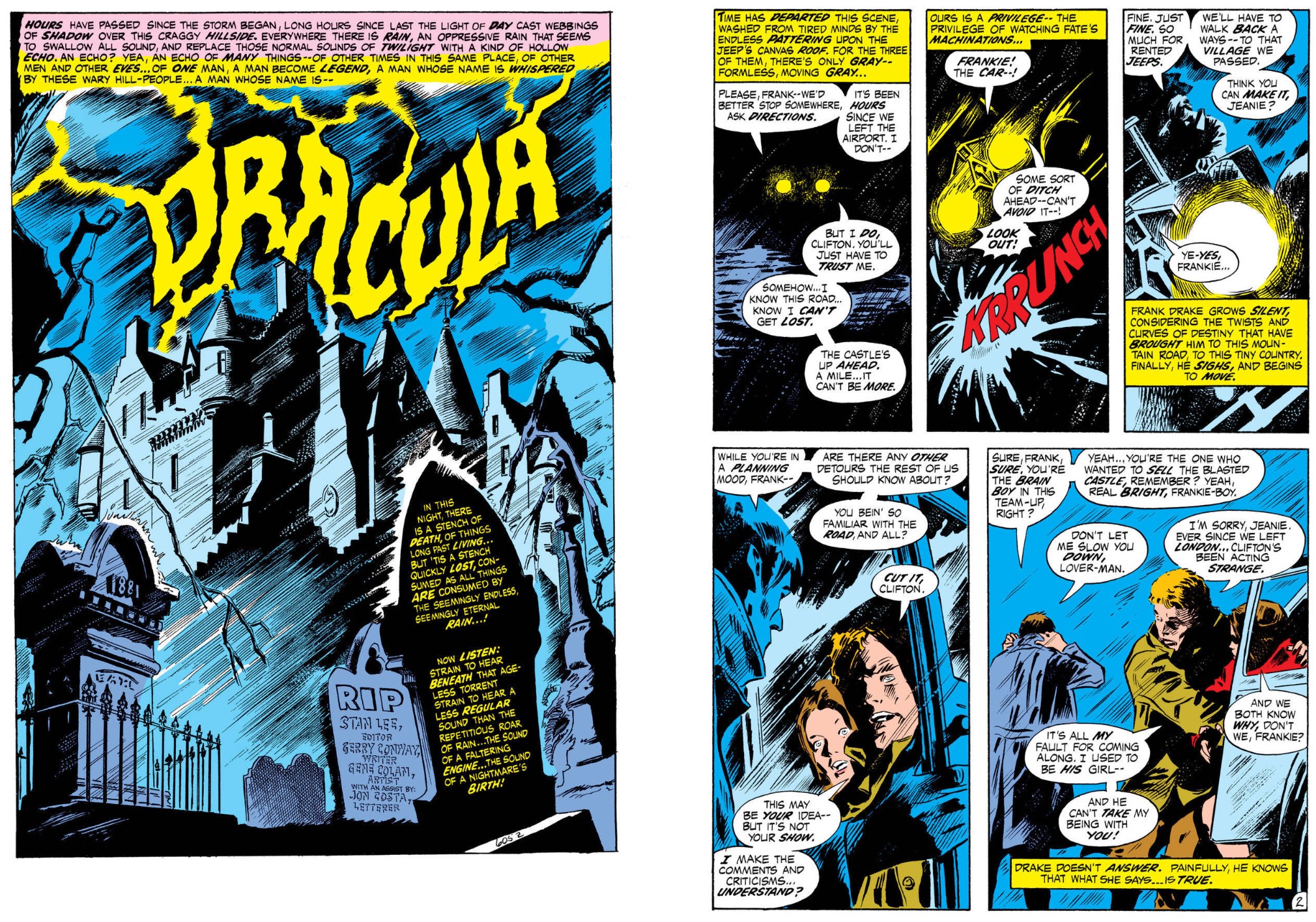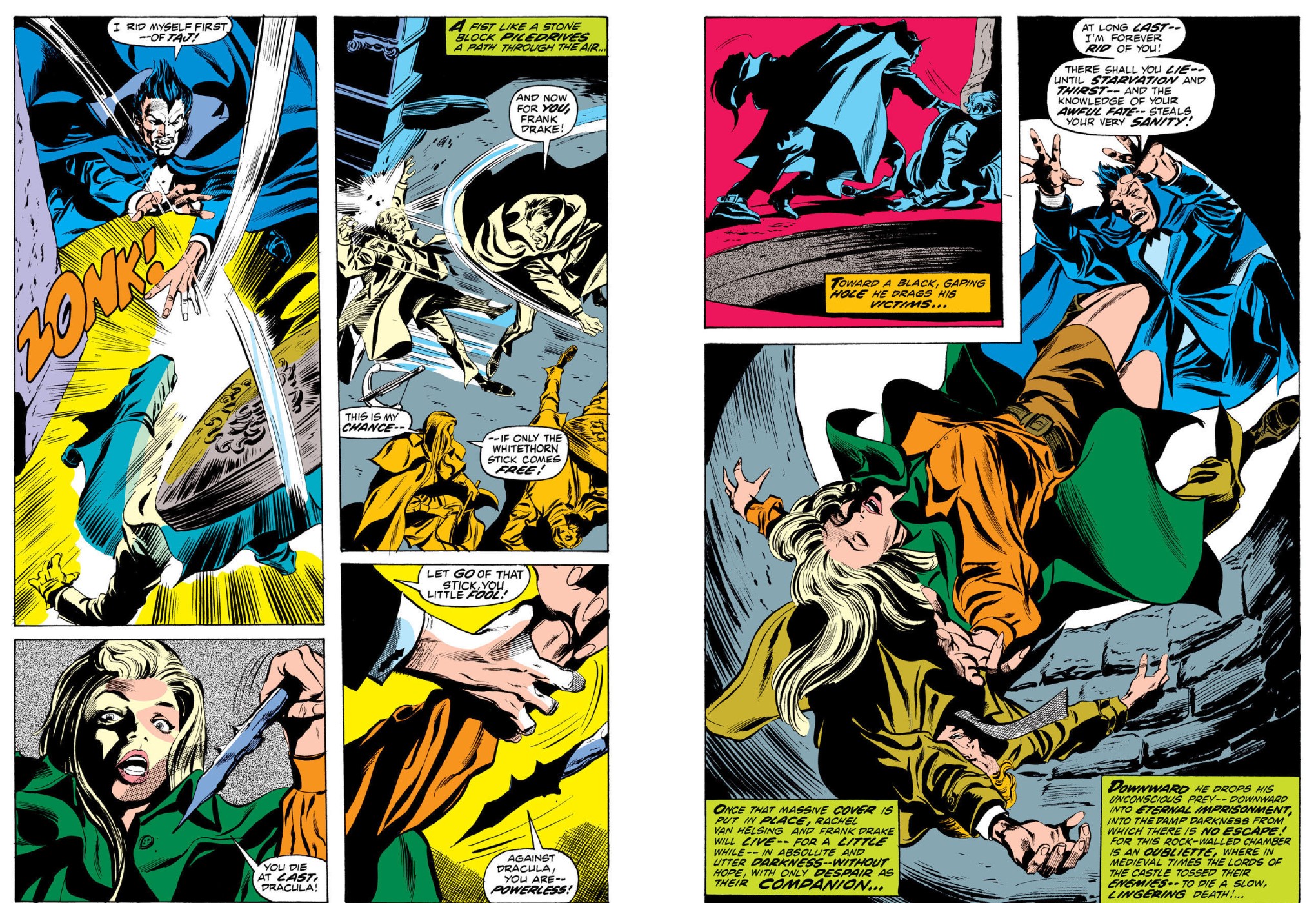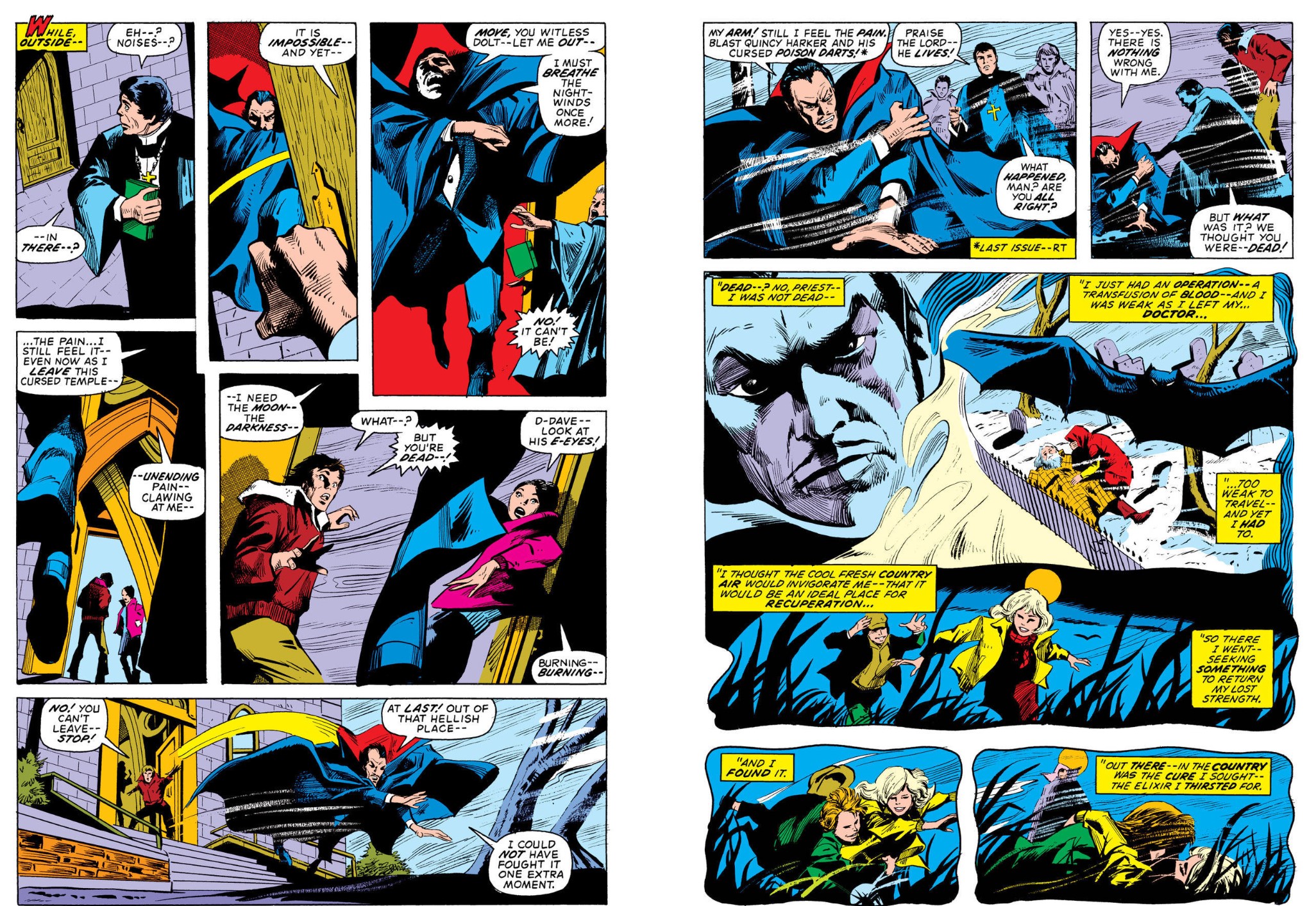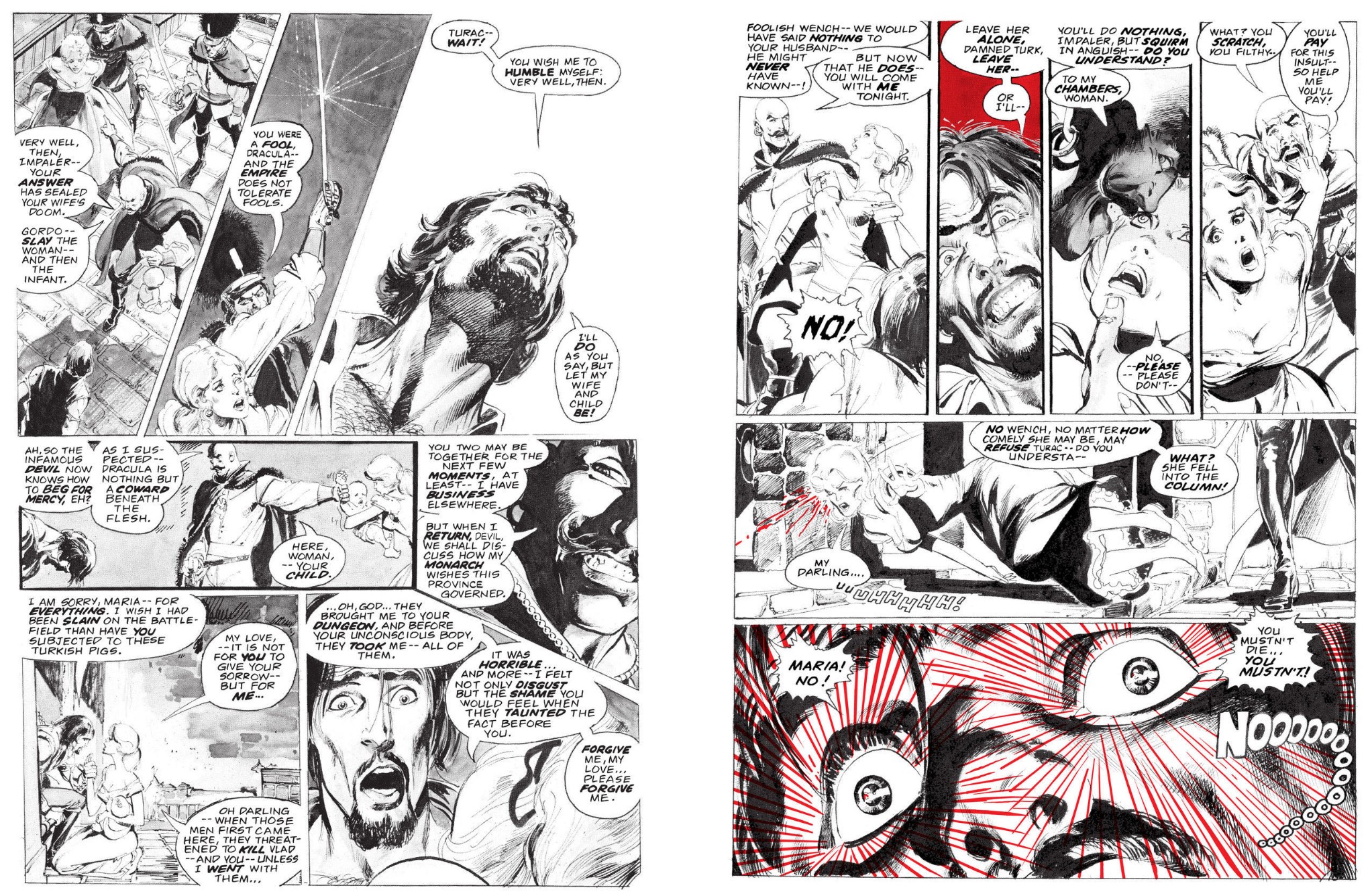
Moon Knight Epic Collection volume 2: Shadows of the Moon


By Doug Moench & Bill Sienkiewicz, with Jack C. Harris, Alan Zelenetz, Denys Cowan, Vicente Alcazar, Jimmy Janes, Greg LaRoque, Klaus Janson, Frank Giacoia, Steve Mitchell, Josef Rubinstein, Armando Gil, John Tartaglione, Bob Camp, Dave Simons, Joe Albelo & various (MARVEL)
ISBN: 978-1-3029-3368-5 (TPB/Digital edition)

This book includes Discriminatory Content produced in less enlightened times.

Moon Knight is probably the most complex and convoluted hero(es) in comics. There’s also a lot of eminently readable strip evidence to support the contention that he’s a certifiable loon. The mercurial champion first appeared during the mid-1970s horror boom: a mercenary Batman knockoff hired by corporate villains to capture a monster. Sparking reader attention, the mercenary spun off into a brace of solo trial issues in Marvel Spotlight and welter of guest shots before securing an exceedingly sophisticated back-up slot in the TV-show-inspired Hulk Magazine and inevitably graduating to the first of many solo series. His origin eventually revealed how multiple-personality-suffering CIA spook-turned-mercenary Marc Spector was murdered by his employer and apparently resurrected by an entombed Egyptian god…

This second colossal compilation re-presents Moon Knight #5-23, transecting March 1981 through September 1982: a period of vast change and experimentation in comics that saw the Lunar Avenger notionally hived off from the greater Marvel Universe to experience far more mature storytelling, via the suddenly blooming Direct Sales comics marketplace…

The saga had begun in Werewolf by Night #32 (August 1975): a fresh strand in an extended plot thread wherein lycanthrope Jack Russell and his sister Lyssa were targets of criminal capitalists the Corporation. The plutocratic cabal believed that by terrorising the public, they could induce them to spend more and sought for months to add werewolves to their army of monsters. Thus Doug Moench & Don Perlin (with assistance from little Howie Perlin) introduced Spector: a rough-&-ready modern warrior hired by plutocratic plunderers and equipped with a silver-armoured costume and weapons to capture Russell or his animal other as ‘…The Stalker Called Moon Knight’. The bombastic battle and its ferocious sequel received an unprecedented response, rapidly rocketing the lunar avenger to prominence as Marvel’s edgy answer to Batman. Within a year the spectral sentinel had returned for a two-part solo mission that fleshed out his characters (yes, plural!) and hinted at a hidden history behind the simple hireling façade (Marvel Spotlight #28-29.

The back-written yarn proved the mercenary to be a well-established clandestine crimebuster with vast financial resources, a dedicated team of assistants including old comrade/pilot “Frenchie” and liaison/lover Marlene Alraune, in-the-know Grant Mansion domestics Nedda & Samuels, plus a wide-ranging network of street informants, a mansion/secret HQ, a ton of cool gadgets… and at least four separate identities. This latter aspect would inform Moon Knight’s entire career as various creators explored where playacting ended and Multiple Personality Disorder – if not outright supernatural possession – began. Thanks to his brush with the werewolf, the vigilante had also gained a partial superpower. As the moon waxed and waned, his physical strength, speed, stamina and resilience also doubled and diminished.

Firstly, however, billionaire Steven Grant, New York cabbie/information gatherer Jake Lockley, repentant gun-for-hire Marc Spector and the mysterious Moon Knight adapted to the lives of an urban vigilante even if occasionally his pasts – especially Spector’s former CIA career and exploits in espionage and terrorism-for-hire – often encroached on his chosen path of redemption. Groundswell took hold and the Moon Knight guested in Defenders #47-#51, Peter Parker, The Spectacular Spider-Man #22-23 & Marvel Two-In-One #52 before landing a back-up slot in adult-adjacent Hulk Magazine #11 (October 1978). The residency and more mature tales led to the advent of artistic debutante Bill Sienkiewicz from #13 (February 1979) and a certain syzygy gelled. The run ended in Hulk Magazine #20 (April 1980) and was followed by monochrome magazine Marvel Preview (#21, Spring 1980), before that chapter in the character’s life apparently closed, leading to the far more complex and conflicted career of a man seeking atonement as the November cover-dated premier solo title exposed the secrets of The Macabre Moon Knight

Moench & Sienkiewicz were allowed leeway to experiment with the format of lone avengers and revealed how world-weary, burned-out mercenary Spector was working for murderous marauder Raul Bushman but reclaimed his moral compass after his ruthless boss murdered archaeologist Peter Alraune for the contents of a recently excavated Sudanese tomb. His daughter Marlene escaped, as did equally disgusted comrade Frenchie, but when Spector attempted to stop Bushman executing witnesses he was beaten and left to die in the desert.

Dying by degrees, Spector crawled for miles and died just as he entered the tomb of Pharoah Seti, where Marlene and her workers were hiding. Dumped at the feet of a statue of Khonshu – ancient god of the Moon, Guardian of Night’s Travellers and Taker of Vengeance – he inexplicably revived. Clearly deranged, he draped the statue’s white mantle around himself, before going out into the night. By dawn, Bushman’s band are dead and the monster fled…

Skipping forward and hinting at an eventful road to his life as a multi-identity superhero, the origin ended with a fateful showdown with the returned Bushman in his New York lair…

In short order, gritty, edgy but (barely) mainstream stories focused on MK’s pitiful homeless informant Crawley targeted by a bloody butcher hunting bums and indigents, introduced first returning villain/nemesis Anton Mogart/The Midnight Man, and saw the Lunar Avenger stalked by a quintet of specialist assassins.

Without pausing for breath Moench, Sienkiewicz & Klaus Janson open proceedings in this second collection by exploring and spoofing teen horror movies, adopting changing cultural cues of the new era. Here the team barely survive a ‘Ghost Story’ (MK #5 March 1981) after tracking trigger-happy bandits to a notorious murder house in upstate New York. The Reddich place boasts horrific historical murders and attracts attention from bravado-drenched kids and ghost chasers but also masks a hidden history of family madness and ongoing mayhem. Add a hunt for long-lost buried loot and a determined guy draped in a white sheet and terrifying revelations – and an increased body count – are the end result…

One month later, Steven Grant gifts Moon Knight’s intelligence gathering unit – Crawley, diner owner Gena Landers, her teen sons Ricky & Ray and cabbie Jake Lockley – with a Caribbean vacation just in case Marc Spector needs help investigating a voodoo-themed crime wave on the isle of St. Lucien. Spector had been requested to crush the Zuvembie ‘White Angels’ by an old war buddy, but soon exposes a drugs and human trafficking scheme by a local plantation owner…

America’s “War on Drugs” also informed MK #7, as Moench, Sienkiewicz & Janson detail how ruthless miscreants poison Chicago’s water supply with hallucinogens and turn the conurbation into a howling homicidal madhouse. Moon Knight & Co are in town and are just as drenched and deranged by the time ‘The Moon Kings’ ends on a cliffhanger, and following a brief gallery of original art from the preceding stories, spectacularly concludes with Frank Giacoia inking ‘Night of the Wolves’ with the still impaired heroes foiling a cruel blackmail plot and last-ditch chemical revenge strike

Moon Knight #9 sees Sienkiewicz inking himself for ‘Vengeance in Reprise’ as Bushman breaks out of jail just as Anton Mogart steals the statue of Khonshu from Steven Grant’s mansion. Sadly, the artefact is all that stabilises Moon Knight’s splintered personalities and as he tracks down and defeats both his despised foes, ‘Too Many Midnights’ (#10) sees the statue lost and the hero fractured. Happily, Marlene has a solution and the lunar guardian is back in #11 ‘To Catch a Killer’ rampaging through the New Orleans Mardi Gras. The team are there in pursuit of coke dealer Cajun Creed, but Frenchie is dangerously distracted by the unexpected return and sudden murder of his old flame Isabelle Kristel

A ghastly new foe debuts in #12 as Marlene’s brother Dr. Peter Alraune Jr. endures ‘The Nightmare of Morpheus’. Administered experimental drugs that hideously mutated him and gave him energy-warping powers by the sleep disorder specialist, patient Robert Markam tirelessly tracks Alraune seeking revenge but thankfully Moon Knight is able to put him out, after which a notionally similar ally appeared…

Despite his early career being packed with guest shots, the solo spooky star Moon Knight was a difficult fixture for many Marvel heroes but a somewhat sympatico headset could be seen in Frank Miller’s Daredevil. Thus MK #13 offered ‘The Cream of the Jest’ as the fresh out on parole master of media manipulation unites with former Moon Knight foe Ace Taggert to achieve mutual revenge on their most hated enemies. Sadly, as both heroes monitor the malefactors, differences in style and approach lead to a clash of policy and methods… and then just a clash…

Moench & Sienkiewicz were continually experimenting and reaching a creative peak, and #14’s ‘Stained Glass Scarlet’ (cover-dated December 1981) was a milestone that polarised fans. A classic tragedy, delving deep into dysfunctional families, it saw a mysterious woman in red occupying an abandoned church until her solitude is shattered by Moon Knight’s pursuit of psychotic prison fugitive Joe “Mad Dog” Fasinera. The killer was looking for loot hidden by his equally murderous father, but found his cloaked foe, his mother Scarlett and his just deserts…

Released on October 6th 1981 but cover-dated January 1982, Moon Knight #15 heralded longer even more mature stories as Marvel dropped the ad content and hived off the title from standard newsstand distribution, making it available only through subscription or specialist comic book stores. To prove this was a far harder hero now Moench & Sienkiewicz’s ‘Ruling the World from His Basement’ featured an assassination campaign against foreign dignitaries perpetrated by a crazed white supremacist spouting Nazi ideology. He was also a trusted member of the community and associate of Moon Knight.

And Rats.

Racist killer Xenos employed rodents in a most disquieting manner, so be warned…

The big evolution was marked and celebrated in an illustrated essay by Moench with ‘Shades of Moon Knight’ precising the character(s) of the lone hero and recapitulating on his techniques, methodology and associates.

‘Shadows of the Moon’ by Jack C. Harris & Denys Cowan, inked by Steve Mitchell, Josef Rubinstein & Janson led in MK #16 as a cop who despises vigilantes like Moon Knight is murdered, and his son begs the masked hero to help. with a guest cameo by Ben The Thing Grimm, Spector’s efforts to expose corrupt industrialist Alexander Latimer, lead to brutal battle with philosopher/assassin Blacksmith and barely thwarted nuclear annihilation before justice is served.

The main event was supplemented by ‘Seekers of Stone’, first tale of new feature Spector: Mercenary – The Man Who Will Be Moon Knight with Harris, Jimmy Janes & Armando Gil revealing how the mercenary dealt with a double-crossing Nazi war criminal who hired him to “recover” a mystic trinket…

With Steve Mitchell inking, Moench & Sienkiewicz return with ‘Master Sniper’s Legacy!’ as an extended epic opened to find Spector contacted by old friend Benjamin Abramov. The Israeli agent needs his help to destroy terrorist Nimrod Strange and his fanatical Third World Slayers cult but is gunned down by Strange’s emissary the Master Sniper whilst talking to Spector and Marlene. Once the killer has been dealt with, Spector vows to destroy the Third World Army at any cost…

Moench, Cowan & Rubinstein’s far lighter ancillary tale sees the young(er) Spector south of the border, raiding tombs and learning the folly of indulging in ‘The Worship of False Idols’ before MK #18 resumes the war as Spector deals with ‘The Slayers Elite’ (Moench, Sienkiewicz & Mitchell) sent to make an example of Abramov’s widow, before “Allen” Zelenetz reminds us of earlier team-ups in ‘The Many Phases of Moon Knight’ text feature which neatly segues into #19’s ‘Assault on Island Strange’ by Moench, Sienkiewicz & Mitchell. As Moon Knight punishes operations by the Third World Slayers, Marlene goes undercover as the top terrorist’s bodyguard. Much too close to Nimrod Strange for comfort, her compromises to survive outrage Moon Knight who takes out his aggression on the maniac’s home base. However, his righteous fury is not enough to stop Strange giving himself a lethal munitions upgrade, renaming himself Arsenal and setting off to attack New York with Marlene still beside him…

The saga explosively concludes in #20’s ‘Cut Adrift off the Coast of America’ (Moench, Sienkiewicz & Mitchell) as Arsenal discovers the viper in his deranged bosom and attempts to turn Manhattan Island into a super-colossal bonfire with stolen oil tankers only to finally fail thanks to Moon Knight and a really, really angry Marlene…

Sudden change of pace ‘The Master of Night Earth!’ (Moench, Vicente Alcazar, John Tartaglione & Bob Camp in MK #21 sees the world-weary warrior of shadow encounter genuine supernatural forces after joining Jericho Drumm/Brother Voodoo to foil insurrection and revolution in Haiti, backed up by new bonus feature Tales of Khonshu, wherein Zelenetz, Greg LaRoque & Dave Simons expose ‘Murder by Moonlight’ as a fleeing murderer encounters a museum statue of the lunar god of vengeance and experiences something… uncanny…

Now possessing mind control and illusion-casting powers, maddened angry sleep-deprived Morpheus returns to wreak final vengeance on his tormentor in Moench & Sienkiewicz’s ‘The Dream Demon’ – and so very nearly succeeds before concluding episode ‘Perchance to Scream’ sees further escalating carnage lead to an ultimate sacrifice that seemingly ends Morpheus’ depredations forever…

Dividing those momentous events, Zelenetz, LaRoque & Joe Albelo lighten the mood with WWII titbit ‘Moon Over Alamein’ as British Eighth Army troops take shelter in a certain tomb, and resist every temptation to rob or defile it. Is that perhaps why a spectral apparition later escorts them safely through deadly mine fields? Only Khonshu knows for sure…

With covers by Sienkiewicz, Earl Norem, Frank Miller, Al Milgrom, Ron Wilson & Dave Simons, Steve Mitchell and Joe Jusko, this collection of groundbreaking and innovative tales and on-fire creators finding new envelopes to push wraps up with a House ad for Scarlet in Moonlight, 1981’s Moon Knight portfolio by Sienkiewicz, offering 4 pencil plates and letter page art from #6, 9, 21, 23. There are also  unused covers for #9, 12 &13 and 11 pages of original art/covers (including a painting) all by LaRoque, Sienkiewicz, Cowan & Rubinstein.

Moody, dark, thematically off-kilter and savagely entertaining this second volume sees the “Batman knock-off” fully evolve into a unique example of the line between hero and villain and sinner and saint, all wrapped up in pure electric entertainment for testosterone junkies and suspense lovers.
© 2019 MARVEL.

Shazam! Family Archives volume 1


By William Woolfolk, Otto Binder, Joe Millard and many unknown authors, C.C. Beck, George Tuska, Mac Raboy, Al Carreño, Mark Swayze & various (DC Comics)
ISBN: 978-1-4012-0779-3 (HB)

This book includes Discriminatory Content produced in less enlightened times.

One of the most venerated and beloved characters of America’s Golden Age of comic books, Captain Marvel was created in 1940: part of the wave of opportunistic creativity which followed the stunning success of Superman in 1938 and Batman one year later. Although there were many notable similarities in the early months, Fawcett’s champion quickly moved squarely into arenas of light entertainment and even pure comedy, whilst as the years passed the Man of Steel increasingly left whimsy behind in favour of action, drama and suspense.

Homeless orphan and all-around decent kid Billy Batson was selected by an ancient wizard named Shazam to utilise the powers of six ancient gods and heroes in a never-ending battle against injustice. Thereafter he could transform from scrawny, precocious kid to brawny (adult) hero Captain Marvel by speaking aloud the wizard’s acronymic name – invoking the powers of legendary patrons Solomon, Hercules, Atlas, Zeus, Achilles and Mercury.

Publishing house Fawcett had first gained prominence through an immensely well-received magazine for WWI veterans entitled Captain Billy’s Whiz-Bang, before branching out into books and general interest magazines. Their most successful publication – at least until the Good Captain hit his stride – was the ubiquitous boy’s building bible Mechanix Illustrated and, as the comicbook decade unfolded, the scientific and engineering discipline and “can-do” demeanour underpinning MI suffused and informed both the art and plots of the Marvel Family titles.

Captain Marvel was the brainchild of writer/editor Bill Parker and brilliant illustrator Charles Clarence Beck who, with his assistant Pete Costanza, handled most of the art for the series throughout its stellar but too brief run. Before eventually evolving his own affable personality the Captain was serious, bluff and taciturn: a rather charmless powerhouse. Always, junior alter ego Billy was the true star: a Horatio Alger archetype of impoverished, boldly self-reliant and resourceful youth overcoming impossible odds through gumption, grit and sheer determination…

After homeless orphan newsboy Billy was granted access to the power of legendary gods and heroes, he won a job as a roaming radio reporter for Amalgamated Broadcasting and first defeated demonic Doctor Thaddeus Bodog Sivana, setting a pattern that would captivate readers for the next 14 years…

At the height of his immense popularity Captain Marvel – and many of his fellow Shazam!-powered pals – were published twice monthly and outsold Superman, but as the Furious Forties closed, tastes changed, sales slowed and Fawcett saw the way the wind was blowing. In 1953, they settled an infamous, long-running copyright infringement suit begun by National Comics in 1940 and the “Big Red Cheese” vanished – like so many other superheroes – becoming no more than a fond memory for older fans. Fawcett in full bloom, however, was a true publishing innovator and marketing dynamo – now regarded as inventor of many established comic book sales tactics we all take for granted today. This stunning, lavishly sturdy full-colour hardback compendium gathers magnificent examples of the most effective strategy: spin-off characters linked to the primary star. Fawcett was the company responsible for creating crossover-events and in 1942 they devised a truly unforgettable villain and set him simultaneously loose on their stable of costumed champions whilst using his (temporary) defeat to introduce a new hero to their colourful pantheon.

The epic creation of Captain Marvel Jr. and his originating antithesis Captain Nazi were fully covered in Shazam! Archives volume 4 so feel free to go there first…

This subsidiary collection gathers his subsequent appearances as brand new headliner in Master Comics #23-32 (February to November 4th 1942) plus the first issue of his own solo title (Captain Marvel Jr. #1, cover-dated 18th November 1942) and also includes the debut appearance of mighty Miss Mary Marvel who premiered in Captain Marvel Adventures #18 (December 11th 1942). All that and the stunning covers by Beck & Raboy are preceded by an erudite and incisive Foreword from artist, editor, historian – and former student of C.C. Beck – P.C. Hammerlinck, who reveals many secrets of the original comics’ production before the classics commence.

Sadly, although the artists involved are easily recognisable, the identities of these tales’ writers are lost to us but strong possibilities include primarily Rod Reed and Ed “France” Herron (both early editors of Fawcett’s comics line) as well as Bill Parker, Manly Wade Wellman, Joe Millard, Otto Binder and William Woolfolk.

Before the advent of the World’s Mightiest Boy, Bulletman – ably assisted by his companion Bulletgirl – was undoubtedly Fawcett’s runner-up star turn; hogging the covers in monthly Master Comics and carrying his own solo comic title. That all changed with the 21st issue and murderous arrival of Captain Nazi. Hitler’s Übermensch made manifest, the monstrous villain was despatched to America to spread terror and destruction and kill all its superheroes.

The Horrendous Hun stormed in, taking on Bulletman and Captain Marvel who united to stop the Fascist Fiend wrecking New York City. The battle ended inconclusively but restarted when the Nazi nemesis tried to wreck a hydroelectric dam. Foiled again, the monster sought to smash a new fighter plane prototype before Captain Marvel countered him, but was not quick enough to prevent the killer murdering an old man and brutally crushing a young boy.

Freddy Freeman seemed destined to follow his grandfather into eternity, but guilt-plagued Billy brought the dying lad to Shazam’s mystic citadel where the wizard saved his life by granting Freddy access to the power of the ancient gods and heroes. Physically cured – except for a permanently maimed leg – there was a secondary effect: whenever he uttered the phrase “Captain Marvel” Freeman transformed into a superpowered, invulnerable version of his mortal self.

The prototype crossover epic concluded in Master Comics #22 when the teen titan joined Bulletman & Bulletgirl in stopping a string of Captain Nazi-sponsored murders, victoriously concluding with a bold announcement that from the very next issue he would be starring in his own solo adventures. That parade of epic exploits begins in this tome with ‘Captain Nazi’s Assassination Plot’ (Master Comics #23), immaculately rendered by the Alex Raymond-inspired Raboy who would produce for the feature some of the most iconic art of his illustrious career. Sadly, that meant struggling constantly with punishing deadlines and his own impossibly harsh standards. Moreover, the legend abounds that Raboy would rewrite scripts he wasn’t happy with…

Earning a living selling newspapers on street corners, young Freddie spots Captain Nazi again and dogs his corpse-strewn trail as the fascist kills a British agent and attempts to murder President Roosevelt. Then ‘Death by Radio’ introduces sinister serial killer Mr. Macabre who brazenly broadcasts his intention to assassinate former business partners until the young Marvel confronts him. Master Comics #25 sees Freddie investigate a little lad’s broken balloon in Woolfolk & Raboy’s ‘The Case of the Face in the Dark!’, only to stumble upon a cunning plot by the Japanese to invade Alaska. Whereas his senior partner’s tales were always laced with whimsy, Junior’s beautifully depicted exploits were always drenched in angst, tension and explosive action. The climax, which involved the bombastic boy-warrior shredding wave after wave of bombers, is possibly one of the most staggering printed spectacles of the Golden Age…

On a smaller scale, the next issue featured Otto Binder’s ‘The Return of Mr. Macabre!’ as the killer, turned sickly green after a failed suicide attempt, kidnaps a US inventor ferrying vital plans to England. The plot goes well until Macabre’s rendezvous with Captain Nazi in mid-Atlantic is interrupted by Junior, who saves the day by ripping their battleship apart with his bare hands! In a rare display of close continuity, Freddie then carries on to London in MC #27 to counter ‘Captain Nazi and the Blackout Terror’, with the malign master of disguise setting out to neutralise the city’s anti-Blitz protocols. For his service, Freddie is made a special agent for Winston Churchill…

Never captive for long, in the next issue the Hunnish Hauptman spearheads an Atlantic reign of terror and kidnaps America’s chief of War Production, until Junior single-handedly invades ‘Hitler’s Headquarters of Horror’, linking up with a German Resistance movement to free the crucial captive. After such smashing successes it was no surprise that in #29 British Intelligence tapped innocuous Freddie Freeman to infiltrate Hitler’s Fortress Europa and prepare the enslaved populations under ‘The Iron Heel of the Huns’ to rise when the inevitable Allied counterattack came…

MC #30 saw the wonder boy back in the USA, stopping Captain Nazi’s plan to poison an entire military base in ‘Captain Marvel Jr. Saves the Doomed Army’, before malignant Mr. Macabre joins the Japanese to abduct a crucially-placed diplomat in ‘The Case of the Missing Ambassador’ but inevitably tasting frustrating defeat and receiving the sound thrashing he so richly deserves…

With #32, Master Comics became a fortnightly publication, but Freddie barely noticed since he was embroiled in a decidedly domestic atrocity wherein corrupt orphanage officials collected and abused disabled kids to turn a profit in ‘The Cripple Crimes’…

A blockbuster hit, “The Most Sensational Boy in the World” promptly won his own title as 1942 drew to a close, but with Raboy already hard-pressed to draw 14 pages a month to his own exacting standards, Captain Marvel Jr. #1 was illustrated by reliable Al Carreño – a Fawcett regular who had covered almost every character in the company’s stable.

The bumper book – probably scripted by Binder & Joe Millard – began by briefly reprising ‘The Origin of Captain Marvel Jr.’ before depicting ‘Wings of Dazaggar!’ wherein Junior follows Captain Nazi to an occupied West African colony and uncovers a flight of secret super-planes intended to bomb America to dust. After scotching that scheme Freddie is drawn into an eerie murder-mystery as a succession of gangsters and investigative reporters fall victim to ‘The Shadow that Walked!’

Then, thugs snatching beggars off the street to fuel a fantastically callous insurance scam make their biggest mistake by grabbing lame Freddie Freeman as their next patsy in ‘The Case of the Cripple Kidnappers’, before the soaring sagas conclude on a redemptive note as Captain Marvel Jr. “encourages” ‘The Cracked Safecracker’ to renounce his criminal ways and look after his elderly, ailing and extremely gullible parents…

This superb graphic grab-bag concludes with a landmark from ‘Captain Marvel Introduces Mary Marvel’, as capably rendered by Otto Bonder and Fawcett illustration mainstay Mark Swayze as first seen in Captain Marvel Adventures #18 (cover-dated December 11th, 1942). Preceded by a glorious painted cover from Beck of what would become known as The Marvel Family, the story saw boy broadcaster Billy Batson hosting a radio quiz show and finding himself drawn to sweet rich kid Mary Bromfield. During the course of the show – which also includes Freddie Freeman amongst the contestants – Billy is made shockingly aware that Mary is in fact a long-lost twin sister he never knew he had (take that, Luke Skywalker!), but before he can share the knowledge with her, gangsters kidnap her for a hefty ransom. Although Captain Marvel & Junior rescue Mary, they foolishly fall under the sway of the crooks and are astounded when she idly mutters the word “Shazam!”, transforms into the World’s Mightiest Girl and rescues them all…

Crisis over, the trio then quiz the old wizard and learn the secret of Mary’s powers – gifts of a group of goddesses who have endowed the plucky lass with the grace of Selene, strength of Hippolyta, skill of Ariadne, fleetness of Zephyrus, beauty of Aurora (always crucial when battling thugs, brutes and beasts!) and wisdom of Minerva – before welcoming their new companion to a life of unending adventure…

Notwithstanding the acute implied sexism of Mary’s talents coming from goddesses rather the same source as the boys’, her creation was a milestone of progress adding a formidable, unbeatable female role model to the ranks of the almost universally male mystery-man population of comic books.

The original Captain Marvel is a key factor in the development of American comics history and a brilliantly conceived superhero for all ages. These enchanting, compelling tales show why “The Big Red Cheese” and his oddly extended family was such an icon of the industry and proves that such timeless, sublime graphic masterpieces are an ideal introduction to the world of superhero fiction: tales that cannot help but appeal to readers of every age and temperament.
© 1942, 2006 DC Comics. All Rights Reserved.

Word came yesterday that we’ve lost yet another comics giant. James Charles Shooter (27th September 27th 1951 – 30th June 2025) wrote countless comics stories, from the minor to the most major of major stars, and changed or steered the courses of US comic book stars with landmark tales like Marvel Super Hero Secret Wars, Secret Wars 2, Avengers: The Korvac Saga, The Superman vs. Flash race tradition, and Original Graphic Novels for Dazzler, Thor, the Avengers & X-Men (The Aladdin Effect) and more.

Wikipedia has a very fair assessment of him which you can read here .

Jim Shooter began his creative career at DC, a teenager helping his poorly-paid parents with bills. His submissions impressed editor Murray Boltinoff who bought his early stories, leading to residencies on the Legion of Super-Heroes and most of the Superman family of titles.

Combining his continued education with the stresses of being a jobbing writer, when he moved to Marvel his tales included continuity-changing runs on Daredevil, The Avengers, Super-Villain Team-Up, Ghost Rider, Spider-Man and others. As editor and publisher he created child-friendly imprint Star Comics for younger readers, sanctioned creator-owned venue Epic Comics and created Marvel’s New Universe sub-strand (writing core title Star Brand – some would say as autobiographical wish fulfilment). He pushed moving beyond the company’s established complex-continuity roots, writing “real world” material such as Team America and others. He also forged indelible links with toy and licensing brands that swiftly made Marvel the most profitable comics publisher in the US.

Outspoken, controversial and often ferociously dogmatic, Jim was Business to the bone without ever forgetting his blue-collar, poverty-driven roots. Bluntly, he alienated many key creators, but whatever others thought, did what he considered best. However, his work – he also pencilled many stories – was never dull and never, never, never boring. He was a master of science fiction themes, and understood childlike wonder, loss and comedy moments.

Always championing creator rights, Jim instituted return of artwork to artists and, when ousted from Marvel and setting up his later companies Valiant, Defiant and Broadway Comics, operated a collective writing policy that saw every participant in the incredibly collaborative process of making comics fully credited and remunerated for their contributions. He also always mentored new talent and encouraged everyone to push their own limits.

Jim Shooter was One of Us: a comics fan and story lover who made the jump from consumer to creator, so I’m asking those who care to remember him for his less well known – but often best written – efforts by hunting down and enjoying the items – or any Shooter effort – reviewed here.

The Valiant Era Collection and Warriors of Plasm
By Jim Shooter, Bob Hall, Faye Perozich, Kevin Vanhook, Don Perlin, Steve Ditko, Gonzalo Mayo, Stan Drake, Yvel Guichet, Ted Halsted, John Dixon, Paul Autio & various (Valiant)
No ISBN/ ASIN: B000H2UTEI

During the market-led, gimmick-crazed frenzy of the 1990s, amongst the interminable spin-offs, fads and shiny multiple-cover events a new comics company revived some old characters and proved once more that good story-telling never goes out of fashion. At DC, 14-year-old Shooter wrote epic runs on The Legion of Super-Heroes, Supergirl and Superman, and scripted the company’s first toy tie-in Captain Action, before moving to Marvel in 1976. When he became the Editor-in-Chief, Shooter made Marvel the most profitable and high-profile they had ever been. and, after his departure, used that writing skill and business acumen to transform an almost forgotten Silver-Age character pantheon into contemporary gold.

Western Publishing had been a major player since comics’ earliest days, blending a wealth of licensed titles such as TV and Disney titles, Tarzan, and the Lone Ranger with homegrown hits like Turok, Son of Stone and Space Family Robinson. During the 1960s superhero boom, these adventure titles expanded to include, Brain Boy, M.A.R.S. Patrol – Total War, Magnus, Robot Fighter and in deference to the atomic age of heroes, Nukla and the utterly brilliant Dr. Solar, Man of the Atom. Despite supremely high quality and passionate fan-bases, they never captured the media spotlight of DC or Marvel’s costumed cut-ups. Western shut up their comics division in 1984.

With an agreement to revive some, any or all of these four-colour veterans, Shooter and co-conspirator Bob Layton came to a bold decision and made those earlier adventures part-&-parcel of their refit: acutely aware that older fans don’t like having their childhood favourites bastardized and that revivals need all the support they can get. Thus the old days were canonical: they “happened”…

The company launched with a classy reinterpretation of science fiction icon Magnus, but the key title to the new universe they were building was the broadly super-heroic Solar, Man of the Atom Alpha & Omega and Second Death which launched with an eye to all the gimmicks of the era, but also cleverly realised and realistically drawn.

Hit after hit followed and the roster of heroes expanded until dire market conditions and corporate chicanery ended the company’s stellar expansion. Gradually it fractionated and despite many revivals since, has all but disappeared now…

Here’s another innovation of that idea-packed era – a sampler of hits and one of their earliest graphic novels – from the early days of the format we’re all so familiar with. The Valiant Era Collection, re-presenting Magnus #12, Solar #10-11, Eternal Warrior #4-5 and Shadowman #8 was released in 1994 as an introduction to the new old brand and canny compendium of first appearances from the company’s burgeoning continuity. It gathered a disparate selection of tales which had one thing in common: the debuts of characters that had quickly become “hot”.

In the collector-led era of the early 1990s – before one zillion internet sites and social networking media – many new concepts caught the public’s attention only after publication. The seemingly-savvy snapped up multiple copies of comics they subsequently couldn’t sell and many genuinely popular innovations slipped by unnoticed until too late. This trade paperback from a company that valued storytelling above all else addressed that thorny issue by simply bundling their own hot and hard to find hits in one book…

‘Stone and Steel’ was written by Faye Perozich & Shooter and illustrated by Gonzalo Mayo, and found Robot-Fighting superman Magnus transported to a timeless dimension where dinosaurs and cavemen existed side by side. Once there he became embroiled in a battle for survival against his old enemy Laslo Noel: a rabid anti-technologist not averse to using modern super-weapons to force his point of view.

The Lost Land had other defenders, most notably two Native American warriors named Turok and his young companion Andar. The pair had been a popular Western Publishing mainstay for over a quarter of a century (see Turok, Son of Stone) and their initial (re)appearance here led to their revival in a succession of titles which survived the company’s demise, as well as a series of major computer and video games.

That spectacular, entrancing epic is followed by a 2-part Solar saga introducing an immortal warrior prince and paving the way for the disclosure of the secret history which underpinned the entire Valiant Universe.

Solar was brilliant nuclear physicist Phil Seleski, who designed a new type of fusion reactor and was transformed into an atomic god when he sacrificed his life to prevent it destroying the world. His energized matter, troubled soul, coldly rational demeanour and aversion to violence made him a truly unique hero – but his discovery of hidden meta-humans and a genuine supervillain in the ambitious, mega-maniacal form of ultra psionic Toyo Harada led Solar into a constantly escalating Secret War. Solar #10 – ‘The Man who Killed the World’ by Shooter, Don Perlin, Stan Drake, John Dixon & Paul Autio – introduced a raft of new concepts and characters, beginning with troubled teen Geoffry McHenry – the latest in a long line of Geomancers blessed/cursed with the power to communicate with every atom that comprises our planet. When the world screams that a sun-demon is about to consume it, Geoff tracks down Seleski only to determine that Solar is not unique and the threat is still at large.

Meanwhile, Harada’s Harbinger Foundation has sent all its unnatural resources to destroy the Man of the Atom, supplemented by a mysterious individual named Gilad Anni-Padda: an Eternal Warrior who had been battling evil around the globe for millennia and has worked with a number of Geoff’s predecessors…

Concluding chapter ‘Justifiable Homicides’ (Shooter, Steve Ditko, Ted Halsted & Mayo) finds Geomancer, Gilad and Solar battling for their lives against an army of Harbinger super-warriors. As always with this series, the ending is not one you’ll see coming…

Gilad soon helmed his own series and Eternal Warrior #4-5 introduced his immortal but unnamed undying nemesis in ‘Evil Reincarnate’ (Kevin Vanhook, Yvel Guichet & Dixon), a tale of ancient China which segues neatly into a contemporary clash with a drug-baron who is his latest reborn iteration. Then nanite-enhanced techno-organic wonder warrior Bloodshot explodes onto the scene in ‘The Blood is the Life’ (Vanhook & Dixon): a blockbusting action epic setting up the enhanced assassin’s own bullet-bestrewn series and tangentially, the 40th century Magnus spin-off Rai

The final debut in this volume was not for another hero but rather the introduction of the Valiant Universe’s most diabolical villain. Shadowman #8 held ‘Death and Resurrection’ (Bob Hall, Guichet & Dixon) and changed the rules of the game throughout the company’s growing line of books.

Jack Boniface was a struggling session saxophonist trying to strike it rich in the Big Easy when he was seduced by Lydia, a mysterious woman he picked up in a club. Her sinister, trysting assault left him unconscious, amnesiac and forever altered by a bite to his neck. Lydia was a Spider Alien: part of a race preying on humanity for uncounted centuries and responsible for creating many of the paranormal humans who secretly inhabit the world.

Her bite forever changes Jack and when darkness falls he becomes agitated, restless and extremely aggressive: forced to roam the Voodoo-haunted streets of New Orleans as the compulsive, impulsive daredevil dubbed Shadowman – violent, driven, manic and hungry for conflict… but only when the sun goes down. This tale examines the deadly criminal drug sub-culture of the city as a new narcotic begins to take its toll. a poison forcing its victims to careen through the streets bleeding from every orifice until they die. Witnesses call them “Blood Runners”…

As Shadowman investigates he is unaware that he is a target of the drug’s creator – ancient sorcerer Master Darque – and that soon the world will no longer be the rational, scientific place he believed. Before long, Jack will have terrifying proof that magic is both real and painfully close and that the Man of Shadow is not a creature of exotic physics and chemistry but something far more arcane and unnerving…

Despite being a little disjointed, these stories are immensely readable and it’s a tragedy that they’re not all readily available, as Valiant’s hostile takeover led to the breaking up of and selling on of various stars…

Still, there are always back issue comics and digital collections and the hope that the new revival might spawn a few trade paperback editions. Until then you can still hunt down this and the precious few other collections via your usual internet and comic retailers, and trust me, you really should…
© 1994 Voyager Communications Inc. and Western Publishing Company, Inc. All rights reserved.

Warriors of Plasm: The Collected Edition
By Jim Shooter, David Lapham, Mike Witherby, Bob Smith & various (Defiant)
ISBN: 978-1374700000, ASIN: B000R4LMUQ

If the 1980s was the decade where anybody with a pencil and a printer’s phone number could enter the business, the 1990s saw the rapid rise – and very often equally swift fall – of the small corporation publisher. Many businesses opened or acquired a comics division to augment or supplement their core business: like the Nintendo Comics that were packaged by and published in conjunction with Valiant Comics…

Jim Shooter founded Valiant with Bob Layton, and later went on to launch the short-lived but highly impressive Defiant Comics of which this book is – to my knowledge – the only collected edition. That’s a great pity as the range of talent that briefly worked there, as well as the titles themselves, showed immense promise. The legal war of attrition with Marvel that caused their early closure is well documented elsewhere, so I’ll swiftly move on to the product itself.

Flagship title Warriors of Plasm was a powerful alien intervention tale set mostly in an alternate universe where a single race had taken genetic science to such extremes that their homeworld had become a voracious planetary organism continually feeding on the biomass of other worlds.

Society on The Org was hierarchical, imperialistic and ritually sadistic, where the credos of “survival of the fittest” and “evolve or die” had the force of fanatical religion. Ruled by a weak Emperor, the court lived a life of brutal hedonistic luxury, revelling in decadence whilst relentlessly jockeying for advantage.

Lorca is a Seeker, high in the court and charged with finding new worlds for the Org to consume, but something within him defies official doctrine that personality is an aberration and that all bio-matter belongs to the greater whole. Bodies are mulched and recycled whilst individuality is an anti-social aberration, yet all organisms clearly would do absolutely anything not to die.

Spurred on by his corrupt rival Ulnareah, Lorca forms an illegal relationship with Laygen, a girl created without state-approval, and when caught, he is forced to recycle her to preserve his own existence.

Bitter and discontented, he eventually returns to work, but when he discovers Earth beyond the transdimensional veil he sees an opportunity to overthrow the Org and take supreme control. Humans are strong, individualistic, fierce warriors, and – with his tricks of genetic augmentation – could defeat any force the Org might muster. Thus, he teleports 10,000 test subjects to his private vats… but something goes wrong.

Only five humans survive, mutated into superhuman beings, but the Seeker is unaware of this since he’s been arrested by the authorities who never stopped watching him…

How the transformed humans escape and the uneasy alliance they form with unlikely liberator Lorca makes for a refreshingly novel spin on the old plot of revolution and redemption, and Shooter’s dialogue and characterisations of what could so easily have been stock characters add layers of sophistication to a fantasy drama many “adult” comics would kill for even today.

Simultaneously understated and outrageous as inked by Mike Witherby, David Lapham’s incredible art & design captivates and bewilders, adding a moody disorientation to a superb, action-packed thriller, especially in the incredible, climactic 4-page fold-out battle scene.

Originally produced as Warriors of Plasm #1-4, ‘The Sedition Agenda’ was preceded by an issue #0 daringly released only as a set of trading cards and supplemented by a prequel tale outlining the social relevance of gory global sporting phenomenon known as ‘Splatterball’, (written & drawn by Lapham with inks by Bob Smith), and these too are gathered here for your delectation.

Still seen on internet vendors’ sites, I have no idea where else you can find a copy of this terrific little book but I hope you do, just as I wish that some smart publisher would pick up the rights for all the Defiant material and the Broadway Comics Shooter produces after Defiant died: but maybe one day somebody will get the remaining band back together and finish all these lost stories…
© 1994 EEP, L.P. All Rights Reserved.

R.I.P. Jim…

Ghost Rider Epic Comics volume 2: The Salvation Run (1975-1978)


By Tony Isabella, Jim Shooter, Steve Gerber, Bill Mantlo, Marv Wolfman, Gerry Conway, Don Glut, Chris Claremont, Roger McKenzie, Scott Lobdell, Frank Robbins, Don Heck, Sal Buscema, George Tuska, Bob Brown, John Byrne, Gil Kane, Don Perlin, Tom Sutton, Vince Evans, Vince Colletta, Mike Esposito, Jim Mooney, Sam Grainger, Keith Pollard, Don Newton, Dan Green, Pablo Marcos, Tony DeZuñiga, Owen McCarron, Steve Gan, Phil Sheehy & various (MARVEL)
ISBN: 978-1-3029-5549-6 (TPB/Digital edition)

This book includes Discriminatory Content produced in less enlightened times.

Closely reflecting the state of their presumed readership, as the 1960s ended US comic books were in turmoil. Superheroes had dominated for much of the previous decade; peaking globally before explosively falling to ennui and overkill. Established genres like horror, westerns, science fiction and war were returning, fed by contemporary events and radical trends in moviemaking where another, new(ish) wrinkle had also emerged: disenchanted, rebellious, unchained Youth (on Motorbikes …and Drugs!) seeking different ways forward. Moreover, most of us thought that we might well all expire in a nuclear fireball at any moment. How glad I am that we’ve finally returned to those halcyon days…

Green Lantern/Green Arrow, Jack Kirby’s Jimmy Olsen, Captain America and many more took the Easy Rider option to boost flagging sales (and if you’re interested, the best of the crop was Mike Sekowsky’s tragically unfinished mini-masterpiece of cool Jason’s Quest in Showcase). Over at Marvel – a company still reeling from Kirby’s defection to DC in 1970 – canny Roy Thomas green-lit a new character combining that freewheeling, adolescent-friendly biker theme with the all-pervasive supernatural furore gripping entertainment fields.

Back in 1967, Marvel had published a western masked hero named Ghost Rider. He was a shameless, whole-hearted appropriation of the cowboy hero creation of Vince Sullivan, Ray Krank & Dick Ayers (for Magazine Enterprises from 1949 to 1955), initially utilising magician’s tricks to fight bandits by pretending to be an avenging phantom of justice.

Scant years later, with the Comics Code prohibition against horror hastily rewritten – amazing how plunging sales affect ethics – scary comics boomed back in a big way. A new crop of supernatural superheroes and monsters appeared on newsstands, supplementing the ghosts, ghoulies and goblins already infiltrating the once science-only scenarios of surviving mystery man titles.

In fact, diluting the Code ban resulted in such an avalanche of horror titles (new material plus reprints from the first boom in the 1950s), in response to the industry-wide downturn in superhero sales, that it probably caused a few more venerable costumed crusaders to – albeit temporarily – bite the dust.

Almost overnight, nasty monsters became acceptable fare for four-colour pages and, whilst a parade of pre-code reprints made sound business sense, the creative aspects of the fascination in supernatural themes was catered to by adapting popular cultural icons before risking whole new concepts on an untested public. As always in entertainment, the watchword was fashion: what was hitting big outside comics was incorporated into the mix as soon as possible. When proto-monster Morbius, the Living Vampire debuted in Amazing Spider-Man #101 (cover-dated October 1971) and the sky failed to fall in, Marvel moved ahead with a line of shocking superstars – beginning with a werewolf and a vampire – before broadening the scope with a haunted biker tapping both Easy Rider’s freewheeling motorcycling chic and a prevailing supernatural zeitgeist.

Preceded by western hero Red Wolf in #1 and the aforementioned Werewolf by Night in #2-4, the all-new Ghost Rider debuted in Marvel Spotlight #5 (August 1972) and the course of comics was changed forever…

What Has Gone Before: Carnival trick cyclist Johnny Blaze sells his soul to the devil in an attempt to save his foster-father Crash Simpson from cancer. As is the way of such things, Satan follows the letter but not spirit of his contract and Simpson dies anyway – just not from cancer. When the Dark Lord later comes for his prize, Blaze’s beloved virginal girlfriend Roxanne Simpson intervenes. Her purity prevents the Devil from claiming his due so, temporarily thwarted, Satan spitefully afflicts Johnny with a body that burns with the fires of Hell every time the sun goes down…

After months of diabolical persecution with Blaze shaming the Devil daily by using his curse to do good and save souls, everything seemed to change after what looked like Jesus Christ himself intervened to get Satan off his back, but of course nothing is ever what it seems…

Spanning cover-dates March 1975 to February 1978, and re-presenting Ghost Rider (1973) #12-28; Marvel Two-in-One #18; Daredevil (vol. 1) #138; Marvel Team-Up #58; Marvel Premiere #28 and material from 1991’s Marvel Tales (vol. 1) #255, this conflagratory compendium sees Blaze and his infernal alter ego unwillingly dragged deeper into the world of superheroes… but not for long…

Marvel Two-in-One #8 opens proceedings and also explores redemptive themes as Blaze teams with Ben Grimm – AKA The Thing – in a quirkily compelling Yuletide yarn. Crafted by Steve Gerber, Sal Buscema & Mike Esposito, ‘Silent Night… Deadly Night!’ finds the audacious Miracle Man attempting to take control of a very special birth in a modern-day stable…

In Ghost Rider #12 Tony Isabella, Frank Robbins, Frank Giacoia & Mike Esposito reveal the fate of World War I fighter ace Phantom Eagle, as Blaze tries to rescue a stranger from a ghostly aerial assault, only to learn he has inadvertently thwarted justice and helped the noble air warrior’s murderer avoid the ‘Phantom of the Killer Skies’, after which GR #13 and Isabella, George Tuska & Vince Colletta declare ‘You’ve Got a Second Chance, Johnny Blaze!’  as the terms of the hero’s on-going curse are changed again, just as the dissolute biker heads to Hollywood and a previously promised job as TV star Stunt-Master’s body-double. No sooner has he signed up, however, than Blaze becomes involved with Daredevil’s former girlfriend, fresh-faced starlet Karen Page and a bizarre kidnap plot by supervillain The Trapster. As ‘A Specter Stalks the Soundstage!’ Blaze’s revenge-obsessed nemesis The Orb returns to destroy Ghost Rider, an action yarn that spectacularly concludes with ‘Vengeance on the Ventura Freeway!’, as illustrated by Bob Brown & Don Heck.

Whilst hanging out on the West Coast, Blaze joins new superteam The Champions, but they play no part in Bill Mantlo, Tuska & Colletta’s fill-in yarn ‘Blood in the Waters’, as Ghost Rider oh, so topically tangles with a Great White Shark in the gore-soaked California surf.

A much reprinted yarn comes next courtesy of Mantlo, Robbins & Steve Gan: an attempt to create a team of terrors long before its time. Marvel Premiere #28 (February 1976) launched the initial line-up of The Legion of Monsters in ‘There’s a Mountain on Sunset Boulevard!’. When an ancient alien manifests a rocky peak in LA, Werewolf by Night Jack Russell, the macabre Man-Thing, Hollywood stuntman Johnny Blaze and living vampire Michael Morbius are drawn into a bizarre confrontation which might have resulted in the answer to  all their wishes and hopes, but instead only leads to destruction, death and crushing disappointment…

Back on track in GR #17, ‘Prelude to a Private Armageddon!’ (Isabella, Robbins & Colletta) triggers a combative and fractious reunion with The Son of Satan when fellow stunt-actor Katy Milner is possessed by a demon and only Daimon Hellstrom can help. The struggle devolves into ‘The Salvation Run!’ as Blaze races through the bowels of Hell, reliving his own traumatic past and at last learning the truth about his own personal Jesus, before finally saving the day on his own terms and merits, rescuing both Katy’s and his own much-tarnished soul in ‘Resurrection’.

All this time the mysterious subplots of Karen’s attempted abduction had percolated through GR, but now explosively boil over into Daredevil #138 as ‘Where is Karen Page?’ (by Marv Wolfman, John Byrne & Jim Mooney) exposes the extensive machinations of deceased criminal maniac Death’s-Head as merely part of a greater scheme involving Blaze, Stunt-Master, the Man without Fear and the homicidal Death Stalker. The convoluted conundrum cataclysmically climaxes in Ghost-Rider #20 with Don Perlin inking Wolfman & Byrne’s ‘Two Against Death!’

After dancing with the Devil and assorted demons for months, and dabbling with team dynamics in the Champions, instinctual loner Blaze’s move to Hollywood had sparked a far more mundane narrative methodology. His glamorous hazardous working gig had brought romantic dalliances, increased interaction with superheroes and supervillains, and more and more clashes with street level crime…

As the action opens in GR #21’s ‘Deathplay!’, Gerry Conway, Gil Kane & Sam Grainger built on the “real world” TV friendly trend as manic super thug for hire The Gladiator attacks the Delazny Studio employing Blaze, seeking a deadly weapon left by a sinister hidden foe. After spectacularly repelling the armoured assassin, Blaze does a little digging into the studio and staff only to clash with another veteran villain – The Eel – abruptly reinforced by an incensed Gladiator seeking a rematch. Thrashing them both only gets Johnny in more trouble with the cops and – on the run again – he finally faces the criminal mastermind who has orchestrated many months of woe. Unfortunately, he learns ‘Nobody Beats the Enforcer!’ (Conway, Don Glut, Don Heck & Keith Pollard)…

The secretive crime lord has his fingers dug deep into the studio and seeks ultimate power in LA, but somehow Blaze is always in his way, such as here, foiling the costumed killer’s attempt to steal a deadly ray concealed in a ring. Attempts to further integrate Ghost Rider with mainstream Marvel continuity intensify with the arrival of new scripter – and actual motorbike afficionado – Jim Shooter. With Dons Heck & Newton illustrating, ‘Wrath of the Water Wizard!’ depicts the embattled biker battling a hydrokinetic hoodlum at the Enforcer’s behest, only to be betrayed and beaten in anticipation of a blockbusting deciding clash in Shooter, Heck & Dan Green’s calamitous concluding climax ‘I, The Enforcer…!’

The end and direction change is emphasised by another crosspollinating adventure as Marvel Team-Up #58 (June 1977 Chris Claremont, Sal Buscema & Pablo Marcos) describes ‘Panic on Pier One!’ as Spider-Man is abducted by The Trapster and how, in saving the hero, damned Johnny Blaze exposes the true nature of his “powers & gimmicks”…

Cover-dated August 1977, (“The New”) Ghost Rider #25 presaged a return to wandering ways as Shooter, Heck & Tony DeZuñiga’s ‘Menace is a Man Called Malice!’ finds our infernal antihero erroneously implicated in an arson attack on a wax museum before battling a high tech madman. Blaze’s diabolical overreaction in victory signalled darkening days ahead…

Don Perlin fully began his long association with the Spirit Cyclist in #26 pencilling ‘A Doom Named Dr. Druid!’ (words by Shooter & inks by Grainger) as recently-revived and revised proto Marvel superhero Anthony Druid (who as Dr. Droom actually predates Fantastic Four #1) hunts a satanic horror and mistakenly attacks Ghost Rider. Only after beating the burning biker does the parapsychologist learn the dreadful error he’s made, but by then Blaze’s secret is exposed, his Hollywood life is ruined and the end of his safe secure life looms…

Back on the road again, Johnny heads for the Mojave desert and encounters two fellow travellers/he-man soulmates, aimless and in trouble. Palling up with disgruntled former Avengers Hawkeye and time-displaced cowboy hero Matt Hawk The Two-Gun Kid in an atypical moment of Marvel Madness crafted by Shooter, Perlin & Green. ‘At the Mercy of the Manticore!’ sees Blaze save the heroes from The Brand Corporation’s bestial cyborg monstrosity, only to drive them away when his demonic other half’s growing propensity for inflicting suffering gets out of control…

Still roaming the southern deserts, Blaze is then targeted again by his personal Captain Ahab in ‘Evil is the Orb!’ (by Roger McKenzie, Perlin, Tom Sutton, Owen McCarron & Pablo Marcos), when his vengeance-crazed rival abducts Roxie and mesmerises a biker gang into doing his vicious, petty dirty work. However, the villain hasn’t reckoned on an intervention by Blaze’s new biking buddy Brahma Bill

Although the 1970s sensationalism stops here, there’s one last yarn by Scott Lobdell, Vince Evans & Phil Sheehy (from Marvel Tales #255: November 1991, which reprinted Marvel Team-Up #58) to enjoy. ‘Shock Therapy’ explores what a dose of Blaze’s satanic Hellfire did to the Trapster and what extreme measures were taken to cure him…

This spooky compendium compounds the chilling action with a full cover gallery by Kane, Tom Palmer, Ron Wilson, Sal Buscema, Ed Hannigan, Dave Cockrum, Rich Buckler, Frank Giacoia, Nick Cardy, John Romita Sr., Gene Colan, Klaus Janson, Jack Kirby, Al Milgrom, Steve Leialoha, George Pérez, Ernie Chan and Sam Kieth and includes pertinent images from ‘The Mighty Marvel Bicentennial Calendar 1976’ by Sal B, plus covers from 1990s reprint series The Original Ghost Rider #19-20, by Sal and Mark Buckingham.

Also on view are original art covers and interior pages by Heck, DeZuñiga, Kirby, John Verpoorten, and Romita Sr. to truly complete your fear-filled fun fest.

One final note: backwriting and retcons notwithstanding, the Christian boycotts and moral crusades of the following decade (and ever since) were what compelled criticism-averse and commercially astute corporate Marvel to “translate” the biblical Satan of these tales into generic and presumably more palatable demonic creatures such as Mephisto, Satanish, Marduk Kurios and other equally naff quibbling downgrades. However, the original intent and adventures of Johnny Blaze – and spin-offs Daimon Hellstrom and his sister Satana – respectively Son and Daughter of Satan – tapped into the period’s global fascination with Satanism, Devil-worship and all things Spookily Supernatural which had begun with such epochal breakthroughs as Rosemary’s Baby (Roman Polanski’s 1968 film more than Ira Levin’s novel). Please remember in funnybook terms these aren’t your feeble bowdlerised “Hell-lite” horrors…

These tales are about the real-deal Infernal Realm and a good man struggling to save his soul from the worst of all bargains – as much as the revised Comics Code would allow – so brace yourself, hold steady and accept no supernatural substitutes…
© 2024 MARVEL.

The Marquis of Anaon volume 3: The Providence


By Vehlmann & Bonhomme, coloured by Delf: translated by Mark Bence (Cinebook)
ISBN: 978-1-84918-277-5 (PB Album/Digital edition)

These books include Discriminatory Content included for dramatic effect.

In 1972 Fabien Vehlmann entered the world in Mont-de-Marsan. He was raised in Savoie, growing up to study business management before taking a job with a theatre group. His prodigious canon of pro comics work began in 1998 and soon earned him the soubriquet of “Goscinny of the 21st Century”.

In 1996, after entering a writing contest in Le Journal de Spirou, he caught the comics bug and two years later – with illustrative collaborator Denis Bodart – produced mordantly quirky, sophisticated portmanteau period crime comedy Green Manor. From there his triumphs grew to include – amongst many others – Célestin Speculoos for Circus, Nicotine Goudron for L’Écho des Savanes and a stint on major property Spirou and Fantasio

Scion of an artistic family, Matthieu Bonhomme received his degree in Applied Arts in 1992, before learning the comics trade working in the atelier of western & historical strip specialist Christian Rossi. Running from 2002-2008, Le Marquis d’Anaon was Bonhomme’s first regular series, after which he began writing as well as illustrating a variety of tales, from L’Age de Raison, Le Voyage d’Esteban, The Man Who Shot Lucky Luke and so much more.

Now, where were we? Imagine The X-Files set in Age of Enlightenment France (circa 1720), played as a solo piece by a young hero reluctantly growing into and accepting the role of crusading troubleshooter. With potent overtones of Jane Eyre, Wuthering Heights, The Fall of the House of Usher and similar gothic romances, it all began in 2001’s L’Isle de Brac: first of 5 albums (all available in English-language paperback and digital formats) tracing the development of a true champion against darkness and human venality.

Under-employed middle class scholar/pragmatic philosopher Jean-Baptiste Poulain is a merchant’s son, ardent disciple of Cartesian logic and former medical student. Well educated but impoverished, he accepted a post to tutor the son of the mysterious Baron of Brac. It was a career decision that shaped the rest of his life…

On the windswept, storm-battered and extremely isolated island off the Brittany Coast, Poulain experienced fear and outrage, superstition and suspicion before ultimately exposing the appalling secret the island overlord his serfs called “the Ogre”, bringing justice and finality to all concerned. In the aftermath, Poulain left but could never outrun the obnoxious title the islanders bestowed upon him in their Bretagne argot: Le Marquis d’Anaon – “the Marquis of Lost Souls”…

Two years later Poulain caught a supposedly demonic but actually faith-based serial killer (The Black Virgin) and in this third exploit tackles a new kind of horror that we have all become increasingly aware of…

It begins in Paris, where not so polite society bores a now notorious sage whilst making him a target of bumptious educated fools. At a soiree where Poulain more than holds his own against aristocratic snobs, he is approached by visiting celebrity the Countess of Almedía, who has a unique problem she needs to consult a truly learned man about…

Wishing to establish a salon of her own in Andalusia, the Contessa invites Poulain to relocate to Spain for a few months, sweetening the offer with extraordinarily generous remuneration. Despite speaking no Spanish, he is soon a passenger aboard ship, acquainting himself with fellow recruit and poet of renown Françoise de la Sange. Their safe passage is abruptly interrupted by a monstrous storm which “the Marquis” cannot help but revel in. As a consequence, he is the first to spot a derelict galleon tossed in the tumult…

When calm waters return, battered hulk La Providence lies before them and he eagerly joins a wary but greedy boarding party. The ship is a floating horror, filled with skeletons and scenes of carnage but according to the recovered Captain’s log, there are far fewer bodies than there should be for a vessel that left the Congo stuffed with ivory and exotic timber and commanded by an extremely entrepreneurial slaver.

Moreover, a lifeboat is also missing…

The Contessa’s dutiful captain decides he must tow the wreck to the nearest port – Bordeaux – but the unanticipated four day diversion quickly sours after a string of mysterious events disrupt shipboard routine and panic the crew. Poulain mentally retraces his steps and realises that what he saw aboard the Providence – already impossible for a rational man to accept – might not be the worst of the perils about to visit himself and his companions…

As men start disappearing, chaos mounts when the captain dies and is replaced by steadfast pragmatic Chief Erwan. Sinking the towed hulk does not end the deaths and by the time Poulain divines the true answer the ship has been diverted again for the nearest dry land… a proposition the Marqis of Lost Souls cannot allow to happen at any cost….

Accompanied by cleverly contrived faux broadsheet character precis ‘Gazette Of the year 1731 – CONCERNING SEVERAL illustrated& authentic tales of the MARQUIS OF ANAON’

This seagoing terror tale offers another tight, taut authentic compellingly script from Vehlmann, depicted via Bonhomme’s densely informative but never obtrusive illustrated realism delivering a moody, ingenious, utterly enthralling tale of modern horror, imbedded in an(other) era of superstition, class separation, burgeoning natural wonder, reason ascendant and crumbling belief. This is spooky enigma enhancing and testing a troubled, self-doubting quester who barely holds at bay the crippling notion that all his knowledge might be trumped one night by a non-rational ever lurking unknown…

The exploits of The Marquis of Anaon area minor mystery milestone well-deserving of a greater audience and one no thinking fear fan should miss.
Original edition © Dargaud Paris 2004 by Vehlmann & Bonhomme. All rights reserved. English translations © 2015 by Cinebook Ltd.

Mercy: Shake the World


By J.M. Dematteis & Paul Johnson (Dover Comics & Graphic Novels)
ISBN: 978-0-486-79905-6 (TPB/Digital edition)

Originally conceived as one of a tranche of titles developed by editor Art Young for the Disney Company’s ambitious but ultimately stillborn Touchmark adult comics imprint (the others being Sebastian O, Enigma and Shadows Fall) in the early 1990s, Mercy was first released as a 64-page one-shot comic book in the initial wave of DC’s Vertigo line in 1993. Thematically at odds with the dark, uncompromising and nihilistic fare of titles such as Swamp Thing, Hellblazer, Doom Patrol and even the groundbreaking but bleakly lyrical Sandman, the astounding near-life experiences of Joshua Rose came and went relatively unremarked then, but at last got a fair chance to shine in this resurrected softcover collection packed with fascinating extras and bonus material.

Finally finding a more receptive audience for its still-fresh, immensely innovative spiritual odyssey, the uplifting tale is preceded by an absorbing reunion in print of the creators as transcribed in ‘About Mercy: Shake the World – a conversation between writer J.M. Dematteis and artist Paul Johnson’, prior to the phantasmagorical revelation road unfolding through a cascade of stunning painted visuals that begin in a coldly antiseptic hospital room…

Middle-aged and long-bled of all inner joy, Joshua Rose was almost glad when the stroke put him into a coma.

Jaded, world-weary and bitterly disappointed to his core, Joshua has no illusions about life’s wonders or humanity’s merits. He lies inert in his exorbitantly expensive private clinical cell, impaled on and afflicted by dozens of tubes, needles and machines. Seemingly dead to the world, he is in fact acutely aware of not just his own physical surroundings, but also every inconceivable nook and cranny of universal time and space.

Spurning his wife and his world, Rose’s morose and twisted psyche roams Infinity, despising everything he sees in it, especially the miraculous mute woman glowing blue, and constantly flashing across his consciousness, dragging him to uncountable encounters with people in all their pathetic, pitiful privation, sordid weakness, tawdry injustice and innate inescapable misery. He derisively calls her “Mercy” but as she silently lures him ever onwards to scenes of family discord in London, an agonising personal trial in a primeval South American rainforest and a death-haunted, woe-infested apartment in Brooklyn, Joshua passively observes her tireless confrontations with monsters and worse and, somewhere deep inside, begins at last to change…

Crafted in true collaborative fashion by Dematteis and Johnson, the deeply evocative and astonishingly expressionistic voyage of discovery is deconstructed in a number of extra features beginning with intriguing ‘Excerpts from the Outline’ exploring the writer’s initial plot concepts before being expanded with forensic intensity through illustrator Johnson’s beguiling monochrome ‘Page Layouts’.

Then, augmented by page after page of lavish and lovely full colour ‘Production Art’, character sketches and design roughs, accompanied by the artist’s thoughts on his process in ‘About the Art’, the entire delicious and eccentric delight is finally summed up in original editor Art Young’s laudatory ‘Afterword’, putting to bed one of the most intoxicating and passionate paeans to humble humanity ever crafted in comics form.

Mercy was different then and it’s still different now: an ideal confection for contemplative comics connoisseurs who remain forever bright at heart…
© 2015 dover publications, inc. Introduction © 2015 J.M. Dematteis & Paul Johnson. Art & text © 2015 J.M. Dematteis & Paul Johnson. Afterword © 2015 Art Young. All rights reserved.

Batman: The Cult – Deluxe Edition


By Jim Starlin & Bernie Wrightson, with Bill Wray, John Costanza & various (DC Comics)
ISBN: 978-1-77952-827-8 (HB Deluxe/Digital edition)

This book includes Discriminatory Content produced in less enlightened times.

Once the runaway success of The Dark Night Returns proved that fans wanted tales with darker, edgier heroes and would stump up big bucks to get them, the floodgates opened for miniseries released on expensive Baxter paper in book-like formats. DC quickly complied, following up with this deceptively effective thriller by two of the industry’s biggest fan-favourites: Jim Starlin and master of horror and suspense Bernie Wrightson, ably augmented by colour artist Bill Wray and lettered John Costanza.

The tale is a straightforward if apocalyptic action-adventure modern film fans will readily recognise, as so many visual elements and beats (if not villains) of the saga appeared in the Nolan Dark Knight Trilogy. Following trenchantly sardonic introduction ‘Burn This Book’ as written by Starlin for the 1990 collected edition, it begins with ‘Ordeal’ as the Batman, experiencing mind-bending hallucinations and irresistible cravings to commit bloody slaughter, slowly awakes to the realisation that he has lost track of how long he has been a has been a prisoner of the army of hoboes, gutter-trash and voluntarily missing citizens who have taken over Gotham City’s worst streets. The legion of the lost are being led by a charismatic self-appointed priest named Deacon Blackfire, with his holy word disseminated by extremely capable lieutenant Jake Baker and cadre of fanatical faithful fronted by the revolting Ratface

Moreover, this dark messiah claims to be an immortal savant who drove off of the indigenous Miagani people who populate the land now called Gotham City long before the White Men came…

Batman knows exactly what Deacon is doing: employing standard techniques developed by cult-leaders and spies to break down resistance. Pain, isolation, sense deprivation, drugs and starvation are all used to break down resistance and individuality: but the harried hero just can’t stop his iron resolve crumbling under the assault. It is more than any man could bear…

In flashbacks that heighten the aura of confusion, the story unfolds. With increasing severity and frequency the city’s worst predators are found beaten or dead, as the worst areas of the metropolis suddenly became safer to live in. The good news soon took a dark turn as fewer thugs were worked over and dumped, and far more just went missing, with only bloodstains and silence to mark their passing. Batman had followed the clues into the sewers… and wasn’t seen again.

Crime levels are down all over: thieves, pimps and muggers are too scared to venture out. Commissioner Gordon knows it’s too good to be true, as does Robin (reformed street kid Jason Todd) but public opinion is hugely supportive of Deacon Blackfire’s clean-up campaign…

… And deep underground, the Dark Knight is crumbling as the army of derelicts find they have a taste for blood and power. Already their definition of what constitutes valid targets has slipped…

In ‘Capture’, the broken Bat has become one of Blackfire’s army, but still baulks at murder. On a tightly controlled sortie up into the city he abruptly rejects Baker’s suggestions and Blackfire’s instructions, instead escaping into the night, rambling and incoherent as he fights off the drugs and conditioning. When Blackfire moves to seize control of the entire city, assassinating police and almost all of the civic officials, Batman is retaken, but this time Robin follows him to the grim world of tunnels and terror. The dynamic duo soon make a break for freedom, but end up deeper underground and unearth horrifying proof of the depths of the Deacon’s terrible madness… or is it magical malignancy?

‘Escape’ sees the hobo army run amok like zombies in the streets as Robin struggles to break the broken Batman out of the sewer citadel. Gordon discovers impossible evidence indicating Deacon’s claims to immortality might not be spurious. Total anarchy has taken hold with citizens being casually murdered in their homes and when Gordon is gunned down the State Governor declares Martial Law and deploys a woefully under-prepared National Guard. With Batman mentally incapacitated and physically depleted, four million citizens flee the city just before the military units are systematically massacred and their top-of-the-line ordnance becomes Blackfire’s.

In response, the federal government simply pulls out, abandoning Gotham and what remains of its population to the cult’s disciples…

The situation appears hopeless and Robin and Alfred can only wait to see if Bruce Wayne will ever become Batman again. After a harrowing re-examination of his history and purpose, a determined, angry and far Darker Knight emerges, with new tactics, harsher weapons and an unshakable hunger to destroy Blackfire and take back his city, as final chapter ‘Combat’ sees the fightback begin with the debut of the “Monster Truck Batmobile” and a sustained assault on the concrete hell beneath Gotham. However, even with the hard-fought battle won and Deacon seemingly dead and gone, inexplicable facts are still emerging…

Added feature ‘The Cult of Wrightson’ closes the case with a stunning treat for art lovers; reprinting 25 pages of roughs, designs, page layouts, pencils and inked pages and even colour process guides, to unravel the creativity behind all that magic and illusion…

Batman: the Cult is a grim and powerful thriller emphasising the psychological rather than physical or technical attributes of the most popular superhero in the world, but the saga is still packed with tension and suspense, peppered with spectacular action set-pieces and bolstered with outlandish gadgets. Fierce, frenzied and ferociously fun, this is a long-neglected slice of Batlore ripe and ready for your reappraisal.
© 1990, 2024 DC Comics. All Rights Reserved.

The Joker: A Celebration of 75 Years


By Bob Kane, Bill Finger, Jerry Robinson, Don Cameron, Jack Burnley, Dick Sprang, Lew Sayre Schwartz, Win Mortimer, David V. Reed, Sheldon Moldoff, Charles Paris, Dennis O’Neil & Neal Adams, Steve Englehart, Marshall Rogers & Terry Austin, John Byrne & Karl Kesel, Jim Starlin, Jim Aparo, Mike DeCarlo, J.M. DeMatteis, Joe Staton, Steve Mitchell, Chuck Dixon, Brian Stelfreeze, Greg Rucka, Devin Grayson, Damian Scott, Dale Eaglesham, Sean Parsons, Sal Buscema & Rob Hunter, Paul Dini, Don Kramer & Wayne Faucher, Tony Daniel & Ryan Winn, Scott Snyder, Greg Capullo, Jonathan Glapion & various (DC Comics)
ISBN: 978-1-4012-4759-1 (HB/Digital edition)

This book includes Discriminatory Content produced in less enlightened times.

There are quite a few comics anniversaries this year. Some of the most significant will be rightly celebrated, but a few will be unjustly ignored. This guy ain’t in the latter category.

When the very concept of high-priced graphic novels was just being shelf tested in in the 1980s, DC Comics produced a line of glorious full-colour hardback compilations spotlighting star characters and celebrating standout stories decade by decade from the company’s illustrious and varied history. They then branched out into themed collections which shaped the output of the modern industry; such as this fabulous and far from dated congregation of yarns offering equal billing and star status to one of the most enduring archfoes in fiction: The Maestro of Malignant Mirth dubbed The Joker.

So much a mirror of and paralleling the evolution of Batman, the exploits of the Joker are preceded here by a brief critical analysis of significant stages in the vile vaudevillian’s development, beginning with the years 1940-1942 and Part I: The Grim Jester.

There will be more on him and his co-anniversarians Robin and Catwoman throughout the year, but today it’s the turn of the opening act of the landmark issue to take his bow in the spotlight…

After erudite deconstruction comes sinister action as debut appearance ‘Batman Vs. The Joker’ – by Bill Finger & Bob Kane from Batman #1, cover-dated Spring 1940 and on sale on April 25th – provides suspenseful entertainment whilst introducing the most diabolical member of the Dark Knight’s rogues’ gallery. A chilling moody tale of brazen extortion and wilful wanton murder begins when an eerie character publicly announces that he will kill certain business and civic figures at specific times…

An instant hit with readers and creators, the malignantly mirthful murderer kept coming back and appeared in almost every issue. In Batman #5 (March 1941, by Finger, Kane & Jerry Robinson) ‘The Riddle of the Missing Card’ once again saw the Crime Clown pursue loot and slaughter, but this time with a gang of card-themed crooks at his side. It did not end well for the whimsical butcher of buffoonery…

Fame secured, the Devil’s Jester quickly became an over-exposed victim of his own nefarious success. In story terms that meant seeking to reform and start over with a clean slate. Turning himself in, the maniac grasses on many criminal confederates but ‘The Joker Walks the Last Mile’ (Finger, Kane & Robinson, Detective Comics #64, June 1942) shows that tousled viridian head twisting inexorably back towards murderous larceny…

As years passed and tastes changed, the Cackling Killer mellowed into a bizarrely baroque bandit. Part II: The Clown Prince assesses that evolution, before providing fascinating examples beginning with ‘Knights of Knavery’ from Batman #25 (October/November 1944 by Don Cameron, Jack Burnley & Robinson). Here he and arch-rival The Penguin fractiously join forces to steal the world’s biggest emerald and outwit all opposition, before falling foul of their own mistrust and arrogance once the Caped Crusaders put their own thinking caps on.

‘Rackety-Rax Racket’ Batman #32 (December 1945, Cameron & Dick Sprang) is another malevolently marvellous exploit which sees an ideas-starved Prankster of Peril finding felonious inspiration in college-student hazing and initiation stunts, after which ‘The Man Behind the Red Hood’ (Detective Comics #168, February 1951) reveals a partial origin as part of a brilliantly engrossing mystery by Finger, Lew Sayre Schwartz & Win Mortimer. It all began when the Caped Crusader regales eager young criminology students with the story of “the one who got away”- just before the fiend suddenly came back…

In ‘The Joker’s Millions (Detective #180, February1952) pulp sci fi writer David Vern Reed, Sprang & Charles Paris provide a gloriously engaging saga disclosing how the villain’s greatest crime rival took revenge from the grave by leaving the Harlequin of Hate too rich to commit capers. It was all a vindictive double-barrelled scheme though, making the Joker a patsy and twice a fool, as the Caped Crusaders eventually found… to their great amusement.

From World’s Finest Comics #61 (November 1952) Reed, Kane, Schwartz & Paris co-perpetrate ‘The Crimes of Batman’ as Robin is taken hostage and the Gotham Gangbuster must commit a string of felonies to preserve the lad’s life. Or so the Joker vainly hopes…

‘Batman – Clown of Crime’ (Batman #85, August 1954, Reed, Sheldon Moldoff & Paris) captures the dichotomy of reason versus chaos as the eternal arch enemies’ minds are swapped in a scientific accident. Soon a law-abiding Joker and baffled Robin are hunting down a madcap loon with the ultimate weapon at his disposal, the secret of the Gotham Guardian’s true identity

The Silver Age of US comic books utterly revolutionised a flagging medium, bringing a modicum of sophistication to the returning sub-genre of masked mystery men. However, for quite some time, changes instigated by Julius Schwartz in Showcase #4 – which rippled out to affect all National/DC Comics’ superhero characters – generally passed Batman and Robin by. Fans buying Batman, Detective Comics, World’s Finest Comics and even Justice League of America would read adventures that in look and tone were largely unchanged from the safely anodyne fantasies that had turned the grim Dark Knight into a mystery-solving, alien-fighting costumed Boy Scout as the 1940s turned into the1950s.

By the end of 1963, Schwartz, having either personally or by example revived and revitalised much of DC’s line and by extension the entire industry with his modernizations, was asked to work his magic with creatively stalled and nigh-moribund Caped Crusaders just as they were being readied for mainstream global stardom. ‘The Joker’s Jury’ (Batman #163 May 1963 by Finger, Moldoff & Paris) was the last sight of the Cosey Clown before his numerous appearances on the blockbuster Batman TV show warped the villain and left him unusable for years…

Here, however, Robin and his senior partner are trapped in the criminal enclave of Jokerville, where every citizen is a fugitive bad-guy dressed up as the Clown Prince, and where all lawmen are outlaws.

The story of the how the Joker was redeemed as a metaphor for terror and evil is covered in Part III: The Harlequin of Hate and thereafter confirmed by the single story which undid all that typecasting damage. ‘The Joker’s Five-Way Revenge’ (Batman #251, September 1973 by Dennis O’Neil & Neal Adams) reversed the zany, “camp” image by re-branding the characters and returning to the original 1930s concept of a grim and driven Dark Avenger chasing an insane avatar of pure chaos. Such a hero needed far deadlier villains and, by reinstating the psychotic, diabolically unpredictable Killer Clown who scared the short pants off readers of the Golden Age, set the bar high. A true milestone utterly redefining the Joker for the modern age, the frantic moody yarn sees the Mirthful Maniac stalking his old gang, determined to eradicate them all, with the hard-pressed Gotham Guardian desperately playing catch-up. As crooks die in all manner of Byzantine and bizarre ways, Batman realises his archfoe has gone irrevocably off the deep end.

Terrifying and beautiful, for many fans this is the definitive Batman/Joker story.

The main contender for that prize follows: a two-part saga from Detective Comics #475-476 (February & April 1978) that concluded a breathtaking, signature run of retro tales by Steve Englehart, Marshall Rogers & Terry Austin. The absolute zenith in a short but stellar sequence resurrecting old foes naturally starred the Dark Knight’s nemesis at his most chaotic, beginning with ‘The Laughing Fish’ and culminating in ‘The Sign of the Joker!’: comprising one of the most reprinted Bat-tales ever concocted and even adapted as an episode of the award-winning Batman: The Animated Adventures TV show in the 1990s.

In fact, you’ve probably already read it. But if you haven’t… what a treat awaits you!

As fish with the Joker’s horrific smile began turning up in sea-catches all over the Eastern Seaboard, the Clown Prince attempts to trademark them. When patent officials foolishly tell him it can’t be done, they start dying – publicly, impossibly and incredibly painfully…

The story concluded in a spectacular apocalyptic clash which shaped, informed and redefined the Batman mythos for decades to come…

Although Crisis on Infinite Earths transformed the entire DC Universe, it left the Joker largely unchanged, but did narratively set the clock back far enough to present fresher versions of most characters. ‘To Laugh and Die in Metropolis’ comes from Superman volume 2 #9 (September 1987) wherein John Byrne & Karl Kesel reveal how the Malicious Mountebank challenges the Man of Steel for the first time. The result is a captivating but bloody battle of wits, with the hero’s friends and acquaintances all in the killer clown’s crosshairs…

The next (frustratingly incomplete) snippet comes from one of the most effective publicity stunts in DC’s history. Despite decades of wanting to be “taken seriously” by the wider world, every so often a comic book event gets away from editors and publishers and takes on a life of its own. This usually does not end well for our beloved art form, as the way the greater world views the comics microcosm is seldom how we insiders and cognoscenti see it.

One of the most controversial sagas of the last century saw an intriguing marketing stunt go spectacularly off the rails – for all the wrong reasons – and become instantly notorious whilst sadly masking the real merits of the piece it was supposed to plug.

‘A Death in the Family’ Chapter Four originated in Batman #427 (December 1988), courtesy of Jim Starlin, Jim Aparo & Mike DeCarlo. It needs a bit more background than usual, though. Robin, the Boy Wonder debuted in Detective Comics #38 (April 1940) created by Kane, Finger & Robinson. The kid was a juvenile circus acrobat whose parents were murdered by a mob boss. The story of how Batman took orphaned Dick Grayson under his scalloped wing and trained him to fight crime has been told, retold and revised many times over the decades and still undergoes the odd tweaking to this day. The child Grayson fought beside Batman until 1970 when, as a sign of those turbulent times, he flew the nest, becoming a Teen Wonder and college student. His invention as a junior hero for younger readers to identify with had inspired an incomprehensible number of costumed sidekicks and kid crusaders, and Grayson continued in similar vein for the older, more worldly-wise readership of America’s increasingly rebellious youth culture. During the 1980s he led the New Teen Titans, re-established a turbulent working relationship with Batman and reinvented himself as Nightwing. This of course left the post of Robin open…

After Grayson’s departure, Batman worked alone until he caught a streetwise urchin trying to steal the Batmobile’s tires. Debuting in Batman #357 (March 1983) this lost boy was Jason Todd, and eventually the little thug became the second Robin (#368, February 1984), with a short but stellar career, marred by his impetuosity and tragic links to one of the Caped Crusader’s most unpredictable enemies…

Todd had serious emotional problems which became increasingly apparent in issues leading up to story arc ‘A Death in the Family’. As the kid became more callous and brutal in response to daily horrors he was exposed to, Jason deliberately caused the death of a vicious drug-dealer with diplomatic immunity. It triggered a guilty spiral culminating in the story-arc which comprised Batman #426-429. Ever more violent and seemingly incapable of rudimentary caution, Jason is suspended by Batman. Meanwhile the Joker returns, but rather than his usual killing frenzy, the Clown Prince is after mere cash, because the financial disaster of Reaganomics has depleted his coffers… meaning he can’t afford his outrageous murder gimmicks…

Without purpose, Jason has been wandering the streets where he grew up. Encountering a friend of his dead mother, he learns a shocking secret. The woman who raised him was not his birthmother, and there exists a box of personal papers naming three different women who might be his true mother. Lost and emotionally volatile, Jason sets out to track them down…

After monumental efforts, he locates Dr. Sheila Haywood working as a famine relief worker in Ethiopia. As Jason heads for the Middle East and a confrontation with destiny, he is unaware Batman is also in that troubled region, hot on the Joker’s trail as the Maniac of Mirth attempts to sell stolen nuclear weapons to any terrorist who can pay…

When Jason finds his mom, he has no idea that she has been blackmailed by the Clown Prince of Crime into a deadly scam involving stolen relief supplies.

I’m not going to bother with the details of the voting fiasco that plagues all references to this tale as it’s all copiously detailed elsewhere, but suffice to say that to test then-new marketing tools a 1-900 number was established and, thanks to an advanced press campaign, readers were offered the chance to vote on whether Robin would live or die in the story. Against all and every editorial expectation vox populi voted thumbs down and Jason died in a most savage and uncompromising manner. Shades of the modern experience of Boaty McBoatface! The public cannot be trusted to take any plebiscite seriously…

Jason had increasingly become a poor fit in the series and this storyline galvanised a new direction with a darker, more driven Batman, beginning almost immediately as the Joker, after killing Jason in a chilling and unforgettably violent manner, became UN ambassador for Iran (later revised as the fully fictional Qurac – just in case!) and, at the request of the Ayatollah himself, attempted to kill the entire UN General Assembly at his inaugural speech.

And here is the true injustice surrounding this tale: the death of Robin (who didn’t even stay dead) and the media uproar over the voting debacle took away from the real importance of this story – and perhaps deflected some real scrutiny and controversy. Starlin had crafted a clever, bold tale of real world politics and genuine issues – and most readers didn’t even notice.

Terrorism Training Camps, Rogue States, African famines, black marketeering, Relief fraud, Economic, Race and Class warfare, Diplomatic skullduggery and nuclear smuggling all featured heavily, as did such notable hot-button topics as Ayatollah Khomeini, Reagan’s Cruise Missile program, the Iran-Contra and Arms for Hostages scandals and the horrors of Ethiopian refugee camps. Most importantly, it signalled a new, fearfully casual approach to violence and death in comics.

The story selected to represent the lad here is a poor choice, however. This is not to say that ‘A Death in the Family’ is a lesser effort: far from it, and Starlin, Aparo & DeCarlo’s landmark, controversial story of the murder of brash, bright Jason Todd by the Joker shook the industry and still stands the test of time. However, all that’s included here is the final chapter, and even I, having read it many times, was bewildered as to what was going on.

If you want to see the entire saga – and trust me, you do – seek out a copy of the complete A Death in the Family .

In 1989 Batman broke box office records in the first of a series of big budget action movies. The Joker was villain du jour and stole the show. That increased public awareness again influenced comics and is covered in Part IV: Archnemesis before ‘Going Sane’ Part Two ‘Swimming Lessons’ offers a fresh look at motivations behind his madness. The story comes from Batman: Legends of the Dark Knight #66 (December 1994). LoDK began in the frenzied atmosphere following the movie. With planet Earth completely Bat-crazy for the second time in 25 years, DC wisely supplemented the Gotham Guardian’s regular stable of titles with a new one specifically designed to focus on and redefine his early days and cases through succession of retuned, retold classic stories.

Three years earlier the publisher had boldly begun retconning the entire ponderous continuity via landmark maxi-series Crisis on Infinite Earths; rejecting the concept of a vast multiverse and re-knitting time so that there had only ever been one Earth. For new readers, this solitary DC world provided a perfect place to jump on at a notional starting point: a planet literally festooned with iconic heroes and villains draped in a clear and cogent backstory that was now fresh and newly unfolding. Many of their greatest properties got a reboot, all enjoying the tacit conceit that the characters had been around for years and the readership were simply tuning in on just another working day.

With Batman’s popularity at an intoxicating peak and, as DC was still in the throes of re-jigging narrative continuity, his latest title presented multipart epics reconfiguring established villains and classic stories: infilling the new history of the re-imagined, post-Crisis hero and his entourage.

An old adage says that you can judge a person by the calibre of their enemies, and that’s never been more ably demonstrated than in the case of Batman and The Joker. The epic battles between these so similar yet utterly antithetical icons have filled many pages and always will…

With that in mind, J.M. DeMatteis, Joe Staton & Steve Mitchell’s 4-part psychological study ‘Going Sane’ takes us back to a time when Batman was still learning his job and had only crossed swords with the Clown Prince of Crime twice before. After a murderously macabre circus-themed killing-spree in the idyllic neighbourhood of Park Ridge and abduction of crusading Gotham Councilwoman Elizabeth Kenner, a far-too-emotionally invested Batman furiously plays catch-up. This leads to a disastrous, one-sided battle in front of GCPD’s Bat signal and a frantic pursuit into the dark woods beyond the city.

Driven to a pinnacle of outrage, the neophyte manhunter falls into the Joker’s devilishly prepared trap and is caught in an horrific explosion. His shattered body is then dumped by an incredulous, unbelieving killer clown reeling in shock at his utterly unexpected ultimate triumph. Stand-alone extract ‘Swimming Lessons’ opens here with Batman missing and Police Captain James Gordon taking flak from all sides for not finding the Predatory Punchinello or the savage mystery assailant who recently murdered an infamous underworld plastic surgeon…

Under Wayne Manor, faithful manservant Alfred fears the very worst, whilst in a cheap part of town thoroughly decent nonentity Joseph Kerr suffers terrifying nightmares of murder and madness. His solitary days end when he bumps into mousy spinster Rebecca Brown. Days pass and two lonely outcasts find love in their mutual isolation and shared affection for classic slapstick comedy. The only shadows blighting this unlikely romance are poor Joe’s continual nightmares and occasional outbursts of barely suppressed rage…

As days turn to weeks and months, Alfred sorrowfully accepts the situation and prepares to close the Batcave forever. As he descends, however, he is astounded to see the Dark Knight has returned…

The story of Joe Kerr – fictive product of a deranged mind which simply couldn’t face life without Batman – is another yarn readers will want to experience in full, but that too will only happen in a different collection.

The World’s Greatest Detective continues to relentlessly battle the Clown Prince in ‘Fool’s Errand’ (Detective Comics #726, October 1998) as Chuck Dixon & Brian Stelfreeze depict a vicious mind-game conducted by the Hateful Harlequin from his cell, using a little girl as bait and an army of criminals as his weapon against the Dark Knight, after which ‘Endgame’ Part Three ‘…Sleep in Heavenly Peace’ (by Greg Rucka, Devin Grayson, Damian Scott, Dale Eaglesham, Sean Parsons, Sal Buscema & Rob Hunter in Detective #741, February 2000) sees the Joker plaguing a Gotham struggling to recover from a cataclysmic earthquake.

It’s Christmas, but the stubborn survivors are so stretched striving to stop Joker’s plan to butcher all the babies left in town, that they are unable to notice this real scheme which will gouge a far more personal wound in their hearts…

‘Slayride’ by Paul Dini, Don Kramer & Wayne Faucher (Detective Comics #826, February 2007 and another Seasonal special) is one of the best Joker – and definitely the best Robin – stories in decades. This Christmas chiller sees our Crazed Clown trap third Boy Wonder Tim Drake in a stolen car, making him an unwilling participant in a spree of vehicular homicides amongst last-minute shoppers. If there is ever a Greatest Batman Christmas Stories Ever Told collection (and if there’s anybody out there with the power to make it so, get weaving please!), this just has to be the closing chapter…

Brining us up nearly to date, Part V: Rebirth focuses on 2011’s New 52 continuity-wide reboot and the even grimmer, Darker Knight who debuted in Detective Comics volume 2 #1 with what might then have been assumed to be the last Joker story. Crafted by Tony Daniel & Ryan Winn, ‘Faces of Death’ follows the mass-murdering malcontent on another pointless murder spree ending with his apparent death, leaving behind only his freshly skinned-off face nailed bloodily to an asylum wall…

One year later the Joker explosively returned, targeting Batman’s allies in company-wide crossover event dubbed Death of the Family. The crippling mind games and brutal assaults culminated in ‘But Here’s the Kicker’ (Batman #15, February 2013 by Scott Snyder, Greg Capullo & Jonathan Glapion) and purportedly the final battle between Bat and Clown: but we’ve all heard that before, haven’t we?

The Joker has the rare distinction of being arguably the most iconic villain in comics and can claim that title in whatever era you focus on; Noir-esque Golden Age, sanitised Silver Age or malignant modern and Post-Modern milieux. This book captures just a fraction of all those superb stories and we’re long overdue an update or second showing…

Including pertinent covers by Sayre Swartz & Roussos, Mortimer, Moldoff, Adams, Rogers & Austin, Byrne, Mike Mignola, Staton & Mitchell, Stelfreeze, Alex Maleev & Bill Sienkiewicz, Simone Bianchi, Daniel & Winn and Capullo, this monolithic testament to the inestimable value of a good bad-guy is a true delight for fans of all ages and vintage.
© 1940, 1941, 1942, 1944, 1945, 1951, 1952, 1954, 1964, 1973, 1978, 1987, 1988, 1994, 1998, 2000, 2007, 2011, 2012, 2014 DC Comics. All Rights Reserved.

Vampirella Archives volume One


By Forrest J. Ackerman, Don Glut, Nicola Cuti, Bill Parente, R. Michael Rosen, Al Hewetson, Terri Abrahms, Nick Beal, Bill Warren, Richard Carnell, Jack Erman, T. Casey Brennan, Gardner F. Fox, Vern Burnett, Larry Herndon, Buddy Saunders, Doug Moench, Tom Sutton, Billy Graham, Reed Crandall, Neal Adams, Ernie Colon, Billy Graham, Mike Royer, Tony Tallarico, Jerry Grandenetti, Bill Fraccio, Dick Piscopo, William Barry, Jack Sparling, Ed Robbins, David St. Clair, Jeff Jones, Dan Adkins, Frank Bolle, Frank Frazetta, Vaughn Bodé, Ken Kelly Bill Hughes, Larry Todd & various (Dynamite Entertainment)
ISBN: 978-1-60690-175-5 (HB/Digital edition) 978-1524126506 (TPB)

This book includes Discriminatory Content produced in less enlightened times

After years of stifling restriction, the American comic book industry finally started to break out of a self-imposed straitjacket in the mid-1960s. Kids of the Counterculture had begun creating and disseminating material relevant to their lives in self-produced “Underground Commix” whilst other publishers sought other ways around the draconian Comics Code applied to comic books.

The most elegant solution was the one chosen by Jim Warren, who had originally established himself with black & white B-Movie fan periodical Famous Monsters of Filmland and satire magazine Help! In 1965 he took his deep admiration of the legendary 1950s EC Comics to its logical conclusion: reviving the concept of anthology horror short stories and pitching them at older fans of the new generation. Of course that actually meant all us kids under 10…

Creepy was stuffed with clever, sardonic, tongue-in-cheek strip chillers illustrated by the top artists in the field (many of them ex-EC stars). Warren circumvented the US’s all-powerful Comics Code Authority – which had ended EC’s glory days and eventually their entire comics line – by publishing his new venture as a newsstand magazine. It was a truly no-lose proposition. Older readers didn’t care to be associated with “kid’s stuff” comic books whilst magazines had tempting cachet (i.e. mild nudity and a little more explicit violence) for readers of a transitional age; moreover the standard monochrome format was a quarter of the costs of colour periodicals.

Creepy was a huge and influential hit, especially among the increasingly rebellious, Rock ‘n’ Roll-crazed teen market, frequently cited as a source of inspiration for the nascent commix underground and furiously feeding on growing renewed public interest in the supernatural. In true Darwinian “Grow or Die” mode, Warren looked around for new projects, following up with companion shocker Eerie and the controversial war title Blazing Combat.

As the decade closed he launched a third horror anthology, but Vampirella was a little bit different. Although it featured the now traditional “host” to introduce and comment on the stories, this narrator was a sexy starlet who occasionally participated in stories. Before too long she actually became the hero and crowd-pulling star of her own regular feature, but that’s material for a later volume…

The other big change was that here female characters played a far more active role. They were still ornamental, prizes, victims and targets but increasingly, whether name stars or bit players, they were as likely to be the big menace or save the day. Whatever their role, though, they were still pretty much naked throughout. Some traditions must be protected at all costs.

Another beguiling Warren staple was the eye-catching painted cover fronting every issue. Here, as crafted by Frank Frazetta, Bill Hughes, Larry Todd & Vaughn Bodé, Jeff Jones & Bodé and Ken Kelly, they are the only full colour pages in an otherwise magnificently monochrome/duo-toned tome. However to be fair I must say that the reproduction on some black-&-white pages leaves much to be desired…

This massive magazine-size (216 x 32 x 279 mm if you opt for physical editions) collection gathers in their entirety the contents of the first seven issues (spanning September 1969 to September 1970). This was a crucial transitional period which saw superheroes dying out at every publishing company; replaced by a genre revival and spearheaded by a tidal wave of horror titles after the Comics Code was frantically rewritten to combat plunging sales.

This volume begins with Vampirella #1, that aforementioned painted cover and a black-&-red Frazetta frontispiece – probably scripted by Editor Bill Parente – setting the blackly humorous tone for a fearsome fangtastic fun fest. The original contents page follows – as do they all in their appropriate place. The compendium also includes every letters page and fan feature – and even nostalgia-triggering ads of the era. If you’re a modern monster fan or kit collector you’ll probably simultaneously weep and drool at the sight of these lost treasures.

The strip sensationalism begins with ‘Vampirella of Drakulon’ by Forrest J. Ackerman & Tom Sutton; introducing a planet where the rivers ran with blood and life evolved to drink it.

However, following a withering drought, Drakulon is dying. Happily for the sultry starving vampire, a ship from Earth arrives, full of people with food in their veins and a ship that can take her to where there’s plenty more.

Vampi’s role from the outset was to be another story host and for the rest of this collection that’s what she mostly is. Her role as an active adventurer didn’t properly begin for quite a while. So, here the chills continue with ‘Death Boat!’ by Don Glut & Billy Graham with the survivors of a shipwreck being picked off one by one by a bloodsucker in their midst. They perish one per night but when the mortals number just two both are still wrong about who the killer is…

Glut & master draughtsman Reed Crandall conspired on ‘Two Silver Bullets!’ as a trapper fights to save his daughter from a werewolf after which ‘Goddess from the Sea’ by Glut and Neal Adams offers a splendid treat for art-lovers: the story of a man seduced by a sea-siren was shot directly from the illustrator’s incredible pencil art. Glut & Mike Royer offer a timely Halloween warning in ‘Last Act: October!’ whilst ‘Spaced-Out Girls!’ (Glut & Tony Tallarico) sees a saucer full of saucy extraterrestrial honeys come shopping for husbands before the premier package closes with Nicola Cuti & Ernie Colon’s mindbending magical murder mystery ‘A Room Full of Changes’.

The spooky story-bonanza resumes in issue #2, opening with coming attraction featurette ‘Vampi’s Feary Tales…’ – courtesy of Sutton – after which Vampi’s putative cousin ‘Evily’ is introduced by Bill Parente & veteran horror-meister Jerry Grandenetti. Here Drakulonian émigré and Earthly sorceress climactically clash over star-billing and bragging rights…

‘Montezuma’s Monster’ is scripted by R. Michael Rosen (incorrectly credited to Glut) and illustrated by Bill Fraccio & Tallarico in their composite identity of Tony Williamsune, detailing the fate of a treasure-hungry explorer who doesn’t believe in feathered serpents whilst ‘Down to Earth!’ by Ackerman & Royer leaves the hosting to Vampirella’s blonde counterpart Draculine as our star auditions for a film role…

That theme continues in ‘Queen of Horror!’ (Glut & Dick Piscopo) wherein a B-Movie starlet uses unique and uncanny advantages to get everything she deserves whilst Cuti & William Barry reveal the tragedy of two brothers who discover a new predatory species of inland cephalopod in ‘The Octopus’. Cuti & Colon’s ‘One, Two, Three’ then explores the power of love in a world of robots and Glut & Graham render a ‘Rhapsody in Red!’ with weary travellers fetching up at a lonely house to deliver a big surprise to the resident vampire…

The third issue augmented ‘Vampi’s Feary Tales…’ with correspondence section ‘Vampi’s Scarlet Letters’ before ‘Wicked is Who Wicked Does’ features the return of Evily in a short shocking battle against ogres by Parente & Sutton. Al Hewetson & Jack Sparling count ‘4- 3- 2- 1- Blast Off! To a Nightmare!’ in the tale of a spaceship full of 24-hour party people who end up as hors d’oeuvres for something very nasty even as ‘Eleven Steps to Lucy Fuhr’ (by Terri Abrahms [story]; Nick Beal [adaptation] and art by Ed Robbins) sees many men drawn to a bizarre bordello and a sinister fate… until the unlikeliest of saviours takes a hand.

‘I Wake Up… Screaming!’ is an all Billy Graham affair as a frightened girl is made aware of her true nature in a sci fi chiller whilst Cuti & Piscopo mine mythology to deliver a salutary tale of fairy tale oppression and bloody liberation in ‘The Calegia!’ A cunning vampire meets his lethal match in Graham’s ‘Didn’t I See You on Television?’ after which Rosen & Sparling close the issue detailing the downfall of a vicious spoiled brat caught in ‘A Slimy Situation!’

Vampirella #4 opens on Sutton revealing past episodes of witch killing in ‘Vampi’s Feary Tales: Burned at the Stake!’ prior to Parente & David St. Clair reaching psychedelic heights in a tale of alien amazons and their deadly ‘Forgotten Kingdom’ whilst Cuti & Royer combine murder and time travel in ‘Closer than Sisters’. A city-slicker falls for a hillbilly hottie and gets sucked into a transformative shocker after trying ‘Moonshine!’ (Glut & Barry), Bill Warren & Sparling reveal the fate of a beautiful and obsessive scientist who bends the laws of God and Man ‘For the Love of Frankenstein’ and a most modern black widow asks a controlling stalker to ‘Come Into My Parlor!’ in a wry yarn by Rosen & Piscopo. Richard Carnell (story); Jack Erman (adaptation) & Sparling then close the show with a weird and nasty tale of a nobleman auditioning women for marriage in ‘Run for Your Wife!’

The fifth issue begins with the usual ‘Vampi’s Feary Tales…’ as Sutton exposes ‘The Satanic Sisterhood of Stonehenge!’ before Glut, Fraccio & Tallarico see a greedily impatient heir speed his benefactress to her ultimate end, unheeding of her beloved pets and ‘The Craft of a Cat’s Eye’. Cavemen battle dinosaurs in an arena of ‘Scaly Death’ – a visceral treat from Glut & Graham – whilst the astounding Jeff Jones lends fine art sensibilities to the murderous saga of a girl, a guy and ‘An Axe to Grind’, after which Parente & Sutton detail the crimes of a sadistic Duke whose fate is sealed by an aggrieved astrologer and astrally ‘Avenged by Aurora’

Glut, Fraccio & Tallarico see graves robbed and corpses consumed in neat bait-&-switch thriller ‘Ghoul Girl’ whilst T. Casey Brennan & Royer reveal the solution of a bereaved husband who finds an ‘Escape Route!’ back to his dead beloved, before Glut & Sparling end it all again via an implausible invasion from the moon in ‘Luna’.

In Vampirella #6, Vampi’s Feary Tales…’ features Dan Adkins’ graphic chat on centaurs as prelude to romantic tragedy the ‘Curse of Circe!’ as Gardner Fox & Grandenetti combine to relate how a strange sea creature offers the witch’s latest conquest his only certain method of escape. Cuti & Sparling then share a story of civil war in the land of ghosts and how love toppled ‘The Brothers of Death’ whilst ‘Darkworth!’ by Cuti & Royer shows how a stripper graduates to murdered assistant of a stage magician and pulls off her own amazing trick in the name of vengeance, after which Fox & Adkins explore the lives of the recently dead with ‘New Girl in Town!’ and Vern Burnett & Frank Bolle return to gothic roots to depict embattled humans outwitting nocturnal predators by volunteering a ‘Victim of the Vampyre!’

Larry Herndon, Fraccio & Tallarico (as Tony Williamsune) get creepily contemporary as a doctor tries to fix an overdosed patient and sends him way, way out on a ‘One Way Trip!’ before Buddy Saunders & Bolle combine adultery and attempted murder in ‘The Wolf-Man’: a wickedly scientific shocker about a very different kind of feral killer…

Vampirella #7 saw Archie Goodwin join as Associate Editor and perhaps his influence can be seen as the issue experiments with a connected theme and extended tale scripted by Nicola Cuti. Graham & Frazetta start the ball rolling by explaining ‘Why a Witch Trilogy’ and Vampirella introduces ‘Prologue: The Three Witches’ before Sutton to segues into the sad story of ‘The White Witch’ who could never feel the sunlight. Ernie Colon picks up the experimental progression as ‘The Mind Witch’ trades magic for science to expose the fate of a psychic predator, after which Graham closes the deal with ‘The Black Witch’ who thought she could conquer love but failed to realise its appalling power…

After Cuti & Sutton’s palate-cleansing ‘Epilogue: The Three Witches’, Doug Moench graduates from letter writer in #3 to scripter as ‘Plague of the Wolf’ – illustrated by Bolle – tracks a bloody serial killer’s progress under the full moon and ‘Terror Test’ offers shocking psychological thrills by Rosen & “Williamsune” with more than one sting in the tail.

In ‘The Survivor’, Saunders & Colon unite to explore a post-apocalyptic world where dedicated archaeologists still struggle to escape their bestial natures and this mammoth first compilation concludes with Rosen & Grandenetti viewing ‘The Collection Creation’ with an artist who finds the wrong kind of immortality…

Stark, surprisingly shocking and packed with clever ideas beautifully rendered, this epic tome (narrowly) escapes and transcends its admittedly exploitative roots to deliver loads of laughs and lots of shocks: a tried and true terror treat for fans of spooky doings and guiltily glamorous games.
© 2012 DFL. All rights reserved.

Maids


By Katie Skelly (Fantagraphics Books)
ISBN: 978-1-68396-368-4 (HB/Digital edition)

This book includes Discriminatory Content included for dramatic and literary effect.

Illustrator Katie Skelly hails from Brooklyn by way of Bethlehem, Pennsylvania and caught the comics bug early, thanks to her newsstand owner dad. Her Barbarella inspired series Nurse, Nurse began after graduating from Syracuse University with a BA in Art History and becoming a postgrad at City College of New York. Thanks to her inquisitive insights, striking art style and potent narrative voice, Skelly has been the subject of many gallery shows and is a star on the global lecture circuit. She has been agonisingly quiet of late but hopefully there are more wonders in store (Sorry! No Pressure!)

Her first graphic novel – again inspired by Gallic trailblazer Jean-Claude Forrest but also with seductive scents and flavours of horror-meister director Dario Argento – was My Pretty Vampire (2017), supplemented by latter collections Operation Margarine and The Agency. All her works ask uncomfortable questions about the role and (permissible) position of women in society, as seen through exploitation genres of mass entertainment, and that’s never been more effectively explored than in this “semi-autobiographical” tome recounting the true-crime story of the Papin sisters.

History says that on February 2, 1933, former convent girls Christine and Léa (working as maids for the wealthy Lancelin family in Le Mans) bludgeoned and stabbed to death Madame Léonie and her daughter Genevieve. The case was manifestly open & shut, but became a Cause Celebre in France following reports of the killers’ early lives and years of service and physical abuse becoming public. Intellectuals championed the Papin sisters and the case was cited as a perfect example of the dangers of inequality and privilege…

In this graphic re-evaluation, Skelly brings her own incisive interpretation to the case, and it’s a little gem that you will find hard to put down and impossible to forget…

Verdict? Read this book.
© 2020 Katie Skelly. This edition © 2020 Fantagraphics Books, Inc. All rights reserved.