Kevin Keller: Welcome to Riverdale


By Dan Parent & Rich Koslowski (Archie Comics)
ISBN: 978-1-936975-23-5

Following the debut of Superman, MLJ were one of many publishers to jump on the “mystery-man” bandwagon, concocting their own small but inspired pantheon of gaudily clad crusaders. In November 1939 they launched Blue Ribbon Comics, promptly following up with Top-Notch and Pep Comics. The content was the standard mix of masked champions, two-fisted adventurers, prose pieces and gags.

Not long after, Maurice Coyne, Louis Silberkleit and John Goldwater (hence MLJ) saw a gap in the blossoming but crowded market and in December 1941 the Fights ‘n’ Tights, He-Man crowd were gently nudged aside by a far from imposing hero; an ordinary teenager who would have ordinary adventures just like the readers, but with the laughs, good times, romance and slapstick emphasised.

Goldwater developed the concept of a youthful everyman protagonist and tasked writer Vic Bloom & artist Bob Montana with the job of making it work and, inspired by the popular Andy Hardy movies starring Mickey Rooney, their new notion premiered in Pep Comics #22. The unlikely star was a gap-toothed, freckle-faced red-headed kid obsessed with impressing the pretty blonde next door.

A 6-page untitled tale introduced hapless boob Archie Andrews and wholesomely pretty Betty Cooper. The boy’s unconventional best friend and confidante Jughead Jones also debuted in the first story as did idyllic small-town utopia Riverdale. The little tale was a huge hit and by the winter of 1942 the kid had won his own title. Archie Comics #1 was MLJ’s first non-anthology magazine and with it began a slow transformation of the entire company. With the introduction of ultra-rich, raven-haired Veronica Lodge, all the pieces were in play for the industry’s second Genuine Phenomenon…

By 1946 the kids were in charge, so MLJ became Archie Comics, retiring most of its costumed characters years before the end of the Golden Age and becoming, to all intents and purposes, a publisher of family-friendly comedies. The hometown settings and perpetually fruitful premise of an Eternal Romantic Triangle – with girl-hating best bud Jughead and scurrilous rival Reggie Mantle to test, duel and vex our boy in their own unique ways – the scenario was one that not only resonated with the readership but was infinitely fresh…

Archie’s success, like Superman’s, forced a change in content at every other publisher (except Gilberton’s Classics Illustrated) and created a culture-shifting multi-media brand which encompassed TV, movies, newspaper strips, toys and merchandise, a chain of restaurants and, in the swinging sixties, a pop music sensation when Sugar, Sugar – from the animated TV cartoon – became a global summer smash hit.

Clean and decent garage band “The Archies” has been a fixture of the comics ever since…

Archie is good-hearted, impetuous and lacking common sense, Betty his sensible, pretty girl next door who loves the ginger goof, and Veronica is rich, exotic and glamorous: only settling for our boy if there’s nobody better around. She might actually love him too, though. Archie, of course, is utterly unable to choose who or what he wants…

The unconventional, food-crazy Jughead is Mercutio to Archie’s Romeo, providing rationality and a reader’s voice, as well as being a powerful catalyst of events in his own right. That charming triangle (and annexe) has been the rock-solid foundation for seven decades of funnybook magic. Moreover the concept is eternally self-renewing…

This perennial eternal triangle has generated thousands of charming, raucous, gentle, frenetic, chiding and even heart-rending humorous dramas ranging from surreal wit to frantic slapstick, with the kids and a constantly expanding cast of friends (boy genius Dilton Doily, genial giant jock Big Moose and occasional guest Sabrina the Teenage Witch amongst many others), growing into an American institution and part of the American cultural landscape.

The feature has thrived by constantly refreshing its core archetypes; boldly and seamlessly adapting to the changing world outside its bright and cheerful pages, shamelessly co-opting youth, pop culture, fashion trends and even topical events into its infallible mix of slapstick and young romance.

Each and every social revolution has been painlessly assimilated into the mix and over the decades the company has confronted most social issues affecting youngsters in a manner both even-handed and tasteful.

Constant addition of new characters such as African-American Chuck and his girlfriend Nancy, fashion-diva Ginger, Hispanic couple Frankie and Maria and spoiled home-wrecker-in-waiting Cheryl Blossom contribute to a wide and refreshingly broad-minded scenario. In 2010 Archie jumped the final hurdle when openly gay Kevin Keller became an admirable advocate capably tackling and dismantling the last major taboo in mainstream comics.

Created by writer/artist Dan Parent and inker Rich Koslowski, Kevin debuted in Veronica #202 (September 2010), a charming, good looking and exceeding together lad who utterly bowled over the rich go-getter. She was totally smitten with him whilst he was far more interested in food, sports and hanging out with Jughead…

When Kevin finally explained to Veronica why she was wasting her time, she became his best buddy: after all they had a lot of common – stylish clothes, shopping and boys…

Immensely popular from the outset (Veronica #202 was the first comicbook in the company’s long history to go into a second printing), Kevin struck a chord with the readership and soon guest shots evolved into a miniseries before the new kid on the block inevitably won his own ongoing title.

Kevin Keller: Welcome to Riverdale collects the first four issues of the groundbreaking solo monthly and opens with handy text feature ‘Kevin Keller: Catch up with the Characters’ reintroducing the bonny lad, his dad (retired army colonel) Thomas, mum Kathy and sisters Denise and Patty.

The feature also brings newcomers up to speed on recent history before the mirth and merriment begins with ‘There’s a First Time for Everything’ from issue #1 wherein the much-travelled Army Brat finally begins settling in at Riverdale High.

In short order he is elected Class President, has his first commercial writing published and reveals a shocking secret…

For all his accomplishments Kevin has never gone on a date, and when a certain someone asks him out he turns to Betty for some confidence-boosting advice. He isn’t a complete neophyte and has had a date before, but due to his catastrophic nervousness it turned into a complete disaster…

Unfortunately Reggie overhears their huddled conversation and the self-proclaimed romance expert elects to give Kevin the benefit of his vast experience…

The exuberant preparations turns into a catalogue of horror and as more well-meaning friends get involved it looks certain that Kevin will repeat that horrific experience. Happily a few stabilising words from love-hating Jughead and an eventful morning with the remarkably understanding Colonel Keller soon restore some necessary calm and equilibrium…

The next tale moves from straight slapstick to heartwarming empathy as Class President Kevin is asked to organise a prom in ‘May I Have this Dance?’ and discovers that he has a secret admirer. Once Veronica finds out it’s not a secret for long…

As the seventies-themed fashion disaster begins to take shape, further furtive communications reveal that the clandestine wooer is someone still not fully at ease with his gender orientation, forcing Kevin to be at his most understanding and forgiving…

Contentious themes and prejudices are tackled in ‘Stranded in Paradise’ when the summer vacation begins and Kevin gets a job as a lifeguard.

The beach is the time-honoured hangout of the Riverdale kids, but when spoiled princess Cheryl Blossom and her rich Pembroke School cronies invade the space, sparks soon fly. The grubby “Townies” are challenged to a surfing contest for possession of the sands with Kevin star competitor for the home team, but he has completely underestimated the vicious tactics of loathsome homophobe Sloan…

The comics portion of this tome concludes with an international epic set at the 2012 London Olympics. ‘Games People Play’ sees Colonel Keller – who has dual British and American citizenship – invited to be a torchbearer.

Having spent four years in England, Kevin is delighted to be going back for a visit and reconnecting with old pal Brian. He doesn’t even mind when shopping-crazy Veronica inveigles an invite to join the family.

However when nominated runner Dad falls foul of London’s Underground at a crucial moment, Kevin is ready and more-or-less willing to step in for what appears to be the unluckiest and most dangerous section of the entire torch route…

Following a moving and appreciative ‘Afterword’ by Dan Parent there’s also a splendid section of ‘Official Kevin Keller Bonus Features’ including ‘Retro Fashion’ pages, ‘Kevin’s Prom Style’, ‘Kevin’s Summer Style with B & V’, ‘Kevin Keller & Friends Style’ and a triptych of ‘Unreleased Promotional Sketches’.

With a cover gallery that includes modern cartoon masterpieces and remastered classic Archie images retrofitted to suit our 21st century star, this is an superb, hilarious and magically inclusive collection for you, your kids and grandparents to enjoy over and over again…

© 2012 Archie Comics Publications, Inc. All rights reserved.

The Phoenix Presents Gary’s Garden book 1


By Gary Northfield (David Fickling Books)
ISBN: 978-1-910200-09-4

In January 2012 Oxford-based family publisher David Fickling Books launched a traditional-seeming weekly comic aimed at girls and boys which sought to revive the good old days of picture-story entertainment Intent whilst embracing the full force of modernity in style and Content.

Every issue offers humour, adventure, quizzes, puzzles and educational material in a joyous parade of cartoon fun and fantasy and, in the years since its premiere, The Phoenix has gone from strength to strength, winning praise from the Great and the Good, child literacy experts and the only people who really count – the astoundingly engaged kids and parents who read it…

The Phoenix was recently voted No.2 in Time Magazine‘s global list of Top Comics and Graphic Novels and is the only UK strip publication started in the last forty years to have passed the 100 issue mark. The magazine celebrated its first anniversary by releasing a digital edition available globally as an app and is still continually expanding its horizons.

It is, most importantly, big and bold and tremendous fun. You should subscribe today…

Moreover, whilst comics companies all seem to have given up the ghost (in this country at least), old-school prose publishers and the newborn graphic novel industry have evolved to fill their vacated niche.

With a less volatile business model and far more sustainable long-term goals, book sellers have prospered from periodical publishers’ surrender. There have never been so many and varied cartoon and comics chronicles, compilations and tomes for readers to enjoy.

This year – at long last – many of the favourite serials and series from The Phoenix joined that growing market, having been superbly repackaged as graphic albums.

Two of them – Von Doogan and the Curse of the Golden Monkey and Bunny vs. Monkey – were selected for The Reading Agency’s prestigious Summer Reading Challenge (which began on July 12th): the first comic-books ever to have featured on the organisation’s Summer Reading Challenge List.

One of the most rewarding and captivating strips in the comic is marvellous minibeast comedy-adventure Gary’s Garden, crafted by Gary Northfield (Beano‘s Derek the Sheep, The Terrible Tales of the Teeytinysaurs).

It is the fourth fabulous release to assuredly delight and enchant young an old alike…

The premise is beguilingly simple and utterly addictive: laggard grown-up Gary, like most of us, doesn’t do as much as he should in his back yard – and the assorted birds, beasts and bugs despise him for it – but at least it means they can all live their lives in relative peace and quiet…

The occasional series began in #2, and this initial collection opens with ‘Chompy’, a rather irascible, over- imaginative but under-achieving caterpillar who here has to set straight a worm with delusions of grandeur…

‘Practice Makes Perfect!’ then peeps in on an artistically pompous spider who makes his enwrapped prey all play in his make-shift orchestra whilst an old worm whinges about the ‘Noisy Neighbours’ in the apples adjacent to his, after which ‘Spring Clean!’ sees the obnoxious garden birds wreak playful havoc with Gary’s socks and smalls as they dry on the washing line…

‘Larry Ladybird, Lord of the Jungle!’ reveals the inner dreamer of an action hero inside a little spotty bug, whilst manic squirrel Rupert kicks into overdrive in ‘Acorn Antics’ when his prospective winter larder is endangered by strong winds and vegetarian mole Thelma. Absolutely no semblance of sanity then returns as the ever-vigilant birds raid Gary’s larder for junk food after suffering a ‘Snack Attack!’…

In the pond, slow and sure Jennifer watches with poignant regret as all the tads grow their ‘First Legs’ and rush off pell-mell to join the metaphorical rat-race whilst in ‘Hide and Peek’ readers get a brilliant lesson in camouflage from a leaf bug, a butterfly and a stick…

Clearly a devotee of the works of Edgar Rice Burroughs, Mr. Northfield then wryly spoofs the Barsoomian Chronicles, when, in a moment of inspired madness we are introduced to ‘John Ladybird, of Mars’ as the self-appointed explorer crosses dimensions, vast gulfs and a garden trampoline for the journey of a lifetime.

Sadly, Chompy is not the most appreciative of audiences for such tales of wonder…

Birds are not the kindest of characters, but they’re not as dangerous as next door’s cat. Happily ‘Podgy Pigeon’ is smart enough to make fools of them all before heroic night stalkers ‘Boris & Monroe’ enter the picture.

The fox is a veteran ninja of darkness and only occasionally wonders if he was wise to take on excitable hedgehog Monroe as his apprentice…

‘Dream On, Chompy!’ finds our voracious idiot trying to rush nature in his eagerness to join his winged brothers in the sky, whilst an elderly spider tries – and generally fails – to remind everyone to take things easily in ‘“Mornin’ Henry!”’ after which frustrated country music star ‘Terrance the Snail’ makes his noisy debut and Jennifer in the pond makes a disturbing self-discovery in ‘Last Legs’…

‘Ronald the Spider’ reveals his tap dancing gifts to a literally captive audience before it’s Flash Gordon‘s a turn for a bit of leg pulling – all six of them – in ‘Zarpovia! Pt 1’ when Professor Ladybird Zarpov discovers an incredible alien world teeming with incomprehensibly strange life in Gary’s front room…

Recruiting bold adventurers Larry Ladybird, Lord of the Jungle and John Ladybird of Mars, the trio explore the glass-sided universe in the astounding ‘Zarpovia! Pt 2’, before those masters of darkness return in ‘Boris & Monroe: Bagsie Me First’, to prove that foolhardy bravery and astonishing agility are no substitute for a little caution…

There’s acrimony and dissent at a ‘Camouflage Club’ meeting, leading to a breakaway movement, but in the interim Gary gets a barracking from the birds in ‘Nice Hat’ and wily Humphrey Housefly lives another day after two ‘Grumpy Spiders’ can’t decide on who should eat him.

The splinter group ‘Mimicry Club’ barely survives its first meeting when mickey-taking poseurs gatecrash the event, after which sensitive Ladybird Melissa develops an abiding but unhealthy affection for the coldly distant, stoic ‘Mr Leaf’ to bring a close to our beastly cabaret.

But don’t fret because there’s one last treat in store. ‘Gary’s Garden: Top Chumps’ provides 34 fascinating pictorial Score Cards (also available as free printable download pages), revealing all the silly secrets and dreams of the quirkily quotidian cast.

The Phoenix Presents… Gary’s Garden is a truly laugh-out-loud comic treat: madcap, endearing and absurdly hilarious. Don’t miss out on the perfect opportunity to get back to – or get back at – Nature by…

Text and illustrations © Gary Northfield 2014. All rights reserved.

The Reading Agency is a charity whose mission is to give everyone an equal chance in life by helping people become confident and enthusiastic readers. The Summer Reading Challenge encourages children aged 4 to 11 to read 6 books during the summer holiday.

Children can read whatever they like just as long as they are borrowed from the library. Every time children finish a book they get stickers and rewards and there’s a certificate for everyone who finishes. The Summer Reading Challenge is open to all school children and is designed for all reading abilities.

Visit www.readingagency.org.uk
To find out more about The Phoenix or subscribe, visit www.thephoenixcomic.co.uk.

Cork High and Bottle Deep


By Virgil Partch, Edited by Jonathan Barli (Fantagraphics Books)
ISBN: 978-1-60699-664-5

Virgil Parch is possibly the greatest of those almost forgotten key men of comedy cartooning: a pervasive creative force who worked away tirelessly for years, making people laugh and slowly, steadily changing the very look and nature of the industry.

Although largely forgotten these days, Virgil Franklin Partch II (1926-2004) is probably one of the most influential and successful of all American cartoonists.

His arch, absurd, rude, sly, subtle, skewed, whacky and astoundingly unique gags, strips, stories and animated shorts were generated with machine gun rapidity from a seemingly inexhaustible well of comedy excess, which could be rendered in a variety of styles which utterly revolutionised the American publishing from the moment in 1941 that the artist switched from a Walt Disney Studio ideas-man to freelance gag-maker.

He is most well regarded for his cavalier abandonment of traditional form and anatomy. Partch is the guy who liberated gag-cartooning from the bonds of slavish attention to body detail: replacing broadly human shape and proportion with a wildly free and frenetic corporeal expressionism – perhaps even symbolism – which captivated legions of fellow artists and generations of fun-starved readers. This is the guy who made 19 fingers on one hand work…

Following 2013’s VIP – The Mad World of Virgil Partch– asuperbly comprehensive art book/biography – comes this themed collection of his most arch, dark and absurd gag panels all devoted to his favourite hobby and avocation: the heroic and determined downing of strong liquor…

This glorious pocket-sized (174 x 174mm) hardback collection gathers – in colour and black-&-white – the vast majority of his hootch-flavoured (and, perhaps, often -inspired) party favours, ranging from the antics of barflies and boozy babes to the aggravated effects of a lifetime of dedicated tippling and how to offset or escape them…

Subtitled “Amidst the stormy seas of booze, with your faithful skipper, the mad Vipper” the first section focuses on the general run of alcohol-induced visions starring blurry, cheery, dreary, maudlin and dumbfounded imbibers of every class and station as well as the long-suffering worldly-wise barkeeps who attend them; an often (literally) staggering precession of invention, surreal acceptance and inevitable regret, ranging from atrocious visual puns to bewilderingly brilliant observations.

The general carousing is followed by a steady stream of themed sections beginning with an astoundingly visually inventive succession of suggestions on The Hangover… and Some Cures, complete with a sneaky subsection of .descriptive diagnoses of particular brain seizures ranging from the ‘Thirsty-Bedouin Hangover’ to the ‘God! Is that Me? or Hallucination Case’…

Assuming you survive that, the blinding switch to full painted colour will shock you sober enough for ‘VIP Views The Drink as seen by…’; a savage selection of interested parties including The Bartender, The Wife and The Guy On the Wagon…

Digging deeper, the artist then invites you to observe fizzy, happy people at ‘Dr. Freud’s Cocktail Party’ displaying Introversion, Exhibitionism , Wish Fulfilment, Hallucination, Rejection and a host of other “isms”, after another large round of general gags and panels runs into ‘VIP’s Tips: How to Taper Off…’

Virgil Partch possessed an eternally refilling reservoir of comedy imagination and a unique visual perspective which made him a true catalyst of cartoon change, and Fantagraphics Books have once again struck pure gold by reviving, commemorating and celebrating this lost legend of cartooning.

Best of all, this is an astoundingly funny collection: a wealth of outrageously funny, deliciously barbed funny drawings and clever ideas as powerfully hilarious now as they ever were, and all brilliantly rendered by a master draughtsman no connoisseur of comedy can afford to miss.

Cheers!

© 2014 Fantagraphics Books. All rights reserved.

The Phoenix Presents How to Make Awesome Comics (With Professor Panels & Art Monkey!)


By Neill Cameron (David Fickling Books)
ISBN: 978-1-910200-03-2

Ah, Summer Holidays!

Are your kids driving you crazy yet?

I haven’t covered a “How To” book for ages and as this one’s entertaining, wonderfully fit for purpose, cheap and readily available there’s clearly no time like the present. This new release would well serve any budding artists and storytellers and will keep idle hands and minds amused, absorbed and entertained for hours…

There are a host of books, both academic and/or instructional, designed to inculcate a love of comics whilst offering tips, secrets and an education in how to make your own sequential narratives. There are precious few that do it with as much style, enthusiasm and cunning craft as this beguiling release from Neill Cameron under the all-ages aegis of The Phoenix.

In January 2012 Oxford-based family publisher David Fickling Books launched a traditional-seeming anthology comic weekly aimed at girls and boys between 6 and 12 which revelled in reviving the good old days of picture-story entertainment intent whilst embracing the full force of modernity in style and content.

Each issue offers humour, adventure, quizzes, puzzles and educational material in a joyous parade of cartoon fun and fantasy and, in the years since its premiere, The Phoenix has gone from strength to strength, winning praise from the Great and the Good, child literacy experts and the only people who really count – the astoundingly engaged kids and parents who read it…

The Phoenix was recently voted No.2 in Time Magazine‘s global list of Top Comics and Graphic Novels and is the only strip publication started in the UK in the last forty years to have passed the 100 issue mark. The magazine celebrated its first anniversary by developing a digital edition available globally as an app and is continually expanding its horizons.

It is, most importantly, big and bold and tremendous fun.

The publishers are also a fantastically inclusive bunch, always eager to get kids involved. ‘How to Make Awesome Comics’ by Neill Cameron has featured intermittently since issue #0, offering enticing insights and practical tips through the auspices of the know-it-all Professor Panels and his long-suffering collaborator Art Monkey.

Now as part of the company’s new line of graphic albums those invaluable observations and exercises have been superbly repackaged into a lexicon of hands-on instruction: a not-so-serious foundation course in cartoon wonder-making no aspiring comicbook genius can afford to be without.

Broken down into 21 easily assimilated lessons the book also makes full use of modern technologies, with exercises, cartoon cheats and spare drawing pages all downloadable from the internet.

Leaping straight in the tuition opens in Chapter 1 with Lessons 1 and 2: Anyone Can Make Awesome Comics and Awesome Comics can be about Anything; offering education from the Prof ranging from stick-figure first-concepts to fully inked and coloured final work, augmented by chances to create your own strips in the first of many Art Monkey Challenges.

Chapter 2 covers Lessons 3 through 6 and How to Have Awesome Ideas, How to Have Awesomer Ideas, How to Have Awesomest Ideas and ends with a treatise on Real Life Awesome (biographical comics) all accompanied by Art Monkey Challenges of increasing fun and complexity…

With the work-philosophy fully engaged, Chapter 3 then focuses on the basics with How Awesome Comics Work, How to Make Funny Comics Which are Awesome and some sound lettering tips in Awesome Words + Awesome Pictures before a welcome pause in which students can peruse a batch of bonus comic strips such as ‘Mecha Monkey Meltdown’, ‘Triceracop’, ‘Kung Fu Banana Squad’ and more…

Returning to learning, Chapter 4 deals with How to Draw Anything Awesomely, How to Draw Cartoons Awesomely, How to Draw Awesome Faces, How to Draw Awesome Robots, How to Draw Awesome Pirates and, of course How to Draw Awesome Monsters.

The truly important stuff is covered in Chapter 5 with How to Tell Awesome Stories, How to Create Awesome Heroes, How to Create Awesome Villains, Creating Awesome Drama and culminating with the big secret, Awesome Endings…

Finally the practicalities of production and dissemination are revealed in Chapter 6 with How to Make Your Very Own Comics (…Which are Awesome), covering such arcane but crucial topics as folding, pagination and layout, copying and reproduction and getting your work into the hands of your readers…

Packed with superb examples, handy breakdown & layout tips, lots of practical exercises and offering tons of cool ideas plus a library of inspirational examples, this magical primer even includes a wealth of Awesome Appendices comprising a gallery of stock characters, Cool Robot Accessories, an Inventory of Pirate Moustachery, How to Draw Dinosaurs, Creepy Creatures and Penguins – all Step-by-Step – and ending with More Fun Comics and Pinups for the now-adept student to complete…

This bright and breezy album perfectly highlights all the core skills necessary to crafting picture-stories and cleverly doses them with an aura of rambunctious, addictive fun. With such a boost how can any prospective or neophyte storyteller fail to be galvanised into making their own magic?

Brilliantly colourful and with clear concise instructions covering the undeniable basics that every artist of any age needs to master, this book is an indispensable aid and a tremendously inspiring introduction for the aspiring Artist of Tomorrow.

Text and illustrations © 2014 Neill Cameron. All rights reserved.

Benson’s Cuckoos


By Anouk Ricard, translated by Helge Dascher (Drawn & Quarterly)
ISBN: 978-1-77046-138-3

Here’s another superb example of sophisticated yet simple Euro-cartooning designed to charm and challenge in equal amounts.

Couched in British TV terms, this beautifully bonkers animorphic fable of modern life is akin to watching David Brent guest star in Little Britain whilst apparently coming down off a mixed selection of unsanctioned recreational pharmaceuticals, but for those with better things to do than stay glued to the goggle box, here’s a more informative, longer-winded appreciation…

Anouk Ricard is an extremely gifted storyteller, author, artist and animator who hails from Istres in the South of France. Her creative output ranges from puzzles to films, book and magazine illustration to science tracts and much, much more.

Her comic albums – both for children and adult audiences – have garnered many awards and nominations, with the all-ages Anna and Froga series (2004) and Galaxy Darling (2009, with Hugo Piette in Spirou) particularly popular amongst critics and the public.

She was born in 1970 and graduated from the Arts décoratifs de Strasbourg in 1995 before beginning her multi-directional career. Now based in Lyon, 2012 saw Ricard win a raft of awards and honours for Coucous Bouzon, a wryly surreal anthropomorphic satirical parody on modern day office practice and politics.

The disturbing and hilarious lampoon, delivered as a calculatedly naïve, faux juvenile soap opera melodrama, is now available in English and will presumably be racking up a few more gongs and trophies…

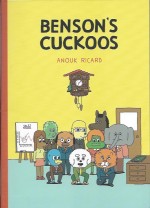
Benson’s Cuckoos produces and distributes those bird-themed clocks loved and loathed in equal amounts by holidaygoers everywhere, and our cautionary tale begins when highly strung Richard (he’s the blue duck on the cover) goes for an interview for an office position which has suddenly and mysteriously become vacant.

The encounter is a nightmare. Mr. Benson is erratic, unfocused and quite emotionally detached – and possibly completely mad. Told to turn up on Monday, Richard leaves the interview unsure whether he has got the job or not…

His first day is even stranger. For starters he has to provide his own computer and the first colleague he meets threatens him sexually…

Dragged into a staff meeting within minutes of setting up, he meets receptionist Sophie who tells him how George – the person he’s replacing – simply vanished one day. She seems nice but won’t let him sit in George’s chair…

The day goes downhill from there and the job appears less and less appealing as the hours pass. Almost everybody is terse and self-absorbed when not outright hostile and Benson roams around wearing strange hats and alternately threatening to fire everybody and over-sharing uncomfortable personal observations.

The next day, pressured for a progress report, Richard opens a fresh can of worms when he innocently asks to see George’s old files. Amidst an aura of sullen intractability, Sophie takes pity on him and passes on an old one but it mysteriously vanishes from his desk before he can read it…

Feeling disturbed he stops in for a session with his analyst but the self-absorbed charlatan just fobs him off with a fresh prescription for antidepressants.

Desperate for a little respite when he arrives home, Richard collapses on the couch and turns on the TV.

There’s a Crimewatch style show on. Lost and Found is featuring the case of a wife whose husband never came home from work. His name was George McCall and he was the Accounts Manager at Benson’s Cuckoos…

The next day the film crew turns up at work and all too soon Richard and Sophie are exposed to the harsh and unjust scrutiny of trial by media…

From there the strange tale inescapably escalates into a bizarre and paranoiac crime-caper punctuated by a succession of further odd events and mysterious disappearances which inexorably reduce our reluctant hero to the status of an alienated, disoriented and powerless player in a grand conspiracy.

Moreover, for Richard and Sophie the course of true love runs anything but smooth before the hyper-surreal and increasingly absurdist drama is concluded…

Moody, calculatedly deranged and feeling like Kafka seen through rainbow-tinted spectacles, Benson’s Cuckoos is a sublime psychological fantasy, an enticingly funny comic treatise on the hidden perils of being a grown up and a grand old-fashioned mystery thriller that will delight any reader smart enough to realise that ducks don’t use computers but can always find some way to get into trouble…

© 2014 Anouk Ricard. Translation © 2014 Helge Dascher. All rights reserved.

The Beano and The Dandy: Favourites from the Forties


By many & various (DC Thomson & Co)
ISBN: 978-0-85116-821-0

As we’re all feeling a wee bit Caledonian at present, I thought I’d take a look at some of Scotland’s greatest achievements whilst simultaneously revelling in the Good Old Days of comics…

Released in 2003 as part of the DC Thomson’s Sixtieth Anniversary celebrations for their children’s periodicals division – which has more than any other shaped the psyche of generations of kids – this splendid oversized (296 x 204mm) 144 page hardback compilation rightly glories in the incredible wealth of ebullient creativity that paraded through the flimsy colourful pages of The Beano and The Dandy during a particularly bleak and fraught period in British history.

Admittedly the book goes through some rather elaborate editing and paste-up additions whilst editorially explaining for younger readers the vast changes to the commonplace that have occurred over more than half a century, and naturally the editors have expurgated a few of the more egregious terms that wouldn’t sit well with 21st century sensibilities (Mussolini lampoon Musso the Wop becomes the far-less ethnically unsound “Musso” for instance) but otherwise this is a superb cartoon commemoration of one of the greatest morale-building initiatives this nation ever enjoyed.

They’re also superbly timeless examples of cartoon storytelling at its best…

Until it folded and was reborn as a digital publication on 4th December 2012, The Dandy was the third longest running comic in the world (behind Italy’s Il Giornalino – launched in 1924 – and America’s Detective Comics in March 1937).

Premiering on December 4th 1937 The Dandy broke the mould of traditional British predecessors by using word balloons and captions rather than narrative blocks of text under the sequential picture frames.

A huge success, it was followed eight months later by The Beano – which launched on July 30th 1938 – and together they completely revolutionised the way children’s publications looked and, most importantly, how they were read.

Over the decades the “terrible twins” spawned a bevy of unforgettable and beloved household names who delighted generations of avid and devoted readers, and the end of year celebrations were graced with bumper bonanzas of the comics’ weekly stars in extended stories in magnificent bumper hardback annuals.

As WWII progressed rationing of paper and ink forced the “children’s papers” into an alternating fortnightly schedule: on September 6th 1941 only The Dandy was published. A week later just The Beano appeared. They only returned to normal weekly editions on 30th July 1949…

This superb celebration of Celtic creativity is packed literally cover-to-cover with brilliant strips. The fun starts on the inside front with a wonderful Biffo the Bear exploit, illustrated by indisputable key man Dudley D. Watkins, followed by Korky the Cat by James Crichton and a listing of ‘Forty from the 40’s’ before the vintage fun properly proceeds, sensibly sub-divided into themed chapters.

Sadly none of the writers are named and precious few of the artists, but as always I’ve offered a best guess as to whom we should thank, and of course I would be so very happy if anybody could confirm or deny my suppositions…

Then and Now offers a smart selection of comparisons to life in the past compared to the 21st century with hilarious examples and contributions from Lord Snooty – by the incredibly prolific Watkins – cowboy superman Desperate Dan at the doctor’s, ostrich antics with Big Eggo by Crichton (or perhaps Reg Carter), lady Wild West sheriff Ding-Dong Belle from Bill Holroyd and a glimpse at primitive fast-food courtesy of Dandy‘s Bamboo Town duo Bongo and Pongo limned by Charlie Gordon.

There’s more medical mirth with Desperate Dan, wash day blues with Mickey’s Magic Book (Crichton?) and a prose yarn pinpointing the funnier points of the class war in The Slapdash Circus – with a stirring illustration by Toby Baines – before Charlie Chutney the Comical Cook (Allan Morley) plays pie-man and Watkins produces another Biffo blast.

Next comes The Horse That Jack Built, a rousing medieval adventure yarn starring a clockwork charger by Holroyd, before the chapter concludes in another Desperate Dan fable about messing around growing vegetables…

Entertainment then explores how fun was had in the war years – i.e. before television – beginning with a phonographic Korky yarn and the first fine example of licensed film feature Our Gang illustrated by that man Watkins.

The Our Gang (later known as Li’l Rascals) movie shorts were one of the most popular series in American Film history. Beginning in 1922 they featured the fun and folksy humour of a bunch of “typical kids” (atypically, though, there was full racial equality and mingling – but the little girls were still always smarter than the boys) having idealised adventures in a time both safer and more simple. The rotating cast of characters and slapstick shenanigans were the brainchild of film genius Hal Roach (he directed and worked with Harold Lloyd, Charley Chase and Laurel and Hardy amongst many others) and these brief cinematic paeans to a mythic childhood entered the “household name” category of popular Americana in amazingly swift order.

As times and tastes changed Roach was forced to sell up to the celluloid butcher’s shop of MGM in 1938, and the features suffered the same interference and loss of control that marred the later careers of the Marx Brothers, Laurel and Hardy and Buster Keaton.

In 1942 Dell Comics in the USA released an Our Gang comicbook written and drawn by Walt Kelly who, consummate craftsman that he was, restored the wit, verve and charm of the cinematic glory days with a progression of short tales that elevated the lower-class American childhood to the mythic peaks of Dorothy in Oz or Huckleberry Finn.

Long before then, however (1937 and The Dandy #1, in fact), DC Thomson secured the British rights and produced their own uniquely home-grown weekly escapades of Alfalfa Switzer, Scotty Becket, Spanky McFarland, Darla Hood, Buckwheat Thomas and the rest, such as the quirky keep-fit frolic here…

Desperate Dan then endured some cool radio fun with Aunt Aggie, Keyhole Kate (Allan Morley) had trouble with a magic Lantern show, and Biffo’s juggling act brought nothing but pain and strife.

As depicted by the wonderful Eric Roberts, Podge found drumming was unwelcome around the village and the not-so-wild animals of Bamboo Town struck up – and out – the band, after which both Biffo and Korky suffered terribly for their R-and-R.

Posh poseur Swanky Lanky Liz (Charles Holt) comes a-cropper in a brace of telling tales after which the aforementioned dictator of Italy is mercilessly lambasted in a cruel quartet of Musso strips by Sam Fair, Charlie Chutney bakes to excess, Our Gang take vengeance on a bullying boxer and Podge foils a bunch of schoolboy cheats.

How the daily travails of conflict were relieved is examined in Wartime 1 with Jimmy and his Magic Patch (Watkins) accidentally visiting bellicose Lilliput, Lord Snooty’s pals battling a Nazi spy and his pigeons whilst barmy barber Hair Oil Hal (by John Brown) cuts up in a clever quartet.

Sam Fair was in excoriating top form with the superbly manic Addie and Hermy slapstick assaults on Adolf Hitler and HermannWilhelm Göring/Goering, Meddlesome Matty (Fair or Malcolm Judge?) becomes a different sort of siren and Mickey’s Magic Book proves more hindrance than help during an air raid…

The complex world of Fashion begins with a plethoraof Korky on parade, Beano’s Ding-Dong Belle offered some six-gun hints on good manners, Doubting Thomas by Roberts was overwhelmed by a shop dummy and Meddlesome Matty went shoe shopping… for a horse…

Pansy Potter, the Strongman’s Daughter by Hugh McNeil was legendary for her unique looks – as seen in three strips here – but Swanky Lanky Liz, Charlie Chutney, Musso, Hair Oil Hal and Biffo all offer their own stylistic visions to round out this section before the un-PC past is more fully and shamefacedly explored in Out of Fashion withBiffo, Desperate Dan, Tin-Can Tommy, the Clockwork Boy (by the Torelli Brothers), Meddlesome Matty, Korky, Doubting Thomas, Bamboo Town and Mickey’s Magic Book all exhibiting behaviours we just don’t condone nowadays…

Strips depicting Transport follow with Multy the Millionaire (Richard Cox), Korky and Biffo all experiencing some distress and delay after which Watkins displays his superb dramatic style for 1946 fantasy adventure Tom Thumb.

There are also more travel travails for Korky, Ding-Dong Belle, Doubting Thomas, Podge, Swanky Lanky Liz and Desperate Dan before a prose chapter from an epic Black Bob serial (a Lassie-like wonder dog illustrated by Jack Prout) precedes a Big Eggo pantomime romp and a 1944 Watkins spectacular starring Jimmy and his Magic Patch as a slave on Roman ship.

The trip down memory lane ends with another bout of combat fever in Wartime 2, containing stunning contributions from Bamboo Town and Desperate Dan and a treat for Pansy Potter fans: four fill-in strips from those tenuous days illustrated by different artists who might or might not be McNeil, Basil Blackaller, Sam Fair, James Clark and/or Charles Grigg.

The campaign continues with a 1942 Tin-Can Tommy tale plus more Podge, Keyhole Kate, Doubting Thomas, Desperate Dan, Korky strips as well as more Jimmy and his Magic Patch and a lovely Lord Snooty and his Pals yarn with the kids helping the Home Guard before Biffo ushers us out just as he had invited us in…

A marvel of nostalgia and timeless comics wonder, the true magic of this collection is the brilliant art and stories by a host of talents that have literally made Britons who they are today, and bravo to DC Thomson for letting them out for a half-day to run amok once again.

© 2003 DC Thomson & Co. Ltd. All rights reserved.

The Mythology of S. Clay Wilson volume 1: Pirates in the Heartland


By S. Clay Wilson, edited by Patrick Rosenkranz (Fantagraphics Books)
ISBN: 978-1-60699-747-5

This book is filled with dark, violent sexual imagery and outrageous situations intended to make adults laugh and think.

If the cover and the copy above hasn’t clued you in, please be warned that this book contain nudity, images of extreme violence, sexual intimacy and excess – both hetero- and homo-sexual – and language commonly used in the privacy of the bedroom, drunken street brawls and probably school playgrounds whenever supervising adults aren’t present.

If the mere thought of all that offends you, read no further and don’t buy the book. The rest of us will just have to enjoy some of the most groundbreaking cartoon experiences ever created without you.

Steve Clay Wilson was a pioneering light of America’s transformative Underground Commix movement: an uncompromising, controversial, in-your-face pioneer of the counterculture, constantly challenging attitudes and sensitivities whilst telling the kind of cartoon tales he wanted – or perhaps had – to.

Something of a contradiction to those who knew him, charming, charismatic Wilson lived life to the full and took his art seriously.

And what art! Stark, complex, shocking, incredibly detailed tableaux jumping with modern Rabelaisian content: mesmerising scenes packed with intense multi-layered busyness, crammed with outrageous, iconic characters in constant surging motion – mostly combative and hilariously violent.

The manly hedonistic exuberance of frantic fighters rejoicing in the wild freedom as exemplified by bikers, cowboys, pirates, bull dykes and devils, augmented by other violent ne’er-do-wells, grotesques, human-scaled beasts and things which could be drawn but never described…

His work seethed and abounded with excess: monsters, mutilations, booze and drug-fuelled romps populated with priapic plunderers and ravening beasts, dangerous and disturbed women and always, always unsettling scenes of society’s biggest taboos – sex and personal freedom.

All Americans already worshipped violence; Wilson just pushed the visuals for that sacrament as far as he could into surreal parody…

Everybody who knew Wilson adored him, but around him they were usually a little nervous and stepped lightly…

The modern successor to Peter Bruegel and Hieronymus Bosch moved on to other artistic arenas when the Underground movement foundered but he never toned down his visions. In 2008 he suffered massive brain damage in mysterious circumstances and has been undergoing full-time palliative care ever since.

This intimate and informative oversize (286 x 202mm) hardcover biography and graphic overview is compiled from previous writings and extensive interviews with the people he grew up with and who shared his eventful life.

Moreover each telling anecdote and reminiscence is augmented with photos, paintings, illustrated letters and private or previously unpublished artworks, and each chapter offers a wealth of strips: comprising all of his published comics work from the heady days of America’s counterculture explosion in 1968 to its virtual demise in 1976.

Our history opens with a warm, picture-packed, fact-filled Introduction by college pal and flatmate John Gary Brown before the hagiography of horrors begins with ‘Wilson’s Childhood’.

Described by Robert Crumb as “the strongest, most original artist of my generation” Steven Clay Wilson grew up in down-home Lincoln, Nebraska, thriving on a diet of EC comics (especially Piracy), post-war prosperity and Great Plains sensibilities. His early life was filled with good family, cool pets, cycling, school and drawing.

Lots of drawing (much of it impressively included in the first chapter) takes us out of High School and unto college but before that unfolds there’s a gory welter of early triumphs in the black and white comics section which includes such classics as ‘Shorts in the Bowl’ from Gothic Blimp Works #1, ‘River City Shoot-Out’from the second issue and ‘No Loot for You, Captain Namrooth’ from Gothic Blimp Works #6, all from 1969, followed by a ‘Goodtimes Front Cover’ for May 1st 1970.

The entirety – 26 images – of the mega-successful arts project which became ‘S. Clay Wilson Portfolio Comix’ leads into the strip ‘Afterwards’ from Hydrogen Bomb Funnies, 1970 and the tableaux ‘It’s a Thrill to Kill’ from Thrilling Murder Comics 1971 and ‘The 137th Dream of Lester Gass’ (Illuminations 1971).

A productive strip period begins with ‘Insect Paranoia’ from Insect Fear #1, ‘Insect Angst’ (#2, both 1970) and ‘Insomnia Angst’ (#3, 1972), followed by ‘Boogie Boogie Horror Yarn’ (Laugh in the Dark, 1971) and closes with ‘Whip Tip Tales’ and ‘Soft Core Porn Yarn’from San Francisco Comic Book issues #1 and #3 in 1970.

Wilson’s turbulent brush with art school and academia at the University of Nebraska is detailed in ‘Higher Education’ as is his understandably less than glorious military service and adoption of the drop out life style, all topped off by more manic strips and panels (he called them “Deep Scenes”) beginning with ‘The Hog Ridin’ Fools’ (Zap Comix #2, 1968 and featuring a very early appearance of Wilson’s signature character the Checkered Demon). That issue also provides ‘Just as you said Madge… He’s Shitting’and ‘Head First’, whilst from the third comes ‘Captain Pissgums and His Pervert Pirates’, ‘Gilded Moments’,‘Captain Edwards St. Miguel Tilden Bradshaw and his crew come to Grips with bloodthirsty foe pirates’, ‘Come Fix’and ‘Arnie, my bra ain’t on’.

Wilson drew at a phenomenal rate and Zap Comix #4 1969 unleashed ‘A Ball in the Bung Hole’, an untitled phantasmagorical double-spread, ‘Leather Tits’ and the debut of his occasional lewd lead ‘Star-Eyed Stella’ whilst Zap #5 1970 barely contained ‘Lester Gass the Midnight Misogynist’, ‘Ruby the Dyke Meets Weedman’and ‘Snake Snatch Tale’.

At the end of 1966 Wilson relocated to ‘Lawrence, Kansas’, a burgeoning Midwestern oasis of counterculture thought and self-expression, and a useful place to concentrate his creative energies before his inevitable move to the West Coast. This chapter is abutted by another wave of glorious filth and ferocity comprising non-biblical epic ‘The Felching Vampires Meet the Holy Virgin Mary’ (Felch Cumics 1975), adult fairy tale ‘Puducchio’ from Pork (1974) which also provided a quartet of single frame gags, after which Bent (1971) provides Deep Scene ‘Dwarf Snuffing Station #103’, ‘Pendants’, a return engagement for ‘Star-Eyed Stella’and ‘Nail Tales’.

Declaring “Art is Therapy”, Wilson always saw its creation as a collaborative process: one which demanded a response. On reaching the golden lands of ‘The Barbary Coast’ his artistic jams with the likes of Crumb – who claims the flatlander inspired him to completely release all his artistic inhibitions – and creative compadres like Spain Rodriguez, Rick Griffin, Robert Williams and Victor Moscoso made them royalty in the San Francisco heart of the revolution.

That star-studded, astounding period and how it began to fade makes up the last revelatory chapter in this initial volume and concludes with one last selection of colour and monochrome masterpieces including the eye-popping ‘Deranged doctors perform operational experiments on mutated patients under the antiseptic incandescent gaze of the Big Daddy Devil Doctor’ from Arcade #3, 1975, illustrations for William Burroughs’seminal short story‘Fun City in Badan’ (Arcade #4), ‘The Corpse Gobblin’ Ogre of Columbite Mountain’(Arcade #5), ‘Monster Bride’ (Arcade #6) and ‘Vampire Lust’(Arcade #7, 1976).

Also on show are multi-hued strip ‘Last Foe’ (Apple Pie July 1975), the cover from Zap Comix #3, the front and back covers from S. Clay Wilson Portfolio Comix, Bent and Pork,‘It’s a treat to blast away the flat foot’s feet’ from Tales of Sex and Death #1, (1971), eight-page, in-record minicomic insert ‘The Saga of Yukon Pete’ from the vinyl platter of the same name by Son of Pete and the Muffdivers, wrapping up in fine style with the infernally euphoric ‘Surfsup’ strip from Tales from the Tube #1, 1972.

Scholarly yet surprisingly engaging, this superb collation, contrived and shepherded by Patrick Rosenkranz, offers an amazingly and unforgettable close-up view of one of the most important cartoonists in American history. This is a book no serious lover of the art form or devotee of grown-up comics can afford to miss.

The Mythology of S. Clay Wilson volume one: Pirates in the Heartland © 2014 Fantagraphics Books. All comics and images by S. Clay Wilson © 2014 S. Clay Wilson. All biographical text © 2014 Patrick Rosenkranz. All other material © 2014 its respective creators and owners. All rights reserved.

Iznogoud volume 5: A Carrot for Iznogoud


By Goscinny & Tabary,translated by Anthea Bell & Derek Hockridge (Cinebook)
ISBN: 978-1-84918-021-4

For the greater part of his too-short lifetime (1926-1977) René Goscinny was one of the most prolific and most-read writers of comic strips the world has ever seen. Incredibly, he still is.

Among his most popular comic collaborations are Lucky Luke, Le Petit Nicolas and, of course Asterix the Gaul, but there were so many others, such as the dazzling, dark deeds of a dastardly usurper whose dreams of diabolical skulduggery all proved to be ultimately no more than castles in the sand…

Scant years after the Suez crisis, the French returned to the hotly contested deserts when Goscinny teamed with sublimely gifted Swedish émigré Jean Tabary (1930-2011) – who numbered Richard et Charlie, Grabadu et Gabaliouchtou, Totoche, Corinne et Jeannot and Valentin le Vagabond amongst his other hit strips – to concoct the innocuous history of imbecilic Arabian (im)potentate Haroun el-Poussah.

However it was the strip’s villainous foil, power-hungry vizier Iznogoud, who stole the show – possibly the conniving little imp’s only successful coup.

Les Aventures du Calife Haroun el Poussah was created for Record; the first episode appearing in the January 15th issue in 1962. A minor hit, it subsequently jumped ship to Pilote – a comics magazine created and edited by Goscinny – where it was refashioned into a starring vehicle for the devious little rat-bag who had increasingly been hogging all the laughs and limelight.

Like all the best storytelling, Iznogoud works on two levels: as a comedic romp with sneaky baddies invariably hoisted on their own petards and coming a cropper for younger readers, whilst older, wiser heads revelled in the pun-filled, witty satire: the same magic formula which made its more famous cousin Asterix such a global success.

…And just like the saga of the indomitable little Gaul, this irresistibly addictive Arabian nonsense is adapted here by master translators Anthea Bell & Derek Hockridge who made those Roman Follies so very palatable to the English tongue.

Moreover the deliciously malicious whimsy is always heavily laden with manic absurdity and brilliantly applied creative anachronism to keep the plots bizarrely fresh and inventive.

Insidious anti-hero Iznogoud is Grand Vizier to affable, easy-going Haroun Al Plassid, Caliph of Ancient Baghdad, but the sneaky little toad has loftier ambitions, or as he is always shouting “I want to be Caliph instead of the Caliph!”

The revamped series launched in Pilote in 1968, quickly becoming a massive European hit, with 29 albums to date (carried on by Tabary’s children Stéphane, Muriel and Nicolas), his own solo comic, a computer game, animated film, TV cartoon show and even a live action movie.

When Goscinny died in 1977 Tabary added the scripting to his sublimely stylish illustration (from the 13th album onwards), moving to book-length complete tales, rather than the compilations of short punchy stories that typified the collaborations.

This fifth Cinebook album was actually the seventh French album (released in 1971 as Une carotte pour Iznogoud) with the lead tale an exceptional, extended epic comprising half the book, bolstered by a triumvirate of shorter yarns and prefaced as ever with a handy catch-up profile page of the usual suspects…

The eponymous ‘A Carrot for Iznogoud’, is a rare bird indeed as the verminous Vizier is all but absent from proceedings which commence when gentle, isolated and very dim Haroun Al Plassid finally gets an inkling of what his trusted deputy is truly like…

Stealing out into Baghdad disguised as an insurance salesman, the Caliph finally gets the message that his beloved people fear, despise and revile his precious Iznogoud. Shocked and dismayed he ponders what to do before – politely – accidentally aiding an ancient wizard (or perhaps crazy old coot…).

In gratitude the dotard tells him of a fabled vegetable that makes people nice. Desperately keen to redeem and “cure” his advisor, the Caliph instantly dashes off on a monumental solo voyage of discovery to secure some of the legendary “Carrot”.

The logic is simple: if eating carrots makes you nice all he has to do is find a place where people are pleasant, kind, honest and generous. The deed is nowhere near as simple as the thought – or indeed, the Caliph…

After exhausting and enraging the grocers and market sellers of his own lands, the search takes the determined Haroun Al Plassid to neighbouring kingdoms, across deserts and even oceans (where he encounters a certain band of pirates moonlighting from their damp and dangerous day jobs in Asterix), but everywhere all he finds are conmen, chancers, rude brutes and impatient surly types just like the ones at home in Baghdad.

He is almost ready to give up when he is sold as a slave to lordly Rhu’Barbfoul in distant Lastyearatmarienbad and sent to the kitchens to grate carrots for soup.

Excited beyond belief he begs his master to give him a carrot and release him, which after hearing the tale of woe and (perhaps) thanks to the steady diet of nice-making veg, the nervous lord does…

The journey home is no less dramatic or magical, though fraught with painful ironies, but even after the Caliph reclaims his vacated throne, the ameliorating herb he fought so hard to secure does not at the last find its way to its intended target…

Wry and deliciously surreal, the epic is an especial change of pace as the evil architect of all woes only appears in two panels over the 19 hilarious pages…

He is completely present for the three venal vignettes which follow, beginning with an outrageously bizarre close encounter in the desert entitled ‘Magic-Fiction’.

When Iznogoud and bumbling, long-suffering crony Wa’at Alahf are taking a break from the sorcery-besotted city of Baghdad they stumble across a couple of Martian explorers. The curious, affable alien explorers want facts and data for their records but, after seeing the power of their Spatial-Temporaliser ray-guns, all the Vizier can envisage is the effect the weapons would have on the royal simpleton he wants to replace: an indolent oaf who couldn’t answer a straight question if his dinner depended on it…

Sadly, after sneaking the E.T.’s back to the palace, Iznogoud’s intemperate temperament gets the better of him before his plan can succeed…

Baghdad is a city that suffers with an excess of heat but in ‘Iznogoud on Thin Ice’the vile vizier hears tell of a drinks seller whose wares are always freezing cold. Ever inquisitive and always looking for an angle he investigates and discovers that the unfortunate lady in charge is so unseemly that anyone who glimpses her face is frozen solid with shock. She just stacks the chilled out victims in her cellar and stores her drinks beside them…

The infernal imp’s heart soars! All he has to do is get the Caliph to peek under the appalling and enigmatic Gehtorehd‘s ever-present veil and the throne is his…

Sadly her gift doesn’t work on anyone with an elevated temperature, so even after getting the gorgon into the palace Iznogoud has to wait for the doctors to cure the Caliph who has a touch of fever, All he has to do is wait a while, but Iznogoud is a very impatient potentate-in-waiting…

There’s more direct skulduggery afoot in ‘Tried and Tsetsed’ which closes this compilation of crazy criminality. When bribe-taking Iznogoud officially greets an embassage from Africa he is given the most dangerous beast they know as a placating present by the chief ambassador who came ill-prepared to grease palms.

He is less than impressed until he is advised that the dread Tsetse Fly can put victims into a permanent slumber with one little bite. Now seeing his dreams falling into place at last, the Vizier lays his plans to introduce the bug to his boss, but is distracted by his idiot servant Wa’at Alahf and releases the flying terror in the wrong room…

Snappy, fast-paced hi-jinks and abundantly stocked with gloriously agonising pun-ishments (see what I did there?), this mirthfully infectious series is a household name in France where “Iznogoud” is common parlance for a certain type of politician: over-ambitious, unscrupulous – and frequently not that tall.

When first released in Britain in the 1970s, these tales made little impression, but hopefully this snappy, wonderfully moreish strip will finally find an appreciative audience among today’s more internationally aware, politically jaded comics-and-cartoon savvy Kids Of All Ages…
© 1971 Dargaud Editeur Paris by Goscinny & Tabary. All rights reserved.

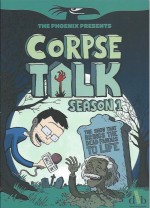
The Phoenix Presents… Corpse Talk Season 1


By Adam Murphy (David Fickling Books)
ISBN: 978-1-910200-01-8

The educational power of comic strips has been long understood and acknowledged: if you can make the material memorably enjoyable, there is nothing that can’t be better taught with pictures. The obverse is also true: comics can make any topic or subject come alive… or at least – as here – hilariously undead…

The conceit in Adam Murphy’s wonderful (Horrible Histories inspired?) cartoon feature Corpse Talk is that famous personages from the past are exhumed for a chatty, cheeky This Is (Was?) Your Life talk-show interview that, in Reithian terms, simultaneously “elucidates, educates and entertains”…

It also often grosses one out, which is no bad thing for either a kids’ comic or a learning experience…

The third collected album release culled from the annals of The Phoenix (courtesy of those fine saviours of weekly comics at David Fickling Books) opens with introductory page ‘And Here’s your Host…’ and a creepy contents section ‘In the Guest Graveyard This Season’.

Before the inspirational post-mortem autobiographies commence there’s also a splendidly informative archaeological burial-map entitled ‘Digging up the Bodies’ providing an effective contextual visual timeline for the likes of ‘Amelia Earhart’ and ‘Nikola Tesla’ to discuss their contributions to the modern world, whilst daring pirate ‘Anne Bonny’ provides a more lurid option for Careers Day, ably supplemented by an extra fact feature page ‘What a Drag!’ detailing one of the more unexpected problems for women dressing up as a male pirates…

Polar explorer ‘Ernest Shackleton’, national hero ‘Joan of Arc’ and go-getting statesman and consolidator ‘Genghis Khan’ then respectively plead their post mortem cases, after which largely unsung explorer and scientist ‘Alexander von Humboldt’ finally gets his moment in the limelight before ‘Marie Curie’ – also augmented by a fact-page on her daunting ‘Killer Research’ – and ‘Emmeline Pankhurst’ describe how their singular contributions changed the world forever.

Digging further back ‘Leonardo Da Vinci’ discusses his inventions, boy Pharaoh Tutankhmun explains the strange reason for his many names in ‘King Tut’ and ‘Boudica’ reveals the shocking saga of her revolt against the Romans

Author Murphy captivatingly indulges himself with the history of artistic inspiration (Katsushika) ‘Hokusai’ – also expanded by a page dedicated to ‘A Brush with Greatness’ – after which famous figures ‘Marie Antoinette’ and ‘Dick Turpin’ dish the dirt on the truth behind their legends and ‘Florence Nightingale’ remembers the bad old days with a supplementary examination of her later ‘Duvet Days’…

After ‘Grigori Rasputin’ and ‘Charles Dickens’ recount their own amazing careers a welcome break is offered in the form of a puzzle asking the reader to find and return the restless guests to their biers and sepulchres in ‘Body Count: the Graveyard’.

The cadaverous chat show resumes with ‘Winston Churchill’ and ‘Wolfgang Amadeus Mozart’ (complemented by ‘The Music Thief’ revealing the musical youth’s amazing powers of memory and discernment) after which ‘Mary Shelley’ discloses how her groundbreaking novel came about and ‘Julius Caesar’ details his rapid rise and fall.

The strips then expand to two pages each for the contribution of his infamous paramour ‘Cleopatra’, our own ‘Henry VIII’ and ‘Gandhi’, whilst literary icon ‘Jane Austen’ includes her own appendix in ‘The Lost Austen’ – revealing what her sister Cassandra did to all her letters upon the author’s passing…

Honest ‘Abe Lincoln’ reveals why he freed the slaves and ‘Albert Einstein’ discusses the nature of everything, whilst oddly merciful pirate ‘Blackbeard’ also offers extra bounty with the ghoulish catalogue of his death in ‘Dreaded, Deaded, Decapitated and Dunked’

The mean man behind the myth is exposed in ‘Richard the Lionheart’ before ‘The Six Wives of Henry VIII’ takes four pages to detail their respective moments as queen, and Scots freedom fighter ‘William Wallace’ rousingly records his achievements before the interviews wrap up with the astounding journey of scientist, botanist and gentle hero ‘George Washington Carver’…

To end the sessions on a fun note there then follows another quizzical corpse hunt in ‘Body Count: the Beach’ just to restore a little order to the proceeding.

Smart, irreverent, funny and splendidly factual throughout The Phoenix Presents… Corpse Talk Season 1 cleverly but unflinchingly deals with history’s more tendentious moments whilst personalising the great and the good for the coming generation.

It is also a fabulously fun read no parent or kid could possibly resist. Don’t take my word for it though, just check with the spirits in question…

Text and illustrations © Adam Murphy 2014. All rights reserved.

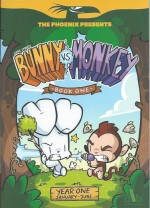
The Phoenix Presents… Bunny vs. Monkey Book One


By Jamie Smart (David Fickling Books)
ISBN: 978-1-910200-07-0

The other day I heaped much well-deserved praise upon Von Doogan and the Curse of the Golden Monkey whilst congratulating David Fickling Books both on its superb weekly comic The Phoenix and new line of graphic albums.

I also noted that their first two book releases had made this year’s list for The Reading Agency’s prestigious Summer Reading Challenge (which begins on 12th July): the first comic-books ever to have been awarded such an honour. It seems only fair then that I cover that other nominee – especially as it’s one of the funniest all-ages books I’ve seen in years.

Concocted with gleefully gentle mania by Jamie Smart (Fish Head Steve!), Bunny vs. Monkey has been a fixture in The Phoenix from the very first issue, a madcap duel of animal arch rivals set amidst the idyllic arcadia of a more-or-less ordinary English Wood.

With precious little unnecessary build-up The Phoenix Presents… Bunny vs. Monkey opens with a ‘Prologue!’ introducing placid, wise, helpful Bunny and not-so-smart pals Pig and Weenie Squirrel.

The foolish innocents have found a hibernating bear and Bunny really wants them to stop trying to wake it up. Meanwhile, over the hill and not so faraway, a bunch of boffins are attempting to launch a really annoying monkey into space…

Year One: January to June then commences a barrage of seasonal silliness as the proposed launch goes hideously awry and the loud, stroppy, obnoxious simian lands in the snow covered glade and declares himself king of this strange alien world in with ‘Bunny vs. Monkey’ …

Monkey loves noise, strife, chaos and trouble and wants to raise a rumpus – everything genteel, contemplative Bunny abhors – so when the apish astronaut introduces techno music in ‘Keep it Down!’ the lines of battle are irrevocably drawn…

Thing escalate in February ‘When Monkey Met Skunky’: a brilliant inventor with a bombastic line in animal-inspired terror weapons such as the Cluck Cluck Zeppelin used to bomb the woods with 10-year old rotten eggs or the giant metal robot hands which give the destructive Monkey ‘Fists of Furry’…

The winter draws on with ‘Soggy ‘n’ Froggy’ wherein a monstrous Frog-O-Saurus becomes the wicked duo’s latest Weapon of Meadow Destruction, after which poor little Pig is transformed into cyborg sensation Pig-O-Tron 5000 in ‘Robo-Chop’ and a simple change of pace sees Weenie and Pig put on a circus show to counter all the nasty animosity but get painfully caught ‘Clowning Around’…

Up until now Monkey has been risking his own pelt road testing all Skunky’s inventions, but when a bewildered former stuntman turns up the sneaky simian is happy to leave all the dangerous stuff to ‘Action Beaver’…

March leads to a profusion of beautiful buds and blossoms which delight the soul of nature loving Bunny.

Tragically they utterly disgust Monkey, who tries to eradicate all that flora in ‘Down with Spring!’ until he comes a-cropper thanks to a sack of spiky Hodgehegs, whilst in ‘Bonjour, Le Fox’ the spacy invader finally goes too far, forcing Bunny to align with a rather radical environmentalist possessed of a big, bushy tail and a French accent…

Some of Bunny’s friends are their own worst enemies. ‘Race to the Moon!’ sees Weenie and Pig build their own spaceship out of natural materials like moss and mushrooms only to have Monkey disastrously commandeer it, after which Skunky builds a terrifying cyber crocodile dubbed ‘Metal Steve!’ which promptly ignores its perfidious programming to spend the day swimming.

Such failures thus compel Monkey to steal a steamroller to personally get rid of all that hateful, ugly cherry blossom infesting the trees in ‘Rollin’ Rollin’ Rollin’!’

The war against nature intensifies in April as ‘Eat Your Greens!’ finds Skunky’s Caterpillar-Zilla devouring the forest foliage until a real creepy crawly steps in, whilst ‘The Whuppabaloo!’ shows the niffy tinkerer’s softer side as he drags Monkey on a wilderness trek to track down the most amazing thing in nature…

‘Hide and Squark!’ depicts the rabbit’s fight back thanks to the double-dealing help of a certain giant parrot, after which a momentary détente for a spot of angling soon turns into another heated duel in ‘Fish Off!’

There’s a brief falling out of the axis of evil in May as ‘Invisi-Monkey’ sees the strident simian squabbling with Skunky to possess a sneaky stealth suit before reuniting to spoil a joyous game of Cake-Ball with their monolithic, monstrous ‘Mole-a-Rolla!’ After that Monkey attempts to turn the Wood into an oil field in ‘Black Gold’ before spoiling Bunny’s dream of a ‘Quiet Day!’ with a giant Robot Cockroach…

Blazing June opens with ‘Bring Him Back!’ as Action Beaver attempts to retrieve watery wanderer Metal Steve whilst simple souls Weenie and Pig accidentally kick off an invention Armageddon which only gets worse when that long-slumbering ursine finally wakes up in ‘Who’s Afraid of the Big Bad Bear?’

‘The Bat!’ apparently introduces a nasty new faction to the ongoing conflict (but all is not as it seems), and there’s no confusing the stakes when Bunny agrees to a winner-take-all fight in ‘Wrestlepocalypse!’ where Monkey learns that cheats never prosper…

Just when things seem likely to settle down fresh chaos ensue when a violent piratical rabbit with an eye-patch storms in to cause stir up trouble in ‘Bunny B!’ leaving us with the delightful prospect of more hair-raising, masterfully magical cartoon mayhem to come…

Endlessly inventive, sublimely funny and outrageously addictive, Bunny vs. Monkey is the kind of comic parents beg the kids to read to them. Don’t miss out on the next big thing.

Text and illustrations © Jamie Smart 2014. All rights reserved.