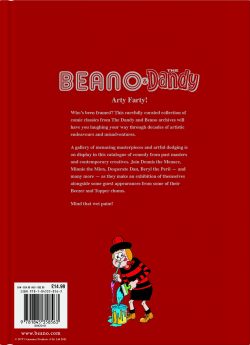
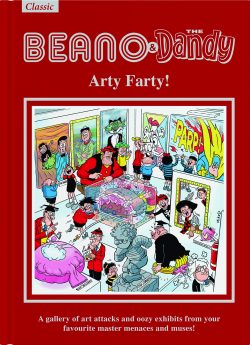
Beano and Dandy Gift Book 2022- Arty Farty!


By Dudley D. Watkins, Allan Morley, Reg Carter, Davy Law, Bill Holroyd, Leo Baxendale, Ken Reid, Eric Roberts, James Crichton, Paddy Brennan, and many & various (DC Thomson & Co)
ISBN: 978-1-84535-856-3 (HB)

This splendidly oversized (225 x 300mm) 144 page hardback compilation rightly glories in the incredible wealth of ebullient creativity that paraded through the flimsy, colourful pages of The Beano and The Dandy during a particularly bleak and fraught period in British history… aren’t they all? Tragically, neither it nor its companion volumes are available digitally yet, but hope springs ever eternal…

Until it folded and was briefly reborn as a digital publication on 4th December 2012, The Dandy was the third-longest running comic in the world (behind Italy’s Il Giornalino – launched in 1924 – and America’s Detective Comics in March 1937).

Premiering on December 4th 1937, The Dandy broke the mould of its traditional British predecessors by using word balloons and captions rather than narrative blocks of text under sequential picture frames. A huge success, it was followed eight months – on July 30th 1938 – later by The Beano and together they utterly revolutionised the way children’s publications looked and, most importantly, how they were read.

Over decades the “terrible twins” spawned a bevy of unforgettable and beloved household names who delighted countless avid and devoted readers, and the unmissable end of year celebrations were graced with bumper bonanzas of the comics’ weekly stars in extended stories in magnificent hardback annuals.

This particularly tome is a collation of strips examining “Art” and a superb tribute to Celtic creativity, packed literally cover-to-cover with brilliant strips, with the mirth starting on the inside front with a rather psychedelic and fourth-wall rending confrontation between The Bash Street Kids and the ever-interventionist “Beano/Dandy artist” actually illustrated by David Sutherland, I suspect.

Sadly, as usual none of the writers are named and precious few of the artists, but I’ve offered a best guess as to whom we should thank, and of course would be so very happy if anybody could confirm or deny my suppositions…

When not in monochrome or full colour, DC Thomson titles were always extremely inventive in using their two-colour printing plate format. Way back when, most annuals and many comics were jazzed up by a wonderful “half-colour” process British publishers used to keep costs down. This was done by printing sections (“Signatures”) of the books with only two plates, such as Cyan (Blue) and Magenta (Red) or Yellow and Black. The sheer versatility and colour range provided was simply astounding…

This book shows that pagination skill over and over again in strips that exploit the print process and deftly subordinate it to the narratives. What splendid fellows their printers must have been to go to all that extra effort…

Here and now though, the picture-in-picture gag cover of Dandy Annual 1971 – a Korky the Cat visual pun by James Crichton or possibly Richard Nixon – segues into a monochrome Big Eggo strip from Reg Carter before indisputable key man Dudley D. Watkins shines in black, white and red with magical lad Peter Piper (from short-lived junior title The Magic Comic) animating pictures at an exhibition before Good King Coke (He’s Stoney Broke) seeks fame in a frame thanks to early art and orange tints from Eric Roberts.

Also from The Magic Comic comes Dolly Dimple – Not So Simple: a monochrome romp by Allan Morley that leads to an Orange section starting with Julius Sneezer the Sneezing Caesar (Morley); Lord Snooty, by the incredibly prolific Watkins, detailing an art heist from an early annual, after which Morley renders more magic with Sammy’s Super Rubberand posh poseur Swanky Lanky Liz – by Charles Holt – makes more enemies with a school painting competition…

Morley’s Old Ma Murphy the Strong-Arm School-Ma’rm gets away with what we’d deem child abuse in her art class before three Dennis the Menace strips from David Law prove that chaos is an art. They’re followed by a drawing lesson with Minnie the Minx (by Jim Petrie?) and a Law full colour Beryl the Peril strip he did for a Topper Annual with the girly menace trying her hand at photography before we enjoy some black, white and red poetry-appreciation piece from a Beano Book The Bash Street Kids extended episode by Sutherland. It precedes a classic Desperate Dan diversion where he paints the town – guess what hue? – and Korky’s Catty Dictionary by Robert Nixon.

A red-toned double bill of Roger the Dodger japes by Ken Reid neatly diverts to fantastic crime as an extended (orange-flavoured) Captain Woosh caper sees the wily jetpack bandit again outwitted by good-hearted errand boy Terry Ball in a stunning Dandy Annual exploit from Charles Grigg, after which Sutherland triumphs in a pan-toned (black, red, yellow and white) classic starring The Bash Steet Kids and Teacher…

Following colourful puzzle pages ‘Blank Looks’ and ‘You Can Draw Me!’, Law’s Dennis the Menace plays ‘Pranks with Paint!’ and shares ‘Drawings by Dennis’ before we all go green with Watkins’ Desperate Dan and enjoy ‘Arty-Crafty!’and ‘Crafty Arty!’ hijinks with perilous Beryl…

Winker Watson gets a fresh look – courtesy of Terry Bave, I believe – as the wily waif interrupts a school painting chore before Ken H. Harrison’s blue period sees Harry and his Hippo get the snapping bug before the Bash Street Dogs of Pup Parade (Nigel Parkinson?) get their portraits done and Bill Holroyd’s robot rascal Brassneck saves the school play – from surly teacher Mr. Snodgrass…

Minnie the Minx endures a multi-coloured assault from a mischievous Beano artist (Tom Paterson?) before Dennis regrets ‘Making his Mark’ as a prelude to more full colour fun from Bill Ritchie’s Baby Crockett and Gordon Bell’s Colonel Blink, before Pup Parade with the Bash Street Dogs resorts to orange tints for a kennel painting prank…

Advancing print technology finally catches up and the remainder of the collection is all full-colour, beginning with Neighbourhood Witch as a little sorceress gets too interested in the family tree, after which Ritchie’s love-starved Smittengoes to extraordinary lengths to find a girlfriend…

Harrison’s Lord Snooty makes no friends when he voluntarily takes up the trumpet, whilst Paterson’s Little Larry truly turns heads (away) with his candid snaps before Bully Beef and Chips (Wayne Thompson?) clash over painted portraits whilst Dennis decrees ‘It’s a Draw’ and The Bash Street Kids romp in extended mayhem looking for cash rewards in ‘A Load of Junk’…

Robot toy manipulator General Jumbo then gets some highly specialised new units to win a painting competition, before activity page ‘Be a Dandy Artist’ segues into a Korky curated museum visit before ‘Quick on the Draw with Ivy the Terrible’ (by Lew Stringer?) ends the tour with a far more accessible lesson learned.

As you leave the volume please be sure to enjoy Sutherland’s classic Beano Book 1971 cover and denouement of the frontispiece saga that opened this extravaganza, and don’t forget to tip your reviewer…

A marvel of nostalgia and timeless comics wonder, the true magic of this collection is the brilliant art and stories by a host of talents that have literally made Britons who they are today, and bravo to DC Thomson for letting them out to run amok once again.
© DCT Consumer Products (UK) 2021 Ltd.
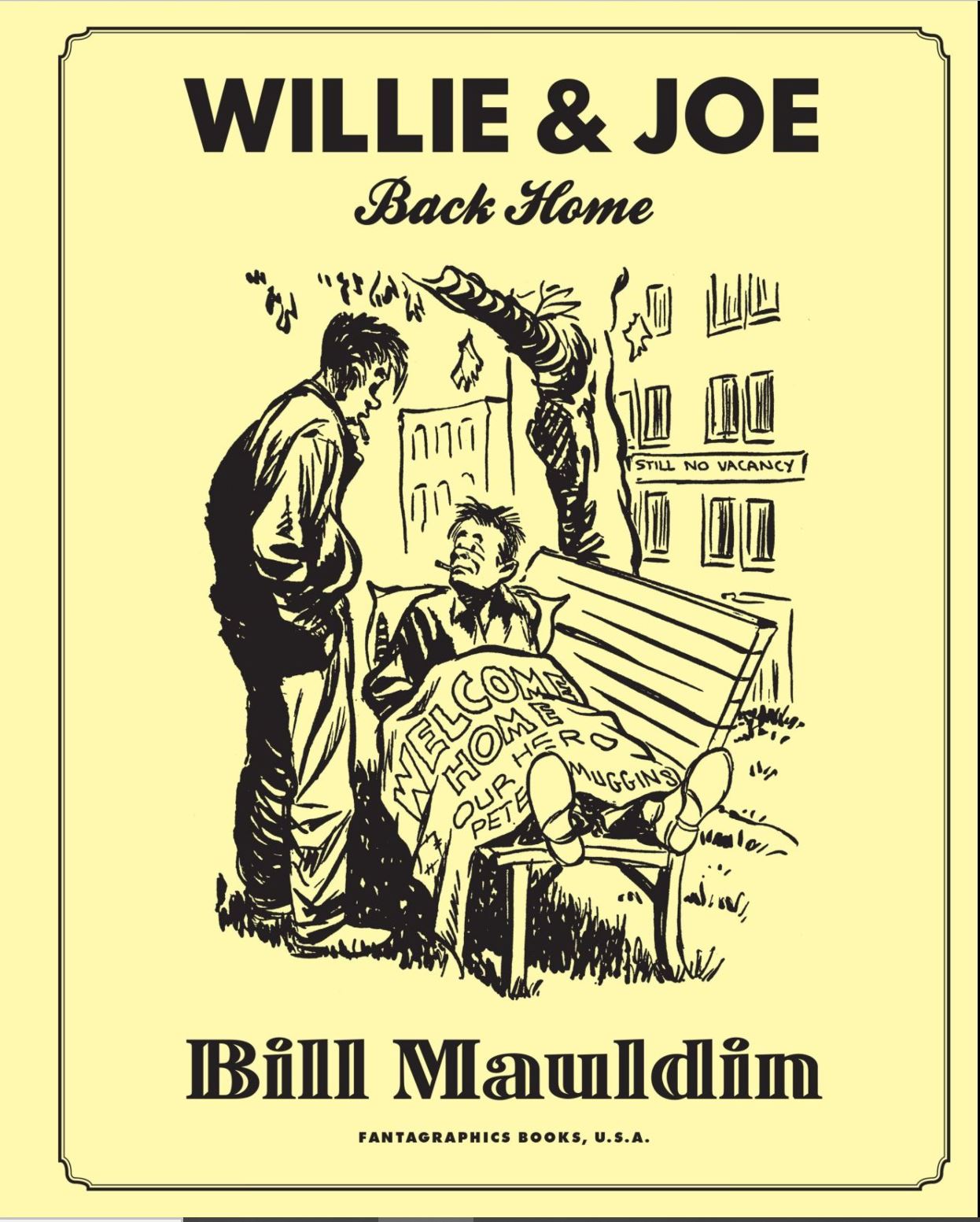
Willie & Joe: Back Home


By Bill Mauldin (Fantagraphics Books)
ISBN: 978-1-60699-351-4 (HB)

Throughout World War II William Henry “Bill” Mauldin fought “Over There” with the United States Infantry whilst producing cartoons about the fighting men and for the fighting men. He told as much of the real nature of the war as his censors and common sense would allow and became an unwilling international celebrity as much because of his unshakable honesty as his incredible artistic talents.

He was incontrovertibly “one of the guys” and American soldiers and civilians loved him for it. During his time in the service he produced cartoons for the folks back home and intimately effective, authentic and quirkily morale-boosting material for military publications 45th Division News, Yank and Stars and Stripes.

They mostly featured two slovenly “dogfaces” – a term he made his own and introduced to the world at large – giving a trenchant and acerbically enduring view of the war from the point of view of the poor sods ducking bullets in muddy foxholes and surviving shelling in the ruins of Europe.

Willie and Joe, to the dismay of much of the Army Establishment, gave an honest overview of America’s ground war. In 1945, a collection of his drawings – accompanied by a powerfully understated and heartfelt documentary essay – was published by Henry Holt and Co.

Up Front was a sensation, telling the American public about the experiences of their sons, brothers, fathers and husbands in a way no historian would or did. A biography, Back Home, followed in 1947.

Willie even made the cover of Time Magazine in 1945, when 23 year old Mauldin won his first Pulitzer Prize. Like so many other returning soldiers, however, Mauldin’s hard-won Better Tomorrow didn’t live up to its promise…

Mauldin’s anti-war, anti-Idiots-in-Charge, anti-bigot views never changed, but found simply new targets at home. However, during the earliest days of the Cold War and despite being a bone fide War Hero, Mauldin’s politically strident cartoons fell ever more out of step with the New America: a place where political expediency allowed racists to resume repressing ethnic sections of the nation now that their blood and sweat were no longer needed to defeat the Axis.

This new America expected women to surrender their war-time freedoms and become again servants and consumers and baby machines: happy to cook suppers in return for the new labour-saving consumer goods America now needed to sell, sell, sell. This nation was far too eager to forget the actual war and genuine soldiers in favour of massaged messages and conformist, inspirational paper or celluloid heroes.

The New America certainly didn’t want anybody rocking their shiny new boat…

When Sergeant Bill Mauldin mustered out in 1945, he was notionally on top of the world: a celebrity hero, youngest Pulitzer Prize winner in history, with a lucrative 3-year syndicated newspaper contract and Hollywood clamouring for him.

Unfortunately for him, Mauldin was as dedicated to his ideals as to his art. As soon as he became aware of the iniquities of the post-war world, he went after them. Using his newspaper tenancy as a soapbox, Mauldin attacked in bitterly brilliant barrages the maltreatment and side-lining of actual combat veterans. During the country’s entire involvement in WWII, less than 10% of military men actually fought, or even left their home country, whilst rear-echelon brass seemed to increasingly reap the benefits and unearned glory of the peace.

Ordinary enlisted men and veterans were culture-shocked, traumatised, out of place and resented by the public, who blamed them disproportionately for the shortages and “suffering” they had endured. Black and Japanese Americans were reduced to second class citizens (again, for most of them) and America’s erstwhile allies were pilloried, exploited and demonised, whilst everywhere politicians and demagogues were rewriting recent history for their own advantage…

Mauldin’s fondest wish had been to kill the iconic dogfaces off on the final day of World War II, but Stars and Stripesvetoed it, and the demobbed survivors moved into a world that had changed incomprehensibly in their absence…

Always ready for a fight, Mauldin’s peacetime Willie and Joe became a noose around the syndicate’s neck as the cartoonist’s acerbic, polemical and decidedly non-anodyne observations perpetually highlighted iniquities and stupidities inflicted on returning servicemen and attacked self-aggrandising politicians. He advocated such socialist horrors as free speech, civil rights and unionisation, affordable public housing and universal medical care for everybody – no matter what their colour, gender or religion. The crazy cartoonist even declared war on the Ku Klux Klan, American Legion and red-baiting House UnAmerican Activities Commission: nobody was too big. When the Soviet Union and United Nations betrayed their own ideological principles, Mauldin went after them too…

An honest broker, he had tried to quit early, but the syndicate held him to his contract so, trapped in a situation that increasingly stifled his creative urges and muzzled his liberal/libertarian sensibilities, he refused to toe the line and his cartoons were incessantly altered and reworked.

During six years of War service his cartoon had been censored three times; now the white paint and scissors were employed by rewrite boys almost daily…

The movie Up Front – which Mauldin wanted to reflect the true experience of the war – languished unmade for six years until a sappy, flimsy comedy bearing the name was released in 1951. The intended screenplay – by Mauldin, John Lardner and Ring Lardner Jr. – vanished: deemed utterly unsuitable and unfilmable …until much of its tone reappeared in Lardner Jr.’s 1970 screenplay M*A*S*H…

As the syndicate bled clients – mostly in segregationist states – and contemplated terminating his contract, Mauldin began simultaneously working for the New York Herald-Tribune. With a new liberal outlet. His tactics changed in the Willie and Joe feature: becoming more subtle and less bombastic. He still picked up the best of enemies, however, adding J. Edgar Hoover and the FBI to the roster of declaimers and decriers…

When his contract finally ended in 1948, neither side wanted to renew. Mauldin left the business to become a journalist, freelance writer and illustrator. He was a film actor for a time (appearing in Red Badge of Courage with Audie Murphy, among other movies); a war correspondent during the Korean Conflict and an unsuccessful candidate for Congress in 1956.

He only finally returned to newspaper cartooning in 1958 in a far different world: working for the St. Louis Post-Dispatch before moving to the Chicago Sun-Times, winning another Pulitzer and a Reuben Award for his political cartoons

He retired in 1991 after a long, glittering and properly-appreciated career. He only drew Willie and Joe four times in that entire period (for an article on the “New Army” in Life magazine; for the funerals of “Soldier’s Generals” Omar Bradley and George C. Marshall and to eulogize Milton Caniff).

Also available digitally, this magnificent hardback companion volume to Willie and Joe: the WWII Years covers the period of work from July 31st 1945 to 31st December 1948, supplemented by a brilliant biographical introduction from Todd DePastino: a superb black-&-white compendium collecting the bittersweet return of the forgotten heroes as they faced confusion, exclusion, contention and disillusion, but always with the edgy, stoic humour under fire that was Mauldin’s stock in trade.

Moreover, it features some of the most powerful assaults on the appalling edifice of post-war America ever seen. The artist’s castigating observations on how a society treats returning soldiers are more pertinent now than they ever were; the pressures on families and children even more so; whilst his exposure of armchair strategists, politicians and businessmen seeking to exploit wars for gain and how quickly allies can become enemies are tragically more relevant than any rational person could wish.

Alternating trenchant cynicism, moral outrage, gallows humour, sanguine observation and uncomprehending betrayal, this cartoon chronicle is an astounding personal testament that shows the powers of cartoons to convey emotion if not sway opinion.

In Willie & Joe: Back Home we have here a magnificent example of passion and creativity used as a weapon of social change and a work of art every citizen should be exposed to, because these are aspects of humanity that we seem unable to outgrow…
This edition © 2011 Fantagraphics Books. Cartoons © 2011 the Estate of William Mauldin. All right reserved.

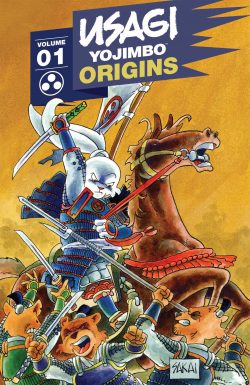
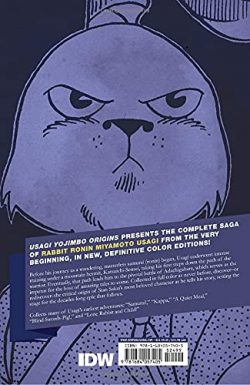
Usagi Yojimbo Origins volume 1: Samurai


By Stan Sakai, with colours by Ronda Pattison (IDW)
ISBN: 978-1-68405-740-5 eISBN: 978-1-68406-955-2

One of the very best and most adaptable survivors of the 1980s black-&-white comics explosion/implosion is a truly bizarre and wonderful synthesis of historical Japanese samurai fiction and anthropomorphic animal adventure: a perfect example of the versatility and strengths of a creator-owned character.

Usagi Yojimbo (which translates as “rabbit bodyguard”) first appeared as a background character in multi-talented creator Stan Sakai’s peripatetic comedy feature The Adventures of Nilson Groundthumper and Hermy, which launched in furry ‘n’ fuzzy folk anthology Albedo Anthropomorphics #1 (1984). He subsequently appeared there on his own terms as well as in Critters Amazing Heroes, Furrlough and a Munden’s Bar back-up in Grimjack.

Sakai was born in 1953 in Kyoto, Japan before the family emigrated to Hawaii in 1955. He attended the University of Hawaii, graduating with a BA in Fine Arts, and pursued further studies at Pasadena’s Art Center College of Design after moving to California.

His first comics work was as a letterer, most famously for the Groo the Wanderer, before his nimble pens and brushes, coupled with a love of Japanese history, legend and the films of Akira Kurosawa and his peers, combined to turn a proposed story about a historical human hero into one of the most enticing and impressive – and astonishingly authentic – fantasy sagas of all time.

The deliciously rambling and expansive period fantasy series is nominally set in a world of sentient animals (with a few unobtrusive human characters scattered about) and specifically references the Edo Period of Feudal Japan around the beginning of the 17th century. It simultaneously samples contemporary cultural icons from sources as varied as Lone Wolf and Cub, Zatoichi and even Godzilla. The saga details the life of Miyamoto Usagi, a ronin or masterless samurai, making an honourable living as a Yojimbo or bodyguard for hire. As such, his fate is to be drawn constantly into a plethora of incredible situations.

And yes, he’s a rabbit; a brave, sentimental, gentle, artistic, long-suffering, conscientious and heroic bunny who just can’t turn down any request for help or ignore the slightest evidence of injustice…

The Lepine Legend later appeared in Albedo #2-4, The Doomsday Squad #3 and seven issues of Critters (1, 3, 6-7, 10-11 & 14) before leaping into his own long-running series. It was the first of many, relating his adventures and mirrored Sakai’s real-world peregrinations from publisher to publisher.

The Sublime Swordsbun has shifted homes frequently, but has been in continuous publication since 1987 – with more than 40 graphic novel collections and books to date. He’s also guest-starred in numerous other series, such as Teenage Mutant Ninja Turtles (and its TV incarnation) and even almost made it into his own small-screen show but there’s still time yet and fashions can revive as quickly as they die out…

There are high-end collectibles, art prints, computer games and RPGs, a spin-off sci-fi comics serial and lots of toys.

Sakai and his creation have won numerous awards both within the Comics community and amongst the greater reading public, and now, as a venerable mainstay of the American comics landscape, the monochrome wanderer’s early exploits got a modern makeover in 2020. Not strictly chronologically ordered, Usagi Yojimbo Color Classics #1-7 are gathered here to hopefully bring him to a new generation…

Following a brief ‘Introduction’ recapping major characters and scenario, ‘Samurai!’ sees the rabbit ronin again meet money-mad bounty-hunter Gennosuké after a deadly duel of honour leaves a warrior named Gunichi a bloody corpse at the Yojimbo’s feet. Pressed by the newly-arrived and curious Rhino, the moodily moved and uncharacteristically loquacious rabbit shares some of the events of his boyhood…

Once, Miyamoto Usagi was simply the son of a small-town magistrate, dispatched with his friend Kenichi to train at the prestigious Dogora Fencing School in Sendai. As the boys make their journey they encounter a lone, aged warrior beset by a pack of bullies from that self-same school, determined to prove their institution’s martial superiority.

Despite all efforts to placate the hotheads, old Katsuichi is – most reluctantly – compelled to slay the toughs. The stunned witnesses start bickering and – whilst Kenichi wants to follow orders and go on to the (clearly honourless) Dogora School, little Usagi seeks out the old man to be his Sensei…

The elder was finished with teaching but eventually sees something in the defiant, determined little rabbit and grudgingly accepts his exceptional young charge…

Usagi spends years learning the Way of Bushido from his stern, leonine master: not just superior technique and tactics, but also a philosophy of justice and restraint to serve him all his days…

The revelations of Usagi’s boyhood training continue in short, revelatory vignettes – nine in all – as the elder Yojimbo and his surly companion continue towards shelter, highlighting the peculiar relationship of Sensei and Student. At the disciple’s first tournament, the scurrilous, vengeful Dogora adherents scheme to “accidentally” cripple the boy and thus humiliate his teacher, but don’t anticipate his innate ability.

After besting the entire Fencing School contingent in duels with Bokken (wooden swords) the boy at last faces his old friend Kenichi and triumphs. His prize is a Wakizashi “Young Willow” and Katana “Willow Branch”. The short and long swords are the soul of a samurai, marking his graduation to martial maturity, but Usagi is blithely unaware of what his victory has cost his childhood companion…

Mere months later, the graduate warrior is challenged by a masterful, mysterious swordsman who was bodyguard to the Great Lord MifunÄ—. Their duel is interrupted when a band of Dogora assassins attack, determined to avenge their school’s humiliation by a single stick-wielding student. The cowards are no match for the steel of Usagi and the mighty Gunichi, and the victors part as friends, with the bodyguard promising to recommend the rabbit for future service to his Lord.

Still assessing his options, the young Samurai encounters Kenichi once more. The disgraced youth has left the Dogora School and is trying to drink himself to death, but when he and Usagi hear their home village is threatened by bandits, the former friends reconcile to save their loved ones…

By holding Usagi’s childhood love Mariko hostage, the brigands successfully neutralise his magistrate father and are stripping the hamlet of its provisions and meagre treasures when Usagi and Kenichi challenge them. None of the villains survive the vengeance of the outraged villagers…

In the aftermath, although Mariko clearly wants Usagi to stay, she says nothing and the Samurai leaves to join Lord MifunÄ—’s service. Kenichi stays…

The young warrior advances quickly as MifunÄ—’s vassal and is soon a trusted bodyguard, serving beside indomitable Gunichi. It is a time of great unrest and war is brewing, and in Usagi’s third year of service, the Lord’s castle is attacked by Neko Ninja assassins. Although the doughty warriors save their master, his wife Kazumi and heir Tsuruichi are murdered. Realising ambitious rival Lord Hikiji is responsible, MifunÄ— declares war…

The struggle ends on the great Adachigahara plain when MifunÄ—’s general Toda switches sides. The Great Lord falls and at the crucial moment Gunichi also breaks, fleeing to save his own skin and leaving outnumbered Usagi to preserve the fallen Lord’s head – and Honour – from shameful desecration…

The story comes full circle now, when after two years as a purposeless, masterless Ronin, the wandering Yojimbo meets Gunichi again…

After the epic origin, short, pithy vignettes cleanse the dramatic palate, beginning with a delicious traditional horror story. In ‘Kappa’ the wanderer encounters a deadly marsh troll at dusk and barely escapes with his life by offering the foul beast some wild cucumbers he has picked. Exhausted, the Ronin finds shelter with an old woman for the night, but when she hears of his adventure she becomes hysterical.

The cucumbers were planted so that her own son – returning that night – would have something to buy off the voracious Kappa. Horrified by his inadvertent error, Usagi dashes back to the marsh to save the son, but after overcoming the monster, shockingly experiences one final sting in the tale…

Moments of peace and contemplation are few in the Yojimbo’s life but, even when a drunken horde interrupt ‘A Quiet Meal’, the rabbit’s patience takes plenty of rousing. Some rude fellows, however, really don’t know when to stop boozing and leave well enough alone…

‘Blind Swords-Pig’ is a sublime comedic parody that sets up future conflicts as the landless lepus meets a formidable companion on the road; one whose incredible olfactory sense more than compensates for his useless eyes. How tragic then that the affable Ino is also a ruthless, blood-spilling outlaw who won’t let comradeship affect his hunger for freedom or carnage…

Closing this collection, ‘Lone Rabbit and Child!’ also sets up major plot threads as the Ronin is hired by beautiful swordswoman Tomoe Ame to protect her Lord Noriyuki. The callow royal child has been travelling to the capital to ratify his role as leader of the prestigious Geishu Clan following the death of his father, but the party has been repeatedly attacked by ninjas working for infamous Hikiji – now risen high in the Emperor’s hierarchy.

The insidious schemer is determined to foil the investiture and appropriate Geishu properties for himself, but has not reckoned on fate and the prowess of the lethally adept Usagi…

Burnished with cover gallery, character sketches and a biography of Stan Sakai, this is a fast-paced yet lyrical compilation; funny, thrilling and simply bursting with veracity and verve. Usagi Yojimbo‘s life story is a magical saga of irresistible appeal to delight devotees and make converts of the most hardened hater of “funny animal” stories. If that’s you, why not try some sheer comicbook poetry by a True Master?
Usagi Yojimbo™ © 2020 Stan Sakai. All rights reserved.

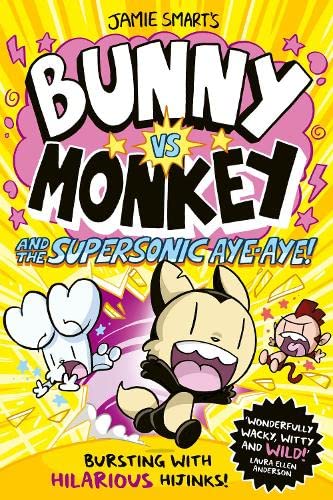
Bunny vs Monkey and the Supersonic Aye-Aye


By Jaimie Smart, with Sammy Borras (David Fickling Books)
ISBN: 978-1-78845-243-4 (TPB)

Bunny vs. Monkey has been a fixture of British comics phenomenon The Phoenix since the very first issue in 2012: recounting a madcap vendetta gripping animal arch-enemies set amidst an idyllic arcadia masquerading as more-or-less mundane English woodlands.

Concocted with gleefully gentle mania by cartoonist, comics artist and novelist Jamie Smart (Fish Head Steve!; Looshkin; Flember), his trend-setting, mind-bending yarns have been wisely retooled as graphic albums available in remastered, double-length digest editions such as this one. In this case, however, here we’ve caught up and the fabulous recycled fun of The Floating Cow Catastrophe is plumped up with new stuff…

All the tail-biting tension and animal argy-bargy began yonks ago after an obnoxious little beast popped up in the wake of a disastrous British space shot. Having crash-landed in Crinkle Woods – scant miles from his launch site – lab animal Monkey believed himself the rightful owner of a strange new world, despite all efforts from reasonable, sensible, genteel, contemplative forest resident Bunny to dissuade him. For all his patience, propriety and good breeding, the laid-back lepine just could not contain the incorrigible idiot ape, who was – and is – a rude, noise-loving, chaos-creating loutish troublemaker…

Problems are exacerbated by the other unconventional Crinkle creatures, particularly a skunk called Skunky who has a mad scientist’s attitude to life and a propensity to build very dangerous robots and super-weapons…

Here – with artistic assistance from Sammy Borras – the war of nerves and mega-ordnances resumes and intensifies. The unruly assortment of odd critters littering and loitering around the bucolic paradise have finally picked a side (sort of): shifting and twisting into bipartisan factionalism. They all seem to have forgotten that rapidly encroaching Hyoomanz are now well underway in building something called a “motorway” right through the sylvan glades and (apparently) unprotected parks… but they are quite interested in new resident Ai – the supersonic Ai-Ai – and where her allegiances fall…

It all resumes with ‘Insomnia!’ as new girl Ai proves to (a) nocturnal, (b) excitable and (c) a bit of a party animal just as Bunny seeks an early night, after which Monkey makes the mistake of stamping on her new house in his modular ‘Mega Mecha!’ and doesn’t get away with all his mechanical body parts intact and ‘Take to the Skies!’ finds Weenie squirrel and Pig optimistically building an aircraft, despite a blessed lack of knowledge and requisite skills. That doesn’t explain why Monkey insists on being the first to test pilot it…

A rare moment of tranquillity in ‘Time to Get Along!’ finds all the woodland weirdoes sharing a natural hot spring, until acrimony returns when somebody makes a whirlpool and someone else activates a robot shark…

‘Spring’ comes round again, finding the forest full of greenery-gobbling ‘Worms!’ until Monkey accidentally saves the day, before ‘A Great Big Snotty Cold!’ afflicts everyone. The cure is too weaponize the germs into a giant bogie-beast… but it doesn’t end there…

Skunky’s latest “greatest invention” generates ‘Bubble Trouble!’ before he builds his snarky simian sidekick’s dream device – an enormous ‘Metal Monkey!’ – that bears no relationship to the enigmatic and apparently unattended ‘Giant Egg!’ Ai and Bunny stumble across. Was that the reason for her throwing a dinner party for all her new friends and urgently urge them to ‘Eat Up!’ while revealing some culinary secrets nobody wanted to know?

‘Spaaaace!’ finds Skunky trying – but failing – to send Monkey back where he came from, after which ‘Storytime!’ shows Bunny’s literary leanings whilst Weenie and Pig enjoy ‘Mud, Glorious Mud!’ and aliens are erroneously blamed for all the fuss on ‘The Night They Floated Our Cows Away!’

Everyone’s recovered by time soapbox cart fever intoxicates the little critters, resulting in a shock ending for the ‘Screwball 4000!’, after which a different – Ai-sponsored – comic reality results in baffling grudge-match ‘Weenie vs Monkey’ before she races off, oblivious to the attentions of brain-battered, bewildered and besotted former stuntmanAction Beaver in ‘♥’…

Skunky’s ploy of creating robot duplicates of his opponents goes just like you’d expect in ‘Double Trouble!’, leaving a certain robot in a tizzy safeguarding rare floral gem ‘The Purple Popplewhatsit!’, just as we ease effortlessly into the middle of the year, with ‘Summer’ heralding the first sighting of Skunky’s latest giant sensation ‘The Walrus!’

Undaunted, the black-&-white bounder almost incinerates the woods with a homemade star making ‘Sun Kinda Trouble!’before building colossal fantasy constructs in ‘The Midnight Dragon’ and spoiling a party whilst the stroppy simian is trapped in a timeloop in ‘Monkeyfloop!’

Catastrophic rivalry erupts as alternate evil genius Maniacal Badger competes with Skunky for a science prize and the title of ‘The Most Brilliant Animal in the Woods!’ whilst a blow to the bonce creates ‘Evil Bunny!’ and Weenie consults the Skunk to achieve the dream of being ‘The Bravest Squirrel in the Woods!’

Monkey triggers road rage by building a motorway around Bunny’s cottage in ‘Beep! Beep!’, yet still find time to completely miss the united animals war against a human invader in ‘Persuasion!’ whilst Weenie’s awesome weaponization of sugary treats in ‘Doughnuts!’ brings us stickily to the ‘Autumn’ segment where ‘A Moment of Solace!’for Skunky still ends in chaos and carnage.

Laziness exacerbates the shameful antics and utter rout of the ‘Monkey Army!’, which leads the valiantly victorious Bunny team to pursue supernatural phenomena in ‘Will-o-de-Wisp!’ Strangely, the glowing phantasm that scarily greets them bears a disturbing resemblance to long-gone local legend Fantastic Le Fox…

‘What a Brave Little Squirrel (Part One)!’ begins a strange excursion to a subterranean realm with terror and abandonment on the cards for Weenie, but hope and escape materialise in ‘What a Brave Little Squirrel (Part Two)!’before being driven away again by the secret power source of Skunky’s new hover board in ‘The Flipping Point!’

That so-familiar spectre returns prophesying ‘Grave Danger!’ and in the resultant ‘Panic!’ Bunny becomes a maddened doomsday-prepper, but Weenie is more concerned with culinary success and new kitchen gadget the Multi-Kitchen Buddy in ‘The Other Side!’

At last the doom arrives, but declaring ‘Battle Stations!’ and gathering everybody together and marshalling extraordinary defences amount to nothing and soon distracted Randolph the Raccoon and Ai are pointlessly competing in ‘Runnnn!’ …with Action Beaver and the timestream itself regretting their actions…

‘The Worst Idea You’ve Ever Had!’ finds Monkey yet again ruining Skunky’s plans as the boffin attempts to imprison a ghost before the madness pauses – for now – with ‘The Woodland Devil!’ as the dreaded, doom-laden grave danger arrives and all the animals are caught napping!

The animal anarchy is augmented here with detailed instructions on How to Draw Ai’ and ‘How to Draw Weenie’ so, as well as beguiling your young ‘uns with stories, you can use this book to teach them a trade…

The absolute acme of absurdist adventure, Bunny vs Monkey is weird wit, brilliant invention, potent sentiment and superb cartooning all in one eccentrically excellent package: providing jubilant joy for grown-ups of every vintage, even those who claim they only get it for their kids. This is the kind of comic parents beg kids to read to them. Is that you yet?
Text and illustrations © Jamie Smart 2022. All rights reserved.

Bunny vs Monkey and the Supersonic Aye-Aye is published on January 6th 2022 and is available for pre-order now.

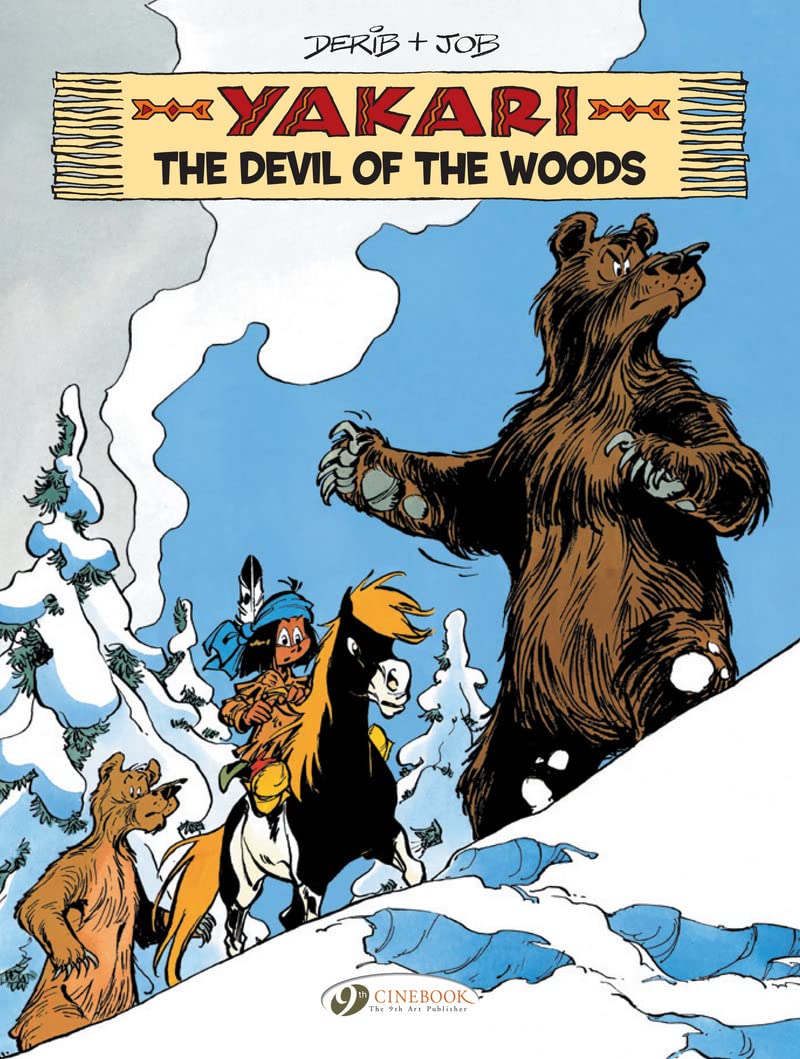
Yakari volume 19: The Devil in the Woods


By Derib & Job, coloured by Dominique and translated by Jerome Saincantin (Cinebook)
ISBN: 978-1-80044-037-1 (Album PB)

Le Crapaud à lunettes was founded in 1964 by Swiss journalist André Jobin who wrote for it under the pseudonym Job. Three years later he hired fellow French-Swiss artist Claude de Ribaupierre AKA “Derib”. The illustrator had launched his own career as an assistant at Studio Peyo, working on The Smurfs strips for venerable weekly Le Journal de Spirou.

Derib – equally au fait with enticing, comically dynamic “Marcinelle” cartoon style yarns and devastatingly compelling meta-realistic illustrated action epics – went on to become one of the Continent’s most prolific and revered creators.

Many of Derib’s stunning works feature his cherished Western themes; magnificent geographical backdrops and epic landscapes, with Yakari considered by fans and critics to be the strip which first led him to deserved mega-stardom. Debuting in 1969, it details the life of a young Oglala Lakota boy on the Great Plains: set sometime after the introduction of horses by the Conquistadores but before the coming of modern Europeans.

The content and set-up are both stunningly simple and effectively timeless, affording new readers total enjoyment with a minimum of required familiarity or foreknowledge. The series – which has generated two separate animated TV series and a movie release last year – has achieved 40 albums thus far: a testament to the strip’s evergreen vitality and the brilliance of its creators, even though originator Job has moved on and Frenchman Joris Chamblain assumed the writer’s role in 2016.

Overflowing with gentle whimsy and heady compassion, young Yakari enjoys a largely bucolic existence: at one with nature and generally free from privation or strife. For the sake of our delectation, however, the ever-changing seasons are punctuated with the odd crisis. Generally they are resolved without fuss, fame or fanfare by a little lad who is smart, brave and can – thanks to a boon of his totem guide the Great Eagle – chat with all animals. This time, however, the conclusion is far from cheery or cosy and presages dark times ahead for some…

It begins in the depths of winter, with deep snow covering the plains and provender scarce for all. As the youngsters Rainbow, Buffalo Seed and Yakari amuse themselves with his pony Little Thunder, the talkative boy’s father Bold Gazeand hunter Taut Bow urgently seek food. Luck turns their way when a large hehaka (wapiti) rushes right into their arrows. By nightfall the entire tribe has eaten well and the leftovers are preserved and dressed to provide more food in the days to come.

The adults cannot shake the impression that their welcome repast was fleeing from something worse than their arrows, and that apprehension is confirmed in the morning when the tribe discover all the remaining food has gone. The fresh snow carries no trace of the thief…

Ever-inquisitive Yakari wants an explanation and sets out to ask his animal pals, eventually finding strange tracks that might belong to some sort of bear. Incautiously following, he sees the footprints peter out just as beaver chieftain Double-Tooth pops up.

The jolly rodent is disturbed by the news and helps in searching, but as Yakari and Double-Tooth follow tracks that constantly seem to vanish into thin air, Bold Gaze and Taut Bow are trailing the thief with the camp dogs. It’s  a horrific mistake as something unseen kills and eats the valiant hounds!

Dread haunts the humans huddled in their tents that night, but in the morning Yakari and Little Thunder check out and eliminate all the local bears – even the notoriously grumpy and insomniac Grizzly who’s having difficulty hibernating – from the suspect list, unaware that something sinister and malign is tracking them…

Baffled and scared that one of their ursine pals has gone mad, Yakari and the beaver clan build a wonderful trap to catch the mysterious thief, but again the stalker outwits them all: even diverting their suspicions to the most unlikely culprit whilst retaliating by destroying the beavers’ precious dam and home…

With all creatures equally endangered by the “devil”, Yakari and his allies convince the mighty and increasingly irate Grizzly to help them hunt, and before long the arrogant quarry rises to the challenge. It confronts its pursuers but the resultant battle is swift, terrible and sadly inconclusive as their brutal clash triggers an avalanche…

In the eerie aftermath, the Great Eagle arrives and shares some disturbing thoughts that may have terrible implications in days to come…

Originally released in 1994, Le diable des bois was the 20th European album, and although its suspenseful, ominous tone feels like a dark departure from the cheery norm, there’s still plenty of humour and slapstick hijinks to balance the grim proceedings, and – in deference to the younger readers – everything is carried out with sensitivity and wit.

As ever, Derib & Job display astounding and compelling narrative virtuosity in this glorious graphic tour de force highlighting the appealing courage of our diminutive heroes, in a visually stunning, seductively smart saga to delight young and old alike.

Yakari is one of the most unfailingly absorbing all-ages strips ever conceived and should be in every home, right beside Tintin, Uncle Scrooge, Asterix and The Moomins.

Original edition © Derib + Job – Editions du Lombard (Dargaud- Lombard s. a.) 2000. All rights reserved. English translation 2021 © Cinebook Ltd.

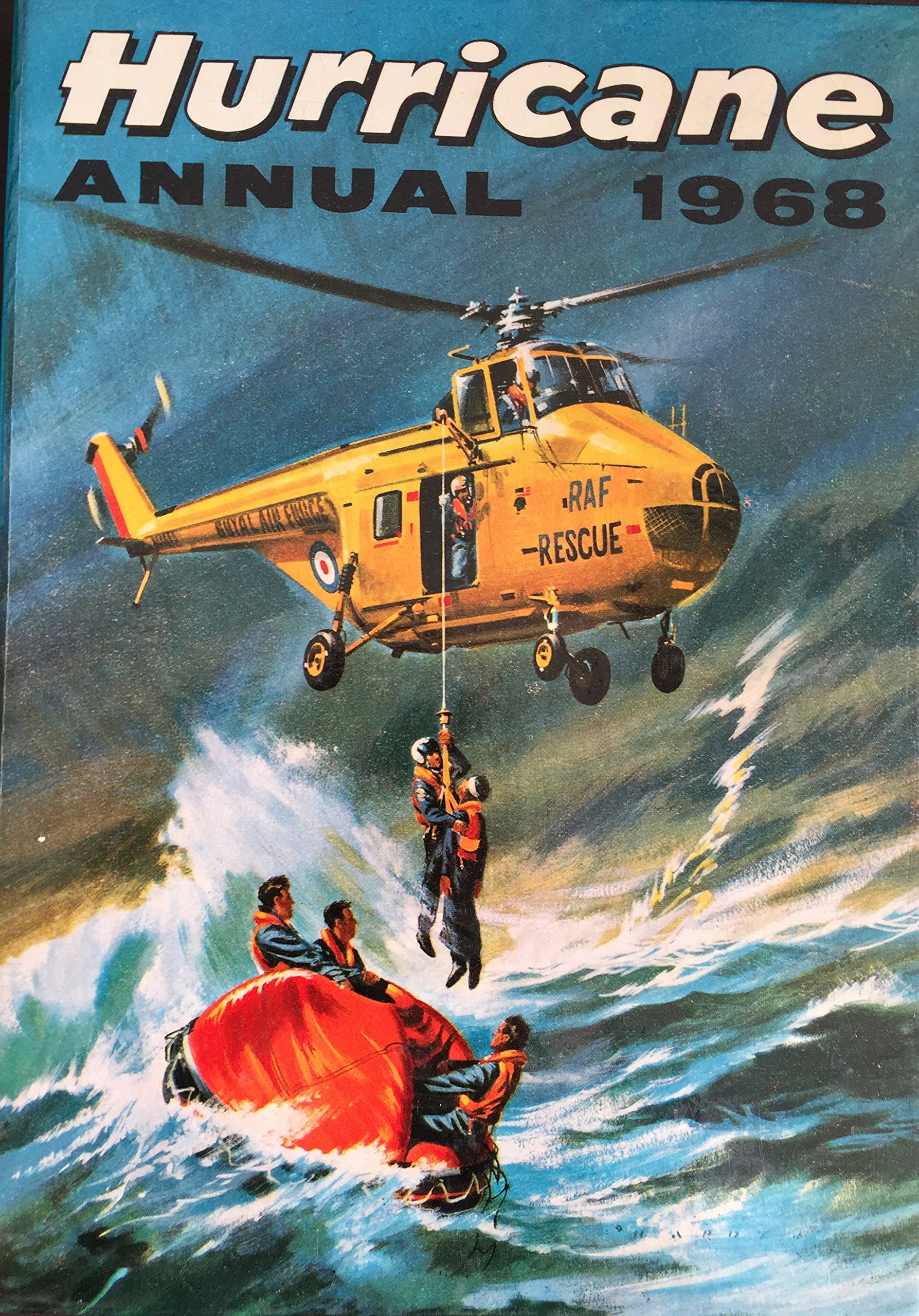
Hurricane Annual 1968


By Many & various (Fleetway)
No ISBN:

From the late 1950s and increasingly through the 1960s, Scotland’s DC Thomson steadily overtook their London-based competition – primarily monolithic comics publishing giant Amalgamated Press. Founded by Alfred Harmsworth at the beginning of the twentieth century, AP sought to regain lost ground, and the sheer variety of material the southerners unleashed as countermeasures offered incredible vistas in adventure and – thanks to the defection of Leo Baxendale and Ken Reid to the enemy – eventually found a wealth of anarchic comedy material to challenge the likes of the Bash Street Kids, Dennis the Menace, Minnie the Minx and their unruly kin.

During the latter end of that period the Batman TV show sent the entire world superhero-crazy. Amalgamated had almost finished absorbing all its local rivals – such as The Eagle‘s Hulton Press – to form Fleetway/Odhams/IPC and were about to incorporate American-styled superheroes into their heady brew of weekly thrills.

Once the biggest player in children’s comics, Amalgamated had stayed at the forefront of sales by latching onto every fad: keeping their material contemporary, if not strictly fresh. The all-consuming company began reprinting early Marvel Comics successes for a few years: feeding on the growing fashion for US style adventure which had largely supplanted the rather tired True-Blue Brit style of Dan Dare or DC Thompson’s Wolf of Kabul.

Even though sales of all British comics were generally – and in some cases, drastically -declining, the 1960s were a period of intense and impressive innovation with publishers embracing new sensibilities; constantly trying new types of character and tales. At this time Valiant and its stable-mate Lion were the Boys’ Adventure big guns (although nothing could touch DC Thomson’s Beano and Dandy in the comedy arena).

Hurricane was an impressive-looking upgrade that began during that period of expansion and counterattack, apparently conceived in response to DCT’s action weekly Hornet. It launched the week of February 29th 1964 and ran for 63 issues, but was revamped three times during that period before ultimately being merged into companion paper Tiger.

It carried a superbly varied roster of features in that time, including two (and a half) stars who survived its extinction. Racing driver Skid Solo and comedy superman Typhoon Tracy as well as Sgt Rock – Paratrooper… but not for so long for him…

There was heavy dependence on European and South American artists initially, among them Mario Capaldi, Nevio Zeccara, Georgio Trevisan, Renato Polese and Lino Landolfi, some of whom lasted into the Annuals. As with so many titles, although the comics might quickly fade, Christmas Annuals maintained a presence for years after and Hurricane seasonal specials were produced for every year from 1965 to 1974…

Following a tried-&-true formula, this book – published in 1967 – offers comics adventures, prose stories, fact-features, funnies and puzzles and kicks off with stunning full-colour fact feature strip ‘Lawmen and Badmen of the Wild West’.

Looking  like they’re painted by Reg Bunn or Tony Weare, these comics outline the lives and times of Wyatt Earp, Tom Smith, Black Bart, Sam Bass, Billy the Kid and Bat Masterson, before fully fictional western star Drago teaches a headstrong young cavalry officer the meaning of command in monochrome thriller ‘He Rides Alone’ – possibly illustrated by Polese.

Regular prose feature ‘The Worst Boy in the School’ (illustrated by Geoffrey Whittam?) follows a page of medical gags entitled ‘Take a dose of Chuckles!’ The long-running boarding school saga was enlivened by its star Duffy coming from Circus stock. Here the comedy, chaos and espionage excitement stems from a New Boy who’s convinced enemies of his father – a South American president – are trying to kidnap him. He’s not wrong…

Returning to monochrome strips, ‘Sgt. Rock – Special Air Service’ ferrets out Nazi infiltrators masquerading as American GIs before we switch back to fact for a photo-feature offering capacious coverage of modern British military might in ‘The Army Marches on its Wheels!’ whilst the comedy capers of ‘Rod the Odd Mod and ‘is old pal Percy Vere’ literally bring the house down when he gets the Hi Fi bug.

‘Casey and the Champ’ stars a veteran railroad man and his steam engine who here reveal in strip form the unlikely salvation of a played-out mining town as prelude to photo feature ‘Why Not Go by Balloon?’ before heading to 1804 where Regency prize-fighter Jim Trim stumbles upon a Napoleonic plot to conquer England in ‘Two Fists Against the World!’ (perhaps illustrated by Carlos Roume)…

Prose yarn ‘Carlos of the Wild Horses’ details the story of conquistadores imperilled by rebellious Aztecs and saved by the bond between the governor’s young son and a herd of mustangs and is followed by text fact-features ‘War Dogs’ – commemorating canines in combat – and ‘Atlantic Greyhounds’ explaining why the glory days of cruise liners had passed and why they could be built no bigger. Ah, the joys of schadenfreude and hindsight in action…

Next is a prose-&-photo precis current of movie release ‘The Train’(starring Burt Lancaster, but I’d never heard of it): a tale of Nazi collaboration and pursuit of transport of stolen art, followed by photo feature ‘When Nature Turns Nasty!’ before the incontestable star of Hurricane thunders in on a wave of colour illustration. ‘The Juggernaut from Planet Z’ is again despatched to aid his Earth chum Dr. Dan Morgan only to be overridden – and temporarily enslaved – by crazed would-be dictator General Zeb.

Sport next as ‘Hurry of the Hammers’ finds the football star in black-&-white and almost deprived of club and grounds by an unscrupulous new owner more interested in profit than the beautiful game. Historical factual strip ‘They Climbed… the Matterhorn’ then leads to a prose outing for the worst ship in the WWII navy. One again confounding the British Admiralty and escaping being broken up for parts in ‘HMS Outcast – Pride of the Fleet’ sees Geoff Campion’s unruly mob save the Pacific flotilla from destruction by the Japanese using ping pong balls and tomato sauce…

‘Typhoon Tracy’s Lucky Strike!’ finds the mighty moron in Alaska, battling bears, triggering a gold rush and helping an old friend stave off poverty, after which Giovanni Ticci employs duo-colour to limn a superbly light-hearted ‘Sword for Hire’ romp starring Cavalier soldier-of-fortune Hugo Dinwiddie who saves a fugitive king’s agent from capture even while acting as an unwilling substitute for a duellist.

Reverting to prose, ‘The Terrible Revenge of Dr. Parvo’ stars atomic accident survivors Ace Sutton and Flash Casey who use their journalistic skills and ability to walk through walls to stop a madman weaponizing weather, after which strip ‘Danger at Manakee Deep’ details a futuristic undersea habitat and resource factory endangered by greed and treachery.

‘Rodeo!’ traces the history of the sport with photos front the Calgary Stampede whilst monochrome strip ‘The Ragged Racer’ offers early environmental activism from its Wildman hero as he thwarts a circus’ scheme to destroy his mountainous animal preserve and gag page ‘It’s a Dog’s Laugh!’ brings us the text cover feature ‘R.A.F. to the Rescue’ outlining the history and activities of the coastal guardians.

The prose perseveres with adventure yarn ‘The Fiery Furnaces’ as two roving sportsmen accidentally dethrone a South American tyrant with delusions of grandeur (with illustrations by either Nevio Zaccara or Alfredo Giolitti) before ‘Rod the Odd Mod and ‘is old pal Percy Vere’ endure a calamitous bath night…

Sport was a major fascination of publishers at this time and ‘Soccer Special by The Ref’ opens an extended section of pictorial mini-features comprising ‘Famous Captains before they were Famous’, ‘Soccer Trophies Worth Winning’ and ‘Strange Things Happen in Soccer’ before we all ride off into the sunset, ending with comic strip masked cowboy ‘The Black Avenger’ who chases and then saves a “white magician” stirring up Indian tribes.

Eclectic, wide-ranging and always of majestically high quality, this blend of fact, fiction, fun and thrills is a splendid evocation of lost days of joy and wonder. We may not be making books like this anymore but at least they’re still relatively easy to track down. Of course, what’s really needed is for some sagacious publisher to start re-issuing them…
© Fleetway Publications Ltd., 1967

Walt Disney’s Donald Duck volume 5: “Christmas on Bear Mountain” by Carl Barks


By Carl Barks (Fantagraphics Books)
ISBN: 978-1-60699-697-3 (HB)

Win’s Christmas Gift Recommendation: The Utter Acme of All-Ages Entertainment… 10/10

Carl Barks was born in Merrill, Oregon in 1901, growing up in the rural areas of the West during some of the leanest times in American history. He tried his hand at many jobs before settling into the profession that chose him. His early life is well-documented elsewhere if you need detail, but briefly, Barks worked as a animator at Disney’s studio before quitting in 1942 to work in the new-fangled field of comic books.

With cartoon studio partner Jack Hannah (another occasional strip illustrator) Barks adapted a Bob Karp script for an animated cartoon short into the comic book Donald Duck Finds Pirate Gold. It was published as Dell Four Color Comics Series II #9 in October of that year and – although not his first published comics work – it was the story that shaped the rest of his career.

From then until his official retirement in the mid-1960s, Barks worked in self-imposed seclusion, writing and drawing and devising a vast array of adventure comedies, gags, yarns and covers that gelled into a Duck Universe of memorable and highly bankable characters. These included Gladstone Gander (1948), Gyro Gearloose (1952), Magica De Spell (1961) and the nefarious Beagle Boys (1951) to supplement Disney’s stable of cartoon actors. His greatest creation was undoubtedly the crusty, energetic, paternalistic, money-mad giga-gazillionaire Scrooge McDuck: the World’s wealthiest winged septuagenarian and the harassed, hard-pressed star of this show.

Whilst producing all that landmark material Barks was just a working guy, generating cover art, illustrating other people’s scripts when asked and contributing stories to the burgeoning canon of Duck Lore. After Gladstone Publishing began re-packaging Barks material – and a selection of other Disney strips – in the 1980s, he discovered the well-earned appreciation he never imagined existed…

So potent were his creations that they inevitably fed back into Disney’s animation output itself, even though his brilliant comic work was done for licensing company Dell/Gold Key, and not directly for the studio. The greatest tribute was undoubtedly the animated series Duck Tales: heavily based on his comics output.

Most notably, Barks was a fan of wholesome action, unsolved mysteries and epics of exploration, and this led to him perfecting the art and technique of the blockbuster tale: blending wit, history, plucky bravado and sheer wide-eyed wonder into rollicking rollercoaster romps that utterly captivated readers of every age and vintage. Without the Barks expeditions there would never have been an Indiana Jones…

Throughout his working life Barks was blissfully unaware that his work (uncredited by official policy as was all Disney’s cartoon and comicbook output), had been singled out by a rabid and discerning public as being by “the Good Duck Artist.” When some of his most dedicated fans finally tracked him down, his belated celebrity began.

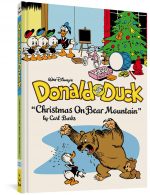
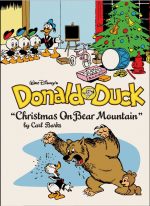
In 2013 Fantagraphics Books began collecting Barks’ Duck stuff in wonderful, carefully curated archival volumes, tracing his output year-by-year in hardback tomes and digital editions that finally do justice to the quiet creator. These will eventually comprise the Complete Carl Barks Disney Library. The physical copies are sturdy and luxurious albums – 193 x 261 mm – that would grace any bookshelf, with volume 5 – Walt Disney’s Donald Duck: “Christmas on Bear Mountain” (for reasons irrelevant here) acting as debut release, re-presenting works from 1947 – albeit not in strictly chronological release order.

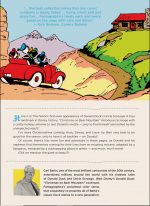
It begins eponymously with landmark introduction of Bark’s most enduring creation. Scrooge McDuck premiered in seasonal full-length Donald Duck yarn ‘Christmas on Bear Mountain’ (Four Color #178 December 1947): a mere disposable comedy foil to move along a simple tale of Seasonal woe and joy. Here a miserly relative seethed in opulent isolation, hating everybody and opting to share the gloom by tormenting his nephews Donald, Huey, Louie and Dewey by gifting them his mountain cabin for the Holidays. Scrooge schemed, intent on terrorising them in a bear costume, but fate had other ideas…

The old coot  was crusty, energetic, menacing, money-mad and yet oddly lovable – and thus far too potentially valuable to be misspent or thrown away. Undoubtedly, the greatest cartoon creation of the legendary and magnificent story showman Carl Barks, the Downy Dodecadillionaire returned often and eventually expanded to fill all available space in the tales from the scenic metropolis of Duckburg.

From the same issue a brace of one-page gags expose Donald’s views on car culture in ‘Fashion in Flight‘ and annoying people looking for directions in ‘Turn for the Worse’ before

‘Donald’s Posy Patch’ (Walt Disney’s Comics and Stories#80, May) turns into another painful and humiliating experience as the bellicose bird tries getting rich by growing blooms…

June’s WDC&S #81 finds him and the kids prospecting and running foul of the post-war arms and rocket-race in ‘Donald Mines his Own Business’ before Four Color #147 (May) takes them on an epic voyage of fantastic discovery to ‘Volcano Valley’ after accidentally buying an army surplus bomber…

Always looking for a quick buck, Donald and the kids turn to commercial charters: flying innocuous-seeming Major Pablo Mañana back to Central American beauty-spot Volcanovia, but they all have a devilishly difficult time getting out again. This yarn sets a solid pattern for Bark’s adventure/travelogue yarns in years to come, blending comedy, thrills, whimsy and social commentary into an irresistible treat…

WDC&S #82 (July) sees adult and juvenile ducks in an ever-escalating war over who’s the best conjuror in ‘Magical Misery’ and by the time Daisy Duck deals with them, Donald is ready for a day of peace and quiet. Sadly, ‘Ring Wrongs’(AKA ‘Vacation Time’ from August’s Walt Disney’s Comics and Stories #83 reveals that thanks to Huey, Louie and Dewey, he’s the target of a relentless wave of door-to-door salesmen and reacts with typical zest and vigour…

An inappropriate experiment in hypnosis transforms Donald (mentally) into a kangaroo and prompts an ‘Adventure Down Under’ (Four Color #159 August) with the eventually restored Drake and his nephews compelled to become ‘roo hunters to pay for return passage to Duckburg. They are mightily outmatched by Mournful Mary “Queen of the Kangaroos” until they meet some local aborigines and experience a change of heart.

Please be aware that – despite Bark’s careful research and diligent, sensitive storytelling – some modern folk might be upset by his depictions from over seven decades ago.

‘If the Hat Fits’ is a gag-page of chapeau japery from Four Color #147 (May), that precedes a medium-length tale describing Donald’s efforts to master dancing in ‘The Waltz Kings’ from WDC&S #84 (September) counterbalanced a month later by #85’s ‘The Masters of Melody’ wherein the boys struggle to learn to play musical instruments…

‘Donald Duck and the Ghost of the Grotto’ is an early masterpiece originating in Four Color #159 (August 1947), with Donald and the kids in the West Indies, running a kelp boat and harvesting seaweed from the abundant oceans.

After being temporarily stranded on an isolated reef, they discover monsters, a shipwrecked galleon, an ongoing abduction mystery dating back centuries and a particularly persistent phantom all blending into a supremely thrilling and beguiling mystery that has never dated…

WDC&S #86 exposes the rise and fall of ‘Fireman Donald’ whose smug hubris deprives him of a job he’s actually good at, after which ‘The Terrible Turkey’ from details the Duck’s frankly appalling efforts to secure a big bird for the Thanksgiving feast despite skyrocketing poultry prices…

Donald and Mickey Merry Christmas 1947 (cover-dated January 1948) sees the boys strive a little too late and much too hard to be ‘Three Good Little Ducks’ and ensure a wealth of swag on Christmas morning before one final single-pager sees kitchen confusion for Donald in ‘Machine Mix-up’ from Four Color #178 (December)…

With the visual verve done we move on to validation as ‘Story Notes’ provides erudite commentary for each Duck tale and Donald Ault relates ‘Carl Barks: Life Among the Ducks’ before ‘Biographies’ reveals why he and commentators Alberto Beccatini, Joseph Robert Cowles, Craig Fischer, Jared Gardner, Rich Kreiner, Ken Parille, Stefano Priarone, R, Fiore, Mattias Wivel are saying all those nice and informative things.

We then close with an examination of provenance as ‘Where Did These Duck Stories First Appear?’ explains the somewhat byzantine publishing schedules of Dell Comics.

Carl Barks was one of the greatest exponents of comic art the world has ever seen, and almost all his work featured Disney’s characters: reaching and affecting untold millions of readers across the world and he all too belatedly won far-reaching recognition. You might be late to the party but it’s never too soon to climb aboard the Barks Express.
Walt Disney’s Donald Duck “Christmas on Bear Mountain” © 2013 Disney Enterprises, Inc. All contents © 2013 Disney Enterprises, Inc. unless otherwise noted. All rights reserved.

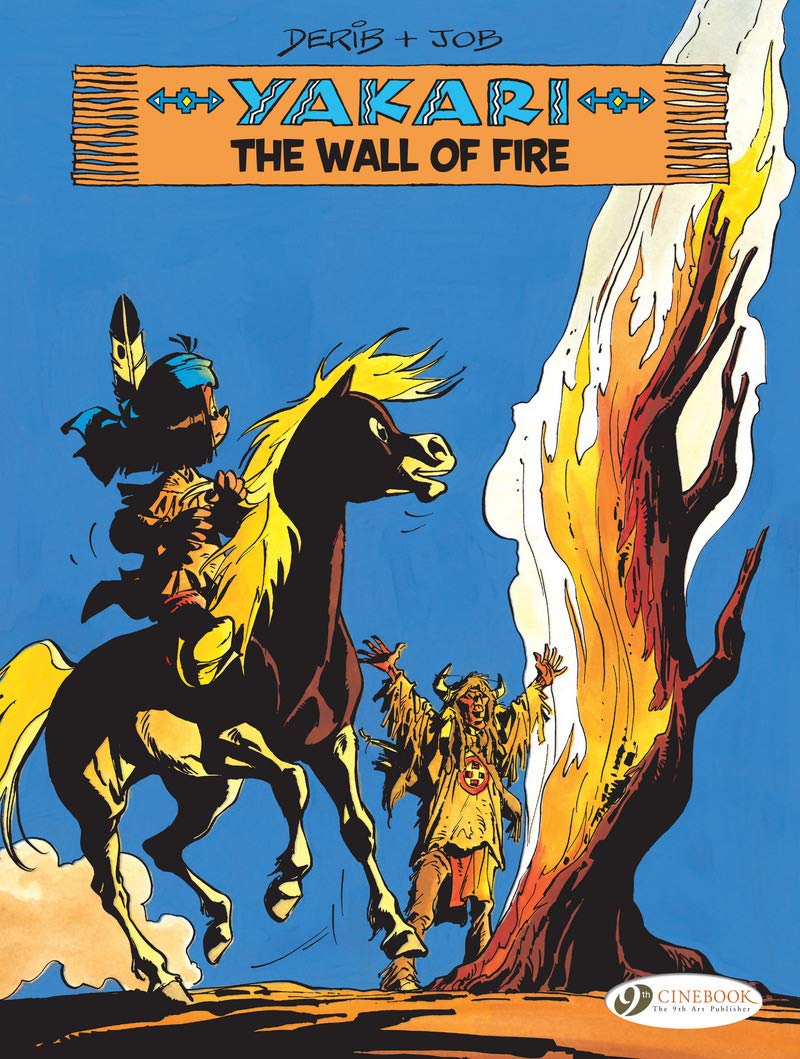
Yakari volume 18: The Wall of Fire


By Derib & Job, coloured by Dominique and translated by Jerome Saincantin (Cinebook)
ISBN: 978-1-84918-591-2 (Album PB)

Win’s Christmas Gift Recommendation: Superb All-Ages Entertainment and Adventure… 9/10

Children’s magazine Le Crapaud à lunettes was founded in 1964 by Swiss journalist André Jobin who then wrote for it under the pseudonym Job. Three years later he hired fellow French-Swiss artist Claude de Ribaupierre AKA “Derib”. The illustrator had launched his own career as an assistant at Studio Peyo (home of Les Schtroumpfs), working on The Smurfs strips for venerable weekly Le Journal de Spirou. Together, they created the splendid Adventures of the Owl Pythagore before striking pure comics gold a few years later with their next collaboration.

Derib – equally au fait with enticing, comically dynamic “Marcinelle” cartoon style yarns and devastatingly compelling meta-realistic action illustrated action epics – went on to become one of the Continent’s most prolific and revered creators. It’s a crime that groundbreaking strips such as Celui-qui-est-né-deux-fois, Jo (the first comic ever published dealing with AIDS), Pour toi, Sandra and La Grande Saga Indienne) haven’t been translated into English yet, but we still patiently wait in hope and anticipation…

Many of Derib’s stunning works over the decades feature his cherished Western themes; magnificent geographical backdrops and epic landscapes. Yakari is considered by fans and critics to be the strip which first led him to deserved mega-stardom.

Debuting in 1969, Yakari follows the life of a young Oglala Lakota boy on the Great Plains and is set sometime after the introduction of horses by the Conquistadores but before the coming of modern Europeans.

The series – which has generated two separate animated TV series and a movie release last year – has achieved 40 albums thus far: a testament to the strip’s evergreen vitality and the brilliance of its creators, even though originator Job has moved on and Frenchman Joris Chamblain assumed the writer’s role in 2016.

Overflowing with gentle whimsy and heady compassion, young Yakari enjoys a largely bucolic existence: at one with nature and generally free from privation or strife. For the sake of our delectation, however, the ever-changing seasons are punctuated with the odd crisis, generally resolved without fuss, fame or fanfare by a little lad who is smart, brave… and can – thanks to a boon of his totem guide the Great Eagle converse with all animals …

Originally released in 1993, la barrière de feu was the 19th European album, but – as always with the best books – the content and set-up are both stunningly simple and effectively timeless, affording new readers total enjoyment with a minimum of familiarity or foreknowledge required…

This time, the little wonder is embroiled in uncharacteristically dark deeds as a raiding party led by Wild Mane results in the loss of all the horses – except valiant pony Little Thunder who not only escapes but also raises the alarm and rouses the sleeping tribe.

As the adults set out on foot to recover their steeds and reclaim their honour, little Yakari tracks his equine friend and is amazed to find Little Thunder is trailing his stolen herdmates. As he follows, the loquacious lad meets a flying squirrel who kindly offers to act as an advance scout…

While the grown-ups are stymied by their cunning quarry’s tactics, the tiny tree-hugger rapidly reunites the boy with his horse and the trio set off together after the thieves. All too soon they have located the raiders, but instead of useless heroic gestures they sagely seek out Yakari’s father and lead his team to the thieves.

Dauntingly, it’s a nomadic convocation of thousands, and a retaliatory raid seems impossible. Moreover, something is shadowing the stalkers themselves, ever unseen but even getting close enough to steal supplies while they’re being carried! The adults are seriously considering swallowing their shame and retreating, but Yakari cannot let go of the notion that something is smarter than he is…

Ultimately, with help from his bestial buddies, the mystery is solved and the boy meets a new friend: a wounded lynx. The beautiful, cunning creature shows the curious kid a new trick: a sticky black liquid that oozes out of the ground and is ideal for sealing wounds.

When the shaman sees it he recognises it for all its many properties, including a tendency to burn, which gives Yakari’s father an inspired idea for countering the raiders’ superior numbers and getting back the tribe’s most treasured possessions…

Exotically enticing, deviously educational and wildly entertaining, this boldly action-packed and splendidly spectacular yarn sees Yakari’s gifts not only used to benefit his people and animal friends but also with the full acknowledgement of the adults he’s previously been unknowingly slighted by. Is our boy finally on the path to being a man?

Once again, Derib & Job display their astounding and compelling narrative virtuosity in another glorious graphic tour de force capturing the appealing courage of our diminutive heroes, and a visually stunning, seductively smart saga to delight young and old alike.

Yakari is one of the most unfailingly absorbing all-ages strips ever conceived and should be in every home, right beside Tintin, Uncle Scrooge, Asterix and The Moomins.
Original edition © Derib + Job – Editions du Lombard (Dargaud- Lombard s. a.) 1993. All rights reserved. English translation 2020 © Cinebook Ltd.

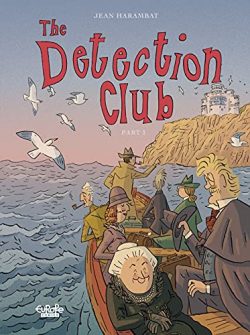
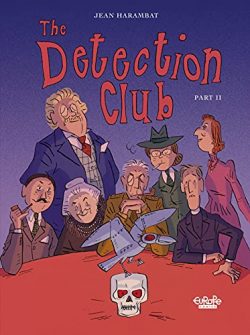
The Detection Club parts 1 & 2


By Jean Harambat, coloured by Jean-Jacques Rouger translated by Allison M. Charette (Europe Comics)
No ISBN: digital release only

Win’s Christmas Gift Recommendation: BA Perfect Portion of Post-Prandial Perplexity…  9/10

What’s the Holiday Season without a devilish mystery to chew on? Not nearly as much fun, I’m sure, and with that in mind here’s a brace of superb cartoon conundrums from the continent, based on an unlikely but actual historical convocation.

As seen on Wikipedia – please use often and make a large a supporting financial donation, if you can – The Detection Club was a literary society of British crime writers, founded in 1930, with the likes of G.K. Chesterton, Dorothy L. Sayers and Agatha Christie as early Presidents. In 1936, American émigré John Dickson Carr became the first non-Brit elected to the august body.

They did stuff, wrote stories, held events and upheld (Ronald) Knox’s Commandments which detailed the rules of mystery writing. The group is the basis of later media McGuffin’s such as Batman‘s Mystery Analysts of Gotham City.

I’m pretty sure the story here collected in two volumes by award-winning cartoonist, screenwriter, graphic novelist, historian, philosopher and journalist Jean Harambat (Les Invisibles, Ulysses, the Songs of Return, Operation Copperhead) is apocryphal, but you never know…

Originally released in 2019, our story opens in a prologue with the reciting of those commandments and the confirmation of Mr. Dixon Carr at a slap-up feed at London hostelry Ye Olde Cheshire Cheese – a pub that doesn’t seem to mind the odd celebratory gunshot…

Present are President Chesterton, Dixon Carr, Christie, Sayers, Baroness Emma Orczy, Major A.E.W. Mason and Monsignor Ronald Knox himself, and – as the repast winds down – proceedings are somewhat disturbed by the arrival of a flying, talking robotic bird bearing a strange invitation…

Eccentric man of means Mr. Roderick Ghyll wishes the company of the sagacious society at his extraordinary domicile on April 1st. Briarcliff House is situated on a private island where Ghyll wishes to celebrate the future through his latest contrivance, promising “challenges”, “enchantments” and “the renaissance of crime fiction”…

Chapter I opens with the scribes and scribblers approaching ‘An Island in Cornwall’ and still heatedly debating the motives of the mystery man. Ghyll greets them effusively before whizzing off in a bizarre electric unicycle leaving them to make their way to his palatial manse which is a gleaming tribute to sleek, tripped down modernism – if not actual futurism…

Apart from the domestic staff chef Alphonse, maid Madeline, implacable Asian manservant Fu, and stepdaughter Millicent, the only other human present is technical assistant Dr. Zumtod and Ghyll’s haughty beautiful wife Honoria. A future generation would call her a “trophy”…

The old plutocrat is a deeply unpleasant and overbearing host who boasts of one more personage that the sharp-minded, brain-testing authors must meet. With smugness and great ceremony he introduces Eric: a mechanical man with more than human insight who can outwit any mortal and easily determine the culprit in any tale they might concoct…

Although challenged with the details of a string of classic novels – which Eric easily and correctly concludes with the name of the perpetrators – the writers remain insulted and unconvinced. Dixon Carr even oversteps the bounds of polite decency by probing the automaton in search of a pre-prepped dwarf or amputee and the display is halted for dinner where Ghyll continues to advocate a world filled with his “metal friends”…

The evening wears on with the usual social distractions balanced by heated argument on many topics sparked by Eric’s existence and the magnate’s pronunciations that art and literature must make way for a machine-run world. At last, the affair breaks up with the guests retiring to their assigned rooms in a state of high dudgeon…

That all ends in esteemed literary tradition, with screams and the writers breaking into Ghyll’s savagely disarrayed bedroom to discover Eric inert in a chair and clear evidence of ‘The Billionaire Out the Window’. Far below, a dressing gown sinks beneath choppy waves and frantic searches can find no sign of their host…

Well-versed if not actually experienced in investigation, the writers set about interviewing the staff and then the residents. Soon Zumtod suggests the painfully obvious: turning Eric loose on the problem. The response is as rapid as the answer is shocking…

While waiting for the outer world to re-establish contact with the isolated isle, Agatha bonds with the presumed widow and probes the step-daughter, whilst Chesterton continues to scour the entire vicinity. He’s suspicious of everything – including whether there has been any crime at all – and soon unearths many unsuspected secrets even as each writer cleaves to their particular speciality and makes their own assessment and forms a hypothesis…

And then a body washes ashore…

The Detection Club‘s second volume begins with third chapter ‘Seven Amateur Detectives’ and an armada of late-arriving constabulary led by Inspector Widgeon to interview the drawing room sleuths. Mounting tensions, contrary theories and wounded pride quickly drive all concerned to fractious conflict even as Millicent’s banished and outcast twin Watkyn re-emerges. Has he only returned because of his despised step-father’s demise or was he actually back just before it happened?

Events seemingly come to a head when Christie expounds her latest theory and provokes a minor hostage crisis until the villain is apprehended through unlikely team work. As the police step in with the handcuffs however, new evidence emerges that sets the cogitators back on the murder-trail until straightforward ratiocination leads one author to the only possible solution…

Wry, witty, and decidedly well-plotted, with devastatingly sharp, catty dialogue (kudos to translator Allison M. Charette) and smart characterisations, this lovely lark is also charmingly limned: a superb tribute to days gone by and superb stylists who tested our wits and expanded our entertainment horizons. This is tale no  whimsically-inclined crime fan can afford to miss.

© 2020 – DARGUAD – HARAMBAT. All rights reserved.

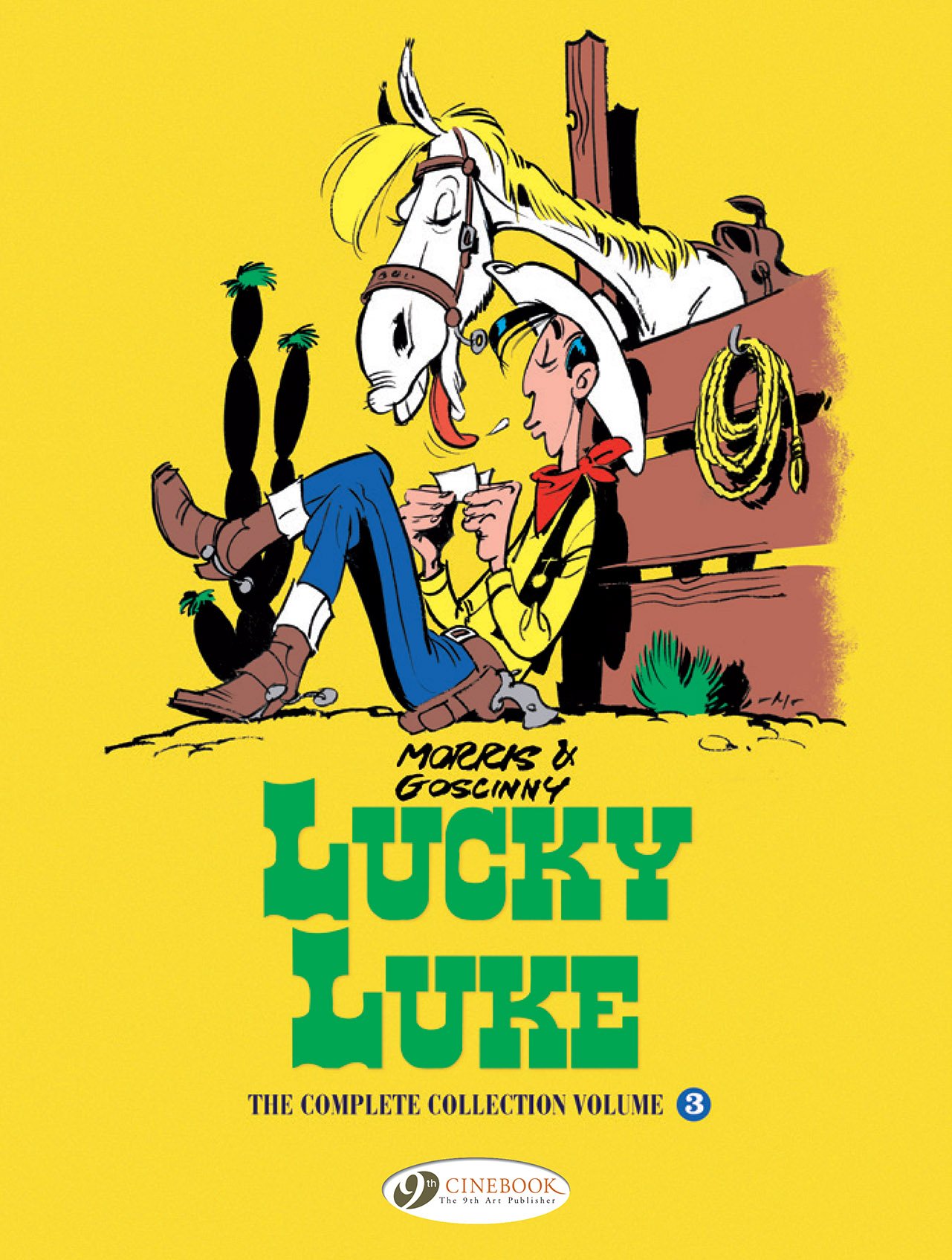
Lucky Luke: The Complete Collection volume 3


By Morris, with René Goscinny; translated by Jerome Saincantin (Cinebook)
ISBN: 978-1-84918-455-7 (Album HB)

Win’s Christmas Gift Recommendation: Blockbuster Thrills No Movie Could Match… 8/10

On the Continent, the populace has a mature relationship with comics: according them academic and scholarly standing as well as meritorious nostalgic value and the validation of acceptance as an art form. Whilst tracing the lost origins of a true global phenomenon, this hardback and digital compilation celebrates the formulative early triumphs of a fictional hero who is certainly a national treasure for both Belgium and France, and it’s also timely in that this worldwide western wonder celebrates his 75th Anniversary this year…

As we know him now, Lucky Luke is a rangy, good-natured, lightning-fast cowboy roaming the fabulously mythic Old West, having light-hearted adventures with his horse Jolly Jumper whilst interacting with a host of historical and legendary figures and icons.

His ongoing exploits have made him one of the best-selling comic characters in Europe (upwards of 80 collected books, plus spin-off series, archival collections and specials, translated into more than 300 million albums in at least 33 languages thus far). He’s also accrued all the usual merchandise spin-offs: toys, computer games, puzzles, animated cartoons, TV shows and live-action movies.

Lucky debuted in 1946, courtesy of Belgian animator, illustrator and cartoonist Maurice de Bévère (“Morris”). For many years we all believed his first appearance was in a Le Journal de Spirou Christmas Annual – L’Almanach Spirou 1947 – before being catapulted into his first weekly adventure ‘Arizona 1880’ on December 7th 1946.

However, the initial volume in this superb archival series (in hardback album and digital editions) revealed the strip actually premiered earlier that year in the multinational weekly comic, but without a title banner and only in the edition released in France…

This third curated outing exhibits – in strict chronological order – strips created between December 1952 and February 1955, with all the art and pages here restored, rejiggled and remastered to achieve maximum contemporary authenticity with the original weekly serialisation. The stories were subsequently gathered as albums L’Élixir du Docteur DOXEY (November 1955, with successive volumes launching every year in that month), Lucky Luke contre Phil Defer (1956) and Des rails sur la Prairie (1957) and this tome even offers a little something extra at the end…

Previous volumes have detailed Morris’s life, career, and achievements, paying particular attention to his alternate duties as an illustrator and caricaturist for magazine Le Moustique and at the CBA (Compagnie Belge d’Actualitiés) cartoon studio, where he met future comics superstars Franquin and Peyo.

Morris was one of “la Bande des quatre” – The Gang of Four – comprising Jijé, Will and Franquin: leading proponents of a new, loosely free-wheeling artistic style known as the “Marcinelle School” which dominated Le Journal de Spirou in aesthetic contention with the “Ligne Claire” style used by Hergé, EP Jacobs and other artists in Le Journal de Tintin.

In 1948 said Gang (all but Will) visited America, meeting US creators and sightseeing. Morris stayed for six years, meeting fellow émigré René Goscinny, scoring work at newly-formed EC sensation Mad and constantly making copious notes and sketches of the swiftly vanishing Old West.

His ongoing works are further detailed and  his “American Period” is extensively explored here in another lavishly illustrated essay from researchers Christelle & Bertrand Pissavy-Yvernault, who relate the Morris family’s jaunts and travels, paying particular attention to the movies they saw and how cinematic flourishes were transformed and recycled on the pages of Lucky Luke. Also on view are examples of work done for American consumption, such as children’s book Puffy Plays Baseball.

Crucially, there’s a detailed section on Goscinny, featuring his artwork – like so many, he was originally a cartoonist who realised his true strengths were plots and words – and side gigs in the USA: foreign correspondent, copywriter, business manager and more. At this time he created evergreen kids feature Le Petit Nicolas with Sempé in Le Moustique and his partnership with Morris formally began. What began as casual assistance eventually became a team effort that changed both their lives after they returned to Europe…

Accompanied by published cartoons and covers, contemporary ads, family photos and tons of original art, the in-depth treatise also focuses on the how and why of edited comics pages; reveals the artist’s film memorabilia (from movies that especially influenced his stories in this collection) and also includes both artwork from European and US publications by Goscinny. There’s even an in-depth analysis of how What Morris Saw became What Lucky Did, closely referencing the comics stories that follow…

Working solo (with early script assistance from his brother Louis De Bevere) until 1955, Morris produced nine albums of affectionate sagebrush parody and action before uniting with Goscinny, who became the regular wordsmith as Luke attained the dizzying heights of superstardom, commencing with Des rails sur la Prairie (Rails on the Prairie), in Le Journal de Spirou in August 1955.

Before we get there though, there’s all-Morris action to enjoy, starting with Doc Doxey’s Elixir which was originally serialised in Le Journal de Spirou #765-808, from December 11th 1952 to 8th October 1953. It relates the predatory journeys of a charlatan physician dispensing disgusting and often lethal liquid cure-alls, aided and abetted by his athletic stooge Scraggy, who gulls the public with his disguises and semi-miraculous instantaneous “recuperations” and fast exits.

Their pernicious peregrinations come to an end after poisoning the frontier town of Green Valley, which puts dogged Lucky on their trail. Packed with classic and episodic chase gags, the hunt concludes with the sneaky snake oil peddler behind bars. Of course, he doesn’t stay there long as sequel saga ‘Manhunt’ details his cunning escape, change of identity – but not modus operandi – and ultimately unsuccessful plot to murder the wandering cowboy…

Follow-up album Lucky Luke contre Phil Defer (or Lucky Luke: Phil Wire in Britain) also comprised two tales, but this time taken from the company’s general entertainment periodical. It introduced deadly gunslinger Phil Wire “The Spider” – based on legendary cinematic bad man Jack Palance – in a strip taken from Le Moustique #1464-1494 (14thFebruary-12th September 1954).

Phil Defer “LE FAUCHEUX” sells his lethal talents to sinister saloon owner O’Sullivan who’s looking to remove a rival. Fate – or perhaps the gods of comedy – unfortunately decree that another tall guy good with guns gets to Bottleneck Gulch first and is mistaken for the rather idiosyncratic notoriously superstitious killer…

Lucky and Wire have already clashed once before and – despite all the hero’s efforts to deter O’Sullivan – meet once more after all “the Spider’s” schemes to remove rival barkeep O’Hara are foiled. It comes down to a showdown on main street and only one man walks away…

The album also features a second serial from Le Moustique #1508-1516 (spanning 19th December 1954 to 13th February 1955): originally entitled Lucky Luke et Pilule.

As Lucky Luke and The Pill it here details a camp fire story told by the rangy gunman, relating how a short-sighted, diminutive hypochondriac tenderfoot with no discernible fighting ability or action acumen became a true gun-toting town-tamer…

It was back to Le Journal de Spirou for the final album reprinted here: gathering material from #906-929 and spanning 25th August 1955 to 2nd February 1956 before launching in November 1957 as ninth album Des rails sur la Prairie. Although uncredited, it was cowritten by Morris and fellow tourist Goscinny: auguring an astounding creative partnership to come…

In 1967 the six-gun star switched publishing teams, transferring to Goscinny’s own magazine Pilote with La Diligence (The Stagecoach). Goscinny produced 45 albums with Morris before his death, from whence Morris continued both singly and with fresh collaborators.

Morris died in 2001 having drawn fully 70 adventures, plus the spin-off adventures of Rantanplan (“dumbest dog in the West” and a charming spoof of cinema canine Rin-Tin-Tin), with Achdé, Laurent Gerra, Benacquista & Pennac taking over the franchise, producing another five tales to date.

Also in 1967, Lucky Luke appeared in British comic Giggle where he was renamed Buck Bingo. He had previously been seen here in weekly comic Film Fun. Before all that, though, this wild and woolly transitional delight features a far more boisterous and raw hero, offering the lighter side of another mythic western scenario…

When track-laying for the Transcontinental Railroad stalls, outraged train moguls demand action and Dead Ox Gulch, Nebraska becomes the crunch point of confrontation. The construction problems are actually caused by a traitor at home. Although a board-member in good standing Black Wilson is also secretly sabotaging the project to protect his other business: a stage coach company…

He contacts the nefarious Wilson Boys gang to keep up the bad work, just as a tall, laconic stranger rides into town. Before long, he is spearheading the march of progress and civilisation by foiling every dirty trick the gang can conceive…

Once the renewed efforts have moved beyond town and onto the prairie and inching closer to California, a train carries Lucky, passengers and the navvies ever-westward, negotiating and stymying hostile natives, greedy townships and the still-active Wilson boys’ shady tactics and stratagems.

Ultimately, Black Wilson takes personal charge and boards a stagecoach westward to destiny. Despite his every trick, though, the showdown is a foregone conclusion…

Adding extra value here is a short Luke lark that first appeared in Risque-Tout #5 (December 1955). A monochrome vignette, ‘Ruckus in Pancake Valley’ has been redrawn and coloured here and details how Lucky tracks down a miscreant who stole his horse…

Packed with contemporaneous extras, commentary, creator biographies, a special ‘Christmas in the Far West’ feature and more, this is perfect for older kids who have gained a bit of historical perspective and social understanding, although the action and slapstick situations are no more contentious than any Laurel and Hardy film – perfectly understandable as Morris was a huge fan of the duo. These early exploits are a grand old hoot in the tradition of Destry Rides Again or Support Your Local Sheriff, superbly executed by a master storyteller, and a wonderful introduction to a unique genre for modern kids who might well have missed the romantic allure of the Wild West that never was…

Bon Anniversaire, Lucky!
All pages relating to Doc Doxey’s Elixir, Phil Wire and Ruckus in Pancake Valley are © Morris/Dupuis 2018. 1949 to 1954 for the first publications in Le Journal de Spirou. All pages relating to Rails on the Prairie © Morris/Goscinny/Dupuis 2018. English translation © 2019 Cinebook Ltd.