A Love for the Ages


By Florence Cestac & Daniel Pennac translated by Edward Gauvin (Europe Comics )
No ISBN: 978-1-910395-63-9 (digital edition)

A writer and an artist go into a restaurant. They make comics for a living, but tonight the talk is of love. Before long, the entire place is involved in the conversation. No, not conversation, Story. Any relationship that has, is or may develop is irrelevant here. The writer is talking about years ago when an impressionable waif encountered and observed the most incredible romance and was forever after beguiled…

Now it’s time to immortalise the affair through words and pictures, and like that keenly observed life of domestic paradise, it must be perfect…

Memories flow, snippets are recalled and a story within a story unfolds and gels. Years back, before the Riviera reinvented itself as a haunt of international snobs and wastrels, inland from Nice in rural La-colle-sur-loup, old folks congregated in picturesque village enclaves and  grandparents got stuck with the youngsters in summer.

Bored and watchful, our kid and his local pals’ best chance of amusement was watching Jean and Germaine Bozignac: she, a delightfully feisty and affably bubbly sharing soul, and he, a hideously ugly yet startlingly charismatic and charming rogue. By all lights, Jean should have been a blight on the community: a cheating cardsharp who never worked after being cut off and disowned from his aristocratic wine-growing family. Yet somehow, the disgraced Marquis was adored by most and accepted by all.

Jean and Germaine were inseparable and lived by, with and through books, and on the day the little the writer-to-be learned that the cashiered lord’s reduced circumstances stemmed solely from his refusing to give up house servant Germaine, the passionate child’s future was set. This was what Love Should and Must be…

Expansive yet grounded, witty, compelling and outrageously funny in all the right ways, A Love for the Ages is the kind of tale our continental cousins excel at: light, fluffy, hilarious yet packed with heartbreaking moments and lined with hidden steel to hit hard when you least expect it.

Only available in English digitally at present, this is what it means to be in love all your life – and trust me I know whereof I speak: my good lady wife has put up with me for nearly 33 years and all I’ve ever had are flesh wounds, contusions and minor bouts of food poisoning. If that’s not proof of a love divine, then what is?
© 2015 DARGAUD – Cestac & Pennac. All rights reserved

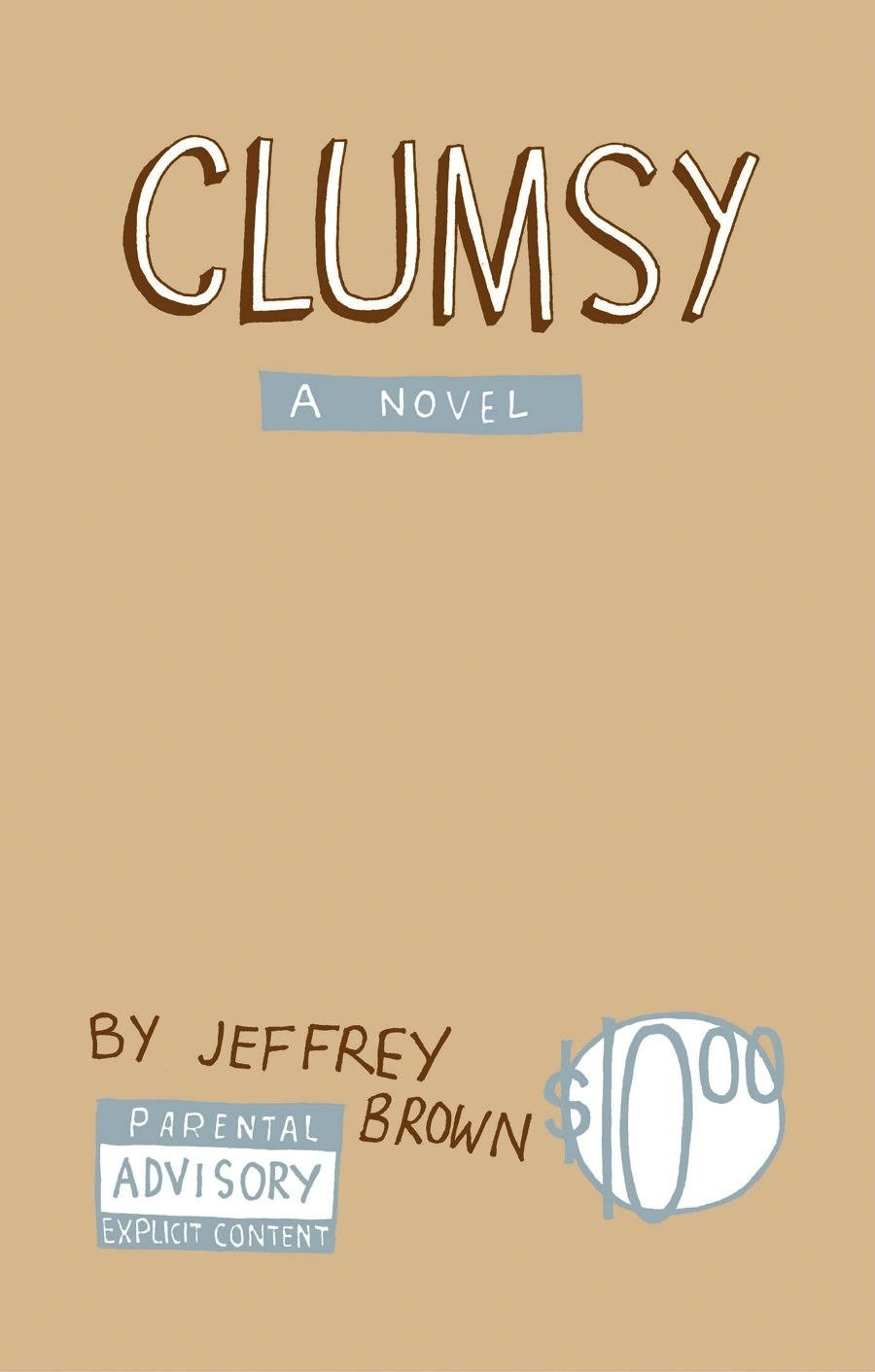
Clumsy


By Jeffrey Brown (Top Shelf Productions)
ISBN: 978-0-97135-976-5 (TPB/Digital edition)

If you’re a fan of Jeffrey Brown’s cartoon exploits you might understandably admit to a small degree of confusion. In 2012 he scored his first global best-seller with a hilarious spin on the soft and nurturing side of the Jedi experience in Darth Vader and Son, following up with equally charming and hilarious sequels Vader’s Little Princess, Star Wars: Jedi Academy and others. You’ll probably adore his latest treats – the Lucy & Andy Neanderthal series…

Before that, Jeffrey Brown was the sparkling wit who had crafted slyly satirical all-ages funny stuff for The Simpson’s Treehouse of Horror, Marvel’s Strange Tales and Incredible Change-Bots and similar visual venues.

The original is yet another Jeffrey Brown: instigator and frequent star and stooge of such quirkily irresistible autobiographical Indy comics classics as Bighead, A Matter of Life, Little Things, Funny, Misshapen Body,Undeleted Scenes and the 4-volume “Girlfriend Trilogy” – Unlikely, AEIOU and Every Girl is the End of the World For Me and opening shot Clumsy, …

Whichever Brown’s your preferred choice, he’s a cartoonist of rare insight and unflinching revelation who still makes you laugh out loud when not prompting you to offer a big consoling hug…

Brown was raised in Michigan but relocated to Chicago in 2000 to attend the School of the Arts Institute. He studied painting but before graduating switched to drawing comics. Clumsy was released in 2002, quickly becoming a surprise hit with fans and critics alike.

The material is both delicious and agonising in its forthright simplicity: a sequence of non-chronological pictorial snippets and vignettes detailing in no particular order how a meek, frumpy, horny, inoffensively charming art-school boy meets a girl and tries to carry out a long-distance relationship.

Every kid who’s gone to college, got a job or joined the services has been through this, and for every romance that makes it, there a million that don’t.

Drawn in a deceptively Primitivist style with masterful staging, a sublime economy of phrase plus a breathtaking gift for generating in equal amounts belly-laughs and those poignant lump-in-throat moments we’ve all experienced and forever-after regretted, this is a skilful succession of stolen moments which establish one awful truth.

We’ve all been there, done that and then hoarded those damned photos we can’t even look at any more…

With titles like ‘My Last Night with Kristyn’, ‘Don’t Touch Me’, ‘I Draw her Naked’, ‘I Farted’, ‘But I Want to Make Love’ and ‘You Can Ask Me’, a mosaic of universal joy and despair forms as we watch Jeff and Theresa meet, blossom, exult, dream, plan and part…

Packed with hearty joyous wonder and brimming with hilarious examples of that continual and seemingly tireless teen-lust us oldsters can barely remember now, let alone understand, Clumsy is a magical delight for anybody safely out of their Romeo & Juliet years and a lovely examination of what makes us human, hopeful and perhaps wistfully incorrigible…
© 2002 Jeffrey Brown.

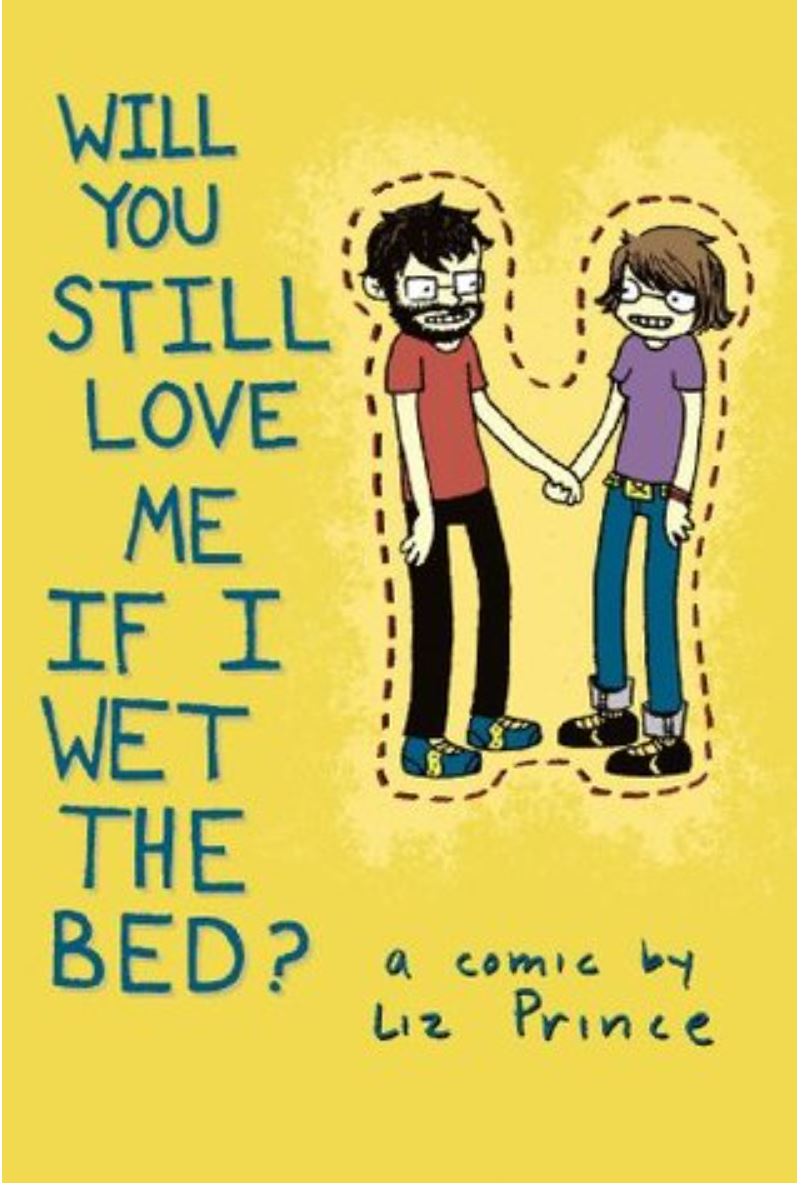
Will You Still Love Me If I Wet the Bed?


By Liz Prince (Top Shelf Productions)
ISBN: 978-1-89183-072-3 (PB/Digital edition)

There’s an irrepressible rumour going about that Love makes the World Go Round. My grasp of physics isn’t strong enough to confirm or deny the hypothesis but I have read enough comics in my time to spot a magical and unmissable celebration of the all-consuming emotion when I see one.

Liz Prince originally hailed from Sante Fe, New Mexico before upping sticks and heading across county in an Eastward direction to attend the School of the Museum of Fine Arts in Boston (Massachusetts, not Lincolnshire).

She is a cartoonist – one of many – who thankfully opted to create a visual journal of her life and saw that one subject kept monopolising her attention. She is also an inspired raconteur who knows how to spin a graphic yarn in adroitly truncated form. Thus, this slim collection which gathers a whole bunch of sublimely intimate, hilariously real moments spent with and apart from her equally fascinating man Kevin and the awesome force which is their cat Science.

Contained in this marvellous monochrome paperback posy are vignettes exploring the giddy silliness of fresh physicality, quirkily adorable breaking of bathroom taboos, the agony and relief of momentary solitude, incidents of intimate accommodation and lots of lovely eternal challenges that test every couple… especially the often bloody traumas of explaining to the incumbent household pet that they are not necessarily “Number One” any more…

Fronted by a suitably droll but downbeat pictorial Introduction ‘On Liz Prince’ by legendary lovelorn doodler Jeffrey Brown, Will You Still Love Me If I Wet the Bed? is thankfully still available – and instantly so if you opt for a downloadable versions (Kindle, Comixology etc.), or preferably direct from Top Shelf Productions – so if you want to share some romantic fellow feeling or just need to see that there’s still hope for all the lonely hearts, this a graphic gem you should promptly treat yourself to.
© & ™ Liz Prince 2005. All rights reserved.

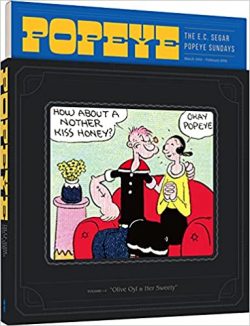
Popeye volume 1: Olive Oyl & Her Sweety (The E.C. Segar Popeye Sundays


By Elzie Crisler Segar with Sergio Ponchione, Cathy Malkasian & various(Fantagraphics Books)
ISBN: 978-1- 68396-462-9 (PB/digital edition)

Popeye popped up in the Thimble Theatre comic strip for January 17th 1929. The strip was an unassuming feature that debuted on 19th December 1919: one of many newspaper cartoon funnies to parody, burlesque and mimic the era’s silent  movies serials. Its more successful forebears included C.W. Kahles’ Hairbreadth Harry and Ed Wheelan’s Midget Movies / Minute Movies .

These all used a repertory company of characters to play out generic adventures firmly based on those expressive cinema antics. Thimble Theatre‘s cast included Nana and Cole Oyl, their gawky daughter Olive, diminutive-but-pushy son Castor, and Horace Hamgravy, Olive’s sappy, would-be beau.

The series ticked along for a decade, competent and unassuming, with Castor and Ham Gravy (as he became) tumbling through get-rich-quick schemes, fear-free adventures and simple gag situations until September 10th 1928, when explorer uncle Lubry Kent Oyl gave Castor a present from his latest exploration of Africa: a hand-reared Whiffle Hen – most fabulous of all birds. It was the start of something groundbreaking.

Whiffle Hens are troublesome, incredibly rare and possessed of fantastic powers, but after months of inspired hokum and slapsick shenanigans, Castor was resigned to Bernice – for that was the hen’s name – when a series of increasingly peculiar circumstances brought him into contention with the ruthless Mr. Fadewell, world’s greatest gambler and king of the gaming resort of ‘Dice Island’.

Bernice clearly affected writer/artist E.C. Segar, because his strip increasingly became a playground of frantic, compelling action and comedy during this period…

When Castor and Ham discovered that everybody wanted the Whiffle Hen because she could bestow infallible good luck, they sailed for Dice Island to win every penny from its lavish casinos. Sister Olive wanted to come along but the boys planned to leave her behind once their vessel was ready to sail. It was 16th January 1929…

The next day, in the 108th instalment of the saga, a bluff, irascible, ignorant, itinerant and exceeding ugly one-eyed old sailor was hired by the pair to man the boat they had rented, and the world was introduced to one of the most iconic and memorable characters ever conceived. By sheer, surly willpower, Popeye won the hearts and minds of readers: his no-nonsense, grumbling simplicity and dubious appeal enchanting the public until by the end of the tale, the walk-on had taken up full residency. He would eventually make the strip his own…

The Sailor Man even affably bulldozed his way onto the full-colour Sunday Pages which form the main course of this curated collection spanning 2nd March 1930 through February 28th  1932.

This paperback is the first of four that will contain the entire Segar Sunday canon and is designed to be stored in a forthcoming slipcase. Spiffy as that sounds, the wondrous stories are also available in digital editions if you want to think of ecology or mitigate age and muscle strain in your spinach-deprived muskles…

Since many papers only carried dailies or Sundays, not necessarily both, a system of differentiated storylines developed early in American publishing, and when Popeye finally made his belated appearance, he was already a fairly well-developed character.

Thus, Segar concentrated on more family-friendly gags – and eventually continued mini-sagas – and it was here that the Popeye/Olive Oyl modern romance began: a series of encounters full of bile, intransigence, repressed hostility, jealousy, mind games and passion which usually ended in raised voices and scintillating cartoon violence – and they are still as riotously funny now as then. Olive was well ahead of her time: the serendipitous stick insect knew her mind and always gave better than she got…

Preceding the vintage treats, this tome also offers some modern and very lovely laudatory comic strips in Sergio (DKW; Grotesque; Memorabilia) Ponchione’s ‘Have a Segar’ and Cathy (Percy Gloom; Eartha) Malkasian’s ‘Oomph – A Popeye Short’: each offering their unique interpretations of Segar’s now meta-real cast and how they changed the world…

When the wondrous weekly full-page instalments start we see Castor Oyl heading home at the heart of the Depression accompanied by Ham Gravy who is appalled to find a ghastly sailor man pitching woo at his (presumed) sweet patootie. When the rival suitors clash, it’s Olive who has the final word …and throws the last punch!

From there onwards, in done-in-one gag instalments an unlikely but enduring romance blossomed (withered, bloomed, withered some more, hit cold snaps and early harvests – you get the idea…) as Olive pursued her man and Popeye vacillated between ignoring her and moving mountains to impress her. As she always kept her options open, he spent a lot of time fighting off – literally – her other gentlemen callers…

A mercurial creature, the maiden miss Oyl spent a lot of her time trying to stop her beau’s battles – tricky, as he spent his time ashore as an extremely successful “sprize fighter” – but would batter mercilessly any floozy who cast cow eyes at the devil-may-care matelot…

In these early formative Sundays, we see how Castor becomes Popeye’s manager and how originally-philanthropic millionaire Mr. Kilph moves from eager backer to demented arch enemy, willing to pay any price to see Popeye pummelled. Opponents include husky two-fisted guys with names like Bearcat, Mr. Spar, Kid Sledge, Joe Barnacle, Kid Smack, Kid Jolt, The Bullet, Johnny Brawn, an actual giant dubbed Tinearo and even a trained gorilla (Kid Klutch), but none ever win and Kilph goes crazier and crazier…

Among many timeless supporting characters, mega moocher J. Wellington Wimpy debuts here as a lazy and corrupt ring referee in extended, trenchant and scathingly witty sequences about boxing. Rowdy, slapstick cartoon violence is at a premium – family values were different then – but Segar’s worldly, probing satire and Popeye’s beguiling (but relative) innocence and lack of experience keeps the entire affair in hilarious perspective whilst making him an unlikely and lovable waif, albeit one eternally at odds with cops and rich folk…

We see softer sides of the sailor-man as he repeatedly gives away multiple purses – and even houses – to widows and “orphinks”, and his rebellious core with numerous jail sentences self-commuted. Popeye always escapes, but – being scrupulously fair-minded – never fails to turn himself in when his latest escapade ends.

After a riot of fun, bonkers pugilism and mad love, this initial outing closes with the Sailor Man’s bold disclosure that the secret of his strength is spinach. Cue a riot at Rough-House‘s seedy diner…

Segar famously considered himself an inferior draughtsman – most of the world disagreed and still does – but his ability to weave a yarn was unquestioned, and grew to astounding and epic proportions in these strips.

Week after week he was creating the syllabary and graphic lexicon of a brand-new art-form: inventing narrative tricks and beats that generations of artists and writers would use in their own cartoon creations.

Popeye is fast approaching his centenary and well deserves his place as a world icon. How many comics characters are still enjoying new adventures 93 years after their first? These volumes are the perfect way to celebrate the genius and mastery of E.C. Segar and his brilliantly flawed superman. These are books that belong in every home and library.
This edition of Popeye Volume 1: Olive Oyl and Her Sweety is © 2021 Fantagraphics Books Inc. All Segar comics and drawings © 2021 King Features Syndicate. Inc./ ™Hearst Holdings, Inc. Strips provided by Bill Blackbeard and his San Francisco Academy of Comic Art, “Have a Segar!” © Sergio Ponchione. Translation © Jamie Richards. “Oomph” © Cathy Malkasian. All rights reserved.

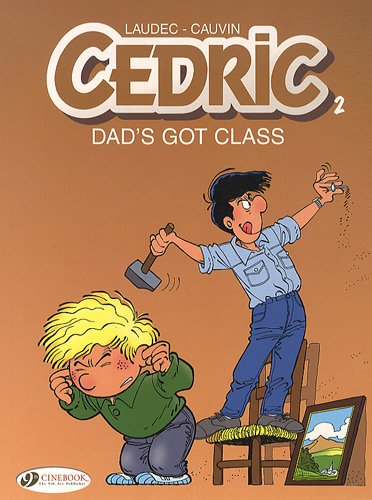
Cedric volume 2: Dad’s Got Class


By Laudec & Cauvin with colours by Leonardo and translated by Erica Jeffrey (Cinebook)
ISBN: 978-1-84918-003-0 (Album PB & Digital edition)

Time for another rumination on romance, and this one has both kinds that afflict Young Boys of an Impressionable Age: older women and the unattainable classmate…

At least our continental cousins have discovered the secret of finding the funny side of the horrors of young love…

Raoul Cauvin was one of Europe’s most successful comics scripters. Born in Antoing, Belgium in 1938, he joined publishing giant Dupuis’ animation department in 1960 after studying Lithography. Happily, he soon discovered his true calling – comedy writing – and began a glittering, prolific career at Le Journal de Spirou where he devised (with Salvérius) the astoundingly successful Bluecoats amongst dozens of other long-running, award winning series. Those included Sammy, Les Femmes en Blanc, Boulouloum et Guiliguili, Cupidon, Pauvre Lampil and Agent 212: cumulatively shifting more than 240 separate albums topping 45 million books in total thus far. Bluecoats alone has sold in excess of 15 million copies thus far.

We lost him to cancer on 19th August 2021.

His collaborator on sharp, witty yet kid-friendly family strip Cédric is Italian born, Belgium-raised Tony de Luca who studied electro-mechanics and toiled as an industrial draughtsman until he could make his break into comics.

Following a few fanzine efforts in the late 1970s, Laudec landed soap-style series Les Contes de Curé-la-Fl’ûte at Spirou in 1979. He built it into a brace of extended war-time serials (L’an 40 in 1983 and Marché Noir et Bottes à Clous in 1985) whilst working his way around many of the title’s other strips. In 1987 Laudec united with Cauvin on the first Cédric shorts and the rest is history… and science and geography and PE and…

We have Dennis the Menace (the Americans have one too but he’s just not the same) and the French-speaking world has Cédric: an adorable lovesick rapscallion with a heart of gold and an irresistible streak of mischief dogging his heels. Collected albums of the variable-length strips – ranging from a ½ page to half a dozen – began appearing in 1989 (with 34 released so far) and are always amongst the most popular and best-selling on the Continent, as is the animated TV show spun off from the strip.

This second Cinebook translation – from 2009 and originally continentally released as Cédric 4: Papa a de la classe – hauls straight in to the love action as the little lout is invited to a party at the palatial home of posh-boy and romantic rival The Right Honourable Alphonse Andre Jones-Tarrington-Dupree…

Previously, overly-imaginative Cedric had been utterly enamoured of his teacher Miss Nelly, but once new girl Chenjoined the class his life changed forever. Chen is different: her skin isn’t the same colour as everyone else’s and she talks really funny. He just can’t stop thinking about her…

All’s fair in love and war as ‘Milady and the Geisha’ finds Dupree tricking Cedric into wearing the most embarrassing fancy dress costume imaginable, only to see his devilish scheme badly backfire, after which ‘There are Flakes, and then there are Flakes…’ reveals how not everything falling from the sky is snow, before ‘Cats, Cats, Cats…’ sees Cedric and best pal Christian try to extort extra New Year’s gifts from feline fancier Aunt Jean only to fall at the first hurdle…

A young man’s initial encounter with grooming products and cologne is always a heady experience and ‘The A-Scent of Man’ shows the result of Cedric’s lack of impulse control, whilst grown-ups take centre stage in ‘A Story That’ll Make Your Hair Stand Up Straight’ as Grandpa starts dangerously criticising his useless son-in-law’s visit to a tonsorial stylist, after which ‘To Each His Own’ renews the simmering war after each tries – and fails – to hang a picture on the living room wall…

When Chen falls ill, Cedric goes to extreme efforts to be with and be like her in ‘Love, Love, Love’ before ‘Tails of All Sorts’ finds Cedric and Grandpa checking out each other’s romantic fascinations…

Kicking and screaming, Cedric is forced into the local Cub Scout group, and even after yomping all over the countryside in ‘Valderee, Valderah’ uses every opportunity to sabotage the experience. Just as he’s being kicked out, however, the Girl Guides march past with little Chen happily with them in line.

When she becomes obsessed with her headphones, Cedric decides to record a message for his darling Chen, but his delivery is no match for his heartfelt enthusiasm in ‘Message Not Received’ and – after Mum and Dad have one of those blazing row over nothing – Grandpa has to explain a few painful facts of life about ‘The Big Scene’ to the appalled kid…

‘Hair Apparent’ deals with the 8-year-old’s first attempt at shaving whilst ‘A Tough Choice’ finds the cash-strapped kid having to choose between a present for Mum or Chen, before the episodic antics end on a slapstick high note with another Cubs camping trip disrupted when ‘A Man Misses His Calling’ finds Cedric seemingly lost in the woods…

Rapid-paced, warm and witty, the exploits of this painfully keen, adorably amorous scallywag are a superbly charming example of how all little boys are just the same and infinitely unique. Cedric is a splendid family-oriented strip perfect for enticing youngsters and old folk alike – but should not to be considered a “How-To” manual for romance…
© Dupuis 1991 by Cauvin & Laudec. All rights reserved. English translation © 2009 Cinebook Ltd.

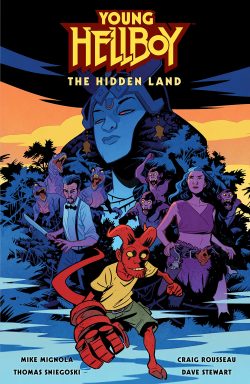
Young Hellboy: The Hidden Land


By Mike Mignola, Thomas Sniegoski, Craig Rousseau, Dave Stewart & Clem Robins (Dark Horse Books)
ISBN: 978-1506723983 (HB) eISBN: 978-1-50672-399-0

Towards the end of World War II an uncanny otherworldly baby was confiscated from Nazi cultists by American superhero The Torch of Liberty and a squad of US Rangers, moments after his eldritch nativity on Earth. The good guys had interrupted a satanic ritual predicted by parapsychologist Professor Trevor Bruttenholm and his associates, who were waiting for Hell to literally come to Earth…

The heroic assemblage was stationed at a ruined church in East Bromwich, England when the abominable infant with a huge stone right hand materialised in an infernal fireball. “Hellboy” was subsequently raised by Bruttenholm, and grew into a mighty warrior engaged in fighting a never-ending secret war against the uncanny and supernatural. The Prof assiduously schooled and trained his happy-go-lucky foundling whilst forming and consolidating an organisation to destroy arcane and occult threats – the Bureau for Paranormal Research and Defense.

After years of such devoted intervention, education and warm human interaction, in 1952 the neophyte hero began hunting down agents of the malign unknown, from phantoms to monsters as lead agent for the BPRD. Hellboy rapidly became its top operative; the world’s most successful paranormal investigator. As decades passed, Hellboy gleaned snatches of his origins and antecedents, learning he was a supposedly corrupted beast of dark portent: a demonic messiah destined to destroy the world and bring back ancient powers of evil. It is a fate he despised and utterly rejected…

It was also a far cry from those halcyon early days, where the devil child grew up in a nurturing if always weird environment and had a fair few fantastic adventures…

This cheery cheeky romp by Mignola, Tom Sniegoski and illustrated by Craig Rousseau gathers 4-part miniseries Young Hellboy: The Hidden Land and delivers a rollicking round of old-world fantasy fun.

In 1947 the hero-struck, comic-consuming little imp is accompanying extremely patient father figure Bruttenholm on an archaeological dig when their plane is brought down by a fellow passenger. This religious fanatic thinks he’s saving humanity from the infernal, but his actions land the survivors on a desolate atoll stuffed with ape people, giant monsters and worse. It’s also on the other side of a dimensional barrier… and for a very good reason…

Separated from the Prof by humongous crabs, dinosaurs, a colossal ape and that really persistent Christian, the little demon almost dies when he’s suddenly saved by a dream…

It’s actually a jungle girl who turns out to be long-missing aviatrix Scarlet Santiago, the “Sky Devil” who’s in all his favourite reading matter…

Although she keeps a big secret from the boy, she introduces him to the monkey folk who rescued her long ago, even as that pesky fanatic answers another clarion call, and awakens the reason the island has been hived off from reality for eons. All too soon an antediluvian vampire queen is marauding again, orchestrating the revival of her empire of blood and working out the fine detail involved in getting back to the earth that so long go banished her…

Can the assorted good guys, jungle girls, great apes and simian shamans stop her before everyone gets it in the neck?

Read on…

Epic and outrageous in the best Willis O’Brien and Ray Harryhausen manner, this manic masterpiece is augmented by a copious ‘Young Hellboy: The Hidden Land Sketchbook’ – annotated by Katii O’Brien – which closes this treasure hoard of hairsbreadth escapes by revealing story-layouts, doodles, roughs, designs and pencilled pages, all accompanied by creator comments and garnished with a full cover and variants gallery by Mignola, Dave Stewart, Rachele Aragno, Wylie Beckert and Anthony Carpenter.

This is another perfect example of comics storytelling at its very best: offering astounding supernatural spectacle, amazing arcane action, momentous mystical suspense and simply huge hairy handfuls of honest fun – something every fear fan and adventure aficionado will enjoy.
Young Hellboy™ and © 2021 Mike Mignola. Hellboy™ and all other prominent featured characters are trademarks of Mike Mignola. All rights reserved.

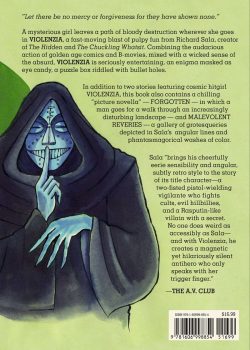
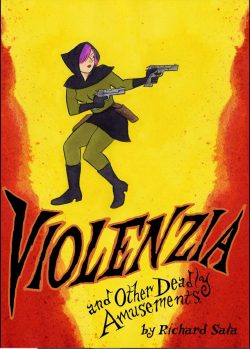
Violenzia and Other Deadly Amusements


By Richard Sala (Fantagraphics Books)
ISBN: 978-1-60699-885-4 (TPB)

Richard Sala was a lauded and brilliantly gifted exponent and comics creator who deftly blended beloved pop culture artefacts and conventions – particularly cheesy comics and old horror films – with a hypnotically effective ability to tell a graphic tale.

A child who endured sustained paternal abuse, Sala grew up in Chicago and Arizona. Retreating into childish bastions of entertainment, he eventually escaped family traumas and as an adult earned a Masters Degree in Fine Arts. He became an illustrator after rediscovering a youthful love of comic books and schlock films that had brightened his youth.

His metafictional, self-published Night Drive in 1984 led to appearances in legendary 1980s anthologies Raw, Blab! and Prime Cuts, with animated adaptations produced for Liquid Television.

He died in 2020 aged 65, but his work remains welcomingly atmospheric, dryly ironic, wittily quirky and mordantly funny; indulgently celebrating childhood terrors, gangsters, bizarre events, monsters and manic mysteries, with a host of women as his stars of choice: girl sleuth Judy Drood, the glorious trenchant storybook investigator Peculia and this particular femme so very fatale…

Sala’s art is a joltingly jolly – if macabre – joy to behold and shone on many out-industry projects such as his work with Lemony Snickett, The Residents and even Jack Kerouac: illustrating the author’s outrageous Doctor Sax and The Great World Snake.

This compelling mystery melange from 2015 combines a quartet of short comics treats commencing with the eponymous ‘Violenzia’: a vividly coloured and constructed pastiche of Hammer Horror films of a mystery maid and her gleaming guns, rousing villagers and pitilessly dealing with a sinister murder cult in the manner they deserve all while getting ever-closer to a very familiar monk-like mastermind…

That smartly witty twisty tale segues to an eerie sepia sampled soliloquy, poetically and despondently following a foredoomed soul retracing his steps until horrifying recalling what he’d ‘Forgotten’…

Macabre musings in the mode of a child’s alphabet primer, ‘Malevolent Reveries – An Alphabetical Exhibition’ mixes rhyme with crafty pictures of the artist’s cartoon canon of characters from ‘An Afternoon of Appalling Apparitions’ to ‘Zero Hour on Zombie Island’ cannily calm the nerves before climactic chills are unleashed when ‘Violenzia Returns’. This time her gunsights are set on the Council of Augers and her dogged pursuit throws up some sudden surprises and a whiff of doomed romance; or possibly just doom…

Clever, compelling and staggeringly engaging, this fabulous farrago of fantastic fiends and ferocious fights (also available in digital formats) is a perfect introduction to Sala’s worlds: a sublimely nostalgic escape hatch back to days when unruly children scared themselves silly under the bedcovers at night, and an ideal gift for idle moments for the big kid in your life – whether he/she/they are just you, imaginary or even relatively real…

Violenzia and Other Deadly Amusements © 2015 Richard Sala. This edition © 2015 Fantagraphics Books All rights reserved.

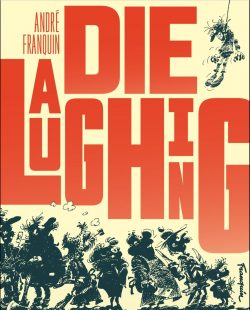
Die Laughing


By Andre Franquin, translated by Jenna Allen (Fantagraphics Books)
ISBN: 978-1-68396-091-1 (HB)

Like so much in Franco-Belgian comics, it all starts with Le Journal de Spirou. The magazine was first seen on April 2nd1938, with its engaging and eponymous lead strip created by Rob-Vel (François Robert Velter). In 1943 publishing giant Dupuis purchased all rights to the comic and its titular star, after which comic-strip prodigy Joseph Gillain (“Jijé”) took the helm.

In 1946 Jijé’s assistant assumed the creative reins, gradually side-lining the previously-established short gag vignettes in favour of extended adventure serials. He introduced a broad, engaging cast of regulars: adding to the mix phenomenally popular rare beast and animal marvel Marsupilami (first seen in Spirou et les héritiers in 1952 and eventually a spin-off star of screen, plush toy store, console games and albums in his own right).

He continued crafting increasingly fantastic tales and absorbing Spirou sagas until his resignation in 1969. Throughout that period the creator was deeply involved in the production of the weekly Spirou comic and increasingly beset by depression and other mental health issues.

André Franquin was born in Etterbeek, Belgium on January 3rd 1924. Drawing from an early age, the lad only began formal art training at École Saint-Luc in 1943. When the war forced the school’s closure a year later, he found work at Compagnie Belge d’Animation in Brussels where he met Maurice de Bévère (AKA Lucky Luke creator “Morris”), Pierre Culliford (Peyo, creator of The Smurfs and Benny Breakiron) and Eddy Paape (Valhardi, Luc Orient).

In 1945 all but Peyo signed on with Dupuis, and Franquin began his career as a jobbing cartoonist/illustrator, producing covers for Le Moustique and scouting magazine Plein Jeu. During those early days, Franquin and Morris were being tutored by Jijé, who was the main illustrator at Le Journal de Spirou. He turned the youngsters – and fellow neophyte Willy Maltaite (AKA “Will” – Tif et Tondu, Isabelle, Le jardin des désirs) – into a smoothly functioning creative bullpen known as La bande des quatre or “Gang of Four”. They later reshaped and revolutionised Belgian comics with their prolific and engaging “Marcinelle school” style of graphic storytelling…

Jijé handed Franquin all responsibilities for the flagship strip part-way through Spirou et la maison préfabriquée (Spirou #427, June 20th 1946). The new kid ran with it for the next two decades; enlarging the scope and horizons of the feature until it became purely his own. Almost every week fans would meet startling new characters such as comrade/rival Fantasio or crackpot inventor and Merlin of mushroom mechanics the Count of Champignac.

Spirou & Fantasio became globe-trotting journalists, travelling to exotic places, uncovering crimes, exploring the fantastic and clashing with a coterie of exotic arch-enemies. However, throughout all that time Fantasio was still a full-fledged reporter for Le Journal de Spirou and had to pop into the office all the time.

While there he conceived another landmark icon, a comedic foil and meta-real alter ego who was an accident-prone, big-headed junior in charge of minor jobs and dogs-bodying. His name was Gaston Lagaffe and through him Franquin expressed his unruly dissident opinions and tendencies…

Gaston – who debuted in #985, (February 28th 1957) – grew to be one of the most popular and perennial components of the comic. In terms of entertainment schtick and delivery, older readers will certainly recognise beats of Jacques Tati and timeless elements of well-meaning self-delusion British readers will recognise from Some Mothers Do Have ‘Em or Mr Bean. It’s slapstick, paralysing puns, pomposity lampooned and no good deed going noticed, rewarded or unpunished…

In a splendid example of good practise, Franquin mentored his own band of apprentice cartoonists during the 1950s. These included Jean Roba (La Ribambelle, Boule et Bill/Billy and Buddy); Jidéhem (Sophie, Starter, Gaston Lagaffe) and Greg (Comanche, Bruno Brazil, Bernard Prince, Zig et Puce, Achille Talon), who all worked with him on Spirou et Fantasio. In 1955, a contractual spat with Dupuis saw Franquin briefly enlist with rivals Casterman on Le Journal deTintin, where he collaborated with René Goscinny and old pal Peyo whilst creating the fashion/lifestyle domestic comedy gag strip Modeste et Pompon. Franquin almost immediately  patched things up with Dupuis and returned to Spirou, subsequently co-creating Gaston Lagaffe (known in Britain these days as Gomer Goof) in 1957, but was obliged to carry on his Casterman commitments too…

From 1959, writer Greg and background artist Jidéhem assisted Franquin, but by 1969 the artist had reached his Spirou limit. He quit, taking his mystic yellow monkey with him…

Later creations include fantasy series Isabelle, illustration sequence Monsters and this arcane convergence of bleak gallows humour, adult conceptual nihilism and impassioned social and ideological frustration lensed through comedy. If you’re aware of the later work of Spike Milligan, you’ll know instinctively what I mean. The strip and original series title Idées Noires has entered into common usage in French-speaking countries, as a term for gloomy or negative thoughts: dark ideas daily obsessing people in crisis expunged and expressed through strident manic humour…

It began as he recuperated from a heart attack in 1975. Idées Noires was part of an insert comic – Le Trombone illustré – he and Yvan Delporte produced for weekly Le Journal de Spirou beginning with the March 17th 1977 issue. After 30 mini-issues, and with the global situation looking increasingly fraught, a revitalised Franquin took the strip to mature reader magazine Fluide Glacial where it ran until 1983.

Plagued throughout his life by depression, Franquin passed away on January 5th 1997, but his legacy remains: a vast body of work that reshaped the landscape of European comics.

In 2018, Fantagraphics gathered and translated the strips, releasing them as Die Laughing.

As seen in Cynthia Rose’s erudite and informative Introduction – ‘Liberty, Audacity, Hilarity: André Franquin‘ – the peripatetic feature gave Franquin room to address his allegiances with issues of environmentalism, animal cruelty, political duplicity and plain old human insanity and strike back with the best weapons in his arsenal: sarcasm, mockery and despairing outrage.

To further demarcate the series from past works, the images are delivered in scratchy, shocking lines and solid blacks, with elements reversed out: it’s a world of silhouettes, deep shadows and brooding forward spaces and middle-grounds, with no extraneous detail: all delivered in eerie evocative, expressionist monochrome, rather than the shining and substantial Disney-inspired colour of Spirou and the Marsupilami…

This hardback and digital compilation consists of half and full page shorts plus a few longer cartoon strips lampooning and spearing, smug pomposity, business greed, military-industrial chicanery and ruthlessness, planetary abuse such as inflicted by oil companies and the global arms race. There are many mordant observations on sport, war for profit, the death penalty (still the guillotine, for Pete’s sake!), alien abduction, the rat race, sheer random surreal absurdism, all skewered by a sense of cosmic justice acknowledged, if not satisfied…

A constant theme returned to with merciless regularity is bloodsports and the kind of arsehole who finds fun and feels magnified by pointless slaughter. Especially singled out are those French “traditionalists” who simply must slaughter songbirds in their thousands every year as they migrate to and from Europe…

Franquin was a master of comedy in all its aspects from whimsically light to trenchantly black-edged. Come see how and why…
Die Laughing © 2018 by Fantagraphics Books, Inc. Comics © Editions Audie/Franquin Estate. All rights reserved. Introduction © 2018 by Cynthis Rose. Afterword © 2018 Gotlib Estate. All other images and text © 2018 their respective copyright holders. All rights reserved.

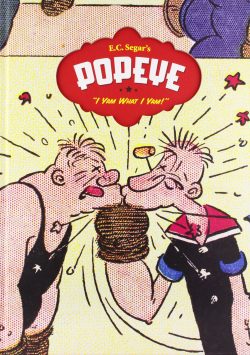
E.C. Segar’s Popeye volume 1: “I Yam What I Yam!”


By Elzie Crisler Segar (Fantagraphics Books)
ISBN: 978-1-56097-779-7 (HB)

HAPPY BIRTHDAY POPEYE!

The incredible Sailor-Man first shumbled onto the world stage in comic strip Thimble Theatre on January 17th 1929. Even though last year Fantagraphics began rereleasing this material in smaller less copious volumes – which I’ll also be reviewing – this initial colossal collection is probably my favourite vintage book ever and I mourn much that it’s out of print and unavailable digitally. I live in hope though…

Thimble Theatre was an unassuming comic strip which began on 19th December 1919; one of many newspaper features that parodied/burlesqued/mimicked the era’s (silent) movies. Its more successful forebears included C.W. Kahles’ Hairbreadth Harry and Ed Wheelan’s Midget Movies (later renamed Minute Movies).

These all used a repertory company of characters to play out generic adventures firmly based on those expressive cinema antics. Thimble Theatre‘s cast included Nana and Cole Oyl, their gawky daughter Olive, diminutive-but-pushy son Castor, and Horace Hamgravy, Olive’s sappy would-be beau.

The series ticked along for a decade, competent and unassuming, with Castor and Ham Gravy, as he became, tumbling through get-rich-quick schemes, gentle adventures and simple gag situations until September 10th 1928 (the first strip reprinted in this astonishingly lavish and beautiful collection), when explorer uncle Lubry Kent Oyl gave Castor a present from his latest exploration of Africa: a hand-reared Whiffle Hen – most fabulous of all birds. It was the start of something groundbreaking.

As eny fule kno Whiffle Hens are troublesome, incredibly rare and possessed of fantastic powers, but after months of inspired hokum and slapsick shenanigans, Castor was resigned to Bernice – for that was the hen’s name – when a series of increasingly peculiar circumstances brought him into contention with the ruthless Mr. Fadewell, world’s greatest gambler and king of the gaming resort of ‘Dice Island’.

Bernice clearly affected writer/artist E.C. Segar, because his strip increasingly became a playground of frantic, compelling action and comedy during this period…

When Castor and Ham discovered that everybody wanted the Whiffle Hen because she could bestow infallible good luck, they sailed for Dice Island to win every penny from its lavish casinos. Sister Olive wanted to come along but the boys planned to leave her behind once their vessel was ready to sail. It was 16th January 1929…

The next day, in the 108th instalment of the saga, a bluff, irascible, ignorant, itinerant and exceeding ugly one-eyed old sailor was hired by the pair to man the boat they had rented, and the world was introduced to one of the most iconic and memorable characters ever conceived. By sheer, surly willpower, Popeye won the hearts and minds of readers: his no-nonsense, grumbling simplicity and dubious appeal enchanting the public until by the end of the tale, the walk-on had taken up full residency. He would eventually make the strip his own…

The journey to Dice Island was a terrible one: Olive had stowed away, and Popeye – already doing the work of twelve men – did not like her. After many travails the power of Bernice succeeded and Castor bankrupted Dice Island, but as they sailed for home with their millions Fadewell and his murderous associate Snork hunted them across the oceans. Before long, Popeye settled their hash too, almost at the cost of his life…

Once home, their newfound wealth quickly led Castor, Ham and Olive into more trouble, with carpetbaggers, conmen and ne’er-do-wells constantly circling, and before long they lost all their money (a common occurrence for them), but one they thing they couldn’t lose was their sea-dog tag-along. The public – and Segar himself – were besotted with the unlovable, belligerent old goat. After an absence of 32 episodes Popeye shambled back on stage, and he stayed for good.

Although not yet the paramour of Olive, Popeye increasingly took Ham’s place as a foil for sharp-talking, pompous Castor Oyl, and before long they were all having adventures together. After escaping jail at the start of ‘The Black Barnacle’ (December 11th 1929) they found themselves aboard an empty ship and at the start of a golden age of comic strip magic…

Segar famously considered himself an inferior draughtsman – most of the world disagreed and still does – but his ability to weave a yarn was unquestioned, and it grew to astounding and epic proportions in these strips.

Day by day he was creating the syllabary and graphic lexicon of a brand-new art-form, inventing narrative tricks and beats that a generation of artists and writers would use in their own works, and he did it while being scary, thrilling and funny all at once.

‘The Black Barnacle’ introduced the dire menace of the hideous Sea-Hag – one of the greatest villains in fiction – and the scenes of her advancing in misty darkness upon our sleeping heroes are still the most effective I’ve seen in all my years…

This incredible tale leads seamlessly into diamond-stealing, kidnappings, spurned loves, an African excursion and the introduction of wealthy Mr. Kilph, whose do-gooding propensities lead Castor and Popeye into plenty of trouble, beginning with the eerie science fiction thriller ‘The Mystery of Brownstone Hill’ and the return of the nefarious Snork, who almost murders the salty old seadog a second time…

The black and white dailies section ends with ‘The Wilson Mystery’ as Castor and Popeye set up their own detective agency – something that would become a common strip convention and the perfect maguffin to keep adventurers tumbling along. Even Mickey Mouse donned metaphoric deerstalker and magnifying glass for much of his own strip service…

These superb and colossal hardcover albums (200 pages and 368 mm by 268 mm) are augmented with fascinating articles and essays; including testimonial remembrances from famous cartoonists – Jules Feiffer in this first volume – and accompanied by the relevant full colour Sunday pages from the same period.

Here then are the more gag-oriented complete tales from 2nd March 1930 through February 22nd 1931, including the “topper” Sappo.

A topper was a small mini-strip that was run above the main feature on a Sunday page. Some were connected to the main strip, but many were just extraneous filler. They were used so that individual editors could remove them if their particular periodical had non-standard page requirements. Originally entitled The 5:15, Sappo was a surreal domestic comedy gag strip created by Segar in 1924 which became peculiarly entwined with the Sunday Thimble Theatre as the 1930s unfolded – and it’s a strip long overdue for consideration on its own unique merits….

Since many papers only carried dailies or Sundays, not necessarily both, a system of differentiated storylines developed early in American publishing, and when Popeye finally made his belated appearance, he was already a fairly well-developed character. Thus, Segar concentrated on more family-friendly gags – and eventually continued mini-sagas – and it was here that the Popeye/Olive Oyl modern romance began: a series of encounters full of bile, intransigence, repressed hostility, jealousy and passion which usually ended in raised voices and scintillating cartoon violence – and they are still as riotously funny now as then.

We saw softer sides of the sailor-man and, when Castor and Mr. Kilph realised how good Popeye was at boxing, an extended, trenchant and scathingly witty sequence about the sport of prize-fighting began. Again, cartoon violence was at a premium – family values were different then – but Segar’s worldly, probing satire and Popeye’s beguiling (but relative) innocence and lack of experience kept the entire affair in hilarious perspective whilst making him an unlikely and lovable waif.

Popeye is fast approaching his centenary and still deserves his place as a world icon. How many comics characters are still enjoying new adventures 93 years after their first? These magnificent volumes are the perfect way to celebrate the genius and mastery of EC Segar and his brilliantly imperfect superman. These are books that every home and library should have.

© 2006 Fantagraphics Books Inc. All comics and drawings © 2006 King Features Inc. All rights reserved.

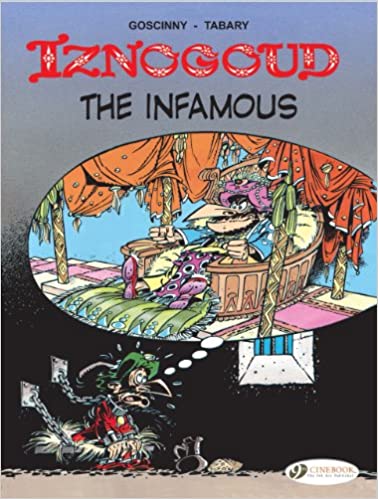
Iznogoud the Infamous


ISBN: 978-1-84918-074-0 (Album PB)

For the greater part of his too-short lifetime (1926-1977) René Goscinny was one of – if not the – most prolific and most-read writers of comic strips the world has ever seen. He still is.

Among his most popular comic collaborations are Lucky Luke, Le Petit Nicolas and, of course, Asterix the Gaul, but there were so many others, such as the dazzling, dark deeds of a dastardly usurper whose dreams of diabolical skulduggery perpetually proved to be ultimately no more than castles in the sand…

Scant years after the Suez crisis, the French returned to those hotly contested deserts when Goscinny teamed with sublimely gifted Swedish émigré Jean Tabary (1930-2011) – who numbered Richard et Charlie, Grabadu et Gabaliouchtou, Totoche, Corinne et Jeannot and Valentin le Vagabond amongst his other hit strips – to detail the innocuous history of imbecilic Arabian (im)potentate Haroun el-Poussah.

However, it was the strip’s villainous foil, power-hungry vizier Iznogoud who stole the show – possibly the conniving little imp’s only successful coup…

Les Aventures du Calife Haroun el Poussah was created for Record; with the first episode appearing in the January 15th1962 issue. A minor hit, it jumped ship to Pilote – a comics magazine created and edited by Goscinny – where it was artfully refashioned into a starring vehicle for the devious little ratbag who had increasingly been hogging all the laughs and limelight.

Like all great storytelling, Iznogoud works on two levels: for youngsters it’s a comedic romp with adorably wicked baddies invariably hoisted on their own petards and coming a-cropper, whilst older, wiser heads can revel in pun-filled, witty satires and marvellously accessible episodic comic capers. Just like our Parliament today.

This same magic formula made its more famous cousin Asterix a monolithic global success and, just like the saga of the indomitable Gaul, the irresistibly addictive Arabian Nit was originally adapted into English by master translators Anthea Bell & Derek Hockridge, who made those Roman Follies so very palatable to British tastes. As always the deliciously malicious whimsy is heavily dosed with manic absurdity, cleverly contemporary cultural critiques and brilliantly delivered creative anachronisms which serve to keep the assorted escapades bizarrely fresh and hilariously inventive.

Insidious anti-hero Iznogoud is Grand Vizier to affable, easy-going Caliph of Ancient Baghdad Haroun Al Plassid, but the sneaky little toad has loftier ambitions, or – as he is always declaiming – “I want to be Caliph instead of the Caliph!”…

The retooled series launched in Pilote in 1968, quickly growing into a massive European hit, with 31 albums to date (carried on by Tabary’s children Stéphane, Muriel and Nicolas), his own solo comic, a computer game, animated film, TV cartoon show and a live-action movie.

When Goscinny died in 1977, Tabary started scripting his own sublimely stylish tales (from the 13th album onwards), switching to book-length complete adventures, rather than the compilations of short, punchy vignettes which typified the collaborations.

Originally released in 1969, Iznogoud l’infâme was the fourth Dargaud collection, the second volume published by Methuen in 1977, and the seventh splendid Cinebook album; offering a wry and raucous quintet of short tales with the Vile Vizier on top form as he schemes to seize power from his oddly oblivious Lord and Master.

The eternal drama begins with ‘The Sinister Liquidator’, which finds Iznogoud and his bumbling, long-suffering henchman and strong-arm crony Wa’at Alahf making their way through a malodorous swamp in search of a Djinn with the power to reduce all he touches to unliving liquid. Enduring the evil Ifreet’s ghastly manners and painful punning, the devilish diplomat strikes a bargain which spells doom for the Caliph… but first he has to get the demon back to the palace.

Since the Djinn cannot completely leave his fetid fluid environment and glorious bustling Baghdad is beyond the Great Desert, Iznogoud and Wa’at Alahf must Djinngerly transport their secret weapon home. Moreover, as under no circumstances can they afford to be moistened by the monster themselves, a succession of buckets, bowls, bottles and vials inexorably diminish the watery wonder and the Vile Vizier’s chances of success until – as you’d expect – the inevitable occurs…

The pun-punctuated comedy of errors is followed by a sneaky dose of inspired iniquity dubbed ‘The Invisible Menace’wherein the dictator-in-waiting learns a magic spell which will banish his imperial impediment from the sight of man. Of course, he still has to find and keep his target still long enough for the magic to work…

Sheer broad slapstick-riddled farce is the secret ingredient of the next craftily convoluted saga. When Iznogoud deliberately accepts a cursed gem which brings catastrophic misfortune in the expectation that he can palm it off on his unsuspecting boss, he greatly underestimates the power of ‘The Unlucky Diamond’.

As soon the ghastly gem latches on to a truly deserving victim and unleashes a succession of punitive calamities, it determines to never let go…

A state visit by an African potentate allows the Vizier plenty of time to confer with his opposite number in ‘The Magic Doll’. Sadly, the bemused Witch Doctor has no idea that his numerous demonstrations of voodoo magic with a clay figurine are Iznogoud’s dry runs for a stab at the throne.

Of course, for the sorcery to work, the Vizier has to somehow obtain a lock of Haroun Al Plassid’s closely guarded and held-as-holy hair…

The manic mirth concludes by descending into sheer surreal absurdity (granting Tabary license to ascend to M.C. Escher-like heights of graphic invention) as an itinerant magician known as ‘The Mysterious Billposter’ crafts a magic advert which can transport people to an idealised paradisiacal holiday destination.

Iznogoud is far more interested in the fact that, once in, no-one can get out again…

Just for a change the plan succeeds perfectly and the blithely unaware Caliph is trapped in an inescapable, idealised extra-dimensional state. Then again – due to his extreme eagerness – so is his not-so-faithful Vizier…

Just such witty, fast-paced hi-jinks and craftily crafted comedy set pieces have made this addictive series a household name in France where “Iznogoud” is common term for a certain type of politician: over-ambitious, unscrupulous – and frequently a little lacking in height.

When first released in Britain during the late 1970s (and again in 1996 as a periodical comicbook) these tales made little impression, but certainly now these snappy, wonderfully beguiling strips have found an appreciative audience among today’s more internationally aware, politically jaded comics-and-cartoon savvy Kids Of All Ages…

And Hansard…
Original edition © Dargaud Editeur Paris, 1969 by Goscinny & Tabary. All rights reserved. This edition published 2011 by Cinebook Ltd.