


By André Franquin, translated by Jerome Saincantin (Cinebook)
ISBN: 978-1-80044-194-1 (Album PB/Digital edition)
This book includes Discriminatory Content produced in less enlightened times. This book also contains Discriminatory Content included for comedic effect.
André Franquin was born in Etterbeek, Belgium on January 3rd 1924 and died on January 5th 1997. In between there were good times and bad, which he handled by creating the most incredible characters and stories, and by making people laugh and think… but mostly laugh. This is one of the very best you can find translated into English.
Adventure-seeking brave lad Spirou headlined the magazine he was named for from the first issue (dated April 21st 1938). He was devised and realised by French cartoonist Françoise Robert Velter (“Rob-Vel”) for Belgian publisher Éditions Dupuis in direct response to the success of Hergé’s Tintin over at rival outfit Casterman. Originally a plucky bellboy/lift operator employed by the Moustique Hotel (a sly reference to the publisher’s premier periodical Le Moustique), his improbable exploits with pet squirrel Spip gradually but steadily evolved into highflying, far reaching, surreal comedy dramas. That evolution was mainly thanks to Velter’s wife Blanche “Davine” Dumoulin who took over the strip when her husband enlisted in 1939 and Belgian artist/assistant Luc Lafnet – at least until 1943 when Dupuis purchased all rights to the property, after which comic-strip prodigy Joseph Gillain (Jijé) took over.
When Jijé handed his own trainee/assistant total responsibility for the flagship feature part-way through serial Spirou et la maison préfabriqué (Le Journal de Spirou #427, June 20th 1946), André Franquin ran with it for the next 20 years. He enlarged the scope and expanding horizons until the feature was purely his own. Almost every week fans would meet startling new characters such as comrade/rival Fantasio or crackpot inventor and Merlin of mushroom mechanics The Count of Champignac. Spirou and Fantasio became globetrotting journalists, travelling to exotic places, uncovering crimes, exploring the fantastic and clashing with a coterie of exotic arch-enemies such as Zorglub and Fantasio’s unsavoury cousin Zantafio.
Gradually sidelining short, done-in-one gag vignettes in favour of longer epic adventure serials, Franquin’s growing cast of engaging regulars soon included one of the first strong female characters in European comics (rival journalist Seccotine AKA Cellophine in the current English translation) and ultimately led to the debut of a scene-stealing, phenomenally popular apparently-magic animal. Marsupilami arrived during 1952’s serial Spirou et les héritiers and never really left…
Franquin, plagued in later life by bouts of depression, died in 1997 but his legacy remains and still grows; a vast body of work which reshaped the landscape of European comics, and inspiring many others to carry on in his name and manner.
As Le Repaire de la murène this eccentric epic was Franquin’s ninth solo affair, originally serialised in LJdS #871-904 from December 23rd 1954 to August 11th 1955. It was eventually collected as an album in 1957. Here, as The Moray’s Lair it directly follows The Wrong Head, scoping out a soupçon of nautical naughtiness as the freshly minted investigative reporting team tackle scientific quandary and marine mystery all whilst simply trying to earn extra cash by attempting a scientific challenge.
Vacationing with mycoprotein mate Pacôme Hégésippe Adélard Ladislas de Champignac at his ramshackle rural estate in Champignac-in-the-Sticks, the idling lads spot a magazine ad offering a startlingly specific engineering exploit with a hefty cash reward for its completion. “Fabulously rich ship owner” Xenophon Hamadryas seeks someone who can invent a means of descending 650 feet underwater and carry out unspecified tasks at that depth in complete safety, and they are up for it.
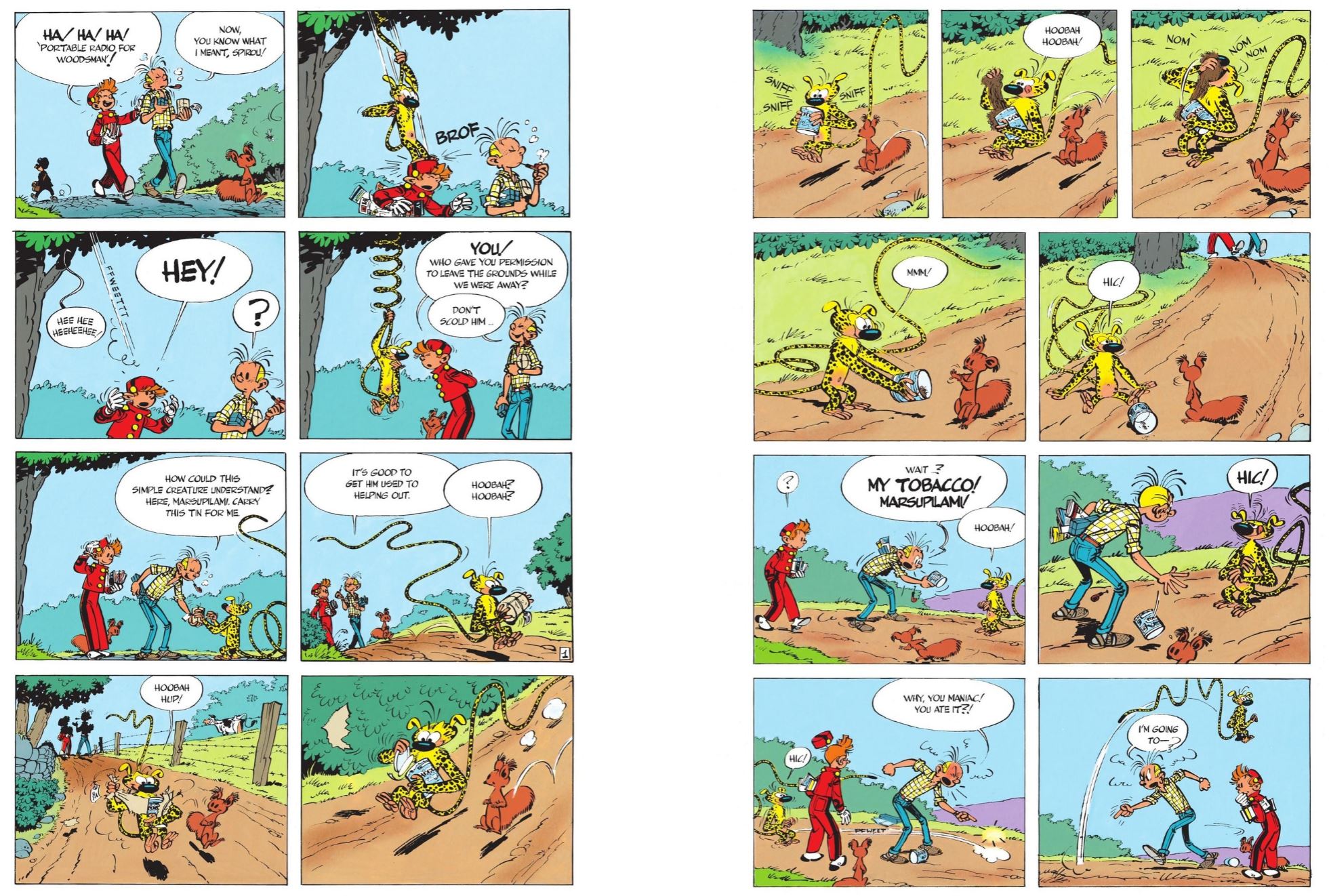
Perhaps distracted by the absurd and distressing antics of Spip, local postman Mr. Zenobius and the Marsupilami, our heroes’ usual caution is overwhelmed by greed and they soon convince The Count to use mushroom science to (temporarily) boost his own formidable brainpower. The result is detailed plans for scuba diving gear, unique new breathing gases, underwater communications systems and even personal minisubs to reach the required depths whilst allowing freedom of movement under the greatest most unfathomable pressures ever recorded.
At least it momentarily stops Pacôme from doing whatever it was he had started to “improve” the estate’s chickens…
The brainstorming meets with initial success, but once the team submit their plans and commission construction of the kit, a wave of suspicious accidents and plain sabotage at the factories building Champignac’s innovations put Spirou & Fantasio on high alert, but not as much as when their incredible elastic-tailed anthropoid pal discovers – and brutally chastises – someone closely observing their every move…
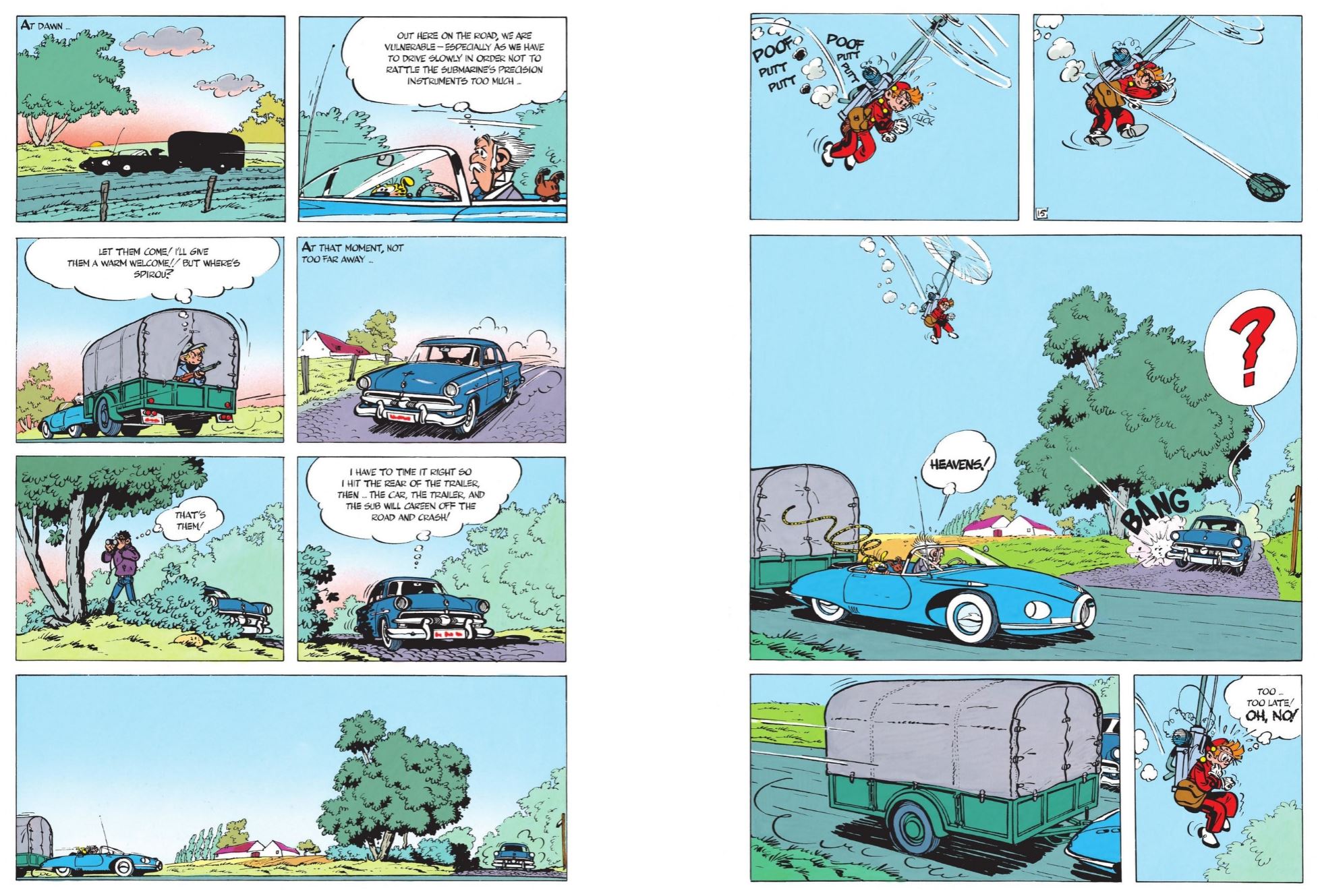
Grudgingly accepting that an over-competitive rival inventor must be behind the campaign, the team continue with enhanced security, which only leads to intimidation, explosions and the destruction of their declared competitors’ efforts. Increasingly wary, Spirou identifies his own stalker after the poor villain is savagely attacked by Marsupilami and convinces the comrades to relocate and continue working in hiding. The plan is actually a trap for watching villains and leads to an epic victory using the Count’s other bizarre science weapons on the spies…
Regarding themselves safe at last, Spirou, Fantasio, the Count and the critters relocate to the shores of the Mediterranean to test their completed prototypes in peace. Barring some minor teething troubles, results are ideal and lead to another amazing discovery in the miraculous Marsu’s biological armoury! Soon they meet competition sponsor Mr. Hamadryas: a most untrustworthy, obnoxious individual who clearly has a secret agenda, plenty of personal goons and lots of unspoken pressures of his own to deal with. Unaware that Spirou has already encountered a mystery sub at the specified subsea location, the shipping magnate claims all other teams have dropped out due to the sabotage campaign, before explaining what he needs… but not really why…
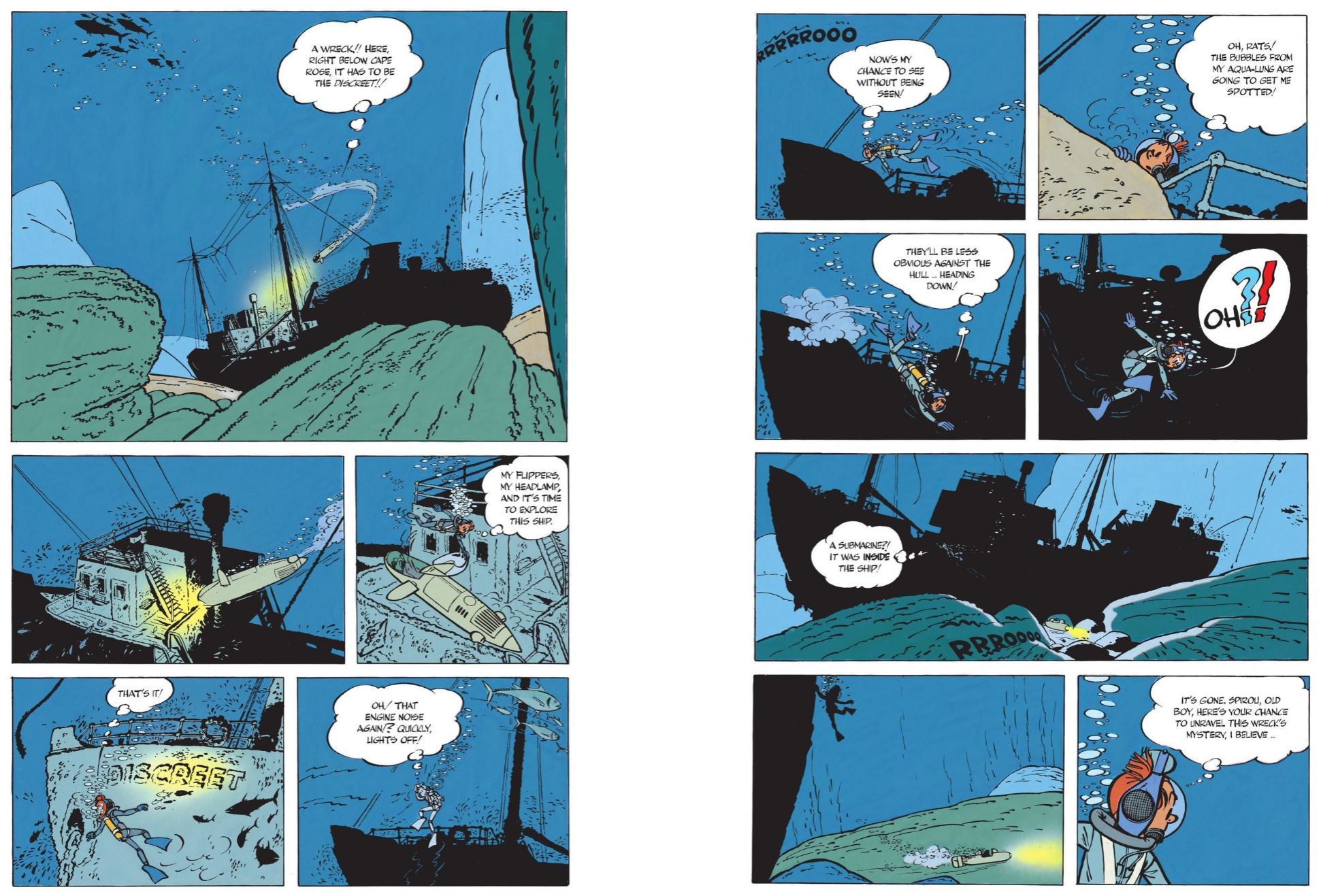
Spouting a ludicrous tale of his best ship (The Discreet) and best friend (Captain John Helena) both being lost in those cold dark depths, the money Midas wants our adventurers to locate the wreck in Helena’s honour and memory, but although they accept the task, the lads are on the lookout for sinister surprises…
What follows is epic spectacle as the marine mission trawls up even more deadly traps, a hidden underwater base, lost treasures, what Hamadryas truly needs and the reason why plundering pirate “The Moray” has been plaguing and confounding the entire endeavour all along. That leads to discovering who he actually works for, and what Marsupilami’s newly revealed power means to the bad guys threatening his human friends…
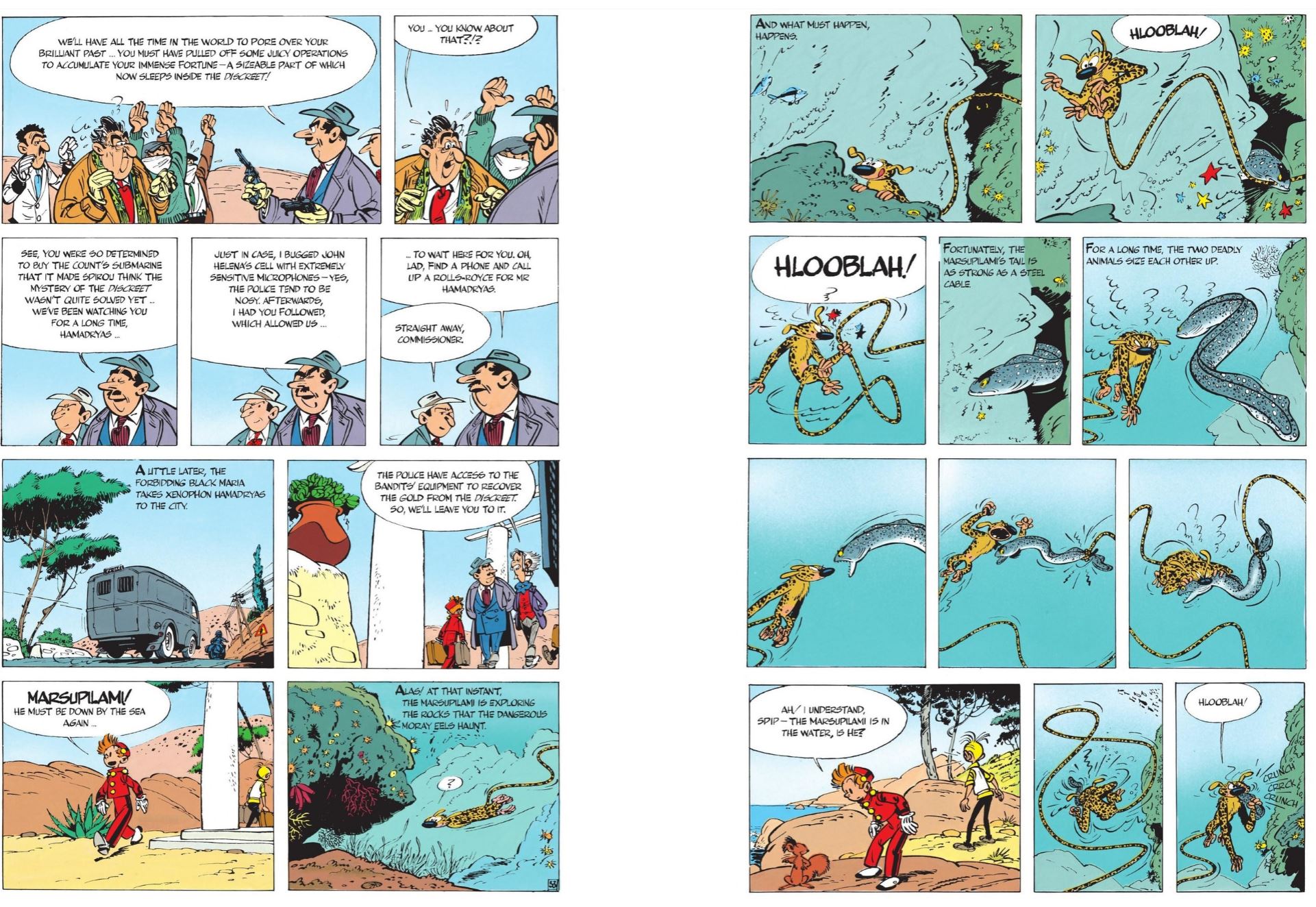
Soaked in sublime slapstick schtick with gallons of gags throughout, this explosively exuberant exploration is packed with cunning crooks coming a-cropper, animal animosity expressed, angst-free action, thrills & spills. It also offers another early ecological message and an always-timely moral regarding the humane treatment of animals. There’s even a fascinating technical overview of nautical facts at time of printing in back-up text feature ‘A Conference by Mr de Champignac’ answering the most telling questions thrown up the mushroom scientist’s apparent flouting of physical law and engineering expertise…
The Moray’s Lair is the kind of lightly-barbed, comedy romp to delight readers fed up and saturated by adults-only carnage, testosterone-fuelled breast-beating, teen-romance monsters or sickly-sweet fantasy. Easily accessible to readers of all ages, drawn with all the beguiling style and seductive yet wholesome verve and panache which make Asterix, Lucky Luke, and Yakari so compelling, these are enduring landmark tales from a long line of superb exploits, deserving to be a household name as much as those series… and even that other kid with the white dog.
Original edition © Dupuis, 1957 by Franquin. All rights reserved. English translation 2026 © Cinebook Ltd.