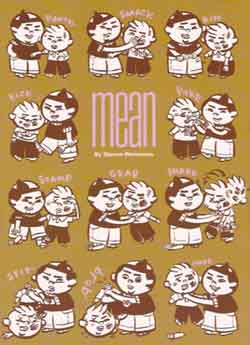
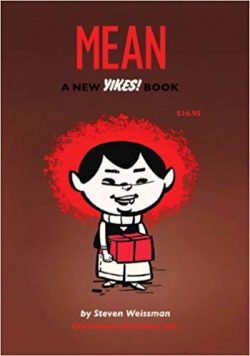
Mean


By Steven Weissman (Fantagraphics Books)
ISBN: 978-1-56097-866-4

Steven Weissman was born in California in 1968 and grew up to be an exceptionally fine and imaginative cartoonist. He’s worked for Alternative Comics, Last Gasp, Dark Horse, Marvel, DC, Vice and Nickelodeon Magazine among others, and his artistic sensibilities have been influenced and shaped by such disparate forces as Super-Deformed manga, “Our Gang” comedies, Abbott and Costello, Dan Clowes, Mike Allred and Peanuts – the strip, not the versatile if sometimes potentially fatal foodstuff.

Much of his groundbreaking, award-winning early work, dating from the mid-1990s, offered a post-modern, skewed and alternative view of friendship, childhood, world weirdness and people’s meanness and can all be enjoyed over and over again in such stunning compilations as Tykes, Lemon Kids, Don’t Call Me Stupid, White Flower Day, Chocolate Cheeks and others. The French and Japanese – who really know quality comics – love him lots and have done so for years.

In 2012 Weissman literally went back to the drawing board, un-and-re-creating himself and his aesthetic methodology for a and unbelievably enchanting hardcover weekly online strip entitled Barack Hussein Obama which has since been collected into a series of stunning cartoon books about the unsuspected nature of modern America. Gosh, I miss those days…

Today though in the spirit of the season we’re revisiting some of his earlier material…

If there is such a thing as ‘Dark and Comforting’ then Weissman’s weird and wicked early cartooning is a perfect example. Following the success of Chewing Gum in Church and Kid Firechief, Fantagraphics promptly compiled earlier works from his self-published Yikes!; amply supplemented with other rare and even unpublished strips to create a lovely insight into the development of a truly unique graphic vision.

These 32 tales, (still available in paperback and digital editions) were all created between 1993 and 2002, and feature his cast of deeply peculiar children in a macabre tribute to Charles Schulz’s signature strip, but they are also literal embodiments of the phrase “little monsters”.

In simple childhood romps such as ‘The See-Thru Boy’, ‘The Loneliest Girl in Town’, ‘Inevitable Time-Travel Story’, ‘No Kiss!’ and many others, the bizarre cast of Li’l Bloody (a child vampire), Kid Medusa, Pullapart Boy and X-Ray Spence live an idyllically suburban 1950’s existence of school, fishing, skateboards, white picket fences, aliens, wheelchair jousting, marbles and weird science.

Weissman’s seductive cast all have huge round heads and ancient bodies like graphic progeria-sufferers, but the drawing is lavish, seductive and utterly convincing.

These are great comics about kids (but perhaps regarded as Best Not For Kids) that are a treat, a revelation and most definitely darkly comforting.
MEAN © 2007 Fantagraphics Books. All content © 2007 Steven Weissman. All Rights Reserved.

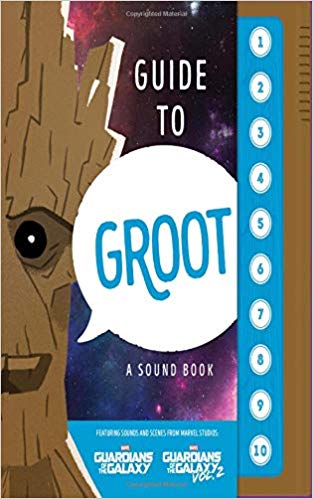
Guide to Groot – a Sound Book


By Matthew K. Manning & Nicholas Rix (Becker & Mayer! books/Quarto)
ISBN: 978-0-7603-6217-4

Win’s Christmas Gift Recommendation: Sheer Delight for Youngsters of Any Age… 9/10

Technically speaking, Groot is one of Marvel’s oldest characters, having debuted as a woody alien invader in Tales to Astonish #13 (cover-dated November 1960), a good year before Fantastic Four #1.

Crafted by Stan Lee, Larry Lieber, Jack Kirby & Dick Ayers, ‘I Challenged Groot! The Monster from Planet X’ revealed how a studious biologist saved humanity from a rapacious rampaging tree intent on stealing Earth cities and shipping them back to his distant world. That tale’s not in this tome, because in the intervening decades the deciduous despot cleaned up his act, pruned off the bad wood and now resides firmly on the side of the good guys…

As a beloved star of print and screen, the leafy legend has profoundly planted himself in the hearts of kids everywhere and this nifty marriage of sound and vision allows readers to enjoy a succession of cool narrative image scenarios by Nicholas Rix whilst Rocket Raccoon (in his identity of author Matthew K. Manning) clarifies the intricacies of Groot’s seemingly limited vocabulary in text. And all while Groot emotes right in your ears!

This is all achieved via a selection of 10 pushbutton activated sound files, each revealing the utterance nuances of the titanic timber-man’s 3-word vocalisations.

Following Rocket’s Introduction, the lessons commence with “I Am Groot” which of course means ‘Hello’ whereas the second spoken “I Am Groot” reveals just how the super sapling says ‘Did You Mean This?’

You get the picture – and they’re all beautifully rendered illustrations of key moments featuring Star-Lord, Gamora, Mantis, Drax, Rocket and other old favourites – as they are followed in close order by ‘I Gotcha’, ‘Nope. Not Gonna Happen’, ‘Geez. Leave Me Alone, Already’, ‘Let’s Dance’, ‘Trust Me. I Got This’, ‘I Want That!’, ‘Face My Wrath, Chumps!’ and ‘I Love You’…

This is a marvellously accessible addition to any fan’s library or toybox so it’s a shame that Guide to Groot is not available in the UK yet. Still, as I’m sure you know the internet is your friend in situations like these…

I am Groot I am Groot I am Groot, I am Groot I am Groot I Am Groot I am Groot-I am Groot I am Groot I am…
© 2018 Marvel. MARVEL and all characters, names and distinct likenesses thereof ™ & © 2018 Marvel characters, Inc. All rights reserved.

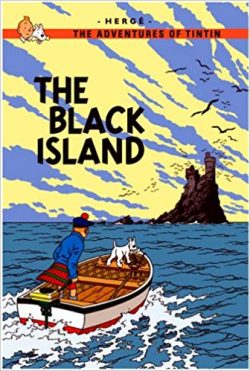
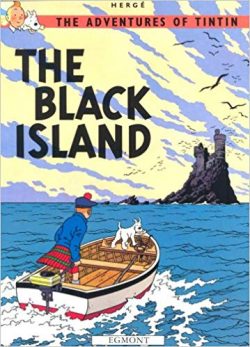
Adventures of Tintin: The Black Island


By Hergé & various; translated by Leslie Lonsdale-Cooper & Michael Turner (Egmont)
ISBN: 978-1-40520-806-2 (HB)                    : 978-1-40520-61-1 (PB)

Georges Prosper Remi – AKA Hergé – created a true masterpiece of graphic literature with his many tales of a plucky boy reporter and his entourage of iconic associates. Singly, and later with assistants including Edgar P. Jacobs, Bob de Moor and the Hergé Studio, Remi accomplished 23 splendid volumes (originally produced in brief instalments for a variety of periodicals) that have grown beyond their popular culture roots and attained the status of High Art.

Like Charles Dickens with The Mystery of Edwin Drood, Hergé died in the throes of creation, and final outing Tintin and Alph-Art remains a volume without a conclusion, but still a fascinating examination and a pictorial memorial of how the artist worked.

It’s only fair though, to ascribe a substantial proportion of credit to the many translators whose diligent contributions have enabled the series to be understood and beloved in 38 languages. The subtle, canny, witty and slyly funny English versions are the work of Leslie Lonsdale-Cooper & Michael Turner.

On leaving school in 1925, Remi worked for Catholic newspaper Le XXe Siécle where he fell under the influence of its Svengali-like editor Abbot Norbert Wallez. The following year, the young artist – a passionate and dedicated boy scout – produced his first strip series: The Adventures of Totor for the monthly Boy Scouts of Belgium magazine.

By 1928 he was in charge of producing the contents of Le XXe Siécles children’s weekly supplement Le Petit Vingtiéme and unhappily illustrating The Adventures of Flup, Nénesse, Poussette and Cochonette when Abbot Wallez urged Remi to create a new adventure series. Perhaps a young reporter who would travel the world, doing good whilst displaying solid Catholic values and virtues?

And also, perhaps, highlight and expose some the Faith’s greatest enemies and threats…?

Having recently discovered the word balloon in imported newspaper strips, Remi decided to incorporate this simple yet effective innovation into his own work.

He would produce a strip that was modern and action-packed. Beginning January 10th 1929, Tintin in the Land of the Soviets appeared in weekly instalments, running until May 8th 1930.

Accompanied by his dog Milou (Snowy to us Brits), the clean-cut, no-nonsense boy-hero – a combination of Ideal Good Scout and Remi’s own brother Paul (a soldier in the Belgian Army) – would report back all the inequities from the “Godless Russias”.

The strip’s prime conceit was that Tintin was an actual foreign correspondent for Le Petit Vingtiéme…

The odyssey was a huge success, assuring further – albeit less politically charged and controversial – exploits to follow. At least that was the plan…

Originally published as monochrome strip Le Mystère De L’Avion Gris (The Mystery of the Grey Plane) from April 15th to November 16th 1937, the stirring saga was rerun in French Catholic newspaper Coeurs Vallaint from April 17th 1938. Its doom-laden atmosphere of espionage, criminality and darkly gathering storms settling upon the Continent clearly caught the public imagination…

Later that year Éditions Casterman released the entire epic as L’ÃŽle noire in a hardback volume that Hergé hated. It was eventually re-released in 1943, reformatted, extensively redrawn and in full colour and was greeted with rapturous success and acclaim.

Further revisions came after Tintin crossed the channel into British bookstores. The Black Island required a number of alterations to suit British publisher Methuen, leading to Herge’s assistant Bob De Moor travelling to England in 1961 for an extensive and extremely productive fact-finding mission which resulted in a new revised and updated edition that appeared not only here but was again serialised in Europe.

One evening as Tintin and Snowy are enjoying a walk in the country, a small plane experiences engine trouble and ditches in a field. When the helpful reporter offers assistance, he is shot…

Visited in hospital by bumbling detectives Thompson and Thomson, the patient discovers they’re off to England to investigate the crash of an unregistered plane. Putting the meagre facts together Tintin discharges himself, and with Snowy in tow, catches the boat-train to Dover.

The young gallant is utterly unaware that he’s been targeted by sinister figures. Before journey’s end they have framed him for an assault and had him arrested. All too soon the wonder boy has escaped and is hounded across the countryside as a fugitive.

Despite the frantic pursuit, he makes it safely to England, having temporarily eluded the authorities, but is still being pursued by the murderous thugs who set him up…

He is eventually captured by the gangsters – actually German spies – and uncovers a forgery plot that circuitously leads him to the wilds of Scotland and a (visually stunning) “haunted” castle on an island in a Loch.

Undaunted, the bonny boy reporter goes undercover to investigate and discovers the gang’s base. He also finds out to his peril that the old place is guarded by a monstrous ape…

And that’s when the action really takes off…

This superb adventure, powerfully reminiscent of John Buchan’s The Thirty-Nine Steps, guarantees the cherished notion that, as always, virtue, daring and a huge helping of comedic good luck inevitably leads to a spectacular and thrilling denouement…

It’s hard to imagine that comics as marvellous as these still haven’t found their way onto everybody’s bookshelf, but if you are one of this underprivileged underclass, now is the time series to rectify that sorry situation.

The Black Island: artwork © 1956, 1984 Editions Casterman, Paris & Tournai.
Text © 1966 Egmont UK Limited. All Rights Reserved.

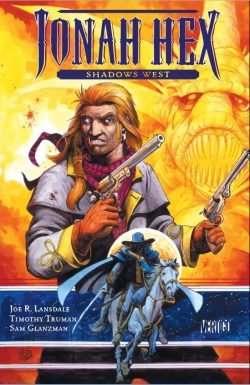
Jonah Hex: Shadows West


By Joe R. Lansdale, Timothy Truman, Sam Glanzman & various (DC/Vertigo)
ISBN: 978-1-4012-4715-7

As initially imagined by John Albano & Tony DeZuñiga, Jonah Hex is probably the most memorable western comic character ever created. He’s certainly the darkest and most grippingly realised, as is the brutal and uncompromising world he inhabits.

A ruthless demon with gun or knife or whatever is at hand, he hunts men for the price on their heads in the years following the American civil war, and the scars inside him are more shocking even than the ghastly ruin of his face.

DC – or National Periodicals as it then was – had run a notable stable of clean-cut gunslingers since the collapse of the super-hero genre in 1949, with such dashing – and immensely readable – luminaries as Johnny Thunder, The Trigger Twins, Nighthawk, Matt Savage and dozens of others in a marketplace that seemed limitless in its voracious hunger for chaps in chaps. However, all things end and comic tastes are notoriously fickle, and by the early sixties the sagebrush brigade had dwindled to a few venerable properties as an onslaught of costumed super-characters assaulted the newsstands and senses.

They too would temporarily pass…

As the 1960s closed, the thematic changes in the cinematic Cowboy filtered through to a comics industry suffering its second superhero retreat in twenty years. Although a critical success, the light-hearted Western series Bat Lash couldn’t garner a solid following, but DC, desperate for a genre that readers would warm to, retrenched and revived an old and revered title, gambling once again on heroes who were no longer simply boy scouts with six-guns.

the very model of the modern anti-hero, Jonah Hex, who first appeared in All-Star Comics #10: a vulgarly coarse and engagingly callous bounty hunter clad in a battered Confederate Grey tunic and hat.

With half his face lost to some hideous past injury, Hex was a brutal thug little better than the scum he hunted and certainly a man to avoid.

From the very start the series sought to redress some of the most unpalatable motifs of old-style cowboy literature and any fan of films like Soldier Blue and Little Big Man or Dee Brown’s iconoclastic book Bury My Heart at Wounded Knee will feel a grim sense of vicarious satisfaction and redress at most of the stories here.

There’s also a huge degree of world-weary cynicism that wasn’t to be found in other comics until well past the Watergate Scandal, the first time when America as a whole lost its social and political innocence. Sadly, not the last, though…

It was that edgy dissimilarity to standard comicbook fare that first attracted esteemed author, occasional comics scripter and devout Robert E. Howard fan Joe R. Lansdale (Bubba Hotep, Edge of Dark Water, Dead Aim) to the series as a child.

As his Introduction details, it’s also a large part of what convinced him and fellow craftsmen Timothy Truman (Grimjack, Scout, Turok: Dinosaur Hunter, Conan) and Sam Glanzman (USS Stevens, Haunted Tank, A Sailor’s Story, The Lonely War of Willy Schultz) to revive and reimagine the grizzled veteran in what turned out to be a highly popular and painfully controversial trio of adulted-oriented miniseries for DC’s Vertigo Comics imprint.

Collecting Jonah Hex: Two-Gun Mojo #1-5 (August-December 1993), Jonah Hex: Riders of the Worm and Such #1-5 (March-July 1995) and Jonah Hex: Shadows West #1-3 (February-April 1999), this volume – available in trade paperback and digital editions – also references heaping helpings of Spaghetti Western tropes, raw-edged Texan lore and attitudes, supernatural weirdness and some of the broadest, crudest, daftest belly-laugh humour ever seen in street-level American comics…

It all kicks off with Jonah Hex: Two-Gun Mojo as the bounty hunter is saved from lynching by the criminals he’s hunting. His saviour is nigh-decrepit aging manhunter Go Slow Smith. Together they despatch the outlaws who arranged the necktie party, but when the pecuniary lawmen try to claim the money on their latest gory prizes, they’re faced with bureaucratic obfuscation and delay.

That’s not too terrible as the town of Mud Creek has booze, beds and hot food, but when the sun goes down horror stalks Main Street and Smith is gunned down by a dead man…

Falsely accused of murder, Hex narrowly avoids another hanging and sets after traveling man Doc “Cross” Williams. When he tracks him down, however, the gunman realises the scientist has perfected a diabolical means of resurrecting the dead. It’s not so hard tackling the Doc’s bizarre coterie of ghastly freaks, but Hex has no chance against the wanderer’s star attraction, the undead but still lightning fast-draw Wild Bill Hickok.

The madman’s big mistake is trying to turn Hex into another zombie slave. After the hell-faced gunman gets way and regroups, Jonah undertakes a slow, relentless revenge that pulls Williams across the deadliest terrain in Texas and straight into the unforgiving sights of remorseless Apache renegades…

The result is a spectacular and breathtaking battle of wills you’ll never forget…

The creative band got back together for Jonah Hex: Riders of the Worm and Such: a truly inspired and deftly ridiculous spoof on western themes and attitudes with Hex cast as willing straight man in a yarn touching base with Robert E. Howard’s subterranean horror myths as viewed through Mel Brook’s Blazing Saddles.

In the searing inhospitable desert scrub a rather quaint English émigré is trying to establish a cattle ranch. He’s got lots of other strange ideas too, based on a lecture he once saw by Oscar Wilde.

At the Wilde West Ranch and Culture Emporium, Mr. Graves pays good wages and provides every amenity. He is well respected, but in return expects his doughty cowpokes to write and recite poetry, perform skits and enthusiastically burst into song at every opportunity.

Sadly, they got the enthusiasm down pat, but exhibit no discernible talent or artistic ability to underpin it…

When the restless Hex and his brash young sidekick stumble upon the cultural bastion, they have just barely survived an horrific encounter with a subterranean monster that drags people and animals beneath the earth to suck out their innards via efficiently-sliced off heads.

It’s not long before the newcomers realise the Englishman and his prairie troubadours are having their own encounters with the vile beasts.

When the effusive Graves reveals that the ranch previously belonged to a luckless fool named Errol Autumn an incredible tale emerges…

Autumn had set up his spread on land that had been contested for millennia by the local Indians and an antediluvian subhuman race dubbed the Worms of the Earth. After the idiot white man accidentally destroyed the wards and charms the natives had used to keep the monsters safely below, something escaped and raped his wife.

The offspring were still wandering the region and now seem intent on reviving that age-old war on humanity…

After one particularly hungry horror busts through the floor of Graves’s compound, Hex and the cowboys decide to take the battle to them and embark on a brain-blasting, ultimately cataclysmic voyage to the heart of hell, with the hybrid worm-children dogging their heels.

At least the underground argonauts can keep up their spirits with a song or two…

The bawdy and absurdist humour remain for the final outing but Jonah Hex: Shadows West also offers plenty of trenchant things to say about the treatment of native cultures too.

After another painful brush with ever-encroaching white civilisation and the stupidity of the law, Hex is induced by diminutive sharpshooter ‘Long Tom’ to join the shamefully low-rent Wild West Show of failed dentist and inveterate chancer Buffalo Will.

It’s an uncomfortable fit despite the huge salary and a reunion with old friend Spotted Balls. Will is an unrepentant shyster and charlatan and his white performers brutally and continually abuse the native hires.

After seeing how the men treat a squaw, Hex decides to quit and is astonished when she and Spotted Balls elect to come with him. The woman has an ulterior motive: her young son is the spawn of a spirit and looks it. He’s half bear, half human, talks and is the proposed means Buffalo Will plans to become stinking rich…

Happy to frustrate the evil impresario, Hex and his charges ride out in search of the spirit folk under ‘Gathering Shadows’ with Long Tom and a posse of killers in hot pursuit and a deadly race and mobile war of attrition ensues.

By the time the fugitives reach their destination, leaving bodies on both sides, ‘Final Shadows’ are falling and all hope seems lost. But even Hex’s cynical disbelief in mystic mumbo-jumbo takes a pounding when the child is reunited with the chief of the Bear Folk…

Raucous, excessively violent and bitingly funny, these irreverent yarns capture the spirit of the original Hex series whilst adding a modicum of unnatural unworldliness and outrageously lampooning the beloved cinema standbys of a bygone era.

If you love dry wit, trenchant absurdity and a non-stop bombardment of high-octane action, you must get this book.
© 1993, 1995, 1999, 2014 DC Comics. All Rights Reserved

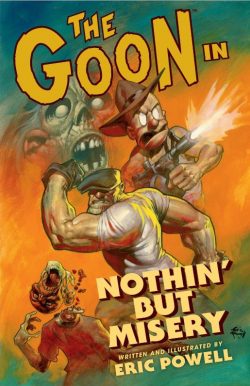
The Goon volume 1: Nothin’ But Misery


By Eric Powell (Dark Horse Books)
ISBN: 978-1-59582-624-4

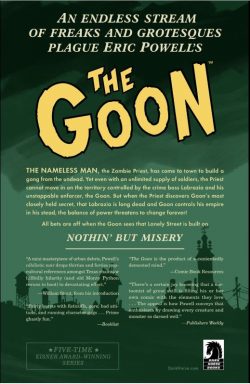
Before Dark Horse picked up The Goon, Eric Powell self-published a number of issues of this splendidly eccentric, side-splitting retro-feature, and these are presented here (mostly) in colour for the first time.

Lord knows how long he’d been working on the thing prior to publication because this is one of those rare Athenaic occasions when the creation springs forth fully formed without the usual noodging and twiddling that customarily occurs as a strip progresses until it settles into a stride.

This initial collection – available in paperback and digital formats – gathers and resurrects The Goon #1-4 and the Goon Color Special, (originally published by Albatross Exploding Funny Books in 2002) plus a short story from the last issue of anthology title Dark Horse Presents.

It opens with engaging Introduction ‘Down at the End of Lonely Street’ courtesy of comix and illustration legend William Stout, citing the series’ apparent antecedents and themes before the full colour, thirties-style pulp fun begins with that Dark Horse Presents outing…

Just in case you were wondering: Operating in the milieu of bootlegging American gangsterism and oozing Weird Tales style ambience, The Goon is a hulking, two-fisted brawler just getting along as best he can in the seamy underbelly of the city.

He and his pal Franky do jobs for reclusive gang-boss Labrazio, work their own scams when they can and look after their friends. They also hate zombies and know the true secret of the never-seen crime overlord…

This makes for a pretty eventful life since Labrazio’s biggest rival is The Nameless Man, an immortal witch-priest whose army of the undead keeps trying to escape from their rightful ghetto bastion on Lonely Street to take over the whole city or at least its rackets….

‘Die, Fish, Die!’ recapitulates all that in a darkly hilarious clash between The Goon and Franky on one side and a monstrous piscine leg-breaker and his scaly minions on the other…

The saga properly begins with the pals hunting a big score of legendary size and infamy.

The astounding Matheson Collection is the unholy grail of lost loot and our un-Made Men want it, but they never reckoned on the hellish house and the coterie of traumatised child phantoms that haunt it…

The second issue pitted the feisty felons against The Nameless Man’s demonic sponsor Evets and a reanimated marsh monster before Goon and Franky find a new and gruesome ally in their war against zombie mobsters. ‘Buzzard! The Creature that Feeds on the Flesh of the Dead!’ is a walking tragedy with an even bigger grudge against the necromancer of Lonely Street…

Add travesty to mawkish sentiment and the result is ‘The Goon: A Christmas Story’ as our guys and helpful werewolf Merle go hunting for abducted kids. When they find the nippers have been consumed by Santa’s carnivorous helpers, the boys need the help of an extra-special ally…

Then, when ever-ambitious Franky is targeted by deviant magician The Moonlight Firefly, the crusty sidekick is subjected to the lewd attentions of relentless, shameless tormenting harpies until his big buddy steps up and steps in, after which the narrative tomfoolery concludes with violent vignette ‘The Goon in… Attack of the One-Eyed Scumbag from Outer Space’.

When you’re as big and mean and handy with your fists as out leading man, the action is over before you know it…

Adding to the surreal cavalcade is a sprinkling of outrageous faux adds for such must-have items as the Billy Lobotomy Kit, Mega Body Pill, Psychic Seal Hotline and much more whilst wrapping up the macabre mirth is a Gallery of The Goon: a flurry of fan art by like-minded pros Michael Avon Oeming, Guy Davis, Mike Hawthorne, Kyle Hotz and Christophe Quet…

This spectacular pop-culture spoof and anthemic tribute to the gory glory days of EC comics offers thrill-a-minute craziness as these not-so-Wise (but extremely tough) Guys tackle flesh-eaters, Cthuluistic hell-shamblers, twisted ghosts, space horrors and every type of thug and monster, armed with nothing more than fists, gats, dirty vests and attitude, all in the name of an easy life.

Powell is a sharp, economical writer with a great ear for period dialogue and a truly surreal sense of humour. This is supplemented by the ability to draw like a cross between Jack Kirby and Wally Wood. Wonderful, wonderful stuff. How have you missed this?
™ & © 2011 Eric Powell. All Rights Reserved.

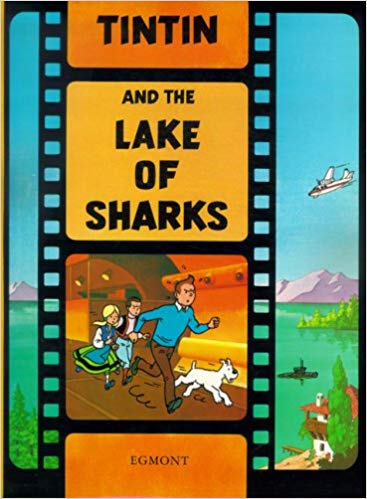
Tintin and the Lake of Sharks – A TINTIN FILM BOOK


By Greg & various, translated by Leslie Lonsdale-Cooper & Michael Turner (Egmont)
ISBN: 978-1-40520-822-2 (HB)                    978-1-4052-0634-1 (PB)

Although this tale is not strictly canonical, fans of Hergé’s intrepid boy reporter and his tragically now completed series of adventures can always console themselves with this high-quality graphic adaptation of the animated feature-film Tintin et la Lac aux Requins.

The motion picture was originally released in 1972 and – although not directly created by Hergé who only enjoyed a supervisory role – remains a classy piece of rousing fiction directed by publisher Raymond LeBlanc and written by European mega-star Michel Regnier.

As “Greg”, he is best remembered now for his comedic anti-hero Achille Talon (translated into English both in animated cartoons and comic albums as Walter Melon), Luc Orient, Bruno Brazil, Zig et Puce and memorable runs as scripter and/or editor on Spirou and Fantasio, Clifton and many more.

Although lacking the smartly satirical edge of Hergé’s efforts, comedy, action and slapstick are still well represented in this hectic yarn which transforms animation stills into sequential narrative, albeit with admittedly mixed results.

Purists who love the artist’s landmark and legendary Ligne Claire style will be deterred that the designs are laid over and across fully-rendered, moulded and painted backgrounds, but although the result is initially jarring, the story does swiftly carry the reader beyond such quibbles.

Ligne Claire – or the Democracy of Lines as it is sometimes called (in case you were wondering) – is the term given to the dramatically simplified drawing style developed by Hergé which has influenced so very many creators. With it sleek, clean lines of equal strength, thickness and prominence are used to impart an almost diagrammatic value to subjects.

This is in contrast to styles which might emphasise foreground or background with varying line-weights. Line-shading, hatching, feathering and the use of shadows are also ignored or down-played. It’s the perfect base for bold. simple colour and imparts an impressive solidity and immediacy to pictures.

When combined with a stripped-down but accurate character or object design, the effect of hyper or even meta-reality is astoundingly convincing. The term was first used by creator, fan and devotee Joost Swarte in the late 1970s. Here Endeth the Lesson…

In The Lake of Sharks a series of art and gem robberies coincide with a trip by Tintin, Captain Haddock and the detectives Thompson and Thomson to visit Professor Calculus. The savant is sequestered at a villa on the shores of Lake Pollishoff; a huge body of water in the mountains of Syldavia, artificially created by building a dam and flooding a village.

The locals believe the area is haunted. And no sooner do our picaresque cast arrive than attempts to kill them begin!

Calculus is in seclusion to perfect his latest invention – a 3-D duplicating machine – but a series of strange events leads Tintin to believe that sinister forces have targeted the eccentric genius once again.

Spies, intruders and weird occurrences seem to be a daily threat at the Villa Sprog! Our heroes are not easily cowed, however, and with the help of two peasant children, Niko and Nushka (and their dog Gustav) a dastardly plot by the heroes’ greatest enemy is revealed. This mastermind now calls himself King Shark…

This magical, fast-paced romp does the canonical episodes proud and can hold its head high even amidst the incredible legacy of one of the true Masters of the Comic Strip. And besides, your collection is incomplete without it…
Artwork © 1955 Editions Casterman, Paris& Tournai. © renewed 1983 Egmont UK Limited. Text © 1971 Egmont UK Limited. All Rights Reserved.

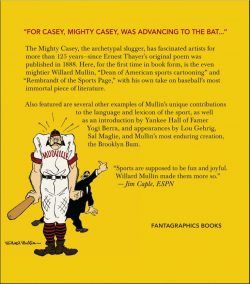
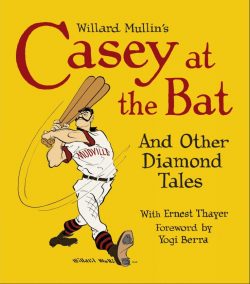
Casey at the Bat and Other Diamond Tales


By Wilford Mullins with Ernest Thayer and various (Fantagraphics Books)
ISBN: 978-1-60699-814-4

Happy Anniversary!

It’s a memorable day. In 1835 HMS Beagle set sail for Charles Island in in the Galapagos Archipelago. Ten years later the New York Knickerbockers formed and adopted the rule code for what would become “America’s favourite game” and in 1846 Johann Gottfried Galle and Heinrich d’Arrest located Neptune. There’s other stuff too. You should look it up…

Oddly I couldn’t find an appropriate book for two of those above-cited commemorations but here’s something for sports-lovers, cartoon connoisseurs and devotes of smart, big laughs…

Casey at the Bat: A Ballad of the Republic Sung in the Year 1888 is probably the most famous piece of high-quality doggerel in the English Language. It was anonymously penned by writer and philosophy graduate Ernest Thayer whilst he was working for The Daily Examiner (later The San Francisco Examiner) and published in the June 3rd, 1888 edition.

It should be noted that “Phin”, as he called himself in print, was employed as a humourist, not a sports reporter…

The piece passed without much notice at the time, but was picked up (pinched, stolen, swiped, “popularised”) by Vaudeville performer DeWolf Hopper who made it his star turn on stage for decades to come. It’s mock-heroic excess and powerful meter also caused it to be plagiarized and adapted by other writers on a tight deadline almost continually ever since.

It has been co-opted to stage, large and small screen and almost every manner of media dissemination, with vocal luminaries from Garrison Keillor to James Earl Jones to actual baseball pitcher Tug McGraw all taking a hit at re-immortalising the daft ditty.

An actual landmark of American history and culture, the poem was used by the sport’s governing body in 1953 to celebrate the 50th Anniversary of the World Series. They issued a set of 14 drinking glasses – with one stanza per mass-produced goblet – as collectable premiums dispensed at ballparks across the nation.

To ensure the desirability of the items the vessels with the verses shared space with suitably comedic illustrations from America’s favourite sports cartoonist – a man who would eventually be awarded the title of “Greatest Sports Cartoonist of the 20th Century”…

Britain never really enjoyed the long and lovingly cherished tradition of sports cartoons enjoyed by America throughout the 20th century – more’s the pity – but in the Land of the Free, illustrated match précis’, captivating portraits, visual biographies, charismatic caricatures and plain old-fashioned gags in drawn form were a vital element of every national and local newspaper… and had been for generations.

Such sporting profiles, sketches, technical tips, skits and lampooning broadsides were borrowed by a new industry to become a staple of Golden Age comicbooks – and far too often the best drawn items in those fantasy-fuelled periodicals.

Willard Mullin (September 14th 1902 – December 20th 1978) captured the magic of America’s favourite game (and other strenuous pastimes) for almost half a hundred years: encapsulating the power, glory, glum disappointment, punishing optimism, heartbreak and incurable unflagging passion of players, managers, owners and fans in spectacular portrait biographies, potent editorial cartoons, gently ferocious caricatures and hilarious, knowing slapstick panels. You can enjoy further examples of his gifts in companion volume Willard Mullin’s Golden Age of Baseball – Drawings 1934-1972…

Mullins’ illustrations for Casey were believed long lost until they resurfaced at an auction in 2002, whereupon Fantagraphics reproduced and collated them in this tasty hardback (or eBook) volume, further spiced up with a selection of the master’s other batting triumphs…

Following a Foreword by sporting legend Yogi Berra and a compelling overview in ‘Willard and Casey’: a photo-limned essay from baseball historian (head of Guilderland Public Library and Director of Research at the Baseball Hall of Fame Library), the full saga unfolds in magical form.

Then photo examples of the actual drinking vessels are accompanied by editor Michael Powers’ appreciative biography of ‘The Longfellow of the Sports Page’ which in turn lead to a selection of Mullin’s other pictorial triumphs – all of a similarly jocund and poetic nature…

A brace of very different paeans to ‘Iron Horse Lou’ (Gehrig) precede a hilarious argot script in prime “Brooklynese” and a trenchant revision of Walt Whitman’s O Captain, My Captain suitably framed to target the tragic Dodgers in ‘Brooklyn, My Brooklyn’.

Baseball ABC’s can be learned in ‘From April to Zeptember’ after which James T. Fields’ The Owl Critic is repurposed in tribute to Sal “the Barber” Meglie as ‘The Barber on Kept Shaving’ before the visual triumphs conclude with Mullins’ famous ‘Go-Go Mets!’ cover for Time Magazine.

Fantagraphics Books struck gold twice over by reviving and celebrating a lost hero and a nigh-forgotten sector of graphic narrative arts in this superb commemoration.

Whether you’re a fan of sports in general or Baseball in particular, if you’re reading this you love narrative art, and Willard Mullin was the Will Eisner of his field: clever, funny, bold, dramatic and capable of astounding emotional connection with his readers. This is a book no lovers of our art form should miss.

This edition © 2015 Fantagraphics Books. Willard Mullin and the Brooklyn Bum are ™ and ® the Estate of Willard Mullin, Shirley Mullin Rhodes, Trustee. Other material © its respective holders or owners as noted within.

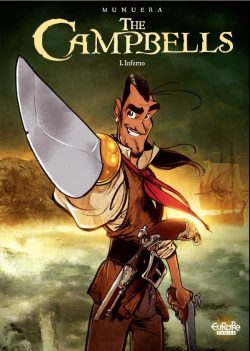
The Campbells volume 1: Inferno


By Jose Luis Munuera, coloured by Sydas and translated by Emma Wilson (Europe Comics)
Digital Edition No ISBN:

Arrr! It be International Talk Like a Pirate Day once morrrre, me Hearties! That gives me license to act like a complete berk whilst plugging a suitably themed graphic yarn. This ‘un be a real cracker, too…

As heavily influenced by a certain Disney movie franchise as continental Europe’s long-standing affection for the genre, and exhibiting a deft hand with the traditions and history of light-hearted freebooting romps, Inferno is the introductory salvo in a convoluted yet engaging family saga about a most unconventional bunch of buccaneers.

Crafted by Andalusian comics veteran Jose Luis Munuera (No Hay Domingos en el Infierno, Merlin, Walter le Loup, Spirou et Fantasio, P’tit Boule et Bill) who has been delighting readers since his debut in 1996, the epic voyage of discovery commences here with smart, snappy episodes introducing an extremely large cast of roguish characters.

First up are devious rapscallion “Captain” Carapepino and his trusty dogsbody Haggins. A very minor player with huge aspirations, the smooth talker is off burying his first chest of treasure on a sun-kissed tropical island when he is ambushed and hijacked by the infamous – and long-missing – Captain Campbell.

Through a most cunning ploy, the pirate’s pirate (with his two young daughters at his side) appropriates the gem-strewn chest and smugly paddles away to another paradisiacal atoll…

The next vignette sees the wonder man at ease in his luxurious haven on Garden Island, patiently watching teenaged Itaca explode again as her obnoxiously bratty sister Genova reads excerpts from her stolen secret diary…

Despite their acting out and outrageous feats of derring-do, the well-educated, ultra-fit kids love each other and desperately miss their mother…

Out in the briny depths, formidable Captain Inferno terrorises victims and his own men. He is a man of dark moods and soaring ambition, but haunted by visions of a dead woman who comes to him often to repeat three horrifying predictions that he cannot escape.

His night terrors are suppressed but not abated by the arrival of the unctuous Carapepino who reveals his encounter with the sea terror’s most despised enemy… and husband of the ghost who currently plagues him…

The Campbells might be a sea-wolves but they are most unconventional ones. Amongst those who love them most are the inhabitants of the Isle of Bakaloo, a leper colony the family regularly visit with supplies of food, books and other life-easing essentials.

On this latest trip, the canny corsairs bring along the latest chest of valuables: after all, what normal, superstitious rogues would risk their scurvy skins amongst the unclean and diseased?

Some days later, the family visit the fiercely neutral township of Bahia Cambalanche, Port Franc. Here all hawks of the seas can meet to trade, carouse and fence their stolen booty. Here and now, Itaca and Genova reluctantly attend lessons arranged by their father.

Right here, right now, Carapepino and a press gang provided by Inferno attempt to abduct the girls only to be beaten back by their unbridled fury and the late intervention of gorgeous teenager Blond Luca.

Itaca is instantly smitten by the glorious hero, blithely unaware that her saviour is a pawn in a dastardly long con…

The deception blossoms soon after as Garden Island is invaded by Carapepino’s borrowed forces. Nevertheless, the trio of Campbells fight free, humiliate the craven dogs and make a bold escape to a new sanctuary…

In the interim, Inferno has not been idle. By ruthless manipulation and scurrilous deals, he has ingratiated himself with English nobility – and Campbell’s oldest enemies – in order to have himself admitted to the top flight of the corrupt aristocracy.

Now invested as Baron of England, with a warrant to hunt all shipping but British vessels, Inferno moves quickly to consolidate power and replace the crown’s agents with his own people…

The Campbells have relocated to Bakeloo where Itaca broods over Luca’s betrayal and her father worries about her distress. Father is blithely oblivious to the passionate adoration of native lovely Nutel-La but the practical islander finally makes a big impression when she suggests that the devoted dad needs to have “the talk” with his swiftly maturing daughter…

Having lost yet another ship, Carapepino and his surviving crew at last link up with former employer Baron Inferno, just in time to become his first prisoners as the newly ennobled provincial ruler moves into his new Governor’s Palace.

The interloper eases gracefully to the head of the aristocratic pack, gleaming in fine clothes, sparkling with newfound power and respectability. After all, aren’t these rich privileged fools just another gang of self-proclaimed predators? Especially the shockingly blunt and ruthlessly amoral Lady Helvetia, who soon becomes his boon companion and more…

However, when the revels end, the Baron’s mind races back decades to the docks of London where he and his bold, inventive, loyal brother picked pockets and sought to escape their monster of a father. How far they have come since then. How far they have drifted apart…

To Be Continued…

Only currently available in English in digital editions, The Campbells is a fabulously engaging rollercoaster of thrills and fun, as good as the first Pirates of the Caribbean movie and far more entertaining and satisfying than the rest of that franchise.

Combining smart and constant laughs with bombastic action, an enticing generational war, murder mystery and heartbreakingly winning characters – goodies and baddies! – the series goes from strength to strength. This first volume is captivating from the outset, with its hyper-kinetic Marcinelle School-derived art grabbing the attention and dragging readers along as though caught in a bow wave, with the raffish gags subtly counterbalancing a strong, and complex family-based conflict and just the merest hint of supernatural menace lurking in the shadows.

Don’t wait for a surely-inevitable print release, scour the electric waves and track down this book and series…
© DUPUIS – MUNUERA 2017. Al rights reserved.

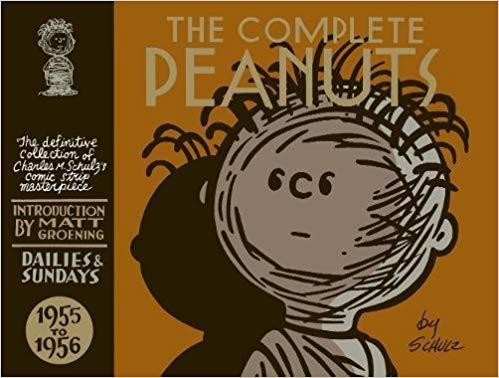
The Complete Peanuts volume 3: 1955-1956


By Charles Schulz (Canongate Books/Fantagraphics Books)
ISBN: 978-1-84767-075-5 (Canongate HB):             978-1-56097-647-9 (Fantagraphics HB)

Peanuts is unequivocally the most important comics strip in the history of graphic narrative. It is also the most deeply personal. At its height, the strip ran in 2,600 newspapers in 75 countries, translated into 21 languages. Many of those venues are still running perpetual reprints, as they have ever since Schulz’ departure. Book collections, a merchandising mountain and television spin-offs made the publicity-shy artist a billionaire.

Cartoonist Charles M Schulz crafted his moodily hilarious, hysterically introspective, shockingly philosophical epic for half a century. During that time he published 17,897 strips from October 2nd 1950 to February 13th 2000, and died – from the complications of cancer – the day before his last strip was printed…

None of that is really the point. Peanuts – a title Schulz loathed, but one the syndicate imposed upon him – changed the way newspaper strips were received and perceived, and proved that cartoon comedy could have edges and nuance as well as pratfalls and punch lines.

Following a heartfelt and clearly awestruck Foreword from contemporary cartoon genius Matt Groening, this third gargantuan landscape hardback compendium (218 by 33 by 172 mm in the solid world and infinitely variable in its digital iterations) offers in potent monochrome the fifth and sixth years in the life of Charlie Brown and Co: an ever-evolving bombardment of cruel insight and bitingly barbed hilarity.

Here our increasing browbeaten but resolutely optimistic little round head and his high-maintenance mutt Snoopy respond with increasing bewilderment to the rapidly changing world of TV, sports, games and especially peers who seem designed only to vex, belittle or embarrass the introspective everyboy.

Gaining far greater prominence is obnoxious “fussbudget” Lucy who, with her infant sibling Linus – an actual architectural idiot savant – are getting more and more of the best lines and set-ups. Another up and comer settling in (amidst a cloud of dust and detritus) is hapless toxic innocent ‘Pig-Pen’: a sad clown in the grand manner, buffeted by a cruel condition but manfully persevering throughout…

Bombastic Shermy and mercurial Patty are slowly being eased out, and brusque Violet is slowly losing ground to gags starring Beethoven-obsessed, long-suffering musical prodigy Schroeder. Linus’ mystic tranquiliser the Security Blanket also gains greater prominence, but his anxiety peaks exponentially whenever raucous, strident newcomer Charlotte Braun ambles by…

The daily diet of rapid-fire gags had now successfully evolved from raucous slapstick to surreal, edgy, psychologically honed introspection, crushing peer-judgements and deep rumination in a world where kids – and certain animals – were the only actors, although even inanimate objects occasionally got into the action with malice aforethought…

The relationships, however, were ever-evolving: deep, complex and absorbing even though “Sparky” Schulz never deviated from his core message to entertain…

The first Sunday page had debuted on January 6th 1952: a standard half-page slot offering more measured fare than the daily. Both thwarted ambition and explosive frustration became part of the strip’s signature denouements and continue to develop here. There are some pure gem examples of running gag mastery in here too, regarding Lucy’s ongoing relationship to certain snowmen of her own macabre devising and mounting jealousy that her predestined inamorata would rather look at plaster busts of Beethoven than upon her living form…

Perennial touchstones on display herein include playing, playing pranks, playing sports, playing golf, playing baseball, playing in mud, playing in snow, playing musical instruments, playing marbles, the rules of croquet, learning to read, coping with increasingly intransigent if not actually malevolent kites, teasing each other, making baffled observations and occasionally acting a bit too much like grown-ups.

New themes include America’s fascination with flying saucers, ditto for TV sensation Davy Crockett, art appreciation and Snoopy’s growing desire to be anything but a maligned and put-upon little dog. Especially one starved of tasty treats and bonbons…

The soft-soap ostracization of Charlie Brown and his expressions of alienation are well explored but in truth Lucy is the real star here, with episodes seeing her seeking to become Mayor of the United States, duelling Snoopy with skipping ropes and investigating the mystery of why the planet is getting smaller…

More exploration of Snoopy’s incredible inner mindscape can be seen here and there are plenty of season-appropriate gags about summer sun, winter snow and the Fall of leaves as well as riffs on festive events such as Halloween, Easter and Christmas. During this time Good Ol’ Charlie starts getting those stress-induced head and stomach aches…

And best of all, auteur Schulz is in brilliant imaginative form crafting a myriad of purely graphic visual gags any surrealist would give their nose-teeth to have come up with…

Now and forevermore Charlie Brown – although still a benign dreamer with his eyes affably affixed on the stars – is solidly locked on the path to his eternal loser, singled-out-by-fate persona and the sheer diabolical wilfulness of Lucy starts sharpening itself on everyone around her…

Adding to the enjoyment and elucidation, a copious ‘Index’ offers instant access to favourite scenes you’d like to see again, after which Gary Groth reviews the life of ‘Charles M. Schulz: 1922-2000’, rounding out our glimpse of the dolorous graphic genius with intimate revelations and reminiscences…

Still readily available, this volume offers the perfect example of a masterpiece in motion: comedy gold and social glue gradually metamorphosing in an epic of spellbinding graphic mastery which became part of the fabric of billions of lives, and which continues to do so long after its maker’s passing.

How can you possibly resist?
The Complete Peanuts: 1955-1956 (Volume Three) © 2004 Peanuts Worldwide, LLC. Foreword © 2005 Matt Groening. “Charles M. Schulz: 1922 to 2000” © 2004 Gary Groth. All rights reserved.

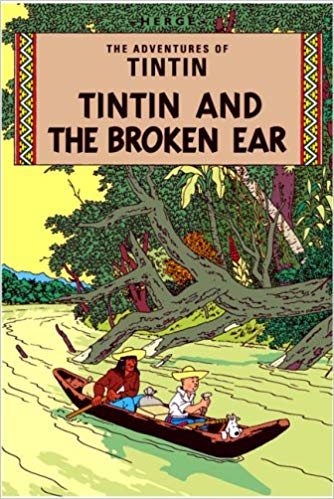
Adventures of Tintin: Tintin and the Broken Ear


By Hergé & various; translated by Leslie Lonsdale-Cooper & Michael Turner (Egmont)
ISBN: 978-1-40520-617-4 (HB)                    : 978-0-416-57030-5 (PB)

Georges Prosper Remi – AKA Hergé – created a true masterpiece of graphic literature with his many tales of a plucky boy reporter and his entourage of iconic associates. Singly, and later with assistants including Edgar P. Jacobs, Bob de Moor and the Hergé Studio, Remi completed 23 splendid volumes (originally produced in brief instalments for a variety of periodicals) that have grown beyond their popular culture roots and attained the status of High Art.

Like Charles Dickens with The Mystery of Edwin Drood, Hergé died in the throes of creation, and final outing Tintin and Alph-Art remains a volume without a conclusion, but still a fascinating examination and a pictorial memorial of how the artist worked.

It’s only fair though, to ascribe a substantial proportion of credit to the many translators whose diligent contributions have enabled the series to be understood and beloved in 38 languages. The subtle, canny, witty and slyly funny English versions are the work of Leslie Lonsdale-Cooper & Michael Turner.

On leaving school in 1925, Remi worked for Catholic newspaper Le XXe Siécle where he fell under the influence of its Svengali-like editor Abbot Norbert Wallez. The following year, the young artist – a passionate and dedicated boy scout – produced his first strip series: The Adventures of Totor for the monthly Boy Scouts of Belgium magazine.

By 1928 he was in charge of producing the contents of Le XXe Siécles children’s weekly supplement Le Petit Vingtiéme and unhappily illustrating The Adventures of Flup, Nénesse, Poussette and Cochonette when Abbot Wallez urged Remi to create a new adventure series. Perhaps a young reporter who would travel the world, doing good whilst displaying solid Catholic values and virtues?

And also, perhaps, highlight and expose some the Faith’s greatest enemies and threats…?

Having recently discovered the word balloon in imported newspaper strips, Remi decided to incorporate this simple yet effective innovation into his own work.

He would produce a strip that was modern and action-packed. Beginning January 10th 1929, Tintin in the Land of the Soviets appeared in weekly instalments, running until May 8th 1930.

Accompanied by his dog Milou (Snowy to us Brits), the clean-cut, no-nonsense boy-hero – a combination of Ideal Good Scout and Remi’s own brother Paul (a soldier in the Belgian Army) – would report back all the inequities from the “Godless Russias”.

The strip’s prime conceit was that Tintin was an actual foreign correspondent for Le Petit Vingtiéme…

The odyssey was a huge success, assuring further – albeit less politically charged and controversial – exploits to follow. At least that was the plan…

After six years of continuous week-by-week improvement, Hergé was approaching his mastery when he began The Broken Ear. His characterisations were firm in his mind, and the storyteller was creating a memorable not to say iconic supporting cast, whilst balancing between crafting satisfactory single instalments and building a cohesive longer narrative.

The version reprinted here (in either hardback or softcover as you prefer) was repackaged in colour by the artist and his studio in 1945, although the original ran as monochrome 2-page weekly instalments from 1935-1937, but there are still evident signs of his stylistic transition in this hearty, exotic mystery tale that makes Indiana Jones look like a boorish, po-faced amateur.

Back from China, Tintin hears of an odd robbery at the Museum of Ethnography and, rushing over, finds the detectives Thompson and Thomson already on the case in their own unique manner.

A relatively valueless carved wooden Fetish Figure made by the Arumbaya Indians has been taken from the South American exhibit. Bafflingly, it was returned the next morning, but the intrepid boy reporter is the first to realise that it’s a fake, since the original statue had a broken right ear.

Perhaps coincidentally, a minor sculptor has been found dead in his flat…

Thus begins a frenetic and enthralling chase to find not just who has the real statue but also why a succession of rogues attempt to secure the dead sculptor’s irreverent and troublesome parrot, with the atmospheric action encompassing the modern urban metropolis, an ocean-going liner and the steamy, turbulent Republic of San Theodoros.

Hhere the valiant lad becomes embroiled in an on-again, off-again Revolution. Eventually, though, our focus moves to the deep jungle where Tintin finally meets the Arumbayas and a long-lost explorer, finally getting one step closer to solving the pan-national mystery.

Whilst unrelenting in my admiration for Hergé I must interject a necessary note of praise for translators Leslie Lonsdale-Cooper & Michael Turner here. Their light touch has been integral to the English-language success of Tintin, and their skill and whimsy is never better seen than in their dialoguing of the Arumbayas.

Just read aloud and think Eastenders…

The slapstick and mayhem incrementally build to a wonderfully farcical conclusion with justice soundly served all around, all whilst solid establishing a perfect template for many future yarns: especially those that would perforce be crafted without a political or satirical component during Belgium’s grim occupation by the Nazis.

Here, however, Hergé’s developing social conscience and satirical proclivities are fully exercised in a telling sub-plot about rival armaments manufacturers using an early form of shuttle diplomacy to gull the leaders of both San Theodoros and its neighbour Nuevo-Rico into a war simply to increase company profits, and once again oil speculators would have felt the sting of his pen – if indeed they were capable of any feeling…

It’s hard to imagine that comics as marvellous as these still haven’t found their way onto everybody’s bookshelf, but if you are one of this underprivileged underclass, there’s no better time to rectify that sorry situation.

The Broken Ear: artwork © 1945, 1984 Editions Casterman, Paris & Tournai.
Text © 1975 Egmont UK Limited. All Rights Reserved.