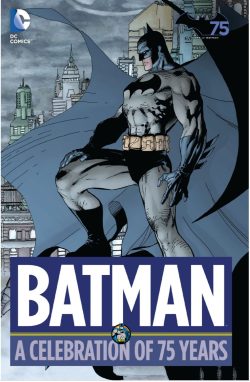
By Bob Kane & Bill Finger, Gardner F. Fox, Don Cameron, Edmond Hamilton, John Broome, Bob Kanigher, Dennis J. O’Neil, Archie Goodwin, Steve Englehart, Mike W. Barr, Peter Milligan, Doug Moench, Chuck Dixon, Greg Rucka, Paul Dini, Scott Snyder, Brad Metzer, Jack Burnley, Sheldon Moldoff, Jerry Robinson, Dick Sprang, Lew Sayre Schwartz, Win Mortimer, Carmine Infantino, George Roussos, Charles Paris, Murphy Anderson, Joe Giella, Sid Greene, Neal Adams, Dick Giordano, Alex Toth, Marshall Rogers & Terry Austin, Frank Miller & Steve Mitchell, Michael Golden & Mike DeCarlo, Alan Davis & Paul Neary, Tom Mandrake, Jim Aparo, Graham Nolan & Cam Smith, Rick Burchett & Rodney Ramos, J.H. Williams III, Simone Bianchi, Greg Capullo & Jonathan Glapion, Chip Kidd & various (DC Comics)
ISBN: 978-1-4012-4758-4 (HB) 978-1-4012-5186-4 (Digital edition)
This book includes Discriminatory Content produced in less enlightened times.
Somehow, I never got around to covering many of the best anthologised DC “Celebration” collections, and with another (possibly last!) Christmas coming, what better time to explore the delights of genuinely guaranteed comic book good times? This one’s a cracker too…
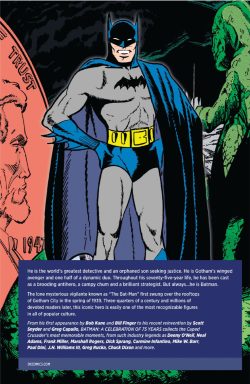
Batman is a creature of the night. Batman is the world’s greatest detective, escapologist and master of disguise. Batman fights criminals, madmen and bad women, aliens and monsters. Batman is all that and more. He apparently sees in black-&-white in world of fabulous hues and constantly shifting blinding colour – mostly red.
Batman is in many ways the ideal superhero: uniquely adaptable and able to work in any type or genre of story, as is clearly evident from the dazzling plethora of vintage tales collected in so many captivating volumes over the years. These vie equally with immediately recent tales collected into albums scant moment after going off-sale as periodical comic books.
Launching a year after Superman, “The Bat-Man” (and latterly Robin, the Boy Wonder) cemented DC/National Comics as market frontrunner and conceptual leader of a burgeoning new publishing industry: comic books.
Having established the fantastic parameters of metahumans with their Man of Tomorrow, the strictly mortal physical perfection and dashing derring-do of DC’s Dynamic Duo became the swashbuckling benchmark by which all other four-colour crimebusters were measured. The epitome of swashbuckling, Batman bloomed at this time and the impetus enabled him to endure and survive the decline of superheroes at the end of the 1940s.
Although he’s frequently played second fiddle to his pioneering predecessor Superman (who debuted in Action Comics #1, June 1938), the Dark Knight has, over his 87 years, grown to become the planet’s most popular superhero. He does have some bragging rights to longevity, however, as he debuted in the company’s most prestigious – and arguably premiere – comics title.
Detective Comics #1 had a March 1937 cover-date and was the third and last anthology title devised by luckless pioneer Major Malcolm Wheeler-Nicholson. In 1935, the entrepreneur had seen the potential in Max Gaines’ new invention (comic books) and quickly conceived and released packages of all-new material entitled New Fun: The Big Comic Magazine and follow-up New Fun/New Adventure (which ultimately became Adventure Comics) under the banner of National Allied Publications. March 30th 1939 saw Batman‘s debut in May cover-dated Detective Comics #27. About one year after that dynamic debut Batman’s resounding growth in popularity resulted in a bombastic bold boy sidekick and the launch of Batman #1 (cover-dated “Spring” 1940 and released on April 25th of that year). At that time, only precursor/stablemate Superman was more successful…
This book was compiled in 2014 to celebrate The Dark Knight’s 75th Anniversary and still only scratched the surface. Imagine the page count in 13 years’ time when it’s a centenary! Seen here are contents and extracts from Detective Comics #27, 33, 83, 211, 216, 327, 359, 395, 442, 474, 574, 633, 711, 757 & 821; Batman #1, 49, 181, 497, 608; Batman (vol. 2) #2; World’s Finest Comics #94, DC Series #21, Batman Special #1 plus Detective Comics #27 – an all-new vintage treat that we’ll get to in due course…
Divided into category-chapters preceded by a text overview, we begin Part I (1939-1954): The Dynamic Duo with originating escapade ‘The Case of the Chemical Syndicate’ by Bob Kane and as yet still anonymous close collaborator/co-originator Bill Finger. A spartan, understated yarn introduced dilettante playboy criminologist Bruce Wayne, drawn into a straightforward murder-mystery as a cabal of industrialists were successively murdered. The killings stop when an eerie figure dubbed “The Bat-Man” intrudes on Police Commissioner Gordon’s stalled investigation, ruthlessly exposing and dealing with the hidden killer.
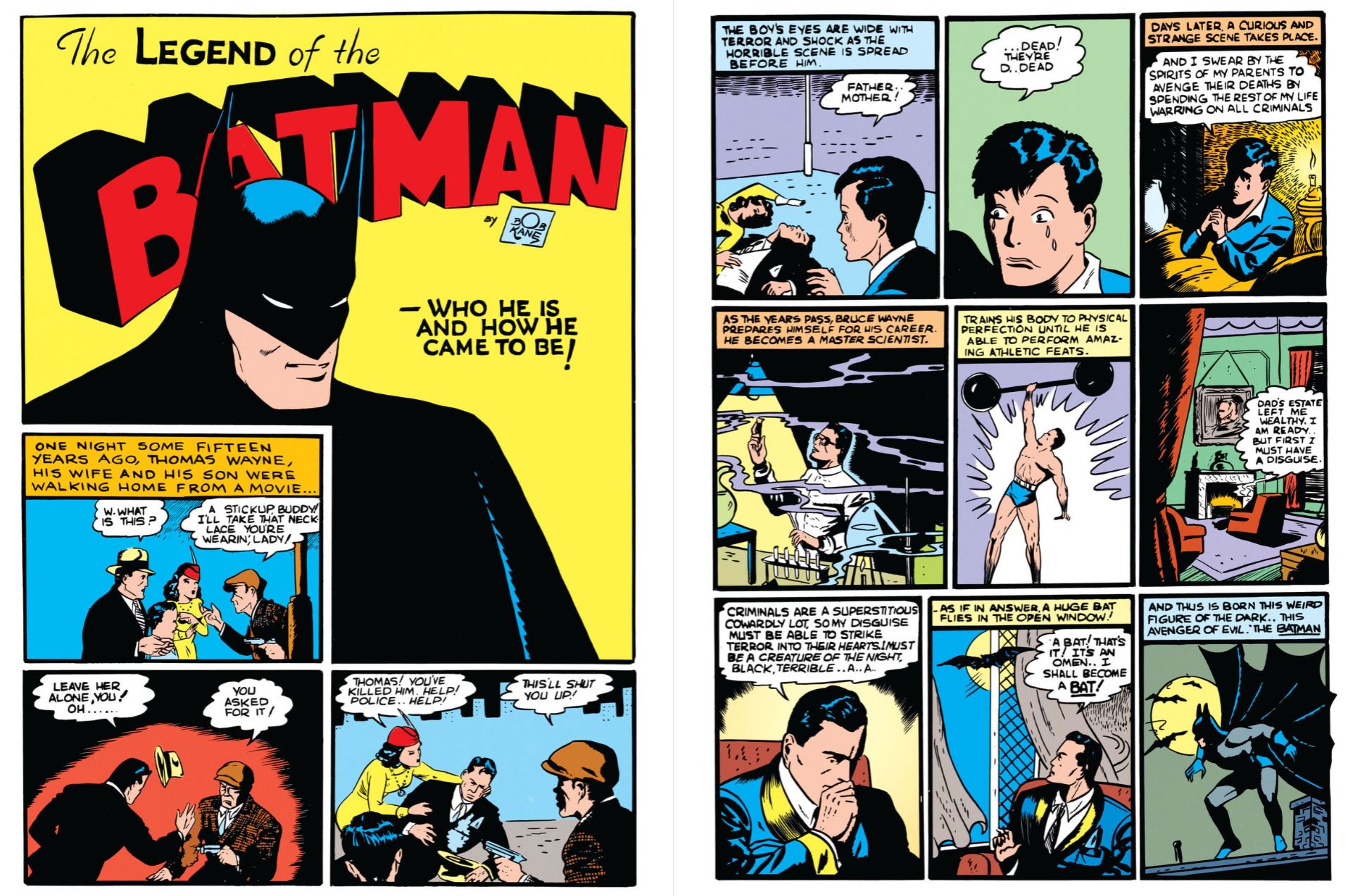
Following on, Batman’s first ever origin moment. It came in Detective Comics #33 (November 1939, on sale from September 30th), scripted by Gardner F. Fox and Finger in lead story ‘The Batman Wars Against the Dirigible of Doom’ . This cunningly included 2-page prologue ‘The Legend of the Batman – Who He Is and How He Came to Be’ and revealed how a young boy witnessed his parents’ hold-up and murder by a petty thug, consequently dedicating his life to becoming a perfect human specimen to avenge them and punish all criminals. Those 12 panels were reprinted at the beginning of Batman #1 (Spring 1940 and included here) and, with occasional minor tweaking, stayed the official version for 50 years.
Next – and taking as read years of baroque villain debuts and the heroes’ war efforts – we jump to Detective Comics #83 (January 1944) when the team supreme are growing comfortable in their endeavours and the mysteries are often cosy and gently humorous. Here, courtesy of Don Cameron, Kane & George Roussos, Wayne’s portly British butler Alfred augments his diet regime with exercise and an abrupt disappearance, leading the Gotham Guardians to a murderous mesmerising medic and criminal insurance scam in ‘Accidentally on Purpose!’, after which we close-up on two debuts in one sitting as seen in Batman #49, (October 1948, by Finger, Kane & Lew Sayre Schwartz). When a madman called the Mad Hatter goes on a crime spree, newly arrived press photographer Vicki Vale is on scene to capture evidence that the mighty hero might also be socialite Bruce Wayne… and nothing our heroes can do will dissuade her from enjoying ‘The Scoop of the Century!’
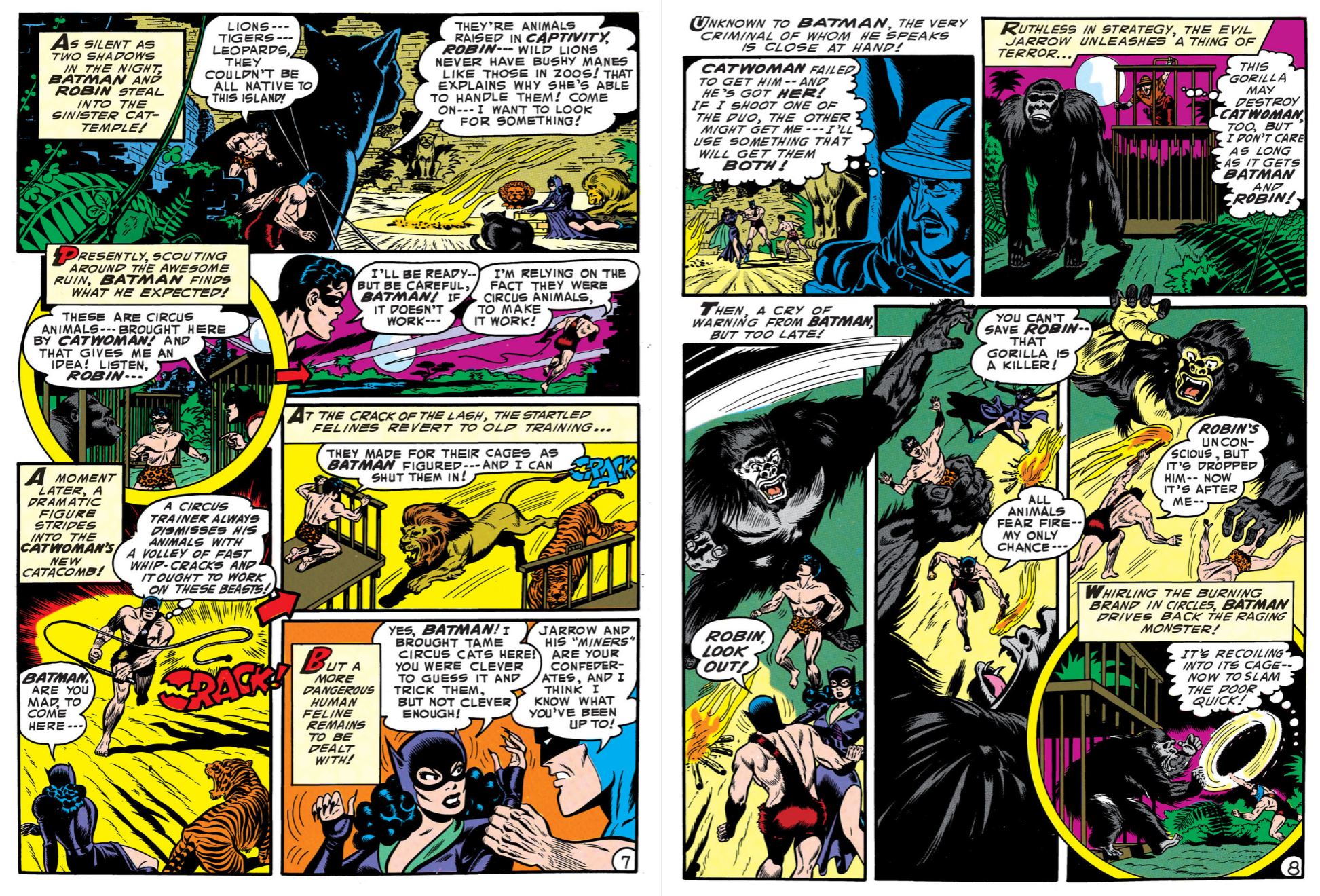
The archest of archfoes briefly gains the upper hand in ‘The Jungle Cat-Queen!’ (Detective #211, September 1954 and written by Edmond Hamilton) when the Caped Crusaders are trapped on a wild atoll without their modern tools and must face wild beasts and furious feline felon Catwoman. Thanks to artists Dick Sprang & Charles Paris, she never looked better…
Dick Sprang (July 28th 1915 – May 10th 2000) began earning money from art and narrative as a designer and illustrator in Ohio whilst still in high school. He edited and contributed art to magazines and pulps from the early 1930s onwards. On graduation in 1934 Sprang joined the bullpen of Toledo, Ohio publishing chain Scripps-Howard delivering deadline-busting ads, editorial cartoons and illustrations. Working with the company engravers Sprang mastered every aspect of print technology before moving to New York City in 1936 to illustrate pulps; everything from westerns to detective to general adventure yarns. Regular clients included Popular Detective, Popular Western, Phantom Detective, G-Men, Detective Novels Magazine, Crack Detective & Black Hood Detective/Hooded Detective, for which he also wrote stories. In 1937, Sprang began ghosting/assisting on newspaper strips including Secret Agent X-9 and The Lone Ranger, which led to his writing episodes of the latter’s radio show.
As pulps declined and comic books proliferated, he capitalised on the trend, forming a studio shop with Ed Kressy (Fact Finders, The Lone Ranger, Power Nelson) & Norman Fallon (Speed Comics, Shock Gibson, World’s Finest Comics). In 1941 they were hired by DC supremo Whitney Ellsworth who anticipated with dread Bob Kane being drafted. The trio began crafting inventory material to offset that inevitable day, which gradually slipped out over the course of the conflict. His first newsstand appearance was on part of the cover for Batman #18 (August/September 1943) whilst his first full outing was the next issue.
For Batman #19, he pencilled all four stories and the cover, but only inked the first three (!) leaving Fallon to embellish the fourth yarn. By 1946, and although utterly uncredited, Sprang was the leading artist on Batman comic book material, which marrying and moving to Sedona, Arizona barely impacted. In fact, he taught commercial photographer/new bride Lora Ann Neusiis to letter and colour his pages and, as “Pat Gordon”, she took off some of the load until their divorce in 1951. Gordon carried on working for DC until around 1961…
In 1955, despite still being unknown to fans, Sprang took on the Superman/Batman team-up feature in World Finest Comics and soldiered on with it, as well as newspaper strips, countless covers and more. His astounding artistry enhanced DC titles for 20 years, including Real Fact Comics #1-3, 18, Strange Adventures #1, Superman, Superman’s Girl Friend, Lois Lane & Superman’s Pal, Jimmy Olsen, and he fully recreated Batman’s look for the forward-facing 1950s, with a new Batplane, Batmobile and other paraphernalia. Sprang’s Joker was definitive and he co-created the Riddler and prototype of Supergirl.
That all ended on his retirement in 1963. When he wasn’t beguiling sedentary adventure fans, Sprang had become a noted explorer and historian of Arizona, Utah and Colorado, and happily commenced a career that brought him the fame comics hadn’t. His many celebrated discoveries and contributions are on show at Northern Arizona Universities Cline Library Special Collections in Flagstaff and the Utah Historical Society in Salt Lake City.
More of his wonders adorn Part II (1955-1969): The Caped Crusader which assesses that evolution via further fascinating examples. Next comes Hamilton, Sprang & Paris’ sold gold sci fi crime masterwork. ‘The Batman of Tomorrow!’ (DC #216, February 1955) visits the 20th century from his home in 3054 to save injured Bruce Wayne from Vicki Vale’s latest exposé and catch a cunning crook in a fast paced and fantastical romp.
‘The Origin of the Superman-Batman Team’ was seen in original team up title World’s Finest Comics (#94 by Hamilton, Sprang & Stan Kaye, June 1958) showing how the Man of Tomorrow seemingly replaces the Caped Crusader with a new partner, thereby provoking a close review of facts and a startling revelation for all concerned…
The Silver Age of US comic books utterly revolutionised a flagging medium, bringing a modicum of sophistication to the returning sub-genre of masked mystery men. However, for quite some time, changes instigated by Julius Schwartz in Showcase #4, which rippled out to affect all National/DC Comics’ superhero characters, generally passed Batman & Robin by. Fans buying Batman, Detective Comics, World’s Finest Comics and even Justice League of America would read adventures that in look and tone were largely unchanged from the safely anodyne fantasies that had turned the grim Darknight Detective into a mystery-solving, alien-fighting costumed boy scout as the 1940s became the largely non-superhero 1950s.
Although individual yarns could still amaze, the Gotham Gangbusters were in a perilous rut and risked being forgotten, even as they were being readied for small screen stardom. Change was needed and stolid, stable Batman scripter-turned-editor Jack Schiff was moving on to more amenable pastures and editorial environs.
By the end of 1963 Schwartz had revived much of DC’s superhero line – and the entire industry – with his modernized masked champions and costumed characters. Now he was tasked to work his magic with the Caped Crusader.
Bringing his usual team of creators with him, he stripped down the trappings and returned to the core-concept, bringing a modern take to the capture of criminals, whilst downplaying all the aliens, outlandish villains and daft transformation tales. He even oversaw a streamlining and rationalisation of the art style itself. The most apparent change to us kids was a yellow circle around the Bat-symbol, but more fundamentally the stories themselves changed. Subtle menace re-entered the comfortable and abstract world of Gotham City. The revolution began with Detective Comics #327 (May 1964, by John Broome, Carmine Infantino & Joe Giella) as ‘The Mystery of the Menacing Mask!’ presented a baffling “Howdunnit?” steeped in action and suspense.
Tracking an underground pipeline of missing crooks and encountering a wise guy who was literally untouchable underlined the renewed intention to emphasise the “Detective” part of the title for the foreseeable future. This comic was to be a brain-teaser from now on, and the advent of the Batman TV show soon followed… and the world went Bat-manic. The series inevitably influenced the comics and, as well as a lightening of tone, threw up new characters. The next new villain was not one of them…
‘Beware of… Poison Ivy!’ in Batman #181 (June 1966) introduced a deadly damsel seeking to be top banana in the ladies criminal ranks and an addition to the Caped Crusader’s Rogues Gallery that owed much to her appearance in the Batman syndicated newspaper strip of the era. However, in this tale she’s only a criminal boss using sex appeal and hallucinogenic perfumes as her tools to split up the Dynamic Duo and defeat rival villainesses in a sly tale from Robert Kanigher, Moldoff & Joe Giella.
The TV show had premiered on January 12th 1966 and ran for 3 seasons (120 episodes in total), airing twice weekly for its first two seasons. It was a monumental worldwide hit sparking a wave of trendy imitation. Resultant media hysteria and fan frenzy generated an insane amount of Bat-awareness, no end of spin-offs and merchandise (including a still-fabulously watchable movie) while introducing us all to the phenomenon of overkill. Batmania exploded across the world and then as almost as quickly turned toxic and vanished. To this day, no matter how much we might squeal and foam about it, or what has occurred since in terms of comics, games or movies, to a huge portion of this planet’s population Batman is always going to be that “Zap! Biff! Pow!” costumed buffoon…
This next innovation was the biggest change in Bat-lore for decades. ‘The Million Dollar Debut of Batgirl!’ (Detective Comics, #359, cover-dated January 1967, by Fox, Infantino & Sid Greene) introduced Barbara Gordon, mousy librarian and daughter of the venerable Police Commissioner into the superhero limelight. By the time the third TV season began on September 14, 1967, she was well-established.
A previous different Batgirl (Betty Kane, niece of the 1950s Batwoman), was already a comics fixture, but for reasons far too complex and irrelevant to mention, was conveniently forgotten to make room for the new, empowered woman in the fresh tradition of Emma Peel, Honey West and the Girl from U.N.C.L.E. She was pretty hot too, which is always a plus for television…
Whereas she fought the Penguin on the small screen, Batgirl’s paper premiere features the no less ludicrous but at least visually forbidding Killer Moth in a clever yarn that still stands up today. The Lethal Lepidopteran was about to kidnap Bruce Wayne until Babs – dressed up for a fancy dress party – stumbles in and busts up his scheme…
Part III (1970-1986): Creature of the Night shows how – in purely comic book terms – after the TV show did terrible things to Batman’s reputation, the efforts to return respect, awe and majesty to the character begam almost as soon as the show stopped. The efforts were greatly aided by another phenomenon beyond editorial control.
When superheroes waned in the 1950s reader tastes turned to traditional genres like westerns, war, science fiction, romance and especially horror. That cycle repeated again as the 1960s closed, with supernatural themes primary piquing the interests of jaded readerships. It took very little effort to shift Batman back into the gothic shadows of his own early days…
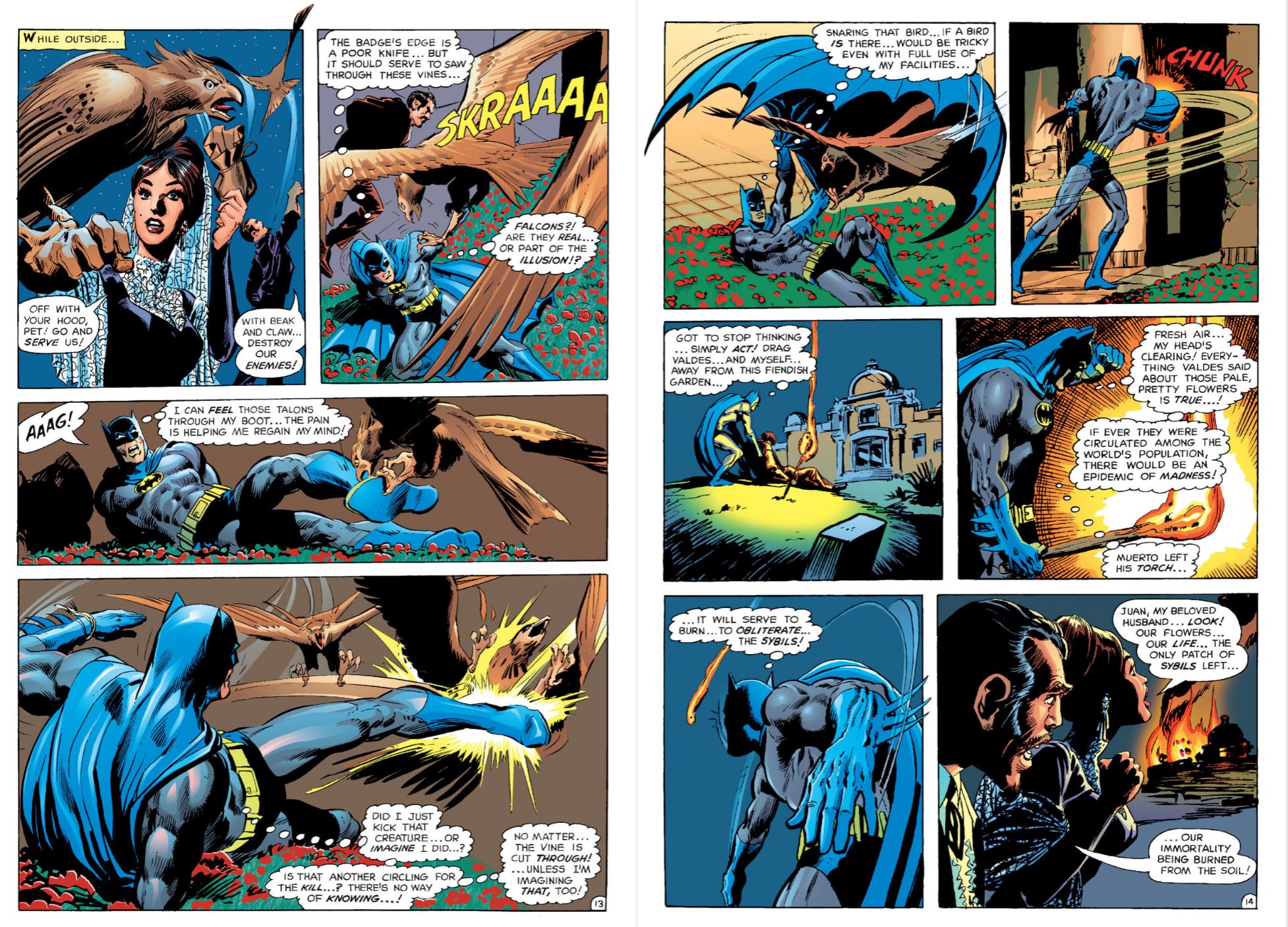
Dennis O’Neil’s script for Detective #395’s ‘The Secret of the Waiting Graves’ (January 1970, limned by Neal Adams & Dick Giordano and recoloured for this edition by Cory Adams) instituted a far more mature – even sinister and almost gothic – take on the Caped Crusader here. In central Mexico the hero finally tracks down and barely survives confrontation with psychotic, nigh-immortal lovers Juan and Delores Muerto… whose passion for each other was fuelled by deadly drugs and sustained by a century of murder…
Adams’ captivating dynamic hyperrealism was a key cog in the reconstruction of the epic Batman edifice but it was also an irresistibly compelling one, and worked well against eerie backdrops of the resurgent horror boom, but all trends tail off. Now confirmed as a truly scary mortal manhunter, Batman’s scope widened and straight crime and adventure sagas also featured heavily. When Archie Goodwin became writer/editor of Detective Comics he generated a string of top tales (for the rest, check out Tales of the Batman: Archie Goodwin) of which the next item is indisputably the best. A stylistic masterpiece, Goodwin’s ‘Death Flies the Haunted Skies!’ (DC #442, September 1974) is a magnificent barnstorming thriller of aviators apparently picked off by a random assassin and a high point in an era of landmark tales. It is illumined by the unique Alex Toth (Zorro, Green Lantern, The Witching Hour, Space Ghost, Bravo for Adventure, Torpedo, Johnny Thunder, Eclipso, X-Men) and is as potent today as it ever was.
With the supernatural fading for fans, action-adventure and retro were the next big deal and ‘The Deadshot Ricochet!’ (DC #474, December 1977) was the penultimate exploit of dream team Steve Englehart, Marshall Rogers & Terry Austin, who had utterly revitalised the Batman mythos with a string of sharp thrillers reinventing the hero’s classic rogue’s gallery.
The single-issue saga updates an old loser for the second ever appearance of a murderous high society dilettante sniper (after his initial outing in Batman #59, 1950). The tale so reinvigorated third-rate trick-shooter Floyd Lawton that he’s seldom been missing from the DC Universe since, starring in series such as Suicide Squad and Secret Six: in a couple of eponymous miniseries and on both silver and small screens.
The tradition of Batman Christmas Miracle tales (maybe we should say “mystery plays”?) is seen next in a short punchy redemption yarn about a bad man who sees the light in ‘Wanted: Santa Claus – Dead or Alive’ by O’Neil, Frank Miller & Steve Mitchell from DC Special Series #2/Super-Star Holiday Special (April 1980) after which Mike W. Barr, Michael Golden & Mike DeCarlo deliver an epic stand-alone saga via Batman Special #1 (April 1984) by introducing the hero’s ultimate antithesis in ‘…The Player on the Other Side!’
The night Bruce Wayne’s parents died, elsewhere two career criminals were killed by police patrolman Jim Gordon. As young Bruce trained himself to be the enemy of all crime, so too did the son of those thieves, becoming over decades the exact equivalent and moral opposite of the hero who would one day safeguard Gotham. Now, as assassin and nemesis of decency and lawmen everywhere, the greatest criminal on Earth comes for Commissioner Gordon. The Wrath will let nothing and no-one get in the way of his vengeance and only Batman even knows he exists…
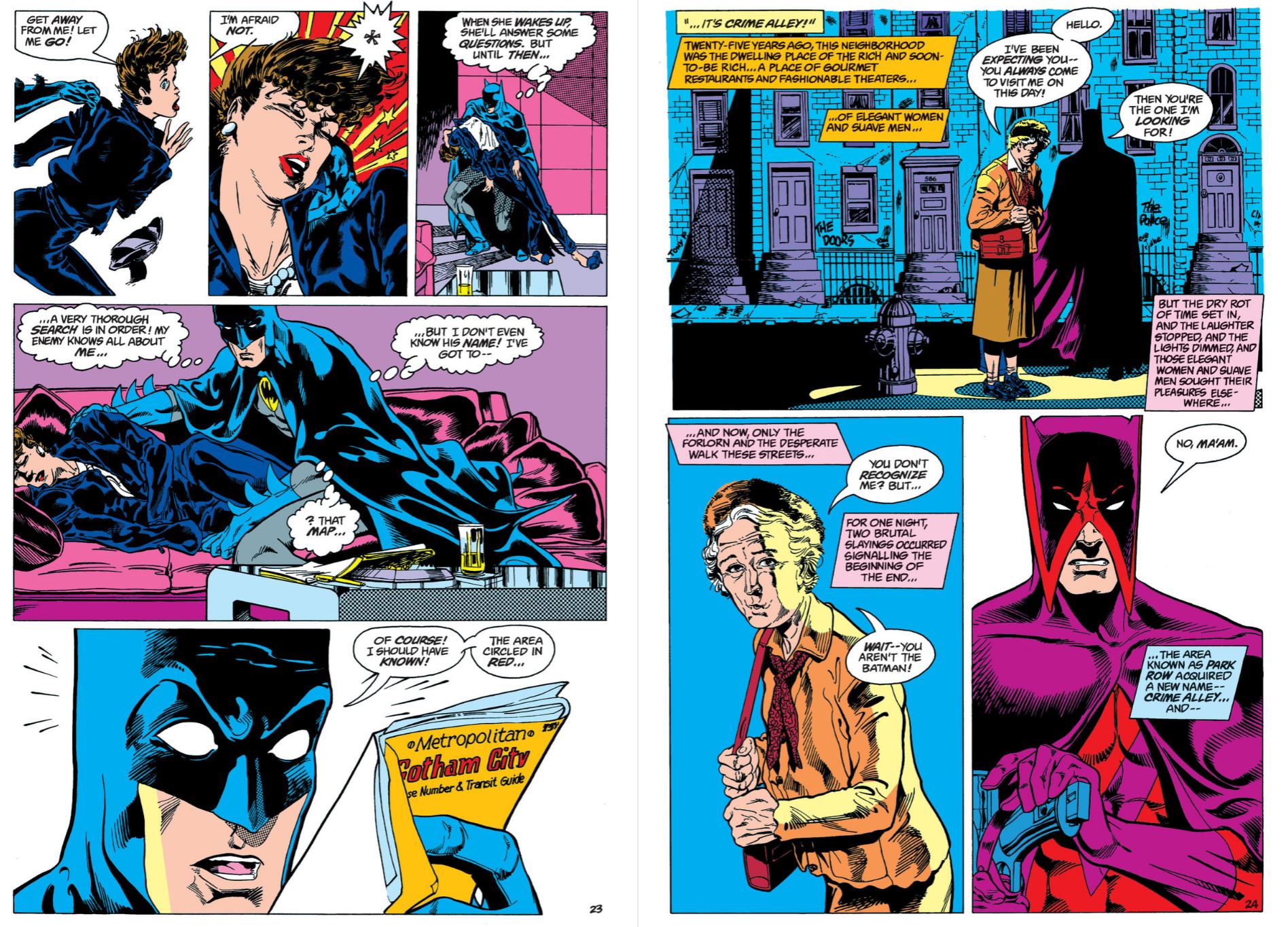
After fifty years, DC rewrote and reinvented itself with a company-wide reboot. Landmark maxi-series Crisis on Infinite Earths streamlined and retconned the entire ponderous continuity; rejecting the concept of a vast multiverse and re-knitting timelines so that there had only EVER been one Earth. For new readers, this solitary DC world provided a perfect place to jump on at a notional starting point: a planet literally festooned with iconic heroes and villains draped in a clear and cogent backstory that was now fresh and newly unfolding. Many of their greatest properties got a reboot, all enjoying the tacit conceit that the characters had been around for years and the readership were simply tuning in on just another working day.
As witnessed in Part IV (1986-2011): The Dark Knight with Batman’s popularity at an intoxicating peak, Crisis on Infinite Earths transformed the entire DC Universe and reinvented big guns like Superman and Wonder Woman, but left the Bat corners of it all largely untouched apart from some careful tweaking. Robin Dick Grayson had still been followed by new recruit Jason Todd, but this new kid was now a troubled runaway plucked off the streets and a true wild card. His exploits were seen as way to imbue verve and a bit of fun into the mythology as well as revive the classic villains, primarily in a strand from Detective Comics by Barr and “British Invaders” Alan Davis & Paul Neary.
From DC #574 (May 1987) the introspective ‘…My Beginning… and My Probable End.’ sees Batman on deathwatch and pondering so many bad decisions as his confidante Dr. Leslie Thomkins struggles to save Todd from his own bravado, prior to Peter Milligan & Tom Mandrake detailing a case of duplication, deception and impossible substitution in ‘Identity Crisis’ Detective #633 (August 1991).
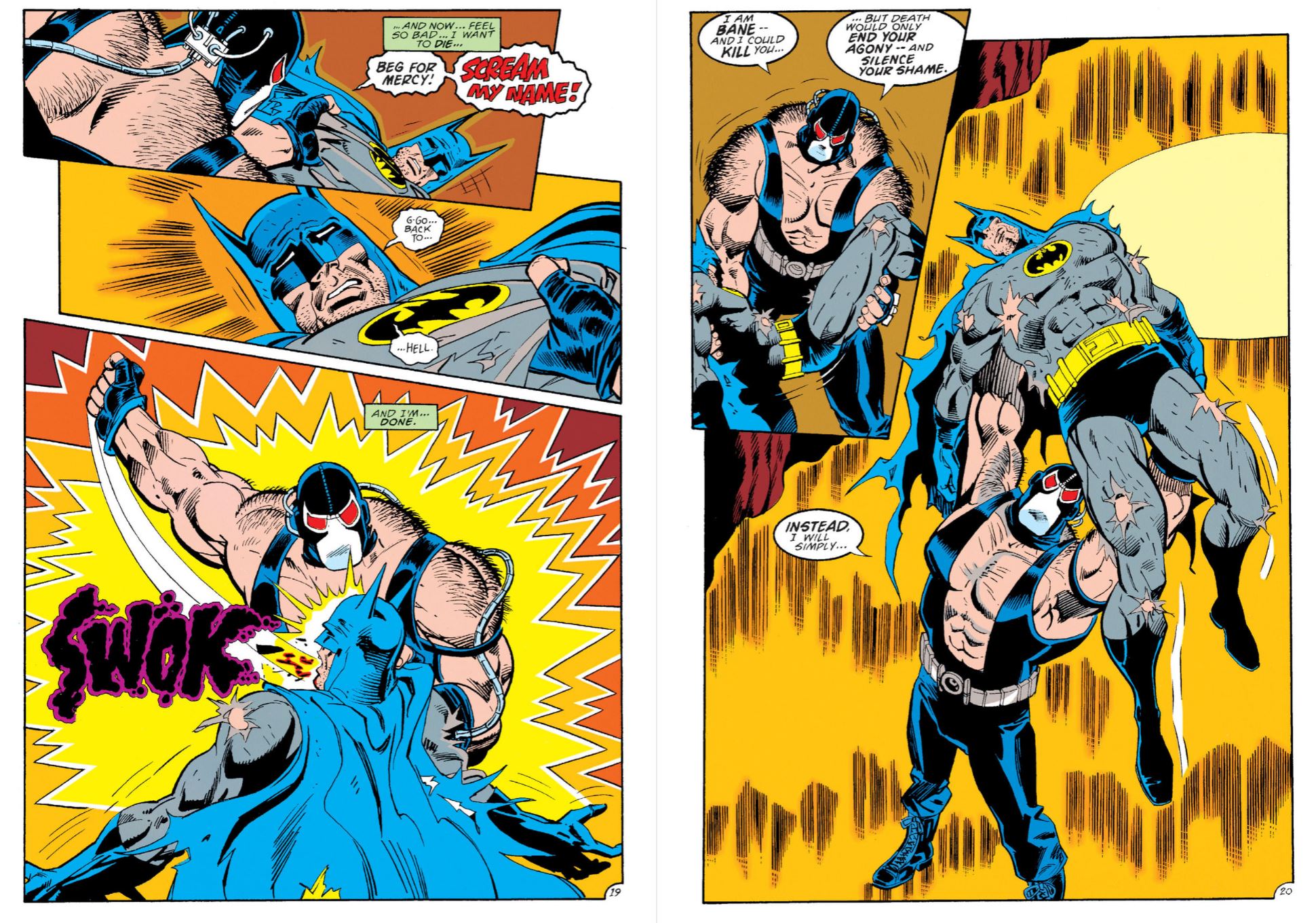
The Nineties were filled with eye-catching publishing stunts and in 1992 DC began their epic Death of Superman story-arc, and its instant success led to a similar tradition-shaking, continuity-shattering epic for their other iconic household-name property. Groundwork had already been laid with the introduction of steroid-pumped archvillain Bane and Jean-Paul Valley, a mild-mannered student programmed since birth by an ancient warrior-cult to be their hereditary instrument of assassination, so all that was needed was to sort creative personnel and decide just how best to shake up the life of the Gotham Guardian. KnightFall and the subsequent arcs KnightQuest and KnightsEnd follow the brutal fall, replacement and inevitable return of Bruce Wayne as the indomitable, infallible Batman and was another spectacular success from the old guard which showed all the comic book upstarts and Young Turks the true value of proper storytelling. It also proved the unshakable power of established characters, as the world was gripped by the Dark Knight’s horrific defeat at the hands of a blatantly superior nemesis.
The crossover publishing event impacted many comics outside the usual Bat-book suspects, spawned a bunch of toys, three novelisations, many (necessarily incomplete) trade paperback collections and even jumped the pond to Britain’s staid BBC who turned it into a serialised audio-play on Radio One. You can find the saga in its own triptych of collections, but here we sample the shock and awe through 11th chapter ‘Broken Bat’ (Batman #497, July 1993, courtesy of Doug Moench, Jim Aparo & Giordano) wherein the brutal Bane utterly defeats and destroys the overmatched hero…
Returned reinvigorated, Batman blossomed in many directions thereafter and next Chuck Dixon, Graham Nolan & Cam Smith reveal a relatively peaceful party-going Bruce enjoying a clandestine ‘Knight Out’ (Detective #711 (July 1997), tackling opportunistic thieves without breaking out the batsuit, whilst DC #757 (2001, by Greg Rucka, Rick Burchett & Rodney Ramos) sees the hero under pressure to catch murdering bandits and rescue a family trapped at the bottom of the river in ‘Air Time’.
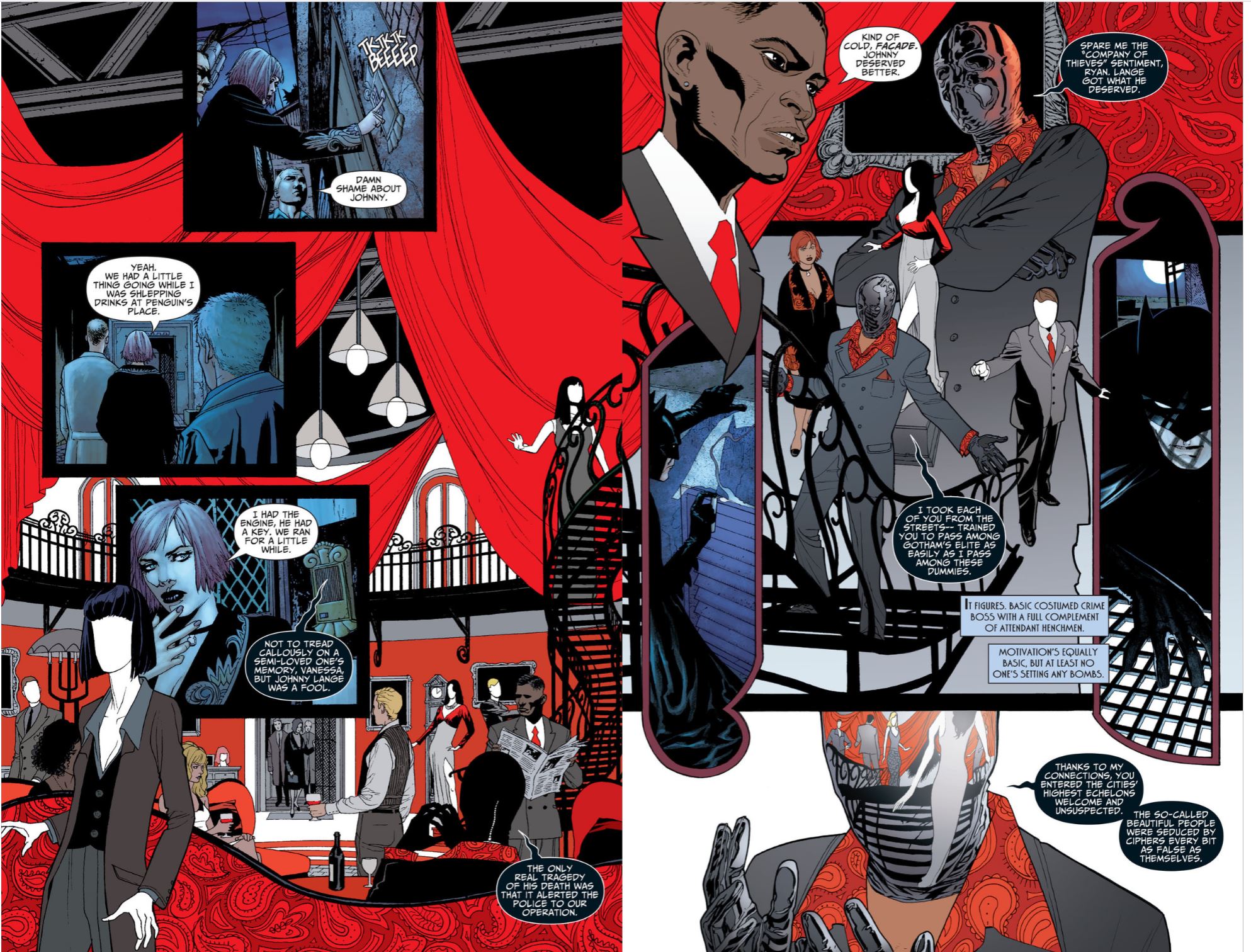
Paul Dini & J.H. Williams spectacularly expose ‘The Beautiful People’ (DC #821, September 2006) working for merciless, murderous identity-stealing maniac Facade as the High Society predator overreaches himself facing the Dark Knight…
Bringing us up nearly to date, Part V (2011 and Beyond): Rebirth focuses on 2011 and DC’s New 52: a second continuity-wide reboot revising the opposing forces into even grimmer, Darker Knight and sundry. The Batman of this hellish vision debuted in Detective Comics volume 2 #1 with what might then have been assumed to be the last Joker story, whilst here from Batman (vol. 2 #2 December 2011) ‘Trust Fall’ by Scott Snyder, Greg Capullo & Jonathan Glapion sees Bruce Wayne meeting Gotham’s Mayor (who will turn out to be hugely significant to his family life) and discovering his beloved city is actually ruled by a secret society dubbed “The Court of Owls”…
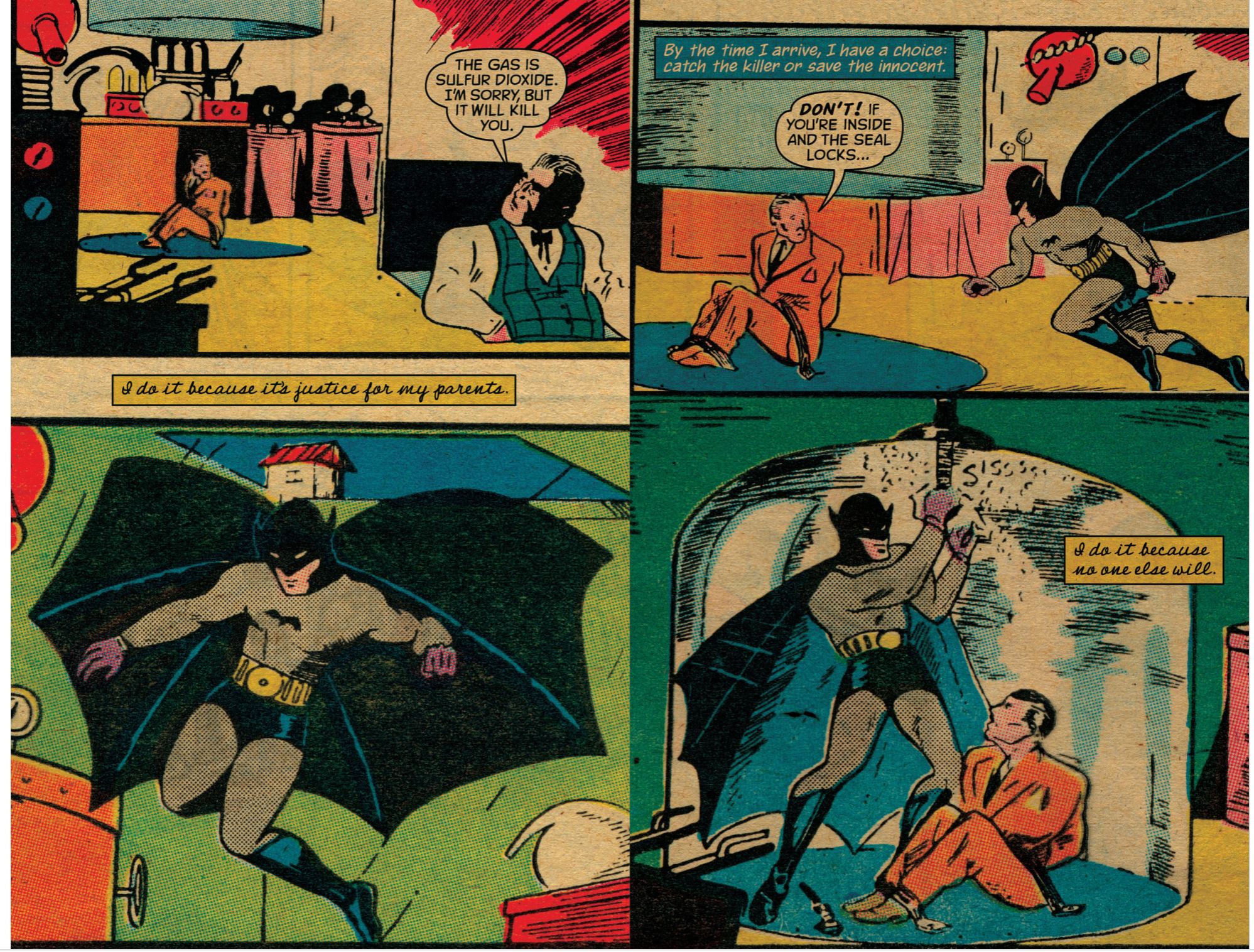
Adapted from 2014’s anniversary release Detective Comics (vol. 2 #27) this book concludes with a tasty treat as Brad Metzer adapts his own updated script for the tribute to the original Kane & Finger tale. Here, however, thanks to super-designer Chip Kidd, ‘The Case of the Chemical Syndicate’ weds the modern words to the original pictures for a truly stunning marriage of old and new: the spartan, understated yarn introducing again dilettante playboy criminologist Bruce Wayne, drawn into a crime-caper as a cabal of industrialists are successively murdered. The killings only stop when eerie figure “The Bat-Man” intrudes on Police Commissioner Gordon’s stalled investigation to ruthlessly expose and deal with the hidden killer.
Augmented by covers by Kane, Burnley, Win Mortimer, Moldoff, Curt Swan, Stan Kaye, Infantino, Anderson, Giella, Adams, Aparo, Rogers & Austin, Davis & Neary, Golden, Jones, Nolan, Tom Palmer, Dave Johnson, Simone Bianchi, Capullo & Glapion, this crime compendium is a true wonder of wit and wild times and you should not be without it.
© 1939, 1940, 1944, 1942, 1948, 1945, 1954, 1955, 1858, 1964, 1966, 1967, 1970, 1974, 1977, 1980, 1984, 1987, 1991, 1993, 1997, 2001, 2002, 2006, 2011, 2014 DC Comics. All Rights Reserved.
Win’s Christmas Gift Recommendation: Timeless Ever-Evolving Wonderment… 9/10