
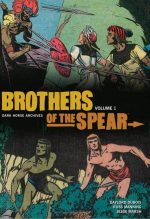
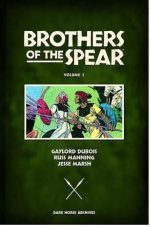
By Gaylord DuBois, Russ Manning, Jesse Marsh & various (Dark Horse Books)
ISBN: 978-1-59582-821-7 (HB)
This book includes Discriminatory Content produced in less enlightened times.
Situated on the West Coast, Western’s Dell/Gold Key imprints rivalled DC & Marvel at the height of their powers, and the comics licensee specialists famously never capitulated to the wave of anti-comics hysteria that resulted in the crippling self-censorship of the 1950s. No Dell or Gold Key Comic ever displayed a Comics Code Authority symbol on the cover – they never needed to…
An utterly unique visual stylist, Jesse Marsh was born on 27th July 1907 and died far too young on April 28th 1966 from diabetic complications at the height of a TV Tarzan revival he was in large part responsible for. Marsh was another Disney animator (from 1939 on) who took a sideways step, becoming a full-time narrative illustrator for the studio’s comic book licensee Whitman Publishing in 1945. Marsh jobbed around and adapted movie properties (mostly westerns like Gene Autry) until 1948 when Dell introduced the first all-new Tarzan comic book. The newspaper strip had run since 1929 and all previous funnybook releases had featured expurgated or modified reprints of those tales.
That all changed when the Ape-Man finally got his own funnybook (beginning with Dell Four Color Comic #134 (February 1947) and eventually a titular periodical. Bimonthly, Edgar Rice Burroughs’ Tarzan #1 was cover dated January/February 1948. Marsh dived in, never looked back and became the go-to guy for other ERB adaptations like Jon of the Kalahari and John Carter of Mars. He naturally handled all the extra stuff in Tarzan…
Marsh was unique in the way he positioned characters in space, using primitivist forms and hidden shapes to augment his backgrounds, and as the man was a fanatical researcher, his trees, rocks, and constructions were 100% accurate. His animals and natives, especially children and women, were all distinct and recognisable; not the blacked-up stock figures in grass skirts even the greatest artists so often resorted to. He also knew when to draw big and draw small: the internal dynamism of his work is spellbinding. Perhaps that was in part due to ever-deteriorating eyesight – due to his battle with diabetes – but it also led to his hiring one of the medium’s most gifted illustrator’s just as the kid was starting out…
Back then, to accommodate US postal regulations (and tax-ratings) regarding shipping rates, comic books and magazines – as opposed to other printed matter – were defined as having a plurality of individual features, strips, pinups and supporting features. Over many decades this legal quirk happily spawned a vast variety of fact-features, prose sections, gag-pages, and crucially for us here, back-up strips in all US comics books…
The Tarzan comic was very much in the Burroughs tradition, but although most of the early ancillary pages were filled with the rich material of the world of John Clayton, Lord Greystoke, soon the brief was expanded to cover wider wonders of jungle existence. This might be to not overexpose the character, but also due to a global uptick in similar rainforest stars like film & TV sensation Nyoka the Jungle Girl and the growing host of sultry “Jungle Queens” in comics.
Moreover, any back up strips – if popular and spun off – would be the property of Western/Dell/Gold Key. The man to generate this vast supporting cast was canny editor and staggeringly prolific scripter Gaylord DuBois.
Poet, author, novelist, biographer, avid outdoorsman and comic book/strips mastermind Gaylord McIlvaine Du Bois was born on August 24th 1899, in Winthrop, Massachusetts. There’s not much biographical data on him, as he seems to have spent every moment of his life writing. Apparently tireless, DuBois created and scripted many long-running favourites (Space Family Robinson/Lost in Space, Turok, Son of Stone, Indian Chief), as well as numerous comics-based kids’ material, ghosted many top newspaper strips, wrote Big Little Books and produced countless movie and TV comics adaptations (like Lassie, Robin Hood, Spartacus and Quentin Durward, Raggedy Ann and Andy, Andy Panda, Our Gang, Tom and Jerry, Jungle Jim,) for Dell/Gold Key. His work on licensed hits also included many Westerns like The Lone Ranger, Red Ryder, Gene Autry, Roy Rogers, Zane Grey’s King of the Royal Mounted, Bat Masterson, and Bonanza, and he delighted and specialised in creating long-running, appropriately-themed support strips (such as Captain Venture: Beneath the Sea, Leopard Girl, Young Hawk, Jungle Twins, Two Against the Jungle, Little Beaver, Bullet, Lotor, Owd Bob and more).
For the ever-expanding Tarzan franchise he wrote the lead, support features and everything else (including puzzles!), forging a 20-year working relationship with Marsh and carrying on his good works with his successors on Marsh’s passing. DuBois died on October 20th 1993.
Brothers of the Spear began in 1951 (Tarzan #25, cover-dated October) replacing DuBois & Marsh’s previous serial Two Against the Jungle, and commencing an epic never-ending African wilderness fantasy that would run continuously between that point and Tarzan #156 in 1966.
The brothers returned sporadically thereafter (#158, 160, 161, 202, 202). but did win their own 18-issue comic book (June 1972 to May 1982, by DuBois, Jesse Santos & Dan Spiegle). Back in Tarzan, Dubois & Spiegle provided Jungle Girl tales whenever the Brothers were absent, and when the book moved to DC Comics with #207 the Bros got their own comic book…
This archive collection – first of three and reprinting the stories from Tarzan #25-67 (October 1951 to April 1955) – comes from 2012 and is long overdue for rerelease. It opens with Foreword ‘Soul Brothers of the Spear’: a heartfelt appreciation and appraisal by legendary cartoonist Gary Panter, packed with information about the enigmatic master and well-considered opinions on what made Marsh and his pupil/assistant so similar and so different…
Born in Van Nuys, California on January 5th 1929, Russell George Manning was one of comics’ greatest stylists. He attended Los Angeles County Art Institute before joining the war effort. Serving in Japan he naturally cartooned for the local servicemen’s newspapers.
Back home in 1953, Russ joined local firm Western Publishing, doing assorted jobs for Dell before settling in with Jesse Marsh. In many ways Manning was the direct antithesis of his mentor, favouring slick presentation and sleek realism, but he too valued simple design, pared-down linework and bold use of empty space. Manning became an absolute master of his art, and is most popularly remembered now for the Star Wars newspaper strip and Magnus, Robot Fighter, but his other triumphs were all Tarzan-related. As well as the comic book and newspaper strip (dailies from 1969-1972 and the Sundays from 1969-1979) he crafted sublime Graphic novel incarnations of Edgar Rice Burroughs’s immortal Lord of the Jungle such as Tarzan: The Land That Time Forgot (most commonly seen these days in international editions; although a Dark Horse edition from the turn of this century is still around if you look hard).
We lost Manning far too soon, to cancer on December 1st 1981.
This tome covers the origins of and transitional hand-over of the supremely compelling Brothers of the Spear, sharing the advancement of two teens reared far from civilisation before set upon an epic journey of vengeance and destiny across Africa in days gone by.
Tarzan #25 cover-dated October #1951) saw the first episode, with Marsh handling the B-feature boys for the first 14 episodes. The feature never had individual chapter titles and steadily grew from 4½ to 8 (or more!) pages.
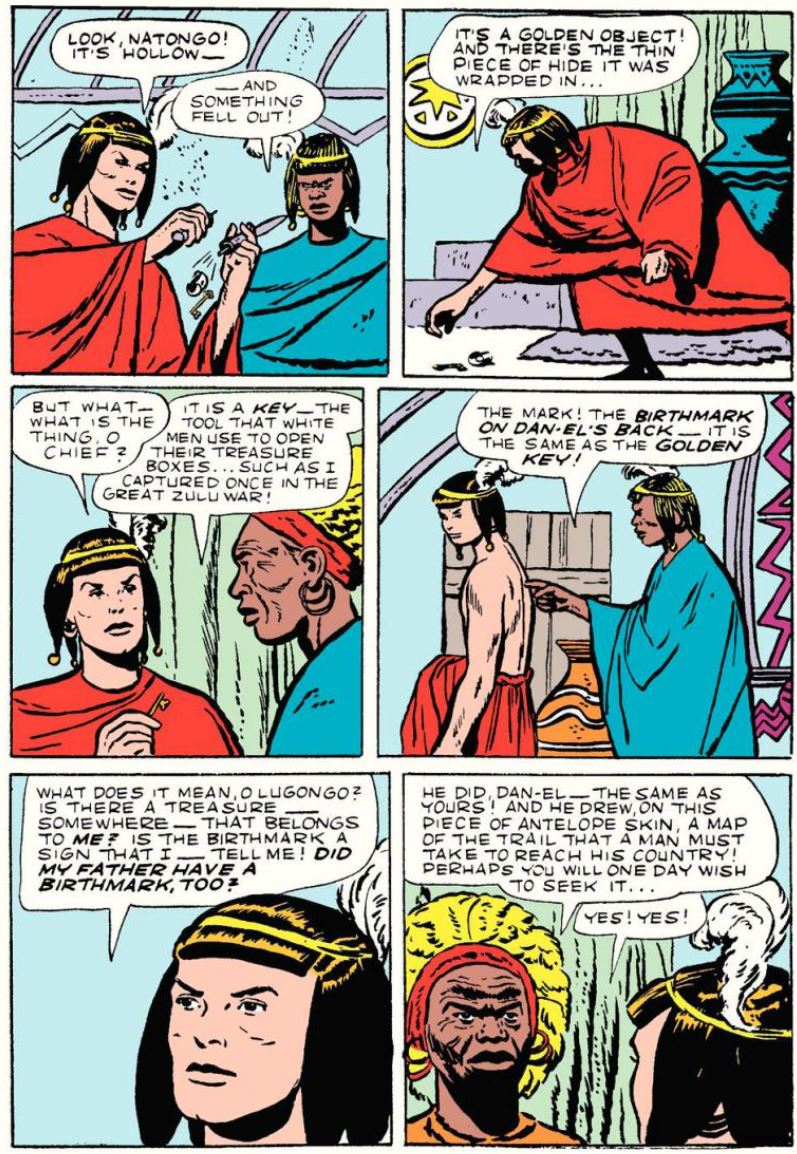
Edged with authenticity, if not realism, it began in Bechuanaland (now Botswana) when Zulu prince Natongo undertakes his manhood ritual – The Ceremony of the Spear. He is superb but matched in every way by his foster brother Dan-El, a white foundling adopted by the great chief sixteen years previously. the boys are inseparable in ability and filial affection and now that he is a man Dane-El is told how he came to the tribe. Long ago his father (a king of a fabled far country) left the infant with the Zulu chieftain for his own safety, with only a golden key. It matched a birthmark on the back of both father and son…
Apparently Dan-El is the fugitive prince of a lost tribe of white men. The mountain domain of Aba-Zulu had haunted his dreams for years and now, armed with knowledge, Dan-El sets out to find them. His beloved, brother, equal in every aspect and skill, will not let him go alone and together they set off…
The next 13 instalments saw the mighty spear-wielding warriors overcome all the dramatic standbys of the genre: like white tyrants with weapons called “guns”; embattled farmers in need of saving; lions and leopards; Arab slavers; warring tribes and other beasts either ferocious and rampaging or faithful and beloved. As they ferreted out clues to the distant destination, their trek took them through deserts, against black insurgent seeking to overturn white rule; wild savannah and across vast, pirate-plagued Lake Tanganyika, but even with diversions and distractions like becoming embroiled in war and failing to save the most beautiful warrior princess ever born (Dell’s lack of Comics Code validation often led to quite horrific, tragic and REALISTIC body counts!), and befriending many tribes and native nations, inexorably the devoted, deathly determined siblings near the ever-calling mountains…
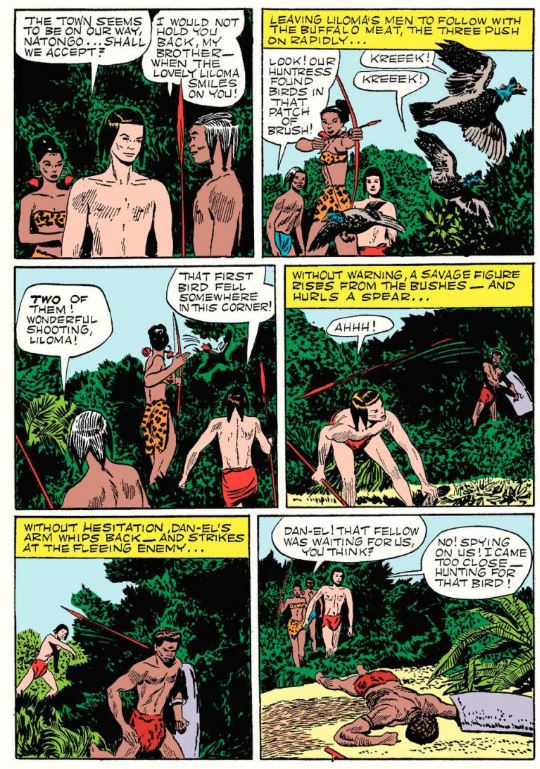
Fortune turns in their favour after escaping slavers. The Brothers fetch up at the foot of a vast mountain range and discover ancient tombs containing dead embalmed kings lying in state… white ones…
With the goal of Aba-Zulu reached in Tarzan #39 (December 1952), a new era of adventure and tribulation began. This episode marked the first solo outing for Manning, who continued on the strip (increasingly with his own assistant Mike Royer) until i966. In those latter days Manning was being pulled away from the Brothers, his own Magnus Robot Fighter and Captain Johner and the Aliens series and even high profile launches like Gold Key’s My Favourite Martian due to the intense scheduling conflicts of the Tarzan newspaper strips and comic book, but at this key moment all his creative efforts were expended on learning and getting better…
Now Natongo & Dan-El begin the next phase of heir eventful lives as entering Aba-Zulu they discover a land oppressed by a ruling class of witchdoctors using trickery and superstition to rule. Their leader Nagopa instituted the uprising that dethroned Dan-El’s father and the malign mage still dominates through royal puppet Han-Ool, a distant relative of Dan-El’s. The people are unhappy but too scared to react… until The Brothers of the Spear rouse old retainers like General Kongoni and valiant aide Mothibi to lead a counter rebellion and free the people.
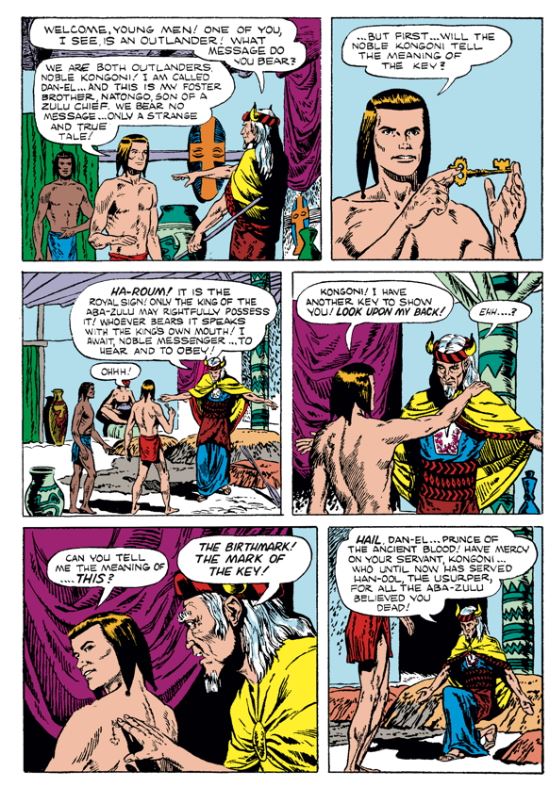
The battle is long and hard and filled with sudden death and constant distraction. Frustratingly over 16 years the tyranny of Nagopa’s tricks are deeply embedded in the people’s consciousness. These mental shackles are hard to shake, but at least the warriors have the support of Kongoni’s daughter Tavane and the irrefutable talisman of the golden key and Dan-El’s birthmark…
Eventually the witchdoctors are forced into retreat, but this only sees the war evolve into a campaign of assassination attempts and traps to discredit Dan-El and Natongo. And of course, this is Africa, with roaming warriors from other regions like neighbouring Obelo, wild weather, and slavers always likely to strike and further divert the cause of liberation…
Nonetheless, the Brothers persevere and triumph, feeling at last most of their work is done, but it’s just a pause allowing Nagopa to unleash all his venomous ire against capable princess to be Tavane…
To Be Continued…
Far less fanciful and more solidly grounded, this strip is a masterful rationalistic saga short on mutants and monsters but brimming with bold, cinematic adventure that should be on everyone’s revival list.
BROTHERS OF THE SPEAR™ ARCHIVE Volume 1 © 1951-1955, 2012, Classic Media LLC. Brothers of the Spear and associated character names, images and other indicia are trademarks of and copyrighted by Classic Media LLC. All rights reserved.
Today in 1899 Gaylord DuBois was born, sharing this day with artist extraordinaire Jim Aparo (The Phantom, Stern Wheeler, Phantom Stranger, Aquaman, The Spectre, Brave and the Bold, Batman) in 1932; Italian writer Max Bunker (Alan Ford) in 1939; Gasoline Alley cartoonist Jim Scancarelli in 1941 and cartoonist Keith Knight (The K Chronicles, (Th)ink, The Knight Life, Woke) in 1966.