
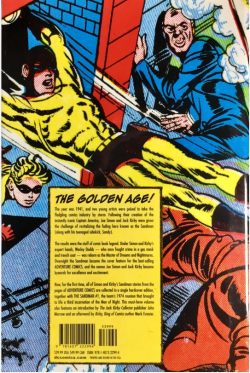
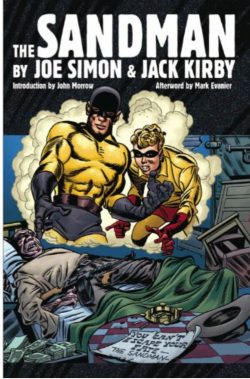
By Joe Simon & Jack Kirby, with Mike Royer & others (DC Comics)
ISBN: 978-1-4012-2299-4 (HB)
This book includes Discriminatory Content produced in less enlightened times.
In the early days of US comic books the fledgling industry was awash with chancers, double-dealers, slick operators and outright crooks. Many creative types fell foul of this publishing free-for-all but a rare few took to the cut and thrust and managed not only to survive but to prosper.
Just as the Golden Age of comics was beginning, two young men with big hopes met up and began a decades-long association that was always intensely creative, immensely productive and spectacularly in tune with popular tastes. They were Joe Simon and Jack Kirby, and gathered here are the joyous exploits of one of their greatest early comics collaborations…
Publisher Martin Goodman made Simon the editor of Timely comics S&K, created a host of iconic characters including Red Raven, Marvel Boy, The Vision, kid gang Young Allies and million-selling mega-hit Captain America. When Goodman failed to make good on his financial obligations, Simon & Kirby jumped ship to industry leader National/DC, who welcomed them with open arms and a big chequebook.
Initially an uncomfortable fit and bursting with ideas the cautious company were not comfortable with, they were handed two strips languishing in the doldrums to tide them over until they found their creative feet. Left to their own devices, they consolidated their Kid Gang genre innovation with The Newsboy Legion and their super-heroic mentor The Guardian, and a unique international army – The Boy Commandos – who shared a spotlight with Batman and Robin in Detective Comics (and whose own solo title became frequently the company’s third best seller during the war years).
Those moribund strips they were first unleashed upon featured big game hunter called Paul Kirk, Manhunter, who they overnight retooled as a darkly manic, vengeful superhero. The other was one of comic books’ first masked mystery-men: The Sandman.
This superb collection reprints all the S&K tales, including covers for issues they didn’t craft; lost art pages, original art reproductions as well as informative text articles from Kirby historian John Morrow and writer Mark Evanier. It even includes Simon & Kirby’s 1974 reunion reinvention of Sandman which in turn spawned one of Kirby’s last series for DC.
Created by Gardner Fox and first illustrated by Bert Christman, The Sandman premiered in either Adventure Comics #40 July 1939 (two months after Batman debuted in Detective Comics #27) or two weeks earlier in New York World’s Fair Comics 1939 – depending on whether some rather spotty distribution records can be believed.
Face utterly obscured by a gasmask, caped and business-suited millionaire adventurer Wesley Dodds wielded a sleeping-gas gun to battle a string of crooks and spies, accompanied by his paramour Dian Belmont, before gradually losing the readers’ interest and slipping from cover-spot to last feature in Adventure Comics, just as the cloaked pulp-hero avengers he emulated slipped from popularity in favour of more flamboyant fictional fare. Possessing a certain indefinable style, eerie charm but definitely no pizzazz, the feature was on the verge of being dropped when he abruptly switched to a skintight yellow and purple costume, complete with billowing cape. He also gained a teenaged sidekick in Sandy the Golden Boy (AC #69, December 1941, by Mort Weisinger & Paul Norris), presumably to move closer to the overwhelmingly successful Batman model.
It didn’t help much.
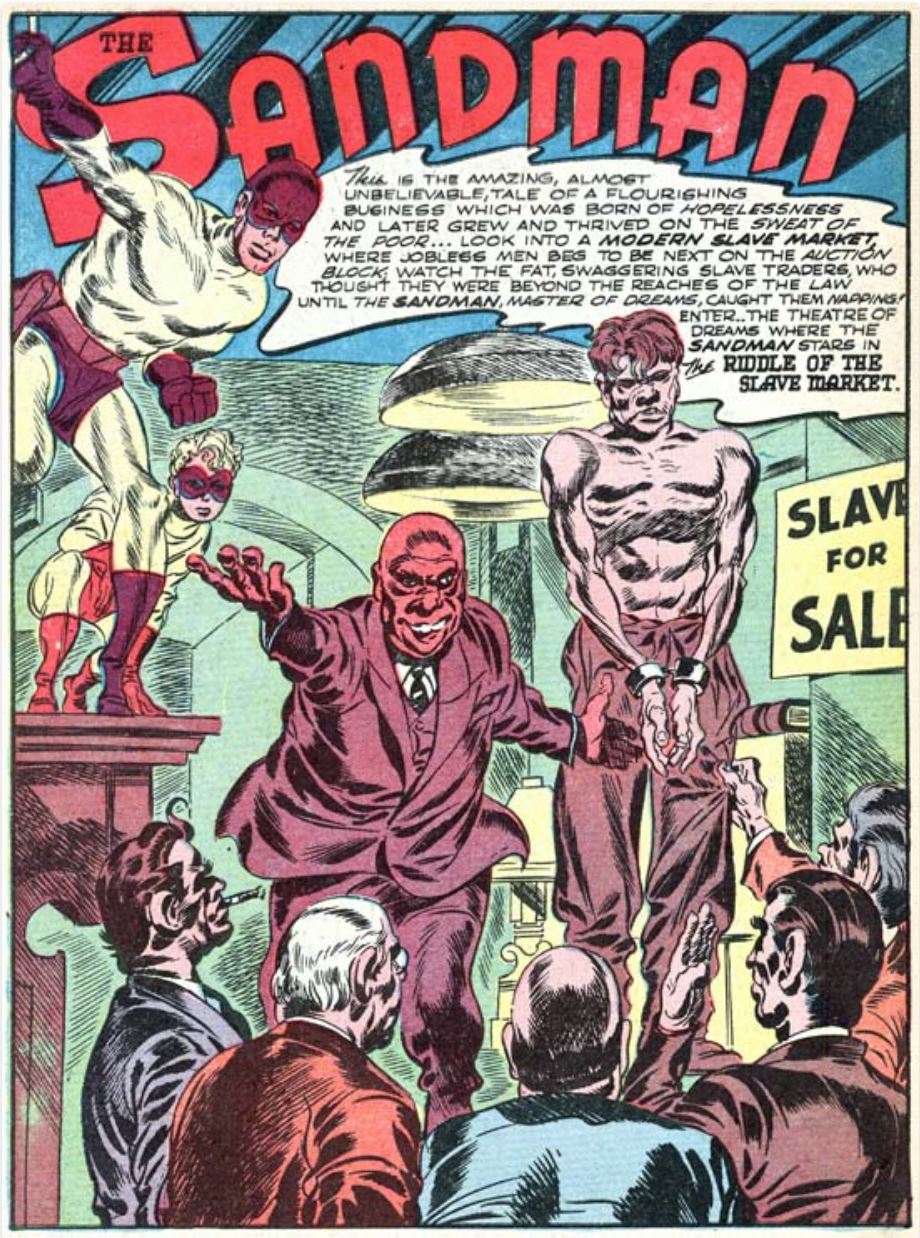
So, when Simon & Kirby came aboard with #72, the little banner above the logo on the Jack Burnley Starman cover gave no hint of the pulse-pounding change that had occurred. ‘Riddle of the Slave Market’ saw a sleek, dynamic pair of gleaming golden lions explode across 11 pages of graphic fury as the Sandman – sans daft cape – crushed a white collar criminal with a nasty line in illicit indentured servitude. Moreover, the hero had overnight acquired a unique gimmick: Sandman’s crusades against crime were presaged by the targeted perpetrator suffering nightmares of imminent retribution…
The semi-supernatural element and fascination with the world of dreams (revisited by S&K a decade later in their experimental suspense series The Strange World of Your Dreams) added conceptual punch to equal the kinetic fury of their art, and #73 (with S&K’s Manhunter now hogging the cover) Sandman strip ‘Bells of Madness!’ ramped up tension in another spectacular action epic wherein the Dream Warriors expose a cunning murder plot.
With AC #74 Sandman & Sandy took back the cover spot (only their third since #51), holding it until the feature ended. Only once did Sandman not appear on the cover – #99: another S&K Manhunter classic. From #103, the magazine underwent a complete overhaul with new feature Superboy headlining and with established regulars Green Arrow, Aquaman, Shining Knight and Johnny Quick parachuted in from other magazines.
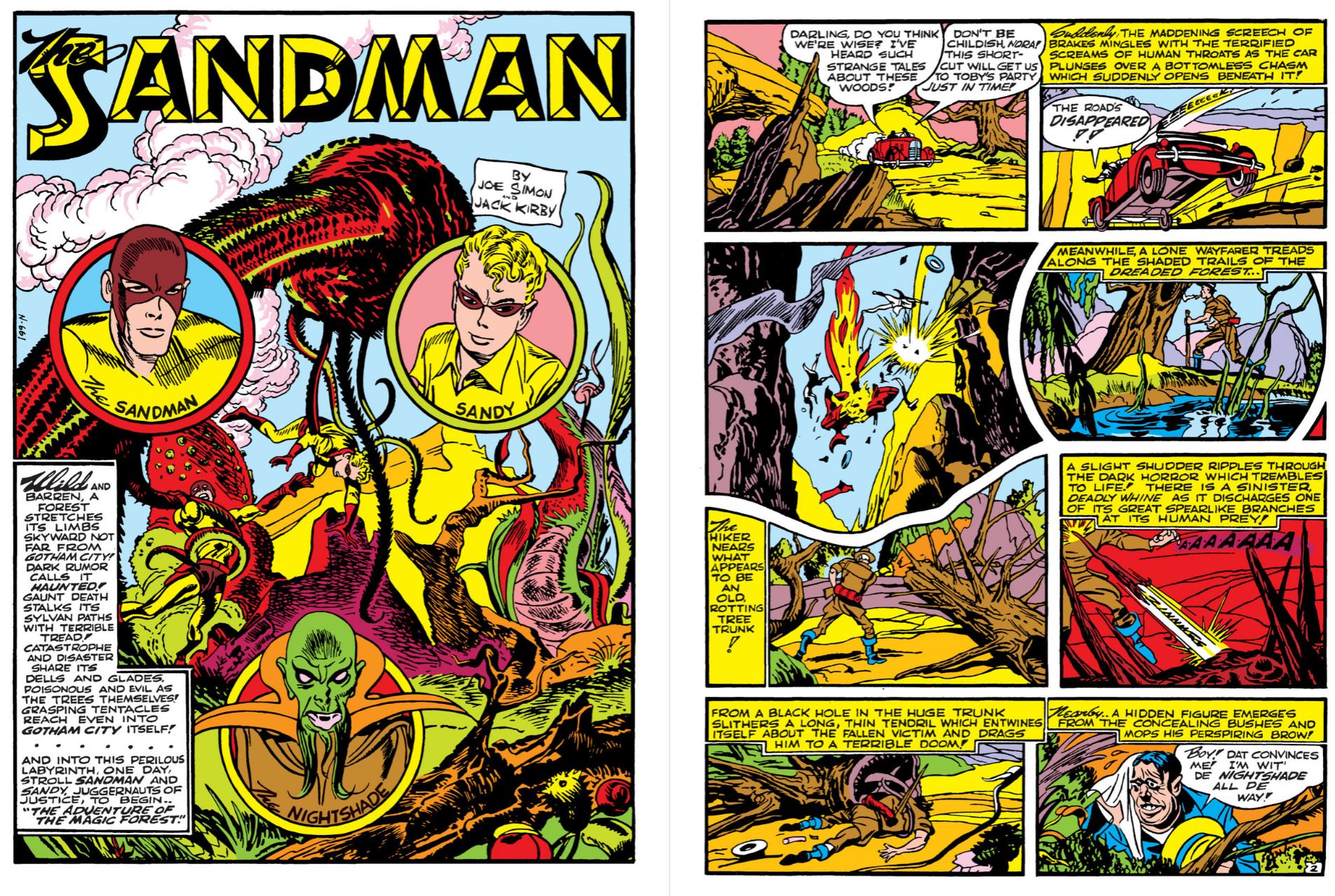
The story for #74 was an eerie instant classic: ‘The Man Who Knew All the Answers’ was a smalltown professor who artificially increased his intellect – but not his ethics. When his perfectly planned crimes bring him into conflict with the heroes, it proves that his brain enhancer did nothing for common sense either. Then ‘The Villain From Valhalla!’ (AC #75 June 1942) pits the galvanic champions against a hammer-wielding Norse god and climaxing in a cataclysmic Battle Royale, followed by an equally astounding clash with sinister floral foe Nightshade. ‘The Adventure of the Magic Forest’ stemmed from World’s Finest Comics #6 (Summer 1942), one of two S&K exploits in that legendary anthology.
Sandman was a founding member of the Justice Society of America, appearing in many issues of All-Star Comics. A number of pertinent chapters therein were also generated by Joe & Jack, but are sadly not included in this otherwise comprehensive compendium: completists will need to track down the superb All-Star Archives volumes 4 & 5 or some of the new DC Finest Justice Society compilations for those dynamic classics.
Adventure #76 again heavily emphasised foreboding oneiric elements in ‘Mr. Noah Raids the Town!’ as a soothsaying mastermind unleashes preposterously intelligent animals to steal and kill, before #77’s ‘Dreams of Doom!’ finds an innocent man plagued by nightmares and compelled to solicit the aid of the Master of Dreams… and only just in time!
A sinister Swami is exposed in ‘The Miracle Maker!’ before their final World’s Finest guest-gig (#7, Fall 1942) dips heavily into exotic fantasy for ‘A Modern Arabian Nightmare!’ Adventure #79 then bangs the patriotic drum in eerie temporal-trap mystery ‘Footprints in the Sands of Time!’ It’s back to thrill-a-minute manic crime mayhem for #80’s ‘The Man Who Couldn’t Sleep!’ before ‘A Drama in Dreams’ presents a baffling conundrum for Sandy to solve alone, after which the creators indulge in some seasonal shocks in madcap Yule yarn ‘Santa Fronts for the Mob.’
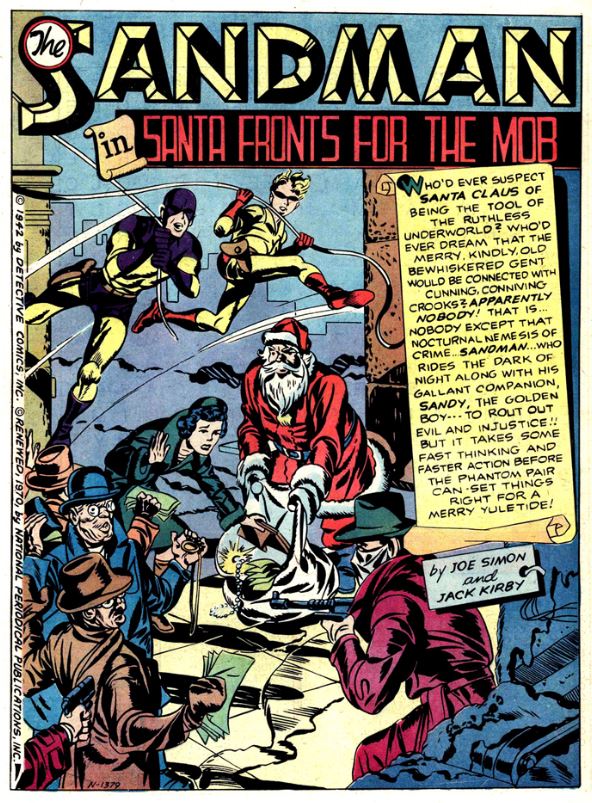
AC #83 brought blockbusting boxing romance as the heroes aid ‘The Lady and the Champ!’ while including a gloriously over-the-top Boy Commandos ad featuring Hitler, Mussolini & Tojo as only Jack & Joe could defame them. Next comes gloriously Grand Guignol saga ‘Crime Carnival’ and delightfully wry romp ‘The Unholy Dreams of Gentleman Jack’, before S&K return to the favoured theme of childhood poverty in ‘The Boy Who Was Too Big for his Breeches.’
The war was progressing and soon both Joe & Jack would be full-time servicemen, so perhaps the increasingly humanistic tales of their latter run were only to be expected. The shift in emphasis certainly didn’t affect the quality of such gems as ‘I Hated the Sandman!’ in #87 wherein narcoleptic Silas Pettigrew learns a salutary lesson, or heartwarming, exuberant childhood fantasy ‘The Cruise of the Crescent’, whereas #89’s kidnap drama ‘Prisoner of his Dreams’ and the boisterous ‘Sleepy Time Crimes!’ proved that whatever else happened, action and excitement would always remain series watchwords.
In the months prior to their induction, Simon & Kirby went into overdrive, building a vast reserve of inventory stories for their strip commitments, but even so relentless publishing deadlines soon ate them up. Adventure Comics #91 featured the last S&K yarn for a year and a half, long after Kirby had shipped out to fight in Europe and Simon had begun his tour of duty with the US Coast Guard. ‘Courage a La Carte’ has precious little – if indeed any -Kirby art in it, but is nonetheless a sterling saga of malice unmasked and justice triumphant, after which only the covers of Adventure #92-97 kept the artist’s light burning in the heart of fans.
The star creators returned for issue #100 (October/November 1945) with tempestuous crime caper ‘Sweets for Swag!’, the cover of #101 and again inside #102 with swansong drama ‘The Dream of Peter Green!’, with Sandman & Sandy exposing shoddy dealings in the city contracting department before ensuring ghetto kids had decent playgrounds to grow fit and healthy in.
National Comics was no longer a welcoming place for the reunited duo. By 1947 S&K had formed their own studio, beginning a long, productive relationship with Harvey Comics (Stuntman, Boy’s Ranch, Captain 3-D, Lancelot Strong: The Shield, The Fly, The Three Rocketeers and others) whilst creating a stunning variety of genre features for Crestwood/ Pines (all supplied by their Essankay/Mainline studio shop). These included Justice Traps the Guilty, Black Magic, Fighting American, Bullseye, Foxhole and landmark innovation Young Romance amongst many more (see the superb Best of Simon and Kirby for a salient selection of these classic creations).
As comics went through bad times the pair eventually went their separate ways, but were reunited for one last hurrah in 1974 whilst both working once more for DC. The result was a re-imagined Sandman: this time a fully fantastic scientific master of the metaphysical, policing the nightmares of humanity from a citadel deep in “The Dream-Stream”.
‘The Sandman’ (scripted by Joe, drawn/edited by Jack & inked by Mike Royer) is pure escapist delight, describing how young Jed Paulsen taps into the oneiric horrors of villainous cybrid General Electric as he attempts to conquer “the World of Our Dreams”. When all hope is exhausted, Jed is rescued and befriended by the omniscient Lord of Sleep and his ghastly assistants Brute & Glob…
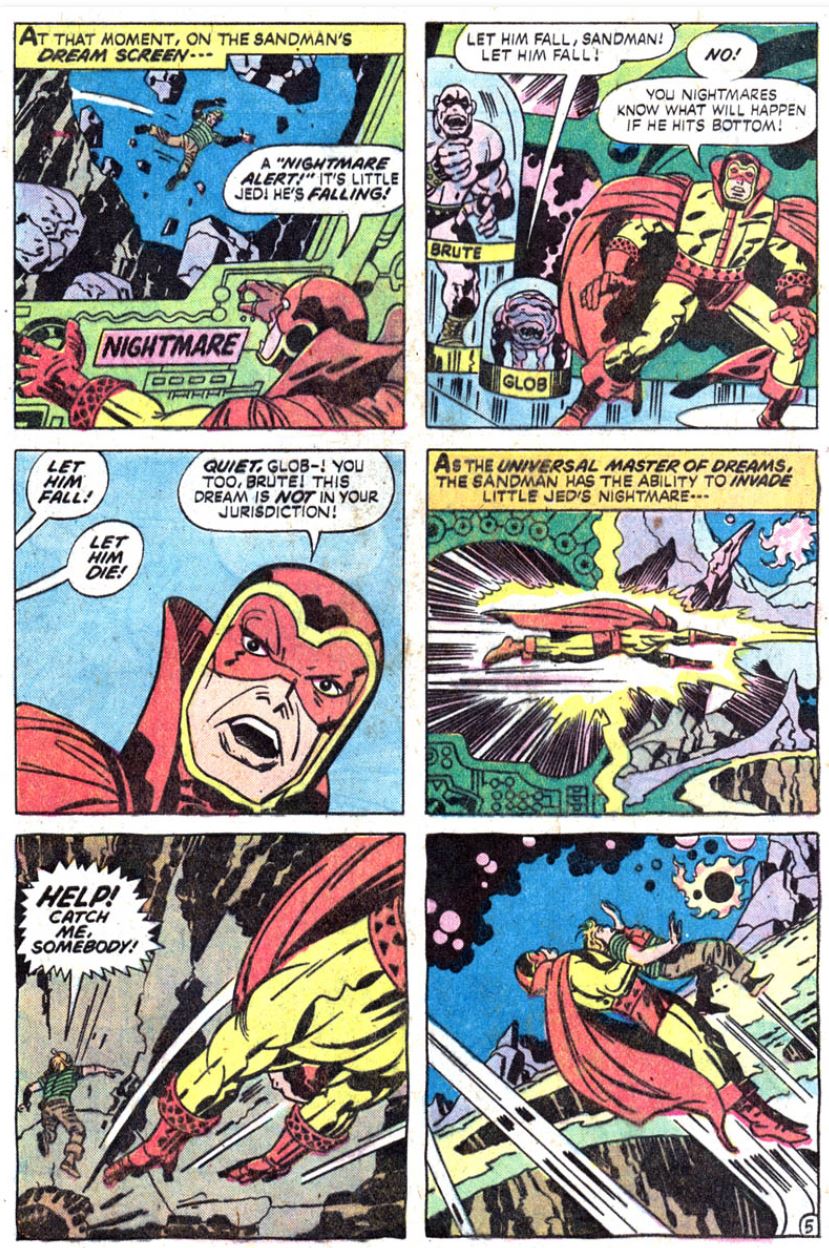
This rambunctious romp is a great place to end our volume but since six further adventures of this Weaver of Dreams were completed (albeit with no Simon and varying degrees of Kirby) perhaps one day they too will make the jump to graphic novel immortality…
After decades of neglect the glorious wealth of Kirby material available these days is a true testament to his influence and legacy, so this magnificent collection of his collaborations with fellow pioneer Joe Simon is a gigantic box of delights perfectly illustrating the depth, scope and sheer thundering joy of the early days of comics: something no amount of corporate shoddy behaviour can ever diminish. Maybe it’s time to systematically rerelease it and all the rest of these dream ticket items?
© 1942, 1943, 1944, 1945, 1946, 1974, 2009 DC Comics. All Rights Reserved.
Today in 1905 Nancy cartoonist Ernie Bushmiller was born, sharing natal honours with Alfredo Alcala (Voltar, Kong the Untamed, The Rampaging Hulk, Savage Sword of Conan, Swamp Thing) in 1925; Malaysian cartoonist Rejabhad (Periwira Mat Gila) in 1939; inker Terry Austin, (Detective Comics, X-Men, Superman Adventures, Popeye) in 1952 and Canadian illustrator Chris Bachalo (Uncanny X-Men, Generation X, Death, Shade the Changing Man, Doctor Strange) in 1965.