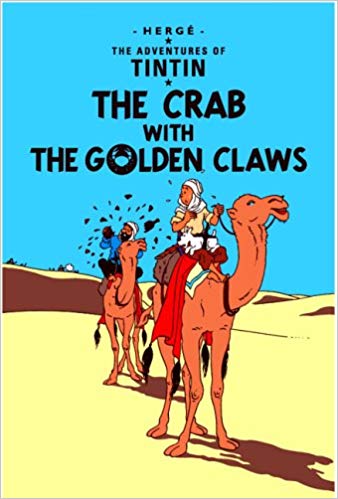
Adventures of Tintin: The Black Island


By Hergé & various; translated by Leslie Lonsdale-Cooper & Michael Turner (Egmont)
ISBN: 978-1-40520-806-2 (HB)                    : 978-1-40520-61-1 (PB)

Georges Prosper Remi – AKA Hergé – created a true masterpiece of graphic literature with his many tales of a plucky boy reporter and his entourage of iconic associates. Singly, and later with assistants including Edgar P. Jacobs, Bob de Moor and the Hergé Studio, Remi accomplished 23 splendid volumes (originally produced in brief instalments for a variety of periodicals) that have grown beyond their popular culture roots and attained the status of High Art.

Like Charles Dickens with The Mystery of Edwin Drood, Hergé died in the throes of creation, and final outing Tintin and Alph-Art remains a volume without a conclusion, but still a fascinating examination and a pictorial memorial of how the artist worked.

It’s only fair though, to ascribe a substantial proportion of credit to the many translators whose diligent contributions have enabled the series to be understood and beloved in 38 languages. The subtle, canny, witty and slyly funny English versions are the work of Leslie Lonsdale-Cooper & Michael Turner.

On leaving school in 1925, Remi worked for Catholic newspaper Le XXe Siécle where he fell under the influence of its Svengali-like editor Abbot Norbert Wallez. The following year, the young artist – a passionate and dedicated boy scout – produced his first strip series: The Adventures of Totor for the monthly Boy Scouts of Belgium magazine.

By 1928 he was in charge of producing the contents of Le XXe Siécles children’s weekly supplement Le Petit Vingtiéme and unhappily illustrating The Adventures of Flup, Nénesse, Poussette and Cochonette when Abbot Wallez urged Remi to create a new adventure series. Perhaps a young reporter who would travel the world, doing good whilst displaying solid Catholic values and virtues?

And also, perhaps, highlight and expose some the Faith’s greatest enemies and threats…?

Having recently discovered the word balloon in imported newspaper strips, Remi decided to incorporate this simple yet effective innovation into his own work.

He would produce a strip that was modern and action-packed. Beginning January 10th 1929, Tintin in the Land of the Soviets appeared in weekly instalments, running until May 8th 1930.

Accompanied by his dog Milou (Snowy to us Brits), the clean-cut, no-nonsense boy-hero – a combination of Ideal Good Scout and Remi’s own brother Paul (a soldier in the Belgian Army) – would report back all the inequities from the “Godless Russias”.

The strip’s prime conceit was that Tintin was an actual foreign correspondent for Le Petit Vingtiéme…

The odyssey was a huge success, assuring further – albeit less politically charged and controversial – exploits to follow. At least that was the plan…

Originally published as monochrome strip Le Mystère De L’Avion Gris (The Mystery of the Grey Plane) from April 15th to November 16th 1937, the stirring saga was rerun in French Catholic newspaper Coeurs Vallaint from April 17th 1938. Its doom-laden atmosphere of espionage, criminality and darkly gathering storms settling upon the Continent clearly caught the public imagination…

Later that year Éditions Casterman released the entire epic as L’ÃŽle noire in a hardback volume that Hergé hated. It was eventually re-released in 1943, reformatted, extensively redrawn and in full colour and was greeted with rapturous success and acclaim.

Further revisions came after Tintin crossed the channel into British bookstores. The Black Island required a number of alterations to suit British publisher Methuen, leading to Herge’s assistant Bob De Moor travelling to England in 1961 for an extensive and extremely productive fact-finding mission which resulted in a new revised and updated edition that appeared not only here but was again serialised in Europe.

One evening as Tintin and Snowy are enjoying a walk in the country, a small plane experiences engine trouble and ditches in a field. When the helpful reporter offers assistance, he is shot…

Visited in hospital by bumbling detectives Thompson and Thomson, the patient discovers they’re off to England to investigate the crash of an unregistered plane. Putting the meagre facts together Tintin discharges himself, and with Snowy in tow, catches the boat-train to Dover.

The young gallant is utterly unaware that he’s been targeted by sinister figures. Before journey’s end they have framed him for an assault and had him arrested. All too soon the wonder boy has escaped and is hounded across the countryside as a fugitive.

Despite the frantic pursuit, he makes it safely to England, having temporarily eluded the authorities, but is still being pursued by the murderous thugs who set him up…

He is eventually captured by the gangsters – actually German spies – and uncovers a forgery plot that circuitously leads him to the wilds of Scotland and a (visually stunning) “haunted” castle on an island in a Loch.

Undaunted, the bonny boy reporter goes undercover to investigate and discovers the gang’s base. He also finds out to his peril that the old place is guarded by a monstrous ape…

And that’s when the action really takes off…

This superb adventure, powerfully reminiscent of John Buchan’s The Thirty-Nine Steps, guarantees the cherished notion that, as always, virtue, daring and a huge helping of comedic good luck inevitably leads to a spectacular and thrilling denouement…

It’s hard to imagine that comics as marvellous as these still haven’t found their way onto everybody’s bookshelf, but if you are one of this underprivileged underclass, now is the time series to rectify that sorry situation.

The Black Island: artwork © 1956, 1984 Editions Casterman, Paris & Tournai.
Text © 1966 Egmont UK Limited. All Rights Reserved.

Lola – a Ghost Story


By J. Torres & Elbert Or (Oni Press)
ISBN: 978-1-934964-33-0 (HB)                    978-1-93266-424-9 (PB)

These days young kids are far more likely to find their formative strip narrative experiences online or between the card-covers of specially tailored graphic novels rather than the comics and periodicals of my long-dead youth.

In times past the commercial comics industry thrived by producing copious amounts of gaudy, flimsy pamphlets subdivided into a range of successfully, self-propagating, seamlessly self-perpetuating age-specific publications.

Such eye-catching items generated innumerable tales and delights intended to entertain, inform and educate such well-defined target demographics as Toddler/Kindergarten, Younger and Older Juvenile, General, Girls, Boys and even Young Teens, but today the English-speaking world can only afford to maintain a few paltry out-industry, licensed tie-ins and spin-offs for a dwindling younger readership.

Where once cheap and prolific, strip magazines in the 21st century are extremely cost-intensive and manufactured for a highly specific – and dwindling – niche market, whilst the beguiling and bombastic genres that originally fed and nurtured comics are more immediately disseminated via TV, movies and assorted interactive games media.

Happily, old-school prose publishers and the burgeoning graphic novel industry have a different business model and far more sustainable long-term goals, so magazine makers’ surrender has become their window, as solid and reassuringly sturdy Comic Books increasingly buck the pamphlet/papers trend.

Some of the old-fashioned publishers even evolved to join the revolution…

Independent comics mainstay Oni deftly made the switch to sturdy stand-alone one-offs at the end of the last century, publishing a succession of superb illustrated tales splendidly pushing the creative envelope whilst providing memorable yarns that irresistibly lure young potential fans of the form into our world…

That looks quite creepy in type-form but that’s okay – this is a beguilingly spooky story and you should be on your guard…

Aimed at readers of seven and above, Lola – a Ghost Story follows young Canadian Jesse as he returns to the rural Philippines farm where his parents grew up. It’s not his first visit, but it is the saddest. They’re going back for the funeral of his grandmother…

In the native Tagalog language Lola means “grandmother” and Jesse’s was pretty scary. She was old and ugly, had a hump on her back and – he thinks – she tried to drown him when he was a baby…

Grandma Lola also saw dead things and monsters and the future… just like Jesse does.

Despite all this he loved her very much and really doesn’t want to accept that she’s gone forever.

After hours of exhausting travel into the forbidding wild region Jesse and his folks at last arrive at the old farmhouse which has seen so much tragedy. The little visitor fulsomely greets his uncle and cousin Maritess, but won’t acknowledge her brother JonJon. That kid’s acting like a jerk as usual, and besides he’s been dead for over a year and no-one else can see him…

Soon the family are gathered together: eating, memorialising the departed and telling stories of Lola – like the time she saw the giant devil-pig and saved the entire family from financial ruin. Despite the convivial atmosphere, Jesse is still ill at ease. Even though everyone here believes his grandmother had second sight and blessed gifts, the sensibly modern boy can’t bring himself to believe the things he sees are real…

Maritess believes though, and she suspects what Jesse won’t admit even to himself…

After JonJon teases him some more and taunts him with the giant bestial, cigar-smoking Kapre lurking at the window, Jesse finally drops into an exhausted, nervous slumber.

The funeral next day is horrible. Everybody is sad, the church is filled with so many shockingly damaged spirits and Jesse is afflicted with a vision of being trapped and burning which makes him run screaming from the ceremony.

Still traumatised that evening, he finds JonJon’s old toybox on his bed and Maritess guesses what has happened.

She tells her cousin the story of the bloodsucking Manananggal which attacked Lola’s mother, causing her unborn daughter’s hump-back and magical sight. Such gifts and curses usually skip a generation and Maritess always assumed she’d be the one to get the sight, but now that it’s clear Jesse is the one to inherit the power, she’s determined to give him all the help he needs.

The box is full of JonJon’s toy cars, and after playing with them Jesse and the dead boy romp over by the farm wall – the one where nobody is allowed to go anymore…

Jesse’s uncle isn’t doing very well: all the tragedies have made him very sad and he’s drinking an awful lot.

There are other problems bothering Jesse. The entire family have stories about his grandmother and it’s clear that she was brave and determined and fought monsters all her life: is that, then, why she tried to drown him when he was a baby?

Maritess tells her Canadian cousin about the time little Lola saved her school friends from a predatory Tiyanak – a baby-shaped carnivorous monster – and he readies himself to ask her if she thinks he might be evil. Just then her father comes in very drunk and shouts at him for leaving JonJon’s cars in the garden.

They are all he has left to remember his son and the boy’s favourite one is already missing. Jesse knows which one it is… the striped one JonJon calls “Zebra” which he wouldn’t share with him last night by the wall…

Uncle Tim hates the wall. It had something to do with his son’s death and Jesse knows he’ll get into trouble if he goes over it. But Uncle is so sad. He misses his boy and really wanted to bury Zebra with JonJon, but it’s gone and the man is so drunk and angry all the time now…

Jesse’s fear that Lola saw something evil in him is assuaged by Maritess who thinks he should use his gift to help people – just like just their grandmother used to – so when JonJon appears again, Jesse climbs the hated wall and vanishes into the wild unknown beyond…

With Jesse’s first good deed successfully accomplished, JonJon can rest and Uncle Tim is at peace. The troubled psychic is even a little less disturbed by his power and his apparent destiny, but that all changes on the trip back to the airport when Jesse sees something utterly horrifying…

Evocative, compelling, gently enthralling and with a genuinely scary shock ending, this superb kid’s chiller is filled with a fascinating new bestiary of monsters and bogey-men to bedazzle Western eyes and imaginations, but mostly relies on captivating art and top-notch storytelling to draw readers in.

I loved it and so will you…
Lola is ™ & © 2009 J. Torres. All other material © 2009 Oni Press, Inc. All Rights Reserved.

Bunny vs Monkey Book 5: Destructo and Other Ridiculous Stories


By Jaime Smart (David Fickling Books)
ISBN: 978-1-78845-055-3

Win’s Christmas Gift Recommendation: Never-Ending Mirthful Madness… 9/10

Since its premiere in 2012, The Phoenix has offered humour, adventure, quizzes, puzzles and educational material in a traditional-seeming weekly comics anthology for girls and boys. The vibrant parade of cartoon fun and fantasy has won praise from the Great and the Good, child literacy experts and the only people who really count – a dedicated and growing legion of totally engaged kids and parents who read it avidly…

The publishers would be crazy not to gather their greatest serial hits into a line of fabulously engaging album compilations, but they’re not, so they do. The latest of these is a fifth fractiously frenetic paperback bout of ongoing conflict troubling a once-chummy woodland waif and interloping, grandeur-hungry, hairy-brained simian…

Concocted with feverishly gleeful inspiration by Jamie Smart, Bunny vs. Monkey has been a Phoenix fixture from the very first issue: recounting a madcap vendetta between animal arch-enemies set amidst an idyllic arcadia which masquerades as a more-or-less mundane English Wood.

Destructo and Other Ridiculous Stories sees the war of nerves and mega-weapons intensify as the unruly assortment of odd critters littering and loitering around the bucolic paradise shift and twist into ever-more unstable factionalism. They all seem to have forgotten that the rapidly encroaching Hyoomanz are now well underway in building something called a motorway right through the sylvan glades and apparently unprotected parks…

All that tail-biting tension began when an obnoxious monkey gatecrasher popped up after a disastrous space shot went awry.

Having crash-landed in Crinkle Woods – a scant few miles from his blast-off site – lab animal Monkey believes himself the rightful owner of a strange new world, despite the continual efforts of reasonable, sensible, genteel, contemplative Bunny to dissuade him. For all his patience, propriety and good breeding, the laid-back lepine just cannot contain the incorrigible idiot ape, who is a rude, noise-loving, chaos-creating troublemaker…

All these collected volumes dispense disaster-drenched doses of daftness in six-month courses of ill-treatment and this book describes Year Three: January to June as transcribed on another vivid Contents page and commencing after a glorious poster-style spread of our bestial Dramatis Personae page…

This tranche of turbulent two-page episodes begins with tiny terror Monkey manifesting more mayhem and almost turning his own stomach inside out whilst attempting to weaponize some very nasty stuff he finds under his feet in ‘Gross!’

With snow on the ground Monkey then finds a way to spoil the Great Sled-Off in ‘Tobog-Gone!’ and latterly set back mammal-robot relations by picking on newcomer ‘Metal Steve 2!’, before a seemingly new menace manifests to worry the woodland folk in the dark guise of evil arch-villain ‘Destructo!’

When the weather clears up, Monkey’s Double-Barrelled Supercharged Snow-Cannon-Tank is suddenly deprived of ammo until the devilish pest repurposes his toy to fire chutney. Sadly, even this resultant chaos is insufficient to his comprehending ‘The Message!’…

A brief and sudden return of ‘Skunky!’ only leads to disappointment, but his crazed influence remains to monsterize the ‘Pretty Flowers!’ whilst the debut of cyborg bounty hunter ‘Alan!’ (Armoured Locating Armadillo Network) threatens to destabilise the ongoing conflict until the big bully gets on the wrong side of gentle, peace-loving Pig‘s ice cream…

Too much of the good life eventually slows down our friends so they convince Le Fox to help them ‘Get Fit!’ just in time for the awful ape to celebrate (or desecrate) Easter by eating all ‘The Wrong Eggs!’

The wee woodlanders then face Skunky’s robotic Vulturaptors in ‘Terror from the Skies’, but when night falls huge ‘Bobbles!’ from the sky spark fears of alien invasion…

The good guys then try to infiltrate Skunky’s new high-tech HQ ‘The Temple!’, just in time for ‘The Audition!’ to join the musky mastermind’s new gang the League of Doom.

Sadly, the only one to make the grade is meek misfit Pig in his new gruesome guise of ‘Pigulus!’…

History horrifically repeats itself when another crashed space capsule ejects an even more destructive newcomer in ‘The Evil Monkey!’ Sadly, that only incites the previous incumbent to up his aggravating game…

When the genteel inhabitants of the wood start enjoying ‘Picnics!’ they have no conception that the day will end in chaos after Skunky’s escaped Grasshopalong induces the science maverick to attempt recapture with a giant Tarsier…

Sometime ally Le Fox cultivates an air of mystery, but when the League of Doom unleash a deadly custard assault his annoying old ‘Uncle Fox!’ quickly proves to be the real superspy deal after which Monkey’s latest property deal lands bunny with an obnoxious ‘Bad Neighbour!’ in the form of musician Bert Warthog. But not for long…

When Skunky unleashes his devastating, colossal De-Forester 9000, the unthinkable occurs as Bunny and Monkey declare ‘The Truce!’ that leads to the mega-machine’s demise but by the time Action Beaver becomes ‘The Messenger!’ for the skunk’s poison letters, all bets are off again and it’s every critter for himself…

More mad science sees the launch of a weather station and an unseasonal snow barrage, but Skunky’s malignant fun is ruined after Weenie Squirrel demonstrates astounding piste pizazz in ‘Ski-Daddle!’, before a lost little skunk destabilises the wicked stinker.

Thomas is unmoved by monster robots like the rampaging Octobosh and truly gets to the emotional soft side of his newfound ‘Uncle Skunky!’…

Perhaps that episode is what prompts his invention of ‘The Truthometer!’, but when Skunky hears what the woodlanders actually think about him, he soon regrets ever thinking of it…

The Quantum Bibble Fobbulator also goes wrong, tearing ‘Wormholes!’ in the forest fabric, but somehow the woodland residents still make the best of the situation, whilst the skunk’s size-changing ray only makes his victims too tall to tackle in ‘The Embiggening!’

The rural riot concludes with a frankly disturbing insight into our simian star’s softer side as he administers first aid to an ailing Bunny and subsequently descends into megalomania as the truly terrifying ‘Nurse Monkey!’…

To Be Continued…

The absolute acme of absurdist adventure, Bunny Vs Monkey is sheers bonkers brilliance and well past definitely on the way to becoming a British Institution of weird wit, insane invention and captivating cartooning. This is another utterly irresistible package of total delight for grown-ups of every vintage, even those who claim they only get it for their kids…
Text and illustrations © Jamie Smart 2018. All rights reserved.

E.C. Segar’s Popeye volume 1: “I Yam What I Yam!”


By Elzie Crisler Segar (Fantagraphics Books)
ISBN: 978-1-56097-779-7

HAPPY 90th BIRTHDAY POPEYE!

Call me an idiot (you know you want to) but for years I laboured under the misapprehension that comics’ first superhuman hero debuted on January 29th 1929. Eventually. thanks to a superb collection of archival albums from the wonderful folk at Fantagraphics, I was disabused of that erroneous notion. Those mammoth oversized compendia are still the best books about the old Swabbie ever published…

Thimble Theatre was an unassuming comic strip which began on 19th December 1919; one of many newspaper features that parodied/burlesqued/mimicked the silent movies of the era. Its more successful forebears included C.W. Kahles’ Hairbreadth Harry and Ed Wheelan’s Midget Movies (later and more famously renamed Minute Movies).

These all used a repertory company of characters to play out generic adventures firmly based on the cinema antics of the silent era. Thimble Theatre‘s cast included Nana and Cole Oyl, their gawky daughter Olive, diminutive-but-pushy son Castor, and Horace Hamgravy, Olive’s sappy, would-be beau.

The series ticked along for a decade, competent and unassuming, with Castor and Ham Gravy, as he became, tumbling through get-rich-quick schemes, gentle adventures and simple gag situations until September 10th 1928 (the first strip reprinted in this astonishingly lavish and beautiful collection), when explorer uncle Lubry Kent Oyl gave Castor a present from his latest exploration of Africa: a hand-reared Whiffle Hen – most fabulous of all birds. It was the start of something groundbreaking.

As eny fule kno Whiffle Hens are troublesome, incredibly rare and possessed of fantastic powers, but after months of inspired hokum and slapsick shenanigans, Castor was resigned to Bernice – for that was the hen’s name – when a series of increasingly peculiar circumstances brought him into contention with the ruthless Mr. Fadewell, world’s greatest gambler and king of the gaming resort of ‘Dice Island’.

Bernice clearly affected writer/artist E.C. Segar, because his strip increasingly became a playground of frantic, compelling action and comedy during this period.

When Castor and Ham discovered that everybody wanted the Whiffle Hen because she could bestow infallible good luck, they decided to sail for Dice Island to win every penny from its lavish casinos. Sister Olive wanted to come along but the boys planned to leave her behind once their vessel was ready to sail. It was 16th January 1929…

The next day and in the 108th instalment of the saga, a bluff, irascible, ignorant, itinerant and exceeding ugly one-eyed old sailor was hired by the pair to man the boat they had rented, and the world was introduced to one of the most iconic and memorable characters ever conceived. By sheer, surly willpower, Popeye won the hearts and minds of every reader: his no-nonsense, grumbling simplicity and dubious appeal enchanting the public until by the end of the tale his walk-on had taken up full residency. He would eventually make the strip his own…

The journey to Dice Island was a terrible one: Olive had stowed away, and Popeye, already doing the work of twelve men, did not like her. After many travails the power of Bernice succeeded and Castor bankrupted Dice Island, but as they sailed for home with their millions Fadewell and his murderous associate Snork hunted them across the oceans. Before long, Popeye settled their hash too, almost at the cost of his life…

Once home their newfound wealth quickly led Castor, Ham and Olive into more trouble, with carpetbaggers, conmen and ne’er-do-wells constantly circling, and before long they lost all their money (a common occurrence for them), but one they thing they couldn’t lose was their sea-dog tag-along. The public – and Segar himself – were besotted with the unlovable, belligerent old goat. After an absence of 32 episodes Popeye shambled back on stage, and he stayed for good.

Although not yet the paramour of Olive, Popeye increasingly took Ham’s place as a foil for the sharp-talking, pompous Castor Oyl, and before long they were all having adventures together. When they escaped jail at the start of ‘The Black Barnacle’ (December 11th 1929) they found themselves aboard an empty ship and at the start of a golden age of comic strip magic…

Segar famously considered himself an inferior draughtsman – most of the world disagreed and still does – but his ability to weave a yarn was unquestioned and it grew to astounding and epic proportions in these strips.

Day by day he was creating the syllabary and graphic lexicon of a brand-new art-form, inventing narrative tricks and beats that a generation of artists and writers would use in their own works, and he did it while being scary, thrilling and funny all at once.

‘The Black Barnacle’ introduced the dire menace of the hideous Sea-Hag – one of the greatest villains in fiction – and the scenes of her advancing in misty darkness upon our sleeping heroes are still the most effective I’ve seen in all my years…

This incredible tale leads seamlessly into diamond-stealing, kidnappings, spurned loves, an African excursion and the introduction of wealthy Mr. Kilph, whose do-gooding propensities would lead Castor and Popeye into plenty of trouble, beginning with the eerie science fiction thriller ‘The Mystery of Brownstone Hill’ and the return of the nefarious Snork, who almost murders the salty old seadog a second time…

The black and white dailies section ends with ‘The Wilson Mystery’ as Castor and Popeye set up their own detective agency: something that would become a common strip convention and the perfect maguffin to keep the adventures tumbling along – even Mickey Mouse would don metaphoric deerstalker and magnifying glass (see Mickey and Donald and The Lair of Wolf Barker among many others).

These superb and colossal hardcover albums (200 pages and 368 mm by 268 mm) are augmented with fascinating articles and essays; including testimonial remembrances from famous cartoonists – Jules Feiffer in this first volume – and accompanied by the relevant full colour Sunday pages from the same period.

Here then are the more gag-oriented complete tales from 2nd March 1930 through February 22nd 1931, including the “topper” Sappo.

A topper was a small mini-strip that was run above the main feature on a Sunday page. Some were connected to the main strip but many were just filler. They were used so that individual editors could remove them if their particular periodical had non-standard page requirements. Originally entitled The 5:15, Sappo was a surreal domestic comedy gag strip created by Segar in 1924 which became peculiarly entwined with the Sunday Thimble Theatre as the 1930s unfolded – and it’s a strip long overdue for consideration on its own unique merits….

Since many papers only carried dailies or Sundays, not necessarily both, a system of differentiated storylines developed early in American publishing, and when Popeye finally made his belated appearance, he was already a fairly well-developed character.

Thus, Segar concentrated on more family-friendly gags – and eventually continued mini-sagas – and it was here that the Popeye/Olive Oyl modern romance began: a series of encounters full of bile, intransigence, repressed hostility, jealousy and passion which usually ended in raised voices and scintillating cartoon violence – and they are still as riotously funny now as then.

We saw softer sides of the sailor-man and, when Castor and Mr. Kilph realised how good Popeye was at boxing, an extended, trenchant and scathingly funny sequence about the sport of prize-fighting began. Again, cartoon violence was at a premium – family values were different then – but Segar’s worldly, probing satire and Popeye’s beguiling (but relative) innocence and lack of experience kept the entire affair in hilarious perspective whilst making him an unlikely and lovable waif.

Popeye is fast approaching his centenary and still deserves his place as a world icon. These magnificent volumes are the perfect way to celebrate the genius and mastery of EC Segar and his brilliantly imperfect superman. These are books that every home should have.
© 2006 Fantagraphics Books Inc. All comics and drawings © 2006 King Features Inc. All rights reserved.

Tintin and the Lake of Sharks – A TINTIN FILM BOOK


By Greg & various, translated by Leslie Lonsdale-Cooper & Michael Turner (Egmont)
ISBN: 978-1-40520-822-2 (HB)                    978-1-4052-0634-1 (PB)

Although this tale is not strictly canonical, fans of Hergé’s intrepid boy reporter and his tragically now completed series of adventures can always console themselves with this high-quality graphic adaptation of the animated feature-film Tintin et la Lac aux Requins.

The motion picture was originally released in 1972 and – although not directly created by Hergé who only enjoyed a supervisory role – remains a classy piece of rousing fiction directed by publisher Raymond LeBlanc and written by European mega-star Michel Regnier.

As “Greg”, he is best remembered now for his comedic anti-hero Achille Talon (translated into English both in animated cartoons and comic albums as Walter Melon), Luc Orient, Bruno Brazil, Zig et Puce and memorable runs as scripter and/or editor on Spirou and Fantasio, Clifton and many more.

Although lacking the smartly satirical edge of Hergé’s efforts, comedy, action and slapstick are still well represented in this hectic yarn which transforms animation stills into sequential narrative, albeit with admittedly mixed results.

Purists who love the artist’s landmark and legendary Ligne Claire style will be deterred that the designs are laid over and across fully-rendered, moulded and painted backgrounds, but although the result is initially jarring, the story does swiftly carry the reader beyond such quibbles.

Ligne Claire – or the Democracy of Lines as it is sometimes called (in case you were wondering) – is the term given to the dramatically simplified drawing style developed by Hergé which has influenced so very many creators. With it sleek, clean lines of equal strength, thickness and prominence are used to impart an almost diagrammatic value to subjects.

This is in contrast to styles which might emphasise foreground or background with varying line-weights. Line-shading, hatching, feathering and the use of shadows are also ignored or down-played. It’s the perfect base for bold. simple colour and imparts an impressive solidity and immediacy to pictures.

When combined with a stripped-down but accurate character or object design, the effect of hyper or even meta-reality is astoundingly convincing. The term was first used by creator, fan and devotee Joost Swarte in the late 1970s. Here Endeth the Lesson…

In The Lake of Sharks a series of art and gem robberies coincide with a trip by Tintin, Captain Haddock and the detectives Thompson and Thomson to visit Professor Calculus. The savant is sequestered at a villa on the shores of Lake Pollishoff; a huge body of water in the mountains of Syldavia, artificially created by building a dam and flooding a village.

The locals believe the area is haunted. And no sooner do our picaresque cast arrive than attempts to kill them begin!

Calculus is in seclusion to perfect his latest invention – a 3-D duplicating machine – but a series of strange events leads Tintin to believe that sinister forces have targeted the eccentric genius once again.

Spies, intruders and weird occurrences seem to be a daily threat at the Villa Sprog! Our heroes are not easily cowed, however, and with the help of two peasant children, Niko and Nushka (and their dog Gustav) a dastardly plot by the heroes’ greatest enemy is revealed. This mastermind now calls himself King Shark…

This magical, fast-paced romp does the canonical episodes proud and can hold its head high even amidst the incredible legacy of one of the true Masters of the Comic Strip. And besides, your collection is incomplete without it…
Artwork © 1955 Editions Casterman, Paris& Tournai. © renewed 1983 Egmont UK Limited. Text © 1971 Egmont UK Limited. All Rights Reserved.

Adventures of Tintin: Tintin and the Broken Ear


By Hergé & various; translated by Leslie Lonsdale-Cooper & Michael Turner (Egmont)
ISBN: 978-1-40520-617-4 (HB)                    : 978-0-416-57030-5 (PB)

Georges Prosper Remi – AKA Hergé – created a true masterpiece of graphic literature with his many tales of a plucky boy reporter and his entourage of iconic associates. Singly, and later with assistants including Edgar P. Jacobs, Bob de Moor and the Hergé Studio, Remi completed 23 splendid volumes (originally produced in brief instalments for a variety of periodicals) that have grown beyond their popular culture roots and attained the status of High Art.

Like Charles Dickens with The Mystery of Edwin Drood, Hergé died in the throes of creation, and final outing Tintin and Alph-Art remains a volume without a conclusion, but still a fascinating examination and a pictorial memorial of how the artist worked.

It’s only fair though, to ascribe a substantial proportion of credit to the many translators whose diligent contributions have enabled the series to be understood and beloved in 38 languages. The subtle, canny, witty and slyly funny English versions are the work of Leslie Lonsdale-Cooper & Michael Turner.

On leaving school in 1925, Remi worked for Catholic newspaper Le XXe Siécle where he fell under the influence of its Svengali-like editor Abbot Norbert Wallez. The following year, the young artist – a passionate and dedicated boy scout – produced his first strip series: The Adventures of Totor for the monthly Boy Scouts of Belgium magazine.

By 1928 he was in charge of producing the contents of Le XXe Siécles children’s weekly supplement Le Petit Vingtiéme and unhappily illustrating The Adventures of Flup, Nénesse, Poussette and Cochonette when Abbot Wallez urged Remi to create a new adventure series. Perhaps a young reporter who would travel the world, doing good whilst displaying solid Catholic values and virtues?

And also, perhaps, highlight and expose some the Faith’s greatest enemies and threats…?

Having recently discovered the word balloon in imported newspaper strips, Remi decided to incorporate this simple yet effective innovation into his own work.

He would produce a strip that was modern and action-packed. Beginning January 10th 1929, Tintin in the Land of the Soviets appeared in weekly instalments, running until May 8th 1930.

Accompanied by his dog Milou (Snowy to us Brits), the clean-cut, no-nonsense boy-hero – a combination of Ideal Good Scout and Remi’s own brother Paul (a soldier in the Belgian Army) – would report back all the inequities from the “Godless Russias”.

The strip’s prime conceit was that Tintin was an actual foreign correspondent for Le Petit Vingtiéme…

The odyssey was a huge success, assuring further – albeit less politically charged and controversial – exploits to follow. At least that was the plan…

After six years of continuous week-by-week improvement, Hergé was approaching his mastery when he began The Broken Ear. His characterisations were firm in his mind, and the storyteller was creating a memorable not to say iconic supporting cast, whilst balancing between crafting satisfactory single instalments and building a cohesive longer narrative.

The version reprinted here (in either hardback or softcover as you prefer) was repackaged in colour by the artist and his studio in 1945, although the original ran as monochrome 2-page weekly instalments from 1935-1937, but there are still evident signs of his stylistic transition in this hearty, exotic mystery tale that makes Indiana Jones look like a boorish, po-faced amateur.

Back from China, Tintin hears of an odd robbery at the Museum of Ethnography and, rushing over, finds the detectives Thompson and Thomson already on the case in their own unique manner.

A relatively valueless carved wooden Fetish Figure made by the Arumbaya Indians has been taken from the South American exhibit. Bafflingly, it was returned the next morning, but the intrepid boy reporter is the first to realise that it’s a fake, since the original statue had a broken right ear.

Perhaps coincidentally, a minor sculptor has been found dead in his flat…

Thus begins a frenetic and enthralling chase to find not just who has the real statue but also why a succession of rogues attempt to secure the dead sculptor’s irreverent and troublesome parrot, with the atmospheric action encompassing the modern urban metropolis, an ocean-going liner and the steamy, turbulent Republic of San Theodoros.

Hhere the valiant lad becomes embroiled in an on-again, off-again Revolution. Eventually, though, our focus moves to the deep jungle where Tintin finally meets the Arumbayas and a long-lost explorer, finally getting one step closer to solving the pan-national mystery.

Whilst unrelenting in my admiration for Hergé I must interject a necessary note of praise for translators Leslie Lonsdale-Cooper & Michael Turner here. Their light touch has been integral to the English-language success of Tintin, and their skill and whimsy is never better seen than in their dialoguing of the Arumbayas.

Just read aloud and think Eastenders…

The slapstick and mayhem incrementally build to a wonderfully farcical conclusion with justice soundly served all around, all whilst solid establishing a perfect template for many future yarns: especially those that would perforce be crafted without a political or satirical component during Belgium’s grim occupation by the Nazis.

Here, however, Hergé’s developing social conscience and satirical proclivities are fully exercised in a telling sub-plot about rival armaments manufacturers using an early form of shuttle diplomacy to gull the leaders of both San Theodoros and its neighbour Nuevo-Rico into a war simply to increase company profits, and once again oil speculators would have felt the sting of his pen – if indeed they were capable of any feeling…

It’s hard to imagine that comics as marvellous as these still haven’t found their way onto everybody’s bookshelf, but if you are one of this underprivileged underclass, there’s no better time to rectify that sorry situation.

The Broken Ear: artwork © 1945, 1984 Editions Casterman, Paris & Tournai.
Text © 1975 Egmont UK Limited. All Rights Reserved.

Artemis Fowl: The Graphic Novel


By Eoin Colfer &Andrew Donkin, illustrated by Giovanni Rigano with colour by Paolo Lamanna (Puffin Books)
ISBN: 978-0-141-32296-4

In an age when the boundaries of good guys and bad guys are constantly blurred and redefined, it’s well to keep your options open. One admirable player for the other side (mostly) is the captivating Artemis Fowl II. A criminal mastermind, scion of Ireland’s greatest family of rogues and villains, he is probably the greatest intellect on the planet.

The wee lad inherited the family business when his father mysteriously vanished on a caper, a loss from which Artemis’ mother has never recovered.

This Machiavellian anti-hero is a teenager so smart that he has deduced that fairies and mystical creatures actually exist and thus spends this first book stealing their secrets to replenish the family’s depleted fortunes and fulfil his greatest heart’s desire…

His greatest ally is Butler, a manically loyal and extremely formidable hereditary retainer who is a master of physical violence…

The first of the eight novels (with four so far making the transition to sequential narrative whilst production of the Disney movie nears completion) is here adapted by the author and Andrew Donkin; illustrated in a kind of Euro-manga style that won’t suit everybody but which nevertheless perfectly captures the mood and energy of the original.

This lavish adventure is also interspersed with comprehensive and clever data-file pages (by Megan Noller Holt) to bring everybody up to full speed on this wild, wild world…

Fowl is utterly brilliant and totally ruthless. Once determining that the mythological realm of pixies, elves, ogres and the like are actually a highly advanced secret race predating humanity and now dwelling deep underground, he “obtains” and translates their Great Book and divines all their secrets of technology and magic.

Artemis has a plan for the greatest score of all time, and knows that he cannot be thwarted, but he has not reckoned on the wit, guts and determination of Holly Short, an elf who works for the Lower Elements Police Reconnaissance Force.

She is the only female LEPRecon operative allowed to work on the world’s surface and has had to prove herself every moment of every day…

Combining sinister mastery, exotic locales, daring adventure, spectacular high fantasy concepts and appallingly low puns and slapstick, this tale has translated extremely well to the comics medium (but that’s no reason not to read the books too, especially as they’re all available in paperback and digital formats), offering a clever plot and characters that are both engaging and grotesquely vulgar – and thus perfect fare for kids.

I especially admire the kleptomaniac dwarf Mulch Diggum, whose species’ biological self-defence mechanism consists of overwhelming, explosive flatulence…

Farting, fighting and fantasy are pretty much the perfect combination for kid’s fiction and boys especially will revel in the unrestrained power of the wicked lead character. This is a little gem from a fabulously imaginative creator and an unrelentingly rewarding publisher. Long may you all reign…
Text © 2007 Eoin Colfer. Illustrations © 2007 Giovanni Rigano. All rights reserved.

Walt Kelly’s Our Gang, Vol 1


By Walt Kelly (Fantagraphics Books)
ISBN 978-1560977537

The movie shorts series Our Gang (latterly the Li’l Rascals) were one of the most popular in American Film history. Beginning in 1922 they featured the fun and folksy humour of a bunch of “typical kids”. Atypically though, there was always full racial equality and mingling – but the little girls were still always smarter than the boys. Romping together, they all enjoyed idealised adventures in a time both safer and more simple.

The rotating cast of characters and slapstick shenanigans were the brainchild of film genius Hal Roach who directed and worked with Harold Lloyd, Charley Chase and Laurel and Hardy amongst many others. These brief cinematic paeans to a mythic childhood entered the “household name” category of popular Americana in amazingly swift order.

As times and tastes changed Roach was forced to sell up to the celluloid butcher’s shop of MGM in 1938, and the features suffered the same interference and loss of control that marred the later careers of Stan and Ollie, the Marx Brothers and Buster Keaton.

In 1942 Dell released an Our Gang comicbook written and drawn by Walt Kelly who, consummate craftsman that he was, deftly restored the wit, verve and charm of the glory days via a progression of short comic stories which elevated lower-class American childhood to the mythic peaks of Dorothy in Oz, Huckleberry Finn or Laura Ingalls of Little House… fame.

Over the course of the first eight issues so lovingly reproduced in this glorious collection, Kelly moved beyond the films – good or otherwise – to scuplt an idyllic story-scape of games and dares, excursions, adventures, get-rich-quick schemes, battles with rival gangs and especially plucky victories over adults: mean, condescending, criminal or psychotic.

Granted great leeway, Kelly eventually settled on his own cast, but aficionados and purists can still thrill here to the classic cast of Mickey, Buckwheat, Happy/Spanky, Janet and Froggy.

Thankfully, after far too long a delay, today’s comics are once again offering material of this genre to contemporary audiences. Even so, many modern readers may be unable to appreciate the skill, narrative charm and lost innocence of this style of children’s tale. If so I genuinely pity them, because this is work with heart and soul, drawn by one of the greatest exponents of graphic narrative America has ever produced. I hope their loss is not yours.

© 2006 Fantagraphics Books. All Rights Reserved.

Corpse Talk: Queens & Kings and Other Royal Rotters


By Adam & Lisa Murphy (David Fickling Books)
ISBN: 978-1-78845-032-4

The educational power of comic strips has been long understood and acknowledged: if you can make the material memorably enjoyable, there is nothing that can’t be better taught with pictures. The obverse is also true: comics can make any topic or subject come alive… or at least – as here – outrageously, informatively undead…

The fabulous and effective conceit in Corpse Talk is that your scribbling, cartooning host Adam Murphy (ably abetted off-camera by Lisa Murphy) tracks down (or rather digs up) famous personages from the past: all serially exhumed for a chatty, cheeky This Was Your Life talk-show interview that – in Reithian terms – simultaneously “elucidates, educates and entertains”. It also often grosses one out, which is no bad thing for either a kids’ comic or a learning experience…

Another splendid album release culled from the annals of The Phoenix (courtesy of those fine saviours of weekly comics at David Fickling Books), this regally-themed recollection is dedicated to not-so-private audiences with a succession of famous, infamous and utterly unforgettable royal rogues and rapscallions in what would almost certainly not be their own words…

Catching up in order of date of demise, our fact-loving host begins these candid cartoon conferences by digging the dirt with ‘Ramesses II: Pharaoh of Egypt 1303 BCE – 1213 BCE’, who preferred to be called ‘Ramesses the Great’. Our intrepid interviewer incisively traces the “accomplishments” and gift for self-promotion of the dusty legend.

As always, each balmy biography is accompanied by a side feature examining a key aspect of their lives such as here with ‘How to Make a Mummy’ scrupulously and systematically revealing the secrets of interring the definitely departed, after which we refocus on the ancient orient to quiz ‘Qin Shi Huang Di: Chinese Emperor 259 BCE 210 BCE’ on his reign and once more sifts truth from centuries of post-mortem PR briefings.

Backing up the inquiry ‘The Emperor’s Tomb’ details the layout of the vast City of Death Qin was buried in, as well as the Palace of Shadows and its terracotta army and the treasures it guarded…

‘Cleopatra: Pharaoh of Egypt 69 BCE – 30 BCE’ then outlines her incredible life, whilst ‘Barging In’ examines her astounding gold sea-craft and how it brought her to the attention of back-up lover/sponsor Mark Anthony.

A thankfully thoroughly sanitised account of the sordid exploits of ‘Nero: Roman Emperor 37-68’ is backed up by an exploration of one of his feasts in ‘Café Nero’, after which ‘Justinian II: Byzantine Emperor 669-711’ explains how his guile and determination enabled him to rule, lose, recapture and retake control of the mighty late Roman Empire. The impenetrable defences of 8th century Constantinople are then dissected in ‘The Walled City’…

As well as a bit about burned cakes, ‘Alfred the Great: King of Wessex 849-6899’ reveals the remarkable military and civilising feats of the learning-obsessed ruler and expands the knowledge base by defining the fractured kingdoms of ‘The Dark Island’ of Britain at the time.

The Norman conquest is unpicked from the (one-eyed) view of the losing contender in ‘Harold Godwinson: English King 1022-1066’ accompanied by an extended look at the historical source document in Born on the Bayeaux’ whilst the first English civil war is remembered by formable Angevin matriarch ‘Empress Matilda: English Queen 1102-1167’. This is followed by a detailed deconstruction of the sturdy castle defensive system in The Old Bailey’.

The Crusades are represented rival legends made real. First up is the admirable and noble ‘Saladin: Sultan of Egypt and Syria 1137-1193’, who is bolstered by a catalogue of Moslem contributions to global civilisation in Gifts of Genius’, after which the unhappy truth about ‘Richard the Lionheart: English King 1157-1199’ is laid bare. After debunking centuries of self-aggrandising myths The Siege of Acre’ then traces one of the crusaders’ few actual heroic exploits…

‘Moctezuma II: Aztec Emperor 1456-1520’ relates how his timidity and sense of self-preservation contributed to the destruction of his dominions at the hands of the conquistadores before ‘Temple of Doom’ takes us into the deepest inner workings of the bloodstained ziggurats dedicated to human sacrifice on an industrial scale…

The most complex and contentious period in British history is taken apart by the royals at the heart of it all when ‘Henry VIII: English King 1491-1547’ tries to give us his spin on events leading to the reformation and – following Full Tilt – a History of Jousting’‘The Six Wives of Henry VIII’ – consecutively Catherine of Aragon (1485-1536), Anne Boleyn (1507-1536), Jane Seymour (1508-1537), Anne of Cleves (1525-1557), Catherine Howard (1523-1542) and Catherine Parr (1512-1548) – offer their side of the arguments and events.

Their revelations are augmented by a breakdown of the duties of a Queen’s faithful attendants in The Waiting Game’.

‘Charles II: English King 1630-1685’ relates how he came to power following the Second Civil War and backs up the personal reveries with A Memoir on Monarchy’ running down the changing role of rulers, before we cross the channel to hear how it all went wrong for France’s final female autocrat in ‘Marie Antoinette: French Queen 1755-1793’. Her fall from grace is abutted by a chilling lesson on the guillotine in Decapitation Stations’.

Contemporary cousin ‘Catherine the Great: Russian Empress 1729-1796’ managed to run things largely her own way, but as back-up Tsars in their Eyes’ shows, was plagued by a constant stream of pretenders, all claiming to be true, proper, better qualified and, yes, male contenders for her throne.

South African rebel and strategic genius ‘Shaka Zulu: Zulu King 1787-1828’, recounts how he literally created a mighty nation from nothing whilst The Battle of Isandlwana’ covers how his innovations were used to humiliate the overwhelmingly powerful British Army before the procession of pomp and circumstance closes with ‘Queen Victoria: English Queen 1819-1901’, accompanied by a phenomenally absorbing family tree, branching out and into every royal bloodline in Europe: a true Game of Thrones’…

Clever, cheeky, outrageously funny and formidably factual throughout, Corpse Talk unyieldingly tackles history’s more tendentious moments whilst personalising the great, the grim and the good for coming generations.

It is also a fabulously fun read no parent or kid could possibly resist. Don’t take my word for it though, just ask any reader, royal-watcher or republican in waiting…
Text and illustrations © Adam & Lisa Murphy 2018. All rights reserved.

Corpse Talk: Queens & Kings will be released on 6th September 2018 and is available for pre-order now. Time to start thinking of Christmas Presents yet…?

Skeleton Key: the Graphic Novel – an Alex Rider Adventure


By Anthony Horowitz, adapted by Antony Johnston, Kanako & Yuzuru Takasaki (Walker Books)
ISBN: 978-1-4063-1345-2

If America is the spiritual home of the superhero, Britain is Great because of spies and detectives. Our popular literary heritage is littered with cunning sleuths and stealthy investigators from Sherlock Holmes, Sexton Blake, Campion and Lord Peter Wimsey to the Scarlet Pimpernel, George Smiley and Harry Palmer.  And Bond; James Bond…

In 2000 Anthony Horowitz produced Stormbreaker, the first of eleven (with a TV series in the offing and Book 12 due in 2019) rip-snorting teen novels featuring 14 year old orphan Alex Rider: a smart, fit, sports-mad lad like any other, who suddenly discovers that his guardian Uncle Ian has also died. Moreover the deceased gentleman was apparently a spy of some distinction and had been surreptitiously teaching the lad all the skills, techniques and disciplines needed to become a secret agent…

Soon MI6 are knocking on his door…

As well as a major motion picture and video game, the books (five so far) have also been adapted to the comics medium; their easy blend of action, youthful rebellion and overwhelmingly comfortable 007-style pastiche winning many fans in the traditionally parlous older-boys book market. They’re really rather good…

Alex is a highly effective but reluctant agent, preferring the normal life of his boarding school to the clandestine machinations of espionage. However his occasional paymasters at MI6 are always looking for ways to exploit his obvious talents. A seemingly innocent offer to work as a ball-boy at the Wimbledon Tennis tournament leads to him foiling a huge gambling scam by a Chinese Triad.

Unfortunately this makes him a target for Triad vengeance, so his “boss” Mr. Crawford suggests a little trip to Cuba until the heat dies down.

Roll Credits…

Alex soon discovers he has been “borrowed” by the CIA to add camouflage to a reconnaissance mission involving Alexei Sarov, an old Stalinist Soviet general who is up to something particularly nasty with stolen atomic weapons from his isolated fortress on the Cayo Esqueleto or “Skeleton Key”.

Tasked with finding out what the old soldier is planning, the American agents at first make him less than welcome, resenting his presence and not trusting a “mere kid”, but I’m sure they changed their minds around about the moment when they got murdered…

Now the only operative in the game, Alex is soon captured by Sarov who proves to be an unbeatable opponent. Moreover, he has a most unique fate planned for the boy after his plans for global annihilation are achieved: he wants to adopt him…

This is an immensely entertaining romp, hitting all the thrill-buttons for an ideal Bank Holiday blockbluster, even though it’s told – and very convincingly – from the viewpoint of an uncertain boy rather than a suave, sophisticated adult. The adaptation is sharp and witty, capturing the insecurities and verve of the young hero perfectly whilst the art by sisters Kanako & Yuzuru Takasaki is in a full-colour, computer-rendered manga style that might not please everybody but does work exceedingly well in conveying the softer moments as well as the spectacular action set-pieces.

Be warned, however, even though this is a kid’s book there is a substantial amount of fighting and a large body count, whilst the violence is not at all cartoony in context. If you intend sharing the book with younger children, read it yourself first.

These books and their comic counterparts are a fine addition to our fiction tradition. Alex Rider will return… why don’t you join him?

Text and illustrations © 2009 Walker Books Ltd. Based on the original novel Skeleton Key © 2002 Anthony Horowitz. All rights reserved.