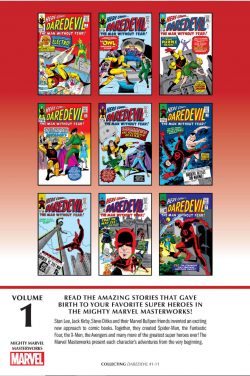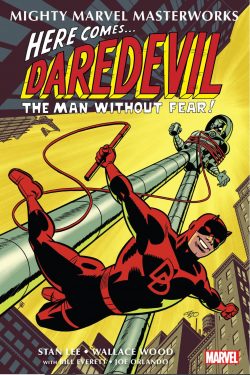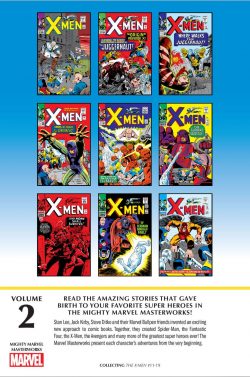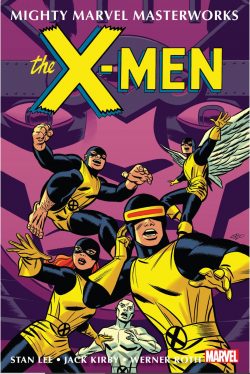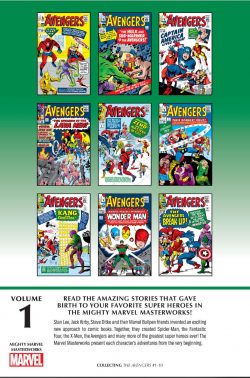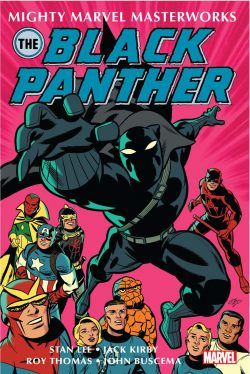
Mighty Marvel Masterworks Daredevil volume 1


By Stan Lee, Bill Everett, Joe Orlando, Wally Wood, Bob Powell & various (MARVEL)
ISBN: 978-1-3029-3440-8 (PB/Digital edition)

As the remnants of Atlas Comics grew in popularity in the early 1960s it slowly replaced its broad variety of genre titles with more and more super-heroes. The recovering powerhouse that was to become Marvel was still hampered by a crippling distribution deal that limited the company to 16 titles (curtailing their output until 1968), so each new untried book would have to fill the revenue-generating slot (however small) of an existing title.

Moreover, as costumed characters were selling, each new similarly-themed title would limit the breadth of the monster, western, war, humour or girls’ comics that had been the outfit’s recent bread and butter. It was putting a lot of eggs in one basket, and superheroes had failed twice before for Stan Lee.

So in retrospect the visual variety of the first few issues of Daredevil, the Man Without Fear seemed a risky venture indeed. Yes, the artists were all talented, seasoned veterans, but not to the young kids who were the audience. Most importantly, they just weren’t Jack Kirby or Steve Ditko, and new features need consistency and continuity…

Still, Lee and his rotating line-up of artists plugged on, concocting some extremely engaging tales until the latest Marvel Sensation found his feet, and the fascinating transition of moody masked avenger to wisecracking Scarlet Swashbuckler can be enjoyed in this collection gathering the first 11 issues (spanning April 1964 to December 1965): an effervescent package of thrills and spills which begins with ‘The Origin of Daredevil’

This much-retold tale recounts how young Matthew Murdock grew up in the slums of New York City, raised alone by his father: washed-up second-rate prize-fighter Battling Jack Murdock.

Determined that his boy will be something, the father extracts a solemn promise from Matt that he will never fight. Mocked by other kids who sarcastically dub him “Daredevil”, the kid abides by his vow, but secretly trains his body to physical perfection.

One day, he saves a blind man from being hit by a speeding truck, only to be struck in the face by its radioactive cargo. His sight is burned away forever, but his other senses are super-humanly enhanced and he gains a sixth, “radar-sense”.

He tells no-one, not even his dad.

The senior Murdock is in dire straits. As his career declined, he signed with The Fixer, knowing full well what the corrupt promoter expected from his fighters. Somehow, the pug’s star started to shine again and his downward spiral reversed itself. Unaware that he was being set up, Battlin’ Jack got a shot at the Big Time, but when ordered to take a dive, he refused. Winning was the proudest moment of his life. When his bullet-riddled corpse was found, the cops had suspicions but no proof…

Heartbroken, Matt graduated college with a law degree and set up in business with his room-mate FranklinFogg” Nelson. They hired a quiet young secretary named Karen Page and, with his life on track, young Matt now had time to solve his father’s murder…

His promise stopped him from fighting, but what if Matt became “someone else”?

Scripted by Lee and moodily illustrated by the legendary Bill Everett (with the assistance of Ditko), this is a rather formulaic and nonsensical yarn but is astonishingly engaging visually. The oft-told tale looked a little dated even at the time, but hinted at magic yet to come…

Plot-wise, the second issue fares little better as Joe Orlando & Vince Colletta assume the art chores for ‘The Evil Menace of Electro!’: a saga wisely exploiting the celebrity of guest-stars The Fantastic Four and featuring a second-hand Spider-Man villain.

The FF consult lawyer Matt Murdock just as the electrical outlaw tries to break into their building and before long Daredevil is spectacularly and relentlessly dealing with the voltaic villain. DD #3 finally offers the sightless swashbuckler a super-foe of his own when he meets and trounces crooked corporate raider ‘The Owl, Ominous Overlord of Crime!’

Daredevil #4 was a turning point, and possibly just in time. ‘Killgrave, the Unbelievable Purple Man!’ finally gave some distinctive character to the big stiff as he strove to overcome a villain who could exert total control over anyone who saw him. Although Orlando & Colletta’s uncomfortable, sedate and over-fussy illustration remained for one last episode, Lee finally got a handle on the hero; just in time for a magician-in-waiting to elevate the series to spectacular heights.

With #5, Wally Wood assumed the art chores and his lush, lavish work brought power, grace and beauty to the series. At last the costumed combat acrobat seemed to spring and dance across the rooftops and pages. Wood’s contribution to the plotting didn’t hurt either. He actually got a cover plug on his first issue.

In ‘The Mysterious Masked Matador!’ a cool, no-nonsense hero who looked commanding and could handle anything started fighting hard and fast. The series began advancing the moribund romantic sub-plot – Foggy adores Karen, who only has eyes for Matt, who loves her, but won’t let her “waste” her life on a blind man – and actually started making sense and progress.

Most importantly, the action scenes were intoxicating…

Although a bullfighter who used his skills for crime is frankly daft, the sublime drawing and sleek inking makes it all utterly convincing, and breathtakingly battle sequence is augmented by a Wood ‘Marvel Masterwork Pin-up of “DD”’ signalling a grand change in fortune…

The wonderment intensified in the following issue as the bold bravo was  ‘Trapped by the Fellowship of Fear!’: a minor classic as the Man Without Fear must defeat not only the super-powered Ox and Eel (two more recycled villains) but also his own threat-specific foe Mr. Fear – who could instil terror and panic in victims, courtesy of his ghastly gas gun.

The improvements led to a major change in Daredevil #7: a true landmark and to my mind one of the Top Ten Marvel Tales of all time.

Here Lee & Wood concocted an indisputable masterpiece as ‘In Mortal Combat with… Sub-Mariner!’ sees Prince Namor of Atlantis travel to the surface world to have his day in court. Resolved to sue all Mankind, he hires Nelson & Murdock and submits to being arrested, but discovers too late that his warlord Krang has usurped the throne in his absence. The tempestuous monarch will not languish in a cell when the kingdom is threatened, so he fights his way to freedom and the sea.

This saga shows Murdock the lawyer to be a brilliant orator, whilst his hopelessly one-sided battle against one of the strongest beings on the planet shows the dauntless courage of DD and true nobility of the Sub-Mariner.

Most notably, and with no fanfare at all, Wood replaced the original yellow-&-black “wrestler’s costume” with the iconic and beautiful all-red outfit we know today. As one pithy commentator stated, “the original costume looked as if it had been designed by a blind man”…

Augmented by another pin-up – in actuality a rejected cover for the tale – this issue proved beyond doubt the potential of Daredevil and promised even better to come…

Another all-new villain debuted in #8; a gripping industrial espionage thriller, ‘The Stiltman Cometh!’ pits the ace acrobat against a thieving, murderous masked miscreant towering above the skyscrapers, after which Golden Age Great Bob Powell came aboard as penciller to Wood’s layouts and inks with #9’s That He May See!’

Relentlessly badgered by Karen, Matt finally agrees to see an eye-specialist who might cure his blindness, but his visit to the European principality of Lictenbad quickly embroils the adventurer in a plot to conquer the world by a Ruritanian maniac with twin knights-in-armour and killer robot fixations…

Wood was clearly chafing after a year on the book and looking to stretch himself. Thus he also scripted the series’ first continued story ‘While the City Sleeps!’: a sophisticated political thriller and complex crime caper which first saw Foggy run for District Attorney of New York, even as a mysterious mastermind known as The Organizer created an animal-powered gang comprising Bird-Man, Frog-Man, Cat-Man and Ape-Man to terrorise the city.

With Powell now on layouts and pencils with Wood as finisher, Lee was left to dialogue the concluding chapter (which also proudly proclaimed the title’s advancement to a monthly schedule) ‘A Time to Unmask!’ as Daredevil pulled out all the stops to confound a devious power-grab scheme which saw the villains defeated, but only at great personal cost to Nelson & Murdock…

Offering covers from Everett, Jack Kirby, Colletta, Wood and Powell and closing with a rousing house ad by Wood, this sleek, economical, kid-friendly Mighty Marvel Masterworks compendium offers a few bumpy false starts before blossoming into a truly magnificent example of Marvel’s miraculously compelling formula for success: smart stories, human characters and magnificent illustration.

If you’ve not read these tales before I strongly urge you to rectify that error as soon as superhumanly possible…
© 2022 MARVEL.

Mighty Marvel Masterworks The X-Men volume 2: Where Walks the Juggernauts


By Stan Lee & Jack Kirby, Alex Toth, Werner Roth & various (MARVEL)
ISBN: 978-1-3029-4619-7 (TPB/Digital edition)

These stories are timeless and have been gathered many times so here’s my now-standard advisory on format.

The Mighty Marvel Masterworks line is designed with economy in mind. Classic tales of Marvel – such as birthday boys and girl on show today – have been an archival book staple since the 1990s, but always in lavish, expensive hardback collectors’ editions. The new tomes cited here are far cheaper, on lower quality paper and are smaller, about the dimensions of a paperback book. Your eyesight might be failing and your hands too big and shaky, but at 152 x 227mm, they’re perfect for kids. If you opt for the digital editions, that’s no issue at all…

Way back in 1963 things really took off for the budding Marvel Comics as Stan Lee & Jack Kirby expanded their meagre line of action titles: putting a bunch of relatively new super-heroes (including hot-off-the-presses Iron Man) together as The Avengers; launching a decidedly different war comic in Sgt. Fury and his Howling Commandos and creating a group of alienated heroic teenagers united to fight a rather specific, previously unperceived threat to humanity. Those halcyon days are revisited in this splendid trade paperback/eBook compilation, gathering from May 1965 to April 1966, the contents of X-Men #11-19.

Way back in the summer of 1963, the premiere issue had introduced Cyclops – Scott Summers, IcemanBobby Drake, AngelWarren Worthington III and The Beast AKA Henry “Hank” McCoy: extremely special students of Professor Charles Xavier. He was a brilliant, charismatic and wheelchair-bound telepath dedicated to brokering peace and integration between the masses of humanity and the emergent off-shoot race: human mutants called Homo Superior. The story saw the students welcome newest classmate Jean Grey, who would be codenamed Marvel Girl. She possessed the ability to move objects with her mind.

No sooner has the Professor explained their mission than an actual Evil Mutant – Magneto – singlehandedly took over American missile base Cape Citadel. A seemingly unbeatable threat, the master of magnetism was nonetheless driven off in under 15 minutes by the young heroes on their first combat mission…

These days, young heroes are ten-a-penny, but it should be noted that these kids were among Marvel’s first juvenile super-doers (unless you count Spider-Man or Human Torch Johnny Storm) since the end of the Golden Age, so it’s perhaps unsurprising that in early tales the youngsters regularly benefitted from a little adult supervision, such as is the case in the landmark tale that opens this book and ended an era…

After spectacular starts on most of Marvel’s Superhero titles (as well as western and war revamps), Jack Kirby’s increasing workload compelled him to cut back to laying out most of these lesser lights. Captain America still offered nostalgic fun through astounding action whilst Thor and Fantastic Four evolved into perfect playgrounds and full-time monthly preoccupations for his burgeoning imagination, but illustrating most of Marvel’s covers and creating a House style for the new Age of Superheroes was unforgiving and all-consuming…

The last series to be surrendered was the still-bimonthly X-Men wherein an outcast tribe of mutants worked diligently and clandestinely to foster peace and integration between the unwary masses of humanity and the gradually-emergent “coming race”. The King’s departure in #11 also marked a major turning point. Drenched in irony, ‘The Triumph of Magneto!’ (scripted by Stan Lee & inked by Chic stone) sees our heroes and The Brotherhood of Evil Mutants (Mastermind, The Toad, Quicksilver and The Scarlet Witch) both seeking a fantastically powered being dubbed The Stranger.

None are aware of his true identity, nature or purpose, but when the Master of Magnetism finds him first, it spells the end of his long war with the X-Men…

With Magneto gone and the Brotherhood broken, Kirby relinquished pencilling to other hands, thereafter providing loose layouts and design only. Alex Toth & Vince Colletta proved a quirky, uncomfortable mix for #12’s tense drama ‘The Origin of Professor X!’: opening a 2-part saga introducing Xavier’s bully half-brother Cain Marko. It also told how the simplistic thug was mystically transformation into an unstoppable human engine of destruction.

The story concludes with ‘Where Walks the Juggernaut!’: a compelling, tension-drenched, all-action tale guest-starring Johnny Storm, and notable for the introduction of penciller Werner Roth (using the name Jay Gavin). He would be associated with the mutants for the next half decade. His inker for this first outing was the infallible Joe Sinnott.

Roth was an unsung veteran of the industry, working for the company in the 1950s on star features like Apache Kid and the inexplicably durable Kid Colt, Outlaw, as well as Mandrake the Magician for King Features Comics and Man from U.N.C.L.E. for Gold Key. As with many pseudonymous creators of the period, it was his DC commitments (mostly romance stories) which compelled him to disguise his moonlighting until Marvel grew big enough to offer him full-time work.

From issue #14 – still laid out by Kirby & inked by Colletta – ‘Among Us Stalk the Sentinels!’ celebrated the team’s inevitable elevation to monthly publication in the first episode of a 3-chapter epic introducing anthropologist Bolivar Trask, whose solution to the threat of Mutant Domination was super-robots that would protect humanity at all costs. Sadly, they mechanoids’ definition of “protect” varied wildly from their creator’s, but what can you expect when a social scientist dabbles in high-energy physics and engineering?

The X-Men took the battle to the Sentinels’ secret base but became ‘Prisoners of the Mysterious Master Mold!’ before beating their ferrous foes with ‘The Supreme Sacrifice!’

Veteran Dick Ayers joined as inker from #15: his clean line blending perfectly with Roth’s smoothly classicist pencils. They remained a team for years, adding vital continuity to this quirky but never top-selling series.

X-Men #17 dealt with the aftermath of the battle – the last time the US Army and government openly approved of the team’s efforts – and the sedate but brooding nature of ‘…And None Shall Survive!’ enabled the story to generate a genuine air of apprehension as safe haven and citadel the Xavier Mansion is taken over by an old foe who picks them off one by one until only the youngest remains to battle alone in climactic conclusion ‘If Iceman Should Fail..!’

With Roth fully laying out his own stories, ‘Lo! Now Shall Appear… The Mimic!’ in #19 was Lee’s last script: the pithy, semi-tragic tale of a troubled teen possessing the ability to copy the skills, powers and abilities of anyone in close proximity, but not the emotional maturity to handle his power. The writing reins were turned over to Roy Thomas in #20.

X-Men was never one of young Marvel’s top titles but it found a devout and dedicated following as the frantic, freakish energy of Kirby’s heroic dynamism comfortably transited into the slick, sleek attractiveness of Roth and the fierce tension of hunted, haunted juvenile outsiders settled into a pastiche of college and school scenarios so familiar to the students who were the series’ main audience, but that’s the meat of the next volume…

Supplemented by covers from Kirby, Stone, Frank Giacoia, Sinnott, Wally Wood, Dick Ayers & Roth, the extras here comprise the art for a 1965 X-Men T-shirt by Kirby & Stone and a copious gallery of original art pages – by Kirby & Stone, Toth & Colletta &Roth & Ayers – plus a compelling contemporary house ad from August 1965 picturing all 13 Marvel Masterpieces on sale that month!

These quirky tales are a million miles removed from the angst-ridden, breast-beating, cripplingly convoluted X-brand of today’s Marvel, and in so many ways are all the better for it. Superbly rendered, highly readable adventures are never unwelcome or out of favour, and it should be remembered that everything here informs so very much of the mutant monolith. These are stories for dedicated fans and rawest converts. Everyone should have this book.
© 2022 MARVEL.

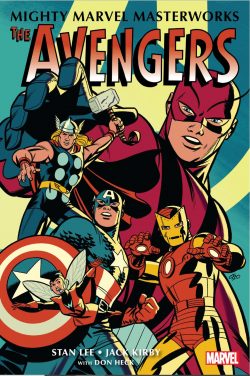
Mighty Marvel Masterworks The Avengers volume 1: The Coming of The Avengers


By Stan Lee & Jack Kirby, Don Heck, Dick Ayers, Paul Reinman, George Roussos, Chic Stone, Sam Rosen, Art Simek & various (MARVEL)
ISBN: 978-1302929787 (TPB/Digital edition)

Probably Marvel’s biggest global franchise success, The Avengers celebrate their 60th anniversary in September 2023, so let’s start the New Year with acknowledgement of that landmark event and a promise of more of the same over the next 12 months…

These stories are timeless and have been gathered many times before but here we’re looking at The Mighty Marvel Masterworks line: designed with economy in mind and newcomers as target audience. These books are far cheaper, on lower quality paper and smaller – about the dimensions of a paperback book. Your eyesight might be failing and your hands too big and shaky, but at 152 x 227mm, they’re perfect for kids. If you opt for the digital editions, that’s no issue at all.

After a period of meteoric expansion, in 1963 the burgeoning Marvel Universe was finally ready to emulate the successful DC concept that had cemented the legitimacy of the Silver Age of American comics. The notion of putting a bunch of all-star eggs in one basket had made the Justice League of America a winner and subsequently inspired the moribund Atlas outfit – primarily Stan Lee, Jack Kirby & Steve Ditko – into conceiving “super-characters” of their own. The result – way back in 1961 – was the Fantastic Four

Nearly 18 months later, the fledgling House of Ideas had generated a small and (mostly) successful stable of costumed leading men (but still only 2 sidekick women!), allowing Lee & Kirby to at last assemble a select handful of them into an all-star squad, moulded into a force for justice and soaring sales…

Seldom has it been done with such style and sheer exuberance. Cover dated September 1963, and on sale from Early July, The Avengers #1 launched as part of an expansion package which also included Sgt. Fury and his Howling Commandos and The X-Men

This premier volume gathers The Avengers #1-10 (running to cover-date September 1965): a stellar sequence of groundbreaking tales no lover of superhero stories can do without…

The tense action kicks off with ‘The Coming of the Avengers! where – rather than starting at a neutral beginning – Stan & Jack (plus inker Dick Ayers) assumed buyers had a passing familiarity with Marvel’s other heroes and wasted very little time or space on introductions.

In Asgard, immortal trickster Loki is imprisoned on a dank isle, hungry for vengeance on his noble half-brother Thor. Whilst malevolently observing Earth, the god of evil espies the monstrous, misunderstood Hulk and mystically engineers a situation wherein the man-brute seemingly goes on a rampage, simply to trick the Thunder God into battling the monster.

When the Hulk’s teen sidekick Rick Jones radios the FF for assistance, Loki scrambles and diverts the transmission, smugly awaiting the blossoming of his mischief. Sadly for the schemer, Iron Man, Ant-Man and the Wasp also pick up the redirected SOS…

Only after the alerted heroes all converge on the American Southwest to search for the Jade Giant, do they realise that something is oddly amiss…

This terse, epic, compelling and wide-ranging yarn (New York, New Mexico, Detroit and Asgard in 22 pages) is Lee & Kirby at their bombastic best, and remains one of the greatest stories of the Silver Age (it’s certainly high in my own top ten Marvel Tales) and is followed by ‘The Space Phantom(Lee, Kirby & Paul Reinman), wherein an alien shape-stealer infiltrates and almost destroys the team from within.

With latent animosities exposed by the malignant masquerader, the epic ends with the volatile Hulk quitting the team in disgust, only to return in #3 as an outright villain in partnership with ‘Sub-Mariner!This globe-trotting romp delivers high-energy thrills and one of the blistering best battle scenes in comics history as the assorted titans clash in abandoned World War II tunnels beneath the Rock of Gibraltar. The tale was preceded hereby the galvanic house ad announcing the clash as seen in Avengers #2…

Inked by George Roussos, Avengers #4 was an indisputable, game-changing landmark as Marvel’s greatest Golden Age sensation returns for another increasingly war-torn era. ‘Captain America joins the Avengers!has everything that made the company’s early output so fresh and vital. The majesty of a legendary warrior returned in our time of greatest need; stark tragedy in the loss of his boon companion Bucky; aliens, gangsters, tragedy-drenched antagonist The Sub-Mariner and even subtle social commentary, all naturally wrapped up in vast amounts of staggering Kirby Action. It even begins with a cunning infomercial as Iron Man unsuccessfully requests the assistance of the company’s other fresh young stars, giving readers a taste of the other mighty Marvels on offer to them…

Reinman returned to ink ‘The Invasion of the Lava Men!: another staggering adventure romp wherein the team – with the unwilling assistance of the ever-incredible Hulk – battle incendiary subterraneans and a world-threatening mutating mountain…

However, even all that pales before the supreme shift in artistic quality that is Avengers #6.

Chic Stone – arguably Kirby’s most effective inker of the period – joined the creative team just as a classic arch-foe was born. ‘The Masters of Evil!reveals how Nazi super-scientist Baron Zemo (who debuted that same month as a Nazi scientist in Sgt. Fury and his Howling Commandos #8) returns from self-exile in South America.

The petty tyrant is forced by his own arrogance and paranoia to emerge from the anonymity of the jungle he’s been skulking in since the Third Reich fell, after learning his despised nemesis Captain America has returned from the dead…

To this end, the war-criminal recruits a gang comprising previously established supervillains to attack New York City and destroy the Avengers. The unforgettable clash between valiant heroes and vile murdering mercenaries Radioactive Man, Black Knight (Nathan Garrett) and The Melter is to this day an unsurpassed example of prime Marvel magic.

Issue #7 followed up with two more malevolent recruits for the Masters of Evil, as Asgardian outcasts Enchantress and The Executioner are exiled to Midgard by Odin and waste no time allying with Zemo. This coincides with Iron Man being suspended from the team, due to “misconduct” occurring in his own series at that time. This was the start of the era of close-continuity where events in one series were regularly referenced and built upon in others. The practise quickly became a rod for the creators’ own backs and led to a radical rethink…

It might have been ‘Their Darkest Hour!, but follow-up Avengers #8 delivered the team’s greatest triumph and tragedy as Kirby (inked with fitting circularity by Ayers) relinquished his full drawing role with a superbly entrancing invasion-from-time thriller. Riffing on The Day the Earth Stood Still, the B-movie-toned classic introduced ‘Kang the Conqueror!: depicting an impossible powerful foe defeated by the cunning of ordinary teenagers and the indomitable spirit of Earth’s Mightiest Heroes…

Whenever Kirby left a title he’d co-created, it took a little while to settle into a new rhythm, and none more so than with these collectivised costumed crusaders. Although Lee and the fabulously utilitarian Don Heck were perfectly capable of producing cracking comics entertainments, they never had The King’s uncanny sense of panoramic scope and scale which constantly sought bigger, bolder blasts of excitement.

The Avengers evolved into an entirely different series when the subtle approachability of Heck’s human-scaled vision replaced Kirby’s larger-than-life bombastic bravura. The series had advanced to monthly circulation and even King Kirby could not draw the massive number of pages his expanding workload demanded.

Heck was a gifted and trusted artist with a formidable record for meeting deadlines and, progressing under his pencil, sub-plots and character interplay finally got as much space as action and spectacle. After Kirby, stories increasingly focused on scene-stealing newcomer Captain America: concentrating on frail human beings in costumes, rather than wild modern gods and technological titans bestriding and shaking the Earth…

Inked by Ayers, Heck’s first outing was memorable tragedy ‘The Coming of the Wonder Man!wherein the Masters of Evil plant superhuman Trojan Horse Simon Williams within the heroes’ ranks, only to have the conflicted infiltrator find deathbed redemption by saving them from the deadly deathtrap he creates…

Another Marvel mainstay debuted with the introduction of (seemingly) malignant master of time Immortus, who briefly combines with Zemo’s devilish cohort to engineer a fatal division in the ranks by removing Cap from the field in ‘The Avengers Break Up!A sign of the Star-Spangled Sentinel’s increasing popularity, the issue is augmented by a Marvel Masterwork Pin-Up of ‘The One and Only Cap, courtesy of Kirby & Ayers, and is followed by a 1963 house ad for Avengers #1 to close this pocket-sized bombshell of wonders.

These are immortal tales that defined the early Marvel experience and are still a joy no fan should deny themselves or their kids. How can you survive without them?
© 2021 MARVEL.

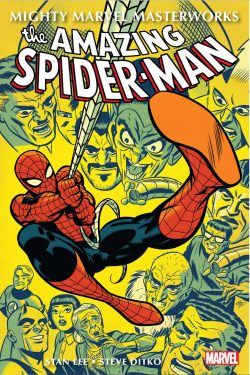
Mighty Marvel Masterworks Spider-Man volume 2: The Sinister Six


By Stan Lee & Steve Ditko, with Sam Rosen & Art Simek (MARVEL)
ISBN: 978-1-3029-3195-7 (TPB/Digital edition)

As any fule kno, The Amazing Spider-Man celebrated his 60th anniversary in 2022. However, I’m one of those radicals who feel that 1963 was when he was really born, so let’s start the New Year with acknowledgement of that opinion and warning of many more of the same over the next 12 months…

These stories are timeless and have been gathered many times before but this time we’re looking at The Mighty Marvel Masterworks line: designed with economy in mind and newcomers as target audience. These new books are far cheaper, on lower quality paper and smaller, about the dimensions of a paperback book. Your eyesight might be failing and your hands too big and shaky, but at 152 x 227mm, they’re perfect for kids. If you opt for the digital editions, that’s no issue at all.

Marvel is often termed “the House that Jack Built” and King Kirby’s contributions are undeniable and inescapable in the creation of a new kind of comic book storytelling. However, there was another unique visionary toiling at Atlas-Comics-as-was, one whose creativity and philosophy seemed diametrically opposed to the bludgeoning power, vast imaginative scope and clean, gleaming futurism that resulted from Kirby’s ever-expanding search for the external and infinite.

Steve Ditko was quiet and unassuming, diffident to the point of invisibility, but his work was both subtle and striking: innovative and meticulously polished. Always questing for affirming detail, he ever explored the man within. He saw heroism and humour and ultimate evil all contained within the frail but noble confines of humanity. His drawing could be oddly disquieting… and, when he wanted, decidedly creepy.

Crafting extremely well-received monster and mystery tales for and with Stan Lee, Ditko had been rewarded with his own title. Amazing Adventures/Amazing Adult Fantasy featured a subtler brand of yarn than Rampaging Aliens and Furry Underpants Monsters: an ilk which, though individually entertaining, had been slowly losing traction in the world of comics ever since National/DC had successfully reintroduced costumed heroes.

Lee & Kirby had responded with The Fantastic Four and so-ahead-of-its-time Incredible Hulk, but there was no indication of the renaissance ahead when officially just-cancelled Amazing Fantasy featured a brand new and rather eerie adventure character…

This compelling compilation re-presents the rise of the wallcrawler as first seen in Amazing Spider-Man #11-19 and Amazing Spider-Man Annual #1 (spanning cover-dates April – December 1964) and is lettered throughout by unsung superstars Sam Rosen & Art Simek, allowing newcomers and veteran readers to comprehensively relive some of the greatest moments in sequential narrative.

The parable of Peter Parker began when a smart but alienated high schooler was bitten by a radioactive spider on a science trip. Discovering he’d developed arachnid abilities – which he augmented with his own ingenuity and engineering genius – Peter did what any lonely, geeky nerd would when given such a gift… he tried to cash in for girls, fame and money.

Creating a costume to hide his identity in case he made a fool of himself, Parker became a minor celebrity – and a vain, self-important one. To his eternal regret, when a thief fled past him, he didn’t lift a finger to stop the thug, and days later returns discovered that his Uncle Ben has been murdered by the same criminal…

Crazy for vengeance, Parker stalked and captured the assailant who made his beloved Aunt May a widow and killed the only father he had ever known. Since his social irresponsibility led to the death of the man who raised him, the boy swore to always use his powers to help others…

It wasn’t a new story, but the setting was familiar to every kid reading it and the artwork was downright spooky. no gleaming high-tech world of moon-rockets, mammoth monsters and flying cars here… this stuff could happen to anyone…

Amazing Fantasy #15 came out the same month as Tales to Astonish #35 – the first to feature the Astonishing Ant-Man in costume, but it was the last issue of Ditko’s Amazing playground. However, the tragic last-ditch tale struck a chord with the public and by year’s end a new comic book superstar launched in his own title, with Ditko eager to show what he could do with his first returning character since the demise of Charlton’s Captain Atom

Holding on to the “Amazing” prefix to jog reader’ memories, the Amazing Spider-Man #1 hit newsstands in December sporting a March 1963 cover-date and two complete stories.

Sans frills and extras, the ongoing saga resumes here with Amazing Spider-Man #11. Ditko’s preference for tales of gangersterism drove the stories and his plot for ‘Turning Point’ involves the reappearance of a major supervillain and a growing dependence on soap opera drama, but his solitary, driven hero was always a loner, never far from the streets and small-scale-crime…

In the aftermath of the webspinner crushing a prison riot single handed and defeating the Big Man and The Enforcers, longer plot-strands were introduced as Peter’s potential girlfriend Betty Brant mysteriously vanishes.

Resolved to find her, Parker discovers she’s somehow involved with the multi-armed menace and the Philadelphia mob and goes after her, clashing again with the lethally deranged scientist whilst seeking to expose a long-hidden secret which had haunted Brant for years. It all ended in a spectacularly climactic fight scene on a ship that has still never been beaten for action-choreography…

The wonderment actually intensifies with ‘Unmasked by Dr. Octopus!’, detailing a dark, tragedy-filled tale of extortion and excoriating tension that stretches from Philadelphia to the Bronx Zoo: cannily tempering trenchant melodrama with spectacular clashes in unusual and exotic locations, before culminating in a truly staggering super-powered duel as only the masterful Ditko could orchestrate it.

A new super-foe premiered in Amazing Spider-Man #13 with ‘The Menace of Mysterio!’ as a seemingly eldritch bounty-hunter hired by Daily Bugle publisher J. Jonah Jameson to capture Spider-Man eventually lets slip his own dark criminal agenda, whilst ASM #14 delivers an absolute milestone in Marvel History when a hidden criminal mastermind manipulates a Hollywood studio into making a movie about the wall-crawler.

Even with guest-star opponents The Enforcers and The Incredible Hulk (his last true guest shot before moving into his new residency in Tales to Astonish), ‘The Grotesque Adventure of the Green Goblin’ is most notable for introducing Spider-Man’s most perfidious and flamboyant enemy.

Jungle superman and thrill-junkie ‘Kraven the Hunter!’ makes Spider-Man his intended prey at the behest of embittered Spidey-foe The Chameleon in #15, and – after ignominiously failing to trap his target in the wilds of Central Park – promptly reappears in the first Amazing Spider-Man Annual

A timeless landmark and still magnificently thrilling Fights ‘n’ Tights tussle, the ‘Sinister Six!’ begins after a team of villains comprising Electro, Kraven, Mysterio, The Sandman, Vulture and Doctor Octopus abduct Aunt May and Betty. Briefly deprived of his powers – lost to a guilt-fuelled panic attack – Peter is forced to confront them without nothing but courage & determination.

A staggeringly enthralling combat clash, with Spider-Man systematically taking down each enemy in a death-defying duels, this influential tale featured cameos (or, more honestly, product placement segments) by every other extant hero of the budding Marvel universe: everyone from The Avengers to The X-Men

Also included from that colossal comic book are special feature pages on ‘The Secrets of Spider-Man!’; comedic short ‘How Stan Lee and Steve Ditko Create Spider-Man’ and a gallery of pin-up pages starring ‘Spider-Man’s Most Famous Foes!’ (namely the Burglar, Chameleon, Vulture, Terrible Tinkerer, Dr. Octopus, Sandman, Doctor Doom, The Lizard, Living Brain, Electro, The Enforcers, Mysterio, Green Goblin and Kraven the Hunter).

There are also pin-ups of Betty and Jonah, Peer Parker’s House and classmates plus a heroic guest stars page…

Amazing Spider-Man #16 extended that circle of friends and foes as the webslinger battles the Ringmaster and his Circus of Crime: consequently meeting – and inevitably battling – a fellow loner hero in a dazzling and delightful ‘Duel with Daredevil’.

We conclude this outing with an ambitious 3-part saga that began in Amazing Spider-Man #17, wherein the rapidly-maturing hero touches emotional bottom before rising to triumphal victory over all manner of enemies. It begins with ‘The Return of the Green Goblin!’ as the wallcrawler endures renewed print assaults from the Daily Bugle and its obsessed publisher J. Jonah Jameson, just as the enigmatic Green Goblin commences a war of nerves and attrition, using the Enforcers, Sandman and an army of bargain basement thugs to publicly humiliate the Amazing Arachnid and make him look like a fool in front of rival frenemy Johnny StormThe Human Torch.

To exacerbate matters, Peter’s beloved Aunt May’s health takes a drastic downward turn…

In ‘The End of Spider-Man!’ pressure continues to mount and the troubled champion quits, concentrating exclusively on finding money to pay for his aunt’s treatment and leaving the Torch to handle the Goblin’s crime rampage…

It all explosively concludes in ‘Spidey Strikes Back!’ featuring a turbulent team-up with the Torch – as a powerful pep talk from May galvanises the disgruntled teen terror and sets him back on his fated path: to the everlasting regret of the Goblin, his gangsters, the Enforcers and Sandman… and Jameson…

This extended tale proved fans were ready for every kind of narrative experiment (single issue or even two stories per issue were still the norm in 1964) and Stan & Steve were more than happy to try anything…

I claimed no extras here, but I lied. Closing the book are some lovely art treats: an unedited view of Ditko’s original cover for ASM #11, the original splash page art for #12 plus page 12and the closing page of #18; every one reason enough to buy this book…

These immortal epics are something no serous fan can be without, and will make an ideal gift for any curious newcomer or nostalgic aficionado.

Happy Unbirthday Spidey and many, many more please…
© 2021 MARVEL.

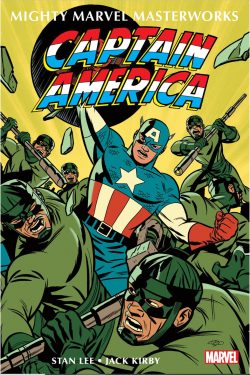
Mighty Marvel Masterworks Captain America volume 1: The Sentinel of Liberty


By Stan Lee, Jack Kirby, Dick Ayers, George Tuska, John Romita & various (MARVEL)
ISBN: 978-1302946159 (PB/Digital edition)

During the natal years of Marvel Comics in the early 1960s Stan Lee & Jack Kirby opted to mimic the game-plan which had paid off so successfully for National/DC Comics, albeit with mixed results. Beginning cautiously in 1956, Julie Schwartz had scored incredible, industry-altering hits by re-inventing the company’s Golden Age greats, so it seemed sensible to try and revive the characters that had dominated Timely/Atlas in those halcyon days two decades previously.

A new Human Torch had premiered as part of the revolutionary Fantastic Four, and in the fourth issue of that title the amnesiac Sub-Mariner resurfaced after a 20-year hiatus (everyone concerned had apparently forgotten the first abortive attempt to revive an “Atlas” superhero line in the mid-1950s).

The Torch was promptly given his own solo lead-feature in Strange Tales (from issue #101 on) where, eventually (in Strange Tales #114), the flaming kid fought a larcenous villain impersonating the nation’s greatest lost hero…

Here’s a quote from the last panel…

“You guessed it! This story was really a test! To see if you too would like Captain America to Return! As usual, your letters will give us the answer!” I guess we all know how that turned out…

With reader-reaction strong, the real McCoy was promptly decanted in Avengers #4 and, after a captivating, centre-stage hogging run in that title, won his own series as half of a “split-book” with fellow Avenger and patriotic barnstormer Iron Man, beginning with #59.

This premiere Mighty Marvel Masterworks Cap collection assembles those early appearances from Tales of Suspense #59-77, spanning November 1964 to May 1966) in a cheap, kid-friendly edition that will charm and delight fans of all vintages…

Scripted throughout by Lee, it begins with eponymous opening outing ‘Captain America’ – illustrated by the staggeringly perfect team of Kirby & Chic Stone. The plot is non-existent, but what you do get is a phenomenal fight as an army of thugs invades Avengers Mansion because “only the one without superpowers” is at home. They soon learn the folly of that misapprehension…

The next issue offered more of the same as ‘The Army of Assassins Strikes!’ on behalf of evil arch enemy Baron Zemo, before ‘The Strength of the Sumo!’ proves insufficient when Cap invades Viet Nam to rescue a lost US airman. Incidentally, that flyer was a black serviceman, signalling early on Kirby’s resolve to break comic books’ colour bar…

The Star-Spangled Swashbuckler then took on an entire prison to thwart a ‘Break-out in Cell Block 10!’: a glorious action riot simply dripping with irony…

After these simplistic romps, the series took an abrupt turn and began telling tales set in World War II. Crafted by Lee, Kirby & Frank Ray (AKA Frank Giacoia), ‘The Origin of Captain America!’ recounts how patriotic, frail physical wreck Steve Rogers is selected to be guinea pig for an experimental super-soldier serum, only to have the scientist responsible cut down by a Nazi bullet and die in his arms…

Now regarded as forever unique, he is given the task of becoming the fighting symbol and guardian of America, all while based as a regular soldier in a US boot camp. There he is accidentally unmasked by Camp Mascot Bucky Barnes, who then blackmails the hero into making the kid his sidekick.

The next issue (Tales of Suspense #64, cover-dated April) kicked off a string of spectacular episodic thrillers adapted from Kirby & Joe Simon’s Golden Age run, with the flag-bedecked heroes defeating Nazi spies Sando and Omar in ‘Among Us, Wreckers Dwell!’ before Chic Stone returned heralding Cap’s greatest foe in landmark saga ‘The Red Skull Strikes!’

‘The Fantastic Origin of the Red Skull!’ sends the series shooting into high gear – and original material – as sub-plots and characterisation are added to the ardent action and spectacle. At last we learn the backstory of the most evil man on Earth: revealed to a captive Sentinel of Liberty… Then ‘Lest Tyranny Triumph!’ and ‘The Sentinel and the Spy!’ (both inked by Giacoia) combine espionage and mad science in a late-exposed plot to murder the head of Allied Command…

The All-American heroes stay in England for moody gothic suspense shocker ‘Midnight in Greymoor Castle!’ (illustrated by Dick Ayers over Kirby’s layouts) before second chapter ‘If This be Treason!’ finds Golden Age veteran and contemporary Buck Rogers newspaper strip artist George Tuska perform the same function.

The final part – and last wartime operation – then reveals what happens ‘When You Lie Down with Dogs…!’ with Joe Sinnott inking Tuska over Kirby’s layouts to deliver a rousing conclusion to this frantic tale of traitors, madmen and terror-weapons.

We return to the present – that’s 1964 to you – ToS #72 where Lee, Kirby & Tuska reveal that Cap has been telling war stories to his fellow Avengers for our last nine months. The reverie triggers a long dormant memory when ‘The Sleeper Shall Awake!’, kicking off a classic catastrophe countdown as a dormant Nazi super-robot activates 20 years after Germany’s defeat, programmed to exact world-shattering vengeance.

Continuing in ‘Where Walks the Sleeper!’ and concluding in ‘The Final Sleep!’, this masterpiece of tense suspense deftly demonstrates the indomitable nature of the perfect American hero.

With John Tartaglione inking, Ayers returns to pencil Kirby’s breakdown designs in ‘30 Minutes to Live!’: introducing both Gallic mercenary Batroc the Leaper and a mysterious girl who would eventually become Cap’s long-term girl-friend. In deference to the era’s fascination with superspies, S.H.I.E.L.D. was rapidly gaining dominance throughout Marvel continuity and one of their best was Agent 13Sharon Carter.

The taut 2-part countdown to disaster ends with ‘The Gladiator, The Girl and the Glory!’, limned by John Romita: the first tale with no official artistic input from Kirby, although he did lay out the next issue (TOS #77) for Romita & Giacoia. ‘If a Hostage Should Die!’ again focuses on WWII, hinting at both a lost romance and tragedy to come, and a possible connection between Agent 13 and the girl Steve Rogers lost in the dying days of war…

Rounding out this patriotic bonanza is a brief gallery of original art pages by Kirby, Stone & Ayers, taken from these tales of dauntless courage and unmatchable adventure.

Fast-paced and superbly illustrated, these adventures introduced a new generation to Captain America, restoring the Sentinel of Liberty to the heights his Golden Age compatriots the Human Torch and the Sub-Mariner never truly regained. These yarns are pure escapist magic: unmissable reading for the eternally young at heart and constantly thrill-seeking.
© 2022 MARVEL.

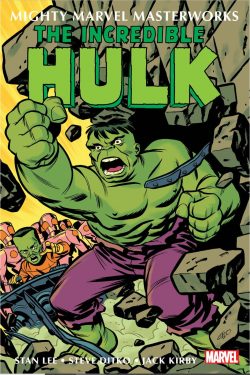
Mighty Marvel Masterworks The Incredible Hulk volume 2


By Stan Lee, Steve Ditko, Jack Kirby, Dick Ayers, Mike Esposito, Bob Powell & various (MARVEL)
ISBN: 978-1-3029-4623-4 (TPB/Digital edition)

Their stories are timeless and have been gathered many times before, but today I’m once more focusing on format before Fights ‘n’ Tights – or is that Rags ‘n’ Shatters?

The Mighty Marvel Masterworks line was expressly designed with economy in mind. Classic tales of Marvel’s key characters as realised by the founding creators and re-presented in chronological order have been a company staple since the 1990s, but always in lavish, expensive collectors editions. These nifty nuggets are far cheaper, albeit with some deletions – such as the occasional pin-up – and with far fewer bonus features. They’re printed on lower quality paper and – crucially – are physically smaller (152 x 227mm or about the dimensions of a B-format paperback book). Your eyesight might be failing and your hands too big and shaky, but they’re perfect for kids and if you opt for the digital editions, that’s no issue at all…

Bruce Banner was a military scientist caught in the world’s first gamma bomb detonation. As a result of ongoing mutation, stress and other factors cause him to transform into a giant green monster of unstoppable strength and fury.

After an initially troubled debut run, the Gruff Green Giant finally found his size 700 feet and a format that worked, becoming one of young Marvel’s most popular features. After his first solo-title folded, The Incredible Hulk shambled around a swiftly-coalescing Marvel Universe as guest star and/or villain du jour until a new home was found for him.

1962 was a big year for burgeoning Marvel, with plenty of star debuts who all celebrate six decades of glory this year. Most oldsters will cite the Amazing Spider-Man as the most significant premier, but this guy can probably claim equal star status…

This tome gathers the Hulky bits from Tales To Astonish #59-74: spanning September 1964 to December 1965, and seeing the nomadic antihero settle down in a new home to restart his march to global fame and misfortune…

Way back then, the trigger for the Hulk’s second chance was a reprinting of his origin in the giant anthology comic book Marvel Tales Annual #1. It was the beginning of the company’s inspired policy of keeping early tales in circulation, which did so much to make fervent fans out of casual latecomers. Thanks to reader response, “Ol’ Greenskin” was awarded a back-up strip in a failing title…

Giant-Man Hank Pym was the star turn in Tales to Astonish, but by mid-1964 the strip was visibly floundering. In issue #59 the Master of Many Sizes was used to introduce his forthcoming co-star in a colossal punch-up, setting the scene for the next issue wherein the Green Goliath’s co-feature began.

The second chapter of the man-monster’s career was about to take off and power-packed prologue ‘Enter: The Hulk!’ (Stan Lee, Dick Ayers & Paul Reinman) sees the Avengers inadvertently inspire woefully insecure Giant-Man to hunt down the Jade Giant Goliath.

Although Pym’s archfoe The Human Top devilishly engineered that blockbusting battle, Lee was the real mastermind as – with the next issue – The Hulk began starring in his own series (and on the covers) whilst Giant-Man’s adventures shrank down to a dozen or so pages.

The event was heralded by a raucous house ad which supplements the story here.

In TTA #60, ‘The Incredible Hulk’ opens with Banner still working for General Thaddeus “Thunderbolt” Ross, despite the military martinet’s deep disgust and distrust of the puny milksop who had won his daughter’s heart.

Aloof and standoffish, Banner keeps secret his astounding condition: an affliction which subjects him to uncontrollable transformations, becoming a rampaging, if well-intentioned, engine of destruction.

The 10-page instalments were uncharacteristically set in the Arizona/New Mexico deserts, not New York, and espionage and military themes were the narrative backdrop of these adventures. Lee scripted, Ditko drew and comics veteran George Roussos – “George Bell” – provided the ink art. The first episode details how an anonymous spy steals an unstoppable suit of robotic armour built by radiation-obsessed Banner, and concludes with a shattering battle in the next instalment wherein the Hulk is ‘Captured at Last!’

Cliffhanger endings such as the exhausted Man-Monster’s imprisonment by Ross’ military units at the end of the yarn would prove instrumental in keeping readers onboard and enthralled. Next chapter ‘Enter… the Chameleon!’ has plenty of action and suspense with the mercenary spy infiltrating Ross’ command, but the real punch is the final panel, hinting at the mastermind behind all the spying and skulduggery. The enigmatic Leader would become the Hulk’s ultimate and antithetical nemesis…

The minor Spider-Man villain worked well as a returning foe: his disguise abilities an obvious threat in a series based on a weapons scientist working for the military during the Cold War. Even the Leader himself has dubious connections to the sinister Soviets – when he isn’t trying to conquer the world for himself.

Preceded by a titanic Jack Kirby Marvel Masterwork Pin-up of the Green Goliath, ‘A Titan Rides the Train!’ (TTA #63, cover-dated January 1965) provides an origin for the super-intellectual menace whilst setting up a fresh subplot wherein new cast addition Major Glen Talbot begins to suspect Banner is a traitor. The action component comes when the Leader tries to steal Banner’s new anti-H-bomb device from a moving freight locomotive…

‘The Horde of Humanoids!’ features the return of guilt-stricken former sidekick Rick Jones who uses his Avengers connections to obtain a pardon for the incarcerated Banner by the simple expedient of letting the American President in on the secret of the Hulk! Ah… kinder times…!

Free again, Banner joins Talbot on an isolated island to test his hotly sought-after atomic device, only to be attacked by the Leader’s artificial warriors – providing a fine example of Ditko’s unique manner of staging a super-tussle.

The chaotic clash continues into the next issue as Ayers assumes the inking. Banner is taken prisoner by those darn Commies, and sees the Hulk go ballistic behind the Iron Curtain ‘On the Rampage against the Reds!’. This gratuitously satisfyingly onslaught spans three issues, with #66 – ‘The Power of Doctor Banner!’ inked by Vince Colletta and ‘Where Strides the Behemoth’ in #67 (inked by Frank Giacoia AKA “Frank Ray”), cumulatively demonstrating the brute’s shattering might.

His Commie-Busting fury finally expended, the Hulk reverts to human form and is captured by Mongolian bandits who see a chance to make lots of ransom money…

Jack Kirby returned as illustrator – supplemented by Mike (“Mickey Demeo”) Esposito – in #68. ‘Back from the Dead!’ sees dauntless Glen Talbot extricate and exfiltrate the tragic scientist, only to lose him again on the way back to America. Even so, Banner falls again into military custody and is ordered to activate his Atomic Absorbatron for one last test…

Yet again the process is interrupted by the Leader’s attacking Humanoids, but this time the Veridian Villain succeeds and the Hulk is ‘Trapped in the Lair of the Leader!’ …but only until the US Army bursts in…

Issue #70 saw Giant-Man benched and replaced by The Sub-Mariner, making Tales to Astonish a title dedicated to aggressive, savage anti-heroes. Increasingly, Hulk stories reflected this shift, and ‘To Live Again!’ sees the furious Leader launch a 500-foot tall Humanoid against a local US missile base, with the Jade Giant caught in the middle.

Kirby reduced his input to layouts and Esposito handles the lion’s share of the art in #71’s ‘Like a Beast at Bay!’: as the despondent Hulk actually joins forces with the Leader before ‘Within the Monster Dwells a Man!’ finds Talbot getting ever closer to uncovering Banner’s dark, green secret.

With legendary illustrator Bob Powell pencilling and inking over Kirby’s layouts, ‘Another World, Another Foe!’ details how the Leader dispatches Hulk to The Watcher’s homeworld to steal an ultimate weapon, just as an “unbeatable” alien rival arrives. ‘The Wisdom of the Watcher!’ ends the quest – and apparently The Leader – in an all-out, brutal action with a shocking climax…

The book closes with a glorious lost page of Ditko’s pencils: a superb unused pin-up of the antihero and his supporting cast, that is quite frankly worth the price of admission all on its own…

To Be Hulk-inued…

Hulk Smash! He always was, and because of stories like this, he always will be…
© 2022 MARVEL.

Mighty Marvel Masterworks Black Panther volume 1: The Claws of the Panther


By Stan Lee & Jack Kirby, Roy Thomas, John Buscema, Frank Giacoia, Barry Windsor-Smith & various (MARVEL)
ISBN: 978-1-3029-4709-5 (TPB/Digital edition)

Win’s Christmas Gift Recommendation: Golden Oldies for Kids of All Ages… 9/10

The Mighty Marvel Masterworks line was designed with economy in mind. Classic tales of Marvel’s key characters by the founding creators, re-presented in chronological order have been a staple since the 1990s, but always in lavish, expensive collectors editions. These books are far cheaper, but with some deletions like the occasional pin-up. They are printed on lower quality paper and – crucially – are physically smaller, about the dimensions of a paperback book. Your eyesight might be failing and your hands too big and shaky, but they’re perfect for kids and if you opt for the digital editions, that’s no issue at all…

This tome gathers in whole or in part early Black Panther adventures from Fantastic Four #52-54, 56; Tales of Suspense #97-99; Captain America #100; The Avengers #52, 62, 73-74 and Daredevil #52 spanning July 1966-March 1970: including his debut and career as a peripatetic guest star before finally securing a series of his own…

Acclaimed as the first black superhero in American comics and one of the first to carry his own series, the Black Panther’s popularity and fortunes have waxed and waned since he first appeared in the summer of 1966.

As created by Jack Kirby & Stan Lee and inker Joe Sinnott, T’Challa, son of T’Chaka, is an African monarch whose secretive kingdom is the only source of vibration-absorbing wonder mineral Vibranium. The miraculous alien metal – derived from a fallen meteor which struck the continent in lost antiquity – is the basis of Wakanda’s immense wealth, making it one of the wealthiest and most secretive nations on Earth. These riches allowed the young king to radically remake his country, creating a technological wonderland even after he left Africa to fight as one of America’s mighty Avengers.

For much of its history Wakanda was an isolated, utopian technological wonderland with tribal resources and people safeguarded and led since time immemorial by a human warrior-king deriving cat-like physical advantages from secret ceremonies and a mysterious heart-shaped herb. This has ensured the generational dominance of the nation’s Panther Cult and Royal Family…

The highly guarded “Vibranium mound” had guaranteed the nation’s status as a clandestine superpower for centuries, but modern times increasingly found Wakanda a target for subversion, incursion and even invasion as the world grew ever smaller.

It all began with Fantastic Four #52-53 (cover-dated July and August 1966) as the innovative and unforgettable character launched in ‘The Black Panther!’: an enigmatic African monarch whose secretive kingdom was the only source of a vibration-absorbing alien metal. These mineral riches had enabled him to turn his country into a futuristic marvel who introduced himself by luring the FF into his savage super-scientific kingdom. Although the team was oblivious to the danger, it was all part of T’Challa’s extended plan to gain vengeance on the murderer of his father.

After battling the team to a standstill, the King revealed his tragic origin in ‘The Way it Began..!’, revealing how his father was murdered by marauding sonic science researcher Ulysses Klaw. However, even as the monarch details how he took vengeance and liberated his people, word comes of incredible solidified-sound monsters attacking the region. Klaw has returned at last…

The cataclysmic clash that follows set the scene for the African Warrior-Chieftain to guest star with a number of Marvel superstars before breaking out into the wider world, but it would years before he finally won his own solo series…

In the aftermath, Human Torch Johnny Storm and his tag-along college roommate Wyatt Wingfoot embark on a quest to rescue the Torch’s Inhuman lover Crystal (imprisoned with her people behind an impenetrable energy barrier in the Himalayas). Their journey is greatly assisted by the Panther’s incredible technology but here that means FF #54’s ‘Whosoever Finds the Evil Eye…!’ ends on page 8, and you’ll need to find a different collection to finish that tale…

The monarch and his personal nemesis returned in #56 when ‘Klaw, the Murderous Master of Sound!’ – reborn as a being of sentient sound energy – ambushes the team in their own home. Happily, the Panther is able to assist them in the nick of time…

Marvel’s inexorable rise to dominance in the American comic book industry really took hold in 1968, when a number of their characters finally got their own titles. Prior to that and due to a highly restrictive distribution deal, the company was tied to a limit of 16 publications per month. To circumvent this, Marvel developed titles with two series per publication, such as Tales of Suspense where original star Iron Man shared honours with late addition Captain America. When the division came, Shellhead started afresh with a First Issue, and Cap retained the numbering of the original title; thereby premiering with #100.

The last few issues of the run – ToS #97-99 and the freshly re-titled Captain America #100 opens with the Sentinel of Liberty having just retired from superhero service and revealed his secret identity to the world, However, he hurtles straight back into the saddle for S.H.I.E.L.D. in ‘And So It Begins…!’: a 4-part saga featuring the Black Panther.

It tells of the apparent return of long-dead Nazi war criminal and Master of Evil Baron Zemo who is attacking the world with an orbital death ray controlled from somewhere in Africa. The epic was scripted by Lee and bombastically plotted and drawn by King Kirby with Sinnott & Syd Shores inking, and sees chaos escalate in ‘The Claws of the Panther!’ and ‘The Man Who Lived Twice!’ before climactically closing in explosive action and a very Big Reveal in ‘This Monster Unmasked!’

As a result of his aid in ending the crisis, T’Challa was recommended by Cap and won his first regular slot in super team, beginning with The Avengers #52 (cover-dated May 1968). At that time, the active team had been reduced to Hawkeye, the Wasp and a recently re-powered Goliath. This changed when they belatedly welcomed new recruit Black Panther. That delay was because ‘Death Calls for the Arch-Heroes!’ was a fast-paced murder mystery by Roy Thomas, John Buscema & Vince Colletta which also introduced obsessive super-psycho The Grim Reaper, who had seemingly murdered the trio and let bewildered newcomer T’Challa take the rap…

After clearing his name and resurrecting the teammates, the Panther settled in as a high-profile international superhero but remained very much a mystery until Avengers #62 (March 1969, by Thomas. Buscema & George Klein), where in the aftermath of a mystic crisis in Africa, Hawkeye, The Vision and occasional ally Black Knight were invited to visit Wakanda…

‘The Monarch and the Man-Ape!’ was a revelatory if brief interlude in the hidden nation and a brutal exploration of the African Avenger’s history and rivals which resulted in a deadly coup attempt when a super-strong trusted regent turned usurper, declaring himself leader of a banned cult and living icon M’Baku the Man-Ape

Returned to America, the African Avenger stepped in as another acrobatic superhero loner struggled with identity issues.

Daredevil #52 (May 1969, by Thomas, Barry Windsor-Smith & Johnny Craig) saw the Scarlet Swashbuckler at his lowest ebb: battling robotics genius, Mad-Scientist-for-Hire and certified lunatic Starr Saxon. The war of wills was wickedly engaging: frantically escalating into a psychedelic thriller wherein Saxon uncovers the hero’s greatest secret after the Man Without Fear succumbs to toxins in his bloodstream and goes berserk.

That saga climaxes here in stunning style on ‘The Night of the Panther!’ as the African Avenger joins the hunt for the out-of-control Daredevil before subsequently helping thwart, if not defeat, the dastardly Saxon. The radically unsettling ending blew away all conventions of traditional Fights ‘n’ Tights melodrama and still shocks today…

These initial forays finish with another 2-part tale, beginning with Avengers #73 and ‘The Sting of the Serpent’. Another Thomas triumph – illustrated by Frank Giacoia & Sam Grainger – it pits the Panther (at the height of the Civil Rights campaign) against his natural prey in the form of seditious racist hate-mongers determined to set New York ablaze, leading to a spectacular and shocking clash between whole team and The Sons of the Serpent in ‘Pursue the Panther!’ when the sinister supremacists capture the hero and set a doppelganger loose to destroy his reputation…

With covers by Kirby, Sinnott, Gene Colan, Giacoia, Buscema, Klein, Marie Severin & Palmer, this tidy tome is a wonderful, star-studded precursor to the Black Panther’s solo exploits and a perfect accessory for film-fans looking for more context.
© 2022 MARVEL

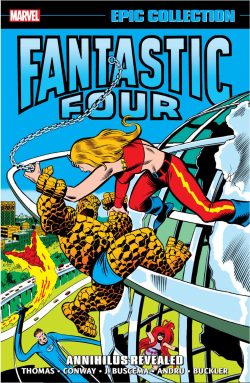
Fantastic Four Epic Collection volume 8: Annihilus Revealed 1974-1974


By Roy Thomas, Gerry Conway, John Buscema, Ross Andru, Ramona Fradon, Rich Buckler, Joe Sinnott, Frank Giacoia & various (MARVEL)
ISBN 978-1-3029-3359-3 (TPB/Digital edition)

Win’s Christmas Gift Recommendation: Fantastic Festive Fun… 8/10

Cautiously bi-monthly and cover-dated November 1961, Fantastic Four #1 (by Stan Lee, Jack Kirby, George Klein & Christopher Rule) was raw and crude even by the ailing company’s standards: but it seethed with rough, passionate and uncontrolled excitement. Thrill-hungry kids pounced on its dynamic storytelling and caught a wave of change starting to build in America. It and succeeding issues changed comics forever.

As seen in the groundbreaking premier issue, maverick scientist Reed Richards, his fiancée Sue Storm, their close friend Ben Grimm and Sue’s bratty teenaged brother survived an ill-starred private space-shot after Cosmic Rays penetrated their ship’s inadequate shielding.

All permanently mutated: Richards’ body became elastic, Sue became (even more) invisible, and Johnny Storm burst into living flame whilst tragic Ben shockingly devolved into a shambling, rocky freak. After the initial revulsion and trauma passed, they solemnly agreed to use their abilities to benefit mankind. Thus was born The Fantastic Four.

Throughout the 1960s it was indisputably the key title and most consistently groundbreaking series of Marvel’s ever-unfolding web of cosmic creation: a forge for new concepts and characters. Kirby was in his creative prime: continually unleashing his vast imagination on plot after spectacular plot, whilst Lee scripted some of the most passionate superhero sagas ever seen.

Both were on an unstoppable roll, at the height of their powers and full of the confidence only success brings, with The King particularly eager to see how far the genre and the medium could be pushed… which is rather ironic since it was the company’s reticence to give the artist creative freedom which led to Kirby’s jumping ship to National/DC in the first place…

And then, he was gone…

With this collection of “The World’s Greatest Comics Magazine” a new style was confirmed. Without Kirby’s soaring imagination the rollercoaster of mind-bending High Concepts had given way to more traditional tales of characters in conflict, with soap-opera leanings and super-villain-dominated Fights ‘n’ Tights dramas.

This cunning compilation re-presents Fantastic Four #126-146 and Giant-Size Super-Stars #1: collectively covering September 1972 to May 1974, which saw Roy Thomas assume the role of writer/editor. He began by revisiting the classic origin and first clash with The Mole Man from FF #1. Illustrated by John Buscema & Joe Sinnott, ‘The Way it Began!’ was all mere prelude for what was to follow…

The reverie prompts the Thing to invade the sub-surface despot’s realm in search of a cure for the blindness which afflicts his girlfriend Alicia Masters in ‘Where the Sun Dares Not Shine!’ and all too soon the embattled brute is embroiled in a three-way war between Mole Man, KalaEmpress of the Netherworld and immortal dictator Tyrannus. When his comrades go after Ben, they are duped into attacking him in ‘Death in a Dark and Lonely Place!’

Having barely survived the three-way war, the exhausted team return to their Baxter Building HQ just in time for lovesick, heartsore Johnny to leave for the hidden kingdom of Attilan and explosively confront lost love – and Inhuman Princess – Crystal.

Tragically as he leaves, ‘The Frightful Four… Plus One!’ sees the Thing ambushed by The Sandman, Wizard and Trapster, beside their newest and almost uncontrollable ally… super-strong amazon Thundra.

Happily, Crystal’s sister Medusa is there to pitch in as the clash escalates, spreading to ‘Battleground: The Baxter Building!’ wherein infant Franklin Richards begins exhibiting terrifying abilities. Always and literally left holding the baby and fed up with her husband’s neglect, Susan finally leaves Reed, whilst in the Himalayas, Johnny has forced his way to Crystal’s side only to find his worst nightmares realised…

Fantastic Four #131 describes a ‘Revolt in Paradise!’ (illustrated by Ross Andru & Sinnott) as Crystal, her new fiancé Quicksilver, and the rest of the Inhumans are attacked by their genetically-bred and programmed slave-race the Alpha Primitives. At first it seems that insane usurper Maximus is again responsible for the strife, but a deeper secret lurks behind the deadly danger of ‘Omega! The Ultimate Enemy!’, and only when the rest of the FF arrive does Reed ferret it out…

FF #133 celebrated the holiday season with plenty of fireworks in ‘Thundra at Dawn!’ as the mysterious “Femizon” returns to battle Ben once more, courtesy of incoming scripter Gerry Conway, guest penciller Ramona Fradon & Sinnott, after which ‘A Dragon Stalks the Sky!’ in #134 (Conway, Buscema & Sinnott) finds Reed, Johnny, Ben and Medusa fighting forgotten super-rich foe Gregory Gideon and his latest acquisition Dragon Man: a bombastic battle which concludes in a struggle to possess ‘The Eternity Machine’

The secret of that reality-warping device is revealed in a two-part thriller as cosmic entity Shaper of Worlds creates a horrific paranoid pastiche of 1950s America: re-running the conflicts between rebellious youth and doctrinaire, paternalistic authority in ‘Rock Around the Cosmos!’ and the surreal conclusion ‘Rumble on Planet 3’ which also tapped into the then-ongoing struggles of the Civil Rights movement…

In amongst the sub-plots, the never-ending stress had forced Sue Richards away from her husband but their son’s rapidly-growing, undiagnosed cosmic powers and problems were pulling them reluctantly back together…

Mr. Fantastic was not taking the separation well and #138 finds him left in an increasingly depressive state when old comrade Wyatt Wingfoot comes looking for assistance against impossible, unimaginable disasters. ‘Madness is… The Miracle Man!’ began a period when rocky everyman Ben Grimm became de facto star of the Fantastic Four and here he, the Torch and Medusa travel to Wingfoot’s tribal lands in Oklahoma to battle a cheesy hypnotist first encountered in their third adventure…

Now, however, thanks to the charlatan’s subsequent studies under mystic Cheemuzwa medicine men, the maniac actually can reshape reality with a thought…

The battle concluded in ‘Target: Tomorrow!’ with the villain able to control matter but not himself spiralling frantically out of control, with our heroes struggling indomitably on until the Miracle Man makes a fatal, world-threatening error…

Reed’s travails take a darker turn in Fantastic Four # 140 as ‘Annihilus Revealed!’ finds the insectoid tyrant king of dying antimatter universe the Negative Zone kidnapping the ever-more powerful Franklin as a prelude to invading the Baxter Building in search of new worlds to ravage.

In triumph, the bug horror discloses his incredible origin to the helpless Wingfoot before dragging all his enemies back to his subspace hell to engineer ‘The End of the Fantastic Four!’ However, even though the beaten heroes counterattack and gain an unlikely victory, Annihilus’ prior tampering with Franklin triggers a cosmic catastrophe. As his limitless power spikes out of control, his tormented father is compelled to blast the boy, shutting down his mutant brain …and everything else.

Appalled at the callous cold calculations needed to put his own son into a coma, Johnny and Ben join Sue in deserting the grief-stricken Mr. Fantastic and declaring their heroic partnership defunct.

With only ruthlessly pragmatic Medusa remaining, FF #142 sees shell-shocked Richards with ‘No Friend Beside Him!’ (as Conway and inker Sinnott were joined by new artist Rich Buckler, whose faithful pastiche of Jack Kirby produced a wave of favourable nostalgia in fans then and now) whilst the Thing follows long-time girlfriend Alicia Masters to central Europe.

She has been lured to the Balkans with promises of a medical breakthrough that can cure her blindness, but once Ben arrives, they are promptly attacked by a sinister supernatural horror named Darkoth the Death-Demon

Back in the USA, Johnny and Wyatt Wingfoot head for Metro College to see their old sports coach Sam Thorne on his way to an Alumni reunion. Reed is another attendee, despondently dragged there by Medusa, but nobody expects that weird foreign kid who had been expelled so long ago to turn up, leading to ‘The Terrible Triumph of Doctor Doom!’ (inked by Frank Giacoia)…

The Iron Dictator was never one to forgive a slight, real or imagined, and as he gloatingly reveals himself to be the creator of Darkoth and jailer of the Thing, Victor von Doom further boasts to his captives of his latest scheme… to utterly eradicate human free will.

Typically, though, the tyrant hasn’t considered how his death-demon might react to the news that he is sham. Outraged the puppet rebels and the monster’s ‘Attack!’ (#144 by Buckler & Sinnott) results in a cataclysmic clash and Doom’s defeat…

Back together but still disunited, the FF part company again in #145, with Johnny accompanying Medusa to the Himalayan citadel of Attilan – hidden city of the Inhumans – only to be brought down by a lost race of ice people and forced to endure a ‘Nightmare in the Snow!’ (illustrated by Andru & Sinnott). Here, snow troglodytes’ plans to make Earth into an ice-ball only they can inhabit go bizarrely awry as the Thing joins the frozen heroes. When a dissident faction trained by a Buddhist monk also pitch in, the conclusion is a happy ending all round in ‘Doomsday: 200 Below!’

This was period of great experimentation and expansion at Marvel, with new formats and lines launching seemingly continuously. Giant-Size Super-Stars #1 (May 1974) was a forerunner in a line of supplementary, double-length titles starring the company’s most popular stars.

In this initial exploratory outing – the title became Giant-Size Fantastic Four with the second quarterly release – Conway, Buckler & Sinnott crafted ‘The Mind of the Monster!’: a shattering reprise of earlier titanic team-up triumphs beginning when Bruce Banner came calling upon the FF, still seeking a cure for his mean green alter ego. Unfortunately, the Thing is overly sympathetic, and in his self-loathing foolishly allows the fugitive physicist to modify one of Reed’s devices…

Unfortunately, meddling with the Psi-Amplifier switches their minds, leaving the Rampaging Hulk trapped and furiously running amok in the Thing’s body whilst Ben/Hulk struggles to stop him.

The situation plummets into more chaos when trans-dimensional Femizon Thundra pitches in, mistakenly believing she is helping her intended main squeeze Ben battle a big green monster, with violence intensifying to the max when Reed, Johnny and Medusa get involved in second chapter ‘Someone’s Been Sleeping in My Head’

Ultimately it takes everybody and a cunning plan to set the world to rights in the spectacular, full-throated conclusion ‘…And in This Corner: The Incredible Hulk!’

Following a bunch of editorial extras from the special, a few last treats complement the covers throughout (by Buscema, Gil Kane, Giacoia, Buckler, Jim Steranko and John Romita). These include a selection of contemporary house ads, the cover of all-reprint Fantastic Four Annual #10 and extracts from F.O.O.M. #1 (Spring 1973): the Steranko cover, intro article ‘Once Upon a FOOM!’, contemporary bios of the Marvel Bullpen, a reproduction of the cover to FF#1 plus attendant article ‘When Titans Clash!’; a checklist of FF issues; a pin-up of FF #73; a Doctor Doom game, Thomas, Len Brown, Gil Kane & Wally Wood’s Fantastic Fear pastiche from Not Brand Echh; Kirby’s Doctor Doom cover from F.O.O.M. #4; ‘Quotations from Chairman Doom’; Charley Parker’s ‘Dr Foom’, and board game ‘Heavy Conflict!’

Also recovered are Buckler & Sinnott’s Thing cover from F.O.O.M. #5, more ‘Marvel Bullpen Profiles’, ‘Marvel’s Greatest Hero: The Thing’ plus uncorrected cover art for FF #130 & 131 and original art pages by Buscema, Buckler & Sinnott.

Although Kirby had taken the unmatched imagination and questing sense of wonder with him on his departure, the sheer range of beloved characters and concepts he had created with Stan Lee carried the series for years afterwards. So once writers who shared the originators’ sensibilities were crafting the stories a mini-renaissance began…

This period offers fans a tantalising taste of the glory days and these solid, honest and intriguing efforts will be welcomed by dedicated superhero fans and continuity freaks alike. They will also thrill and enthral the casual browser looking for an undemanding slice of graphic narrative excitement, so what’s stopping you?
© 2022 MARVEL.

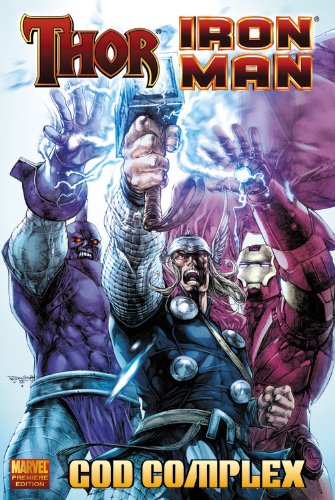
Doctor Doom: The Book of Doom Omnibus


By Stan Lee & Jack Kirby, Steve Ditko, Larry Lieber, Roy Thomas, Gerry Conway, Denny O’Neil, Chris Claremont, David Michelinie, John Byrne, Jim Shooter, Roger Stern, Walter Simonson, Mark Waid, Dwayne McDuffie& Ed Brubaker, Bob Layton, Tom DeFalco, Christopher Priest, Wally Wood, Gene Colan, Mike Sekowsky, Keith Giffen, Bob Hall, Frank Miller, Dave Cockrum, John Romita Jr., Mike Zeck, Mike Mignola, Mike Wieringo, Casey Jones & Pablo Raimondi, Frank Giacoia, George Tuska, John Buscema, Arthur Adams & Paolo Rivera, & many & various (Marvel)
ISBN: 978-1-3029-3420-0 (HB/Digital edition)

Win’s Christmas Gift Recommendation: One of Marvel’s Mightiest… 10/10

As a rule I’ve traditionally steered clear of reviewing the assorted Omnibus editions out there. For the longest time we felt that they were a bit elitist: phenomenally expensive and frequently only available in physical formats. The print version of this hardback book is 1336 pages and weighs 3.5 kilos – over 7½ pounds! – so if you’re old, infirm or have simply never developed any muscles because you’ve frittered away your life READING COMICS, that’s a big downside…

That’s all starting to change now, so here’s a review of the digital version – which is only as unwieldy as your preferred electronic reader of choice and cost me far less because of a discount sale…

Once upon a time, you hadn’t really made it as a Marvel superhero – or villain – until you’d clashed with Doctor Doom. Victor Von Doom is a troubled genius who escaped the oppression heaped on his Romani people via an ultimately catastrophic scholarship to America. Whilst there he succumbed to an intense rivalry with young Reed Richards, even then perhaps the most brilliant man alive.

The arrogant student performed unsanctioned experiments which went wrong and marred his perfect features, leading him down a path of super-science and sinister sorcery and fuelled his overwhelming hunger for ultimate power and total control. From the ashes of his failure, Von Doom rebuilt his life, returned to seize control of his Balkan homeland and become a danger to the world and the multiverse.

This truly king-sized and epically imperious compendium was released to celebrate the 60th anniversary of the Lord of Latveria, who debuted in Fantastic Four #5 April 1962. It gathers many of his greatest battles and other landmark moments of triumph and tragedy, and opens with a contextualising Introduction from Ralph Macchio before reprising the contents of Fantastic Four #5, 6, 39-40, 246-247, 258-260, 350, 352, 500; Amazing Spider-Man #5 & Annual #20; Marvel Super-Heroes #20; Giant-Size Super-Villain Team-Up #1-2 & Super-Villain Team-Up #13-14: Champions #16; Uncanny X-Men #145-147; Iron Man #149-150; Marvel Super-Heroes Secret Wars #10-12; Marvel Graphic Novel Emperor Doom; Marvel Graphic Novel Doctor Strange and Doctor Doom: Triumph and Torment; Fantastic Four (volume 2) #67-70; Fantastic Four Special (2005) #1 and Books of Doom #1-6, as well as material from Fantastic Four #236, 358 & Annual 2; Astonishing Tales #1-3, 6-8 and Marvel Double-Shot #2 collectively spanning July 1962-June 2006.

The drama begins as it must with that debut in Fantastic Four #5. At that time, aliens and especially monsters played a major part in earlier Marvel’s output. However, after a tentative start, Stan Lee & Jack Kirby’s recreation of super-heroes embraced the unique basics of the idiom: taking a full bite out of the Fights ‘n’ Tights apple by introducing the first full-blown, unrepentant super-villain to their budding Marvel Universe.

Admittedly the Mole Man had appeared in #1, but that tragic little gargoyle, for all his plans of world conquest, wouldn’t truly acquire the persona of a costumed foe until his more refined second appearance in FF #22.

‘Prisoners of Doctor Doom’ (inked by the sublimely slick and perfectly polished Joe Sinnott) had it all. An attack by a mysterious enemy from Mr. Fantastic’s past; super-science, magic, lost treasure, time-travel, even pirates. Ha-Haar, me ‘earties!

The tale is sheer comics magic and the creators knew they were on to a winner, as the deadly Doctor returned in the very next issue, teaming with the recently revived and recalcitrantly reluctant Sub-Mariner to attack our heroes as ‘The Deadly Duo!’ in the first Super-Villain Team-Up of the Marvel Age…

Prince Namor, the Sub-Mariner was the second super-star of the Timely Age of Comics – but only because he followed the cover-featured Human Torch in the running order of Marvel Mystery Comics #1 in 1939. He has had, however, the most impressive longevity of the company’s original “Big Three” – Torch, Subby and Captain America. The Marine Marvel was revived in 1962 in Fantastic Four #4; once again a conflicted noble villain, prominent in the company’s pantheon ever since.

Inked by Dick Ayers, FF #6 also introduced the concept of antiheroes as Namor was promptly betrayed by Doom and ended up saving the heroes from death in space: creating a truly complex dynamic with his fellow rogue monarch and the FF. The Master of Latveria’s inevitably betrayal colours the relationship of both kingly characters to this day…

Doom was frequent threat to the Fantastic Four, and was the first foe to break another unspoken rule by going after other heroes in the cohesive shared universe Lee & Kirby were building.

Cover dated October 1963, Amazing Spider-Man #5 found the webspinner ‘Marked for Destruction by Dr. Doom!’ – not so much winning as surviving his battle against the deadliest man on Earth. In this titanic comedy of errors the villain again sought super-powered pawns for his war against humanity, but seriously underestimated his juvenile opponent…

The one-dimensional evil genius was recast as a tragic figure forever shackled by his flaws thanks to the primary contents of Fantastic Four Annual #2 (September 1964) where Chic Stone inked ‘The Fantastic Origin of Doctor Doom!’

A short (12 page) scene-setter, it momentously detailed how brilliant “gypsy” youth Victor Von Doom remade himself into the most dangerous man in creation: ruthlessly overcoming obstacles such as ethnic oppression, crushing poverty and the shocking stigma of being the son of a sorceress. That past informed the present as the ultimate villain again attacks old friend Reed Richards and is left falsely believing he has achieved ‘The Final Victory of Dr. Doom!’ through guile, subterfuge and mind-control, but he has in fact suffered his most ignominious defeat. This clash also introduced a long-running plot thread connecting the Monstrous Monarch to time-travelling tyrant Rama Tut/Kang the Conqueror

Jumping forward to the summer of 1965 FF #39 (cover-dated June, with Frank Giacoia – as Frank Ray – inking) saw the team stripped of their powers and targeted by an enraged Doctor Doom in ‘A Blind Man Shall Lead Them!’ wherein sightless vigilante Daredevil stepped up and provided their only hope of staying alive.

The tale concluded in #40’s ‘The Battle of the Baxter Building’ with Vince Colletta inking a bombastic battle revealing the undeniable power, overwhelming pathos and indomitable heroism of the brutish Thing as – cruelly restored to his monstrous mutated form – he hands Doom the most humiliating defeat of his life…

Experimental try-out title Marvel Super-Heroes #20 (May 1969) awarded the villain his first full-length solo shot in ‘This Man… This Demon!’ Written by Larry Lieber & Roy Thomas, and illustrated by Lieber, Giacoia & Colletta, it restated Doom’s origins and revealed a youthful dalliance with an innocent Romani maid named Valeria. In the now, that failed relationship was exploited by demon alchemist Diablo who claimed to need an ally and partner but truly sought a slave. Doom dealt with the charlatan in typically effective style…

The metal-shod maniac profited from Marvel’s first big expansion and won his own solo-series (Astonishing Tales #1-8). It began with ‘Unto You is Born… the Doomsman!’ (July-August 1970) wherein Thomas & Wally Wood depicted the master manipulator’s daily struggle to maintain iron control over the Ruritanian kingdom of Latveria: building a super-robot to crush an incipient rebellion led by ousted Crown Prince Rudolfo and his mysterious sponsor.

However, the use of Victor von Doom’s lost love had the desired effect and the rebels almost succeeded in driving the tyrant from Doom Castle. In the attendant chaos the Doomsman device wandered away…

AT #2 declared ‘Revolution!’, proving Doom was not the only master of mechanoids as Rudolfo and the enigmatic Faceless One used the lost Doomsman to wreak havoc throughout Latveria, before the final assault in ‘Doom Must Die!’ (scripted by Lieber) saw all the tyrant’s enemies vanquished and the Monarch of Menace once more firmly in control…

Astonishing Tales #6 (June 1971, by Lieber, George Tuska & Mike Esposito) saw the Lord of Latveria invade African nation Wakanda in ‘The Tentacles of the Tyrant!’, resolved to seize its Vibranium, only to fall to the furious tenacity of its king and defender T’Challa the Black Panther in ‘…And If I be Called Traitor!’ (Gerry Conway, Gene Colan & Frank Giacoia).

A major plot and character strand was added for his final solo story in AT #8 (October 1971). ‘…Though Some Call it Magic!’ is a minor landmark entitled wherein Conway, Colan & Tom Palmer revealed the Devil Doctor’s darkest secret. On one night every year the ultimate villain duelled the rulers of Hell in the vain hope of liberating his mother’s soul. She had been a sorceress, and now burned in the inferno for the unholy powers she used in life, powers which her son also possesses.

Victor battled to free her from eternal torment and always failed: a tragic trial which punished both the living and the dead…

With this tormented tale even more depth and drama were added to the greatest villain in the Marvel universe. His residency ended without warning; Doom resumed his status as the MU’s premier antagonist until Giant-Sized Super-Villain Team-Up #1 (cover-dated March 1975): again bathing the Iron Dictator in a starring spotlight beside aggrieved acquaintance The Sub-Mariner. The special and its sequel led to significant series Super-Villain Team-Up and major crossovers in The Avengers and The Champions.

Giant-Sized Super-Villain Team-Up #1 detailed how Doom and Namor grudgingly reunited, in a framing sequence by Thomas, John Buscema & Sinnott interlaced with reprints of previous meetings.

In the intervening years since FF #6, Sub-Mariner had won and lost his own series, despite some very radical and attention-grabbing stunts. At the close, surface dwellers dumped nerve-gas into the sea, accidently but catastrophically altering Namor’s hybrid body, forcing him to wear a hydrating-suit to breathe. The same toxin had plunged the entire nation of Atlantis into a perpetual coma…

Here, in ‘Encounter at Land’s End!’, Prince Namor – alone and pushed to the brink of desperation – rescues Doom from a deadly plunge to Earth after the Iron Dictator’s latest defeat (at the hands of the FF and Silver Surfer) in an impressive and effective framing sequence bracketing two classic reprint tales (the aforementioned ‘This Man… This Demon!’ and ‘In the Darkness Dwells Doom!’ from Sub-Mariner #20 – and not included in this already too-heavy tome).

Sub-Mariner is in dire need of scientific wizardry to cure his sleeping kin and prepared to offer an alliance against mankind to get it. Initially refused and rebuked by Doom, Namor refuses to back down…

Following Thomas’ editorial ‘The Road to Land’s End’, Giant-Sized Super-Villain Team-Up #2 sees Doom reconsider the partnership deal in ‘To Bestride the World!’ (June 1975, by Thomas, Mike Sekowsky & Sam Grainger) after his own vast robot army rebels. The crisis is caused by the tyrant’s long-lost Doomsman droid – in its new guise of Andro – who returns and co-opts the mechanoids for a war against all organic life. As a result of the blistering battle and extensive carnage-wreaking, Namor and Doom triumph together and part as uneasy allies, only to regroup in the pages of Super-Villain Team-Up #1 (beginning August 1975) in a chaotic ongoing series…

SVTU #13 (August 1977) ended the sleeping Atlantis storyline as Doom finally fulfilled his oath, and resurrected the comatose mer-people, but only after a blistering sub-sea battle between Namor, amphibian arch-nemesis Krang and a Brobdingnagian sea beast in ‘When Walks the Warlord!’ courtesy of Bill Mantlo, Keith Giffen & Don Perlin).

With Atlantis and Namor restored, a new era began in Super-Villain Team-Up #14 (October 1977). ‘A World for the Winning!’, by Mantlo, Bob Hall, Perlin & Duffy Vohland found mutant villain Magneto tricked into a duel with Doom who was at that moment de facto master of the world after since seeding the planet’s atmosphere with mind-control gas. Ever the sportsman, the Lord of Latveria released Magneto from mental control, allowing him to liberate one other thrall and challenging them both to save the world from his ultimate dominance…

It was SVTU’s last issue and the story concluded in The Champions #16 (November 1977) as the Master of Magnetism and The Beast overcame all odds to save the day in ‘A World Lost!’ (Mantlo, Hall & Mike Esposito).

Despite appearing seemingly everywhere we pick up Doom three years later as Amazing Spider-Man Annual #14 (1980) sees Frank Miller & Tom Palmer perfectly recapture the moody mastery of Steve Ditko’s peak periods. That year’s summer offering was a frantic magical mystery masterpiece scripted by Denny O’Neil wherein Doctor Doom and extra-dimensional dark god Dread Dormammu attempt to unmake Reality by invoking the Arcane Armageddon of “The Bend Sinister”.

‘The Book of the Vishanti’ reveals how an unsuspecting dupe captures Doctor Strange for the malevolent allies, almost unleashing cosmic hell with only the wondrous wallcrawler left to literally save the world: a thrilling confection of magic and mayhem that deeply references and reverences the glory days of Ditko, by channelling the legendary first team-up of webspinner and wizard from Spidey’s second annual.

Gathering Uncanny X-Men #145-147 – spanning May to July 1981 – Chris Claremont, Dave Cockrum & Joe Rubinstein oversaw an extended clash of cultures with ‘Kidnapped!’ finding the mutant outcasts targeted by Doom. The assault was triggered through the machinations of deranged assassin Arcade, with half of the team – Storm, Colossus, Angel, Wolverine and Nightcrawler – invading the Diabolical Dictator’s castle whilst a substitute-squad consisting of Iceman, Polaris, Banshee and Havoc despatched to the latter maniac’s mechanised ‘Murderworld!’ to rescue innocent family and friends kidnapped as a preliminary to the plot…

Sadly, in the interim Doom triumphs over the invaders to his castle, but his act of entrapping claustrophobe Ororo backfires, triggering a ‘Rogue Storm!’ that threatens to erase the USA from the globe…

August and September 1981 heralded Iron Man #149-150, wherein David Michelinie, John Romita Jr. & Bob Layton crafted a time-travelling clash with Marvel’s deadliest villain. In ‘Doomquest!’ and ‘Knightmare’ the Armoured Avenger and Demon Doctor are trapped in the days of King Arthur and must unite to rebuild themselves and their tech as well as defeat evil Morgana Le Fey before they can return to their home time!

After achieving superstar status on The X-Men, writer/artist John Byrne moved on to carve out a one-man renaissance of the Fantastic Four, beginning with #232. He achieved his dream of relatively complete autonomy when assigned all the creative chores on Marvel’s flagship book and hit an early peak in #236’s ‘Terror in a Tiny Town’ (cover-dated November 1981).

His fifth issue was a 40-page epic crafted to celebrate the 20th anniversary of the team: reprising the classic origin and crafting a classic confrontation with both Doctor Doom and Puppet Master. It remains one of the very best non-Kirby tales of the entire canon.

The Lord of Latveria returned in a thematic sequel in Fantastic Four #246 & 247 (cover-dated September & October 1982) as ‘Too Many Dooms’ saw the Iron Tyrant escape incarceration to launch a retaliatory strike against all his enemies and reclaim his shattered but free kingdom in concluding chapter ‘This Land is Mine!’

Another extended Doom saga appeared in FF #258-260 (September – November 1983) beginning with ‘Interlude’ as the newly reinstalled ruler schools and programs his appointed heir Kristoff in statecraft and dominance whilst preparing his next strike against his American enemies. Recruiting cosmic marauder Terrax the Tamer, he launches that attack in ‘Choices’, only to apparently perish when the Silver Surfer joins the escalating battle ‘When Titans Clash!’

Regarded as dead and replaced by Kristoff as a legacy tyrant, Victor Von Doom became the star of Marvel Super Heroes Secret Wars: kickstarting the seemingly insatiable modern passion for vast, braided mega-crossover publishing events, which came about because of an impending action figures licensing deal with toy monolith Mattel.

Marvel Editor-in-Chief Jim Shooter, a great advocate of tales accessible to new, younger readers as well as the dedicated fan-base, apparently concocted the rather simplistic but engaging saga starring the House of Ideas’ top characters: building his tale around a torrent of unsolicited, inspirational mail from readers, all begging for one huge dust-up between all the heroes and villains…

The 12-issue Limited Series launched with a May 1984 cover-date and closed (April 1985) with a double-sized blockbusting battle that left many characters changed forever – or at least as “Forever” as comics get…

The premise was that all-powerful force The Beyonder abducted many Earth heroes and villains – and Galactus – in a quest to understand the emotion of desire. The enigmatic, almighty entity dumped the abducted on a purpose-built Battleworld created from and populated with fragments of other planets as a vast arena in which to prove which was better: “self-gratification or sacrifice”…

As crafted by Shooter, Mike Zeck & John Beatty, it saw Avengers, X-Men, FF, the Hulk, Spider-Man, Doom, Molecule Man, Ultron, Dr. Octopus, the Lizard, Enchantress, Absorbing Man, Kang the Conqueror, Wrecking Crew and Galactus teleported into the deep unknown…

After Doom fails to convince his fellow villains of the underlying threat, he tries to join the heroes before in exasperation, taking charge for himself…

Represented here by Secret Wars #10-12 (February-April 1985), ‘Death to the Beyonder!’ sees Doom makes his move, using a hastily constructed device to absorb all the omnipotent instigator’s power, using the stolen energies to rebuild himself and declare the Secret War over with Doom the sole victor…

In ‘…And Dust to Dust!’, he exults in the joys of becoming omnipotent, but the troubled new god finds it hard to hang on to lust for conquest, or even personal ambition after achieving all-consuming divinity, and his benign acts and vapid indolence betray a certain lack of drive and ambition…

With heroes and villains nervously awaiting the new supreme one’s next move, events take a subtly disturbing turn as a strange energy wisp begins to possess a succession of heroes, making its way ever closer to the Doom Deity…

The other heroes remain deep in conference, debating their response to the self-proclaimed but apparently benevolent saviour of the universe. At the moment they finally decide to oppose him they are all vaporised by a bolt of energy…

Of course it doesn’t end there as the resurgent Beyonder battles through heroic and villainous proxies to reclaim his purloined power and put everything to rights – sort of – in blockbusting finale ‘…Nothing to Fear!…’

Returned to mortal life, he appears here next as Emperor Doom (1987): an all-original graphic novel conceived by Mark Gruenwald, Michelinie and Shooter, scripted by Michelinie and illustrated by Bob Hall with additional inking by Keith Williams.

The plot itself is delightfully sly and simple: for once eschewing rash attacks against assembled superheroes, deadly dictator Doom has devised a scheme to dominate humanity through subtler means. Inviting Sub-Mariner to act as his agent, the master villain uses the sub-sea anti-hero to neutralise mechanical heroes and rivals prior to using a pheromone-based bio-weapon to make all organic beings utterly compliant to his will. Naturally, Doom then betrays his aquatic ally…

Meanwhile, energy being Wonder Man is undergoing a month-long isolation experiment to determine the nature of his abilities. When he exits the chamber, he discovers the entire planet has willingly, joyously accepted Doom as their natural and beloved ruler. Alone and desperate, the last Avenger must devise a method of saving the world from its contented subjugation…

Of course there’s another side to this story. Doom, ultimately utterly successful, has turned the planet into an orderly, antiseptic paradise: no war, no want, no sickness and no conflict, just happy productive citizens doing what they’re told. In this totalitarian triumph, all trains run on time and nobody is discontented. All Doom has to do is accept heartfelt cheers and do the daily paperwork.

Sadly, with the entire world an idealised clone of Switzerland, the Iron Despot is bored out of his mind…

So it’s with mixed emotion that Doom realises Wonder Man and a select band of newly liberated Avengers are coming for him, determined to free the world or die…

Tense and compelling this intriguingly low-key tale abandoned traditional all-out action for a far more reasoned and sinisterly realistic solution – disappointing and baffling a large number of fans at the time – but the clever premise and solution, understated illustration and wickedly tongue-in-cheek attitude remove this yarn from the ordinary Fights ‘n’ Tights milieu and elevate it to one of the most chillingly mature Avengers epics ever produced.

It’s followed by another OGN: Triumph and Torment by Roger Stern, Michael Mignola & Mark Badger.

This occult odd couple concoction is one of the very best Marvel Universe yarns; a powerful tale contrasting the origins of the two doctors to produce effective motivations for and deeper insights into both characters.

Stephen Strange was America’s greatest surgeon, a vain and arrogant man who cared nothing for the sick, except as a means to wealth and glory. When a drunken car-crash ended his career, Strange hit the skids until an overheard barroom tall tale led him to Tibet, an ancient magician, and eventual enlightenment through daily redemption. He battles otherworldly evil as Sorcerer Supreme and Master of the Mystic arts.

When a magical call goes out to all the World’s adepts, offering a granted wish to the victor in a contest of sorcery, both Doom and Strange are among those gathered. After mystic combat reduces the assemblage to the two doctors, Doom’s granted wish is to rescue his mother’s soul from Hell…

A classic quest saga, Triumph & Torment saw the twinned mages storming the Underworld in a mission of vain hope and warped mercy, battling the hordes of Mephisto and their own natures in a mesmerizing epic of power and pathos.

Stern was at his absolute writing peak here and the unlikely art team of Mignola and Badger defy any superlatives I could use. The art is simply magical, especially the mesmerising colouring, also courtesy of Mr Badger. It’s augmented here by Macchio’s Afterword to the original release.

Writer/artist Walt Simonson and inker Allen Milgrom then end years of confusion in ‘The More Things Change…! (Or… It’s the Real Thing…’ (Fantastic Four #350, cover-dated March 1991) as Doom, Kristoff and countless rogue Doombots all battle to decide who’s the real deal: a conflict mirrored by two overlapping iterations of the FF also deciding – far less lethally – who will stay in the official line up. With treachery and betrayal everywhere, the tale concludes in Fantastic Four #352 (May 1991) as ‘No Time Like the Present! (Or… It Ain’t Funny How Time Slips Away!’ sees both clashes coincide as time itself is sundered and the bureaucratic myrmidons of the Time Variance Authority step in…

Some crucial clarity into all that chaos comes in Fantastic Four #358 (November 1991) as Tom DeFalco & Arthur Adams provide ‘The Official Story’ (A Tale of Doom!)’ to reset reality and usher in a less confused cosmos…

A beautifully painted vignette from Marvel Double Shot #2 (February 2003 by Christopher Priest & Paolo Rivera), ‘Masks’ is a character piece revealing how a psychological assassin almost ends the tyranny of Doom before Fantastic Four (volume 3) #67-70 & (volume 1) #500 – cumulatively spanning May-September 2003 – sees the villain reinvent himself and almost win his eternal war against Reed Richards. This saga concluded the FF’s third volume before the series reverted to its original numbering with #500: capping a spectacular run by writer Mark Waid and illustrator Mike Wieringo, gloriously celebrating their “back-to-basics” approach which utterly rejuvenated the venerable property in 2003.

Key to that revival was a reassessment and reappraisal of their greatest foe as seen in ‘Under her Skin’ (#67, inked by Karl Kesel) wherein Doom abandons his technological gifts and inclinations, rejecting them for overwhelming sorcerous might to humiliate and destroy his greatest rival. All he must do is sacrifice his greatest love and only hope of redemption…

This terrifying glimpse into Doom’s past and shocking character study in obsession was but prologue to 4-part epic Unthinkable’ which opened one month later. Waid’s greatest gift is his ability to embed hilarious moments of comedy into tales of shattering terror and poignant drama, and it’s never better displayed than here when Marvel’s First Family suddenly find their daily antics and explorations ripped from them.

The method is straightforward enough: Doom attacks them through their children, using baby Valeria as a medium for eldritch exploitation and sending firstborn Franklin Richards to Hell as part payment to the demons to whom the debased doctor has sold the last dregs of his soul…

A supreme technologist, Richards had never truly accepted the concept of magic, but with Mystic Master Stephen Strange oddly unwilling to help, the reeling and powerless Mr. Fantastic nonetheless leads his team to Latveria for a showdown, still unable to grasp just how much his arch-foe has changed.

Invading the sovereign – if rogue – nation, the team fight the greatest battle of their lives and lose anyway. The normally quicksilver mind of Richards seems unable to deal with his new reality and the FF are locked away in prisons specifically and sadistically designed to torment them. As a sign of his utter disdain, Doom locks his broken rival in a colossal library of grimoires and mystic manuscripts, knowing the defeated, dogmatic scientist can never make use of what is there. Big mistake…

Before attacking the FF, Doom had ensorcelled Dr. Strange, but greatly underestimated the Sorcerer Supreme. Struggling to free himself, the mage established contact with Richards and began teaching the unbelieving ultra-rationalist the basics of magic…

By the time Doom discovers his danger, Reed has freed his comrades and daughter. In the catastrophic battle which ensues, the Iron Dictator replaces Franklin as the hostage of Hell, but not before, in one final act of malice, maiming Reed with searing mystic retaliation: melting half his face by means neither magic nor medicine can mend…

Although victorious, the Fantastic Four are far from winners. Doom’s assault upon the family has scarred them all, but none more so than Franklin, whose time in Hell left him deeply traumatised and near-catatonic.

Dwayne McDuffie, Casey Jones & Vince Russell then deliver a restrained psycho-drama in ‘My Dinner with Doom’ (Fantastic Four Special, February 2006). Here the rivals intellectually sparr: testing each other’s defences as the Latverian simultaneously seeks to wipe out all his lesser enemies.

The story portion of this book concludes as Ed Brubaker, Pablo Raimondi, Mark Farmer, Drew Hennessy & Robin Riggs revisit, in-fill, expand and apply mature modern nuance to Doom’s origins and life in Books of Doom #1-6 (January-June 2006) detailing again how a hounded boy became a wounded exile who overcame all obstacles – physical, emotional and ethical – to become supreme ruler of Latveria and menace to all mankind…

The comic classics are supplemented by a gallery of covers by Kirby – with Sinnott, Ayers, Wood & Giacoia; Ditko, Lieber, Colletta; Marie Severin, Bill Everett. John Buscema, John Verpoorten, Esposito, John Romita Sr., Herb Trimpe; Ron Wilson, Gil Kane, Giffen, Byrne, Terry Austin, Miller, Cockrum, John Romita Jr., Simonson, Zeck, Hall, Williams, Mignola, Paul Ryan, Joe Jusko, Wieringo, Kesel, Rivera and Leinil Francis Yu with even more to adore.

The graphic grimoire continues with a section of Doom pinups from Fantastic Four Annual #1 (1963, by Kirby), Amazing Spider-Man Annual #1(1964, by Ditko), Marvelmania Poster (1970, by Kirby) and Quotations from Chairman Doom 1984 (F.O.O.M. #4 Winter 1973, by Robert Cosgrove Kirby); Doom’s entry from the Official Handbook of the Marvel Universe Deluxe Edition (1985, by Gruenwald, Peter Sanderson, Byrne & Kirby), spoof ads from Marvel 1989: The Year in Review (by Mignola, Gregory Wright) plus a Marvel Masterwork Pin-up by Ron Frenz & Sinnott from Fantastic Four #358.

Dedicated art lovers can luxuriate in layouts, design sketches and unused art from Wieringo and the covers to The Villainy of Doctor Doom TPB (1999 by Kirby, Klaus Janson & Marie Javins) – plus Tom Brevoort’s Introduction to that tome – and earlier Doom depictions revisited in this big book.

These include covers to Marvel Masterworks Fantastic Four vol. 4 (Kirby & Dean White) and Fantastic Four Annual #7 (1969, Kirby & Sinnott); Spider-Man Classics #6 (Frenz & Austin, September 1993); Spider-Man Collectible Series #11 (Frenz & Milgrom, October 2006); X-Men Classic #49 & 51 (Steve Lightle, July & September 1990); Iron Man vs. Doctor Doom (Julie Bell, 1994); Greatest Villains of the Fantastic Four TPB (Vince Evans 1995), variant covers to Emperor Doom and Triumph and Torment, Fantastic Four #500 Directors Cut (2003 by Wieringo, Kesel & Richard Isanove.

Sheer comic enchantment, this a book no lover of the fantastic fiction can afford to ignore -just as long as they eat plenty of Spinach…
© 2022 MARVEL

Amazing Spider-Man Epic Collection volume 8: Man-Wolf at Midnight 1973-1975


By Gerry Conway Ross Andru, Gil Kane, John Romita, Paul Reinman & various (MARVEL)
ISBN: 978-1-3029-3350-0 (TPB/Digital edition)

Win’s Christmas Gift Recommendation: Astounding Arachnid Amazement… 9/10

Amazing Spider-Man was a comic book that matured with – or perhaps just slightly ahead of – its fan-base. This epic compendium of chronological webspinning wonderment sees the World’s Most Misunderstood Hero facing even greater and evermore complex challenges as he slowly recovers from the trauma of losing his true love and greatest enemy in the same horrific debacle…

Once original co-creator Stan Lee replaced himself with young author Gerry Conway, the scripts acquired a more contemporary tone (which of course often feels quite outdated from here in the 21st century): purportedly more in tune with the times whilst the emphatic use of soap opera subplots kept older readers glued to the series even when the bombastic battle sequences didn’t.

Moreover, as a sign of those times, a hint of cynical surrealism also began creeping in…

Thematically, there’s a decline in old-fashioned gangsterism and a growing dependence on outlandish villains. The long-established balance of costumed super-antagonists with thugs, hoods and mob-bosses was gradually tipping and a global resurgence in supernatural stories resulted in more monsters and uncanny happenings…

Nevertheless, the wallcrawler was still indisputably mainstream comics’ voice of youth and defined being a teen for readers of the 1970s: facing incredible hardships, fantastic foes and the most pedestrian and debilitating of frustrations.

For newcomers – or those just visiting thanks to the latest Spider-Man movies: Smart-but-alienated Peter Parker was bitten by a radioactive spider during a school trip. Discovering strange superhuman abilities which he augmented with his own natural chemistry, physics and engineering genius, the kid did what any lonely, geeky nerd would do with such newfound prowess: he tried to cash in for girls, fame and money.

Making a costume to hide his identity in case he made a fool of himself, Parker became a minor media celebrity – and a criminally vainglorious one. To his eternal regret, when a thief fled past him one night he didn’t lift a finger to stop him, only to find when he returned home that his guardian uncle Ben Parker had been murdered.

Crazed and vengeful, Peter hunted the assailant who’d made his beloved Aunt May a widow and killed the only father he had ever known. He discovered to his horror that it was the self-same felon he had neglected to stop. His irresponsibility had resulted in the death of the man who raised him, and the traumatised boy swore to forevermore use his powers to help others.

Since that night, the Wondrous Wallcrawler tirelessly battled miscreants, monsters and madmen, with a fickle, ungrateful public usually baying for his blood even as he perpetually saves them.

Now the high school nerd has grown up and gone to college. Because of his guilt-fuelled double-life he struggles there too – even developing a stress ulcer – but finds abiding love with cop’s daughter Gwen Stacy… until she is murdered by the Green Goblin. Now Parker must pick up the pieces of his life…

This stunning compilation reprints Amazing Spider-Man #124-142 and Giant-Size Super-Heroes #1: collectively covering cover-dates September 1973 to March 1975, affirming an era of astounding introspective drama and captivating creativity.

As previously stated, at this time horror was on the rise and the trend permeated all aspects of Marvel continuity. In #124, J. Jonah Jameson’s astronaut son John was revealed to have picked up a strange gem during a unofficial moonwalk which later transformed him into a lupine beast bearing ‘The Mark of the Man-Wolf!’ by Conway, Gil Kane & John Romita.

Deranged and deadly, the hairy horror stalks his own fiancée Kristine Saunders as well as his scandal-obsessed, newspaper-publisher father, with a gravely-traumatised, fighting-mad Spider-Man reacting in a far more brutal manner than ever before…

The conclusion marked the official debut of the title’s next star penciller as Ross Andru joined Conway and Romita to delineate the end of the Man-Wolf saga in ‘Wolfhunt!’: offering a particularly grisly cure for the ethereally-altered astronaut…

In #126, a new subplot bloomed as a marketing firm hires the astounded and unbelieving arachnid to build a “Spider-Mobile” (thanks to a budding toy-merchandising deal Marvel was then negotiating) whilst an old and extremely inept enemy returns as ‘The Kangaroo Bounces Back!’ (drawn by Andru and inked by Jim Mooney).

Short of cash and desperate, Spidey ropes in best frenemy Johnny (Human Torch) Storm to help assemble the anticipated automobile, but is totally unprepared for his Australian attacker since bouncing bounder has endured a rapid and ultimately unwelcome power upgrade from a rogue – and extremely deranged – doctor named Jonas Harrow

Meanwhile, in the apartment Peter still shares with Harry Osborn (son of the Green Goblin), his flatmate finally succumbs to the mental illness that has been sucking him down since the death of dear old Dad…

Peter’s frivolous party-loving friend Mary Jane Watson comes under the spotlight in #127 as ‘The Dark Wings of Death!’ – inked by Frank Giacoia & Dave Hunt – finds her targeted by a strangely familiar monster who believes she witnessed his last kill. The mystery concludes in ‘The Vulture Hangs High!’ wherein an incredible truth about the avian atavist is revealed. Moreover, portents of future catastrophe manifest as Parker’s biology tutor Professor Miles Warren warns that the scholarship student’s grades are slipping and his position is far from secure…

Conway, Andru, Giacoia & Hunt crafted a true landmark in comics history in Amazing Spider-Man #129 with ‘The Punisher Strikes Twice!’: introducing not only the renegade gunslinger but also nefarious manic mastermind The Jackal.

Although one of the industry’s biggest hits from the late 1980s onwards, compulsive vengeance-taker Frank Castle was always an unlikely and uncomfortable star for comic books. His methods are always excessively violent and usually permanent. It’s intriguing to note that unlike most heroes who debuted as villains (Black Widow, Hawkeye and Wolverine immediately come to mind) The Punisher actually became more immoral, anti-social and murderous, not less: the buying public simply shifted its communal perspective as the Punisher never toned down or cleaned up his act…

He was created by Conway, Romita Sr. and Andru; an understandably sanitised and muted response to popular prose anti-heroes like Don Pendleton’s Mack Bolan: the Executioner: the cutting edge of a bloody tide of fictive Viet Nam vets who all turned their training and talents to wiping out organised crime in the early 1970s.

In this short, sharp shocker the man with the skull on his chest is duped by his manipulative partner into hunting Spider-Man. Still a suspect in the death of Norman Osborn, the hero is easy to frame for the murder of the Punisher’s personal armourer and gunmaker…

A long-running mystery over Aunt May’s connection to Doctor Otto Octavius is at last addressed in #130 as ‘Betrayed!’ finds up-&-coming gang boss Hammerhead prodded and provoked by the Jackal, just as arch-rival Doctor Octopus resurfaces.

Distracted by his now-completed Spider-Mobile, the webslinger is slow to react …until he finally discovers why May Parker is so important to the villain, but by then she’s in the process of becoming Mrs. Otto Octavius…

Spider-Man is just about to bust up the wedding in ‘My Uncle… My Enemy?’ when Hammerhead beats him to it. As the three-way war escalates, the truth comes out. May has inexplicably inherited a desolate Canadian island which just happens to be teeming with uranium deposit, and its own Fast Breeder Atomic Reactor, which both Ock and Hammerhead want to secure as the means to becoming an independent nuclear power. When the rival rogues furiously clash, it’s all Peter can do to get May out before the entire place becomes an atomic inferno…

Illustrated by John Romita Sr., Paul Reinman & Tony Mortellaro, fresh moody mystery welcomes the weary Spider-Man back to New York after saving Aunt May from becoming a collateral casualty of atomic armageddon as he stumbles into ‘The Master Plan of the Molten Man!’ It begins when old school flame Liz Allen resurfaces needing help. Peter has no idea she is secretly trying to help her criminal stepbrother…

As a super-strong metal-skinned bandit Mark Raxton was only a minor inconvenience to the wallcrawler, but now his chemically induced condition has worsened and he is swiftly turning into an incandescent human fireball. However, by the time ‘The Molten Man Breaks Out!’ in #133 – illustrated by new regular creative team Andru and inkers Giacoia & Hunt – there’s nothing the hero can do but fight until one of them is dead…

Slightly adrift of publishing chronology, next comes a classic monster action yarn from Giant-Size Super-Heroes #1. With the monster boom in full swing, Marvel during this period flooded newsstands with horror-themed heroes and antiheroes and cannily teamed two of the Amazing Arachnid’s eeriest enemies in a double-length epic as ‘Man-Wolf at Midnight!’ – by Conway, Kane & Mike Esposito – finds John Jameson again gripped by murderous moon-madness. This time, however, the tormented former astronaut has been enthralled by Living Vampire Morbius and used to help that bloodsucker secure a possible cure for his own appalling condition in ‘When Strikes the Vampire!’

That dynamic dust-up led directly into a flurry of over-sized Giant-Size Spider-Man editions, but as none of them are included in this volume we return to Amazing Spider-Man #134 (July 1974) wherein the webspinner again crosses paths with The Punisher after a South American bandit – trained to be his oppressive regime’s Captain America before going freelance – attempts to pirate, pillage and ransom a Manhattan tour boat in ‘Danger is a Man Named… Tarantula!’ (Conway, Andru, Giacoia & Hunt).

Once again unwilling allies, the ethically-estranged duo dutifully dismantle the villain’s larcenous schemes leading to a ‘Shoot-Out in Central Park!’ but the real danger is building elsewhere as Parker’s roommate Harry Osborn accepts at last the infamous inheritance of his devilish, recently departed dad…

The compelling, long-brewing clash of former friends kicks off with completely crazy Harry attempting to blow up Peter and Mary Jane in ‘The Green Goblin Lives Again!’…

Privy to his best friend’s secrets, the maniac then targets all Parker’s loved ones, precipitating a desperate, deadly duel as ‘The Green Goblin Strikes!’ resulting in doom, destruction, shocking revelations and another tragedy for Peter to feel forever responsible for…

‘Madness Means… the Mindworm!’ finds a still-reeling Parker evicted from his apartment and relocating downmarket to Queens, just in time to encounter a macabre psychic parasite feeding off the denizens of the district.

Issue #139 then introduces a bludgeoning brute with a grudge against J. Jonah Jameson on the ‘Day of the Grizzly!’ When Spidey intervenes, he is soundly thrashed and handed over to the costumed crazy’s silent partner the Jackal who melodramatically reveals he knows the hero’s true identity…

Even though Peter escapes his diabolical trap in ‘And One Will Fall!’ the major maniac flees and remains at large…

A long-running comedy thread ends as the ridiculous Spider-Mobile ends up in the river, but the wallcrawler barely has time to care as an apparently dead enemy returns in #141’s ‘The Man’s Name Appears to be… Mysterio!’ Despite aggressively escalating psychological assaults and our hero questioning his own sanity, the mystery is smartly resolved in ‘Dead Man’s Bluff!’, wrapping up this transitional period in the life of Peter Parker and setting the scene for another shocking epic, life-changing encounter next time…

These narrative delights are supplemented by Romita’s cover, frontispiece, contents page and back cover from the 1974 debut tabloid edition Marvel Treasury Edition #1: The Spectacular Spider-Man as well as a faux Daily Bugle feature by Conway & Marie Severin; plus House ads; Kane page and cover layouts; the original Punisher design sketch by Romita and original art covers and interior pages by Kane, Romita &Andru.

Also on show are the Romita-rendered entry from Mighty Marvel Calendar for 1975, and a text & photo feature on the first live action Spider-Man film.

Blending cultural veracity with superb art, and making a dramatic virtue of the awkwardness, confusion and imputed powerlessness most of the readership experienced daily always resulted in an irresistibly intoxicating read, especially when delivered in addictive soap-styled instalments, but none of that would be relevant if Spider-Man’s stories weren’t so compellingly entertaining.

This action-packed collection relives many momentous periods in the wallcrawler’s astounding life and is one every Fights ‘n’ Tights fanatic must see…
© 2022 MARVEL.