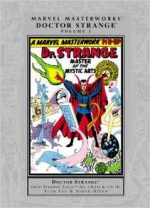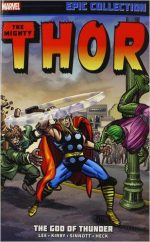
Marvel Masterworks: Doctor Strange volume 1


By Stan Lee, Steve Ditko, Don Rico, George Roussos & various (Marvel)
ISBN: 978-0-7851-4564-6

Win’s Christmas Gift Recommendation: A Little Seasonal Magic… 9/10

When the budding House of Ideas introduced a warrior wizard to their burgeoning pantheon in the summer of 1963 it was a bold and curious move. Bizarre adventures and menacing monsters were still incredibly popular but mention of magic or the supernatural (especially vampires, werewolves and their eldritch ilk) were harshly proscribed by a censorship panel which dictated almost all aspects of story content.

At this time all – almost a decade after a public witch hunt led to Senate hearings – comics were ferociously monitored and adjudicated by the draconian Comics Code Authority. Even though the some of the small company’s strongest sellers were still mystery and monster mags, their underlying themes and premises were almost universally mad science and alien wonders, not necromantic or thaumaturgic horrors.

That might explain Stan Lee’s low key introduction of Steve Ditko’s mystic adventurer: an exotic, twilight troubleshooter inhabiting the shadowy outer fringes of society.

Capitalising on of the runaway success of Fantastic Four, Lee had quickly spun off the youngest, most colourful member of the team into his own series, hoping to recapture the glory of the 1940s when the Human Torch was one of the company’s untouchable “Big Three” superstars.

Within a year of FF #1, anthology title Strange Tales became home for the blazing boy-hero (with issue #101, cover-dated October 1962), launching Johnny Storm on a creatively productive but commercially unsuccessful solo career.

Soon after in Tales of Suspense #41 (May 1963) current sensation Iron Man battled a crazed scientific wizard dubbed Doctor Strange, and with the name successfully and legally in copyrightable print (a long-established Lee technique: Thorr, The Thing, Magneto and the Hulk had been disposable Atlas “furry underpants monsters” long before they became in-continuity Marvel characters) preparations began for a new and truly different kind of hero.

The company had already published a quasi-mystic precursor: balding, trench-coated savant Doctor Droom – later rechristened (or is that re-paganed?) Dr. Druid – had an inconspicuous short run in Amazing Adventures (volume 1 #1-4 & #6: June-November 1961). He was a balding psychiatrist, magician and paranormal investigator who tackled everything from alien invaders to Atlanteans and was subsequently retro-written into Marvel continuity as an alternative candidate for Stephen Strange‘s ultimate role as Sorcerer Supreme…

After a shaky start, the Master of the Mystic Arts became an unmissable icon of the cool counter-culture kids who saw in Ditko’s increasingly psychedelic art, echoes and overtones of their own trippy explorations of other worlds…

That might not have been the authors’ intentions but it certainly helped keep the mage at the forefront of Lee’s efforts to break comics out of the kids-stuff ghetto…

This enchanting full colour paperback compilation – also available as a digital download – collects the mystical portions of Strange Tales #110, 111 and 114-141 and a titanic team-up from Amazing Spider-Man Annual #2; spanning July 1963 to February 1966. Moreover, although the Good Doctor was barely cover-featured until issue #130, it also magnanimously includes every issue’s stunning frontage: thus offering an incredible array of superbly eye-catching Marvel masterpieces from the upstart outfit’s formative heyday by Jack Kirby, Dick Ayers, Bob Powell, John Severin and others.

Following a fond reminiscence and commentary from Dean Mullaney our first meeting with the man of mystery comes courtesy of a quiet little chiller which has never been surpassed for sheer mood and imagination.

‘Doctor Strange Master of Black Magic!’ by Lee & Ditko debuted at the back of Strange Tales #110 and saw a terrified man troubled by his dreams approach an exceptional consultant in his search for a cure…

That perfect 5-page fright-fest introduces whole new realms and features deceit, desperation, double dealing and the introduction of both a mysterious and aged oriental mentor and devilish dream demon Nightmare in an unforgettable yarn that might well be Ditko’s finest moment…

A month later in #111 he was back, ‘Face-to-Face with the Magic of Baron Mordo!’ which introduced a player on the other side…

The esoteric duel with such an obviously formidable foe established Strange as a tragic solitary guardian tasked with defending the world from supernatural terrors and uncanny encroachment whilst introducing his most implacable enemy, a fellow sorcerer with vaulting ambition and absolutely no morals. In the astounding battle that ensued, it was also firmly confirmed that Strange was the smarter man…

Strange Tales #114 (November 1963) was one of the most important issues of the era. Not only did it highlight the return of another Golden Age hero – or at least a villainous facsimile of him by Lee, Jack Kirby & Dick Ayers. Here’s a quote from the last panel. “You guessed it! This story was really a test! To see if you too would like Captain America to Return! As usual, your letters will give us the answer!” We all know how that turned out…

Nevertheless, for many of us the true treasure trove here was the fabulously moody resurrection of Doctor Strange: permanently installing an eccentric and baroque little corner of the growing unified universe where Ditko could let his imagination run wild…

With #114 the Master of the Mystic Arts took up monthly residence behind the Torch as ‘The Return of the Omnipotent Baron Mordo!’ (uncredited inks by George Roussos) found the Doctor lured to London and into a trap, only to be saved by unlikely adept Victoria Bentley: an abortive stab at a romantic interest who would periodically turn up in years to come.

The forbidding man of mystery was at last revealed in all his frail mortality as Strange Tales #115 offered ‘The Origin of Dr. Strange’, disclosing how Stephen Strange was once America’s greatest surgeon. A brilliant man, yet greedy, vain and arrogant, he cared nothing for the sick except as a means to wealth and glory. When a self-inflicted drunken car-crash ended his career, Strange hit the skids.

Then, fallen as low as man ever could, the debased doctor overheard a barroom tale which led him on a delirious odyssey or, perhaps more accurately, pilgrimage to Tibet, where a frail and aged mage changed his life forever. It also showed his first clash with the Ancient One‘s other pupil Mordo: thwarting a seditious scheme and earning the Baron’s undying envious enmity…

Eventual enlightenment through daily redemption transformed Stephen the derelict into a solitary, dedicated watchdog for at the fringes of humanity, challenging all the hidden dangers of the dark on behalf of a world better off not knowing what dangers lurk in the shadows…

‘Return to the Nightmare World!’ saw the insidious dream predator trapping earthly sleepers in perpetual slumber until the doubtful authorities asked Strange to investigate and invade his oneiric enemy’s stronghold after which ‘The Many Traps of Baron Mordo!’ apparently saw the malevolent mage devise an inescapable doom, which once more foundered after Strange applied a little logic to it…

The wildness and infinite variety of Strange’s universe offered Ditko tremendous opportunities to stretch himself visually and as plotter of the stories. In ST #118 the Master of Magic travelled to Bavaria to combat ‘The Possessed!’ and found humans succumbing to extra-dimensional invaders neither fully mystic or mundane, whilst ‘Beyond the Purple Veil’ found him rescuing burglars who had stolen one of his deadly treasures from ray-gun wielding slaver tyrants…

Strange Tales #120 played with the conventions of ghost stories after a reporter vanishes during a live broadcast from ‘The House of Shadows!’ and the concerned Doctor diagnoses something unworldly but certainly not dead…

Mordo sprang yet another deadly trap in ‘Witchcraft in the Wax Museum!’ but was once again outsmarted and humiliated after stealing his rival’s body whilst Strange wandered the world in astral form…

Roussos returned as an uncredited inker for #122’s ‘The World Beyond’ wherein Nightmare nearly scored his greatest victory after an exhausted Strange fell asleep before uttering the nightly charm that protected from him from attack through his own dreams.

Strange hosted his first Marvel guest star #123 whilst meeting ‘The Challenge of Loki!’ (Lee, Ditko & George Roussos as George Bell from August 1964) as the god of Mischief tricked the earthly mage into briefly stealing Thor’s hammer before deducing where the emanations of evil he sensed really came from…

Strange battled a sorcerer from ancient Egypt to save ‘The Lady from Nowhere!’ from time-bending exile and imprisonment, and performed similar service to rescue the Ancient after the aged sage was kidnapped in ‘Mordo Must Not Catch Me!’ after which Roussos/Bell moved on whilst Lee & Ditko geared up for even more esoteric action.

Strange Tales #126 took the Master of the Mystic arts to ‘The Domain of the Dread Dormammu!’ as an extra-dimensional god sought to subjugate Earth. In a fantastic realm Strange met a mysterious and exotic woman who revealed the Dread One operated by his own implacable code: giving the overmatched Earthling the edge in the concluding ‘Duel with of the Dread Dormammu!’ which saw Earth saved, the Ancient One freed of a long-standing curse and Strange given a new look and mystic weapons upgrade…

Restored to his homeworld and Sanctum Sanctorum in Greenwich Village, Strange solved ‘The Dilemma of… the Demon’s Disciple!’ by saving a luckless truth-seeker from an abusive minor magician and – after a stunning pin-up by Ditko – tackled a demonic god of decadence stealing TV guests and execs in #129’s ‘Beware… Tiborro! The Tyrant of the Sixth Dimension!’ (scripted by Golden Age great Don Rico).

Doctor Strange got his first star cover slot in Strange Tales #130 to celebrate the start of an ambitious multi-part saga which would be rightly acclaimed one of the mystic’s finest moments. ‘The Defeat of Dr. Strange’ opens with an enigmatic outer-dimensional sponsor entering into a pact with Baron Mordo to supply infinite power and ethereal minions in return for the death of Earth’s magical guardian…

With the ancient One assaulted and stuck in a deathly coma, Stephen Strange was forced to go on the run: a fugitive hiding in the most exotic corners of the globe as remorseless, irresistible forces closed in all around him…

A claustrophobic close shave whilst trapped aboard a jetliner in ‘The Hunter and the Hunted!’ expands into cosmic high gear in #132 as Strange doubles back to his sanctum and defeats the returning Demon only to come ‘Face-to-Face at Last with Baron Mordo!’ Crumbling into weary defeat as the villain’s godly sponsored is revealed, the hero is hurled headlong out of reality to materialise in ‘A Nameless Land, A Timeless Time!’ and confront tyrannical witch-queen Shazana.

Upon liberating her benighted land the relentless pursuit resumes as Strange re-crosses hostile dimensions to take the fight to his foes in ‘Earth Be My Battleground’. Returning to the enclave hiding his ailing master, he gleans a hint of a solution in the mumbled enigmatic word “Eternity” and begins searching for more information, even as, in the Dark Dimension, a terrified girl attempts to sabotage the Dread Dormammu’s efforts to empower Mordo…

As the world went super-science spy-crazy and Nick Fury Agent of S.H.I.E.L.D. took over the lead spot with Strange Tales #135, the Sixties also saw a blossoming of alternative thought and rebellion. Doctor Strange apparently became a confirmed favourite of the blossoming Counterculture Movement with its recreational drug experimentation subculture. With Ditko truly hitting his imaginative stride, it’s not hard to see why. His weird worlds and demonstrably adjacent dimensions were just unlike anything anyone had ever seen or depicted before…

‘Eternity Beckons!’ when Strange is lured to an ancient castle where an old ally seeks to betray him and, after again narrowly escaping Mordo’s minions, the Mage desperately consults the aged senile Genghis in #136 and makes a grave error in judgement. Once more catapulted into a dimension of deadly danger, Strange barely escapes a soul-stealing horror after discovering ‘What Lurks Beneath the Mask?’

Back on Earth and out of options the Doctor is forced to test his strength against the Ancient One’s formidable psychic defences to learn the secret of Eternity ‘When Meet the Mystic Minds!’ and after barely surviving the terrible trial translates himself to a place beyond reality to meet the embodiment of creation in ‘If Eternity Should Fail!’

The quest for solutions or extra might bears little fruit and as he despondently arrives on Earth he finds The Ancient One and his unnamed female friend prisoners of his worst enemies in anticipation of a fatal showdown…

Strange Tales #139 warns ‘Beware…! Dormammu is Watching!’ but as Mordo, despite being super-charged with the Dark Lord’s infinite energies, fails over and again to kill the Good Doctor the Overlord of Evil loses all patience and drags the whole show into his domain…

Intent on making a show of destroying his mortal nemesis, Dormammu convenes a great gathering in which he will smash Strange in a duel using nothing but ‘The Pincers of Power!’ and is again bathed to ultimate humiliation as the mortal’s wit and determination result in a stunning triumph in the concluding ‘Let There Be Victory!’ As the universes tremble Doctor Strange wearily heads home, blithely unaware that his enemies have laid one last trap…

To Be Continued…

After all that tense suspense there are a few treats still in store, beginning with one last Lee/Ditko yarn to enthral and beguile: Although a little chronologically askew, it is very much a case of the best left until last…

In October 1965 ‘The Wondrous World of Dr. Strange!’ (from Amazing Spider-Man Annual #2) was the astonishing lead feature in an otherwise vintage reprint Spidey volume.

The entrancing fable unforgettably introduced the webslinger to arcane adventure and otherworldly realities as he teamed up with the Master of the Mystic Arts to battle power-crazed wizard Xandu in a phantasmagorical, dimension-hopping masterpiece involving ensorcelled zombie thugs and the purloined Wand of Watoomb.

After this story it was clear that Spider-Man could work in any milieu and nothing could hold him back… and the cross-fertilisation probably introduced many fans to Lee & Ditko’s other breakthrough series.

But wait, there’s more! Wrapping up the proceeding is a selection of original art pages and contemporary T-shirt designs, a cover gallery from the 1970’s reprint revival of “Strange Tales” volume 2 with art from Gil Kane, Ed Hannigan, Dan Adkins, Klaus Janson, Frank Giacoia, Gene Colan & Tom Palmer, all nicely rounded off by a re-presentation of this collection’s previous Ditko/Dean White cover and informative ‘Biographies’ of the creative stars featured herein…

Doctor Strange has always been the coolest of outsiders and most accessible fringe star of the Marvel firmament. This glorious grimoire is a magical method for old fans to enjoy his world once more and the perfect introduction for recent acolytes or converts created by the movie iteration.
© 2016 Marvel Characters, Inc. All rights reserved.
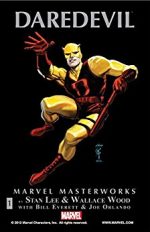
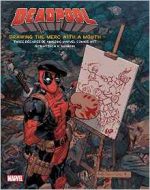
Deadpool: Drawing the Merc with a Mouth – Three Decades of Amazing Marvel Comics Art


Written by Matthew K. Manning, art by many and various (Titan Books)
ISBN: 978-1-78565-428-2

Win’s Christmas Gift Recommendation: Picture Perfect … 9/10

Comics are almost unique in the narrative arts for their capacity to turn throwaway characters into superstars – although modern revisionist novelists are doing a pretty good job these days turning the acquaintances of Sherlock Holmes or Oliver Twist into money-spinners…

Our industry, however, thrives on the fans taking to their hearts – and wallets – the villains, the weirdoes and the deliberately dire and turning them into multimedia attention magnets.

Here’s an ideal case in point…

Deadpool is Wade Wilson (a thinly disguised knockoff of Slade Wilson AKA Deathstroke the Terminator: get over it – DC did), a costumed hired killer and survivor of genetics experiments that have left him a grotesque bundle of scabs, scars and physical abnormalities.

The upside – if such it is – of the ordeal is that he is now practically immortal, invulnerable and capable of regenerating from any injury.

Any.
Injury.

He is also a certifiable loon…

As you will find within this monolithic (279 x 356 mm) hardback – courtesy of Matthew K. Manning’s concise career retrospective and interview-filled appreciation – the wisecracking “Merc with a Mouth” was created by Rob Liefeld & Fabian Nicieza. He debuted in New Mutants #98 (February 1991); one more escaped product of the Canadian “Weapon X” project which created Wolverine and so many other mutant/cyborg super-doers.

He got his first shot at solo stardom with a couple of miniseries in 1993 (Deadpool: the Circle Chase & Sins of the Past) but it wasn’t until 1997 that he finally won his own title, which blended 4th-wall-busting, absurdist humour (a la Chuck Jones Road Runner cartoons via Ambush Bug) into the all-action mix; securing the crazy killer’s place in comics history.

Since then he has become one of Marvel’s iconic, nigh-inescapable over-characters, perpetually undergoing radical rethinks, surviving death, identity changes, reboots and more before always, inevitably, reverting to irascible, irreverent, intoxicating type in the end…

This colossal celebration will not teach you how to render the resoundingly robust rascal but instead offers a selection of high-quality art examples – cover, panels, panels and unseen treats – from some the industry’s best and brightest illustrators. Following the scene-setting ‘Introduction’ Deadpool’s eccentric publishing history is divided into terse, picture-packed chapters beginning with ‘Creating a New Mutant’ tracking his trajectory from ‘From Villain to Antihero’ and his first taste of stardom as ‘The Merc with a Mouth’.

A radical departure is fully assessed in the chapter detailing the divergent life of ‘Agent X’ and an unlikely partnership with mutant martinet Cable is covered in ‘The Odd Couple’. The shift to full time metaphysical mischief starts with ‘The Title Character’ and details the intricate madness of ‘Deadpool’s World’ before reaching the only ‘Conclusion’ possible…

His is primarily a celebration of comic art and artists featured here include Liefeld, Greg Capullo, Ian Churchill, Joe Madureira, Aaron Lopresti, Ed McGuiness, Pete Woods, Alvin Lee, Bernard Chang, Dan Norton, Arthur Adams, Jim Calafiore, Cully Hamner, Tim Sale, Rick Leonardi, Darick Robertson, Georges Jeanty, Steve Harris, Alvin Lee & UDON studios, Brian Stelfreeze, Patrick Zircher, Mark Brooks, Skottie Young, Reilly Brown, Ron Lim, Clayton Crain, Carlo Barberi, Jason Pearson, Geof Darrow, Mike Hawthorne, Tony Moore, Kris Anka, Paco Medina, Dave Johnson, Nick Bradshaw, Bong Dazo, David Nakayama, Matthew C. Waite, Kyle Baker, Scott Koblish, Kevin Maguire, Arthur Suydam, Dalibor Talajic, Pascual Ferry, Mike Gustovich, Joe Cooper, Humberto Ramos, Max Fiumara, David Lopez, Ryan Stegman, Tony Moore, Jim Cheung, Mike McKone, Das Pastoras, Greg Land, Jae Lee, Mike Del Mundo, Kaare Andrews, Salva Espin, Jay Shaw, Adam Kubert Walter McDaniel, Esad Ribic, Julian Totino Tedesco, Phil Noto, Katie Cook and many more…

Bold, brash, brilliantly eye-catching and designed to improve your musculature just by lifting it, Deadpool: Drawing the Merc with a Mouth is a wonderful visual treasure trove and even comes with an exclusive Reilly Brown cover print.
© 2016 Marvel. All rights reserved.

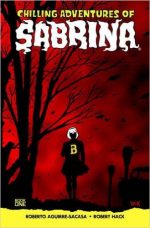
Chilling Adventures of Sabrina Book 1


By Roberto Aguirre-Sacasa, Robert Hack & various (Archie Comics)
ISBN: 978-1-62738-987-7

Win’s Christmas Gift Recommendation: A shockingly wicked spooky story… 9/10

For nearly three quarters of a century Archie Comics have epitomised good, safe, wholesome fun but the company has always been a surprisingly subversive one.

Family friendly – and not – iterations of superheroes, spooky chills, sci fi thrills and genre yarns have always been as much a part of the publisher’s varied portfolio as the romantic comedy capers of America’s cleanest-cut teens.

As you probably know by now, the eponymous Archie has been around since 1941, but the publisher has other wholesome stars in their stable almost as well known and just as prone to radical reinterpretation.

To keep all that accumulated attention riveted, the company has always looked to modern trends with which to expand upon their archetypal storytelling brief. In times past they have cross-fertilised their pantheon through such unlikely team-ups as Archie Meets the Punisher, Afterlife with Archie and Archie Vs Predator, whilst every type of fashion fad and youth culture sensation has invariably been accommodated into and explored within the pages of the regular titles.

Following-up the stunning success of their aforementioned zombie apocalypse outing, the publishers recently took another bold and controversial step by radically reinventing saccharine sweet teen witch Sabrina.

Thus, when playwright, screen scripter and comicbook scribe Roberto Aguirre-Sacasa (whose many comics hits include The Mystery Plays, 4: Marvel Knights Fantastic Four, Stephen King’s The Stand – and Afterlife with Archie amongst others) pitched the idea to re-imagine the saucy sorceress in terms of Rosemary’s Baby and The Exorcist, it wasn’t long before a strange new enterprise was hatched.

The writer’s other scripting credits include the 2013 Carrie remake and a new version of the horror musical Little Shop of Horrors.

Archie Comics is no stranger to such material. In the 1970s the company created the sub-imprint Red Circle for anthology terror tales during a supernatural boom time, before converting the line to superhero features as the decade progressed. They even had resident witch-girl Sabrina narrating Chilling Tales of Sorcery…

The Teenaged Witch debuted in Archie’s Madhouse #22 (October 1962), created by George Gladir & Dan de Carlo as a throwaway character in a quick-fire gag anthology which was simply one more venue for comics’ undisputed kings of kids’ comedy.

Almost instantly she became a regular in the burgeoning cast surrounding core stars Archie, Betty Cooper, Veronica Lodge and Jughead Jones.

By 1969 the little enchantress had grown popular enough for her own animated Filmation TV series (just like Archie and Josie and the Pussycats), thereafter graduating to lead feature in Archie’s TV Laugh Out and finally her own title in 1971.

The first volume ran 77 issues from 1971 to 1983 and, when a hugely successful live action TV series launched in 1996, a comicbook spin-off appeared in 1997. That version folded in 1999 after a further 32 issues.

Volume 3 – simple entitled Sabrina – was based on new TV show Sabrina the Animated Series. This ran from 2000-2002 for 37 issues before a back-to-basics reboot saw the comicbook revert to Sabrina the Teenage Witch with #38. This carefully blended elements from all the previous print and TV versions.

A creature of seemingly infinite variation and variety, the mystic maid continued in this vein until 2004 and issue #57 wherein – responding to the global craze for of Japanese comics – the company switched format, transforming the series into a manga-style high school comedy-romance in classic Shōjo manner.

That Sabrina is just a typical Greendale High School girl. She lives with her Aunts Hilda and Zelda Spellman, has a pet cat – Salem – and is tentatively dating childhood pal Harvey Kinkle. The cute but clueless boy reciprocates the affection but is far too scared to rock the boat by acting on his own desires.

Sabrina is an atypical witch: half-mortal (on her mother’s side), living in the mundane world and assiduously passing herself off as normal.

This first volume of the Chilling Adventures of Sabrina collects the shockingly adult and hard-hitting first five issues by Aguirre-Sacasa, artist and colourist Robert Hack (Doctor Who, Life with Archie, New Crusaders) and letterer Jack Morelli.

After a revelatory scene-setting Introduction from the author, the extremely nasty tale of ‘Something Wicked’ opens on October 31st 1951 in Westbridge, Massachusetts. Edward Spellman is celebrating the first birthday of his baby girl Sabrina by handing her over to a human-flesh eating, Satan-worshipping coven.

At least that was the plan: things go awry at the very last moment as his pathetic human wife Diana absconds with the infant. With dark magic at her pursuers’ command, she doesn’t get far…

By 1957 warlock Edward is out of the picture too and Sabrina is living with “aunts” Hilda and Zelda. Her birthday is a special occasion since Sabrina is given her first familiar. Salem is a very nasty cat who used to be a very nasty warlock. His current form is penance for unspoken but heinous past misdeeds…

All too soon, however, the other young witches at the secret school are bullying Sabrina over her halfbreed origins, so – after suitable reparations are set in motion – the family up stakes and move to a funeral home in bucolic Greendale. It’s 1962 and the move provides perfect cover. The little girl can refine her burgeoning powers in isolation and the constant flow of cadavers provides an income, raw materials and the occasional gustatory treat…

Life goes on and in 1964 the family grows larger as disgraced British teen warlock Cousin Ambrose moves in. He will become a dangerous, rebellious influence on the witch-in-training and when Sabrina starts human High School in September, he is constantly urging her use her powers to make life easier and more interesting…

Despite her uncanny origins Sabrina is still a girl and when she meets local hunk Harvey Kinkle, the hunky human works his own kind of magic on her, much to the dismay of mortal hottie Rosalind who claims “dibs” and doesn’t like to lose…

Sabrina’s aunts are also unhappy. She is only thirteen and must remain pure until she gives herself to Satan during her Baptism on her sixteenth birthday…

Nearby, in the deep woods, arcane events are spiralling out of control. Neophyte witches Betty Cooper and Veronica Lodge are dabbling in magic far beyond them. Horrifically they accidentally resurrect one of the most wicked of sorcerous sisters…

As seen in ‘The Secret History of Madame Satan’, unstable witch Iola was going to wed Edward Spellman, but he inexplicably dumped her for a mortal. In emotional turmoil Iola dramatically and spectacularly killed herself and her soul went to the Hell for Suicides. Now she has been accidentally called back and hungers for revenge…

She also has a natural gift for encountering nasty men and hurrying them on to their just reward…

After rebuilding her corrupted body from the flesh of innocents and vindictively divining the fates of Edward and Diana, Iola exults in learning they had a daughter. With malice in mind, “Madame Satan” turns towards Greendale and makes spiteful plans…

It’s October and as Sabrina’s birthday approaches she is more consumed with Harvey’s increasingly ardent attentions and her own theatrical ambitions and the upcoming dark Baptism…

Hilda and Zelda have been preparing Sabrina for her ‘Unholy Baptism’ for years. It will be the turning point of her life; resolving whether or not she will accede to her full powers and potential and serve the Evil One forever. Nothing must be allowed to impede or mar the crucial moment.

Sadly, it’s just not going to happen. Iola has hit town and, through arcane manipulation, inserted herself into Sabrina’s increasingly confused and conflicted life. As replacement teacher Evangeline Porter, Madame Satan even offers horny frustrated Harvey the delights Sabrina is denying him…

Culmination comes after she tricks the lad into interrupting the demon-drenched birthday Black Mass before leaves the horrified human boy to a ghastly fate…

So great is the power of witchcraft however that even death does not end the Harvey Horrors’. The repercussions of Iola’s plan reverberate throughout the town and the coven, even reaching as far as Riverdale and the witches hiding there…

Although she had nothing to do with the wrecking of the baptism ritual Sabrina is then summonsed to appear before a fearsome court of witches to endure ‘The Trial’. After surreptitiously aiding Selena to escape Satanic justice, Miss Porter then delivers her sadistic coup de grace, offering the distraught teen witch everything her heart desires… or so she thinks…

Happily this is a continuing series and there’s more malevolent magic to come…

This radical makeover also offers a host of ‘Special Features’ including a ‘Cover Gallery’, variants by Hack spoofing classic movie poster such as Rosemary’s Baby, Häxan, Carrie and Creepshow, assorted retailer incentive variants by Francesco Francavilla, J. Scott Campbell and Hack, an ‘Original Sketch Gallery’ and a text feature about original Golden Age Scream Queen Madame Satan and an original exploit by Joe Blair & Harry Lucey from Pep Comics #17 (July 1941).

Brooding, slow boiling and shockingly potent – beware of profanity, gore and nudity, Archie traditionalists! – Chilling Adventures of Sabrina is a classic grown up horror story to delight hardcore far fanatics.
© 2016 Archie Comics Publications, Inc.

Hellboy volume 7: The Troll Witch and Others


By Mike Mignola, Richard Corben, P. Craig Russell, Dave Stewart & various (Dark Horse Books)
ISBN: 978-1-59307-860-7

Hellboy was first seen in San Diego Comic-Con Comics #2 (August 1993) before formally debuting. That launch was in miniseries Seed of Destruction with John Byrne scripting over Mignola’s plot and art.

As a baby Hellboy was taken – on December 23rd 1944 – from Nazi cultists by American superhero The Torch of Liberty and a squad of US Rangers. They had interrupted a satanic ritual predicted by Allied parapsychologist Professor Trevor Bruttenholm and his associates.

They were waiting at a ruined church in East Bromwich, England when the abominable infant with a huge stone right hand materialised in a fireball. Raised by Bruttenholm, the child grew into a mighty warrior fighting a never-ending secret war. The Professor trained the infernal foundling whilst forming an organisation to destroy supernatural threats – the Bureau for Paranormal Research and Defense.

After years of such devoted intervention, education and warm human interaction, in 1952 the neophyte hero began destroying unnatural threats and supernatural monsters as lead agent for the BPRD. “Hellboy” rapidly became its top operator… the world’s most successful paranormal investigator…

As the decades unfold, Hellboy gleans snatches of his origins, learning he is a supposedly corrupted creature of dark portent: born a demonic messiah, somehow destined to destroy the world and bring back ancient powers of evil. It is a fate he despises and utterly rejects…

This sinister seventh spellbinding compendium of graphic grotesquery and grave wit collects material from 2003 to 2007 as previously seen in The Dark Horse Book of Witchcraft, The Dark Horse Book of the Dead, The Dark Horse Book of Hauntings, The Dark Horse Book of Monsters, 2-issue miniseries Hellboy: Makoma, the Hellboy Premiere Edition and Hellboy: Wizard 1/2. Also included is an original story created especially for his trade paperback edition.

The format is a gathered scattering of short yarns and vignettes presenting exploits from Hellboy’s chequered career as a “weird-buster” and, following an engaging Introduction from fellow multi-talented tale-weaver Walter Simonson, Mignola briefly expounds on the folkloric influences and other antecedents of the uncanny yarns which follow before the eldritch enigmas at last unfold.

Coloured and lettered by regular support crew Dave Stewart and Clem Robins, ‘The Penanggalan’ (Hellboy Premiere Edition, 2004) is set in 1958 Malaysia with the already world-weary troubleshooter investigating a macabre vampiric creature with disgusting habits and a neat line in deceptive camouflage. Even though appearances are frequently deceiving, the veteran monster-hunter is not fooled by a pretty face or placid demeanour…

‘The Hydra and the Lion’ (The Dark Horse Book of Monsters) resulted from a collaboration between Mignola and his young daughter: subtly referencing Hercules’ legendary battles against the Nemean lion and a many-headed dragon. Hellboy’s frenetic clash occurred in Alaska in 1961 after the death of a circus strongman somehow led to recurring raids by monsters in the fog…

Eponymous lead feature ‘The Troll Witch’ came from The Dark Horse Book of Witchcraft and is set in Norway circa 1963. It opens with Hellboy quizzing a wizened crone whilst investigating a series of bizarre and unnaturally savage murders. She relates an old legend of a barren woman who sought magical aid to give her husband children. The successful outcome was two girls. One was beautiful and one was not…

When trolls took the lovely lass, her ugly sister responded with great fury and effect to save her… and therein lay the clue to Hellboy’s latest case… and its eventual solution…

‘The Vampire of Prague’ – written by Mignola, mischievously illustrated by P. Craig Russell, with colours by Lovern Kindzierski and the lettering of Galen Showman – was created especially for this compilation and was the result of the author’s trip to the Czech republic whilst scouting movie locations…

With sublime wit and sly joy, it details the depredations of an ancient gambling-addicted bloodsucker and how the reign of terror was finally ended in one night in August 1982 when a certain red-faced, stone-handed hero hit town…

Mignola, Stewart & Robins reunited for ‘Dr. Carp’s Experiment’ (The Dark Horse Book of Hauntings) with Hellboy embroiled in an atypical ghost story, confronting restless spirits in an old house on Long Island in 1991: a dank domicile blighted not just by gore-drenched phantoms but also malevolent time-travellers and killer-apes wielding electric harpoons…

‘The Ghoul or Reflections on Death and The Poetry of Worms’ by Mignola, Stewart & Robins is an experimental item from The Dark Horse Book of the Dead, taking place in London 1992 with our paranormal paragon hunting a predatory, verse-spouting cadaver consumer.

The narrative remainder of the book offers Mignola’s broad interpretation of African myth Makoma and the Giants, realised here by the one-and-only Richard Corben, with Stewart & Robins in dutiful attendance.

‘Makoma or, A Tale Told by a Mummy in the New York City Explorers Club on August 16 1993’ is a story within a story outlining how Hellboy’s visit to a venerable institution exposes an unsuspected connection to one of Earth’s earliest and most important champions who tackled terrible titans, tamed the wild places and faced devils and dragons whilst setting mankind in his rightful place in the world hierarchy…

The epic adventure is supplemented by a new Mignola pinup, a Corben cover gallery and sketchbook pages by Mignola and Russell.

Baroque, bombastic, suspenseful and explosively action-packed, this is another superbly scary rollercoaster ride to delight one and all.
™ and © 2007, 2006, 2005 2004 and 2003 Mike Mignola. Hellboy is ™ Mike Mignola. Introduction © 2006 Walter Simonson. All rights reserved.

The Monster of Frankenstein


By Gary Friedrich, Doug Moench, Bill Mantlo, Gerry Conway, Mike Ploog, John Buscema, Bob Brown, Val Mayerik, Don Perlin, Sal Buscema & various (Marvel)
ISBN: 978-0-7851-9906-9

Whereas DC Comics capitalised on the early 1970s global boom in all things supernatural and mystic by creating a plethora of short-story anthologies and the occasional spooky star, Marvel Comics took the trend in another direction and created a small army of horror-heroes to headline their own series.

This particular collection reprints the House of Ideas’ interpretation of the Mary Shelley classic from a time when the censorious Comics Code Authority first loosened some of its strictures banning horror material from the pages of comics. That translates here to 18 issues of the colour comicbook; Giant-Sized Werewolf #2, Marvel Team-Up #36-37 and all the pertinent strips from adult-oriented Marvel magazines Monsters Unleashed #2, 4-7, 9-10 and one-shot Legion of Monsters (spanning January 1973 – September 1975), all awaiting your rapt attentions.

Some comic artists work best in black-&-white. Such is certainly the case with the groundbreaking Mike Ploog. A young find who had previously worked with Will Eisner, Ploog illustrated Gary Friedrich’s pithy adaptation of the original novel before moving on to new ventures as the strip graduated to in-house originated material. This monumental paperback tome is presented mostly in colour, but if you are of a similar opinion you could try to lay your hands on the 2004 monochrome Essential Monster of Frankenstein edition…

‘Mary Shelley’s Frankenstein!’ debuted with a January 1973 cover-date and introduced Robert Walton IV, great grandson of the sea-captain who had rescued scientist Victor Frankenstein from the polar ice and was subsequently regaled with the incredible tale of “the Modern Prometheus”.

In 1898, leading a band of rogues, cutthroats and sullen Inuit, Walton finds the fabled monster interred in a frozen slab and brings it aboard his ice-breaker. He then recounts the story to his fascinated cabin-boy, unaware of the fear and discontent simmering below decks…

A bloody mutiny during a terrible gale opens the second issue as the burning ship founders. Meanwhile the flashbacked tale of tragic Victor reaches the terrible moment when the monster demands a mate. The guilt-plagued scientist complies only to baulk at the last and destroy his second creation. ‘Bride of the Monster!’ concludes with the creature’s fearsome vengeance on his creator paralleling the grim fate of the storm-tossed ship…

In The Monster of Frankenstein #3, ‘The Monster’s Revenge!’ has the reawakened creature freed from its ice-block to overhear the continuation of his life-story from Walton’s lips, even as the last survivors struggle to find safety in the Arctic wastes.

Thereafter ‘Death of the Monster!’ – with inker John Verpoorten taking some of the deadline pressure off the hard-pressed Ploog – turns the tables as the monster reveals what happened after the polar showdown with his creator, leading to a new beginning when Walton reveals that not all the Frankensteins were eradicated by the Monster’s campaign of vengeance. Their warped  blood-line lives on…

A new direction began with issue #5 as ‘The Monster Walks Among Us!’. Making his way south, the tragic creature arrives in a Scandinavian village in time to save a young woman from being burned at the stake on a blazing longboat, only to rediscover that when villagers pick up pitchforks and torches to go a-screamin’ and a-hollerin’ for blood, they generally have a good reason…

With issue #6 the comic-book renamed itself The Frankenstein Monster as the undying creature reaches the village of Ingolstadt a century after he wreaked bloody vengeance on his creator’s loved ones.

‘…In Search of the Last Frankenstein!’ is a mini-classic of vintage horrors scripted as usual by Friedrich but plotted, pencilled and inked by Ploog who was reaching an early peak in his artistic career. It was also his last issue.

Ploog was followed by John Buscema and Bob Brown before Val Mayerik settled as regular artist and Friedrich gave way to Doug Moench, a writer once synonymous with Marvel’s horror line.

Issues #7, 8 and 9 bowed to the inevitable and pitted the Monster against Marvel’s top horror star (albeit 75-ish years prior to his contemporary adventures). Beginning with ‘The Fury of a Fiend!’ continuing in ‘My Name is… Dracula!’ and concluding with ‘The Vampire Killers!’, this is an extremely classy tribute to the old Universal movies and then-current Hammer Films in equal measure, wherein the misunderstood misanthrope battled an undying evil for ungrateful humanity, consequently losing the power of speech; and becoming more monstrous in the process.

Produced by Friedrich, John Buscema and John Verpoorten, this trilogy lacks the atmosphere of Ploog’s tenure, but the action is very much in the company’s house-style. With #10 (inked by Frank Giacoia and Mike Esposito) the creature finally found ‘The Last Frankenstein!’ …much to his regret.

With number #11’s ‘…And in the End…!?’ – illustrated by Bob Brown & Vince Colletta – and #12’s ‘A Cold and Lasting Tomb’ by Doug Moench, Val Mayerik and Colletta, the Monster wrapped his historical adventures by falling into a glacial sea. Frozen once again into another block of ice he was revived, Captain America-like, in modern times: i.e. the swinging 1970s…

The epic account then switches to monochrome as the more mature episodes from Monsters Unleashed begin, starting with #2 and ‘Frankenstein 1973’ by Friedrich, John Buscema & Syd Shores. Here we see how an obsessive young man finds the Monster preserved as a carnival exhibit, only to see his jealous girlfriend revive it whilst trying to burn down the sideshow. The story continued in #4 as ‘Frankenstein 1973: Chapter Two The Classic Monster’ (Friedrich, Buscema and Golden-Age Great Win Mortimer), with a literal mad scientist actually putting his own brain in the monster’s skull. Happily the unnatural order is restored in ‘Once a Monster…’

Monsters Unleashed #6 introduced new creative team Doug Moench and Val Mayerik who wrapped up the introduction to today’s storyline with a good old-fashioned monster hunt in ‘…Always a Monster!’ which leads directly to #7’s ‘A Tale of Two Monsters!’: a dark, socially relevant tale of the modern underclass and man-made horrors carried on in ‘Frankenstein 1974: Fever in the Freak House’ before concluding in #9’s ‘The Conscience of the Creature’.

The horror boom was fading by this time and Monsters Unleashed #10 was the Monster’s last outing there: a superbly dark and sardonic Christmas offering complete with elves, snow, terrorists and a Presidential assassination attempt.

One final tale ‘The Monster and the Masque’ appeared in the 1975 one-shot The Legion of Monsters, by Moench, Mayerik, Dan Adkins & Pablo Marcos (accompanied by a chilling frontispiece by Marcos). This bittersweet morality play sees the creature accidentally accepted at a fancy dress party which is ruined when a different sort of monster gets carried away…

Switching back to full-colour comicbooks, next up is a rather tame team-up/clash from Giant-Sized Werewolf #2 wherein ‘The Frankenstein Monster Meets Werewolf by Night’ (by Moench, Don Perlin & Colletta): collaterally combining to quash a band of run-of-the-mill West Coast Satanists in the process.

Resuming his own series, The Frankenstein Monster #13 displays ‘All Pieces of Fear!’ (Moench, Mayerik and Jack Abel) as, shoe-horned into mid-1970s America, the Monster is drawn into a tale heavy with irony as men act like beasts and an obsessive father ignores his family whilst building his own abominations through the nascent science of cloning.

With a hip young teenager as a sidekick/spokesperson ‘Fury of the Night-Creature’ (with Dan Green inking) extends the saga by introducing I.C.O.N. (International Crime Organizations Nexus): yet another secret organisation intent on conquest through corporate business practices and traditional gangsterism.

Issue #15 ‘Tactics of Death’ (with a young Klaus Janson on inks) briefly concludes the acronym-agenda as the Monster and his young companion Ralph mop up the men in suits only to be shanghaied to Switzerland to meet the latest Last-of-the-Frankensteins in ‘Code-name: Berserker!’ (inked by Bob McLeod – who managed to handle the next issue too).

Veronica Frankenstein was still absorbed in the family business, but claims to be fixing her ancestors’ mistakes when the incorrigible I.C.O.N. creeps show up, demanding her biological techniques in ‘A Phoenix Beserk!’. Beautifully inked by Mayerik and Dan Adkins, the last colour issue ended on a never-to-be completed cliffhanger (although scripter Bill Mantlo covered elements of the story in Iron Man a few years later) when the Monster and his new friend met ‘The Lady of the House’ – the utterly bonkers creature-crafter dubbed Victoria Von Frankenstein…

Perhaps the abrupt cancellation was a mercy-killing after all…

Rounding off the narrative wonderment is a two-part tale by Gerry Conway, Sal Buscema & Colletta from Marvel Team-Up #36 and 37 wherein Spider-Man is kidnapped and shipped off to Switzerland by the assuredly insane Baron Ludwig Von Shtupf, who proudly proclaims himself The Monster Maker…

In ‘Once Upon a Time, in a Castle…’ the bonkers biologist wants to pick-&-mix creature traits and has already secured the Frankenstein Monster to practise on, but after the Webslinger busts them both out and they stumble upon sexy SHIELD Agent Klemmer, their rapid counterattack goes badly wrong after Von Shtupf unleashes his other captive – the furiously feral Man-Wolf – and only big Frankie can prevent a wave of ‘Snow Death!’

This codex of comic creepiness concludes with a mammoth bonus section offering art lovers and funnybook historians additional treats such as Ploog’s very first design sketch of the monster from 1972, original art, illustrations and (finished but pre-editorial addition) painted covers by Boris Vallejo.

Also on show are assorted frontispieces, pencils, inks and previous collected editions covers and original art by Tom Sutton, Gray Morrow, Vince Evans, Mayerik, Bernie Wrightson and Arthur Adams, making this compendium a perfect treat for fantasy fans and dedicated horrorists: one that should be a first choice for introducing scare-loving civilians to the world of comics.
© 1973, 1974, 1975, 2015 Marvel Characters, Inc. All Rights Reserved.

S.H.I.E.L.D. by Lee & Kirby: The Complete Collection


By Stan Lee, Jack Kirby, Roy Thomas, Denny O’Neil, John Severin, Don Heck, John Buscema, Joe Sinnott, Howard Purcell, Ogden Whitney & various (Marvel)
ISBN: 978-0-7851-9901-4

Veteran war-hero Nick Fury debuted in Fantastic Four #21 (December 1963): a grizzled, world-weary and cunning CIA Colonel at the periphery of the really big adventures.

What was odd about that? Well, the gruffly capable everyman was already the star of the minor publisher’s only war comic, set twenty years earlier in (depending on whether you were American or European…) the middle or beginning of World War II.

Sgt. Fury and his Howling Commandos was an improbable, decidedly over-the-top and raucous combat comics series, similar in tone to later movies such as The Wild Bunch or The Dirty Dozen and had launched in May of that year. Although Fury’s later self became a big-name star when espionage yarns went global in the wake of popular sensations like The Man from U.N.C.L.E., the elder iteration was given a second series beginning in Strange Tales #135 (August 1965).

Nick Fury, Agent of S.H.I.E.L.D. combined Cold War tensions with sinister schemes of World Conquest by a subversive, all-encompassing, hidden enemy organisation. The saga came with captivating Kirby-designed super-science gadgetry and, later, iconic imagineering from Jim Steranko whose visually groundbreaking graphic narratives took the art form to a whole new level (but that’s a subject of another Complete Collection…).

For those few brief years with Steranko in charge, the S.H.I.E.L.D. series was one of the best strips in America – if not the world – but when the writer/artist left just as the global spy-fad was fading, the whole concept faded into the background architecture of the Marvel Universe…

This astounding full-colour paperback compendium, however, deals with the outrageous, groundbreaking, but still still carefully wedded-to-mundane-reality iteration which set the scene. Here Jack Kirby’s genius for gadgetry and gift for dramatic staging mixed with Stan Lee’s manic melodrama to create a tough and tense series which the new writers and veteran artists that followed turned into a non-stop riot of action and suspense…

This stunning hardback omnibus gathers those early days of spycraft; comprising Fantastic Four #21, Tales of Suspense #78 and Strange Tales #135-150 – spanning December 1963 to November 1966 – and providing timeless thrills for lovers of adventure and intrigue.

Fantastic Four #21 introduced the latter-day Fury as a CIA agent seeking the team’s aid against a sinister demagogue called ‘The Hate-Monger’ (by Lee & Kirby with inks by comics veteran George Roussos, under the protective nom-de-plume George Bell) just as the 1960s espionage vogue was taking off, inspired by James Bond films and TV shows like Danger Man.

Fury craftily manipulated Marvel’s First Family into invading a sovereign nation in the throes of revolution in a yarn cracking with tension and action.

The main event starts next as Strange Tales #135 (August 1965) saw the Human Torch solo feature replaced by Nick Fury, Agent of S.H.I.E.L.D. – which back then stood for Supreme Headquarters International Espionage Law-enforcement Division…

In the rocket-paced first episode, Fury is asked to volunteer for the most dangerous job in the world: leading a new counter-intelligence agency dedicated to stopping secretive subversive organisation Hydra. With assassins dogging his every move, the Take-Charge Guy with the Can-Do Attitude quickly proves he is ‘The Man for the Job!’ in a potent twelve-page thriller from Lee, Kirby & Dick Ayers.

Even an artist and plotter of Kirby’s calibre couldn’t handle another strip at that busiest of times so from the next issue “The King” cut back to laying out episodes, allowing a variety of superb draughtsmen to flesh out the adventures. Even so, there’s probably a stunning invention or cool concept on almost every page that follows…

‘Find Fury or Die!’ brought veteran draughtsman John Severin back to the company; pencilling and inking the Kirby’s blueprints as Fury becomes the target of incessant assassination attempts and we are introduced to the masked Supreme Hydra…

The tension ramps up in the next instalment as a number of contenders are introduced – any of whom might be the obscured overlord of evil – even as S.H.I.E.L.D. strives mightily but fails to stop Hydra launching its deadly Betatron Bomb in ‘The Prize is… Earth!’

Despite the restrictions of the Comics Code, these early S.H.I.E.L.D. stories were stark and grim and frequently carried a heavy body count. Four valiant agents died in quick succession in #137 and the next issue underscored the point in ‘Sometimes the Good Guys Lose!’ with further revelations of Hydra’s inner workings.

Fury and fellow Howling Commando war heroes Dum-Dum Dugan and Gabe Jones meanwhile played catch-up after Hydra assassins invade S.H.I.E.L.D. and almost eradicate Fury and munitions genius Tony Stark: the only man capable of destroying the nuclear sword of Damocles hanging over the world. Although Nick saves the inventor, he is captured in the process…

Tortured by Hydra in #139’s ‘The Brave Die Hard!’ (with Joe Sinnott replacing Severin as finisher) Fury finds an unlikely ally in Laura Brown: Supreme Hydra’s daughter and a young woman bitterly opposed to her father’s megalomaniacal madness.

Even with only half a comic book per month to tell a tale, creators didn’t hang around in those halcyon days and #140 promised ‘The End of Hydra!’ (Don Heck & Sinnott) as a S.H.I.E.L.D. squad invades the enemy’s inner sanctum to rescue the already-free-and-making-mayhem Fury, just as Stark travels into space to remove the Betratron Bomb with his robotic Braino-Saur system. The end result left Hydra temporarily headless…

Strange Tales #141 saw Kirby return to full pencils (inked by Frank Giacoia pseudonymously moonlighting as Frank Ray) for the mop-up and ‘Operation: Brain Blast!’ as Mentallo – a renegade from S.H.I.E.L.D. ESP division – joined with technological savant the Fixer to attack the organisation as the first step in an ambitious scheme to rule the world.

The raid began in ‘Who Strikes at… S.H.I.E.L.D.?’ (illustrated by Kirby with Mike Demeo – AKA – Esposito) with the deadly rogues hitting hard and fast: seizing and mind-controlling Fury before strapping him to a mini-H-bomb. None too soon, however, Dugan and the boys come blasting in ‘To Free a Brain Slave’ in #143 with Howard Purcell & Esposito embellishing Kirby’s layouts.

A new and deadly threat emerged in #144 as ‘The Day of the Druid!’ saw a mystic charlatan target Fury and his agents with murderous flying techno-ovoids. Happily, new S.H.I.E.L.D. recruit Jasper Sitwell was on hand to augment the triumphant fightback in ‘Lo! The Eggs Shall Hatch!’ by Heck & Esposito over Kirby.

As Marvel continuity grew evermore interlinked, ‘Them!’ saw Captain America team with Fury in the first of the Star-Spangled Avenger’s many adventures as a (more-or-less) Agent of S.H.I.E.L.D.

Taken from Tales of Suspense #78 (June 1966: scripted by Lee with Kirby full pencils and Giacoia inks), the story saw the WWII wonders battling an artificial assassin with incredible chemical capabilities after which Nick sought the creature’s mysterious makers in Strange Tales #146 ‘When the Unliving Strike!’ (Kirby, Heck & Esposito).

As technological Special Interests group Advanced Idea Mechanics courted Fury’s governmental and military masters, promising incredible weapons if only they sacked that barbaric slob Fury, the S.H.I.E.L.D. supremo was getting close to exposing A.I.M.’s connection to “Them” and an old enemy thought long gone…

A concerted whispering campaign and “briefing-against” seemingly sees Fury ousted in ‘The Enemy Within!’ and put on trial in ‘Death Before Dishonor!’ (scripted by Kirby with Heck & Esposito finishing his layouts) but it’s all part of a cunning counter-plan which results in a shattering conclusion and ‘The End of A.I.M.!’ in #149 (with script from Denny O’Neil, and art by Kirby & Ogden Whitney).

As depicted by Lee, Kirby, John Buscema & Giacoia, a malign and devilishly subtle plan is finally uncovered in Strange Tales #150 as Fury’s team put together clues from all the previous year’s clashes and come to one terrifying conclusion: ‘Hydra Lives!’…

This sets the scene for the bombastic debut by Jim Steranko, but that’s to be seen in another collection at another time…

Here the epic espionage extravaganza wraps up with appetising Afterword ‘Against the Hordes of Hydra’ by Lee and a treasure trove of original art pages comprising covers, pencils and inked pages – and even try-out pages – by Kirby, Severin, Whitney and Buscema, plus a rousing 1965 House Ad plugging not just the Espionage elite but the simultaneously debuting Sub-Mariner strip in Tales to Astonish #70.

Fast, furious and fantastically entertaining, these high-octane vintage yarns are a superb snapshot of early Marvel Comics at their creative peak and should be part of every fanboy’s shelf of beloved favourites.
© 2015 Marvel Characters. Inc. All rights reserved.

Iron Fist Epic Collection: The Fury of Iron Fist – volume 1 1994-1997


By Roy Thomas, Chris Claremont, Doug Moench, Tony Isabella, Gil Kane, Larry Hama, John Byrne & various (Marvel)
ISBN: 978-0-7851-9164-3

Comicbooks have always operated within the larger bounds of popular trends and fashions – just look at what got published whenever westerns or science fiction dominated on TV – so when the ancient philosophy and health-&-fitness discipline of Kung Fu made its unstoppable mark on domestic entertainment it wasn’t long before the Chop Sockey kicks and punches found their way en masse onto the four-colour pages of America’s periodicals.

As part of the first Martial Arts bonanza, Marvel converted a forthcoming license to use venerable fictional villain Fu Manchu into a series about his son. The series launched in Special Marvel Edition #15, December 1973 as The Hands of Shang Chi: Master of Kung Fu and by April 1974 (#17) it became his exclusively.

A month later the House of Ideas launched a second oriental-tinged hero in Iron Fist; a character combining the Eastern combat philosophy with high fantasy, magic powers and a proper superhero mask and costume…

The character also owed a hefty debt to Bill Everett’s pioneering golden Age super-hero Amazing Man who graced various Centaur Comics publications between 1939 and 1942. The tribute was paid by Roy Thomas & Gil Kane who adopted and translated the fictive John Aman’s Tibetan origins into something that gibed better with the 1970’s twin zeitgeists of Supernatural Fantasy and Martial Arts Mayhem…

This collection gathers the far-ranging appearances of the Living Weapon from Marvel Premier #15-25, Iron Fist #1-15 and Marvel Team-Up #63-64 (spanning May 1974 to December 1977), which saw the high-kicking wonder uncover his past and rediscover his heritage and humanity before inevitably settling into the inescapable role of costumed crusader as half of superhero and detective bromance Power Man and Iron Fist.

The saga began on a spectacular high in Marvel Premier #15 with ‘The Fury of Iron Fist!’ by Thomas, Kane and inker Dick Giordano as a young masked warrior defeats the cream of a legendary combat elite in a fabled other-dimensional city before returning to Earth.

Ten years previously little Daniel Rand had watched as his father and mother died at the hands of Harold Meachum whilst the party risked Himalayan snows to find the legendary city of K’un Lun.

Little Danny had travelled with his wealthy parents and business partner Meachum in search of the fabled city – which only appeared on Earth for one day every ten years. Wendell Rand had some unsuspected connection to the fabled Shangri La but was killed before they found it, and Danny’s mother had sacrificed herself to save the child from wolves and her murderous pursuer.

As he wandered alone in the wilderness, the city found Danny. The boy spent the next decade training: mastering all forms of martial arts in the militaristic, oriental, feudal paradise and enduring arcane ordeals, living only for the day he would return to Earth and avenge his parents…

After conquering all comers and refusing immortality, Iron Fist returned to Earth a Living Weapon able to turn his force of will into a devastating super-punch…

From the outset the feature was plagued by an inability to keep a stable creative team, although, to be fair, story quality never suffered, only plot and direction. Reaching New York City in #16, ‘Heart of the Dragon!’ by Len Wein, Larry Hama & Giordano found Iron Fist reliving the years of toil which had culminated in a trial by combat with mystic dragon Shou-Lao the Undying, winning him the power to concentrate his fist “like unto a thing of Iron” and other unspecified abilities. The epic clash permanently branded his chest with the seared silhouette of the fearsome wyrm.

His recollections are shattered when martial arts bounty hunter Scythe attacks, revealing that Meachum knew the boy was back and had put a price on his head…

Danny had not only sacrificed immortality for vengeance but also prestige and privilege. As he left K’un Lun, supreme ruler of the city Yü Ti, the August Personage in Jade, had revealed that murdered Wendell Rand had been his brother…

Marvel Premier #17 saw Doug Moench take over scripting as Iron Fist stormed Meachum’s skyscraper headquarters; a ‘Citadel on the Edge of Vengeance’ converted into a colossal 30-storey death trap, leading to a duel with a cybernetically-augmented giant dubbed Triple-Iron and a climactic confrontation with his parents’ killer in #18’s ‘Lair of Shattered Vengeance!’

The years had not been kind to Meachum. He’d lost his legs to frostbite returning from the high peaks, and, hearing from Sherpas that a boy had been taken into K’un Lun, the murderer had spent the intervening decade awaiting in dread his victims’ avenger…

Filled with loathing, frustration and pity, Iron Fist turns away from his intended retribution, but Meachum dies anyway, slain by a mysterious Ninja as the deranged multi-millionaire attempts to shoot Danny in the back…

In #19 Joy Meachum and her ruthless uncle Ward – convinced Iron Fist had killed the crippled Harold – steps up the hunt for Iron Fist via legal and illegal means, whilst the shell-shocked Living Weapon aimlessly wanders the strange streets of Manhattan. Adopted by the enigmatic Colleen Wing Danny meets her father, an aging professor of Oriental Studies who has fallen foul of a ‘Death Cult!’

In his travels the aged savant had acquired ancient text The Book of Many Things, which, amongst other things, held the secret of K’un Lun’s destruction. The deadly disciples of Kara-Kai are determined to possess it. After thwarting another murder attempt Iron Fist tries to make peace with Joy, but instead walks into an ambush with the bloodthirsty ninja again intervening and slaughtering the ambushers…

A period of often painful inconsistency began as Tony Isabella, Arvell Jones & Dan Green took over with #20. The Kara-Kai cultists renew their attacks on the Wings whilst Ward Meachum hires a veritable army of killers to destroy the Living Weapon in ‘Batroc and other Assassins’ – with the identity of the ninja apparently revealed here as the elderly scholar…

Marvel Premier #21 introduced the ‘Daughters of the Death Goddess’ (inked by Vince Colletta) as the Wings are abducted by the cultists and bionic ex-cop Misty Knight debuts, first as foe but soon as an ally. When Danny tracks down the cult he discovers some shocking truths – as does the ninja, who had been imprisoned within the ancient book by the August Personage in Jade in ages past and recently possessed Professor Wing in search of escape and vengeance…

All was revealed and the hero exonerated in #22’s ‘Death is a Ninja’ (inked by “A. Bradford”) with the ninja disclosing how, as disciple to sublime wizard Master Khan, he had attempted to conquer K’un Lun and been imprisoned within the crumbling tome for his pains.

Over the years he had discovered a temporary escape and subsequently manipulated the Wing and Iron Fist to secure his permanent release and the doom of his jailers. Now exposed, he faces the Living Weapon in a final cataclysmic clash…

A measure of stability began with #23 as Chris Claremont, Pat Broderick & Bob McLeod took the series in a new direction. With his life’s work over and nearly nine years until he could go “home”, Danny was now a man without purpose… until whilst strolling with Colleen he stumbles into a spree shooting in ‘The Name is… Warhawk.’

When the cyborg-assassin has a Vietnam flashback and begins heedlessly sniping in Central Park, the Pride of K’un Lun instantly responds to the threat… and thus began his career as a hero…

In ‘Summerkill’ (inked by Colletta) the itinerant exile battles alien robot the Monstroid and opens a long and complicated association with Princess Azir of Halwan, with the mysterious Master Khan resurfacing, apparently intent on killing her and seizing her country…

Marvel Premier #25 was the last of the hero’s run and the start of his short but sweet Golden Age as John Byrne became regular penciller for ‘Morning of the Mindstorm!’ (inked by Al McWilliams). Whilst Colleen is driven to unconsciousness and abducted – and her father driven to the edge of insanity – by mind-bending terrorist Angar the Screamer, Danny, made of far sterner stuff, overcomes the psychic assaults and tracks the attackers to Stark Industries and into his own series…

Iron Fist #1 (November 1975) featured ‘A Duel of Iron!’ as he is tricked into battling Iron Man, even as Colleen escapes and runs into Danny’s future nemesis Steel Serpent before being recaptured and renditioned to Halwan…

After a spectacular, inconclusive and ultimately pointless battle, Danny and Misty Knight also head for Halwan in ‘Valley of the Damned!’ (#2, inked by Frank Chiaramonte) with our hero recalling a painful episode from his youth wherein his best friends Conal and Miranda chose certain death beyond the walls of regimented K’un Lun rather than remain in the lost city where they could not love each other…

As Master Khan begins to break Colleen, Danny and Misty stopover in England where a nuclear horror named The Ravager slaughters innocents by blowing up London Airport and the Post Office Tower (we rebuilt it as the BT Tower, so don’t panic), compelling Iron Fist to punch way above his weight in ‘The City’s Not For Burning!’

Inevitably it ends in ‘Holocaust!’ as Ravager is unmasked as old villain Radion the Atomic Man. He fatally irradiates Danny until the wounded warrior fortuitously discovers the cleansing and curative power of the Iron Fist and storms to his greatest triumph yet…

With Misty recuperating, Danny gets involved with a guilt-ridden IRA bomber named Alan Cavenaugh before tackling another of Khan’s assassins in ‘When Slays the Scimitar!’ after which Iron Fist and Misty finally infiltrate Halwan in #6, courtesy of crusading lawyer Jeryn Hogarth who also promises to secure Danny’s inheritance and interests from the Rand-Meachum Corporation.

The Pride of K’un Lun doesn’t much care since the successfully brainwashed Colleen had been unleashed by Khan, determined to kill her rescuers in ‘Death Match!’…

None of the earthly participants are aware that, from a hidden dimension, Yü Ti is observing the proceedings with cold calculation…

By using his mystic Iron Fist to psychically link with Colleen, Danny breaks Khan’s conditioning and at last the malignant mage personally enters the fray in #7’s ‘Iron Fist Must Die!’: a blistering battle which breaches the dimensions and exposes the August Personage in Jade’s involvement in Wendell Rand’s death.

Given the choice between abandoning his friends on Earth or returning to K’un Lun for answers and justice, the Living Weapon made a true hero’s choice…

With Iron Fist #8 Danny returns to New York and attempts to pick up the pieces of a life interrupted for more than a decade. Unaware that Steel Serpent now works for Joy Meachum, Danny joins the company until merciless mob boss Chaka and his Chinatown gangs attack the business ‘Like Tigers in the Night!’ (inked by Dan Adkins), and Iron Fist is fatally poisoned.

Sportingly offered an antidote if he survives a gauntlet of Chaka’s warriors, Danny triumphs in his own manner when ‘The Dragon Dies at Dawn!’ (Chiaramonte inks) but when a hidden killer bludgeons Chaka, Danny is once again a fugitive from the cops and dubbed the ‘Kung Fu Killer!’ (Adkins) until he, Colleen and Misty expose the entire plot as a fabrication of the gangster.

In #11 ‘A Fine Day’s Dawn!’ the Living Weapon squares off against the Asgardian-empowered Wrecking Crew and, with Misty a hostage, is compelled to fight Captain America in #12’s ‘Assault on Avengers’ Mansion!’ until the Pride of K’un Lun and the Sentinel of Liberty unite and turn the tables on the grotesque god-powered gangsters…

In the intervening time Cavenaugh arrives in New York, but has not escaped the reach of his former Republican comrades. They hire hitman Boomerang to kill the defector and ‘Target: Iron Fist!’ with little success, whereas the villain introduced in issue #14 comes a lot closer: even eventually eclipsing Iron Fist in popularity…

‘Snowfire’ – inked by Dan Green – finds Danny and Colleen running for their lives in arctic conditions when a retreat at Hogarth’s palatial Canadian Rockies estate is invaded by deadly mercenary Sabre-tooth. It just wasn’t their week as, only days before, a mystery assailant had ambushed Iron Fist and impossibly drained off a significant portion of the lad’s Shou-Lao fuelled life-force…

Despite being rendered temporarily blind, the K’un Lun Kid ultimately defeats Sabre-tooth, but the fiercely feral mutant would return again and again…

With Claremont & Byrne increasingly absorbed by their stellar collaboration on the revived and resurgent adventures of Marvel’s mutant horde, Iron Fist #15 (September 1977) was their last Martial Arts mash-up for a while. The series ended in spectacular fashion as – through a comedy of errors – Danny stumbles into battling Wolverine, Colossus, Nightcrawler, Banshee, Storm and Phoenix in ‘Enter, the X-Men’.

The cancellation was clearly not planned however as two major subplots went unresolved: Misty had disappeared on an undercover assignment to investigate European gang-boss John Bushmaster and Danny again had his chi siphoned off by Steel Serpent…

Fans didn’t have to wait long: Claremont & Byrne had already begun a stint on Marvel Team-Up and turned the Spider-Man vehicle into their own personal clearing house for unresolved plot-lines.

MTU #63-64 (November & December 1977 and inked by Dave Hunt) revealed the secret of K’un Lun exile Davos in ‘Night of the Dragon’ as Steel Serpent sucked the power of the Iron Fist from Danny, leaving him near death. Risking all she had gained, Misty broke cover and rushed to his aid…

With the Wall-crawler and Colleen (the girls using the team name “Daughters of the Dragon”) to bolster him, Iron Fist defeated Davos and reclaimed his heritage in ‘If Death be my Destiny…’ before shuffling off into a quiet retirement and anonymity.

…But not for long – and certainly the subject of further mammoth full-colour paperback Epic Collections to come…

Although suffering a few grim patches, the greater bulk of the Iron Fist saga ranks amongst the most exciting and enjoyable Costumed Dramas of Marvel’s second generation. If you want a good, clean fight comic this is probably one of your better bets, especially if you’re a fan of original artwork as this titanic tome closes with a fabulous selection, shot from Byrne’s inked pages and original pencil character sketches…
© 1974, 1975, 1976, 1977, 2015 Marvel Characters, Inc. All rights reserved.
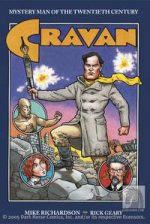
Marvel Masterworks: Luke Cage, Hero for Hire volume 1


By Archie Goodwin, Steve Englehart, Gerry Conway, Billy Graham, Tony Isabella, George Tuska & various (Marvel)
ISBN: 978-0-7851-9180-3

Win’s Christmas Gift Recommendation: A Ideal Item for new Marvel Movie-verse addicts… 8/10

In 1968 the consciousness-raising sporting demonstration of Black Power at the Olympic Games politicised a generation of youngsters. By this time a few comics companies had already made tentative efforts to address what were national and socio-political iniquities, but issues of race and ethnicity took a long time to filter through to still-impressionable young minds avidly absorbing knowledge and attitudes via four colour pages that couldn’t even approximate the skin tones of African-Americans.

As with television, breakthroughs were small, incremental and too often reduced to a cold-war of daringly liberal “firsts.” Excluding a few characters in Jungle comic-books of the 1940s and 1950, Marvel clearly led the field with a black soldier in Sgt. Fury’s Howling Commandos team (the historically impossible Gabe Jones who debuted in #1, May 1963, and was accidentally re-coloured Caucasian at the printers, who clearly didn’t realise his ethnicity). He was followed by first negro superheroes Black Panther in Fantastic Four #52 (July 1966), and the Falcon in Captain America #117 (September 1969).

America’s first Black hero to star in his own title had come (and gone largely unnoticed) in a little remembered or regarded title from Dell Comics. Created by artist Tony Tallarico and scripter D.J. Arneson, Lobo was a gunslinger in the old west, battling injustice just like any cowboy hero would, first appearing in December 1965.

Arguably a greater breakthrough was Joe Robertson, City Editor of the Daily Bugle; an erudite, brave and proudly ordinary mortal distinguished by his sterling character, not a costume or skin tone. He first appeared in Amazing Spider-Man # 51 (August 1967), proving in every panel that the world wouldn’t end if black folk and white folk occupied the same spaces…

This big change slowly grew out of raised social awareness during a terrible time in American history; yes, even worse than today’s festering social wound, as typified by cops under pressure providing no answer to the seemingly constant Black Lives Matter events. Although far rarer, those tragedies occur here in the UK too, so we have nothing to be smug about either. We’ve had race riots since the Sixties here which left simmering scars that only comedians and openly racist politicians dared to talk about. Things today in post-Brexit Britain don’t seem all that different, except the bile and growing taste for violence is turned towards European accents as well as brown skins…

As the 1960s became a new decade, more positive and inclusive incidences of ethnic characters appeared in the USA, with DC finally getting an African-America hero in John Stewart (Green Lantern #87 December 1971/January 1972), although his designation as a replacement Green Lantern might be construed as more conciliatory and insulting than revolutionary.

The first DC hero with his own title was Black Lightning, who didn’t debut until April 1977, although Jack Kirby had introduced Shilo Norman as Scott Free‘s apprentice (and eventual successor) in Mister Miracle ##15 (August (1973).

As usual, it took a bold man and changing economics to really promote change. With declining comics sales at a time of rising Black Consciousness, cash – if not cashing in -was probably the trigger for “the Next Step.”

Contemporary “Blaxsploitation” cinema and novels had fired up commercial interests throughout America, and in that atmosphere of outlandish dialogue, daft outfits and barely concealed – if justified – outrage, an angry black man with a shady past and apparently dubious morals must have felt like a sure-fire hit to Marvel’s bosses.

Luke Cage, Hero for Hire launched in the summer of 1972. A year later the Black Panther finally got his own series in Jungle Action #5 and Blade: Vampire Hunter debuted in Tomb of Dracula #10.

This stunning full-colour hardback compendium collects the first 16 issues of the breakthrough series: the entire run before the series was thematically adjusted to become Luke Cage Power Man.

The saga begins with Lucas, a hard-case inmate at brutal Seagate Prison. Like all convicts he claims to have been framed and his uncompromising attitude makes mortal enemies of the savage, racist guards Rackham and Quirt whilst not endearing him to the rest of the prison population such as genuinely bad guys Shades and Comanche either…

‘Out of Hell… A Hero!’ was written by Archie Goodwin and illustrated by George Tuska & Billy Graham – with some initial assistance from Roy Thomas and John Romita senior – and sees a new warden arrive promising to change the hell-hole into a proper, correctly administered correctional facility.

Prison Doctor Noah Burstein then convinces Lucas to participate in a radical experiment in exchange for a parole hearing, having heard the desperate con’s tale of woe…

Lucas had grown up in Harlem, a tough kid who had managed to stay honest even when his best friend Willis Stryker had not. They remained friends even though they walked different paths – until a woman came between them. To be rid of his romantic rival Stryker planted drugs and had Lucas shipped off to jail. While he was there his girl Reva, who had never given up on him, was killed when she got in way of bullets meant for up-and-coming gangster Stryker…

With nothing to lose Lucas undergoes Burstein’s process – an experiment in cell-regeneration – but Rackham sabotages it, hoping to kill the con before he can expose the illegal treatment of convicts. The equipment goes haywire and something incredible occurs. Lucas, panicked and somehow super-strong, punches his way out of the lab and the through the prison walls, only to be killed in hail of gunfire. His body plunges over a cliff and is never recovered…

Months later a vagrant prowls the streets of New York City and stumbles into a robbery. Almost casually he downs the felon and accepts a reward from the grateful victim. He also has a bright idea. Strong, bullet-proof, street-wise and honest, Lucas will hide in plain sight while planning his revenge on Stryker. Since his only skill is fighting, he became a private paladin… A Hero For Hire…

Making allowances for the colourful, often ludicrous dialogue necessitated by the Comics Code’s sanitising of “street-talking Jive” this is probably the grittiest origin tale of the classic Marvel years, and the tense action continued in ‘Vengeance is Mine!’ as the man now calling himself Luke Cage stalks his target.

Stryker has risen quickly, now controlling a vast portion of the drug trade as the deadly Diamondback, and Cage has a big surprise in store when beautiful Doctor Claire Temple came to his aid after a calamitous struggle.

Thinking him fatally shot her surprise is dwarfed by his own when Cage meets her boss. Seeking to expiate his sins, Noah Burstein has opened a rehab clinic on the sordid streets of Times Square, but his efforts have drawn the attention of Diamondback who doesn’t like someone trying to fix his paying customers…

Burstein apparently does not recognise Cage, and even though faced with eventual exposure and return to prison, the Hero for Hire offers to help the hard-pressed medics. Setting up an office above a movie house on 42nd Street Cage meets a lad who will be his greatest friend: D.W. Griffith: nerd, film freak and plucky white sidekick.

However, before Cage can settle in, Diamondback strikes and the age-old game of blood and honour plays out the way it always does…

Issue #3 introduced Cage’s first returning villain in ‘Mark of the Mace!’ as Burstein – for his own undisclosed reasons – decides to keep Cage’s secret, and disgraced soldier Gideon Mace launches a terror attack on Manhattan. With his dying breath one of the mad Colonel’s troops hires Cage to stop the attack, which he does in explosive fashion.

Inker Billy Graham graduated to full art chores for ‘Cry Fear… Cry Phantom!’ in #4 as a deranged and deformed maniac carried out random assaults in Times Square. Or was there perhaps another motive behind the crazed attacks?

Steve Englehart took over as scripter and Tuska returned to pencil ‘Don’t Mess with Black Mariah!’ in the next issue: a sordid tale of organised scavengers which introduced unscrupulous reporter Phil Fox, an unsavoury sneak with greedy pockets and a nose for scandal…

The private detective motif proved a brilliant stratagem in generating stories for a character perceived as a reluctant champion at best and outright antihero by nature. It allowed Cage to maintain an outsider’s edginess but also meant that danger and adventure literally walked through his shabby door every issue.

Such was the case with ‘Knights and White Satin’ (by Englehart, Gerry Conway, Graham and Paul Reinman) as the swanky, ultra-rich Forsythe sisters hire him to bodyguard their dying father from a would-be murderer too impatient to wait the week it will take for the old man to die from a terminal illness.

This more-or less straight mystery yarn (not counting a madman and killer-robots) is followed by ‘Jingle Bombs’, a strikingly different Christmas tale by from Englehart Tuska & Graham, before Cage properly entered the Marvel Universe in ‘Crescendo!’ when he is hired by Doctor Doom to retrieve rogue androids which had absconded from Latveria.

They were hiding as black men among the shifting masses of Harlem and the Iron Dictator needed someone who could work in the unfamiliar environment. Naturally Cage accomplishes his mission, only to have Doom stiff him for the fee. Big mistake…

‘Where Angels Fear to Tread!’ in issue #9 finds the enraged Hero for Hire borrowing a vehicle from the Fantastic Four to play Repo Man in Doom’s own castle just in time to get caught in the middle of a grudge match between the tyrant and an alien invader called the Faceless One.

It was back to street-level basics in ‘The Lucky… and the Dead!’ as Cage takes on a gambling syndicate led by the schizophrenic Señor Suerte who could double his luck by becoming murderous Señor Muerte (that’s Mr. Luck and Mr. Death to you): a two-part thriller complete with rigged games and death traps that climaxes in the startling ‘Where There’s Life…!’ as relentless Phil Fox finally uncovers Cage’s secret…

Issue #12 featured the first of many battles against alchemical villain ‘Chemistro!’, after which Graham assumed full art duties with ‘The Claws of Lionfang’ – a killer using big cats to destroy his enemies – before Cage tackles hyperthyroid lawyer Big Ben Donovan in ‘Retribution!’ as the tangled threads of his murky past slowly become a noose around his neck…

‘Retribution: Part II!’ finds Graham and Tony Isabella sharing the writer’s role as so many disparate elements converge to expose Cage. The crisis is exacerbated by Quirt kidnapping Luke’s girlfriend, and fellow Seagate escapees Comanche and Shades stalking him whilst the New York cops hunt him.

The last thing the Hero For Hire needs is a new super-foe, but that’s just what he get in #16’s ‘Shake Hands With Stiletto!’ (Isabella, Graham & inker Frank McLaughlin): a dramatic finale which literally brings the house down and clears up most of the old business. This would lead to a re-branding of the nation’s premier black crusader, but that’s meat for a different collection.

Bracketed by an Introduction from Steve Englehart – offering an informative issue-by-issue breakdown on how the series was created and bonus material including a cover gallery, promotional material from the times, unused artwork and pre-corrected/toned down pages (LCHFH was one of the most potentially controversial and thus most scrupulously edited books in Marvel’s stable at the time) and full creator Biographies, this is a fabulous and unmissable glimpse at one of the edgiest series of the era, and a fine way to back up the live-action Netflix iteration.
© 2015 Marvel Characters Inc. All rights reserved.

Essential Hulk volume 6


By Len Wein, Roger Stern, David Anthony Kraft, Gerry Conway, Chris Claremont, Sal Buscema, Herb Trimpe, George Tuska, Keith Pollard, Jim Starlin & various (Marvel)
ISBN: 978-1-7851-4540-0

Bruce Banner was a military scientist accidentally caught in a gamma bomb blast of his own devising. As a result, stress and other factors cause him to transform into a giant green monster of unstoppable strength and fury. He was one of Marvel’s earliest innovations and first failure but after an initially troubled few years finally found his size-700 feet and a format that worked, becoming one of the company’s premiere antiheroes and most popular features.

During the 1960s, artist Herb Trimpe had made the character his own; the Jack Kirby-based “house” art-style he initially employed quickly evolving into often startlingly abstract mannerism, augmented by an unmatched facility for drawing technology – especially honking great ordnance and vehicles – and, crucially, who could possibly deny the sheer cathartic reader-release rush of those spectacular “Hulk Smash!” moments…

However, by the time of the tales in chronologically complete monochrome mammoth (re-presenting Incredible Hulk #201-225 and Incredible Hulk King Size Annual #6, July 1976-July 1978) the artistic reins had passed to another illustrator who would become inextricably associated with the Jade Juggernaut whilst writer Len Wein continued to insert fresh ideas and characters, redefining the man-monster for the modern age…

The blockbusting battle-action starts with ‘The Sword and the Sorcerer!’ (illustrated by regular art-team Sal Buscema & Joe Staton) wherein the Hulk found himself in a perilously primitive world.

He had been miniaturised and inserted into the brain of Major Glen Talbot by former pursuers Dr. Leonard Samson and General Thaddeus Ross to restore the mind of Banner’s comatose rival for Betty Ross-Talbot‘s affections. The radical psycho-surgery was not without complications, however, and at the moment of his greatest triumph and sacrifice the Man-Monster began uncontrollably shrinking beyond the ability of Samson’s team to reach him…

He stabilised on a sub-atomic world long enough to liberate a primitive people from the domination of a brutal despot (and demon-possessed pawn) Kronak the Barbarian before starting to diminish once more. His last stop was the promised land of his beloved and long-lost alien queen Jarella…

Sadly ‘Havoc at the Heart of the Atom’ revealed how his last visit had rendered the world tectonically unstable and shattered the civilisation which once had the power to blend Banner’s mind with the Hulk’s body. Moreover the once-gentle population had turned on the queen they held responsible…

Reunited with his beloved, the simplistic brute swore to fix the problem and was soon embroiled with the antediluvian horror who first hijacked him to the Microverse and who still craved bloody revenge…

Once again evil was defeated as the ‘Assault on Psyklop!’ led to another crushing defeat for the vile insectoid and a guardedly happy ending for the man-brute as a rescue attempt from Earth brought the Hulk home, carrying the astounded Jarella with him…

Herb Trimpe returned in #204 to pencil a tale of time-bending might-have-beens as brilliant theoretician Kerwin Kronus offered to eradicate Banner’s problems by turning back time and undoing the accident which created the Hulk. Sadly, the experiment succeeded all too well: briefly forming an alternate timeline where original sidekick Rick Jones died and the time-master became an even greater menace to reality. Banner/Hulk made a heartbreaking sacrifice to close that ‘Vicious Circle’…

The evergreen artist – aided by inkers Frank Giacoia & Mike Esposito – remained to illustrate David Anthony Kraft’s ‘Beware the Beehive!’ from Incredible Hulk King Size Annual #6, wherein a band of mad scientists attempted to recreate their greatest success and failure.

Morlak, Hamilton, Shinsky and Zota were a rogue science collective known as the Enclave and from their hidden “Beehive” had spawned puissant artificial man Him (latterly Adam Warlock). Here and now, three of them reunite for another go at building a god they can control, but when they abduct Dr. Stephen Strange to replace their missing fourth, the magician summons the Jade Juggernaut to save him from the experiment’s inevitable consequences: a marauding, compassionless super-slave dubbed Paragon whose first tasks are to eradicate Strange and subdue mankind.

Happily, after a border-shattering, army-crunching global rampage, that’s when the Hulk kicks the wall in and goes to work…

‘Do Not Forsake Me!’ in Hulk #205 saw Wein, Buscema & Staton back to depict the most tragic moment in the Green Goliath’s tortured life as Jarella sacrifices herself to save a child from rampaging robbery robot Crypto-Man, leaving the bereft Hulk ‘A Man-Brute Berserk!’

His grief-stricken trail of destruction leads from Gamma Base, New Mexico all the way to New York City where even his friends and allies are unable to calm the green gargantuan, leading to a brutal battle ‘Alone Against the Defenders!’ who finally realise compassion is the only method that will work against their traumatised foe…

Hulk #208 finds ‘A Monster in Our Midst!’ as Bruce finally rejects ending his pain-wracked existence and begins a new and hopefully stress-free life where his alter ego will never be seen again. That resolve only lasts as long as it takes the maniacal Crusher Creel – freed as a consequence of the Jade Juggernaut’s most recent rampage – to accept a commission from a triumvirate of hooded schemers who want the Hulk dead…

However, even though ‘The Absorbing Man is Out for Blood!’ the super-thug is no match for Hulk’s unfettered fury, but his well-deserved defeat results in Banner collapsing unconscious in alley where he is eventually found by a mystic do-gooder in search of an ally…

With #210, Ernie Chan became new regular inker as ‘And Call the Doctor… Druid!’ sees both Banner and the Hulk crucial to a plan to stop immortal mutant Maha Yogi, his vast mercenary army and alien bodyguard Mongu before they complete their preparations for world domination…

Although the battles of ‘The Monster and the Mystic!’ are a close-run thing, virtue is eventually victorious, but that makes little difference to the Hulk’s once-companion Jim Wilson as he hitch-hikes across America, utterly unaware that he is the target of a vicious criminal conspiracy…

The plots hatch once Jim reaches New York where his hidden tormentors decide that he must be ‘Crushed by… the Constrictor!’ but neither they nor their ruthless high-tech hitman expected the Hulk to intervene…

With a friend and confidante who knows all his secrets, you’d expect Banner’s life to get a little easier, but the authorities will never stop hunting the Hulk, who initially realises ‘You Just Don’t Quarrel with the Quintronic Man!’ (inked by Tom Palmer) before bouncing back to trash the formidable five-man mecha suit.

As Chan returns this battle leads to a frenzied clash with a new hyper-powered hero determined to make his name by defeating America’s most terrifying monster in ‘The Jack of Hearts is Wild!’

Macabre old enemy the Bi-Beast is resurrected in #215; still hungry to eradicate humanity in ‘Home is Where the Hurt Is’ and close to succeeding after seizing control of SHIELD’s Helicarrier. Only desperate action by General Ross can save the day and the old soldier uses the carrier’s tech to shanghai Banner, letting nature take its course and hoping that the right monster wins the inevitable earthshaking battle before a ‘Countdown to Catastrophe!’ leaves the planet a smoking ruin…

A moodily poignant change of pace graces #217 as ‘The Circus of Lost Souls!’ sees the shell-shocked Hulk lost somewhere in Europe, defending a band of carnival freaks from the crooked depredations of the Ringmaster and his Circus of Crime: a solid demarcation as Wein moves away from scripting in favour of simple co-plotting, allowing Roger Stern to find his own big green feet to guide the Green Goliath’s future…

It all begins with ‘The Rhino Doesn’t Stop Here Anymore’ (#218 by Wein, Stern, George Tuska, Keith Pollard & Chan) as super-strong psychologist Doc Samson takes centre stage battling the ruthless Rhino whilst in #219 Banner learns ‘No Man is an Island!’ (Wein, Stern, Buscema & Chan) after hiring on as a deck hand on a freighter, only to have it sunk from under him by submarine-based pirate Cap’n Barracuda.

Washed ashore on a desert atoll, Hulk is befriended by a deluded individual who believes himself to be Robinson Crusoe, but as events unfold an even stranger truth is revealed. After Barracuda captures the madman, it is to pluck the secret of making monsters from his broken mind but the cruel corsair has completely underestimated the ferocious loyalty and compassion of the Hulk, who unleashes devastating catastrophic ‘Fury at 5000 Fathoms!’

With Stern in complete authorial control, Sal Buscema is joined by Alfredo Alcala for #221’s ‘Show Me the Way to Go Home’ as the still all-at-sea Banner is rescued from drowning by marine explorer Walt Newell who ferries his exhausted passenger back to New York where he is recognised as Bruce Banner. Realising he has unleashed the Hulk on a major population centre, Newell exposes his own secret identity as sub-sea superhero Stingray and pursues his former guest. The battle is painfully one-sided and Stingray is near death when Jim Wilson intervenes, saving the marine crusader’s life but only at the cost of Hulk’s trust…

Wein returned for one last hurrah in #222, aided and abetted by Jim Starlin & Alcala for a creepy horror yarn as the Green Goliath tears through another unfortunate army unit before being gassed into unconsciousness. Banner awakens in the care of two children living in a cave, but they’re not surprised by the fugitive’s transformations: not since the radioactive stuff changed their little brother.

Of course now people have started disappearing and although they haven’t grasped the truth of it yet, Bruce instantly grasps what is involved in ‘Feeding Billy’ and what his intended role is…

Now firmly established, Stern began an ambitious storyline in Incredible Hulk #223 as ‘The Curing of Dr. Banner!’ (illustrated by Sal Buscema & Josef Rubinstein) saw the monster’s human half spontaneously purged of the gamma radiation that triggered the changes.

Heading for Gamma Base to verify his findings, Bruce discovers the entire facility has been taken over: mind-controlled by his ultimate archenemy…

As the crowing villain makes everyone ‘Follow the Leader!’, Doc Samson and General Ross escape and beg Banner to again sacrifice his humanity for the sake of mankind. Only the Hulk has ever defeated the Leader and their only hope is to recall and harness the beast’s unstoppable fury. Tragically, the halfway measures fail at the final moment and the villain has cause to ask ‘Is There Hulk after Death?’

With Banner seemingly deceased, his compatriots tried to jump start his system with another overwhelming dose of gamma rays and soon have cause to regret the resurrection of the original Gamma Goliath…

To Be Continued…

This catastrophically cathartic tome also includes pages taken from the Marvel Universe Handbook giving the lowdown on Jarella and the Constrictor plus an alternative cover to Hulk #206.

The Incredible Hulk is one of the most well-known comic characters on Earth, and these stories, as much as the movies, cartoons, TV shows, games, toys and action figures are the reason why. For an uncomplicated, earnestly vicarious experience of Might actually being Right, you can’t do better than these exciting episodes, so why not Go Green – even if it’s only in monochrome and in your own delirious head?

1976, 1977, 1978, 2010 Marvel Characters, Inc. All rights reserved.
Marvel Adventures Avengers: Thor and Captain America


By Paul Tobin, Scott Gray, Todd Dezago, Ronan Cliquet, Ron Lim, Lou Kang & various (Marvel)
ISBN: 978-0-7851-5584-3

Since its earliest days Marvel has always courted young comicbook consumers. In 2003 the company instituted the Marvel Age imprint to update and reframe classic original tales by Stan Lee, Jack Kirby, Steve Ditko and others for a fresh-faced 21st century readership.

The experiment was tweaked in 2005, becoming Marvel Adventures. The tone was very much that of the company’s burgeoning TV cartoon franchises, in execution if not name. Titles bearing the Marvel Adventures brand included Spider-Man, Fantastic Four, Super Heroes, The Avengers and Hulk. These iterations ran until 2010 when they were cancelled and replaced by new volumes of Marvel Adventures: Super Heroes and Marvel Adventures: Spider-Man.

Almost all of those yarns have been collected in digest-sized compilations such as this one which gathers a selection of fantastic feats starring the God of Thunder or Sentinel of Liberty and their friends, comprising four all-ages tales from the second volume of Marvel Adventures Super Heroes #13-16 (spanning June-September 2011).

The action opens with a mythological masterpiece by Paul Tobin, Ronan Cliquet & Amilton Santos wherein plucky novice hero Nova is invited by Avenging comrades Thor and Valkyrie to accompany them on an annual errand for Odin the All-Father.

In the distant past when Asgardians warred with Trolls, a godling messenger named Glane failed in his mission and was banished to the ghastly Fields of the Fallen to pay penance by continually battling the Golden Realm’s vilest enemies.

Periodically Thor has been sent to add new tasks to the sinning failure’s heavy burden, and this year as the Thunderer and Valkyrie ready themselves for the trip, they invite the starstruck Nova to tag along.

However, as the trio battle their way through horrific monsters and overwhelming odds, Nova finds himself increasingly uncomfortable with the sentence meted out to Glane and even begins to doubt the motives of his immortal mentors. All that changes once he meets and battles beside the convicted penitent…

Originating in MASH #14, ‘Out of Time!’ is by Todd Dezago, Ron Lim & Scott Koblish (inspired by Gerry Conway & Ross Andru’s tale from the original Marvel Team-Up #7) and sees the Lord of Storm intercepting Spider-Man after the wall-crawler is blasted high into the sky whilst battling raving maniac the Looter.

That happy coincidence occurs just a bizarre force freezes time around them. When the heroes discover that only they have escaped a devastating weapon deployed by Trollish tyrant Kryllk the Conqueror to paralyze and overwhelm both Asgard and the mortal plane, they must divide their strength to simultaneously smash the conqueror in both Manhattan and Asgard if they are to set time running free again…

Captain America takes the spotlight in #15 as ‘Back in Time’ (Tobin, Cliquet & Santos) finds the Star-Spangled Avenger battling Neanderthals with ray-guns in a National Forest after tracking down rogue geneticists who have stolen a huge amount of plutonium.

A mere mile away, Peter Parker‘s girlfriend Sophia Sanduval is getting back to nature and chilling with her furry, scaly and feathered friends. As Chat, the mutant teen’s power to communicate with animals makes her a crucial component of the mystery-solving Blonde Phantom Detective Agency, but even she has never seen anything like the wave of extinct creatures which appear after Cap begins battling the tooled-up cavemen.

Soon she has been briefed on the deadly experiments of rogue technologist Jerrick Brogg – whose ambition is to build an army out of revived extinct creatures – and swears to help Cap put the maniac away and save all the beasts he has recreated from short painful lives of terror and brutal exploitation…

Wrapping up the action comes ‘Stars, Stripes and Spiders!’ by Dezago, Lou Kang & Pat Davidson (based on Len Wein & Gil Kane’s tale from Marvel Team-Up #13).

When a certain wall-crawling high-school student and occasional masked hero stumbles into Captain America tackling an AIM cadre stealing super-soldier serum, the nervous lad learns a few things about the hero game from the legendary guy who wrote the book. Sadly, not making that lesson any easier is petrifying super-villain Grey Gargoyle, whose deadly touch almost ends Spidey’s homework worries – and continued existence – forever…

Never the success the company hoped, the Marvel Adventures project was superseded in 2012 by specific comics tied to those Disney XD television shows designated as “Marvel Universe cartoons”, but these collected stories are still an intriguing, amazingly entertaining and superbly accessible means of introducing characters and concepts to kids born sometimes three generations or more away from the originating events.

Fast, furious, funny and enthralling, these riotous mini-epics are extremely enjoyable yarns, although parents should note that some of the themes and certainly the level of violence might not be what everybody considers “All-Ages Super Hero Action”…
© 2011 Marvel Characters, Inc. All rights reserved.