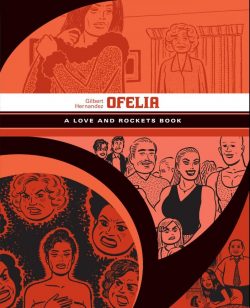
Ofelia – A Love and Rockets Book: 11


By Gilbert Hernandez (Fantagraphics Books)
ISBN: 978-1-60699-806-9 (TPB)

Please pay attention: this book contains stories and images of an extremely adult nature – specifically designed for consumption by mature readers – as well as coarse vulgar language most kids are fluent in by the age of ten.

If reading about such things offends you, please stop now and go away. Tomorrow I’ll do something with violence and explosions, so come back then.

In addition to being part of the ongoing graphic literary revolution that is Love and Rockets (where his astonishingly compulsive tales of Palomar gained vast critical acclaim), Gilbert Hernandez has produced stand-alone tales such as Sloth, Girl Crazy, Julio’s Day and Hypnotwist: all distinguished by his bold, simplified line artwork and sensitive use of the literary techniques of Magical Realist writers Carlos Fuentes and Gabriel García Márquez: techniques which he has added to and made his own.

Love and Rockets – by Gilbert and brothers Jaime and Mario – was/is an anthology comics publication featuring sleek, intriguing, sci-fi-ish larks, heart-warming, gut-wrenching soap-opera fantasies, terrifying manic monster stories and experimental comic narratives that pretty much defy classification. To this day, the Hernandez boys continue to captivate with incredible stories sampling a thousand influences conceptual and actual – everything from Archie Comics and alternative music to German Expressionism and masked wrestlers.

Originally conceived for extended serial Heartbreak Soup, Palomar was a conceptual playground and cultural toybox; an impoverished Latin-American village with a vibrant, funny and fantastically quotidian cast. Everything from life, death, adultery, alien infiltration, magic making, hauntings, serial-killing and especially gossip happened in its meta-fictional environs as Gilbert plundered his own post-punk influences – comics, music, drugs, comics, strong women, gangs, sex, family and comics – in a style informed by everything from Tarzan strips to Saturday morning cartoons and The Lucy Show.

Beto – as he signs himself – returns to Palomar constantly, usually with tales involving formidable matriarch Luba, who ran the village’s bath house and cinema; acted as Mayor and sometimes law enforcer – as well as adding regularly and copiously to the general population. Her children, brought up with no acknowledged fathers in sight, are Maricela, Guadalupe, Doralis, Casimira, Socorro, Joselito and Conchita.

Luba is a character who defies easy description and I don’t actually want to: As one of the most complex women in literature, let alone comics, she’s somebody you need to experience, not learn of second-hand. You will certainly notice that she has absolutely enormous breasts. Deal with it. These stories are casually, graphically, sexually explicit, and appalling violence is also never far from the players lives…

Luba’s story is about Life, and sex and death happen, casually and often, usually to and with the wrong people at the wrong time. If harsh language and cartoon nudity (male and female) are an insurmountable problem for you, don’t read these tales; but it is genuinely your loss.

Throughout all those eventful years, normally always in the background and frequently sidelined, was Luba’s cousin Ofelia: confidante, babysitter, surrogate mum, family conscience and keen – if not especially detached – observer…

After a run of spectacular stories (all of which have been collected in a variety of formats and editions which I really must get around to reviewing in their entirety), the first incarnation of Love and Rockets ended. Luba and her extended family graduated to a succession of mini-series which focussed on her relocation to the USA to reunite with her half-sisters Rosalba (“Fritz”) and Petra Martinez. The tone and content ranged from surreal to sad to funny to thrilling. The entire world can be found in those pages.

Although in an ideal world you would read that aforementioned older material first, there’s absolutely no need to. Reminiscence and the force of memory are as much a part of this potent passion-play as family feeling, music, infidelity, survival, punk rock philosophy, and laughter – lots and lots of laughter.

Brilliantly illustrated, these are human tales as earthy any as any Chaucer’s Pilgrims could tell, as varied and appetising as any of Boccaccio’s Decameron and as universally human as the best of that bloke Shakespeare…

This particular monochrome family album – available in paperback and digital editions -compiles assorted material first seen in Luba #3-9; Luba’s Comics and Stories #2-5 and Measles #3 and sees so-often sidelined “sister” Ofelia notionally promoted to headliner. Following a pictorial reintroduction to ‘Luba’s Family’, the ever-unfolding saga resumes with ‘Remember Me’ as the youngest kids swap tales of the fathers they have never known.

‘Luba and the Little Ones’ finds the ferocious matron calming down her very excitable progeny, beforeSocorro…’details that girl’s educational problems. Apparently, she is too smart and her teachers want her transferred to a special school…

‘The Book of Ofelia Part One’ sees Luba and her mute, maimed and possibly former gangster husband Khamo reeling from the news that their faithful major domo is considering writing a book based on her cousin’s drama-drenched life. With friction mounting, the frustrated author and perennial babysitter casts her mind back to Palomar, where she sacrificed her relationship with lover Rico (“call me Ooli”) to raise a wild toddler called Luba.

Back in the now, wise-beyond-her-years Casimira knows her quiet guardian is in contact with an old flame on the internet…

‘The Book of Ofelia Part Two’ expands on the theme as the prospective writer recalls years of fighting with her wilful, almost elemental charge, whilst pondering a too-long deferred decision…

‘Spot Marks the Ex’ then exposes more family scandals as entrepreneurial Pipo tries to get rid of her former husband Gatoand deal with the ongoing problems caused by Luba’s daughter Doralis.

Much to the sponsors’ horror the teen star of Pipo’s popular Spanish-language kid’s show plans to come out as a lesbian, someone at the studio is giving the newspapers salacious scandals for their holier-than-thou gossip pages and her beloved son Sergio Jimenez (a soccer superstar and celebrity bad boy) is having an affair with Fritz Martinez – the very woman Pipo cannot get out of her own libidinously supercharged mind…

Fritz is a terrifyingly complex creature: psychiatrist, therapist, B-Movie actress, belly dancer, amorous drunk, gun-fetishist, sexually aggressive and a manipulative serial spouse. Beautiful, enticingly emotionally damaged, her “high soft lisp” more likely an affectation than genuine speech impediment, she sashays from crisis to triumph and back again, and (almost) everybody who wants hers can apparently have her – except increasingly impatient Pipo…

Moreover, as strident accountant Boots signs on to save Pipo’s company, the stressed and busy businesswoman begins to suspect Sergio and his stepfather Gato have some strange connection and are up to no good…

‘El Show Super Duper Sensacional Fantastico de Doralis’ reveals the controversial gay star’s story of the irresistibly beguiling merfolk who live in secret amongst us, after which ‘Snail Trail’ introduces well-meaning young Hector who rescues Socorro and Joselito after they steal and crash a car.

He sees and is instantly enchanted by their Tia (that’s Aunt in Spanish, hombre) Fritz in ‘Bromear’ and in ‘Meeting Cute, Fucking Cuter’ falls hopelessly for the sexual predator: so much so, in fact, that he agrees to her request to date her quirky, buff, bodybuilding older sister Petra, thus leaving Fritz free for a sordid secret affair with toyboy acquaintance Sergio…

Sadly, whipped Hector finds he has more in common with Petra’s little daughter Venus. They both love the same comicbooks, movies and music and she doesn’t make him do things he’d rather not…

A garden party bids ‘Buen Viaje, Socorro’ and sees the smart girl’s last family fun before heading off to smart kid boarding school, after which ‘Luba One’ finds the downhearted mum dragged to a fetish party by Fritz and Pipo where she finds blonde sex god Fortunato: a man no woman can resist and a perfect lover who derives no joy from his conquests…

Boots, mindful of the merman legend, speculates on his origins in ‘The Fortunato Files’ after which ‘The Goddess and the Goof’ finds Hector finally capitulating to pressure and taking gloriously gorgeous, Amazonian Petra out only to discover she is every inch as bewitching and satisfying as her sister. Conflicted by a surfeit of physical riches he ponders a big decision…

After a little dance madness in ‘El Biale’, Venus and Doralis share a moment with one of the fallen star’s fans in ‘The Glamorous Life’ whilst ‘Boots Takes the Case’ has the tenacious little accountant assume a larger role. With Gato exposed as the source of the leaks and sorrowfully reaping his reward in ‘And So…’, Boots proceeds to pry out more secrets in ‘Kisses for Pipo’; appraising key moments since the entrepreneur entered America as a teen, disclosing her past interactions with Sergio, Gato (and his current wife Guadalupe), Fortunato and Pipo’s latest fling Igor…

‘In Bed with Pipo’ targets her bizarrely twisted relationship with gun-obsessed Fritz, the men they occasionally share and a terrifying past experience when both were stranded in a country in the midst of an anti-Christian genocide…

Revelations include the horrific tale of how High-School junior Rosalba fell into an abusive relationship with a middle-aged cop, offering telling insights for her modern personas…

‘Luba Two’ delves deep into Khamo’s off-kilter arrangements with both cops and drug dealers whilst – after surreal sight-gag ‘Uno Dos Tres’‘The New Adventures of Venus’ proves the latest generation can be just as determined and violently forceful. When the little comics lover discovers her best friend is a potential romantic rival, Venus takes excessive punitive action on the soccer field…

With the entire world on tenterhooks as a colossal meteor hurtles towards Earth, Fritz’s exploitative ex-husband Scott gets up to his old tricks in ‘The Beloved and the Damned’. He couldn’t have expected the savage beating a mysterious stranger delivers after ripping off kickboxing Petra’s baby sister though.

Unfortunately, the Avenger in question gets a taste for vigilantism and begins looking for other jerks in need of straightening out…

Khamo’s underworld connections then lead to a disquieting abduction and ‘Luba’s Science Lesson’ before ever-more conflicted Hector returns, still unable to choose between Petra and Fritz but currently distracted by his ex-girlfriend taking him to court as part of a whacko ploy to get him back in ‘And Justice for Some’.

That plan goes badly wrong after a stranger beats her to a pulp in the parking lot of the strip club she works at…

Boot’s ongoing investigations resurface as she explains ‘The Tao of Doralis’ before a very stoned ‘Hector‘ rescues non-English-speaking Luba from a bar, leading into flashbacks of ‘Khamo’ and her early days. That long, weird walk home also delivers more revelations about the enigmatic Fortunato before Luba and her taciturn husband at last reconcile in ‘Lovers and Hector’…

Events then take a dark turn in ‘Sergio Rocks’ as the wild child is targeted by gangster gamblers, even as belly-dancing novice ‘Guadalupe’ strives to escape the overwhelming influence of her charismatic Tia Fritz…

Receding Ofelia resurfaces in ‘Luba Again’ as the cousins bitterly and violently argue over the proposed warts-and-all book and, after visual aside ‘Click!’, the determined author visits Socorro in ‘La Luba’ whilst long ostracised Maricela has a rather one-sided chat with step-dad Khamo in ‘Burning for You’…

‘Pipo’s Burden’ revisits her still-growing obsession with Fritz whilst ‘Of Two Minds’ highlights Hector’s suspicions when he attends one of Petra’s boxing bouts and Fortunato works his magic on schoolteacher Guadalupe and Ofelia in ‘But the Little Girls Understand’ after which ‘Luba Three’ ushers in the beginning of the end of this family’s affairs…

‘Fritz and Pipo, Sittin’ in a Tree’ sees Sergio growing aggressively intolerant of his mother’s dilemma whilst still making casual use of Fritz himself. Soon the still-active vigilante has hospitalised the entrepreneur, and more tragedy strikes when Ofelia has a heart attack in ‘God Willing’…

Once the violence begins it seems impossible to stop and in ‘Luba Four’ the so-dysfunctional family splinters even further when an abduction and punishment beating goes too far…

I’m certainly more obtuse – just plain dense or blinkered – than most, but for years I thought this stuff was all about the force of Family Ties, but it’s not: at least not fundamentally. Palomar is about love. Not the sappy one-sided happy-ever-after stuff in chick-flicks, but LOVE, that mighty, hungry beast that makes you instinctively protect the child that betrays you, that has you look for a better partner whilst you’re in the arms of your one true love, and hate the place you wanted to live in all your life. The love of cars and hair-cuts and biscuits and paper-cuts and stray cats that bite you: selfish, self-sacrificing, dutiful, urgent, patient, uncomprehending, a feeling beyond words. A Love that can hurt and even kill…

A bit like the love of a great comic…

Funny, deeply moving, compelling and deftly capable of delivering shock after breathtaking shock, Ofelia is remarkable and unmissable: no true fan of the medium can afford to forego this treat.

All contents © 2015 Gilbert Hernandez. This edition © 2015 Fantagraphics Books. All rights reserved.
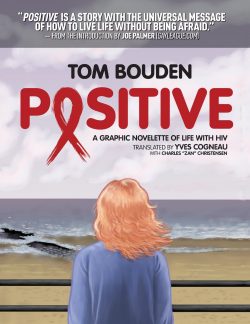
Positive


By Tom Bouden, translated by Yves Cogneau with Charles “Zan” Christensen (Northwest Press)
ISBN: 978-0-98459409-2 (PB)

Here’s something short, sweet and utterly, comfortingly satisfying. Please enjoy.

Human Immunodeficiency Virus is a Lentivirus that attacks the jbody’s immune system. If untreated, the infection usually leads to Acquired Immunodeficiency Syndrome – commonly known as AIDS. For the longest time, the condition was a killer, but can be controlled quite successfully now through a variety of medications, treatments and lifestyle modification.

At its height, the disease ravaged the world, and has killed approximately 38 million people and completely changed global society.

Sadly, how those testing positive for HIV were treated also revealed a lot about the people around them…

This powerful but truly uplifting graphic tome was created in 2008 by Belgian cartoonist Tom Bouden (Max and Sven; The Importance of Being Earnest; In Bed with David & Jonathan; Queerville): a means of exploding idiotic myths and explaining how a positive diagnosis actually changes the life of a someone with the disease and affects those around them.

Subtitled “A Graphic Novelette of Life with Aids”, the charming tale is rendered in a traditional and welcoming Ligne Claire (like Tintin or Blake and Mortimer) style, and laced with plenty of warm humour to balance the tension, fear and pain, and begins eight years ago as young marrieds Sarah and Tim‘s latest row is interrupted by a visit from their doctor…

He has results that explain Sarah’s recent bout of assorted maladies, but needs her to take a second, confirmatory test…

And so begins a methodical discourse as the couple carefully share her diagnosis with friends, family and past intimates, delivered with compassion and sensitivity and braced with actual facts throughout. Navigating various treatments, dealing with work issues and living as normal as life as feasible, Sarah and Tim build support networks, while moving ever onward, embracing bucket lists and pill packs, discarding despair and fostering hope until they reach the stage where they can consider the next positive step… having a child…

Fronted by an emphatically positive Introduction from activist and Gay League executive Joe Palmer, this is a lovely, sensible and above all straightforward examination of HIV in the real world, but parents might want to police these pages if young children are around, as it contains forthright depictions of nudity and lovemaking.
© 2013 Tom Bouden. All rights reserved.
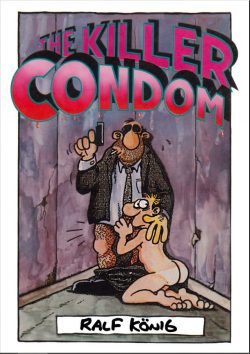
The Killer Condom and Down to the Bone


By Ralf König: translated by Jim Steakley and Jeff Krell (Northwest Press/Ignite! Entertainment)
ISBN: 978-0-96563-238-6 (Killer Condom PB) 978-0-96563-239-3 (Down to the Bone PB)
Digital editions by Northwest Press – no ISBN

Standard Disclaimer: These comedy stories contain rude words, explicit nudity, depictions of graphic and hilarious sexual situations and normal non-Biblical lifestyles. If any of these are likely to offend, what the hell are you doing here anyway?

I’d like to think that most social problems humanity suffers from can be fixed by a little honesty and a lot of communication – especially when it comes to relationships. Being able to laugh together probably helps too. In regard to sexual politics and freedom it’s an attitude Germany adopted decades ago. As a result, the country has an admirable record of acceptance of the LGBTQIA+ community and a broad penetration (yes, I’m awful! And Not Funny!) of gay comics into the general population.

Undisputed king of home-grown graphic novels is Ralf König, a multi-award-winning cartoonist, filmmaker and advocate with almost fifty titles – such as Suck My Duck; Santa Claus Junior; Prototyp; Archetyp; Antityp and Stehaufmännchen– under his belt.

He was born in August 1960 and came out in 1979, crafting an unceasing parade of incisive and hilarious strips and sagas set in and around the nation’s ever-evolving gay scene. Much to his own surprise, he discovered that his work had vaulted the divide from niche market to become a staple of popular mass market book sales. Many of his works have been rereleased as eBooks from Northwest Press.

The two volumes covered here were major sellers all over the world: blending the sordid shock-chic of 1970s American crime films and TV shows like Dirty Harry, The Warriors or Kojak and schlocky Sci Fi-horror (as in Scanners or Critters) with absurdist humour and the delicious notion of New York’s toughest Top Cop being Out, Loud and obnoxiously Proud…

First released in Britain in 1991 and wholly embracing the conceit of being an art house movie, The Killer Condom originally debuted in 1987 as Kondom des Grauens: a whole-hearted genre spoof introducing disgraced and disgraceful New York detective Luigi Macaroni, called on by his reluctant and harassed boss to solve a rash of gory emasculations plaguing the area around the notorious pay-by-the-hour Hotel Quickie.

Brash, gruff and deliberately sleazy, Macaroni is too good a cop to get rid of, despite his brazen attitude, and begins to work just like in every other case his straight colleagues won’t touch. However, as he investigates the brutal street scene he quickly realizes that no human agency is biting the dicks off an escalating stream of unfortunate sinners…

When he picks up a rent boy for a little relief, they too go to the Quickie and soon face terror beyond imagination and every man’s darkest nightmare…

Crafted at a time when HIV/AIDS was ravaging the gay community and scaring the pants off the wider world, this darkly trenchant satire adds a bizarre codicil to the still-ongoing debate about safe sex and condom use, but remains at its core an outrageously funny romp for grown-ups. In 1996, it and sequel Down to the Bone were adapted as a German comedy horror movie, latterly released in America as Killer Condom.
The Killer Condom © 1988 by Editions Kunst der Comics/Ralf König. Revised Edition © 2009, Published by Ignite! Entertainment. All rights reserved.

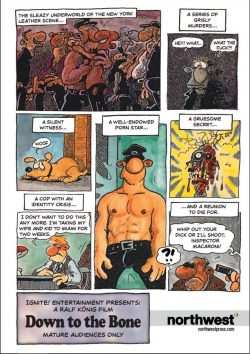
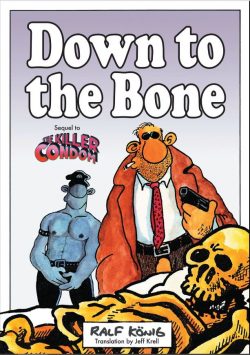
Down to the Bone emerged in 1990. As Bis Auf die Knochen, it heralded the triumphant return of Detective Inspector Macaroni – an even-more embittered man following his failure to maintain a loving relationship. It’s New Year’s in New York and the city is darker and nastier than ever. In the dead of winter, a fresh horror stalks the streets…

When a man hungry for negotiable affection encounters an oddly familiar “leatherman” hooker, it turns into the last trick of his life. Meanwhile, celebrity restauranteur Joe Baluga meets a similar fate, as does another hapless John triggering another campaign of atrocity in the mouldy, worm-infested Big Apple.

This time, it’s not dicks that are disappearing: now entire bodies are being instantly reduced to bleached skeletons and the Captain needs the department’s top Queer to stop the rot. As the third victim is the wealthy son of an infamous billionaire, and just to be safe, the embattled chief assigns painfully straight whitebread Detective Brian Plumley to assist him – affording Macaroni an irresistible opportunity to play pranks and reaffirm his reputation as a total bastard…

As they trawl the leather bars and other outposts of “the scene” they quickly establish an apparent link to the gay porn industry. But other than providing the inspector with a celebrity hook-up, the investigation stalls until a bizarre find proves that what they’re all hunting is far from human…

From there the pieces swiftly fall into place and the escalating horror leads back to an old case involving carnivorous latex prophylactics. With bodies still dropping, Macaroni and a far-more woke Plumley track down an old mad scientist and his ghastly creation and encounter a deranged fundamentalist determined to enforce Biblical mandates at all costs…

Wry, witty, coarsely hysterical, these books marry the surly, unsavoury thrills of urban cop fiction with a bawdily outrageous whimsy that sadly won’t appeal to everybody, but if you love big raucous ludicrous belly laughs with your thrills and chills, these might well become some of your favourite reads.
Down to the Bone © 1990 by Editions Kunst der Comics/Ralf König. Revised Edition © 2011, and published by Ignite! Entertainment. All rights reserved.

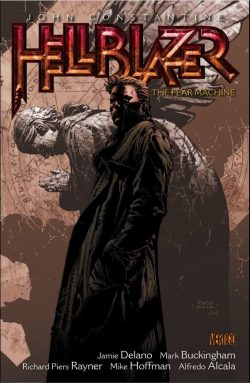
John Constantine, Hellblazer volume 3: The Fear Machine (New Edition)


By Jamie Delano, Richard Piers Rayner, Mike Hoffman, Mark Buckingham, Alfredo Alcala & various (Vertigo/DC Comics)
ISBN: 978-1-4012-3519-2 (TPB)

You’ve either heard of John Constantine by now or you haven’t, so I’ll be as brief as I can. Created by Alan Moore during the early days of his groundbreaking run on Swamp Thing, John Constantine is a mercurial modern wizard, a dissolute chancer who plays like an addict with magic on his own terms for his own ends. He is not a hero. He is not a nice person. Sometimes though, he’s all there is between us and the void…

Given his own series by popular demand, he premiered in the dying days of Reaganite Atrocity in the US but at the height of Thatcherite Barbarism in England, so as we’re singing the same song now – but with second-rate Britain’s Got Talent cover-artist wannabes as leaders – I thought I’d cover a few old gems that might be regaining relevance in the days ahead…

In 1987 Creative Arts and Liberal attitudes were dirty words in many quarters and the readership of Vertigo was pretty easy to profile. Jamie Delano began the series with relatively safe horror plots, introducing us to Constantine’s unpleasant nature, chequered history and odd acquaintances but even then, discriminating fans were aware of a joyously anti-establishment political line and wildly metaphorical underpinnings.

Skinheads, racism, Darwinian politics, gender fluidity, plague, famine, gruesome supernature and more abound in the dark dystopian present of John Constantine – a world of cutting edge mysticism, Cyber-shamanism and political soul-stealing. In Delano’s world the edges between science and magic aren’t blurred – they simply don’t exist.

Some terrors are eternal and some seem inextricably tied to a specific time and place. The Fear Machine (available in paperback and digital formats and collecting issues #14-22 spanning December 1988-September 1989) is an engrossing extended epic which begins in ‘Touching the Earth’ (by Delano, Richard Piers Rayner & Mark Buckingham) as the wizard goes on the run thanks to the tabloid press pillorying him as a sex-crazed Satanist serial killer.

Forced to flee his London comfort-zone, Constantine is adopted by neo-pagan Travellers and journeys through the heartland of Britain. Apparently, these dangerous non-conformists are responsible for all the ills plaguing society of the 1980s and 1990s, just like fat people, the poor and immigrants are today…

Going native amongst the drop-outs, druggies, bath-dodgers and social misfits, Constantine buddies up with an immensely powerful psychic girl named Mercury and her extremely engaging mum, Marj, but even amidst these freewheeling folks he can feel something nasty and unnatural building. The first inkling occurs in ‘Shepherd’s Warning’when Mercury discovers an ancient stone circle has been fenced off by a quasi-governmental company named Geotroniks. It seems someone is trying to shackle Mother Earth’s circulatory system of Ley lines.

Meanwhile elsewhere, people are compelled to kill and mutilate themselves while Geotroniks boffins watch and take notes…

Mercury is abducted when police raid the Travellers’ campsite in ‘Rough Justice’. Imprisoned in a secret complex where the mind’s limits and the Earth’s hidden forces are being radically tested, she witnesses horrors beyond imagining and cutting-edge science. If only the subjects and observing scientists can be persuaded to stop committing suicide…

Mike Hoffman illustrates fourth chapter, ‘Fellow Travellers’ wherein Constantine heads back to London for help in finding Mercury and uncovering Geotroniks’ secrets. He gains one horrific insight when the train he’s on is devastated by a psychic assault which forces the passengers to destroy themselves…

With Buckingham & Alfredo Alcala assuming the art duties, ‘Hate Mail & Love Letters’ begins two months later. Marj and the travellers are hiding in the Scottish Highlands with a fringe group called the Pagan Nation, led by the mysterious Zed – an old friend of the wily trickster. Constantine keeps digging, but across the country, suicide and self-harm are increasing. Society itself seems diseased, but at least the Satanist witch hunt has been forgotten as the bloody pack of Press vultures rage on to their next sanctimonious cause celebre …

Touching base with his precious few police contacts and pet journalists, the metropolitan mage soon stumbles into a fresh aspect of mystery when a Masonic hitman begins removing anyone who might further his enquiries in ‘The Broken Man’. Constantine saves journalist Simon Hughes from assassination in a particularly exotic manner guaranteed to divert attention from his politically-damaging investigations, and discovers new clues. It all points the psychic horror and social unrest being orchestrated by reactionary factions of the government employing a sinister and all-pervasive “Old Boy network”…

And somewhere dark and hidden, Mercury’s captors are opening doors to places mortals were never meant to go…

As the Pagan Nation’s priestesses work subtle magics to find the missing girl and save humanity’s soul, a disgusting, conglomerate beast-thing is maturing, made from fear and pain, greed, suffering and deep black despair: provoking a response from and guest-appearance by Morpheus, the Sandman, which prompts Constantine, Hughes and possibly the last decent copper in London to go hunting…

After picking up another recruit in the form of KGB scientist Sergei in ‘Betrayal’, events spiral ever faster as the Freemasons – or at least their “Magi Caecus” elite – are revealed as organisers of the plot to combine Cold War paranormal research, economic imperialism, divisive Thatcherite self-gratification and the Order’s own quasi-mystical arcana to create a situation in which their guiding principles will dominate society and the physical world. It’s nothing more than a greedy, sleazy power-grab using blood and horror to fuel the engines of change…

All pretence of scientific research at Geotroniks is abandoned in ‘The God of All Gods’ as Masonic hitman Mr. Webstergoes off the deep end, ignoring his own Lodge Grandmaster’s orders to abort the project amidst an escalating national atmosphere of mania. He is determined to free the fearful thing they’ve created and unmake the modern world at all costs. Constantine’s allies are all taken and the wizard is left to fight on alone.

Knee deep in intrigue, conspiracy and spilled guts, humanity is doomed unless Constantine’s band of unhappy brothers and a bunch of Highland witch-women can pull the biggest, bloodiest rabbit out of the mother of all hats in spectacular conclusion ‘Balance’…

The heady blend of authoritarian intransigence, counterculture optimism, espionage action, murder-mystery, conspiracy theories and ancient sex-magic mix perfectly to create an oppressive tract of inexorable terror and shattered hope before an astounding climax forestalls – if not saves – the day of doom, in this extremely impressive dark chronicle which still resonates with the bleak and cheerless zeitgeist of the time.

This is a superb example of true horror fiction, inextricably linking politics, religion, human nature and sheer bloody-mindedness as root cause of all ills. That our best chance of survival is a truly reprehensible, exploitative monomaniac seems a perfect metaphor for the world we’re locked into…

Clever, subversive and painfully prophetic, even at its most outlandish, this tale jabs at the subconscious with its scratchy edginess and jangles the nerves from beginning to end. An unmissable feast for fear fans, humanists and political mavericks everywhere…
© 1989, 2012 DC Comics. All Rights Reserved.

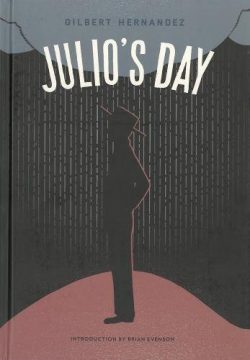
Julio’s Day


By Gilbert Hernandez (Fantagraphics Books)
ISBN: 978-1-60699-606-5 (HB)

In the 1980s a qualitative revolution forever destroyed the clichéd, stereotypical ways different genres of comic strips were produced and marketed. Most prominent in destroying the comfy pigeonholes we’d built for ourselves were three guys from Oxnard, California: Jaime, Mario (occasionally) and Gilberto Hernandez.

Love and Rockets was an anthology magazine featuring slick, intriguing, sci-fi tinted hi-jinx of punky young things Maggie & Hopey – the outrageously beguiling las Locas – as well as heart-warming, terrifying, gut-wrenching soap-opera fantasies from the rural Central American paradise of Palomar.

Supreme synthesists, Los Bros Hernandez enthralled and enchanted with incredible stories that sampled a thousand influences, conceptual and actual; everything from Comics, TV cartoons, masked wrestlers and the emergent exotica of American Hispanic pop culture to iconic German Expressionism. There was also a perpetual backdrop displaying the holy trinity of the young: Sex and Drugs and Rock and Roll – for which please hear alternative music and punk rock.

The result was dynamite. Mario only officially contributed on rare occasions, but Jaime’s slick, enticing visual feasts explored friendship and modern love whilst destroying stereotypes of feminine attraction through his fetching coterie of Gals Gone Wild, whilst “Beto” exhaustively crafted a hyper-authentic rural landscape and playground of wit and passion created for his extended generational saga Heartbreak Soup: a quicksilver chimera of breadline Latin-American village life with a vibrant, funny and fantastically quotidian cast.

Everything from life, death, adultery, magic, serial killing and especially gossip could happen in Palomar’s meta-fictional environs, as the artist mined his own post-punk influences through a powerfully effective primitivist style which blended the stylised mythologies and iconographies of comics, music, recreational drugs, gangs, sex, forceful, capable, dominating women and the inescapable bonds of family using a narrative format which is at the graphic vanguard of Magical Realism.

There’s fiction, there’s Meta-fiction and then there’s Gilbert Hernandez. In addition to his astonishingly captivating Palomar tales he has authored stand-alone books such as Sloth, Grip, Birdland and Girl Crazy, all marked by his boldly compelling, disingenuous artwork and a mature, sensitive adoption of literary techniques by writers like Carlos Fuentes and Gabriel García Márquez: techniques which he has amplified and, visually at least, made his own.

He later played with his own filmic and literary influences – Roger Corman, John Cassavetes, Elmore Leonard and Jim Thompson – breaking new ground by reprocessing the cultural influences forming all us baby-boomers, through “adaptations” of the trashy B-Movies which were perennial plot “maguffins” in his stories. Those became a little more actual in his “adaptations” of thrillers like Chance in Hell, The Troublemakers and Love from the Shadows…

Accruing critical acclaim but seldom financial reward, the brothers eventually went their own ways, but a few years ago creatively reunited to produce annual collections of new material in their particularly peculiar shared – or, rather, adjacent – pen-and-ink universes. This beguiling pictorial elegy began in Love and Rockets volume II, #1 but remained unfinished until completed in this stark evocative monochrome hardback and digital delight.

Here, Gilbert foregoes many signature elements and the frenetic youth-fuelled backdrop he’s famous for to methodically detail the moving life-story of an ordinary man.

Of course, once you start looking. you realise there’s really no such thing as ordinary…

It’s about families and friends, the secrets we must keep and how, even though the World changes, sometimes we just can’t…

I’d be doing you and the author a huge disservice by going into too much detail, but suffice to say that somewhere in Southern California a baby is born in 1900. From the start Julio is nourished and cherished by a loving family – excepting his uncle Juan, whom only the infant’s older sister Sofia realises should be kept well away from all children at all costs…

Over 100 pages, until his passing in 2000, Julio grows up with friends Tommy and Araceli, dimly aware of yet barely affected by humanity’s great crises. Sadly, the uncompromising nature of the times, elements and environment shape the people of the village just as powerfully as any global war or Stock Market crash. One slip in a mere mudslide affects the family for three tragic generations. Moreover, even in such placid outreaches, bullying, cruelty, bigotry and intolerance exist in abundance to mould young hearts and minds…

As he grows to maturity, Julio loses family, makes new friends and comes to realises he has a secret he cannot share with anyone: one that, despite the way the times change society before his very eyes, he simply cannot admit or acknowledge…

Dedicated to the proposition that big history happens somewhere else even as its effects touch us all, this warm-hearted, deceptively heartrending, challenging, and incontrovertibly groundbreaking epic is a grown-up comics fan’s dream come true; proving again just how far the medium has progressed.

From traditional world-saving, anodyne fist-fights, fanciful fantasies and children’s escapism to the likes of Maus, One Bad Rat, Palestine, Persepolis, Pride of Baghdad, Sailor Twain and so many more, comics have evolved until they not only produce material equal to other art forms, but with Julio’s Day – a diamond point at the cutting edge of graphic narrative – have arrived at masterpieces which can only be truly told as graphic narratives…

…As you will surely see…
© 2013 Gilbert Hernandez. This edition © 2013 Fantagraphics Books, Inc. All Rights Reserved.

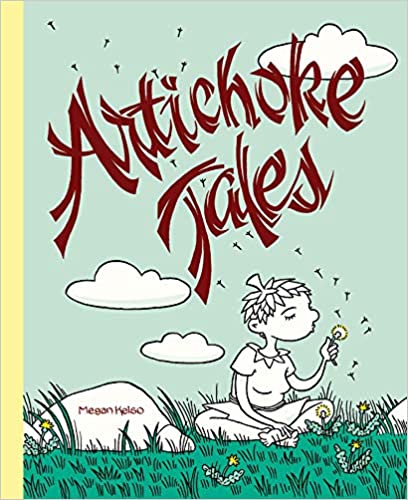
Artichoke Tales


By Megan Kelso (Fantagraphics Books)
ISBN: 978-1-60699-344-6 (HB)

Megan Kelso has been producing unique, idiosyncratic, thought-provoking comics stories for over 30 years; the very best of which can be seen in her award-winning collections Queen of the Black Black and The Squirrel Mother. In 2004 she edited exclusively-female comics anthology Scheherazade: Stories of Love, Treachery, Mothers, and Monsters, following up in 2007 with weekly strip Watergate Sue for The New York Times Magazine.

She works far too slowly for my greedy nature to be completely happy with, but as the results are always superb, I should just be patient and count myself lucky whenever something new hits the bookshelves. Until then, though, here’s another look at my personal fave-rave, happily still available in both hardcover and digital editions…

Artichoke Tales is a generational saga which recounts, like film run backwards, the aftermath, events of and build-up to a tragic and devastating civil war on a serene, stable agrarian culture: a land of farmers, foragers and fisher-folk who all look like they’re sporting vegetable hair-dos. Don’t be fooled though – despite the stalks sprouting from their skulls these are not Arcadian vegan characters dreamily dwelling in their own sylvan Pogle’s Wood: these are people, gullible, fallible and intensely complex.

Kelso first created her artichoke people for a tale in anthology comic Girlhero, before beginning this epic in 1999; citing such thematic influences as the Little House on the Prairie books, Colleen McCullough’s The Thorn Birds and Anthony Minghella’s Cold Mountain for her gently compelling, beguiling story of the Quicksand family – apothecaries to the village of Ladle – and how an insane and unwelcome split between North and South sorely wounds not only the nation but three generations of women caught up in it…

Young Brigitte was gathering herbs for her grandmother when she once again met the dashing soldier Adam. Military types weren’t particularly welcome and Northerners even less so, despite all the years that had passed since the War, but young hormones and the promise of something fresh and exotic always win out over common sense…

Torn between imminent passion, a sudden hatred for her boring old life and fear of the unknown. Brigitte forces Grandma Charlotte to tell the previously unspoken history of the conflict and how it shaped the Quicksand family: a tale of pride, high-handedness and avoidable mistakes that led to those bitter prejudices which still scar people on every side.

Told in a stunning minimalist manner demanding the reader’s closest scrutiny and collaboration, the refined drawings unfold stories within stories, like the skin of an onion, with truths peeling away to reveal some depressingly universal truths about families, society and the use of power.

Be warned: despite the engagingly simple art and storytelling style, this is not a book for younger readers, so parents should read this beautiful parable before you let your kids at it…

Those of you without impressionable progeny can just go right ahead and dig in: Artichoke Tales is truly magical and awaits your avid, appreciative attention and consumption…
© 2010 Megan Kelso. All Rights Reserved.

War Stories volume 1


By Garth Ennis, David Lloyd, Chris Weston, Gary Erskine, John Higgins & Dave Gibbons & various (Avatar Press)
ISBN 978-1-59291-238-4 (TPB)

Garth Ennis is a devout aficionado of the British combat comics, strip and stories he read as a lad. He’s also a major writer of mature-audience fiction with a distinct voice and two discrete senses of humour. In 2004, he demonstrated this lifelong affection for the past and his unique viewpoint in an occasional series of WWII one-shots for DC’s Vertigo imprint. The tales were graced by an impressive cast of illustrators assembled to produce some of their finest work.

The first four of these were collected a few years later in War Stories from Vertigo/DC and again in 2015 via Avatar Press in both trade paperback and digital editions. They remain a true highpoint in the history of combat comics, with this edition closed by Ennis’ Afterword, detailing the historical events that formed the basis of these astounding fictionalised encounters, plus a bibliography of sources used to craft them.

Kicking off the Big Show and limned by Chris Weston & Gary Erskine, “Johann’s Tiger” charts the retreat of a Panzer crew from both the Russians and their own Nazi Field Police, with their guilt-wracked commander urgently seeking Americans he can safely surrender to…

Set in 1944 and illustrated by John Higgins, the next mini saga sees raw English posh boy Second Lieutenant Ross join a combat unit of Ulstermen slogging their way through the supposedly “cushy” part of the war – namely the 20-month campaign to re-take Italy. It’s no picnic and mental health is not a priority, especially with the Nazis and booby traps and disparaging remarks in Parliament by Lady Astor who apparently deems their slow, bloody demise the work of “The D-Day Dodgers”…

Dave Gibbons illuminates a thoroughly unconventional take on boots-on-the-ground America’s contribution in “The Screaming Eagles”, wherein a squad of weary G.I.s take an unsanctioned – and thoroughly debauched – furlough in a palatial chateau only recently abandoned by Nazi top brass. With time to decompress, minds turn to pleasure and peace, but the war isn’t that far away…

David Lloyd then closes this volume (the first of two) with the moody and moving “Nightingale”: Ennis’ painfully powerful tale of dishonour and redemption featuring a British Destroyer on escort duty and the sorry fate of those who chase death in the name of duty…

These are not tales for children. Due to Ennis’s immense skill as a scripter and his innate understanding of ordinary people in extraordinary circumstances these stories strike home, and strike hard whether the author is aiming for gallows humour or lambasting Establishments always happy to send fodder to slaughter.

The visuals, from a brave band of Britain’s finest artists, are equally uncompromising: offering dangerous visions nobody should ever see except as a warning or in a nightmare. This is not glorious. This is madness made to stop future insanity and honour the lost.

These are the realest of people. This is war as I fear it actually is, and it makes bloody good reading.
© 2015 Avatar Press. Afterword © 2015 Garth Ennis. WAR STORY: JOHANN’S TIGER © 2015 Garth Ennis & Chris Weston. WAR STORY: D-DAY DODGERS © 2015 Garth Ennis & John Higgins. WAR STORY: SCREAMING EAGLES © 2015 Garth Ennis & Dave Gibbons. WAR STORY: NIGHTINGALE © 2015 Garth Ennis & David Lloyd.

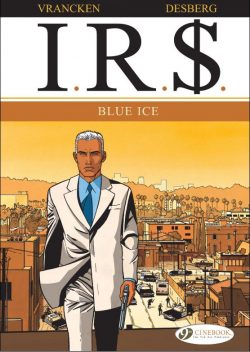
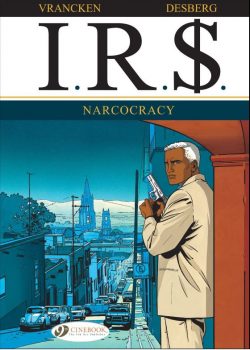
I.R.$. volume 2: Blue Ice


By Vranken & Desberg; coloured by Coquelicot and translated by Luke Spear (Cinebook)
ISBN: 978-1-905460-74-8 (Album PB)

As I’ve perpetually stated, the most appealing aspect of European comics is the sheer breadth of genres, styles and age-ranges their efforts address and their huge readerships support. Thus, this quirky exceedingly readable, all-action Franco-Belgian thriller-series with a tantalising twist offering a deliciously different spin on the tried-and-true trope of driven mystery-man superspy.

The unlikely champion of these sagas is a civil servant with the US government, which once upon a time started employing super-cool, infallibly effective special agents to go after the type of tax-dodger totally beyond the reach of the law. Maybe one day, fact will pilfer from fiction and perhaps every nation will have one…

Belgian writer Stephen Desberg is one of France’s most popular comics authors. He was born in Brussels in 1954, son of an American lawyer (the European distribution agent for Metro-Goldwyn Mayer) and a French mother. Stephen began studying law at Université Libre de Bruxelles but dropped out to follow a winding path into the comics biz.

He began with plots and eventually scripts for Will (Willy Maltaite) on Tif et Tondu in Le Journal de Spirou, growing into a reliable jobbing scribe on established strips for younger readers before launching his own (the Stéphane Colman illustrated) Billy the Cat (a funny animal strip, not the DC Thomson superhero series).

Thereafter came 421 with Eric Maltaite, Arkel (Marc Hardy), Jimmy Tousseul (with Daniel Desorgher) and many others. During the 1980s he gradually redirected his efforts to material for older readerships (such as The Garden of Desire) and in 1999 created contemporary thriller IR$. Historical conspiracy thriller Le Scorpion joined his catalogue of hits a year later.

Bernard Vranken was an award-winning artist by the time he was fifteen. A year later he was working for Le Journal deTintin. Whilst studying architecture at Saint-Luc, he took some comics courses by legendary illustrator Eddy Paape at St. Gilles and his true career-path was set.

Vranken was crafting short stories for A Suivre when he met Desberg. In 1996 they collaborated for the first time on epic romance Le Sang Noir. Three years later they traded love for money with I.R.$.…

The premise is simple and delicious, and Cinebook’s second translated English edition from 2009 once again doubles the bang for your buck by combining third and fourth European albums – Blue Ice and Narcocratie – into one compelling compilation.

Blue Ice (originally released in 2001) opens with stylish American bean-counter Larry B. Max relaxing in his sumptuous home. The quiet start offers the observant reader a few hints into Larry’s past – and motivations – before he renews his odd, long-distance, anonymous relationship with favourite chat-line girl Gloria Paradise.

Larry hates complications in his life but there’s just something about her voice and attitude…

A little later he attends a piano rehearsal and promises his little sister he’ll be there for the recital on Friday. It’s just asking for trouble…

Meanwhile downtown, three very bad men are meeting excessively violent ends while Los Angeles airport sees an American passenger from Mexico trigger a wave of security alerts. Typically, though, just too late for the inattentive security staff to do more than watch him spectacularly disappear into the city, leaving two dead agents behind…

Later at DEA HQ, a high-level meeting of numerous Federal agencies convenes to discuss Ryan Ricks. During his tour in Vietnam, Ricks began managing the money of his platoon-mates, subsequently using it to make a killing on the Stock Exchange.

Slightly wounded, he then shipped out for home to be eagerly pursued by finance houses who saw his unique gift for using money and making it. Ricks settled in at a major tobacco company and started creating wealth…

Nobody noticed – or perhaps cared – that Ricks was making side-deals, nor that being utterly amoral, he went where the money was to be easily found: terrorist nations…

When the IRS found out he was using dirty cash to make the company more money – and making himself fabulously rich at the same time – Ryan was fired. He claimed to have no understanding of why terrorist money was bad, while profits from giving people cancer was good…

Ricks was a man ahead of his time. Even before the Cold War ended, he was saying New Capitalism would be beyond any laws, and consequently pursued that philosophy to its logical extreme. Specialising in creating off-shore accounts, he became the world’s greatest money-launderer, devising an international network for tax evasion.

That’s when Larry Max first encountered him, but the wily finance wizard simply vanished, with a swathe of alphabetised American agencies waiting for him to turn up ever since…

Now twelve years later he’s back in the USA, so scores can be settled and pride regained. However, some bigwigs are unconvinced. With so many major players in the Monterrey Cartel gunned down in the street, the feds would rather concentrate on a clearly-brewing turf war than some nebulous cash-converter.

Late-arriving Larry is “only” a tax collector, not a true cop, but he can’t help wondering why they all think the events are unconnected…

Consulting his own researches, Mr Max coolly exposes a traitor in the cross-agency conclave and foresees things becoming extremely dramatic for the Monterrey Cartel, but is fobbed off with only two agents to assist him. Hanson‘s shadowy spook-show has access to covert satellite surveillance and phone monitoring whereas Ella Hidalgo of DEA is a stone killer everyone calls “Blue Ice”. She’s going to be useful once lead starts flying…

Across the border, the prediction has already come true. Aged, untouchable head of the clan Dion Monterrey has begun cleaning house, eradicating all dissent before heading to LA for the most important meeting of his life…

Aided by cutting-edge covert spy technology, the hunt for Ricks moves into high gear and it’s not long before Larry and Hildalgo are quietly closing in. Then, a second traitor inadvertently tips his hand too soon and the astounded IRS agent has the key piece of information he needs to complete the puzzle…

Ultimate harbinger of unfettered Free Enterprise, Ricks has returned to America because he’s acting as facilitator for the deal of the ages: selling off one of world’s largest drugs cartels…

Larry is not satisfied. The facts simply don’t add up, and as he ponders the mystery and sweats the details, Ricks is closing the deal and Dion is ensuring there’s no one left to contest the sale…

With every party understandably edgy, the final handover is set to occur on the roof of a luxury shopping mall. While fanatical Ricks describes the way business will be conducted in the until-now inefficiently managed, under-exploited market of modern coke consumption, the good guys quietly close in but they have grossly underestimated the guile and paranoia of their targets. Soon the entire scene is a hellish firefight of lethal proportions…

As ever, the end result is a pile of bodies, massive collateral damage and Ricks a ghost in the wind, but this time Larry is hot on his tail…

Without pause for breath the story concludes in Narcocracy as Max arrives in Tijuana, just as the next move in Ricks’ grand strategy goes live: acquisition and expansion…

Before dawn breaks in the seedy hellhole, many of the proud cartel hold-outs opposing the new order are gone and the game plan is clear. It’s not consolidation or merger Ricks and his mystery backers have in mind for the already lucrative drug trade, it’s a hostile takeover…

The only fly in the ointment is a certain white-haired American implacably following the money magician everywhere: someone proving utterly impossible to kill…

Help comes from a most unexpected quarter as the Mexican Federal Bureau of Narcotics picks up the taxman, claiming he’s about to blow a massive sting operation. Larry keeps his thoughts to himself when meeting the country’s top brass to warn them of Rick’s current ambitious activities. After all, money talks; he’s in a country notorious for corruption and the wizard of wealth-creation has more cash than any other crook in the world…

Soon Max is partnered with the Bureau’s top investigators and chasing his elusive quarry, but even though Larry knows a trap is waiting to spring somewhere, he’s not sure when or who’s going to trigger it. Moreover, behind all the double-dealing and staggering slaughter, he can perceive the kind of chicanery only real, Harvard-style business types are capable of.

All he has to do is find out who and prove it…

Inevitably the hammer falls and bodies drop again. For a moment, it looks like someone’s going to miss a piano concert…

Complex, fast-paced, suspenseful and incredibly violent, this yarn is pure movie blockbuster: a sleek, lithe action-fest to seduce any thriller addict. IR$ is a splendidly effective, stylishly gritty series to delight fans of modern mayhem in all it’s artistic forms.

Only death and taxes are inescapable, and Larry B. Max offers either or both in one suavely economical package…
Original edition © 1977 Editions du Lombard (Le Lombard/Dargaud SA) 2001-2002 by Desberg &Vrancken. English translation 2008 © Cinebook Ltd.

Bosnian Flat Dog


By Max Andersson & Lars Sjunnesson (Fantagraphics Books)
ISBN: 978-1-56097-740-7 (PB)

Very much in the far-too-large category of “why is this out of print and not available digitally?”, here’s a bizarre treat from long ago that you can still find with luck and persistence. And you should…

This manic lost gem is a startling and powerful excursion into the “collective unconsciousness of the Balkans” which resulted in a surprisingly compelling and funny tale from two of Sweden’s finest comic makers. It first emerged appeared in Death & Candy #2-4 before being remastered for this deliciously dark and daft tome which broke loose in 2006. Ostensibly, this is the account of a journey by the creators to Slovenia and an alternative cartoonists convention that spirals inescapably into a manic road-movie quest.

Just after they decide to reimburse an old friend for a story they had “borrowed” for their latest comic creation, an out-of-control ice cream truck begins shooting at them. After miraculously surviving, they discover amongst the debris an engraved grenade shell with the word “Sarajevo” on it. Taking this as sign that they must do the right thing, they resolutely embark on a Kafka-esque trip to the troubled Balkans. Along the way they encounter zombies, mummies, war atrocities and a man who has a refrigerator in his car containing the corpse of Marshal Tito (look him up if you have to and, in your next life, stay awake in history class).

Not to mention that rare breed of hound: The Bosnian Flat Dog…

More treatise than adventure, and savagely underpinned by the appalling realities of the Sarajevo crisis at its worst, this thought-provoking psycho-comedy has compelling pictures, dark whimsy and enough fourth-wall contravention to supply the reader with much metaphysical and social meat to digest long after they’ve finished reading. As surreal as it seems, though, there is still a distressing amount of truth still to be found amid the icons of the fantasy world. This is a damned compelling book if you want a read that will wake you up and not lull you to sleep.
© 2006 Max Andersson & Lars Sjunnesson. All rights reserved.

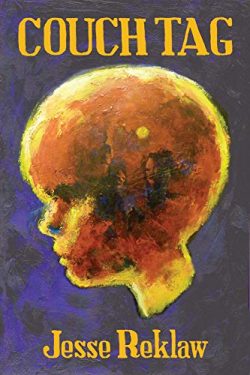
Couch Tag


By Jesse Reklaw (Fantagraphics Books)
ISBN: 978-1-60699-676-8

In modern trend for graphic novels combining autobiography with a touch of therapy as they recount the lives of their authors is well established now, but once such “tragicomics” were a scarce but inviting commodity. Immensely appealing and frequently painfully unforgettable, they prove our medium fully capable of tackling the most contentious issues. One of the most moving and impressive came from veteran Indie cartoonist and mini comics self-publisher Jessie (Dreamtoons; Ten Thousand Things to Do; Lovf: An Illustrated Vision Quest of a Man Losing His Mind) Reklaw: who’s generated unmissable thought-provoking strips and stories since 1995 when he was working towards his doctorate in Artificial Intelligence.

Born in Berkley, California in 1971, he grew up in Sacramento before attending UC Santa Cruz and Yale, and his earliest publications – just like most of his modern output – delved into the phenomena and imagery of dreams. The experimental Concave Up led to syndicated weekly strip dream-diary Slow Wave, which uses readers’ contributions as the basis of the episodes. It ran from 1995 to 2012 in both printed periodicals and as a webcomic and is sorely missed.

His graphic autobiography is just as beguiling: a life reduced to brief vignettes serially grouped into 5 innocuous-seeming chapters which, through cleverly layered and carefully tailored reminiscences, describe Recklaw’s strangely unconventional (if not actually dysfunctional) family and personal struggle for stability.

Primarily crafted in monochrome wash, the history sessions begin with ‘Thirteen Cats of My Childhood‘ – which older readers will recognises from Houghton Mifflin’s Best American Comics 2006, where it was also published – wherein succinct and ferociously functional recollections of a succession of ill-starred family pets serves as a splendid and powerfully effective narrative conceit to introduce the far from ordinary Walker clan.

By following the brief lives of ‘Black Star’, ‘Frosty’, ‘The Triplets’, ‘Mischief’, ‘Figgy Pudding’, ‘Gene’, ‘Survivor’,‘Tiger’, ‘Boots’ and ‘Harry’, we see a family of decidedly alternative outlook whilst also relating the rules of the furniture-based children’s game which gives this book its title.

‘A Note About Names Part One’ follows, revealing more about the sensibilities of the author’s parents, after which ‘Toys I Loved’ continues the amazingly instructive anecdotes about formative influences, as games and playthings act as keys to memory in increasingly unsettling, discordant and disturbing tales beginning in infancy with cuddly toy ‘Ruff-Ruff’ and skipping through a childhood dotted with sibling rivalries and sporadic best-friendships.

Jess, Sis, Mom and “Daddy Bill” are all defined courtesy of ‘The Mask’, ‘Me’s’, ‘Blankie’, ‘Sprinkler’, ‘Play-Doh’, ‘Stretch Armstrong’, ‘Six-Million-Dollar Man’, ‘The Hulk’, ‘Firecrackers’, ‘Green Cup’, ‘Diecast Robots’, ‘Drawers’, ‘Comic Books’, ‘Action Figures’, ‘Dirt Pile’, ‘Doll House’ and ‘Barbies’, before the life-changing advent of ‘Dungeons & Dragons’…

‘The Fred Robinson Story’ details the potentially obsessive nature of teenage pranks with Jess and like-minded buddy Brendan – over a number of years – bombarding a complete stranger with a barrage of creative celebration; turning a random name in a phone book into the recipient of odd gifts and star of music and handmade comic books in ‘The Box’.

The lads develop their musical tendencies in ‘Los Angeles’ and penchant for creative vandalism in ‘Batsigns’, before returning to their lengthy cartooning crusade in ‘Fred Robinson X-ing’: relating how the prank publishing campaign mushroomed and Brendan’s girlfriend Kristin changes the status quo, after which Jess gets a ‘Letter from Norway’ and‘Better Fred’ reveals how things eventually ended…

‘The Stacked Deck’ recounts educational episodes and memorable moments resulting from the entire extended family’s passion for card games and tendency towards compulsive behaviour, as seen in ‘War’, ‘Go Fish’, ‘Spades’, ‘Pinochle’,‘Crazy Eights’, ‘Speed’, ‘Poker’, ’31’, ‘Rummy’, ‘Solitaire’, ‘Spite & Malice’ and ‘Ascension’…

Final chapter ‘Lessoned’ is delivered in a succession of distressed colour-segments: raw and disturbing pages of evocative collage and experimental narrative dealing out a unique tarot set of A-to-Z insights and disclosures, beginning with ‘Adults’, ‘Birth’ and ‘the Crash’.

Ranging between early days and contemporary times, the alphabetical summary and keen self-diagnosis continues with ‘Disease’, ‘Earache’, ‘Family’, ‘Gifted’, ‘Humor’ and ‘Invulnerability’, turning a corner towards understanding with ‘Joint’, ‘Kiersey Test’, ‘Legal Guardian’, ‘Melancholic’, ‘Number’ and ‘Obsession’.

After cleverly addressing the revelations of the author’s bipolar mood disorder and explosive determination to take control of his life by rejecting sickness and weakness, ‘Phlegmatic’, ‘Question’, ‘Role-Playing’, ‘Sanguine’, ‘Tests’ and ‘Unconscious’ carry the account to a new normal with ‘the Vandal’, ‘Walker’, ‘X-Mas’, ‘Yesterday’ and ‘Zero’.

Bleak yet uplifting, nostalgic and distressing, harsh and blackly funny, Couch Tag is a devastatingly moving account of coping with adverse heredity, sexual deviancy, social nonconformity and familial discord which I suspect could only be told in comics.

This is not a book everyone can like, but it’s definitely a story to resonate with anyone who has felt alone, odd or different.

And surely that’s all of us at some time…
© 2013 Jesse Reklaw. This edition © 2013 Fantagraphics Books, Inc. All rights reserved.