
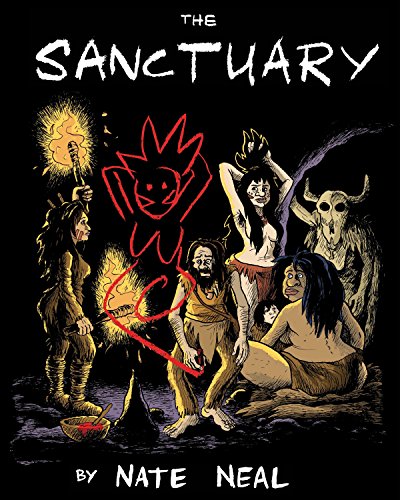
The Sanctuary


By Nate Neal (Fantagraphics Books)
ISBN: 978-1-60699-388-0 (TPB)

Nowadays there’s a wonderful abundance of impressive and talented cartoonists crafting superbly thought-provoking comics all over the world. Moreover, they are all blessed with perfect timing, in that they’re more or less able to support themselves by their efforts, thanks to modern technology and markets. Formerly in America, the imaginative likes of Kirby, Ditko and even R. Crumb had to filter themselves through a system of editors, publishers and distributors to get their work to readers, surrendering control and rights in the process. Other countries also monetised talent and imagination in similar ways, always to the detriment of the creative force at the centre.

In our freshly liberated modern crucible, ideas can take you anywhere and religious ideologues, self-righteous pressure groups, blinkered editors and fear of lost sales have only negligible effect: indeed, assorted squeals of outrage or timid support for unconventional thoughts and images can actually help potentially contentious or uncommercial graphic material reach the audiences it was actually intended for.

Which is a very roundabout and longwinded way to introduce today’s golden oldie. Not that Nate Neal’s first graphic novel was ever particularly contentious or outrageous. Even though there is nudity, fornication, wanton violence and gleeful irreverence, what mostly comes through in The Sanctuary is the arduous effort and intelligent philosophical questioning in this primordial tale of a band of cave-dwellers living and dying at the nativity of our greatest inventions… language and art.

Neal (Spongebob Comics) is Michigan born and Brooklyn dwelling: one of the creative crew that launched splendid indie comics anthology Hoax with Eleanor Davis, Dash Shaw & Hans Rickheit. He has crafted a string of impressive colour and monochrome pieces such as ‘Delia’s Love’, ‘Mindforkin” and ‘Fruition’ in Fantagraphics’ stunning and much-missed arts periodical Mome. His high-profile commercial gigs include Truckhead for Nickelodeon Magazine and Mad‘s perennial favourite Spy Vs. Spy (originally created by Antonio Prohias and since covered by such diverse lights as Dave Manak and Peter Kuper).

Like kitsch movie masterpieces When Dinosaurs Ruled the Earth and 1,000,000 Years B.C. , this primeval parable is produced with a unique and supremely limited intrinsic language (which, if you pay attention, you will readily decipher) serving to focus the reader on the meat of the tale: how art and graphic narrative became a fundamental aspect of human cognition.

Please don’t be put off by my jokey references to classic bubblegum cinema; The Sanctuary has far more in common with the antediluvian aspects of Alan Moore’s Voice of the Fire than with any “big lizard meets busty cave-babe” flick (although if you’re a fan of Quest for Fire, that film’s gritty, grey and darkly sardonic ethos does eerily resonate here…)

Largely silent and broadly pantomimic, the snapshot episodes in this bleak black-&-white generational saga describe a small clan – or more properly “pack” – of brutal hominids eking out a squalid and desperate existence about thirty-two thousand years ago. The tribal equilibrium is forever altered when a young female is traded to them, affording the lowest-ranked male in the group a crumb of physical comfort. Prior to this, he was practically outcast, having to steal food from the alpha males – and females – who have been and continue to struggle for control of the group.

This omega-male has a gift and a passion. He obsessively commemorates the tribe’s hunts through art, but after the girl arrives, he discovers a new use and purpose for his propensities. However, life is hard and hunger and danger go hand in hand. The cold war between young and old, fit and maimed, male and female is inevitably boiling over…

This is a powerful tale about creativity, morality, verity and above all, responsibility which demands that the reader work for his reward. As an exploration of imagination, it is subtly enticing, but as an examination of Mankind’s unchanging primal nature The Sanctuary is pitilessly honest. Abstract, symbolic, metaphorical yet gloriously approachable, this devastatingly clever saga is a “must-see” for any serious fan of comics and every student of the human condition.
© 2010 Nate Neal. All rights reserved.

Velveteen & Mandala


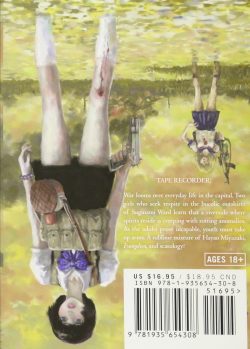
By Jiro Matsumoto (Vertical)
ISBN: 978-1-935654-30-8 (Tankōbon PB)

Things have been a bit too much sweetness and light around here lately. Here’s a change of pace and taste then then needs a bit of an advisory warning. This book revels in gratuitous violence, barely-closeted misogyny and sexualised imagery. So why, then, is it so very good?

Civilisation has radically changed. What we knew is no longer right or true, but disturbing remnants remain to baffle and terrify, as High School girl Velveteen and her decidedly off-key classmate and companion/enemy Mandala eke out an extreme existence on the banks of a river in post-Zombie-Apocalypse Tokyo.

Here (with straight-faced nods to Tank Girl), using an abandoned battle-wagon as their crash-pad, the girls while away the days and nights casually slaughtering roaming hordes of zombies – at least whenever they can stop squabbling with each other…

From the very outset of this grim, sexy, gratuitous splatter-punk horror-show there is something decidedly “off” going on: a gory mystery beyond the usual “how did the world end this time?”

On the surface, Velveteen & Mandala (Becchin To Mandara in its original 14-chapter run between 2007-2009 in the periodical Manga Erotics F) is a monster-killing yarn which owes plenty to Buffy the Vampire Slayer, but there’s more than meets the eye or ballistic charge happening here.

We begin at ‘The Riverside’ with the pair awaking from dreams to realise and remember the hell they now inhabit. Cunning catch-up concluded, ‘Smoke on the Riverside’ then reveals a few of the nastier ground-rules of their current lifestyle, and especially Velveteen’s propensity for arson and appetite for destruction…

‘Sukiyaki’ finds the girls on edge as food becomes an issue, whilst the introduction of ‘The Super’ who monitors their rate of zombie dispatch leads to more information (but not necessarily any answers) in this enigmatic world, after which ‘The Cellar’ amps up the uncertainty as Velveteen steals into her new boss’s ghastly man-cave inner sanctum…

In a medium where extreme violence is commonplace, Matsumoto increasingly uses unglamourised nudity and brusque vulgarity to unsettle and shock the reader, but the flashback events of … ‘School Arcade, Underground Shelter’ – if true and not delusion – indicate that a society this debased might not be worth saving from the undead…

In ‘Omen’ and ‘Good Omen (Whisper)’ the obfuscating mysteries begins to clear as B52 bombers dumps thousands more corpses by the Riverside, adding to the “to do” roster of walking dead the girls must deal with once darkness falls…

Throughout the story Matsumoto liberally injects cool artefacts of fashion, genre and pop-culture seemingly at random, but as the oppressive horrors get ever closer to ending our heroines in ‘Genocide’ and ‘Deep in the Dark’, a certain sense can be imagined, so that once the Super is removed and Velveteen promoted to his position in ‘Parting’, the drama spirals into a hallucinogenic – possibly untrustworthy – climax for ‘Mandala’s Big Farewell Party’ and ‘Nirvana’ before the further revelations of ‘Flight’…

Deliberately misleading and untrustworthy – and strictly aimed at over-18s – this dark, nasty, scatologically excessive tale graphically celebrates the differences between grotesque, flesh-eating dead-things and the constantly biologically mis-functioning Still-Living (although the zombie “Deadizens” are still capable of cognition, speech and rape…); all wrapped up in the culturally acceptable and traditional manner of one blowing the stuffings out of the other…

Confirmed confrontationalist Jiro Matsumoto (Uncivilized Planet, Avant-Pop Mars, A Revolutionist in the Afternoon, Tropical Citron) is probably best known for dystopian speculative sci-fi revenge thriller Freesia, but here his controversial yet sublime narrative gifts are turned to a much more psychologically complex – almost meta-fictional – layering of meaning upon revelation upon contention, indicating that if you have a strong enough stomach the very best is still to come…

First seen in English as a monochrome paperback in 2011, this stand-alone saga will be available in digital formats later this year.
© 2009 Jiro Matsumoto. All right reserved. Translation © 2011 Vertical, Inc.

Sumo


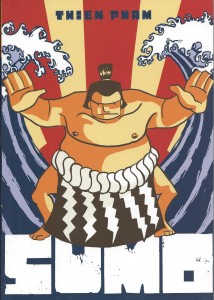
By Thien Pham (First Second)
ISBN: 978-1-59643-581-0 (PB)

This book is about looking.

The magically multi and cross-cultural nature of pictures mixed with words continually generates a wealth of absolutely fantastic and improbable gems for readers with eyes and minds wide open. Back in 2012, this deliciously absorbing visual poem instantly became one of my favourite tomes: an elegiac and gently enthralling visual experiences of a kind I’ve seldom encountered in many a year, and one I often return to.

It’s all about pasts and futures…

The tale begins in a Japanese Dojo as another rikishi in training greets the dawn. He carries out his assigned chores and exercises with the other jonokuchi in the heya training stable. Despite his superior strength, size and speed, he is again knocked out. The supervising oyakata is in despair and doubts the spirit and determination of his latest find…

Scott once thought he was a big man in every sense of the term, but the glory days of High School Football never turned into the glittering, lucrative Pro career he dreamed of. Somehow, he ended up in his small town of Campbell with his best buddies, drinking beer and wasting his days.

When adored girlfriend Gwen dumped him, even that shallow, pointless life needed to end. They had been together since grade school…

Years ago, a visiting Japanese Sumo trainer had watched the boy play and never forgotten the warrior spirit he saw displayed in that sports arena. When the venerable gentleman offered a chance for fame and glory, Scott thought long and hard…

With nothing to lose, Scott accepted a bizarre offer: move to Japan and try out as a junior wrestler in the decidedly un-All-American enterprise known as Sumo…

This is a hard look at expectations and second chances…

The transition hasn’t been what he expected or hoped for. They dyed his hair and changed his name since all Sumo have professional shikona stage-names and looks. Only now “Hakugei” is failing again. If it wasn’t for the trainer’s daughter Asami and the idyllic occasional break spent fishing, this new life would be as intolerable as his old one…

This story is about striving…

With time fast running out, Hakugei must decide what he really wants and has to do it before the last match of the mae-zumo tournament. He has to win at least one bout or be sent home in disgrace …and he’s just lost the fourth one in a row…

It’s all about the build-up towards tension’s inevitable release…

This surprisingly contemplative and lyrical exploration of love, hope, honour and gigantic nearly-naked men bitch-slapping each other in truly explosive manner effortlessly blends and intercuts flashbacks and real time to craft a sublimely skilful and colourfully emotive experience. Cartoonist and teacher Thien Pham (Level Up) hypnotically and enthrallingly marries two wildly disparate worlds to produce an enchanting and thoughtful story that will delight and astound. This is a graphic novel you too will read over and over again.
© 2012 Thien Pham. All rights reserved.

Maybe… Maybe Not and Maybe… Maybe Not Again!


By Ralf König, translated by Jeff Krell (Northwest Press)
No ISBNs:

I’d like to think that most of the social problems humanity suffers from can be fixed by a little honesty and a lot of communication – especially when it comes to relationships. Being able to laugh together probably helps too. In regard to sexual politics and freedom it’s an attitude Germany adopted decades ago. As a result, the country has an admirable record of acceptance of the LGBTQ community and a broad penetration (yes, I’m awful! And Not Funny!) of gay comics into the general population.

Undisputed king of home-grown graphic novels is Ralf König, a multi-award-winning cartoonist, filmmaker and advocate with almost fifty titles (such as Suck My Duck, Santa Claus Junior, Stehaufmännchen, and Kondom des Grauens – released in Britain as The Killer Condom) under his belt.

He was born in August 1960 and came out in 1979, crafting an unceasing parade of incisive and hilarious strips and sagas set in and around the nation’s ever-evolving gay scene. Much to his own surprise, he discovered that his work had vaulted the divide from niche market to become a staple of popular mass market book sales. The two collections covered here – curated, “Foreworded” and translated by American cartoonist Jeff Krell (creator of gay domestic sitcom strip Jayson) and available as eBooks from Northwest Press even inspired the largest grossing film in German history…

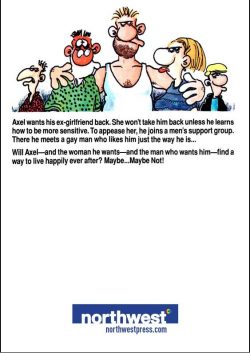
Originally published as Der Bewegte Mann in 1987 (and appearing in a UK paperback from Ignite! Entertainment in 2005 if you can find it), Maybe… Maybe Not introduces a cool and comfortable group of gay men enjoying their glamourous, gossipy days and nights in Dusseldorf. However, after ambiguous – and curious – hetero hunk Axel enters their lives, Walter Ruhmann AKA Waltrina and Norbert find composure increasingly rocked and jarred out of kilter…

After failing to trick his girlfriend Doro into taking him back via a fake suicide attempt, Axel rudely returns to the Men’s Support Group where Waltrina acts as the expert voice on homosexuality and related issues as a representative of the Dusseldorf Gay Alliance.

Waltrina cannot take his eyes off Axel, and astonishingly, über-macho Axel seemingly responds. Maybe he’s not totally ‘On the Straight and Narrow’…

The confusion mounts in ‘Clothes Make the Man’ as Axel agrees to go to a party with Walter and Norbert also falls under his brawny spell…

An ever-escalating comedy of errors and sexual impolitics launches as Axel adjusts surprisingly well to the alternative lifestyle and scene of those turbulent times, before grudgingly revealing a few secrets from his own past. Before long, he’s couch-surfing with his new pals, but everything comes to a hedonistic head after ‘Attack of the Killer Penis’ exposes the clearly-confused and conflicted brute to the pros and cons of Gay culture, proving he is still ‘Deep in the Closet’ one way or another…

Doro, meanwhile, is having second thoughts about the useless lump she thought she was well rid of. She’s been to the doctor and has some news…

The hilarious and still-outrageous volume ends with a happy event in ‘Epilogue: Two Months Later’ when Axel’s two worlds collide and have to play nice at the church…


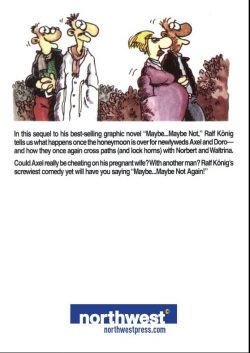
Sequel volume Maybe… Maybe Not Again! opens scant months later with ‘Trouble in Paradise’ and Axel still undecided on whether he’s Gay or Straight (modern shades of gender and sexuality being largely unestablished way back in 1988), but definitely less than enamoured of his impending membership in a traditional nuclear family. He’s also blithely unaware of the fallout he’s left in the now-acrimonious friendship circle inhabited by Watrina and new rival Norbert.

A new disruptive element arrives when ‘Muscle Queens’ introduces spitefully provocative bitch Frank Hilsmann – who thrives on infidelity and innuendo. He targets poor Norbert even as Axel’s manic old flame ‘Elke Schmitt’ resurfaces and tempts the undecided oaf with yet another bad choice… hot, commitment-free hetero infidelity while Doro is at her most shouty and unattractive…

Of course he succumbs, and of course he drags in his still-smitten Norbert to provide cover and a comfortable liaison space. And of course, such ‘Commitment’ to friendship and fidelity only makes things worse for poor Norbert as he finds himself overwhelmed by the cost of everyone else’s ‘Primal Urges’. Thankfully the chaos is derailed when Doro turns up on her way to the delivery room…

Simultaneously wry and witty and coarsely hysterical, these books manage to bawdily entertain whilst asking questions that still vex many of us to this day. Maybe… Maybe Not and Maybe… Maybe Not Again! certainly won’t appeal to everybody, but if you love a big raucous belly laugh about how daft we can all be about one of the most basic drives we’re afflicted with, these might well become some of your favourite reads.
© 1987, 1988 by Rowohlt Taschenbuch Verlag GmbH, Reinbek bei Hamburg, Germany. All rights reserved.

A Quick & Easy Guide to Queer and Trans Identities


By Mady G & J.R. Zuckerberg (Limerance Press/Oni Press)
ISBN: 978-1-62010-586-3 (PB) eISBN: 978-1-62010-587-0

Here’s a handy rule of thumb for getting along. People get to decide what to call themselves. You get to accept and agree with them, as long as no one is being actually harmed. That assessment is to be made by Law, not personal belief or some higher calling. If you can’t accept their definitions of themselves, you have the right to leave people alone and never interact with them.

Okay?

We are the naming primate. If we encounter something unknown and/or scary, we give it a description, definition and title and accept it into our ever-expanding understanding of Reality. It’s what enabled us to take over this world. Naming things is generally a good thing and allows us to navigate our universe.

Some people, however, use the power of naming to isolate, ostracise and wound. They are not doing it right. People like us have plenty of really fitting names for people like them when they abuse our gift…

Seriously though, it seems like every time we make a move towards greater inclusivity, some faction of retrograde, regressive backwards-looking churl and biological luddite manufactures a reason why we can’t all get along.

I personally favour retaliation, but the only way to truly counter them is with understanding, so here’s a book that offers plenty of names and definitions we should all be adding to our lexicons…

I’ve frequently argued that comic strips are a matchless tool for education: rendering the most complex topics easily accessible and displaying a potent facility to inform, affect and alter behaviour. Here’s a splendid example of the art form using its great powers for good…

The Quick & Easy Guide series has an admirable record of confronting uncomfortable issues with taste, sensitivity and breezy forthrightness: offering solutions as well as awareness or solidarity.

Here, coast-to-coast cartoonists Mady G. and J. R. Zuckerberg collaborate on a bright and breezy primer covering the irrefutable basics on establishing one’s own sexual and gender identity (including the difference between those terms), safely navigating all manner of relationship and exploring the spectrum of experiences available to consenting adults.

A major aspect of us People Primates is that we spend a lot of our lives trying to work out who we are. It takes varying amounts of time for every individual and lots of honesty.

It’s like most work. It can be unwelcome, laborious, painful and even dangerous and nobody should attempt it too soon or alone.

Moreover, all too often, assistance and advice offered can be unwelcome and stemming from somebody else’s agenda. In my own limited experience for example, any sexual guidance offered by anybody with a religious background is immediately suspect and a waste of breath. Perhaps your experience is different. That’s pretty much the point here. In the end, you have make up your own mind and be your own judge…

Unlike me, A Quick & Easy Guide to Queer and Trans Identities takes no sides and offers no bias as it runs through the fundamentals, but only after a Foreword from cartoonist and author Roz Chast and an Intro by Mady lay out the rules of engagement on the attaching and utilisation of the labels and roles gradually becoming common modern parlance…

The micro lectures are set during a wilderness trek where an agglomeration of troubled humans have a group teaching encounter under the supervision of a “Queer Educator” endeavouring to define for them the nature of ‘Queerness’…

The useful commentary, educational asides and plentiful laughs are generated by a colony of snails avidly observing proceedings like a raucous and bewildered Greek Chorus. Such gastropods, as I’m sure you recall from school, are either male, female, hermaphroditic or something else entirely, depending on what time it is. Now that’s perspective…

Subjects covered with forthright verve, clarity and – crucially – wry wit begin with ‘What is Queer?’, proffering terms for defining Sexuality and Gender as subdivided into Bisexuality, Asexuality, Pansexuality amongst other permutations. These and later lessons are illustrated with examples starring primarily neutral vegetable critters dubbed The Sproutlingswho are conveniently pliable and malleable…

‘What is Gender Identity?’ digs deeper, discussing Gender vs Sex via a little biology tutorial before ‘Now… What’s Gender Expression?’ expands the debate, determining modern manners and ways of signalling the world what one has decided is a person’s (current, but not necessarily permanent) status. The lecture comes with carefully curated real-world examples…

This is all fine in an ideal world, but contentious, often life changing problems that can occur are tackled head-on in ‘What Does Dysphoria Mean?’, detailing examples of the traumas accompanying the realisation of not being how you believe you ought to be. Divided into Physical, Social and non-binary Dysphoria, the examination includes ways of combatting the problems and more case histories courtesy of the human wilderness students…

In swift succession ‘So, what is Asexuality?’ and ‘What does it mean to Come Out?’ offer further practical thoughts and prospective coping tactics before vital life lessons are covered in ‘Here are some Relationship Basics’.

Also included here are an “Outro” by Zuckerberg and a section of activities including ‘Design a Pair of Friendship Jackets’, ‘Create Your Own Sprout-sona!’ and ‘How to make a Mini Zine!!’ as well as information on ‘More Resources!’and Creator Biographies.

I hail from a fabulous far-distant era where we happily ravaged the planet without a qualm but believed emotional understanding led to universal acceptance. We’re apparently smarter about the planet now, and it’s wonderful to see that the quest to destroy intolerance and ignorance still continues. This witty, welcoming treatise offers superb strategies for fixing a pernicious issue that really should have been done and dusted decades ago.

Hopefully, when we all share appropriate, non-evocative and un-charged terms for discussing human sexuality and gender – such as seen here – we can all make decisions and assessments that will build a fairer, gentler world for everybody…
A Quick & Easy Guide to Queer and Trans Identities ™ & © 2019 Mady G & J.R. Zuckerberg. All rights reserved.

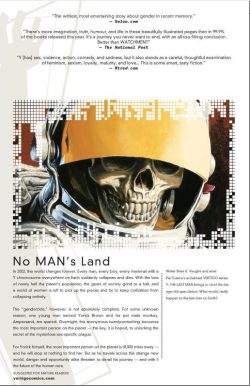
Y the Last Man Book Three


By Brian K. Vaughan, Pia Guerra, Goran Sudžuka & various (DC/Vertigo)
ISBN: 978-1-4012-2578-0 (HB) 978-1-4012-5880-1 (TPB)

Back in 2002, an old, venerable and cherished science fiction concept got a smart and satirical updating in Vertigo comic book series Y: The Last Man. These days it’s more relevant than ever as the premise explores the aftermath and consequences of a virulent global plague.

When a mystery contagion killed every male on Earth, only amateur stage magician, escapologist and all-round slacker goof-ball Yorick Brown and his pet monkey Ampersand survived in a world suddenly and utterly all girl.

Since his politician mother is high in America’s new government, Yorick is a highly prized and top-secret commodity. After a number of potential catastrophic incidents, he is condemned to covertly travel with conflicted secret agent 355 and maverick geneticist Dr. Allison Mann across the devastated American continent to her state-of-the-art laboratory. Mann believes she somehow caused the patriarchal apocalypse by self-inseminating and giving birth to the world’s first parthenogenetic human clone, but all young Yorick can think of is re-uniting with his girlfriend/fiancée Beth, cut off and trapped in Australia ever since the world was abruptly unmanned. As far as Brown is concerned, the geneticist’s Californian retreat is about halfway to his most cherished goal…

The trek is slow, arduous and fraught with peril and revelation: one none of the voyagers initially realise is dogged with stealthy intrigue and hostile surveillance from the start. Hard on their heels is a cult of crazed women determined to erase every vestige of male influence and achievement: modern “Daughters of the Amazon” determined to eradicate the accursed Y chromosome entirely from planet Earth. They are racing against a team of Israeli commandos whose commander is determined that the Promised Land will have sons again, no matter what the cost. Tragically, they are not the only or worst of the special interests hunting Yorick…

This third compilation – available in hardcover, trade paperback and eBook formats – collects issues #24-36, spanning September 2004-October 2005 and opens with a 2-parter by originators and co-creators Brian K. Vaughan and Pia Guerra. In case you were wondering, the entire book is inked by José Marzán Jr, coloured by Zylonol and lettered by Clem Robbins.

In ‘Tongues of Flame’ events move into higher gear as Dr. Mann and the formerly-fanatical secret agent who has been thanklessly bodyguarding Yorick both reach turning points in their own particular journeys. Suddenly on his own, Yorick finds reaffirmation in a climactic and far from spiritual meeting with faux nun Beth, who is solitarily expiating her own sins in a commandeered catholic church. Sadly, their moment in paradise is ruined by marauding Amazons. The reputed last man alive then uses all his conjuring tricks to return the disfavour…

Meanwhile in the Australian Outback, a couple of lost Americans make an unpleasant discovery and run into a spot of bother…

‘Hero’s Journey’ switches focus to Yorick’s previously deranged sister. Hero Brown has been stalking the expedition across the ravaged and now generally dis-United States, plagued by memories of her own childhood and difficult adolescence. The reverie also encompasses the night all the men died and how the traumatised paramedic swiftly fell under the sway of psychotic chief Amazon Victoria.

Hero’s long walk takes her to the plains of Kansas and a secret government facility, where twin American biologists and former Russian agent Natalya Zamyatin are guarding the planet’s greatest secret and penultimate hope for humanity…

For the entire saga thus far, Yorick has been carrying a wedding band for his Beth. ‘Ring of Truth’ finally reveals the history of the piece and the strange provenance it carries in a flashback to a chance encounter in a magic shop.

In the present, the trekkers have reunited in San Francisco. After Agent 355 has a lethal confrontation with her ex-comrades (and rival covert organisation the Setauket Ring), Dr. Mann actually discovers the secret of the last man’s immunity to the disease that killed all those guys. Sadly, it coincides with Yorick being overcome with a mystery ailment that seems to present like the haemorrhagic bug which wiped out all the other men…

Remember the monkey? As all the crises converge, and Hero appears to save the day, Ampersand is stolen by one of the aforementioned sinister forces following them and expeditiously shipped abroad. Once Yorick recovers, it becomes absolutely imperative that the team rescue him from captivity. That means a frantic trip to Japan but all Yorick can think of is how he’s getting ever closer to Beth in Australia…

Goran Sudžuka steps in for issues #32-35 as ‘Girl on Girl’ finds the wanderers in warm pursuit on repurposed cruise liner/cargo boat The Whale. When every male creature on Earth expired, Yorick’s true love was on an anthropology field trip in the Australian Outback, and all his previous adventures have been geared to eventually reuniting with her, despite the collapse of civilisation, and the mass extinction event that is gradually eliminating all higher life on Earth.

Sailing, for the Port of Yokogata – a destination that has particular significance for Dr. Mann – Yorick and his retinue are now painfully aware that Ampersand has been ape-napped by a mysterious ninja because he apparently holds the secret to the mystery of the plague which removed all us mouth-breathing, unsanitary louts.

Whilst aboard ship, Yorick’s drag disguise yet again fails and his concomitant and somewhat unwilling liaison with the lusty ship’s Captain is only thwarted by a torpedo fired by the Australian Navy. It seems that the commander has a few secrets of her own – and a highly illegal sideline…

After a brutal battle and more pointless bloodshed it seems the lad is fated to go to Oz after all, despite the depredations of pirates, drug runners, ninja-assassins and the imminent return of old foe General Alter Tse’elon and her renegade cadre of Israeli commandos…

Yorick isn’t absolutely sure Beth Deville is actually still alive, but we are, after the last chapter tells her life story and hints that when her man comes for her, she might not actually be there anymore…

Guerra returns for ‘Boy Loses Girl’ #36 (the entire script for which bolsters the back of this already-bountiful feast of adult fun and frolic) detailing how a typical student love story becomes a life-altering hallucinogenic spiritual walkabout for Beth and how her decision inadvertently derails every plan the Last Man ever laid…

By honing to the spirit of this admittedly overused premise but by carefully building strong, credible characters and situations, Vaughan & Guerra have crafted an intellectually seductive fantasy soap-opera of remarkable power: one every mature comics fan should enjoy.
© 2004, 2005, 2015 Brian K. Vaughan & Pia Guerra. All Rights Reserved.

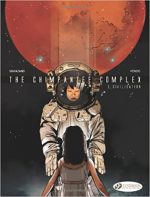
Chimpanzee Complex volumes 1 (Paradox); 2 (The Sons of Ares) & 3 (Civilisation)


By Richard Marazano & Jean-Michel Ponzio, translated by Jerome Saincantin (Cinebook)
ISBN: 978-1-84918-002-3 (Album PB Paradox), 978-1-84918-015-3 (Album PB The Sons of Ares), 978-1-84918-043-6 (Album PB Civilisation)

One thing French comics creators excel at is challenging, mind-blowing, astoundingly entertaining science fiction. Whether the boisterous, mind-boggling space opera of Valerian and Laureline, the surreal spiritual exploration of Moebius’ Airtight Garage or the tense, tech-heavy brooding of Orbital, our Gallic cousins always got it: the genre is not about hardware or monsters; it’s about people encountering new and uncanny ideas…

Prolific, multi award-winning Richard Marazano was born in Fontenay-aux-Roses in 1971. He initially pursued a career in science before switching to Fine Arts courses in Angoulême. He debuted in bande dessinée in the mid 1990s. Although an extremely impressive artist and colourist when illustrating his own stories (Le Bataillon des Lâches, Le Syndrome d’Abel), he is best known for his collaborations with other artists such as Michel Durand (Cuervos), Marcelo Frusin (L’Expédition) and Xavier Delaporte (Chaabi) to name just a few.

His partnerships with artist Jean-Michel Ponzio are especially fruitful and rewarding. As well as Le Complexe du Chimpanzé – the trilogy under discussion here available singly in trade paper and digitally, but not yet in one epic edition – the daring duo produced the taut, intricate social futurism of Genetiksâ„¢ and high-flying paranoiac cautionary tale Le Protocole Pélican.

Jean-Michel Ponzio was born in Marignane and, after a period of scholastic pick-&-mix during the 1980s, began working as a filmmaker and animator for the advertising industry. He moved into movies, designing backgrounds and settings; listing Fight Club and Batman and Robin among his many subtle successes.

In 2000, he started moonlighting as an illustrator of book covers and edged into comics four years later, creating the art for Laurent Genfort’s T’ien Keou, before writing and illustrating Kybrilon for publisher Soliel in 2005. This led to a tidal wave of bande dessinée assignments before he began his association with Marazano in 2007. He’s still very, very busy and his stunning combination of photorealist painting, 3D design and rotoscoping techniques grace and enhance a multitude of comics from authors as varied as Richard Malka to Janhel.

Cinebook began publishing The Chimpanzee Complex in 2009 with the beguiling and enigmatic Paradox, which introduces the world to a bizarre and baffling cosmic conundrum…

February 2035: experienced but frustrated astronaut Helen Freeman is still reeling from the latest round of cutbacks which have once again mothballed NASA’s plans to send an expedition to Mars. The young mother is resigned to living an Earthbound life in Florida with the daughter she has neglected for so long, but just as she tentatively begins to repair her relationship with young, headstrong Sofia, her world is again turned upside down when a call comes from her ex-bosses.

Bowing to the inevitable despite Sophia’s strident objections, she and old boss Robert Conway are whisked away under the tightest of security conditions to a US aircraft carrier in the Indian Ocean under the draconian control of Top Brass Spook Konrad Stealberg.

Here they learn that, days previously, an unidentified object splashed down from space and was recovered by divers.

The artefact was the Command Module of Apollo 11 and it carried the still-living Neil Armstrong and Buzz Aldrin: legendary heroes forever mythologised as the first men to walk on the moon. Baffled and bewildered, the recovered astronauts have steadfastly refused to speak to anybody except NASA representatives…

Helen is the first to get any information from them, and whilst Stealberg’s technicians check every bolt, wire and component of the capsule, she and Robert carefully quiz their greatest idols. When the lost astronauts learn they have been in space for 66 years they are horrified. When they realise that history records they returned safely and died unremarkably years later, they go ballistic: exhibiting what Freeman describes as the traumatic shock response peculiar to space voyagers categorised by NASA as “the Chimpanzee Complex”…

Impatient martinet Stealberg has harder questions: if – as every test they can think of indicates these men are the real thing, who or what landed on Earth all those decades ago?

And most importantly, when they were feted by the world in 1969, was third astronaut Michael Collins – who never walked on Luna – one of us or one of “them”?

Exerting military privilege, he peremptorily kicks Conway out whilst pressganging Helen onto his staff, and transfers the mystery-nauts and their capsule to his ultra-secure Red Hills Creek Base in Colorado…

Helpless but conflicted, Freeman plays along, enjoining Robby to explain and take care of Sofia. If she had been angry before, the daughter’s reaction to this further enforced absence from a mother she feels doesn’t want her will be terrible indeed…

Events move very fast at the paranoid levels of the Military-Industrial complex, and as Helen continues her interviews with the biologically-perfect astronauts, she begins to discover inconsistencies and memory-lapses in their stories.

That’s enough for Stealberg to initiate other, harsher procedures, but before they can be implemented Helen is awoken from fantastically real dreams of exploring Mars to a new crisis: Armstrong and Aldrin are dead. From the state of their corpses they have been for decades…

In Florida Robby is still trying to assuage Sofia’s feelings, telling her Mum will be home soon. There’s no chance of that, though, as Stealberg has moved on with his plans and arranged a private meeting with the President.

The result is the re-commissioning of the completed – but mothballed – Mars exploration shuttle, with the intention of revisiting the site of the Apollo moon landings. As NASA’s top flier and an expert on the Mars vehicle, Helen is going too… whether she wants to or not.

Twelve days later, amidst massive public uproar and speculation at the ludicrous cover story for the sudden moon-shot, Helen and her crew meet the rest of the exploration team and she realises with horror that her professional career is based on a lie.

NASA has never had an American monopoly on spaceflight: the military had been running a clandestine, parallel black-book program since the very start, funded by siphoning the Agency’s operating budget and personally instigated by ex-Nazi rocket pioneer Werner von Braun…

The launch is televised around the world, trumpeted as a final shakedown flight before closing the costly space program forever. Aboard the blazing javelin, Helen and close companion Aleksa ponder the coincidence of heading for the moon in the week they were originally scheduled to take off for Mars, but are more concerned that mission leader Stealberg has filled the shuttle with mysterious, classified containers…

All too soon, the vehicle establishes lunar orbit and a Lander touches down on the most hallowed site in the history of technology. It’s a huge shock: the paraphernalia left by the missions doesn’t match the records and there is a strange trail of footprints. Following them, the terrified explorers discover the mummified, space-suited, long-dead bodies of Armstrong and Aldrin, even as, high above them pilot Kurt matches velocities with a piece of space junk and discovers the Apollo 11 Command Module…with Collins’ corpse in it…

Moreover, there’s a recorded distress message in the primitive computers: a 66-year old Russian cry for aid originating from Mars…

And that’s when Stealberg reveals his biggest secret, summoning booster rockets and a second-stage shuttle from deep orbit whilst breaking out the cryogenic coffins that will keep the crew alive as they travel on to Mars and an appointment with the truth, whatever it might be…

Second volume The Sons of Ares opens in October 2035, focussing on Freeman’s best friend. NASA bureaucrat Robert Conway has struggled to look after the increasingly wayward Sofia. Increasingly off-the-rails, she argues and acts out, whilst in interplanetary space the fourth month of the journey finds American astronauts Paul Dupree and Mark Lawrence taking their boring turn awake for monitor duty, whilst their comrades endure resource-saving but life-shortening hibernation. The monotony is suddenly broken by a freak radiation storm. Only one of the terrified explorers makes it to the ship’s shielded area in time…

In Florida, Robert is acutely conscious of his failings as a surrogate parent, just as Helen is blissfully unaware of the personal crisis when her slumbering crew rouse from cold sleep to find Paul insane and Mark missing…

In reporting the situation to Earth, Helen again misses – or perhaps avoids – a chance to speak to Sofia – who is gradually coming to terms with the possibility that she might never see her mother again…

As the shuttle at last establishes Mars orbit, Paul is locked up for his own safety and the suspicious voyagers’ peace of mind. Konrad then shares intel gathered by his agents on Earth whilst they slept. The Soviet clandestine Cosmonaut project began in 1963, headed by space pioneer Yuri Gagarin – whose death had been faked to facilitate his smooth transition to commander of their Mars shot.

Expecting a monumental propaganda coup, the Kremlin simply said nothing when contact was lost with Gagarin’s mission, preferring stolid rhetoric to incontrovertible proof of failure. Now, with so many inexplicable events inevitably leading to the Red Planet, Stealberg expects Helen and her team to find all the answers with the Russians’ bodies on the dust surface. He couldn’t be more wrong…

Locating a base at the polar cap, Konrad dispatches his heavily armed crew to the site even as on Earth, Sofia runs away from home. However even whilst experiencing her greatest desire – walking on another world – Helen can’t help but worry about Paul, doped up and locked into the isolation chamber of the otherwise empty Shuttle…

Whilst Robert frantically searches for Sofia on Earth, the astronauts are astounded to discover the primitive landing site and corpses they expected are, in actuality, a thriving, efficient facility, stuffed with botanical wonders and manned by the very strong and vital cosmonauts who had landed there in the1960s.

After an initial exchange of hostilities – and gunfire – friendly contact is established and another incomprehensible tale unfolds. Russians Vladimir and Borislav have lost all sense of time in the “twelve years” since they landed and Commander Gargarin – having discovered a strange tunnel in a Martian glacier – has been absent for most of that period. They only know he’s still alive because food keeps vanishing…

Stealberg, seeing uncomfortable similarities in the agelessness of the cosmonauts and the duplicate Armstrong and Aldrin on Earth, sedates the Russians, who constantly ramble about the nature of reality, but Helen’s interest is piqued and, with Kurt’s assistance, she sneaks off into the glacier tunnel to find Gagarin…

When she succeeds, it only leads to more baffling questions. The First Man in Space perpetually stares into the unyielding ice-wall, seemingly unsurprised by Helen’s reports on the Apollo returnees, the impossible time-differentials and the fall of the Soviet Union.

He merely ruminates on Heisenberg’s Uncertainty Principle, and whether such a subatomic phenomenon could apply to larger constructs – such as human beings – in a constant and simultaneous state of being and non-being: a “probability of presence”…

They also converse about children they will probably never see again…

As Helen returns to the greenhouse module, the Russians are planning more armed resistance, but Stealberg has an even more pressing problem. Much to Helen’s astonished disbelief, he’s found Gagarin’s 60-years-dead corpse…

As Vladimir and Borislav attack, setting fire to the modules, the Americans fall back to their vehicle, dragging the now hysterical Helen, who has promised her very much alive Yuri Gagarin a ride home…

The tension increases when they re-enter the orbiting Shuttle: Paul has vanished and no trace can be found of him. Thoroughly rattled, Konrad orders an immediate return to Earth, with increased watches for every day of the trip.

May 2036: on Earth Robert has tracked down Sofia and they both eagerly await Helen’s return at Cape Canaveral. However, as the Shuttle nears Earth it suddenly vanishes from all tracking systems. Aboard the vessel, Helen and Kurt experience the horror of seeing their home planet vanish. Unable to brake the shuttle, and with no world in view, they rejoin the others in cold sleep, not knowing when they will next awaken or even if they will still be in their solar system when they do.

Helen’s last conscious thoughts are of the daughter she may never see again…

Concluding volume Civilisation completes the trilogy by picking up in the Great Unknown as hibernation ends after 70 years. Only Helen and Aleksa remain alive, all the other cryo-capsules having failed at some indeterminate time.

With only finite resources and dwindling power, Helen consoles herself by catching up on messages beamed in hope and anticipation by Robbie Cooper, but is roused from her fatalistic depression by Aleksa who has made a shocking discovery…

Seeing one of the EVA suits missing, he at first believed their comrade Alex had committed suicide by walking out of the airlock. Then he saw the impossibly huge unidentified space ship and called Helen…

Suiting up and arming themselves, they cross to the vessel, Helen further encumbered by a laptop with all the messages – read and unread – from Cooper stored on it. They have no idea when Alex left, or if she even tried to reach the UFO. However, as it’s their only hope of survival, they make a leap into the void and, after great struggle, find themselves in a vast and terrifying mechanical chamber of disturbing proportions.

Alex’s abandoned gear is on the floor. She had clearly camped there for some time before vanishing into the dark, dusty cavernous interior…

Whilst they rest and consider their next move, Helen watches the last message Robbie sent from Earth. It is sixty-seven years old…

Later, Helen freaks out when they find Alex’s empty suit, until Aleksa does the unthinkable and opens his own EVA garb. The enigma ship has warmth and a breathable atmosphere…

And then something pushes part of the vessel over on them…

Narrowly escaping harm, they cautiously explore the vessel, but after splitting up Aleksa is attacked again. When terrified Helen finds him, he is hugging the crazed, decrepit, wizened but still alive Alex. Mute but still vital, she leads them through vaulting passageways to what they can only assume is a skeleton. A really, really big one. Outside a viewing portal, Mars spins by above them. It’s as if they’ve come home…

However fast or far or forward humanity travels, their fears and foibles go with them and before long distrust and dread spark a final confrontation in the uncanny construct. Thus, only one person makes an implausible, inexplicable escape back to Earth…

It’s 2097 and as a long-missing craft splashes down in the ocean to begin the circle anew, it becomes clear that some mysteries, like some philosophies and some family bonds, remain ineffably beyond the sphere of rational thinking…

Bold, challenging and enticingly human, this astonishing science mystery dances and darts adroitly between beguiling metaphysics and hard-wired mortal passions, easily encompassing our species’ inbuilt inescapable isolation, wide-eyed wonderment, hunger to know everything and terror of finding out. Marazano’s pared-to-the-bone script is brought to hyper-life with stunning clarity by Ponzio to produce a timeless fusion of passion, paranoia and familial fulfilment. A deft blend of intrigue, hope, paranoia and abiding curiosity, The Chimpanzee Complex is a tale no lover of fantasy and suspense should ignore.

Do you read me? Do read The Chimpanzee Complex.
© Dargaud, Paris, 2007, 2008 by Marazano& Ponzio. All rights reserved. English translation © 2009, 2010 Cinebook Ltd.

Y: The Last Man Book Two


By Brian K. Vaughan, Pia Guerra & José Marzán with Goran Parlov, Paul Chadwick & various (DC/Vertigo)
ISBN: 978-1-4012-5439-1 (TPB)

Back in 2002, an old, venerable and cherished science fiction concept got a new and pithy updating in the Vertigo comic book Y: The Last Man. These days it’s more relevant than ever as the premise explores the aftermath and consequences of a virulent global plague.

When it killed every male on Earth, only amateur stage magician, escapologist and all-round slacker goof-ball Yorick Brown and his pet monkey Ampersand survived in a world suddenly and utterly all girl.

Since his politician mother is high in America’s new government, Yorick is condemned to travel with conflicted government secret agent 355 and maverick geneticist Dr. Allison Mann across the devastated American continent to a Californian bio-lab. Mann secretly believes she caused the patriarchal apocalypse by giving birth to the world’s first parthenogenetic human clone, but all the young man can think of is re-uniting with his girlfriend/fiancée Beth, trapped in Australia since the disaster hit.

The trek is slow, fraught with peril and revelation and one none of the voyagers realise has been dogged with covert intrigue from the start. Hard on their heels is a cult of crazed modern “Daughters of the Amazon” determined to eradicate the Y chromosome entirely from planet Earth as well as a team of Israeli commandos whose commander is determined that the Promised Land will have sons again, no matter what the cost. Tragically, they are not the only special interests hunting Yorick…

This second aggregated volume, collecting issues #11-23 from of the monthly comic book and spanning July 2003-August 2004, begins a progression of shorter tales with ‘One Small Step’ illustrated by co-creator Pia Guerra and colourist Pamela Rambo. As the wanderers gradually make their way across a devastated America to the Left Coast the tale picks up from the previous volume with the eagerly-anticipated arrival of three astronauts who have (probably) avoided plague contamination by the simple expedient of being in space when it struck. Moreover, two of them are hulking great healthy men…

With its re-entry capsule diverted to the plains of Kansas and a handily hidden secret government bio-containment facility, the trekkers ally with Russian agent Natalya Zamyatin who has been ordered to retrieve her nation’s last cosmonaut, but duplicity in the White House sets the Israelis on their trail and more bloodshed results in a pyrrhic victory at best…

Following is a 2-part story illustrated by Concrete creator Paul Chadwick with Rambo. ‘Comedy & Tragedy’ examines the roles of Art and Mass Entertainment on a media-deprived populace in the post-plague world. The drama unfolds as a band of strolling players arrive in prim and proper Northlake, Nebraska and upset the applecart with their radical drama about the last man on Earth. The playwright’s inspiration came after her troupe found an impossibly live male monkey lost in the wilds. In the chaos of first night, when three masked strangers burst in a to reclaim the primate, nobody noticed that a ninja was tracking the newcomers…

Having reached Colorado, the travellers pause in their everyday adventures so the increasingly gung-ho Yorick can get medical care for Ampersand. By his very existence, Yorick is a valuable commodity, so must spend most of his time in some form of drag. Rather than risk his discovery needlessly, 355 leaves him with a conveniently adjacent fellow undercover agent (their particular organisation/sect is called The Culper Ring) whilst she and Dr. Mann scavenge for antibiotics in ‘Safeword’ (with art by Guerra & Zylonol)…

It’s no surprise agent 711 has her own agenda. Yorick wakes up naked, tied to a ceiling and subject to a spooky Dominatrix’s specialist attentions. All is not as it seems, though, and an extended – and adults only! – “interview” provides some valuable, if obscure, glimpses of Yorick’s life before the plague.

By the time it’s all over we’ve been given crucial insight into what keeps Yorick going and been introduced to another enigmatic factor in this saga – the deadly agents of rival agency the Setauket Ring…

America is devastated by the plague, but recovery is slower than might be expected. One reason for this is revealed in ‘Widow’s Pass’ (illustrated by Goran Parlov & Zylonol) as the pilgrims reach Queensbrook, Arizona. Following in the bootsteps of their paranoid, survivalist-militia menfolk, a band of traumatised women have blockaded Interstate 40 – the only motorway traversing the broken, isolated halves of the USA – and are starving the country. Believing the Federal Government created the Plague, the “Daughters of Arizona” are retaliating in the only way they know, and as usual Yorick and his companions are soon in the middle of all the trouble…

Ultimately, it’s only brutal, life and character-changing violence that solves the crisis. And once again, the true victims are the innocent bystanders who can’t help but try to help Yorick…

With a stunning cover gallery from J.G. Jones, Aron Wiesenfeld & Massimo Carnevale plus Vaughn’s full script for Y: The Last Man #18, the saga reaches far beyond its clichéd Sci Fi premise in this volume, becoming a smart, ironic and powerful tale to be read on its own terms.

Despite the horrific – and distressingly contemporary – narrative backdrop, Brian K. Vaughn’s tale unfolds at a relatively leisurely pace with plenty of black humour, socio-political commentary and proper lip service paid to the type of society the world would be if abruptly deprived of the majority of its pilots, entrepreneurs, mechanics, labourers, abusers and violent felons, but the action quotient is steadily ramping up. When you ultimately reach top gear, the wait will be worth it…
© 2003, 2004, 2015 Brian K. Vaughan, Pia Guerra. All Rights Reserved.

A Quick & Easy Guide to Sex & Disability


By A. Andrews (Limerance/Oni Press)
ISBN: 978-1-62010-694-5 (PB) eISBN: 978-1-62010-706-5

Comic strips are an incredibly powerful tool for education, rendering the trickiest or most complex topics easily accessible. They also have an overwhelming ability to affect and change behaviour and have been used for centuries by politicians, religions, the military and commercial concerns to modify how we live our lives. Here’s a splendid example of the art form using its great powers for good…

The Quick & Easy Guide series has an admirable record of confronting uncomfortable issues with taste, sensitivity and breezy forthrightness: offering solutions as much as awareness or solidarity. Here, disabled cartoonist A. Andrews (Oh, Hey! It’s Alyssa!) shares experiences and highlights situations too many people would prefer never having to think about…

Before we go any further though, let’s just state something that ought to be obvious. Most human beings want and have sex.

Even amongst the majority, that encompasses a variety of preferences, techniques and practices generally undertaken in a spirit of cooperation and carried out on a sliding scale of satisfaction and success for (at least one of) those taking part. The goal however, surely must be mutual gratification for all involved, right?

Sadly, for a large section of humanity, this fundamental function presents many difficulties. Most have been previously addressed in many learned clinical tracts and therapeutically-themed sources but this welcomingly frank cartoon lecture isn’t one of those. It’s a chat session led by a person who’s lived some of those difficulties and who uses passion, humour, common sense and earnest language to cope. Think here not about achieving sex, but rather making your version of sex better, if not best…

After starting out with some daunting statistics from the Center for Disease Control and World Health Organization to establish the state of play for disabled people (Earth’s largest minority group, accounting for 15% of global adult population), Andrews quickly moves to the meat of the matter in ‘Disability Sexuality’.

Defining different forms of disability – congenital, acquired, intellectual and invisible – and outlining intersecting impacts on individuals as well as tackling the differences between sexuality and gender, naturally leads to an examination of ‘Myths About Disabled Bodies’ before revealing the big secret… ‘Communication’…

Following short and pertinent questionnaire ‘Activity Time’, the talk about talking resumes with ‘Instead of … Try This…’ and more sage advice, plus a fascinating ‘Self-Care Plan’ and the value of preparedness and tools, enhancements and toys in ‘Getting Down’, ‘Positioning’ and ‘Aftercare’…

Also included is a listing of additional information and resources in print, podcast and web formats.

I hail from a distant era when we believed understanding led to acceptance, so it’s wonderful to see that the quest to destroy intolerance and ignorance still continues. This witty, welcoming comics guide tackles an issue that really should have been done and dusted decades ago, but until disability (and race and gender and sexuality and body size and even bloody hair colour) lose every shade of meaning and connotation except purely descriptive, books like this one will remain a necessity and utterly welcome…
A Quick & Easy Guide to Sex & Disability ™ & © 2020 A. Andrews. All rights reserved.

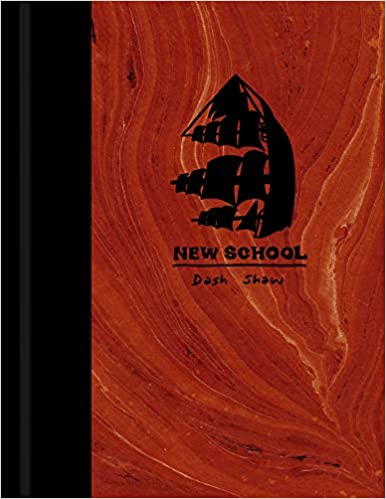
New School


By Dash Shaw (Fantagraphics Books)
ISBN: 978-1-60699-644-7 (HB)

Dash Shaw is a sublimely talented creator with a singular authorial voice and a huge repertoire of styles to call upon. Born in 1983, he is a leading light of a “new wave” (please note no capital letters there) of multi-tasking cartoonists, animators and web content originators whose interests and sensibilities heralded a recent renaissance in graphic narrative.

Like so many, he began young with independently published comics before graduating to paid work. Previous successes include Love Eats Brains, GoddessHead, Garden Head, Mother’s Mouth and the superbly haunting Bottomless Belly Button and Bellyworld.

In 2009 the Independent Film Channel commissioned him to convert his short series The Unclothed Man In the 35th Century A.D. (from comic arts quarterly Mome) into an imaginative and compelling animated series which then translated into an incredibly impressive graphic novel/art book comprising not only the evocative, nightmarish and tenderly bizarre tales but also the storyboards, designs and scripts Shaw constructed to facilitate the transition from paper to screen.

With New School, Shaw’s bold, broad experimentalism found a forward-looking yet chaotically nostalgia-generating fresh mode of communication for the oldest of information-storing, emotion-generating devices…

Here is another unique, achingly visual exploration of family, relationships and even the art of telling stories, at once dauntingly challenging, emotively ambivalent and metaphorically obfuscatory, even as Shaw impossibly pulls an authorial sleight of hand trick which renders this colossal chronicle surprisingly accessible.

Danny is a smart, content, obedient boy who worships his older brother Luke and he is telling us about his life. As our narrator, he only speaks in declarative and pompously declamatory, almost mock-heroic idiom, although his emotional underpinning is oddly off-kilter, like someone high-functioning on the autistic spectrum.

He speaks solely in the present tense even though his story begins with memories of 1990. Moreover, Danny believes he has prophetic dreams such as that one day there will be a movie called Jurassic Park or that the TV actor who plays Captain Picard will one day be the leader of the X-Men in a film…

Their highly-strung father publishes Parkworld – The Quarterly Journal of Amusement Park Industry News and Analysis and is justifiably proud of his sons’ artistic gifts and family fealty, but their solid, stolid lives begin to change in 1994 when Danny takes the credit for a dinosaur drawing Luke created and the devoted boys have a tremendous fight. As a result of the tussle, Danny is temporarily rendered deaf…

Even though his hearing returns, things have changed between the brothers, and soon rebellious Luke is despatched by Dad to the nation of X where an amusement park genius is setting up an incredible new entertainment experience called “Clockworld”.

Ashar Min AKA “Otis Sharpe” is the greatest designer of rides on Earth and – with the backing of X’s government – is turning the entire Asian island-state into a theme park tourist trap. To that end, Sharpe is hiring Americans to teach the X-ians to speak English and learn Western ways – and Dad wants 17-year old Luke there…

Three years younger, dutiful obedient Danny feels betrayed and abandoned, even as he guiltily noses around in his brother’s now-empty room. Two years pass and Luke has not communicated with the family since his departure.

Danny’s future-dreams are troubled. He is apprehensive when Mother and Father inform him he is to visit his brother on X, with the intention of bring their silent first-born home…

However, on arrival at the bustling, strange shore Danny is shocked by how much Luke has changed. Even his speech and dress are lax, debased and commonplace. The once-shining example of probity drinks, swears and fornicates…

Shock follows shock, however, as the newcomer is shown the burgeoning economy and infrastructure growing in the wake of Clockworld’s imminent completion. Moreover, after visiting the New School where Luke teaches, Danny’s joy in reuniting with his beloved sibling is further shaken, when he realises how much he has changed and has no intention of returning to America.

Worse yet, the influence of X and its people also begin to increasingly infect the appalled boy, forcing him to perpetually disgrace himself as his dreams torment him with incredible, impossible visions.

At least he thinks it’s the island making him mean and spiteful or causing him to shamefully stare at the unconsciously libertine, scandalously disporting women…

This book is drenched in the turbulent, reactive, confusing and conflicted feelings of childhood and physically evokes that sense. At 340 pages – all delineated in thick black marker-like lines with hulking faux mis-registered plates of flat colour seemingly whacked willy-nilly on the 279 x216mm pages, this feels like a mega-version of one of those cheap colouring books bought for kids on a seaside holiday in the 1960s. In fact the sheer size of the tome hammers that point home, no matter how grown up your hands now are. The effect even carries over if you opt for the various digital editions…

Strident yet subtle; simplistic whilst psychologically intellectual; viscerally, compellingly bombastically beautiful in a raw, rough unhewn manner, this a graphic tale every dedicated fan of the medium simply must see, and every reader of challenging fiction must read.

It’s big! It’s pretty! It’s different! Buy it!
© 2013 Dash Shaw. This edition © 2013 Fantagraphics Books. All Rights Reserved.