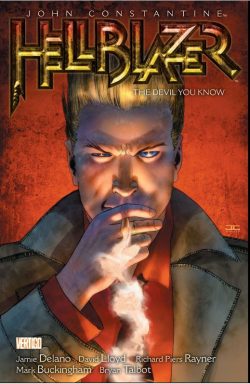
John Constantine, Hellblazer volume 2: The Devil You Know (New Edition)


By Jamie Delano, David Lloyd, Richard Piers Rayner, Mark Buckingham, Bryan Talbot, Mike Hoffman, Dean Motter & various (DC Comics)
ISBN: 978-1-4012-3302-0 (TPB)

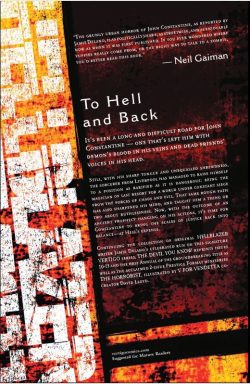
Originally created by Alan Moore during his groundbreaking run on Swamp Thing, John Constantine is a mercurial modern wizard, a dissolute chancer who plays like an addict with magic on his own terms for his own ends. He is not a hero. He is not a nice person. Sometimes, though, he’s all there is between us and the al-consuming void…

Granted his own series by popular demand, Constantine premiered at the height of Thatcherite Barbarism in Britain, during the dying days of Reaganite Atrocity in the US, to become a founding father of DC’s adult-oriented Vertigo imprint. Ah, what happy, simple times they seem now…

This collection – available in paperback and digital formats – collects Hellblazer #10-13, Hellblazer Annual #1 plus 2-part tangential miniseries The Horrorist: cumulatively spanning January to October 1988 and revelling in the renaissance of comicbook horror these yarns spearheaded, and which thrive to this day.

Back in 1987, Creative Arts and Liberal Sentiments were dirty words in many quarters and the readership of Vertigo was pretty easy to profile. British scripter Jamie Delano began the Constantine solo series with a relatively safe horror-comic plot about an escaped hunger demon, introducing us to Constantine’s unpleasant nature and odd acquaintances – such as Papa Midnite – in a tale of infernal possession and modern voodoo, but even then, discriminating fans were aware of a welcome anti-establishment political line amidst the metaphorical underpinnings.

The wonderment begins by concluding an epic eldritch saga started in Hellblazer: Original Sins (go read that, it’s great too) as the sanctimonious Resurrection Crusade attempt to re-enact the birth of Christ and their rivals the Damnation Army try to stop them, using Constantine as their weapon. Both sides learn that such a vile trickster is never to be trusted. ‘Sex and Death’ is by Jamie Delano with art from Richard Piers Rayner & Mark Buckingham.

The same team are responsible for the next trinity of linked stories ‘Newcastle’: A Taste of Things to Come (from #11 of the monthly comic) forms the beginning of an origin of sorts for the sordid sorcerer as we flashback to 1978 where punk rock singer/would-be wizard John Constantine takes a motley assortment of mystic wannabees into a possessed nightclub for what they think will be a simple exorcism.

It’s anything but, and the horrific events twist the survivors for the rest of their lives… ‘The Devil You Know’ features the mage’s return (from an insane asylum and worse) and revenge on the hellbeast that shaped his life….

Issue #13 finds him ‘On the Beach’, chilling after all the horror, but still somehow sucked into an ecological nightmare. What follows is an epic tale of two Constantines, as a ghastly heritage of magic and monstrosity is revealed.

Taken from the first Hellblazer Annual in 1989, ‘The Bloody Saints’ parallels the urban occultist’s squalid existence against the history of Kon-Sten-Tyn, mighty mythic Merlin‘s apprentice and a putative successor to King Arthur.

A glamorous rogue and unprincipled cheat, Kon-Sten-Tyn steals Merlin’s magic, makes pacts with devils, feigns conversion to Christianity, assumes unearned sainthood and generally does whatever he wants in a vividly dark, outlandish comedy terror beautifully illustrated by Bryan Talbot.

Also from the Annual comes an illustrated version of ‘Venus of the Hard-Sell’ originally “recorded” by Constantine’s punk band Mucous Membrane. Whatever you think it is, you’re wrong. Just get the book, revel in it and the wonderful creativity of writer/artist Dean Motter.

The 2-part miniseries The Horrorist fills the remainder of the book. Written by Delano and stunningly painted by David Lloyd, this is a bleak, cold fable which finds – in a state just like ‘Antarctica’ – an emotionally paralysed Constantine dutifully hunting across traumatised cityscapes and wretched broken America for a destructive force wreaking bloody havoc. All the trauma and misery of an uncaring world is the irresistible tool of a third world survivor and only more suffering seems to satisfy her…

As the creature called Angel passes, a typhoon of guilt, fear and terror is inevitably unleashed, savagely ending unfulfilled lives. She can’t be stopped by any means the wizard has used before, but there is one appalling tactic he can try…

John Constantine is probably the most successful horror comic character ever, with mood, tension and his surly, smug, intransigent attitude easily overwhelming and outlasting mere gore and splatter time after time. Ambivalent and ever-changing, the antihero of this series and the worlds he exposes never fail to deliver shock after shock.

Delivered by creators capable and satiric, but still wedded to the basic tenets of their craft, these superb examples of contemporary horror fiction – inextricably linking politics, religion, human nature and sheer bloody-mindedness as the root causes of all ills – are still powerfully engaging. Beautifully constructed, they make a truly abominable character seem an admirable force for our survival. The art is clear, understated and subtly subversive, while the slyly witty, innovative stories jangle at the subconscious with scratchy edginess.

This is a book no fear-fan should miss.
Hellblazer 10-13, Hellblazer Annual © 1988, 1989, 2011 DC Comics. All Rights Reserved. The Horrorist #1-2 © 1995, 1996, 2011 Jamie Delano & David Lloyd. All Rights Reserved.

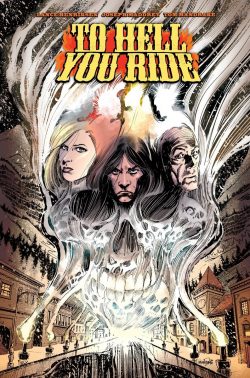
To Hell You Ride


By Lance Henriksen, Joseph Maddrey, Tom Mandrake & various (Dark Horse Books)
ISBN: 978-1-61655-162-9 (HB) eISBN: 978-1-62115-870-7

With all the chaos and kerfuffle besetting the world, it’s possibly therapeutic to dip into fantasy and disaster that we can control to some extent. In that spirit, here’s a good old-fashioned horror yarn to curl your toes in these eco-political end times…

Originally released as a 5-part miniseries from December 2012 to July 2013, To Hell You Ride was a lifetime dream project for actor Lance Henriksen (Aliens, Millennium, Near Dark) inspired by a visit to the town of Telluride, Colorado in the 1970s.

He saw his idea as a movie, but eventually, after working with screenwriter and documentarian Joseph Maddrey (Nightmares in Red, White and Blue), shifted his ideas to sequential narrative, with horror veteran Tom Mandrake (Swamp Thing, Grimjack, Martian Manhunter, Batman) rendering the project into stunning creepy visuals. Finishing the package were colourists Cris Peter & Mat Lopes and letterer by Nate Piekos of Blambot®.

Told in parallel time periods and trenchant flashbacks, the drama begins in the snow-swamped Colorado Mountains of 1880 where a greedy trapper plunders Indian graves and finds gold. A year later, the sacred ground is utterly defiled, turned into a pit of depravity as dozens of prospectors rip up the terrain in search of yellow metal.

The tribe’s only response is to begin a ritual of atonement. Undertaken by their holiest warriors – “The Old Ones” – even this act of pious desperation is despoiled. Interrupted by miners, four celebrant warriors are killed and their derailed devotions slowly poison the environment, becoming a curse for future generations and another prime example of ‘White Man’s Guilt’… that is, none at all…

The ritual is not done, however, and continues to proceed at its own pace…

More than a century later, drunk, lost and perpetually angry Native American Seven George (his true name is “Two Dogs”) continues being a pain in the ass to everybody. Yet again, sheriff Jim Shipps gives the kid a pass, but by the time the young man reaches his desolate, dilapidated shack, he’s become aware that something’s changed: an unnatural alteration that’s killing the birds…

Thankfully, he knows the history and takes steps to protect himself from an interrupted ritual that’s coming back and coming to a close…

The never-ending wounds to the region have affected both his father Six George and grandfather Five George in their own times, bring trouble and death to those who could least risk it, and as Two Dogs sits in a jail cell at Christmas, waiting for his own fate to unfold, the unnatural takes over. Soon the mountain town is buried in a wall of white, courtesy of ‘The Alchemy of Snow’…

Greedy town officials like Cubby Boyer just see another way to make money. Snow tourists rapidly flood in, but the joy and profits freeze once the visitors start dying: victims of a bloody, explosive ‘Metamorphosis’…

All the region’s wildlife is frightened and aware of big change coming. With chaos growing and a news blackout intensifying the crisis, Two Dogs and Shipps are forced to work together, but certainly not with the same ends in mind…

As the death toll mounts government spooks move in, setting up a quarantine line to keep America safe from “plague carriers” and “contaminated snow”… And they’re not really real Feds either…

Although the lands’ original occupiers feel their time is returning, they can’t hold a solid front, dividing into factions based on ancient spirits. With the Spider and the Trickster apparently walking the land, somehow, only Two Dogs knows what’s really needed. He begins his personal ‘Ghost Dance’ to the ever-present Watchers from the Spirit World, seeking to save who he can of the terrified survivors but, ultimately all that’s left is to accept his fate and ready himself for his ‘Death Song’…

Perhaps here is the solution he’s been searching for…?

Deftly blending contemporary horror themes with judiciously cherrypicked – or just plain cod – First Nations mythology, To Hell You Ride is not as spiritually astute as it would like but is far more fun than you possibly imagine: a superbly chilling race against doom with epic undertones and potent symbology.

Adding to the experience is text feature ‘Origins’, detailing how the story evolved over decades and supplemented with character studies, commentary, notes and developmental drawings of Two Dogs, The Watchers, Jim Shipps, Mary Ambrose, Cubby Boyer & the Town, The Spider, The Trickster, Smokin’ Bones, and recurring key image The Appeal to the Great Spirit (derived from Cyrus E. Dallin’s sculpture of the same name).

Sheer, unalloyed spooky delight, this is a magical yarn that really would make a brilliant movie. Why hasn’t anybody thought of it?
To Hell You Ride™ © 2012, 2013 Lance Henriksen, Joseph Maddrey & Tom Mandrake. All rights reserved.
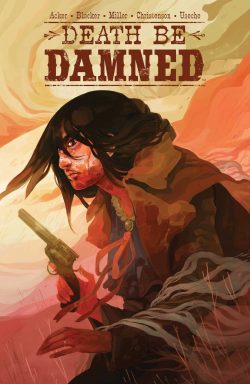
Death Be Damned


By Acker, Blacker & Miller, Hannah Christenson, Juan Useche & various (Boom! Studios)
ISBN: 978-1-68415-039-7 (PB) eISBN: 978-1-61398-716-2

First seen as a 4-issue miniseries in 2017 written by Ben Acker, Ben Blacker (The Thrilling Adventure Hour; Deadpool; Thunderbolts; Supernatural) and Andrew Miller (Backstrom; League of Pan; The Secret Circle), spooky sagebrush saga Death Be Damned is a deft and compelling addition to the growing and cross-fertilising genre of supernatural westerns. The series was visualised by celebrated illustrator Hannah Christenson (Harrow County; Mouse Guard; Jim Henson’s Storyteller) with colours by Juan Useche and letters from Colin Bell.

In delivery the tale is stripped down, raw and utterly engaging, delivered in sweeping tributes to more than a century of high plains cinema and begins in 1873 Wyoming when brutalised settler Miranda Coler awakes face down in the river to find her entire family have been butchered. A tough, determined survivor, she buries her husband and child and, picking up her man’s rifle, sets about tracking down the gang who killed them.

By the time she reaches South Pass City, she’s ready to accept any passing pain or humiliation if it leads to her justified vengeance, but anger doesn’t make her good enough to kill one of the marauders in the town whorehouse. He casually puts a bullet in her brain…

Local undertaker Murray takes his job far too seriously. Since his wife passed, he’s become an expert of death rituals and is letting his studies affect his work. He keeps trying to raise the dead and can’t believe he’s succeeded with the crazy woman just killed in the cathouse…

Events eventually prove he hasn’t, really, but perhaps his attempts to retrieve the dead have set something incredible in motion…

And in Laramie City, mass killer Bickford hangs for his crimes. A little later he also gets up: drawn inexorably to South Pass where something unnatural needs to be quashed…

Miranda thinks Murray is crazy, but after he kills her and she comes back again, she finally hears him out. He wants the revenant to rescue his wife from Hell, but has no idea what the land of death is really like. Miranda still wants revenge though, and she’s happy to exploit the undertaker’s foolish whims if it gets her closer to her goal, no matter how many times she has to die in the doing of it…

A tale of dark obsessions played out through a nest of gradually-unfolding mysteries, the sinister saga employs all the iconography of “big sky” westerns to add mood to a blistering tale of debts incurred and accounts called due. Unstoppable Miranda even beats her devils to exact precious retribution and learns the painful truths of her life, her man and a hell of a lot of death…

Available in paperback and digital editions, Death Be Damned also offers an expansive cover gallery by Christenson and Konstantin Tarasov; as well as character designs and also reveals the secrets of the illustrator’s Cover Process.
Death Be Damned is ™ and © 2017 Workjuice Corp. & Andrew Miller.

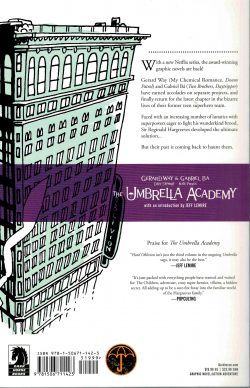
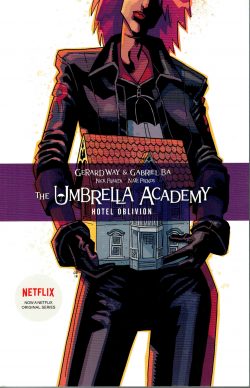
The Umbrella Academy volume 3: Hotel Oblivion


By Gerard Way & Gabriel Bá, with Nick Filardi & Nate Piekos (Dark Horse)
ISBN: 978-1-50671-142-3 (TPB)

Superheroes have been around so long now that they’ve been able to evolve into different sub-sets: straight Save-the-World continuity types as championed by DC and Marvel, obsessively “real” or rationalist iterations such as Marvelman, Crossfire or Kick-Ass, comedic spins like Justice League International or Next Wave and some rare ducks that straddle a few barstools in between.

Addressing the same Edgy, Catastrophic Absurdism as Grant Morrison’s classic Doom Patrol, the archly anti-didactic antics of The Umbrella Academy offered readers a subtly subversive take on the idiom which impressed the heck out of everybody and lured many disillusioned fans back to the pitifully tired and over-used genre when first released. Author creator Gerard Way even parlayed the extraordinary success of the Weird Science heroes into a TV series for the team and built a second creative career steering DC’s outré, off-the-wall Young Animal imprint of alternative heroes…

Now a decade later, a new miniseries has resulted in the long-awaited third collected volume (available in trade paperback and digital formats) and is presented here with an effulgent Introduction from star writer and late-converted fan Jeff LeMire…

Once upon a time a strange event occurred. All across Earth, 43 babies were unexpectedly born as the result of apparent immaculate conceptions – or perhaps some kind of inexplicable parthenogenesis.

The births even surprised the mothers, most of whom discarded, abandoned, sold or arranged adoption of their unexpected, terrifying newborns.

Notorious scientist, entrepreneur and closet extraterrestrial Sir Reginald Hargreeves – inventor of the Levitator, mobile umbrella communicator, Clever Crisp cereal, Televator and a process which enabled chimps to speak – had a secret plan, and he knew these kids would all be special. He thus acquired seven of these miracle babies for an undisclosed purpose, subsequently rearing and training the children to become his private superhero team to enact it.

He was in no way a “good” parent…

The callously experimental family, after a spectacular early career, eventually proved to be unmanageable and the Umbrella Academy – created and trained “to save the World” – sundered in grief and acrimony, but not before poor Ben, Number 6 AKA “The Horror”, pointlessly lost his brave young life and Number 5 “The Boy” took a short trip into the future and never came back…

The surviving members of the utterly dysfunctional superhero team parted but were reunited twenty years later when the news broke that Hargreeves – whose nom de guerre was The Monocle – had died. You shouldn’t believe everything you hear on the news…

In the interim, Number 1 son Luther had become an off-earth defender and pioneer, so hideously damaged by a doomed journey to Mars that to save him, Hargreeves had grafted The Spaceboy‘s head onto the body of a colossal Martian Gorilla.

Poor, neglected Vanya, whose musical gifts Hargreeves deemed utterly useless, became a drop-out and wrote a scandalous tell-all book before becoming a voluntary exile amidst Earth’s lowest dregs. When Number 7 returned she was again rejected by her “family” and summarily seduced by a manic musician who unleashed her true potential and almost destroyed the world with her untapped power…

The Boy returned after 60 years of ranging through the time-stream and materialised in the body of the 10-year old he had been. However, his physical form was frozen and he stopped aging at that moment…

Favourite friend, technologist, housekeeper, actual lifelong care-giver and talking chimp Dr. Pogo had died in Vanya’s – or rather The White Violin‘s – apocalyptic attack which had left Allison (Number 3, The Rumor) with her throat severed, apparently forever deprived of her talent for warping reality with a word…

Diego (Number 2, The Kraken) remained the obsessive scary vigilante psychopath he’d always been but Klaus (Number 4, The Séance) was even weirder than before: a floating, shoeless space-case who talked to the dead and pulled the wings off the laws of physics…

Once upon a time, long ago and whilst still children, the Umbrella Academy saved Washington DC from an animated and extremely angry Lincoln Memorial. They’ve had an odd relationship with American Presidents ever since…

Having saved the entire world from prophesied destruction, the dysfunctional quintet were at a loss and killing time in the rubble of their old home until a fresh crisis boiled over and was cleaned up after The Boy’s hidden sponsors (ruthless chronal cops the Temps Aeternalis) sought to make him fulfil the mission they had originally recruited and rebuilt him for…

Now in the aftermath of the global carnage that generated, the battered survivors recuperate unaware that old ‘Evil’ is manifesting in their midst. Long ago, Hargreeves had taken steps to create the ultimate penitentiary for the violent, vicious, crazy and too-powerful foes of his pet Academy, but now the “guests” of his Hotel Oblivion are successfully checking out…

As The Boy explosively pursues the minion’s of The Perseus Corporation, elsewhere Spaceboy is consulting with aged savant Doctor Zoo. The old duffer is planning a trip into the bizarre region dubbed “Afterspace” in search of a lost legend…

The Séance has fallen very low, trading seedy encounters with dead loved ones for drugs, but when he attempts to scam his biker-thug minders events overtake him just when his old allies leave the universe behind in KMiniature War in a Miniature Home’

With Hargreeves’ guests loose in the hotel, ‘Violence’ mounts in a range of places and dimensions but the greatest threat comes as the nigh-omnipotent Scientific Man gathers his god-like powers and the deadly Murder Magician secures a televator back to Earth…

Chaos increases exponentially as the Academy heroes battle alone against a host of foes and heir own selfish agendas even as Spaceboy braves ‘The Labyrinth’ and discovers lost legend St. Zero hibernating in

The crisis breaks after The Boy’s current target – Perseus X – infiltrates the hotel to liberate his dad and realises that he’s too late… and that something even more diabolical is ‘Free’

With a host of monsters and super-creeps like Doctor Terminal, the Mothers of Agony and Medusa ravaging Earth, as well as the quandaries of an imminent attack by a trans-dimensional behemoth and a mysterious wonder baby and its revenant, rampaging mother to deal with, the scattered young comrades grudgingly work together against ‘The Fear You Cannot Speak’ but their late collaboration is all for naught as a new team of empowered players materialise with a shocking revelation in concluding chapter ‘Reunion’.

Sadly, the big reveal is a cosmic cliffhanger so be prepared for some major frustration…

Big on mood, bafflement-by-design and astounding action, this is compelling adventure if you’re fully au fait with the previous books and prepared to give the events your full attention, but Hotel Oblivion is only the beginning of the drama and should not be consumed casually. Trust me, though, it’s going to be worth it in the end…

Accompanying all the meta-real wonderment are a wealth of sketches, character drawings and variant covers by Way and Bá under the broad remit ‘Designing the Umbrella Academy Hotel Oblivion’.

Whilst happily swiping, homaging, sampling and remixing the coolest elements from many and varied comics sources, The Umbrella Academy offers a unique synthesis to achieve its own distinctive originality within the tired confines of the superhero genre. It’s a reading experience no jaded Fights ‘n’ Tights fan should miss.
© 2019 Gerard Way and Gabriel Bá. All rights reserved. The Umbrella Academy™ and all properties are trademarks of Gerard Way and Gabriel Bá.
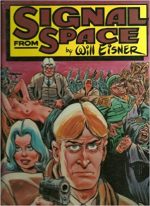
Signal from Space/Life on Another Planet


By Will Eisner with Andre LeBlanc (Kitchen Sink Press/DC Comics/W.W. Norton & Co)
ISBN: 978-0-87816-014-3 (Kitchen Sink colour HB): 0-87816-370-0 (KSP B&W PB):
978-1-56398-677-4 (DC Comics Library PB): 978-0-39332-812-7 (WW Norton PB)

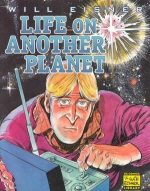
Here’s a long-lost contemporary cartooning classic which – although readily available in a number of formats – is still seen best in its first release. Ambitious and deliberately targeting an adult book-reading rather than comics audience, this initial collection of Will Eisner’s trenchant political thriller-cum-social commentary proves once more that sometimes the medium really is the message…

William Erwin Eisner was one of the pivotal creators who shaped the American comicbook industry, with most of his works more or less permanently in print – as they should be. From 1936 to 1938 he worked as a jobbing cartoonist in the comics production hothouse known as the Eisner-Eiger Shop, creating strips for both domestic US and foreign markets.

Using the pen-name Willis B. Rensie he created and drew opening instalments for a huge variety of characters ranging from funny animal to historical sagas, Westerns, Detective fiction, aviation action thrillers… and superheroes… lots of superheroes …

In 1940 Everett “Busy” Arnold, head honcho of the superbly impressive Quality Comics outfit, invited Eisner to take on a new challenge. The Register-Tribune newspaper syndicate wanted a 16-page weekly comicbook insert for the Sunday editions. Eisner jumped at the opportunity to move beyond the limitations of the nickel and dime marketplace, creating three series which would initially be handled by him before two were delegated to supremely talented assistants.

Bob Powell inherited Mr. Mystic and distaff detective Lady Luck fell into the capable hands of Nick Cardy (then still Nicholas Viscardi) and later the inimitable Klaus Nordling.

Eisner kept the lead feature for his own and over the next twelve years The Spirit became the most impressive, innovative, imitated and talked-about strip in the business. However, by 1952 he had more or less abandoned it for more challenging and certainly more profitable commercial, instructional and educational strips. He began working extensively for the US military in manuals and magazines like P*S, the Preventative Maintenance Monthly, generally leaving comics books behind him.

After too long away from his natural story-telling arena, Eisner creatively returned to the streets of Brooklyn where he was born on March 6th 1906. After years spent inventing much of the visual semantics, semiotics and syllabary of the medium he dubbed “Sequential Art” in strips, comicbooks, newspaper premiums and instructional comics, he capped that glittering career by inventing the mainstream graphic novel, bringing maturity, acceptability and public recognition to English language comics.

In 1978 a collection of four original short stories in strip form were released as a single book: A Contract with God and Other Tenement Stories. All the material centred around 55 Dropsie Avenue, a 1930’s Bronx tenement housing impoverished Jewish and immigrant families. It changed the American perception of cartoon strips forever.

Eisner wrote and drew a further 20 further masterpieces, opening the door for all other comics creators to escape the funnybook and anodyne strip ghettos of superheroes, funny animals, juvenilia and “family-friendly” entertainment. At one stroke comics grew up.

Eisner was constantly pushing the boundaries of his craft, refining his skills not just on The Spirit but with his educational and promotional material. In A Contract with God he honed in on unexplored territory with truly sophisticated, mature themes worthy of Steinbeck or F. Scott Fitzgerald, using pictorial fiction as documentary to examine social experience.

One of the few genres where Eisner never really excelled was science fiction – and arguably he doesn’t in this tale either as, in Signal from Space, the big discovery is just a plot maguffin to explore politics, social interactions and greed – all premium Eisner meat…

As ‘Life on Another Planet’ the material in this collection was originally serialised as eight 16-page episodes in Will Eisner’s Spirit Magazine from October 1978 to December 1980, rendered in toned monochrome (a format adhered to and title revived in subsequent Kitchen Sink, DC and W.W. Norton collections).

However, for this luscious hardback, the auteur and long-time confederate Andre LeBlanc fully-painted the entire saga using evocative tones and hues to subtly enhance the sinister, cynical proceedings…

One momentous night, lonely radio astronomer Mark Argano – based at a New Mexico observatory – picks up ‘The Signal’: a mathematical formula originating from Barnard’s Star and thus proof positive of extraterrestrial intelligence…

One colleague wants to inform the public immediately, but Argano is adamant that they go slowly as he (secretly) harbours schemes to somehow “cash in”. Unfortunately, the other scientist he shares the secret with is a Soviet sleeper agent…

Almost immediately the first murder in a long and bloody succession is committed as various parties seek to use the incredible revelation to their own advantage. World-weary science advisor and maverick astrophysicist James Bludd is dispatched by the CIA to verify and control the situation, but he walks straight into a KGB ambush and narrowly escapes with his life…

There’s now a deadly Cold War race to control contact with the mysterious signallers and ‘The 1st Empire’ follows recovering addict Marco as he turns his life around; using the now-public sensation to create a personality cult dedicated to leaving Earth and joining the aliens. Whilst Marco’s Star People grab all the headlines, ruthless plutocrat Mr. MacRedy uses his monolithic Multinational Corporation to manipulate Russia and America, intending to be the only one to ultimately capitalise on any mission to Barnard’s Star…

Since travel to far space is still impossible for humans, MacRedy sanctions the unethical and illegal creation of a human/plant hybrid and starts looking for volunteers to experiment on in ‘A New Form of Life’, whilst Bludd – now more reluctant spy than dedicated scientist – accepts another undercover assignment.

Casualties moral, ethical and corporeal mount in ‘Pre-Launch’ whilst in distressed African nation Sidiami, a desperate despot declares his bankrupt nation a colony of Barnard’s Star to avoid UN sanctions and having to pay back his national debt to Earthly banks…

Soon, he’s offering a base to Multinational for their own launch site and sanctuary to those Star People anxious to emigrate…

In ‘Bludd’ the scientist and his sultry KGB counterpart find themselves odd-bedfellows just as the Mafia get involved in the crisis – for both personal and pecuniary reasons – whilst in America, MacRedy prepares to install his own President to expedite his company’s requirements…

Now determined to take matters into his own hands and screw all governments and interests, Bludd is caught up in an unstoppable, uncontrollable maelstrom of events in ‘Abort’, and, after the American President has a fatal accident in ‘The Big Hit’ MacRedy thinks he’s finally won. He is utterly unprepared for Bludd’s unpredictable masterstroke in ‘The Last Chapter’…

Signal from Space is a dark and nasty espionage drama as well as a powerfully intriguing ethical parable: a Petrie dish for ethical dilemmas where Eisner masterfully manipulates his vast cast to display human foible and eventually a glimmer of aspirational virtue. This is a hugely underrated tale from a master of mature comics guaranteed to become an instant favourite. And it’s even better in this sumptuous oversized edition which is well worth every effort to hunt it down.

After all, Per Ardua ad Astra…

However, if you can’t find this version, there are numerous later editions, in the original black & white that have their own potent appeal and if you were a really dedicated fan, you’d only be happy with both, wouldn’t you?
© 1978, 1979, 1980, 1983 Will Eisner. All rights reserved.

Freeway


By Mark Kalesniko (Fantagraphics Books)
ISBN: 978-1-60699-356-9 (PB)

It’s a strange occupation writing about a largely pictorial art-form and sometimes the only thing you want to say is “you have got to read this!” However, as I love to babble on, I’ll slightly elaborate about this forgotten gem: a superb quasi-autobiographical fable from animator and cartoonist Mark Kalesniko which features another moving and thought-provoking reverie starring his dog-faced alter ego Alex .

After working for Disney on such modern classics as The Little Mermaid, The Lion King, Mulan and Atlantis, in 1991, British Columbia-born Kalesniko began crafting powerful and imaginative comics, beginning with the audacious ‘Adolf Hears a Who.’

In 1994 he spawned Alex; the tale of an alcoholic ex-animator returning to his old hometown, following up in 1997 with Why Did Pete Duel Kill Himself? – an account of young Alex’s formative years. In 2001, the auteur diverged from Alex’s exploits to examine another aspect of the inherent isolationism of creative types in Mail Order Bride.

Freeway marked Kalesniko’s return to his signature character to describe in powerfully oppressive form the heartrending misery of successfully attaining your greatest dream…

Young Alex has left Canada for Hollywood to fulfil his lifelong ambition of being an animator for the monolithic Babbitt Jones Productions (a transparently veiled Walt Disney Studios analogue) but the achievement of his passionate wish is not working out how he had hoped.

The neophyte seems to spend most of his day trying to drive to or from the studio (no longer part of the colossal Babbitt Jones main complex but now hidden away in a seedy warehouse in a decidedly dodgy business district).

After the initial disappointment of discovering the animators and ideas that built the company have become sidelined and despised by corporate drones who now run the business, Alex settles in and begins the intolerable grind of making art by committee diktat. As he sees his fellow creatives slowly crumple under the unremitting pressures of office politics, daily compromise, poor leadership and lack of vision in a place where being good is less important than being compliant, his elation fades.

Succumbing to nostalgia and seduced by his own joyous yearning for those good old days he never experienced, Alex falls in love with a co-worker. Typically, her family considers him an outsider…

Every day he sees the talent, imagination, aspirations and sensitivity of his fellow artists mauled by malicious ambition and jealousy, and every day he wastes angry and frustrated hours embedded in the vast aggressive steam kettle of the Los Angeles rush hour…

Little wonder then that his fertile, repressed imagination begins to wander: but when daydreams of violent death and merciful release are more satisfying than your life, how long can a creative soul last before it withers or snaps?

This mesmeric saga is deliciously multi-layered: blending compelling narrative with tantalising titbits and secret snippets from the golden age of animation, with rosy reveries of the meta-fictional post-war LA and the sheer tension of a paranoid thriller. Kalesniko opens Alex’s mind and soul to us but there’s no easy ride. Like Christopher Nolan’s Memento, there’s a brilliant tale unfolding here but you’re expected to pay attention and work for it.

Available in paperback and in digital formats and illustrated with stunning virtuosity in captivating black line, Alex’s frustration, anger, despair, reminiscences and imaginings from idle ponderings to over-the-top, compulsive near-hallucinations are chillingly captured and shared in this wonderful book – which can be happily read in isolation of all the other tomes previously cited. And happily, they’re still available and recommended and can only enhance this glorious and bold truly graphic novel.
Contents © 2011 Mark Kalesniko. This edition © 2011 Fantagraphics Books. All rights reserved.T

Outrageous Tales from the Old Testament


By Arthur Ranson, Donald Rooum, Dave Gibbons, Alan Moore, Hunt Emerson, Neil Gaiman, Mike Matthews, Julie Hollings, Peter Rigg, Graham Higgins, Steve Gibson, Dave McKean, Kim Deitch, Carol Bennett, Brian Bolland & various (Knockabout)
ISBN: 978-0-86166-054-4

Although I couldn’t be happier with the state of the graphic novel market these days, I do miss the early days when production costs were high and canny pioneer publishers resorted to producing anthologies of short tales.

Knockabout Comics has been providing cutting edge and controversial cartoon triumphs since 1975 and although this cracking all-star oddment is actually out of print – like far too many of the graphic novels and collections I recommend – it remains one of their most potent and engaging releases.

However, if you’re a devout Christian you be best advised to just jump to the next review.

Originally released in 1987, it features a varied band of British creators adapting – with tongues firmly in cheeks – a selection of Biblical episodes, and the results are mordantly earnest, deeply bitter and darkly funny.

‘Creation’ is the preserve of supreme stylistic realist Arthur Ranson, whilst affable anarchist legend Donald Rooum explores Eden in ‘Gandalf’s Garden’ and Dave Gibbons puts some decidedly modernistic top-spin to the saga of ‘Sodom and Gomorrah’.

Alan Moore & Hunt Emerson examine ‘Leviticus’ (that would be the one with all those pesky Commandments) after which Neil Gaiman tackles ‘The Book of Judges’ accompanied by Mike Matthews (both the introduction and ‘The Tribe of Benjamin’); with Julie Hollings (for ‘Jael and Sisera’); Peter Rigg (‘Jephthah and His Daughter’); Graham Higgins (‘Samson’) and Steve Gibson (‘Journey to Bethlehem’). He even finds time to produce ‘The Prophet Who Came to Dinner’ (From the Book of Kings) with seminal long-time collaborator Dave McKean.

Closing the slim oversized (290 x204 mm) monochrome tome are underground cartooning icon Kim Deitch with ‘The Story of Job’, ‘Daddy Dear’ (from Ecclesiastes) adapted by Carol Bennett & Julie Hollings and the intensely uncompromising ‘A Miracle of Elisha’ (also from the Book of Kings) by the magnificent Brian Bolland.

Powerful and memorable, these interpretations won’t win any praise from Christian Fundamentalists, but they are fierce, subtle and scholarly examinations of the Old Testament realised by passionate creators with something to say and an unholy desire to instruct. As free-thinking adults you owe it to yourself to read these stories, but only in the spirit in which they were created.
© 1987 Knockabout Publications and the Artists and Writers. All Rights Reserved.

Benson’s Cuckoos


By Anouk Ricard, translated by Helge Dascher (Drawn & Quarterly)
ISBN: 978-1-77046-138-3 (PB)

Here’s another superb example of sophisticated yet simple Euro-cartooning designed to charm and challenge in equal amounts.

Couched in terms of British television, this beautifully bonkers anthropomorphic fable of modern life is akin to watching David Brent guest star in Little Britain whilst apparently coming down off a mixed selection of unsanctioned recreational pharmaceuticals. However, for those with better things to do than stay glued to the goggle box, here’s a more informative, longer-winded appreciation…

Anouk Ricard is an extremely gifted storyteller, author, artist and animator who hails from Istres in the South of France. Her creative output is vast, ranging from puzzles to films, book and magazine illustration to science tracts and much, much more.

Her comic albums – both for children and adult audiences – have garnered many awards and nominations, with the all-ages Anna aet Froga series (Capsule Comique, 2004) and Galaxy Darling (2009, with Hugo Piette in Le Journal de Spirou) being particularly popular amongst critics and the public.

She was born in 1970 and graduated from the Arts décoratifs de Strasbourg in 1995 before beginning her multi-directional career. Now based in Lyon, 2012 saw Ricard win a raft of awards and honours for Coucous Bouzon, a wryly surreal anthropomorphic satirical parody of modern day office practice and politics. In 2014, GQ France magazine named her one of the 25 most humorous women in France.

The disturbing and hilarious lampoon delivered here is a calculatedly naïve, faux juvenile soap operatic melodrama. It’s one of her few translated works thus far, but one of the best……

Benson’s Cuckoos produces and distributes those bird-themed clocks loved and loathed in equal amounts by holidaymakers everywhere, and our cautionary tale begins when highly strung Richard (he’s the blue duck on the cover) attends an interview for an office position which has suddenly and mysteriously become vacant.

The encounter is a nightmare. Mr. Benson is erratic, unfocused and quite emotionally detached – and quite possibly completely mad. Told to turn up on Monday, Richard leaves the interview unsure whether he has got the job or not…

His first day is even stranger. For starters, he has to provide his own computer and the first colleague he meets threatens him sexually…

Dragged into a staff meeting within minutes of setting up, Richard meets receptionist Sophie who tells him how George – the person he’s replacing – simply vanished one day. She seems nice, but won’t let him sit in George’s chair…

The day goes downhill from there and the job appears less and less appealing as the endless hours pass. Almost everybody is terse and self-absorbed when not outright hostile, and Benson roams around wearing strange hats; alternately threatening to fire everybody and over-sharing uncomfortable personal observations.

Tuesday, pressured for a progress report, Richard opens a fresh can of worms when he innocently asks to see George’s old files. Amidst an aura of sullen intractability, Sophie takes pity on him and passes on an old one, but it mysteriously vanishes from his desk before he can read it…

Feeling disturbed, the new guy stops in for a session with his analyst but the self-absorbed charlatan just fobs him off with a fresh prescription for antidepressants. Desperate for a little respite when he arrives home, Richard collapses on the couch and turns on the TV.

There’s a Crimewatch style show on. Lost and Found is highlighting the case of a wife whose husband never came home from work. His name was George McCall and he was the Accounts Manager at Benson’s Cuckoos…

A film crew turns up at work the next day and all too soon Richard and Sophie are exposed to the harsh and unjust scrutiny of trial-by-media…

From there the strange tale inescapably escalates into a bizarre and paranoiac crime-caper punctuated by a succession of further odd events and mysterious disappearances which inexorably reduce our reluctant hero to the status of an alienated, disoriented and powerless player in a grand conspiracy.

Moreover, for Richard and Sophie the course of true love runs anything but smooth before the hyper-surreal and increasingly absurdist drama is concluded…

Moody, calculatedly deranged and feeling like Kafka seen through rainbow-tinted spectacles, Benson’s Cuckoos is a sublime psychological fantasy, an enticingly funny comic treatise on the hidden perils of being a grown up and a grand old-fashioned mystery thriller that will delight any reader smart enough to realise that ducks don’t use computers but can always find some way to get into trouble…
© 2014 Anouk Ricard. Translation © 2014 Helge Dascher. All rights reserved.

The League of Extraordinary Gentlemen volume one


By Alan Moore & Kevin O’Neill, with Ben Dimagmaliw & Bill Oakley (America’s Best Comics/DC Comics)
ISBN: 978-1-56389-665-1 (HB) 978-1-56389-858-7 (TPB)

The Victorian era saw the birth of both popular and populist publishing, especially in the sub-genres of fantasy and adventure fiction.

Writers – and accompanying illustrators – of varying skill, but possessed of unbounded imaginations, explored and proselytized the concepts of honour and heroism, wedded unflinchingly to the underlying core-belief of English Supremacy in matters of culture and technology. In all worlds and even beyond them, the British gentleman took on all comers for Right and Decency, viewing danger as a game and showing “Johnny Foreigner” just how that game was played.

In today’s poisoned political environment, it’s rather odd to see so much of that dated and offensive rhetoric revived and bombarding us from venal politicians’ untrustworthy mouths and online arsenals without a hint or trace of the splendid irony used in this delicious exercise in retro-imagination…

For all the faults our modern sensibilities can – or at least should – detect in those stirring sagas, many of them remain unshakable classics of adventure and the roadmap of all modern fictional heroes. Open as they are to charges of Racism, Sexism (and Misogyny; so, so much misogyny), Class Bias and Cultural Imperialism, the best of them remain the greatest of all our store of communally-shared ripping yarns.

As heroic prototypes, a gaggle of these Imperialist icons were fabulously deputized by Alan Moore and Kevin O’Neill for a six-issue miniseries in 1999 (coloured by Ben Dimagmaliw and lettered by Bill Oakley) which managed to say as much or more about our modern world as that far ago one, and incidentally tell a truly captivating tale as compelling as any of its antecedents.

Available in deluxe hardcover, trade paperback, digital editions and omnibus collections, the story is also one of the best superhero exploits you’ll ever read, all presented as a faux seasonal compendium of that bygone age, with puzzles, paint-by numbers pages, pin-ups, a cover gallery and text features (such as novella ‘Allan and the Sundered Veil’ gilding the lily: a book no fan of fiction should miss.

Wilhelmina Murray survived a clash with a supernatural bloodsucking monster but was forever altered by the encounter. Some years later, recruited by British Secret Service chief Campion Bond, she is charged with organising a team of superior operatives to defeat an insidious foreign menace growing within the very heart of the British Empire. To this end, she circles the globe and convinces the greatest hero and most iniquitous outlaws of the era to band together.

Aged Great White Hunter Allan Quatermain is unlikely company for Invisible Man Hawley Griffin, Captain Nemo and Mister Hyde, although diffident and cultured Dr. Henry Jekyll can be considered a suitable companion for a widow under almost any circumstance…

Despite differences of class, honour, attitude, morality and disposition, together they ultimately foil a most dastardly plot only to discover that all is not as it seems…

The story grew beyond the authors’ avowed expectations of “a kind of Victorian Justice League” to become a veritable steampunk classic, with fin de siècle technology, trappings, expectations and attitudes, to establish itself as a powerful allegory for our own millennial end of days, and the act of its creation materialising as a game for creator and reader alike as every character in the tale was culled from existing works of literature and the audience all-but-dared to identify them…

The wit, artifice and whimsy of the compelling mystery – for that, gentle reader is what it is – as well as the vast, complex array of sub-texts and themed extras (such as faux advertising broadsheets woven into the text) all add to a truly immersive experience the inevitable film adaptation could not match.

To be Clear. This book is better than the movie. Do not watch it. Read This!

The League of Extraordinary Gentlemen is an incredible work of scholarship and artistry recast into a fabulous pastiche of an entire literary movement. It’s also a brilliant piece of comics wizardry of the sort that no other art form can touch.

If you haven’t seen the film – and even more so if you have – I urge you to read this. And then you can start in on Dickens, Rider Haggard, Stevenson, Wells, Verne, Conan Doyle, Stoker, Rohmer and all the glorious rest…
© 1999, 2000 Alan Moore & Kevin O’Neill. All Rights Reserved.

Bent


By Dave Cooper (Fantagraphics Books)
ISBN: 978-1-60699-378-1 (HB)

Every so often I tend to stray a little from my accustomed comfort zone and regulation hunting grounds: moving beyond narrative art into broader realms of imagination. In that vein, here’s a little item available in hardback and digital formats that promises all of that and more. Whilst not sequential art the enticing yet profoundly disturbing images contained herein are certainly full of technical craft and intense imagination; and moreover, the chillingly subversive pictures tell stories the way no thousand words ever could… by boring straight into your brain and making themselves uncomfortably at home.

Dave Cooper was born in November 1967 in Nova Scotia, before relocating – presumably with adult guardians of some sort – to Ottawa when he was nine. A few years later, he was swept up in the massive mid-1980s Independent comics Boom & Bust that generated great and wonderful series such as Teenage Mutant Ninja Turtles, Puma Blues, Flaming Carrot and Silent Invasion, as well as lots of awful couldn’t die fast enough stuff. Young Cooper toiled for schlockmeister Barry Blair on numerous Aircel Comics titles and doesn’t like to talk about it much now…

Thoroughly “blooded”, his real career began in the 1990’s at Fantagraphics, creating challenging underground comix styled material like Suckle, Weasel and graphic novel Ripple amongst other strips. In 2007, as Hector Mumbly, he published his first kid’s book Bagel’s Lucky Hat.

By 2002 he had transformed into an acclaimed oil painter with international gallery shows and awards and ended the decade as a creator/designer of animated kids TV shows such as Pig Goat Banana Cricket (with Johnny Ryan for Nickelodeon) and The Bagel and Betty Show (Teletoon/BBC) as well as short film for adults The Absence of Eddy Table. He’s still painting and is now a Director of the Saw Gallery.

A sequence of Cooper’s darker, violently sinister and most sexually surreal paintings is assembled in this pictorially grotesque catalogue of forbidden delights, preceded by effusive Introduction ‘Bent and Free’ from Guillermo del Toro.

The illustrative technique is sheer, Impressionistic welcoming seduction, but the content is deranged, deformed and disturbingly gelid: all soft contours, glossy surfaces and childhood dreams, offering human forms distorted and reformed by Lovecraftian physics and biology. It’s a uniquely horrid beauty and one that, once seen, is so very hard to forget…

As well as fully-realised paintings, the book also features pencil & pen sketches and working drawings offering a glimpse into the mind and process of a one-of-a-kind talent.

If you crave images that push every envelope, track down this macabre tome…
© 2010 Dave Cooper. All rights reserved.