Calamity Jane: The Calamitous Life of Martha Jane Cannary, 1852-1903


By Christian Perrissin & Matthieu Blanchin, translated by Diana Schutz & Brandon Kander (IDW Publishing)
ISBN: 978-1-63140-869-4 (HB)

Other people’s lives are fascinating. Just check out any TV schedule to affirm that watching what neighbours or strangers are have done, are doing or want to do is a major drive for us nosy hairless apes. And it’s even more enticing if we’re allowed a smidgen of comparison and an ounce of judgement, too.

One problem with famous dead people though is that we’re forced to make those assessments at a remove – because they’re dead – and only have records or, worse, myths and legends to construct our portrait from. Thankfully, we’re pretty imaginative monkeys too and have drama to help us fill in the gaps and flesh out the characters.

Those gifts proved immensely valuable to author Christian Perrissin and illustrator Matthieu Blanchin in the creation of a 3-volume graphic biography demythologising one of the Wild West’s most enigmatic icons. The result was the award-winning Martha Jane Cannary: La vie aventureuse de celle que l’on nommait Calamity Jane (Martha Jane Cannary: The Calamitous Life of Calamity Jane).

Perrissin studied Fine and Applied Arts before moving into Bande dessinée, and from 1987 to 1990 apprenticed with Yves Lavandier before going solo with his Hélène Cartier series (co-created with cartoonist Buche). He has since scripted TV shows and film, written epic sagas such as El Niño and Cape Horn and inherited the scripting of venerable comics classic Redbeard.

Co-creator Blanchin started out as a storyboard artist and illustrator at the turn of the century, before moving into comics, producing work for a host of companies and titles. Eventually he moved into historical and autobiographical material such as Blanche and Le Val des ânes and the Les années series. In 2002 he was hospitalised by a brain tumour and languished in a coma for ten days. After convalescence and relapse he ultimately (in 2015) turned the experience into the hugely influential and celebrated Quand vous pensiez que j’étais mort: Mon quotidien dans le coma (When You Thought I was Dead: My Daily Life in a Coma).

This monochrome, duo-toned hardback (and digital) translation offers their collaboration in one titanic tome, blending the often-sordid facts of outrageous adventures, unflagging spirit and astonishing determination into a tapestry that shows the underbelly of the American dream.

With great warmth and humour, they construct a true masterpiece of the very real and strong woman behind all the stories – many of them concocted by Martha Jane herself – as she survived against impossible odds, doing whatever was necessary to survive and protect her family.

The tale begins with a graphic note from the creators, citing their sources and contextualising her life and times in ‘The Mormon Trail…’, before the unforgettable life story begins in an overcrowded cabin in the desolate prairie region of Utah…

In her life, Martha Jane Cannary worked hard for little reward, met scoundrels and scalawags, gunslingers and heroes, lived on her wits and determination and was forced far too often to compromise her principles to preserve others as well as herself. She knew many famous men in many infamous places but I’m not naming them. This is her book, not theirs.

Calamity Jane was present throughout much of the most infamous moments of American history in the most iconic locations. She had far more enemies than friends and was more often despised and ostracised than honoured, but always carried on, living her life her way. It was often tainted by tragedy, but she also scored her share of triumphs and experienced joy and love – and always on her terms.

This is a compelling and utterly mesmerising chronicle of authentic western principles and achievement that will enthuse and enthral anyone with a love of history and appreciation of human strength and weakness.
Calamity Jane: The Calamitous Life of Martha Jane Cannary, 1852-1903 Translation and Art © 2017 IDW Publishing. Story © 2017 Futuropolis. All rights reserved.

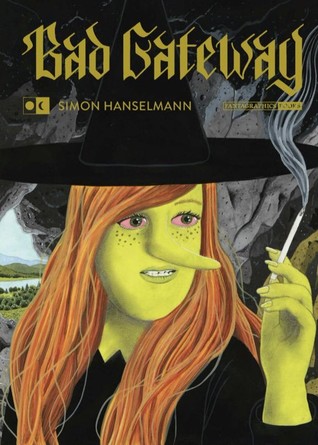
Bad Gateway


By Simon Hanselmann (Fantagraphics Books)
ISBN: 978-1-68396-207-6 (HB)

Simon Hanselmann is a well-travelled cartoonist of Tasmanian origin who has, since 2009, been producing one of the best cartoon strips of all time.

Originally located on his girlmountain.tumblr site, later episodes of this engagingly deceptive, inappropriately pigeon-holed “stoner comedy” Megg & Mogg have popped up in places as varied as Kus, Smoke Signal, Gangbang Bong and assorted minicomics, but can now all be found in a sturdy, full colour archival compilations such as this latest titanic (313 x 212mm) which carries our scurrilous cast to a final crisis point…

Hanselmann’s signature characters were loosely based on childhood memories of British children’s books Meg & Mog (created by Helen Nicoll & Jan Pienkowski and begun in 1972), but warped and filtered through a druggy haze and damaged childhoods. Depression-afflicted teen druggie witch Megg lives with her mean-spirited feline familiar Mogg, but their existence also impacts on sensitive, insecure, affection-starved Owl and violently self-destructive Werewolf Jones…

When not confronting or testing each other or hanging with the wrong crowd, they spent most of their time in a haze of self-inflicted ennui or on dope-fuelled junk-food binges in the apartment or in front of the TV. They probably don’t like each or themselves much but dwell in a fug of dangerous co-dependency. Their strange yet oddly compulsive adventures have enthralled a generation of readers: a most improper tribute to a life lived more wryly through chemistry and sarcasm. After a stellar decade of awards and critical acclaim, the ongoing internationally successful series stumbles to a critical point and psychological crux in this latest luxury hardback (and digital) release…

And just in case you were wondering…

This book is packed with drug references, violent sexual imagery and outrageous situations intended to make adults laugh and think.

If the copy above hasn’t clued you in, please be warned that this book uses potentially disturbing images of abuse, sexual intimacy, excess and language commonly used in the privacy of the bedroom, drunken street brawls – and all school playgrounds whenever supervising adults aren’t present – to make its artistic and narrative points.

If the mere thought of all that appals and offends you, read no further and don’t buy it. The rest of us will just have to enjoy some truly astounding cartoon experiences without you.

Lethargically anarchic and cruelly hilarious, the escapades reopen after ‘Previously in Megg, Mogg & Owl’ with 28 Days Later’ as the pharmacologically paralysed and insecure Megg reluctantly abandons malicious, experience-craving Mogg to debase herself even further. It’s time for her Welfare Benefits review and under the new administration she’s going to have to excel if she wants to keep getting money to maintain her current lifestyle.

Hyper-anxious, she also delivers an ultimatum: come what may, Mogg is going to have to get a job…

In the meantime, part-time dealer and full-time patsy Werewolf meets up with a couple of regulars and gets well and truly shafted… again…

With the latest crisis averted for now and all wounds healing, the junkies start looking for stuff to sell but when Megg tries to pawn her ‘Rollerblades’ the unwelcome memories take her down roads she’d rather not acknowledge let alone recognise…

‘Banned’ follows Megg into therapy, but as her extended circle of acquaintances share their own troubles, Mogg finds new ways to amuse himself…

‘The Birdcage’ then finds the friends staging a bizarre intervention for Werewolf, after which Megg makes a major decision in ‘Vibrate’ when her mother sends a message begging for help, precipitating a cross-country jaunt, a re-visitation of past events and a confrontation that is the emotional equivalent of ‘Throwing Rocks at Power-lines’, before some kind of stability is restored through a time-dishonoured ‘Ritual’…

Despite surface similarity to some no-harm, no-foul adult situation comedies – and believe me there are outrageous laughs by the bucketful – what predominates here is a strong, frequently overwhelming narrative progression of painful yet beguiling stories which navigate with easy confidence the tightrope between sordid and surreal, hilarity and horror, survival and sinking away.

Dark, affecting and unforgettable, this is a book no lover of truly mature fiction should ignore.
Bad Gateway © 2019 Simon Hanselmann. This edition © 2019 Fantagraphics Books, Inc. All rights reserved.

Why Art? (Fourth Edition)


By Eleanor Davis (Fantagraphics Books)
ISBN: 978-1-68396-082-9 (PB)

Probably everybody here will agree that comics is art sequentially wedded to pictures. However, when asked to define what constitutes “Art”, the answers become a little more nuanced and open to debate. What’s needed is someone sharp, talented and well-travelled – preferably a practitioner – who can give us all a full and final assessment…

Eleanor Davis is one of those rare sparks that just can’t help making great comics. Born in 1983 and growing up in Tucson, Arizona, she was blessed with parents who immersed their child in classic strip literature such as Little Nemo, Little Lulu and Krazy Kat.

Following unconventional schooling and teen years spent making minicomics, Davis studied at Georgia’s prestigious Savannah College of Art and Design, where she now teaches. Her own innovative works have appeared in diverse places such as Mome, Nobrow and Lucky Peach.

A life of glittering prizes began after her award-winning easy reader book Stinky was released in 2008. Davis subsequently followed up with gems such as The Secret Science Alliance and the Copycat Crook (with her husband Drew Weing), You & a Bike & a Road and How to be Happy. Who better, then, to lay to rest possibly the most infuriating conundrum of the modern age?

In 2018, Fantagraphics released Why Art?, based on elements of her presentation for ICON: The Illustration Conference 9. The result is a whimsical exploration of what the term means – albeit seen through the lens of one of the slyest, driest and most cultured senses of humour in the business…

If you can keep your own wits about you, in this deliriously addictive paperback/eBook you will glean potential solutions to perennial mysteries all de- and re-mystified in chapters on ‘Color’ as interpreted through scale; ‘What is our audience searching for’ via an examination of Masks; how to use physical and metaphorical ‘Mirrors’ and how some art is ‘Edible’…

Narrative fully enters the frame in a section on ‘Concealment artworks’ and the liberational force of ‘Shadowbox’ creations. which serves to introduce a repertory cast of creatives who work in different media and then take us on their shared journey of catastrophic revelation…

Wry and surreal, strong>Why Art? is a delicious tease and poker of hornets’ nests that slickly tackles loads of old, overused questions while offering a few new queries you never thought of…

It’s also beautifully drawn and rendered: A brilliant diversion combining wit and wisdom in a manner every self-accused intellectual and unrepentant picture lover can revel in.
© Eleanor Davis 2018. This edition © 2018 Fantagraphics Books, Inc. All rights reserved.

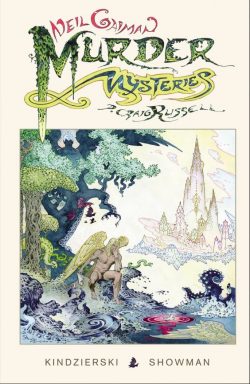
Neil Gaiman’s Murder Mysteries


By Neil Gaiman, P. Craig Russell & various (Dark Horse Books)
ISBN: 978-1-61655-330-2 (HB)

A short story first written for the 1992 prose horror anthology Midnight Graffiti, Murder Mysteries was adapted into a radio play – or more accurately an audio drama – in 2000. You can also find it in Gaiman’s 2005 anthology collection Smoke and Mirrors. A reputedly excellent film script of the timeless tale remains – as of this writing – ready and waiting for a benefactor to make it happen…

In 2002 esteemed comics virtuoso P. Craig Russell in collaboration with the author adapted the story into a sublime graphic narrative and the result was an intriguing, introspective parable within a fable.

This classy hardback (or digital equivalent, should your preferences incline that way) is a luxurious second edition which also offers a fulsome deconstruction and critique of the finished comics work by Durwin S. Talon: the extended afterword ‘Mysteries Demystified’. Initially seen in The Art of P. Craig Russell, its analysis and copious visual extras – such as sketches, script excerpts and layouts – are augmented by an annotated Sketchbook section contributed by Russell, offering even more intimate glimpses into the creative process, and include original pencilled pages, ink and colour stages plus alternate and rejected images, as well as previous collection covers.

The meat of the book is a tale within a tale within yet another and begins after a nefarious interlude in Heaven with a British traveller stuck in Los Angeles over Christmas.

He’s reeling from culture shock, and momentarily succumbs to the allure of an old lover before extricating himself from a difficult situation. Aimlessly roaming the streets, he meets a bum who tells him a story in exchange for a shared cigarette.

As the oddly-compelling derelict speaks, the displace stranded listener is mesmerised by the eerie echoes of his own existence. The bum is actually an ex-angel and recounts a tale of the Silver City…

After God created the Angels, but before he made us or the world, the sexless winged paragons – each with their own divinely appointed role – were finishing up the details of Creation. The narrator was once Raguel: The Vengeance of the Lord, and it spent this period waiting.

Eventually Lucifer came to it. A novel thing had happened, something unique, something… wrong. An Angel’s existence had been ended. Deliberately…

Raguel was expected to find and punish the perpetrator, but the “who” and “how” of the mission soon gave way to a search for an undefinable “why”. Mired in an obfuscatory maze of resistance from other Angels, Raguel reached a conclusion: the abominable act was somehow connected to a new emotion the deceased had been constructing. It was called “Love”…

This engrossing murder-mystery, detective tale and supernatural fantasy has a languid lyrical quality devoid of tension or drama, but is nonetheless an engrossing diversion, technically perfect, gently compelling. The clean, lovely art – augmented by colours from Lovern Kindzierski and typography by Galen Showman – is some of the best Russell has ever created.

If you can appreciate beauty for its own sake and suspend your need for pulse-quickening drama and angst, this is a triumphant and fascinating example of the power of style over content.
Text © 2002, 2014 Neil Gaiman. Adaptation and illustrations © 2002, 2014 P. Craig Russell All Rights Reserved.

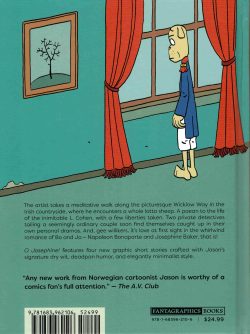
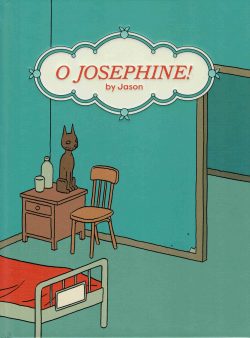
O Josephine!


By Jason (Fantagraphics Books)
ISBN: 978-1-68396-210-6 (HB)
Jason is secretly John Arne Saeterrøy: born in Molde, Norway in 1965 and an overnight international cartoon superstar since 1995 when his first graphic novel Lomma full ay (Pocket Full of Rain) won that year’s Sproing Award (Norway’s biggest comics prize).

He won another Sproing in 2001 for his Mjau Mjau strip and the following year turned almost exclusively to producing graphic novels. Now an established global star, he has garnered numerous major awards from such disparate locales as France, Slovakia and the USA.

Jason’s breadth of interest is capacious and deep: comics, movies, music, high literature, low life, real life and pulp fiction all feature equally with absolutely no inherent sense of hierarchy, and his puckish mixing and matching of such evergreen founts of inspiration always result in a picture-treatise well worth a reader’s time.

A master of short-form illustrated tales, many Jason yarns are released as snappy little albums which are perfect for later inclusion in longer anthology collections such as this one which gathers a quartet of the most recent and very best.

As always, the visual/verbal bon mots unfold in Jason’s beguiling, sparse-dialogued, pantomimic progressions with enchantingly formal page layouts rendered in the familiar, minimalist evolution of Hergé’s Ligne Claire style; solid blacks, thick lines and settings of seductive simplicity. That delight is augmented here by a beguiling palette ranging from stark monochrome to primary yellow duotones…

Available thus far only as a sturdily comforting hardback, the stream of subtle wonderment opens with a suitably understated autobiographical jaunt to the land of Erin and an uneventful but truly mind-blowing progression along ‘The Wicklow Way’. The vacation hikes might be scenic and uneventful, but you’re never alone as long as you’re stuck inside your own head…

With the addition of a jaundiced inky outlook (and employing “yellow journalism” of the most literal kind) ‘L. Cohen: A Life’ then outlines the life and times of the poet, musician and philosopher, with a strong emphasis on whimsical inaccuracy and factual one-upmanship…

Filmic classicism underpins ‘The Diamonds’ as a pair of barely-boiled detectives lose all objectivity as their scrupulous surveillance of a simple family affects their own hidden lives before the low key dramatics slip back into monochrome and into the twilight zone after weary world traveller Napoleon Bonaparte returns to Paris and falls head over shiny heels for infamous exotic dancer Josephine Baker. As with all doomed romances, the path to happiness is rocky, dangerous, and potentially insurmountable, but… c’est l’amour!

Jason’s comic tales are strictly for adults but allow us all to look at the world through wide-open childish eyes, exploring love, loss, life, death, boredom and all aspects of relationship politics without ever descending into mawkishness or simple, easy buffoonery. His buffoonery is always slick and deftly designed for maximum effect…

Jason remains a taste instantly acquired: a creator any true fan of the medium should move to the top of their “Must-Have” list.
All characters, stories, and artwork © 2019 Jason. This edition © Fantagraphics Books, Inc. All rights reserved.

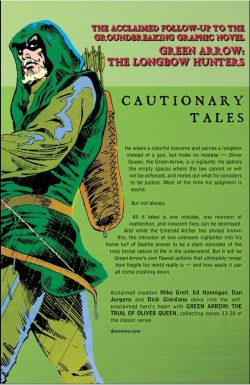
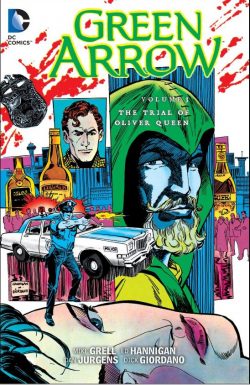
Green Arrow volume 3: The Trial of Oliver Queen


By Mike Grell, Ed Hannigan, Dan Jurgens, Dick Giordano, Frank McLaughlin & various (DC Comics)
ISBN: 978-1-4012-5523-7 (TPB)

Premiering in More Fun Comics #73 in 1941, Green Arrow is one of very few superheroes to be continuously published (more or less) since the Golden Age of American comicbooks. At first glance this blatant amalgamation of Batman and Robin Hood seems to have very little going for him but has always managed to somehow keep himself in vogue.

Probably his most telling of many makeovers came in 1987, when, hot on the heels of The Dark Knight Returns, writer/artist Mike Grell was tasked with making him the star of DC’s second “Prestige Format Mini-Series”.

Grell was one of comics’ biggest guns at the time. Beginning his rise with a laudable run on Legion of Super-Heroes, he went on to draw the revived Green Lantern/Green Arrow and practically saved the company with his Edgar Rice Burroughs-inspired fantasy epic Warlord. He had also notched up a big fan following illustrating many Aquaman, Batman and Phantom Stranger stories before establishing his independent creator credentials at First Comics with Starslayer and Jon Sable, Freelance…

In the grim ‘n’ gritty late Eighties, it was certainly time for another overhaul of the Emerald Archer. Exploding arrows yes, maybe even net or rope arrows, but arrows with boxing gloves or paint brushes on them just wouldn’t wash with a newer, more sophisticated readership. Thus, in an era of corrupt government, drug cartels and serial killers, the evergreen survivor adapted and thrived under the direction of a creator famed for the uncompromising realism of his work.

The Longbow Hunters focused on the superhero’s mid-life crisis as he relocated to Seattle and struggled to come to terms with the fact that since his former sidekick Speedy was now a dad, Oliver Queen had technically become a grandfather. Beside long-time “significant other” Dinah (Black Canary) Lance he began to simplify his life, but the drive to fight injustice never dimmed for either of them.

Dinah went undercover to stamp out a drug ring whilst Ollie became engrossed in the hunt for a psycho-killer dubbed “The Seattle Slasher”. The archer also learned of a second – cross-country – slayer who had been murdering people with arrows…

Eschewing gaudy costume and gimmicks, Queen reinvented himself as an urban hunter to stop such unglamorous, everyday monsters, stumbling into a mystery which led back to World War II involving the Yakuza, CIA, corporate America and even the Viet Nam war, even as it introduced a deadly female counterpart to the beleaguered bowman: an enigmatic, morally ambiguous archer called Shado…

The intricate plot, subtly blending three seemingly separate stories which were in fact one, still delivers a shocking punch even now in its disturbingly explicit examination of torture: a treatment which won the series undeserved negative press when it was first published. Although possibly tame to most modern tastes, this was eye-opening stuff in the 1980’s, which is a shame, as it diverted attention from the real issue… and that was a massive surge in quality and maturity.

The intricate, maturely sophisticated plot – interweaving themes of age, diminishing potency, vengeance and family – highlighted another turning point in American comics and led to an ongoing series specifically targeting that nebulous “Mature Readership”. The treatment and tone heavily influenced and flavoured today’s TV adaptation Arrow and has led to the release of Grell’s entire saga of nigh-forgotten urban predator tales in a range of economical, no-nonsense, full-colour trade paperbacks and digital editions.

This third collection, scripted by Grell with superbly efficient, powerfully understated art from Ed Hannigan, Dan Jurgens, Dick Giordano & Frank McLaughlin, re-presents Green Arrow volume 2 #13-20 (eclectically cover-dated “Holiday” and January-July 1989): a succession of two-part tales offering starkly authentic dramas ripped from headlines that have as much impact and relevance today as they did three decades ago…

Sparse, Spartan and startlingly compelling, the action begins – sans any preamble – with

‘Moving Target’ parts 1 & 2 (Jurgens & Giordano) wherein the hero carries on his crusade against street punks, petty thugs, wifebeaters and neo-Nazis, blithely unaware that only sheer dumb luck has prevented his assassination by a hired gun…

Once he’s caught up, Oliver eliminates all the usual suspects including the CIA and mercenary spy Eddie Fyres and almost misses his chance when the real would-be killer finally breaks cover for a final face-to-face confrontation…

‘Seattle & Die’ (Hannigan, Giordano & McLaughlin) then sees the archer on the trail of a mystery shooter who kills a gang of thieves to prevent a bloodbath in a night club. Determined to find the criminal saviour before the cops do, Queen becomes entangled in a devious web of intrigue involving an Australian Secret Service kill-team and suffers a chilling presentiment of how his own life might end…

Veteran fans in the know will enjoy the subtle tweaking of characters that allow Grell’s archer to notionally team up with his aforementioned indie hit John Sable…

Jurgens, Giordano & McLaughlin then combine to depict the sordid bloody saga of ‘The Horseman’ who hits Seattle hard, fast and furious in an uncompromising search for a missing stripper. His campaign of destruction sparks a brutal war amongst the drug dealers and flesh peddlers of the city, but by the time the Arrow gets involved, the conflict has escalated and working girls are being murdered in grotesque and obscene manner…

Before long, however, the mysterious Horseman is proven to have hidden motives for his brutal vendetta and another distasteful alliance is formed to find the real killers…

Always challenging and controversial, the themes hit especially hard in the final story as the Longbow Hunter gets it terribly wrong in a dark dingy alley and a young paintballer gets an arrow in the chest after seemingly shooting a cop.

Broken inside, the vigilante meekly submits to ‘The Trial of Oliver Queen’ (Hannigan, Giordano & McLaughlin) and, although completely exonerated in the eyes of the Law, condemns himself to death by dissipation – until an old friend intervenes in a most unconventional manner to restore Green Arrow’s equilibrium and moral compass…

Terse scripts, intelligent, flawed human interactions, stunning action delivered through economical and immensely effective illustration and an unfailing eye for engaging controversy make these epic yarns some of the most powerful sagas American comics ever produced. Compiled here with a cover gallery by Hannigan, Jurgens & Giordano, this compulsive retooling is yet another long-overlooked highpoint of superhero storytelling no lover of the genre will want to miss.
© 1988, 1989, 2015 DC Comics. All Rights Reserved.

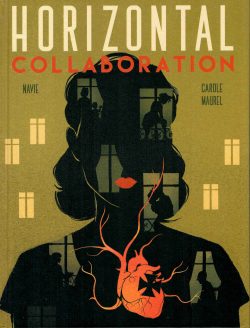
Horizontal Collaboration


By Navie & Carole Maurel, translated by Margaret Morrison (Korero Press)
ISBN: 978-1-91274-001-7

World War II – with its world-shaking reordering of society and all the consequent, still-felt repercussions – is very much in people’s minds at the moment and I’d like to offer up this new translated European tale as a counterpoint to the commemorative bombast, and the much-delayed honours finally being paid to the ever-dwindling last of “The Few”.

At least now, as well as the valiant men, we’re finally acknowledging the commonly disregarded contributions of women also caught up in the conflict, not to mention the unsung heroes of all nations who were drawn into the horror.

This particular hardcover, however, is not about heroes. Horizontal Collaboration deals with people: civilians and fugitives, women and invading occupiers: the ones who are seldom celebrated but who also confronted the triumph of global darkness, all in their own small, unnoticed ways…

France fell to the Germans in 1940. The country was occupied and partitioned on June 22nd, with the Germans holding the industrial north and central regions whilst Marshal Philippe Pétain‘s puppet protectorate Régime de Vichy was allowed to govern the south and pacified colonies such as Algeria. When the nation was liberated in September 1944, a vicious wave of retaliation began against those who cooperated with the conquerors in ways great and small.

A sordid time of scores settled (real, imagined or fabricated) and cruel abuses almost arbitrarily inflicted on guilty and innocent alike plagued France for years afterwards. The most telling indignities were perpetrated upon women – wives, mothers, sisters or strangers – accused of fraternising with or giving comfort to the enemy.

Such liaisons were called “Collaboration Horizontale” and even the most nebulous or unfounded accusation of such betrayals carried a heavy and immediate price…

Just about now, a grandmother listens to her granddaughter unload about her current amour and her mind drifts back to the war and a secret she has never shared with anyone…

In 1942, a large apartment house on Passage de la Bonne-Graine is filled with families, all dealing with the German conquerors in their own way. Despite the change in their fortunes, they have not found any way to overcome the petty grudges and ingrained social difficulties that kept them at odds with each other even before war broke out…

Surly aged crone Madame Flament is rude to everybody, and spends all her time complaining or disappearing into the cellars to feed her cats. What secret is she really hiding?

Old Camille is deemed the man of the house, but he is gentle, ineffectual and blind; blithely letting life go on around him and apparently noticing nothing. His wife is the building’s concierge. Brusque matron Martine Andrée is a snooping busybody loudly championing decency and family values, but her home life is nothing to envy and her sharp tongue scores points off family, friends and foes indiscriminately.

She despises the younger women and their families in the building, especially pretty Joséphine Borgeon who makes ends meet through her theatre act. Everybody knows what she really does to survive…

Also viewed with suspicion is young mother Rose. Her husband Raymond has been taken away to work for the Nazis, so his friend and neighbour Leon – a gendarme – has been keeping a “friendly” eye on her, even though his own pregnant wife Judith keeps clumsily falling and hurting herself and surely needs proper supervision…

Strangely boyish artist Simone keeps to herself as much as she can and – originally – there was also a Jewess called Sarah Ansburg and her son Anaël. They somehow disappeared before the Germans could find them. That must be the reason Abwehr intelligence officer Mark Dinklebauer spends so much time in the building. It couldn’t possibly be that he has fallen in love with one of the occupants, or that this most forbidden of passions is dangerously, illegally reciprocated, can it?

Crafted with deft incisiveness by media writer and historian (Mademoiselle) Navie and rendered in a beguiling style (powerfully reminiscent of Will Eisner in his later years) by seasoned illustrator and author Carole Maurel (Luisa: Now & Then, Waves, L’apocalypse selon Magda), this is a meditative and uncompromising glance at ordinary lives under relentless pressure: an ensemble piece of human drama that takes as its heart and centre point an unlikely flowering of true but doomed love…

Moving, beguiling and evocatively rewarding, Horizontal Collaboration is a beautiful tragedy and potent reminder that love takes no prisoners while enslaving all it touches.
© Editions Delcourt – 2017. All rights reserved.

Horizontal Collaboration will be released on 18th June 2019 and is available for pre-order now.

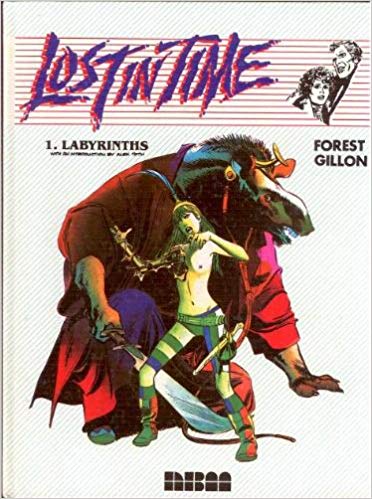
Lost in Time volume 1: Labyrinths


By Jean-Claude Forest & Paul Gillon, with an introduction by Alex Toth (NBM)
ISBN: 978-0-91834-818-0 (HB)

France has had an ongoing love affair with science fiction that goes back at least to the works of Jules Verne and – depending upon your viewpoint – arguably even as far back as Cyrano de Bergerac’s posthumously published fantasy stories L’Autre Monde: ou les États et Empires de la Lune (The Other World: or the States and Empires of the Moon) and Les États et Empires du Soleil (The States and Empires of the Sun) published in 1657 and 1662. Moreover, their comic iterations have always been groundbreaking, superbly realised and deeply enjoyable.

A perfect case in point is Les Naufragés du Temps (alternately translated as either Castaways in Time or, as here, Lost in Time) created in 1964 by Jean-Claude Forest and classical master-draughtsman Paul Gillon.

Forest (1930-1998) was a Parisian and graduate of the Paris School of Design who began selling strips while still a student. His Flèche Noire (Black Arrow) led to a career illustrating for newspapers and magazines such as France-Soir, Les Nouvelles Littéraires and Fiction in the 1950s, all whilst producing the Charlie Chaplin-inspired comic series Charlot and acting as chief artist for publisher Hachette’s science fiction imprint Le Rayon Fantastique. For this last client he produced illustrations and covers on translations of imported authors A. E. Van Vogt, Jack Williamson, and others.

In 1962, Forrest created Barbarella for V-Magazine and his sexy-charged icon quickly took the country and world by storm, consequently generating an explosion of like-minded SF Bandes Dessinées features. Forest never looked back, subsequently creating Baby Cyanide and more serious tales like Hypocrite; the Verne-inspired Mysterious Planet; La Jonque Fantôme Vue de l’Orchestre and Enfants, c’est l’Hydragon qui Passe.

He also found time to script for other artists: Ici Même for Jacques Tardi, occult detective series Leonid Beaudragon for Didier Savard and, with Gillon, the subject of today’s review – a classic of both comics and science fiction inexplicably all-but-ignored by English language publishers since the 1980s. If you read French, however, all volumes are still available in print and digitally…

Paul Gillon (1926-2011) was also born in Paris but suffered from debilitating tuberculosis in early life. After his full recovery, the isolated shut-in became something of a brilliant wild child, expelled from many schools – including the prestigious Ecole des Arts Graphiques.

As a teenager he considered a career in film, theatre or fashion, but slipped almost accidentally into the world of cartooning and caricature, working freelance for such arts magazines as Samedi-Soir, France Dimanche and Gavroche.

The end of WWII created chaotic circumstances in France, subsequently spawning a whole new comics industry, and in 1947 Gillon began illustrating for the popular weekly Vaillant, both on existing adventures strips such as Wango and Lynx Blanc (both written by Roger Lécureux) and Jean Ollivier’s Le Cormoran, as well as the later spin-off Jérémie which Gillon also scripted. In 1950, he created Fils de Chine (Sons of China) with Lécureux which ran for three years.

Working in a refined and highly classicist style epitomised by the likes of global industry giants Alex Raymond, Milton Caniff and Hal Foster, Gillon also wrote and drew shorter complete pieces for titles such as 34 Camera, Femmes D’Aujourd’hui, Reves and Radar, but his big break came in September 1959 when he began illustrating a daily soap-opera strip for national newspaper France Soir.

He would render the stunningly beautiful human heartbreaks of 13, rue de l’Espoir until the end of 1972, becoming a household name in the process…

Based on the American serial The Heart of Juliet Jones and scripted by Jacques and François Gall, the feature followed the fortunes of vivacious Parisienne Françoise Morel, and unfolding daily took the heroine and the Family Morel through some of the most tumultuous years of modern European social change, in nearly 4200 strips which were naturally compiled into two collected Albums – something else which should be translated into English but probably won’t be…

Throughout that period Gillon continued in comics, producing Jérémie, working for the Disney comic Le Journal de Mickey and other magazines while trying out new venues and genres.

Les Naufrages du Temps first appeared in 1964, part of the line-up in short-lived French comic Chouchou. A decade after the periodical closed, the strip was reprinted and saga completed in France-Soir before being released as 2 bichromic (a two-coloured palette) albums from major publisher Hachette in 1974 and 1975. Two further full-colour book volumes followed in 1976.

In 1977 the saga was serialized in groundbreaking Sci-fi magazine Metal Hurlant, prompting publisher Les Humanoides Associes to re-release the four albums (L’Etoile Endormie/The Sleeping Star; La Mort Sinueuse/The Creeping Death; Labyrinthes/Labyrinths and L’Univers Cannibale/The Cannibal Universe) in colour, before continuing the series with Gillon scripting as well as illustrating until its end in 1989: a total of six further volumes.

Never idle, Gillon then created spy-thriller Les Leviathans (The Leviathans) for Les Humanoides and adult science fiction epic La Survivante (The Survivor) for L’Echo des Savanes. He also adapted literary classics such as Victor Hugo’s Notre Dame de Paris and Herman Melville’s Moby Dick and re-imagined the legend of Joan of Arc as the erotic epic Jehanne.

His later efforts included Processus de Survie (Survival Process) in 1984 and La Derniere des Salles Obscures (The Last of the Dark Rooms) in 1998. He was still creating comics well into the 21st century and remains one of France’s most honoured, celebrated and revered comics creators, so just why so few of his incredibly illustrated tales have been translated is an utter mystery to me.

One that did make the jump was Lost in Time: Labyrinths, released as a spectacular hardback by NBM in 1987 and one of the few European imports to be seen “cold” in the USA (i.e. without first running as a serial in Heavy Metal magazine). As cited above it was the third album of the French series and opened with a much-needed preamble…

So just to recap something we hadn’t actually seen: at the end of the 20th century, humanity was imperilled by “the Scourge”: a plague of extraterrestrial spores and/or a global sickness of its own negligent making.

Chris Cavallieri and Valerie Haurele were selected for a shot at survival and placed in suspended animation in individual space-capsules to preserve the best of our race and possibly reconstruct our lost glories in a newer age…

A thousand years later Chris was awakened into a bewildering but thriving multi-species civilisation in deadly danger. Earth was a derelict, plague world inhabited by mutant monsters whilst society abandoned it and grew to inhabit a hugely re-configured Solar system.

Helping the inhabitants of the patchwork “System” – ex-pat human, alien and genetically altered/hybridised animal-beings – to defeat an invasion by alien winged rats dubbed the Thrass, Chris fortuitously found Valerie’s lost capsule and revived her – but the longed-for happy reunion led to utter disaster.

Throughout their millennial slumber both ancient human lovers had dreamt of each other and a perfect meeting, but once they were together again in a furious new future, they discovered that they could not stand each other…

This tale begins after the defeated Thrass have fled the System and Valerie, rejected by Chris, has disappeared. The resurrected Ancient and his new-found true love Mara (one of the scientists who first recovered and rehabilitated Christopher) are the topic of much discussion amongst his new friends Dr. Otomoro and military cyborg Major Lisdal. Chris haunts morgues and seedy dives of the pan-cosmopolitan city of Roobo-ein-Sarra on System capital Limovan, unable to shake his destructive, obsessive fear for the fate of his millennial ex-lover…

Depressed, despondent and bitterly confused, Chris roams the exotic streets and bazaars where hordes of newly-liberated beings manically celebrate their hard-won freedom and security, unaware that he has been targeted by sinister plotters. An old “frenemy”, Morfina, accosts him and, past injuries and seductions forgotten, lures the old Earthman to the Mood Market, a vast, baroque area of bordellos run by a legendary criminal overlord. The Boar is a burly, erudite and unctuous humanoid with a Tapir’s head and plenty to hide…

(In the original this major series villain is in fact the Tapir – I’ve no idea why he was so erroneously renamed but have a sneaking suspicion that it involves European prejudices about English and American educational attainment…)

Completely off-guard, Chris succumbs to sybaritic release and is framed for the murder of a diplomat and his companion whilst out of his head. Once awake and panicked by the corpses around him, the Last Earthman accepts the extremely costly aid of the Boar to escape…

Even Christopher believes himself guilty until he discusses the affair with Mara, Lisdal and Otomoro in the cold light of day. However, even as the wool is pulled from his eyes and he realises his precarious predicament, the bamboozled human is utterly unaware that The Boar is working with compliant, vindictive Valerie, who is briefing the crime-lord on all Chris’s secrets…

When Lisdal suggests seeking help from brilliant scientific maverick Saravon Leobart, the friends are welcomed by the aged sage, but the Boar moves quickly, sending his gamin cyber-assassin Baby to quickly whisk Chris and Mara away under the pretext that the police have arrested Lisdal and Otomoro…

It’s all a colossal bluff: The Boar needs Chris to recover a deadly pre-Scourge secret weapon cached away at the time of humanity’s fall, and all the data needed to find and operate it lies buried in his Ancient subconscious. Chris is completely unaware that the thing even exists: his mind was re-programmed before his hibernation and only vengeful Valerie holds the secret of retrieving it…

Soon the Boar and his “guests” are hurtling deep into the outer system with Leobart, Morfina and Chris’ chums in hot pursuit. After a brutal clash in space, Chris and Mara are rescued but the Boar is ready and willing to retaliate. Moreover, benevolent Leobart is not all he seems…

To Be Continued…

This is a beautiful, stately and supremely authoritative adult fantasy thriller, tantalisingly teasing the reader with the promise of so much more. The second part was released in English as Lost in Time: Cannibal World in 1987, but even that only moved the saga forward without comfortably ending things. As far as I know, the only other Gillon works to make it into English are the first two volumes of The Survivor…

Mature, solid science fiction with thoroughly believable and pettily human characters confronted with fantastic situations, lots of action and loads of gratuitous nudity: how on Earth has this sublime series remained a secret French Possession for so very long? And can we please end that particular embargo soon?
© Les Humanoides Associes. © NBM 1986 for the English edition.


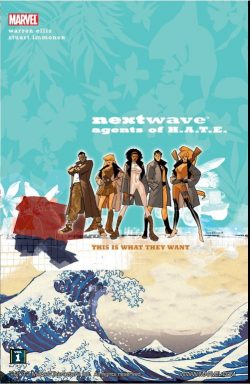
Nextwave Agents of H.A.T.E. volume 1 This is What They Want and volume 2 I Kick Your Face


By Warren Ellis, Stuart Immonen & Wade Von Grawbadger (Marvel)
ISBN: 978-0-7851-2278-4 (Vol. 1 HB); 978-0-7851-1910-4 (Vol. 2 TPB)

Even for the most dedicated fans, superhero comics can become a little samey and pedestrian, so when gifted big- name creators such as Warren Ellis and Stuart Immonen decide to have a little fun with the fringes of such a ponderous continuity as Marvel’s, expectations are always understandably high.

In 2006 Nextwave: Agents of H.A.T.E. (Highest Anti-Terrorism Effort) launched for a breathtaking and controversial 12 issue run and happily proved to be everything a jaded old fan could hope for…

The series has been compiled into one complete volume, these two collections (re-presenting #1-6 and #7-12 respectively) as well as in digital formats. That’s the illusion of choice right there, that is…

Wry, cynically Post-Modern and malevolently mischievous, the saga borrowed shamelessly from kid’s bubblegum pop culture – especially trans-pacific animation. There was even a theme-song you could hear online and a variant-issue that readers could colour in to win prizes – as well as the forgotten contents of the daftest corners of Marvel’s decades of accumulated continuity to captivatingly satirise the genre, the medium and itself.

Best of all, it was hilariously anti-globalisation, counter-capitalist, rude, sexy and excessively ultra-violent…

H.A.T.E. is another of those numerous acronymic quasi-governmental, covert high-tech agencies dedicated to keeping us all safe in our overpriced, indolent beds – at least that was what their eccentric team of operatives initially believed.

When they discovered that their employers were in fact a fully owned subsidiary of the Beyond Corporation© and the latest iteration of diabolical terrorist cabal S.I.L.E.N.T., former Avengers Monica Rambeau (Captain Marvel II/Photon/Spectrum, etc…) and artificial individual Aaron (Machine Man) Stack rightly rebelled.

With ex-X-Man Tabitha Smith (Meltdown/Boom Boom); stroppy immortal monster-hunter Elsa Bloodstone and hyper-powered, unimaginative enigma The Captain in tow, they went AWOL, intending to stop their former paymasters at all costs.

Incidentally, the last-cited was formerly Captain $#!£ until ostracized by all the other military-monickered mystery-men, after which Captain America punched his foul-mouthed head in and washed his mouth out with soap.

Further investigation disclosed that the terrorist conglomerate was actually planning to product-test potentially lucrative BWMDs (Bizarre Weapons of Mass Destruction) on American soil and ordinary folks, so the disgruntled quintet promptly stole a super-ship and all the plans, determined to stop the callous campaign and take down the despicable Beyond©-ers forever…

With their increasingly deranged, suicidal and sexually outré former commander Dirk Anger in hot pursuit, the team begins its fightback in Abcess, North Dakota where the legendary giant dragon-in-underpants Fin Fang Foom has been awakened and… stimulated… into going on a rampage of destructive frustration…

On the streets of Abcess, hordes of Beyond©’s mass-produced vegetable warriors are attacking the citizenry and exacerbating the chaos until Elsa and The Captain intervene with their signature lack of restraint and disregard for human life or private property.

As municipal damage and general unrest spiral upwards, Monica devises an unsavoury plan and orders Aaron – a fantastic, military-created robot who despises human “fleshy ones” and has reprogrammed himself to crave vast amounts of beer – to get himself swallowed and deal with the dragon from the inside…

With no rest for the Wicked-crushers, the renegade revengers then head to Sink City, Illinois where brutally corrupt cop Mac Mangel has been infected with a mechanistically mutating program, transforming him into a colossal flesh-and-steel beast hungry to eat metal and/or children…

With mounting carnage everywhere, the Captain still gets distracted into an origin flashback, leaving Tabitha to deal with the Transformer-ed Mangel in her stylishly simple yet permanent manner…

In Wyoming, the Nextwave discover a Beyond© War Garden and set about destroying the next crop of broccoli berserkers and cabbage crusaders, just as Dirk Anger and his other – still-loyal – agents of H.A.T.E. arrive in their flying citadel to unleash all the insane instruments of doom in their arsenal. However even the Drop Bears of Cuddly Koala Death, a flock of Assault Pterosaurs, Samurai Robots and Homicide Crabs cannot contain the righteous indignation of the forgotten heroes, and when Aaron counterattacks by stealing Dirk’s chic-est most secret possession the deviant Director has no choice but to retreat…

To Be Continued…


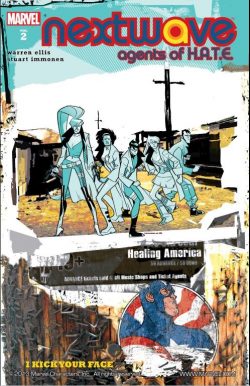
Nextwave Agents of H.A.T.E. volume 2: I Kick Your Face

The action barely pauses for a primer recap before Beyond©orp’s follow-up BWMD event sees the terrorist entrepreneurs summon an extremely minor and rather juvenile Elder God, Rorkannu, Lord of the Dank Dimension. The malefactors trade that for access to a deadly invading army of mystic behemoths that Dr. Strange fans will recognise as merciless “Mindless Ones” to decimate the town of Shotcreek, Colorado.

Ready to back-up the embattled townspeople are Monica and her crew, but things take a decidedly surreal turn as the monolithic marauders prove to be not all that mindless after all…

In the blistering last-stand battle, Elsa becomes lost in fond reminiscences of her truly unique and bloody childhood, before, against all odds, the Captain stumbles onto Rorkannu and -contrary to everyone’s expectations – finally does something right…

When Steve Rogers became Captain America in 1941, nobody realised that a second Nazi spy stole his urine sample. Now, through a most torturous and arcane path, that last remnant of the original Super-Soldier serum has allowed the ruling elite of the Beyond© group to create whole battalions of customised metahuman champions…

When Nextwave finally track the terrorists to their inverted floating fortress, they are confronted by an army of esoteric adversaries derived and developed from the misappropriated hero-pee and aligned in specifically themed teams such as The Surgery, The Vestry and The Homosexuality, but even such lethally dedicated foes as Dr. Headless, Father Pain, Dr. Nosexy, Sun King, Red Rosary and Slightly Creepy Policewoman pale into feeble insignificance beside the reality-altering threat of Forbush-Man and his eerily familiar comrades the New Paramounts…

Once again plunged into horrifically violent combat, the Nextwave are slowly making bloody headway until the diminutive demon plunges the team into depressing and dreary alternate lives from the worst recesses of their inner visions. Tragically for Forbush-Man, nobody had ever found any evidence of intellect or imagination in Tabitha, just an overwhelming vacuity, urge to steal and need to blow stuff up…

With the end in sight, the triumphant heroes invade the Beyond Corporation©’s hidden HQ State 51 just as Dirk Anger, transformed and degraded beyond imagination, arrives, culminating in an even more spectacular clash before finally confronting the utterly macabre mastermind behind the monstrous marketing campaign of destruction. The elation is non-existent as the team discover an even more bizarre kingmaker behind it all and finally bring the hammer down once and for all…

As action comics in their purest form, the tales are laced with light-hearted lethality and superbly smutty innuendo, with hints of Garth Ennis and John McCrea’s Hitman, Ben Edlund’s The Tick, Pat Mills & Kevin O’Neill’s Marshall Law and Keith Giffen’s Ambush Bug, with all the verve, panache and invention of the Powerpuff Girls and Dexter’s Laboratory, all wrapped up in pithy corporate sloganeering a la Better Off Ted, Corporate and Joseph Goebbels…

Jam-packed with in-joke extras, this is a glorious comic series – in every sense of the word – and an experience no, fun-loving fan could possibly find fault with.

“Healing America by Beating People Up” and making us laugh by taking the piss…

© 2006, 2007, 2010 Marvel Characters, Inc. All rights reserved.

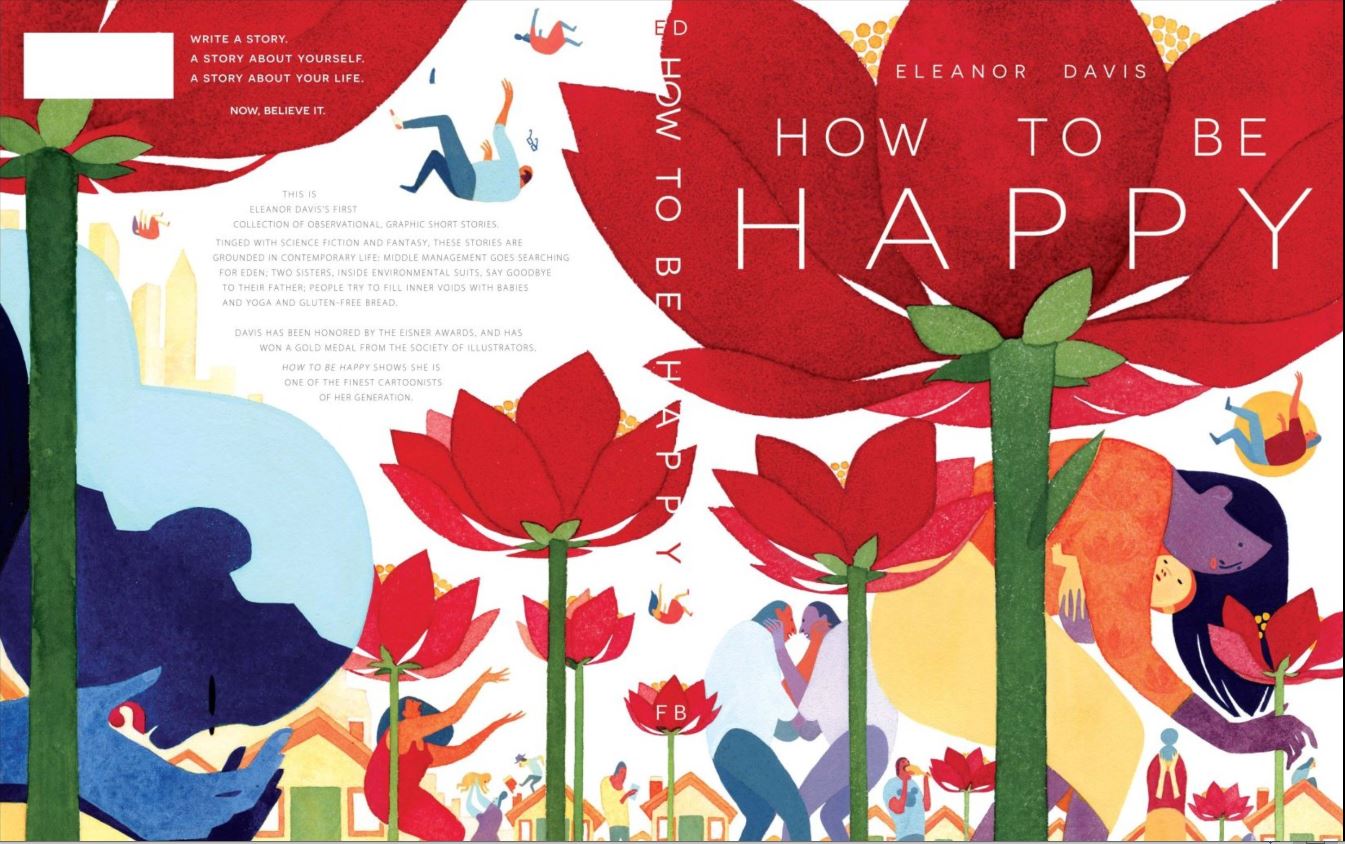
How to Be Happy


By Eleanor Davis (Fantagraphics Books)
ISBN: 978-1-60699-740-6 (HB)

Do acts of creation make one happy? They certainly do for me. but sometimes so do acts of wanton destruction. I’m sharing, not judging…

Eleanor Davis is one of those rare sparks that just can’t help making great comics. Born in 1983, and growing up in Tucson, Arizona, she was blessed with parents who reared her on classic strips such as Little Nemo, Little Lulu and Krazy Kat. Following unconventional schooling and teen years spent making minicomics, she studied at Georgia’s wonderful Savannah College of Art and Design, where she now teaches. Her innovative works have appeared in diverse places such as Mome, Nobrow and Lucky Peach.

A life of glittering prizes began after her award-winning easy reader book Stinky was released in 2008. Davis has since followed up with gems such as The Secret Science Alliance and the Copycat Crook (with her husband Drew Weing), You & a Bike & a Road and Why Art?

In 2014, Fantagraphics released her themed collection of epigrammatic tales, crafted in a mesmerising variety of styles and riffing on the concept of joy and contentment: causes, failings, and what to do with them when and if they happen. These are enigmatic variations on the most ephemeral of emotions and one you only really notice when it’s gone, but the individual episodes here are truly joyous to share.

How to Be Happy is NOT a self-help book – at least not in any traditional sense, but it did make me feel very good when I first read it and only increases my sense of fulfilment every time I pick it up, whether in its comforting reassuring hardback edition or my ever-present anxiety-reducing digital edition…

These observational short stories were created, it seems, for the sheer innocent joy of making them, and examine many aspects of life through self-contained yarns ranging from cautionary tales to excoriating self-diagnosis to flights of sardonic fancy. Some are titled like proper narratives whilst others just happen like life does. Those I’ve identified by first lines if no title is obvious…

Packed with evocative, stand-alone imagery, the episodes commence with line art pictorial pep talk ‘Write a Story’ before switching to lush colour for ‘In Our Eden’, wherein a primitive life of pastoral toil starts to grate on Adam and Eve. They are, unsurprisingly, not all they seem…

Further monochrome line art interventionism manifests in ‘First We Take Off Our Clothes’ after which a short hop into full-colour and a longer one into a fraught future examines family life on Tomorrow’s sub-continent when ‘Nita Goes Home’…

Separation and rural isolation underpin black-&-white monologue ‘We Come Down on Clear Days’ before the restricted colour palette of ‘Stick and String’ offers a hard look at relationships and agency in the tale of a wandering minstrel and the captivating power of momentary fascination…

Relations are further tested in monochrome as ‘Darling I’ve Realized I Don’t Love You’ provides unwise solutions to ancient problems before a truly disquieting incident of mutual grooming in ‘Snip’ segues into a chilling visit to ‘The Emotion Room’.

Colour is employed to potent effect in ‘He turned a grey-green and thought he might pass out’ whilst ‘Seven Sacks’ addresses grisly problems in a fresh fable Aesop or the Brothers Grimm would be proud to pen.

Two colours and self-delusion tinge ‘Did you want to see the statue?’, whilst B&W lines detail the rewards of heroic vitality in ‘Make Yourself Strong’, after which young love blossoms in living colour in ‘Summer Snakes’…

The pure exultation and imagination of childhood is exposed through stark monochrome in ‘Thomas the Leader’ before a brief Vox-pop moment in ‘I used to be so unhappy but then I got on Prozac’ is built upon in further untitled moments of self-realisation before a strong admonition to ‘Pray’…

Observation, tribulation and revelation all come to the author in ‘In 2006 I took a Greyhound from Georgia to Los Angeles’ before a descent into dark moments and extreme actions in ‘The fox must have been hit pretty recently…’ is balanced by intimate sharing in ‘The woman feels sadness’.

Colour adds depth in an extended moment of group therapy release in ‘No Tears, No Sorrow’, after which the wandering introspection of ‘9/26’ leads to a conclusion of sorts in a cab ride to ’25 Washington Street, Please’…

A superb example of the range and versatility of image and text happily combined, this a true joy for all fans of unbridled expression no one could fail to enjoy.
© Eleanor Davis 2014. All rights reserved.