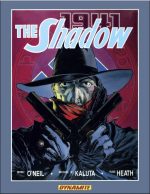

The Shadow 1941: Hitler’s Astrologer


By Dennis O’Neil, Michael William Kaluta, Russ Heath & various (Dynamite Entertainment)
ISBN: 978-1-60690-429-9

In the early 1930s, The Shadow gave thrill-starved Americans their measured doses of extraordinary excitement via cheaply produced pulp periodical novels, and over the mood-drenched airwaves through his own radio show.

“Pulps” were published in every style and genre in their hundreds every month, ranging from the truly excellent to the pitifully dire, but for exotic or esoteric adventure-lovers there were two stars who outshone all others. The Superman of his day was Doc Savage, whilst the premier dark, relentless creature of the night dispensing terrifying grim justice was the putative hero featured here.

Radio series Detective Story Hour – based on stand-alone yarns from the Street & Smith publication Detective Story Magazine – used a spooky-toned narrator (variously Orson Welles, James LaCurto or Frank Readick Jr.) to introduce each tale. He was dubbed “the Shadow” and from the very start on July 31st 1930, he was more popular than the stories he related.

The Shadow evolved into a proactive hero solving instead of narrating mysteries and, on April 1st 1931, began starring in his own printed adventures, written by the astonishingly prolific Walter Gibson under house pseudonym Maxwell Grant. On September 26th 1937 the radio show officially became The Shadow with the eerie motto “Who knows what evil lurks in the hearts of Men? The Shadow knows!” ringing out unforgettably over the nation’s airwaves.

Over the next eighteen years 325 novels were published, usually at the rate of two a month. The uncanny crusader spawned comicbooks, seven movies, a newspaper strip and all the merchandising paraphernalia you’d expect of a smash-hit superstar brand.

The pulp series officially ended in 1949 although Gibson and others added to the canon during the 1960s when a pulp/fantasy revival gripped the world, generating reprinted classic yarns and a run of new stories as paperback novels.

In graphic terms The Shadow was a major player. His national newspaper strip – by Vernon Greene – launched on June 17th 1940 and when comicbooks really took off the Man of Mystery had his own four-colour title; running from March 1940 to September 1949.

Archie Comics published a controversial contemporary reworking in 1964-1965 under their Radio/Mighty Comics imprint, by Robert Bernstein, Jerry Siegel, John Rosenberger and Paul Reinman. In 1973 DC acquired the rights to produce a captivating, brief and definitive series of classic comic sagas unlike any other superhero title then on the stands.

DC periodically revived the venerable vigilante. After the runaway success of Crisis on Infinite Earths, The Dark Knight Returns and Watchman, Howard Chaykin was allowed to utterly overhaul the vintage feature for an audience at last acknowledged as grown-up enough to handle more sophisticated fare.

This led to further, adult-oriented iterations and one cracking outing from Marvel before Dark Horse assumed the license of the quintessential grim avenger for the latter half of the 1990s and beyond.

Dynamite Entertainment secured the option in 2011 and, whilst reissuing much of those other publishers’ earlier efforts, began a series of new monthly Shadow comics.

A year after Howard Chaykin and DC catapulted The Shadow into the grim ‘n’ grungy contemporary arena the dream-team that had first returned him to comic-book prominence reunited for a larger-than-life grand romp, ably abetted by the inking skills of master artist Russ Heath.

Denny O’Neil and Michael Kaluta had produced a stand-out series of adventures in the early 1970s (collected as The Private Files of the Shadow), set in the mad scientist/spy/gangster-ridden ‘thirties, and when they reunited to produce a Marvel Graphic novel expectations were high. As it turned out, in many ways that complex and devious yarn was the final chapter in that astounding graphic procession. In 2013 Dynamite re-released Hitler’s Astrologer with the entire affair re-mastered by Mike Kelleher, finally doing justice to the colouring of Mark Chiarello, Nick Jainschigg and John Wellington – as well as letterer Phil Felix – which had nor fared well under the production processes of the time…

On Easter Sunday 1941 a beautiful woman is pursued through the teeming crowds of Times Square theatre-goers by sinister thugs until rescued in the nick of time by agents of The Shadow.

She is Gretchen Baur, personally despatched to America by Josef Goebbels to gather astrological data for the Reich’s Ministry of Propaganda. However, now the confused fräulein cannot understand why agents of her own government have tried to abduct her…

The Shadow reveals that she is an unwitting pawn in a deadly battle for supremacy within the Nazi Party that revolves around her father, Der Führer’s personal astrologer…

And thus begins a tense and intricate conspiracy thriller that ranges from the bloody streets of New York through the killer skies of Europe to the very steps of Hitler’s palace in Berlin as a desperate plan to subvert the course of the war comes up hard against a twisted, thwarted love and a decades-long hunt for vengeance.

Deliciously and suitably Wagnerian in style, this action-packed mystery drama exudes period charm; nobody has ever realised The Shadow and his cohorts as well as Kaluta, whilst Russ Heath’s sleek inks add weight and volume to the cataclysmic proceedings.

This sinister saga of the man in the black slouch hat with the girasol ring is another superb addition to the annals of the original Dark Knight, and one no one addicted to action and mystery should miss.
The Shadow ® & © 2013 Advance Magazine Publishers Inc. d/b/a Conde Nast. All Rights Reserved.

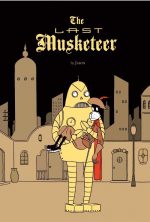
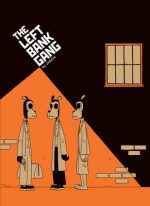
The Left Bank Gang…


By Jason, coloured by Hubert and translated by Kim Thompson (Fantagraphics Books)
ISBN: 978-1-56097-742-1

Jason is secretly John Arne Saeterrøy: born in Molde, Norway in 1965 and an overnight international cartoon superstar since 1995 when his first graphic novel Lomma full ay regn (Pocket Full of Rain) won that year’s Sproing Award (Norway’s biggest comics prize).

He won another Sproing in 2001 for the series Mjau Mjau and in 2002 turned almost exclusively to producing graphic novels. Now a global star among the cognoscenti he has won seven major awards from such disparate regions as France, Slovakia and the USA.

Now his latest novella is released, rife with his signature surreality; populated with cinematic, darkly comic anthropomorphs and featuring more bewitching ruminations on his favourite themes of relationships and loneliness, viewed as ever through a charmingly macabre cast of bestial movie archetypes and lost modern chumps.

In this brief full-colour tract – originally released in France as Hemingway – Jason puts his quirkily-informed imagination into literary overdrive and postulates what might have been at a moment of intense intellectual cross-pollination.

It’s Paris in the 1920s and émigrés F. Scott Fitzgerald, Ezra Pound, James Joyce and Ernest Hemingway are all struggling to make their marks on the world – and most especially on the other artistic Men and Women of Destiny congregated in the enclave of creative excellence that has grown up around the Latin Quarter.

As wannabe cartoonists their own meagre efforts seem paltry and trivial in comparison to the masterful comic books being produced by Dostoyevsky or Faulkner, whilst true artists such as Jean-Paul Sartre and Man Ray all seem to have no trouble with their medium or message…

Worst of all Scott thinks something is bothering Zelda: she might even be cheating on him…

The disaffected Young Turks are all plagued by nightmares of the past and frustrated dreams of mediocre futures and everyday life keeps coming at them demanding vile money just to stay alive and keep on fruitlessly toiling. And then Hemingway says it: why not just rob a bank…?

Blending literary pretention and modern creative mythology with the iconography and ironic bombast of Reservoir Dogs is a stroke of genius no one else could pull off.

As always, this visual/verbal bon mot unfolds in Jason’s beguiling, sparse-dialogued, pantomimic progressions with enchantingly formal page layouts rendered in the familiar, minimalist evolution of Hergé’s Claire Ligne style; solid blacks, thick lines and settings of seductive simplicity augmented here by a stunning palette of stark pastels and muted primary colours.

Jason’s work always jumps directly into the reader’s brain and heart, always probing the nature of “human-ness” by using the beastly and unnatural to ask persistent and pertinent questions. Although the clever sight-gags are less prominent here his repertory company of “funny-animal” characters still uncannily depict the subtlest emotions with devastating effect, proving again just how good a cartoonist he is.

This wry mis-history lesson is strongly suggested for adults but makes us all to look at the world through wide-open childish eyes. Jason is instantly addictive and a creator every serious fan of the art form should move to the top of the “Must-Have” list.
All characters, stories and artwork © 2007 Editions de Tournon-Carabas/Jason. All rights reserved.

I Killed Adolf Hitler


By Jason, coloured by Hubert and translated by Kim Thompson (Fantagraphics Books)
ISBN: 978-1-56097-828-2

Jason is secretly John Arne Saeterrøy: born in Molde, Norway in 1965 and an overnight international cartoon superstar since 1995 when his first graphic novel Lomma full ay regn (Pocket Full of Rain) won that year’s Sproing Award (Norway’s biggest comics prize).

He won another Sproing in 2001 for the series Mjau Mjau and in 2002 turned almost exclusively to producing graphic novels. A global star among the cognoscenti, he has won many major awards from such disparate regions as France, Slovakia and the USA.

In this deliciously wry novella his signature surreality is marginally restrained in favour of a shaggy-dog-story plot, although the quirky tale is – as ever – populated with cinematic, darkly comic anthropomorphs and features more bewitching ruminations on his favourite themes of relationships and loneliness, viewed as ever through a charmingly macabre cast of bestial archetypes and socially-lost modern chumps.

Here he puts his sedately fevered mind to an issue that has perplexed the intellects and consciences of many modern generations and produced – as you would imagine – the very last thing anybody expected…

This post-modern short-and-speculative fable unfolds through the usual beguiling, sparse-dialogued, pantomimic progressions he favours but also resonates with the best of B-Movie Sci Fi shtick. The solidly formal page layouts are rendered in Jason’s minimalist evolution of Hergé’s Claire Ligne style: solid blacks, thick lines and settings of seductive simplicity augmented here by Hubert’s enticing but reductive palette of stark pastels and muted hues.

In a world much like our own, but where petty annoyances can be easily eradicated by one of the many contract killers legally plying their trade in shops and cafes, a certain hard-working hitman toils his weary way through the unchanging days.

The murder mechanic’s love life is troubled and the work-life balance tipped too far into the repetitive tedium of the next execution. He barely breaks a sweat as someone fails to erase him, and he’s pretty sure he knows who sent the gunman to kill him whilst he watched TV…

That missing spark rekindles the next day, however, when an old professor comes into the office. This old duffer wants him to kill Hitler and has even built a time machine to accomplish the task.

Soon the assassin is prowling the halls of the Berlin Chancellery but hasn’t reckoned on the fanatical devotion of the Fuehrer’s minions. That crucial first attempt spoiled, the job becomes impossible after Adolf steals the time machine and escapes to the future where he makes the best of his opportunity to start over…

Still, a job is a job and the hunter finds a way to persevere… and that’s when things get really complicated…

Jason’s work always jumps directly into the reader’s brain and heart, always probing the nature of “human-ness” by using the beastly and bizarre to ask persistent and pertinent questions. Although the clever sight-gags are less prominent here his repertory company of “funny-animal” characters still effectively depicts the subtlest emotions with devastating flair, proving again just how good a cartoonist he is.

This comic tale is best suited for adults but makes us all look at the world through wide-open childish eyes. Jason is instantly addictive and a creator every serious fan of the medium should move to the top of the “Must-Have” list. While you’re at it, make room there for Werewolves of Montpellier, The Left Bank Gang and all the scintillating rest too…
All characters, stories and artwork© 2007 Editions de Tournon-Carabas/Jason. All rights reserved.

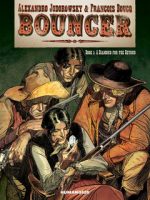
Bouncer volume 1: A Diamond for the Beyond


By Alejandro Jodorowsky & François Boucq, coloured by Ben Dimagmaliw & Nicolas Fructus and translated by Justin Kelly(Humanoids)
ISBN 978-1-59465-600-2 (Digital edition)

Born in Tocopilla, Chile in 1929, Alejandro Jodorowsky Prullansky is a filmmaker, playwright, actor, author, world traveller, philosopher, spiritual guru and comics writer.

The amazing modern polymath is most widely known for such films as Fando y Lis, El Topo, The Holy Mountain, Sante Sangre, The Rainbow Thief, The Dance of Reality and others, and a vast and influential comics output, including Anibal 5 (created whilst living in Mexico), Le Lama blanc, Aliot, The Meta-Barons, Borgia, Madwoman of the Sacred Heart and so many more, created with some of the world’s greatest artists.

His decade-long collaboration with Moebius on the Tarot-inspired adventure The Incal (1981-1989) completely redefined and reinvented what comics could aspire to and achieve.

Most widely regarded for his violently surreal avant-garde films, loaded with highly-charged, inspired imagery – blending mysticism and what he terms “religious provocation” – and his spiritually-informed fantasy and science fiction comics tales, Jodorowsky is also fascinated by humanity’s inner realms.

To better explore that arena he has devised his own doctrine of therapeutic healing: Psychomagic, Psychogenealogy and Initiatic massage.

He remains fully engaged and active in all these creative areas to this day.

French illustrator François Boucq was born in Lille on November 28th 1955 and has made a career out of rendering – with staggering scope, surreal subtlety power and entrancing élan – stories both intellectually challenging and viscerally powerful.

With material such as Little Tulip, The Magician’s Wife, Sente, Bouche de diable, Billy Budd, KGB and many more, he has garnered numerous awards at the Angoulême International Comics Festival and elsewhere. His work here in collaboration with the impeccably adroit raconteur on a work of pure genre is amongst the best he has ever crafted…

Scarce but still available in English as one large hardback compilation or in tantalising digital instalments such as the one under review here, Bouncer began appearing in 2001, eking out eight volumes between then and 2012.

Stuffed with carefully harvested tropes and memes of an immortal and iconic form of myth-making, the classic vengeance tale Un diamant pour l’au-delà opens as A Diamond for the Beyond with a gang of confederate-clad riders torturing a deserter from their ranks. The war might be long over but Captain Ralton van Dorman is still waging it… against civilians he encounters and even his own men when they try to make him see reason…

A sadist with his own code of honour, the Captain even gives the latest traitor a fighting chance. Admittedly not much of one, but still…

Butchery completed, the raiders move inexorably on, plundering a small settlement for supplies and to allow the men to indulge their baser natures before he heads them west out into the big country…

Far ahead of them Preacher Blake and his Indian wife Emihiyah wonder where their troublesome boy Seth is…

The son is deep into a shadowed canyon exploring an old dilapidated house where he finds a desiccated corpse in a coffin. Fascinated, he can’t stop himself taking the ornate pistols and fancy gun-belt cinched around the body.

Naturally his stern pa confiscates them as soon as he gets home and refuses to explain why his name is engraved on them, and any further argument is curtailed when van Dorman’s mob riotously rides in and Seth’s parents frantically make him hide…

It’s been seventeen years since Ralton last saw his brother and the murderous racist has not mellowed in all that time. He is appalled by his brother’s miscegenation and still wants the diamond…

Baffled Seth can only watch in horror as the uncle he never knew and his vile companions commit every kind of abuse and outrage on his kin and even his dog. When the atrocities conclude and the outlaws ride away, traumatised Seth remembers his father’s last word to him: go to Barro City and tell the Bouncer at the Inferno Saloon…

Barro is a typical lawless frontier town and Seth barely survives a few close scrapes before finding his man. In truth, the bouncer finds him after two hulking thugs try to take those fancy guns away from him…

The rangy private peacekeeper is quite a surprise: quiet, composed and deadly in a fight despite only having one arm. He also claims to be Seth’s other uncle…

The next day they make the weary pilgrimage back to bury the dead and the Bouncer shares a ghastly tale. Ralton wants a fabulous diamond called the Eye of Cain that Seth’s grandmother once owned…

A whore and child of whores, hardened by a horrific life, she became “Aunty Lola”: the meanest and most successful Madam in the west, complete with her own saloon. She handled all problems with ruthless efficiency and had three sons out of wedlock who grew up mean and dangerous. Their lives all changed after she and her boys blew up and robbed a train to steal a gigantic diamond bought by a millionaire to lure away one of Lola’s girls…

Hiding out in a shack in secluded canyon, greed then got the better of them. Lola wouldn’t let go of the gem and she and the boys fell to fighting. Before she drove them all off Ralton lost an eye, Bouncer got his arm blown off and Blake lost his nerve…

By the time they were able to go back, Lola had killed herself, but not before hiding the gem where nobody could ever find it…

Now Ralton’s back to claim what’s his, unaware that he’s created a killer who will stop at nothing to avenge his parents. All he has to do is convince the Bouncer to teach him how to kill…

To Be Continued…

Stylish, ultra-violent and wickedly wry, the compelling mystery of the Eye of Cain and Seth’s quest for “justice” is delivered with confidant panache and rendered unforgettable by Boucq’s astounding illustration: especially the mind-bending vistas and landscapes of the valleys and canyons of the classic cinematic wild west.

Magnificent and unforgettable, this a tale no one should miss.
© 2015 Humanoids, Inc., Los Angeles (USA). All rights reserved.

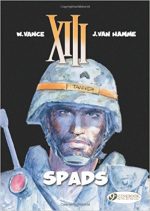
XIII volume 4: SPADS


By William Vance & Jean Van Hamme, coloured by Petra (Cinebook)
ISBN: 978-1-84918-058-0

One of the most consistently entertaining and popular adventure serials on the European scene, XIII was created by author Jean Van Hamme (Wayne Shelton, Blake and Mortimer, Lady S.) and illustrator William Vance (Bruce J. Hawker, Marshal Blueberry, Ramiro).

Van Hamme was born in Brussels in 1939 and is one of the most prolific writers in comics. After pursuing Business Studies, he moved into journalism and marketing before selling his first graphic tale in 1968. Immediately clicking with the public, by 1976 he had also branched out into prose novels and screenwriting. His big break was monumentally successful mixed-genre fantasy series Thorgal for Tintin magazine but he truly cemented his reputation with mass-market bestsellers Largo Winch and XIII as well as more cerebral fare such as Chninkel and Les maîtres de l’orge. In 2010 Van Hamme was listed as the second-best selling comics author in France, ranked between the seemingly unassailable Hergé and Uderzo.

William Vance is the bande dessinée nom de plume of William van Cutsem. He was born in 1935 in Anderlecht and, after military service in 1955-1956, studied art at the Académie Royale des Beaux-Arts. He became an illustrator of biographic features at Tintin in 1962. His persuasive illustrative style is a classical blend of meticulous realism, scrupulous detail and spectacular yet understated action.

In 1964 he began maritime adventure serial Howard Flynn (written by Yves Duval) before graduating to more popular genre work with western Ray Ringo and espionage thriller Bruno Brazil (scripted by Greg). Further success followed when he replaced Gérald Forton on science fiction classic Bob Morane in Femmes d’Aujourd’hui and latterly Pilote and Tintin.

Although working broadly and constantly on serials and stand-alone stories, Vance’s signature achievement is his lengthy collaboration with fellow Belgian Van Hamme on this contemporary thriller loosely based on Robert Ludlum’s novel The Bourne Identity…

XIII launched in 1984, originally running in Spirou to great acclaim. A triad of albums were rushed out – simultaneously printed in French and Dutch editions – before the first year of serialisation ended.

The series was a monumental hit in Europe but fared less well in its earlier attempts to make the translation jump to English, with Catalan Communications, Alias Comics and even Marvel all failing to find an audience for the epic mystery thriller.

The grand conspiracy saga of unrelenting mood, mystery and mayhem opened in The Day of the Black Sun when an old beachcomber found a body. The human flotsam had a gunshot head wound and was near death when Abe and his wife Sally found him. She discovered a key sewn into his clothes and the Roman numerals for thirteen tattooed on his neck. The remote hideaway offered little in the way of emergency services, but their alcoholic, struck-off surgeon friend managed to save the stranger…

As he recuperated, a complication became apparent. The patient – a splendid physical specimen clearly no stranger to action or violence – had suffered massive and irreversible brain trauma. Although increasingly sound in body he had completely lost his past.

Language skills, muscle memories, even social and reflexive conditioning all remained, but every detail of his life-history was gone…

They named him “Alan” after their own dead son – but hints of the intruder’s lost past explosively intruded when hitmen invaded the beach house with guns blazing. Alan lethally retaliated with terrifying skill, but too late…

In the aftermath he found a photo of himself and a young woman on the killers and traced it to nearby Eastown. Desperate for answers and certain more killers were coming, the human question mark headed off to confront unimaginable danger and hopefully find the answers he craved.

The picture led to a local newspaper and a crooked cop who recognised the amnesiac but said nothing…

The woman in the photo was Kim Rowland, a local widow recently gone missing. Alan’s key opened the door of her house. The place had been ransacked but a thorough search utilising his mysterious talents turned up another key and a note warning someone named Jake that “The Mongoose” had found her…

He was then ambushed by the cop and newspaper editor Wayne. Calling him “Shelton” they demanded the return of a large amount of missing money…

Alan/Jake/Shelton reasoned the new key fitted a safe-deposit box and bluffed the thugs into taking him to the biggest bank in town. The staff there also knew him as Shelton, but when his captors examined the briefcase in Shelton’s box a booby trap went off. Instantly acting, the mystery man expertly escaped and eluded capture, holing up in a shabby hotel room, pondering again what kind of man he used to be…

As he prepared to leave he stumbled into a mob of armed killers. In a blur of lethal action he escaped and ran into another bunch of heavies led by a Colonel Amos. This chilling executive referred to his captive as “Thirteen”, claiming to have dealt with his predecessors XI and XII in regard to the “Black Sun” case…

Amos very much wanted to know who Alan was, and offered some shocking titbits in return. The most sensational was film of the recent assassination of American President, William B Sheridan, clearly showing the lone gunman was XIII…

Despite the amnesiac’s heartfelt conviction that he was no assassin, Amos accused him of working for a criminal mastermind, and wanted that big boss. The interrogator failed to take Alan’s instinctive abilities into account and was astounded when his prisoner leapt out of a fourth floor window…

The fugitive headed back to the beach where he was found but more murderers awaited; led by a mild-seeming man Alan inexplicably knew was The Mongoose. The criminal overlord expressed surprise and admiration: he thought he’d killed Thirteen months ago…

Following an explosion of hyper-fast violence which left the henchmen dead and Mongoose vanished but vengeful, the mystery man regretfully hopped a freight train west towards the next stage in his quest for truth…

His journey of discovery took him to the army base where Kim Rowland’s husband was stationed. His enquiries provoked an unexpected and violent response resulting in his interrogation by General Ben Carrington and his sexily capable aide Lieutenant Jones.

They’re from the Joint Chiefs of Staff, know an awful lot about black ops units and have proof that their memory-challenged prisoner is in fact their agent: believed-deceased Captain Steve Rowland…

After testing the amnesiac’s abilities Carrington then drops him off in Rowland’s home town of Southberg to pursue his search for his missing wife, but the prodigal’s return to his rat’s nest of a family rekindles long-simmering passions and jealousies. The entire town seems to want Rowland’s blood and before long he’s been made the target of an assassination attempt and victim of a diabolical murder-plot…

Despite Carrington and Jones’ last-minute intervention Alan/Steve is framed for murdering his father and grabbed by a furious posse.

After an indeterminate period of time “Steve” resurfaces, undergoing the worst kind of psychiatric care at Plain Rock Penitentiary for the Criminally Insane. Despite drugs and shock treatments, progress is negligible, probably because aging martinet Dr Johansson‘s claims of curing for his patient’s apparent amnesia are clearly just a judgemental sadist’s justifications for inflicting agony on the helpless…

Carrington and Jones meet with Amos who has troubling information. His investigations revealed the amnesiac had undergone illicit plastic surgery and his army records were altered. Whoever was in Plain Rock, he wasn’t Steve Rowland…

Amos’ files proved the plotters who had the President killed were still active and their amnesiac assassin was now the only link to them. Acting on her own initiative, Jones decided it was time she took a hands-on approach…

Anxious and isolated, Not-Rowland received a visitor who galvanised him out of his induced torpor and knew his days were numbered…

Deep within the corridors of power, Amos informs Carrington further researches have obtained them a name. XIII and the man they are actually dealing with is former soldier and intelligence operative Ross Tanner.

Probably…

Perhaps…

Rowland/Tanner opts for escape but is swiftly recaptured and restricted to the medical section. XIII is helpless when the Mongoose’s inside man makes his move. Luckily Jones had also inserted herself in a position where she could do the most good…

Spectacularly busting out, “Rowland” and the mystery woman then race into the desert, somehow avoiding a massive manhunt before vanishing without trace.

Some time later, Amos and Carrington confer over the disappearance, but one of them knows exactly where the fugitive is. Now, with another new name, the warrior without a past and his new powerful allies lay plans to take the fight to their secret enemy…

SPADS is the fourth complex and convoluted chapter (first released in Europe in 1987) and opens with a much more concise and visual recap than I’ve just given, before kicking the plot into high gear as the race to replace murdered President Sheridan hots up. The contenders are Old Boy Network hack and former Vice President Joseph Galbrain battling Sheridan’s glamorous and idealistic younger brother Walter: latest scion of a venerable dynasty of leaders…

Amos’ diligent investigation is relentless. After exhuming a host of bodies, he can confidently claim to know who Tanner really is, is but when his search leads him into a trap that kills his assistant and incapacitates him, he starts to wonder if he’s tracking a target or being led onto a bullseye…

Elsewhere, in a green hell of sweat and testosterone, Ross Tanner is making no friends as he trains to join elite combat unit SPADS (SPecial Assault and Destruction Squads). He doesn’t fit in and is always causing trouble. It’s as if he’s there under false pretences…

When Amos and Judge Allenby confront Carrington at the Pentagon with news that Tanner is also an alias for an as yet unknown operative, the reaction is little short of explosive. Soon after, special aide Lieutenant Jones goes AWOL…

Back in the Bayou, the man everybody is hunting has made a fresh advance into uncovering his occluded past. Sergeant Betty served with the real Rowland and knows he didn’t die at the time and in the manner the official reports describe. Before she shares the details, however, she has an itch that needs scratching…

That conversation is curtailed by camp commander Colonel McCall, who tells the undercover operative that he’s being transferred out in the morning by direct order of General Carrington. Realising his chance to solve his personal mystery is evaporating, XIII settles a few outstanding scores before sneaking into Betty’s quarters…

Amos and Allenby meanwhile have not been idle, and the former is certain he has at last gleaned the actual identity of the multi-named agent XIII, but when they visit a certain grave they walk right into another ambush and a well-placed mole is forced to break cover…

As Amos is plucked from the firefight by the last person he expected to see, a continent away Tanner’s liaison gets even more dangerous when another Mongoose mole interrupts and tries to kill them both. Happily, Carrington’s back-up agent is well placed to save them and they all flee together, unaware that their escape vehicle has been boobytrapped and sabotaged…

Amos by now is securely ensconced in a palatial hideaway, being feted by a coterie of political heavyweights who finally reveal the truth about all the men Ross Tanner is and isn’t. They then explain the incredible reason for the smoke-&-mirrors operation and the earth-shattering stakes…

To Be Continued…

XIII is one most compelling and multi-layered mystery adventures ever conceived, with subsequent instalments constantly taking the questing human enigma two steps forward, one step back, stumbling through a world of pain and peril whilst cutting through an interminable web of past lives he seemingly led…

Rocket-paced and immensely inventive, XIII is a series no devotee of action sagas and conspiracy thrillers will want to miss.
Original edition © Dargaud Benelux (Dargaud-Lombard SA), 1987 by Van Hamme, Vance & Petra. All rights reserved. This edition published 2010 by Cinebook Ltd.

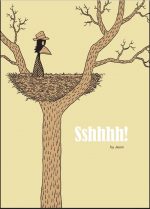
Hey Wait…


By Jason, translated by Kim Thompson (Fantagraphics Books)
ISBN: 978-1-56097-641-7

It’s usually a cheap cop-out by tired or hackneyed critics but some creators’ work comes close to defying description. That’s never more true than when reviewing another brilliant graphic exposition by Jason.

Jason is secretly John Arne Saeterrøy: born in Molde, Norway in 1965 and an overnight international cartoon superstar since 1995 when his first graphic novel Lomma full ay regn (Pocket Full of Rain) won that year’s Sproing Award (Norway’s biggest comics prize).

He won another Sproing in 2001 for the series Mjau Mjau and in 2002 turned almost exclusively to producing graphic novels.

A global star among the cartoon cognoscenti, Jason has earned many major awards from all over the planet. His work always jumps directly into the reader’s brain and heart, utilising the beastly and unnatural to gently pose eternal questions about basic human needs in a soft but relentless quest for answers. That you don’t ever notice the deep stuff because of the clever gags and safe, familiar “funny-animal” characters should indicate just how good a cartoonist and storyteller he is…

The stylised static-seeming artwork is delivered in formalised page layouts rendered in a minimalist evolution of Hergé’s Claire Ligne style, solid blacks, thick outlines and settings of seductive simplicity – often augmented by a deft and subtle use of flat colour which enhances his hard, moody, suspenseful and utterly engrossing Cinema-inspired world.

The superbly understated art acts in concert with his dead-on, deadpan pastiche repertoire of scenarios which dredge deep from our shared experience of old film noir classics, horror and sci fi B-movies and other visual motifs which transcend time and culture, and the result is narrative dynamite. His preferred oeuvre mixes such fantasy elements with a deep and overwhelming inquiry into why bad stuff happens to ordinary “people”…

A compact (176 x 254mm) monochrome paperback, Hey Wait… is just such a confection: an eerie and glorious paean to boyhood friendships with young Bjorn and Jon enjoying a life of perfect childhood of collecting comics, watching movies and gadding about until a tragic accident – perhaps the result of boon companions egging each other on a little too much? – ends the idyll forever.

Life, however, goes on (and on and on and on) for one of the inseparable childhood comrades but it has become a life sentence…

The survivor’s existence becomes populated from then on with mundane encounters, tedious assignations, failed aspirations and the usual parade of ghosts and visions, but then again so is everybody else’s tedious day to day progress to the end …

Hey Wait… resonates with Jason’s favourite themes and shines with his visual dexterity and skewed sensibilities. disclosing a decidedly different slant on secrets and obsessions. Primal art supplemented by sparse and spartan dialogue, enhanced to a macabre degree by immaculate cartooning and skilled use of silence and moment utilised with devastating economy, affords the same quality of cold, bleak yet perfectly harnessed stillness which makes Scandinavian crime dramas such compelling, addictive fare.

This comic tale allows us all to look at the world through wide-open young eyes but never sugar-coats what’s there to see…
© 1998, 1999, 2001, 2005 Jason. Translation © 2001 Fantagraphics Books. All rights reserved.

Red Range: A Wild West Adventure


By Joe R. Lansdale, Sam Glanzman & various (It’s Alive!/IDW)
ISBN: 978-1631409943

Once upon a time, not that very long ago, nearly all of fiction was engorged with tales of Cowboys and Indians. As always happens with such periodic popular phenomena – for example the Swinging Sixties’ Superspy and Batmania booms or the recent trend for Vampire and/or Werewolf Boyfriends – there was a tremendous amount of momentary merit, lots of utter dross and a few irrefutable gems that would affect public tastes from then on.

Most importantly, once such surges have petered out there’s also generally a small cadre of frustrated devotees who mourn its passing and, on growing up, resolve to do something to venerate or even revive their lost and faded favourite fad…

Following World War II the American family entertainment market – for which read comics, radio and the burgeoning television industry – became comprehensively enamoured of the clear-cut, simplistic sensibilities and easy, escapist solutions offered by the antiseptic anodyne branch of Tales of the Old West; already a firmly established favourite of paperback fiction, movie serials and feature films.

I’ve often pondered on how almost simultaneously a dark, bleak, nigh-nihilistic and oddly left-leaning Film Noir genre quietly blossomed alongside that wholesome revolution, seemingly for the cynical minority of entertainment intellectuals who somehow knew that returned veterans still hadn’t found a Land Fit for Heroes… but that’s a thought for another time and a different review.

Even though comicbooks had encompassed Western heroes from the very start – there were cowboy crusaders in the premier issues of both Action Comics and Marvel Comics – the post-war years saw a vast outpouring of anthology titles with new gun-slinging idols to replace the rapidly-dwindling supply of costumed Mystery Men, and true to formula, most of these pioneers ranged from transiently mediocre to outright appalling.

With every comic-book publisher turning hopeful eyes westward, it was natural that most of the historical figures would quickly find a home and of course facts counted little, as indeed they never had with cowboy literature…

Despite minor re-flowerings in the early 1970s and mid-1990s, for the longest of times Cowboy comics largely vanished from our funnybook pages: seemingly unable to command enough mainstream commercial support to survive the crushing competition of garish wonder-men and the furiously seductive futurescapes.

Europe and Britain also embraced the Sagebrush zeitgeist and produced some pretty impressive work, with France and Italy eventually making the genre their own by the end of the 1960s. They still make the best straight Western strips in the world…

Happily, however, an American revolution in comics retailing and print technologies at the end of the 20th century allowed fans to create and disseminate relatively inexpensive comicbooks of their own and, happier still, many of those fans are incredibly talented creators in other genres. A particularly impressive case in point is this captivating lost treasure originally published by independent creator-led outfit Mojo Press.

The brainchild of Richard Klaw (publisher, reviewer, essayist, writer, historian and self-confessed geek maven), the little outfit published some amazing and groundbreaking horror, fantasy, science fiction and Western graphic novels and prose books between 1994 and their much-lamented demise in 1999.

As revealed in Klaw’s informative Introduction ‘When Old is New and New Old‘, Red Range was probably their most controversial release: an uncompromising adventure tale and deftly-disguised (a tad too much so, apparently) attack on contemporary racism and institutionalised bigotry astoundingly approached as an ultra-violent cowboy revenge yarn.

Originally published in stark black and white in 1999, Joe E. Lansdale and Sam Glanzman’s amazing unfinished odyssey has been remastered and adapted to full-colour (courtesy of Jorge Blanco & Jok and letterer Douglas Potter) and given a new lease of life in this sublime hardcover edition, just as America’s latest President seems set to return the nation to those days of implicit supremacism, casual segregation and wealth-based Jim Crow laws…

A Word of Warning: if your sensibilities and senses are liable to freak out at profoundly yet historically accurate scenes of violence or repeated use of the “N” word as used by drawn representations of murdering racist bastards in white sheets, don’t buy this book. Actually, do buy it; just don’t whine that you weren’t warned…

In Texas in the late 19th century a band of Klansmen are brutally torturing a black family who have had the temerity to buy land and plant crops. The ignorant butchers’ repugnant fun is mercilessly interrupted when a masked negro vigilante known as The Red Mask attacks, killing many of them and driving off their leader Batiste.

The unlikely avenger is too late to save the parents but does take their son Turon under his wing. As they ride to his hideout, the lone rider confides in his youthful new companion.

Caleb Range‘s story is appallingly similar to the boy’s own recent tragedy. It’s probably one repeated hundreds of times every day in America since the Black Man was emancipated…

Back in town, Batiste recruits a specialist tracker and plenty more white men eager to teach coloureds their rightful place. Hunting down Red Mask the bigot again underestimates his quarry’s determination and facility with weapons…

Angry, frustrated and humiliated, Batiste gathers yet more men and sets out to end his nemesis forever. The relentless pursuit leads into the desert wastes and straight out of any semblance of rationality as Caleb and Turon survive one more cataclysmic battle before falling into a lost world of ancient tribes and ravenous dinosaurs with Batiste and his few surviving killers hard on their heels…

In this place however, the so-superior white men are seen as less than human by the indigenous humans: nothing more than prey and provender. Regrettably, they hold pretty much the same opinion regarding Caleb and Turon, who quickly discover they might not just be lost in space but also time…

To Be Continued…

Vivid, shocking, staggeringly exciting, ferociously uncompromising and yet often outrageously, laugh-out-loud funny, Red Range has both message and moral but never for a moment lets that stand in the way of telling a great story. Hopefully, this long-overlooked gem will get fair shake this time around…

Adding value and enlightenment, this opening chapter in a hopefully longer saga is augmented by ‘Beneath the Valley of the Klan Busters: (A Sort of) Afterword by Stephen R. Bissette’ which offers some historical and social context to the proceedings and inside gen on creators Lansdale and Glanzman, as well as a potted history of the role of black people in western movies from 1920s star-turn Bill Pickett to Jamie Foxx in Django Unchained.

The bonus goodies continue with a silent monochrome masterpiece of action and bleak, black humour in ‘I Could Eat a Horse!’ (first seen in Wild West Show, 1996), with the artist displaying a firm grip of both killer slapstick and grim irony as Cowboy, Indian and other beasts go in search of meal, before Bissette rides us into the sunset with an erudite and fascinating trip down memory lane for “Pop Culture Cowpokes and Carnosaurs” with ‘A Brief History of Cowboys & Dinosaurs’…

These fresh looks at an overexposed idiom prove there’s still meat to found on those old bones, and cow-punching aficionados, fans of nostalgia-tainted comics and seekers of the wild and new alike can all be assured that there’s a selection of range-riding rollercoaster thrills and moody mysteries still lurking in those hills and on that horizon…

What more could you possibly ask for?
Red Range: A Wild West Adventure © 1999-2017 Joe R. Lansdale. “I Could Eat a Horse” © 2017 Sam Glanzman. “When Old is New and New Old” © 2017 Richard Klaw. “Beneath the Valley of the Klan Busters” and “A Brief History of Cowboys & Dinosaurs” © 2017 Stephen R. Bissette. All rights reserved.

Red Range: A Wild West Adventure is scheduled for publication June 28th 2017 and is available for pre-order now.

Stark Plug Book.com


By Chap (Rolling Tire Productions)
ISBN: 978-0-329-9759318-3-7 (PB)              eISBN: 978-0-329-9759318-2-0

One of my greatest joys is reading work by creators who clearly get off on the sheer joy of cartooning and that is definitely the case in this outrageously addictive tome offering “A Nice Alternative to Television”…

Obviously and enticingly inspired by the graphic absurdity of Gilbert Shelton and his Fabulous Furry partners Dave Sheridan and Paul Mavrides, Wisconsin-based printmaker and illustrator Steven C. Chappell has concocted a delicious dose of warmly witty strips combining keen observational humour and slapstick shenanigans with splendidly surreal visual hijinks and capers featuring life-battered wage-slave everyman Stark Plug.

The artist then generously gathered them all in a wonderfully engaging softcover album – mainly black and white, but with judiciously and mischievously applied spot and full-colour sections – and self-deprecatingly allowed the material to do its job… to the delight of anyone savvy enough to read it.

Following a handy pictorial introduction to ‘The Primary Cast of Characters’, all manner of wry and supremely engaging jollity commences with ‘Another Day… at the Job’ as overstretched screen-monkey Stark is informed by his bullying boss that he now has to do the work of three for the same wage and resoundingly assured yet again “no raise for you!”.

Inundated with tedious repetitive keyboard-tapping, Mr. Plug’s mind starts to wander into realms both bizarrely graphical and enticingly metaphysical…

Another day brings oversleeping, fresh anxiety and a mad dash through Madison’s snowbound streets – past local ambulatory busking landmark Bernie the Banjo Bum – and culminates in a close shave with icy death, before the tedious toil resumes. At least Stark can enjoy official breaks with co-worker Stacy whilst expounding on the joys of the “Fry It Diet”…

He may consume copiously and unhealthily, but our man keeps fit, as seen in the purely visual, rainbow-hued and wildly experimental peregrination ‘Stark Walks’, after which ‘Power Outage!’ sees office and city plunged into stygian gloom, giving the workers license to get a bit daring with their habits and clothing…

Whilst out with his dog Dioji, Stark’s mind is set to wandering after overhearing ‘Jump Rope Jabber with Those Crazy Kids!’ before taking in an extensive tour of life’s finer things during ‘A Day at the City Gallery’. After enjoying the colour-enhanced delights of an entrancing Wood Block Print Show he consequently descends into a ‘Mid-Life Crisis…’ which entails quitting his doleful, penurious job to become a cartoon character in newspaper strip Memphis and Harry, playing straight man to a weirdly-drawn cat…

When the strip is cancelled due to catnip-fuelled excess, it’s back to the terminal grind of his old job where the pressure can only be relieved by frenetic dancing in ‘Stark Raving Mad’…

A much needed ‘Coffee Break’ leads to Stark learning more than he ever wanted to about Stacy and her friend Rita so he indulges himself by devising ‘The Most Hilarious Comic Strip Ever!’ – a potentially lethal stunt involving fake moustaches, male nudity, bicycles, flying, the dome of the Wisconsin State Capitol and an army of gun-happy cops – which can only be balanced by a moment of ‘Stark Meditation ‘ before the madcap buffoonery concludes in mellow contemplative manner as Stark Plug and Dioji indulge in a gentle nocturnal ‘Moon Walk’…

The entire experience is then topped off with quirky Ads for ‘Stark Plug Schwag’ (I got a cool bunch of stuff with my review copy – yay! – so I can thoroughly recommend this bit) bringing to a close the funniest book I’ve read this year… and it’s already March…
© 2017 Steven C. Chappell (Chap). All rights reserved.

For further information check out the book’s title, or if that’s too much work type this – starkplugbook.com – into a computer.

Solomon Kane volume 2: Death’s Black Riders


By Scott Allie, Mario Guevara, Juan Ferreyra & various (Dark Horse)
ISBN: 978-1-59582-590-2

Following on from their revitalisation – if not actual creation – of the comicbook Sword and Sorcery genre in the early 1970s with their magnificent adaptation of pulp superstar Conan the Barbarian, Marvel Comics quite naturally looked for more of the same, and found ample material in Robert Ervin Howard’s other warrior heroes such as King Kull, Bran Mac Morn and dour Puritan Avenger Solomon Kane.

The fantasy genre had undergone a global prose revival in the paperback marketplace since the release of soft-cover editions of Lord of the Rings (first published in 1954), and the 1960s resurgence of two-fisted action extravaganzas by such pioneer writers as Edgar Rice Burroughs, Otis Adelbert Kline and Fritz Lieber. This led to a generation of modern writers such as Michael Moorcock and Lin Carter kick-starting their literary careers with contemporary interpretations of man, monster and mage. Without doubt, though, nobody did it better than the tragic Texan whose other red-handed stalwarts and tough guys such as El Borak, Steve Costigan, Dark Agnes and Red Sonya of Rogatino excelled in a host of associated genres and like milieux.

As a prose paragon, Solomon Kane debuted in the August 1928 issue of Weird Tales in a gripping tale of vengeance entitled “Red Shadows”; thereafter making seven more appearances before abruptly vanishing in 1932 as his creator concentrated on the far more successful Conan.

Three more tales, some epic poems and a few unfinished ideas and passages remained unpublished until 1968 when renewed interest in the author’s work prompted publishers to disinter and complete the yarns.

Apart from two noteworthy 4-colour exceptions, during the 1970s and 1980s, Marvel was content to leave Solomon Kane to monochrome adaptations of canonical Howard stories in Dracula Lives, Savage Sword of Conan, Monsters Unleashed and other older-reader magazines, but with his 21st century transfer to the Dark Horse stable, the Holy Terror has flourished in broader, lavishly-hued and much-expanded interpretations of the short stories and assorted unfinished snippets left when the prolific Howard took his life in 1936.

Beginning in 2008 and released as a succession of miniseries, these almost-new adventures offer modern fans a far darker and more moody iteration of the driven, doom-laden wanderer. This second volume features as graphic narrative short story Rattle of the Bones combined with a mere fragment of recovered prose latterly dubbed Death’s Black Riders, with scripter Scott Allie fleshing out the meagre fare for modern audiences. The strips were originally published in 4-issue miniseries Solomon Kane: Death’s Black Riders and are supplemented here by an all-new short continued saga which originally ran online in MySpace Dark Horse Presents #27 and 28.

For the uninitiated: Kane is a 17th century disenfranchised English soldier-of-fortune on a self-appointed mission to scour the Earth doing God’s Work. He interprets that to mean punishing the wicked and destroying devils and monsters. With no seeming plan, the devout Puritan lets fate guide his footsteps ever onwards towards trouble…

The drama opens here where the previous collection left off. Having survived epic clashes with demon wolves, devilish pagans and satanic thralls, the surly pilgrim is still lost in Germany’s vast and foreboding Black Forest and eager to find his way out.

Sadly, his wanderings merely lead to more conflict as he encounters the remains of a band of slaughtered gypsies where an extremely capable Frenchman named Gaston battles against a vile pack of voracious double-mouthed, distressingly equine talking horrors.

Joining the fray, the chilling churchman kills three of ‘Death’s Black Riders’, but not in time to save any but Gaston from the beast’s butchery…

Although something about the Frenchman disturbs and unsettles him, Kane accompanies the sole survivor as they make their way on foot through the benighted forest, eventually coming upon a lonely inn, blithely unaware that the hostelry is afflicted by ‘The Rattle of Bones’…

The deeply suspicious landlord is far from welcoming but the wanderers’ misgivings are offset by inclement weather and the fact that the four-legged devils are still at large and probably close at hand. Despite gaining entry behind the stout walls and sturdy doors the travellers are cautiously on guard as they assess their temporary dwelling, especially after discovering their room cannot be secured from the inside…

Searching for bars and barricades, they come upon a room with a skeleton chained to a wall and Gaston – in an act of courage-bolstering bravado – smashes the aged links with his sword. Not long after, the Frenchman makes his long-delayed move, ambushing Kane and attempting to steal his purse. Too late the puritan recognises infamous bandit Gaston the Butcher, but before he can save himself the demented innkeeper strikes…

This madman had been preying on visitors for years, despatching those unfortunate enough to share his hospitality. The lunatic even managed to kill a travelling sorcerer and was wise enough to chain up his corpse so that the enchanter could not strike back at from beyond the grave…

Thus, although recently added to the murderer’s tally, Gaston’s revenge comes as the skeleton prowling the inn finds the target it has waited decades to meet again, and in the gory aftermath the aghast Kane prepares to take his chance with the forest when a pounding comes upon the door. It is a terrified Catholic priest and at his heels is a pack of ravening horse-like monsters…

The terrifying tension rises to fever pitch as ‘The Black Riders Return’ to lay siege to the inn with puritan and priest trading doctrinal sallies whilst battling the bludgeoning beasts outside and evading the unquiet sorcerer’s unburied corpse within the house…

As a shattering storm rages, the war of Good and Evil reaches an appalling crescendo, and when day breaks only one man walks away…

A non-stop parade of peril and explosive action, the art here is both beguiling and emphatically evocative with Mario (The Lone Ranger and Tonto) Guevara’s pencils ably augmented by the potent palette of colourist Juan Ferreyra (Rex Mundi), but the tone changes utterly as Guy Davis assumes the illustration chores for Allie’s eerie follow-up ‘All the Damned Souls at Sea’…

Here the exhausted, world-weary horror hunter takes ship for his long-missed England, intent on seeing once more his beloved childhood haunts of Devon.

Typically, however, Kane clashes with a witch before boarding and, as he reminisces during the crossing of his previous voyages battling the Spanish navy, an uncanny transformation grips the ship, remaking it into a predatory beast hungry for sailors’ souls…

As always, this turbulent battle-scarred tome is packed with fascinating artistic extras and behind-the-scenes bonuses such as a gallery of covers and art pieces from Mike Mignola, Jason Shawn Alexander and Darick Robertson plus creative insights via ‘The Art of Solomon Kane’ with sketches, designs, process art and commentary by Guevara, Davis, Chad Vaughn and Allie.

Powerful, engaging and sumptuously spooky, this fight-filled fantasy fear-fest will delight both fans of the original canon and all lovers of darkly dreaming, ghost-busting thrillers.
© 2009 Solomon Kane Inc. (“SKI”). Solomon Kane and all related characters, names and logos are ™ and ® SKI.

My Favorite Thing is Monsters


By Emil Ferris (Fantagraphics Books)
ISBN: 978-1-60699-959-2

Once upon a time, comics were ubiquitous and universal and scorned by most people.

Gradually people came to realise that there were gems amongst the dross, and a critical arena grew where graphic novels could be judged on their own intrinsic merits and afforded serious consideration as Art.

Every so often an example of purely perfect sequential narrative emerges which reshapes the Artform and forces the entire world to sit up and take notice: Maus, Persepolis, American Splendor, Watchmen…

I’m pretty certain as I read my review copy (for the third time in two weeks) that My Favorite Thing is Monsters is soon going to be automatically added to that list of ground-breaking, world-shaking graphic masterpieces whenever people talk about the absolute best that sequential graphic narrative has to offer…

Crafted over decades, this massive onion-skin of tales-within-tales ostensibly details a murder mystery, but conceals within its astoundingly illustrated layers a “you-are-here” historical perspective of the social chaos resulting amongst the impoverished and disenfranchised after the assassination of Dr. Martin Luther King, Jr., a crushing examination of child abuse, an impassioned discourse on the nature and role of Art, a chilling coming-of-age experience, a telling testament of the repercussions of survival for Holocaust victims and a mesmerising trek through the psyche of a very troubled little girl on the cusp of leaving the security of childhood forever…

The viper’s nest of stories is delivered through the beguiling conceit that we are reading the diary of an extremely intelligent, artistically gifted little girl who has inscribed and illustrated in her spiral-bound notebook the far-from-mundane recent events of her life: an unedited, unexpurgated stream-of-consciousness account, just as the events happened…

Karen Reyes sees monsters. She sees them everywhere but that’s okay because most of them are her friends or at least not overly hostile and besides, she’s a monster too…

In 1968 Chicago, our 10-year-old protagonist/narrator is obsessed with movie and comicbook creature features, to the point of seeing herself as a cute werewolf (much in the mould of Maurice Sendak’s Wild Things).

She is also worldly-wise beyond her years perhaps blessed with synaesthesia: able to smell colours, taste the tone or character of places and enter the many paintings her artist brother takes her to see at the gallery…

The single-parent family lives in Chicago in 1968 in a tenement owned by local gangboss Mr. Gronan. The mobster’s wife is one of the many women Karen’s brother Deeze regularly shares his bed with, not the wisest of things to admit to…

Despite his social shortcomings Deeze is a brilliant artist who has always shared his passion with his gifted sister, but as the story opens he is keeping a secret from Karen. Their adoring mother is dying…

Karen’s cool reserve is frequently tested. Many kids at school bully and abuse her whilst their parents scorn and despise her. At least she has a few trusted outcast associates in her corner. It’s no wonder though that she prefers the clannish world of screen and comicbooks to what reality offers up daily…

Blithely unaware of how painful the world can be, the dutiful daughter’s world shifts from filmic fantasy to real life tragedy when troubled tenant Anka Silverberg dies. Karen, who has shared a special relationship with the concentration camp survivor for years, realises it must be murder, not the inevitable suicide most of the adults say it was.

The Werewolf-girl thus resolves to use her gifts to find the killer and embarks on an horrific voyage of discovery. With the unwittingly aid of befuddled sot Sam Silverberg and her own uncanny, wise-beyond-her-years instincts, Karen stalks her elusive prey, slowly gaining an understanding of the real-world atrocities Anna endured before reaching America and her inescapable date with doom…

Moreover, as Karen continues to investigate the life and death of Anka, the increasingly violent real world gets a stronger hold on her inner landscape, distracting the monster girl from her self-appointed mission…

Astoundingly complex and multi-layered, and accessing a phenomenally intricate interior landscape blending the shocking squalor, deprivation and social unrest of mid 1960’s Chicago with the thoughts and impression of a brilliant child and natural outsider, My Favorite Thing is Monsters offers a stunning examination of loss and what it means to be human. Moreover, the barrage of intertwined stories never obfuscates, but always offers some snippet of revelation and does so with warmth, humour, great heart and inspirational passion.

Best of all, this tome is only the beginning and the story will continue in a sequel…
© 2016 Emil Ferris. All rights reserved.