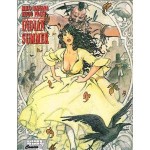

Little Tulip


By Jerome Charyn & François Boucq (Dover Comics & Graphic Novels)
ISBN: 978-0-486-80872-7

Some creative teams spend all their time collaborating: crafting works that constantly remind us why we are wise to await their every effort. Other artisans only link up at agonisingly rare intervals, and when their newest works are finally finished we hungry lovers of their art can only breathe a huge sigh of relief and release.

A sublime case-in-point are the all-too-rarely seen concoctions of American crime author and graphic novelist Jerome Charyn (Johnny One-Eye, I Am Abraham, Citizen Sidel, Bitter Bronx: Thirteen Stories) and French illustrator François Boucq (Bouncer, Sente, Jérôme Moucherot, Bouche de diable) who together created Femme du magicien/The Magician’s Wife and Billy Budd, KGB: uniquely compelling graphic novels which have won popular acclaim and numerous awards all over the world.

Now their latest dark masterpiece – published in French in 2014 – is at last available in a remastered English translation by Charyn himself.

A ferocious and captivating blend of bleak reverie, coming-of-age drama, noir thriller and supernatural vengeance tale, the action opens in New York City in 1970 where tattooist Pavel plies his trade under the admiring gaze of fascinated teen Azami.

She too is enslaved to the act of drawing, and wants to know everything: how to mark the skin, the secrets of adapting a past design, where and how the master got his own skinful of stories…

The city is in a growing panic. A serial-killing rapist dubbed Bad Santa is terrorising the night; targeting late working women such as Azami’s mother, so Pavel is keeping a quiet eye on them both. He’s actually far more informed than most citizens, as his uncanny ability to draw likenesses from the barest of witness accounts makes the old man a crucial component of the cops’ war on crime.

This almost magical ability has been consistently failing in regard to the Bad Santa killings, however, and the tension makes Pavel dream of his own appalling childhood…

Just after WWII ended, his artist father emigrated from Washington Heights, USA to the Soviet Union to work with legendary film-maker Sergei Eisenstein.

In those constrained environs Pavel absorbed a love of drawing and hunger for creative expression that was not crushed even when a political shift in climate saw him and his family arrested as spies and shipped off to the horrific Siberian gulag of Kolyma.

The daily casual atrocities of the corrupt guards were worse than what the boy experienced at the hands of the rival criminal gangs who actually ran the prisons. Soon he was alone, but his instinct for survival and gifts as an artist set him upon a new path, creating the sacrosanct, almost-holy tattoos the inmates used to define, embolden and characterise themselves.

It was not the only art Pavel learned. As he grew older he became the top gladiator of his gang: a fast deadly warrior with a blade in pitch darkness or broad daylight…

As the wave of killings continue in the blighted Big Apple, Pavel’s thoughts keep returning to the unceasing stream of hardships and atrocities he experienced in the camp. Slowly a grim conclusion comes to him about the nature of the Bad Santa… but too late for him to save the people nearest and dearest to him…

Bleak, uncompromising, seductive and painfully authentic whilst tinged with a smear of supernatural mystery, the story of Little Tulip is an unforgettable peek into the forbidden and the profane that will take your breath away.

Also included in this album-sized (280 x 210 mm) full-colour paperback is a glorious selection of sketches and working drawing in an entrancing display of ‘Artwork by François Boucq’ to inspire you to making your own meaningful marks on paper – or any preferred medium…
© 2014 Jerome Charyn and François Boucq. © 2014 Le Lombard. Lettering © 2016 Thomas Mauer. All rights reserved.

Little Tulip is officially released January 27th 2017 and is available for pre-order now. Check out www.doverpublications.com, your internet retailer or local comics-store or bookshop.

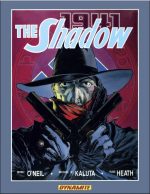
The Shadow volume 3: The Light of the World


By Chris Roberson, Giovanni Timpano & various (Dynamite Entertainment)
ISBN: 978-1-60690-461-9

In the early 1930s, The Shadow gave thrill-starved Americans their measured doses of extraordinary excitement via cheaply produced pulp periodical novels, and over the mood-drenched airwaves through his own radio show.

“Pulps” were published in every style and genre in their hundreds every month, ranging from the truly excellent to the pitifully dire, but for exotic or esoteric adventure-lovers there were two stars who outshone all others. The Superman of his day was Doc Savage, whilst the premier dark, relentless creature of the night dispensing terrifying grim justice was the putative hero under discussion here.

Radio series Detective Story Hour – based on stand-alone yarns from the Street & Smith publication Detective Story Magazine – used a spooky-toned narrator (variously Orson Welles, James LaCurto or Frank Readick Jr.) to introduce each tale. He was dubbed “the Shadow” and from the very start on July 31st 1930, he was more popular than the stories he highlighted.

The Shadow evolved into a proactive hero solving instead of narrating mysteries and, on April 1st 1931, began starring in his own printed adventures, written by the incredibly prolific Walter Gibson under the house pseudonym Maxwell Grant. On September 26th 1937 the radio show officially became The Shadow with the eerie motto “Who knows what evil lurks in the hearts of Men? The Shadow knows!” ringing out unforgettably over the nation’s airwaves.

Over the next eighteen years 325 novels were published, usually at the rate of two a month. The uncanny crusader spawned comicbooks, seven movies, a newspaper strip and all the merchandising paraphernalia you’d expect of a superstar brand.

The pulp series officially ended in 1949 although Gibson and others added to the canon during the 1960s when a pulp/fantasy revival gripped the world, generating reprinted classic yarns and a run of new stories as paperback novels.

In graphic terms The Shadow was a major player. His national newspaper strip – by Vernon Greene – launched on June 17th 1940 and when comicbooks really took off the Man of Mystery had his own four-colour title; running from March 1940 to September 1949.

Archie Comics published a controversial contemporary reworking in 1964-1965 under their Radio/Mighty Comics imprint, by Robert Bernstein, Jerry Siegel, John Rosenberger and Paul Reinman. In 1973 DC acquired the rights to produce a captivating, brief and definitive series of classic comic sagas unlike any other superhero title then on the stands.

DC periodically revived the venerable vigilante. After the runaway success of Crisis on Infinite Earths, The Dark Knight Returns and Watchman, Howard Chaykin was allowed to utterly overhaul the vintage feature for an audience at last acknowledged as grown-up enough to handle more sophisticated fare.

This led to further, adult-oriented iterations (and even one cracking outing – Hitler’s Astrologer – from Marvel) before Dark Horse assumed the license of the quintessential grim avenger for the latter half of the 1990s and beyond.

Dynamite Entertainment secured the option in 2011 and, whilst reissuing much of those other publishers’ earlier efforts, began a series of new monthly Shadow comics.

Set in the turbulent 1930s and war years that followed, these were crafted by some of the top writers in the industry, each taking their shot at the immortal legend, and all winningly depicted by a succession of extremely gifted illustrators.

This third volume – collecting #13-18 of the monthly comicbook from 2013 – comes courtesy of author Chris Roberson (House of Mystery, iZombie, Cinderella: From Fabletown with Love, Superman/Batman) and illustrator Giovanni Timpano, ably abetted by colourist Fabrício Guerra and letterer Rob Steen. This time the Master of the Dark prowls the bloody streets of New York in search of a fantastic vigilante as deadly and remorseless as himself…

The drama begins as yet another rich, powerful man is butchered whilst secretly indulging in sordid pleasures of the flesh. The perpetrator is rumoured to be a ghostly, sword-wielding “lady phantom”…

Very few know that the black-cloaked fist of final retribution known as The Shadow masquerades by day as abrasive, indolent playboy Lamont Cranston. Most are agents in his employ: all aware of his semi-mystical abilities to detect thoughts and cloud the minds of men. They are about to learn that there are other beings blessed with uncanny abilities, relentless determination and unshakeable agendas…

Cranston and his paramour/top operative Margo Lane begin their investigations at the prestigious Cobalt Club: pumping the wealthy patrons and Police Commissioner Weston in the guise of idle gossip-mongering and scandal-seeking…

The authorities, it seems, give little credence to the testimony of prostitutes – the only survivors of the attacks – and have dismissed reports of a vengeful woman as sole perpetrator. The Shadow’s operatives are far more astute and less prejudiced: information is gathered and soon after the Dispenser of Vengeance is on hand when the woman in white confronts her next victim…

As the first of a series of poignant flashbacks begins to reveal the secret of the bizarrely radiant swordswoman, in the modern moment of her confrontation with The Shadow, the Master of Men quickly realises this seeming angel of death is every inch his equal in the arts of combat. In fact, her ability to cast a blinding glow might well give her the edge…

After a brutal duel he manages to drive her off before she can finish off her latest victim, but, before he or the police can get any useful information from the survivor, the maimed man is silently butchered in his locked and guarded hospital room…

And thus the war between light and darkness progresses with The Shadow losing battles but gradually winning the war: inexorably closing in on The Light by pitting all his resources and risking his greatest assets to trap his glowing antithesis who works for the most pure, if misguided, of causes…

Dynamite publishes periodicals with a vast array of cover variants and here that gallery features a wealth of iconic alternate visions by Alex Ross, Francesco Francavilla, Tim Bradstreet, Paolo Rivera and Jason Shawn Alexander to delight any art lover’s eyes and heart.

Moody and brooding, The Light of the World is a solid pulp thriller with an intriguing history and premise for its “player on the other side” scenario, plenty of action and a spectacular cinematic climax at the top of New York’s steel-&-concrete canyons…

This is another superb addition to the annals of the original Dark Knight, and one no one addicted to action and mystery should miss.
The Shadow ® & © 2013 Advance Magazine Publishers Inc. d/b/a Conde Nast. All Rights Reserved.

America Gone Wild! – Cartoons by Ted Rall


By Ted Rall (Andrews McMeel)
ISBN: 978- 0-7407-6045-7

You might have seen this quote before. Doesn’t mean it’s not still true…

“True patriotism hates injustice in its own land more than anywhere else” – Clarence Darrow.

From its earliest inception cartooning has been used to sell: initially ideas or values but eventually actual products too. In newspapers, magazines and especially comicbooks the sheer power of narrative with its ability to create emotional affinities has been linked to the creation of unforgettable images and characters. When those stories affect the daily lives of generations of readers, the force they can apply in a commercial or social arena is almost irresistible…

For as long as we’ve had printing there have been scurrilous, impassioned gadfly artists commentating on rulers, society and all iniquities: pictorially haranguing the powerful, pompous, privileged and just plain perfidious through swingeing satire and cunning caricature. Sometimes these artists have been just plain mean…

The cartoonist has held a bizarrely precarious position of power for centuries: the deftly designed bombastic broadside or savagely surgical satirical slice instantly capable of ridiculing, exposing and always deflating the powerfully elevated and apparently untouchable with a simple shaped-charge of scandalous wit and crushingly clear, universally understandable visual metaphor.

For this method of concept transmission, literacy or lack of education is no barrier. As the Catholic Church proved millennia ago with the Stations of the Cross, stained glass windows and a pantheon of idealised saints, a picture is absolutely worth a thousand words…

More so than work, sport, religion, fighting or even sex, politics has always been the very grist that feeds a pictorial gadfly’s mill. That’s never been more true – or more dangerous – than in the United States of America in the last three decades…

Frederick Theodore Rall III is interested and engaged and knows the risks.

Born in 1963, he is a respected and despised columnist, freelance editorial cartoonist, graphic novelist and war correspondent who homes in like a laser-sight on social ills, cultural stupidity and the venality of power elites – celebrities, businesses, organisations, religions and especially political demagogues. He is always accused of being a Liberal, and always hated (and probably feared) by whoever is in Office at the time…

Although his work has been seen in numerous publications such as Rolling Stone, Time, Fortune and the New York Times, this particular collection features cartoon panels and strips taken from a range of syndicated sources as well as publications such as the Charleston City Paper, Gear, Men’s Health, The Village Voice and Mad magazine amongst others: all crafted during the last Republican incumbency: a time of madness, war, terror, torture, hypocrisy and sheer greed.

It’s an era the new American president promises to in large part restore…

This sublime Weapon of Mass Deliberation comes as square, monochrome paperback (224 x 224 mm) and variable-sized eBook (now that’s democracy for you!) fronted by an evocative Foreword from our own pen-pushing one-man protest movement Steve Bell before Rall’s Prefaceincluding a Behind the Scenes Look at my Most Controversial Cartoons – offers background, context, reasons for his artistic decisions.

This includes intimate details and a truly terrifying selection of death threats, internet abuse messages and apologies from folks who were enraged at Rall’s screed du jour. Other inclusions show that many thought they were mad at him only to discover how they’d been misled, massaged or merely lied to by the mainstream commercial news outlets.  Surely not…?

Ted Rall pulls no punches and that attitude has won him a raft of awards, the loathing of fanatics of every stripe and persuasion plus lots of apologies whenever his peculiar passion – seeing all sides of issues which are almost never binary equations – is finally accepted by a public which usually only hears about his cartoons from agenda-based media outlets such as Fox News or New York Daily News.

This collection actually lets you see what trolls, drones and professional complainers are so disgracefully quick to react to: representing some of Rall’s most potent, memorable and effective graphic broadsides and strip scalpel-slashes from the war years of the G. W. Bush Administration. These include but are far from restricted to pithy exposés of media-hungry ‘Terror Widows’, ruminations over ‘The War on Judgment’ and explanation of resource-management in ‘Here’s Where We’ll get More Troops’…

Some of the compulsive commentator’s most life-endangering panels are included here too. ‘Reagan in Hell’ generated an appalling storm of poison for the artist, as did ‘Uncle Tom’s Cabinet or, Black Man’s Burden’ and ‘Appropriate Punishments for Deposed Bushists’, but the most important thing to remember throughout this collection is that the picture and words result from genuine concern from a very smart, talented and INFORMED individual who actually bothers to check facts before sounding off…

Also making this final cut are such slyly fervent strips as ‘Free Speech Maniacs’, ‘Just Get Over It!’, ‘Let’s Meet Other Heroic Government Workers’, ‘Proxy Politics’, ‘Republicans on the Rampage!’, ‘Why we Spy on Americans Instead’ and ‘Ordnance sans Frontières’; satirical assaults like ‘Special Privileges for Blacks’, ‘Society at a Glance’, ‘The Left Gets Organized’, ‘Jury Selection Made E-Z’ and ‘Understanding Editorial Cartoons’ as well as less-emotionally charged, surreal snipes and contemporary cultural critiques including ‘Enroll in School of Bodily Fluid Arts’, ‘Jihad Slacker’, ‘Sometimes Love is Not Enough’ and ‘Freedom Marches On’…

Presumably just to prove he’s not always proselytising, there are also splendid selections of comics on life-style, work and relationships from Men’s Health and outrageously strange strips from Mad focusing on high school (7 Periods) and superheroes (The Adventures of Fantabulaman) to keep you laughing when you’re not shouting or crying.

This is a superb slice of “Look Back in Anger” by an immensely talented proponent of the art, dedicated to the most revered principles of cartoon dissent and journalistic calling-to-account. His recent stuff is even better. As a new era dawned in US politics he released a “manifesto to topple Trumpism”. I can’t wait to see that as a graphic novel…
© 2006 Ted Rall. All rights reserved.

James Bondâ„¢ volume 1: VARGR


By Warren Ellis, Jason Masters, Guy Major & Simon Bowland (Dynamite Entertainment)
ISBN: 978-1-60690-901-0

James Bond is the ultimate secret agent. You all know that and have – thanks to the multi-media empire that has grown up around Ian Fleming’s masterful creation – your own vision of what he looks like and what he does. That’s what dictates how you respond to the latest movie, game or novel.

There are also some exceedingly enjoyable comicbook and newspaper strip versions detailing the further exploits of 007 which have never really found the appreciation they rightly deserve. This collection is just one of the most recent, compiling the first six issues of a regular comicbook series from licensing specialists Dynamite Entertainment and quite possibly one of the top ten Bond adventures ever seen in any medium…

Dumping the decades of gaudy paraphernalia that’s grown around the brand, writer Warren Ellis, illustrator Jason Masters, colourist Guy Major and letterer Simon Bowland have opted for a stripped-down, pared-back, no-nonsense iteration who is all business.

It begins after Bond’s return from a personal mission to Helsinki which culminated in the elimination of the assassin who recently killed 008. On returning to MI6, however, the infallible agent is carpeted by M.

With motions in progress to close the Double-O department, Bond is given a simple assignment: “dissuading” a small European drug dealer from distributing his latest recreational designer dope in the United Kingdom.

Of course, no job is ever simple…

The first snag is a new Home Office ruling depriving Bond of his gun whilst within British borders, but at least Q has few treats for him to use once he’s touched down on foreign soil…

Following an impromptu briefing on his contact – the Intel has come via a CIA informant used by old comrade Felix Leiter, so at least that’s reliable – Bond jets off for Berlin Station, only to narrowly escape being murdered by impossibly strong impostor-agent Dharma Reach as soon as he gets out of the airport…

Taking the near-miss in stride, 007 swiftly starts his surveillance by meeting the CIA’s asset, Serbian geneticist and medical pioneer Slaven Kurjak, who has been making astounding breakthroughs in both pharmaceuticals and powered prostheses.

The exceedingly eccentric doctor puts him on the trail of a minor local gang with a new method of processing cocaine, so Bond sets off on the trail of his new target, resolute but clearly suspicious…

Meanwhile in London, drug addicts begin exhibiting strange, horrific and ultimately fatal side-effects after their latest scores…

Kurjac obviously has his own agenda, but the methodical Bond opts to investigate this disquieting informant’s “information” first and is soon in the fight of his life after stumbling into a major drugs operation run by the huge Al-Zein cartel.

On returning – shaken, stirred but largely intact – to the MI6 office, he’s intercepted by Slaven’s most dangerous guinea pig Mr. Masters, moments after the chemically-corrupted killer has depopulated the entire Berlin Station. Attempts to lure Bond into a fresh trap have been anticipated, however, and 007 is more than ready when the killer makes his move. Masters’ agonised last words to Bond are “Vargr. Please. Vargr”…

A frustrating confrontation with Kurjac then reveals the shocking truth about the crazy doctor’s hideous plans for the tainted drugs on Britain’s streets, but ends with apparent defeat and Bond stuck in a seemingly inescapable death-trap…

Through his usual blend of ingenuity and inspired insanity Bond survives and returns to London for debriefing but is again ambushed by Dharma Reach. She inadvertently provides a clue to her boss’ whereabouts before explosively expiring…

With a clear target and destination – and determined to end the bloody shambles at any cost – Bond heads to Norway and a final confrontation with Kurjak. The resolution to the mystery of Vargr is cataclysmic and incomprehensibly bloody…

With a gallery of covers by Dom Reardon and 22 variants from Masters, Glenn Fabry, Francesco Francavilla, Gabriel Hardman, Jock, Stephen Mooney, Dan Panosian, Joe Jusko, Aaron Campbell, Timothy Lim, Dennis Calero, Robert Hack and Ben Oliver plus Concept Art from Masters featuring character designs and model sheets, this elegant espionage episode is fast, furious, dryly witty, superbly smart and impeccably stylish: in short, the perfect James Bond thriller.

Try it and see for yourselves…
© 2016 Ian Fleming Publications, Ltd. James Bond and 007 are ™ Danjaq LLC, used under license by Ian Fleming Publications, Ltd. All rights reserved.

Snow


By Benjamin Rivers (Benjamin Rivers Inc.)
ISBN: 978-0-9813495-8-9

Life isn’t drama. Life is ordinary: dull, repetitive, anxiety-provoking, tedious, unsatisfactory and just a bit less good than everybody else’s.

Until it isn’t…

And then we make it a story. In a story you can mould reality into a shape you like and polish it to your own satisfaction. Then again, there are some stories which like to bend their own rules and aspire to being life-like…

If you’re a fan of high-tension thrillers or blockbuster epics, there doesn’t appear to be much going on in Snow: a miniseries-turned-graphic compilation detailing the overlapping and intersection of ordinary people living and/or working on Queen Street West, Toronto.

However, that either means you have a very glamorous lifestyle or you spend too much time submerged in fiction and not enough looking and listening to what’s going on around you…

Crafted by illustrator and games developer Benjamin Rivers (who somewhat shoots my argument in the foot by having turned this comics collation into both an Indy movie and computer game), Snow is delivered in stark, monochrome simplicity, centring on Dana, a rather nervous young woman who works in a bookstore.

Economically, times are tough and she’s fixating on the number of shops and businesses that are closing in the locality.

Dana doesn’t like change and she doesn’t like confrontation.

However, these days there’s an aura of tension everywhere – even in her former comfort zone at the store. Her co-workers are mostly ok, but old Mr. Abberline isn’t looking well and Dana can’t shift the suspicion that soon they’ll all be looking for new jobs. Even best friend Julia doesn’t get it though: it seems so easy for her to shut out such concerns and just party…

As she trudges along snowbound Queen Street to work and back, to the bar or the Laundromat, Dana can’t shift an oppressive sense of impending doom. Things come to a head abruptly when she overhears an argument in a closing-down, already shuttered CD store.

She can just about ignore that and go home, but after hearing a gunshot, Dana, in her unrushed, gradual manner, abandons the instincts of a lifetime and goes to investigate…

What she finds on entering the shop is the trigger to remaking her entire life, but change is so hard and so comes so painfully slowly…

Appearing cautious and careful, this deceptively simple and elegant saga offers a supremely understated exploration of how folk like you and me react to a shocking event and its aftermath: treating the extraordinary with the dismay and respect it deserves when it impinges on real lives.

Most importantly, just like life, although there are always questions asked, we seldom get all the answers we want or need before, in the end, life goes on…

Amongst the Bonus Material included here is the movie poster for the film adaptation, annotated creator’s notes and sketches, concept-&-character designs, an examination of the drawing process which resulted in the book’s signature visual style and the author’s reminiscent Afterword: Is It Still Snowing?, as well as a handy street guide and map of the ‘The World of Snow’.

Just like life, Snow is better experienced than fed to you second-hand or reprocessed, so please read this graphic novel if you’re looking for something a little different from what comics think of as normal…
© 2014 Benjamin Rivers. All rights reserved.

Afrika


By Hermann (Dark Horse)
ISBN: 978-1-59582-844-6 (HC)                    eISBN: 978-1-62115-865-3

Hermann Huppen is a master of comics storytelling, blending gritty tales of human travail and personal crisis with astoundingly enticing illustration and seamless storytelling. His past masterpieces include Bernard Prince, Comanche, Jeremiah, Towers of Bois-Maury, Sarajevo-Tango, Station 16 and many others.

Far too little of his work exists in English translation but this brief yet potent contemporary excursion into the Heart of Darkness is undoubtedly one of his most evocative.

Delivered in an oversized full-colour hardback edition, stand-alone tale Afrika is set on a Tanzanian Wildlife preserve, tracing the final fate of irascible man of mystery Dario Ferrier.

This passionate and dedicated preserver of the continent’s most iconic animals is facing the prospect of outliving the magnificent creatures under his protection. All his team’s efforts mean nothing in the face of the constant depredations of well-funded poachers and the callous indifference of world governments.

Their slide into extinction is inexorable and the battle all but lost yet Dario carries on day after day, bolstered only by the passionate attentions of his woman Iseko and the determination of his comrades-in-arms. However even they are under constant pressure to abandon him…

When a headstrong but gullible European photo-journalist is foisted upon him, Dario sees the end in sight. Charlotte dogs his heels and challenges his cynical assumptions all across the veldt, but when she accidentally films atrocities and war-crimes perpetrated by unassailable people of wealth and authority, the stunned Europeans quickly find themselves the quarry in a pitiless hunt through the bush.

Sadly for the pursuers, however, they have no conception of how dangerous Dario truly is…

Determined to get Charlotte to safety, the world-weary guardian knows his own life is over: all he hopes for is to go out his way…

Plotted with deceptive subtlety, packed with visceral, uncompromising action and painted with breathtaking skill, this glorious tale is a phenomenal vision of modern infamy and the oldest of motivations.

Afrika is a truly perfect adventure comic.
© 2007 SAF Comics.

Outlaw Territory volume 1


By Many & Various (Image Comics)
ISBN: 978-1-60706-004-8

The Western is a rather odd entertainment genre which can be sub-divided into two discrete halves: the sparkly, shiny version that dominated kids’ books, comics and television for decades, best typified by heroes such as Roy Rogers and Gene Autry – and the other stuff: the material typified by the efforts of Sam Peckinpah, Sergio Leone, Clint Eastwood and Lee Van Cleef…

In comics, that kind of cowboy yarn – grimy, gritty, excessively dark and nihilistic – was done best for years by Europeans in such strips as Charlier & Giraud’s Lieutenant Blueberry or Bonelli and Galleppini’s Tex Willer: iconic sagas which have only recently made their mark on US culture…

Outlaw Territory is of the latter variety; an anthological series offering fervid snapshots of  the sort of bleak, brutal incidents and accidents that were latterly sanitised for kiddie consumption but which in the end are probably just as far from the historical truth as any six-gun shootout on Main Street…

The iconic trappings of the Western make the milieu well-nigh irresistible to creative folk. We all want a crack at a cowboy yarn and this invitational series drew in a vast number of writers, artists and colourists who all took their shot – and occasionally more than one – resulting in this evocative initial paperback compilation of dark vignettes covering all aspects of the genre.

This first collection gathers stories by veteran and neophyte comics-creators who all have a spirited go at making something fresh out of a well-worn subject and, whilst the quality might occasionally falter, the rampant enthusiasm never does…

The moody moments begin with a painterly and poetic dialogue-free treatise on the traditional vengeance quest in ‘Daniel 5:27’ by Moritat, after which ‘Ballad of a Bad Man’ from Joe Kelly, Max Fiumara & letterer Thomas Mauer (who inscribes almost all of the tales in this collection) details the family traumas and depths plumbed to make a stone-cold killer…

Joshua Ortega & Trevor Goring deliver an iconic view of cruel and unusual punishment delivered at ‘Sundown’ before Shay, Dean Kotz & Ramiro Diaz Legaspe reveal a Civil War skirmish between aged experience and youthful enthusiasm for possession of ‘The Dispatch’ and Jose L. Torres & Jorge Molina Manzanero stylishly recount the story of a Mexican bounty hunter gripped by the ‘American Dream’…

Ivan Brandon, Andy Macdonald, Daniel Heard & Kristyn Ferretti offer a different spin on a legendary moment in history with ‘The First Car in Mexico – or, the End of Pancho Villa’ whilst ‘The Most Civilized Establishment from Ocean to Ocean’ sees two would-be bandits dealt the most terrifying experience of their sorry lives in a spooky chiller by James Patrick, Khoi Pham & Jeremy Colwell.

‘Ahiga’ concentrates on rip-roaring gunplay and a bold jailbreak in a violent vignette from Christian Beranek & Koray Kuranel whilst Joshua Hale Fialkov & Christie Tseng plump for macabre moodiness as ‘Incident over Thirty-Six Days in the Colorado Rockies’ examines the instinct for survival in sub-zero conditions which seizes both a bounty hunter and his captive…

As depicted by Greg Pak & Ian Kim, institutional racism and casual genocide in ‘Rio Chino’ results in payback from most a most unusual avenger, after which ‘One Man’s Land’ by Stephen Reedy & Giorgos Gousis finds a fanatical territorial dispute devolving into murderous farce before Steven Grant, Shannon Eric Denton & John Choins deliver a wicked spin on the tried-and-true tragedy of ‘The Bounty Killer’…

Greed for gold leads bad men to an extremely baroque and ugly end in Chris Moreno’s ‘He Will Set Your Fields on Fire’ whereas Fred Van Lente, Johnny Timmons & Danika Massey contrive deviously beautiful closure for a merciless beast after he meets ‘The Weaponsmith’ and M. Sean McManus & Michelle Silva craft a “Western Style Romance” when a sadistic brute meets his just end in a whorehouse after mistreating ‘Nora’…

A very nasty father/son bonding experience informs ‘The Apprentice’ by Steve Orlando, Tyler Niccum & Matt Razzano whilst ‘Griswold’s Song’ – by Chad Kinkle & Ming Doyle – elegiacally examines a life short, unwise and bloody before Leonard N. Wallace & Christopher Mitten detail the grisly fate of Indian Hunters who hate each other more than the painted devils hungry to inflict their ‘Savage Practices’ upon them…

‘For Old Times’ Sake’ by Pat Loika, Jose Holder & Garry Henderson has old adversaries reunite in scarlet-spattered showdown after the intervening years have pulled each to the opposing side of the law, before cattle dispute leads to bloody murder in ‘Gutshot’ (Michael Woods, David Miller & Philip Fuller) and ‘Them What Comes’ from mpMann details a protracted siege and most unusual meeting of East and West…

Frank Beaton & Melika Acar scrutinise the ‘Craftsmanship’ of a hangman-turned-outlaw, Nemo Woodbine & Yeray Gil Hernandez detail the work practises of an exceedingly accomplished lady in ‘We Never Sleep’ and Josh Wagner & Joiton lavishly perform the sorry saga of an unrepentant rogue in ‘The Ballad of Sid Grenadine’.

‘The More Things Change’ by Skipper Martin, Christopher Provencher & Ellen Everett references big sky country and a truly twisted romance before Orlando, Niccum & Razzano reunite to trace the career-path of a long-in-the-tooth manhunter ‘Working on Christmas’…

A band of unlovely brutes are served their just deserts in Noble Larimer, Jason Cheeseman Meyer & John Forucci’s ‘Hell Hath No Fury’ after which the mythic movie showdown scenario is given a smart makeover in ‘We Meet at Twelve’ by P. J. Kryfko, William Simpson &Mark Murphy before Simon Fraser craftily opts for a monochrome delivery and outrageous bad-taste black comedy to outline a bloody shaggy dog tale in ‘Ass Meat’…

Wrapping up this first foray into contemporary Western wonderment, project instigator Michael Woods & illustrator Chad Sell share a gory story of frontier surgery and doing what’s right in ‘Memories’; calling to a close a superb compendium of mini-epics encapsulating the Good, The Bad, the Ugly and most especially the Fascinating for us literary mavericks and any newcomers keen on trying out new entertainment territory…
© 2009 Michael Woods. Outlaw Territory™ and its logos are trademarks of Michael Woods. All stories and characters likenesses are trademarks of their respective creators unless otherwise noted.

Chance in Hell


By Gilbert Hernandez (Fantagraphics Books)
ISBN: 978-1-56097-833-6

There’s fiction, there’s Meta-fiction and then there is Gilbert Hernandez. In addition to being part of the graphic and literary revolution that was Love and Rockets (where his incredibly insightful tales of Palomar and later stories of those characters collected in Luba gained such critical acclaim) he has produced stand-alone tales such as Sloth, Grip, Birdland and Girl Crazy; all marked by his bold, instinctive, compellingly simplified artwork and a mature, sensitive adoption of the literary techniques of Magical Realism. In comicbook terms he has evolved those techniques and made them his own.

A seemingly tireless experimenter and innovator, in 2006 Beto began to acknowledge some of his cinematic and literary influences such as Roger Corman, John Cassavetes, Elmore Leonard and Jim Thompson: breaking new ground and reprocessing cultural influences that shaped many of us baby-boomers.

In Luba and other tales of Palomar we often glimpsed the troubled life of her half-sister Rosalba “Fritz” Martinez: a brilliant, troubled woman, lisping psychotherapist, sex-worker, belly-dancer and former B-movie starlet of such faux screen gems as Three Mystic Eyes, Blood is the Drug and Love From the Shadows. In her fictive biography Fritzi had begun her film career in a brutal exploitation pic called Chance in Hell…

Hernandez began “adapting” those trashy movies as fully realised graphic novels.

He started with Chance in Hell – although Fritzi only had a bit part in it – and crafted a bleak, violent yet strangely contemplative tale about a girl born into the worst of lives: one which she eventually escaped from if not necessarily grew out of…

Released as a digest-sized monochrome hardback, this sordid saga opens in a place we’ve all seen if not experienced…

Barely a toddler, Empress had already endured the worst the apocalyptic slum could muster: starvation, rape and casual murder as she blithely questioned the other juvenile scavengers in search of “Daddy”…

Even after being “adopted” by one of the boy-gangs her quest continues, punctuated by hunger, violence and the constant attention of well-to-do, predatory men from the city intent on slaking their particular peccadilloes on a child nobody values…

When a misunderstanding results in an ever-escalating slaughter, her protector dies and Empress is spirited away to the city by one of those prowling vultures in suits.

Some years later, exuding the confidence of wealth and experience, Empress is constantly drawn to the Red Light district where the flashy pimps and their human wares ply a never-ending trade. She’s barely a teenager and doesn’t seem to care about the lucky life she leads. The man who ultimately took her from the wastes where the city has always left its unwanted children is decent and honest: a poetry editor. She has never had to feel the terror and pain inflicted on so many others from her station, but still she is restless and increasingly rebellious…

Empress wants to be with the dangerous under-people; the debased and violent survivors. She despises her guardian’s hopes and aspirations that she will one day “rise above”…

Even though her current existence is a comparative paradise, she is drawn to those elements which exemplify her traumatic early years and when she discovers the sordid, sexual secret of her adoptive father something primal resurfaces in her…

Abandoning everything she knows, Empress seeks out a church-run Safe Haven for Girls and grows to womanhood in vague, regimented security. Even after settling down with a good man and becoming a suburban housewife, her disconnection and discontent remain. When a face from her past resurfaces so does her primal conditioning and she seeks out the formative places of her childhood. Tragedy follows tragedy and when the notorious “babykiller” of her youth escapes justice, her mind begins to spiral…

Whatever you’re assuming happens next, you’re almost certainly wrong…

Raw and disturbing yet thoroughly engaging, this tale within a tale eschews all the traditions of dramatic plot for casual causality: stuff happens, we react, more stuff happens, people die, the world goes on…

And yet beneath it all there’s shaded but potent criticism of how we allow our society to treat individuals, and hard questions asked about what we actually mean by the terms “caring” and “humanity”…

For all its experimental veneer and political subtext, Chance in Hell still has all Hernandez’s signature elements: matter-of-fact sexuality, sharp dialogue and sly surrealism to elevate it above the vast body of such fiction. This is a tale no thinking fan of the comics medium should miss…
© 2007 Gilbert Hernandez. All rights reserved.

Flood! – A Novel in Pictures


By Eric Drooker (Dark Horse)
ISBN: 978-1-61655-729-4 (HB)                    978-1-59307-676-4(PB)

Win’s Christmas Gift Recommendation: A Book to Truly Immerse Yourself In… 9/10

In the comics biz it’s not too often that something truly different, graphically outstanding and able to subvert or redirect the medium’s established forms comes along. Moreover,

when it does, we usually ignore it whilst whining that there’s nothing fresh or new in view.

Happily that’s not what happened with Eric Drooker’s Flood! – A Novel in Pictures when in was first released in 1992. A New York City native, Drooker is a legendary left-leaning activist, thinker and creator of street art who attended Downtown Community School in the East Village and studied sculpture at Cooper Union before becoming a designer and illustrator.

His covers for The New Yorker are unforgettable, as are his ferociously expressive, eye-catching pieces in The Wall Street Journal, Heavy Metal and World War 3 Illustrated. His drawings and paintings – especially from his graphic novels – have been used in videos for Faith No More and Rage Against the Machine whilst the animated film Howl was the culmination of his extensive collaboration with the poet Allen Ginsberg (Illuminated Poems, Howl: a Graphic Novel).

Drooker’s political stance and creative influences make his pictorial narratives such as Blood Song: a Silent Ballad both contentious and greatly favoured by a readership ranging far beyond the usually cloistered and comfortable confines of the regular comics community.

He has won an American Book Award, Inkpot and Firecracker Award and the artwork for Flood! has been inducted into the Prints & Photographs Division of the Library of Congress.

Drawing on his earliest influences and following the Depression Era-traditions of artists and printmakers such as Frans Masreel, Lynd Ward, Otto Nuckel and Giacomo (please link to White Collar Sep. 28 2016) Patri, Drooker’s first graphic novel is produced in linocuts and spot-colour: consisting of three discrete sections or chapters created between 1986 and 1992.

These symbolic, spine-tingling observations and tumultuous progressions are generally dispensed without words as lone protagonists – or perhaps alienated, excluded victims – struggle to survive and find meaning in a world that just don’t care. The Man in View restlessly moves past centres of employment which shut down when you’re not looking, trudging cold, mean, directionless streets and alleys at the bottom of canyon-like skyscrapers or riding bleak subways while the pitiless skies look down and just keep spitting more and more rain…

Following a damning indictment of the modern world and warning of the social apocalypse to come from Luc Sante in his trenchant Introduction, the journey into oblivion begins with ‘Home’ as a simple worker discovers he’s no longer wanted and slowly makes his way back to the little he still possesses, and sees the city and his life in a new way…

That peregrination takes him below the city in ‘L’: into the tunnels trains share with lost, abandoned and forgotten people reduced to their most primal elements…

‘Flood’ then takes us to a lonely garret where an artist and his cat toil to finish a treasured prospective masterpiece as the waters rise all around them. The deluge is here and everything’s about to change forever…

It’s time for one final excursion out into the drowning city…

This is a parable of immense depth and potency; made all the more effective by Drooker’s intense visualisations. We all know the sheer power of images over words, but they also impart greater liberty as the reader’s mind is free to attribute as much meaning to the narrative as their own experiences will allow. The result is sheer poetry – and possibly prophecy…

Flood! – A Novel in Pictures is into its fourth edition now (five if you count the eBook) and this latest release from Dark Horse is a deluxe (167 x 235 mm) hardback in black-&-blue-&white which also includes a revelatory conversation with the artist first seen in Comics Journal as a much longer ‘Interview with Eric Drooker’.

Conducted by Chris Lanier and supplemented with a superabundant wealth of sketches, full pages, roughs and illustrations it adds great insight to what has gone before and sets us up nicely for Drooker’s even better second work – Blood Song: a Silent Ballad…

Scary, beautiful and irresistibly evocative, this is a dream vision you must see and will always remember.
Text and illustrations of Flood! – A Novel in Pictures © 1992, 2002, 2007, 2015 Eric Drooker. All rights reserved. Introduction © 2001 Luc Sante. Comics Journal interview used with permission.

Through the Habitrails: Life Before and After My Career in the Cubicles


By Jeff Nicholson (Dover Comics & Graphic Novels)
ISBN: 978-0-486-80286-2

Win’s Christmas Gift Recommendation: Epic Self-Exploration and Terrifyingly Revelatory Erudition… 9/10

To cheekily hijack a common aphorism, Comics Will Eat Itself whenever an opportunity occurs. The way creators, readers, devotees and collectors respond to the medium is infinitely fascinating to us and has formed the basis of many stellar strips and novels: not just in the arena of Graphic Autobiography but also in other picture/prose genres…

For a brief while and every so often, Jeff Nicholson was a comicbook creator. His most well known works are probably 1980s self-published satirical parody series Ultra Klutz and the award-winning Colonia. After this last concluded in 2006, Nicholson quit comics.

Somewhere in between those two radically different creations, he produced one of the scariest yet most compelling ruminations on the experiences and compulsions of making picture stories and working as an artist-for-hire ever put to paper.

From 1990 to 1997 Through the Habitrails appeared episodically in Steve Bissette’s groundbreaking horror anthology Taboo and there has never been a better examination of an (extra)ordinary guy being creative on command, turning visual tricks and drafting wonders whilst under corporate pressure and an obsessive personal need to make art…

Moreover, he crafted the experience as a mesmerising blend of autobiography and toxic, paranoid terror-tale; rendered even more isolating and crushing by adopting a fiercely bleak science fictional tone and deeply symbolic method of illustration…

After Matt Fraction qualifies the vicissitudes of the modern work experience in his ‘Foreword’ Bissette’s Introduction offers history, context and untrammelled appreciation in ‘Never on Monday: Through the 21st Century Habitrails’ and ends by explaining how Nicholson was persuaded to return to his sinister seminal work to update – if not placate – his growing legion of (perhaps unwanted) admirers…

Lettered throughout by Chad Woody, the cartoon catharsis begins with ‘Increasing the Gerbils’ as a literally faceless wage slave – drawing to order in a corporate studio which is only a small division of a massive mercantile monolith – describes his increasingly intolerable life. The office is crammed and ponderously industrious and incorporates tubes and tunnels in the walls where creepy rodents run maze-like from room to room: a Byzantine and barely explicable connection with the serried, unknowable Powers That Be…

None too slowly, the line between employee and subject beast of burden begins to blur…

Another unwholesome aspect of the job is how Management wanders the halls, arbitrarily tapping the workers and consuming their vital spirit, as grimly revealed in ‘It’s Not Your Juice’…

The steps taken to remain an individual are touched on in ‘No End’ and pitifully laid out in ‘Jar Head’ as the worker describes the use and variety of intoxicants used by the not-quite-captive Creatives to maintain output before his attention shifts to describing the fate of ‘The Doomed One’: the worker who did not bend to an oppressive, self-selected yoke but instead tried to rebel. Her fate was incomprehensible and appalling but not unexpected…

Such pressure to perform can not be endured forever and our pictorial peon eventually found release in walking and wandering in his downtime. The shocking repercussions of ‘Escape #1: “El Muerte”’ were expansive but still tantalised him with a promise of better… once he returned to work…

Not all needs can be met by the benefits of being a corporate drudge. Nevertheless, it’s the most likely place to meet potential mates. When ‘Futile Love’ happens and goes horribly wrong, naturally it provokes another deviation from protocol and ‘Escape #2: “The Dry Creek Bed”’ quietly carries him far away but ultimately only back to where he started from…

The unshakable drive to resist only brings uncomfortable attention from the managers who simply demand ‘Be Creative’, but after another pointless close call the worker heads home and in a barren wasteland discovers a possible answer to all his problems: a weapon he secretes as a tiny, prospective notion of rebellion he chooses to call ‘Animal Control’…

With a glint of hope and a possible ally in reserve, the thought that one of his fellows might be untrustworthy begins to dominate, but the truth about and fate of ‘The Infiltrator’ leaves nobody wiser or happier…

The hunger for space and wish for clarity push the artist into ever-greater unsanctioned ventures but ‘Escape #3: “Concow”’ again proves that no matter how far you go, what awaits is never going to be a welcome surprise…

A near-escapee who was dragged back into the fold attempts to rationalise his twice-lost liberty with the suffocating security of wage slavery and constant draining by creating an exposé. Sadly his assumptions about the value and efficacy of his ‘Dark Spiral’ can only end one way and the artist must resort to collusion with his dark side as delineated by ever-encroaching sometime ally ‘The Gerbil King’…

With work and notional reality fully at war, a catastrophic climax approaches as ‘Jimmy’ enters his life and changes everything forever…

Was that all a little vague? I certainly hope so because this is something you really need to work your way through on your own. The tone fits though: don’t read this unless and until you’re psyched up and suitably apprehensive…

The material has been collected a number of times since it first appeared but this superb Dover Edition offers what we smart-arse cognoscenti never expected: a continuation of the tale and dialogue with the creator from a place and position far less dark than that animal-infested region of the 1990s.

Preceding an ‘Afterword by Jeff Nicholson’ and the now-mandatory ‘About the Author’ feature, the comics self-diagnosis concludes with ‘Epilogue 1: Beyond the Habitrails’ and ‘Epilogue 2: Ghost Town Studio’: bringing us up to date in an equally abstracted but far more upbeat manner and supposing that at the end of some tunnels – or tubes – there can be light, not darkness…

Barbed with allegory, using metaphor like a scalpel and employing all the darkly surreal glamour and oppressive verve of Terry Gilliam’s Brazil or Spike Jonze’s Being John Malkovich, this potent dose of exploratory surgery for the soul simultaneously dissects why comics are made and why some of us must make them whilst telling one of the scariest tales of modern times.

Although certainly an acquired taste, Through the Habitrails is a must-see, never-forget graphic novel for anybody with a vested of intellectual interest in the Ninth Art.
© 1994, 1996, 2016 by Jeff Nicholson. Foreword © 2016 Matt Fraction. Introduction © 1996 Stephen Russell Bissette. All rights reserved.