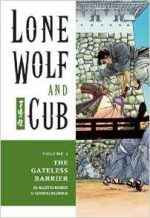
Lone Wolf and Cub volume 2: The Gateless Barrier


By Kazuo Koike & Goseki Kojima, translated by Dana Lewis (Dark Horse Manga)
ISBN: 978-1-56971-503-1

Best known in the West as Lone Wolf and Cub, the epic Samurai saga created by Kazuo Koike & Goseki Kojima is without doubt a global classic of comics literature.

An example of the popular “Chanbara” or “sword-fighting genre of books and cinema, Kozure Okami was serialised in Weekly Manga Action from September 1970 until April 1976 and was an immense hit. Those tales soon prompted a thematic companion series, Kubikiri Asa (Samurai Executioner) which ran from 1972 to 1976, but the major draw at home – and increasingly abroad – was always the nomadic wanderings of doomed noble ÅŒgami Ittō and his solemn child.

Revered and influential, Kozure Okami was followed after years of supplication by fans and editors by sequel Shin Lone Wolf & Cub (illustrated by Hideki Mori) and even spawned – through Koike’s indirect participation – science fiction homage Lone Wolf 2100 by Mike Kennedy & Francisco Ruiz Velasco with.

The original saga has been successfully adapted to many other media, spawning six movies, four plays, two TV series, games and merchandise. The property is notoriously still in pre-production as a big Hollywood blockbuster.

The several thousand pages of enthralling, exotic, intoxicating narrative art produced by these legendary creators eventually filled 28 tankobon volumes, beguiling generations of readers in Japan and, inevitably, the world. More importantly, their philosophically nihilistic odyssey with its timeless themes and iconic visuals has influenced hordes of other creators.

The many manga, comics and movies these stories have inspired are impossible to count. Frank Miller, who illustrated the cover of this edition, referenced the series in Daredevil, his dystopian opus Ronin, The Dark Knight Returns and Sin City. Max Allan Collin’s Road to Perdition is an unashamed tribute to this masterpiece of vengeance-fiction. Stan Sakai has superbly spoofed, pastiched and celebrated the wanderer’s path in his own epic Usagi Yojimbo and even children’s cartoon shows such as Samurai Jack can be seen as direct descendants of this astounding achievement of graphic narrative.

We in the West first saw the translated tales as 45 Prestige Format editions from First Comics beginning in 1987. That innovative trailblazer foundered before getting even a third of the way through the vast canon, after which Dark Horse Comics assumed the rights, systematically reprinting and translating the entire epic into 28 tankobon-style editions (petite 153 x 109 mm monochrome trade paperbacks, of about 300 pages each) between from September 2000-December 2002. When the entire translated epic had run its course it was all placed online through the Dark Horse Digital project.

A certain formula informs the early episodes: the acceptance of a commission to kill an impossible target, a cunning plan and inevitable success, all underscored with bleak philosophical musings alternately informed by Buddhist teachings in conjunction with or in opposition to the unflinching personal honour code of Bushido. The protagonist is also – probably – the most dangerous swordsman in creation…

The foredoomed killer-nomad was once Kōgi Kaishakunin: the Shogun’s official executioner, capable of cleaving a man in half with one stroke. An eminent individual of esteemed imperial standing, elevated social position and impeccable honour, ÅŒgami Ittō lost everything through the machinations of enemies at court and now roams feudal Japan pushing his toddler son in a tricked-out weaponised pram; two doomed souls hell-bent for the dire, demon-haunted underworld of Meifumado.

ÅŒgami’s wife was murdered and his clan eternally dishonoured due to the machinations of the politically ambitious Yagyu Clan, and the Emperor ordered ÅŒgami to commit suicide. Instead he rebelled, choosing to become a despicable Ronin (masterless samurai) and assassin, pledging to revenge himself on the Yagyus until they were all dead or Hell claimed him.

Although little more than a baby, his son Daigoro also chose the way of the sword, and together they now tread the grim and evocative landscapes of feudal Japan, one step ahead of destruction with death behind and before them.

This second magnificent monochrome volume – set in the depths of Japan’s legendary winters – again offers a grimly compelling combination of vengeful fable and addictive action-adventure which resumes here with ‘Red Cat’ as ÅŒgami leaves Daigoro with his client’s maid and engineers his own capture.

He wants to be incarcerated in the brutal, Fukuyama Han Prison where he can at last reach his target. Frequently the infallible assassin’s best ploy was to allow himself to be taken prisoner, endure unimaginable torture and then fight his way out having slaughtered his target: perhaps a self-induced penance for his failings…

Akaneko Shinsuke is an arsonist who once burned down the jail; effecting the escape of many criminals and causing the death and dishonour of the client’s father who was the warden at the time. Now “Red Cat” is back inside the rebuilt prison and on Death Row, but that is not punishment enough for the client.

He must not die impersonally, and the mastermind who truly created the shameful tragedy must be exposed and ended too…

Enduring appalling treatment and leaving a stack of corpses behind him, the Lone Wolf manoeuvres himself onto Death Row beside Shinsuke and learns the truth of that terrible night and the great fire, before rekindling the conflagration and bringing hell back to earth for final retribution…

Another aspect of ÅŒgami’s methodology re-emerges in ‘The Coming of the Cold’. The assassin always insists on a personal interview with his client and demands not only who is to die, but why. Perhaps the cautious killer only wants to know the extent of what he’s getting into, but we know he’s judging: seeing whether the target deserves death… or if the client does…

Upon accepting his latest job, ÅŒgami is proud to despatch the man who hired him before plunging into arctic conditions to complete his commission. The client’s retainers also happily sacrifice their lives to allow the Lone Wolf to infiltrate the fortified town of Oyamada and its impenetrable castle. As this scheme unfolds, little Daigoro sits in a cave in the midst of a blizzard fully aware that unless his father returns within five days, he will freeze or starve.

But that was before the avalanche…

Believing his son dead, Ōgami continues his mission, drawing ever closer to the traitor Lord who has chosen to rebel against the Shogun and forced his most loyal retainer to hire an assassin to cleanse the honour of the Han and remind his corrupted comrades of the purity of the beliefs they have forsaken…

His task accomplished, the assassin is replaced by the grieving father, but there is a miracle awaiting the weary warrior on his path to hell…

‘Tragic O-Sue’ begins as Daigoro gets into a fight with older children. When he wounds the son of the local Lord he is arrested and savagely beaten until the Lord realises the silent child is the son of the infamous and terrifying Lone Wolf.

ÅŒgami meanwhile is semi-conscious in a deserted temple, recovering from the fever and wounds earned during his last job. As he struggles back to health and sanity, little Daigoro is locked up with only the lowliest servant of the great house caring whether he lives or dies.

When the O-Sue’s charity is discovered, the Lord – convinced ÅŒgami has been sent to kill him – deals brutally with her and nearly dies for his callous brutality when enraged Daigoro escapes. Following the fugitive boy though the snow, the Lord intends to find the hidden assassin but doesn’t survive the success of his plan…

Delving deeply into Buddhist lore, ‘The Gateless Barrier’ sees ÅŒgami travel to desolate Wolf Mountain in search of spiritual clarity. However, although the animal predators find a way to live in harmony with him, his fellow humans are not so inclined. Cleansed and prepared, ÅŒgami proceeds with his latest job…

Strife between church and state over taxes in a famine-afflicted Han leads civil officials to hire the assassin to kill a “living Buddha” stirring up trouble. Before he can succeed in this sacrilegious assignment, however, the Wolf must be schooled in the proper procedures… by his victim…

This potently beautiful compendium of philosophic bloodletting concludes with an absorbing and fabulously off-kilter mystery as a highborn Samurai woman turned prostitute (a licensed and regulated profession in the Tokugawa Shogunate) proudly ends her life.

Elsewhere at the same time, the high-living head of the Han secretariat and his wife are murdered in almost impossible circumstances. Beside their bodies is a local blossom known as the ‘Winter Flower’ and the local criminal investigator wonders if there can be any connection. When an informant reveals that one of the prostitute’s last clients was a wandering ronin pushing a baby carriage, wheels begin to turn in the mind of the inspector…

Solid police work leads to a ramshackle hut in temple grounds, but the battalion of deputies and soldiers are loath to storm the shack since the local priest warned them that the warrior inside is dying of a highly contagious and revolting disease…

As metsuke (Police Inspector/Regional Spy Chief) Takariki Jinbei shouts through the closed door, the dying assassin tells him the shameful, shocking reasons the Han Chief and his bride had to die before igniting the hut and ending his tortured existence…

However, the metsuke is a remarkably astute, honourable and dedicated man. Seeing Daigoro, he wonders if he can trust his eyes and returns later: a move that results in a most enlightening confrontation with the devious Ōgami…

These stories are deeply metaphorical and work on a number of levels most of us Westerners just can’t grasp on first reading – even with the contextual help provided by bonus features such as the copious Glossary, providing detailed clarification and context on the terms used in the stories.

That only makes them more exotic and fascinating. Also, a little unsettling is the even-handed treatment of women in the tales. Within the confines of the incredibly stratified culture being depicted, females – from servants to courtesans, prostitutes to highborn ladies – are all fully-rounded characters, with their own motivations and drives. ÅŒgami’s female allies are valiant and dependable, and his foes, whether ultimate targets or mere enemy combatants in his path, are treated with professional respect by the Lone Wolf. He kills them just as if they were men…

A breathtaking tour de force, these are comics classics you simply must read.
© 1995, 2000 Kazuo Koike & Goseki Kojima. Cover art © 2000 Frank Miller. All other material © 2000 Dark Horse Comics, Inc. All rights reserved.

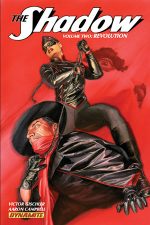
The Shadow volume 2: Revolution


By Victor Gischler, Jack Herbert, Aaron Campbell, Giovanni Timpano & various (Dynamite Entertainment)
ISBN: 978-1-60690-361-2

In the early 1930s, The Shadow gave thrill-starved readers their measured doses of extraordinary excitement via cheaply produced pulp periodical novels, and over the mood-drenched airwaves, through his own radio show.

“Pulps” were published in every style and genre in their hundreds every month, ranging from the truly excellent to the pitifully dire, but for exotic or esoteric adventure-lovers there were two star who outshone all others. The Superman of his day was Doc Savage, whilst the premier dark, relentless creature of the night dispensing terrifying grim justice was the putative hero under discussion here.

Radio series Detective Story Hour – based on stand-alone yarns from the Street & Smith publication Detective Story Magazine – used a spooky voiced narrator (variously Orson Welles, James LaCurto or Frank Readick Jr.) to introduce each tale. He was dubbed “the Shadow” and from the very start on July 31st 1930, he was more popular than the stories he highlighted.

The Shadow evolved into a proactive hero solving instead of narrating mysteries and, on April 1st 1931, began starring in his own printed pulp series, written by the incredibly prolific Walter Gibson under the house pseudonym Maxwell Grant. On September 26th 1937 the radio show officially became The Shadow with the eerie motto “Who knows what evil lurks in the hearts of Men? The Shadow knows!” ringing out unforgettably over the nation’s airwaves.

Over the next eighteen years 325 novels were published, usually at the rate of two a month. The uncanny crusader spawned comicbooks, seven movies, a newspaper strip and all the merchandising paraphernalia you’d expect of a superstar brand.

The pulp series officially ended in 1949 although Gibson and others added to the canon during the 1960s when a pulp/fantasy revival gripped America, generating reprinted classic stories and a run of new adventures as paperback novels.

In graphic terms The Shadow was a major player. His national newspaper strip – by Vernon Greene – launched on June 17th 1940 and when comicbooks really took off the Man of Mystery had his own four-colour title; running from March 1940 to September 1949.

Archie Comics published a controversial contemporary comicbook in 1964-1965 under their Radio/Mighty Comics imprint, by Robert Bernstein, Jerry Siegel, John Rosenberger and latterly Paul Reinman; and in 1973 DC acquired the rights to produce a captivating, brief and definitive series of classic comic adventures unlike any other superhero title then on the stands.

DC periodically revived the venerable vigilante. After the runaway success of Crisis on Infinite Earths, The Dark Knight Returns and Watchman, Howard Chaykin was allowed to utterly overhaul the vintage feature. This led to further, adult-oriented iterations (and even one cracking outing from Marvel) before Dark Horse assumed the license of the quintessential grim avenger for the latter half of the 1990s and beyond.

Dynamite Entertainment picked up the option in 2011 and, whilst republishing many of those other publisher’s earlier efforts, began a series of new monthly Shadow comics.

Set in the turbulent 1930s and war years that followed, these were crafted by some of the top writers in the industry, each taking their shot at the immortal legend, and all winningly depicted by a succession of extremely gifted illustrators.

This second volume – collecting #7-12 of the monthly comicbook from 2013 – comes courtesy of Victor Gischler (Gun Monkeys, Deadpool: Merc with a Mouth, Kiss Me Satan), again throwing a spotlight on the increasing deadly geopolitics of a civilisation sliding inexorably into another World War….

His scripts were variously realised by Jack Herbert, Aaron Campbell, Giovanni Timpano, Ivan Nunes & Carlos Lopez, and the action opens with a self-contained prelude that begins with the Master of the Macabre suffering from uncharacteristic bad dreams…

Very few people know that the black-cloaked fist of final retribution known as The Shadow masquerades by day as abrasive, indolent playboy Lamont Cranston. Most are agents in his employ and they are all aware of his semi-mystical abilities to detect thoughts and cloud the minds of men, but not that in the past few days those abilities have seemingly waned and led to the death of an innocent…

Engaging veteran Great War pilot Miles Crofton, Cranston embarks on a journey to the Himalayan region where he long ago studied under august adepts of the arcane. However, his voyage is interrupted in Nepal when he encounters a brutal bandit leader dubbed Red Raja. This thuggish crimelord seems to have powers and abilities similar and equal to his own…

Eschewing immediate confrontation, Cranston delves deep into the past and eventually learns the Raja also studied with the esoteric “Masters”. Tragically, when his innate evil nature forced them to expel him, the student returned with men and guns; wiping out the entire enclave of puissant accumulated knowledge…

Armed with information and fuelled by righteous fury, The Shadow then assaults Red Raja’s fortress, single-handedly eradicating his army of rogues before enacting final judgement…

Weeks later, vacationing in Paris whilst Miles has their plane repaired, the restless Shadow passes his time hunting down human predators and becomes emotionally embroiled in a missing persons case.

The trail leads to a grand soiree at the Spanish Embassy where Cranston makes a particular splash with the assorted dignitaries and persons of wealth and high station, particularly after loudly declaring that he is an arms dealer with product to sell.

It is 1937 and the civil war in Spain has all but stalled, with both sides afflicted by attrition and exhaustion…

Horrified Ambassador Ramirez is only too happy to fob off the tiresome Cranston on his military attaché. As soon as he sees the devastating Major Esmeralda Aguilar, the Shadow knows she is no ordinary woman…

The swaggering millionaire is only too eager to ditch the stuffy party with the exotic spy, but their intimate drive through the City of Lights is almost ended by a machine gun attack. Then Cranston discovers just how dangerous his companion truly is…

The next day Miles resurfaces with news on a freighter full of munitions headed for Spain and the final clue to the disappearances the Shadow has been investigating. Even with mental faculties and powers diminished and compromised, the Dark Avenger is clear on where his next destination lies…

Intercepting the gunrunners as they seek to offload their illicit cargo at a Spanish port, the Shadow dispenses his brand of justice before vanishing, and twelve hours later Lamont Cranston arrives in Barcelona, unsure of what trick of fate or his own subconscious has brought him there.

His mystically-attuned senses go into overdrive once he meets an inoffensive British volunteer in the Socialist Brigade calling himself “George Orwell”…

After befriending the oddly magnetic militiaman, Cranston excuses himself and resumes his trail of guns whilst Orwell returns to his unit in Aragon. Diligent hunting takes the Shadow to a warehouse where a gang led by a masked woman named Black Sparrow are attempting to sell the munitions to representatives of the underworld.

When the crooks try a double-cross they are savagely wiped out by the Sparrow as her men stand idly by, and from his hidden vantage point the Shadow realises just how extraordinary Major Aguilar truly is…

Soon the Avenger is risking spectacular airborne death; chasing her back to an ancient castle in the Aragon Region where he uncovers a bold scheme by an international cabal to place a third ruler on the throne of Spain. Of course, when he blazes in to end the conspiracy, Cranston finds more than he bargained for.

“El Rey” is far from the dominating despot he appears, and the true mastermind behind the plot is far more of a match for the Shadow than the grim guardian could possibly have anticipated.

And that’s when fate reveals the potential value of a certain nondescript British soldier of ideology and fortune…

This historically-flavoured jaunt then concludes with one last hurrah as Miles and Cranston belatedly return to New York just in time for the Shadow to fixate on a gang of ruthless bank robbers terrorising the city with their bold and lethal raids.

Broaching his contacts on the police force and rampaging through the ranks of the underworld, the Shadow turns the city upside down until at last a grudging tip takes him to a certain Chinatown whorehouse where a most exotic creature provides all the details he need to exact his vengeance on the guilty.

Now all that remains is to trigger the bloody end…

Dynamite publish periodicals with a vast array of cover variants and here a vast gallery features dozens of iconic alternate visions from Alex Ross, John Cassaday, Darwyn Cooke, Francesco Francavilla, Tim Bradstreet, Mike Mayhew, Michael Golden, Jack Herbert and Sean Chen to delight any art lover’s eyes and heart.

Sardonic, uncompromising and packed with subtle nuance, Revolution is a superb addition to the annals of the quintessential Dark Knight, and one no one addicted to action and mystery should be without.
The Shadow ® & © 2013 Advance Magazine Publishers Inc. d/b/a Conde Nast. All Rights Reserved.

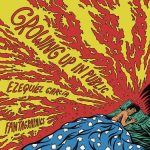
Growing Up in Public


By Ezequiel García (Fantagraphics Books)
ISBN: 978-1-60699-936-3

With the acceptance of graphic novels as a valid and worthy form of entertainment and mature expression has come a welcome flowering of personal stories and authorial voices blending unique – and literal – visions with perspectives far removed from our cosy own.

After all, potent and evocative as they might be, the graphic observations and conclusions of a Harvey Pekar or Eddie Campbell still resonate with shared concerns, experiences and ideologies for most English-speaking, western-reared readers from Britain, the USA, Canada, New Zealand or Australia.

Such a view just can’t be taken when absorbing the pictorial ruminations of equally brilliant and driven artisans from countries with differing historical, socio-cultural, linguistic and even artistic world views.

That kind of revelatory exotic intimacy can be found in Growing up in Public, the latest cartoon epistle from Argentinean artist and cartoonist Ezequiel García as he contemplates his achievements, total lack of success or celebrity and place in the world following his thirtieth birthday…

Born in 1975, García studied under Argentinean comics legend Alberto Breccia whilst co-editing several comics anthologies and trying his hands at other forms of artistic expression. Growing up in troubled times in a country that has always taken culture, heritage and the arts seriously, he has had short works appear in comics magazines in Europe and South America.

He won the comics award at Brazil’s Salon del Humor de Piracicaba in 2000, and his first graphic novel Turning 30 was released in Argentina in 2007. In recent years, Garcia has served as a comics teacher, art gallery curator, and co-organizer of the Festival Increible de Historietas, Fanzines y Afines whilst labouring on this eclectic, far-ranging, intimate, polemical and engaging reminiscence.

In a free-wheeling, affectingly immersive, starkly black-&-white outpouring, Ezequiel introduces us to his world at a certain point in his life. A struggling artist, the author derives much of his inspiration from the history, music and architectural heritage of Buenos Aires. Here, however, as he struggles to find a publisher for his comics, galleries to exhibit his other art, women to sleep with and someone special to love, his attentions are increasingly distracted by the ongoing destruction of all he cherishes as big banks and foreign businesses take over, rebuild and desecrate the magnificent dance palaces, film theatres and civic buildings which were the landmarks and milestones of his childhood…

In truth the entire city is under threat of losing its identity as money and encroaching corporate globalisation seeps in, buying off officials and easily circumventing the legal protections supposedly safeguarding these edifices for the nation…

Most galling of all is Ezequiel’s quest for creative acceptance. He’s getting some traction, but as he and his friends visit show after show, he’s starting to feel that the art world only wants to reward shallow charlatans regurgitating old or devalued concepts and no longer has room or respect for toil, craftsmanship and honest searches for truth…

He feels equally powerless to change his personal situation. Ezequiel has no trouble meeting women, but really wants a girlfriend and just can’t decide on which one to get serious with…

The most potent temptation of autobiographical comics is the total autonomy the exercise grants. In the midst of his collation of linked episodes and hope-filled introspections highlighting the aggravating, mundane or personally significant, García takes the opportunity to radically depart from his prescribed path to interweave a psychedelic, emotionally overcharged diversion.

As he is drawn into a late-night church meeting after reading Moby Dick, he is transported to mind-boggling flights of fancy as the firebrand cleric ranting conflates Melville’s tale with the biblical example of Jonah; resulting in a stunning visual tornado of iconic idolatrous revelation…

And then reality returns and he goes back to his catalogue of disaffection. As he endures more and more of the same the increasingly uncomfortable thirty-someone reaches a crisis in his romantic stalemates and decides it’s time to make decisions and changes in his life…

As previously stated, music plays a great part in the author’s life, and song lyrics – in Spanish – are woven into almost every page of García’s fiercely expressionistic art like street art or a graffiti Greek Chorus. Don’t fret however, as a full compliment of ‘Song Translations’ featuring all those mood-enhancing lines is included in the Bonus Section, which also includes a page of the artists ‘Inspiration’ sources as well as ‘Notes’ offering context and commentary on the story.

Powerful, uncompromising, mesmerising and unforgettable, this is a superb peek at life’s unchanging verities through fresh and expressive eyes and one all lovers of comics as art should seek out.
© 2016 Ezequiel García. Design © 2016 Fantagraphics. Translation © 2016 Ezequiel García. All rights reserved.

Black River


By Josh Simmons (Fantagraphics Books)
ISBN: 978-1-60699-833-5

After far too long way, cartoonist Josh Simmons (House, Jessica Farm, The Furry Trap) returns with another masterfully monochrome comics epic: a poetically potent, visually enthralling, ferociously challenging tale some might reasonably call a horror story.

However, despite its post-apocalyptic setting and milieu and constantly rising death-toll, Black River has more in common with the arduous privations and torturous trials of endurance and personal choice typical of a Jack London adventure novel than a slasher flick, serial killer slaughter or even last ditch stand against the zombie horde du jour.

Sacrificing plot to concentrate on character and experience, the story details how a band of people roam the wastes of Earth after the world ends.

Incessantly moving forward, the motley mixed-up band of strangers hunt for scarce supplies in wrecked cities and outpost; staying one step ahead of whatever destroyed civilisation. Of course, even as they wearily trudge the length of the continent, scavenging for necessities – and even occasional, instantly abused luxuries like booze and drugs – they cannot stop madness finding them or death from picking them off one by one.

Their years-long nomadic perambulation takes an even darker turn after they are all captured by a marauding band led by a charismatic sociopath called Benji. These brutes have reverted to little more than true beasts, but solitary, traumatised Shauna endures the worst atrocities they can commit before lethally turning the tables on them and leading the now solely female group back out into the wilds again.

Years pass, battles are fought and the group thins as life winnows them down to nothing…

Simmons doesn’t offer answers or explanations: this epic trek of unrelieved toil and raw survivalism is truly all about the journey and what happens next as the ever-shifting cast of desperately determined humans take life one day at a time, one step after another until the inescapable end comes…

Black River is bleak, unrelenting and morbid, but Simmons is a fantastically perceptive creator and realises that even in such an existence, there must be moments of rude hilarity or short-lived contentment and even unexpected joy to balance the constant fight for one more day…

A saga of grim attrition in a world without hope, Black River perfectly displays the best and worst of human nature and is a tale which, once read, will never be forgotten…
© 2015 Josh Simmons. This edition © 2015 Fantagraphics Books, Inc.

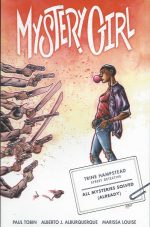
Mystery Girl volume 1


By Paul Tobin, Alberto J. Albuquerque, Marissa Louise & Marshall Dillon (Dark Horse Books)
ISBN: 978-1-61655-959-5

There’s a fabulous wave of smart, entertaining stand-alone comics on the market these days, offering readers a single uncomplicated hit of graphic entertainment without the grief of buying into massive back-history or infinite cross-continuity.

One of the best I’ve seen recently is the compilation of a fierce, frenetic and funny debut 4-issue miniseries from 2015, starring the most infallible detective of all time.

As crafted by Paul Tobin (Marvel Adventures Spider-Man, Plants vs. Zombies, Bandette, Colder) and Alberto J. Albuquerque (Letter 44) – with colours by Marissa Louise and letters from Marshall Dillon – this slim, sleek, slick yarn seems certain to lead to more enigmas excitingly unravelled in our immediate future…

Like any ancient city, London has its fair share of unique characters and unsolved mysteries, but that’s never the case whenever Trine Dorothy Hampstead sets up her “office” on the pavements and begins chatting…

The effusive, ebullient young woman has an incredible gift. She knows the answer to any question she’s asked. Instantly and infallibly. “Where are my keys?” “Did Dad leave a will?” “Where is my son’s body?”

All inquiries get an instant response and every answer is correct…

Trine is a local celebrity in her community, not only for the fact that she’s never judgemental or exploits her gift, but also because everyone knows there’s only one mystery the poor lass can’t solve: how she got her uncanny power…

Trine has an immense taste for life at full throttle and abiding desire to help those in need: regularly consulting with local private eye Alfie and aiding her perpetually sceptical boyfriend – and Metropolitan police constable – Ken Bloke in his work, even though he refuses to believe in her gift…

Her already extraordinary life takes a big step into the unknown when ancient DNA specialist Jovie Ghislain comes to Trine with a fascinating query. The biologist has been researching a 1930’s expedition to the wild Sakha region of Siberia. In the notes of the fabled Weimar-Steinberg trek, the explorers detail how they uncovered a frozen mammoth carcass so perfectly preserved that the meat was still fresh and edible.

The records are tragically incomplete and Ghislain – desperate to secure viable DNA from the deceased giant – wants to know where the rest of the body is now…

The answer is not immediately forthcoming. In fact Trine refuses to say anything unless she can join Jovie’s excursion and personally show the scientists where it is.

Trine thrives on new experiences and this time her gift has paid a huge dividend. As preparations are made, she shrugs off all questions from friends and acquaintances but does confide in her pet budgie Candide. The reason that mammoth meat was so fresh is obvious. It hadn’t been dead long. Now she’s off to see its kin in the only place on earth where the mighty beasts still live…

Sadly, the original expedition and its journals are also the subject of a search by wealthy and far less friendly folk. However, when a mystery billionaire commissions a psychopathic hitman to find all the original journals and stop the new expedition, even the deadly Linford is taken with Trine. Foregoing his usual callous efficiency, the murdering mercenary takes his time, insinuating himself into the life of all her friends. It’s all working out fine until the Mystery Girl is asked about her pal’s latest boyfriend and suddenly she knows all about the new beau, including his real profession…

Hampstead’s plan to deal with him is shockingly effective, but doesn’t go nearly far enough…

Believing the coast clear, Trine and Jovie head for the Arctic Circle, blissfully unaware that their trail is being dogged by Linford’s sinister paymaster and that the killer himself is down but not out. Instead he has devised a cunning method to turn his opponent’s gift against her…

Yet again, however, the obsessive hitman has underestimated Trine’s power, ingenuity and ruthless resolve but when finesse fails at least he can always fall back on overwhelming firepower and direct action…

With the explorers nearing their frozen El Dorado, the bad guys make their move, revealing what’s actually behind all the death and destruction. Now it no longer matters if Trine is asked the right question or not…

As the ghastly true story of the Weimar-Steinberg expedition is exposed, their heirs and inheritors will prove willing to commit mass murder to keep the bloody secret covered up, but Trine asks herself a different question and a life-saving solution pops into her head…

Fast-paced, spectacularly action-packed, witty and superbly balanced as hero and villain play cat-&-mouse around the world, Mystery Girl is a funny, imaginative, brutally uncompromising introduction to a potent and engaging new female character who seems destined for greatness.

Also included are fascinating bonus features including a copious and heavily annotated Sketchbook section with commentary from Tobin and Albuquerque, concept to finished art examples, cover roughs and designs and unused cover art, revealing the masses of effort that went into making this one of the best character debuts of the year.

Don’t ask why you weren’t in at the beginning of her climb to stardom: get Mystery Girl and become someone with (some of) the answers…
Mystery Girl™ & © 2015, 2016 Paul Tobin and Alberto J. Albuquerque. Mystery Girl™ and all prominently featured characters are trademarks of Paul Tobin and Alberto J. Albuquerque.

Time Clock


By Leslie Stein (Fantagraphics Books)
ISBN: 978-1-60699-930-1

Help Wanted: Girl cartoonist seeks meaning of contemporary existence and like-minded individuals to share bewilderment and revelations with.

Interests/Hobbies include: drinking, counting sand, growing stuff, antiquing for pop culture “trash”, drinking, meaningful conversations with musical instruments, playing board games with same, recreational herbal intoxicants, reminiscing about wild-times with gal-pals and old cronies, drinking, visiting difficult relatives.

Employment: unwanted but regrettably necessary. Although not native to the Big City, is extremely adaptable and will do anything – unless it’s hard, boring or she sucks at it…

After graduating from the New York School of Visual Arts, Leslie Stein began producing astonishingly addictive cartoon strips in the self-published Yeah, It Is. Winning a Xeric Grant for her efforts, she then started an even better comicbook entitled Eye of the Majestic Creature: blending autobiographical self-discovery, surreal free-association, philosophical ruminations, nostalgic reminiscences and devastatingly dry wit to describe modern life as filtered through her seductive meta-fictional interior landscape. She is a creator who sees things as they really aren’t, but makes them authentic and even desirable to anyone willing to pay attention…

This long-awaited third volume resumes Stein’s airy, eccentric and engaging pictorial mood-music as her mythologized autobiography continues to reveal the history and ambitions (for want of a better term) of Larrybear – a girl deliberately and determinedly on her own, trying to establish her uniquely singular way of getting by.

Eschewing chronological narrative for an easy, breezy raconteur’s epigrammatic delivery, illustrated in loose, free-flowing line-work, detailed stippling, hypnotic pattern-building or even honest-to-gosh representational line-drawing, Stein operates under the credo of “whatever works, works” – and she’s not wrong…

Larrybear makes friends easily: bums, winos, weirdoes, dropouts, misfits, non-English-speaking co-workers and especially inanimate objects. Her bestest buddy is her talking guitar/flatmate Marshmallow, one of the many odd fellow travellers who all aggregate around her, briefly sharing her outré interests and latest dreams.

However Larrybear doesn’t want an average life, just more experiences, less hassle and affable companions to share it all with.

This latest graphic dinner party starts with another Friday at work. After scrupulously completing her wage-slave tasks, she heads off to show her latest creation at the long-awaited Sand Counters Convention.

The guy at the next table next is annoying but okay, and she’s touched when venerable old Sand Counter Henry Peet admires her work but, after seeing über-stylist Tim Heerling swanking and lapping up the adulation of the audience, she is mysteriously moved and decides that now she has a new nemesis…

And in the meantime, stay-at-home stringed instrument Marshmallow – feeling unfulfilled – takes up baking to shorten the incessant loneliness…

A second untitled segment then finds Larrybear hanging out with old pal Boris, sharing stories and intoxicants, but still blithely unaware of how he feels about her…

After months of prevaricating, and whilst still enduring dreams about that Heerling guy, our aimless star finally relocates to the countryside where she, Marshmallow and the rest of her animated instrument collection enjoy a life of bucolic fulfilment and idle contemplation until they can’t stand it any more…

This superbly quirky diversion then concludes with ‘Boy’ as Larrybear learns that living miles from the nearest bar and being unable to drive is severely impacting her drinking time, whilst having competition-quality sand delivered is a huge mistake…

All too soon however, she’s back in her natural environment, dealing booze to drunks and sharing their buzz, just as the biggest storm in living memory threatens to close up the city…

All delivered in a mesmerising, oversized (292 x 204 mm) monochrome package, these incisive, absurdist, whimsically charming and visually intoxicating invitations into a singularly creative mind and fabulous alternative reality offer truly memorable walks on the wild side. For a gloriously rewarding and exceptionally enticing cartoon experience – one no serious fan of fun and narrative art can afford to miss – you simply must spend a few hours with a Time Clock.
© 2016 Leslie Stein. All rights reserved.

Worry Doll


By Matt Coyle (Dover Comics & Graphic Novels)
ISBN: 978-0-486-80616-7

In the comics biz it’s not too often that something truly different, graphically outstanding and able to subvert or redirect the medium’s established forms comes along.

Sadly, when it does we usually ignore it whilst whining that there’s nothing fresh or new in view.

That’s pretty much what happened with Matt Coyle’s astounding Worry Doll when, after six years of work on the dark epic, it was published by Mam Tor in 2007 and sank from the collective audience’s sight after causing but the barest of ripples.

To be fair, British-born, Australia-based Coyle (see also, if you can, his mordant, socio-political satire Registry of Death) did win the 2007 Rue Morgue award for Best Comic Book Artist for his incredible photo-realistic line-art on Worry Doll, but the innovative delivery of one of the creepiest tales in comics history never garnered the acclaim it deserved in our superhero-saturated toy, TV and film license-loaded entertainment arena.

Now, thanks once again to Dover Books’ Comics & Graphic Novels division, another lost classic of the art form has a second chance to shine, so let’s show some proper respect and make this edition the popular success it should be…

A soft-cover monochrome landscape affair; enigmatic observations and conversations are delivered in the oldest format of pictorial narrative, with blocks of text on one page balanced by an illustrated panel or sequence of images on the facing folio, as a most distressing story unfolds…

A happy home becomes a charnel scene of slaughter and in the aftermath, amidst the bloody remains of a recently-despatched family, a trio of beloved mannequins intended to assuage anxiety take on ghastly animation and leave in search of answers – or is it actually just different questions?

Making their way across familiarly picturesque and simultaneously terrifying country, the dolls increasingly depend on the kindness of strangers, until their nightmare road-trip is eventually subsumed in someone’s story. As our perspective shifts, we get clues that other hands are working these puppets and the story is not as it seems nor quite done yet…  

Spooky and subversive, blending classic noir mood and tone with storybook quests and psychologically daunting introspection, Worry Doll operates on multiple layers of revelation, both in the staggeringly detailed illustration and the prose accompaniment; constantly offering hints and forebodings if not answers…

With a new Foreword from comics author and filmmaker Shaun Tan (The Lost Thing, The Red Tree, The Arrival) who sagely deconstructs the journey and Coyle’s virtuosity with line and form, this is a complex, engaging and ominously beautiful masterwork no true lover of comics or addict of sinister suspense can afford to miss.
© 2007 by Matthew Coyle. Foreword © 2016 by Shaun Tan. All rights reserved.

Dream Gang


By Brendan McCarthy & various (Dark Horse Books)
ISBN: 978-1-50670-000-7

London-born Brendan McCarthy came to funnybook prominence in 2000AD before finding international comics stardom whilst pursuing a parallel career in film, television, music videos and design.

Forward-looking, iconoclastic yet simultaneously deeply reverential of comics’ great innovators, his most notable graphic works include Strange Days and Paradax, Judge Dredd, Zenith, Sooner or Later, Skin, Rogan Gosh, Spider-Man: Fever and innumerable stunning covers. His moving-media credits are equally singular and impressive, having produced scripts and/or design work for The Storyteller, Highlander, Lost in Space, pioneering CGI animation series Reboot, Mad Max 4: Fury Road and so much more.

Originally seen as scintillating segments of a occluded whole in Dark Horse Presents volume 3 #1-4, #7-10 and #14-17 in 2014-2015, McCarthy’s latest magnum opus has been completely remastered here: a digitally-psychedelic, intoxicatingly intriguing yarn (with lettering from Nate Piekos of Blambot® and additional colouring from Len O’Grady) which begins with a tedious worn-down wage slave enduring his greyly monochrome mind-numbing existence.

Everything changes – but not necessarily for the better – when his head hits the pillow and he is transported to an incredible, overwhelming wonderworld where dreams are made manifest and the id and subconscious roam free and wild…

However the dreamscape is in the midst of a terrifying civil war with a marauding entity dubbed Zeirio ripping apart the fantastical strata and recondite regions of the Dreamscape in his lust to acquire a hidden ultimate weapon and break out into the real world.

Instantly attacked by a passing Hate-Wraith, our reluctant wanderer is only saved by the swift intervention of quirkily charismatic Sheriff Chumhartley who then presses him into service by activating his Dream Avatar…

Now submerged within the masked super-heroic frame of the Dream Voyager, the baffled, bemused and partially amnesiac real-worlder is subjected to a parade of mind-blasting sights as he reluctantly joins the imaginary brotherhood of the Dream Gang in a last-ditch pursuit of Zeirio.

However, with his new allies losing ground – and, too often, their lives – the imported champion is further baulked and distracted by the appearance of a beloved and long-lost friend from his past, who distracts his dream-fuelled attention and might well be their adversary’s greatest and cruellest counter-weapon…

An astounding visual voyage of discovery to a region of tantalisingly phantasmagorical, thought-bending phenomena to endure Horatian struggles against insurmountable odds, this is a moody, moving and creepily compelling psychological escapade to delight all lovers of the life fantastic.

Devotees of McCarthy’s unique artistic visions will be further rewarded by a copious bonus section which includes an informative Afterword and a large gallery of art pieces: sketches, production notes, concept development and character designs from the decades in which this story moved from enchanting idea to finished ethereal epic.
Dream Gang™ © 2014, 2015, 2016 Brendan McCarthy. All rights reserved.

Memetic


By James Tynion IV & Eryk Donovan (Boom Entertainment)
ISBN: 978-1-60886-743-1

Even people who love to be scared can get a bit jaded. Terror tales come in many forms and formats, from Sophisticated Suspense to J-Horror to no-holds-barred graphic splatter and torture-porn, but at the heart of them all is the power to connect with an audience and make them nervously wonder. Thankfully, thus far creators are keeping just ahead of consumers and still seem able to enact new notions with great style and captivating facility whenever we need a little extra anxiety in our lives…

Embracing all the old adages whilst thinking far outside the box, in 2014 writer James Tynion IV (The Eighth Seal, Batman Eternal) partnered with old associate Eryk Donovan (The House in the Wall), colourist Adam Guzowski and letterer Steve Wands to put a fresh, clever and thoroughly post-modern spin on the overused doomsday scenario of the Zombie Apocalypse with 3-issue miniseries Memetic.

If you need a little definition here: A meme is an idea that starts with individual, spreads to many and potentially is taken up by entire communities or societies, like not eating yellow snow, washing behind the ears or voting for the worst possible candidate in any given election…

Aaron Sumner had a bad start in life but simply persevered. Despite the congenital illness which messed up his eyes and left him needing hearing aids and daily medication, he made friends, worked hard and now leads a relatively normal life at Jefferson State College.

He even had a boyfriend until recently, but was totally unprepared for the role he was about to play in the last act of humanity…

Aaron is still fretting about recently gone-but-not-forgotten beloved Ryan Nowak, and petulantly surfing the web when someone forwards an image that promises to “change everything”…

Intrigued, he opens the file and agrees that it’s a pretty picture, unaware that he is one of the few humans on the planet immune to its secret power…

Everybody else who sees the image is immediately besotted and cannot stop looking at it, but baffled Aaron soon tires of not getting it and goes to sleep. He’s woken up by best friend Sarah Bentley who totally feels the tingle of friendly companionship the picture generates. Together they reason that it’s Aaron’s medical deficits which are preventing him from sharing the togetherness.

In mere hours the image has gone beyond viral. It has been copied and pasted on walls and even made it onto regular news channels. Nobody can grasp just why it has such a feelgood factor, but it looks like before the day is over everybody on Earth will be sharing the joy…

That’s disturbing news for Marcus Shaw. The former military specialist was one of the Pentagon’s biggest military brains until macular degeneration rendered him practically sightless, and the effect he hears of on the news and from speaking to his increasingly distracted friends reminds him of an old project proposed by Weird Science specialist Dr. Barbara Xiang.

When he contacts his old bosses he quickly realises it’s too late. Someone has succeeded where they failed and created a weaponised Meme…

All over the world progress pauses as people see the picture, disseminate the picture and perpetually stare at the picture.

Aaron is baffled and growing concerned. That turns to total terror when the second-stage kicks in. Twelve hours after initial exposure, the image addicts begin bleeding from the eyes and take to the streets in lemming-like mass marches. Screaming mindlessly, they surge through the streets ripping apart anyone not sharing their mindless union and converging in towering masses of melting flesh…

Elsewhere, last-ditch action is being taken. Dr. Xiang has managed to avoid seeing the image and linked up with Marcus. She knows full well the potential threat and wants him to lead a reconnaissance mission to find the originator of the meme and, if possible, create a counter-measure.

Aaron’s world is crumbling. Sarah stays with him until she starts to feel the scream building inside her, and even a last-minute reunion with Ryan is doomed to end badly…

Using now-abandoned government and military resources, Marcus and Xiang locate the origin point of the meme and a team heads off to confront their hidden enemy. They cannot help but speculate on who – or what – could have created such a complex thought weapon: one which is clearly evolving and forcing humanity into its final moments…

The answer, when it comes, is beyond anything they could possibly have imagined…

And Aaron ostracised, alone and again an outsider makes one final act of free will…

Engaging, engrossing, fearsomely believable and utterly compelling, Memetic also offers behind the scenes bonuses including sketches, model sheets, a feature showing the creative process from ‘Script to Page’, commentary and ‘Afterwords’ from author and artist, plus a cover and variants gallery by Donovan.

Unfolding at a frenetic pace – 72 hours from start to a doom-drenched finish – this a yarn to chill the hearts of blasé Generation Tech and the most timid of silver surfer alike: one you also will have extreme difficulty turning away from…
™ & © 2015 James Tynion IV. All rights reserved.

Marie Antoinette: Phantom Queen


By Rodolphe & Annie Goetzinger translated by Peter Russella (NBM)
ISBN: 978-1-68112-029-4

As I’ve previously stated, like so much European art and culture, French language comics (I’m controversially including Belgium and Swiss strips in this half-baked, nigh-racist, appallingly sweeping statement) often appear as a triumph of style over content.

That doesn’t mean they’re bad – far, far from it – but rather that sometimes the writing and plotting isn’t as important to the creators – or readers – as the way it looks on a page and in a book, and complex characterisation isn’t always afforded the same amount of room that scenery, players, fighting or sex gets.

That is not the case in this sublimely evocative and eerily placid episode by eminent Bande Dessinée scenarist Rodolphe D. Jacquette (Le Conservateur, Raffini, Cliff Burton) and former fashion artist turned comics creator supreme Annie Goetzinger (Girl in Dior, Casque d’Or, Aurore, L’Agence Hardy) which seamlessly blends the tone and timbre of two iconic eras in French history in a tale of mystery, imagination and rather indolent intrigue…

First seen in 2011 as Marie Antoinette, La Reine Fantome the translated wonderment follows an enlightening Introduction from Rodolphe, describing the origins and provenance of the story before co-writer and sole illustrator Goetzinger introduces us to artist Maud as she sits in the gardens of the Petit Trianon at Versailles.

It’s October 5th 1934 and her sketching of the scene is a brief yet welcome escape from her problems. Her beloved but far older husband is recently dead, leaving her a vast fortune which her stepson son covets.

Remy constantly pesters her to marry him, but she knows he’s as likely to kill as wed her to get his hands on the inheritance…

Things take a strange turn when her dog breaks loose and scampers away. He is quite the hit with the ladies of the Court when he bounds into a grand building, just as a frantic footman warns Queen Maria Antoinette that they must all retreat to the castle before the peasants besieging Versailles find them. It is still October 5th, but also so very long ago…

As her stepson’s attentions become more obnoxious and intolerable, Maud’s dreams are hunted by potent, tangible glimpses of the dead queen’s final days and close friends Suzy and Maggie convince her to try an oh-so-fashionable séance.

Also attending the affair is attractive psychiatrist Dr. Maurice D’Octrobre, a man of great charm and learning, possessed of a remarkably open mind…

Good thing too, as the ceremony allows Marie Antoinette to manifest, imploring Maud to find her remains and re-inter her so that the tragic queen might rest at last…

And so begins an utterly beguiling and entrancingly sophisticated, classically constructed ghost story with clever plot twists, genteel suspense and even a vile villain who sees his stepmother’s unsuspected psychic gifts as a stepping stone to having her committed and stealing her fortune…

Maud’s path is unswerving and her triumph never in doubt, but she never expected that in addition to the satisfaction of a job well done and a soul saved there would be such tangible rewards for her good deed…

Eerily comfortable and superbly satisfying; balancing melancholy shades of The Ghost and Mrs Muir with the poesy of Daphne Du Maurier’s Rebecca, Marie Antoinette: Phantom Queen is a superb step back into a lost world of elegant mystery and imagination: one no fantasy lover or mature comics reader should miss.
© Dargaud 2011. All rights reserved.

Marie Antoinette: Phantom Queen will be released on August 18th 2016. It can be pre-ordered now and is also available in all e-book formats.For more information and other great reads see http://www.nbmpub.com/