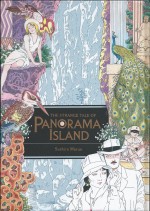
The Strange Tale of Panorama Island


By Edogawa Rompo, adapted and illustrated by Suehiro Maruo, translated by Ryan Sands & Kyoko Nitta (Last Gasp)
ISBN: 978-0-86719-777-8

Win’s Christmas Gift Recommendation: Beautiful, seductive and intoxicating… 10/10

Edogawa Rompo is hailed as the Godfather of Japanese detective fiction – his output as author and critic defining the crime thriller from 1923 to his death in 1965. Born Tarō Hirai, he worked under a nom-de-plume based on his own great inspiration, Edgar Allen Poe, penning such well-loved classics as The Two-Sen Copper Coin, The Stalker in the Attic, The Black Lizard and The Monster with 20 Faces as well as many tales of his signature hero detective Kogoro Akechi, notional leader of the stalwart young band Shōnen tantei dan (the Boy Detective’s Gang).

He did much to popularise the concept of the rationalist observer and deductive mystery-solver. In 1946 he sponsored the detective magazine Hōseki (Jewels) and a year later founded the Detective Author’s Club, which survives today as the Mystery Writers of Japan association.

Although his latter years were taken up with promoting the genre, producing criticism, translation of western fiction and penning crime books for younger audiences, much of his earlier output (Rampo wrote twenty novels and lots of short stories) were dark, sinister concoctions based on the trappings and themes of ero guro nansensu (“eroticism, grotesquerie, and the nonsensical”) playing into the then-contemporary Japanese concept of hentai seiyoku or “abnormal sexuality”.

From that time comes this particular adaptation, originally serialised in Enterbrain’s monthly magazine Comic Beam from July 2007-January 2008.

Panorama-tō Kidan or The Strange Tale of Paradise Island was a vignette released in 1926, adapted here with astounding flair and finesses by uncompromising illustrator and adult manga master Suehiro Maruo.

A frequent contributor to the infamous Japanese underground magazine Garo, Maruo is the crafter of such memorable and influential sagas as Ribon no Kishi (Knight of the Ribbon), Rose Coloured Monster, Mr. Arashi’s Amazing Freak Show, The Laughing Vampire, Ultra-Gash Inferno, How to Rake Leaves and many others.

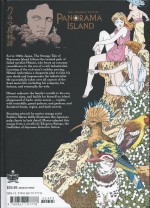
This is a lovely book. A perfect physical artefact of the themes involved, this weighty oversized (262x187mm) monochrome hardback has glossy full-colour inserts, creator biographies and just feels like something extra special, whilst it compellingly chronicles an intriguingly baroque tale of greed, lust, deception and duplicity which begins when starving would-be author Hitomi Hirosuke reads of the death of the Taisho Emperor.

The shock of losing the revered ruler (December 26th 1926) echoed through the entire nation and forces the failing writer to brutally reassess his life.

He finds himself wanting…

At another fruitless meeting with his editor Ugestu, Hitomi learns that an old friend, Genzaburo Komoda, has passed away. At college the boys were implausibly inseparable: the poor but ambitious kid and the heir to one of the greatest industrial fortunes in Japan. Perhaps it was because they looked and sounded exactly alike: doppelgangers nobody could tell apart…

The presumed cause of death was the asthma which had plagued the wealthy scion all his life and Hitomi, fuelled by self-loathing and inspired by Poe’s tale “The Premature Burial”, hatches a crazy scheme…

Faking his own suicide the writer leaves his effects to Ugestu before travelling to Kishu and immediately beginning his insane plot. Starving himself the entire time, Hitomi locates his pal’s grave, disposes of the already mouldering body and dons the garments and jewellery of Komoda. He even smashes out a front tooth and replaces it with the false one from the corpse…

His ghastly tasks accomplished, the starving charlatan simply collapses in a road where he can be found…

The news spreads like wildfire and soon all Komoda’s closest business associates have visited the miraculous survivor of catalepsy. The intimate knowledge Hitomi possesses combined with the “shock and confusion” of his miraculous escape is enough to fool even aged family retainer Tsunoda, and the fates are with him in that the widow Chiyoko has gone to Osaka to get over her loss. Of course she will rush back as soon as she hears the news…

However with gifts and good wishes flooding in, even Chiyoko is seemingly fooled and the fraudster begins to settle in his new skin. Just to be safe, however, he keeps the wife at a respectful and platonic distance. Comfortably entrenched, he begins to move around the Komoda fortune.

Hitomi the starving writer’s great unfinished work was The Tale of RA, a speculative fantasy in which a young man inherits a vast fortune and uses it to create an incredible, futuristic pleasure place of licentious delight. Now the impostor starts to make that sybaritic dream a reality, repurposing the family wealth into buying an island, relocating its inhabitants and building something never before conceived by mind of man…

Fobbing off all questions with the lie that he is constructing an amusement park that will be his eternal legacy, he populates the marvel of Arcadian engineering, landscaping, and optical science with a circus of wanton performers, living statues of erotic excess and a manufactured mythological bestiary.

He even claims that the colossal expenditure will kick-start the local economic malaise, but for every obstacle overcome another seems to occur. Moreover he cannot shift the uneasy feeling that Chiyoko suspects the truth about him…

Eventually however the great dream of plutocratic grandeur, lotus-eating luxury and hedonistic sexual excess is all but finished and “Komoda” escorts his wife on a grand tour of the wondrous celebration of debauched perversity that is his personal empire of the senses.

Once ensconced there he ends his worries of Chiyoka exposing him, but all too soon his PanoramaIsland receives an unwanted visitor.

Kogoro Akechi has come at the behest of the wife’s family and he has a few questions about, of all things, a book.

It seems that an editor, bereaved by the loss of one of his protégés, posthumously published that tragic young man’s magnum opus to celebrate his wasted life: a story entitled The Tale of RA…

This dark compelling morality play is realised in a truly breathtaking display of artistic virtuosity by Maruo, who combines clinical detail of intoxicating decadence with vast graphic vistas in a torrent of utterly enchanting images, whilst never allowing the visuals to overwhelm the underlying narrative and rise and fall of a boldly wicked protagonist…

Stark, stunning, classically clever and utterly adult The Strange Tale of Paradise Island is one of the best-looking, most absorbing crime thrillers I’ve seen this century, and no mystery loving connoisseur of comics, cinema or prose should miss it.

© 2008, 2013 HIRAI Rutaro, MARUO Suehiro. All rights reserved. English translation © 2013 Last Gasp.
This book is printed in ‘read-from-back-to-front’ manga format.

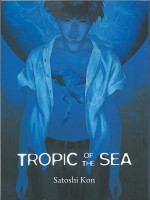
Tropic of the Sea


By Satoshi Kon, translated by Maya Rosewood (Vertical)
ISBN: 978-1-939130-06-8

In the West we’re used to single manga stories filling entire bookcases: epic sagas filling thousands of pages with brilliant, lovely, exciting but generally very long tales on every theme and subject under the sun.

Every so often, however, something comes along which is more familiar to English sensibilities, such as this short, sharp, sinister shocker from screenwriter, artist, animator and Director Satoshi Kon.

The author was born in Kushiro Subprefecture, Hokkaido in 1963 and after High School attended MusashinoArtUniversity’s Graphic Design department from 1982-1987. Whilst there he spent a lot of time studying foreign film.

Whilst still a student he released the short manga Toriko and became an assistant to Katsuhiro Otomo, dividing his time between comics and animation. In 1990 he produced the single volume Kaikisen we’re concentrating on here, before graduating more fully toward film as scripter, layout artist and animator.

Amongst his credits are World Apartment Horror, Roujin Z, Patlabor 2: The Movie, Magnetic Rose, Perfect Blue Millennium Actress, Tokyo Godfathers and others. What would have certainly been a stellar career in either or both art forms was cruelly cut short in 2010 when he died tragically young from pancreatic cancer.

As Shinsouban Kaikisen, this eerie yarn was first serialised in Kodansha’s Young Magazine in 1990: eleven episodes between issues #17 and 29, thereafter collected in tankōbon form and again as a Bijutsu Shuppan edition in 1999. That commemorative tome provides the informative Afterword which ends this book describing the author’s path from mangaka to animator.

Tropic of the Sea opens on a secluded beach where teenager Yosuke and his dog Fujimaru play before the dutiful son climbs to a hilltop shrine to enact a centuries-old ritual. His joyful morning is then disturbed when his father brings a TV crew into the sacred area.

Yozo Yashiro is the 23rd Head Priest of the Hiratsu Shrine; a thoroughly modern man keenly supporting a major consortium’s ambitious plans to turn the sleepy fishing village of Ade into a modern luxury resort. As such he’s keen on publicity and is happy to disturb the Mermaid’s Egg within the shrine and show it to all the viewers whilst explaining the silly but charming legend attached to it.

Long ago his ancestor found another such egg and promised a mermaid to respectfully care for it. After six decades the egg was returned to the sea and another egg left. In return the sea matron guaranteed calm waters and abundant fishing. This current egg was deposited in the shrine almost exactly sixty years ago…

The televised lecture is interrupted by Yosuke’s furious grandfather who has dragged himself out of hospital to stop the travesty he has just seen. Again the bitter argument begins. Grandfather is a fierce opponent of the proposed resort, whereas the current priest is no believer in his duties, nor the sacrosanct pact between the fishermen and the nonsensical sea-woman.

He does however realise the tourist potential of a Mermaid’s Egg theme park…

The village too is divided into warring camps on the issue. The fishermen see their ancestral livelihoods threatened by the proposed tourist trap whilst shopkeepers imagine thousands of new customers flocking in daily.

As Yosuke and best buddy Tetsu discuss the potential influx of college girls and summer days, they watch a limousine full of Ozaki Construction bigwigs arrive to inspect the monstrous Hotel growing like a giant tumour on the beach, and feel a pang of apprehension…

The egg is now common knowledge and billboards proclaiming “Welcome to Mermaid Country” are everywhere, but the boys’ minds are on more mundane things… but only until they take a dinghy out to the sacrosanct offshore islet Kamijima and catch a tantalising glimpse of something impossible in the water…

It turns out to be only old school friend Nami, back from Tokyo for the summer mermaid festival and taking a playful swim, but Yosuke is still uneasy and oddly unsettled…

With Ade becoming a bustling, money-mad boomtown and the priestly Yozo vigorously pushing villagers into selling their land to the developers, grandfather – despite his illness – is determined to honour the family’s ancient promise, and things take a decidedly dark turn when ambitious corporate development head Kenji Ozaki starts taking an unhealthy interest in the Egg. He also lets slip that Kamijimi will be razed and turned into Marine Land theme park…

He’s too late: by the time his team get to the hilltop shrine the Mermaid’s treasure has vanished. The trail leads to Kamijima where Nami and the boys find grandpa with the Egg in a submerged grotto. It’s the place where the mermaid has come every sixty years to pick up her hatchling and leave a new egg and grandpa has almost killed himself getting it here. Hard on the kids’ heels, however, come Ozaki and his goons.

As the businessman tries to appropriate the gleaming globe a strange waterspout erupts and in the tumult Yosuke badly cuts his hand. The drama soon subsides though, and as they all return to Ade in Ozaki’s launch, the boy is amazed to realise that when he picked up the Egg his wound completely healed…

There’s even stranger news to come as tensions over the Corporation’s full building schemes leak out. In the hospital the doctors cannot understand how grandpa’s terminal stomach cancer has completely gone…

Days pass and already the first wave of tourists are despoiling the previously quiet seaside atmosphere. Nami and Yosuke – no longer sceptical about the Egg – are making plans, but Ozaki is also convinced that the object has some mysterious power and takes steps to claim it for the company even as his bulldozers begin to clear Kamijima.

The fishermen are furious. Their once-abundant catches have dried up and the Mermaid’s Egg festival, crowded with suits and tourist interlopers, degenerates into a massive riot. In the melee, with Yozo’s compliance, Ozaki takes the artefact into his safekeeping, and the stunned, betrayed Yosuke thinks he sees a figure on a rock, waiting in vain for her child to be returned…

As Ozaki’s technicians poke and probe the Egg, the traditional day of surrender comes and goes. Yosuke barely survives an uncanny contact with something beyond the scope of science and, with Nami and Tetsu, determines to retrieve the Egg and return it to its true owner whatever the risk…

A tense clash on a bridge finds the kids surprisingly victorious but it’s too late. The Egg hatches in Yosuke’s hands and at the beach the sea vanishes. It can mean only one thing. A tsunami is coming: a wall of angry wild water to wipe away all the foul fabrications of double-dealing, oath-breaking mankind…

Brooding and pensive, this superb supernatural thriller builds tension with masterful dexterity in beguilingly understated style and Kon’s superb draughtsmanship and meticulous pacing keeps the suspense simmering until the spectacular denouement snatches your breath away. A cracking tale no fiction fan or comics collector should miss – especially as the book also includes a gallery of the beautiful title pages which accompanied the original Young Magazine serialisation.

Tropic of the Sea is a minor masterpiece of modern fantasy fiction and a perfect spooky epic movie in waiting…

© 2013 KON’STONE Inc. All rights reserved.
This book is printed in ‘read-from-back-to-front’ manga format.

Sickness Unto Death volume 1


By Hikaru Asada & Takahiro Seguchi (Vertical)
ISBN: 978-1-939130-09-9

Continuing their line of challenging manga for adult readers, Vertical have begun here a two-volume translation of Takahiro Seguchi’s gripping psychological melodrama Sickness Unto Death: a bleak and enthralling, emotionally complex tale of love, compulsion and dependency turned into spellbinding comics by artist Hikaru Asada.

Inspired by Danish Christian philosopher Søren Kierkegaard’s treatise The Sickness Unto Death, this extremely accessible tale first appeared in Japan as Shi ni Itaru Yamai, serialised in Hakusensha’s fortnightly Seinen magazine Young Animal in 2009, and opens with a Professor standing beside a student over the grave of his first case – and greatest love…

When, as a young man, Kazuma Futaba came to the city to study clinical psychology, he was lucky to find lodgings in an old house. However on his way there he encountered a young girl with white hair suffering a crushing anxiety attack in the street. Although everybody ignored the crippled creature he went to her assistance and happily complied with her desperate need to be held.

‘Emiru’ was impossibly cold to the touch and although both were merely 18 years old she seemed inexorably gripped by an ancient despondency, and overwhelming gloom…

When she recovered he hurried on to find his new digs in a vast old house and met the butler Kuramoto who revealed that the place belonged to the orphan Emiru Ariga, a beautiful vivacious creature who had within the last two years suddenly succumbed to a crushing ‘Despair’ so great it had bleached her hair, caused drastic weight-loss, weakened her heart and caused her body temperature to fall to far below normal. He described it as a “terminal illness of the spirit”…

She spent most of her time locked in her room, drawing monsters and waiting to die…

Intrigued, desperate to help but painfully aware of how inexperienced he was, Futaba examined the compliant, barely-living corpse and determined to somehow help her. At least she showed some animation when he was near. Both Kuramoto and his young mistress wanted Futaba to fix her…

In ‘Haunted Mansion’ the relationship developed further as the student transferred what he learnt by day at school into evening practise. Emiru seemed brighter, even though she believed the house concealed ghosts…

When Kuramoto was called away for a few days, he left Futaba in charge, but after the frail girl spent too long in a bath the boy had panicked and broke in, seeing her painfully thin, nude form for the first time. Embarrassed and confused he dashed out and discovered a mystery room, door nailed shut with heavy planks.

Emiru saw ghosts: a crying, lonely child and a monster with teeth but no face…

Her sleep was perpetually disturbed, and Futaba – after learning about Night Terrors in class – agreed to ‘Sharing a Bed’, even though he was no longer certain his own motives were strictly professional. Nevertheless, resolved to save her he began with a ‘Psych Assessment’, gathering facts and personal history, but learned little more than once she was normal and then suddenly she wasn’t…

Emiru spent increasing time locked in despair, weeping outside the barred room; her traumatic nights eased by Kazuma’s platonic presence, although she felt the spectral presence of ‘The One in the Mansion’ whenever he was away…

In the present, Professor Futaba and student Minami – who thinks she too can see a ghost in the abandoned dwelling – explore the deserted, decrepit mansion which housed his greatest regret. When they stop at a monster drawing scrawled on a wall, it takes him back to those troubled years…

A setback in Emiru’s recovery occurred when another ghost sighting triggered a wave of depression and young Futaba learned of her carefree ‘High School Years’ from fellow psych student Koizumi – a classmate of Emiru when she a healthy, happy, raven-haired ball of wild energy, fun and adventure…

Koizumi believed she became burdened with some terrible secret which overnight transformed her into the frail fading creature Futaba describes, prompting the floundering lad to confer with his tutor Professor Otsuki who lent him a copy of Kierkegaard’s Sickness Unto Death…

For such a weakened patient even a cold could be fatal, but with Futaba at her side Emiru pulled through. However after recovering she had enticed him into crossing a ‘Forbidden Line’ but neither as therapist nor lover was young Futaba assured of securing her ‘Happiness and Beauty’ until and unless he could her unburden her obsessive soul of the dark secret strangling it from within…

To Be Concluded…

Beguiling and hypnotic, this exceptional medical mystery/ghostly love story is far from the familiar – to Western eyes at least – explosive bombast and action slapstick normally associated with manga. As such it might just make a few converts amongst die-hard holdouts who prefer sensitive writing, deep themes and human scale to their comics.

Moody, moving and far more than just another adult comic, Sickness Unto Death is that rare thing: a graphic novel for people who don’t think they like comics…

© 2010 Hikaru Asada. © 2010 Takahiro Seguchi. All rights reserved.
This book is printed in ‘read-from-back-to-front’ manga format.

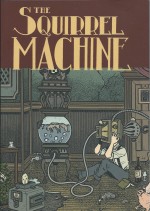
The Squirrel Machine


By Hans Rickheit (Fantagraphics Books)
ISBN: 978-1-60699-646-1

Hans Rickheit was born in 1973 and has been producing skilfully crafted art in many different arenas since the 1990s, beginning with self-published mini-comics before graduating to full-sized, full-length epics such as Kill, Kill, Kill. He has also worked in film, music, gallery works and performance art.

A Xeric award beneficiary, he came to broader attention in 2001 with the controversial graphic novel Chloe, and has since spread himself wide contributing to numerous anthologies and periodicals such as The Stranger, creating webcomics and instigating the occasional anthology periodical Chrome Fetus.

A keen student of dreams, Rickheit has been called obscurantist, and indeed in all his beautifully rendered and realised concoctions meaning is layered and open to wide interpretation. His preferred oeuvre is the recondite imagery and sturdily fanciful milieu of Victorian/Edwardian Americana which proved such rich earth for fantasists such as Edgar Allen Poe, H.P. Lovecraft, Clark Ashton Smith and August Derleth, whilst his fine, studied, meticulously clear line is a perfect, incisive counterpoint to the cloud of miasmic mystery and cosmic confusion engendered by the protagonists of his most successful book.

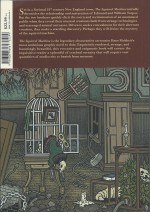
The brothers Edmund and William Torpor abide in a secluded 19th century New England town but have never been part of their community. Raised alone by their artist mother they are very different from other kids, with Edmund especially obsessed with arcane engineering and the assemblage of one-of-a-kind musical instruments from utterly inappropriate components.

Fantastic dream-like journeys and progressions mark their isolated existence, which is far more in tune with a greater metaphysical cosmos, but as puberty gradually moves them to an awareness of base human sexuality they find the outside world impacting their private one in ways which can only end in tragedy and horror…

Moreover, just where exactly did the plans for the ghastly Squirrel Machine come from…?

Visually reminiscent of the best of Rick Geary, this is nevertheless a singularly surreal and mannered design; a highly charged, subtly disturbing delusion that will chill and upset and possibly even outrage many readers.

It is also compelling, seductive, sublimely quirky and nigh-impossible to forget. As long as you’re an adult and braced for the unexpected, expect this to be one of the best books you’ll read this century – or any other…

Out of print since 2009, The Squirrel Machine has now been remastered and released in an accessible paperback edition, just in time to disturb the sleep of a new generation of fear fans just as the winter nights draw in…

© 2013 Fantagraphics Books. Contents © 2009 Hans Rickheit. All Rights Reserved.

Win’s Perfect Present Alert: For him or her or even “it” as long as they’re mature enough to handle it…10/10

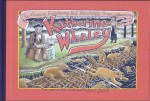
The Amazing, Enlightening and Absolutely True Adventures of Katherine Whaley


By Kim Deitch (Fantagraphics Books)
ISBN: 978-1-60699-631-7

Since the 1960s Kim Deitch has been one of most consistently effective stars of America’s Commix Underground, although as with Harvey Pekar’s American Splendor, it is only relatively recently that he has won wider acclaim. This has been primarily through a series of interconnected prose-and strip fantasies such as Boulevard of Broken Dreams, Shadowland, The Search for Smilin’ Ed and other multi-layered alternative history/faux biographies such as the book under review here.

For the past two decades he has been producing occasional short stories about a down-at-heel carnival and the shabby, eccentric no-hopers who have populated it throughout the 150 years of its existence, the eerie aliens who have preserved its posterity and, of course, the immortal Waldo the Cat.

That saga organically grew into explorations of the minor characters they encountered and soon a great big narrative snowball started rolling…

In The Amazing, Enlightening and Absolutely True Adventures of Katherine Whaley, we return to the increasingly formalised, craftily chronicled Deitch Universe, albeit tangentially, wherein the author focuses on other members of his inexhaustible cast all the while tellingly revealing lost secrets of American history through a lens of scholarly examination and conspiracy theory woven through popular culture scenarios of the past.

Notionally picking up on a minor player last seen in Deitch’s Pictorama, the story here explores the incredible life of an unprepossessing little old lady, as disclosed in a letter left as part of a bequest…

The story-within-a-story begins in the grotty logging town of Lumberton, New York State in 1908, when demure Katherine Whaley, after failing as librarian and school teacher, took a job playing piano in the brand new movie theatre operated by old man Braunton as just another way to deprive lumberjacks and dissolute townies of their hard-earned cash.

The early 20th century was a time of immense and radical social change and after a brush with movie stardom – courtesy of a roving chapter-play Production Company – Katherine makes the acquaintance of the charismatic Charles Varnay and his super-intelligent dog Rousseau, whose esoteric and beguiling beliefs in the nigh-mystical powers of “Enlightenment” carry her off her on an odyssey of self-discovery…

Varnay sees her as the personification of that noble conceptual ideal and wants her to star in a movie serial that will spread his life-changing philosophy to the world’s masses. Naturally, much of her part as The Goddess of Enlightenment involves acting in the nude…

Covering the major cultural landmarks of the early century, from movie mania, the Jazz Age, the Great War and Prohibition, Katherine’s account swings between dubious memoir to laudatory manifesto as her perceptions and opinions of the mysterious Varnay swing from philandering charlatan to messianic superman.

Whilst she might find it hard to accept that the philosopher possesses actual recordings of Jesus Christ delivering his teachings, undiluted by millennia of obfuscating organised religion, there is no doubt that Varnay has great power: after all he stopped her aging and may himself be more than 200 hundred years old…

The beauty of this tale is the complex detail with which it unfolds: the grace and wit with which Deitch overlays historical fact with brilliant fabrication. Thus, I’m certainly not going to spoil the sheer revelatory enchantment for you by giving anything away…

With this surreal historiography of the little-known peripheries of the birth of cinema, Deitch has concocted another utterly unique and absorbing graphic treat – printed in a lavish widescreen format in this stunning monochrome hardback – again sharing the intoxicating joys of living in the past and dwelling in shared social memories.

Combining science-fiction, conspiracy theory, pop history, fact and legend, show-biz razzmatazz and the secret life of Beavers with a highly developed sense of the absurdly meta-real, the author once more weaves an irresistible spell that charms, thrills and disturbs whilst his meticulous drawing holds the reader in a deceptively loose yet inescapable grip.

Follow the secret saga of the World According to Deitch and you too will succumb to the arcane allure of his ever-unfolding cartoon parade revealing the “Americana Way”. In Fact – or Fiction – you might already be there, but you’ll never know unless you look…

© 2013 Kim Deitch. This edition © 2013 Fantagraphics Books, Inc. All Rights Reserved.

Eye of the Majestic Creature volume 2


By Leslie Stein (Fantagraphics Books)
ISBN: 978-1-60699-672-0

Help Wanted: Girl cartoonist seeks meaning of contemporary existence and like minded individuals to share bewilderment and revelations with.

Interests/Hobbies include: drinking, counting sand, growing stuff, antiquing for pop culture “trash”, drinking, meaningful conversations with musical instruments, playing board games with same, recreational herbal intoxicants, reminiscing about wild-times with gal-pals and old cronies, drinking, visiting difficult relatives.

Employment: unwanted but regrettably necessary. Although a newcomer to the BigCity, is extremely adaptable and willing to do anything – unless it’s hard, boring or she sucks at it…

After graduating from the New York School of Visual Arts, Leslie Stein began producing unbelievably addictive cartoon strips in the self-published Yeah, It Is. Winning a Xeric Grant for her efforts, she then started the even better comicbook Eye of the Majestic Creature, miraculously blending autobiographical self-discovery, surreal free-association, philosophical ruminations, nostalgic reminiscences and devastatingly dry wit to describe modern life as filtered through her seductive meta-fictional interior landscape. Here at play is a creator who sees things as they really aren’t – but makes them authentic and even desirable to everyone willing to pay attention…

This long-awaited second collected volume (gathering issues #5-7) resumes the airy, eccentric and addictive pictorial mood-music as the mythologized autobiography continues to reveal the history of Larrybear – a girl deliberately and determinedly on her own, trying to establish her uniquely singular way of getting by.

Eschewing chronological narrative for an easy, breezy raconteur’s epigrammatic delivery, all illustrated in loose, flowing line-work, detailed stippling, hypnotic pattern-building or even honest-to-gosh representational line-drawing, Stein operates under the credo of “whatever works, works” – and she’s not wrong…

Larrybear makes friends easily. Bums, winos, weirdoes, dropouts, misfits and especially inanimate objects – her BFF is her talking guitar and flatmate Marshmallow – all aggregate around her, sharing her outré interests and ambitions (of a sort) but she just doesn’t want an average life, just more experiences, less hassle and good companions to share it all with …

Delivered in mesmerising, oversized (292 x 202mm) monochrome snippets, these incisive, absurdist, whimsically charming and visually intoxicating invitations into a singularly creative mind and fabulous alternative reality begin with the delightful story of how the country girl hit the untamed New York metropolis and found a job in a clothes shop.

‘Sister Carrie’ is a partly pantomimic tour de force underpinned by pertinent extracts from American Naturalist author Theodore Dreiser’s novel of the same name, revealing how Larrybear’s debilitating daily toil is leavened by new friends, odd customers, alcohol and second-hand sand-counting memorabilia…

Issue #6 takes a ride on the Wayback Machine to the 1980s; disclosing childhood fun and traumas as Larry’s mom meets a guy in a bar and invites the freewheeling Jonathan to join them on a visit to Disneyworld Orlando.

‘Brown Heart’ dips into even more intimate territory as precocious doodler Larrybear accompanies her mom to AA meetings whilst ‘That Sticky Machine’ recounts the girl’s tragic relationship with a gumball machine…

Larry’s brief flirtation as a thirteen year guitarist with politically aware – and older -grunge band Lithium in Chicago neatly segues into a family reunion and Jonathan’s departure…

The final portion of the chronicle opens with ‘A Better Intoxication: the Subconscious Noodle’ as in contemporary New York Larrybear, Marshmallow and drinking buddy/life guru Boris renew their relationship with booze, whilst in ‘Soup’ her new boyfriend Poppin the Flower grows closer after she meets his incredibly difficult dad over a memorable Thanksgiving dinner…

The memories lane ramble then concludes with ‘Who Are You?‘ as after finding an iconic pop culture mask (Booji Boy from Devo, hipsters and post-punks!) Larrybear at last finds the drive and initiative to quit her job…

With additional art and info-features on Dreiser and Booji Boy, this exceptional wander on the wild side is a gloriously rewarding and enticing cartoon experience and one no serious fan of fun and narrative art can afford to miss.

© 2013 Leslie Stein. All Rights Reserved.

The Children of Palomar


By Gilbert Hernandez (Fantagraphics Books)
ISBN: 976-1-60699-625-6

In the 1980s a qualitative revolution forever destroyed the clichéd, segregated, stereotypical ways genres of comic strips were produced and marketed. Most effective in blasting the comfy funnybook pigeonholes were three young guys from Oxnard, California: Jaime, Mario and Gilberto Hernandez.

Love and Rockets was an anthology magazine (and previously a self-published comic in 1981) that broke all the rules, featuring intriguing, adventuresome larks and captivating, experimental narratives which pretty much defied classification, all cloaked in the ephemera of LA’s Hispanic and punk music scene.

Stories generally focussed on the slick, sci-fi-seasoned larks of young gadabouts Maggie, Hopey and their extended eccentric circle of friends or the heart-warming, terrifying, gut-wrenching soap-opera travails of rural Central American outpost Palomar.

The Hernandez Boys, gifted synthesists all, enthralled and enchanted with incredible stories that sampled a thousand influences conceptual and actual – everything from comics, cartoon shows, masked wrestlers, trashy movies and American Hispanic pop culture to German Expressionism. There was also a perpetual backdrop displaying the holy trinity of youth: Sex and Drugs and Rock and Roll – for which please hear mostly alternative music and punk rock.

The result was dynamite. Mario only officially contributed on rare occasions but his galvanising energy informed everything. The slick and enticing visual forays by Jaime explored friendship and modern love whilst destroying stereotypes of feminine attraction through his fetching coterie of Gals Gone Wild, whilst Gilberto mostly crafted a hyper-real microcosm in his Latinate landscape: a playground of wit, toil, passion and raw humanity in a poor village with a vibrant, funny and fantastically quotidian cast created for his extended epic Heartbreak Soup.

Everything from life, death, adultery, magic, monsters, murder and especially gossip could happen in Palomar’s metafictional environs, as the artist mined his own post-punk influences in a deceptively effective primitivist art style which perfectly blended a personalised mythology of comics, music, intoxicants, strong women, gangs, sex and family. The denizens of Palomar still inform and shape Beto’s work, both directly and as imaginative spurs for spin-off stories.

Winning critical acclaim but little financial success, the brothers temporarily put aside their favourite toys to work on side projects and special series before creatively reuniting a few years back to produce annual collections of new material in their particularly peculiar shared or, rather, intermittently adjacent pen-and-ink universes.

In 2006, more than a decade after the canonical Heartbreak Soup stories, Beto popped back to his leafy arcadia via a three-magazine run entitled New Tales of Old Palomar, producing a too-brief selection of elucidating tales drenched in revelation and imagination which revealed a few answers to questions we never knew we had…

In the opening act of ‘The Children of Palomar’ the denizens of the little town are going about their daily business with a little less than usual calm since a couple of abandoned wild kids have been stealing food from everyone, everywhere. The naked little nippers are incredibly fleet-footed and not even Sheriff Chelo can catch them.

Her immediate problems are solved once sporty soccer-playing Pipo decides to prove who is truly the fastest runner in town, but unfortunately, once feral foundlings Tonantzin and Diana Villaseñor have been taken in, the village has to civilise and find homes for them…

The men meanwhile have devised a scheme to make Palomar a little export money. They mean well but when the mayor and his pals decide to blow up a boulder just as the stray kids take off, it takes all Pipo’s acceleration to prevent a horrific tragedy…

Another time little boys were on the other side of “The Crack” hazing young Gato before letting him join their black shirt gang. When they got bored and left, Pintor tried to help the traumatised candidate get home but the log across the giant gorge had vanished.

Stuck and terrified they were then abducted by strangers in space suits who experimented on them. The strangers spoke a strange language but another Palomar boy named Manuel was there and he said that soon they would be made to forget everything…

The villagers meanwhile had noticed them gone and Sheriff Chelo led a search party to the gap, but when their makeshift bridge sundered, only she managed to get across. By the time she found the kids their captors were arguing and the violence only escalated when she intervened…

The entire outpost then vanished in an explosion but at least she got the boys back…

Of course, Chelo had no idea that one of the ghostly White Strangers was still alive and intensely interested…

Palomar is surrounded by huge, ancient statues and the people all know they live in a world of magic. When babosa-selling Tonantzin began seeing a ghostly chuckling “Blooter Baby”, a wise woman explained that they only appeared to girls and women who would be childless, before telling her how to get rid of it.

Instead, she and the spectre reach an accommodation and the girl learns she is not alone before gaining a mission for life…

Our picaresque peregrinations conclude some time later when diminutive Carmen thinks she feels an Earth tremor no one else noticed. She considers asking the peculiar white scientists doing their weird bird research at the edge of town but doesn’t know their language.

Everybody goes about their day until the strangers kidnap Chelo and the horrified sheriff recognises one of the “aliens” from across the gorge all those years ago. Although formidable, she succumbs to superior force and wakes up maimed but back in bed in Palomar.

Not normally an unforgiving woman, Chelo goes looking for her tormentors as soon as she’s able… and finds them…

There’s fiction, there’s Meta-fiction and then there’s Gilbert Hernandez. In addition to Love and Rockets‘ captivating tales of Palomar he has produced numerous controversial and groundbreaking volumes such as Sloth, Grip, Birdland, Girl Crazy and Julio’s Day: all distinguished by his bold, instinctive, compellingly simplified artwork and a mature, sensitive adoption of the literary techniques of Magical Realist writers like Carlos Fuentes and Gabriel García Márquez.

These techniques he has sublimely amplified and, visually at least, made utterly his own. This beguiling return to his landmark, signature series has been long overdue for a deluxe edition such as this splendid hardback, and such is the quality of the accessible writing and intoxicating art that first-timers will have no trouble slipping south of the border to join the veterans and devotees in a marvellous Latin mystery and adventure…
© 2013 Gilbert Hernandez. This edition © 2013 Fantagraphics Books, Inc. All rights reserved.

Walrus (Brandon Graham’s All Bum Album – from Tusk ‘Till Dawn)


By Brandon Graham (PictureBox)
ISBN: 978-0-9851595-9-7

Autumn is officially here, with its fire-storms, droughts and sunburns, so it’s hard to escape the conclusion that the Holiday Season is inescapably close. After all, the Christmas films have been playing on Sky Movies since early March…

Seriously though, if you’re prudent, it is time to start looking at gifts for your loved ones or family, and here’s one of the prettiest and most intriguing comics art-books I’ve seen in many a year…

Brandon Graham was born in Oregon in 1976, an inveterate graffiti artist who seamlessly turned his graphic gifts and narrative flair to comicbook storytelling, beginning with Ameri-manga publisher Antarctic Press (October Yen) in 1996, dividing his time with Alternative or Independent Publisher projects and gracing the mainstream with work for Image, NMB, IDW and Vertigo.

He is a founder member of artistic collective MeatHaus, and if you like comedy, science fiction, erotica, manga and Moebius, you might want to seek out collections such as King City, 24Seven, Escalator, Multiple Warheads, Perverts of the Unknown and others – as well as this book…

Walrus is a monochrome and colour compendium of “Drawings and Sketchbook Comics from 2009-2011”, featuring  artworks, working roughs, calligraphy, rendered thoughts and idle musings, finished pieces and found imagery that serve to introduce viewers into a beguiling world of fantastic futurity and mesmerising wonderment – and there are weird critters and hot chicks…

A roughly comicbook-sized paperback (112 pages, 240x173mm) with a beautiful gatefold cover, this marvellous compendium comprises snippets of reportage, designs, roughs and layouts from finished stories.

There are moments of tenderness and intimacy, peeks into the creative process, bizarre moments of communal reality, caricatures, gags, spoofs of and tributes to comics and movies (such as Fantastic Four #9, Dirty Pair, Conan and The Good, The Bad and The Ugly), a commemoration of Moebius (The Long Goodbye), deliciously funny and whimsical gags, complete stories such as ‘Far North’, ‘Work Weak’ and ‘Today in the Life’ plus a preponderance of pages dedicated to evocative, seductive post-modern glamour art.

Punky, funky, enduring, enchanting and sublimely entertaining, this is another perfect example of the kind of book that makes the reader hungry to get out and draw stories now! Now!! NOW!!!

…As well as being just plain wonderful to see.

All art-forms need such creators and Walrus might well be the book to get you – or your kids – off the couch and into a studio.
© 2013 Brandon Graham. All rights reserved.

Gahan Wilson Sunday Comics


By Gahan Wilson (Fantagraphics Books)
ISBN: 978-1-60699-612-6

According to Gary Groth’s Afterword here, legendary cartoonist Gahan Wilson was born in 1930 and grew up reading comic strips.

It shows.

The mordantly macabre, acerbically wry and surreal draughtsman has been tickling funnybones and twanging nerves with his darkly dry graphic confections since the 1960s; contributing superb spoofs, sparklingly horrific and satirically suspenseful drawings and strips and panels as a celebrated regular contributor in such major magazines as Playboy, Collier’s, The New Yorker and others.

He also wrote science fiction, criticism, book and film reviews for Again Dangerous Visions, The Magazine of Fantasy & Science Fiction, The Twilight Zone Magazine and Realms of Fantasy.

In an extremely broad and long career he has worn dozens of creative hats, and even embraced that modern electrickery stuff by creating – with Byron Preiss – his own supernatural computer game, Gahan Wilson’s the Ultimate Haunted House.

When National Lampoon first began its devastatingly satirical all-out attack on the American Dream, Wilson was invited to contribute a regular strip to their comics section. His sublimely semi-autobiographical, darkly hilarious paean to lost childhood ran from 1972 and until 1981 and was recently collected as Nuts.

Few people– me included – knew that during that period he also, apparently more for fun and relaxation than profit, produced his own syndicated Sunday strip feature.

For two years beginning on March 3rd 1974, Gahan Wilson Sunday Comics appeared in a small cross-section of newspapers from Boston to Los Angeles and, as with all his work, it bucked a trend.

At a time when most cartoonists were seeking a daily continuity strip, building a readership and eking jokes out with sensible parsimony, Wilson let himself go hog-wild, generating a half-dozen or so single-shot gags every Sabbath, blending his signature weird, wild monsters, uncanny aliens and unsavoury scenes with straight family humour, animal crackers, topical themes and cynically socio-politically astute observations.

Looking at them here it’s clear to me that his intent was to have fun and make himself laugh as much as his readers; capturing those moments when an idea or notion gave him pause to giggle whilst going about his day job…

I’m not going to waste time describing the cartoons: there are too many and despite being a fascinating snapshot of life in the 1970s they’re almost all still outrageously funny in the way and manner that Gary Larson’s Far Side was a scant six years later.

I will say that even whilst generating a storm of humorous, apparently unconnected one-offs, consummate professional Wilson couldn’t help himself and eventually the jokes achieved an underlying shape and tone with recurring motifs (clocks, beasts, wallpaper, etc), guest appearances by “The Kid” (from Nuts) and features-within-the-feature such as The Creep and Future Funnies…

Collected in a gloriously expansive (176 pages, 309x162mm) full-colour, landscape hardback, this complete re-presentation of a lost cartooning classic offers a freewheeling, absurdist, esoterically banal, intensely, trenchantly funny slice of nostalgia. These fabulous joke page compendiums range from satire to slapstick to agonising irony and again prove Wilson to be one of the world’s greatest visual humourists.

This is book no fan of fun should miss and, with Christmas bearing down on us, could be a crucial solution to the perennial “what to get him/her” question…

All comic strips © 2013 Gahan Wilson. This Edition © Fantagraphics Books, Inc. All rights reserved.
Gahan Wilson Sunday Comics will be published September 26th 2013.

Helter Skelter Fashion Unfriendly


By Kyoko Okazaki (Vertical)
ISBN: 978-1-93565-483-4

Following her debut in 1983, producing erotic material for the men’s markets, Kyoko Okazaki established a reputation for challenging, controversial, contemporary manga tales before gradually shifting her focus to produce stories specifically for and about women (such as Pink, Happy House and River’s Edge), focusing with unflinching intensity on their social issues and the overwhelming pressures of popular culture in modern Japan. You can find out more about this pioneering creator here.

From 1994-1995, and following her immensely successful strip Tōkyō Girls Bravo in mainstream fashion magazine CUTIE, Okazaki created a biting expose of the industry – and its casualties – in Shodensha’s Feel Young anthology.

Heruta Sukeruta took the author’s concerns, inclinations and observations into realms tinged with dark speculation, but the episodes never seemed too far-fetched or distant from what we all believed models and managers and clients actually experienced…

Liliko is the undisputed top model in Japan. The Lily’s face and body are everywhere, selling products and lifestyle to men, women and especially young girls. She is an unchanging paragon of look and style and has been so for absolutely ages.

In fact, nobody seems to know quite how long – except ruthless model agency president Mama Tada – and only Liliko’s long-suffering gofer/manager Hada and make-up artist Kin Sawanabe have any inkling of the real person under the gloss and glitz and glamour…

Despite her star status Lily is incredibly unhappy: bored, paranoid, burned out and increasingly obsessed with her inevitable usurpation by some fresh young “Next Year’s Model”…

Knowing her days are numbered, the fragile yet hard-as-nails supermodel is frantically chasing singing and acting gigs, capitalising on her celebrity. Sadly, lacking any discernible talent, she’s only getting ahead by sleeping with all the money-men involved…

When not drugged up, stressed out or screaming, she finds some measure of contentment in the arms of Takao, handsome, spoiled heir to the Nanbu department store fortune (and the man she plans to marry) or in degrading and debauching the obsessively devoted Hada.

Liliko’s biggest problem is an incredible secret that could shake the nation. All her beauty and success come from a series of cosmetic procedures, carried out by a renegade plastic surgeon at an exclusive clinic that caters to the most powerful and influential people in the world.

Long ago a desperate girl with a sordid past met Mama and agreed to a complete, full-body series of operations. Now only her bones and some meat is her – all that glittering skin and surface is a fabrication, maintained by constant use of addictive drugs supplied by the dowdy doctor in charge to fight implacable tissue rejection.

Sadly, after years of use even these experimental remedies aren’t as efficient as before and Liliko’s look is breaking down and fragmenting…

She is by no means the only client of the clinic, and following a spate of suspicious deaths and the trail of illegal aborted foetal organ traffickers, police prosecutor Asada has begun to put the pieces together. However even he is not completely immune to the Lily’s allure…

In the face of increasing breakdown, Mama brings Kin up to date and makes him part of the conspiracy, whilst arranging with “The Doctor” to perform still more operations on her fragile star…

Liliko’s damaged psyche endures even greater shocks when her fat and dumpy little sister turns up. Having impossibly tracked down her sublime sibling, little Chikako is sent away with stars in her eyes, a dream in her heart and newfound determination to be beautiful too, whatever the cost…

Chemically deranged, paranoid and alternatively wildly uncontrollable and practically catatonic, Lily goes off the deep end when Takao admits that he’s marrying an heiress for dynastic reasons but will still, of course, have sex with her in secret…

Having already seduced Hada and her boyfriend in a moment of malicious boredom, Liliko induces them to take revenge for her bruised pride and events quickly spiral into an inescapable crescendo of catastrophe that extends far beyond the intangible world of image and illusion into the very bedrock of Japanese society…

Harsh, raw, brutal and relentlessly revelatory, the author’s forensic examination of the power of sex, temptations of fame and commoditisation of beauty is a multi-layered, shockingly effective – if occasionally surreal – tale that should alarm every parent who reads it. It is also a superb adult melodrama, tense political thriller and effective crime mystery to delight all broad-minded fans of comics entertainment looking to expand their horizons beyond capes, and ghost and ray-guns…

Vertical are dedicated to bringing the best of Japan’s adult comics to English-speaking audiences and Helter Skelter is part of a line books targeting women readers with challenging material that breaks out of the genre ghettos usually attributed to manga. Helter Skelter Fashion Unfriendly certainly qualifies. The cautionary tale was collected into a Japanese tankōbon edition in 2003, winning a number of awards including the 2004 Osamu Tezuka Culture Prize, and was subsequently adapted into a film shown in Cannes.

Grim, existential and explicit, this is not a book for kids or the squeamish, but it is a dark marvel of graphic narrative and one well deserving of your attention.

© 2003 Kyoko Okazaki. All rights reserved.
This book is printed in ‘read-from-back-to-front’ manga format.