Batman: The Golden Age volume 2


By Bob Kane, Bill Finger, Jerry Robinson, George Roussos & various (DC Comics)
ISBN: 978-1-4012-6808-4 (TPB/Digital edition)

This book includes Discriminatory Content produced in less enlightened times.

Batman: The Golden Age volume 2 is another paperback-format feast (there’s also a weightier, pricier and more capacious hardback Omnibus available) re-presenting our anniversarial Dark Knight’s earliest exploits. Set out in original publishing release order, it forgoes glossy, high-definition paper and reproduction techniques in favour of a newsprint-adjacent feel and the same flat, bright-yet-muted colour palette which graced the originals. Those necessary details dealt with, what you really need to know is that this is a collection of Batman tales depicting how the character grew into the major player who would inspire so many: developing a resilience to survive the stifling cultural vicissitudes coming decades would inflict upon him and his partner, Robin.

With the majority of material crafted by Bill Finger and illustrated by Bob Kane, there’s no fuss, fiddle or Foreword, and the book steams straight into mesmerising mysterious action, re-presenting astounding cape-&-cowl classics and iconic covers from Detective Comics #46-56, Batman #4-7 and the Dynamic Duo’s stories from World’s Best Comics #1 and World’s Finest Comics #2-3: cumulatively covering all groundbreaking escapades from December 1940 to November 1941…

Plunging right into perilous procedures, Detective #46 (Kane with regular embellishers Jerry Robinson & George Roussos) features the return of Batman’s most formidable fringe scientific adversary as the heroes must counteract the awesome effects of ‘Professor Strange’s Fear Dust’, after which #47 delivers drama on a more human scale in ‘Money Can’t Buy Happiness’. This action-packed homily of parental expectation and the folly of greed leads into Batman #4 (Winter 1941) which opens with a spiffy catch-all visual resume prior to ‘The Joker’s Crime Circus’, plus the piratical plunderings of ‘Blackbeard’s Crew and the Yacht Society!’. ‘Public Enemy No.1’ tells a gangster fable in the manner of Jimmy Cagney’s movie Angels With Dirty Faces, and ‘Victory For the Dynamic Duo’ involves the pair in the treacherous world of sports gambling.

Detective Comics #48 finds the lads defending America’s bullion reserves in ‘The Secret Cavern’, and they face an old foe when ‘Clayface Walks Again’ (Detective Comics #49, March 1941), as the deranged horror actor resumes his passion for murder and re-attempts to kill Bruce Wayne’s old girlfriend Julie. DC #50 pits Batman & Robin against acrobatic burglars in ‘The Case of the Three Devils’, leading neatly into Batman #5 (Spring 1941). Once again, Joker plays lead villain in ‘The Riddle of the Missing Card’, before the heroes prove their versatility by solving a quixotic crime in Fairy Land via ‘The Book of Enchantment’.

‘The Case of the Honest Crook’ follows: one of the key stories of Batman’s early canon. When a mugger steals only $6 from a victim, leaving much more behind, his trail leads to a vicious gang who almost beat Robin to death. The vengeance-crazed Dark Knight goes on a rampage of terrible violence that still resonates in the character to this day. The last story from Batman #5 –‘Crime does Not Pay’ – once again deals with kids going bad and their potential for redemption, after which World’s Best Comics#1 (Spring 1941 – destined to become World’s Finest Comics with its second issue) offers an eerie murder mystery concerning ‘The Witch and the Manuscript of Doom’. With most stories still coming from unsung genius Finger and art chores shared out between Kane, Robinson & Roussos, the team got a new top contributor as Fred Ray signed on to produce fantastic World’s Finest covers that offered the only venue to see the Gotham Gangbusters operating beside the Metropolis Marvel.

Sordid human scaled wickedness informs ‘The Case of the Mystery Carnival’, ‘The Secret of the Jade Box’ and ‘Viola Vane’ (Detective #51, 52 and 53 respectively): all mood-soaked crimebusting set-pieces featuring fairly run-of-the mill thugs, serving as perfect palate-cleansers for ‘The Man Who Couldn’t Remember!’ from WF #2: a powerful character play and a chilling conundrum that still packs a punch today.

‘Hook Morgan and his Harbor Pirates’ finds the Dynamic Duo cleaning up the docks whilst the quartet from Batman #6 (Murder on Parole’, ‘The Clock Maker’, ‘The Secret of the Iron Jungle and ‘Suicide Beat’) offer a broad range of yarns encompassing a prison-set human interest fable to the hunt for a crazed maniac to racket busting and back to the human side of being a cop. Detective #54 heads back to basics with spectacular mad scientist thriller ‘The Brain Burglar’, after which a visit to a ghost town results in eerie romp ‘The Stone Idol’ (Detective #55) before World’s Finest #3 launches a classic villain with the first appearance of one of Batman’s greatest foes in ‘The Riddle of the Human Scarecrow’.

The volume ends with a grand quartet of tales from Batman #7. ‘Wanted: Practical Jokers’ again stars the psychotic Clown Prince of Crime, whilst ‘The Trouble Trap’ sees our heroes crushing a spiritualist racket before heading for Lumberjack country to clear up ‘The North Woods Mystery’.

The last story is something of a landmark case, as well as being a powerful and emotional melodrama. ‘The People Vs. The Batman’ finds Bruce Wayne framed for murder and the Dynamic Duo finally sworn in as official police operatives. They would not be vigilantes again until the grim ‘n’ gritty 1980s…

Kane, Robinson and their compatriots created an iconography which carried Batman well beyond his allotted life-span until later creators could re-invigorate it. They added a new dimension to children’s reading… and their work is still captivatingly accessible.

Moreover, these early stories set the standard for comic superheroes. Whatever you like now, you owe it to these stories. Superman gave us the idea, but inspired and inspirational writers like Bill Finger refined and defined the meta-structure of the costumed crime-fighter.

Where the Man of Steel was as much Social Force and juvenile wish-fulfilment as hero, Batman and Robin did what we ordinary mortals wanted to do most: teach bad people the lessons they richly deserved…

These are tales of elemental power and joyful exuberance, brimming with deep mood and addictive action. Comic book heroics simply don’t come any better.
© 1940, 1941, 2017 DC Comics. All Rights Reserved.

Buz Sawyer volume 1: The War in the Pacific


By Roy Crane (Fantagraphics Books)
ISBN: 978-1-60699-362-0 (HB)

Win’s Christmas Gift Recommendation: Perfect Comics with Timeless Punch… 10/10

This book includes Discriminatory Content produced in less enlightened times.

Modern comics evolved from newspaper comic strips. Until relatively recently these pictorial features were utterly ubiquitous, hugely popular with the public and valued by publishers who used them as a sales weapon to guarantee and increase circulation and profits.

It’s virtually impossible for us to today to understand the overwhelming power of the comic strip in America (and the wider world) from the Great Depression to the end of World War II. With no television, broadcast radio far from universal and movie shows at best a weekly treat for most folk, household entertainment was mostly derived from the comic sections of daily and especially Sunday Newspapers. The Funnies were the most common recreation for millions: well served by a fantastic variety and incredible quality. From the very start humour was paramount; hence the actual terms “Funnies” and “Comics”, and from these gag and stunt beginnings – a blend of silent movie slapstick, outrageous fantasy and the vaudeville shows – came a thoroughly entertaining mutant hybrid: Roy Crane’s Wash Tubbs.

Debuting on April 21st 1924,Washington Tubbs II was a breezily comedic gag-a-day strip that evolved into a globe-girdling adventure serial. Crane crafted pages of stunning, addictive quality yarn-spinning whilst his introduction of moody swashbuckler Captain Easy in the landmark episode for 6th May, 1929 led to a Sunday colour page that was arguably the most compelling and visually impressive of the entire Golden Age of Newspaper strips (as seen in Roy Crane’s Captain Easy, Soldier of Fortune: The Complete Sunday Newspaper Strips volumes 1-4).

Improving almost minute by minute, Crane’s imagination and his fabulous visual set pieces achieved a timeless immediacy that made each page a unified piece of sequential art. The influence of those pages can be seen ever since in the works of near-contemporaries such as Hergé, giants-in-waiting like Charles Schulz and comics creators including Alex Toth and John Severin.

The work was obviously as much fun to create as to read. In fact, the cited reason for Crane surrendering the Sunday strip to his assistant Les Turner in 1937 was NEA/United Features Syndicate’s abrupt and arbitrary demand that all its strips must be henceforward produced in a rigid panel-structure to facilitate their being cut up and re-pasted as local editors dictated – although the compelling text features in this book dedicated to his second masterpiece reveal a few more commercial and professional reasons for the jump from the small and provincial syndicate to the monolithic King Features outfit. At the height of his powers Crane just walked away from the astounding Captain Easy page, concentrating on the daily feature, and when his contract expired in 1943 he left United Features to create the World War II aviation strip Buz Sawyer; lured away by the grandee of strip poachers William Randolph Hearst.

The result is still one of the freshest and most engaging comics strips of all time…

Where Wash Tubbs was a brave but comedic Lothario and Easy a surly, tight-lipped he-man, John Singer “Buz” Sawyer was a happy amalgam of the two: a plain & simple, good-looking popular country-boy who went to war because his country needed him.

After the gripping and informative text feature ‘Crane’s Great Gamble’ by Jeet Heer, the strip explodes into action on Christmas Eve 1942, as new Essex Class Aircraft Carrier USS Tippecanoe steams for the Pacific Theatre of Operation carrying 100 fighter-bombers and an extremely keen pair of cartoon paladins.

Buz Sawyer is a fun-loving, skirt-chasing, musically-inclined pilot and his devoted gunner Rosco Sweeney, a bluff, simple ordinary guy – as well as one of the best comedy foils ever created.

The strip is a marvel of authenticity: picturing not just the action and drama of the locale and situation, but more importantly capturing the quiet, dull hours of training, routine and desperate larks between the serious business of killing whilst staying alive. Like contemporaries Bill Mauldin and Milton Caniff, Crane was acutely aware that all his readers had someone involved in the action and therefore felt a duty to inform and enlighten as well as entertain. Spectacular as the adventure was, the truly magical moments focus on the off-duty camaraderie and candid personal interactions that pepper the daily drama.

This beautiful archival hardback covers the entire war years of the strip from November 1st 1943 to October 5th 1945, wherein the inspired artist perfected his masterly skill with Craftint (a mechanical monochrome patterning effect used to add greys and halftones which Crane employed to add miraculous depths and moods to his superb drawing) and opens with the lovable lads shot down whilst tackling a Japanese carrier.

Marooned, their life raft washes up on a desolate desert island where they’re hunted by enemy troops and discover a marooned German farmer and his beautiful daughter. At first hostile, lovely fräulein April soon succumbs to Buz’s boyish charm. Helping Buz and Roscoe escape, the trio only make it as far as the next islet, where fellow pilot and friendly rival Chili Harrison has also been stranded since his plane went down.

Eventually rescued, the Navy fliers return to “the Tip” for training on new planes (sublimely detailed and delineated Curtiss SB2C Helldivers; in case you were wondering) in preparation for the push to Japan. Amidst spectacular action sequences, shipboard life goes on, but during a raid on an occupied island Buz and Sweeney are once more shot down. In the middle of a fire-fight they effect repairs and head back to the Tippecanoe, but not without cost. Rosco has been hit…

Sawyer’s exemplary exploits haven’t gone unnoticed and, whilst Sweeney is recovering from wounds, the titular hero is selected for a secret mission deep into enemy territory; ferrying an intelligence agent to a meeting with enigmatic underground leader the Cobra. It all goes tragically wrong and the US agent is captured. With the enemy hunting high and low for the pilot, Buz then falls back on his most infuriating ability: dropping into the willing laps of beautiful women…

‘Sultry’ is a gorgeous collaborator high in the favour of the occupying Japanese, but she too finds the corn-fed aviator irresistible. Of course, it might simply be that she’s also Cobra…

This extended epic is a brilliant, breathtaking romp blending action, suspense, romance and tragedy into a compelling thriller that carries Buz all the way to December 1944. As a result of his trials, the hero is sent back to America on a 30-day leave – enabling Crane to reveal some enticing background and invoke all the passions, joys and heartbreaks of the Home Front.

Buz doesn’t want to go, but orders are orders, so to make things a little more bearable he takes still-recuperating Sweeney with him. It isn’t that the young flier despises his origins – indeed, his civilian life is a purely idyllic American Dream – it’s simply that he wants to get the job done against the enemy. Nevertheless, with a warrior’s grace under pressure, he resigns himself to peace and enjoyment whilst his comrades soldier on. If he knew the foe he would face in his little hometown, Buz would probably have gone AWOL…

Crane’s inspirational use of the War at Home was a masterstroke: it’s not a world of spies and insidious Bundists, but just an appetising little burg filled with home comforts and proud people: the kind of place soldiers were fighting to preserve and a powerful tool in the morale-builder’s arsenal. It’s also a place of completely different dangers…

Buz is the son of the town’s doctor; plain, simple and good-hearted. In that egalitarian environment, the kid was sweetheart to the richest girl in town, and when Tot Winter‘s upstart, nouveau riche parents hear of the decorated hero’s return they hijack the homecoming and turn it into a self-serving publicity carnival.

Moreover, ghastly, snobbish Mrs. Winter conspires with her daughter to trap the lad into a quick and newsworthy marriage. Class, prejudice, financial greed and social climbing are enemies Buz and Sweeney are ill-equipped to fight, but luckily that annoying tomboy-brat Christy Jameson has blossomed into a sensible, down-to-earth, practical and clever young woman. She’s scrubs up real pretty too…

After a staggeringly smart and compelling soap opera sequence that would do Eastenders or Coronation Street proud, Buz ends up (accidentally) engaged to Tot after all. Mercifully, his leave ends and he and Sweeney must return to the war – but even then, they are disappointed to discover that they won’t immediately be fighting again.

Posted to Monterey, California, they are to be retrained for new planes and a new squadron, reuniting with rowdy rival Chili Harrison. Even so, Mrs Winter is determined to have a war hero in the clan and pursues them with Tot in tow, determined to get Buz married before he returns to the Pacific. Insights into another aspect of the military experience (Crane had almost unfettered access, consultation privileges and the grateful willing cooperation of the US Navy) are revealed to readers as the whiz-kid is suddenly back in school again; and usually in the dog-house because of his hot-dogging.

Dramatic tension divides evenly between Buz’s apparent inability to be a team-player and the increasingly insistent and insidious ploys of Mrs. Winter. Moreover, the squadron’s training commander has an uncanny ability to predict which pilots will die in training or combat and Buz’s name is high on that list…

At last the training concludes and – miraculously alive and unmarried – Buz & Sweeney ship out to the Pacific and the relatively easy task of ending the war. Part of a vast fleet mopping up island fortresses en route to Tokyo, they are soon flying combat missions, and before long, shot down once more. This time they are taken prisoner aboard an enemy submarine…

After more incredible escapes and rousing triumph, the war finishes, but Crane actually ratcheted up the tension by covering the period of American consolidation and occupation as Buz & Sweeney await demobilisation. Whilst posted to a medical facility in Melatonga, the lads and Chili meet a woman from Buz’s chequered past they had all believed long dead…

When discharge papers finally arrive (in the episode for September 9th 1945) an era of desperate struggle closes. However, with such a popular and pivotal strip as Buz Sawyer, that only means that the era of globe-girdling adventure is about to begin…

This superb monochrome hardback also offers a selection of Sunday strips in full colour. The eternal dichotomy and difficulty of producing Sunday Pages (many client papers would only buy either dailies or Sunday strips, not both) meant that some strip creators produced different story-lines for each feature – Milt Caniff’s Steve Canyon being one of the few notable exceptions. Crane handled the problem with typical aplomb: using the Sundays to tell completely unrelated stories. For Wash Tubbs he created a prequel series starring Captain Easy in exploits set before the mismatched pair had met; with Buz Sawyer he turned over the Sabbath slot to Rosco Sweeney for lavish gag-a-day romps, big on laughs and situation comedy.

Set among the common “swabbies” aboard ship, it was a lighter family-oriented feature and probably far more welcome among the weekend crowd of parents and children than the often chilling or disturbing realistically and sophisticated saga that unfolded Mondays to Saturdays.

Also included here – and spanning November 28th 1943 to 25th February 1945 in delicious full-page fold outs – are 15 of the best (many with appearances by Buz): a cheerily tantalising bonus which will hopefully one day materialise as an archival collection of their own. Whilst not as innovative or groundbreaking as Captain Easy, they’re still superb works by one of the grand masters of our art-form.

This initial collection is the perfect means of discovering or rediscovering Crane’s second magnum opus – spectacular, enthralling, exotically immediate adventures that influenced generations of modern cartoonists, illustrators, comics creators and storytellers. Buz Sawyer: War in the Pacific ranks as one the greatest strip sequences and best war stories ever crafted: thrilling, rousing, funny, moving yarn-spinning that is unforgettable, unmissable and utterly irresistible.
Strips © 2010 King Features Syndicate, Inc. This edition © 2011 Fantagraphics Books, all other material © the respective copyright holders. All rights reserved.

Showcase Presents Ghosts


By Leo Dorfman, Murray Boltinoff, John Broome, Jack Miller, Joe Samachson, George Kashdan, Bob Haney, Richard E. Hughes, Carl Wessler, Tony DeZuñiga, Jim Aparo, Sam Glanzman, Carmine Infantino, Sy Barry, Frank Giacoia, John Calnan, Bob Brown, George Tuska, Wally Wood, Curt Swan, Ruben Moreira, Irwin Hasen, Leonard Starr, Jerry Grandenetti, Nick Cardy, Ramona Fradon, Art Saaf, Michael William Kaluta, Jack Sparling, Win Mortimer, Ernie Chan, Buddy Gernale, Nestor, Quico & Frank Redondo, Alfredo Alcala, Gerry Talaoc, Nestor Malgapo, E.R. Cruz, Rico Rival, Abe Ocampo, Ernesto Patricio & various (DC Comics)
ISBN: 978-0-85768-836-1 (TPB)

Win’s Christmas Gift Recommendation: A Perfect Serving of Spectral Wonderment… 8/10

This book includes Discriminatory Content produced in less enlightened times.

Happy Dia de los Muertos! Let’s wind down our own Halloween celebrations and enjoy the more life-affirming Day of the Dead with a fabulously appropriate tome…

DC Comics came relatively late to funnybooks’ phantom-peril party, only bowing to the inevitable hunger for horror and mystery in the early 1950s. Comparatively straight-laced anthology The House of Mystery (cover-dated December 1951/January 1952) started the ball rolling with a gradual pick up that stopped dead after a hysterical censorship scandal and governmental witch-hunt created a spectacular backlash. It resulted in the industry adopting a castrating straitjacket of self-regulatory rules. Horror titles produced under the aegis of the Comics Code Authority were sanitised, anodyne affairs in terms of Shock and Gore, even though the appetite for suspense was still high. Nevertheless, in 1956 National/DC added sister title House of Secrets which specialised in taut human-interest tales in a fantasy milieu.

Stories were dialled back into marvellously illustrated, rationalistic, fantasy-adventure vehicles which dominated the market until the 1960s when super-heroes finally overtook them. When that bout of cape-and-cowl craziness peaked and popped, sales began bottoming out for Costumed Dramas and comics faced another punishing sales downturn.

Nothing combats censorship better than falling profits. As the end of the 1960s saw the superhero boom end with so many titles dead and some of the industry’s most prestigious series circling the drain too, the publishers took drastic action. This real-world Crisis led to the surviving players in the field agreeing to loosen their self-imposed restraints against crime and horror comics. Nobody much cared about gangster titles but as liberalisation coincided with another bump in public interest in all aspects of the Worlds Beyond, a resurrection of spooky comics was a foregone conclusion…

The chilling comeback resumed with The House of Mystery in 1968, and soon supernatural mystery titles dominated the marketplace, DC began a steady stream of launches along narrowly differing thematic lines. There was gothic horror romance title Sinister House of Secret Love, combat iteration Weird War Tales and, from late summer 1970, a bold new book which proudly boasted “True Tales of the Weird and Supernatural!” and challenged readers to read on… if they dared…

Originally released on St Valentine’s Day 2012, this sadly sole and singular monochrome encyclopaedia of the uncanny collects the first 18 issues of Ghosts, covering like a shroud September/October 1970 to September 1973. Lead scripter and supernatural enthusiast Leo Dorfman produced most of the original material for a title he is generally credited with creating. Dorfman was one of the most prolific scripters of the era (also working as David George and Geoff Brown) and a major scripter of horror stories for DC and Gold Key titles.

The thrills and chills begin with a graphic ‘Introduction’ from Tony DeZuñiga – probably scripted by editor Murray Boltinoff – prior to ‘Death’s Bridegroom’ (Dorfman & Jim Aparo) exposing a conniving bluebeard conman who finally picked the wrong girl to bilk and jilt. Sam Glanzman illustrated a fearsome tale of a shipbuilder slain while sabotaging a Nazi U-Boat before returning as a vengeful ‘Ghost in the Iron Coffin’, after which John Broome, Carmine Infantino & Sy Barry’s ‘The Tattooed Terror’ offers a slice of Golden Age anxiety (from Sensation Mystery #112, November 1952) with a career criminal seemingly haunted by his betrayed partner. Broome, Infantino & Frank Giacoia then relived ‘The Last Dream’ (Sensation Comics #107, December 1951-January 1952) as a 400-year old rivalry results in death for a 20th century sceptic, and this initial issue ends with a Western mystery in ‘The Spectral Coachman’ by Dorfman & DeZuñiga.

The second issue opens with a predatory ghost-witch persecuting a Carpathian village in Dorfman, John Calnan & George Tuska’s ‘No Grave can Hold Me’, whilst ‘Mission Supernatural’ (limned by Bob Brown & Wally Wood) reveals a WWII secret perpetually plaguing a modern English airport. A brace of revered reprints begin with light-hearted romp ‘The Sorrow of the Spirits’ from HoM #21 (December 1953, Jack Miller, Curt Swan & Ray Burnley) wherein a plague of famous phantoms attempt to possess their descendants’ bodies and ‘Enter the Ghost’ (Joe Samachson & Ruben Moreira, HoM #29, August 1954) finds an actor endangered by a dead thespian jealous of anyone recreating his greatest role…

With Dorfman still writing the lion’s share of new material, DeZuñiga renders the sorry fate of an unscrupulous diver seduced by discovery of a ‘Galleon of Death’, as Miller & Irwin Hasen’s ‘Lantern in the Rain’ (Sensation Mystery #113, January/February 1953) recounts an eerie railroad episode. Dorfman & Glanzman reunite to tell an original tale of ‘The Ghost Battalions’ who still haunt the world’s battle sites from Gallipoli to Korea.

Dorfman & DeZuñiga visited 17th century Scotland for #3’s opening occult observation, wherein a sea-born princess demands her child back from a wicked Laird in ‘Death is My Mother’, after which ‘The Magician who Haunted Hollywood’ (George Kashdan & Leonard Starr, HoM #10, January 1953) reveals how actor Dick Mayhew may have been aided by a deceased escapologist when playing the starring role in the magician’s biopic…

Drawn by Calnan, ‘The Dark Goddess of Doom’ reveals how a statue of Kali deals with the ruthless collector who stole her, after which anonymously authored ‘Station G.H.O.S.T.’ (limned by Moreira for HoM #17, August 1953) discloses how a man’s scheme to corruptly purchase a house haunted by his ancestor goes weirdly awry, before Tuska draws the saga of a WWII pilot who crashes into a desert nightmare and fatefully meets a ‘Legion of the Dead’. Following a reprinted fact-file on ‘Ghostly Miners’, Jerry Grandenetti depicts how a French landowner who unwisely disturbs a burial ground meets ‘The Screaming Skulls’

Ghosts #4 starts with a secret history of one of America’s most infamous killers in ‘The Crimson Claw’ (Tuska & cover artist Nick Cardy) before The Ghostly Cities of Gold’ (Grandenetti) reveals some truth about fabled, haunted Cibola as the first reprint reveals The Man Who Killed his Shadow!’ Crafted by Miller, Swan & Burnley for HoM #16 (July 1953) it tells how a murdered photographer reaches from beyond the grave for justice. Thereafter, Ernie Chan limns ‘The Fanged Spectres of Kinshoro’, with a Big Game hunter pitting 20th century rationality against an ancient Ju-Ju threat, whilst the superb team of Bob Haney, Ramona Fradon & Charles Paris shine again with ‘The Legend of the Black Swan’ (HoM #48, March 1956) wherein three sceptical US students in Spain have an eerie encounter with doomed 17th century sailors before concluding on ‘The Threshold of Nightmare House’ with Calnan & Grandenetti illustrating inevitable doom for a woman haunted by her own ghost…

During the invasion of China in 1939, a greedy Japanese warlord meets his fate – and the spirits of the Mongol warriors whose tomb he robbed. Issue #5’s lead tale ‘Death, the Pale Horseman’ (Dorfman & Art Saaf) is followed by ‘The Hands from the Grave’ (Calnan) which somehow saves a young tourist from early death, after which reprint ‘The Telltale Mirror’ (by an unknown author & Grandenetti from HoM #13, April 1953) shows the dread downside of owning a looking glass that reflects the future…

Original yarn ‘Caravan of Doom’ (Jack Sparling) tells of an uncanny African warrior aiding enslaved Tommies in WWI Tanganyika, balanced by uncredited reprint ‘The Phantom of the Fog’ (Moreira art from HoM #123, June 1962), wherein valiant rebels overthrow a petty dictator with the apparent aid of an oceanic apparition, before Grandinetti’s ‘The Hearse Came at Midnight’ ends the issue with spoiled college frat boys learning an horrific lesson about hazing and initiation rites…

With Ghosts #6, page counts dropped from 52 to 32 pages and reprints were curtailed in favour of new material. Proceedings begin with Dorfman & Saaf’s cautionary tale of an avaricious arcane apothecary when ‘A Specter Poured the Potion’, before ‘Ride with the Devil’ (Calnan) tells of a most unexpected lift for an unwary hitchhiker whilst ‘Death Awaits Me’ (Grandenetti) exposes an eerie premonition marking the bizarre death of dancer Isadora Duncan. A rare DC outing for mercurial comics genius Richard E. Hughes illustrated by Sparling closes this slimline edition with ‘Ghost Cargo from the Sky’, exposing the incredible power of wishing to Pacific Islanders in the aftermath of WWII.

Michael William Kaluta stood in for Cardy as cover artist for #7 but Dorfman remained as writer, beginning with ‘Death’s Finger Points’ (Sparling) as a bullying Australian sheep farmer falls foul of aborigines he’d abused, whilst President in waiting Lyndon B. Johnson becomes the latest VIP to learn the cost of ignoring a Fakir’s warning in the Saaf-illustrated ‘Touch not my Tomb’.

Calnan closed things out with ‘The Sweet Smile of Death’ in a doomed romance between a 20th century photographer and a flighty Regency phantom who refused to let this last admirer go. ‘The Cadaver in the Clock’ (art by Buddy Gernale) opened #8, as a succession of heirs learn the downside of an inheritance which perforce included a mummified corpse inside a grand chronometer, but Glanzman’s ‘The Guns of the Dead’ shows a far more beneficial side to spectres as US marines are saved by their unstoppable – deceased – sergeant in 1944. Lovingly limned by the wonderful Nestor Redondo, ‘Hotline to the Supernatural’ recounts cases of supernatural premonition, whilst ‘To Kill a Tyrant’ (Quico Redondo) implausibly links the incredible last hours of Rasputin to the so-necessary death of Stalin decades later…

Ghosts #9 begins with Calnan’s ‘The Curse of the Phantom Prophet’ as an Indian holy man continues his war against the insolent British and rapacious white men long after his death by firing squad. The Last Ride of Rosie the Wrecker’ (gloriously illustrated by Alfredo Alcala) then details the indomitable determination of a crushed US tank that shouldn’t have been able to move at all, and Grandenetti’s ‘The Spectral Shepherd of Dartmoor’ shows how a long-dead repentant convict still aids the weak and imperilled in modern Britain. Events end on an eerie note as vacationers see horrific apparitions but discover ‘The Phantom that Never Was’ has created a real ghost out of a hoax disaster in a genuine chiller drawn by Bob Brown & Frank McLaughlin.

Fact page ‘Experimenters Beyond the Grave’ – from Dorfman & Win Mortimer – details attempts by Harry Houdini, Mackenzie King and Aldous Huxley to send messages from the vale of shades before storytelling resumes in #10 with the Gerry Talaoc/Redondo Studio limned tale of a Vietnamese Harbinger of Doom in ‘A Specter Stalks Saigon’. Increasingly, superb Filipino artists took on art chores for the ubiquitous Dorfman’s scripts, such as ‘The Ghost of Wandsgate Gallows’ by Ernie Chan, detailing the inevitable fate of an English noble who hires and then betrays a contract killer. Although naval savant Sam Glanzman could be the only choice for the US maritime mystery ‘Death Came at Dawn’, Nestor Malgapo artfully handles horrific saga ‘The Hell Beast of Berkeley Square’, which for decades slaughtered guilty and innocents alike in prosperous Mayfair…

Ghosts #11 opened with Eufronio Reyes (E.R.) Cruz’s contemporary thriller wherein Nazi war criminals recovering long-hidden loot finally pay for their foul crimes in ‘The Devil’s Lake’, before Chan sketches a subway journey where the ‘Next Stop is Nowhere’. Graphic master Grandenetti visually captures ‘The Specter Who Stalked Cellblock 13’ (of San Quentin), and Brown returns to illustrate how a church organ killed anyone who played it in ‘The Instrument of Death’ before Sparling charts the sinister coincidences of ‘The Death Circle’ dictating that every US President elected in a year ending in zero dies in office. Of course, not everyone today is happy that the myth has been debunked…

Issue #12 featured ‘The Macabre Mummy of Takhem-Ahtem’ (Calnan): more a traditional monster-mash than purportedly true report, after which Grandinetti’s ‘Chimes for a Corpse’ sees a German watchmaker die for his malicious treatment of an apprentice before the always amazing Glanzman-limned Beyond the Portal of the Unknown’ closed proceedings in magnificent style when French soldiers in 1915 uncover a terrible tomb and unleash a centuries old vendetta of vengeance…

Dorfman & Brown open issue #13 with ‘The Nightmare in the Sandbox’ detailing a war of voodoo practitioners in Haitian garden, whilst Calnan’s ‘Voice of Vengeance’ depicts macabre marionette vengeance on an embezzling official who silences their maker. ‘Have Tomb, Will Travel’ (Talaoc) sees contract killers using a scrapyard to lose their latest corpse discover their brand-new car comes with his unquiet spirit as an angry extra as Nestor Redondo depicts the inexplicable experience of lost GIs spending a night in a castle that isn’t there and learning ‘Hell is One Mile High’

In #14, an heirloom wedding dress that comes with a curse doesn’t stop Diane Chapman marrying her young man in Gernale’s ‘The Bride Wore a Shroud’, whilst ‘Death Weaves a Web’ (Kashdan & Chan) sees a bullying uncle live to regret destroying his little nephew’s spider collection – but not for long. Talaoc’s ‘Phantom of the Iron Horseman’ finds a young train driver and host of passengers saved from disaster by the spirit of his disgraced grandpa before the issue ends with a catalogue of global portents warning of the appalling 1966 Aberfan tragedy in Cruz’s ‘The Dark Dream of Death’.

Gernale opened #15 with ‘The Ghost that Wouldn’t Die’, another case of domestic gold-digging, ectoplasmic doppelgangers and living ghosts, whilst ‘A Phantom in the Alamo’ (Carl Wessler & Glanzman) reveals the ghastly fate of the American who sold out the valiant defenders to the Mexican attackers. Alcala lent his prodigious gifts to the Balkan tale of a corpse collector who abandons morality and to profit from his sacred trust in ‘Who Dares Cheat the Dead?’ and Rico Rival delineates a gripping yarn wherein a corrupt surgeon is haunted by the hit-and-run victim he’d silenced in ‘Hand from the Grave’.

Ghosts #16 has a Spanish “gypsy” cursed to see ‘Death’s Grinning Face’ whenever someone is going to die, in a stirring thriller from Rival, and Glanzman again displays his uncanny knack for capturing shipboard life – and death – when, after 25 years, a deserter finally joins his dead comrades in ‘The Mothball Ghost’. Talaoc then delineates Napoleon Bonaparte’s services to France after the Little Corporal dies to become ‘The Haunted Hero of St. Helena’.

Issue #17 finds a phantom lady saving flood-lost children in Dorfman & Alcala’s moving ‘Death Held the Lantern High’ after which editor Murray Boltinoff & Talaoc reveal ‘The Specters Were the Stars’ as a film company tries to capture the horror of the 1920 Ulster Uprising, whilst Kashdan & Calnan expose the seductive allure and inescapable power of traditional Roma using ‘The Devil’s Ouija’ to combat centuries of prejudice…

This first terrifying tome terminates with Ghosts #18 and Alcala’s account of a hateful Delaware medicine chief still luring white men to his watery ‘Graveyard of Vengeance’, centuries after his death, whilst Abe Ocampo details the unlikely ‘Death of a Ghost’ at the hands of a very smug inventor who has just moved into a haunted mansion. Frank Redondo describes how villagers in old Austria knew young Adolf would come to a bad end because the boy had ‘The Eye of Evil’ and the spookiness at last ceases with Ernesto Patricio & Talaoc’s ‘Death Came Creeping’ as a visiting Egyptian merchant and his unique pet stop a sneak thief’s predations in an age-old manner…

These turbulent terror-tales captivated readers and critics alike when they first appeared and it’s almost certain that they saved DC during one of the toughest downturns in comics publishing history. Their blend of sinister mirth, classic horror scenarios and suspense set-pieces can most familiarly be seen in such children’s series as Goosebumps, Horrible Histories and their many imitators. Everybody loves a good healthy scare – especially today or even on those dark Christmas nights to come – and this beautiful gathering of ethereal escapism (sadly, still only available in monochrome and paperback) is a treat fans of fear and fantastic art should readily take to their cold, dead hearts…
© 1971, 1972, 1973, 2011 DC Comics. All Rights Reserved.

Orwell


By Pierre Christin & Sébastien Verdier, with André Juillard, Olivier Balez, Manu Larcenet, Blutch, Isabelle Merlet, Juanjo Guarnido, Enki Bilal & more: translated by Edward Gauvin (SelfMadeHero)
ISBN: 978-1-910593-87-5 (TPB/Digital edition)

Capping what has been an already appalling month for planet Earth, (belated) news just reached us that we have lost two more of comics’ most prodigious and influential talents. You’re all busy and so am I, but we can’t let this go unremarked, so here’s a quick reminder in review form of what we can no longer enjoy and why Pierre Christin will be so missed.

We all have our heroes. One whom I apparently share with another of my most admired and revered favourites is Eric Arthur Blair, who you may know as George Orwell.

One of the most significant literary, societal, cultural and political figures of the 20th century, Orwell is also a particular fascination of comics icon Pierre Christin, co-creator of epically barbed, venerable sci fi masterpiece Valerian and Laureline. Born in Saint-Mandé on July 27th 1938, Christin studied political science at the Sorbonne and Paris Institute of Political Studies, and became a professor of French Literature at the University of Utah, Salt Lake City, before penning his first barbed comics script (Le Rhum du Punch for Pilote) in 1966. Academia’s loss was literature’s gain and his stellar works have enriched us all. Christin died On October 3rd 2024.

The inveterate scholar investigator and raconteur was also – and primarily – a seditiously canny political commentator in his own right – as seen in such thought-provoking pictorial subversions as The Town That Didn’t Exist, The Black Order and The Hunting Party. He began this particular piece of literary reportage after completing a personal project investigating the world’s various functioning – if not necessarily functional – Communist regimes…

Also a writer to his core, Eric Blair was a true and ardent democratic socialist: author, critic, essayist and unflinching observer of humanity saddled with a loathing of privilege and an inescapably, embarrassingly obvious upper-class education. Blair was a solitary individual who loved people, and an angry humanist vehemently opposed to greed, stupidity, extremism, totalitarianism and oppression (equally from the Left, Right and Religious alike). He fought for his ideals during the Spanish Civil War and loathed Stalin, Hitler and probably his own and all other national leaders with equanimous passion.

The complex man’s fascinating private life is brilliantly and addictively detailed in Orwell: Old Etonian, copper, prole, dandy, militiaman, journalist, rebel, novelist, eccentric, socialist, patriot, gardener, hermit, visionary: Christin’s compelling graphic biography and appreciation primarily illustrated by Sébastien Verdier (Ultimate Agency; Le marathon de Safia; Zodiaque) with additional visual contributions from André Juillard, Olivier Balez, Manu Larcenet, Blutch, Juanjo Guarnido, Enki Bilal, colourist Isabelle Merlet and more.

Sagely divided into ‘Orwell Before Orwell’, ‘Blair Invents Orwell’ and ‘Orwellian Orwell’, with an assessment of the world ‘After Orwell’, the narrative messaging and potent documentary depictions are bolstered with adapted snatches from Orwell’s groundbreaking stories and non-fiction, plus plenty of quotes taken from the cultural witness/prophet’s diaries.

Moving, revelatory, potent and supplemented by a methodological Afterword from Christin, this is a captivating graphic triumph no fan of graphic biography or devotee of the only man to provably predict the future should be without.
Orwell © DARGAUD 2019, by Christin, Verdier. All rights reserved. English translation © 2021 SelfMadeHero.

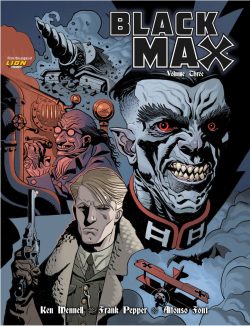
Black Max volume 3


By Frank S. Pepper, Ken Mennell, Alfonso Font & various (Rebellion Studios)
ISBN: 978-1-83786-102-6 (TPB/Digital edition)

This book includes Discriminatory Content produced in less enlightened times.

Win’s Christmas Gift Recommendation: Astoundingly Eerie Air Ace Action… 8/10

It’s time for another sortie down memory lane for us oldsters and, hopefully a frolic down a new, untrodden path for fans of the fantastic in search of a traditionally quirky British comics experience. This compelling compilation is another stunning nostalgia-punch from Rebellion’s superb, ever-expanding Treasury of British Comics, concluding the exotic, esoteric episodic exploits of seminal shocker Black Max: another darkly sparkling gem from our crown jewels of weird kids’ comics… and yes, there’s a strong argument that the readers were as wild and whacko as the strips we loved…

This sinister selection delivers the last gasps of the unsavoury war criminal of the skies, and includes rare-for-the-era crossover with another strip star. Black Max debuted in the first issue of Thunder and more than ran the distance: surviving cancelation and merger, soaring on into Lion & Thunder which finally gave up the ghost mid-decade. This third volume carries the last wave of those stories, covering 15th January to October 21st 1972 with the aviation excitement augmented by a brace of longer yarns taken from Thunder Annual 1974.

The series was typical of the manner in which weekly comics functioned back then: devised by screenwriter, veteran editor and prolific scripter Ken Mennell (Cursitor Doom, Steel Claw, The Spider and many more), with the first episode limned by the company’s star turn for mood and mystery, Eric Bradbury (Invasion, The Black Crow, Cursitor Doom, House of Dolman, Hookjaw and dozens more). The whole kit and kaboodle was then handed off to another team to sink or swim with, which they did until 1973: a pretty respectable run for any British comic feature…

In many ways, the attrition rate of British strips bore remarkable similarities to WWI casualty figures, but this serial was well-starred. The assigned follow-up writer was Frank S. Pepper. who began his legendary comics career in 1926. By 1970, he had clocked up many major successes including Dan Dare, Rockfist Rogan, Captain Condor, Jet-Ace Logan and Roy of the Rovers to name but a very, very few. Series illustrator Alfonso Font was a 10-year veteran – mostly for overseas publications – when he succeeded Bradbury. Based in Spain, Font had worked not just for Odhams/Fleetway but on strips for US outfits Warren and Skywald and continental classics such as Historias Negras (Dark Stories), Jon Rohner, Carmen Bond, Bri D’Alban, Tex Willer, Dylan Dog, Clark & Kubrick: Spiritualists Inc., Taxi, Héloise de Montfort and more…

Episodic by nature and generally delivered in sharp, spartan 3-page bursts, by the time of these trench warfare and skyborne tales, the premise and key characters were firmly established and Pepper & Font were growing bolder and more experimental…

In 1917, Germany and her allies were slowly losing the Great War. In the Bavarian schloss of Baron Maximilien von Klorr, the grotesque but brilliant scientist/fighter ace devised a horrific way to tip the scales back in favour of his homeland. His extremely ancient family had, for millennia, enjoyed an almost affinity with bats, and the current scion had bred giant predatory versions he controlled by various means – including magic amulets and telepathy. These flew beside him to terrify and slaughter the hated English. Initially, they had been a secret weapon used sparingly, but by this juncture allied soldiers and aviators knew well this other form of death from the skies…

His schemes were imperilled and countered on a weekly basis by young British pilot Tim Wilson. Originally a performer in a peacetime flying circus, the doughty lad was possibly the best acrobatic aviator on the Western Front and his constant clashes with von Klorr and the colossal chiropterans constantly frustrated the manic monster master…

Now, with Wilson’s superiors fully aware of the fearsome bioweapons, and thanks to the peasant’s constant interference, the Baron devotes an astonishing amount of time and effort to killing the English fighter ace… when not butchering Allied fliers and ground troops in vast numbers.

The odds seemed to shift once von Klorr began mass-producing his monsters, but Wilson eventually gained the upper hand: driving “Black Max” out of his castle HQ and into a hidden facility where the vile villain retrenched and made bigger, better terrors…

As lengthy, multi-part serials became the standard, the human fliers’ private duel expanded to include many veteran English Aces, infiltrating traitors into the Royal Flying Corps, brainwashing and torturing prisoners, steering zeppelins on civilian raids, and kidnapping British animal scientist Professor Dutton to improve the strength of his killer beasts…

Always, however, the Baron is foiled by his inability to ignore or avoid Wilson: a mistake that scuttles his grand schemes and costs him dearly…

Down but never out, the Baron returns to successful strategies and familiar killing fields, but suffers another reversal when Wilson discovers his current laboratory base. With only one giant bat left and his resources exhausted, Von Klorr relocates to a deserted aerodrome to consider his options and is shocked to receive a message from his grandfather. The terrifying patriarch of the “bat clan” has knowledge spanning millennia and reveals he has unearthed an ancient potion to recreate the “great Kingbat!”

Thanks to more timely interference from Tim, the killer beast attacks both German and British lines, necessitating an unprecedented alliance of the sworn enemies. Wilson is completely ready for von Klorr to betray him, but is still taken unawares when the moment comes as they kill the rampaging terror…

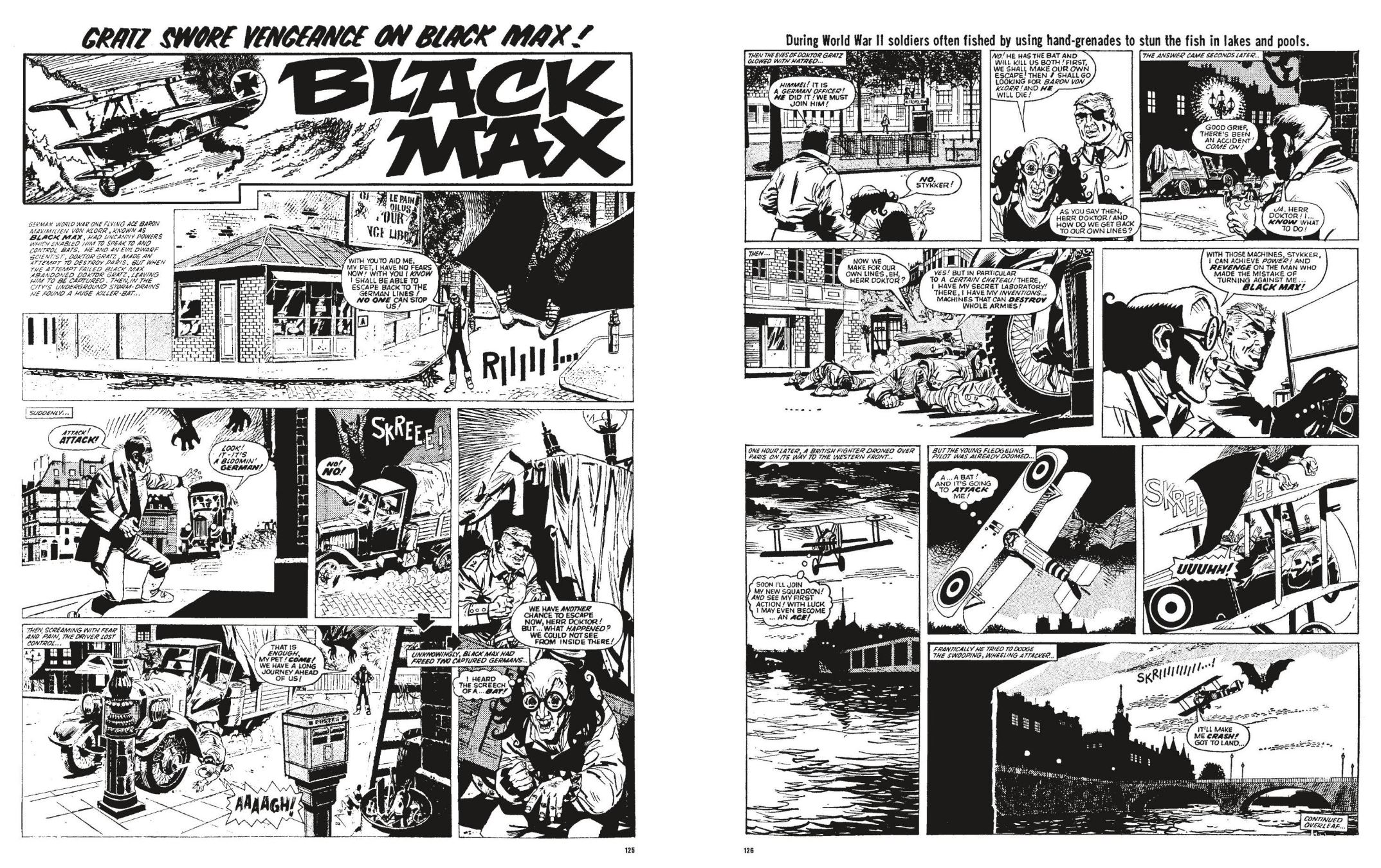
Here and now, it’s mere weeks after the crisis, and business as usual in the skies over Europe. As brave men shoot at each other, Von Klorr is almost court-martialled by his own leaders, but responds by secretly unleashing his last killer bat in defiance of the generals. It leads to a shocking meeting with another German freak and outcast every bit as nefarious and deranged as the Baron. Doktor Gratz is a towering intellect and supergenius in a warped, stunted body as proved by the mighty mole machine he travels under the earth in and the whirlwind weapon he uses to smash ships from the sky. He hates the British too and knows a fellow fiend when he sees one…

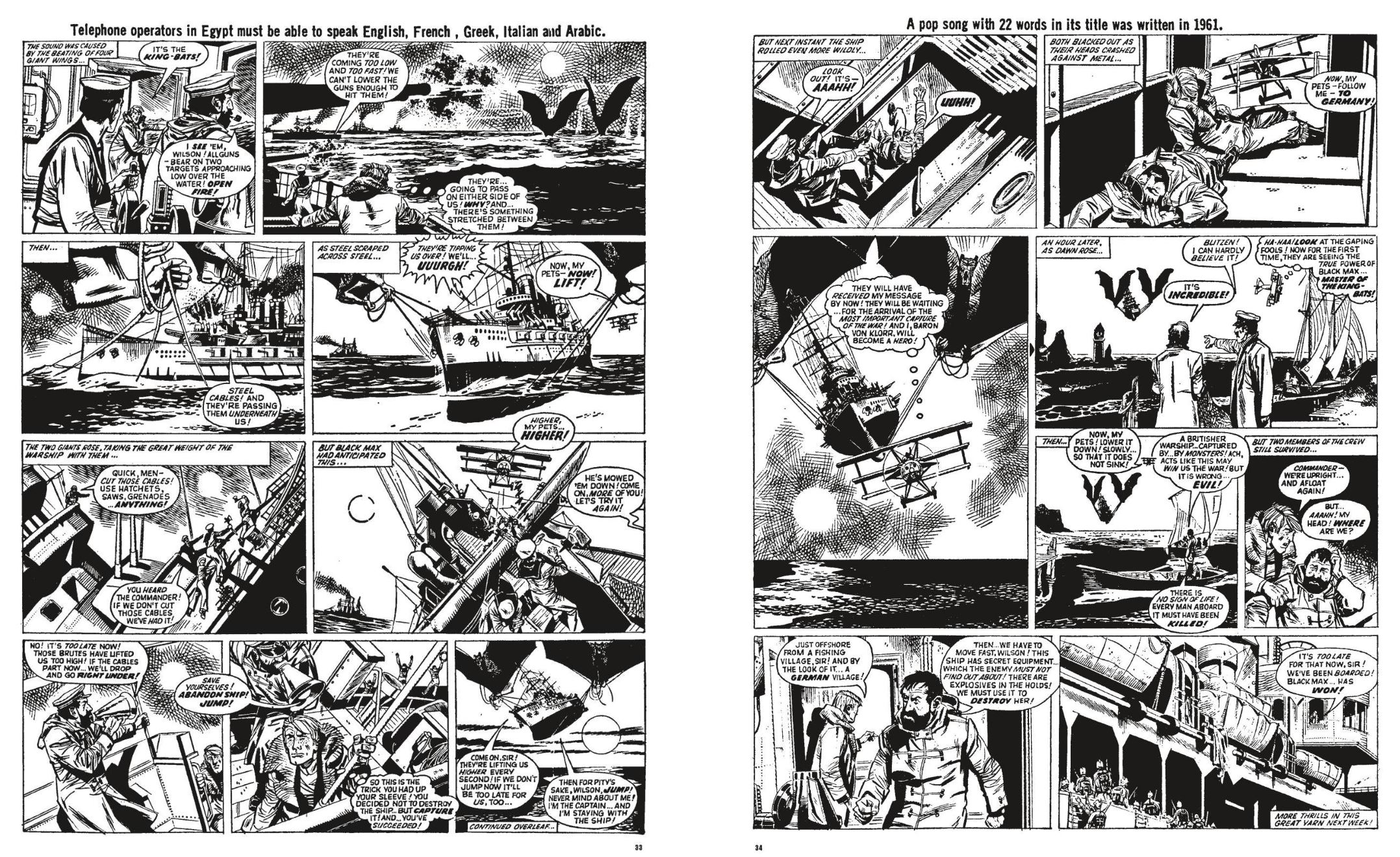
Soon they are attacking the allies and making a real dent, but Herr Doktor is keeping secrets from his partner. Sadly for them, Wilson is dogging their trail and prevents Gratz gaining his true objective, whilst exposing his perfidy to the furious Baron. The upshot is a sundered alliance, but Von Klorr does regain the trust of the generals which he uses – with his grandfather’s aid – to unleash more colossal Kingbats. His scheme is incredible in its audacity: employing the monsters to sink a British naval flotilla, capture an entire experimental battleship and imprison its crew…

Once again, it’s Wilson to the rescue, infiltrating a German internment camp to spring the sailors before leading the cruiser’s recovery in the face of the very worst the Kingbats can do. Von Klorr, meanwhile, has found even more uncanny allies in the form of an ancient race of subterranean bat-men dwelling unsuspected under the French countryside. These he controls with an amulet, but the sentient horrors are more than happy to kill humans…

Nearby, opportunistic Doktor Gratz reemerges and negotiates a truce with the Baron in anticipation of killing more enemy soldiers. Soon the macabre coalition is pushing back the Allied advance and all looks very bleak, but Wilson has a plan…

Defeated again and in retreat, Black Max and Gratz launch a new terror weapon – sinister “ghost planes” – but once more their subtle trickery is exposed, but not before the human devils unleash an assassination plot against French leaders and attack Paris in force with a legion of flying monsters. The build-up of months climaxes with relentless pursuit as the Germans abandon all schemes in a vengeful effort to kill the British flier, but as chaos mounts they reach too far…

In a rare event the series came to a fitting conclusion here and although the Baron was declared dead, Gratz did very well out of these walk-on appearances: he won his own spin-off series once Black Max ended. Uncomfortably entitled Secrets of the Demon Dwarf, it ran in Lion from October 28th 1972 to March 17th 1973 (plus annual and specials) as the mad scientist accidentally stranded himself in the 1970s and sought revenge for losing two World Wars and presumably just the one World Cup. Font did some of most expressive and inventive work on the feature, but I suspect Rebellion won’t be archiving this series any time soon…

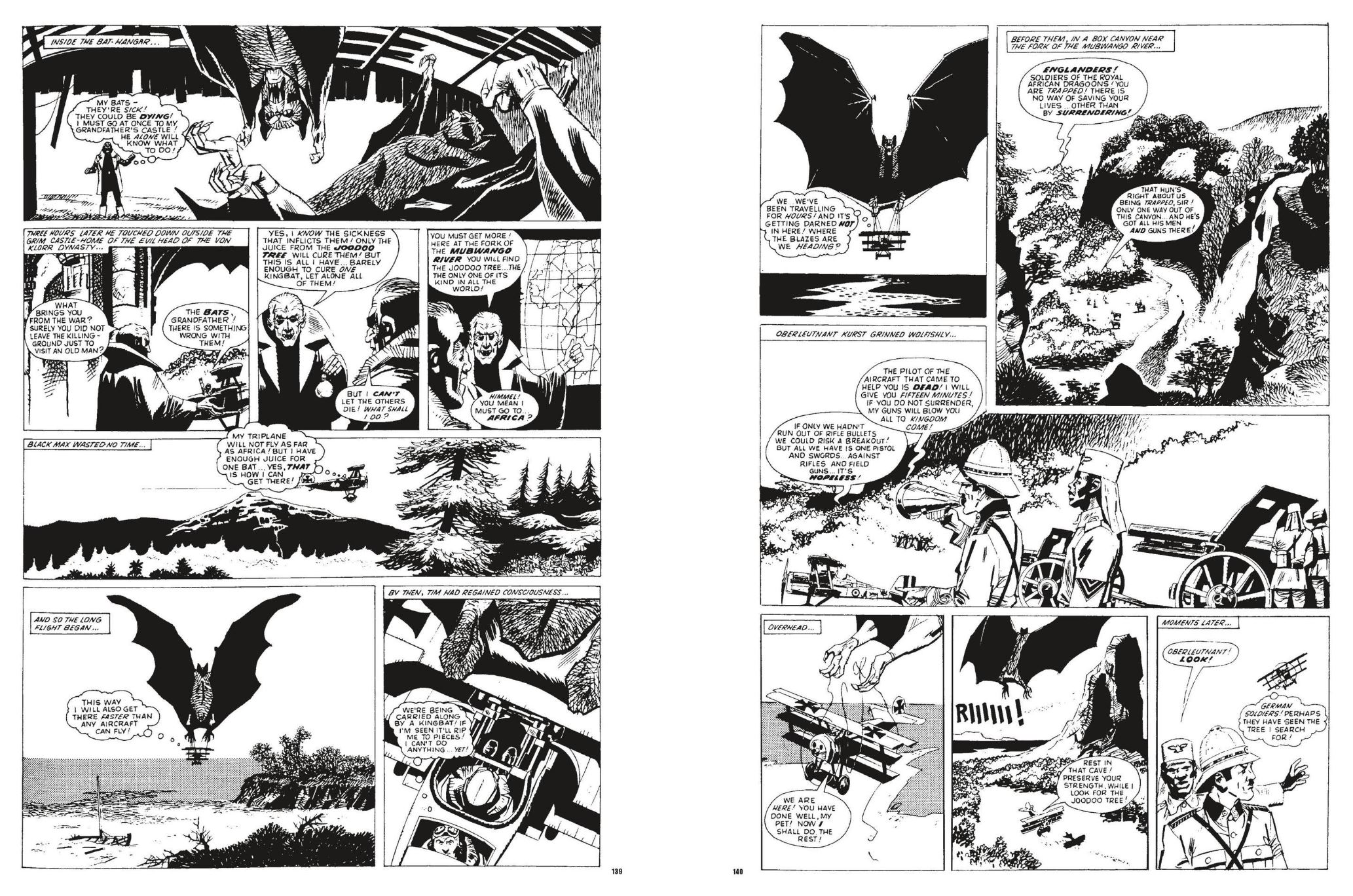
As previously stated, this closing collection also includes two complete adventures from Thunder Annual 1974: one in prose and illustrated by an artist unknown and a final furious comics foray. The text tale saw Von Klorr visiting a Serbian castle to bolster failing Austrian forces only to fail due to Tim Wilson, whilst the final flight sees the true Brit following the Baron to Africa in search of ingredients to make a potion that might save his dying Kingbats from a dire disease…

These strip shockers are amongst the most memorable and enjoyable exploits in British comics: smart, scary and beautifully rendered. This a superb example of war horror that deserves to be revived and revered.
© 1972, 1973 & 2024 Rebellion Publishing IP Ltd. Black Max and all related characters, their distinctive likenesses and related elements are ™ Rebellion Publishing Ltd. All Rights Reserved.

Gary Gianni’s MonsterMen and Other Scary Stories


By Gary Gianni with William Hope Hodgson, Robert E Howard, Clark Ashton Smith, Percival Landon: lettered by Sean Konnot & Todd Klein (Dark Horse Books)
ISBN: 978-1-50670-480-7 (TPB) eISBN: 978-1-50670-481-4

This book includes some Discriminatory Content included for dramatic effect.

The tradition of extraordinary individuals banding together or even acting individually to confront night terrors and supernatural predators probably extends further back than even Gilgamesh or Beowulf. However, it really came to the fore once bards and skalds were rendered obsolete by cheap printing, mass literacy and pulp publishing. Action, crime, weird science and the supernatural all became strange bedfellows in service to monthly (sometimes fortnightly) blood-&-thunder adventures, with the best of the bunch still sneaking out the odd exploit nearly a century later…

The sublime stuff of legend in both story and illustrations has beguiled many a latecomer (Chaykin, Steranko, Wrightson and Kaluta first come to mind) but the absolute doyen of those that followed is Gary Gianni. Born in the Windy City in 1954, he graduated from the Chicago Academy of Fine Arts in 1976 and subsequently worked as a courtroom sketch artist, in network television and as an illustrator for the Chicago Tribune before breaking into comics with modern Classics Illustrated adaptations of Tales of O. Henry and 20,000 Leagues under the Sea.

This led him to Dark Horse Comics’ licensed titles with stints on The Shadow and Indiana Jones (…and the Shrine of the Sea Devil), with other strip work including Tarzan, Tom Strong and Batman. In 2004 he replaced John Cullen Murphy, becoming the third official artist on Prince Valiant, limning the epic Sunday feature until March 25th 2012. His book illustration work includes Savage Tales of Solomon Kane, Bran Mak Morn: The Last King, George R.R. Martin’s A Song of Ice and Fire prequel A Knight of the Seven Kingdoms, Ray Bradbury’s Nefertiti-Tut Express and Michael Chabon’s Gentlemen of the Road.

Always busy and much in demand, Gianni nevertheless managed to create a number of linked serial sorties concerning a mystery-solving ghostbusters, most of which originally appeared in the back of Hellboy titles (specifically Hellboy Christmas Special, Wake the Dead, The Wild Hunt #5-6, Almost Colossus), plus a solo one-shot The MonsterMen: The Skull and the Snowman. The other material filling this scare package all come from The Dark Horse Book of Monsters; the Dead; Hauntings & Witchcraft

Set in the golden-hued yet shadowy environs of America’s pulp past, the tales are witty, elegant thematic pastiches of rip-roaring thriller-chiller masterworks – including early Batman yarns – and are preceded by a whimsical ‘Foreword by Gary Gianni’ and effusive ‘Introduction by Michael Chabon’.

The far too few exploits of The MonsterMen open with ‘Silent as the Grave’ as first seen in Hellboy: Wake the Dead #1-5, revealing a secret organisation who insert themselves in weird events such as the disappearance of actress Julia Adler, strange murder of her lover and inexplicable appearance of ghost images on the latest rushes of maverick director Larry St. George. Doggedly pursued by savvy reporter Sunset Lane, the famed movie maven has a dark unpleasant personal pestilence, but uses it for good, like battling occult whacko monster-wrangler Crulk beside sartorial nightmare/immortal mystic warrior monk Benedict(us) of the Venerable Guild of Corpus Monstrum. The pair are almost insufficient when the fiendish forces behind the plot go on the attack.

Almost…

A shorter, lighter yarn follows in ‘Autopsy in B-Flat’ (Hellboy: Almost Colossus#1-2) as, whilst laboriously exhuming a suspect, Benedict is regaled by an old exploit of his comrade: a tropical island mystery involving monstrous, seductive creatures and pirates who can’t stay dead, that nearly proves his distracting end during the current case…

‘A Gift for the Wicked’ (Hellboy Christmas Special) finds the odd couple cleaning an old dark house of unwanted tenants at the supposedly happiest time of the year – albeit with a little festive assistance – before ‘The Skull and the Snowman’ sees Sunset Lane despatched from a Tibetan Lamasery, carrying a cursed object to the Corpus Monstrum, just as Crulk returns to bedevil Benedict, begging aid to escape marauding Puttyfoons dogging his misshapen steps…

As reality goes wild and the modern metropolis roils under ancient satanic scourgings, all parties converge on the skull (still trying to get out of Tibet) and the power it promises. The quest draws out a legion of terrors and concludes with shocking revelations about two of the world’s most infamous monsters…

The comics cavorting concludes with a staggeringly eccentric and beautiful horror romp as ‘O Sinner Beneath Us’ (Hellboy: The Wild Hunt #5-6) channels Little Nemo in Slumberland in a classic unearthly child tale, with new recruits Sunset and Crulk taking pole positions for a wild chase for the salvation of innocence and retrieval of the ghastly Mustacchio Demoniac…

The Other Scary Stories section of this timeless terror tome offers classic pulp horror prose spectacularly illustrated and illuminated by Gianni, opening with a masterful vignette by William Hope Hodgson as ‘The Gateway of the Monster’ details the crushing fears and tragic outcomes generated by a haunted room in an English country house… and what celebrated spirit photographer Carnacki the Ghost Breaker must endure to end the appalling threat it poses…

It’s followed by the author’s stand-alone nautical tale ‘A Tropical Horror’, detailing the last voyage of the SS Glen Doon out of Melbourne, relentlessly and systematically stripped of its crew by a sea thing both ravenous and pitiless.

Wry, sardonic humour infuses a seductive tale of a powerful woman who takes what she wants in Clark Ashton Smith’s Mother of Toads’, before Robert E. Howard’s horror western ‘Old Garfield’s Heart’ proves he wasn’t all about bulging thews and swinging swords. He could mix a mood as well as any horror master and inspire some potent illustration too…

Wrapping up the bedtime reading is one last period ghost story of haunted houses and murderous rooms imaginatively illuminated, as ‘Thurnley Abbey’ by Percival Landon, all sealed down with a lavishly illumined ‘Biography’.

Madcap, frenzied, skilfully constructed and just plain fun, MonsterMen and Other Scary Stories is stuffed with astounding imagery, packed with incidental iniquities such as zombie cowboys, squid corsairs, abominable snowmen, spectral skulls, movie phantoms, dark dragons and flabby flying demons, all delivered in snippets of smartly nostalgic nonsense. This is kids’ stuff for adults and there’s simply not enough of it, so get what there is while you can, fright fans!
Gary Gianni’s MonsterMen and Other Scary Stories™ © 1996, 1997, 1999, 2003, 2004, 2005, 2006, 2009, 2012, 2017 Gary Gianni. Introduction © 2012, 2017 Michael Chabon. All rights reserved. All other material ™, © or ® respective holders and owners.

The Phantom – the complete newspaper dailies: volume Three 1939-1940


By Lee Falk, Ray Moore & Wilson McCoy: introduction by Mike Bullock (Hermes Press)
ISBN: 1-932563-61-X (HB/Digital edition)

This book includes Discriminatory Content produced in less enlightened times.

Born Leon Harrison Gross, Lee Falk created the Ghost Who Walks at the request of his King Features Syndicate employers who were already making history, public headway and loads of money with his first strip sensation Mandrake the Magician. Although technically not the first ever costumed champion in comics, The Phantom became the prototype paladin to wear a skin-tight body-stocking and the first to have a mask with opaque eye-slits…

The generational champion debuted on February 17th 1936, in an extended sequence pitting him against an ancient global confederation of pirates. Falk wrote and drew the daily strip for the first two weeks before handing over illustration to artist Ray Moore. The spectacular and hugely influential Sunday feature began in May 1939.

For such a long-lived, influential series, in terms of compendia or graphic collections, “the Ghost Who Walks” was quite poorly served in the English language market (except in the Antipodes, where he has always been accorded the status of a pop culture god). Many companies have sought to collect strips from one of the longest continually running adventure serials in publishing history, but in no systematic or chronological order and never with any sustained success. That has been rectified recently by archival specialists Hermes Press who launched curated collections in 2010 which have made almost all the various canonical iterations accessible to the devoted.

This third landscape Dailies edition is currently only available digitally. Released in 2011, its pages are stuffed with sumptuous visual goodies like panel and logo close-ups, covers and lots of original art and opens with ‘Introduction: The Phantom and I’: a memories-rich text feature stuffed with sumptuous visual goodies from author/musician and uber-fan Mike Bullock before the vintage blood-&-thunder fun begins with exotic thriller ‘The Mysterious Girl’ (originally running Mondays to Saturdays, May 8th to September 2nd 1939).

Roaming Alexandria in plainclothes, the Ghost Who Walks interrupts a brutal abduction, but the jewel-bedecked victim doesn’t want his help or even to talk about it. Persistent and curious, The Phantom investigates further and learns she is currently amnesiac; terrified and being stalked by sleezy Count Pharos, who claims to be her guardian. When the rogue convinces “Miss Banks” to take a sea voyage with him, the Phantom and his faithful wolf Devil join the jaunt. Before long the heroes are apparently lost at sea, before the memory-afflicted maiden is also disappeared. Hard to kill, The Phantom trails the Count and finds a second abducted prisoner. Young Baron Marshall Dufresne is Pharos’ real ward and his imprisonment and wealth are what really concern the villain, particularly as the lad loves a girl named Merle and is prepared to sign a suicide note leaving everything to Pharos in return for her safety.

Of course, all those sneaky plans come unstuck once the Phantom decides to step in and stop the plot, but not before almost dying in many shocking ways as Pharos and his hulking henchman Red flee with the Phantom in spectacular hot pursuit, The chase ends in justice and Merle’s memories – and reputation – restored. Fast-paced, packed with peril and introducing a truly unique character in the bulky shape of Hannah – a fight-loving domestic servant who is The Phantom’s physical equal in fisticuffs – this epic exploit is sublimely frenetic fun, and segues seamlessly into ‘The Golden Circle’ (September 4th 1939 to January 20th 1940) as the hero’s true love resurfaces. Wealthy American adventurer Diane Palmer was made a nervous wreck by her time with The Phantom and has, for many months, believed him dead. Her doctors advised the masked man to go along with the sham for her sake…

The recuperating heiress has been unsuccessfully wooed by airman Lieutenant Byron, but when the Phantom checks in and finds her still pining for him, checks out again. The example inspires the pilot, who cables the hero to tell him Diana has agreed to become Mrs. Byron…

Enraged and jealous the hero returns to the hospital but finds her already gone. After dealing with Byron, The Phantom chases, catches and re-bonds with Diana. Sadly, that only generates a truly insurmountable problem as Diana’s snooty mother declares the masked peasant unworthy of her daughter. They can only wed if he gets a real job…

Chained to generations of duty and by his vow to oppose evil, the lovers are seemingly parted forever, and soon after in France the heartbroken hero is targeted by a mother/daughter con team and framed for murder. His frantic escape exposes another all-woman criminal gang plundering the world and The Phantom barely escapes the many traps and tribulations of the insidious organization The Golden Circle…

With war in Europe and the epic battle against the Circle ended, the subplot of Diana returns as Mama Palmer finally admits that all the men she’s pushed at her distraught daughter have not passed muster. Running from January 22nd to July 27th) ‘The Seahorse’ sees the dowager advertise for a suitable son-in-law with the result that Diana is feted, charmed, courted and ultimately kidnapped by scurrilous Count Danton. Naturally, The Phantom is not far away, but is he solely motivated by jealousy or does the fact that Danton is the foremost and deadliest enemy agent in the western hemisphere impact the hero’s incredible actions in winning her back?

Crucially, will clearing Diana of espionage charges and accusations of treason make The Phantom a more eligible suitor in Mama’s eyes?

This volume concludes with ‘The Game of Alvar’ (July 27th
to December 14th 1940) as the reunited lovers enjoy a little downtime together… but only until they stumble onto a canny smuggling operation and Dian is targeted by a deadly assassin running a private murder-island. Naturally the Ghost Who Walks rushes to her aid, but the sinister Mr. Alvar has the entire police force and civil authorities on his payroll. Ultimately, this time it’s Diana who takes up arms, saves the day and restores honourable government to the oppressed, even if The Phantom does latterly land a blow or two…

The saga pauses for now with a few more images taken from The Phantom Big Little Books – another treat long overdue for resurrection.

Stuffed with chases, cruises, air and submarine clashes, assorted fights, torture, action antics, daredevil stunts and many a misapprehension – police and government authorities clearly having a hard time believing a pistol-packing masked man with a pet wolf might not be a bad egg – this is sheer gripping pulp-era excitement that still packs a punch and many sly laughs.
© 2011 King Features Syndicate, Inc.: ® Hearst Holdings, Inc.; reprinted with permission. All rights reserved.

The A-Z of Marvel Monsters


By Jack Kirby, Dick Ayers, Stan Lee, Larry Lieber & various (Marvel)
ISBN: 978-1-3029-0863-8 (HB/Digital edition)

Win’s Christmas Gift Recommendation: Fan Smash! … 9/10

This book includes Discriminatory Content produced in less enlightened times.

To dyed-in-the-wool comic book fanboys there’s a much beloved period in history when a frankly daft and woefully formulaic trend produced utter, joyous magic. We look back on it now and see only the magnificent art, or talk with loving derision of the crazy (and frequently onomatopoeic) names, but deep down we can’t shake the exuberant thrill inside or the frisson of emotion that occurs when we see or even think of them.

Before Jack Kirby & Stan Lee brought superheroes back to Marvel Comics, the company was on its last legs. Locked into a woefully disadvantageous distribution deal, the company’s output was limited to some sixteen genre titles. But there was hope…

The outside, mainstream, world was currently gripped in an atomic B-movie monster craze, so Lee, Kirby and Steve Ditko dutifully capitalised on it in their anthology mystery titles Journey into Mystery, Strange Tales, Tales to Astonish and Tales of Suspense. In an unending procession of brief inspirational novelettes, dauntless or canny or just plain outsider humans outsmarted a succession of bizarre aliens, mad scientists, an occasional ghost or sorcerer (this was, after all, the heyday of the Comics Code Authority when any depiction of the supernatural was BAD) and a horde of outrageous beasties in a torrent of wonders best described by the catchphrase “monsters-in-underpants.”

Simplistic, moralistic, visually experimental yet reassuringly predictable in narrative, these Outer Limits-style yarns were – and still are – the epitome of sheer unrelenting fun with no redeeming social context required. Marvel have increasingly celebrated that fact in recent years (even folding most of the yarns into their modern multiversal continuity) and – over the course of one month – commissioned a line of 26 “Kirby Monster” variant covers for their periodical releases, all lovingly crafted by a number of top names to highlight the treasured contribution of beasties, things and what-nots…

This volume gathers those images in a handy hardcover primer (and eBook edition) whilst gloriously gilding the lily with a splendid selection of a few of the original mini-epics as created from those pre-Marvel Age masterpieces. The short sharp surprise is suitably augmented by ‘Jack Kirby, Atlas Comics & Monsters!’: a 1994 Introduction from the King himself.

The next bit’s another shopping-list moment, so if you want to skip ahead a little, I shouldn’t be at all surprised…

Augmented by the original cover of each diabolical debut, the worshipful A to Z art-section opens with Erica Henderson’s reinterpretation of ‘The Awesome Android!’ (as first seen in Fantastic Four #15) and rapidly follows up ‘The Blip!’ by Simon Bisley, and ‘The Crawling Creature!’, delineated by Maguerite Sauvage. An extreme late entry in the Kirby-Kritter Circus, ‘Devil Dinosaur!’ launched in his own title in 1978 and his moody reprise from Matthew Wilson is followed by Jeff Lemire’s take on ‘Elektro!’ and ‘Fin Fang Foom!’ – first seen in Strange Tales #89, and rendered here by Walter Simonson & Laura Martin.

Michael & Laura Allred depict latter-day cellulose celluloid star ‘Groot!’ (originating in Tales to Astonish #13), before Francesco Francavilla highlights ‘The Hypno-Creature!’, Paolo Rivera revisits Fantastic Four #24’s weird menace ‘The Infant Terrible!’ and Glenn Fabry regales us with an Asgardian god battling ‘The Jinni Devil!’ in a scene that didn’t make it into 1967’s Thor #137…

Dave Johnson details a key point in the life of ‘Kraa the Unhuman!’ before John Cassaday & Matthew Wilson illuminate the depredations of ‘Lo-Karr, Bringer of Doom!’, after which Geof Darrow whisks us back to Thor #154 to meet again amalgamated atrocity ‘Mangog!’

Kirby’s astounding 1976 Eternals series produced many incredible images, with Paul Pope & Shay Plummer selecting 2,000 feet tall Space God ‘Nezarr the Calculator!’ to set the pulses racing, whilst Mike del Mundo plumps for Strange Tales #90’s ‘Orrgo!’ and James Stokoe recalls Strange Tales of the Unusual #1 (December 1956)’s forgotten fiend ‘Poker Face!’

Recurring FF foe ‘The Quonian!’ first appeared in Fantastic Four #97 and wows again here thanks to Christian Ward, after which Eric Powell previews ‘Rommbu!’ and Tradd Moore pits Ant-Man against Tales to Astonish #39 terror ‘The Scarlet Beetle!’ before Chris Bachalo & Tim Townsend show us the power of ‘Thorr!’ Chris Samnee & Wilson expose the fervent ferocity of Journey into Mystery #63’s undersea goliath ‘Ulvar!’ and Arthur Adams & Chris Sotomayor hark back to Tales to Astonish #17 to focus on ‘Vandoom’s Monster’ after which one last FF antagonist features as Cliff Chiang reveals ‘The Wrecker’s Robot!’ as seen in Fantastic Four #12.

Wrapping up this astounding alphabet are Dan Brereton’s rendition of ‘Xemnu!’ and Phil Noto’s depiction of ‘The Yeti!’ who battled Kirby’s Black Panther in #5 before Tony Moore & John Rauch hilariously conclude the countdown with alien outlaw ‘Zetora’.

Okay. Maybe a few of those spooky stalwarts might have been from a later era and star in superhero sagas, but the influence and intent was clearly seen throughout and just sets the tone for the Kirby-crafted fearsome fantasy-fest that follow…

The family-friendly monster mash – featuring scripts by Lee and Larry Lieber with Dick Ayers inking – opens with ‘I Learned the Dread Secret of The Blip!’ (Tales to Astonish #15, January 1961) wherein an openminded radar operator attempts to assist a stranded alien energy being. ‘I Dared to Battle the Crawling Creature!’ comes from TtA #22 (August 1961) as a scrawny High School nerd travels into the bowels of the Earth to face a primitive predator, whilst an aging electronicist creates and eventually counters would-be computerised conqueror ‘Elektro! He Held the World in his Iron Grip!’ (Tales of Suspense #19, January 1961).

The hideous Hypno-Creature harried a very human hero in extra-dimensional invasion epic ‘I Entered the Dimension of Doom!’ (ToS #23, November 1961) whilst facing hulking atomic victim ‘Kraa the Unhuman!’ (ToS #18, June 1961) proves the making of a timid American teacher…

A sunken stone head on a Pacific Island proved to be big trouble when explorers awakened ancient alien invaders in ‘Here Comes… Thorr the Unbelievable’ (Tales to Astonish #16, February 1961) and the origins of Defenders villain Xemnu the Titan are exposed in ‘I Was a Slave of the Living Hulk!’ (Journey into Mystery #62, November 1960) whilst one hapless human proves to be the perfect hideout for extraterrestrial fugitive Zetora in ‘The Martian Who Stole My Body!’, as seen in JiM #57 (March 1960).

Foolish, fabulous, thrill-packed, utterly intoxicating and unforgettable, these are fun-filled tales no puny human could possibly resist.
© 1956-1961, 2017 Marvel Characters Inc. All rights reserved.

Mandrake the Magician: Fred Fredericks Sundays volume 1 – The Meeting of Mandrake and Lothar


By Lee Falk & Fred Fredericks (Titan Books)
ISBN: 978-1-78276-692-6 (HB/Digital edition)

This book includes Discriminatory Content produced during less enlightened times.

Time for another Birthday briefing as we exploit the month of mystery and imagination to celebrate 90 glorious years for another Golden Age stalwart…

Regarded by many as comics’ first superhero, Mandrake the Magician debuted as a daily newspaper strip on 11th June 1934 – although creator Lee Falk had sold the strip almost a decade previously. Initially drawing it too, Falk replaced himself as soon as feasible, allowing the early wonderment to materialise through the effective understatement of sublimely solid draughtsman Phil Davis. An instant hit, Mandrake was quickly supplemented by a full-colour Sunday companion page from February 3rd 1935.

Falk – as 19-year-old college student Leon Harrison Gross – had sold the strip to King Features Syndicate years earlier, but asked the monolithic company to let him finish his studies before dedicating himself to it full time. Schooling done, the 23-year-old born raconteur settled into his life’s work, entertaining millions with astounding tales. Falk also created the first costumed superhero in moodily magnificent generational manhunter The Phantom, going on to spawn an entire comic book subgenre with his first creation. Most Golden Age publishers boasted at least one (and usually many) nattily attired wizards in their gaudily-garbed pantheons: all roaming the world(s) making miracles and crushing injustice with varying degrees of stage legerdemain or actual sorcery.

Characters like Mr. Mystic, Ibis the Invincible, Sargon the Sorcerer, and an assortment of  the Magician”’s like Zatara, Zanzibar, Kardak proliferated ad infinitum: all borrowing heavily and shamelessly from the uncanny exploits of the elegant, enigmatic man of mystery gracing the world’s newspapers and magazines. In the Antipodes, Mandrake was a suave and stalwart regular of Australian Women’s Weekly and became a cherished icon of adventure in the UK, Australia, Italy, Brazil, Germany, Spain, France, Turkey and across Scandinavia: a major star of page and screen, pervading every aspect of global consciousness.

Over many decades he has been a star of radio, movie chapter-serials, a theatrical play, television and animation (as part of series Defenders of the Earth). With that has come the usual merchandising bonanza of games, toys (including magic trick kits), books, comics and more…

Falk worked on Mandrake and “The Ghost who Walks” until his death in 1999 (even on his deathbed, he was laying out one last story), but also found a few quiet moments to become a renowned playwright, theatre producer and impresario, as well as an inveterate world-traveller. After drawing those first few strips Falk united with sublimely polished cartoonist Phil Davis, whose sleekly understated renditions took the daily strip, and especially the expansive full-page Sunday pages (collected in companion volume The Hidden Kingdom of Murderers), to unparalleled heights of sophistication. Davis’ steadfast, assured realism was the perfect tool to render the Magician’s mounting catalogue of spectacular miracles. Soon the Magician was a major star of page & screen, pervading all aspects of global consciousness as hinted at in a furore of fact features and massed memorabilia treats, beginning with introductory essay ‘The Real Mandrake the Magician’. This discusses real-life stage magician Leon Mandrake – who shared the evocative sobriquet in the mid-20th century – as revealed courtesy of his son Lon. Next on the bill is an appreciation of Davis’ inspired replacement as illustrator, in ‘Fred Fredericks – My Mandrake Artist’ by Andreas Erikson, with incisive exploration of Harold “Fred” Fredericks, who took over art production when Davis died and who ultimately assumed full creative duties when Falk himself passed on in 1999. This briefing covers that his tenure and includes his prodigious pre- and post-Mandrake comics work.

Those in the know are well aware that Mandrake was educated at the fabled College of Magic in Tibet, thereafter becoming a suave globe-trotting troubleshooter. Always and everywhere he was accompanied by African partner-in-crimefighting Lothar and, from early on, capable companion (eventually, in 1997, bride) Princess Narda of Cockaigne. Together they solved mysteries and fought evil. Those exploits took the close-knit team literally everywhere, and the strips section of this luxury monochrome landscape hardback opens on ‘Traveler’s Tale’ which ran from March 21st to August 22nd 1965 and saw the last episodes illustrated by Davis, before his death in 1964 from a heart attack.

The saga sees Mandrake in the arctic, where iceberg-watching leads to the recovery of an apparent alien in a survival capsule. A physical and mental marvel, while slowly awakening Opolo deduces not just the English language but also that he’s been in hibernation for 60,000 years. He goes on to reveal that he’s actually from Earth, albeit part of a space-faring race that preceded Homo Sapiens. He’s also pining for his estranged true love Adrana, and Mandrake is happy to help him find her and the long buried civilisation they both came from and are the last survivors of…

Incredibly, along the way, the magician also solves an ancient murder mystery and plays cupid to the reunited survivors, before seeing them abandon their birthworld for the stars…

Always well in tune with contemporary zeitgeists – like sci fi and spy fi – Falk dipped into the growing well of supervillains monopolizing book shelves and airwaves by next reviving Mandrake’s personal arch-nemesis as ‘The Cobra Returns’ (August 29th 1965 – April 3rd 1966). The sinister savant was once Mandrake’s tutor at The College of Magic and here begins a globally destabilising assassination spree, provoking crime busting agency Inter-Intel to call in the Magician and his crew to consult. Sadly, the ploy only makes the perfidious plotter turn his full murderous attentions on our heroes, in an escalating series of attacks that ultimately end in a spectacular showdown and apparent end of the evil one…

With global stability secured, organised crime goes wild, and the miracle trio are kept busy helping the good guys crack down on mobsters in ‘The Underworld vs. Inter-Intel’ (April 10th – August 7th 1966), after which ‘The Astro Pirates’ (August 14th – December 25th 1966) highlights a modern spin on an old racket…

When bold bandits begin holding up airliners in the stratosphere they foolishly pick a jet carrying Narda, and a fully-engaged Mandrake and Lothar spare no effort to end the sinister sky-jinks, after which – inspired by the “Great Northeast Blackout” of November 5th 1965 – Falk & Fredericks fill us in on ‘The Blackout Caper’ (January 1st – April 23rd 1967), as a mad scientist teams up with mobsters to use darkness and chaos to get rich quick and fulfil even nastier nuclear ambitions but underestimate the power of the mighty magician…

Fredericks was a liberal and civil rights proponent, and had for months been subtly changing the “happy, loyal native” appearance of the African globetrotter to match the acts and character Falk had been crafting for years. The process was completed with a reboot of their first adventure together spanning April 30th – September 24th. ‘The Meeting of Mandrake and Lothar’ relates how the practically superhuman prince of reclusive kingdom “the 12 Nations” joins Mandrake in stopping crazed fugitive Mad Dog Dill, before abdicating all monarchical responsibilities to fight evil everywhere. However, returning to the present, shocks abound as Lothar agrees to helm his people’s transition to democracy by becoming their president, just as Mandrake and Narda are targeted by a manic gambler turned master-villain.

‘The Game of Chance’ (October 1st 1967 – February 11th 1968) soon sees Lothar return to aid in the comeuppance of devious blackmailer, kidnapper and influence-peddler Baron Chance and, prior to a resurgence of full-on fantasy, returns in ‘Invasion of the Babu’ (February 18th – July 21st 1968). No stranger to space adventure, Mandrake and Co are best friends with Magnon and Carola, Emperor and Empress of the Central Galaxy and benign rulers of one million worlds. The humans were there when the potentates had their baby Nardraka, and, as dutiful “godparents”, pull out all the stops when the toddler princess is abducted by barbaric invaders the Baboos.

Sadly for them, the apelike alien aggressors make a string of mistakes, beginning with hiding the hostage on even more barbaric Earth, continuing with trying to outsmart Mandrake and closing with believing Nardraka is “just” a stupid little female…

With one crisis resolved, Mandrake barely survives the renewed attentions of the Baron as ‘Second Chance’ (July 28th – November 3rd 1968) sees the magician and Inter-Intel hunt the murderous malefactor to his hidden island fortress and strike a major blow against organised crime, after which ‘The All or Nothing Hunt’ (November 10th 1968 – March 30th 1969), heralds the arrival of alien gamblers Alpha and Beta, who have made the mage their next obsession. Hiding a planet-eradicating bomb on Earth, the wagerers expect the wonder wizard to traverse the globe, deciphering clues to deactivate it. Of course, the extraterrestrials don’t play fair, but Mandrake isn’t playing at all…

No good deed goes unpunished, however, and ‘The Galactic Rumble’ (April 6th – September 7th 1969) reveals that Alpha and Beta are intergalactic crime lords with millions of thugs now indulging in an intergalactic gang war Magnon’s military and peacekeepers are helpless to stop. Isn’t it time to call in some consultants with the know-how to fight them on their own terms?

Yes it is, and not even exploding stars and marauding star dragons can long slow them down…

Ending the show are ‘The Fred Fredericks Mandrake the Magician Complete Sunday Checklist (1965-2002)’, plus full biographies of Fred Fredericks and Lee Falk. This thrilling tome offers exotic locales, thrilling action, bold belly laughs, cunning crime action and sheer wonder in equal measure. Paramount taleteller Falk instinctively knew from the start that the secret of success was strong and, crucially, recurring villains to test and challenge his heroes, and make Mandrake an unmissable treat for every strip addict. These stories have lost none of their impact and only need you reading them to concoct a perfect cure for the 21st century glums.
Mandrake the Magician © 2018 King Features Syndicate. All Rights Reserved. All other material © 2018 the respective authors or owners.

Superman: The Silver Age Dailies volume 3 – 1963-1966


By Jerry Siegel & Wayne Boring (IDW Publishing/Library of American Comics)
ISBN: 978-1-6134-0179-4 (HB)

his book includes Discriminatory Content produced during less enlightened times.

The American comic book industry – if it existed at all – would be utterly unrecognisable without Superman. Jerry Siegel & Joe Shuster’s unprecedented invention was fervidly adopted by a desperate and joy-starved generation and quite literally gave birth to a genre if not an actual art form. Spawning an army of imitators and variations within three years of his 1938 debut, the intoxicating blend of breakneck, breathtaking action and wish-fulfilment which epitomised the early Man of Steel grew to encompass cops-&-robbers crimebusting, socially reforming dramas, sci fi fantasy, whimsical comedy and, once the war in Europe and the East sucked in America, patriotic relevance for a host of gods, heroes and monsters, all dedicated to profit through exuberant, eye-popping excess and vigorous dashing derring-do.

From the outset, in comic book terms Superman was master of the world. Moreover, whilst transforming the shape of the fledgling funnybook biz, the Man of Tomorrow irresistibly expanded into all areas of the entertainment media. Although we all think of the Cleveland boys’ iconic invention as epitome and acme of comics creation, the truth is that very soon after his springtime debut in Action Comics #1 the Man of Steel was a fictional multimedia monolith in the same league as Popeye, Tarzan, Sherlock Holmes and Mickey Mouse.

We parochial and possessive comics fans too often regard our purest and most powerful icons in purely graphic narrative terms, but the likes of Batman, Spider-Man, X-Men, Avengers and their hyperkinetic kind long ago outgrew their four-colour origins and are now fully mythologized modern media creatures instantly familiar in mass markets, across all platforms and age ranges…

Far more people have seen and heard the Man of Steel than have ever read his comic books. His globally syndicated newspaper strips alone were enjoyed by countless millions, and by the time his 20th anniversary rolled around, at the very start of what we know as the Silver Age of Comics, he had been a thrice-weekly radio serial star, headlined a series of astounding animated cartoons, become a novel attraction (written by George Lowther) and helmed two films and his first smash, 8-season live-action television show. He was a perennial sure-fire success for toy, game, puzzle and apparel manufacturers and in his future were even more shows (Superboy, Lois & Clark, Smallville, Superman & Lois), a stage musical, franchise of blockbuster movies and almost seamless succession of games, bubble gum cards and TV cartoons. These started with The New Adventures of Superman in 1966 and have continued ever since. Even superdog Krypto got in on the small-screen act…

Although pretty much a spent force these days, for the majority of the previous century the newspaper comic strip was the Holy Grail that all American cartoonists and graphic narrative storytellers hungered for. Syndicated across the country – and often the planet – it was seen by millions, if not billions, of readers and generally accepted as a more mature and sophisticated form of literature than comic-books. It also paid better.

And rightly so: some of the most enduring and entertaining characters and concepts of all time were created to lure readers from one particular paper to another and many of them grew to be part of a global culture. Mutt and Jeff, Flash Gordon, Dick Tracy, Buck Rogers, Charlie Brown and so many more escaped their humble tawdry newsprint origins to become meta-real: existing in the minds of earthlings from Albuquerque to Zanzibar. Most still do…

The daily Superman newspaper comic strip launched on 16th January 1939, supplemented by a full-colour Sunday page from November 5th of that year. Originally crafted by luminaries like Siegel & Shuster and their studio (Paul Cassidy, Leo Nowak, Dennis Neville, John Sikela, Ed Dobrotka, Paul J. Lauretta & Wayne Boring), the mammoth task required the additional talents of Jack Burnley and writers like Whitney Ellsworth, Jack Schiff & Alvin Schwartz. The McClure Syndicate feature ran continuously until May 1966, appearing at its peak, in over 300 daily and 90 Sunday newspapers; a combined readership of more than 20 million. Eventually, Win Mortimer and Curt Swan joined the unflagging Boring & Stan Kaye whilst Bill Finger and Siegel provided stories, telling serial tales largely divorced from comic book continuity throughout years when superheroes were scarcely seen.

Then in 1956 Julie Schwartz kicked off the Silver Age with a new Flash in Showcase #4 and before long costumed crusaders began returning en masse to thrill a new generation. As the trend grew, many publishers began to cautiously dabble with the mystery man tradition and Superman’s newspaper strip began to slowly adapt: drawing closer to the revolution on the comicbook pages. As Jet-Age gave way to Space-Age, the Last Son of Krypton was a comfortably familiar icon of domestic America: particularly in the constantly evolving, ever-more dramatic and imaginative comic book stories which had received such a terrific creative boost when superheroes began to proliferate once more. The franchise had been cautiously expanding since 1954 and by 1961 Superman was seen not only in Golden Age survivors Action Comics, Superman, Adventure Comics, World’s Finest Comics and Superboy, but also in Superman’s Pal Jimmy Olsen, Superman’s Girlfriend Lois Lane and Justice League of America. Such increased attention naturally filtered through to the more widely-read newspaper strip and resulted in a rather strange and commercially sound evolution…

This third and final  hardback collection (encompassing November 25th 1963 to its end on April 9th 1966) opens with a detailed Introduction from Sidney Friedfertig, disclosing the provenance of the strips; how and why Siegel was tasked with repurposing recently used and soon to be published scripts from comic books; making them into daily 3-and-4 panel black-&-white continuities for an apparently more sophisticated, discerning newspaper audience.

It also offers a much-needed appreciation of the author’s unique gifts and contributions…

If you’re a veteran comic book fan, don’t be fooled: the tales “retold” here might seem familiar but they are not rehashes: they’re variations and deviations on an idea for audiences seen as completely separate from the kids who bought comic books. Even if you are familiar with the traditional source material, the serialised yarns here will read as brand new, especially as they are gloriously illustrated by Wayne Boring at the peak of his illustrative powers.

After a few years away from the feature, Boring had returned to replace his replacement Curt Swan at the end of 1961, regaining the position of premiere Superman illustrator to see the series to its demise. Moreover, as the strip drew to a close many strip adaptations began appearing prior to the “debut” appearances in the comics. As an added bonus, the covers of the issues these adapted stories came from have been included as a full, nostalgia-inducing colour gallery…

Siegel & Boring’s astounding everyday entertainments recommence with Episode #145, ‘The Great Baroni’ (November 25th to September 14th 1963), revealing how the Caped Kryptonian helps an aging stage conjuror regain his confidence and prowess. It’s based on a tale by Siegel & Al Plastino from Superboy #107 (which had a September 1963 cover-date).

‘The Man Who Stole Superman’s Secret Life’ (December 16th 1963 to 1st February 1964 as first seen in Superman #169, May 1964, by Siegel & Plastino) was a popularly demanded sequel to the story where the Man of Tomorrow lost his memory and powers, but fell in love.

When his Kryptonian abilities returned he returned to his regular life, unaware that he had left heartbroken Sally Selwyn behind. She thought her adored Jim White had died…

Now as Clark investigates a crook who is a perfect double for Superman, he stumbles into Sally and a potentially devastating problem…

Episode #147 – February 3rd to March 9th – saw the impossible come true as ‘Lex Luthor, Daily Planet Editor’ (by Leo Dorfman, Swan & George Klein from Superman #168 April 1964) reveals how the criminal genius flees to 1906 and lands the job of running a prestigious San Francisco newspaper – until a certain Man of Tomorrow tracks him down…

March 9th saw Clark, Jimmy Olsen and Lois Lane begin ‘The Death March’ (originally an Edmond Hamilton & Plastino tale from Jimmy Olsen #76, April 1964): an historical recreation turned agonisingly real after boss Perry White seemingly has a breakdown. Of course, all is not as it seems…

‘The Superman of 800 Years Ago’ has a lengthy pedigree. It ran in newspapers from April 6th to May 18th but was adapted from an unattributed, George Papp illustrated story, ‘The Superboy of 800 Years Ago’. That debuted in Superboy #113 (June 1964), and was in turn based upon an earlier story limned by Swan & Creig Flessel from Superboy #17 at the end of 1951. Here a robotic Superman double is unearthed at a castle in Ruritanian kingdom Vulcania, so our inquisitive hero time-travels back to the source to find oppressed people and a very familiar inventor. Suitably scotching the plans of a usurping scoundrel, he leaves a clockwork champion to defend democracy in the postage stamp feudal fiefdom…

‘Superman’s Sacrifice’ was the 150th daily strip sequence, running from May 18th to June 20th (adapted from a Dorfman & Plastino thriller first seen in Superman #171, August 1964). Here the Man of Steel is blackmailed by advanced alien gambling addicts Rokk and Sorban, who want to wager on whether Superman will kill an innocent. If he doesn’t, they will obliterate Earth. The callous extraterrestrials seem to have all the bases covered and, even when the Metropolis Marvel thinks he’s outsmarted them, the wicked wagerers have an ace in the hole…

It’s followed by another tale from the same issue wherein Hamilton & Plastino first described ‘The Nightmare Ordeal of Superman’ (June 22nd – July 25th) wherein the Action Ace voyages to another solar system just as its power-bestowing yellow sun novas into red. Deprived of his mighty powers, our hero must survive a primitive world, light-years from home; battling cavemen and monsters until rescue comes in a most unlikely fashion…

The author of ‘Lois Lane’s Love Trap’ was unattributed, but the tale was drawn by Kurt Schaffenberger when seen in Superman’s Girlfriend Lois Lane # 52 (October 1964). As reinterpreted here by Siegel& Boring (July 27th to August 22nd) however, it tells how Lois and Clark travel to the rural backwoods to play doctor and cupid for diffident lovers, after which August 24th to October 10th depicts ‘Clark Kent’s Incredible Delusions’ (seen in comic books in Superman #174, January 1965 by Hamilton, Swan, Plastino & Klein).

Incredible incidents begin after a visitor to the Daily Planet casually reveals he is secretly Superman. Not only does he have the powers and costume, but Clark cannot summon his own abilities to challenge the newcomer. Can Kent have been hallucinating for years? The real answer is far more complex and confusing…

A tip of the hat to a popular TV show follows as a deranged actor trapped in a gangster role kidnaps Lois and her journalistic rival, determined to prove her companion is a mobster and ‘The “Untouchable” Clark Kent’ (October 12th – November 7th): a smart caper transformed by Siegel from a yarn by Dorfman, Swan & Klein in Superman #173 November 1964.

‘The Coward of Steel’ (Siegel & Plastino, Action Comics #322, March 1965) ran November 9th to December 19th, revealing how Superman’s pipsqueak act becomes all-consuming actuality after aliens ambush the hero with a fear ray.

The year changed as Lois went undercover to catch a killer in ‘The Fingergirl of Death’ (Superman’s Girlfriend Lois Lane # 55 by Otto Binder & Schaffenberger; February 1965), reinterpreted here by Siegel & Boring from December 21st 1964 to January 23rd.

‘Clark Kent in the Big House’ – January 25th to March 6th – by Binder & Plastino was seen in Action #323 April 1965 and saw Clark in a similar situation: covertly infiltrating a prison to get the goods on an inmate. Sadly, once he’s there the warden has an accident and nobody seems to recognise Kent as anything other than a crook getting his just deserts…

There was more of the same in ‘The Goofy Superman’ (March 8th to April 12th, taken from Robert Bernstein & Plastino’s tale from August 1963’s Superman #163). This time though, Red Kryptonite briefly makes Clark certifiably insane. After he is committed and gets better, he sticks around to clear up a few malpractices and injustices at the asylum before heading home. A different K meteor causes extremely selective amnesia ‘When Superman Lost His Memory’ (from April 14th to May 22nd and originally by Dorfman, Swan & Klein from Superman #178 July 1965). This time the mystified Man of Steel must track down his own forgotten alter ego…

‘Superman’s Hands of Doom’ was the 160th strip saga, running May 24th through June 26th, as adapted from a Dorfman & Plastino thriller in Action #328 (September 1965). It detailed the cruelly convoluted plans of big-shot crook Mr. Gimmick who tries to turn Superman into an atomic booby trap primed to obliterate Metropolis, after which a scheming new reporter uses dirty tricks to make her mark at the Planet, landing ‘The Super Scoops of Morna Vine’ (June 28th– August 21st) through duplicity, spying, cheating and worse in a sobering tear-jerker first conceived and executed by Dorfman, Swan & Klein in Superman #181, November 1965.

The comic book version of ‘The New Lives of Superman’ – by Siegel, Swan & Klein – didn’t appear until Superman #182 in January 1966, but the Boring version (such an unfair name for a brilliant artist!) ran in papers from August 23rd – October 16th 1965: detailing how Clark has an accident which would leave any other man permanently blind. Not being ordinary, Superman had to find another secret identity and hilariously tries out being a butler and disc jockey before finding a way for Clark to return to reporting…

Something like the truly bizarre ‘Lois Lane’s Anti-Superman Campaign’ was seen in SGLL #55 (Dorfman & Schaffenberger, January 1966). As reinterpreted by Siegel & Boring for an adult readership from October 18th to December 18th, the stunts produced for the Senatorial race between her and Superman are wild and whacky (and could never happen in real American politics, No Sirree Bob Roberts!), even if 5th Dimensional pest Mr. Mxyzptlk is behind it all. (and wouldn’t that be a comforting reason for the last year of campaigning…)

Running December 20th 1965 through January 8th 1966, as adapted from a Dorfman & Pete Costanza thriller in Superman #185 (which eventually saw full-colour print in April 1966), ‘Superman’s Achilles Heel’ offers a slick conundrum as the Man of Might must wear a steel box on his hand after losing his invulnerability in one small area of his Kryptonian anatomy. The entire underworld tries to get past that shield, but nobody really thinks the problem through…

The end of the hallowed strip series was fast approaching, but it was business as usual for Siegel & Boring who exposed over January 10th through February 26th ‘The Two Ghosts of Superman’ (Binder & Plastino from Superman #186, May 1966) as our hero goes after crafty criminal charlatan Mr. Seer. Fanatical fans might be keen to see the cameo here from up-&-coming TV superstar Batman before the curtain comes down…

The era ended with another mystery. ‘From Riches to Rags’ (Dorfman & Plastino from Action Comics #337, May 1966) has Superman compulsively acting out a number of embarrassing roles – from rich man to poor man to beggar-man and so forth. Spanning February 28th to April 9th, it sees a hero at a complete loss until his super-memory kicked in and recalled a moment long ago when a toddler looked up into the night sky…

Superman: The Silver Age Dailies 1963-1966 is the last of three huge (305 x 236 mm), lavish, high-end hardback collections starring the Man of Steel and a welcome addition to the superb commemorative series of Library of American Comics which has preserved and re-presented in luxurious splendour such landmark strips as Li’l Abner, Tarzan, Rip Kirby, Polly and her Pals and many of the abovementioned cartoon icons. If you love the era or just crave simpler stories from less angst-wracked times these yarns are great comics reading, and this is a book you simply must have…
Superman ™ & © 2014 DC Comics. All Rights Reserved.