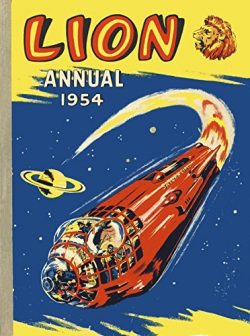
Lion Annual 1954


By Frank S. Pepper, Ron Forbes, Edwin Dale, Ted Cowan, Vernon Crick, & many & various (Amalgamated Press)
No ISBN: Digital edition

The 1950s ushered in a revolution in British comics. With wartime restrictions on printing and paper lifted, a steady stream of new titles emerged from many companies and when The Eagle launched from the Hulton Press in April 1950, the very idea of what weeklies could be altered forever. That kind of oversized prestige package with photogravure colour was exorbitantly expensive however, and when London-based publishing powerhouse Amalgamated Press retaliated with their own equivalent, it was an understandably more economical affair.

I’m assuming they only waited so long before the first issue of Lion launched (cover-dated February 23rd 1952) to see if their flashy rival periodical was going to last. Lion – just like The Eagle – was a mix of prose stories, features and comic strips and even offered its own cover-featured space-farer in Captain Condor – Space Ship Pilot.

Initially edited by Reg Eves, the title ran for 1156 weekly issues until 18th May 1974 when it merged with sister-title Valiant. Along the way, in the approved manner of British comics which subsumed weaker-selling titles to keep popular strips going, Lion absorbed Sun (in 1959) and Champion (1966) before going on to swallow The Eagle in April 1969 before merging with Thunder in 1971. In its capacity as one of the country’s most popular and enduring adventure comics, the last vestiges of Lion finally vanished in 1976 when Valiant was amalgamated with Battle Picture Weekly.

Despite its demise in the mid-70s, there were 30 Lion Annuals between 1953 and 1982, all targeting the lucrative Christmas market, combining a broad variety of original strips with topical and historical prose adventures; sports, science and general interest features; short humour strips and – increasingly in the 1970s – reformatted reprints from IPC/Fleetway’s vast back catalogue.

That’s certainly not the case with this particular item. Forward-dated 1954, but actually published in late 1953, it’s the first counterstrike from AP in the war to own Christmas: a delicious – but occasionally ethno-socially and culturally dated and dubious – dose of traditional comics entertainment. Big on variety, sturdily produced in a starkly potent monochrome, it offers a wide mixed bag of treats to beguile boisterous boys in a rapidly-changing world. What’s especially satisfying is that, current sensibilities notwithstanding, this volume has been digitised and can be bought and read electronically by kids of all vintages today…

I’m sure I don’t need to remind you that these entertainments were produced in good faith with the best of intentions by creators in a culture and at a time very different from ours. Very frequently attitudes and expressions are employed which we now find a little upsetting, but this book is actually one of the better examples of racial, gender and cultural tolerance. Still, even so…

The cornucopia of prose, puzzles, strips and features (all illustrated by artists as photography was too expensive) opens with a rather disturbing but truly lovely painted frontispiece ‘The Redskin Accepts the Challenge’ before a contents page promises astounding wonders to come.

We then rocket into adventure in the future where freedom fighter Captain Condor – by Frank S. Pepper and probably illustrated by original artist Ron Forbes – continues his war against despots running the solar system by solving ‘The Mystery of the Vanished Space-Ship!’ Edwin Dale then provides a prose thriller starring troubleshooter Mr. X, who discovers ‘The Tree that Stopped a Rebellion’ as he traverses the fabled African Veldt…

Presumably scripted by Ted Cowan & illustrated by Barry (R. G. Thomas) Nelson, ‘Sandy Dean’s Prize Guy’ is a comic strip wherein the schoolboy paragon and his chums deal with cheating classmates sabotaging and stealing effigies built to celebrate Guy Fawkes Night. It’s followed by Nigel Dawn’s prose thriller ‘Too Smart for the Atom Spy!’ wherein a schoolboy pigeon fancier foils a cunning espionage plot, after which we segue into a historical action strip credited to George Forrest (Cowan again).

‘The Slaves who Saved the Emperor’ follows two recently escaped British warriors who foil an imperial Roman assassination and is counterbalanced by Tom Stirling’s (E. L. Rosman) humorous text tale ‘Only a Press-Button Champ!’ This sees inventor’s nephew Jingo Jones stir up tons of trouble using his “Invisibliser” to save himself from a bully. Sadly, it also gives his headmaster and a boxing promoter the idea that the skinny runt is a fighting marvel…

‘The Weird Ways of Witch-Doctors Beat the Bush-Rangers’ (possibly by John Donnelly Jr.) shares amazing “facts” about jobbing mages in the post-war world after which John Barnes -AKA Peter O’Donnell – tells prose tale of ‘Chalu the Elephant Boy’ who clears his beloved four-legged co-worker Tooska when the big beast is framed as a murderous rogue animal…

Rex King (A.W. Henderson) delivers comic strip cowboy thrills as cavalry scout exposes a traitor and battles ‘Peril on the Tomahawk Trail’ before ‘Wiz and Lofty – Rescuers of the Kidnapped King’ (by E.L. Rosman as Victor Norman) delivers text thrills and spills as the globetrotting speed merchants stumble into a deadly plot to usurp a kingdom…

Harry Hollinson D.F.C. details and depicts some soon to be commonplace future wonders in speculative feature ‘Scientists Land on the Moon’ after which we pop back to WWII where Edward R. Home-Gall (AKA Edwin Dale) reveals in cartoon form how ‘The Lone Commandos’ scupper hidden Nazi artillery and save British soldiers in ‘Operation Gunfire’ before Vernon Crick shows in prose that ‘Rust’s the Boy for Stunts’: a rousing tale of motorcycle mayhem and skulduggery at a circus’ Wall of Death ride…

A pictorial ‘World-Wide Quiz’ tests your general knowledge before Peter O’Donnell – as Derek Knight – delivers a chilling prose vignette of Arctic endeavour as ‘Tulak Hunts the Polar Terror’, saving lost scientists, capturing murderous outlaws and stalking a killer bear…

A sea strip by A. W. Henderson as Roy Leighton sees schooner skipper Don Watson save pearl divers and solve ‘The Secret of Ju-Ju Island’ whilst Michael Fox’s prose story ‘Mike Merlin – Master of Magic’ details the greatest trick of a schoolboy conjuror before we meet one of British comics’ most enduring stars.

Robot Archie began life as ‘The Jungle Robot’ and his comic strip (by E. George Cowan & Ted/Jim Kearon) reveals how the mechanical marvel becomes the ‘Pal o’ the Pigmies’ before another prose piece by R. G. Thomas sees a western trader and his Native American pal stave off bandits and a hidden tribe of renegades in ‘Rod and the Red Arrow Raiders’

A ‘Picture Parade of Facts from Near and Far’ precedes a text thriller by Hedley Scott (AKA Hedley O’Mant) wherein ‘The Schoolboy Treasure Hunters’ do a bit of digging and uncover presumed pirate gold with a far more modern and sinister provenance, before John Fordice (Colin Robertson) employs the comic strip form to catch ‘The Smash-and-Grab Speedster’, courtesy of consulting crimebuster Brett Marlowe, Detective as he explores the contemporary sporting phenomenon of motorcycle speedway…

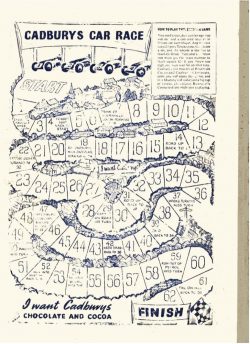
Donald Dane’s prose yarn ‘Kurdo of the Strong Arm’ details the fascinating, action-packed saga of a Viking teenager – from ancient Scotland – stranded in North America hundreds of years before Columbus and leads to all those puzzle answers and final cartoon fact file ‘Fishy Tales – But They’re True!’ before a House Ad for weekly Lion – “The King of Picture Story Papers!’ brings us to the back cover and a sponsored treat: early infotainment treat ‘Cadbury’s Car Race puzzle’.

Sadly, many of the creators remain unknown and uncredited, especially the exceptional artists whose efforts adorn the prose stories, but this remains a solid box of delights for any “bloke of a certain age” seeking to recapture his so-happily uncomplicated youth. It also has the added advantage of being far less likely than other (usually unsavoury) endeavours which, although designed to rekindle the dead past, generally lead to divorce…

Before I go, let’s thank Steve Holland at Bear Alley (link please) and all the other dedicated diligent bods researching and excavating the names and other facts for everyone like me to cite and pretend we’re so clever…

A true taste of days gone by, this is a chance for the curious to test bygone tomes and times and I thoroughly recommend it to your house…
© 1955 the Amalgamated Press and latterly IPC. All rights reserved.

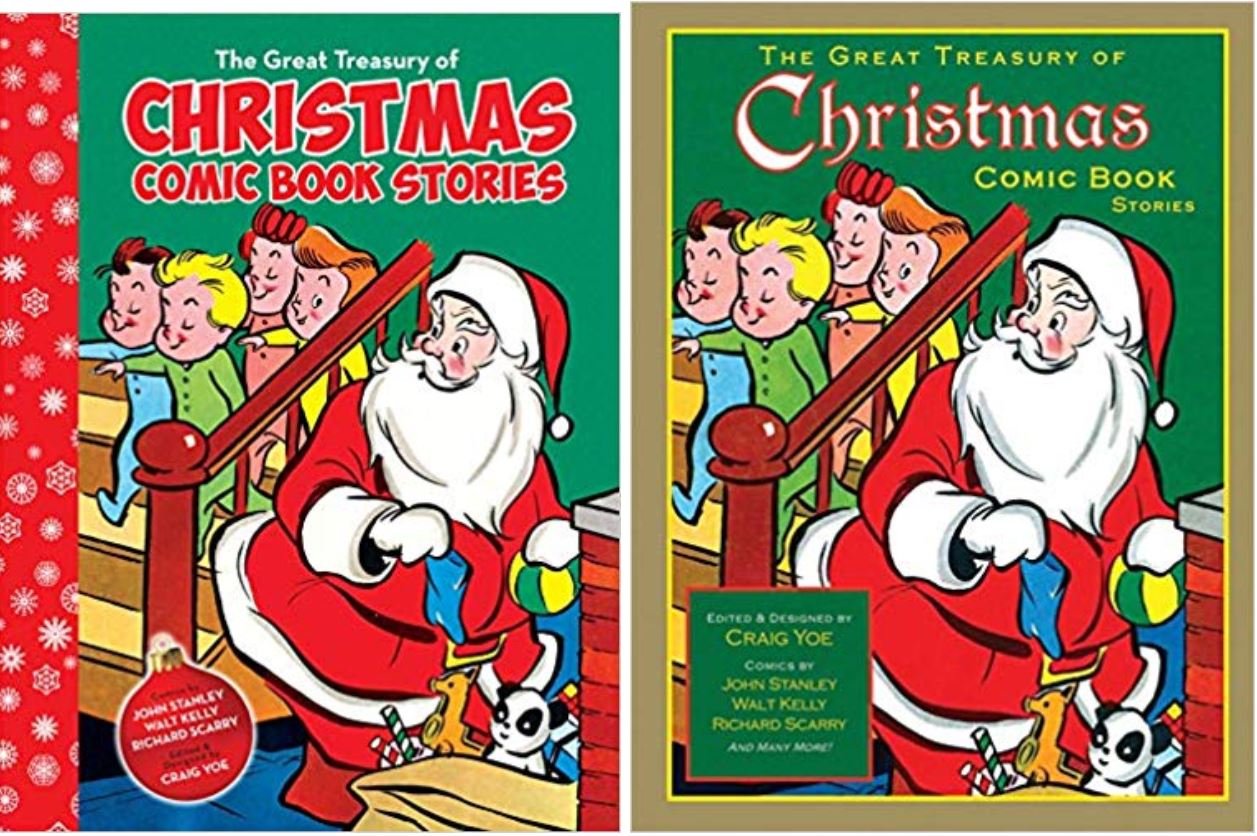
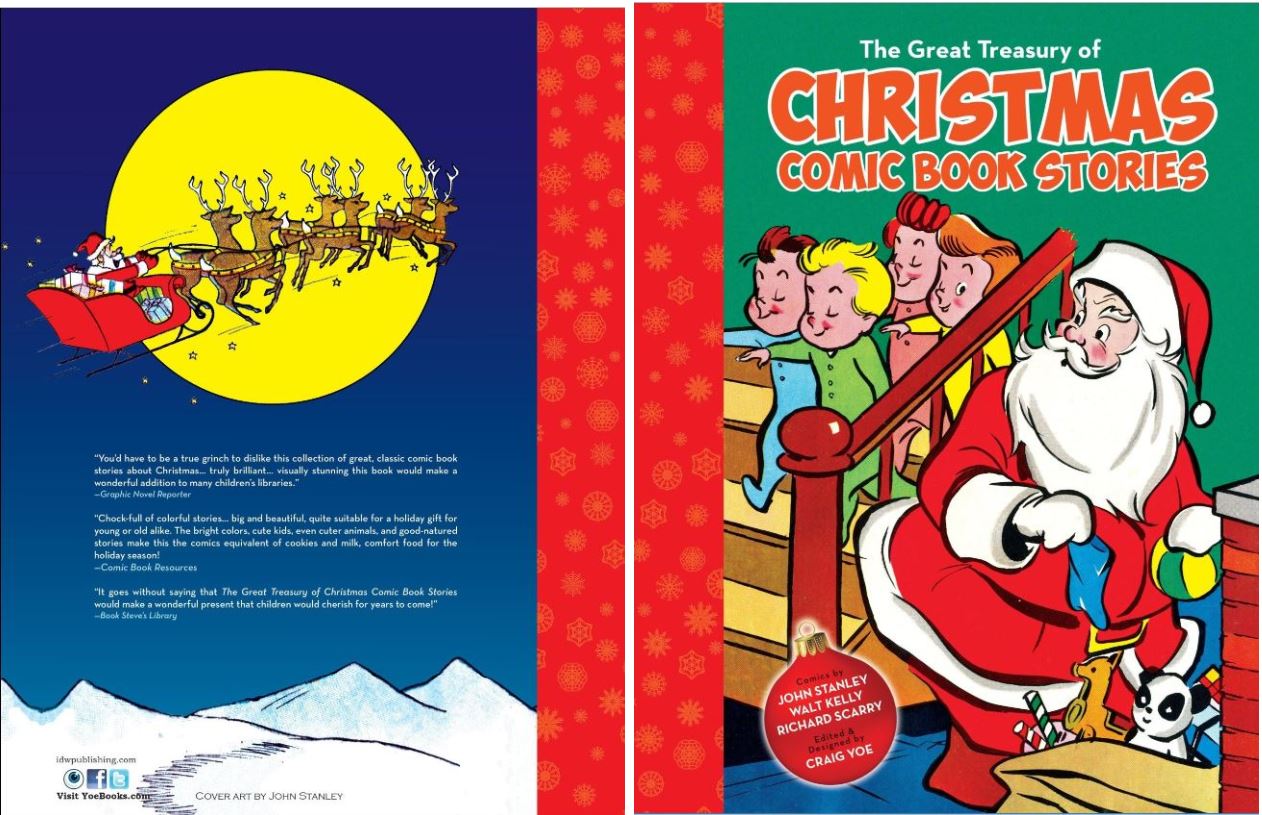
The Great Treasury of Christmas Comic Book Stories


By John Stanley, Walt Kelly, Richard Scarry, Jack Bradbury, Klaus Nordling, Mike Sekowsky, Alberto Giolitti & various: edited and designed by Craig Yoe with Clizia Gussoni (IDW Publishing)
ISBN: 978-1-60010-773-3(HB); 978-1-68405-009-3(TPB); eISBN: 978-1-68406-352-9

Win’s Christmas Gift Recommendation: The Clue is in the Title… 10/10

Justifiably revered for brilliant, landmark newspaper strip Pogo, or perhaps his wonderful Our Gang tales, the incredible Walt Kelly also has a pretty strong claim to owning traditional western culture’s Christmas – at least in terms of childhood experience. From 1942 until he quit comic-books for newsprint, Kelly produced stories and magazines dedicated to the season of Good Will for publishing giant Dell.

Santa Claus Funnies and Christmas with Mother Goose were a Holidays institution in both their Four Color and Dell Giant incarnations, and the sheer beauty and charm of Kelly’s art defined what Christmas should be for generations. Kelly transferred his affinity for the best of all fantasy worlds to the immortal Pogo but still was especially associated with the Festive season. Many publications sought out his special touch. The Christmas 1955 edition of Newsweek even starred Kelly and Co on the cover.

Thanks to dedicated preserver of America’s Comics history Craig Yoe, we can add more great creators and stories to our communal archive of seasonal joy, with this cracking tome celebrating Yuletide comic classics.

Wrapped up here are old masters and vintage delights from Santa Claus Funnies # 61, 91,128, 175, 205, 302, 361, 867, 1154 & 1274 (spanning 1944-1962) plus 1962’s Santa Claus Funnies #1 and material from A Christmas Treasury #1 1954; Sleepy Santa (1948); Ha Ha Comics #49 (1947); Santa and the Pirates (1953); Here Comes Santa (1960); Christmas at the Rotunda, Giant Comics #3 (1957) and Christmas Carnival volume 1 #2 (1954). This superb funfest opens with a silent short by Kelly revealing the Big (in red) Man’s working practice, & Mo Gollub introducing ‘The Christmas Mouse’ (from Santa Clause Funnies #126 and #175) before we enjoy a Seasonal message (illustrated by Mel Millar) revealing ‘Hey Kids, Christmas Comics!’

‘How Santa Got his Red Suit’ is a superbly imaginative, gnome-stuffed origin fable by Kelly from Santa Claus Funnies # 61, after which H.R. Karp & Jack Bradbury reveal the salutary saga of ‘Blitzen, Jr.’ as first seen in Ha Ha Comics #49, whilst a tragically uncredited team disclose in prose-&-picture format the magical adventure of ‘Santa and the Pirates’, taken from a booklet Premium released by Promotional Publishing Co. NYC.

As rendered by the inimitable John Stanley, SCF #1154’s ‘Santa’s Problem’ explores the good intentions and bad habits of polar bears, before Mike Sekowsky contributes a concise, workmanlike adaptation of Charles Dickens’ ‘A Christmas Carol’ (from A Christmas Treasury #1) before Kelly returns with the heart-warming tale of ‘A Mouse in the House’ (SCF #128).

Stanley strikes again with ‘The Helpful Snowman’ (Here Comes Santa) offering aerial assistance to Kris Kringle whilst Christmas at the Rotunda offers a classy version of ‘The Shoemaker and the Elves’ courtesy of Elsa Jane Werner & Richard Scarry, after which cognoscenti can see potent prototypes for Pogo characters in 1945’s ‘Christmas Comes to the Woodland’ (SCF #91): another whimsical Kelly classic.

Imbecilic but well-meaning elf Scamper causes mayhem, prompting ‘Santa’s Return Trip’ in a wry delight from John Stanley & Irving Tripp (from SCF #1274), after which Stanley & Dan Gormley craft an epic voyage for determined rugrats Cathy and David as they deliver ‘A Letter for Santa’ (Santa Claus Funnies #1).

Another masterful Kelly prose-&-picture fable then recounts the sentimental journey of ‘Ticky Tack, the Littlest Reindeer’ (SCF #205) and the animal crackerz continue as a lost puppy finds friendship and a new home in ‘Sooky’s First Christmas’ (Stanley & Gormley from SCF #867)…

Charlton Comics were late to the party for X-mas strips, but their glorious Giant Comics #3 from 1957 provides here both Frank Johnson’s anarchic ‘Lil’ Tomboy in It Was the Day Before Christmas…’ and an extra-length action-packed romp for Al Fago to masterfully orchestrate in ‘Atomic Mouse in The Night before Christmas’. Separating those yarns is a deft updating of Clement Clark Moore’s ubiquitous ode in ‘The Night before Christmas’ by Dan Gormley from A Christmas Treasury #1…

In 1947, Kelly set his sights on consolidating a new Holiday mythology and succeeded with outrageous aplomb in ‘The Great Three-Flavoured Blizzard’ (Santa Claus Funnies #175) as an unseasonal warm spell precipitates a crisis and necessitates the making of a new kind of snow, before fabulous Klaus Nordling contributes a stylish comedy of errors with ‘Joe and Jennifer in the Wonderful Snowhouse’ from Christmas Carnival volume 1 #2.

Bringing things to a close Dan Noonan concocts a staffing crisis for Santa to solve with the aid of ‘Teddy Bear in Toyland’ (SCF #91, 1950) after which we enjoy a moment of sober reflection as ‘The Christmas Story’ – according to St. Matthew’s gospel and illuminated by Alberto Giolitti – (A Christmas Treasury #1) reminds us that for many people it’s not just about loot, excess and fantasy.

Kelly then ushers us out with a brace of end pieces encompassing a poetic hunt for the old boy and a silent silly symphony from ‘The Carollers’

It absolutely baffles me that Kelly and his peers’ unique and universally top-notch Christmas tales – and Batman’s too for that matter – are not re-released every November for the Yule spending spree. Christmas is all about nostalgia and good old days and there is no bigger sentimental sap on the planet than your average comics punter. And once these books are out there their supreme readability will quickly make converts of the rest of the world.

Just you wait and see…
The Great Treasury of Christmas Comic Book Stories © 2018 Gussoni-Yoe Studio, Inc. All Rights Reserved. Material reprinted: Sleepy Santa © 1948 Belda Record & Publishing Co. Ha Ha Comics #49 © Creston Publications Corporation. Santa and the Pirates © 1953 Promotional Publishing Co. NYC. Christmas at the Rotunda © 1955 Ford Motor Company and Artists and Writers Guild, Inc. Giant Comics #3 © 1957 Charlton Comics Group Christmas Carnival vol. 1 #2 St. John Publishing Corp. ©1954. © Western Printing & Lithographing Co. 1948, 1950, 1951, 1954, 1957, 1960, 1961, 1962. © 1944, 1945, 1946, 1947, Oscar Lebek/Dell Publishing, Western Printing & Lithographing Co.

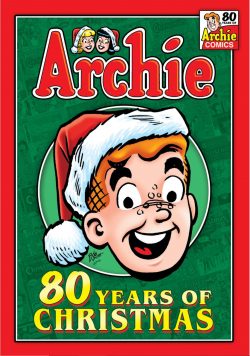
Archie: 80 Years of Christmas (Archie Christmas Digests book 3)


By Dan Parent, Angelo DeCesare, Francis Bonnet, Pat & Tim Kennedy, Bill & Ben Galvan, Jeff Shultz, J. Torres, Hal Lifson, Bob Bolling, Mike Pellowski, Dexter Taylor, Kathleen Webb, Dan DeCarlo & family, Stan Goldberg, Henry Scarpelli, Holly G!, John Lowe, Rudy Lapick, Frank Doyle, Dan DeCarlo, Alison Flood, George Gladir, Jon D’Agostino, Joe Edwards, Chic Stone, John Rosenberger, Dick Malmgren, Al Hartley, Joe Sinnott, Victor Gorelick, Bill Vigoda, Terry Szenics, Mario Acquaviva, Harry Lucey, Tom Moore, Harry Sahle, Bob Montana & various (Archie Comics)
ISBN: 978-1-64576-927-9 (TPB/Digital edition)

Win’s Christmas Gift Recommendation: An Unmissable Tradition… 9/10

As long-term readers might recall, my good lady wife and I have a family ritual we’re not ashamed to boast of or share with you. Every Christmas, we barricade the doors, draw the shutters, stockpile munchies (healthy ones, because we’re old now), bank up the fires and lazily subside into a huge pile of seasonal comics from yesteryear.

(Well, I do: she also insists on a few monumental feats of cleaning and shopping before manufacturing the world’s most glorious and stupefying meal to accompany my reading, gorging and – eventually, inevitably – snoring… Oh, so much snoring and from all ends!)

The irresistible trove of funnybook treasures generally comprises older DC’s, loads of Disney’s and British annuals, but the vast preponderance is Archie Comics.

From the earliest days this American institution has quite literally “owned Christmas” via a fabulously funny, nostalgically charming, sentimental barrage of cannily-crafted stories capturing the spirit of the season through a range of cartoon stars from Archie to Veronica, Betty to Sabrina and Jughead to Santa himself…

For most of us, when we say “comic books” thoughts turn to anthropomorphic animals or steroidal types, and women in too-skimpy tights and G-strings: hitting each other, bending lampposts and lobbing trees or cars about. That or stark, nihilistic crime, horror or science fiction sagas aimed at an extremely mature and sophisticated readership of confirmed fans…

Throughout the eight decades of the medium, other forms and genres have waxed and waned. One that has held its ground over the years – although almost completely migrated to TV these days – is the genre of teen-comedy, begun by and synonymous with a carrot topped, homely (at first, just plain ugly) kid named Archie Andrews.

MLJ were a small publisher who jumped on the “mystery-man” bandwagon following the debut of Superman. In November 1939 they launched Blue Ribbon Comics, promptly following-up with Top-Notch and Pep Comics. Content was a standard blend of costumed heroes and two-fisted adventure strips, although Pep did make a little history with its first lead feature The Shield, who was the American industry’s first superhero to be clad in the flag (see America’s 1st Patriotic Hero: The Shield).

After initially revelling in the limitless benefits of the Fights ‘N’ Tights game, Maurice Coyne, Louis Silberkleit and John Goldwater (MLJ, duh!) spotted a gap in their blossoming market. In December 1941 their stable of costumed cavorters and two-fisted adventurers were gently nudged aside – just a fraction at first – by a wholesome, improbable and far-from-imposing new hero: an unremarkable (except, perhaps, for those teeth) teenager who had ordinary adventures just like the readers might, but with the laughs, good times, romance and slapstick emphasised.

Inspired by the hugely popular Andy Hardy movies, Goldwater developed the concept of a youthful everyman protagonist: tasking writer Vic Bloom & artist Bob Montana with the job of making it all work. Their precocious new notion premiered in Pep #22: gap-toothed, freckle-faced, red-headed and obsessed with impressing the pretty blonde girl next door.

An untitled 6-page tale introduced hapless boob Archie and wholesome Betty Cooper. The boy’s unconventional best friend and confidante Jughead Jones also debuted in the story, as did idyllic small-town utopia Riverdale. It was a huge hit and by the winter of 1942 the kid and his pals won a title of their own.

Archie Comics #1 was MLJ’s first non-anthology title and with it began a slow, inexorable transformation of the entire company. With the introduction of ultra-rich, raven-haired Veronica Lodge, all the pieces were in play for the industry’s second Genuine Phenomenon…

By 1946, the kids were in charge and the publisher rebranded as Archie Comics: retiring most of its costumed cohort years before the end of the Golden Age, becoming to all intents and purposes a publisher of family-friendly comedies. The hometown settings and perpetually fruitful premise of an Eternal Romantic Triangle – with girl-hating best bud Jughead and scurrilous rival Reggie Mantle to test, duel and vex our boy in their own unique ways – the scenario was one that not only resonated with the readership but was infinitely fresh…

Like Superman, Archie’s success forced change in content at almost every other publisher, building a multi-media brand which encompasses TV, movies, newspaper strips, toys, games and merchandise, a chain of restaurants and, in the swinging sixties, a pop music milestone when Sugar, Sugar – from the animated TV cartoon – became a global pop smash. Clean and decent garage band “The Archies” has been a fixture of the comics ever since…

The Andrews boy is good-hearted, impetuous and lacking common sense, Betty his sensible, pretty girl next door loves the ginger goof, and Veronica is rich, exotic and glamorous: only settling for our boy if there’s nobody better around. She might actually love him too, though. Archie, of course, is utterly unable to choose who or what he wants. Over the years, other girls like Cheryl Blossom and pop Pussycat Valerie have also added to his confusion…

Unconventional, food-crazy Jughead is Mercutio to Archie’s Romeo, providing rationality and a reader’s voice, as well as being a powerful catalyst of events in his own right. That charming House of Luurve (and Annexe of Envy) has been the rock-solid foundation for seven decades of funnybook magic. Moreover, the concept is eternally self-renewing…

This eternal triangle has generated thousands of charming, rowdy, gentle, frenetic, chiding and even heart-rending humorous dramas ranging from surreal wit to frantic slapstick, with the kids and a constantly expanding cast of friends – junior genius Dilton Doily, genial giant jock Big Moose and aspiring cartoonist Chuck amongst many others – growing into American institutions and part of the nation’s cultural landscape.

Archie’s world thrives by constantly re-imagining its core archetypes: seamlessly adapting to the changing world outside its bright, flimsy pages, shamelessly co-opting youth, pop culture and fashion trends into its infallible mix of slapstick and young romance. Every social revolution has been assimilated into the mix and, over decades, the company has confronted most social issues affecting youngsters in a manner always both even-handed and tasteful.

Constant addition of new characters such as African-Americans Chuck and his girlfriend Nancy, fashion-diva Ginger, Latinx couple Frankie and Maria, spoiled Cheryl Blossom and gay teen Kevin Keller have contributed to a wide and appealingly broad-minded scenario.

One of the most effective tools in the company’s arsenal has been the never-failing appeal of seasonal and holiday traditions. In Riverdale it was always sunny enough to surf at the beach in summer and it always snowed at Christmas…

The Festive Season has never failed to produce great comics stories, and Archie also started early (1942) and kept on producing memorable year-end classics. The stories became so popular and eagerly anticipated that in 1954 the company created a specific oversized title – Archie’s Christmas Stocking – to cater to demand, even as it kept the winter months of its other periodicals stuffed with assorted tales of elves and snow and fine fellow-feeling…

For this extra-festive celebratory commemoration, the editors have done something rather smart and savvy. Most collections – and there have been many – have advanced forward chronologically to whenever “now” is, but this one postulates a countdown back to the earliest natal nonsense, and thus we begin with a selection from The 2020s, but only after brief overview ‘80 Years of Holiday Hijinks’

Santa’s globetrotting troubleshooter Jingles the Elf – who cannot be seen by adults – has been a seasonal Archie regular for decades. Here Dan Parent & Jim Amash – with colourist Glenn Whitmore & letterer Jack Morelli – reveal ‘That Elf is Shelved!’ (from Archie Comics Jumbo Digest #315, January 2021) as the playful but exhausted pixie pops in to Riverdale and becomes a helpless tool of Archie’s inability to pick just one girl…

Betty & Veronica Jumbo Comics Digest #289 (January 2021) declares ‘You’re Baking Me Crazy!!’ as Parent, Bob Smith, Whitmore & Morelli depict the eternal rivals competing to create the best Gingerbread House, but making a cookie rookie mistake by letting Jughead judge…

The same creative team unleashed a ‘Blast From the Past’ (World of Archie Jumbo Comics Digest #315, December 2020) as the gang help Pop Tate decorate his diner and recall when they all made him ornaments. It was soooo long ago, but soon they’re squabbling over which one was best …and best-beloved…

Archie Comics Jumbo Digest #304 (January 2020), finds Angelo DeCesare, the Kennedy Bros!, Smith, Whitmore & Morelli introducing old-fashioned Dad Andrews to social media in ‘Yule Tube’ after which ‘It’s the Thoughtlessness That Counts’ (World of Archie Jumbo Comics Digest #94, January 2020 by Francis Bonnet, Bill & Ben Galvan) again sees Archie reel from misdirecting his gifts…

Distant decade The 2010s opens with ‘Santa Sleighed’ (Archie & Me Comics Digest #12, November 2018 by Parent, Jeff Shultz, Jim Amash, Whitmore & Morelli) as the fabled deliveryman makes an unscheduled pit stop at the Lodge mansion, before Little Archie makes trouble – and a big mess – trying to impress grade schoolers Betty & Veronica in ‘Snow Problem!’, courtesy of J. Torres, Bob Bolling & Amash as first seen in Archie Comics Double Digest #257 (February 2015). The era ends with Hal Lifson, Bill Galvan Amash, Phil Felix & Barry Grossman conjuring ‘An Old School Yule’ (Archie Double Digest #233, December 2011) with the world-weary teens recalling their childhoods when Christmas was fun, and going attic and basement diving to reconstruct a Christmas their parents can actually enjoy…

Stopping our retrograde voyage in The 2000s, ‘Christmas Cookies’ stars Little Jughead in a foody fable by Mike Pellowski, Dexter Taylor, Al Milgrom, Bill Yoshida & Grossman. It comes from Archie’s Double Digest Magazine #148 (February 2004) and sees the entire class required to create an original Holidays dish. Juggie’s is exceptional and its effects are global – even reaching Santa at the Pole…

That darned attention-seeking elf returns in ‘Jingles All the Way’ (Archie #543, February 2004, by Kathleen Webb, Stan Goldberg, Amash, Vickie Williams & Grossman), trying to pry Archie away from Betty & Veronica for some guy time and good deeds. However, its greedy Jughead who finds somewhere the pixie can really make a difference…

Archie’s Holiday Fun Digest Magazine #9 (December 2004) provides Betty & Veronica’s Holiday Style’ pinups by Parent, as a prelude to Webb, Shultz, Henry Scarpelli & Yoshida celebrating ‘A Dreamy Teen Christmas’ (Betty & Veronica #156, February 2001), with the rivals asked to decorate a very special tree for a charity bash, but unable to cease sparring over Archie…

Cheryl Blossom #28 (January 2000, by Holly G!, John Lowe, Yoshida & Grossman) finds Riverdale’s most spoiled brat in a war of excess with Veronica. Their flashy cash contest seeks to prove who’s swankiest, but the ‘Holi-Daze’ leave Betty and the plebian kids better off. Then The 1990s test failing memories with feelgood drama ‘Mall Be Home for Christmas’ (Archie & Friends #13, February 1995, by Parent, Rudy Lapick, Yoshida & Grossman), as Ronnie’s up-to-the-wire shopping spree coincides with a freak storm, trapping the entire class in a plush arcade on Christmas: Happily, money solves all problems…

Archie’s Christmas Stocking #1 (January 1995, by Frank Doyle, Dan DeCarlo, Alison Flood, Yoshida & Grossman) delivered ‘A Jingle for Justice’ as the elf’s seasonal sojourn uncovers an embezzler attempting to impoverish Veronica’s dad, after which Little Archie learns how poor people survive the season. Thanks to impoverished Sue Stringly, the kind-hearted but naïve little lad learns some hard truths and grows into a better boy in ‘Shine a Little Light’ (Archie Giant Series Magazine #607, January 1990 by Bolling, Mike Esposito, Yoshida & Grossman).

The 1980s offers pictures of Christmas pasts in ‘Archie’s Christmas Photo Album’ by George Gladir, Parent & Jim DeCarlo as first seen in Archie… Archie Andrews, Where Are You? Comics Digest Magazine #54, February 1988), before Joe Edwards & Dan DeCarlo, explore ‘Christmas Past, Present and Future’ when Ronnie mistakenly thinks Daddy is selling up and moving them out. Archie and Me #161 (February 1987, by Gladir, Chic Stone, Lapick, Yoshida & Grossman) sees Archie accidentally prevent school being closed with his lucky ‘Goof Spoof’, after which teen witch Sabrina learns how her aunts are crucial to Santa’s big night in ‘With a Little Help From His Friends’ (Archie Giant Series Magazine #515, January 1982 by Gladir, Goldberg & Jon D’Agostino). Issue #512 (December 1981) then details Archie’s rejection of faux yule logs and subsequent calamity in search of the real deal in ‘Christmas List’ by Gladir, Goldberg, Lapick, Yoshida & Grossman…

Little Archie #163 (February 1981 by Bolling & Grossman) then saw Little Veronica learn some hard truths of her own when Sue Stringly recruited her to help save ‘The Christmas Ducks’ before the decade closed with silly but satisfying sight gag ‘Carry Tarry’ courtesy of Archie’s Jokebook Magazine #265, February 1980…

The 1970s opens with ‘Christmas Togetherness’ by Doyle, Dan DeCarlo Jr. with Jimmy DeCarlo & Yoshida from Archie Giant Series Magazine #488 (December 1979), as the red-headed fool ponders the perfect gift for mom and dad, after which Sabrina and her family cleverly divert Head Witch Della’s plan to sabotage the Season in ‘And a Zappy New Year’ (AGSM #479, January 1979, by Gladir, Dan DeCarlo, Lapick, Yoshida & Grossman). The previous issue, released the same month, offered a traditional comedy of errors as the easily-distracted Andrews boy got his parcels mixed up in ‘Wisecracker’ by Dick Malmgren, D’Agostino & Grossman, before January 1975 unwraps Doyle, DeCarlo & Lapick’s ‘Plastic Santa’ (AGSM #230) as Mr Lodge is bombarded by the kids’ polemic about the meaning of the Season and still finds a way to make a profit…

AGSM #192 (January 1972) explored ‘Past and Present’ in a yarn by Al Hartley, Joe Sinnott & Yoshida wherein shopping-traumatised Archie hallucinates about the good old, pre-industrial days, coincidentally heralding the jump to The 1960s

Hartley went solo on gag strip ‘Make Their Christmas Wish’ from AGSM #150 (January 1968), followed by Doyle, Goldberg, Vince DeCarlo, Yoshida & Grossman’s ‘Party Pooper’ from the same issue as Archie suffers greatly to organise a surprise soiree for his parents, and Gladir, John Rosenberger & Victor Gorelick’s ‘Gift Tift’ (AGSM #144, January 1967) wherein conniving Reggie outsmarts himself in the cold war to win Ronnie away from Archie…

AGSM #31 (January 1965) offers a ‘Betty Pin Up’ by assorted DeCarlo’s & Lapick before #20 (January 1963) sees everyone trying to get at Archie’s ‘Black Book Bonanza’ in a wild romp by Doyle, DeCarlo’s & Lapick, after which the same team in the same title see Reggie ‘Go For Broke’ after ruining Archie’s flashy perfume gift and reaping a whirlwind of pungent regret.

Staying with AGSM #20, Doyle, Bill Vigoda, Terry Szenics & Grossman continue Reggie’s agonising learning curve as ‘Not Even a Moose’ finds him playing foolish pranks on the naïve, short-tempered giant. The prankster discovers the dangers of telling innocent people there is such a man as Santa…

Veronica’s ‘Pin Up Page’ by Dan DeCarlo from AGSM #15 (January 1962) then segues into gag page ‘Gift Rapped’ (Archie’s Jokebook Magazine #52, February 1961), detouring to AGSM #10 (January 1961, by Vigoda & Mario Acquaviva) where the red menace fumbles a ‘Gift Collection’ and trashes Christmas for the entire school. The period closes with Tom Moore’s gag page from the same issue proving rival Reg and Arch have ‘More Pull Than Talent!’

Heading rapidly for the opening stretch, we explore the feature’s golden age of The 1950s beginning with a wily witticism by slapstick genius Harry Lucey who reveals ‘Santa’s Surplus’ in a certified classic from Archie’s Jokebook Magazine #39 (March 1959), whilst Archie #98 (February 1959) shares Vigoda’s take on Shopping with Veronica in ‘Package Deal’ and Doyle, Lucey & Grossman’s skating themed fiasco ‘Deep Freeze’

Vigoda, Acquaviva & Grossman crafted party panic in ‘Tree to Get Ready’ (Archie’s Girls Betty and Veronica #40, January 1959) before the age of optimism ends with ‘Dis-Missile’ by Doyle, Dan and Vince DeCarlo & Lapick from AGSM #4 (1957) as our helpful B&V coordinate school letters to Santa and trigger a clerical crisis…

We end as it all began in The 1940s where Harry Sahle crafted ‘Mush, Oscar!, Mush!’ for Archie #12 (Winter 1944). Starring Archie’s Dog Oscar it again proved that – although well-intentioned – even the pets in the Andrews home were disaster magnets – especially if there was snow on the ground and ice on the pond…

We close with ‘The Case of the Missing Mistletoe!’ from Winter 1942 by Bob Montana. It featured in Archie #1, and found Archie and Jughead more baffled than ever and at loggerheads after unknowingly taking identical twins to a Christmas party…

These are joyously effective and entertaining tales for young and old alike, crafted by some of Santa’s most talented Helpers, epitomising the magic of the Season and celebrating the perfect wonder of timeless all-ages storytelling. What kind of Grinch could not want this book in their kids’ stocking (from where it can most easily be borrowed)?
© 2021 Archie Comics Publications, Inc. All rights reserved.

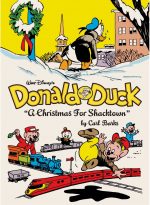
Walt Disney’s Donald Duck by Carl Barks volume 11: Christmas For Shacktown


By Carl Barks & various (Fantagraphics Books)
ISBN: 978-1-60699-574-7 (HB/Digital edition)

Win’s Christmas Gift Recommendation: Utter Acme of All-Ages Entertainment… 10/10

Carl Barks was born in Merrill, Oregon in 1901, growing up in the rural areas of the West during some of the leanest times in American history. He tried his hand at many jobs before settling into the profession that chose him. His early life is well-documented elsewhere if you crave detail, but briefly, Barks worked as an animator at Disney’s studio before quitting in 1942 to work in the new-fangled field of comic books.

With studio partner Jack Hannah (another animator turned occasional strip illustrator) Barks adapted a Bob Karp script for a cartoon short into Donald Duck Finds Pirate Gold. It was published in October of that year as Dell Four Color Comics Series II #9 and – although not his first published comics work – was the story that shaped the rest of Barks’ career.

From then until his official retirement in the mid-1960s, he worked in self-imposed seclusion, writing, drawing and devising a vast array of adventure comedies, gags, yarns and covers that gelled into a Duck Universe of memorable and highly bankable characters, including Gladstone Gander (1948), the Beagle Boys (1951), Gyro Gearloose (1952) and Magica De Spell (1961) to supplement Disney’s stable of illustrated actors.

His greatest creation was undoubtedly the crusty, paternalistic, money-mad giga-gazillionaire Scrooge McDuck: world’s wealthiest septuagenarian waterfowl and the harassed, hard-pressed, scene-swiping co-star of this tome.

Whilst producing all that landmark material, Barks was just a working guy, crafting covers, drawing other people’s scripts and contributing his stories to a burgeoning canon of Duck Lore. Only in the 1980s – after Gladstone Publishing began re-packaging his work and other Disney strips – did Barks discover the devoted appreciation he never imagined existed…

So potent were his creations that they inevitably fed back into Disney’s animation output, even though his brilliant comics were produced for licensing company Dell/Gold Key, and not directly for the Disney studio. The greatest tribute was undoubtedly the animated series Duck Tales: heavily based on his Scrooge comics output.

Barks was a fan of wholesome action, unsolved mysteries and epics of exploration, and this led to him perfecting the art and technique of the comedy blockbuster: blending wit, history, science, plucky bravado and sheer wide-eyed wonder into rollicking rollercoaster romps which captivated readers of every age and vintage. Without the Barks expeditions, there would never have been an Indiana Jones

Throughout his working life, Barks was blissfully unaware that his efforts – uncredited by official policy as was all Disney’s strip and comic book output – had been singled out by a rabidly discerning public as being by “the Good Duck Artist”. When some of his most dedicated fans finally tracked him down, Barks’ belated celebrity began.

In 2013 Fantagraphics Books started collecting his Duck materials in carefully curated archival volumes, tracing the output approximately year-by-year in hardback tomes and digital editions that finally did justice to the quiet creator. These will eventually comprise the Complete Carl Barks Disney Library

The physical copies are sturdy and luxurious albums – 193 x 261 mm – that would grace any bookshelf, with volume 5 – Walt Disney’s Donald Duck: “Christmas on Bear Mountain” (for reasons irrelevant here) acting as debut release and showcasing works from 1947. Today we’re revisiting 1951-1952, with volume 11 offering another landmark Seasonal tale that critically reshaped the supposedly throwaway, 2-dimensional miser into the richly rounded character beloved by billions…

It begins eponymously with Bark’s most enduring creation in top form. The elder McDuck had debuted in ‘Christmas on Bear Mountain’ (Four Color #178, December 1947): a handy comedy foil stemming from a Yuletide tale of woe and joy. He was a miserly relative who seethed in opulent isolation, hating everybody and meanly opting to share the gloom by tormenting his nephew Donald and his junior houseguests Huey, Louie and Dewey – by gifting them his mountain cabin for the Holidays. Scrooge schemed, intent on terrorising them in a bear costume, but fate had other ideas…

After the tale ended Barks realised that although the old coot was creepy, menacing and money-mad, he was also energetic and oddly lovable – and thus far too potentially valuable to be misspent or thrown away. Further appearances proved that he was right and his expedient maguffin was undoubtedly his greatest cartoon creation. The Downy Dodecadillionaire returned often, eventually expanding to fill all available space in tales set in the scenic metropolis of Duckburg.

Here. shifted slightly out of publishing chronology – because McDuck is not about wasting time or money – we open eponymously with the lead tale from Four Color #367. Cover-dated January 1952, ‘A Christmas For Shacktown’ begins as Donald’s nephews take a detour through the bad side of town and realise they cannot allow all the poverty-stricken children they see endure a festive season without food or toys…

Their discussion also inspires Daisy Duck, who resolves to organise a solution, and before long her women’s club is tapping Duckburg’s citizens for contributions. Daisy herself asks Donald – who’s experiencing a personal cashflow crisis and can’t afford his own Yule celebrations – who might make up her final $50 shortfall. When the nephews suggest Scrooge McDuck, Donald is reluctantly despatched to beg a donation, and does not relish the conversation…

That last 50 bucks is to buy turkeys and provide the joyless waifs with a train set, but after a titanic tussle, Donald can only get the skinflint to agree to $25… and that’s only for the food, not silly fripperies like toys…

Rapidly regrouping, Donald and Daisy are overwhelmed when the nephews hand over their savings and tell their “Unca Donald” to similarly donate the money put aside for their presents, but it’s still not enough and the trio then head off to shovel snow from sidewalks to make up the difference.

Ashamed and emboldened, Donald resolves to get what’s needed from Scrooge, embarking upon a series of increasingly wild stunts – including recruiting despicable rival Gladstone Gander – that culminates in disaster when Scrooge’s overloaded money vault collapses under the weight of its own reserves, plunging his entire fortune into the bowels of the Earth.

Confronted with penury, the despondent tycoon is saved by Donald and the boys who devise a means of retrieving the loot which gives the miser a new perspective on the value of toys: a view that rightly translates into Shacktown enjoying the best Christmas ever…

A month prior to that yarn, anthological Walt Disney Comics & Stories #135 (cover-dated December 1951) featured The Big Bin on Killmotor Hill’ wherein the old money magnate debuted his monolithic money bin, and invites Donald and the boys to inspect it… if they can get past all his baroque and byzantine security measures. Sadly, the visit also inspires the dastardly Beagle Boys to try to empty it…

WDC&S #136 (January 1952) then finds Donald suffering a braggart’s boasts again as his despised super-lucky rival recounts ‘Gladstone’s Usual Good Year’. Driven to distraction, Donald resorts to cheating just to raise his own spirits and something very unlikely occurs…

For #137, Donald and the nephews head to the mountains after he sells a song. Sadly, ‘The Screaming Cowboy’ is a particularly annoying tune that Donald smugly plays on every juke box in the region: the ominously named Avalanche Valley…

Scrooge returned in (WDC&S #138 March 1952), acting in a most uncharacteristic manner as ‘Statuesque Spendthrifts’ revealed him locked in financial combat with the proudly philanthropic Maharajah of Howduyustan to prove who was truly “the richest man in the world”. The battle revolved around who could donate the most ornate, ostentatious and gaudy monument of Duckburg’s founder…

When Huey, Dewey & Louie’s latest hobby – racing pigeons – inspires Donald’s disdain, the mean Unca attempts to sabotage and gaslight them, but learns his lesson when ‘Rocket Wing Saves the Day’ (WDC&S #139, April) after he has an accident…

The family – and even outrageous inventor Gyro Gearloose – are united in WDC&S #140, working to uncover annoying wastrel ‘Gladstone’s Terrible Secret’, and the chaos-creating boffin is back in #141, much to Donald’s dismay and the nephews’ delight: upsetting the natural order with machines giving beasts human attributes in ‘The Think Box Bollix’

Four Color #408 (July/August 1952) was an All-Donald/All Barks affair and opens with a brace of single page gags, starting with ‘Full-Service Windows’ as the wily retailer finds a cheap and easy way to clean his shop front and compounding interest with ‘Rigged-Up Roller’ (alternately called ‘Rigged Up Lawn’) wherein the nephews must find a new way to keep the yard maintained…

The main event was extended action adventure ‘The Golden Helmet’ wherein bored museum guard Donald stops a suspicious individual poking about in a Viking longship and uncovers a hidden deerskin map. It reveals how explorer Olaf the Blue discovered America in 901 AD, and left a golden helmet which confirms when and how the nation was born.

The museum authorities are exultant… but only until the meddler returns with his lawyer Sharky. Azure Blue claims to be the descendant of Olaf and invokes the ancient “code of discovery” law. It dictates that as proof of the event, the helmet also confers ownership of the continent on the heirs… but only if Azure finds it first…

Almost resenting his earlier dreams of adventure, Donald recruits his nephews and dashes off with the museum curator to Labrador. They are all intent on saving Americans from becoming Blue’s slaves: battling deadly weather, constant misfortune and the machinations of Azure and Sharky in a superb action romp anticipating, Dan Brown, The Librarian and the National Treasure screen franchise…

The fun finishes with Donald’s Nephews ‘Awash in Success’ beside a faulty drinking fountain, counterbalanced by a Donald and Scrooge single from Four Color #422, (cover-dated September/October 1952) with the money-wise miser benefitting from bulk buying in ‘Stable Prices’.

Back on track and sampling Walt Disney Comics & Stories (#142, July 1952) sees Donald drag the kids on a ‘Houseboat Holiday’ to keep their summer vacation pranks and hijinks at a manageable level. Instead, he finds himself at the centre of a storm of freak calamities and life-threatening disasters. Its only marginally less fraught one month later when he takes them to the desert as ‘Gemstone Hunters’ and is bamboozled by cunning fraudsters and again humiliated by Gladstone…

The remainder of Four Color #422 follows, opening with a follow-up action excursion. In ‘The Gilded Man’ avid stamp collector Donald believes he’s tracked down a hugely valuable item and heads for British Guiana, with the nephews in tow and Gladstone hot on his trail.

The quest is for fabled El Dorado, and the jungle trek ultimately leads them to victory of a sort after exposing the secrets of the ancient golden god…

Two more one-pagers wrap up the issue: detailing correct precautions for saving a cat in ‘Armored Rescue’ before adapting an old idea to avoid social commitments in ‘Crafty Corner’

Scrooge stole the spotlight again in WDC&S #144 (September) as another storage crisis in his vault compelled the old bird to try and learn a new trick. In an effort to make room, he hires insanely profligate Donald to share the secret of ‘Spending Money’ but is far from satisfied with what he learns…

The story portion of this tome terminates with the remainder of Four Color #367, with ‘Treeing Off’ showing how the nephews brighten up the Christmas decorating, after which Donald pays the price for presumption with mistletoe in ‘Christmas Kiss’ and the boys have the last word when adapting modern science to list writing in ‘Projecting Desires’ (AKA ‘Stamp-Sized Christmas List’).

The comics are augmented by a sublime Cover Gallery proving the Master’s gift for visual one-liners in Four Color (volume II) 367, 408 & 422, and Walt Disney Comics & Stories#135-144 which intercut context, commentary and validation in ‘Story Notes’ for each Duck tale gathered here. Following Donald Ault’s essay ‘Carl Barks: Life Among the Ducks’, ‘Biographies’ then introduces commentators Ault, R, Fiore, Craig Fischer, Jared Gardner, Rich Kreiner, Ken Parille, Stefano Priarone and Matthias Wivel and why they’re saying all those nice and informative things. We close as ever with an examination of provenance in ‘Where Did These Duck Stories First Appear?’

Carl Barks was one of the greatest exponents of comic art the world has ever seen, with almost all his work featuring Disney’s Duck characters: reaching and affecting untold billions across the world. You might be late to the party but don’t be scared: it’s never too late to climb aboard the Barks Express.

Walt Disney’s Donald Duck “A Christmas For Shacktown” © 2012 Disney Enterprises, Inc. All contents © 2015 Disney Enterprises, Inc. unless otherwise noted. All rights reserved.
 

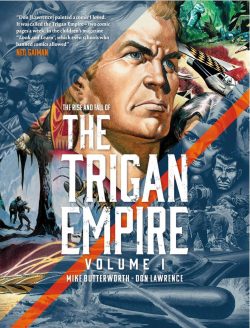
The Rise and Fall of the Trigan Empire volume 1


By Mike Butterworth & Don Lawrence & various (Rebellion Studios)
ISBN: 978-1-78108-755-8 (TPB/Digital edition)

Win’s Christmas Gift Recommendation: Classic Boys Own Nostalgia… 9/10

For British – and Dutch – readers of a certain age and prone to debilitating nostalgia, The Trigan Empire (or The Rise and Fall of the Trigan Empire to give it its ponderous full title) was only ever about two things: boyish wish-fulfilment and staggeringly beautiful art.

The strip was created by Senior Group Editor Leonard Matthews and given to the editor of Sun and Comet to develop and continue. A trained artist, Mike Butterworth became writer of many historical strips such as Buffalo Bill, Max Bravo, the Happy Hussar, Battler Britton and Billy the Kid – and latterly a crime and Gothic Romance novelist with more than 20 books to his pen names.

Based in equal part on cinematic Sword & Sandal/Biblical epics and space age fascination of a planet counting down to a moonshot, for the saga Butterworth combined his love of the past, a contemporary comics trend for science fiction and the long-established movie genre of manly blockbusters to construct a vast sprawling serial of heroic expansionism, two-fisted warriors, wild beasts, deadly monsters and even occasionally the odd female.

The other huge influence on the series was the fantasy fiction of Edgar Rice Burroughs (especially John Carter of Mars and Pellucidar) but without his concentration on strong and/or blatantly sexy women – usually as prizes for his heroes to save. In the formative days of the Trigan Empire, ladies dressed decorously, minded their manners and were dutiful wives or nurses… unless they were evil, vindictive or conniving…

The compellingly addictive, all-action thematic precursor to Warhammer, Civilisation and Warcraft might have been a short run venture had it not been for the art. The primary illustrator was Don Lawrence (Marvelman, Wells Fargo, Billy the Kid, Karl the Viking, Fireball XL5, Maroc the Mighty, Olac the Gladiator, The Adventures of Tarzan, adult comedy strip Carrie and his multi-volume Dutch magnum opus Storm), who painted each weekly instalment.

Initially he used watercolours before switching to quicker-drying gouaches, rendered in a formal, hyper-realistic style that still left room for stylistic caricature and wild fantasy: one that made each lush backdrop and magnificent cityscape a pure treasure. Other, later artists included Ron Embleton, Miguel Quesada, Philip Cork, Gerry Wood and Oliver “Zack” Frey, as the strip notched up 854 weekly instalments, beginning in September 1965 and only ending in 1982. Along the way, it had also appeared in Annuals and Specials and become a sensation in translated syndication across Europe. Even after it ended, the adventure continued: in reprint form, appearing in the UK in Vulcan and across the world; in two Dutch radio plays; collected editions sold in numerous languages; a proposed US TV show and numerous collected editions from 1973 onwards. Surely someone must have a movie option in process: if only Kirk Douglas, Burt Lancaster and Tony Curtis were still around, we could completely close the creative circle…

Lawrence (17th November 1928-29th December 2003) inspired a host of artists such as Brian Bolland and Dave Gibbons, but as he worked into the 1990s, his eyesight was increasingly hindered by cataracts and he took on and trained apprentices such as Chris Weston and Liam Sharp (who offers his own potent reminiscences in the Introduction to this first archival volume from Rebellion Studios’ Treasury of British Comics). Sharp collaborated with the venerable artist on his last Storm stories…

Inescapably mired in powerful nostalgia, but also standing up remarkably well on its own merits, this first collected volume re-presents the series from its enigmatic opening in high-end glossy tabloid magazine Ranger, combining comics with a large selection of factual features. The fantasy soon began to steal the show and was the most noteworthy offering for the entirety of the publication’s 40 week run, spanning 18th September 1965 to 18th June 1966. It then carried over – with a few other choice strips – into Look and Learn, beginning with #232: remaining until the magazine closed with #1049 (April 1982).

Ranger had been a glossy, photogravure blend of traditional comic anthology strips and educational magazine, and when it folded, the only publication able to continue The Trigan Empire in its full grandeur was Look and Learn

One of our most missed publishing traditions is the educational comic. From science, history and engineering features in the legendary Eagle to a small explosion of factual and socially responsible boys and girls papers in the late 1950s to the heady go-getting heydays of the 1960s and 1970s, Britons always enjoyed a healthy sub-culture of comics that informed, instructed and revealed …and that’s not even counting all the pure sports comics!

Amongst many others Speed & Power, Treasure, World of Wonder, Tell Me Why, and Look and Learn spent decades making things clear, illuminating understanding and bringing the marvels of the changing world to our childish but avid attentions with wit, style and – thanks to the quality of the illustrators involved – astonishing beauty.

Look and Learn launched on 20th January 1962: brainchild of Fleetway Publications’ then Director of Juvenile Publications Leonard Matthews. The project was executed by editor David Stone (almost instantly replaced by John Sanders), sub-editor Freddie Lidstone and Art Director Jack Parker.

For 20 years it delighted children, and was one of the county’s most popular children’s weeklies. Naturally there were many spin-off tomes such as The Look and Learn Book of 1001 Questions and Answers, Look and Learn Book of Wonders of Nature, Look and Learn Book of Pets and Look and Learn Young Scientist as well as the totally engrossing Christmas treat The Look and Learn Book – and, in 1973 – The Look and Learn Book of the Trigan Empire: The serial’s very first hardback compilation…

Strangely, many, many kids learned stuff they didn’t think they cared about simply because it filled out the rest of that comic that carried the Trigan Empire…

In this tome we span 25th June1966 through 17th May 1968: encompassing Ranger #1-40 and Look and Learn #232-331: subdivided for your convenience into 13 chapter plays of what we oldsters absorbed as one continuous unfolding procession of wonder…

Depicted with sublime conviction and sly wit, it begins with ‘Victory for the Trigans’ (18th September 1965 – 29th January 1966) as fishermen in the Florida swamps witness a spaceship crash. All aboard are dead, and after, the global news cycle wearies of the story, the craft is reduced to a sideshow attraction whilst scholars investigate its technology, dead voyagers and a huge set of journals written in a truly indecipherable language. No one succeeds and eventually, no one cares…

All except student Richard Peter Haddon, who spent the next half century looking for the key and at age 70 cracked the code, subsequently translating the history of a mighty race of aliens so like earthmen…

From then on the scene switches to distant twin-sunned world Elekton, where a number of kingdoms and empires-in-waiting jostle for position. In many ways it’s like Earth a few thousand years before the birth of Christ… except for all the monsters, skycraft and ray guns…

In the wilds and wastes between the nations of Loka, Tharv, Davelli and Cato, brutish free-ranging tribes of nomadic Vorg hunt and clash and live brief free lives, until three brothers decide, existence could be so much more…

Driven, compelling and charismatic, notional leader Trigo has a dream and convinces his siblings Brag and Klud to ask their people to cease following roving herds of beasts and settle by a river where five hills meet. Before long they have built a city and begun the march to empire and dominance. Of course the defiant libertarians were initially resistant to becoming civilised, but that ended after the Lokans began hunting them for sport from their flying ships…

By the time Loka’s King Zorth finally got around to conquering Tharv and formally annexing the lands of Vorg in his plan to become global dictator, Trigo had begun building his city and invited refugees from Tharv to him. Amongst the survivors of Lokan atrocity was Peric – an architect and philosopher acclaimed as the smartest man alive and his daughter Salvia. Both would play major roles in the foundation of the Trigan Empire…

When Zorth at last turned to consolidate by taking Vorg, his air, sea and land forces were met by an unbeatable wall of death and history was rewritten. It had come at great cost, most notably to Trigo as victory was almost snatched from him when his brother Klud attempted to murder him, seize power and betray his people to the Lokans…

With the empire established, one translated book ended, and Professor Haddon’s life’s work moved on to what we’ll call ‘Crash in the Jungle’ (5th February – 19th February 1966) which introduces young warrior/pilot Janno. As the son of Brag, he is childless Trigo’s nephew and heir apparent: undergoing many dynamic adventures as an imperial troubleshooter whilst being groomed for rule…

Here, still wet behind the ears, the lad crashes in the plush green rainforests of Daveli, befriends Keren – son of a formerly antagonistic chieftain – and facilitates an alliance with the ever-expanding Trigan Empire. When Janno returns to pilot training, Keren is beside him and will be his constant companion in all further exploits…

Planetary chaos erupts next as ‘The Falling Moon’ (26th February – 28th May 1966) reshapes Elekton’s political map. When Gallas impacts sister moon Seres, the cosmic collision sends the former satellite smashing into Loka where – forewarned – Zorth seeks to relocate his power base and entire populace by seeking sanctuary in Trigo’s city. Once admitted and welcomed the Lokans bite the hand that shelters them by seizing the city. Valiant Brag manages to save wounded Trigo, but they are captured and enslaved by desert raiders of the Citadel…

As Janno and Keren escape to mount a futile resistance to the Lokans, slave worker Trigo foils an assassination and earns the gratitude of the Citadel king, who lends him a band of warriors to retake his own city. When they unite with Janno and Keren, Zorth’s defeat and doom are assured…

Time seems to move differently on Elekton and many events seem telescoped, but as the strip jumps to a new home, continuity manifests in ‘The Invaders from Gallas’ (4th June – 18th June in Ranger and then Look and Learn #232-237 from 25th June to 30th July 1966. As the fallen moon cools, aliens dwelling inside emerge to attempt the conquest of their new world via their mind control techniques.

With the Trigans crazed and killing each other, only a deaf man holds the key to their survival…

Look and Learn #238-242 (6th August -3rd September 1966) featured ‘The Land of No Return’ – which sees Janno accidentally sent along the River of Death (a rather cheeky “tribute” to Burroughs’ Mars stories), debunking an insidious religious belief that had for millennia curtailed life for Elekton’s elderly and destroying a cult of slavers…

‘The Revolt of the Lokans’ (L&L #243-255, 10th September – 3rd December 1966) returned to the exiled former-conquerors who poisoned and deranged Trigo before retaking his city. Thankfully, Keren and Peric found a way to restore order to the city and its ruler, after which issues #256-264 (10th December 1966 – 4th February 1967) detailed ‘War with Hericon’ as Trigo married Lady Ursa, sister of King Kassar: the ruler of the aloof, distant empire (a visual melange of Earth’s Persian and Byzantine kingdoms). The diplomatic love affair was soured by a single sinister malcontent when Yenni – a vengeful criminal outcast of both Hericon and Trigan – fomented racial unrest in both realms and let human nature do its worst…

Janno and Keren took the lead again in ‘Revolution in Zabriz’ (#265-273, 4th February – 8th April 1967), when he was despatched to survey a distant mountain outpost and uncovered a plot by its governor to use captive labour to finance a coup to oust Uncle Trigo and take over the empire, after which The Lokan Invasion’ (Look & Learn #274-279, 15th April – 20th May) sees the bold brothers-in-arms stumble into a devious scheme by chemist Vannu to destroy the Trigans by contaminating their water with an amnesia-inducing potion…

Revenge is once more the pivotal force as ‘The Revenge of Darak’ (#280-290, 27th May – 5th August) reveals how Trigan’s greatest pilot betrays his emperor and is punished with slavery in the mines. After a year he escapes and uses his intimate knowledge to drive a wedge between Trigo and Brag, poison Peric and embroil Hericon in war. Thankfully, brotherly love trumps hurt feelings and justice conquers all…

A taste of horror comes with The Alien Invasion’ L&L #291-297 (13th August – 23rd September) as energy beings land on Elekton. Able to possess organic brains, the intruders work their way up the planet’s food chain until Keren, Kassar and Trigo are fully dominated, but the cerebral tyrants have not reckoned on Peric’s wit or Janno’s cunning…

The first big role for a woman comes in ‘The Reign of Thara’ (Look & Learn #298-316, 30th September 1967 – 3rd February 1968) as the royal family is ousted by deceit and a secret society of soldiers instals the daughter of Klud in Trigo’s place. Vain, haughty and imperious, she is intended as a puppet of secret manipulators, but proves to possess too much pride and backbone to allow the empire to fall to mismanagement and enemy incursions. Happily, the actual Royal Family have survived their well-planned dooms and returned, leading an army of liberated slaves and a fleet of pirates sworn to Trigo’s service…

During the campaign, Kern and Janno befriend a rural bumpkin, obsessed with flying, and Roffa becomes their third “musketeer”, playing a major in the concluding tale here.

Spanning Look & Learn #317-331 (10th February – 17th May 1968) ‘The Invasion of Bolus’ sees the trio captured by rogue scientist Thulla: pressganged into joining his mission to build a ship and conquer Elekton’s inhabited moon. Unable to defy or escape, they become unwilling members in his army, before defecting to the super-advanced but pacifistic Bolans. At least they left a warning before lift-off: one that – eventually – reaches Trigo and Peric.

As the Trigans rush to construct a rescue vessel, Thulla brutally seizes the moon people’s city and commences the second part of his plan: building a colossal ray cannon to destroy all life on Elekton…

As Trigo’s ship takes off – too late to stop devasting blasts from Bolus – Janno and Keren are forced to desperate measures to save their people from the murderous madman…

Incorporating a tantalising teaser for the next volume and biographies of the creators, this truly spectacular visual triumph is a monument to British Comics creativity: one that simultaneously pushes memory buttons for old folk whilst offering a light but beautiful straightforward space opera epic readily accessible to the curious and genre inquisitive alike.

Is that you or someone you know?
The Rise and Fall of the Trigan Empire is ™ Rebellion Publishing IP Ltd. © 1965, 1966, 1967 & 2019 Rebellion Publishing IP Ltd. All Rights Reserved.

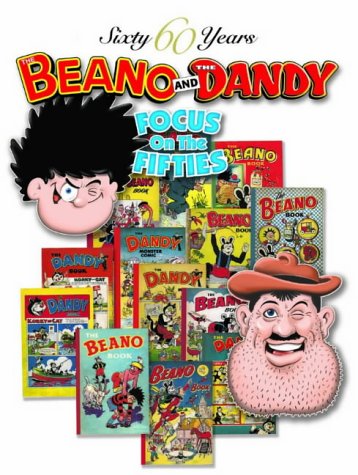
Sixty Years: The Beano and The Dandy – Focus on the Fifties


By Many & various (DC Thomson)
ISBN: 978-0-851-16846-3 (HB)

Win’s Christmas Gift Recommendation: Scotland’s Finest Fun Factory Fancies… 9/10

Whenever we’ve faced our worst moments, humans tend to seek out old familiarities and wallow in the nostalgia of better days. Let’s see how this particular foray feels, especially as it’s still unreachable by that there newmfangled electro retrieval widgetry, but still remarkably cheap in assorted emporia and on them there interwebs… 

Released in 2004 as part of the DC Thomson Sixtieth Anniversary celebrations for their children’s periodicals division – which has more than any other shaped the psyche of generations of British kids – this splendidly oversized (299 x 205mm) 144 page hardback compilation rightly glories in the incredible explosion of ebullient creativity that paraded through the flimsy colourful pages of The Beano and The Dandy during a particularly bleak and fraught period in British history. Tragically, neither it nor its companion volumes are available digitally yet, but hope springs ever eternal…

Admittedly this book goes through some rather elaborate editing, design and paste-up permutations to editorial explaining for modern readers the vast changes to the once-commonplace that’s happened in the intervening years. Naturally the process has quietly dodged the more egregious terms and scenarios that wouldn’t sit well with 21st century sensibilities, although to my enlightened sensibilities the concentration on whacking children on the bottom does occur with disturbing frequency – the Bash Street Kids even had their fearfully expectant upraised bums as the strip’s logo for a few years!

However, viewed as a cultural and historical memoire, this is a superb comic commemoration of one of our greatest communal formative forces, with a vast number of strips and stories carefully curated from a hugely transformative period in national history.

They’re also superbly timeless examples of cartoon storytelling at its best…

Until it folded and was briefly reborn as a digital publication on 4th December 2012, The Dandy was the third-longest running comic in the world (behind Italy’s Il Giornalino which launched in 1924 and America’s Detective Comics in March 1937). The Dandy premiered on December 4th 1937: breaking the mould of traditional British predecessors by using word balloons and captions on some strips, rather than just the narrative blocks of text under the sequential picture frames that had been the industry standard.

A huge success, it was followed on July 30th 1938 by The Beano – and in concert they revolutionised the way children’s publications looked and, most importantly, how they were read.

Over the decades the “terrible twins” spawned so many unforgettable and beloved household names who delighted countless avid and devoted readers, and their unmissable end of year celebrations were graced with bumper bonanzas of the comics’ weekly stars in extended stories in magnificent hardback annuals.

During WWII, rationing of paper and ink forced the “children’s papers” into an alternating fortnightly schedule: on September 6th 1941, only The Dandy was published. A week later just The Beano appeared. The rascally rapscallions only returned to normal weekly editions on 30th July 1949, but the restrictions had not hurt sales. In fact, in December 1945, The Beano #272 became the first British comic to sell a million copies, and the post-war period saw more landmarks as the children’s division of DC Thomson blossomed over the next decade, with innovative characters and a profusion of talented cartoonists who would carry it to publishing prominence, even as the story papers died back in advance of more strip anthologies like The Topper (1953) and The Beezer (1956)…

This compilation primarily concentrates via random extracts and selected strips on the development of established 1940s stars – like Biffo the Bear (1948), Lord Snooty (1938), The Smasher (1938, but completely reinvented in 1957), Korky the Cat and Desperate Dan (both 1937), who all survived the winds of change to grow into beloved and long-lived favourites in the new era. They’re highlighted beside the most successful new characters of the fifties, including Dennis the Menace (1951), Minnie the Minx, Roger the Dodger & Little Plum (all 1953) and the Bash Street Kids (1956 or 1954 if you count prototype When the Bell Rings! as the same).

Nevertheless there’s also a wonderful selection of less well known features on view…

This superb celebration of Celtic creativity is packed literally cover-to-cover with brilliant, breakthrough strips with the mirth starting on the inside front with an outrageous 2-colour Frontispiece tableau by Leo Baxendale of When the Bell Rings!

It’s mirrored at the back of the book by a similarly hilarious spread starring Biffo by indisputable cartoonist Dudley D. Watkins

The main event begins with Focus on the 50’s, as a full-colour Roger the Dodger page by Ken Reid and a Baxendale 2-tone Bash Street Kids strip heralds an editorial introduction, context on soapbox cart building and casting call ‘Fifties Fun-Folk’ before seguing into a tale of Tin Lizzie: a pioneering comedy strip in block-text & pic format about a mechanical housemaid and robot butler Brassribs. Starting in 1953 as a prose serial, it was remodelled as a comic drawn by Jack Prout and  Charles Grigg which presaged later mega-hit Brassneck

With all these pages playing with the theme of “carties”, snatches of Watkins’ Lord Snooty and the 1957 iteration of The Smasher by Hugh Morren lead to an episode of ‘Charlie the Chimp’.

Limned by Charles Grigg, the feature was another comedy drama in block & pic format starring a smart but strictly realistic simian working as a porter in a boarding house…

A full-colour Korky strip by James Crighton, with the cat using his cart as a taxi, ends this section before ‘A Day in the Life of Dennis’ offers an extended collection of strips and features starring the magnificent Menace, rendered by creator Davey Law. The Bad Boy debuted in The Beano #452 (in shops from March 12th 1951) and begins with prose piece ‘Nursery Crimes – or Dennis Growing Up by Dennis’s Dad’ taken from the first Dennis the Menace Book. Its backed up by 15 strips from the era, including ‘News Boy’, ‘Doctor’s Orders’, ‘Top of the Class’ and ‘Dad in Disgrace’ before literally and figuratively shifting gear to see Korky and Biffo as “Teddy Boys” in individual full-colour fashion yarns…

Assorted snapshot strips from venerable fantasy serial ‘The Iron Fish’, illustrated by Jack Glass, lead to a Watkins moment in ‘50’s Medicine the Desperate Dan Way!’ before Baxendale’s ‘Little Plum’ enjoys his own time in the spotlight via 22 strips culled from both comics and Annuals.

Desperate Dan crops up again in episodes from 1952-1954 before “Strongman’s Daughter” Pansy Potter (by James Clark) outwits a wicked wizard whilst Paddy Brennan exults in full-colour in the debut chapter of fantasy thriller ‘Fighting Forkbeard (The Sea Wolf from Long Ago)’ wherein a dragonship full of Vikings washes up and attacks a modern fishing village…

A Baxendale Bash Street strip guest-starring Minnie the Minx opens a selection of crossovers with Biffo and others, after which Hungry Horace and Shaggy Doggy offer a glimpse at the work of Allan Morley, an old school cartoonist who had been with The Beano since #1 but was now giving way to new style and content…

Created by Ken Reid, Jonah was an accursed sailor who sank every vessel he touched and the splendid sampling of strips here leads to Watkins’ introduction of Desperate Dan’s nephew Danny and niece Katey from February 1957, and is followed by a Biffo strip showing a number of things totally banned from modern comics…

‘Guess the Date!’ and ‘50’s Housing – the Desperate Dan Way!’ plus a Korky clash with his arch enemies – The Mice – lead to examples of strips that didn’t work out with a page each for Jenny Penny (Jimmy Thompson) and Little Angel Face (by Ken Reid) before a Lord Snooty vignette from 1954 opens a section starring a certified superstar – Roger the Dodger…

Realised by Reid, the consummate con artist struts his stuff and takes his retributive punishments in a dozen strips, after which the modern medium of home entertainment is tackled in a colour Korky tale and ‘50’s Tele-Watching – the Desperate Dan Way!’ before a Morley Charlie Chutney cookery classic from 1954 acts as palate cleanser for what follows…

All that spanking endured by wayward kids is especially prevalent in a selection of manic material starring Minnie the Minx: in 28 episodes of conniving, chicanery and clobbering courtesy of Baxendale…

A brilliant blast of Biffo in colour brings us to the Bash Street Kids in all their grubby glory. Accompanied by another mini-editorial providing historical context, a slap-happy selection combines double-page tableaux of When the Bell Rings! with a surfeit of Bash Street strips and reveals how the feature evolved. The Baxendale cover to story paper Wizard #1547 (October 1955) accompanies prose tale ‘Bash Street School’ from the June 4th edition, and discloses how the tableau feature inspired comedic school stories which in turn informed a stripped-down strip version with the 16+ kid cast pared down to the 9 we know today…

The process was applied to a few DCT characters, as seen in text story ‘The Boyhood of Desperate Dan’, preceded by the cover for Wizard #1492 (September 18th 1954) and a page of prose thriller ‘Red Rory of the Eagle’ (September 1951) ranged beside the strip it became with a Jack Glass rendered episode from September 1958…

Bill Holroyd provides a 1954 tale of voracious be-kilted ‘Plum MacDuff – The Highlander Who Never Gets Enough’ and the animal antics of ‘Kat and Kanary’ – created by Grigg but probably illustrated here by Baxendale – introduces ‘50’s Tele-Watching – the Desperate Dan Way!’ and follows up with a Biffo strip from November 1956 that might just be the UK’s first infomercial; a Grigg royal rarity featuring Prince Whoopee and a Reid Roger the Dodger lark that eschews the punitive slipper for a more targeted retribution…

A sampling of fantasy drama series follows: name – and picture – checking ‘The Horse That Jack Built’, Brennan’s ‘The Shipwrecked Circus’ and Glass’ ‘The Bird Boy’ before we hit the final stretch, starting with a 1959 Smasher saga about boots, a quick appearance for ‘Cocky Sue, the Cockatoo – She’s the Brains of the Pirate Crew’ by an artist I should recognise, but don’t, and ‘50’s Transport – the Desperate Dan Way!’

With past and future in mind Lord Snooty then pre-empts the microwave oven in a wild yarn from 1954, whilst ‘Wee Davie and King Willie’ strike an early and unexpected blow for animal rights in a strip from 1957 by Ken Hunter, who also ends our comic capers with a wild & woolly double page bonanza tableau set in ‘Wee Davie’s Zoo’

Sadly, none of the writers are named and precious few of the artists, but I’ve offered a best guess as to whom we should thank, and of course I would be so very happy if anybody could confirm or deny my supposition…

A marvel of nostalgia and timeless comics wonder, the addictive magic of this collection is the brilliant art and stories by a host of talents that have literally made Britons who they are today. Bravo to DC Thomson for letting them out for a half-day to run amok once again; can we please have more and in digital edition, too?
© DC Thomson & Co. Ltd. 2004

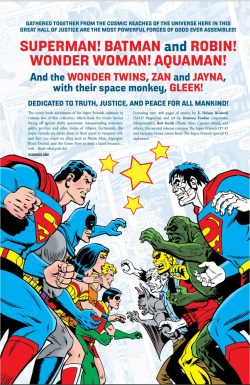
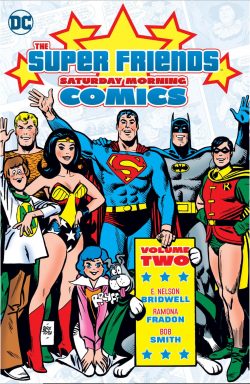
Super-Friends: Saturday Morning Comics volume 2


By E. Nelson Bridwell, Bob Rozakis, Martin Pasko, Bob Oksner, Ramona Fradon, Kurt Schaffenberger, Romeo Tanghal, Joe Staton, Bob Smith, Vince Colletta & Kim DeMulder with Alex Toth & various (DC Comics)
ISBN: 978-1-7795-0592-7 (HB/Digital edition)

Win’s Christmas Gift Recommendation: Absolute Entertainment Perfection… 9/10

Once upon a time comics were primarily created with kids in mind and, whilst I’d never advocate exclusively going back to those days, the modern industry has for the longest time sinned by not properly addressing the needs and tastes of younger fans these days. Happily, DC has latterly been rectifying the situation with a number of new and – most importantly for old geeks like me – remastered, repackaged age-appropriate gems from their vast back catalogue.

A superb case in point of all-ages comics done right is this massive tome. And don’t stress the title: it may celebrate the joys of past childhood shows but this is definitely a great big Sunday “settle back and luxuriate” treat…

The Super Friends: Saturday Morning Comics gathers comic book tales spun off from a popular Saturday Morning TV Cartoon show of the 1970s: one that – thanks to the canny craftsmanship and loving invention of primary scripter E. Nelson Bridwell – became an integral and unmissable component of the greater DC Universe, as a well a key supplier of fresh fodder to enhance its all-encompassing omniverse. So very many of his supporting characters became superstars in their own right and trappings such as the junior characters, villains and the Hall of Justice are now key components of today’s overarching continuity…

The Super Friends was also one of the most universally thrilling and satisfying superhero titles of the period for older fans: featuring the type of smart and witty, straightforward adventures people my age grew up with, produced during a period when the entire industry was increasingly losing itself in colossal continued storylines and bombastic, convoluted, soap opera melodrama.

It’s something all creators should have tattooed on their foreheads: sometimes all you really want is a smart plot well illustrated, sinister villains well-smacked, a solid resolution and early bed…

Under various guises, the TV show Super Friends ran from 1973 to 1986: a vehicle for established television-alumni Superman, Batman and Robin, Aquaman and Wonder Woman, supplemented by a succession of studio-originated kids as student crimebusters. The show also offered airtime to occasional guest stars from the DCU on a case by case basis. The animated show made a hugely successful transition to print as part of the publisher’s 1976 foray into “boutiqued” comics which saw titles with television connections cross-marketed as “DC TV Comics”.

Child-friendly Golden Age revival Shazam! – the Original Captain Marvel had been adapted into a popular live action series and its Saturday Morning silver screen stablemate The Secrets of Isis consequently reversed the process by becoming a comic book. With the additions of hit comedy show Welcome Back Kotter and animated blockbuster Super Friends’ four-colour format, DC had a neat little outreach imprimatur tailor-made to draw viewers into the magic word of funnybooks.

At least, that was the plan: with the exception of Super Friends, none of the titles lasted more than 10 issues…

This massive mega-extravaganza (the second of 2) gathers Super Friends #27-47, The Super Friends Special #1, The Best of DC: Blur Ribbon Digest #3, Limited Collectors’ Edition C-41 and Super Friends!: Truth Justice and Peace! (collectively spanning December 1979 to August 1981), ending the initial run whilst sharing material from assorted reprints and one-shots.

The majority of stories were by E. Nelson Bridwell & Ramona Fradon (Aquaman; Batman; Metamorpho the Element Man; The Brave and the Bold; Brenda Starr, Reporter). Bridwell (Secret Six; Inferior Five; Batman; Superman; The Flash; Batman and Robin newspaper strip; Legion of Super-Heroes; Captain Marvel/Shazam!) had been one of the art form’s earliest mega-fans, turning his hobby into a career in the 1950s.

He was justly renowned as DC’s Keeper of Lore and Continuity Cop – thanks to an astoundingly encyclopaedic knowledge of publishing minutiae and ability to instantly recall every damn thing about anything! Thankfully, he was also an ingenious and supremely witty writer. Fradon was a pioneering artist who also got her start in the 1950s, graced with a uniquely smooth and accessible style. She became one of comics’ earliest (acknowledged!) female artists and was a fan-favourite for generations.

Neither Bridwell or Fradon considered working at the junior end of the market as in any way less important or prestigious than the auteur/adult drama sector just starting to manifest in the American industry…

When Super Friends first aired, the costumed champions were mentors to two kids and their pet: tasked with training the next generation of superheroes. Without warning or explanation, Wendy, Marvin and Wonderdog were replaced for the second television season by alien shapeshifters Zan and Jayna and their elastic-tailed space monkey Gleek. In the comics – with more room to extrapolate and far more consideration for the fans – Bridwell turned the cast change into an extended epic.

When two siblings from distant planet Exor – a girl able to transform into animals and a boy who can become any form of water from steam to ice – came to Earth with an urgent warning they saved the world and were marooned here.

Their integration became an ongoing plot strand with the adults (and Robin) not only training Zan and Jayna, but also jointly acclimating them and introducing them into human society…

This concluding compilation of thrilling fun resumes with The Super Friends #27 and ‘The Spacemen Who Stole Atlantis!’ (Bridwell, Fradon & inker Bob Smith) sees domed undersea city Poseidonis stolen away by ruthlessly curious alien scientists who had not factored in Earth’s greatest defenders.

Inked by Vince Colletta, the next issue detailed a ‘Masquerade of Madness!’ in a Halloween yarn packed with guest stars (including Etrigan the Demon, Solomon Grundy, Man-Bat, Swamp Thing and Jimmy “wolfboy” Olsen) as mystic malcontent Felix Faust crashes a costume ball, trapping attendees in their outfits until Bruce Wayne hands over a certain magical gem… And that’s when the other – untransformed – Super Friends step in…

Another extraterrestrial invasion by colonising invaders seeking to evict humanity manifests in #29, with the new bosses wielding technology that seems to make all resistance futile. However, Wonder Woman and the Wonder Twins find a work-around meaning the war can be won by the heroes making themselves ‘Invisible Defenders of Earth!’

The issue also offers an adventure of the Wonder Twins, who now have secret identities and live in the home of guardian Professor Carter Nichols – Bruce Wayne’s science advisor/time travel expert who debuted in Batman #24, August 1944.

Here Bridwell, Kurt Schaffenberger & Smith establish the ‘Scholars from the Stars’ as transfer students at Gotham Central High, but John and Joanna Fleming are soon being stalked by curious classmates eager to learn all they can about the strange newcomers…

Nichols plays a major role in #30 as Fradon-illustrated ‘Gorilla Warfare Against the Humans!’ sees the heroes battle super-primate Grodd and his ally Giganta as they deploy their new tech to transform men into apes…

Guest stars were always a big draw and #31’s ‘How to Trap an Orchid!’ (inked by Colletta) saw DC’s most enigmatic hero targeted and framed by a ruthless enemy and helped by the Friends before Schaffenberger pencilled and Smith inked #32’s ‘The Scarecrow Fights with Fear!’ as the Tyrant of Terror afflicts the heroes with crippling weaponised personal phobias that only teamwork and determination can overcome

Fradon & Colletta combine for ‘The Secret of the Stolen Solitaire!’ as obsessive old enemy Menagerie Man returns, still using trained animals to commit spectacular robberies. His schemes are derailed when Jayna becomes a famously extinct creature and is “captured”, leading the heroes and visiting VIP Hawkman to his lair and the Winged Wonder’s captive sidekick Big Red

With #34, two stories per issue became the norm, leading with Bridwell, Fradon & Colletta’s ‘The Creature That Slept a Million Years!’, in which a hibernating beast awakened on Earth causes inadvertent chaos, balanced by ‘The Boss and the Beast’ as John and Joanna Fleming help their favourite teacher by saving her husband from a crooked boss fitting him up for a life of crime…

Romeo Tanghal & Smith illustrate full-length spectacle ‘Circus of the Super-Stars’ as the Super Friends and their showbiz impersonators trade places to outwit crooks targeting a massive charity event, before #36 bifurcates with a brace of tales limned by Tanghal & Colletta. First up is ‘Warhead Strikes at Gotham’ with Plastic Man and Woozy Winks tracking a war-mongering maniac and overlapping with the Super Friends battle to stop a paramilitary criminal force, after which The Wonder Twins visit a museum in their school personas and discover the shocking truth about ‘The Dinosaur Demon!’

Fradon & Colletta depict #37’s ‘Bad Weather for Supergirl!’ as the Kryptonian Crime-crusher (in her then-current day job as teacher) brings a class to Gotham just as the Weather Wizard goes on a rampage. Kara’s problem is not the villain’s outrages but that her kids seem far more impressed by the late-arriving superteam than their own hometown hero…

Drama is balanced by rampant fantasy in support story ‘The Giant Who Shrunk Ireland!’, with Bridwell’s creation Jack O’Lantern using his magical gifts to save the Celtic fairy realms from an awakened Fomorean Giant.

Jack was one of a number of international heroes Bridwell and Fradon devised, who grew in popularity and were eventually retrofitted into a team dubbed the Global Guardians. Another debuted in a solo spot at the back of #38, after ‘The Fate of the Phantom Super Friends’ (art by Fradon & Colletta), which saw alien tyrant Grax recruit and arm Earth gangsters to take revenge on his enemies. Then Bob Oksner & DeMulder illustrate ‘The Seraph’s Day of Atonement’ as Bridwell relocates his Israeli holy warrior to a new Jewish settlement in disputed territory just in time to save it from bandits pretending to be Arab terrorists. When, in his righteous anger, he goes too far in punishing the evildoers, he faces divine consequences…

Another former foe resurfaces in #39 with a sinister scheme to create hyper-evolved clones of the only being he trusts… himself. However, ‘The ‘Future’ Son of Overlord!’ (Fradon & Colletta) proves insufficient to the demands and the demise of “Futurio” only results in Overlord cruelly retrenching, after which the human-seeming Wonder Twins discover nightclubs are another place crazy crime can occur in ‘The Boogie Mania Will Get You’ (Tanghal & Collett)…

Inked by Kim DeMulder, #40’s lead tale ‘Menace of the Mixed-Up Senses!’ pits the heroes against a vindictive scientist creating disasters by scrambling perceptions, before Jack O’Lantern returns to teach a smooth-talking conman a life lesson in ‘Blarney for Sale!’ (Bridwell, Tanghal & DeMulder)

Bob Rozakis joins Fradon & Colletta in detailing ‘The Toyman’s Tricky Thefts!’ as the veteran villain attacks a Christmas toy convention as prelude to his true diabolical plan, whilst the rear guard of #41 witnesses Oksner write & illustrate ‘Dry Earth… Stolen Waters’ as The Seraph foils an industrial spy stealing the secrets of an experimental desalination device…

In Seasonal Special #42, Bridwell, Tanghal & Colletta debut Brazilian hero Beatriz Da Costa (AKA Green Fury, Green Flame and/or Fire) who joins the Wayne Foundation just in time to help the Super Friends defeat a vegetation-controlling villain in ‘How Green Was My Gotham!’ and still leave room for the Wonder Twins to enjoy ‘A Christmas with Everything!’ in a heartwarming tale of family and little miracles…

Overlord tries again in #43, unleashing ‘Futurio Times Ten!’ to destroy the collegiate heroes, (and Green Fury) but fails when the over-evolved clone develops an unholy fascination with potential mate Wonder Woman, after which Plastic Man bounces back in ‘Mouth-Trap!’ by Pasko, Staton & Smith, taking down thieving shock jock Lou Kwashus – AKA Chatterbox

Issue #44 leads with Bridwell, Tanghal & Colletta’s ‘Peril of the Forgotten Identities!’ as a menace from the Wonder Twins’ homeworld warps the memories of the team leaving Zan, Jayna & Beatriz to save the day. As counterpoint, Jack O’Lantern then solves a snag in the (super)natural order by ensuring ‘The Death-Cry of the Banshee!’ is heard by the right person…

The “International Heroes” who would become Global Guardians (Rising Sun, Bushmaster, Olympian, Wild Huntsman, Godiva and Little Mermaid) were formally gathered by immortal wizard Doctor Mist in #45 and united with the Super Friends to defeat ‘The Man Who Collected Villains!’

Another classic by Bridwell, Tanghal & Colletta, it pits the merged squads against uber-baddie The Conqueror and his personal Doom Legion – Hector Hammond, Kanjar Ro, Queen Bee, Sinestro, Time Trapper and World-Beater – in a brutal clash that concludes in the next issue.

Before that though, courtesy of Pasko, Staton & Smith, Plastic Man & Woozy discover ‘One of Our Barbarians Is Missing!’ and must halt the rampage of a temporarily-deranged movie swordsman being manipulated by devious crooks…

The frantic Fights ‘n’ Tights clash then results in ‘The Conqueror’s Greatest Conquest!’ (Bridwell, Tanghal & Colletta) – and ultimate downfall before The Seraph battles an ‘Echo of Evil’ and the ghosts of Masada (look it up) in an all-Oksner thriller.

The comic book Super Friends ended with #47: a 25-page epic by Bridwell, Tanghal & Colletta detailing the origin of Green Fury, a plane of animal spirits and ‘The Demons from the Green Hell!’ whose actions sought to unmake the world until the team stepped up…

Times and tastes were changing and it would be years until superheroes – and not toy tie-ins – for kids were a viable option again: when once again TV led that march with breakthrough adaptations of Batman, Superman and Justice League Animated Series…

Here and now, this epic collation closes with series designer Alex Toth’s 1976 cover for Limited Collectors’ Edition C-41 and The Best of DC: Blur Ribbon Digest #3 (January-February 1980) cover by José Luis García-López & Bob Smith. Also on view is Ross Andru & Dick Giordano’s cover from The Super Friends Special #1 1981 and Toth’s frontage from the 2003 Super Friends!: Truth Justice and Peace! trade paperback collection.

Sublimely resplendent in the rich flavours and simple joys of DC’s Silver Age boom, and with covers by Fradon, Smith, Schaffenberger, Tanghal, & Colletta, this concluding compendium is superbly entertaining, masterfully crafted and utterly engaging. It offers stories of pure comics gold to delight children and adults in equal proportion. Truly generational in appeal, they are probably the closest thing to an American answer to the magic of Tintin or Asterix and no family home should be without this tome.
© 1976, 1979, 1980, 1981, 2003, 2020 DC Comics, Inc. All Rights Reserved.

Sugar and Spike Archives volume 1


By Sheldon Mayer (DC Comics)
ISBN: 978-1-4012-3112-5 (HB)

Win’s Christmas Gift Recommendation: Utter Entertainment Perfection… 10/10

I actually intended this for a forthcoming week of kid-friendly books in the New Year but on re-reading this gloriously whimsical and hilariously absurdist tome I came to the conclusion that just like its scintillating and ultra-impatient co-star, I am quite impatient and don’t like to share with just anybody, so this is for Right Now …and probably just for the parents, ok?

And just so we’re clear, miss Sugar Plumm predates Miss Piggy by DECADES and is marginally scarier! Okay? Good, now go on, and let the kids see it too if you want…

Sheldon Mayer (April 1, 1917 – December 21, 1991) is arguably the most important man in American comic book history. A writer and cartoonist, he was also the editorial guiding light behinds dozens of major features at All American Publishing, with a hand in the creation of Wonder Woman, The Flash, Hawkman, Green Lantern, Justice Society and many more.

He mentored young creators like Carmine Infantino and Joe Kubert and his creative opinions as assistant to Max Gaines and others dictated the way the entire industry unfolded.

Back in 1935, he was a writer, artist and eventually editorial assistant to Major Malcolm Wheeler-Nicholson at embattled and failing outfit National Allied Publications. In 1938, Mayer was credited with rescuing from the trash can a weird strip about a strongman in tights and a cape. He apparently loved the feature – by two kids named Siegel and Shuster – and pushed until Harry Donenfeld put it in his new anthology Action Comics. That worked out pretty well in the end…

Above all else, Mayer was an inveterate and incurable cartoonist. In 1936, at Dell Comics he created semi-autobiographical boy cartoonist Scribbly, and when “Shelly” joined Gaines at AA he brought that comical kid with him. When the superhero craze truly kicked off, Mayer added one to the strip. Ma Hunkel was Scribbly’s fearsome landlady, and when crime and ne’er-do-wells plagued her neighbourhood, she tackled the problem by making a costume from kitchen scraps and pots to patrol her inner city district as the mighty, mysterious Red Tornado

In 1948, Mayer surrendered his editorial position to devote himself to drawing and storytelling. He had already spearheaded AA/DC’s move into funny animal features four years previously, in new or converted titles Funny Stuff (Summer 1944), Animal Antics (March 1946) and Funny Folks (April 1946). Cover-dated June 1945, Leading Comics (former home of the Seven Soldiers of Victory) was the first to drop superheroes, becoming an anthropomorphic mainstay with #15.

Mayer’s mirth mountain included the return of Scribbly; exploring the burgeoning teen scene in Leave it to Binky and Buzzy, and generating all-ages whimsy and hilarity in dozens of strips like Doodles Duck, Peter Porkchop, Nutsy Squirrel, Dodo and the Frog and The Three Mouseketeers. In 1956, he created the most charming and adorable comics concept ever published… Sugar and Spike.

The series was an all-Mayer affair that ran 98 issues – until his eyesight failed and he stopped drawing. Undaunted, he carried on as a writer: scripting anthological horror tales for Adventure Comics and sundry DC mystery titles like House of Mystery and Forbidden Tales of Dark Mansion. He also created Black Orchid, revived DC’s 1950s iteration of Rudolf the Red Nosed Reindeer and – following eye surgery – resumed drawing Sugar and Spike for international syndication.

Some of those stories were reprinted in DC digests The Best of DC, and in 1992, a commemorative 99th issue of Sugar and Spike: released as part of the DC Silver Age Classics series. As usual, I’m revelling in nostalgic joys here whilst whining like a baby and opining for DC to commission a full archival revival in print and digitally…

The concept is beautifully simple and evergreen and as a sign of the regard DC held Mayer in, he was allowed to sign his work: an honour only Siegel & Shuster, Bob Kane and Charles Moulton enjoyed at that time.

In in ordinary domestic America, there are two neighbouring families; each with a toddler. Those little kids get up to all sorts of mischief, much of it quite destructive. These kids are like all baby beings – able to clearly communicate with every other infant in creation – but not adults. The premise constantly generates captivating magic as the bright kids daily discover, categorise and classify their world: posit their own soundly rationalistic explanations for the grown-ups’ weird behaviours and fascinating toys and foods (or anything else they can put in their mouths…). Naturally, the adults think the babytalk babble is cute, but surely it’s nothing but charming nonsense?

Preceded by a revelatory Introduction from Comics historian Bill Schelly the wonderment opens right on the cover which introduces Sugar Plumm and Cecil “Spike” Wilson and sets up a regularly recurring gag: although friends and neighbours, the toddlers’ parents have differing approaches to child rearing. Whenever the kids discuss these discrepancies and attempt to capitalise on the parents’ latest tactic (this was the great era of baby advice gurus like Dr. Benjamin Spock), it’s usually Spike who suffers for it…

That premiere issue opens with ‘Sugar and Spike!’ as the Plumm family move in and quickly introduce themselves and their new daughter to the Wilsons. The kids get on like a house on fire, chatting away like old pals, even though it’s the first baby Spike has ever seen and he can’t form proper words yet…

He’s just discovered a universal truth: although everything has to learn its own language, all babies are born able to communicate with each other…

Soon he’s showing the fascinating new creature with the hair tail all the fun places in his house, like daddy’s basement workshop where all the loud fast toys and paint tins are, and despite the resultant chaos triggering the first of many spats between the adults a friendship for the ages is born…

‘Thumbs Up!’ then builds on the front-cover gag as the infants compare notes on how their parents react to thumb-sucking, unaware that there’s more than one baby-care book and varying opinions can produce wildly varying adult responses…

Mayer was well aware that his young readership needed lots of participatory stimulation and worked hard on activity pages such as ‘Write Your Own Comic Page’, wherein kids could fill in blank word balloons of a strip and colour it in afterwards, before ‘Busy Corners’ introduces Sugar’s Uncle Charley. He’s a motorcycle cop and her favourite adult, partly because he rides that bizarre “put-put” thing and partly because he always brings fun (for which read “inappropriate”) toys, but mostly because Uncle Charley never really grew up. Spike is initially jealous but soon warms to the big guy… just before his antics result in both babies and Charley being sent to stand in the corner again…

‘Free Wheeling’ then sees the tots work out the best – but not correct – way to use a wheelbarrow and invent an indoor sport based on golf that has immense destructive potential in ‘The Big Question’, after which their discovery of ‘The Yak-Yak Box’ leads to telephonic disaster. The debut issue then closes with a back-up starring older kid ‘Littul Snoony’, whose dabbling with a junior chemistry set leads to manic misunderstanding…

Sugar and Spike #2 (cover-dated June/July 1956) opens with mystery yarn ‘Photo Finish’ as the plucky lad attacks another baby photographer hired to snap little miss Plumm. The parents can’t understand why cameras terrify Sugar or why Spike always gallantly attacks the lens-jockeys, but that’s because they can’t understand the little lady’s tale of woe about a snake-ejecting trick box during an earlier photoshoot…

Understandable frustration at big people’s inability to understand baby talk boils over during ‘The Return of Uncle Charley’ who comes bearing a water-spurting fire truck and gets them stuck in the corner again, after which ‘Spike at Home’ and ‘Sugar at Home’ prove that the cooperative kids can cause chaos all on their own, before ‘The Big Toy Mystery’ details their discovery of vehicular fun – and folly – after Spike gets a tricycle…

Mayer was always aware that the newspaper comic strip was a powerful and ubiquitous tool used to raise circulation and promote customer loyalty in the 20th century, and as well as laughs, thrills and escapism creators often added games, cut-out collectibles and paper toys to their output. The common belief was that youngsters – especially girls – loved this kind of “dress-up” play, but I suspect many young men also joined in. One of the most popular and perennially effective was beloved characters in their underwear, plus assorted outfits to clothe them in. Many features took the process further by inviting readers to contribute designs.

This practise graduated from the strips to comic books, and Sugar and Spike employed paper-doll pages for its entire run, beginning with a set of cut-out ‘Pint-Size Pin-ups’ (the kids in diapers and six readers’ ensembles from summer dresses to a Davy Crockett suit), after which the kids go to a swish department store where Sugar teaches her “doll-boy” ‘How to Play Loozum’. This issue closes with a ‘Do It Yourself Comic Page!’ where all the characters are faceless and readers can either draw their own or cut and paste from a selection of expressions graciously provided…

For #3, Spike is given a marble by some older kids, but his love for it triggers calamity when it’s eaten by a vacuum cleaner and Sugar makes the monster give back ‘The Shiny Round Roller’, after which ‘Spike Discovers the Ocean!’ and is quickly convinced that it hates him…

More ‘Pint-Size Pin-ups’ lead to a minor masterpiece as the boy is taken to his first restaurant and befriends the main course in ‘Lobsters Away!’ His screams lead to the Wilsons taking the baby crustacean home, where Spike and Sugar resolve to return “Alice” to her home in the ocean…

Activity page ‘You Be the Editor!!’ presents a scrambled strip to put in order – and colour in – before the issue closes with a “kootchy-coo!” monster invading the Wilson home. Happily, Sugar has encountered a “Nanty” before and her ‘Anti-Aunty’ tactics include roping in Uncle Charley to drive the beast away…

Cover-dated October/November, S&S #4 introduced another major theme and recurring gag: the babies’ gradual capitulation to nature and maturation, as epitomised by learning – to say, if not understand – new grown-up words. ‘Who’s Sorry Now?’ sees Spike in the corner when Sugar teaches him a term that makes adults forgive everything. However, when they hear someone apparently abusing the magic term, their vengeance is both fearsome and bizarre…

The tots’ discovery of a ‘New Gadget’ results in utter chaos and necessary redecoration before ‘One Sunday Afternoon’ finds Pa Wilson failing to self-assemble a new garden hammock thanks to their assistance. Staying with recreation, the ‘Water Babies’ are dumped on their dads, and enjoy a fishing trip that borders on the surreal and uncanny…

Sugar and Spike #5 (December 1956-January 1957) opens with the infants attending ‘The Birthday Party’ of an older kid, and utterly misunderstanding the notion of GIVING OTHER PEOPLE presents. This hilarious romp introduced mean bully Clarence: a spoiled older boy continually outwitted by the toddlers over the years.

Insomnia informs ‘The Early Birds’ as the tiny tots go walkabout whilst the parents enjoy the sleep of the exhausted, and Spike ponders ‘Grampa’s Problem’ – a sly observation on the indignities of old age – before more ‘Pint-Size Pin-ups’ anticipate ‘The Mystery of the Funny Runner’ with our curious kids questioning how older kids have wheels on their feet…

They seek to imitate firefighters in ‘To the Rescue’ with unwelcome results before the copy closes with a backyard clean-up that reveals ‘A Place for Everything’ isn’t literal when looking for somewhere to put fallen leaves…

Charm manifests in almost lethal amounts in #6 as the veteran infants meet and bring up to speed a newborn in ‘The New Baby’, and another developmental milestone is reached on ‘The Trip’ as both tots stay with Spike’s grandparents for their first Christmas. That witty wonderment is augmented by a ‘How To Make Sugar and Spike Dancing Dolls’ and more gloriously adorable ‘Pint-Size Pin-ups’, before ‘Winter Sunday’ sees the downside of shovelling snow off sidewalks with curious toddlers joining in and ‘Cats? Meowch!’ explores the hazards of finger painting with anchovy paste. This issue then folds with Spike and Sugar addressing consumerism in combat with all the mod cons (that was “Modern Conveniences” if you’re post Millennial) in ‘Baby vs. Machine’

By #7 (April/May 1957) Mayer was regularly using fashions contributed by readers, as here in opening yarn ‘Mud Mud Mud!’ when the moms try to split up the kids and Mrs Wilson bribes the local older boys to include Spike in their war games. When their messy roughness provokes a tantrum, Sugar comes to his rescue with shocking consequences but not as much as what happens when the misbehaving tots catch their moms consulting ‘The Magic Book’ that seems to dictate what punishments they get…

The mayhem of Spike’s ‘First Haircut’ came from a plot sent in by two readers, one of whom also designed outfits for another ‘Pint-Size Pin-ups’ section, whilst Mayer can claim full credit for Spike’s close encounter with ‘The Don’t-Touch Thing’ and almost sending his dad to jail from the passenger seat in motorcar moment ‘Three-Wheel Driver’

Issue #8’s mixes crockery carnage and childish misdemeanours with high concept as the kids give the adults ‘Speech Lessons’ in an attempt to make their moms properly communicate in clearcut babytalk and ‘Uncle Charley Strikes Again’ with another magnificently inappropriate toy for Sugar before a double helping of ‘Pint-Size Pin-ups’ leads to another failed experiment when Sugar ensures that ‘The Tick-Tock Won’t Tick-Tock Now!’

Grandpa then finds a way to replace a hobbyhorse in ‘Ride ‘Em Cowboy’, and we close with more animal antics in ‘Trip to the Zoo’

Sugar and Spike #9 saw the title shift to a monthly frequency: opening with ‘Double Trouble’ as the infants investigate a strangely familiar couple inside the big glass toy, whilst their wear & tear on  toys is tackled by daddy – AKA ‘The Fix-It Machine’, and – after two more ‘Pint-Size Pin-ups’‘Horse Sense’ traces the troubles caused by their first trip to an amusement park where the nippers naturally “liberate” a baby-talking little pony…

Another ‘Write Your Own Comic Page’ then leads to a breakthrough in counting in ‘Spike Learns Big Business’

This sublime collection concludes with #10 (cover-dated September 1957) beginning with ‘The Big Word Mystery’ as the troublesome toddler parrots a grown-up sound that makes adults go crazy, after which the kids learn that pulling ‘The Magic String’ makes day-time go away.

One last brace of ‘Pint-Size Pin-ups’ leads to another seaside jaunt where the parents go ‘Beach Nuts’ after the kids go AWOL and – once safely home – ‘More Adventures with the Yak-Yak Box’ when Spike tries in vain to rescue the random toddler who answered whilst he was playing with the very-forbidden telephone…

These are wonderful, whimsical stories from a time when comics were a major entertainment medium and the only mass market accessible to kids. Thanks to the gifts of Sheldon Mayer, these yarns remain some of the most beguiling and hilarious ever crafted – just ask the numerous countries the feature was syndicated to – and absolutely MUST be brought back for kids of every vintage to enjoy.
© 1956, 1957, 2011 DC Comics. All Rights Reserved.

Billy’s Boots Book 1: The Legacy of ‘Dead-shot’ Keen


By Fred Baker, Colin Page, Mike Western, Bill Lacey, Tom Kerr & various (Rebellion Studios)
ISBN: 978-1-78108-671-1 (HB/Digital edition)

Win’s Christmas Gift Recommendation: Classic Comics Fun and Games… 9/10

British kids have always been utterly besotted with sports and comics have continually fed and fuelled their addiction. Even in the days when children’s only exclusive “entertainment” was primarily prose “Story Papers”, tales of playing field rivals, earnest competition, glorious accomplishments, fair play and sporting prodigies dominated. As comic strips took tight hold of kid’s lives during WWII and after, generations of boys grew up wanting to be Wilson, Alf Tupper, His Sporting Lordship, Skid Solo or Roy of the Rovers.

As the 1950s unfolded, football became the undisputed leader of sporting strips: a peculiarly wide field that had found room for speedway, cricket, motor racing, rugby, boxing, wrestling, athletics and fishing among many, many others. In September 1954, Amalgamated Press launched a companion comic to anthological market leader Lion. Edited by Derek Birnage – until 1963, when Barrie Tomlinson took over – Tiger – The Sport and Adventure Picture Story Weekly was cover-dated 11th September and out in time for the new football season. Primarily sports-themed for its entire run (1573 issues until 1985) it merged with or absorbed Champion (1955), Comet (1959), Hurricane (1965), Jag (1969), Scorcher (1974) and Speed (1980) before itself being subsumed by the relaunched Eagle in April 1985.

Among its most memorable treasures was Skid Solo, Johnny Cougar, Rod and Line, Hot Shot Hamish, Nipper, Football Family Robinson, Billy’s Boots and Roy of the Rovers

As the 1960s segued into a new decade, across the United Kingdom, football was king in comics: everything from straight sporting drama strips to wild comedies with strange teams and odd motivations, and even supernaturally-tinged strips like Raven on the Wing

Shoot launched in 1969, a junior, comics-heavy version of adult magazine Goal (which it eventually absorbed!) and Striker in January 1970. Its lead strip would graduate to The Sun newspaper.

Scorcher also kicked off on January 10th 1970, with an all football roster of photo-features sports journalism dedicated to the beautiful game and strips including Kangaroo Kid, Royal’s Rangers, Bobby of the Blues, Sub (He’s always on the sidelines!), Paxton’s Powerhouse, Lags Eleven, Jack of United, Jimmy of City, Hotshot Hamish and Nipper, but the breakout feature proved to be a dramatic reimagining of a comedy strip from Tiger: Billy’s Boots

Scorcher became Scorcher and Score after 77 issues (merging with Score ‘n’ Roar in early July 1971) and finally called “time” with the October 5th 1974 issue – a further 171 outings. Its favourite features were ultimately absorbed into Tiger in 1980, but Annuals and Summer Specials continued to appear until 1984.

The stories here originally played in Scorcher from 10th January 1970 to 9th January 1970. The strip had taken its name from a comedic feature by Frank Purcell that ran in Tiger from 1961-1963. For a fresh new era, it was overhauled by 50-year veteran scripter Fred Baker (Martin’s Marvellous Mini, Skid Kids, Tommy’s Troubles, Hot-Shot Hamish, and much more in titles including Tiger, Buster, Chips, Radio Fun, Film Fun, Valentine and Roy of the Rovers).

He wrote the feature for most of its first 20 years run which was initially illuminated – in this volume at least – by Colin Page (Adam Eterno, Paddy Payne), Bill Lacey (Rick Random, Super Detective Library, Cowboy Comics Library, Mickey Mouse Weekly, Mytek the Mighty, Rat Pack), Mike Western (Lucky Logan, Biggles, No Hiding Place, The Wild Wonders, The Leopard from Lime Street, Darkie’s Mob, HMS Nightshade, Roy of the Rovers) and Tom Kerr (Little Lew, Fay, Monty Carstairs, Kip Kerrigan, Kelly’s Eye, Captain Hurricane, The Steel Claw, Charlie Peace, Kraken, Black Axe, Boy Bandit, Tara King/The Avengers, Peter the Cat, Clarks Commandos et al).

Billy’s Boots was initially rendered in 2-page, full colour instalments and survived Scorcher’s merger with Tiger in 1974, and amalgamation with Eagle in 1985. A year later Billy migrated to Roy of The Rovers magazine offering new adventures until 1990. Even then, the lad kept kicking, appearing in reprints, Annuals and Best of Roy of the Rovers Monthly, Striker and Total Football magazine into the 21st century.

He’s also an international star, having been translated into Finnish, Swedish, Icelandic, Dutch, Bengali, Turkish and more…

In October 1971, John Gillatt took over the art for a 16-year run which truly defined the strip in readers’ eyes and minds, but that’s a treat for another volume…

Here however, in interlinked serials we meet 12-year-old Billy Dane who is an avid – but rubbish – footballer. His earnest desire is simply to play the game but he’s so bad nobody will let him join even a playground kickabout…

An orphan living with his grandmother, Billy’s life changes forever when he dutifully cleans out her attic and finds a battered old pair of football boots. They were a souvenir his grandad had picked up, and had been used by sporting legend Charles “Dead-Shot” Keene. When Billy wistfully dons them and starts mucking about in the backyard, something miraculous occurs.

Suddenly, he can kick with the force and accuracy of an adult professional and later testing shows that the fabulous footwear sends him subconscious messages, enabling to read a field and almost predict the best place to be in any game situation…

Now bursting with confidence and hungry to play, he rapidly moves from friendly games to school caps, county matches and even international fixtures, with a heaping helping of drama accruing from his eagerness frequently leading him to play for rivals and opposing teams…sometimes on the same day…

Further confusions and concerns arise as he researches the life of Dead-Shot and realises that he’s often reliving actual events that affected the star and shaped his astounding career. The phenomenon doesn’t let up even after Billy finally meets and befriends his idol…

Of course, as this is a drama the most challenging problem Billy constantly faces is losing, mislaying, being deprived of and recovering the ratty, tatty, far-out-of-fashion old boots: prompting many manic moments where the plucky kid must humiliatingly go on without the miracle-making fantastic footwear, but always the lad perseveres and overcomes…

It’s also not as if he doesn’t have other problems too. At one stage he’s forced to move across the country, leaving all his friends: encountering school bullies, and teachers and trainers who think he’s troubled…

After its initial set-up the nature of the stories become rather formulaic, with Billy always seeking to be the best he could: trying to wean himself off ghostly footgear and develop innate natural skills. This was usually a huge disappointment as he always failed unless he was wearing the boots of his hero. Thankfully, the astounding illustration always makes the stories feel fresh and the ongoing mystery of how and why the boots work keeps the tension up…

Such narrative repetition was not deemed a problem at the time, since editors held the firm conviction that readers had a definite shelf-life and would quickly move on to better things… like Chaucer, Len Deighton, or the back pages of The Sun or Daily Mirror

This astoundingly absorbing classic is another perfect example of purely British comics sensibilities: passionate, idealistic and desperately earnest as it follows the path of a working class hero navigating a treacherous path to glory or dismal defeat. This is a welcome reintroduction: inspirational, warm, beautifully rendered and absolutely unforgettable. Another treasure-trove from Rebellion’s ever-expanding Treasury of British Comics, this tale span generations and demands to be in every family bookcase.
© 1970, 1971, & 2020 Rebellion Publishing IP Ltd. All Rights Reserved.

A thankful tip of the fact hat to footy publications site Soccerbilia – for some of the background recycled here.

Marvel Masterworks: Golden Age Sub-Mariner volume 1


By Bill Everett, Paul Gustavson, Roy Gill, Harry Sahle, Lewis Glanzman, Stan Lee, Alan Mandel, Mickey Spillane, Art Gates, Basil Wolverton & others (Marvel)
ISBN: 978-0-7851-1617-2 (HB) 978-0-7851-5789-2 (TPB/Digital edition)

Win’s Christmas Gift Recommendation: The Sea Son’s Greatest Golden Moments… 8/10

Prince Namor, the Sub-Mariner was the second super-star of the Timely Age of Comics – but only because he followed the cover-featured Human Torch in the running order of Marvel Comics #1 in October 1939. He has had, however, the most impressive longevity of the company’s “Big Three”: Torch, Subby and Captain America

The Marine Marvel was revived in 1962, an unbeatable force in Fantastic Four #4; once again an anti-hero/noble villain, prominent in the company’s pantheon ever since.

In world, the hybrid offspring of an undersea Atlantean princess and American polar explorer is a being of immense strength: highly resistant to physical harm, able to fly and thrive above and below the waves.

Created by young Bill Everett, Namor technically predates Marvel/Atlas/Timely Comics entirely, and first caught the reading public’s attention as part of the “Fire vs. Water” headliners in the anthological Marvel Comics #1 – which became Marvel Mystery Comics with the second issue. His elementally apposite co-star was the Human Torch, but Namor had originally been seen – albeit in a truncated version – in the monochrome freebie Motion Picture Funnies: a weekly promotional giveaway handed out to moviegoers earlier that year.

Swiftly becoming one of Timely’s biggest draws, Namor won his own title at the end of 1940 (cover-dated Spring 1941) and was one of the last super-characters to go at the end of the first heroic age.

In 1954, when Atlas (as the company had become known) briefly revived the Big Three Everett returned for an extended run of superb fantasy tales, but the time wasn’t right for superheroes yet and the title sunk again. Once again, Subby was the last revived character to be cancelled, as rumours of a possible TV series deal kept the book afloat…

When Stan Lee & Jack Kirby reinvented superheroes in 1961 with the Fantastic Four, they revived the angry amphibian as a troubled, amnesiac, yet decidedly more regal and grandiose anti-hero, who was understandably embittered at the loss of his sub-sea kingdom (seemingly destroyed by American atomic testing). He also became a dangerous bad-boy romantic interest: besotted with the FF’s golden-haired Sue Storm – who couldn’t make up her mind about him for decades…

Namor knocked around the budding Marvel universe for years, squabbling with assorted heroes like the Avengers, X-Men and Daredevil before securing his own series as part of “split-book” Tales to Astonish beside fellow antisocial antihero the Incredible Hulk. From there both went on to become cornerstone of the modern Marvel Universe.

Way back then, after his illustrious (and at long last finally filmic) career began in Marvel Comics #1, the Sub-Mariner solo vehicle launched in Spring 1941. The first four issues are gathered here – in hardcover, trade paperback and digital formats – accompanied by a fact-filled reminiscent Introduction from Subby scribe and comics historian Roy Thomas: sharing all the context and backstory any finny fun-fan could ever need. This titanic tome also incorporates all the rousing in-situ ads seen in the original releases…

Sub-Mariner Comics #1 featured two complete strip-stories starring the conflicted overlord of a “lost subsea kingdom at the South Pole”, plus a chilling back-up yarn starring costumed detective/adventurer The Angel: the first of a long run of macabre thrillers…

The drama begins with a ‘Deep-Sea Blitzkrieg’, prompting Namor to declare war on the perfidious Nazis after a fleet of U-Boats depth-charges his underwater home city. The Avenging Prince immediately retaliates in a bombastic show of super-power that deftly displays the unmatched graphic virtuosity of his creator Bill Everett.

The second story (by Everett and unknown assistants) concerns a deadly disease afflicting the Prince’s aquatic subjects, necessitating the Sub-Mariner’s return to New York. This trip is to obtain – by any means necessary – a supply of Radium. The dual nature of the antihero was always a major factor in Namor’s popularity, so even a shared enemy couldn’t keep him on the good side of the American authorities for long…

For most of these stories Everett and other lead artists used a string of assistants culled from the comic book “Shop” outfits. Sadly, with no accurate records, best guesses for uncredited contributors include Charles Nicholas (nee Wojtkoski), Witmer Williams, Ben Thompson, Sam Gilman, George Mandel, Mike Roy, Al Fagaly & Jimmy Thompson.

These deluxe editions also include the mandatory text features comics were compelled to run to maintain their postal status (an arcane system allowing publishers to procure large postal discounts as “second class mail”) so you can also enjoy prose fable ‘Namor… His Boyhood’ by Roy Gill before moving on to Paul Gustavson’s caped & costumed shamus in 20-page gothic chiller ‘The Angel and the House of Horror’.

Although dressed like a superhero, this dashing do-gooder was actually a blend (knock-off would be perhaps a bit unkind) of Leslie Charteris’ The Saint and The Lone Wolf (Louis Vance’s urbane two-fisted hero who was the subject of 8 books and 24 B-movies between 1917 – 1949).

One marked difference was the quality of the Angel’s enemies: his foes tended towards the arcane, the ghoulish and the just plain demented…

The globe-trotting paladin also seemed able to cast a giant shadow in the shape of an angel -. not the greatest aid to cleaning up the scum of the Earth, but he seemed to manage…

Sub-Mariner Comics #2 (Summer 1941) starts off with an untitled Nazi-busting tale – even though America was officially neutral until December 8th of that year – with Namor foiling a scheme to spring thousands of German POW’s from internment in Canada.

Everett’s hand is still in evidence, but by this time a growing number of the aforementioned assistants were slowly diluting his work as he struggled to produce a monthly strip in Marvel Mystery and his other commitments.

‘Steaming Statistics of Fire and Water’– illustrated by Harry Sahle – offers a package of fun facts before a second tale finds Namor in a Pennsylvania town hunting Fifth columnists and spies fomenting a strike amongst the miners producing coal for ships fuel. Cartoonist Lewis Glanzman provided a ‘Bum Jokes’ gag-page and young Stan Lee scripts text feature ‘The Story behind the Cover: Namor “Blitzes” a Nazi Sub’ before The Angel (art by Alan Mandel) quashes a sinister plot in New England to free ‘The Slaves of the Python’.

The Fall 1941 issue then opens with ‘The Mystery of the Disappearing Island’: a strikingly topical two-part tale combining Winston Churchill, the thorny question of Irish neutrality and a submerged city of druids invaded by Nazis as a staging post for future bomber raids on Britain.

Tinged with immediacy by political issues, this exotic fight-heavy romp was extra-length (40 pages), and followed by a mediocre, uncredited prose tale ‘Dispatch from Africa’ before culminating with a rather incestuous murder mystery wherein the Angel hunts for a killer when ‘Death Draws a Comic Strip!’

Sub-Mariner Comics #4 opens with ‘Murders by Ghost Light’ as Namor investigates a haunted hospital hiding all manner of non-Hippocratic shenanigans. The spooky themes continue when he then encounters a giant madman-made monster in ‘The Horror That Walked’.

‘Fresh Meat for a Raider’ is a prose naval adventure written by a promising young writer named Mickey Spillane, whilst ‘Pop’s Whoppers’ (by Art Gates) is a jolly comedy feature starring an inveterate tall-tale teller, followed by another sinister horror puzzler for the Angel: ‘Death’s Merry-Go-Round!’.

The vintage voyages conclude with a lost gem from legendary graphic genius Basil Wolverton who wraps things up with a comically surreal Dr. Dimwit page.

Before we leave, however, a selection of Sub-Mariner Comics house ads and photo features of a contemporary comics newsstand – with Everett himself – further enhance the period experience…

Many early Marvel Comics are more exuberant than qualitative, but this compendium, even if largely devoid of premier league talent, is a wonderful exception. Offering high-octane – albeit outrageously jingoistic and culturally enmired in its time – staggering action, it is a splendid, historically unvarnished read as well as a forgotten treasure Fights ‘n’ Tights fans will find irresistible.
© 1941, 2005, 2012, 2017 Marvel Characters, Inc. All rights reserved.