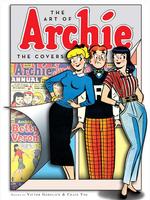
The Art of Archie: the Covers


By various, edited by Victor Gorelick & Craig Yoe (Archie Books)
ISBN: 978-1-936975-79-2

Win’s Christmas Gift Recommendation: A perfect celebration of the magic of comicbooks… 10/10

For most of us, comics mean buff men and women in capes and tights hitting each other, lobbing trees about, or stark, nihilistic genre thrillers aimed at an extremely mature and sophisticated readership of confirmed fans – and indeed that has been the prolific norm for nearly twenty years.

However, over the decades since comicbooks were invented in 1933, other forms of sequential illustrated fiction genres have held their own. One that has maintained a unique position over the years – although almost now completely transferred to television – is the teen-comedy genre begun by and synonymous with a carrot topped, homely (at first just plain ugly) kid named Archie Andrews.

MLJ were a small outfit which jumped wholeheartedly onto the superhero bandwagon following the debut of Superman. In November 1939 they launched Blue Ribbon Comics, promptly following with Top-Notch and Pep Comics. The content was the accepted blend of costumed heroes, two-fisted adventure strips and one-off gags. Pep made history with its lead feature The Shield – the industry’s first superhero clad in the American flag – but generally MLJ were followers not innovators.

That all changed at the end of 1941. Even while profiting from the Fights ‘N’ Tights phalanx, Maurice Coyne, Louis Silberkleit and John Goldwater (hence MLJ) spotted a gap in their blossoming market and in December the action strips were joined by a wholesome, ordinary hero; an “average teen” who had invitingly human-scaled adventures that might happen to the readers, but with the laughs, good times, romance and slapstick heavily emphasised.

Pep Comics #22 introduced a gap-toothed, freckle-faced, red-headed goof showing off to the pretty blonde next door. Taking his lead from the popular Andy Hardy movies starring Mickey Rooney, Goldwater developed the concept of a youthful everyman, tasking writer Vic Bloom & artist Bob Montana with the job of making it work.

So effective and all-pervasive was the impact and comforting message the new kid offered to the boys “over there” and those left behind on the Home Front that Archie Andrews and the wholesome image of familiar, beloved, secure Americana he and the Riverdale gang represented, one could consider them the greatest and most effective Patriotic/Propaganda weapon in comics history…

It all started with an innocuous 6-page tale entitled ‘Archie’ which introduced the future star and pretty girl-next-door Betty Cooper. Archie’s unconventional best friend and confidante Forsythe P. “Jughead” Jones also debuted in that first story as did the small-town utopia they lived in.

The premise was an instant hit and in 1942 the feature graduated to its own title. Archie Comics #1 was the company’s first non-anthology magazine and began an inexorable transformation of the entire company. With the introduction of rich, raven-haired Veronica Lodge, all the pieces were in play for the industry’s second Phenomenon (Superman being the first).

By May 1946 the kids had taken over and, retiring its heroic characters years before the end of the Golden Age, MLJ renamed itself Archie Comics, becoming to all intents and purposes a publisher of family comedies. This overwhelming success, like the Man of Tomorrow’s, forced a change in the content of every other publisher’s titles and led to a multi-media industry including a newspaper strip, TV, movies, pop-songs and even a chain of restaurants.

Intermittently the costumed cut-ups have returned on occasion but Archie Comics now seems content to specialise in what they do uniquely best.

The eponymous high-schooler is a good-hearted lad lacking common sense and Betty – pretty, sensible, devoted girl next door, with all that entails – loves the ridiculous redhead. Ronnie is spoiled, exotic and glamorous and only settles for our boy if there’s nobody better around. She might actually love him too, though. Archie, of course, can’t decide who or what he wants…

This never-tawdry eternal triangle has been the basis of seventy years of charmingly raucous, gently preposterous, frenetic, chiding and even heart-rending comedy encompassing everything from surreal wit to frantic slapstick, as the kids and an increasing cast of friends grew into an American institution.

Adapting seamlessly to every trend and fad, perfectly in tone with and mirroring the growth of teen culture, the host of writers and artists who’ve crafted the stories over the decades have made the archetypal characters of Riverdale a benchmark for youth and a visual barometer of growing up American.

Archie’s unconventional best friend Jughead is Mercutio to Archie’s Romeo, providing rationality and a reader’s voice, as well as being a powerful catalyst of events in his own right. There’s even a likeably reprehensible Tybalt figure in the crafty form of Reggie Mantle – who first popped up to cause mischief in Jackpot Comics #5 (Spring 1942).

This beguiling triangle (plus annexe and outhouse) has been the rock-solid foundation for decades of comics magic. …And the concept is eternally self-renewing…

Archie has thrived by constantly reinventing its core characters, seamlessly adapting to the changing world outside the bright, flimsy pages, shamelessly co-opting youth, pop culture and fashion trends into its infallible mix of slapstick and young romance.

Each and every social revolution has been painlessly assimilated into the mix with the editors tastefully confronting a number of social issues affecting the young in a manner both even-handed and tasteful over the years.

The cast is always growing and the constant addition of new characters such as African-American Chuck – an aspiring cartoonist – his girlfriend Nancy, fashion-diva Ginger, Hispanic couple Frankie & Maria and a host of others like spoiled home-wrecker-in-waiting Cheryl Blossom all contribute to a wide and refreshingly broad-minded scenario. In 2010 Archie even jumped the final social repressive hurdle when Kevin Keller, an openly gay young man and clear-headed advocate, joined the cast, capably tackling and dismantling the last major taboo in mainstream comics.

A major component of the company’s success has been the superbly enticing artwork and especially the unmistakable impact afforded via the assorted titles’ captivating covers. This spectacular compilation (a companion to 2010s Betty & Veronica collection) traces the history and evolution of the wholesome phenomenon through many incredible examples from every decade. Augmented by scads of original art, fine art and commercial recreations, printer’s proofs and a host of other rare examples and graphic surprises no fan of the medium could possibly resist, this huge hardback (312 x 235mm) re-presents hundreds of funny, charming, gloriously intriguing and occasionally controversial images plus background and biographies on the many talented artists responsible for creating them.

Moreover, also included are many original artworks – gleaned from the private collections of fans – scripts, sketches, gag-roughs, production ephemera from the art-to-finished-cover process, plus an extensive, educational introductory commentary section stuffed with fascinating reminiscences and behind-the-scenes anecdotes.

The picture parade begins with some thoughts from the brains behind the fun as ‘It’s a Gift’ by current Publisher/Co-CEO Jon Goldwater, ‘You Can Judge a Book by its Cover!’ – Editor-in-Chief/Co-President Victor Gorelick – and ‘On the Covers’ from cartoonist and Comics Historian Craig Yoe take us to the 1940s where ‘In the Beginning…’ details the story of Archie with relevant covers and the first of a recurring feature highlighting how later generations of artists have recycled and reinterpreted classic designs.

‘A Matchless Cover’ leads into the first Artist Profile – ‘Bob Montana’ – and a wealth of cracking Golden Age images in ‘Who’s on First!’ before chapters on specific themes and motifs commence with a celebration of beach scenes with ‘In the Swim’ after which artist ‘Bill Vigoda’ steps out from behind his easel and into the spotlight.

‘Déjà Vu All Over Again’ further explores the recapitulation of certain cover ideas before ‘Rock ‘n’ Roll!’ examines decades of pop music and “guest” stars such as the Beatles, whilst ‘Archie’s Mechanically Inclined’ examines a short-lived dalliance with an early form of home DIY magazines. The life of veteran illustrator ‘Al Fagaly’ leads into a selection of ‘Fan Faves’ ancient and modern and the biography of ‘Harry Sahle’ then segues neatly into a selection of cheerleading covers in ‘Let’s Hear It for The Boy!’

It wasn’t long after the birth of modern pop music that the Riverdale gang formed their own band and ‘Ladies and Gentlemen, The Archies!’ focuses on those ever-evolving musical prodigies with scenes from the Swinging Sixties to the turbulent Rap-ridden 21st century after which the history of artist ‘Joe Edwards’ leads into a barrage of smoochy snogging scenes in ‘XOXOXO!’

Always a keen follower of fads and fashions the Archie crowd embraced many popular trends and ‘Monster Bash!’ concentrates on kids’ love of horror and recurring periods of supernatural thrills after which a bio of ‘Dan Parent’ leads unerringly to more ‘Celebrity Spotting!’ with covers featuring the likes of George (Sulu) Takei, Michael Jackson, Simon Cowell, J-Lo, Kiss, the casts of Glee and Twilight, and even President Barack Obama all eagerly appearing amongst so very many others.

‘Art for Archie’s Sake’ dwells on the myriad expressions of junior painting and sculpture and, after the life story of the sublimely gifted ‘Harry Lucey’, ‘The Time Archie was Pinked Out!’ details the thinking behind the signature logo colour schemes used during the company’s pre-computer days.

‘Life with Archie’s a Beach!’ takes another look at the rise of teenage sand and surf culture through the medium of beautifully rendered, scantily clad girls, whilst after the lowdown on writer/artist ‘Fernando Ruiz’, ‘Dance! Dance! Dance!’ follows those crazy kids from Jitterbug to Frug, Twisting through Disco and ever onwards…

‘The Happiest of Holidays’ highlights the horde of magical Christmas covers Archie, Betty and Ronnie have starred on whilst ‘Rhyme Time’ reveals the odd tradition of poetry spouting sessions that have been used to get fans interested and keep them amused.

A history of the inimitable ‘Samm Schwartz’ precedes a look at classroom moments in ‘Readin’ Writin’ an’ Archie’ – with a separate section on organised games entitled ‘Good Sports!’ – after which the life of legendary artist ‘Dan DeCarlo’ neatly leads to another selection of fad-based fun as ‘That’s Just Super!’ recalls the Sixties costumed hero craze as well as a few other forays into Fights ‘n’ Tights fantasy…

‘Let’s Get this Party Started’ features covers with strips rather than single images and is followed by a biography of ‘Bob Bolling’ before ‘A Little Goes a Long Way!’ concentrates on the assorted iterations of pre-teen Little Archie comics. This is then capped by the eye-popping enigma of teen taste as visualised in the many outfits du jour revealing ‘A Passion for Fashion’…

‘Come as You Aren’t!’ is devoted to the theme of fancy dress parties after which the modern appetite for variant covers is celebrated in ‘Alternate Realities’ (with stunning examples from Fiona Staples, Tim Seeley and Walter Simonson amongst others) all wrapped up by the gen on artistic mainstay ‘Bob White’.

The entire kit and caboodle then happily concludes with an assortment of surreal, mindblowing covers that defy categorisation or explanation in ‘And Now, For Something Completely Different’, proving that comics are still the only true home of untrammelled imagination: featuring scenes that literally have to be seen to be believed…

Mesmerising, breathtaking graphic wonderment, fun-fuelled family entertainment and enticing pop art masterpieces; these unforgettable cartoon confections truly express the joyous spirit of intoxicating youthful vitality which changed the comic industry forever and comprise an essential example of artistic excellence no lover of narrative art should miss.

Spanning the entire history of American comicbooks and featuring vintage images, landmark material and up-to-the-minute modern masterpieces, this is a terrific tome for anybody interested in the history of comics, eternally evergreen light laughs and the acceptable happy face of the American Dream.
™ & © 2013 Archie Comics Publications, Inc. All rights reserved.
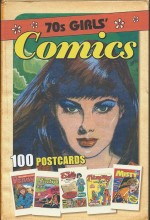
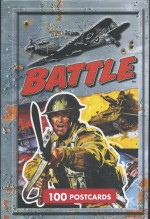
Egmont Classic Comics Postcard Sets


Battle 100 Postcards, 70’s Girl Comics 100 Postcards, Thunderbirds 100 F.A.B. Postcards
By various (Egmont)

ISBNs: 978-1-4052-6837-0, 978-1-4052-6838-7 & 978-1-4052-6893-6

Win’s Christmas Gift Recommendation: Fun and useful – a gift that keeps on giving… 10/10

I like to fool myself that I have a pretty good idea of what the Now Read This! regulars are like – (love art, adore stories, cherish childhood, never get enough exercise, never grew up…).

If that’s you, I think I’ve solved all your Christmas present quandaries.

Well, not me exactly, but hundreds of talented artists, years of accumulated nostalgia and those devilishly clever people at Egmont publishing…

Egmont UK’s Classic Comics library offers a huge variety of unforgettable British strips such as the iconic Roy of the Rovers, combat chronicles Charley’s War, Johnny Red and Major Eazy from legendary war comic Battle, spooky sagas from girls comic Misty and The Thirteenth Floor from kids’ horror anthology Scream – but only be accessed digitally via the iTunes store….

Now however the company has produced a trio of superb full-colour postcard sets: each providing 100 stunning recreations from the memory-mired vaults and all beautifully packaged in stylish commemorative caskets.

Seminal girl’s weekly Misty ran from February 1978 until 1980 when it merged with Tammy. The amalgam carried on until 1984 when it was subsumed into Princess.

In many ways Misty presaged today’s obsession with supernatural, doomed love: blending eerie chills with relationship dramas in such memorable serials as The Cult of the Cat, Moonchild, The Black Widow,  Hush, Hush, Sweet Rachel, The Sentinels, Mr. Walenski’s Secret and Sticks and Stones as well the comedy witch Miss T.

Even with scripts from Pat Mills, Malcolm Shaw and Barry Clements, the big draw was always the stellar art from international artists including John Armstrong, Joe Collins, Brian Delaney, John Richardson, Ken Houghton, Peter Wilkes, Eduardo Feito, Bob Harvey, Honiera Romeu, Badia, Barrera Gesali, Mario Capaldi & Jesus Redondo.

Misty is the most revered these days – hence the preponderance of pictures included here – but AP/Fleetway/IPC ran for decades and even if material from Princess, Girl, Pink, June and Sandie might have passed some sort of sell-by date, the assorted accompanying images and illustrations culled from Tammy, Penny, Jinty and Sally stuffed into this darkly delightful hope chest are truly timeless.

The cards here include many covers but there’s also a selection of beguiling single-page strips (such as the dubiously un-PC Bessie Bunter), Horoscopes, stunning single panels and posters, title pages like Guitar Girl and so very much more…


The aforementioned Battle is synonymous with British comics, which have always had a solid tradition for top-notch strips about the World Wars. However the material produced by this radically subversive and decidedly different publication in the 1970s and1980s surpassed all previous efforts and has been acknowledged as having transformed the entire art form.

Battle was one of the last great British weekly anthologies (the other of course being 2000AD). The all-combat comic began as Battle Picture Weekly on 8th March 1975 and through absorption, merger and re-branding survived becoming Battle Picture Weekly & Valiant, Battle Action, Battle, Battle Action Force and finally Battle Storm Force before itself being combined with the too-prestigious-to-cancel Eagle on January 23rd 1988.

Over 673 gore-soaked, epithet-stuffed, adrenaline drenched issues, it gouged its way into the bloodthirsty hearts of a generation, consequently producing some of most memorable and influential war strips ever conceived, including Major Eazy, D-Day Dawson, The Bootneck Boy, Johnny Red, HMS Nightshade, Rat Pack, Fighter from the Sky, Hold Hill 109, Fighting Mann, Death Squad!, Panzer G-Man, El Mestizo, Joe Two Beans, The Sarge, Hellman of Hammer Force and the stunning, landmark Charley’s War among so many others.

The list of talented contributors is equally impressive: writers Pat Mills, John Wagner, Steve McManus, Mark Andrew, Gerry Finley-Day, Tom Tully, Eric & Alan Hebden, collaborated with artists such as Eric Bradbury, Colin Page, Pat Wright, Giralt, Carlos Ezquerra, Geoff Campion, Jim Watson, Ian Kennedy, Mike Western, Joe Colquhoun, Carlos Pino, John Cooper, Mike Dorey, Cam Kennedy and many more too numerous – or uncredited – to mention.

The battered war-chest for this pack houses hordes of reproduction covers, electrifying series ads, cutaway-drawings featuring Master Plan, quizzes, single page strips such as This Amazing War, some stunning single panels and title pages and much, much more.


The last box is slightly different, featuring a century of scintillating photos and stills from Gerry Anderson’s astounding Thunderbirds TV series, and whereas I’d have liked to see captures from the superb comics associated with the show, these classic images are immensely evocative too – and there’s always room for a second set, right?

Contained herein are snaps from the unforgettable title sequence, portraits of the Tracy clan and their extended network of allies and companions, the malign, sinister Hood, and of course all those astounding, breathtaking wonder machines employed by the  International Rescue outfit to make the future a kinder, safer place.


At least one of these smart, sharp, impossibly satisfying packs are a perfect present for anybody in “our” set and you could even use them to send good old-fashioned thank you notes for your other presents…

But I’ll bet you won’t be able to…

70’s Girl Comics Collection © 2013 and published by Egmont UK Ltd. All rights reserved.

Battle Collection © 2013 and published by Egmont UK Ltd. All rights reserved.

Thunderbirds ™ and © ITC Entertainment Group Limited 1964, 1999, 2013. Licensed by ITV Ventures Limited. All rights reserved. Published by Egmont UK Limited.

Thunderbirds – the Comic Collection


By Alan Fennell, Scott Goodall, Frank Bellamy, John Cooper, Eric Eden, Graham Bleathman & various (Egmont)
ISBN: 978-1-4052-6836-3

Win’s Christmas Gift Recommendation: 10/10 because it just is.

Stand By For Frothing!
Growing up in 1960’s England was the best of all possible worlds for a comic lover. As well as US imports you were treated to some frankly incredible weekly publications, and market bookstalls sold second-hand comics for at least a third of their cover price. We also had some of the greatest artists in the world working on some of the best licensed properties around. A perfect example is the TV – primarily Gerry Anderson – anthology comic TV Century 21.

For British kids of a certain vintage – it varies from eighty to four and three quarters – the Anderson experience is a large and critical component of the DNA of childhood. The TV episodes, toys, bubblegum cards, movies and especially the comic strips all irresistibly evoke and re-manifest the thrill and fevered anticipation of juvenile ecstasy in the millions of kids who enjoyed the weekly rush of mind-boggling, mouth-watering adventure – even decades after the initial hit.

Thus this latest glossy compilation, collecting some of the greatest strips in comics history is probably going to leave a lot of people gurgling in delight as they revisit or – if they’re incredibly lucky – see for the first time a spectacular panorama of futuristic fantasy thrills, spills and chills.

TV Century 21 (the unwieldy “Century” was eventually dropped) was patterned after a newspaper – albeit from 100 years into the future – and this shared conceit carried avid readers into a multimedia wonderland as television and comics fed off each other.

The incredible illustrated adventures were often supplemented with colour stills taken from the shows and photos also graced all text features and fillers which added to the unity of one of the industry’s first “Shared Universe” products. Even the BBC’s TV “tomorrows” were represented in a full-colour strip starring The Daleks.

The first issue launched on January 23rd 1965, instantly capturing the hearts and minds of millions of children and further proving to British comics editors the unfailingly profitable relationship between TV shows and healthy sales.

Filled with high quality art and features, printed in gleaming photogravure, TV21 featured such strips as Fireball XL5, Supercar and Stingray as well as a strange series about a posh future lady spy and her burglar chauffeur.

In an attempt to be topical, the allegorically Soviet and terribly totalitarian state of Bereznik was used in many strips, acting as an overarching, continuity-providing bad guy. Behind numerous plots and outrages, the TomorrowTerrorState constantly schemed against the World Government (for which read “The West”) in an eerily advanced Cold War espionage scenario which augmented the aliens, aquatic civilizations, common crooks and cataclysmic disasters that threatened the general well-being of the populace.

Although Thunderbirds did not premiere on TV until September of that year (with Frank Bellamy’s incredible strip joining the comic’s line-up in January 1966 with #52) Lady Penelope and Parker (subtitled as and promising “Elegance, Charm and Deadly Danger”) had been running since issue #1.

The aristocratic super-spy was promoted to her own spin-off, top-class photogravure publication in January 1966 – just as Anderson’s newest creations launched into super-marionated life: their comics exploits becoming the big draw in the already unmissable TV21.

All that is further explained in an expansive ‘Introduction’ before the procession of weekly wonderment – two staggeringly intoxicating pages every seven days! – begins in this massive (290 pages, 297x222mm) full-colour luxury hardback.

It all begins with the thirteenth adventure, which ran from #141-146 (30th September to November 4th 1967, scripted by Scott Goodall and illustrated by Frank Bellamy) and details how an avaricious madman intends splitting Persia in two with ‘The Earthquake Maker’.

The unforgettable alien invader story ‘Visitor from Space’ (#147-154) follows, with one of the most memorable monsters in comics history stealing the show on every page, after which ‘The Antarctic Menace’ (6th January-17th February 1968, #155 to 161) begins a brand new year with the same tried and true thrills as the Tracy boys are called in to save the day after the Australia-Antarctica highway is sabotaged!

‘Brains is Dead’ (#162-169, running until 13th April) features the skulduggery of the sinister Hood in a deadly game of industrial espionage, after which artist Graham Bleathman provides a captivating glimpse at those longed-for technical details with double-page cutaway spreads and single page strip sequences ‘Thunderbird 1 Technical Data’, ‘Launch Sequence: Thunderbird 1’, ‘Launch Sequence: Thunderbird 2’ and ‘Thunderbird 2 Technical Data’.

The suspenseful strip stories resume with ‘The Space Cannon’ (Goodall & Bellamy, from TV21 #170-172 April 20th to May 4th 1968) as the team have to stop a continually firing neutron cannon that’s crashed into the Thames, whilst follow-up yarn ‘The Olympic Plot’ by Howard Elson & Bellamy (#173-178) finds the great games – held in the crater of Vesuvius – disrupted not only by a lake of fire but also a madman digging up a pirate treasure hidden since the 17th century…

TV21 #184-187 (27th July-17th August 1968) offered ‘Devil’s Crag’ (Goodall & Bellamy) and saw International Rescue save a lost schoolboy; a spectacular visual extravaganza that belies its deceptively simple plot, after which ‘The Eiffel Tower Demolition’ (#188-191) goes dreadfully wrong and Scott and Virgil find themselves endangered by thieves and saboteurs…

Bleathman returns with more pictorial top secrets in ‘Specifications of Thunderbird 3’, ‘Launch Sequence: Thunderbird 3’, ‘Launch Sequence: Thunderbird 4’ and ‘Specifications of Thunderbird 4’ after which Goodall & Bellamy expose ‘The Nuclear Threat’ (TV21 #192-196, 21st September-19th October 1968) of an out-of-control drone ferrying atomic weapons to their intended deep sea dumping ground, whilst the ‘Hawaiian Lobster Menace’ (#197-202) outrageously reveals a plot to turn tasty crustacean treats into explosive anti-personnel weapons…

‘The Time Machine’ (December 7th 1968 to January 11th 1969) used by Jeff and Scott Tracy malfunctioned in a most unfortunate manner, whilst from #209-217 a more domestic disaster saw ‘The Zoo Ship’ which foundered off Tracy Island lead to crewmen trapped aboard ship and savage beasts loose on shore with our harried heroes trying to save lives whilst keeping their secrets safe from the ever insidious Hood…

Bleathman has more artistic innovations to display in ‘Specifications of Thunderbird 5’, ‘The Construction of Thunderbird 5′, ‘This is Tracy Island’ and ‘Tracy Island’ giving us all the detail and data we desire before ‘City of Doom’ (Goodall as “Spencer Howard” & Bellamy from #218-226, 22nd March to May 17th) finds a top secret, ultra-futuristic Andean science metropolis endangered by a wild nuclear reaction…

Scripted by Goodall or (perhaps John W. Jennison?), ‘Chain Reaction’ ran in TV21 and TV Tornado #227-234, May 24th-12th July 2069) wherein the Tracy team had to stop an out of control 50,000-ton space freighter from impacting in the middle of San Francisco – and that’s just the start of an epic calamity which threatened to destroy the entire Pacific Rim…

There’s a big jump here to October 1968 for ‘The Big Bang’ by Geoff Cowan & John Cooper, possibly explained by the fact that once Bellamy left the strip, his cruelly underrated replacement rendered the strip in black and white. When Fleetway revived the Anderson franchise in the early 1990s the comics featured artwork from TV21 supplemented with new original material from another generation of fans and creators, but as Thunderbirds was far and away the biggest hit, some of Cooper’s strips were reprinted with the artist at last getting the chance to colour his efforts.

Thus this, his second original yarn from TV21 & Joe 90 #5-8 (25th October-15th November 1969), involving smuggled diamonds and a boy trapped on a building both sinking and about to explode…

The endeavours of the Tracy clan then conclude with ‘The Mini Moon’ (Richard O’Neill & Cooper (TV21 & Joe 90 #22-28, 21st February to April 4th 1970) as a roving planetoid menaces Earth and Brains, Alan and Gordon have to blow it up while it’s still far enough away to pose no extinction-level threat…

Happily there’s still plenty for fans to enjoy as, after Bleathman’s revelatory ‘The Secrets of FAB 1’ and Creighton-Ward Stately Home’, the adventures of Lady Penelope and her invaluable manservant Parker begin with ‘Mr. Steelman’ by Alan Fennell & Eric Eden. Originally seen in TV Century 21 #1-11, January 23rd to April 3rd 1965, this is a complex thriller involving espionage and a deadly robot, after which Bellamy handles ‘The Isle of Arran Riddle’ (#35-43, September 18th to November 13th 1965) wherein the Honourable Lady Creighton-Ward attempts to solve an ancient puzzle and inherit a fabulous ruby.

Eden returned for ‘The Vanishing Ray’ (#44-51) as the stately spy was mysteriously sent a torch that turned objects transparent, unaware that the wicked Hood was hot on its trail.

The deadly games end with ‘The Enemy Spy’, illustrated by the legendary Frank Hampson from the July 1965 Lady Penelope Summer Extra, wherein an idle glance at the TV news sets Her Ladyship on the trail of Bereznik’s top assassin…

But of course the real treasure is the phenomenal and unparalleled work of Frank Bellamy, whose fantastic design, drawing and painted colour (which holds up rather well here, despite the limitations of modern print technology to accommodate the subtleties of the photogravure process) steals the show – and usually one’s breath away!

The work of Bellamy and his successors are a cherished highpoint of British comic-making. Crisp, imaginative writing, great characters and some of the very best science-fiction art of all time make this a must-have book for just about anybody with a sense of adventure and love of comics. It doesn’t get better than this.
Thunderbirds ™ and © ITC Entertainment Group Limited 1964, 1999, 2013. Licensed by ITV Ventures Limited. All rights reserved.

The High Fidelity Art of Jim Flora – Album Covers and Music Illustrations


By Irwin Chusid & Barbara Economon (Fantagraphics Books)
ISBN: 978-1-60699-655-3

Some artists can be said to epitomise an era, their works forever evoking the time and style and flavour of a discreet age. Usually it’s all those inspired invisible creatives toiling at the coalface of imagination: advertising and package designers, film poster artists, fashion designers and yes, comic and strip illustrators, whose individual yet socially synergistic efforts pool and leak into a generation’s psyche.

A very select few artists can be also be charged with actually creating the definition of an epoch: Jim Flora was one of those…

Born in Ohio in 1914, he studied at the Art Academy of Cincinnati from 1935-1939. A year before he graduated Flora met brilliant but troubled author and artist Robert Lowry and together they founded the influential Little Man Press, publishing a stellar line of impressive literary titles with eye-catching art and design.

In 1942 they parted and Flora, newly married, briefly became a freelance artist before taking a job with Columbia Records. He upped sticks for Westport Connecticut, initially working for the in-house art department under Alex Steinweiss (inventor of the illustrated album cover).

The newcomer designed ads, crafted and illustrated new-release pamphlets and assorted retail trade literature, but when his boss enlisted in the Navy, the 4-F Flora was promoted to Art Director.

Always drawing and designing, he continued until 1945, creating the groundbreaking advance-trade periodical Coda, and was promoted to Advertising Manager. However, afflicted with an insatiable hunger to create, Flora chafed in such a time-consuming, bureaucratic position, even as his first landmark LP designs began to appear throughout 1947.

Despite having a wife and five kids to support, in 1950 he resigned and relocated with the brood to Mexico for 15 months. Despite revelling in artistic freedom and absorbing the colourful kinetic art of the region, the Floras returned to Connecticut in 1951, and Jim began a hugely successful career as a freelance illustrator. Thereafter he lent his uniquely enchanting style to record covers for Columbia, RCA Victor, Camden and others whilst generating mountains of illustrations for books, newspapers and magazines.

Life, Look, Newsweek, The New York Times Magazine, Fortune, Holiday, Mademoiselle, Research and Engineering, Computer Design Magazine, Sports Illustrated, Collier’s and many others numbered him amongst their regular contributors, and for most of 1952 he also operated as Art Director for Park East, where he published the earliest commercial art of R.O. Blechman and Andy Warhol.

His tireless creativity and graphic invention always forcing him into new challenges, Flora also created storyboards for animator Gene Deitch at cartoon factory United Productions of America (UPA).

He was also a savvy professional and could see how times and trends would inevitably shift. With fashion inexorably against him, Rock ‘n’ Roll supplanting Jazz and classical sounds and photography encroaching on album sleeves, in 1955 he sold his first illustrated children’s book The Fabulous Fireworks Family to Harcourt Brace, and produced sixteen more until retirement in 1982.

He loved everything nautical or maritime and cherished Jazz, and his pervasive, infectious style transformed animation and graphic illustration from the late1950s on, when all those kids who’d bought his LP covers or read his publicity bulletins began to work on cartoons for the burgeoning, all-consuming television industry or entered the advertising field.

Flora was addicted to making art and employed a uniquely frenetic, narrative-packed rhythmic style that jumped with boundless energy and charm and paid no-nevermind to foolish hobgoblins like perspective, representational anatomy or good taste and common sense. Many of the most impressive works abound with wry but subtly concealed scenes of horror, sex and violence…

Flora never drew comics, but if he had they would have been amazing…

This superb coffee-table art book by biographers, archivists and fans Irwin Chusid and Barbara Economon is the fourth compilation in a series that includes The Mischievous Art of Jim Flora (2004), The Curiously Sinister Art of Jim Flora (2007) and The Sweetly Diabolic Art of Jim Flora (2009). As such it contains hundreds of beguiling and revelatory images, roughs, sketches, photos, designs, layouts, complete ads and spot illustrations from his most productive decades: images impossibly familiar and nostalgia-loaded for anyone who grew up in the 1960s and 1970s.

Most importantly this book also reproduces every (known) record cover Flora created…

It all opens with Chusid’s expansive biographical overview ‘Wizard of the Square-Foot Canvas’ and includes an ‘Interview with Jim Flora’ plus Martina Schmitz’ ‘Interview with Robert Jones’ (lifelong buddy and Flora’s Art Director successor at Columbia, RCA Victor and Park East, he commissioned a vast number of works from the freelancer), all liberally bedecked with stunning pictures.

The colossal Album Covers gallery then commences to steal your visual breath away presenting stunning reproductions of those eccentric masterpieces from Mambo For Cats to The Dukes of Dixieland, Strollin’ the Cha Cha Cha to Inside Sauter-Finegan, from Lord Buckley’s Hipsters, Flipsters, and Finger-Poppin’ Daddies Knock Me Your Lobes to Mexican Folk Songs or Till Eulenspiegel to For Boppers Only, concluding with a groovy selection of his commercial art spreads and later fine art pieces – paintings, drawings and prints celebrating music, friends and life.

His influence on generations of artists is incalculable and lasting. Flora passed away in 1998, but his pictures are still here, frantically jinking and jiving in every mind that ever saw them…

The High Fidelity Art of Jim Flora © 2013 Irwin Chusid. All images © the Heirs of Jim Flora, except where noted otherwise. All rights reserved.
Win’s Christmas Gift Recommendation: a pictorial time-warp for hepcats of all ages… 8/10

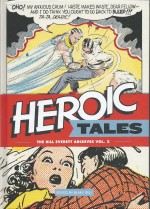
Heroic Tales: The Bill Everett Archives volume 2


By Bill Everett and others, edited and complied by Blake Bell (Fantagraphics Books)
ISBN: 978-1-60699-600-3

Thanks to modern technology there is a superabundance of collections featuring the works of too-long ignored founding fathers and lost masters of American comic books. A magnificent case in point is this second superb chronicle revisiting the incredible gifts of one of the greatest draughtsmen and yarn-spinners the industry has ever seen.

You could save some time and trouble by simply buying the book now rather than waste your valuable off-hours reading my blather, but since I’m keen to carp on anyway feel free to accompany me as I delineate just why this tome needs to join the books on your “favourites” shelf.

He was a direct descendent and namesake of iconoclastic poet and artist William Blake. His tragic life and awe-inspiring body of work – Bill was possibly the most technically accomplished artist in US comicbook industry – reveals how a man of privilege and astonishing pedigree was wracked by illness, an addictive personality (especially alcoholism) and sheer bad luck, nevertheless shaped an art-form and left twin legacies: an incredible body of superlative stories and art, and, more importantly, saved many broken lives saved by becoming a dedicated mentor for Alcoholics Anonymous in his later years.

William Blake Everett was born in 1917 into a wealthy and prestigious New England family. Bright and precocious, he contracted Tuberculosis when he was twelve and was dispatched to arid Arizona to recuperate.

Thus began a life-long affair with the cowboy lifestyle: a hard-drinking, smoking, tall-tale telling breed locked in a war against self-destruction, described in the fact-filled, picture-packed Introduction by Blake Bell which covers ‘The Early Years of Comics: 1938-1942’, ‘The Birth of Marvel Comics’ and ‘The Comic Book Production System’, before ‘The Heroes’ precedes a full-colour selection of incredible prototypical adventure champions with a brief essay on the set-up of Centaur Comics, Novelty Press, Eastern Color Printing, Hillman and Lev Gleason Publications…

Accompanied by the covers for Amazing Mystery Funnies volume 2 #3, 5 and 6 (March, May & June 1939, Centaur) are three outer space exploits of futuristic trouble shooter Skyrocket Steele, whilst Tibetan-trained superhero Amazing-Man offers a transformative triptych of titanic tales spanning war-torn Europe, augmented by the covers to Amazing-Man Comics #9-11 February-April 1940.

Everett’s deeply held western dreams are covered next with a brace of rootin’ tootin’ yarns starring Bull’s-Eye Bill from Novelty Press’ Target Comics #3-4 (April & May 1940) whilst from #7-9 (August-October 1940), the author smoothly switched to sophisticated suspense with master of disguise The Chameleon crushing contemporary criminals in scintillating escapades from Target Comics’ answer to The Saint, the Falcon and the Lone Wolf.

Thanks to his breakthrough Sub-Mariner sagas Everett was inextricably linked to water-based action, and Eastern Comics hired him to create human waterspout Bob Blake, Hydroman for the bimonthly Reg’lar Fellers Heroic Comics. Here, spanning issues # 6-9 (May-November 1941, with the covers for #6 and 7), are four spectacular, eerie, offbeat exploits, covering an extended battle against foreign spies and American Fifth Columnists, after which Red Reed in the Americas! (created by Bob Davis & Fitz) offers the first two chapters in a political thriller wherein a college student and his pals head South of the Border to fight Nazi-backed sedition and tyranny in a stunning tour de force first seen in Lev Gleason’s Silver Streak Comics #20 & 21 (April & May 1942).

A section of Miscellaneous and text illustrations follows, blending Western spot drawings with the eye-catching covers from Amazing Mystery Funnies volume 2 #18, Target Comics #5 and 6, Blue Bolt (vol. 1 #11, vol. 2 #1, 2 and 3) and Famous Funnies #85.

The Humorous and More describes Everett’s forays into other markets: niche sectors such as licensed comics, comedy and romance, and even returns to pulp and magazine illustration as he strove to stay one step ahead of a constantly shifting market and his own growing reputation for binges and unreliability.

‘What’s With the Crosbys?’ is a superbly rendered gossip strip from Famous Stars #2 (1950, Ziff-Davis) whilst a stunning monochrome girly-pin-up of ‘Snafu’s Lovely Ladies’ (from Snafu #3 Marvel, March 1956), and the cover of Adventures of the Big Boy #1 (also Marvel, from the same month) lead into the Back Cover of Cracked #6 (December 1958, Major Magazines) and other visual features from the Mad imitator as well as the colour cover to less successful rip-off Zany (#3, from March 1959).

Everett’s staggering ability to draw beautiful women plays well in the complete romance strip ‘Love Knows No Rules’ (Personal Love #24, November 1953 Eastern Color), and this section concludes with a gritty black and white title page piece from combat pulp War Stories #1, courtesy of Marvel’s parent company Magazine Management, September 1952.

The Horror concentrates on the post-superhero passion for scary stories: an arena where Bill Everett absolutely shone like a diamond. For over a decade he brought a sheen of irresistible quality to the generally second-rate chillers Timely/Atlas/Marvel generated in competition with genre front-runners EC Comics. It’s easy to see how they could compete and even outlive their gritty, gore-soaked competitor, with such lush and lurid examples of covers and chillingly beautiful interior pages…

Following a third informative background essay detailing his life until its cruelly early end in 1973, a choice selection of his least known and celebrated efforts opens with tale of terror ‘Hangman’s House’ (Suspense #5, November, 1950): a grim confrontation with Satanic evil, followed by futuristic Cold War shocker ‘I Deal With Murder!’ and a visit to a dark carnival of purely human wickedness in ‘Felix the Great’ (both culled from Suspense #6, January 1951).

Adventures into Weird Worlds #4 (Spring 1952) offered a laconic, sardonic glimpse into ‘The Face of Death’, whilst from the next issue (April 1952) ‘Don’t Bury Me Deep’ tapped untold depths of tension in a moodily mordant exploration of fear and premature burial. Hard on the heels of the cover to Journey Into Unknown Worlds #14 (December 1952) comes one of its interior shockers as ‘The Scarecrow’ helped an aged couple solve their mortgage problems in a most unusual manner.

The Marvel madness then concludes with a cautionary tale of ‘That Crazy Car’ from Journey into Mystery #20, December 1954, concluding a far too brief sojourn amidst arguably Everest’s most accomplished works and most professionally adept period.

This magnificent collection ends with a gallery of pages and one complete tale from the end of his career; selected from an even more uninhibited publisher attempting to cash in on the adult horror market opened by Warren Publishing with Eerie, Creepy and Vampirella.

Skywald was formed by industry veteran Israel Waldman and Everett’s old friend Sol Brodsky, tapping into the burgeoning black and white market with mature-reader and supernatural magazines Hell-Rider, Crime Machine, Nightmare, Psycho and Scream. Offered an “in” Everett produced incredible pin-ups (included here are three from Nightmare (#1, 2 & 4, December 1970-June 1971), ‘A Psycho Scene’ (Psycho #5, November, 1971) a stunning werewolf pin-up from Psycho #6 and one of revived Golden Age monstrosity ‘The Heap’ from Psycho #4.

Most welcome, however, is a magnificent 10-page monochrome masterpiece of gothic mystery ‘The Man Who Stole Eternity’ from Psycho #3, May, 1971.

Although telling, even revelatory and concluding in a happy ending of sorts, what this book really celebrates is not the life but the astounding versatility of Bill Everett. A gifted, driven man, he was a born storyteller with the unparalleled ability to make all his imaginary worlds hyper-real; and for nearly five decades his incredible art and wondrous stories enthralled and enchanted everybody lucky enough to read them.

© 2013 Fantagraphics Books. Text © 2013 Blake Bell. All art © its respective owners and holders. All rights reserved.
Win’s Christmas Gift Recommendation: Perfect for art lovers, Marvel Zombies and addicts of pure comics magic… 9/10

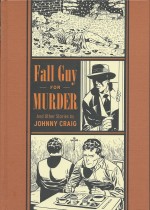
Fall Guy for Murder and Other Stories


By Johnny Craig, with Ray Bradbury, Bill Gaines & Al Feldstein (Fantagraphics Books)
ISBN: 978-1-60699-658-4

From 1950-1954 EC was the most innovative and influential comicbook publisher in America, dominating the genres of crime, horror, adventure, war and science fiction. They even originated an entirely new beast – the satirical comicbook.

After a shaky start, following the death of his father (who actually created Comicbooks in 1933), new head honcho William Gaines and his trusty master-of-all-comics trades Al Feldstein turned a slavishly derivative minor venture into a pioneering, groundbreaking enterprise which completely altered the perception of the industry and art form.

As they began co-plotting the bulk of EC’s output together, intent on creating a “New Trend” of stories aimed at older and more discerning readers – and not the mythical 8-year-old comicbooks ostensibly targeted – they shifted the emphasis of the ailing company towards dark, funny, socially aware and more adult fare.

Their publishing strategy also included hiring some the most gifted writers and artists in the field. One of the very best and most undervalued today was Johnny Craig…

This lavish monochrome hardcover volume, part of Fantagraphics’ EC Library, gathers a chilling collection of Craig’s supernatural suspense and especially his superbly Noir-drenched crime stories in a wonderful primer of peril packed with supplementary interviews, features and dissertations, beginning with the informative and picture-packed ‘Brilliant Good Guys, Even More Brilliant Bad Guys’ by lecturer Bill Mason, after which the succession of classic genre tales begins with  ‘One Last Fling!’ from Vault of Horror #21 October/November 1951. Craig was an absolute master of pen-and-ink illustration, but his scripting was just as slick and deceptively, hilariously seductive.

In his initial yarn here, a circus knife-thrower refused to let the mere fact that his beloved assistant had become a vampire drive them apart, whilst ‘Out of the Frying Pan…’ (from Crime SuspenStories #8, December 1951/January 1952) is a wry gem of misdirection, as a temporarily blind killer lets the wrong little old man plan his escape from hospital for him…

From Vault of Horror #22 (December 1951/January 1952), ‘Fountains of Youth!’ was straightforward supernatural thriller about a vitality-leeching monster, but ‘Understudy to a Corpse!’ (Crime SuspenStories #9, February/March 1952) was a brilliantly twisty murder-plot involving a penniless actor who murdered his uncle and diverted police attention by impersonating the victim post mortem. It did not go according to plan…

‘A Stitch in Time!’ (Vault of Horror #23 February/March 1952) is a grotesque classic in which a tyrannical sweatshop boss pays a ghastly price for abusing the desperate seamstresses in his employ, before ‘…Rocks in His Head!’ from Crime SuspenStories #10 (April/May 1952) sees a harassed hard-pressed surgeon with a greedy young wife making a disastrous choice when faced with a jewel-bedecked corpse to autopsy, and ‘A Bloody Undertaking!’ (Vault of Horror #24, April/May 1952) takes the same theme into supernatural territory as a pretty young thing turns the head of an old country doctor who really should know better…

Regarded as one of the company’s slowest creators, Craig nevertheless found time to illustrate scripts by Gaines & Feldstein such as ‘…On a Dead Man’s Chest!’ (Haunt of Fear #12 March/April 1952) wherein, after a sordid affair and brutal murder, retribution from beyond the grave sought out the victim’s wife and philandering brother…

‘Stiff Punishment!’ from Crime SuspenStories #11 June/July 1952 was all Craig, however, and again dealt with the pressures of greedy young things who wed staid old doctors. This time when the medical lecturer finally snapped he thought he had the perfect way to hide the body – but, ironically, he hadn’t…

In ‘Séance!’ (Vault of Horror #25 June/July 1952) a couple of conmen kill a mark who learns too much but are undone when the widow consults their own spiritualist for answers, after which Gaines & Feldstein scripted a shocking tale of gluttony and a vengeful sword-swallower in the gloriously macabre ‘Fed Up!’ from Haunt of Fear #13 May/June 1952.

The genuine tension of ‘The Execution!’ (Crime SuspenStories #12 August/September 1952), wherein a death row inmate waited for the witness who could save him from the chair, came from one simple shocking fact. In Craig’s stories the good guys didn’t always win, and justice was frequently derailed and even cheated…

‘Two of a Kind!’ (Vault of Horror #26 August/September 1952) offered a sexually charged love story of the most extreme kind of sacrifice, whilst in ‘Silver Threads Among the Mold!’ (Vault of Horror #27 October/November 1952) an avaricious model regrets making a fool of the sculptor who adores and supports her, and ‘Sweet Dreams!’ (Crime SuspenStories #14 December 1952/January 1953) reveals the dire lengths an insomniac will stoop to in search of a little rest.

‘Till Death…’from Vault of Horror #28, December 1952/January 1953 – is, for many fans, the ultimate zombie story as a besotted plantation owner loses his new bride to disease and soon learns to regret using voodoo to restore her to his side.

‘When the Cat’s Away…’ (Crime SuspenStories #15 February/March 1953) is pure Crime Noir as a cuckolded husband deals with his wife and best friend with finesse and grim finality, whilst ‘The Mausoleum!’ from Vault of Horror #29, February/March 1953, sees an English landowner sell his family castle to a ghost-crazy American, lock, stock and damning evidence of the murder he committed to inherit everything…

‘Rendezvous!’ (Crime SuspenStories #16 April/May 1953) brilliantly outlines the sheer dumb luck that scotched the perfect murder/insurance scam, after which ‘Split Personality!’ (Vault of Horror #30 April/May 1953) details the incredible lengths to which a con artist went to deprive identical twin sisters of their fortunes…

‘Touch and Go!’ from Crime SuspenStories #17 June/July 1953 is Craig’s sublimely paranoiac and compulsive adaptation of the Ray Bradbury vignette about a killer who left damning fingerprints, whilst romantic obsession underpins the tragic tale of an artist-turned-mugger who only stole to pay for true love’s medical bills in ‘Easel Kill Ya!’ from Vault of Horror #31 June/July 1953.

This addictive compilation concludes with a devilishly convoluted tale of a Private Eye set up to take the blame for a perfect crime. Written by Gaines & Feldstein, ‘Fall Guy for Murder!’ (Crime SuspenStories #18 August/September 1953) is the quintessential 1950s crime story: smart, scary, devious and morally utterly ambiguous…

The comics classics are then followed by more background revelations via S.C. Ringgenberg’s in-depth personal history in ‘Johnny Craig’ – complete with a stunning selection of Craig’s most eye-catching and controversial covers – and a general heads-up on the short-lived but world-shaking  phenomenon in ‘The Ups and Downs of EC Comics: A Short History’ by author, editor, critic and comics fan Ted White and the comprehensively illuminating ‘Behind the Panels: Creator Biographies’ by Mason, Tom Spurgeon and Janice Lee.

The short, sweet but severely limited output of EC has been reprinted ad infinitum in the decades since the company died. These titanic comics tales revolutionised not just our industry but also impacted the whole world through film and television and via the millions of dedicated devotees still addicted to New Trend tales.

Fall Guy for Murder is the fifth Fantagraphics compendium highlighting the contributions of individual creators, adding a new dimension to aficionados’ enjoyment whilst providing a sound introduction for those lucky souls encountering the material for the very first time.

Whether an aged EC Fan-Addict or the merest neophyte convert, this is a book no comics lover or crime- caper victim should miss…

Fall Guy for Murder and Other Stories © 2013 Fantagraphics Books, Inc. All comics stories © 2013 William M. Gaines Agent, Inc., reprinted with permission. All other material © 2013 the respective creators and owners.
Win’s Christmas Gift Recommendation: Brooding menace and stunning drama leavened with black humour… 10/10

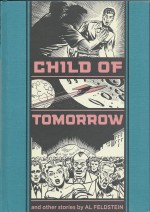
Child of Tomorrow and Other Stories


By Al Feldstein with Graham Ingels, George Roussos, George Olesen, Max Elkan & Sid Check (Fantagraphics Books)
ISBN: 978-1-60699-659-1

EC Comics began in 1944 when comicbook pioneer Max Gaines sold the superhero properties of his All-American Comics company to half-sister National/DC, retaining only Pictures Stories from the Bible. His plan was to produce a line of Educational Comics with schools and church groups as the major target market.

He augmented his core title with Picture Stories from American History, Picture Stories from Science and Picture Stories from World History but the worthy project was already struggling when he died in a boating accident in 1947.

As detailed in the final comprehensive essay in this superb graphic collection, his son William was dragged into the family business, with much support and encouragement from unsung hero Sol Cohen – who held the company together until the initially unwilling Bill Gaines abandoned his dreams of being a chemistry teacher and transformed the ailing enterprise into Entertaining Comics…

After a few tentative false starts and abortive experiments following industry fashions, Gaines took advantage of his multi-talented associate Al Feldstein, who promptly graduated from creating teen comedies and westerns into becoming Gaines’ editorial supervisor and co-conspirator.

As they began co-plotting the bulk of EC’s stories together, they shifted the emphasis of the ailing company in a bold and impressive change of direction. Their publishing strategy, utilising the most gifted illustrators in the field, was to tell a “New Trend” of stories aimed at older and more discerning readers, not the mythical 8-year old all comicbooks ostensibly targeted.

From 1950 to 1954 EC was the most innovative and influential publisher in America, dominating the genres of crime, horror, war and science fiction and the originator of an entirely new beast: the satirical comicbook…

Feldstein had started life as a comedy cartoonist and after creator/editor Harvey Kurtzman departed in 1956, Al became Mad’s Editor for the next three decades…

This volume of the Fantagraphics EC Library gathers a mind-boggling selection of Feldstein fantasy stories in a lavish monochrome hardcover edition, packed with supplementary interviews, features and dissertations, beginning with the informative ‘Cosmic Destruction With a Twist of Wry’ by lecturer Bill Mason and a gushing Introduction from cartoon superstar Gilbert Hernandez. Oddly enough writer-artist Feldstein was no fan of science fiction but was turned on to the genre by Gaines; an insomniac with a brain that always voraciously sought out the fresh and the new…

Feldstein worked on every genre in EC’s stable, but the short, ironic, iconic science thrillers he produced during that paranoid period of Commies and H-Bombs, Flying Saucer Scares and Red Menaces, irrevocably transformed the genre from Space-babes and Ray-gun adventure into a medium where shock and doom lurked everywhere.

His cynically trenchant outlook and darkly comedic satirical stories made the cosmos a truly dangerous, unforgiving place and kept it such – until the Comics Code Authority and television pacified and diminished the Wild Black Yonder for all future generations…

This superb monochrome hardback sampler of cosmic calamity opens with ‘“Things” from Outer Space!’ (originally presented in Weird Science #12, May/June 1950), wherein a scientist’s comely assistant accidentally uncovers alien infiltrators in the highest echelons of America’s government.

From the same month ‘Am I Man or Machine?’ (Weird Fantasy #13) then taps into Noir sensibilities with a tale of true love and tragic sacrifice when an accident victim falls into the hands of scientists too concerned with mere mechanical advancement, oblivious to sentiment…

Weird Science #13 (July/August 1950) tapped into the nation’s unease by gloriously spoofing the Air Force investigation into alien sightings with ‘The Flying Saucer Invasion’, whilst Feldstein and Gaines started a convention of writing themselves into their stories in Weird Fantasy #14 that same month as their comicbook editorial speculation led to enemy agents causing a ‘Cosmic Ray Bomb Explosion!’

Doomsayers and whistleblowers always played a big part in these tales. In ‘Destruction of the Earth!’ (Weird Science #14, September/October 1950), Washington’s refusal to listen to maverick researcher Fredrick Holman had truly catastrophic repercussions, whilst over in that month’s Weird Fantasy (#15) the Capitol was saved from ‘Martian Infiltration!’ by another, friendlier race of visitors…

‘Panic!’ (Weird Science #15, November/December 1950) played with the fact of Orson Welles’ infamous War of the Worlds radio broadcast, but the tone over in Weird Fantasy #16 was far more sardonic when ‘The Last City’ revealed the logical flaw in New York’s plan to erect an impenetrable, air-tight, H-bomb proof force field over the metropolis…

Sex, love and time-travel merged in Weird Science #5 (January/February 1951) as an ordinary Joe took a mysterious tourist trip into the future and brought back heartbreak in the form of a synthetic, build-her-yourself wife – and trust me, the ending is not one you’ll be expecting – whilst in ‘Child of Tomorrow!’ (Weird Fantasy #17) a lucky survivor of an atomic conflagration discovers at first hand the appalling effects of radiation on human reproduction…

The grim warnings and prognostications continued in ‘Spawn of Venus’ (Weird Science #6, March/April 1951) as an exploratory voyage to our sister world brings back something hungry which cannot be killed, whilst in that month’s Weird Fantasy (#6 – as the frankly whacky numbering systems were at last rationalised) a doomed romance was rekindled by fate after a bold astronaut returned from a ‘Space-Warp!’.

‘It Was the Monster from the Fourth Dimension’ (Weird Science #7, May/June 1951) pitted valiant friends against a creature – or a least a portion of it – from outside our limited perceptions, but Feldstein’s wry, cynically dry humour fully informed the tale of a patriotic hillbilly super-prodigy who naturally offered his gifts and services to the bigwigs in Washington in ‘7 Year Old Genius!’ (Weird Fantasy #7, May/June 1951).

Man versus Monster was an inescapably popular and rousing theme of the times and ‘Seeds of Jupiter!’ (Weird Science #8, July/August 1951) is one of the most visually compelling examples of the type, whilst the accidental time-travel by astronauts in Weird Fantasy #8 imaginatively postulated on ‘The Origin of the Species!’ displays the author’s superb ability to build tension, even if you have already guessed the “shock ending”…

Even whilst scripting and illustrating these stories, the tireless Feldstein was becoming increasingly involved in the editorial and production side of the business.

After The Origin of the Species! he stopped drawing science fiction adventures, but wrote stories for other artists to draw. This final section reprints a few of them by less prolific or well known illustrators – who probably won’t have their own book collections – and kicks off with ‘House, in Time!’ (Weird Science #15, November/December 1950) for horror star Graham Ingels to render

In it a young couple rent a perfect dwelling at a ludicrous price, but are unable to comply with the peculiar landlord’s simple request – to never open the back door…

The multi-talented George Roussos limned the next three, beginning with Weird Fantasy #7 (May/June 1951) wherein astronauts discover another Earth ‘Across the Sun!’ and learn a ghastly secret of human development, after which ‘The Escape!’ (Weird Science #8, July/August 1951) delivers a knockout crime thriller of murder in space and inescapable justice.

That motif of cosmic comeuppance also informs ‘The Slave Ship!’ (Weird Fantasy #8, July/August 1951) as piratical traders in human flesh find out just what that feels after aliens abduct them…

Unsung comic strip stalwart George Olesen (Ozark Ike, The Phantom) illustrated ‘The Slave of Evil!’ (Weird Science #9, September/October 1951) wherein a mechanical man displays more humanity than the humans who constructed him, after which veteran Max Elkan revealed the heartbreaking secret of ‘The Connection!’ (Weird Fantasy #9, September/October 1951) between a heartbroken old inventor and a vivacious young orphan girl.

The forays into the fantastic conclude then with ‘Strategy!’ (Weird Science #14, July/August 1952) illustrated by Sid Check, which reveals the big mistake of brain-stealing aliens who picked the wrong man to probe for Earth’s military secrets…

Also adding to the value of this captivating chronicle is ‘Gut and Glory’: an interview with the creator himself, conducted by Gary Groth, the incisive biography ‘Al Feldstein’ by S.C. Ringgenberg, a general heads-up on the entire EC phenomenon in ‘The Ups and Downs of EC Comics: A Short History’ by author, editor, critic and comics fan Ted White and the comprehensively illuminating ‘Behind the Panels: Creator Biographies’ by Bill Mason, Arthur Lortie and Janice Lee.

The short, sweet but severely limited output of EC has been reprinted ad infinitum in the decades since the company died. These astounding stories and art changed not just comics but also infected the larger world through film and television and via the millions of dedicated devotees still addicted to New Trend tales.

However, this series of collections (Child of Tomorrow is the sixth) highlighting thematic contributions of individual creators has added a new dimension to au fait readers’ enjoyment and offers a solid introduction for those lucky souls encountering the material for the very first time.

I strongly suggest that whether you are an aged EC Fan-Addict or callow contemporary convert, this is a book no comics aficionado can afford to miss…

Child of Tomorrow and Other Stories © 2013 Fantagraphics Books, Inc. All comics stories © 2013 William M. Gaines Agent, Inc., reprinted with permission. All other material © 2013 the respective creators and owners.

Win’s Christmas Gift Recommendation: Wide Eyed Wonderment seasoned with wry wit… 9/10

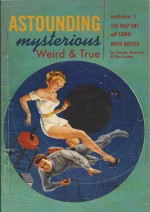
Astounding, Mysterious, Weird & True Volume 1: The Pulp Art of Comic Book Artists


By Steven Brower & Jim Simon (SB Studio Books)
ISBN: 978-1-4820-3313-7

Once upon a time, literacy was at an all-time high in the English-speaking world. A determined push to educate all and sundry took reading out of the hands of a moneyed intelligentsia and made it a tool of the working man, just as print technology was finding cheaper and more effective ways for creators and purveyors to disseminate their wares to growing markets.

Moreover, what everybody in the publishing world knew was what working folk needed more than anything (even religion) was cheap entertainment – the less wholesome and salutary the better…

In Britain we had newspapers, a burgeoning comics sector, “blood and thunder” periodicals and story magazines. In America they had “The Pulps”…

The first was indisputably The Argosy, created by Frank A. Munsey in 1896 and largely superseding most types of the infamous “Dime Novel” which had, with untrammelled sensationalism, ruled the periodical markets since 1860.

Argosy and its end-of-the-century imitators dominated and inspired a publishing phenomenon which eventually covered every genre – or blend of genres – in an industry niche which lasted well into the 1990s, albeit in a much reduced and rarefied form.

As well as spectacular colour covers, almost all pulps had black and white interior illustrations – spots, splashes and spreads – and some even had their own comic strip serials.

There were pulps for every possible taste and topic from romance to mystery to all-out action – including racier “men’s adventures”: two-fisted exotic action-thrillers heavy on mildly fetishistic sadism and bondage themes, with Rugged American men coming to the rescue of white women in peril from thugs and foreigners, saving them (the white women, of course) from “fates worse than death”, but only just in time and never before they had lost most of their clothes (the girls, and often many of the Rugged Americans too…).

One publisher in particular specialised in this niche market, producing a range of saucy genre thrillers all graced with a defining appellative: Spicy Detective, Spicy Western, Spicy Mystery and Spicy Adventure Stories. This was printer-turned-publisher Harry Donenfeld, who occasionally assumed control of companies who couldn’t pay their print bills. In 1934 and knowing pretty well what readers liked, he created a “Men’s Mag” mini empire under the twin banners of Culture and Trojan Publications. Of course, that’s also how he assumed control of the company that became DC Comics less than a decade later…

In 1943 the pressure exerted by various censorious elements in America became too much and Trojan/Culture changed tack and “Spicy” overnight evolved into “Speed Detective”, “Speed Western” and so forth. Perhaps the fact that Donenfeld was sitting on a wholesome family goldmine of comicbook characters such as Superman and Batman had something to do with that…

The story of how Max Gaines turned freebie pamphlets containing reprinted newspaper strips into a discrete and saleable commodity (thereby launching an entire industry, if not art-form) has been told far better elsewhere, but undoubtedly the influence of eye-grabbing pulp pictures as much as those reformatted strips influenced the growth and iconography of comicbooks.

Moreover, with thematic similarities and the same few owners hiring illustrators (and writers), naturally the creatives of one market frequently worked in both – and occasionally all three – arenas.

Now at long last, with comicbooks the indisputable major force in today’s illustrated fiction, comes a superb collection of images gathered together by writer/designer Steven Brower and novelist Jim Simon which shines a welcome light on those artists whose talents were to be found in all areas of popular printed fiction…

This superb gallery begins with ‘Diamonds and Rust’ by Simon; an efficient and studious overview of the history, artists and characters that thrived in those bygone days of wonder before the sublime and stunning panoply of pictures – all accompanied by incisive and revelatory potted biographies – commences.

The images are all culled from such evocative titles as Astounding, If, Courage, Super Science Stories, Weird Tales, Marvel Stories, Galaxy, Nick Carter, Detective, Basketball Stories, Wonder Stories, Big Book, Detective Short Stories, Planet Stories, Adventure, World’s News, Speed Detective, Sky Fighters, Dime Western and many more…

The many artists whose work features in this initial volume can be broken into roughly three categories. The first is pulp masters who also worked in comicbooks such as Edd Cartier, Charles Coll, Virgil Finlay, Kelly Freas, Roy G. Krenkel, Gray Morrow and Alex Schomburg whilst the second is jobbing artists equally at home in newspapers comicbooks, pulps and eventually commercial art.

Those include Benjamin “Stookie” Allen, D, Bruce Berry, Jack Binder, Jon L. Blummer, J. C, Burroughs (son of Tarzan creator Edgar Rice Burroughs), Harry Campbell, Paul Cooper, Harvey Eisenberg, Elton Fax, Harry Fisk, Dan Heilman, Ray Isip, Jeff Jones, Jacob Landau, D.H. Moneypenny, Lou Morales, Leo Morey, Norman Nodel, Neil O’Keefe, George Olesen, Paul Orban, H.L. Parkhurst, Louis Ravielli, Rod Ruth, John Styga, Riley Thomson, Elmer Wexler, Chuck Winter and Cedric Windas.

Finally there are fascinating examples of non-narrative illustration by legendary stars of comics such as Dan Adkins, Murphy Anderson, Dick Ayers, Matt Baker, Dan Barry, C.C. Beck, Pete Constanza, Stan Drake, Bill Draut, Will (or Bill) Ely, Creig Flessel, Dick Fletcher, John Forte, Matt Fox, Dick Giordano, John Giunta, Jerry Iger, Graham Ingels, Jack Kirby, George Klein, Alex Kotsky, Alden McWilliams, Mort Meskin, Irving Novick, Rudy Palais, Alex Raymond, Paul Reinman, Syd Shores, Joe Simon and Wally Wood.

There even a few British superstars included, such as Norman Petit (creator of legendary strips Jane and Susie), Brian Lewis (Dan Dare, Suki, Starlord, 2000AD, House of Hammer) and the inimitable Don Lawrence, artist on Storm, Trigan Empire, Marvelman, Olac the Gladiator, Buffalo Bill and so many more…

Also included in this wonderful celebration is an intriguing selection of Prototypes, displaying potential pulp antecedents of comics characters such as the Joker and Mr. Mxyzptlk…

If you’re of a nostalgic bent or simply a lover of magnificent art and illustration, Astounding, Mysterious, Weird & True is a compendium that will amaze and delight you.

© 2013 Steven Brower & Jim Simon. Diamonds and Rust © 2013 Jim Simon. Text and design © 2013 Steven Brower.

Astounding, Mysterious, Weird & True was made via the CreateSpace Independent Publishing Platform.

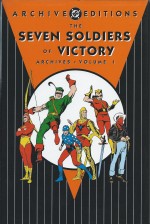
Seven Soldiers of Victory Archives volume 1


By Mort Weisinger, Bill Finger, Jerry Siegel, Mort Meskin, George Papp, Jack Lehti, Hal Sherman, Creig Flessel, Ed Dobrotka & various (DC Comics)
ISBN 978-04012 1-84576-236-3

After the actual invention of the comicbook superhero – for which read the Action Comics debut of Superman in 1938 – the most significant event in the industry’s history was the combination of individual sales-points into a group. Thus what seems blindingly obvious to us with the benefit of four-colour hindsight was proven: a multitude of popular characters could multiply readership simply by appearing together.

Plus, of course, a mob of superheroes is just so much cooler than one (or one-and-a-half if there are sidekicks involved) …

You can’t say it too often: the creation of the Justice Society of America in 1941 utterly changed the shape of the budding industry. Soon after the team launched, even National/DC – All American Comics’ publishing partner in the landmark venture – wanted to get in on the act and created their own proprietary squad of solo stars, populated with a number of their characters who hadn’t made it onto the roster of that super-successful cooperative coalition of AA and DC stars.

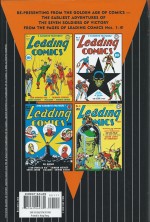
Oddly they never settled on a name and the team of non-super powered mystery men who debuted in Leading Comics #1 in 1941 were retroactively and alternatively dubbed The Law’s Legionnaires or The Seven Soldiers of Victory.

They never even had their own title-logo but only appeared as solo stars grouped together on the 14 spectacular covers – the first four of which, by Mort Meskin and Fred Ray, preface each collaborative epic in this spectacular deluxe hardback.

The full contents of this bombastic barrage of comicbook bravado were originally presented in the quarterly Leading #1-4, spanning Winter 1941/1942 to Fall 1942 and, following a fascinating history lesson and potted biography of the component crusaders in cartoonist, biographer and historian R.C. Harvey’s Foreword, the Golden Age glamour and glory begins with the heroes’ first adventure.

The sagas all followed a basic but extremely effective formula, established by scripter Mort Weisinger in the first adventure when dying criminal genius The Hand drew up a ‘Blueprint for Crime’ (illustrated by George Papp) to leave a lasting legacy of villainy.

Unable to carry out his perfidious plans in person, he subcontracted a fistful of macabre felons but insisted they warn their particular heroic arch-enemies as part of the triumphal deal…

Following a trail of breadcrumbs, Green Arrow and Speedy, the Shining Knight, Star-Spangled Kid and Stripesy, Crimson Avenger and the Vigilante stumbled upon each other, shared their knowledge of the grand scheme and soon separated again to tackle their own particular antagonists…

Papp continued as illustrator whilst the Emerald Archers headed to ‘Death Valley’ to stop the ingenious Professor Merlin using a freeze machine to extort the location of a fabulous gold mine out of a sun-loving old prospector, before heading back to track down the Hand…

Regular creative team Jerry Siegel & Hal Sherman then took the Star-Spangled Kid and Stripesy south of the border in ‘Peril in Panama’, where ectomorphic assassin the Needle tried to steal a seismic ray gun and shatter the Canal Zone and American trade, whilst Jack Lehti revealed how Crimson Avenger (and oriental sidekick Wing) bagged blue-collar mobster Big Caesar when the thug created a ‘Blackout over Broadway’ to plunder in relative safety…

Arthurian paladin the Shining Knight slept in ice until defrosted in 1941, where his magic sword, armour and winged horse made Sir Justin a formidable foe of injustice. Here he battled ‘The Red Dragon’ (illustrated by Creig Flessel) to free a lost tribe of Indian braves from the sinister slaver whilst undisputed artistic star of the show Mort Meskin revealed in stunning style how Hollywood’s glitterati were saved from being transformed into ‘The Stone People’ by the diabolical Dummy…

With each subordinate subdued, the heroes simultaneously closed on The Hand to end the dying dastard’s depredations in Weisinger & Papp’s explosive finale ‘Blueprint for Crime’…

The valiant crusaders came together again in Leading Comics #2 as ‘The Black Star Shines’ (Weisinger & Flessel) found juvenile genius Sylvester Pemberton and his chauffer Pat Dugan witnesses to a simple bank heist perpetrated by five of the nation’s most infamous criminals and realising that Star-Spangled Kid and Stripesy might need a little assistance…

The Pentagram of Perfidy were actually operating under explicit instructions to steal millions for themselves from a cautious and secretive hidden Machiavelli who only required five unobtrusive and mundane objects for himself, but the Law’s Legionnaires had no inkling of such when they split up to track the fiends down…

The cross-country campaign began with Sir Justin who hit New Orleans during Mardi Gras to confront the ‘Mystery of the Clowning Criminals’ (Weisinger & Flessel). The Shining Knight clashed with gang-leader Falseface and his battalion of buffoons, but although victorious was unable to prevent the sneaky Black Star from stealing an old rag doll…

Hal Sherman joined Weisinger to solve the ‘Mystery of the Santa Claus Pirate’ wherein the Star-Spangled Kid and Stripesy tackled a seaborne scoundrel Captain Bigg in Florida: a jolly jokester who gave away rather than stole loot. Of course the bandit had a bigger game plan in motion which the patriotic pair soon scuttled, but once again the surreptitious Black Star got away with the true prize – an old corncob pipe…

‘Mystery of the One-Man Museum’ (Weisinger & Papp) found Green Arrow and Speedy in glamorous Pleasure City hunting The Hopper, a mobster trying to appropriate valuable objets d’art from an eccentric millionaire. Once the human kangaroo was captured, however, his silent partner delightedly sloped off with a broken pocket watch…

The Crimson Avenger and Wing headed for the Great Lakes to duel with The Brain in ‘The Case of the Twisted Twins’ (Weisinger & Lehti), wherein the criminal genius assaulted attendees at an identical siblings convention whilst Black Star used the subsequent commotion to purloin an old silver dollar.

Bill Finger & Meskin handled the last two chapters and revealed the incredible truth as Vigilante battled venomous villain The Rattler at rich retired folk’s resort ‘The Sixty Kiddie Club’, but couldn’t stop the real menace grabbing an old key. Thus when ‘The Black Star Shines’ – using the gathered bric-a-brac to become an incredible super-menace – it needed the full might of the assembled Seven Soldiers to thwart the menace and end his astounding threat forever.

The scripter of ‘The Tyrants of Time’ in Leading #3 is sadly unknown but the first chapter (with art credited to Meskin) discloses how sinister scientist Dr. Doome built a time machine and recruited five historical tyrants to loot 1942, gathering funds and resources to build an even better device.

Their entire campaign was overheard by Speedy and the temporal thugs were then targeted by the Law’s Legionnaires, beginning with Stripesy and the Star-Spangled Kid who gave Napoleon a taste of ‘Defeat Before Waterloo’ (Sherman art), whilst the Amazing Archers prevented Alexander the Great from turning ‘The Radium Robots’ (Papp) into his most unbeatable army…

Flessel illustrated ‘The Man Who Told a Fish Story’ with the Shining Knight and an inveterate angler scuppering the naval ambitions of time-transplanted Genghis Khan, even as Vigilante teamed with a western legend to smash the schemes of Attila the Hun in ‘The Spirit of Wild Bill Dickson’ (by Meskin as “Mort Morton & Cliff”).

Lehti then delineated the bombastic battle between the Crimson Avenger and piratical Emperor Nero in ‘Fiddler’s Farewell’ before the Septet of Sentinels convened to follow Dr. Doome into the past and end the menace of ‘The Tyrants of Time’ in a stunning conclusion by Meskin, set at the fall of fabled Troy…

‘The Sense Master’ in Leading #4 was completely created by Bill Finger & Ed Dobrotka: a clever compendium of mystery and melodrama which commenced after paralysed mastermind The Sixth Sense used a robot to surgically augment the abilities of a band of brigands, as part of a plan to obtain five unique jewels for his undisclosed but nefarious purposes.

Interrupted by Sir Justin, the hyped-up hoods overcame the crusader before scattering, leaving the Shining Knight no recourse but to call in his crime-busting colleagues…

The Crimson Avenger then intercepted sound sensitive Mickey Gordon as ‘The Crime Concerto’ that the ex-musician conducted deprived a young girl of her precious diamond, but also started an irrevocable process of redemption in the penitent criminal…

In ‘Don Quixote Rides Again’ the Knight followed “Fingers” to the home of a dotty scholar who loved a certain book, but although he saved Don Coty‘s life, the paladin was unable to stop the theft of his golden Topaz, after which the Star-Spangled Kid (and Stripesy) failed to stop the Human Bloodhound from stealing Mrs. Pemberton‘s fabulous emerald in ‘The Man Who Followed His Nose’.

Vigilante and his geriatric sidekick Billy Gunn met a former movie idol who was ‘The Man who was Afraid to Eat’… It was all a cunning campaign by taste-sensitive poisoner “Palate” to purloin the faded star’s gem and, following his success, Green Arrow and Speedy were unable to prevent ‘The Man with the Miracle Eyes’ making off with a circus barker’s garnet.

However “Eagle Eye” didn’t escape, and once the heroes joined forces – assisted by Mickey Gordon – to track down ‘The Sense Master’ behind the whole incredible charade, they saw him briefly obtain ultimate power only to lose everything once the indomitable crusaders waded in…

These raw, wild and excessively engaging capers are actually some of the best but most neglected thrillers of the halcyon Golden Age. Still modern tastes too have moved on and these yarns are probably far more in tune with contemporary mores, making this a truly guilty pleasure for all fans of mystery, mayhem and stylish superteam tussles…
© 1941, 1942, 1949, 2005 DC Comics. All Rights Reserved.

The Adventures of Blake and Mortimer: The Secret of the Swordfish Part 1 – Ruthless Pursuit


By Edgar P. Jacobs, coloured by Philippe Biermé & Luce Daniels translated by Jerome Saincantin (Cinebook)
ISBN: 978-1-84918-148-8

Belgian Edgard Félix Pierre Jacobs (1904-1987) is rightly considered one of the founding fathers of the Continental comics industry. Although his output is relatively meagre when compared to some of his contemporaries, the iconic series he worked on formed the basis and backbone of the art-form in Europe, and his splendidly adroit, roguish and impeccably British adventurers Blake and Mortimer, created for the first issue of Le Journal de Tintin in 1946, swiftly became a staple of post-war European kids’ life the way Dan Dare would in Britain in the 1950s.

Edgar P. Jacobs was born in Brussels, a precocious child who began feverishly drawing from an early age but was even more obsessed with music and the performing arts – especially opera. He attended a commercial school but, determined never to work in an office, pursued art and drama following graduation in 1919.

A succession of odd jobs at opera-houses – scene-painting, set decoration, working as an acting and singing extra – supplanted his private performance studies, and in 1929 Jacobs won an award from the Government for classical singing. His proposed career as an opera singer was thwarted by the Great Depression, however, as the arts took a nosedive following the global stock market crash.

Picking up whatever stage work was going, including singing and performing, Jacobs switched to commercial illustration in 1940. Regular employment came from the magazine Bravo; as well as illustrating short stories and novels, he famously took over the syndicated Flash Gordon strip, after the occupying German authorities banned Alex Raymond’s quintessentially All-American Hero and left the publishers desperately seeking someone to satisfactorily complete the saga.

Jacob’s ‘Stormer Gordon’ lasted less than a month before being similarly sanctioned by the Nazis, after which Jacobs created his own epic science-fantasy feature in the legendary Le Rayon U, a milestone in both Belgian comics and science fiction adventure.

The U Ray was a huge hit in 1943 and scored big all over again a generation later when Jacobs reformatted the original “text-block and picture” material to incorporate speech balloons and re-ran the series in Tintin with subsequent releases as a trio of graphic albums in 1974.

I’ve read differing accounts of how Jacobs and Tintin creator Hergé got together – and why they parted ways professionally, if not socially – but as to the whys and wherefores of the split I frankly don’t care. What is known is this: whilst creating the weekly U Ray, one of Jacob’s other jobs was scene-painting, and during the staging of a theatrical version of Tintin and the Cigars of the Pharaoh Hergé and Jacobs met and became friends. If the comics maestro was unaware of Jacob’s comics output before then he was certainly made aware of it soon after.

Jacobs began working on Tintin, colouring the original black and white strips of The Shooting Star from newspaper Le Soir for a forthcoming album collection. By 1944 he was performing a similar role on Tintin in the Congo, Tintin in America, King Ottokar’s Sceptre and The Blue Lotus. By now he was also contributing to the illustration as well, on the extended epic The Seven Crystal Balls/Prisoners of the Sun.

Jacob’s love of opera made it into the feature as Hergé (who loathed the stuff) teasingly created the bombastic Bianca Castafiore as a comedy foil and based a number of bit players (such as Jacobini in The Calculus Affair) on his long-suffering assistant.

After the war and liberation, publisher Raymond Leblanc convinced Hergé, Jacobs and a number of other creatives to work for his new venture. Launching publishing house Le Lombard, he also started Le Journal de Tintin, an anthology comic with editions in Belgium, France and Holland edited by Hergé, starring the intrepid boy reporter and a host of newer heroes.

Beside Hergé, Jacobs and writer Jacques van Melkebeke, the comic featured Paul Cuvelier’s ‘Corentin’ and Jacques Laudy’s ‘The Legend of the Four Aymon Brothers’. Laudy had been a friend of Jacobs’ since they worked together on Bravo, and the first instalment of the epic thriller serial ‘Le secret de l’Espadon’ starred a bluff, gruff British scientist and an English Military Intelligence officer (closely modelled on Laudy): Professor Philip Mortimer and Captain Francis Blake…

The initial storyline ran from issue #1 (26th September 1946 to 8th September 1949) and cemented Jacobs’ status as a star in his own right. In 1950, with the first 18 pages slightly redrawn, Le secret de l’espladon V1 (The Secret of the Swordfish) became Le Lombard’s first album release; with the concluding part published three years later. These volumes were reprinted nine more times between 1955 and 1982, with an additional single complete deluxe edition released in 1964.

In 1984 the story was reformatted and repackaged in English translation as three volumes with additional material (mostly covers from the weekly Tintin added to the story as splash pages) as part of a European push to win some of the lucrative Tintin and Asterix market here, but failed to find an audience and ended after seven volumes. Now happily Cinebook has released the tale – albeit after publishing the later adventures first…

Hergé and Jacobs purportedly suffered a split in 1947 when the former refused to grant the latter a by-line on new Tintin material, but since the two remained friends for life and Jacob’s continued to produce Blake and Mortimer for the Belgian weekly, I think it’s fair to say that if such was the case it was a pretty minor spat.

I rather suspect that The Secret of the Swordfish was simply taking up more and more of the brilliant, diligent artist’s time and attention…

The U Ray also provided early visual inspiration for Blake, Mortimer and implacable nemesis Colonel Olrik, who bear a more than passing resemblance to the heroic Lord Calder, Norlandian boffin Marduk and viperous villain Dagon from that still lauded masterwork – one also well overdue for translation…

One minor word of warning: by having the overarching enemies of mankind be a secret Asiatic “Yellow Peril” empire of evil, there’s some potential for offence – unless one actually reads the text and finds that the assumed racism is countered throughout by an equal amount of “good” ethnic people and “evil” white folk…

The incredible journey begins with ‘The Incredible Chase’ as a secret army in the Himalayas prepares to launch a global Blitzkrieg on a world only slowly recovering from its second planetary war. The wicked Basam Damdu, Emperor of Tibet, has assembled an arsenal of technological super-weapons and the world’s worst rogues such as the insidious Colonel Olrik in a bid to seize control of the entire Earth.

However a bold British-Asian spy has infiltrated the hidden fortress and surrenders his life to get off a warning message…

In England, physicist and engineer Philip Mortimer and MI5 Captain Francis Blake discuss the worsening situation at an industrial installation where the boffin’s radical new aircraft engine is being constructed. When the warning comes that the war begins that night, the old friends swing into immediate action…

As the super-bombers rain destruction down on all the world’s cities, Mortimer’s dedicated team prepares his own prototype, the Golden Rocket, for immediate launch, taking off just as Olrik’s bombers appear over the desolate complex. Despite heavy fire, the Rocket easily outdistances the rapacious Imperial forces, leaving ruined homes in its wake as the fleeing Britons fly into a hostile world now brutally controlled by Basam Damdu…

Whilst seeking to join British Middle East resistance forces who have another prototype super-plane, teething troubles and combat damage create tense moments in the fugitives’ flight. When the Rocket is attacked by a flight of jets the test ship’s superior firepower enables it to fight free but only at the cost of more structural deterioration. Failing now, the Rocket goes down in the rocky wilds between Iran and Afghanistan. Parachuting free of the doomed Rocket, Blake, Mortimer and the crew are machine-gunned by pursuing Empire jets and only three men make it to the ground safely…

After days of struggle Blake, Mortimer and the indomitable Jim are cornered by Iranian troops who have joined Olrik’s forces. Sensing disaster, the Britons hide the plans to Mortimer’s super plane but one of the Iranians sees the furtive act. When no one is looking – even his superiors – Lieutenant Ismail hurriedly scoops up the documents but misses one…

Under lock and key and awaiting Olrik’s arrival, the prisoners are accosted by Ismail, who sees an opportunity for personal advancement which the Englishmen turn to their own advantage. Denouncing him to his superiors, Blake instigates a savage fight between Ismail and his Captain. During the brief struggle Jim sacrifices himself, allowing Blake and Mortimer to escape with the recovered plans. Stealing a lorry, the desperate duo drive out into the dark desert night…

Followed by tanks into the mountain passes, the ingenious pair trap their pursuers in a ravine just as hill partisans attack. The Imperial collaborators are wiped out and, after exchanging information with the freedom fighters, the Englishmen take one of the captured vehicles and head to a distant rendezvous with the second Rocket, but lack of fuel forces them to stop at a supply dump where they are quickly discovered.

By setting the dump ablaze the heroes escape again, but in the desert Olrik has arrived and found the sheet of notes left behind by Ismail. The cunning villain is instantly aware of what it means…

Fighting off aerial assaults from Empire jets and streaking for the mountains, Blake and Mortimer abandon their tank and are forced to travel on foot until they reach the meeting point where a British-trained native Sergeant Ahmed Nasir is waiting for them. The loyal Indian served with Blake during the last war and is delighted to see him again, but as the trio make their way to the target site they become aware that Olrik has already found it and captured their last hope…

Only temporarily disheartened, the trio use commando tactics to infiltrate Olrik’s camp, stealing not the heavily guarded prototype but the villainous Colonel’s own Red-Wing super-jet. Back on course to the British resistance forces, the seemingly-cursed trio are promptly shot down by friendly fire: rebels perceiving the stolen plane as just another enemy target…

Surviving this crash too, the trio are ferried in relative safety by the apologetic tribesmen to the enemy-occupied town of Turbat, but whilst there a spy of the Empire-appointed Wazir recognises Blake and Mortimer. When Nasir realises they are in trouble he dashes to the rescue but is too late to prevent Mortimer from being drugged.

Sending the loyal Sergeant on ahead Blake tries frantically to revive his comrade, even as Imperial troopers rapidly mount the stairs to their exposed upper room…

To Be Continued…

Gripping and fantastic in the best tradition of pulp sci-fi and Boy’s Own Adventures, Blake and Mortimer are the very epitome of True Brit grit and determination, always delivering grand old-fashioned Blood and Thunder thrills and spills in timeless fashion and with staggering visual verve and dash. Despite the high body count and dated milieu, any kid able to suspend modern mores and cultural disbelief (call it alternate earth history if you want) will experience the adventure of their lives… and so will their children.

This Cinebook edition also includes a tantalising preview of the next volume as well as stand alone adventure The Yellow “M”, plus a biography feature which offers a chronological publication chart and publishing order of the Cinebook release dates.

Original editions © Editions Blake & Mortimer/Studio Jacobs (Dargaud – Lombard S.A.) 1984 by E.P. Jacobs. All rights reserved. English translation © 2012 Cinebook Ltd.