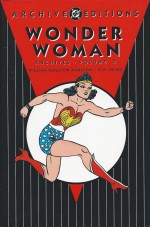
Wonder Woman Archives volume 3


By Charles Moulton (William Moulton Marston & Harry G. Peter) with Frank Godwin (DC Comics)
ISBN: 1-56389-814-4

Wonder Woman was conceived by polygraph pioneer William Moulton Marston and illustrated by Harry G. Peter in an attempt to offer girls a positive and forceful role model. She debuted as a special feature in All Star Comics #8 (December 1941), before springing into her own series and the cover-spot of new anthology title Sensation Comics a month later. An instant hit the Amazing Amazon quickly won her own eponymous supplemental title in late Spring of that year (cover-dated Summer 1942).

Once upon a time on a hidden island of immortal super-women, American aviator Steve Trevor of US Army Intelligence crashed to Earth. Near death, he was nursed back to health by young and impressionable Princess Diana.

Fearing her growing obsession with the creature from a long-forgotten and madly violent world, her mother Queen Hippolyte revealed the hidden history of the Amazons: how they were seduced and betrayed by men but rescued by the goddess Aphrodite on condition that they isolated themselves from the rest of the world and devoted their eternal lives to becoming ideal, perfect creatures.

However when goddesses Athena and Aphrodite subsequently instructed Hippolyte to send an Amazon back with the American to fight for global freedom and liberty, Diana overcame all other candidates and became their emissary – Wonder Woman.

On arriving in Americashe bought the identity and credentials of lovelorn Army nurse Diana Prince, elegantly allowing the Amazon to be close to Steve whilst enabling the heartsick medic to join her own fiancé in South America. Soon Diana also gained a position with Army Intelligence as secretary to General Darnell, ensuring she would always be able to watch over her beloved. She little suspected that, although the painfully shallow Steve only had eyes for the dazzling Amazon superwoman, the General had fallen for the mousy but superbly competent Lieutenant Prince…

Using the nom de plume Charles Moulton, Marston (with some help in later years from assistant Joye Murchison) scripted almost all of the Amazing Amazon’s many and fabulous adventures until his death in 1947, whereupon Robert Kanigher took over the writer’s role. Venerable veteran illustrator and co-creator H.G. Peter performed the same feat, limning practically every titanic tale until his own death in 1958. A couple of the very rare exceptions appear in this volume…

This third superbly luxurious full-colour deluxe hardback edition collects her every groundbreaking adventure from Wonder Woman #5-7 and Sensation Comics #18-24 from June-December 1943, and commences, after an appreciative Foreword from comics historian Les Daniels, with ‘The Secret City of the Incas’ from Sensation #18, illustrated by the superbly talented classical artist Frank Godwin, in which the Princess of Power rescued a lost Inca tribe from a despotic theocracy and ancient greed whilst in #19 (Godwin again)‘The Unbound Amazon’ responded to a little boy’s letter and stumbled onto big trouble in the far north woods. Of course Diana knew little Bobby from the Adventure of the Talking Lion (as seen in the previous Archive edition) and with wicked Nazi spy Mavis on the loose wasn’t about to take any chances.

This terrific thriller is notable for the revelation that if an Amazon removed her Bracelets of Submission she turned into a raving, uncontrolled engine of sheer destruction…

H. G. Peter drew the vast entirety of Wonder Woman #5 (June/July 1943), which presented an interlinked epic in the ‘Battle for Womanhood’ as war-god Mars (who instigated the World War from his HQ on the distant red planet through his earthly pawns Hitler,  Mussolini and Hirohito) returned to plague humanity. This time he enlisted the aid of a brilliant but deformed and demented misogynistic psychologist with psychic powers. The tormented Dr. Psycho used his talents to marry and dominate a medium named Marva, using her abilities to form ectoplasmic bodies as he sought to enslave every woman in the world.

Happily Wonder Woman countered his gods-sponsored schemes, after which prominent sidekicks ‘Etta Candy and her Holliday Girls’ comedically crushed a burglary before ‘Mars Invades the Moon’ returned to the overarching tale when the frustrated war-god was ousted by the Duke of Deception.

In attempting to take over the Moon – home of peace-loving goddess Diana – Mars made the biggest error of his eternal life as the Amazing Amazon led a spectacular rescue mission which resulted in the invaders’ utter rout.

The issue then concluded with ‘The Return of Dr. Psycho’ who had escaped prison and again perpetrated a series of ghastly attacks on America’s security and the freedom of women everywhere until the Holliday Girls and their demi-divine mentor stepped in…

Sensation #20 was also by Peter – who was slowly coming to grips with the increased extra workload of the explosively popular 64-page Wonder Woman series every three months – and ‘The Girl with the Gun’ saw Diana Prince investigate sabotage at a munitions factory and the murder of a General at WAACs training base Camp Doe. To the Amazon’s complete surprise the culprit appeared to be Marva Psycho, but there was far more going on than at first appeared…

Godwin handled the art for #21 as Steve and Diana tracked down insidious traitor the American Adolf as he conducted a murderous ‘War Against Society’ whilst issue #6 – another all-Peter extravaganza – introduced another macabre foe in ‘Wonder Woman and the Cheetah’.

Marston’s psychiatric background provided yet another deeply disturbed antagonist in the form of sugar sweet debutante Priscilla Rich who shared her own body with a jealously narcissistic, savage feline counterpart dedicated to murder and robbery. The Cheetah framed the Amazing Amazon and almost destroyed Steve, Etta and the Holliday girls before Wonder Woman finally quashed her wild rampages.

It wasn’t for long as the Cheetah returned to mastermind an espionage-for-profit ring in ‘The Adventure of the Beauty Club’ which resulted in the Perfect Princess being captured by Japan’s High Command before spectacularly busting loose for a final confrontation in ‘The Conquest of Paradise’. Here the Feline Fury infiltrated the home of the Amazons and almost irretrievably poisoned the minds of the super women sequestered there…

By this time Peter was fully adapted to his new schedule and in Sensation Comics #22 took the psychological dramas to new heights when a cured Priscilla Rich was seemingly attacked by her manifested evil self  after the Cheetah stole America’s latest weapon ‘The Secret Submarine’…

In issue #23 the creators tackled school bullying and women in the workplace as production line staff were increasingly stricken by ‘War Laugh Mania’. Only one of the problems was being promulgated by Nazi spies though…

It was back to straight action in #24 as ‘The Adventure of the Pilotless Plane’ saw Steve abducted by Japanese agents whilst investigating a new gas weapon which prevented US aircraft from flying. The vile villains had nothing that could stop Wonder Woman from smashing them and freeing him however, and the status quo was fully restored for the last saga in this lavish hardcover collection.

Wonder Woman #7 offered an optimistic view of the future in a fantastic fantasy tale ‘The Adventure of the Life Vitamin’ wherein America in the year 3000AD revealed a paradisiacal world ruled by a very familiar female President where a miracle supplement had expanded longevity to such an extent that Steve, Etta and all Diana’s friends were still thriving.

Sadly some old throwbacks still yearned for the days when women were second-class citizens subservient to males which meant there was still work for the Amazing Amazon to do…

‘America’s Wonder Women of Tomorrow’ continued the wry but wholesome sex war with Steve going undercover with the rebel forces uncovering a startling threat in ‘The Secret Weapon’ before the focus returned to the present and a far more intimate crisis for wilful child Gerta whose mother Paula (fully reformed ex-Nazi Baroness Paula von Gunther) was forced to deal with a ‘Demon of the Depths’.

But was that the evil octopus at the bottom of the paddling pool or her daughter’s dangerously anti-authoritarian attitudes…?

Far too much has been made of supposed subtexts and imagery of bondage and submission in these early tales – and yes, there really are a lot of scenes with girls tied up, chained or about to be whipped – but I still don’t care. Whatever Marston and Peters might have intended, the plain truth is that the skilfully innovative dramas and incredibly imaginative story-elements influenced the entire nascent superhero genre as much as Superman or Batman, and we’re all the richer for it.

This sterling deluxe book of nostalgic delights is a marvel of exotic, baroque, beguiling and uniquely exciting wonder and these Golden Age adventures of the World’s Most Fabulous female are timeless, pivotal classics in the development of comicbooks and still provide astounding amounts of fun and thrills for anyone interested in a grand nostalgic read.
© 1943, 2002 DC Comics, Inc. All Rights Reserved.

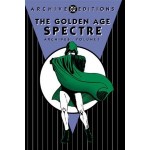
Golden Age Spectre Archives volume 1


By Jerry Siegel & Bernard Baily with various (DC Comics)
ISBN: 978-1-56389-955-3

The Spectre is one of the oldest characters in DC’s vast stable of characters, created by Jerry Siegel and Bernard Baily in 1940 and debuting with a 2-part origin epic in More Fun Comics #52 and 53 where he was the first superhero to star in the previously all-genres adventure anthology. For a few years the Ghostly Guardian reigned supreme in the title with flamboyant and eerily eccentric supernatural thrillers, but gradually slipped from popularity as firstly Dr. Fate and successively Johnny Quick, Aquaman, Green Arrow and finally Superboy turned up to steal the show. By the time of his last appearance the Spectre had been reduced to a foil for his own comedic sidekick Percival Popp, the Super-Cop…

Just like Siegel’s other iconic creation, the Dark Man suffered from a basic design flaw: he was just too darn powerful. Unlike the vigorously vital and earthy early Superman however, the ethereal champion of justice was already dead, so he couldn’t be logically or dramatically imperilled. Of course in those far-off early days that wasn’t nearly as important as sheer spectacle: grabbing the reader’s utter attention and keeping it stoked to a fantastic fever pitch. This the Grim Ghost could do with ease and always-increasing intensity.

Re-presenting the first 19 eerie episodes and following a fulsome Foreword from pre-eminent Comics historian Dr. Jerry Bails, detailing the state of play within the budding marketplace during those last months of the 1930s, the arcane action commences in this stunning full-colour deluxe hardback with ‘The Spectre: Introduction’ from More Fun Comics #52 (February 1940).

This wasn’t the actual title: like so many strips of those early days, most stories didn’t have individual titles and many have been only retroactively designated for collections such as this.

The Ghostly Guardian was only barely glimpsed in this initial instalment. Instead the action rested upon Jim Corrigan, a hard-bitten police detective, who was about to marry rich heiress Clarice Winston when they were abducted by mobster Gat Benson. Stuffed into a barrel of cement and pitched off a pier, Corrigan died and went to his eternal reward. Almost…

Rather than finding Paradise and peace, Corrigan’s spirit was accosted by a glowing light and disembodied voice which, over his strident protests, ordered him return to Earth to fight crime and evil until all vestiges of them were gone…

Standing on the seabed and looking at his own corpse, Corrigan began his mission by going after his own killers…

In #53 ‘The Spectre Strikes’ found the furious revenant swiftly, mercilessly and horrifically ending his murderers and saving Clarice, before calling off the engagement and moving out of the digs he shared with fellow cop and best friend Wayne Grant. After all, a cold, dead man has no need for the living…

The origin ends with Corrigan implausibly sewing himself a green and white costume and swearing to eradicate all crime…

Splendidly daft, this two-part yarn is one of the darkest and most memorable origins in comicbook history and the feature only got better with each issue as the bitter, increasingly isolated lawman swiftly grew into most overwhelmingly powerful hero of the Golden Age.

In MFC #54 the Supernatural Sentinel tackled ‘The Spiritualist’, a murderous medium and unscrupulous charlatan who almost killed Clarice and forever ended the Spectre’s hopes for eternal rest, after which #55 introduced ‘Zor’: a ghost of far greater vintage and power, dedicated to promulgating evil on Earth. He too menaced Clarice and only the intervention of the Heavenly Voice and a quick upgrade in phantasmal power enabled The Spectre to overcome the malign menace.

More Fun Comics #56 was the first to feature Howard Sherman’s Dr. Fate on the cover but the Spectre was still the big attraction even if  the merely mundane bandits and blackmailers instigating ‘Terror at Lytell’s’ were no match for the ever-inventive wrathful wraith. Far more serious was ‘The Return of Zor’ in #57, as the horrific haunt returned from beyond to frame Corrigan for murder and again endanger the girl Jim dared not love…

An embezzler turned to murder as ‘The Arsonist’ in #58, but was no match for the cop – let alone his eldritch alter ego – whilst ‘The Fur Hi-Jackers’ actually succeeded in killing the cop yet were still brought to the Spectre’s unique brand of justice.

In #60 ‘The Menace of Xnon’ found a super-scientist using incredible inventions to frame the ghost and even menace his ethereal existence, prompting The Voice to again increase its servant’s power – this time by giving The Spectre the all-powerful Ring of Life – but not before the Ghostly Guardian had been branded Public Enemy No. 1.

With Corrigan now ordered to arrest his spectral other self on sight, #61 (another Dr. Fate cover) featured ‘The Golden Curse Deaths’ wherein prominent citizens were dying from a scientific terror with a deadly Midas Touch, after which ‘The Mad Creation of Professor Fenton’ pitted the Phantom Protector against a roving, ravaging disembodied mutant super-brain…

In #63 a kill-crazy racketeer got his just deserts in the electric chair only to return and personally execute ‘Trigger Daniels’ Death Curse’ on all who had opposed him in life. Happily The Spectre proved to be more than his match but ‘The Ghost of Elmer Watson’ was a far harder foe to face. Murdered by mobsters who had also nearly killed Corrigan’s only friend Wayne Grant, the remnant of the vengeful dead man refused to listen to The Spectre’s brand of reason and its dreadful depredations had to be dealt with in fearsome fashion…

‘Dr. Mephisto’ was a spiritualist who utilised an uncanny blue flame for crime in #65, after which the Ghostly Guardian battled horrendous monsters called forth from ‘The World Within the Paintings’ probably written by the series’ first guest writer – Gardner Fox – before Siegel returned with ‘The Incredible Robberies’ which found the phantom policeman battling deadly mystic Deeja Kathoon to the death and beyond…

With MFC #68 The Spectre finally lost his protracted cover battle to Dr. Fate even though, inside, the ‘Menace of the Dark Planet’ featured a fabulously telling tale of Earthbound Spirit against alien invasion by life-leeching Little Green Men, before in #69 ‘The Strangler’ murders led Corrigan into an improbable case with an impossible killer…

This first fearful tome terminates with issue #70 and ‘The Crimson Circle Mystery Society’ in which a sinister cult employed a merciless phantasmal psychic agent named Bandar to carry out its deadly schemes…

Still a mighty force of fun and fearful entertainment, The Spectre’s Glory Days – and Nights – were waning and more credible champions were coming to the fore. He would be one of the first casualties of the post-War decline in mystery men and not be seen again until the Silver Age 1960’s…

Moreover, when he did return to comics, the previously omnipotent ghost was given strict limits and as he continued to evolve through various returns, refits and reboots The Spectre was finally transmogrified into a tormented mortal soul bonded inescapably to the actual embodiment of the biblical Wrath of God. Revamped and revived in perpetuity, revealed to be the Spirit of Vengeance wedded to a human conscience, Jim Corrigan was finally laid to rest in the 1990s and Hal (Green Lantern) Jordan replaced him. Returning to basics in recent years, the latest host is murdered Gotham City cop Crispus Allen.

They’re all worth tracking down and exhuming: spooky comic champions who have never failed to deliver an enthralling, haunted hero rollercoaster – or is that Ghost Train? – of thrills and chills.
© 1940, 1941, 2003 DC Comics. All Rights Reserved.

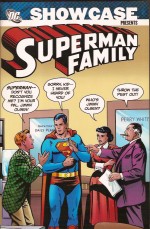
Showcase Presents Superman Family volume 2


By Otto Binder, Curt Swan, Kurt Schaffenberger & various (DC Comics)
ISBN: 978-1-84576-812-4

During the 1950s and early 1960s in America, being different was a bad thing. Conformity was sacrosanct, even in comicbooks, and everybody and thing was meant to keep to its assigned and intended role.

For the Superman family and cast that meant a highly strictured code of conduct and parameters: Daily Planet Editor Perry White was a stern, shouty elder statesman with a heart of gold, Cub Reporter Jimmy Olsen was a brave and impulsive, unseasoned fool – with a heart of gold – and plucky News-hen Lois Lane was brash, nosy, impetuous and unscrupulous in her obsession to marry Superman although she too was – deep down – another possessor of an Auric aorta.

Yet somehow even with these mandates in place the talented writers and artists assigned to detail their wholesomely uncanny exploits managed to craft tales both beguiling and breathtakingly memorable and usually as funny as they were exciting.

This second cunningly combined chronologically complete compendium collects the affable, all-ages tales from Superman’s Pal Jimmy Olsen #23-34 (September 1957-January 1959), Lois’s second tryout issue  from Showcase #10 (September/October 1957) as well as Superman’s Girlfriend Lois Lane #1-7 (March/April 1958-February 1959) and promptly commences with the Man of Steel’s Go-To Guy and the three tales which comprised issue #23 of his solo title, illustrated as almost always by the wonderful Curt Swan & Ray Burnley. ‘Jimmy Olsen’s Two Super-Pals’ was the first of three scripts by the irrepressible Otto Binder and described how our lad gained an other-dimensional Genie as another faithful Super-Friend. Of course with sinister radium bandits plaguing Metropolis there was more to the cosmic companion than met the eye…

This was followed by ‘Jimmy Olsen, the Bearded Boy’ wherein boastful hubris and a magic potion inflicted runaway whiskers on many Daily Planet staff – even ClarkKent – prompting many face-saving secret feats from the identity conscious Man of Tomorrow. As Jimmy’s series progressed, one of the most popular plot-themes (and most fondly remembered and referenced today by most Baby-Boomer fans) was the unlucky lad’s appalling talent for being warped, mutated and physically manipulated by fate, aliens, magic, mad science and even his friends… a fate which frequently befell Lois too although Jimmy got a lot less marriage proposals from aliens, murderers of monsters…

The boy’s bits then concluded with ‘The Adventures of Private Olsen’ wherein the Cub Reporter was assigned to write articles on Army life and – with Superman’s assistance – taught an unscrupulous drill sergeant a much-needed lesson…

When Lois Lane – arguably the oldest supporting character/star in the Superman mythology if not DC universe – finally received her own shot at a solo title, it was very much on the terms of the times. I must shamefacedly admit to a deep, nostalgic affection for her bright and breezy, fantastically fun adventures, but as a free-thinking, (nominally) adult liberal of the 21st century I’m often simultaneously shocked nowadays at the jolly, patronising, patriarchally misogynistic attitudes underpinning too many of the stories.

Yes, I’m fully aware that the series was intended for young readers at a time when “dizzy dames” like Lucille Ball or Doris Day played to the popular American gestalt stereotype of Woman as jealous minx, silly goose, diffident wife and brood-hungry nester, but to ask kids to seriously accept that intelligent, courageous, ambitious, ethical and highly capable females would drop everything they’d worked hard for to lie, cheat, inveigle, manipulate and entrap a man just so that they could cook pot-roast and change super-diapers is just plain crazy and tantamount to child abuse. They’re great, great comics but still…

I’m just saying…

Showcase #10 (September/October 1957) was the second and final try-out appearance – all illustrated by Wayne Boring & Stan Kaye – for Superman’s Girlfriend, Lois Lane and opened with ‘The Jilting of Superman’ by Binder, wherein the Action Ace almost fell for a most ancient ploy when Lois pretended to marry another man to make the alien oaf realise what she meant to him…

‘The Sightless Lois Lane’ written by Jerry Coleman told how a nuclear accident temporarily blinded the journalist, and how her sudden, unexpected recovery almost exposed Clark Kent‘s secret when he callously changed to Superman in front of the “sightless” lass, after which Binder delightfully detailed the contents of ‘The Forbidden Box from Krypton’: a cache of devices dug up by a Smallville archaeologist originally packed by Jor-El and intended to aid the infant Superbaby on Earth. Of course when Lois opened the chest all she saw was a way to become as powerful as the Man of Steel and soon became addicted to being a super-champion in her own right…

The Jaded Journo launched into her own title scant months later, clearly offering exactly what the reading public wanted…

Jimmy Olsen #24 featured another trio of top tales from Binder, Swan & Burnley beginning with ‘The Superman Hall of Trophies’ which found a Kryptonite-paralysed Metropolis Marvel trapped in a museum and rescued by the brave boy reporter, whilst ‘The Gorilla Reporter’ saw the poor sap briefly brain-swapped with a mighty (confused) Great Ape before Superman again had to divert attention from his exposure-threatened alter ego by convincing the world at large that Jimmy was ‘The Luckiest Boy in the World’…

Issue #25 as ever by Binder, Swan & Burnley, featured ‘The Secret of the Superman Dummies’ wherein a trip to a magic show resulted in Jimmy being inescapably handcuffed to the last man in the world Superman dared to approach, ‘The Second Superboy’ saw the poor kid accidentally rocketed to an alien world where he gained incredible abilities – courtesy of resident absent-minded genius Professor Potter – and ‘The Day There Was No Jimmy Olsen’ offered a tantalising hoax and mystery which ended with an unexpected promotion for the pluckily ingenious boy…

He began #26 subjected to inexplicable bouts of deadly mass fluctuations as ‘The World’s ‘Heavyweight’ Champ’ before the newly appointed ‘Jimmy Olsen, Foreign Correspondent’ uncovered a sinister scheme to defraud the Ruritanian Kingdom of Hoxana.  Back home however he had to again undergo a well-intentioned con from his best pal after he saw Clark flying and subsequently – inadvertently – himself became ‘The Birdboy of Metropolis’…

Superman’s Girlfriend Lois Lane #1 (March/April #1958) at last arrived sporting three stunning yarns illustrated by sleek, slick Kurt Schaffenberger whose distinctive art-style would quickly become synonymous with the reporter. Everything kicked off with ‘The Bombshell of the Boulevards’ (scripted by Leo Dorfman) wherein she donned a blonde wig to deceitfully secure aHollywood interview and soon provoked a death-duel between rival enflamed suitors. Of course it was only another scheme by Superman and Jimmy to teach her a lesson in journalistic ethics. Good thing reporters are so much less unscrupulous these days…

During this Silver Age period with Superman a solid gold sensation of the newly ascendant television phenomenon, many stories were draped in the wholesome trappings of Tinseltown – even more so than most of celebrity-obsessed America. It didn’t hurt that editor Whitney Ellsworth was a part-time screenwriter, script editor and producer as well as National DC’sHollywood point man.

Otto Binder then reunited with his old Captain Marvel collaborator for ‘Lois Lane, Super-Chef’ as Lois disastrously tried to master home cooking in her latest scheme to get the Man of Steel to propose, whilst in ‘The Witch of Metropolis’ a science assignment went horrifically awry and transformed her into a wizened old hag every time the sun set…

JO #27 opened with ‘The Boy from Mars’ wherein the reporter got his own lesson in integrity after trying to create a circulation-boosting hoax, and another in the perils of pride and over-confidence after messing up ‘A Date with Miss Metropolis’ before the issue ended with a riotous battle with his own evil duplicate after Professor Potter accidentally created ‘The Outlaw Jimmy Olsen’: all courtesy of Binder, Swan & Burnley.

Ever so slowly a more mature tone was developing in the Cub’s adventures. In #28’s ‘The Spendthrift and the Miser’ an alien gift from Superman caused wildly manic mood swings whilst an accidental time-trip impossibly revealed that Jimmy was destined to become ‘The Boy who Killed Superman’ whilst in ‘The Human Skyscraper’ another botched Potter product enlarged the kid to monumental, city-endangering size.

In the second Lois Lanecomicbook she was apparently appalled to uncover ‘Superman’s Secret Sweetheart’ (uncredited here but possibly Bill Finger?), but was in fact on her very best mettle helping a bullied college girl fight back against her mean sorority sisters, after which Binder recounted how Tinseltown improbably called and the reporter became – eventually – an extremely high maintenance actress in ‘Lois Lane in Hollywood’…

‘Superman’s Forbidden Room’ then closed proceedings with a cruel hoax playing on her well-publicised infatuation, but this time it wasn’t the Man of Tomorrow doing the fooling and the stakes had never been higher in a moody thriller illustrated by Boring & Kaye and probably written by Jerry Coleman.

In Jimmy Olsen #29 the usually adept reporter hit a monumental writer’s block whilst working on a novel, but ‘The Superman Book that Couldn’t be Finished’ eventually was – with a little hands-on Kryptonian help – whilst in ‘Jimmy Olsen’s Super-Pet’ the Cub Reporter was adopted by super-hound Krypto in his twilight years – and was instrumental in rejuvenating the Dog of Steel for a new generation. ‘The Amazing Spectacles of Doctor X’ then ended the issue with a clever thriller as Jimmy appropriated goggles which could see the future and glimpsed something he wished he hadn’t…

‘The Rainbow Superman’ by Binder & Schaffenberger, opened Lois Lane #3 and saw the News-hen at her very worst as a cosmic accident made the Man of Tomorrow an ambulatory spectrum and she set about trying to see if Clark too glowed, whilst ‘The Man who was Clark Kent’s Double’ (scripted by Coleman, as was the final tale here) broke her heart after she again proved too nosy for her own good. ‘Lois Lane and the Babe of Steel’ then gave her a terrifying glimpse of her dreams come true when Superman traded temporal places with his toddler self and caused all manner of problems for the capable bachelorette…

In JO #30 ‘The Son of Superman’, Binder, Swan & Burnley jerked our tears when an attempt by the Kryptonian to adopt the reporter went tragically wrong after which they proved equally adept at creating mystery and tension as criminals schemed to destroy Jimmy by making him ‘The Cub who Cried Wolf’. ‘Superman’s Greatest Enemy’ – with Dick Sprang standing in for Curt Swan – then revealed how the naïve lad fell for a crook’s scam but had enough smarts to turn the tables…

Binder & Schaffenberger opened LL #4 with a well-meaning Jimmy using hypnotism to get Clark to propose to Lois, utterly unaware who he was actually using those gimmicks on, catastrophically leading to ‘The Super-Courtship of Lois Lane’…

Times have changed, but when Coleman scripted ‘Lois Lane, Working Girl’ he was simply referring to her being challenged to undertake a job in manual labour, so shame on you. Alvin Schwartz then crafted a canny conundrum in ‘Annie Oakley Gets her (Super)man’ for Boring & Kaye to illustrate, as a riding accident out West caused Lois to believe she was the legendary cowgirl sharpshooter whilst hunting some very nasty gangsters with very real guns…

Jimmy Olsen #31 highlighted the now mythic tale of ‘The E-L-A-S-T-I-C Lad’ (Binder, Swan & Burnley) wherein Superman was ultimately responsible for the reporter gaining stretching powers after leaving a chest of alien artefacts with the nosy, accident-prone kid, whilst in ‘The Mad Hatter of Metropolis’ the power of suggestion convinced the kid that he could imitate the feats of famous folks simply by donning their characteristic chapeaus before ‘The Boy who Hoaxed Superman’ saw the lad attempt to get a pay raise by pretending to leave for the future. It didn’t work, and everybody seemed to prefer the replacement Perry hired who was, of course, Jimmy in disguise…

In #32 Professor Potter’s latest chemical concoction made Jimmy look like Pinocchio but did give him ‘The Super Nose for News’ whilst an uncanny concatenation of crazy circumstances turned the sensibly staid Man of Tomorrow into ‘The Rock ‘n’ Roll Superman’ every time the reporter masquerading as a pop star twanged his old guitar, and ‘The Jimmy Olsen from Jupiter’ (by Alvin Schwartz) revealed how aliens mutated the Cub Reporter into one of their scaly selves, complete with extremely useful mind-reading abilities, much to Superman’s chagrin…

‘Superman’s Greatest Sacrifice’ by Robert Bernstein & Schaffenberger led in Lois Lane #5, as the journalist met her millionaire double and seemingly lost her beloved Metropolis Marvel to her, whilst in ‘The Girl of 100 Costumes’ the canny lass tried to use a myriad of new looks to catch his attention, in an uncredited story drawn by Al Plastino. It was back to silly usual in Binder & Schaffenberger’s ‘The Fattest Girl in Metropolis’;  a plant growth ray accidentally super-sized the vain but valiant reporter. Imagine her reaction when she found out that Superman had deliberately expanded her dimensions… for good and solid reasons, of course…

Binder, Swan & Burnley were in sparkling form in JO #33, starting with ‘Legends that Came to Life’, wherein a nuclear accident animated the strangest foes from fairytales and only Jimmy, not his mighty mentor, could save the day, whilst in ‘The Lady-Killer from Metropolis’ a classic case of boyish arrogance and girlish gossip led to the boy reporter briefly becoming the sexiest thing in Hollywood. The horror and hilarity was capped with ‘The Human Flame-Thrower!’ as Potter’s latest experiment caused Jimmy the worst case of high-octane halitosis in history…

Coleman, Boring & Kaye opened LL #6 with ‘The Amazing Superman Junior’ as yet another attempt to teach Lois a lesson backfired on the pompous Man of Steel and she brought in a mysterious kid to show the Kryptonian what it felt like…

This was followed by a brace of tales by Bill Finger & Schaffenberger, starting with ‘Lois Lane… Convict’ which saw seemingly saw the reporter take a bribe from gangster Baldy Pate and pay a terrible price, whilst in ‘Lieutenant Lois Lane, U.S. Army’ she and Clark joined the military for a story only to have the – temporary – rank turn her into a man-hating bully. Surely some mistake, no…?

‘Superman’s Pal of Steel’ by Binder, Swan & Burnley, opened the last Jimmy Olsen issue in this marvellous monochrome collection as another secret identity-preserving scheme took a bizarre turn after the boy reporter genuinely gained an incredible power. Alvin Schwartz then wrote ‘The Underworld Journal’ which saw the kid inherit his own newspaper and swiftly go off the journalistic rails before Potter’s newest invention turned Jimmy’s clunky old kit into ‘The Most Amazing Camera in the World’ (Binder) – and a deadly danger to Superman’s greatest secret…

Superman’s Girlfriend Lois Lane #7 closes out this volume with three more mixed-message masterpieces beginning with ‘Lois Lane’s Kiss of Death’ (by Bernstein & Schaffenberger), wherein a canny conman tried to fool the reporter into botching her biggest crime exposé. Schwartz then had Lois use hypnotism to wash her heroic obsession out of her mind in ‘When Lois Lane Forgot Superman’.

Illustrated by Boring & Kaye, the tale took an unlikely turn when she then turned her passionate, unfulfilled attentions on poor Clark, after which Lana Lang fully entered the Man of Steel’s modern mythology. When Lois took in the destitute, down-at-heel lass who once held the Boy of Steel’s heart, she seemingly allowed her to also become ‘The Girl who Stole Superman’ in a tense and clever tale from Coleman and Schaffenberger…

These spin-off support series were highly popular top-sellers for more than two decades; blending action, adventure, broad, wacky comedy, fantasy and science fiction in the gently addictive manner scripter Binder and artist Schaffenberger had perfected at Fawcett Comics on the magnificent Marvel Family.

As well as containing some of the most delightful episodes of the pre angst-drenched, cosmically catastrophic DC, these fun, thrilling and yes, occasionally deeply moving, all-ages stories also perfectly depict the changing mores and tastes which reshaped comics from the safe 1950s to the seditious, rebellious 1970s, all the while keeping to the prime directive of the industry – “keep them entertained and keep them wanting more”.

I certainly do…
© 1957, 1958, 1959, 2008 DC Comics. All Rights Reserved.

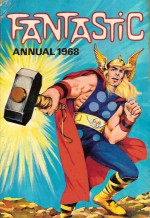
Fantastic Annuals 1968, 1969, 1970


By various (Odhams)
No ISBNs

Fantastic was the flagship of the “Power Comics” sub-brand used by Odhams to differentiate those periodicals which contained reprinted American superhero material from the company’s regular blend of sports, war, western and adventure comics. During the mid-1960s these captivating ubiquitous British weeklies did much to popularise the budding Marvel characters and universe in this country. With its sister paper Terrific the comic was notable for not reformatting or resizing the original artwork. In Wham!, Pow! and Smash! an entire 24 page adventure could be squeezed into 10 or 11 pages over two weeks…

However, although the all-action comic featured Thor, Iron Man and the X-Men in chronological tales (with a few gags and a UK generated adventure feature), the annuals were a far more exotic and intriguing mixed bag…

The 1968 book – released in December 1967 – opens with the full-colour Thor thriller ‘When Magneto Strikes!’ (by Stan Lee, Jack Kirby & Chic Stone from Journey into Mystery #109, October 1964) recounting a blistering battle beneath the sea between the Thunder God and mutant master of Magnetism before plunging on after with the home-produced fantasy adventure ‘The Temple of Zentaca’ wherein a two explorer pals, their dog and a handy super-rifle foil a plot by a manic mad scientist in a cunning, anonymous yarn probably illustrated by the great Luis Bermejo Rojo.

After a rather bland and uncredited science fiction prose vignette ‘The Fugitives’ the Annual lapses into traditional two tone mode (red and black) and offers a Marvel monster yarn ‘The Man Who Hated Monstro!’ (from Journey into Mystery #92, May 1963 by Stan Lee, Larry Lieber & Paul Reinman) before launching into the bombastic ‘Beware of the Blob!’ (X-Men #3 1963, Lee, Kirby & Reinman) wherein the mutant teens tackle an immovable human mountain and his evil carnival, followed by a magical Stan Lee/Steve Ditko sci fi yarn ‘I Used to be… Human!’ …also taken from JiM #92.

‘Colossus!’ is another British weird mystery saga illustrated by European master José Ortiz Moya, with a young man obtaining ultimate vengeance for the murder of his father by animating a giant stone statue…

Full colour is restored for the prose short ‘The Invaders’ and the book closes with the captivating Lee/Robert Bernstein/Kirby classic ‘Iron Man vs Doctor Strange!’ (or ‘The Stronghold of Doctor Strange!’ as it originally was: a mad scientist who paved the way for the later Master of the Mystic Arts and whose one-and-only appearance was in Tales of Suspense #41, May 1963).

This fabulous collection blew me away Christmas morning and still makes my weary pulse race today…

© 1967 Odhams Books Limited. Selected material © Marvel Comics Group (1963) 1967.

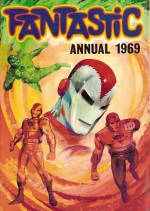
One year later the magic resumed with Fantastic Annual 1969, which began with a beautiful double-page painted frontispiece featuring the entire heroic pantheon contained therein before the X-Men battled artificially enhanced giant insects in ‘The Plague of the Locust!’ (from X-Men #24, September 1966, by Roy Thomas, Werner Roth & Dick Ayers) after which ‘Miniman the Incredible Crusader’ debuted in a spectacular clash with insane roboticist Dr. Tome; another uncredited fantasy thriller illustrated by a tantalisingly familiar artist tragically unknown to me…

With talk of moonshots in the air the ‘Conquest of Space’ was an inevitable but endearing text feature, followed by the red and black section which kicked off with folksy fantasy masterpiece ‘Humans Keep Out!’ (Journey into Mystery #86, November 1962) by Stan Lee and the marvellous Don Heck, who also illustrated the untitled Iron Man thriller which followed, pitting the Armoured Avenger against the wicked Count Nefaria and invaders from the Moon.

(For your peace of mind the story was originally entitled ‘If a Man be Mad!’, scripted by Al Hartley and inked by Mike Esposito from Tales of Suspense #68, August 1965).

After another ‘Conquest of Space’ page ‘All About Iron Man’ reprinted a selection of fact pages and pin-ups disclosing the technical secrets of old Shellhead, whilst ‘The Mighty Thor Battles the Incredible Hulk!’ (Lee, Kirby & Chic Stone from Journey into Mystery #112, January 1965) gave us one of the very best frantic fight-fests in Marvel’s entire history before Lee & Ditko leavened the mood with a classy time travel thriller ‘Prophet of Doom!’ (from Tales of Suspense #40, April 1963) whilst Lee & Sol Brodsky shone light on the incredible unknown with ‘Mr. Flubb’s Torch’ (originally the more euphonius “Flashlight” in the October 1963 ToS #46)…

After one final ‘Conquest of Space’ full colour was restablished and this year’s model concluded with a magnificent adventure of home-grown superman Johnny Future who travelled to the end of the universe to defeat the invincible Disastro in a stunning tale probably scripted by Alf Wallace and illustrated by the inimitable Luis Bermejo.

© 1968 Odhams Books Limited. Selected material © Marvel Comics Group (1963) 1968.


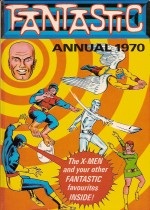
Fantastic Annual 1970 saw the end of the era. Interest in superheroes and fantasy in general were on the wane and British weeklies were gradually switching back to war and sports stories. This was one of the last Odhams Christmas compendiums to feature imported Marvel material: from then on the Americans would handle their own Seasonal books rather than franchise out their classics to mingle with the Empire’s motley, anarchic rabble.

The frantic fun started in full colour with the contents of X-Men #40, January 1968, by Roy Thomas, Don Heck & Dick Ayers, wherein the merry mutants tracked down an alien robot Frankenstein in ‘The Mark of the Monster!’ after which the switch to red and black synchronised with ‘The Fantastic Origin of Doctor Doom!’ – a genuine Marvel Masterwork by Stan Lee, Jack Kirby & Chic Stone from Fantastic Four Annual #2, September 1964, which revealed the pride and folly which shaped one of the greatest villains in comics.

‘The Haunted House!’ (or ‘I Speak of the Haunted House’ from Tales of Suspense #42, June 1963) is a splendid example of Lee and Ditko at their light-hearted best, whilst Thor displayed his warrior acumen battling ‘The Evil of Loki!’ in a severely edited, almost truncated reprint of ‘The Day Loki Stole Thor’s Magic Hammer!’ (Lee, Robert Bernstein & Joe Sinnott from Journey into Mystery #92, May 1963). At least it was in full colour, as was the group pin-up page featuring the Thunder God, the X-Men and Iron Man traced off by a Power Comics art junior – possible Steve Parkhouse or Barry (Windsor) Smith – after which the two colour printing returns as the Armoured Avenger is ‘Suspected of Murder!’

The supposed victim was, of course, his own alter-ego Tony Stark in this tense, guest-star studded yarn by Lee, Heck & Dick Ayers (from Tales of Suspense #60, December 1964) after which ‘The March of the Steelmen’ offered another excellent but uncredited science fiction thriller, pitting a brace of upstanding British researchers against an uncanny invasion of unstoppable metallic warriors from a sub-atomic world…

The final tale, in full colour, introduces another indomitable domestic hero as ‘Matt Marvel – Lawman of the Future’ pitted all his incredible resources against maddest of scientists Doctor Merlin in a mind-boggling battle of wits and wiles with the world at stake…

These stunningly more-ish collections are mostly tasty treats for we backward-looking baby-boomers, but even though the Marvel material has been reprinted ad infinitum, there’s still a wealth of excellent and intriguing home-made heroic action going begging here, and it’s long past due for some enterprising publisher to gather all that quirky British invention into a modern compendium of weird warriors and wonders.

Anybody here tempted by a new/old UK Action Force…?
© 1969 Hamlyn Publishing Group Limited. Selected material © Marvel Comics Group (1963, 1964) 1969.

Merry Christmas, Boys and Girls

Since the Mayans miscalculated and we’re all (most?) still here, I’ve gotten all extra-nostalgic and doubled my pleasure by indulging in not just one but two days of British Annual excellence…

Today’s Cool Yule Drool comprises a trio of my most often enjoyed festive frolics and tomorrow we’re doing it again with even more passion but just a little less imaginatively.

Have a Very Merry Day and always keep reading new things…

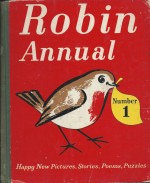
Robin Annual Number 1
By various, edited by Marcus Morris (Hulton Press)
No ISBN:

There’s not a lot around these days in our field which both caters specifically for little kids and simultaneously introduces them to the ineluctably tactile wonders and sensorium of a high quality comics anthology experience, but once upon a time there was a whole subdivision of the business dedicated to enthralling and enchanting our youngest and, hopefully, brightest…

Robin was created in the hugely successful wake of Marcus Morris and Frank Hampson’s iconic Eagle, catering to the pre-school market the way Swift targeted 6-10 year olds and Girl concentrated on potential young ladies (that looks far creepier in print than I’d intended…). The periodical ran from March 28th 1953 to 25th January 1969, a startling 836 joy-stuffed issues.

Offering a range of beautiful genteel, diffidently Christiano-centric stories, strips and puzzles for parents to read with and to their toddlers, Robin sported the same supremely high production values as all the Hulton Press titles. It was edited by Morris until 1962 when Clifford Makins took over, shepherding the title until its absorption into Odhams/Fleetway comic Playhour, just as the collapse of theUK comics industry was beginning…

There were at least nine Christmas Annuals – such as this first one from 1953 – which combined stunning, lavishly illustrated colour strips and features with solid, memorably stylish and glossy monochrome pages for an 80 page compendium of enticing wonderment between sturdily thick and reassuring red cardboard covers.

Again like its older brothers and sister, Robin included a selection of licensed characters well known to the new but ever-growing television audience…

This particular British Festive icon opens with double-page front and end-pieces by Reg Forster, depicting railway station scenes to colour in and a beautiful painted dedication to the young Princess Anne and Prince Charles, after which the prose tale of ‘Johnny and Mr Spink’ related the tale of a boy given a pony for his birthday.

The first comic strip is in colour. ‘The Amazing Adventure of Percy and the Cricket Ball’ featured anthropomorphic animals and a young man who turned sporting disaster to his advantage, followed by an illustrated poem ‘Things to Do’ and ‘The Story of Woppit’, a monochrome strip featuring an infamous teddy-bear in the snow with bunnies.

More shrew than bear, Mr. Woppit was merchandised as a toy and one was adopted as a lucky mascot by notoriously superstitious sportsman and speed enthusiast Donald Campbell. It was with him when Campbell died piloting the hydroplane Bluebird K7 on Coniston Water in 1967, and found amidst the floating wreckage.Campbell’s remains weren’t recovered until 2001.

A Play Page of puzzles is followed by the first TV star as ‘Andy Pandy’ played garden pranks on Teddy after which ‘The Old Woman and the Mouse’ offered a delightfully salutary prose fable illustrated by the incredibly talented David Walsh and then ‘The Twins Simon and Sally’ got into a mess feeding the chickens in their first strip saga.

‘Princess Tai-Lu’ was a magical Siamese cat and in her initial strip here celebrates Christmas with a few furry feline friends in her own unique manner, whilst the illustrated poem ‘Little Grey Stone’ by Margaret Milnes is a visual feast of tone-&-wash mastery and colour comic ‘Tom the Tractor’ related the heroic rescue of a climbing lamb and piglet by a handy animated farm vehicle,

‘Scruffy the Scarecrow’ was almost junked by the farmer until some friendly Magpies saved his job in a rather moving text tale, but ‘The Proud Mouse’ was the architect of her own downfall in a delightfully executed strip by an uncredited hand.

‘Richard Lion’ (and his animal chums Henry the kangaroo, Pug the bulldog, Peggy the black panther, Nemo the jester and others) seems like a rather excellent knock-off of Bestall’s Rupert Bear by the brilliant Maria Jocz, but it still offers wonder and joy aplenty in a two-chapter, vividly coloured strip which finds the cubs being harassed by and then saving some irascible Snow Gnomes. Next comes the second of the BBC’s Watch With Mother properties as Bill and Ben ‘The Flower-Pot Men’ saved a tortoise from his own exuberant folly in a captivating black and white strip.

A black Scottie dog narrates ‘The Sad Story of McTavish’ (by Norman Satchell) whilst ‘Charlie and the Cake’ takes only three panels to explain the folly of stealing confectionery from the larder…

The snow-bound adventures of Rufus, Rodney Rita and little brother “Fums” resulted in a new family pet thanks to the intervention of ‘The Magic Wellingtons’ in a beguiling colour strip, whilst, following a Bo Peep maze-page, ‘The Twins Simon and Sally’ return no wiser than before as their attempts to bath both a dog and cat at the same time goes spectacularly awry…

‘Midge the Motor Car’ was a living autonomous little auto and his trip to the local Fair resulted in initially chaos but eventually a dramatic and heroic rescue in a lovely monochrome strip from Catherine Hammond and an uncredited scripter, after which ‘The Shepherd Boy’ retold the story of David and Goliath in a stylish full colour comics version, and short story ‘The Runaway Bus’ – illustrated by Forster – detailed how a London Passenger Service Vehicle took itself off to the seaside for the day…

The poem ‘Eider Downy House’ (Gay Wood) is followed by the sublime black and white nature strip ‘The Dormouse at Christmas’ and a full colour rebus double spread of the alphabet before the prose tale of ‘Ku Mu and the Crocodile’ (written and illustrated by Dorothy Craigie) told a gentle tale of West Africa and the strip ‘Bingo, Bango and Bongo’ by Jenetta Vise demonstrated to three monkeys that performing in a circus was far more fun than merely spectating…

A ‘Mrs Bunny Maze Puzzle’ precedes the all-colour adventures of talking calf ‘Johnny Bull’ on land, sea and in the air, after which the superbly limned prose story ‘The Excited Red Balloon’ shows the sheer class of illustrator Eileen Bradpiece, before Technicolor tiny titan ‘Andy Pandy’ performed a prankish encore at a tea-party for Teddy and ‘Tina, Tim and the Magic Helicopter’ undertook an astounding prose voyage to the Wild West…

Patricia Hubbard drew an amazing strip adventure of the dolls in ‘Toyville’ and, following the conclusion of Richard Lion‘s excursion to the cave of the Snow Gnomes and another rebus page entitled ‘Can You Read this Letter?’, ‘The Flower-Pot Men’ accidentally built themselves a splendid flying sailboat.

The rather trenchant warnings in the tale of ‘Canty Kitten’ are balanced by a practical feature on ‘How to Draw a Toy Engine’, after which David Walsh displays his dexterity with both monochrome and full colour scenes for the ode to ‘Skating on a Pond’ and the enigmatic Kearon (perhaps Robot Archie artist Ted Kearon?) exhibits great virtuosity in relating the strip saga of ‘Philip’s Circus’…

The indefatigable Walsh then lent his deft pen and brush to the alarmist but happily ended text tale of ‘The Squirrel Who Forgot’ and sublime ‘Princess Tai-Lu’ returned to save her human companion’s hat in another lovely monochrome strip.

‘Billyphant’s Birthday’ provided a menagerie of pets for the lonely little pachyderm and that motivated Motor Car returned in ‘Midge at the Zoo’, handling runaway rhinos and adoring peacocks alike, before another Play Page segued into a black and white bible strip detailing what happened when ‘Jesus gets lost’ and all the seasonal magic ended with the prose saga of runaway pigs ‘Quibble and Quarrel’.

Unlike most periodicals of the time, this annual actually lists all the creative contributors involved – although not which pieces they worked on – so those I’ve been unable to identify I’ve name-checked here: writers Leila Berg, Maria Bird, John Byrne, Nancy Catford, Dennis Duckworth, Jessica Dunning, Rosemary Garland, James Hemming, Maureen Hillyer, Winifred Holmes, Ursula John, Rosemary Sisson, John Taylor, Billy Thatcher, & Shelagh Fraser whilst artists unattributed include Anthony Beaurepaire, Nancy Catford, Harry Hants, Irene Hawkins, Elizabeth Hobson, Stewart Irwin, Faith Jacques, Janet & Anne Graham Johnstone, Mary McGowan, Constance Marshall, Michael K. Noble, Walter Pannett, Prudence Seward, A.E. Speer, Astrid Walford & Andrew Wilson.

Relatively cheap and still quite available, books like this were and should remain an integral part of our communal history, always astoundingly high in quality and absolutely absorbing. Whimsical, comforting and supremely entertaining, this is a package with a host of child-friendly tales that have tragically missed becoming nursery classics simply because they appeared in a disposable comic rather than permanent kid’s novel, and it’s long past time publishers re-examined this wealth of forgotten material with a view to creating new masterpieces for library shelves and wholesome all-ages TV animation projects…

No copyright notice so I’m guessing most of the originally created intellectually properties material now resides as part of IPC or Egmont. If you know better I’ll be happy to have this entry amended.

Superadventure Annual 1967
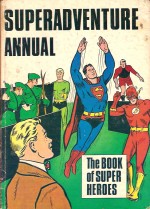
By various (Atlas Publishing & Distribution)
No ISBN

Whereas the 1962 edition – the first Christmas Annual I can remember getting – was a stunning shock to my British-born, Polish/German reared, pre-school senses, by the advent of the 1967 Superadventure Annual (December 25th 1966 at about 11 minutes past 4 in the morning), I was a far more sophisticated but no less excitable consumer.

I had since learned in those short intervening years quite a bit about Superman, Jimmy Olsen, Aquaman, Green Arrow, Flash, Tommy Tomorrow and all the rest through the sleek American import comics that my Dad faithfully brought home every Friday after work, teaching me – and himself – English (admittedly American-seasoned) by poring through them together over weekends filled with sugary snacks and in-between huge, rustic, home-grown and Mum-cooked meals.

That early indoctrination and fascination remains strong – for the comics at least. I’m far too old and debilitated for sugar, starch, caffeine and artificial additives now…

This was one of the last licensed UK DC collections before the Batman TV show turned the entire planet Camp-Crazed and Batmanic, and therefore offered a delightfully eclectic mix of material far more in keeping with traditionally perceived British boy’s interests than the masked suited and booted madness that was soon to follow in the Caped Crusader’s scalloped wake. Of course this collection was still produced in the cheap and quirky mix of black and white, dual-hued and full colour pages which made those Christmas books such a bizarrely beloved treat.

The action opens with a classically lovely yarn starring the Fastest Man Alive, printed in black and red.

The first story is reprinted from The Flash #119 (March 1961), crafted by John Broome, Carmine Infantino & Murphy Anderson, and related how the lethal Looking Glass Bandit used his incredible technology to turn our hero into a living genie before attempting to murder him with ‘The Mirror Master’s Magic Bullet’ after which space cop Tommy Tomorrow tackled – in plain old monochrome – ‘The Planeteer’s Alien Allies’.

The strip was a hugely long-running back-up strip which moved from Real Fact Comics, to Action Comics and Worlds Finest Comics before fading from sight and memory. This particular tale of sneaky conniving ETs only pretending to be Earth’s friends comes from WF #122, December 1961, courtesy of scripter Jack Miller and versatile illustrator Murphy Anderson. Ubiquitous gag cartoonist Henry Boltinoff produced hundreds of funny pages and characters over the years, and a great selection are sprinkled through this book, beginning with a crafty ‘Casey the Cop’ howler…

World’s Finest Comics #125 from May 1962 provided the Green Arrow thriller ‘The Man Who Defied Death’ (by Ed “France” Herron and Lee Elias); a bold and grittily terse mini-epic and taut human drama about a desperate daredevil willing to do absolutely anything to earn the cash for his son’s medical bills, followed by a Boltinoff ‘Moolah the Mystic’ rib-tickler and the start of the full (but exceedingly odd) colour section.

Superman’s Pal Jimmy Olsen #60 (April 1962) provided the astonishing story of ‘Super-Mite’ as author Leo Dorfman & artist Al Plastino had the exuberant cub reporter explore the mystery of a little action figure given by the Man of Steel to an ailing boy which inexplicably became as smart and powerful as any full-sized Kryptonian! This is followed by a Boltinoff gag starring ‘Peter Puptent, Explorer’ and a chiller featuring Aquaman and Aqualad battling ‘The Curse of the Sea Hermit’.

First seen in Detective Comics #295, September 1961 by George Kashdan & Nick Cardy, this spooky sea tale seemingly pitted the heroes against ancient evil but there was ultra-modern piratical plundering behind this scheme…

Back in black and white, ‘The Trickster Strikes Back’ (Flash #121, June 1961) saw the rapacious return of an air-walking bandit with murderous intent, outmanoeuvred by the Vizier of Velocity in a stunning yarn from Broome, Infantino and Joe Giella whilst, after another Peter Puptent page, Tommy Tomorrow undertook a desperate ‘Journey to 1966’ (originally entitled ‘Journey to 1960’, by Miller & Jim Mooney, when it first appeared in WF #113, November 1960) to capture a would-be world-conqueror with the inadvertent aid of the Planeteer’s own grandfather, after which the grand Costumed Dramas end in fine style with ‘The League of Fantastic Supermen’ (by Jerry Siegel, Curt Swan & George Klein from Superman’s Pal Jimmy Olsen #63, September 1962) in which a quartet of Kryptonian outlaws and the double-dealing Legion of Super-Villains are all outwitted by the plucky junior journalist.

Maybe I’m blinded by nostalgia-coloured goggles, but it seems admirably astounding to me that the all-ages stories featured here are so perfectly constructed that whether an innocent(ish) tubby toddler or the sullen, embittered old coot I became, these tales continue to beguile, bemuse and satisfy in a way that no food, drink or drug could. This is another book that will always say “Merry Christmas” to me.

…And hopefully to you, too…

© 1966 National Periodical Publications, Inc.,New York. Published and distributed jointly by Atlas Publishing and Thorpe & Porter, Ltd., by arrangement with The K.G. Murray Publishing Company Pty. Ltd., Sydney.

Beano Book 1972
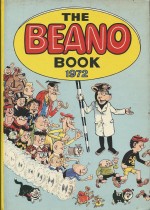
By various (DC Thomson & Co., Ltd.)
Retroactively awarded ISBN: 978-0-85116-038-2

For many British – and indeed Commonwealth – fans, Christmas can only mean The Beano Book (although Scots worldwide and of every nationality have a pretty fair claim that the season belongs exclusively to them via the traditional, annually-alternating collections of The Broons and Oor Wullie which make every December 25th mirthfully magical), so I’ve yet again highlighted another of the venerable and beloved tomes as particularly representative of the Season of Joy.

In those days these annuals were produced in the wonderful “half-colour” British publishers used to keep costs down. This was done by printing sections or “Signatures” of the books with only two plates, such as Cyan (Blue) and Magenta (Red): The sheer versatility and colour range this provided was astounding. Even now this technique inescapably screams “Holidayextras” for me and my contemporaries.

As is always the tragic case, my knowledge of the creators involved is criminally sub-par but I’ll hazard the usual wild guesses in the hope that someone with better knowledge will correct me when I err and embarrassingly get it wrong again…

This boisterously compelling chronicle opens with a double-page splash of The Bash Street Kids (by David Sutherland) breaking the fourth wall and playing mischievous hob with the book’s two-colour formatting, after which The Three Bears by Bob McGrath and the exceedingly domestic Biffo the Bear (Sutherland again) officially welcome us to the festivities.

Leading off this year’s anarchic antics is a splendid school Panto skit starring Minnie the Minx courtesy of Jim Petrie, after which the iconoclastic Dennis the Menace and Gnasher make their first appearance adding their own unique tinge of terror to a school play thanks to prolific diversity of style chameleon David Sutherland.

“Fastest boy on Earth” Billy Whizz (by Malcolm Judge) then experiences painful feedback from a rashly hurled boomerang and his Antipodean counterpart, before the re-assembled Bash Street Kids helpfully assist Teacher get over his over-sleeping problem with the expected catastrophic results in a dedicated and extended niche chapter interwoven with the eccentric and imaginative ‘Bash Street Motor Cartie Show’.

Biffo and human pal Buster go shopping for new furniture next – in an eye-popping blue and yellow segment – after which Roger the Dodger is again outwitted by his dad and Lord Snooty learns the error of his selfish, posh-boy ways in a brace of gloriously funny strips from Robert Nixon, whilst Ronald Spencer’s painfully un-PC but exceedingly hilarious Little Plum follows with the rambunctious redskin falling foul of a bolshie buffalo before Billy Whizz rockets back with a tricky ‘Whizz Quiz’ to test our wits and reactions.

In a previous annual the Bash Street Kids found themselves the reluctant owners of an accident-prone elephant, and she riotously returns here in an extended episode of Pups Parade starring the Bash Street Dogs (and Ethel Hump) by the marvellous Gordon Bell. Stuck with the excitable, ponderous pachyderm by the awesome and omnipotent Beano Editor, the mangy mutts soon handed her off to their arch-foes The Bash Street Cats but it took the canny connivings of ‘The Nibblers’ (drawn by either John Sherwood or Ron Spencer?) to finally quell Ethel’s destructively effusive spirits…

At this time The Beano still had the odd adventure strip and perhaps the greatest of these was local boy superhero Billy the Cat. Here in an expansive section of his own, the plucky acrobat chases burglars over rooftops, crushes bullies, catches car thieves and almost mucks up a fire drill in a rollicking rollercoaster of blistering action by Sandy Calder – and there’s also a splendid ‘Quick on the Draw’ feature inviting readers to become artists themselves…

Biffo the Bear then endures an agony of indecision whilst his hirsute and voracious American cousins The Three Bears got a slap-up Christmas feed even after failing again to breach the impregnable local general store of grocer Hank Huckleberry…

The defences of Bunkerton Castle proved too much when Lord Snooty and His Pals tried to bring in a truly tremendous Xmas tree, but Minnie the Minx had far more success in her spring-heeled hi-jinx – until Dad caught her, at least – whilst the ‘Billy Whizz Diary’ proved its worth in mirth before Little Plum and that buffalo had their hands and hooves full trying to wigwam-train Chiefy‘s latest pet – a Smart Alec chimpanzee…

The Nibblers next resumed their war of attrition with malicious moggy Whiskers whilst Roger’s latest Dodges proved ultimately unsuccessful but did prompt him to dream big and explain what would happen ‘If I Were a Rich Boy…’

Another extended journey to Bash Street found the Kids literally sucking up to Teacher after “borrowing” a Corporation Dust Cart and industrial vacuum cleaner, whilst following some enthralling, appalling ‘Party Puzzles’ the ‘Pup Parade’ ended the segment with a dirty scheme to clean up the dog’s communal dustbin home…

Biffo then worked out with the local Fire Brigade and ‘The Three Bears’ had snow fun at all when Hank trapped them with a frigid, foodless maze, after which Minnie found things to amuse herself – but not so many other folks – building snowmen…

The Festive fun then concludes with a thinly veiled but entertaining ad for that year’s Dennis the Menace Annual and a return to the Bash Street Kids’ colour cavortings…

This is another astoundingly compelling edition, and even in the absence of legendary creators such as Dudley Watkins, Leo Baxendale and Ken Reid there’s no discernable decline in the outrageous and infectious insanity. With so much merriment on offer I can’t believe this forty year old book is still sprightlier and more entertaining than most of my surviving friends and relatives. If ever anything needed to be issued as commemorative collections it’s these fabulous DC Thomson annuals…

Divorcing the sheer quality of this brilliant book from nostalgia may be a healthy exercise – perhaps impossible, but I’m perfectly happy to simply wallow in the magical emotions this annual still stirs. It’s a fabulous laugh-and-thrill-packed read from a magical time, and turning those stiffened two-colour pages is always an unmatchable Christmas experience – and still relatively easy to find these days.

© 1971 DC Thomson & Co., Ltd.

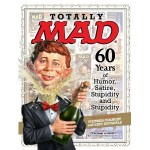
Totally Mad – 60 Years of Humour, Satire, Stupidity and Stupidity


By “The Usual Gang of Idiots” & edited by John Ficarra (Time Home Entertainment)
ISBN: 978-1-61893-030-9

Win’s Christmas Gift Recommendation: a truly timeless tome bringing back a golden age of laughter – no matter how young you are… 10/10

EC Comics began in 1944 when comicbook pioneer Max Gaines sold the superhero properties of his All-American Comics company to half-sister National/DC, retaining only Picture Stories from the Bible. His plan was to produce a line of Educational Comics with schools and church groups as the major target market.

Gaines augmented this core title with Picture Stories from American History, Picture Stories from Science and Picture Stories from World History, but the so-worthy notion was already struggling when he died in a boating accident in 1947.

With disaster looming, his son William was dragged into the family business and with much support and encouragement from unsung hero Sol Cohen – who held the company together until the initially unwilling Bill Gaines abandoned his dreams of a career in chemistry – transformed the ailing enterprise into Entertaining Comics…

After a few tentative false starts and abortive experiments, Gaines and his multi-talented associate Al Feldstein settled into a bold, fresh publishing strategy, utilising the most gifted illustrators in the field to tell a “New Trend” of stories aimed at an older and more discerning readership.

From 1950 to 1954 EC was the most innovative and influential publisher in America, dominating the genres of crime, horror, war and science fiction, spawning a host of cash-in imitations and, under the auspices of writer, artist and editor Harvey Kurtzman, the inventor of an entirely new beast: the satirical comicbook…

Mad also inspired dozens of knock-offs and even a controversial sister publication, Panic.

Kurtzman was a cartoon genius and probably the most important cartoonist of the last half of the 20th century. His early triumphs in the fledgling field of comicbooks (Mad, Two-Fisted Tales, Frontline Combat) would be enough for most creators to lean back on, but Kurtzman was a force in newspaper strips (See Flash Gordon Complete Daily Strips 1951-1953) and a restless innovator, a commentator and social explorer who kept on looking at folk and their doings: a man with exacting standards who just couldn’t stop creating.

He invented a whole new format and gave the USA Populist Satire when he transformed his highly successful full-colour comicbook baby Mad into a mainstream monochrome magazine, safely distancing the outrageously comedic publication from fall-out caused by the 1950s socio-political witch-hunt which eventually killed all EC’s other titles, and bringing the now more socially acceptable publication to a far wider, broader audience.

He pursued his unique brand of thoughtfully outré comedy and social satire with the magazines Trump, Humbug and Help!, all the while conceiving challenging and powerfully effective humour strips such as Little Annie Fannie (for Playboy), The Jungle Book, Nutz, Goodman Beaver, and Betsy and her Buddies. Seemingly tireless, he also inspired the next generation through his creations on Sesame Street and with his teaching of cartooning at the School of Visual Arts in New York. He died far too early in 1993.

…And he was just one of the astonishingly gifted creators who have turned Mad into a staggeringly influential cultural phenomenon and global brand in the intervening years…

Just in time to be an ideal gift, and celebrating the history and progress of an institution we all grew up with if not in, Totally Mad reviews the rise and rise of the magazine with tantalising snippets of gags and features accompanied by great big buckets of captivating excerpts and illustrations from the many brilliant creators who have contributed to its success.

Be Warned: this is not a “best of” collection – it would be impossible to choose, and besides there are hundreds of reprint book compilations and websites for that. This is a celebration of past and present glories and a compulsive taster for further exploration, but with very few complete stories…

At 256 pages this huge (312x235mm) and luxurious compendium includes historical articles, hundreds of pages of amazingly funny art and cleverly barbed observations, divided by decades and augmented by hundreds of full-colour, iconic cover reproductions, referencing favourite features such as Spy vs Spy (both by originator Antonio Prohias and successor Peter Kuper), Mad Fold-Ins, Al Jaffee’s ‘Scenes We’d Like to See’, Dave Berg’s ‘The Lighter Side of…’, ‘Snappy Answers to Stupid Questions’, ‘Mad Mini-Posters’, whilst Film and TV parodies include ‘Gunsmoked’, ‘My Fair Ad-Man’, ‘East Side Story’, ‘Flawrence of Arabia’, ‘Star Blecch’, ‘Jaw’d’, ‘Saturday Night Feeble’, ‘LA Lewd’, ‘Dorky Dancing’, and assorted mega-movie franchises ad infinitum…

Whatever your period, and whichever is your most dearly revered, it’s probably sampled here…

Following an eccentric and loving Introduction from Stephen Colbert and Eric Drysdale -illustrated by Sam Viviano – veteran contributor Frank Jacobs provides a photo-packed profile of the magazine’s unique father-figure by asking – and answering – ‘Who Was Bill Gaines?’ after which ‘Mad in the 1950s’ recalls the Kurtzman era with brightly hued extracts from giant ape spoof ‘Ping Pong!’, ‘Superduperman!’, ‘Lone Stranger Rides Again!’, ‘Sound Effects!’, ‘Melvin of the Apes!’, ‘Mad Reader!’, ‘Bringing Back Father!’ and ‘Starchie’, highlighting the talents of Will Elder, Wallace Wood, Jack Davis, John Severin, Basil Wolverton & Bernie Krigstein, before moving into the magazine phase by spoofing advertising and popular pastimes with ‘Readers Disgust’, ‘What Makes a Glass of Beer Taste so Good?’ and more.

Arch-caricaturist Mort Drucker began his stellar run at this time as did the mildly maniacal Don Martin, whilst proven comics masters Joe Orlando, Wood, Davis and George Woodbridge reached astonishing peaks of artistic excellence with a parade of stunning covers and end-pages by Kurtzman, Kelly Freas, Norman Mingo and others proving as effective now as in your granddad’s day…

In ‘Who is Alfred E. Neuman?’, Jacobs recounts the twisted and turbulent origins of the magazine’s iconic gap-toothed-idiot mascot after which ‘Mad in the 1960s’ highlights the rise of Television and the counter-culture whilst ‘Was Mad Ever Sued?’ finds Jacobs  testifying to some truly daft and troubling moments in the mag’s life…

Some of the very best bits of ‘Mad in the 1970s’ is followed by the conclusion of ‘Who Was Bill Gaines?’ after which Davis, Dick DeBartolo & Jacobs’ legendary ‘Raiders of the Lost Art’ skit opens ‘Mad in the 1980s’ as patriotism, movie blockbusters, Hip-hop and computer games seized the public’s collective imagination…

‘What Were the Mad Trips?’ explores a grand tradition of company holidays, after which the transitional years of ‘Mad in the 1990s’ covers Rap music, the rise of celeb culture and the magazine’s forays into a rapidly changing world. This is followed by ‘Mad After Gaines’ which details the internal adjustments that took place following the death of the hands-on, larger-than life publisher in 1992 whilst ‘Mad in the 2000s’ details the brand’s shift into the digital world, with exemplars from creators old and new spoofing medicines, newspaper strips, elections, dead phrases, celebrity causes, religion, cell-phones, man-boobs, war in Iraq, Obesity, satirical rival ‘The Bunion’, contemporary Racism and media sensations Donald  Trump, whilst parodies included ‘Bored of the Rings’, ‘Sluts in the City’, ‘Spider-Sham’, and so much more…

Current editor John Ficarra provides a suitable Afterword and this magnificent tome also includes a poster pack of a dozen of the very best covers from Mad’s epochal run.

Most of you can happily stop now, but if you’re into shopping lists here’s just a small portion of the other contributing “idiots” who have madr the magazine a national institution… like graft and pimples:

Sergio Aragonés is represented throughout with his Mad Marginals as well as many masterful cartoons and pastiches, and writers include Vic Cohen, Tom Koch, Larry Siegel, Nick Meglin, Earl Doud, Lou Silverstone, Jacobs, DeBartolo, Arnie Kogen, Chevy Chase, Marylyn Ippolito, Max Brandel, Stan Hart, Billy Doherty, Barry Liebman, Desmond Devlin, Russ Cooper, Joe Raiola, Charlie Kadau, Robert Bramble, Michael Gallagher, Butch D’Ambrosio amongst so many others.

All-rounders both scripting and scribbling include Dave Berg, Al Jaffee, Aragonés, Don Martin, John Caldwell, Paul Peter Porges, Don “Duck” Edwing, Tom Cheney, Drew Friedman, Peter Kuper, Christopher Baldwin, Feggo and star artists making a splash range from venerable veterans such as Frank Frazetta, John Cullen Murphy and Angelo Torres to Mark Frederickson, Bob Clarke, Gary Belkin, Paul Coker Jr., Mutz, Jack Rickard, Irving Schild, Gerry Gersten, Rick Tulka, Harry North, Richard Williams, Tom Bunk, Bill Wray, Steve Brodner, Mark Stutzman, Tom Richmond, Gary Hallgren… the list is nigh endless.

Wrist-wreckingly huge, eye-poppingly great and mind-bogglingly fun, this is one all the family will be happy to pore through… and probably fight over.
© 2012 E.C. Publications, Inc. All rights reserved.

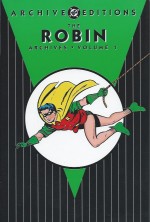
Robin Archives volume 1


By Bob Kane, Bill Finger, Win Mortimer, Jim Mooney & various (DC Comics)
ISBN: 978-1-4012-0415-0

Robin the Boy Wonder debuted in Detective Comics #38 (April 1940), created by Bob Kane, Bill Finger & Jerry Robinson and introduced a juvenile circus acrobat whose parents were murdered by a mob boss. The story of how Batman took the orphaned Dick Grayson under his scalloped wing and trained him to fight crime has been told, retold and revised many times over the decades and still regularly undergoes tweaking to this day.

In the comics continuity Grayson fought beside Batman until 1970 when, as an indicator of those turbulent times, he flew the nest, becoming a Teen Wonder college student and eventually leader of a team of fellow sidekicks and young justice seeker – the Teen Titans.

He graduated to his own featured solo spot in the back of Detective Comics from the end of the 1960s, which he alternated and shared with Batgirl, and held a similar spot throughout the 1970s in Batman and won a starring feature in the anthology comic Batman Family and the run of Giant Detective Comics Dollar Comics. During the 1980s he led the New Teen Titans, first in his original costumed identity but eventually in the reinvented guise of Nightwing, re-establishing a turbulent working relationship with his mentor Batman.

His creation as a junior hero for younger readers to identify with has inspired an incomprehensible number of costumed kid crusaders, and Grayson continues in similar innovative vein for the older, more worldly-wise readership ofAmerica’s increasingly rebellious contemporary youth culture… but his star potential was first realised much earlier in his halcyon career…

From 1947 to 1952, (issues #65-130) Robin the Boy Wonder had his own solo series and regular cover spot in Star Spangled Comics at a time when the first superhero boom was fading to be replaced by more traditional genres such as crime, westerns and boys’ adventure stories. The stories blended in-continuity action capers with more youth-oriented fare with adults Batman and Alfred reduced to minor roles or entirely absent, allowing the kid crusader to display not just his physical skills but also his brains, ingenuity and guts.

This stellar deluxe hardback Archive compilation gathers together the first 21 tales from Star Spangled #65-85 covering February 1947 to October 1948, recapturing the bold, verve and universal appeal of one of fantasy literature’s greatest youth icons, opening with a fascinating Foreword by Roy Thomas, who discusses the origins and merits of boy heroes and the history of the venerable anthology title before offering some insightful guesses as to the identity of the generally un-named writers of the Robin strip.

Although almost universally unrecorded, most historians consider Batman co-creator Bill Finger to be the author of most if not all of the stories in this volume and I’m going to happily concur here with that assessment until informed otherwise…

Star Spangled Comics #65 started the ball rolling with ‘The Teen-Age Terrors’ illustrated by regular artist Win Mortimer (with the inking misattributed to Charles Paris) in which the Caped Crusaders’ faithful butler happens across an unknown trophy and is regaled with Dick’s tale of the time he infiltrated a Reform School to discover who inside was releasing the incarcerated kids to commit crimes on the outside…

That tale segues seamlessly into ‘The No-Face Crimes’ wherein the Boy Wonder acted as stand-in to a timid young movie star targeted by a ruthless killer, whilst #67 revealed ‘The Case of the Boy Wonders’ which saw our hero as part of a trio of boy geniuses kidnapped for the craziest of reasons…

An outrageously flamboyant killing in #68 resulted in the pre-teen titan shipping out on a schooner as a cabin and spending ‘Four Days Before the Mast’ to catch the murderer, after which modern terror took hold when Robin was the only one capable of tracking down ‘The Stolen Atom Bomb’ in a bombastically explosive contemporary spy thriller.

Star Spangled Comics #70 introduced an arch-villain all his own as ‘Clocks of Doom’ saw the debut of an anonymous criminal time-and-motion expert forced into the limelight once his face was caught on film. The Clock‘s desperate attempts to sabotage the movie Robin was consulting on inevitably led to hard time in this delightful romp (this one might possibly be scripted by Don Cameron)…

Chronal explorer Professor Carter Nichols succumbed to persistent pressure and sent Dick Grayson back to the dawn of history in #71’s ‘Perils of the Stone Age’ – a deliciously anachronistic cavemen and dinosaurs epic which saw Robin kick-start freedom and democracy, after which the Boy Wonder crashed the Batplane on a desert island and encountered a boatload of escaped Nazi submariners in ‘Robin Crusoe’ in a full-on thriller illustrated by Curt Swan & John Fischetti.

In #73 the so-very tractable Professor Nichols dispatched Dick to revolutionary France where Robin battled Count Cagliostro, ‘The Black Magician’, in a stirring saga drawn by Jack Burnley & Jim Mooney, after which the Timepiece Terror busted out of jail determined to have his revenge in ‘The Clock Strikes’, illustrated in full by Mooney who would soon become the series’ sole artist.

However Bob Kane & Charles Paris stepped in for the tense courtroom drama in #75 as ‘Dick Grayson for the Defense’ found the millionaire’s ward fighting for the rights of a schoolboy unjustly accused of theft, after which cunning career criminal The Fence came a cropper when he tried to steal 25 free bikes given as prizes to Gotham’s city’s best students in ‘A Bicycle Built for Loot’ (Finger & Mooney).

Prodigy and richest kid on Earth, Bert Beem was sheer hell to buy gifts for, but since the lad dreamed of being a detective, the offer of a large charitable donation secured the Boy Wonder’s cooperation in a little harmless role play. However when real bandits replaced the actors and Santa, ‘The Boy Who Wanted Robin for Christmas’ enjoyed the impromptu adventure of a lifetime…

Another rich kid was equally inspired in #78 and became the Boy Wonder of India, but soon needed the aid of the original when a Thuggee murder-cult tried to destroy ‘Rajah Robin’, whilst in ‘Zero Hour’ (illustrated by Mooney & John Giunta) The Clock struck one more with a spate of regularly-scheduled time crimes before Star Spangled #80 saw Dick Grayson become ‘The Boy Disc Jockey’, only to discover that the station was broadcasting clever instructions to commit robberies in its cryptically cunning commercials…

Robin was temporarily blinded in #81 whilst investigating the bizarre theft of guide dogs, but quickly adapted to his own canine companion and solved the mystery of ‘The Seeing-Eye Dog Crimes’, but had a far tougher time as a camp counsellor for ghetto kids after meeting ‘The Boy Who Hated Robin’. It took grit, determination and a couple of escaped convicts before the kids learned to adapt and accept…

A radio contest led to danger and death before one smart lad earned the prize for discovering who ‘Who is Mr. Mystery?’ in #83, after which Robin tried to discover the causes of juvenile delinquency by going undercover as a notorious new recruit to ‘The Third Street Gang’, and this initial outing ends on a spectacular high as the Boy Wonder sacrifices himself to save Batman and ends up marooned in the Arctic. Even whilst the distraught Caped Crusader is searching for his partner’s body, Robin has responded to the Call of the Wild, joined an Inuit tribe and captured a fugitive from American justice in #85’s ‘Peril at the Pole’…

Beautifully illustrated, wittily scripted and captivatingly addictive, these stirring all-ages traditional superhero hi-jinks are a perfect antidote to teen-angst and the strident, overblown, self-absorbed whining of contemporary comicbook kids. Fast, furious and ferociously fun, these are superb tales no Fights ‘n’ Tights fan will want to miss…
© 1947, 1948, 2005 DC Comics. All Rights Reserved.

Richie Rich Gems Special Edition


By Sid Jacobson, Ernie Colón, Ralph Newman, Lennie Herman, Warren Kremer, Sid Couchey & various (Ape Entertainment)
ISBN: 978-1-937676-27-8

Win’s Christmas Gift Recommendation: a cheap and cheerful treat for the entire family starring a true icon of kids comics… 8/10

Even if in today’s world the subtext that money fixes everything might be a little harder to swallow, the core premise of this golden classic is charmingly simple: Richard “Richie” Rich Jr. is the only child of the wealthiest man in the world, but hasn’t let the money spoil him. The lad loves simple pleasures and prefers to pal around with proper kids like Freckles and Pee-Wee Friendly rather than his obnoxious wannabe-girlfriend Mayda Munny or mean, spoiled cousin Reggie Van Dough Jr.

Moreover Richie is utterly smitten with pretty, proud pauper Gloria Glad, who spends all her time trying to convince Richie to stop showering her with imprudent, impractical presents and flashy, expensive treats.

Even so the trapping of outrageous fortunes are always there: allowing for incredible adventures and wild situations…

Once upon a time the American comicbook for younger readers was totally dominated by Gold Key, with their TV and Disney licenses, and Harvey Comics. The latter had begun in the 1941 when Brookwood Publications sold its comicbook licenses for Green Hornet and Joe Palooka to entrepreneur Alfred Harvey. Hiring his brothers Robert B. and Leon, the new publisher began making impressive inroads into a burgeoning new industry.

For nine years the company combined conventional genres and some licensed properties in a bid for the general market, but from 1950 increasingly concentrated on a portfolio of   wholesome, kid-friendly characters for early readers and fans of gentle comedy.

In the late 1940s the Harvey Brothers struck a deal with Famous Studios/Paramount Pictures to produce strips starring movie animation stars Little Audrey, Baby Huey, Herman and Katnip and Casper, the Friendly Ghost to supplement newspaper comics stars such as Blondie and Dagwood, Mutt and Jeff and Sad Sack amongst others, and eventually minted original wholly-owned stars such as Little Dot, Little Lotta and Richie Rich.

Even though the company constantly tried to diversify into mainstream genres such as horror, science fiction, western, war and superhero (producing some of the very best “forgotten classics” of the era) it was always the kids’ titles that made the most money. In 1959 the Harvey’s bought the controlling rights to their Famous Studios characters just in time for the 1960s boom in children’s television cartoons.

The result was a stunning selection of superb young reader comics starring Casper, Spooky the Tuff Little Ghost, Nightmare, The Ghostly Trio, Stumbo, Wendy, the Good Little Witch and Hot Stuff, the Little Devil all bolstered by weekly “Harveytoons” TV shows.

It was a new Golden Age for kid-appropriate funny books that lasted until declining morals, the inexorable rise of “free” entertainments such as television, games saturation and rising print costs finally forced Harvey to bow out in 1982 when company founder Alfred Harvey retired.

During that boom period, however, a new star had risen to staggering dominance.

Richie Rich first debuted as a back-up strip by Alfred Harvey and artist Warren Kremer in Little Dot #1 (September 1953) but was only given his chance at solo stardom in 1960 by line editor Sid Jacobson in 1960.

As both writer and editor, Jacobson masterminded the Harvey Comics monopoly of strips for younger American readers in the 1960s and 1970s, devising Wendy and many others whilst re-creating Richie Rich, and spinning the character off into more than 55 separate titles between 1960 and 1982.  When the company folded he then worked the same magic for Marvel’s Star Comics imprint, where he oversaw a vast amount of family-friendly material; both self created – such as Royal Roy or the superb Planet Terry – and a huge basket of licensed properties.

In latter years he has worked closely with fellow Harvey alumnus Ernie Colón on such thought-provoking graphic enterprises as The 9/11 Report: a Graphic Adaptation in 2006 and its 2008 sequel After 9/11: America’s War on Terror, Che: a Graphic Biography and Vlad the Impaler.

Colón was born in Puerto Rico in 1931: a creator whose work has been loved by generations of readers. Whether as artist, writer, colourist or editor his contributions have benefited the entire industry from the youngest (Monster in My Pocket, Richie Rich and Casper the Friendly Ghost for Harvey Comics, and many similar projects for Marvel’s Star Comics), to the traditional comicbook fans with Battlestar Galactica, Damage Control and Doom 2099 for Marvel, Arak, Son of Thunder and Amethyst: Princess of Gemworld, the Airboy revival for Eclipse, Magnus: Robot Fighter for Valiant and so very many others.

There are also his sophisticated experimental works such as indie thriller Manimal, and his seminal genre graphic novels Ax and the Medusa Chain. Since 2005 he’s been hard at work on the strip SpyCat for Weekly World News.

Jacobson and Colón were reunited with one of their oldest projects in 2011 when Ape Entertainment relaunched and resurrected the “Poor Little Rich Kid” as contemporary kids adventure comicbook Richie Rich: Rich Rescue – which saw the beloved, whimsical child character and friends reformatted as altruistic young trouble-shooters helping the less fortunate.

Touted as a blend of “James Bond and Indiana Jones with the bank account of Donald Trump” the comic miniseries also prompted two one-shot seasonal specials (Valentine’s Day and Winter 2012) combining new material with a wealth of themed reprints from the vast archives. This slim digitally (re)coloured compilation happily re-presents them both in one single tome with a gold-plated guarantee of scintillating satisfaction…

The wealth of wholesome fun opens with the all-new ‘Unhappy Valentine’s Day’ by Jacobson & Colón, wherein nasty Reggie sabotages Gloria’s card to Richie, only to reap his usual reward of regret and recrimination courtesy of Richie’s devoted robot maid Irona, after which the vintage treasures begin with ‘Box of Chocolate’ (by Ralph Newman & Warren Kremer), wherein crafty Richie again sneaks a sumptuous gift to his disapproving girl Gloria.

‘The Great Mansion Mystery’ by Lennie Herman & Colón told of how ghostly presences in the vast Rich residence turned out be long lost – really, really lost – lovers, whilst ‘Ju$t Married!’ (Herman & Kremer) saw Richie save the day when the confetti and rice ran out at a High Society ceremonial, and ‘All That Glitters’ (Newman & Colón) again found Gloria accepting a simple gift with unsuspected cachet and value…

Richie’s ‘Electric Serenade’ (by Newman & Sid Couchey) actually charmed the stubborn little red-head, but Mayda Munny was far from happy with Richie’s expansive courtship of her rival in ‘Too Much Gloria’ (Herman & Kremer), after which it was back to business as ‘Garden Party’ by Herman & Kremer, ‘The Sound of Money’ by Newman & Colón and ‘Big Drink’ from Newman & Couchey all demonstrated the lovesick lad’s largesse but lack of restraint when shopping for the feisty Miss Glad…

Mayda once again calamitously tried to outshine her rival by becoming the ‘The Big Donator’ at a gem-studded charity event (Herman & Colón), whilst Richie was too touched by Gloria’s gift to him to reveal what truly constituted ‘Giant Jellybeans’ (Newman & Colón). The romantic reminiscences conclude with ‘Wel-Gum Home!’ by Newman & Couchey as the Lucky Lad reciprocated in his own unique style…

The Winter Special again opened with a new yarn in the spooky saga of ‘The Walking, Stalking and, Yes, Talking Snowmen’ by Jacobson & Colón wherein another of Reggie’s cruel pranks inevitably rebounded on him, after which some indoor fun in the mansion proved that there was ‘Snow Need for a Heater’ (Newman & Couchey) and ‘Snow Much Fun!’ (Newman & Colón) again displayed how imagination and improvisation were always more desirable that any expensive toy.

Newman & Kremer united to tell of ‘The Abominable Snow Plan’ of Reggie Van Dough and how Richie scotched his sneaky schemes Yeti again in ‘A Snow Thing’, after which ‘Snow Time to Play’, ‘Snow Problem’ (Newman & Colón), Kremer’s ‘Snow Problem Bonus Pin-up’ and Newman & Colón’s ‘It Seems Like Real Fun’ all demonstrate the sheer joy of combining skiing with mischief-making …

Topping off the package are four single-page gag strips from the Rich Rescue series featuring the odd inventions of on-staff boffin Professor Keenbean.

Keenbean’s Corner #1-4′ are by Patrick Rills & James Silvani and reveal the ups and downs of science in relation to super submarines, mouthy microchips, exo-skeleton gadgets and unsanctioned tinkering with faithful old Irona…

With contemporary children’s comics all but extinct these days, it’s lucky we have such timeless classics to draw upon and draw kids in with, and compilations like this one belong on the shelves of every funnybook-loving parent and even those still-contented couples with only a confirmed twinkle in their eyes. This clutch of classic children’s tales is a fabulous mix of intoxicating nostalgic wonder and exuberant entertainment which readers of all ages cannot fail to love…
™ and © 2012 Classic Media LLC. All rights reserved.

Batman Archives volume 6


By Bob Kane, Bill Finger, Edmond Hamilton, Don Cameron, Lew Sayre Schwartz, Win Mortimer, Jack & Ray Burnley, Jim Mooney, Charles Paris & various (DC Comics)
ISBN: 1-4012-0409-0

Debuting a year after Superman, “The Bat-Man” (joined eventually by Robin, the Boy Wonder) cemented National Comics as the market and genre leader of the burgeoning comicbook industry, and the dashing derring-do and strictly human-scaled adventures of the Dynamic Duo rapidly became the swashbuckling benchmark by which all other four-colour crimebusters were judged.

By the time of this the tales in this superb sixth deluxe hardback compilation (collecting the Batman adventures from Detective Comics #120-135, spanning cover-dates February 1947-May 1948) the Dynamic Duo were inescapably a co-operative effort with a large and ever-changing creative team crafting increasingly varied and captivating escapades for the heroes. One further note: many of the tales in this tome carry no writer’s credit but are most likely the work of pulp writer Edmond Hamilton, so apologies for the less than usually clear attributions throughout…

As discussed in the Foreword by celebrated critic and historian Bill Schelly, the post-war years saw a careful repositioning and reformatting of the heroes, as the publishers cautiously proceeded to tone down outlandish violence and nightmarishly macabre villains in favour of a wide variety of more mundane mobsters, gangsters and petty criminals, plus a few of the most irrepressibly popular favourites such as Penguin and The Joker.

Even so the former felon even gets cover billing in the opening costumed drama, reproduced in full from Detective #120; another riotous romp co-starring the rakish, rotund rogue indulging in ‘Fowl Play!’

Illustrated by Win Mortimer, this yarn describes how the pompous Penguin responds after an ornithologist is cited as America’s Greatest Bird Expert, leading to a campaign of fresh feather-themed crimes before the Dynamic Duo once again caged the crafty crook.

In #121 Hamilton & Howard Sherman take a rare look at corruption when Gotham’s top cop is forced from office by blackmailers exerting pressure on the Mayor. However, even whilst ‘Commissioner Gordon Walks a Beat’ Batman and Robin are tracking down the true cause of all the city’s woes…

Bob Kane & Charles Paris limned the uncredited (but probably Hamilton) case of ‘The Black Cat Crimes’ in the next issue as the sinisterly sultry Catwoman busted out of jail and ruthlessly, spectacularly exploited superstitions to plunder the city, whilst with Ray Burnley on inking in #123 ‘The Dawn Patrol Crimes’ saw a trio of aged pioneer pilots fall prey to the insidious schemes of a criminal mastermind in their fevered desperation to fly again. Happily the sinister Shiner had not reckoned on the Batman’s keen detective ability or the indomitable true grit of the patsy pilots…

The Joker returned in #124 as ‘The Crime Parade’ (Hamilton, Kane, Lew Sayre Schwartz & George Roussos) found the Mountebank of Mirth turn a radio chart show into his own private wishing well of inspired brazen banditry, after which ‘The Citadel of Crime’ (scripted by Bill Finger in #125) saw the Caped Crimebuster infiltrate a fortress where reformed crooks were imprisoned by a deranged maniac dubbed the Thinker and forced to build deadly weapons for a criminal army. Although credited here to Dick Sprang, this is actually one of the last art strips by the superb Jack Burnley, ably inked by his brother Ray and Charles Paris.

Detective Comics #126’s ‘Case of the Silent Songbirds’, by Hamilton(?) & Jim Mooney, again found The Penguin purveying his particular brand of peril and perfidy by stealing the voices of nightclub singers as part of the world’s most incredible protection racket until Batman stepped in, whilst #127’s ‘Pigmies in Giantland’ – featuring a rare pencil and ink outing for Charles Paris – saw the outrageous Dr. Agar shrink his wealthy victims to the size of dolls until the Dynamic Duo unravelled the impossible truth…

Only The Joker could conceive of ‘Crime in Reverse’ (Hamilton, Kane & Ray Burnley) as he proceeded to once again attempt to bamboozle Batman and Boy Wonder, whilst in

Detective #129 Finger, Jack Burnley & Paris took our heroes to ‘The Isle of Yesterday’ where a rich eccentric had turned back time to the carefree 1890s for all the bemused but unstressed inhabitants. Such a pity then that a mob of modern crooks were using the idyllic spot as a hideout… but not for long…

In #130 Finger, Kane & Paris described the horrific fate of a string of greedy crooks who tried to open ‘The Box’ but it took Batman’s razor-keen intellect to finally solve the decades-long mystery behind the trail of bodies left in its wake, after which Don Cameron, Kane, Sayre Swartz & Paris examined the tragic lives of two brothers doomed by dire destiny: one a callous racketeer and the other a good man forced by family ties to become ‘The Underworld Surgeon’…

In #132 esteemed escapologist Paul Bodin retired to raise his daughter, but within months ‘The Human Key’ began robbing vaults using all the master’s tricks. Only Batman could see through the open-and-shut case to discern the truth in a powerful human interest tale illustrated by Mooney & Paris, whilst ‘The Man Who Could See the Future’ (Hamilton, Kane, Sayre Schwartz & Paris) offered a moody counterpoint as the Gotham Gangbusters exposed an unscrupulous charlatan clairvoyant whose uncanny predictions always led to shocking disasters and missing valuables.

The Penguin opened ‘The Umbrellas of Crime’ in Detective #134 (Finger, Mooney & Paris) but his innovative inventions couldn’t stop Batman closing down his latest crime spree, and this blockbusting barrage of vintage Bat-tales comes to a blistering climax with #135’s ‘The True Story of Frankenstein’ (Hamilton, Sayre Swartz & Paris) as the Caped Crusaders were drawn back in time by Professor Carter Nichols to save a rural village from an incredible monster and the brute he manipulated into acts of evil…

With stunning covers by Jack Burnley, Paris, Mortimer, Kane & Sayre Schwartz, Mooney and Dick Sprang, and full creator biographies included, this supremely thrilling, bombastic action-packed compilation provides another perfect snapshot of the Batman’s amazing range from bleak moody avenger to suave swashbuckler, from remorseless Agent of Justice and best pal to sophisticated Devil-May-Care Detective, in timeless tales which have never lost their edge or their power to enthral and enrapture. Moreover, these sublimely sturdy Archive Editions are without doubt the most luxuriously satisfying way to enjoy them over and over again.
© 1947-1948, 2005 DC Comics. All Rights Reserved.

Superman Archives volume 6


By Jerry Siegel, Joe Shuster, Don Cameron, Jack Burnley, Fred Ray, Ed Dobrotka, John Sikela, Leo Nowak, George Roussos, Pete Riss, Sam Citron & various (DC Comics)
ISBN: 1-56389-602-8

I sometimes think – like many others I know – that superhero comics were never more apt or effective than when they were whole-heartedly combating fascism with explosive, improbable excitement and mysterious masked marvel men. All the most evocative visceral moments of the genre seem to come when gaudy gladiators soundly thrashed – and please forgive the offensive contemporary colloquialism – “Nips and Nazis”.  However, even in those long-ago dark days, comics creators were wise enough to augment their tales of espionage and imminent invasion with a barrage of gentler and more whimsical four-colour fare…

This sixth classic hardcover Superman compendium – collecting #21-24 (March/April to September/October 1943) of the World’s Premier Superhero own solo title – revisits the height of those war years with the indomitable Man of Tomorrow a thrilling, vibrant, vital role model whose sensational exploits spawned a host of imitators, a genre and an industry. His startling abilities and take-charge, can-do attitude had won the hearts of the public at home and he was embraced as a patriotic tonic for the troops across the war-torn world.

Behind stunning, morale-boosting covers by Fred Ray and Jack Burnley depicting Superman thrashing scurrilous Axis War-mongers, reminding readers what we were all fighting for and even having a gentle, stress-relieving laugh with us, scripter Jerry Siegel was producing some of the best stories of his career, showing the Man of Steel in all his ebullient glory, thrashing thugs, spies and masters of bad science whilst America kicked the fascists in the pants…

However at this time of this collection the call of armed duty caught up with the writer and Don Cameron was hired to fill the authorial void. Co-creator Joe Shuster however, exempt from military service due to his rapidly failing eyesight, was still fully involved in the creative process, despite being plagued by crushing deadlines on the syndicated newspaper strip iteration. In the comicbooks he could only manage the occasional story and was forced to merely oversee the illustration production line: drawing character faces whenever possible, but leaving the lion’s share to the burgeoning talent pool of the “Superman Studio”…

Following the fulsome Foreword ‘A Short Flight and a Long Journey’ by distribution and retail guru Stephen A. Geppi, the all-star, full-colour action begins with the splendid, all-Siegel contents of Superman #21 starting with ‘X-Alloy’, drawn by Ed Dobrotka & John Sikela, wherein a virtual secret army of Nazi infiltrators and fifth columnists stole American industrial secrets and would have conquered the nation from within if not for the ever vigilant Man of Steel.

It was Clark Kent rather than his flamboyant alter ego who really cracked the Leo Nowak-limned case of ‘The Four Gangleaders’ who had declared war on each other, whilst in ‘The Robber Knight’ (illustrated by Shuster & George Roussos) Lois Lane was accused of shoplifting after an armour-suited Robin Hood began giving pretty women “presents” from the department store he plundered. Once again it took a real steel hero to sort things out before ‘The Ghost of Superman!’ (with Pete Riss art) saw the Action Ace play dead to trick a confession out of a cheap killer defying justice…

Light-hearted yet barbed whimsy led in the Siegel-scripted issue #22 as ‘Meet the Squiffles!’ (Riss) found Adolf Hitler approached by the king of a nefarious band of pixies who offered to sabotage all of America’s mighty weapons. Neither nefarious rogue had factored Superman – or patriotic US gremlins – into their schemes though…

A philanthropic, well-beloved gambler was framed by unscrupulous stockbrokers, but with the Man of Tomorrow’s assistance eventually regained ‘The Luck of O’Grady!’ (Sikela), after which ‘The Great ABC Panic!’ (Dobrotka) featured the return of the perfidious Prankster who almost succeeded in patenting the English language until his greatest enemy intervened, and Riss’ ‘A Modern Robin Hood’ saw the inevitable tragic end to a well-intentioned, altruistic thief who could handle Superman but not actual mobsters and gunsels…

Superman #23 opened with a Don Cameron script illustrated by Sam Citron. ‘America’s Secret Weapon!’ was a rousing paean to American military might as Clark and Lois reported on cadet manoeuvres and the Man of Steel became an inspiration to the demoralised troops in training. Siegel then wrote the rest of the issue beginning with ‘Habitual Homicide’ (Roussos art): a crime-caper worthy of Batman which began when a co-ed rebuffed her tutor’s amorous advances, prompting the unstable scholar to frame her boyfriend for murder. Unfortunately for Superman and the staff of Spurdyke University, once Professor Raymond Lock started killing he found that he really liked it…

Then ‘Fashions in Crime!’ (Riss) found Lois and Clark plunged into the world of Haute Couture and designer knock-offs, accidentally uncovering a lethally lucrative business run by a masked swell dubbed The Dude, whilst the Sikela-illustrated ‘Danger on the Diamond!’ once more combined sports action with gambling skulduggery as Superman saved the career of an on-the-skids Baseball player and cleaned up the game… again.

Cameron wrote all but one tale in issue #24, starting with a surreal Dobrotka fantasy which eschewed rational continuity to relocate the entire Superman cast back to the 1890s, where our hero saved his chaste intended from ‘Perils of Poor Lois!’

Siegel & Riss then revealed ‘The King of Crackpot Lane’ – a Marx Brothers-inspired romp which introduced whacky mute inventor Louie Dolan of the Army’s Department of Constructive Theories whose impossible gadgets made a lot of trouble for both the Man of Tomorrow and America’s enemies…

Cameron, Dobrotka & Roussos close this collection with a couple of stirring adventure yarns; first with ‘Surprise for Superman!’ which saw the Metropolis Marvel plagued by an inventive impostor who even fooled Lois, after which ‘Suicide Voyage!’  ends everything on an exuberant high as Clark – and stowaway Lois – visit the Arctic as part of a mission to rescue downed American aviators. Of course nobody was expecting a secret invasion by combined Nazi and Japanese forces, but Superman and a patriotic polar bear were grateful for the resultant bracing exercise…

Ageless and evergreen, endlessly re-readable, these epic hardback Archive Editions fabulously frame some of the greatest and most influential comics tales ever created, and taken in unison form a perfect permanent record of breathtaking wonder and groundbreaking excitement. How can any dedicated fan resist them?
© 1943, 2003 DC Comics. All Rights Reserved.