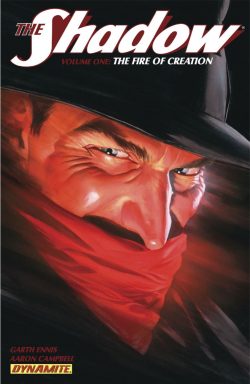
By Garth Ennis, Aaron Campbell, Carlos Lopez & various (Dynamite Entertainment)
ISBN: 978-1-60690-361-2 (TPB/Digital edition)
This book includes Discriminatory Content used for dramatic effect.
Throughout the 1930s, The Shadow granted thrill-starved readers measured doses of extraordinary excitement via cheaply produced periodical novels dubbed “pulps” (because of the low-grade paper they were printed on), as well as over the mood-drenched airwaves, via his own radio show. Pulp titles were published in their hundreds every month, ranging from the truly excellent to the pitifully dire, in every style and genre, but for exotic adventure lovers there were two star characters who outshone all others. The Superman of his day was Doc Savage, Man of Bronze, whilst the foremost dark, relentless creature of the night dispensing terrifying grim justice was a mysterious slouch-hatted hero under discussion here. Originally, radio series Detective Story Hour – based on stand-alone yarns from Street & Smith publication Detective Story Magazine – used a spooky voiced narrator (variously Orson Welles, James LaCurto and Frank Readick Jr.) to introduce each tale. He was generically dubbed “the Shadow” and from the very start on July 31st1930, he was far more popular than the stories he introduced.
The Shadow swiftly evolved into a proactive force, solving instead of narrating mysteries and, from April 1st 1931 (Happy 95th anniversary, mystery-man!), starred in his own printed pulp series, written by astoundingly prolific Walter Gibson under house pseudonym Maxwell Grant. On September 26th 1937 the radio show officially became The Shadow, with the eerie slogan/mantra “Who knows what evil lurks in the hearts of Men? The Shadow knows!” ringing out unforgettably over the nation’s airwaves.
Over the next eighteen years 325 novels were published, usually at the rate of two a month. The uncanny crusader spawned comic books, seven movies, a newspaper strip and all the merchandising paraphernalia you’d expect of a superstar brand. The pulp series officially ended in 1949, although Gibson and others added to the canon during the phantasmagorical 1960s as a pulp-fantasy revival gripped America, generating reprinted classic tales and a run of new adventures marketed as paperback novels.
As hinted above, in graphic terms The Shadow was a major player. His national newspaper strip (by Vernon Greene) launched on June 17th 1940 and when comic books took off, the Man of Mystery had his own four-colour title; running from March 1940 to September 1949. Archie Comics published a controversial contemporary comic book (1964-1965, by Robert Bernstein, Jerry Siegel, John Rosenberger & Paul Reinman) under their Radio/Mighty Comics imprint and in 1973, DC acquired the rights to produce a captivating, brief and totally definitive series of classical adventures unlike any other superhero title then on the stands.
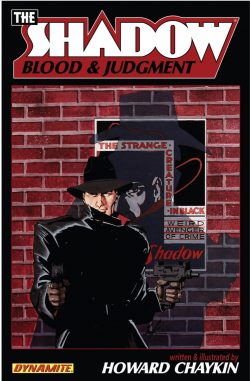
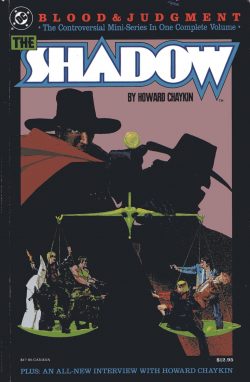
DC periodically revived the venerable and vicious vigilante. After the runaway success of Crisis on Infinite Earths, The Dark Knight Returns and Watchman, Howard Chaykin was engaged to utterly overhaul the vintage feature. This led to further, adult-oriented iterations (and even one cracking outing from Marvel) before Dark Horse assumed the license of the quintessential grim avenger for the latter half of the 1990s and beyond. Dynamite Entertainment picked up the option in 2011 and, as well as re-releasing many of those other publishers’ earlier efforts, began a series of new monthly Shadow comics.
Set in the turbulent 1930s & 1940s these were designed as self-contained story arcs, crafted by some of the top writers in the industry, each taking their shot at the immortal legend, and all winningly depicted by a succession of extremely gifted illustrators. First to fire was the incomparable Garth Ennis who muted his signature black humour for a tale screaming of unrequited injustice over six stunningly compelling episodes…
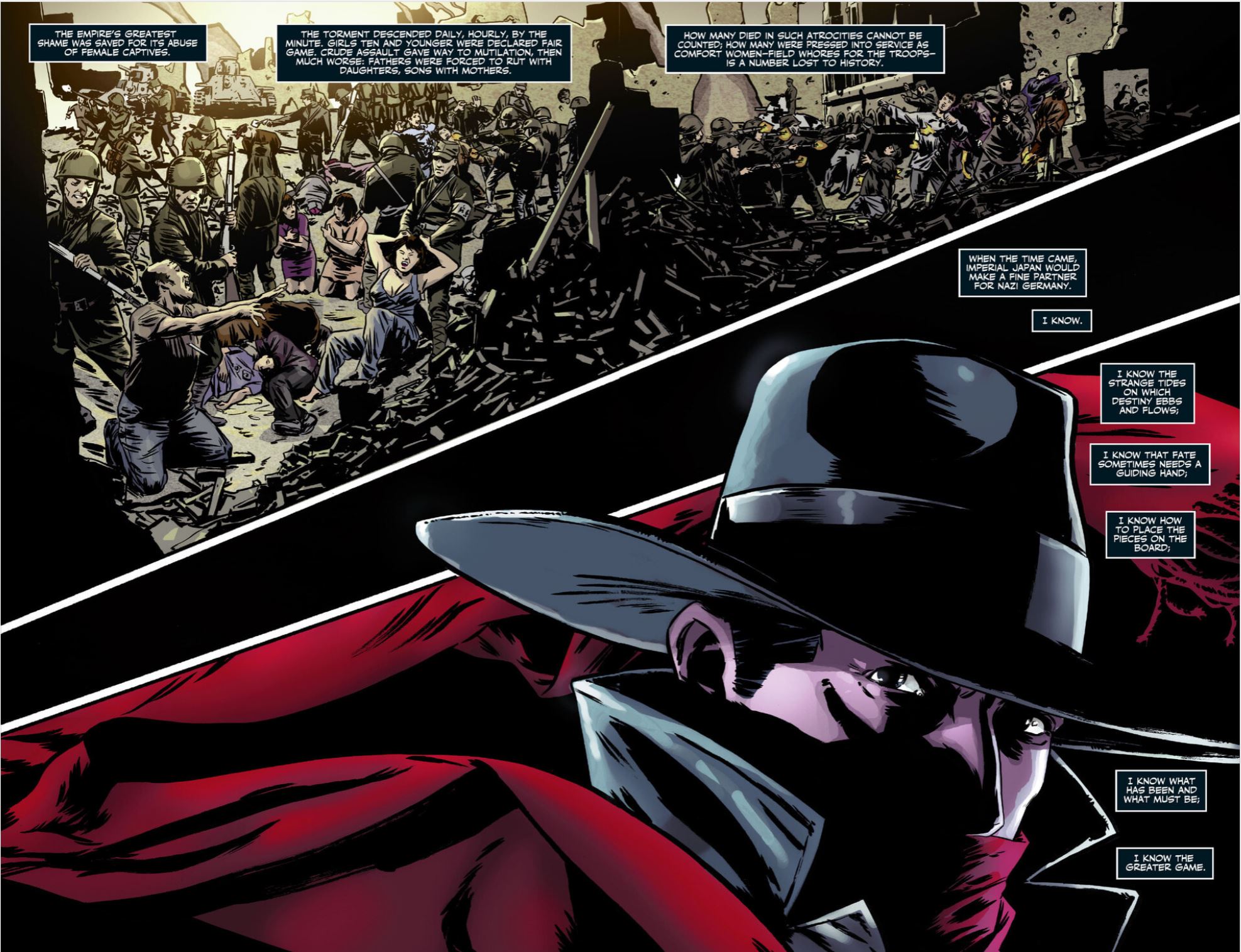
It begins with a précis of Japan’s official invasion of China in 1937 and appalling atrocities inflicted by their forces as they began building their “Greater East Asian Co-Prosperity Sphere”, jumping a few years and to the docks of New York City, where a dark angel dispenses bloody judgement to a murderous band of crooked dockworkers. A little later abrasive, indolent playboy Lamont Cranston joins Washington insider Mr. Landers and his gung-ho young protégé Pat Finnegan at the Algonquin Hotel. They are meeting to discuss an imminent crisis amidst the ever-worsening situation in the East, and how the massacre at the pier was connected to it. Specifically, two of the bodies dropped at the scene were high-ranking Japanese agents…
Despite Finnegan’s outspoken distaste at involving a civilian dilettante, a tale is shared of a rare mineral that both America and Japan will do anything to obtain. Cranston agrees to lead a small party into China to secure the samples (originally dug up by prospecting American geologists before they vanished) for the Land of the Free. Of great concern is the unspecified part played by Taro Kondo: a formidable and ruthless Major in the Japanese intelligence service with whom Cranston had unsavoury dealings during his younger, less salubrious years in the East…
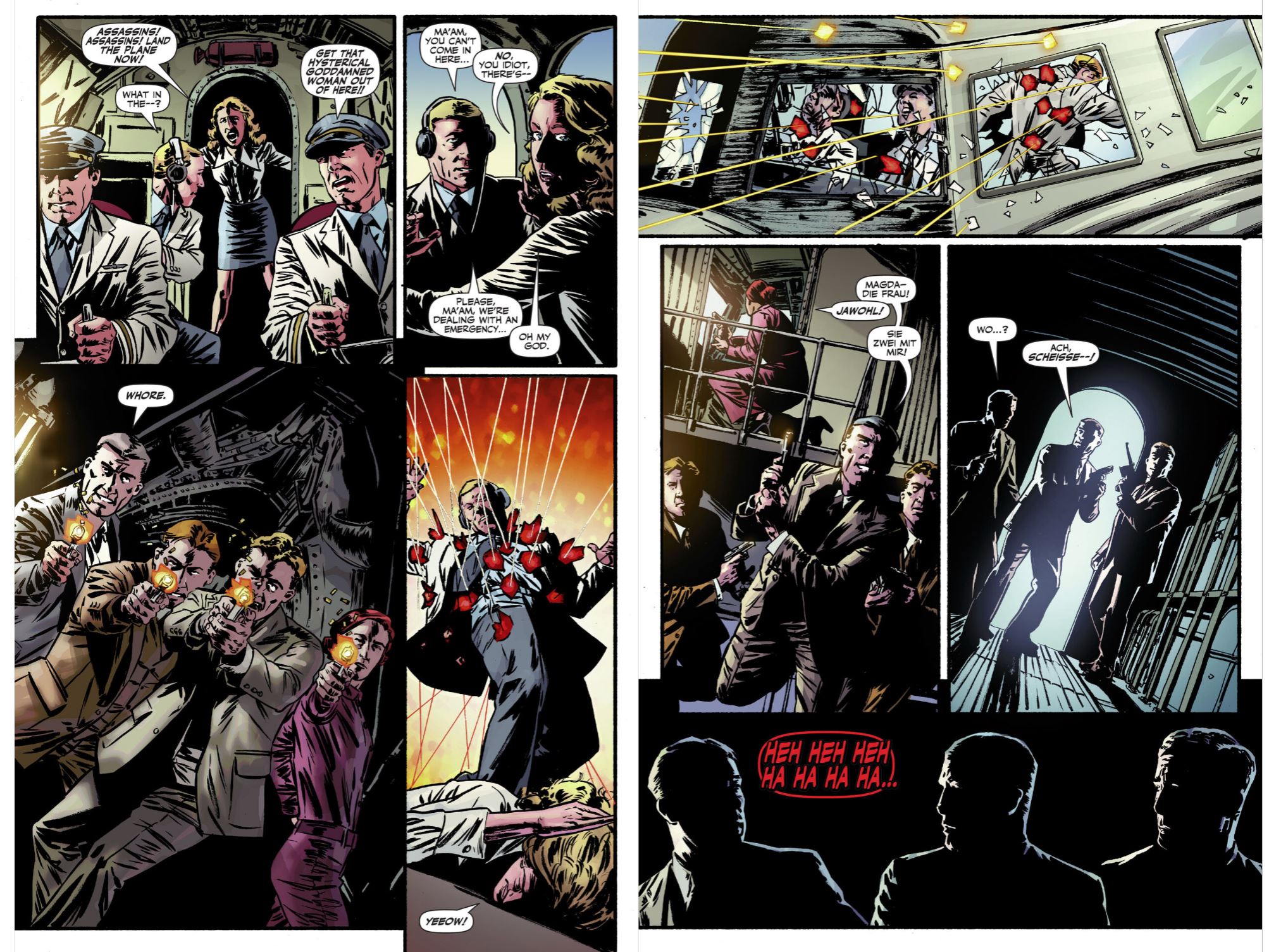
Cranston prepares his paramour and assistant Margo Lane for the rigours that lie ahead, but she has no conception of how much true horror and mass slaughter The Shadow has foreseen in the years to come. Whilst Finnegan travels by spartan military plane transport, Cranston & Margo escape his juvenile jingoistic fervour by taking a Pacific Clipper. However, their luxurious voyage is abruptly ended when they are attacked by Nazi agents masquerading as rich, indolent vacationers. The resulting bloodbath brings down the plane and our heroes barely survive. They also have far greater problems to worry about…
Ahead of them Kondo leads ambitious Emperor-lover and sexual deviant General Akamatsu on a tawdry trek to meet Chinese bandit Lord Wong Pang-Yan, descriptively and accurately known to all as the Buffalo. The grotesque, greedy barbarian is their only means of acquiring a rare mineral they crave, and Kondo is eager to placate his haughty, nauseated superior. After all, they know The Shadow is coming and have other plans in place to deal with him. To soothe the General’s nerves, Kondo promises he can behead the double-dealing Buffalo, just as soon as they have the enigmatic matter poetically described as the Spirit-Weapon and Fire of Creation…
Since Buffalo Wong originally offered his treasure to many nations, there are a numerous expeditions converging on the region, and when a Japanese fighter plane removes a rival Soviet military force from the game, Kondo gloats at another problem solved before returning to placate his aggravating, arrogant “superior”. It’s only a minor inconvenience to him that Cranston has survived his German allies’ attack and linked up with US agent Finnegan in Shanghai…
As the Yankees’ arrangements to use a British Navy vessel to reach Wong’s stronghold are finalised, Kondo’s assassins strike, but once again are no match for The Shadow’s mesmerism and blistering gunplay. To make a point, the Dark Avenger not only eliminates his attackers but weeds out and ends every Japanese and German agent in the city…
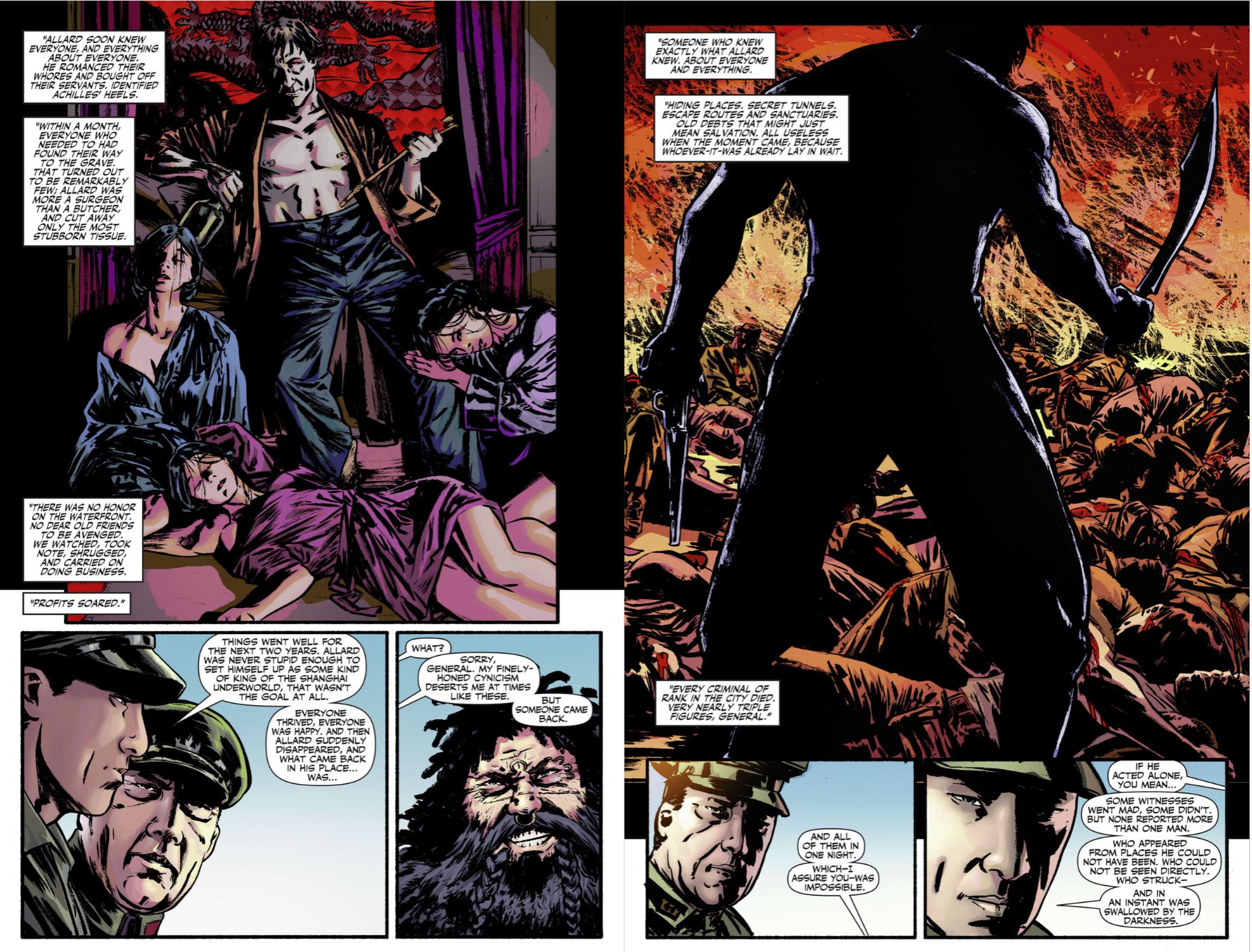
The delay gives Kondo’s party a healthy head start. As their sailing boat (an unpowered Junk) navigates the great river, the former smuggler/crimelord passes the time by sharing all he knows of human monster Kent Allard who was his criminal rival 15 years ago. What he doesn’t know is that the despicable rogue became the man called Cranston, but is certain that he is still the most implacable and remorseless killer on Earth…
Behind them, Finnegan, determined to prove his manhood and authority, pushes the British Commander and crew. Resolved to catch Kondo’s military detachment before they reach their ultimate destination, he sees firsthand atrocities Japanese soldiers casually inflict on “lesser” races, and in his disgust and inexperience leads the gunboat into a lethal trap only he, Margo and the insufferable Cranston survive…
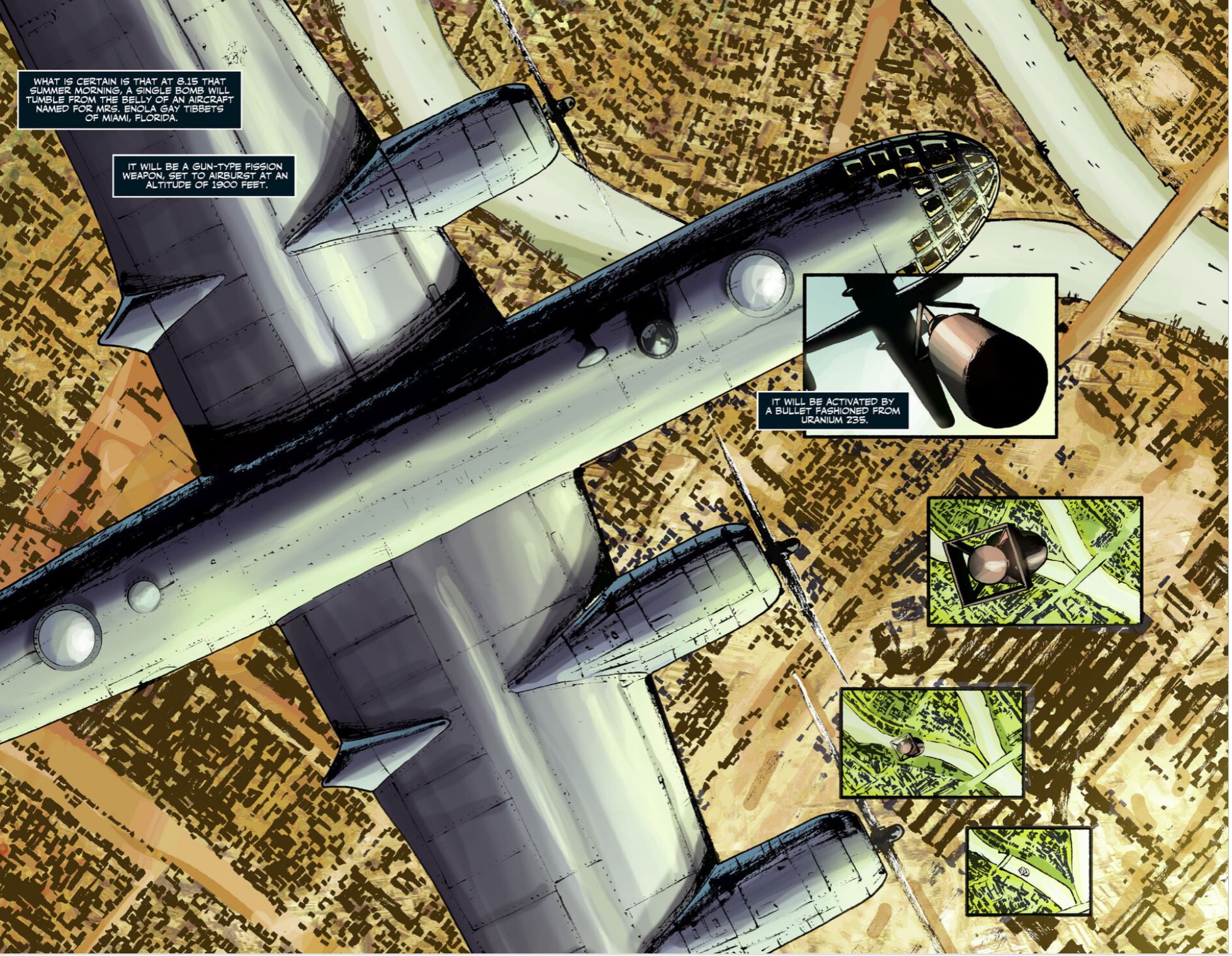
Far ahead of them, Kondo and Akamatsu make their final trade with Wong – miracle mineral for gold – and the inevitable double-crossing and bloodletting begins. What none of the treacherous villains realize is that the angry, vengeful Shadow is already amongst them, cutting down soldiers and bandits like chaff as he methodically, determinedly makes his way to the true cause of all the terror. At last Kondo realises he has only one card left to play, but the monstrous future has already begun and will inevitable end in fire…
Dynamite publish periodicals with a vast array of cover variants and here a copious collected gallery highlights dozens of iconic visions from Alex Ross, Chaykin, John Cassaday, Stephen Segovia, Ryan Sook, Sean Chen, Francesco Francavilla & Jae Lee. Adding to the Bonus Material is Ennis’s script for the first issue, and gloriously gilding the lily is a mountain of powerful pencil studies by Ross and Lee.
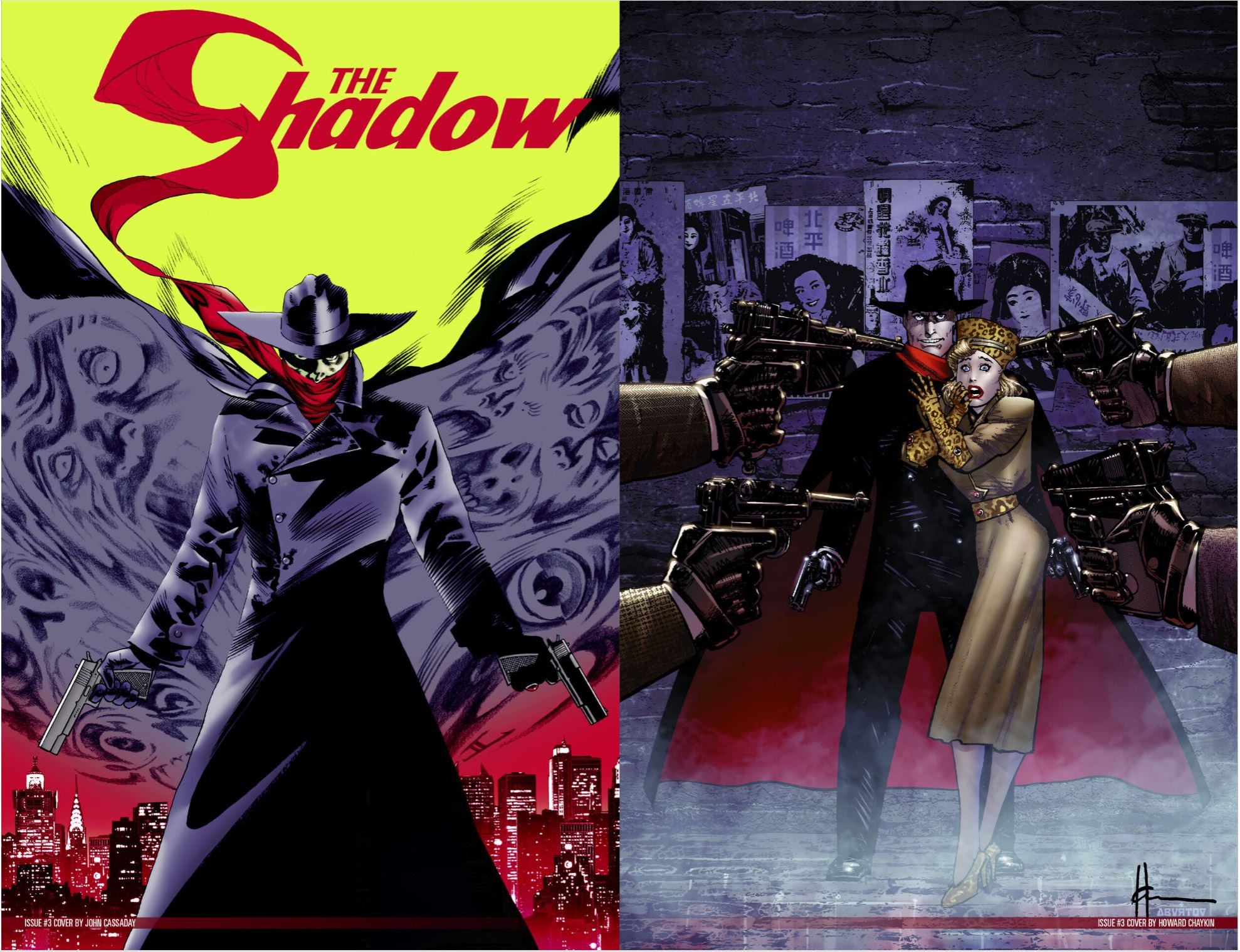
Sardonic, brutal and deviously convoluted, The Fire of Creation is a splendid addition to the annals of the ultimate and original Dark Knight, and one no lover of action and mystery can afford to miss.
The Shadow® & © 2012 Advance Magazine Publishers Inc. ™ & © Conde Nast. All Rights Reserved.
Today in 1817 trailblazing British cartoonist John Leech (Punch) was born, sharing the day with veteran Disney all-star Al Taliaferro (Donald Duck, Silly Symphonies) in 1905; illustrator Patrick Zircher (Green Hornet, Iron Man, Nightwing) in 1963; Norwegian creator Karine Haaland (Våre venner menneskene, Piray) in 1966 and US all-rounder Jason Pearson (Body Bags, Legion of Super-Heroes) in 1970.
On this day in 1983, Underground commix frontrunner Rory Hayes (Bijou Funnies, Arcade) died.