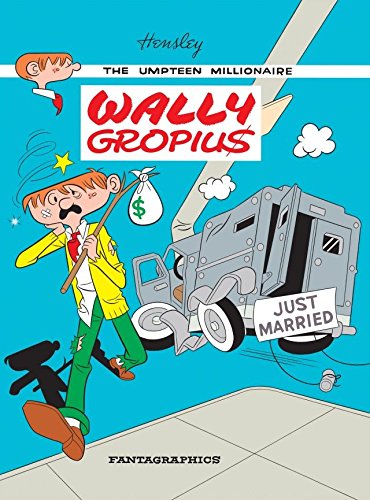
Wally Gropius


By Tim Hensley (Fantagraphics Books)
ISBN: 978-1-60699-355-2 (HB)

Win’s Christmas Gift Recommendation: Because it’s the Thoughts That Count… 9/10

Comics are the most subversive means of communication yet devised. If you’re a creator at the top of your game with no editorial restrictions you can depict and say one thing, in a manner that even the primmest censor would approve of and adore, whilst surreptitiously advocating the most unsavoury, improper and civilisation-threatening dogma. In comics there are no “tells” to give the game away and the manner in which an author writes and draws can actually enhance the propaganda or outright lies…

Have you met Tim Hensley?

A gifted musician, cartoonist and second-generation comics fan, Hensley’s graphic narrative work began popping up all over the alternative scene following his minicomics series Ticket Stub (9 issues published between 2000 and 2006). He subsequently appeared in such magazines as Kramer’s Ergot, Smoke Signal, Dirty Stories, The Believer, Comic Art, Duplex Planet Illustrated, special editions of The Comics Journal and Fantagraphics’ sublime anthology Mome from where the intensely sly, brash, revolutionary and mind-bendingly beguiling Wally Gropius emerged to challenge our every precept of Capitalist culture. This book collects all those Mome moments and also includes – at no extra charge – new and revised material.

Available digitally and as a colossal 64-page 260 x 320 mm hardback potently reminiscent of the earliest English-language Tintin albums, the compilation is illustrated in a starkly jolly, primary-coloured pastiche of Baby-Boomer kids comics – and not just the obvious and overt Richie Rich or Archie Andrews trappings, but with a tip of the pen to lost classics of a once ubiquitous, now nearly-forgotten 1960s graphic style ranging from Mort (Spider, Beetle Bailey) Walker, Irving Tripp and John Stanley to the animated creations of Jay Ward and all those unnamed geniuses who drew such Dell/Gold Key classics as The Little Monsters and Thirteen Going on Eighteen.

Wally Gropius is barbed and edgy teen satire. The wealthiest teenager on Earth and scion of a petrochemical dynasty, Wally can have anything he wants. He sings in his band The Dropouts and doesn’t have a care in the world – until his father orders him to marry “the saddest girl on Earth.” With every girl in range tearfully throwing herself at him, Wally suddenly notices the stand-offish and highly hard-to-get Jillian Banks…

Wally Gropius is a devastating, vicious and subversive cartoon assault on the modern bastions of Commercialism, Celebrity, and Casual Power. Wally tries everything money can buy to win Jillian, but there’s something he’s blithely unaware of…

A madcap, screwball and incredibly surreal comedy with many hidden and time-delayed laugh-traps cunningly concealed for later effect by a keen observer with a disturbingly-honed intellect and a laudable absence of taste, this a subversive treasure no thinking being should miss – especially at this time of year. Take note: Money isn’t Everything and Subtext über Alles…

Wally Gropius is Even Cleverer Than It Thinks It Is. Invest in it and enjoy a thoroughly mature modern masterclass in mercantile mockery and morbidly Infantile Analysis.
© 2010 Tim Hensley. All rights reserved.

A Secret History of Coffee, Coca & Cola


By Ricardo Cortés (Akashic Books)
ISBN: 978-1-61775-134-9 (HB)

Win’s Christmas Gift Recommendation: Potent, Punchy and Thought-Provoking Fodder to Ponder and Enjoy after Overindulging… 9/10

The astounding power of graphic narrative to efficiently, potently and evocatively disseminate vast amounts of information in layered levels has always been best utilised in works with a political or social component. That’s seldom been better demonstrated than in this stunning and scholarly work from Ricardo Cortés.

Born in 1973, illustrator/artistic intellectual activist Cortés has had a sublimely seditious career thus far. He made waves in Vanity Fair, Entertainment Weekly, The New York Post, The Village Voice, San Francisco Chronicle, and been challenged on CNN and FOX News after his controversial children’s book Marijuana: It’s Just a Plant – written by Marsha Rosenbaum – was mentioned in Congress. He followed up by illustrating Adam Mansbach’s Times Best-Selling Go the F**k to Sleep and sequel Seriously, Just Go to Sleep, and created the colouring book I Don’t Want to Blow You Up! about famous Muslims who aren’t terrorists.

In 2011 he received a grant from the Department of Cultural Affairs’ Greater New York Arts Development to create Jury Independence Illustrated – a public booklet dealing with Jury Nullification produced with the intention of educating potential jurors about their powers to acquit if they disagree with specific laws or judicial rulings. Clearly a born troublemaker…

This particular project is a brilliantly engrossing exploration of acceptable addictions blending scrupulously scholarly reportage with a seductively beautiful selection of captivating images and historical reproductions.

The story starts with the origins and history of ‘Coffee‘ from its mythic discovery as a berry fruit for goats in Ethiopia, through being taken up by Yemeni traders who disseminated “qahwah” throughout the Islamic world. A proven intoxicant, concerns over its salubrity, morality and legality grew and it was soon being trafficked by desperate men. In the 16th century the beverage was banned in Mecca, Cairo and elsewhere, but its taste and effects were impossible to resist.

By the time “kahveh” reached Turkey, trading in the beans carried the death penalty. As “Coffee” it reached Europe in the 17th century, touted as a miracle cure-all for everything from headache to miscarriage and grew explosively into an intellectual’s seditious vice. In 1675, Charles II ordered it suppressed and closed England’s Coffee Houses by Royal Edict.

Things got even stranger in 1820 after the alkaloid “Caffe-ine” was finally distilled from the coffee cherry…

The rest of caffeine’s turbulent and torturous legal and commercial progress to today’s status as the world’s most popular stimulant is followed by the story of ‘Cola and Coca’ in which caffeine’s other singularly popular method of natural dissemination is examined. The Kola Nut of West Africa is amazingly high in the stimulant alkaloid and has been used for centuries – if not millennia – as an energy-intensifying fortifier by the various tribes and nations either by chewing the raw nut or brewing a drink called “cola”.

Cola is one of the most popular ancient beverages on Earth and when in 1886 Dr. John Pemberton devised his own formulation – dubbed Coca-Cola – by adding a dash of coca leaves, his medicinal tonic, after an initial shaky start, grew to become the most monolithic drinks brand on Earth.

…But not, apparently, without a little government help…

Coca originated in the Andes, where for centuries indigenous peoples used the herbal bounty as a pick-me-up. Indios chewed coca leaves the way we do gum in the west and in 1499 explorer Amerigo Vespucci brought back tales of the wonder herb’s propensity to promote feats of concentration and endurance. In 1859, Dr. Karl Scherzer returned to Austria after a 2-year scientific voyage aboard the Frigate Novara with 60 pounds of coca, as previously requested by German pharmacologists. Soon after doctoral student Albert Niemann isolated from the samples a new alkaloid which he dubbed “Coca-ine”. This fresh medical marvel – its transparent crystals easily derived from coca leaves – was from 1884 enthusiastically prescribed by the likes of Sigmund Freud for melancholia. Oculist Carl Koller discovered it to be an incredible regional (or as we now say “local”) anaesthetic, allowing unprecedented new surgical procedures to be performed. It became a popular treatment for toothache, labour pains, nervousness, fatigue, impotence, asthma and as a cure for morphine addiction – hence Pemberton’s inclusion of the stuff in his health tonic.

By 1889 cases of compulsive use and abuse began to be reported, leading to heated medical debate, and when the era’s obsessive racial concerns were added to the mix (“cocaine made negroes insane” and it was peddled by “greedy Jewish doctors”) the writing was on the puritanical wall for the foreign import.

On a rising tide of public disapproval, the 1914 Harrison Narcotics Act prohibited Cocaine use and coca importation in the USA. However, due to some truly unbelievable backroom dickering, the already powerful Coca-Cola Company secured a constant supply of the banned substance – re-designated “Merchandise No. 5” – for their Schaefer Alkaloid Works in New Jersey – still thriving today as the Stepan Chemical Company. This mercantile miracle was all due to diligent work of Commissioner Harry J. Anslinger of the Federal Bureau of Narcotics and Ralph Hayes, a former aide to the US Secretary of War and – from 1932 – a vice President of the Coca-Cola Company.

Anslinger was a rabid anti-drug zealot, so just why did he spend 40 years – under seven different US Presidents – enforcing draconian and often expensive, nigh-impossible bans on a vast number of natural pharmaceutical products whilst actively securing and defending Coca-Cola’s uninterrupted supply of cocaine? He even facilitated clandestine schemes to grow coca on American soil and his campaign was so successful that American policy became UN and global norms, forcibly negating all the proven scientific benefits of resources which grew naturally in countries which could never afford Western drugs and chemical advances.

Trust me; you only think you know the answer…

Astonishingly addictive and intoxicatingly revelatory, Coffee, Coca & Cola offers an impressively open-minded history lesson and an incredible look at the dark underbelly of American Capitalism. Exposed here through telling research and beguiling illustrations is a catalogue of hypocrisy wherein successive political administrations and big business always found ways to place commercial interests ahead of any specious moral imperative ingenuously forwarded by the “World’s Cop”.

Learn here how corporations and statesmen conspired to ruthlessly crush the traditions, customs and rituals of other nations and cultures (as recently as 2010, America acted to suppress many sovereign South American countries’ social, spiritual, medicinal and nutritional use of coca) and continue to prevent poor countries utilisation of such ancient natural resources as caffeine and cocaine whilst peddling products inescapably wedded to both American Expansionism and Ideology…

A stunning, hardcover coffee-table book (also available in digital formats) for concerned adults, this captivating chronicle is a true treasure – or perhaps in the parlance of the idiom, I might just say – lip-smacking, trust-quenching, cool looking, stimulating, motivating, hard talking, fool busting, fast thinking, hard quizzing… and unmissable.
© 2012 Ricardo Cortés. All rights reserved.

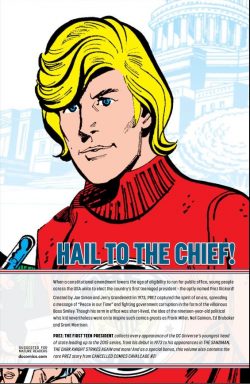
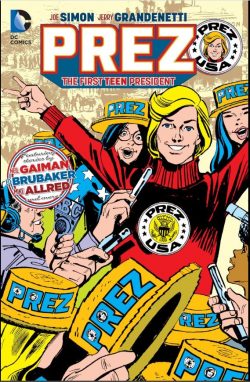
Prez: The First Teen President


By Joe Simon, Jerry Grandenetti & Creig Flessel, with Cary Bates, Neil Gaiman, Ed Brubaker, Frank Miller, Grant Morrison, Art Saaf, Mike Allred, Bryan Talbot, Mark Buckingham, Eric Shanower & various (DC Comics)
ISBN: 978-1-4012-6317-1 (TPB)

Win’s Christmas Gift Recommendation: Because We Believe … 9/10

I’ve been saving this fabulously funny, viciously satirical gem for the closing moments of an actual election, and now that my interference can’t possibly affect what has become the strangest and most contentious campaign in US history and the icing on the Great Big Cake celebrating the utter devaluation of democracy, I think it well past time to offer the world a different vision of leadership and governance before it’s too late…

It won’t change anything in the grand scheme of things, but at least we can comfortably claim that this time around it can’t possibly get any stranger than fiction, right?

At a time when American comic books were just coming into their adolescence – if not maturity – Prez was a hippie teenager created by industry royalty. In the early 1970s, Joe Simon made one of his irregular yet always eccentrically fruitful sojourns back to DC Comics, managing to sneak a bevy of exceedingly strange concepts right past the usually-conservative powers-that-be and onto the spinner racks and newsstands of the world.

Possibly the most anarchic and subversive of these postulated a time (approximately twenty minutes into the future) when and where teenagers had the vote. The first-time electorate – idealists all – elected a diligent, honest young man who was every inch the hardworking, honest patriot every American politician claimed to be…

In 2015 that concept was given a devilishly adroit makeover for the post-millennial generation and the result was the superbly outrageous cartoon assessment of the State of the Nation known as Prez: Corndog-in-Chief. Once you’re done here, you should read that too and then ferociously lobby DC to release the concluding chapters in that saga…

Back here, however, and in 1972, Simon (Captain America, Fighting American, The Fly, Black Magic, Young Romance) was passionately doing what he always did: devising ways for ever-broader audiences to enjoy comics…

This carefully curated trade paperback compilation (also available in digital formats) deftly gathers every incidence of the best leader they never had from original run Prez #1-4 (September 1973-March 1974), through unpublished tales from Cancelled Comics Cavalcade #2, through guest cameos and revivals in Supergirl #10, The Sandman #54, Vertigo Visions: Prez #1, The Dark Knight Strikes Again and The Multiversity Guidebook #1.

It all begins in the little town of Steadfast where average teen Prez Rickard makes a minor splash by fixing all the clocks to run on time, whilst throughout the urban USA, dissent, moral decay and civil breakdown terrify the populace in an election year. Corrupt businessman and political influencer Boss Smiley, wants to capitalise on the new amendment allowing 18-year olds to vote and picks young Rickard as his perfect patsy, but all his chicanery comes awry when newly elected Prez turns out to have a mind and agenda of his own…

With early – if rather heavy-handed – salutes to ecological and native rights movements, ‘Oh Say Does That Star Spangled Banner Yet Wave?’ by Simon, veteran illustrator Jerry Grandenetti set the scene for a wild ride unlike any seen in kids’ comics…

Equal parts hallucinogenic political satire, topical commentary and sci-fi romp, the mandate mayhem expanded with second issue ‘Invasion of the Chessmen’, as a global goodwill tour threatens to bring worldwide peace and reconciliation until America’s chess master provokes an international incident with the chess-loving Soviet Union. Cue killer robots in assorted chess shapes and a sexy Russian Queen and watch the fireworks…

‘Invasion of America’ in issue #3 tackles political assassination and social repercussions after Prez decides to outlaw guns. I think no more need be said here…

The original run ended with the fourth saga, which examined international diplomacy as Transylvania dispatches its latest Ambassador to Washington DC: an actual werewolf paving the way to devious conquest and a ‘Vampire in the White House’ (inked by Creig Flessel)…

Although the series was cancelled, a fifth tale was in production when the axe fell. It appeared with other prematurely curtailed stories in 1978’s Cancelled Comics Cavalcade #2 and in monochrome appears here as ‘The Devil’s Exterminator!’ with a bug infestation in DC tackled by a mythical madman. When Congress refuses to pay his sky-high bill ($5 million or three lunches in today’s money!), Clyde Piper abducts all the children, and PotUS is forced into outrageous executive action…

There was one final 1970s appearance. Supergirl #10 (October 1974) featured ‘Death of a Prez!’ by Cary Bates, Art Saaf & Vince Colletta wherein the youthful Commander in Chief was targeted for assassination by killer witch Hepzibah, using an ensorcelled Girl of Steel to do her dirty work… with predictable results…

Prez Rickard vanished in a welter of superhero angst and science fiction spectacle after that but made a quiet reappearance in Neil Gaiman’s iconic Sandman story arc World’s End. Illustrated by Michael Allred, Bryan Talbot & Mark Buckingham, ‘The Golden Boy’ (The Sandman #54 October 1993) offers a typically askance view of the boy leader’s origins, his enemies, the temptations of power and the ends of his story. This generated enough interest to spark follow-up one-shot Vertigo Visions: Prez #1 (September 1995) wherein Ed Brubaker & Eric Shanower crafted ‘Smells Like Teen President’. After being missing for years, America’ youngest President is being trailed by a young hitchhiker who might well be his son…

The moving search for family, identity, belonging and purpose is followed by a typically iconoclastic vignette by Frank Miller & Lynn Varley taken from The Dark Knight Strikes Again (December 2001) with the Leader of the Free(ish) World exposed as a computer simulation before the history lesson concludes with Grant Morrison, Scott Hepburn & Nathan Fairbairn’s page on Hippie-dippy ‘Earth 47’ and its comic book landmarks (Prez, Brother Power, The Geek, Sunshine Superman and other) as first seen in The Multiversity Guidebook #1 (January 2015).

I used to think comics were the sharpest reflection of popular culture from any given era. That’s certainly the case here, and maybe there are even lessons to be learned from re-examining them with the eyes of experience. What is irrefutable, and in no way fake news, is that they’re still fun and enjoyable if read in a historical context.

So read this, vote if you can and get ready. I can guarantee not even funnybook creators can predict what’s coming next…
© 1973, 1974, 1978, 1993, 1995, 2001, 2002, 2015, 2016 DC Comics. All Rights Reserved.

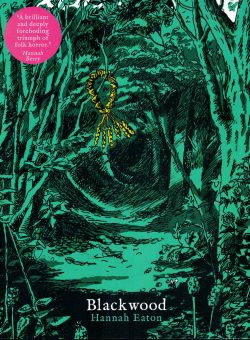
Blackwood


By Hannah Eaton, (Myriad Editions)
ISBN: 978-1-908434-71-5 (PB) eISBN: 978-1-908434-72-2

It’s all about personal tastes in the end, but when I assessed the many horror-themed and Halloween-adjacent review copies despatched from kind creators, PR sentinels and hopeful publishers this month (thank you one and all!), from very early on I knew we had to end on this one. Read on, read Blackwood itself and learn just why…

As nations and cultures, we all think we’re special, but every so often a piece of art comes along and you think “no other nationality could have produced this…” That’s an especially inescapable conclusion after indulging in the glorious melange that is this intriguing annal of Albion.

Rendered and reproduced as soft and subtle pencil drawings, Blackwood is quintessentially English: channelling our beloved countryside, quirky folk of different classes (co-existing if not actually living in harmony), witchcraft, cosy murder-mysteries, corrupt councils, devil-worshipping mystic masons, ordinary people well in over their heads, inbred insularity and racism, an extremely reserved, controlled sense of events getting away from you. There’s also a chilling sense that there’s always more going on under the surface of civility and respectability than meets your eye…

Best of all, as this tale of identical rural murders occurs simultaneously 65 years apart, we get to see – up close and personal – just how much and how little society has changed, especially when the modern-day killing draws in troublesome nosy strangers from outside the community… and even foreigners…

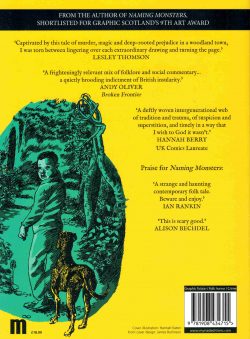
Augmented by an Afterword detailing the generational tale’s real-world inspirations, this is a yarn that only comes from gifted, thoughtful artists like Hannah Eaton (check out Naming Monsters while you’re at it) who have seen a bit of the world before settling down to devise their own.

Channelling delicious notes of Gary Spencer Milledge’s Strangehaven and the first series of Gracechurch, this very human-scaled drama is funny, scary and seductively compelling, like the best Scandi-dramas, but with tea and a Victoria Sponge all laid on.

Is Blackwood a heartfelt paean to a forgotten place and time or a devious attack on oppressive social structures and change-based bias that still hold us apart and down? Yes, no, maybe and mind your own business. It is a chilling, delightful and utterly compelling mystery that, once read, will not be forgotten.

So, go do that then, right?
© Hannah Eaton 2020. All rights reserved.

Plutocracy: Chronicles of a Global Monopoly


By Abraham Martínez, translated by Montana Kane (NBM)
ISBN: 978-1-68112-268-7 (HB) eISBN: 978-1-68112-269-4

Do you want to read something that is really scary?

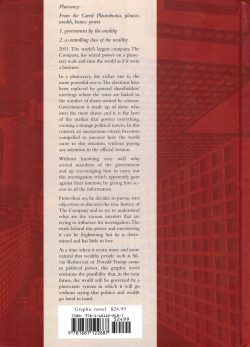
Almost everybody loves a good cathartic chiller, but every one of us also has a point where it stops being safe entertainment and becomes instead disturbing, unsettling and extremely unwelcome. For me – and Spanish author Abraham Martínez – it’s clearly the terrifying prospect envisioned in his 2017 graphic novel translated for profitable outreach by those fine folk at NBM.

Of course, the concept of a corporate superstate is not new, but I’ve never seen it better thought out or more crushingly realised down to the finest penny-pinching detail than here… and I’ve been reading Judge Dredd since 1977…

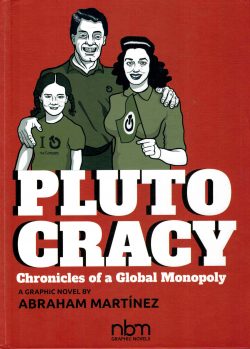
Rendered in drear industrial tones (mostly neutral greens and basic blues) and shapes very reminiscent of bog-standard informational stencil forms in a devastatingly underplayed agitprop manner, Plutocracy ostensibly follows one insignificant drone through a corporate landscape as he breaks free and begins digging for answers in a world where profit is everything.

After years of closer and closer ties between big business and national governments, in 2051 the last corporations swallowed each other and merged into one all-encompassing unit – “the Company” – that simply bought out nationhood and established a system to cost-effectively run the world. Everybody worked for, were paid by and bought goods and services from the same entity: a perfect perpetual motion machine for society.

They even managed to remain democratic, though there was only ever one party or candidate to vote for on any occasion.

Detective Homero Durant grew bored when the majority of police work became desk-based investigations involving fraud and deception. With precious little to do, he took a career sidestep and eventually became a writer.

Growing increasingly interested in how the world has reached its present state, he applies to write a book about it, and is astounded to discover, instead of closed ranks and obfuscation, the powers that be welcome his project and provide every possible access, even to personal interviews with the far-sighted mogul who had single-handedly engineered the death of nations and triumph of the Plutocracy…

As the deeply suspicious investigator plunges on meeting nothing but cooperation at every step, his resolve begins to falter, but his tell-all exposé has taken on a life of its own, and nothing can stop it from becoming the biggest sensation in The Company’s past history or projected profit forecasts…

Dark, bleak and brimming with mordant satire, this trenchant tale is an ideal metaphor and warning for our times and one no contemplative rational consumer can afford to miss.
© Text & illustrations Abraham Martínez 2017 © Bang. ediciones, 2017. © 2020 NBM for the English translation.

Plutocracy: Chronicles of a Global Monopoly is scheduled for release in hardback on November 19th and digitally on December 15th 2020, and is available for pre-order now.

NBM books are also available in digital formats. For more information and other great reads see http://www.nbmpub.com/

In a Glass Grotesquely – Selected Picture Stories


By Richard Sala (Fantagraphics Books)
ISBN: 978-1-60699-797-0 (PB)

Richard Sala is a lauded and much-deserving darling of the Literary Comics movement (if such a thing exists), blending beloved pop culture artefacts and conventions – particularly cheesy comics and old horror films – with a hypnotically effective ability to weave a graphic tale.

He grew up in Chicago and Arizona before earning a Masters in Fine Arts and, after beginning a career as an illustrator, rediscovered his early love of comicbooks. The potentially metafictional self-published Night Drive in 1984 led to appearances in legendary 1980s anthologies Raw and Blab! as well as animated adaptations of the series on Liquid Television.

His work is welcomingly atmospheric, dryly ironic, wittily quirky and mordantly funny; indulgently celebrating childhood terrors, gangsters, bizarre events, monsters and manic mysteries, with girl sleuth Judy Drood and the gloriously trenchant storybook investigator Peculia probably the most well-known characters in his gratifyingly large back-catalogue.

Sala’s art is a joltingly jolly – if macabre – joy to behold and has also shone on many out-industry projects such as his work with Lemony Snickett, The Residents and even – posthumously – Jack Kerouac; illustrating the author’s outrageous Doctor Sax and The Great World Snake.

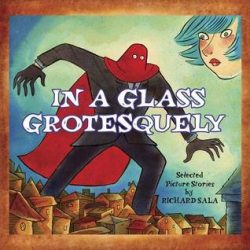
In a Glass Grotesquely is one of his very best: an irresistible tract of baroque pictorial enchantment, deftly combining a 2014 webcomic with a triptych of visceral and saturnine delusions from the end of the last century, all exploring the bleakest corners of the modern world’s communal fantasy landscape and applying his truly skewed raconteur’s gifts to giving us a thrill, a chill and a chortle…

The majority of this spookily sublime confrontation with the cartoon dark side is taken up with the gripping saga of ultimate enemy of America ‘Super-Enigmatix’, a diabolically inspired super-villain determined to avenge himself upon America for slights both imagined and tragically real… and no, he has never run for political office, and it’s too late for the “write-in” option…

Delivered in punchy alternating doses of surreal full-colour splashes and moody monochrome subplots, the story details how the brilliant weird-scientist – served by an army of beautiful female zealots and hidden race of mole people – tries to destroy modern society, only opposed by disenchanted ex-cop Natalie Charms and a dedicated band of “conspiracy nuts”…

The struggle against a self-created monster hiding behind a smoke screen of urban legend is fast-paced, Byzantine, and insidiously politically charged: a mesmerising chase-caper and delight of post-modern paranoia meeting classic pulp-fiction melodrama…

Like a bleakly mordant reinvention of the Catholic Church’s Stations of the Cross, ‘It Will All Be Over Before You Know It…’ is a sequence from single panel monochrome epigrams building to a tableau of modern terrors for women seeking work, after which 1998’s ‘Stranger Street’ silently details the building tension as a psycho-killer haunts the streets of an already chilly town…

The cracked chronicle then concludes with a Kafkaesque shaggy bird story delivered in barrage of grey wash, as an ineffectual nobody receives – and loses – a once-in-a-lifetime boon in ‘The Prestigious Banquet to Be Held in My Honor’…

Available in paperback and digital formats, In a Glass Grotesquely amusingly exposes the seamy, scary underbelly of existence with these enigmatic, clever, compelling and staggeringly engaging yarns, blending nostalgic escapism with the childish frisson of kids scaring themselves silly under the bedcovers at night. It will therefore make an ideal gift for the big kid in your life – whether he/she/they are just you, imaginary or even relatively real…
In a Glass Grotesquely © 2014 Richard Sala. This edition © 2014 Fantagraphics Books, Inc.

Grosz


By Lars Fiske (Fantagraphics Books)
ISBN: 978-1-68396-041-6 (HB)

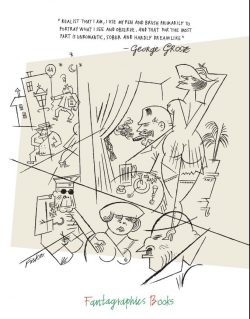
Although I bang incessantly on and on about the communicative power of word and pictures acting in unison, I will never deny the sheer efficacy and raw potency of the drawn image. Therefore, whenever an author makes the extra effort to create a narrative that stands or falls on vision alone, I’m ready to applaud mightily and shout “oi, look at this!”

Today that means taking a little lesson in art history and social awareness via a truly radical pictorial biography of Dadaist anti-fascist, caricaturist, artist and commentator Georg Ehrenfried Groß AKA George Grosz.

He was a complex and amazing man, risking his life for his beliefs but deeply flawed at the same time, and this cartoon confection really captures the feel of him and his tempestuous, self-annihilating life…

Devoid of verbal narrative, an edgy and uncompromising picture play adds reams of emotional kick to the history of a radical non-conformist who grew up in Imperial Germany, found his true calling during the Great War and fought a seditious and dangerously lonely struggle against the growing National Socialist (Nazi) party in the post-war Weimar Republic, all while embracing the heady sexual decadence of that pre-apocalyptic era…

In brief visual sallies supported by brief quotes from his writing – such as ‘Pandemonium: “I am up to my neck in visions”’, ‘Amerikanismus: “Day by day my hate for Germany gains, new, blazing nourishment”’ and ‘Nationalsocialismus: “The Devil alone knows how things will turn out”’ – Lars Fiske traces the one-sided conflict and follows the artists as he relocates to his long-loved-from-afar USA… and what happened next…

With this book there’s no half-measures. Oddly, I suspect that the reader will be best served if you know a lot about Grosz or nothing at all, but if he’s an artist you vaguely recall, there may be many rapid consultations of Wikipedia before you come away awed and amused…
© 2017 Lars Fiske, by arrangement with No Comprendo Press.

School Spirits


By Anya Davidson (Picturebox)
ISBN: 978-1-939799-02-9 (HB)

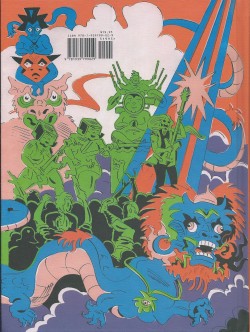
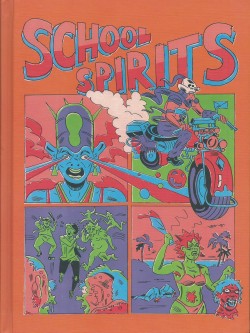
Sometimes art – and especially comics – defy dull ration analysis and, just like the music your parents didn’t like, grabs you way below any conscious level. Such is the case here as prodigious printmaker, mini comics auteur and cult musician Anya Davidson (Barbarian Bitch/Kramer’s Ergot, Child of the Sun, Coughs & Cacaw, Band for Life) who emerged into the major leagues with this cool, cruel monochrome hardback which lifts the lid on those terrible teenager people through a wry and macabre quartet of tales defining modern School Spirits.

Through freewheeling progressions, flashbacks, daydreams and conceptual digressions, David carries her girl of the moment Oola and BFF Garf through vicious, monstrous, demonic, occasionally surreal stream-of-consciousness hallucinatory everyday escapades which eerily recapitulate and invoke the best of underground commix and modern independent cartoonists from S. Clay Wilson to Johnny Ryan…

It all begins with a quick pictorial introduction in ‘School Spirits Picturebox Brooklyn’ before ‘Ticket Thicket’ introduce our cast when radio DJ Weird Wally Walczac galvanises a generation by offering a pair of phone prize tickets to the hottest gig in town: Hrothgar‘s Halloween concert…

At ‘Vinyl Command’ we get a quick glimpse at the imagined, nigh-mythological life of the rock god Renaissance Man who wrote Blasphemous Corporeal Stench and Rotting Abortion before Oola wakes up and faints, after which the largely silent ‘Battle for the Atoll’ reveals the powers and mysteries of Primal Woman and leads us to a seat of learning…

‘No Class’ opens with a frantic chase before retreating to school where Oola’s hunger for knowledge and passionate drooling over class stud-muffin Grover is ruined by mouthy dick Jason, who spoils Art and Ceramics only to die hideously in our heroine’s fevered thoughts…

Further bouts of noxious reality – such as the affair between teachers Miss DeLeon and Mister Kirbowski – fall prey to imagination and horny supposition, all similarly despatched and destroyed in dreamscape, until break when the girls can continue planning the big magic spell they’re concocting to really shake up the town…

And thus the time passes progress until the day of the gig when Oola is caught shoplifting and stabs a guard before fleeing into another miasmic multi-reality chase which culminates at the life-changing Hrothgar show ‘In the Great Riff Valley’…

Like some fervent Archie Comics of the Damned, School Spirits readily blends the profane with the arcane, and the regimented tedium of waiting to be in charge of your life with the terrors and anticipation of the moment it all becomes Your Own Fault, in a rollercoaster ride of eclectic images Davidson describes as ‘“Beavis and Butthead” meets James Joyce’s “Ulysses”’. What I know is this: the pace, style and sheer ingenuity of this book is brutally addictive and, despite constantly playing with the vertical and horizontal holds of Reality, never slips up and never loses narrative focus.

Strong, stirring stuff, full of sex and violence, and outrageously amusing all round. So, if you’re one of the millions of parents agonising over whether your kids are safe back at school, just remember they never have been…
© 2013 Anya Davidson. All rights reserved.

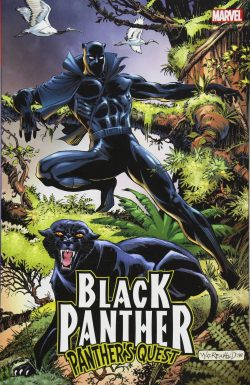
Black Panther: Panther’s Quest


By Don McGregor, Gene Colan, Tom Palmer & various (Marvel)
ISBN: 978-1302908034 (TPB)

The loss of Chadwick Boseman is a terrible blow to fans of film and every supporter of the rights and inherent dignity of all humanity. Whatever the reason, it seems that black people are just not allowed to have living role models. Our condolences and best wishes go out to his family and all who knew or were affected by him.

The pettiest part of that tragedy is that his iconic role as T’Challa of Wakanda is also ended. Having read about the kind of man he was, I’m shamelessly taking the opportunity to review the Black Panther story I suspect he would most have liked to realise on film…

Lauded as the first black superhero in American comics and one of the first to carry his own series, the Black Panther‘s popularity and fortunes have waxed and waned since the 1960s when he first attacked the FF (in Fantastic Four#52; cover-dated July 1966) as part of an extended and elaborate plan to gain vengeance on the murderer of his father.

T’Challa, son of T’Chaka was revealed as an African monarch whose hidden kingdom was the only source of a vibration-absorbing alien metal upon which the country’s immense wealth was founded. Those mineral riches – derived from a fallen meteor which struck the continent in primeval antiquity – had powered his country’s transformation into a technological wonderland.

That tribal wealth had long been guarded by a hereditary feline-garbed champion deriving physical advantages from secret ceremonies and a mysterious heart-shaped herb that ensured the generational dominance of the nation’s warrior Panther Cult.

Lyrical intellectual Don McGregor had already immortalised T’Challa in a stunning 1970s periodical run which produced the revered Panther’s Rage saga and the controversial Panther vs the Klan storyline. After years away from the mainstream, creating groundbreaking graphic novels such as Sabre: Slow Fade of an Endangered Species and Detectives Inc., series such as Ragamuffins and Nathaniel Dusk, he was lured back to his roots to spin a shocking tale of contemporary intolerance and the end-days of Apartheid…

He was joined by a semi-regular collaborator whose credentials in crafting human-scaled tales of adventure, horror and empathetic emotional drama were second to none. He was also one the industry’s earliest exponents of strong black characters…

Eugene Jules “Gene” Colan (September 1st 1926 – June 23rd 2011) was one of comics’s greatest talents: a quietly professional artist who valued accuracy and authenticity in his work, whether it was science fiction, horror, war, satirical humour of the vast number of superheroes he brought to life.

A devotee of classic adventure strips, Colan studied at the Art Students League of New York, before beginning his own illustration career in 1944 (on Wings Comics) before military service in the Philippines. The war had just ended and Colan had spare time to draw for local paper The Manilla Times.

By 1946 he was a civilian again, and working for Stan Lee’s Atlas outfit on crime and supernatural stories. He illustrated the last Golden Age Captain America (Captain America’s Weird Tales #75; February 1950), an all-horror issue that had no superhero material at all. It was like a sign…

As the industry radically transformed, he began freelancing at DC/National Comics as well as remaining a mainstay of Atlas. His assignments increasingly focused on the new genres of War Stories and Romance.

As Superhero stories returned, he moved exclusively to Marvel (except for a range of monochrome horror stories done for Archie Goodwin at Warren Magazines), where his dynamic realism offered a powerful alternative to the graphic styles of Jack Kirby, Steve Ditko, John Romita and Don Heck.

Colan became renowned for his work on Daredevil (where he created blind black detective Willie Lincoln), Captain America, Doctor Strange, Iron Man, Avengers, Sub-Mariner and Howard the Duck. During this period he co-created the Guardians of the Galaxy, two Captain Marvels (Mar-Vell and Carol Danvers), drew all of Tomb of Dracula – thereby introducing Blade the Vampire Slayer to the world – and was responsible for another black comic book icon and the nation’s first African American costumed hero, The Falcon.

In the 1980s he moved to DC, working on Batman, Superman, Wonder Woman, and the Spectre, co-creating Night Force, Silverblade, Jemm, Son of Saturn and period private eye Nathanial Dusk before expanding into independent comics at the forefront of innovation that marked the rise of the Direct Sales Market.

His later career was blighted by health issues, but he continued drawing whenever he could, for many companies. On one of his periodic returns to Marvel he reunited with McGregor for this astounding tale which was originally serialised in in 25 chapters in fortnightly anthology Marvel Comics Presents # 13-37 (February to December1989). Here, the entire affair is preceded by ‘To Follow the track of The Great Cat with renewed wonder on his Panther’s Quest (From “Panther’s Rage” to “Panther’s Prey”)’ a typically effulgent and informative Introduction from author McGregor…

One of the most thought-provoking mainstreaming comics tales ever released, Panther’s Quest added pressure to the ever-growing Anti-Apartheid movement in comics and western media, by examining not only the condition of racial inequality but also turning a damning eye on sexual oppression. Whether in his numerous solo series or as part of super-teams such as the Avengers, Fantastic Four or the Ultimates, Black Panther has always been one of Marvel’s most politically strident and socially-crusading characters. This is a book I’m certain Chadwick Boseman would have admired and supported…

Inked in its entirety by perfect partner Tom Palmer, it begins on a dark night as the Panther infiltrates neighbouring totalitarian South Africa where a white minority still oppresses the millions of blacks who live there. T’Challa has heard ‘A Rumour of Life’ and has come seeking his stepmother Ramonda. His father’s second wife had raised the bereaved boy when T’Challa’s birth mother died, but one day when he was only three, she vanished and no one would speak of her.

Now, he’s invaded the most dangerous land on Earth – for his kind – in search of answers from unscrupulous information peddler Patrick Slade…

‘Forgotten Corpses’ sees that clandestine meeting savagely interrupted by white paramilitaries who seek to kill them – but without alerting the police or security services…

McGregor has always a fascination with the real effects and consequences of violence, and this tale contains some pretty shocking moments that will make many readers wince. Suffice it to say I’m staying vague throughout this review, but will say that vicious brute Elmer Gore graphically tortures the Panther with barbed wire in ‘Lost Blood in Copper Dust’, leading to the maimed hero staggering into the arms of ‘The Man Who Loved Sunrise’.

Oppressed miner and narrative everyman Zanti Chikane is a black miner and second class citizen crushed by his intolerable life, but he still overcomes his understandable caution to offer assistance to torn, bleeding T’Challa. That leads to his own brush with death as white killers employ what they consider ‘Reasonable Force’ against the suspects, before being trounced by the still fighting cat-man…

The scene changes with ‘Naked Exposures’ as government Magistrate of Communications Anton Pretorius orders his battered and furious minions to capture an invading masked terrorist dubbed Black Panther. This invader is a threat to national security but the mercenaries need no other reasons to kill the treacherous “kaffir”. Just to be sure, though, Pretorius also uses his position to send out a nationwide TV alert…

‘Battered Artifacts’ finds T’Challa tracking Slade to an impoverished township, unaware that he’s under surveillance and about to step into the other side of the deadly politics that wracked South Africa at this time.

‘Hatred under Tears’ sees the mercenaries attack, uncaring of the small children they are endangering. As the Great Cat stops to aid a tear-gassed toddler, ‘Justifiable Action’ sees him shot for his efforts and arrested in ‘Personal Risk’ before breaking free and escaping…

‘The Official Version’ gives T’Challa a lesson in realpolitik from Slade’s wife even as the State intensifies its hunt for him, with Security Minister Doeke Riebeek officially branding the entire emergency a communist plot…

In the township ‘Voices Heard, Voices Ignored’ sees Zanti pondering the terrifying dangers to his family before returning to aid the Panther whilst ‘A Right to Kill’ shows Riebeek beginning to suspect Pretorius might have ulterior motives for his actions. Meanwhile, the enraged township men are moving against a suspected traitor determined ‘Somebody’s Going to Pay’. They’re carrying petrol and tyres needed for the appalling punishment they call “necklacing”. Do not google it or buy this book if you have a weak stomach…

When the Panther acts to save a life, he is horribly burned but events escalate to total tragedy as ‘Last Night I Wept for Freedom’ shows how the boy he helped returns the favour and pays the ultimate price, despite his own superhuman efforts and the initially-reluctant intervention of a white doctor in ‘Lost Promises’…

Traumatised and repentant, T’Challa returns to Slade whose ‘Dark Maneuvers’ lead them into a trap laid by Pretorius’ mercenaries in ‘So Many Nameless Enemies’. The battle is brief but results in a crucial clue in the true quest, as the trader reveals how, years ago, he learned of a black woman held in glittering bondage for decades at the home of a high-ranking government official…

‘Chances’ see Riebeek and his forces closing in as T’Challa follows his fresh clue to Johannesburg to confront one of the mercs in ‘The Great Cat in the City of Gold’. Now focused on finding Pretorius, the Panther and Zanti attempt to save his precious stealth-ship from being captured by Riebeek in ‘Losing Control’… but at a terrible cost…

After ‘Saying Goodbye’, the Panther’s quest moves into its endgame as T’Challa assaults Pretorius’ luxurious citadel, circumventing deadly ‘Barriers’, and crushing human and canine ‘Opponents’ (still more grimly authentic action in need of a strong stomach advisory…), to ultimately rescue Ramonda from the luxurious cell she has inhabited ever since Pretorius abducted her years ago.

The tyrannical hypocrite’s obsessive, abusive passion for her was also his downfall: a secret capable of destroying him in a nation and government that decreed interracial mixing immoral and illegal…

Ultimately, it’s Ramonda who decrees his fate whilst enjoying a ‘Dawn Reunion’ with her long-lost child…

Available in trade paperback and digital editions and augmented by a full cover gallery and pinups from Marvel Fanfare#47 (by Bill Reinhold & Linda Lessman) and #45(Steve Rude & Steve Oliff) this is the most important Black Panther tale you’ll ever read. So do.
© 2018 Marvel Characters Inc. All rights reserved.

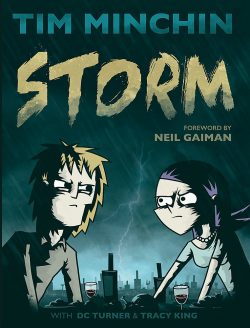
Storm


By Tim Minchin, DC Turner, Tracy King & various (Orion)
ISBN: 978-1-4091-5209-5 (HB), 978-1-4091-5625-3 (TPB), eISBN: 978-1-4091-5210-1)

The world is a magical, wondrous place stuffed with miracles and mysteries.

However, there’s not one single atom of it that depends on the eldritch or supernatural and none of it – or even the greater universe around it – is wrought from the efforts of supreme beings. Nor does it operate on principles of forgotten lore denied us common folk…

It’s all explainable, utterly rational and absolutely subject to revision by us every time we find out or disprove something that previously has been a puzzle or misunderstood. To do otherwise is nothing less than a crime against humanity.

No gods, no ghosts, no witchcraft, no magic crystals. Got it?

It’s amazing how many people haven’t and how the latest anti-science fad or fashion can cause genuine harm to the world, deprive generally sensible folk of their money and too often make dinner parties a theatre of war. That’s especially relevant at a time when a new lifeform is predating upon large sections of humanity in a manner we haven’t anticipated or properly categorised yet…

Tim Minchin is an Australian creative whirlwind and multi-media entertainment polymath who performs musical stand-up comedy, acts in edgy sitcoms, composes award-winning stage musicals like Matilda and acts in hit shows like Jesus Christ, Superstar.

He’s very smart, very funny and doesn’t believe in goblins or faith-healing.

In 2006 his 90-second diatribe ‘If You Open Your Mind Too Much Your Brain Will Fall Out (Take My Wife)’ – a “refutation of the plausibility of astrology, psychics, homeopathy and an interventionist God” impressed and delighted fans.

In 2008, after a close encounter with a pontificating new-agey nitwit at a party where the reasonable, rationalist Mr. Minchin politely opted not to contest a stream of bubble-headed nonsense, he took his ire and indignation and turned it into a piece of true inspiration: a beat poem, Socratic dialogue and “anthem for critical thinkers”…

It’s a very funny, edgy slice of entertaining refutation and I-wish-I’d-said-that-ism which was used as the closer for the Ready For This? Tour for more than two years.

In Britain animators/illustrators/producers Dan “DC” Turner and Tracy King saw that show and determined that at all costs they must turn that paean to logic and sense into an animated film. As described in Minchin’s Introduction to this book (available in trade paperback and eBook formats as well as a 1000 copy Limited Edition Deluxe Hardback with extra content) and the Afterword by Turner and King, after some wheeler-dealing, they did just that…

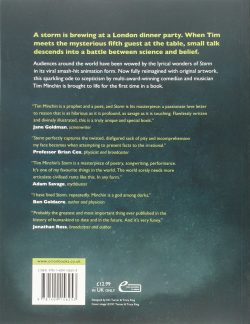
Storm became an internet sensation with many million hits on YouTube after its launch in 2011. The artists and Mr. Minchin then completely reworked that cartoon sensation into an astoundingly compulsive and scathingly funny graphic novel which opens at an intimate soiree in North London where the narrator and his wife sit down to sup with friends and are force-fed a stream of nonsensical blather by a beautiful girl with a tattoo of a fairy.

Her name is Storm and this time the quiet man she inanely and arrogantly lectures is not going to hold his tongue…

By turns tense, barbed, hilariously evocative and furiously cathartic, this stunning visual feast delivers the barrage of scathing sense we’ve always wanted (but been too polite) to unleash on evolution-deniers, pseudo-scientists, astrological aromatherapy advocates, vaccination-withholders, ghost-chasers and every other stripe of pontificating irrationalist in a graphic tumult of colour, line and typography that will simultaneously stun and galvanise.

This magnificent reinterpretation includes a Foreword by Neil Gaiman, Biography pages for Minchin, Turner & King and – because it’s all about the fun – a selection of variant covers by Ricky Earl, Freya Harrison, Andy Herd, Dave “Swatpaz” Ferguson and Stuart Mason & Rachael King which might have graced the issues had this yarn been serialised as comic periodicals rather than released as a complete book…

There has been and always will be a valuable and cherished place for fantasy, imagination and all the wild and woolly boggles and phantasms of a rich realm of tradition and ignorance. Indeed I believe it’s absolutely necessary for every child to be fully acquainted with all aspects of fairies and spectres and wish-fulfilling rings and lamps, but there comes a time when they must retire to a place of nostalgia and fun, regularly revisited for amusement but never, never, never used to dictate the content of school curricula, divert funds from genuine medical research or be employed as justification to persecute whole sectors of society or even one single “different” individual…

Storm is an edgy pictorial tour de force to delight and enchant readers who love the funny and fantastic but never forget where the horizons of fantasy end and the borders of imagination begin…
Text © Tim Minchin 2014. Illustrations © Tracy King and Daniel Charles Turner 2014. All rights reserved.