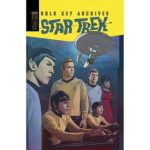
Star Trek Classics volume 5: Who Killed Captain Kirk?


By Peter David, Tom Sutton, Gordon Purcell, Ricardo Villagran & various (IDW)
ISBN: 978-1-61377-831-9

The stellar Star Trek brand and franchise probably hasn’t reached any new worlds yet, but it certainly has permeated every aspect of civilisation here on Earth. You can find daily live-action or animated TV appearances constantly screening somewhere on the planet as well as toys, games, conventions, merchandise, various comics iterations generated in a host of nations and languages and a reboot of the movie division proceeding even as I type this.

Many comicbook companies have published sequential narrative adventures based on the exploits of Gene Roddenberry’s legendary brainchild, and the splendid 1980s run produced under the DC banner were undoubtedly some of the very finest.

Never flashy or sensational, the tales embraced the same storytelling values as the shows and movies; being simultaneously strongly character- and plot-driven. An especially fine example can be found in this superior epic, seamlessly blending spectacular drama, subtle character interplay and good old fashioned thrills, with the added bonus of madcap whimsy thanks to the impassioned fan-pandering efforts of scripter Peter David.

This swashbuckling space-opera (originally printed in DC’s Star Trek #49-55 and boldly spanning April-October 1988) was a devotee’s dream, pulling together many old plotlines – in a manner easily accessible to newcomers – to present a fantastic whodunit liberally sprinkled with in-jokes and TV references for über-fans to wallow in.

Illustrated by Tom Sutton & Ricardo Villagran, it began in ‘Aspiring to be Angels’ as, following the aftermath of a drunken shipboard stag-night riot (caused by three very senior officers separately spiking the punch), the Enterprise crew discovers a rogue Federation ship with impenetrable new cloaking technology is destroying remote colonies in a blatant attempt to provoke all-out war with the Klingons.

At one decimated site they find a stunted, albino Klingon child who holds the secrets of the marauders, but his traumatised mind will need special care to coax them out…

Naturally the suspicious, bellicose Klingons want first dibs on the Federation “rebels” and political tensions mount as Kirk and his opposite number Kron not-so-diplomatically spar over procedure in a ‘Marriage of Inconvenience’.

Emotions are already fraught aboard the Enterprise. Preparations for a big wedding are suffering last-minute problems and a promising ensign is being cashiered for the High Crime of Species Bigotry…

Moreover, unknown to all a telepathic crew-member has contracted Le Guin’s Disease (that’s one of those in-jokes I mentioned earlier), endangering the entire ship…

The crisis comes with Federation and Klingon Empire on the verge of open hostilities. Thankfully the renegade ship moves too precipitately and is defeated in pitched battle. However, when Security teams board the maverick ship what they recover only increases the mystery of its true motives and origins…

Taking advantage of a rare peaceful moment, ensigns Kono and Nancy Bryce finally wed, only to get drawn into a ‘Haunted Honeymoon’ as the Enterprise is suddenly beset by uncanny supernatural events, culminating in the crew being despatched to a biblical torture-realm resembling ‘Hell in a Handbasket’…

When the effects of the telepathic plague are finally spent, normality returns for the crew, just in time for them to discover Kirk has been stabbed…

Gordon Purcell steps in for ‘You’re Dead, Jim’, with Dr. McCoy swinging into action to preserve the fast-fading life of his friend. Lost in delirium, Captain Kirk is reliving his eventful life and is ready to just let go when Spock intervenes…

With the Captain slowly recovering and categorically identifying his attacker, justice moves swiftly. The assailant is arrested and the affair seems open and shut, but ‘Old Loyalties’ delivers a shocking twist and sets up a fractious reunion as Kirk’s Starfleet Academy nemesis Sean Finnegan (who first appeared in the classic TV episode Shore Leave – written by the legendary Theodore Sturgeon) arrives.

The senior officer has been sent by the Federation Security Legion to investigate the case and what he finds in ‘Finnegan’s Wake’ (with Sutton & Villagran reuniting for the epic conclusion) is an astounding revelation which upsets everyone’s firmly held convictions, unearthing a sinister vengeance scheme decades in the making…

Masterfully weaving a wide web of elements into a fabulous yarn of great and small moments, Peter David has crafted a compelling yarn which ranks amongst the greatest Star Trek stories in any medium: one which will please fans of the franchise and any readers who just love quality comics.
® and © 2013 CBS Studios, Inc. © 2013 Paramount Pictures Corp. Star Trek and related marks and logos are trademarks of CBS Studios, Inc. All Rights Reserved.

Dr. Who: The Tenth Doctor volume 1: Revolutions of Terror


By Nick Abadzis, Elena Casagrande, Arianna Florean & various (Titan Comics)
ISBN: 978-1-78276-384-0

Doctor Who first materialised through our black-&-white television screens on November 23rd 1963 in the first episode of ‘An Unearthly Child’. Less than a year later his decades-long run in TV Comic began with issue #674 and the premier instalment of ‘The Klepton Parasites’. Throughout the later Sixties and early 1970’s strips appeared in Countdown (later retitled TV Action) before shuttling back to TV Comic.

On 11th October 1979 (although adhering to the US off-sale cover-dating system so it says 17th) Marvel’s UK subsidiary launched Doctor Who Weekly, which became a monthly magazine in September 1980 (#44) and has been with us under various names ever since.

All of which only goes to prove that the Time Lord is a comic hero with an impressive pedigree…

In recent years the strip portion of the Whovian mega-franchise has roamed far and wide and currently rests with British publisher Titan Comics who have sagely opted to run parallel series starring the Tenth, Eleventh, and Twelfth incarnations of the tricky and tumultuous Time Lord.

Scripted by the ever-excellent Nick Abadzis (Hugo Tate, Children of the Voyager, The Amazing Mr. Plebus, Laika) and illustrated by Elena Casagrande (Suicide Risk, Star Trek, X Files) & Arianna Florean – with art assistance from Luca Lamberti, Michele Pasta, Annapaolo Martello, Giorgio Sposito & Paolo Villanelli – these tales comprise the first five issues of the 2014 monthly comicbook and are set at the conclusion of the Fourth Season starring David Tennant, just after he lost his cherished (time) travelling Companion Donna Noble…

‘Revolutions of Terror’ opens in picturesque Sunset Park, Brooklyn, where the locals are gearing up for Halloween and the Mexican Day of the Dead.

Gabriella Gonzalez is less than joyous. A talented creative type, she wants to go to art school but her father is keeping her home to help in his restaurant and run his latest side-venture – a Laundromat. He is letting her go to night college though… but only to study accountancy and book-keeping…

When the washing machines all go crazy and spin out of control that day, prospective brother-in-law Hector is quick to pass on the blame to her, so Gabriella is feeling pretty annoyed and despondent. When the weird British-sounding guy turns up at the Castillo Mexicano for breakfast she barely notices him, what with grandma suddenly seeing ghosts and Hector being accosted by a demon…

Strange sights and uncanny apparitions continue throughout the day and Sunset Park is in no mood for celebrations as Gabby takes the subway to class, but when the train is attacked by monsters the weird Brit is there to fight the thing off with a buzzing blue flashlight…

Soon introductions are made and “The Doctor” has introduced her to an uncanny new universe she never believed possible… and one that might soon be ending thanks to an invasion by toxic-emotion devourers called The Silent. They are – apparently – voracious weaponised Cerebravores from another planet…

As she ingeniously holds the terrors at bay in the Laundromat, the Doctor visits their origin-world and, once he’s gained the knowledge he needs, returns with a plan to defeat them. Sadly it depends completely on Gabby’s artistic gifts and her family’s good mood…

Nevertheless global doom is averted, and the Doctor is preparing to slope off when Gabriella makes her big pitch to go with him…

Agreeing to just one quick trip, the Time Lord takes his new guest to the Pentaquoteque Gallery of Ououmos, one of the greatest collections of ‘The Arts in Space’ but, as Gabby’s cartoon strip journal shows, it’s much more of a pant-wetting scary adventure than a dry museum visit…

A driven artistic soul, Gabriella is naturally intoxicated with everything, but the real show-stopper is her introduction to puissant Zhe Ikiyuyu‘s block transfer sculptures: a rare discipline which can manifest solid objects by mathematically manipulating Quantum Foam Harmonics through singing or chanting…

However the rapt fascination quickly turns into more terrified running after the Doctor takes her to Zhe’s private moon where they discover the compulsive creative artist has taken the ultimate step in her art and the creations now run the roost…

This racy, pacy, superbly authentic and in-touch little tome comes with a bunch of bonus material such as humorous strip extras by A. J, David Leach, Emma Price & Rachel Smith and a vast gallery of Gallifreyan alternate and variant covers (photographic, digitally manipulated, painted and/or drawn) by the likes of Casagrande, Alice X. Zhang, Rob Farmer, Warren Pleece and Verity Glass. Also on offer is a behind-the-scenes peek at ‘Designing Gabby’ making this a splendid slice of comics magic starring an incontestable bulwark of British Fantasy.

If you’re a fan of only one form, this book might make you an addict to both. Revolutions of Terror is a fabulous treat for casual readers, a fine shelf addition for devotees of the TV show and a perfect opportunity to cross-promote our particular art-form to anyone minded to give comics a proper go…
BBC, Doctor Who (word marks, logos and devices) and Tardis are trade marks of the British Broadcasting Corporation and are used under licence. BBC logo © BBC 1996. Doctor Who logo © BBC 2009. Tardis image © BBC 1963. First edition April 2015.

Blake and Mortimer: Professor Satō’s Three Formulae Part 1 – Mortimer in Tokyo


By Edgar P. Jacobs, with colours by Paul-Serge Marssignac, translated by Jerome Saincantin (Cinebook)
ISBN: 978-1-84918-292-8

Pre-eminent fantasy raconteur Edgar P. Jacobs devised one of the greatest heroic double acts in pulp fiction: pitting his distinguished scientific adventurers Professor Philip Mortimer and Captain Francis Blake against a broad variety of perils and menaces in a sequence of stellar action-thrillers which merged science fiction scope, detective mystery suspense and supernatural thrills. The magic was made perfect through his stunning illustrations, rendered in the timeless Ligne Claire style which had made intrepid boy-reporter Tintin a global sensation.

The Doughty Duo debuted in September 1946; gracing the pages of the very first issue of Le Journal de Tintin. This was an ambitious international anthology comic with editions in Belgium, France and Holland, edited by Hergé, with his eponymous, world famous star ably supplemented by a host of new heroes and features for the rapidly-changing post-war world…

Les 3 formules du professeur Satō was a tragically extended affair and Jacob’s last hurrah. What became the eleventh album was serialised between September 1971 and May 1972 in Tintin, after which the author abandoned his story due to failing health and other personal issues.

Edgard Félix Pierre Jacobs died on February 20th 1987 and soon after Bob de Moor was commissioned by his family and estate to complete his final tale from Jacob’s pencil roughs and script notes. The concluding album was finally released in March 1990. This led to a republishing of all the earlier exploits and eventually fresh adventures from a variety of creative teams…

Here however the action opens at Haneda Airport, Tokyo where Air Traffic Controllers experience a unique problem as a UFO disrupts their carefully plotted flight courses. With disaster imminent two Starfighter jets are scrambled to pursue the meteoric anomaly and, just before they are destroyed, the pilots radio back they are being attacked by a dragon…

As the news filters around the world, renowned cyberneticist Professor Akira Satō argues with his assistant Dr. Kim, deeply remorseful that his latest breakthrough has been the cause of such tragedy. Kim only barely dissuades his Sensei from turning himself in to the authorities but is utterly unable to convince or prevent Satō from involving visiting colleague Philip Mortimer in his crisis of conscience…

The British Professor is in Kyoto attending a succession of scientific conferences, but when an ominous outsider hears of Satō’s intentions through hidden surveillance methods, the reaction is both explosive and potentially murderous…

The first Mortimer knows of the problem is when a gang of gunmen attempt to kidnap him off the streets, but after fighting them off and escaping the old warrior returns to his hotel and finds a telegram waiting for him…

An urgent request to join old friend Satō immediately seems impossible to accomplish due to stringencies of train timetabling, but an accommodating journalist overhears and offers a speedy compromise…

Mortimer is suspicious of the happy accident… but not suspicious enough…

Surviving another assassination attempt by sheer force of will, the professor is then lost in the wilds of Japan but eventually manages to battle his way to Satō’s lab outside Tokyo where he witnesses a series of astonishing sights.

His host has worked miracles in the fields of robotics – including the dragon which so recently and horrifically malfunctioned – but is at a loss to explain how his incredible creations have gone wrong at such a late stage.

Worldly-wise Mortimer soon deduces the causes: espionage and sabotage…

As the British boffin sends for his old comrade-in-arms Captain Blake, Satō is comforted by the fact that the key formulae for producing his mechanical marvels have been divided and deposited at three different banks in Tokyo. The Sensei breathes even easier after arranging that only Mortimer can retrieve them but this only prompts their hidden enemy to accelerate his plans and reveal himself as one of Mortimer’s greatest foes…

Unable to induce or force Mortimer to retrieve the scientific goldmine, the mastermind has an android double constructed to visit the banks but the rush-job breaks down before the task is completed. Now the vile villain has only more card to play before the formidable Blake arrives…

This Cinebook edition then concludes with excerpts from two other Blake & Mortimer albums (The Time Trap and a tantalising glimpse of Professor Satō’s Three Formulae Part 2) plus a short biographical feature and publication chart of Jacobs’ and his successors’ efforts to whet the appetite for further treats in store… Cunning and convoluted, this devilishly devious tale unfolds with potent authenticity and ever-escalating tension, building to an explosive conclusion which eventually took eighteen years to conclude. At least we don’t have to wait that near life-time for the epic denouement…
Original edition © Editions Blake & Mortimer/Studio Jacobs (Dargaud-Lombard S. A.) 1977 by E.P. Jacobs. All rights reserved. English translation © 2016 Cinebook Ltd.

Death Sentence: London


By Montynero & Martin Simmonds with John Pearson & Jimmy Betancourt (Titan Comics)
ISBN: 978-1-78276-507-3

For most of us Sex Sells. If that’s not you and you’re easily shocked or offended, stop Right Here, Right Now and come back for a less grown-up review tomorrow.

As for the salacious, tawdry, vulgar majority of humanity, however, fornication is a force that will not be resisted and we’re always gagging for it.

One outrageous potential result of that inescapable biological imperative was recently explored in a dark, decadent fable from writer, artist and games designer Montynero who, with illustrator Mike Dowling, crafted a ferociously effective satire on modern attitudes in Death Sentence.

After an initial and truncated appearance in Clint Magazine in 2012 the sexily sordid saga was retooled as a breakthrough 6-issue miniseries which took the comics world by storm when released in 2013.

Something that good was bound to be tried again and a series followed, of which Death Sentence: London – illustrated now by Martin Simmonds – is but the first compulsive compilation…

In the World That’s Coming a sexually transmitted disease known as G+ is spreading rapidly through the population. It is invariably fatal and kills in six months. For that length of time, however, the victim “suffers” from increased vigour, stamina, sex drive and even develops super powers…

The true extent of the threat only became apparent to the public after media darling, affirmed libertine and proud G-Plus carrier David “Monty” Montgomery used his exponentially-expanding psychic powers to kill Britain’s government, royal family and one million Londoners.

Having crowned himself King of Britain, Monty was only stopped by two other critically enhanced G-Plus sufferers: frustrated artist Verity Fette and shambolic fading rock star Daniel Waissel AKA Weasel.

More through luck than effort – and despite the interference of a UN Taskforce, covert US super-weapon deployment and best attempts of the British military – the wonder kids narrowly managed to kill Monty in a blockbusting super-battle televised around the world. The conflagration especially terrified the assorted world governments who collectively feared their days of ruling the masses were over…

Britain’s bosses had been aware of the growing crisis for ages and had already tasked its shadowy Department of National Security to deal with it. The usual tactics of murder, blackmail, disinformation and cover-ups proved ineffective, however, and soon something else was being considered.

At least Verity died in the final battle and what’s left of the UK’s Powers-That-Be now only have sybaritic, self-destructive Weasel to manage until the disease finally kills him…

In the meantime, on a remote Scottish island, a very nice old lady runs a vast secret base beneath the heather where she and her team toil away with no sense of scientific niceties – or ethics – as they strive to find a cure for G+…

Dr. Lunn had been helping sufferers for quite a while. She crash-trained Verity and Weasel in the use of their abilities (also providing space, time, tuition and medical-grade drugs) before siccing them on the out-of-control Monty…

Following handy recap ‘Previously in Death Sentence’ the story resumes with ‘“A” Bomb on Wardour Street’ as Weasel is riotously fêted by the metropolitan populace whilst über-ambitious Old Etonian London Mayor Tony Bronson seethes and schemes. There’s a power-vacuum in the country at this moment and he’ll be buggered if he lets anyone else fill it… especially some oikish, pox-ridden musical miscreant…

An ocean away, undercover Fed Jeb Mulgrew is closing his latest case when everything goes tits-up after his targets display out of control super-powers. Luckily his keenly-observing back-up team are equipped with the latest horrific innovation in anti-G-Plus ordnance…

At City Hall, Tony’s latest opportunistic sound-bite does nothing to slow the looting tearing up the remainder of London; much of it seemingly orchestrated by new dissident movement the Invaders. The spreading violence even reaches a nearly deserted fast-food franchise where an armed robbery is foiled, giving first notice that Verity might not be dead after all…

As Jeb tries to reconnect with his wife and home in Texas, London sees another bloody crime stopped by the enigmatic Artgirl and Tony snaps, declaring martial law in His city…

Each episode is followed by a carefully-tailored supplemental feature and here ‘The Age of the Super G’ exposes the Americans’ thermonuclear contribution to Monty’s demise before the comics saga continues with ‘Uprising’ as Weasel attends a rally in Brixton. The borough is in the process of declaring its independence and seceding from Tory-infested London and big-business corrupted Britain…

Bronson’s response is uniquely typical: ramping up military action, closing down social media and arresting G+ carriers whilst ordering the public to stop having sex until a cure is found.

When tanks roll up during a memorial service, Weasel is just in the mood to share the misery he’s been feeling since Monty killed his little boy, but in the victorious aftermath it’s the anonymous mask-wearing Invaders who are making converts and dictating policy on the streets of Brixton…

In Texas, things just aren’t working out for Jeb so when his bosses ask him to infiltrate British intelligence and steal their potential cure for the super-sex plague, he can’t wait to start…

After a faux magazine feature on Creighton Baines and how his alien-masked Invaders haunt protest sites and agitate for social change, the story starts again in ‘Eton Rifles’ as dedicated journalist Fincham is handed a certain dossier by a mole with suspicious intent. Soon the Chronicle‘s top scribe is making things hot for golden gibbon-esque, sexually-deviant Tony…

As tensions escalate everywhere, Verity assuages her own through increasingly bawdy encounters as she drifts ever closer to isolated, segregated, curfew-enduring Brixton. She has no idea that she’s been targeted for immediate assassination, but then again, her would-be executioners have no idea how powerful she now is…

Preceded by excerpts from reputable rag The Chimes – detailing the rise of international angst and the stalling of the World Powers debating a space-based weapons ban – ‘Sitting Here’ sees a turf war brewing between local gangster Retch and weed-dealing newcomer Roots. Both have their supporters and both are high-functioning G-Plus victims, with all the deadly benefits that condition brings…

As Tony’s Territorials rumble into Brixton savage violence erupts, but he’s elsewhere, busily indulging his nasty copulatory habits. Fincham, meanwhile, is tracking a rumour about a Scottish Island and a woman who might have a cure, even as Retch and Roots clash for control of their streets…

Following snippets from The Chronicle News – revealing the not-so-quiet war for dominance between power-hungry Mayor Bronson and top surviving aspirant Party-leader Michael DeGraves – the Mayor gets a rude and ribald awakening as the winner of the Brixton gang rumble exposes the hypocrite’s nasty upper-class peccadilloes in ‘Burn’. Across town, Verity gives doggedly determined Fincham an exclusive, comprehensive interview which will never see print…

Later, as Bronson strives frantically to keep ahead of the political game, an intimate well-wisher makes a big mistake by approaching G+ sufferers in tune with the old guard and hereditary rulers. They can be of immense service to this Sceptr’d Isle… after they pass a training course at a facility on a certain Scottish island…

An excerpt from Creative Review debating ‘Artgirl: High Art of Graffiti?’ leads the tale to a temporary halt in ‘Kill at Will’ as Dr. Lunn welcomes a new bioanalyst – who looks remarkably like American Jeb Mulgrew – to her little secret empire. In Brixton, meanwhile, the military are moving in to wipe out all resistance but are totally unprepared for the unlikely, unstable convergence of all London’s omega-level G-Plus super-beings waiting for them…

And then long-range telemetry shows that Verity’s condition has taken a terrifying and impossible turn nobody could have predicted…

To Be Continued…

Packed with plenty of bonus features including a breathtaking covers and variants selection by Montynero, Death Sentence: London is an uproarious adult fairytale blending superhero tropes with outrageous cheek, deliriously shocking situations and in-your-face irreverence.

Buy it, read it and spread it around to anyone you fancy… and maybe some you don’t…
Death Sentence ™ and © 2014 Montynero, Mike Dowling and Titan Comics. All rights reserved.

Astro Boy volume 3


By Osamu Tezuka, translated by Frederik L. Schodt (Dark Horse Manga)
ISBN: 978-1-56971-678-6

Osamu Tezuka rescued and revolutionised the Japanese comics industry. From the late 1940s onward until his death in 1989, he generated an incomprehensible volume of quality work that transformed the world of manga and how it was perceived. A passionate fan of Walt Disney’s cartoon films, he performed similar sterling service with the country’s fledgling animation industry.

His earliest stories were intended for children but right from the start his ambitious, expansive fairytale-flavoured stylisations harboured more mature themes and held hidden treasures for older readers and the legion of fans growing up with his many manga masterpieces…

“The God of Comics” was born in Osaka Prefecture on November 3rd 1928. As a child he suffered from a severe illness which made his arms swell. The doctor who cured him also inspired the boy to study medicine, and although Osamu began his professional drawing career while at university in 1946, he wisely persevered with his studies and qualified as a medical practitioner too. Then, as he faced a career crossroads, his mother advised him to do the thing which made him happiest.

He never practiced as a healer but the world was gifted with such unforgettable comics masterpieces as Kimba the White Lion, Buddha, Black Jack and so many other graphic narratives.

Working ceaselessly over decades Tezuka and his creations inevitably matured, but he was always able to speak to the hearts and minds of children and adults equally. His creations ranged from the childishly charming to the disturbing – such as Adolf or The Book of Human Insects.

He died on February 9th 1989, having produced more than 150,000 pages of timeless comics, recreated the Japanese anime industry and popularised a peculiarly Japanese iteration of graphic narrative which became a fixture of world culture.

This superb digest volume (168 x 109 x 33 mm) continues to present – in non-linear order – early exploits of his signature character, with the emphasis firmly on fantastic fun and family entertainment…

Tetsuwan Atomu (literally “Mighty Atom” but known universally as Astro Boy due to its successful, if bowdlerised, dissemination around the world as an animated TV cartoon) is a spectacular, riotous, rollicking sci fi action-adventure starring a young boy who also happens to be one of the mightiest robots on Earth.

The landmark, groundbreaking series began in the April 3rd 1952 issue of Shōnen Kobunsha and ran until March 12th 1968 – although Tezuka often returned to add to the canon in later years. Over that time Astro spawned the aforementioned global TV cartoon sensation, comicbook specials, games, toys, collectibles, movies and the undying devotion of generations of ardent fans.

Tezuka often drew himself into his tales as a commentator and in his revisions and introductions often mentioned how he found the restrictions of Shōnen comics stifling; specifically, having to periodically pause a plot to placate the demands of his audience by providing a blockbusting fight every episode. That’s his prerogative: most of us avid aficionados have no complaints…

Tezuka and his production team were never as wedded to close continuity as the fans. They constantly tinkered and revised both stories and artwork in later collections, so if you’re a certified purist you are just plain out of luck. Such tweaking and modifying is the reason this series seems to skip up and down the publishing chronology. The intent is to entertain at all times so the stories aren’t treated as gospel and their order is not immutable or inviolate.

It’s just comics, guys…

And in case you came in late, here’s a little background to set you up…

In a world where robots are ubiquitous and have (limited) human rights, brilliant Dr. Tenma lost his son Tobio in a road accident. Grief-stricken, the tormented genius used his position as head of Japan’s Ministry of Science to build a replacement. The android his team created was one of the most ground-breaking constructs in history, and for a while Tenma was content.

However, as his mind re-stabilised, Tenma realised the unchanging humanoid was not Tobio and, with cruel clarity, summarily rejected the replacement. Ultimately, the savant removed the insult to his real boy by selling the robot to a shady dealer…

Some time later, independent researcher Professor Ochanomizu was in the audience at a robot circus and realised diminutive performer “Astro” was unlike the other acts – or any artificial being he had ever encountered. Convincing the circus owners to part with the little robot he closely studied the unique creation and realised just what a miracle had come into his hands…

Part of Ochanomizu’s socialization process for Astro included placing him in a family environment and having him attend school just like a real boy. As well as friends and admirers the familiar environment provided another foil and occasional assistant in the bellicose form of Elementary School teacher Higeoyaji (AKA Mr. Mustachio) …

The astounding action and spectacle resumes in this third mighty monochrome digest volume following ‘A Note to Readers’ – which explains why one thing that hasn’t been altered is the depictions of various racial types in the stories.

‘The Greatest Robot on Earth’ was first seen from June 1964 through January 1965 in Shōnen Magazine, and introduces formidable fighting fabrication Pluto. This monstrous mechanoid marvel was commissioned by Sultan; a small disgruntled Eastern potentate who dreams of being King of the World, and convinces himself that if his colossal construction (built by enigmatic masked genius Dr. Abullah) defeats and destroys the seven most powerful robots in existence, Pluto could declare himself ultimate overlord of the planet and rule as Sultan’s proxy…

Nothing is ever that simple of course. Despite initially eradicating mighty – and benevolent – Mont Blanc of Switzerland, Pluto’s ferocious attack on Astro Boy ends in a draw. Cleverly outmanoeuvred, the beast withdraws to reconsider.

As the cataclysmic conflicts continue and a pantheon of super-robots inexorably grows smaller, Astro futilely seeks ways to help his fellow targets but meets with repeated failure. However, what nobody expects was pulverising Pluto challenging his core programming and developing a conscience…

Packed with devious plot twists and sudden surprises, this extended epic also includes a starring role for Astro’s feisty little sister Uran before our artificial hero achieves his dream of upgrading his power to one million horsepower (thanks to a reconciliation with Dr. Tenma) and takes on the conflicted Pluto one last time…

Action-packed and brutally astute – Tezuka gives each endangered robot beguiling character and a winning personality before it is led to the slaughter – this is a stunning example of the author’s narrative mastery and still manages to pull off a stunning surprise ending.

Concluding this Little Book of Wonders is ‘Mad Machine’ (Shōnen Kobunsha August to September 1958) which introduces robot Parliamentarian Colt and his crusade to establish an official “Machine Day” for and celebrating Earth’s non-organic citizens.

His real troubles only begin after his triumph, as the mean-spirited and corrupt movers and shakers of business enterprise Colossal attempt to turn back progress and thwart the will of the people – organic and otherwise.

The plan involves hiring certified mad scientist Dr. Nutso to build a device capable of generating waves to disrupt the brains of all thinking machines…

With mechanisms from cars to military machines going bonkers, it’s a good thing the greedy double-dealing quack warned the public first. His treacherous tactic – designed to extort two fees for his machine – allows Professor Ochanomizu time to dismantle Astro Boy until the first fusillade of Nutso Waves passes.

Now, however, the Prof has only minutes to reassemble the mechanical marvel and have Astro destroy the hidden generator inside the heavily booby-trapped Colossal skyscraper before the next program-scrambling barrage begins…

Astro Boy is one of the most beguiling kids’ comics ever crafted: a work all fans and parents should know, but be warned: although tastefully executed, these tales don’t sugar-coat drama or combat and not all endings can be judged as happy by today’s anodyne, risk-averse definitions.

Breathtaking pace, outrageous invention, bold, broad comedy and frenetic action are the watchwords for this riotous assemblage, bringing to a close another perfect exhibition of Tezuka’s uncanny storytelling gifts which can still deliver a potent punch and instil wide-eyed wonder on a variety of intellectual levels.
Tetsuwan Atom by Osama Tezuka © 2002 by Tezuka Productions. All rights reserved. Astro Boy is a registered trademark of Tezuka Productions Co., Ltd., Tokyo Japan. Unedited translation © 2002 Frederik L. Schodt.

The Shadow volume 1: The Fire of Creation


By Garth Ennis, Aaron Campbell, Carlos Lopez & various (Dynamite Entertainment)
ISBN: 978-1-60690-361-2

In the early 1930s, The Shadow gave thrill-starved readers their measured doses of extraordinary excitement via cheaply produced periodical novels dubbed – because of the low-grade paper they were printed on – “pulps” and, over the mood-drenched airwaves, through his own radio show.

Pulp titles were published in their hundreds every month, ranging from the truly excellent to the pitifully dire, in every style and genre, but for exotic adventure lovers there were two star characters who outshone all others. The Superman of his day was Doc Savage, Man of Bronze, whilst the premier dark, relentless creature of the night dispensing terrifying grim justice was the mysterious slouch-hatted hero under discussion here.

Originally, the radio series Detective Story Hour – based on stand-alone yarns from the Street & Smith publication Detective Story Magazine – used a spooky voiced narrator (variously Orson Welles, James LaCurto and Frank Readick Jr.) to introduce each tale. He was dubbed “the Shadow” and from the very start on July 31st 1930, he was more popular than the stories he introduced.

The Shadow evolved into a proactive hero solving instead of narrating mysteries and, on April 1st 1931, starred in his own pulp series written by the incredibly prolific Walter Gibson under the house pseudonym Maxwell Grant. On September 26th 1937 the radio show officially became The Shadow with the eerie motto “Who knows what evil lurks in the hearts of Men? The Shadow knows!” ringing out unforgettably over the nation’s airwaves.

Over the next eighteen years 325 novels were published, usually at the rate of two a month. The uncanny crusader spawned comic books, seven movies, a newspaper strip and all the merchandising paraphernalia you’d expect of a superstar brand.

The pulp series officially ended in 1949 although Gibson and others added to the canon during the 1960s when a pulp/fantasy revival gripped America, generating reprinted classic stories and a run of new adventures as paperback novels.

As hinted above, in graphic terms The Shadow was a major player. His national newspaper strip – by Vernon Greene – launched on June 17th 1940 and when comicbooks really took off the Man of Mystery had his own four-colour title; running from March 1940 to September 1949.

Archie Comics published a controversial contemporary comicbook in 1964-1965 under their Radio/Mighty Comics imprint, by Robert Bernstein, Jerry Siegel, John Rosenberger and latterly Paul Reinman; and in 1973 DC acquired the rights to produce a captivating, brief and definitive series of classic comic adventures unlike any other superhero title then on the stands.

DC periodically revived the venerable vigilante. After the runaway success of Crisis on Infinite Earths, The Dark Knight Returns and Watchman, Chaykin was allowed to utterly overhaul the vintage feature. This led to further, adult-oriented iterations (and even one cracking outing from Marvel) before Dark Horse assumed the license of the quintessential grim avenger for the latter half of the 1990s and beyond.

Dynamite Entertainment picked up the option in 2011 and, as well as republishing many of those other publisher’s earlier versions, began a series of new monthly Shadow comics. Set in the turbulent 1930s and 1940s these yarns were designed as self-contained story arcs, crafted by some of the top writers in the industry, each taking their shot at the immortal legend, and all winningly depicted by a succession of extremely gifted illustrators. First to fire was the incomparable Garth Ennis who muted his signature black humour for this tale screaming of unrequited injustice…

It begins with a précis of Japan’s official invasion of China in 1937 and the appalling atrocities inflicted by their forces as they began building their “Greater East Asian Co-Prosperity Sphere”, jumping a few years and to the docks of New York City, where a dark angel dispenses bloody judgement to a murderous band of crooked dockworkers.

A little later abrasive, indolent playboy Lamont Cranston joins Washington insider Mr. Landers and his gung-ho young protégé Pat Finnegan at the Algonquin Hotel. They are meeting to discuss an imminent crisis amidst the worsening situation in the East, and how the massacre at the pier was connected to it. Specifically, two of the bodies dropped at the scene were high-ranking Japanese agents…

Despite Finnegan’s outspoken distaste at involving a civilian dilettante, a tale is shared of a rare mineral that both America and Japan will do anything to obtain. Cranston agrees to lead a small party into China to secure the samples (originally dug up by prospecting American geologists before they vanished) for the Land of the Free.

Of great concern is the unspecified part played by Taro Kondo: a formidable and ruthless Major in the Japanese intelligence service that Cranston had some unsavoury dealings with during his younger, less salubrious years in the East…

As Cranston prepares his paramour and assistant Margo Lane for the rigours that lie ahead, she has no conception of how much true horror and mass slaughter the Shadow has foreseen for the years to come…

Whilst Finnegan travels by spartan military plane transport, Cranston and Margo escape his juvenile jingoistic fervour by taking a Pacific Clipper. However their luxurious voyage is abruptly ended when they are attacked by Nazi agents masquerading as rich, indolent vacationers. The bloodbath that results brings down the plane and our heroes barely survive, but they have far greater things to worry about…

Ahead of them Kondo leads ambitious Emperor-lover and sexual deviant General Akamatsu on a tawdry trek to meet Chinese bandit Lord Wong Pang-Yan, descriptively and accurately known to all as “the Buffalo”.

The grotesque and greedy barbarian is their only means of acquiring the mineral they crave, and Kondo is eager to placate his haughty, nauseated superior. After all, they know the Shadow is coming and have other plans in place to deal with him. To soothe the General’s nerves Kondo promises he can behead the double-dealing Buffalo; as soon as they have the enigmatic matter poetically described as the Spirit-Weapon or Fire of Creation…

Since Buffalo Wong originally offered his treasure to many nations, there are a number of expeditions converging on the region. As a Japanese fighter plane removes the Soviet military force from the game, Kondo gloats at another problem solved and returns to placating his aggravating, arrogant superior.

It’s only a minor inconvenience to him that Cranston has survived his German allies’ attack and rendezvoused with the American agent Finnegan in Shanghai…

As the Yankees’ arrangements to use a British Navy vessel to reach Wong’s stronghold are finalised, Kondo’s assassins strike but once again are no match for the mesmerism and gunplay of the Shadow.

To make a point, the Dark Avenger not only eliminates his attackers but weeds out and ends every Japanese and German agent in the city…

At least the delay gives Kondo’s party a good head start. As their sailing boat (an unpowered Junk) navigates the great river, the former smuggler and crimelord passes the time by sharing all he knows about the human monster Kent Allard who was his criminal rival fifteen years previously. He doesn’t know how that despicable rogue became the man now known as Cranston, but is certain he is still the most implacable and remorseless killer on Earth…

Behind them Finnegan, determined to prove his manhood and authority, pushes the British Commander and crew. Resolved to catch Kondo’s military detachment before they reach their ultimate destination, he sees first hand the atrocities the Japanese soldiers casually inflict on “lesser” races, and in his disgust and inexperience leads the gunboat into a lethal trap.

Only he, Margo and the insufferable Cranston survive…

Far ahead of them Kondo and Akamatsu make their final trade with Wong – miracle mineral for gold – and the inevitable double-crossing and bloodletting begins.

What none of the treacherous villains realize is that the vengeful Shadow is already amongst them, cutting down soldiers and bandits like chaff as he patiently, determinedly makes his way to the true cause of all the terror…

At last Kondo realises he has only one card left to play…

Dynamite publish periodicals with a vast array of cover variants and here a vast collected gallery highlights dozens of iconic visions from Alex Ross, Chaykin, John Cassaday, Stephen Segovia, Ryan Sook, Sean Chen, Francesco Francavilla & Jae Lee. Adding to the Bonus Material is Ennis’s script for the first issue, and gloriously gilding the lily is a mountain of powerful pencil studies by Ross and Lee.

Sardonic, brutal and deviously convoluted, The Fire of Creation is a splendid addition to the annals of the ultimate and original Dark Knight, and one no lover of action and mystery can afford to miss.
The Shadow ® & © 2012 Advance Magazine Publishers Inc. d/b/a Conde Nast. All Rights Reserved.

Yoko Tsuno volume 5: The Dragon of Hong Kong


By Roger Leloup translated by Jerome Saincantin (Cinebook)
ISBN: 978-1-84918-041-2

Indomitable intellectual adventurer Yoko Tsuno debuted in Spirou in September 1970 and is still delighting regular readers and making new fans to this day. These astounding, all-action, excessively accessible exploits of the slim, slight Japanese technologist-investigator are amongst the most intoxicating, absorbing and broad-ranging comics thrillers ever created.

The globe-girdling, space-&-time-spanning episodic epic was devised by monumentally multi-talented Belgian maestro Roger Leloup who began his solo career after working as a studio assistant on Herge’s Adventures of Tintin.

Compellingly told, superbly imaginative and – no matter how implausible the premise of any individual yarn – always solidly grounded in hyper-realistic settings and underpinned by authentic, unshakably believable technology and scientific principles, Leloup’s illustrated escapades were at the forefront of a wave of strips changing the face of European comics in the mid-1970s.

That long-overdue revolution featured the rise of competent, clever and brave female protagonists, all taking their places as heroic ideals beside the boys and uniformly elevating Continental comics in the process. Happily, most of their exploits are as timelessly engaging and potently empowering now as they ever were, and none more so than the trials and tribulations of Yoko Tsuno.

Her very first outings (the still unavailable Hold-up en hi-fi, La belle et la bête and Cap 351) were mere introductory vignettes before the superbly capable engineer and her valiant but less able male comrades Pol Paris and Vic Van Steen properly hit their stride with premier full-length saga Le trio de l’étrange in 1971 with Spirou‘s May 13th issue…

Yoko’s exploits generally alternate between explosive escapades in exotic corners of our world, time-travelling jaunts and sinister deep-space sagas with the secretive, disaster-prone alien colonists from planet Vinea. However, for the majority of English translations thus far, the close encounters have been more-or-less sidelined in favour of intriguing Earthly exploits such as this gloriously gargantuan ground-shaker with hidden depths.

There have been 27 European albums to date. This tale was first serialised in 1981 (Spirou #2244-2264) and collected the following year as 16th album Le Dragon de Hong Kong. Due to the quirks of publishing it reached us Brits as Yoko’s fifth Cinebook outing: a delicious homage to monster movies displaying the technomantic trouble-shooter’s softer sentimental side…

In the years before China regained control of Hong Kong, Yoko is visiting a distant Chinese branch of the family when the boat she is travelling on is attacked by a colossal reptile. The beast is driven off but Yoko finds a claw fragment imbedded in a gunwhale and takes it to a local lab for analysis. The results are startling…

The boffin in charge declares the talon is from a creature which has been biologically manipulated. He’s seen other such samples recently, all provided by a seller in the harbour fishmarket…

On questioning the vendor, Yoko learns the oversized produce on offer comes from an abandoned typhoon-wrecked aquaculture farm on Lantau Island, but by the time she reaches the desolate area the sun is setting.

It’s a lucky break. With the growing darkness, a little girl with a lantern appears amongst the broken pens and enclosures and starts playing a flute. As Yoko watches, the scene becomes even more incredible as the sounds summon the monstrous lizard, which the child joyously addresses as Dai Loon…

Astonished, Yoko watches the girl feed the beast and make it perform tricks, but the uncanny sight becomes deadly serious when a masked man in a motorboat roars in and tries to kidnap the little miss…

Yoko’s prompt and dynamic action drives off the thug and soon the sodden wanderer is sitting in front of fire whilst little Morning Dew‘s grandfather relates the bizarre history of the scaly wonder.

It all began when a researcher from the Chinese mainland rented the enclosures from Dew’s father to use as test-beds for his experiments…

They varied in success, but when the storm came all the subjects escaped. The elderly guardian cannot explain the strange connection between the dragon and the child but worries for her safety and future as his own days are surely numbered…

Three days later, Yoko and Morning Dew are shopping in Kowloon before meeting the recently arrived Pol and Vic at the airport. The canny inventor has a few ideas about tracking the dragon and wants their technical assistance with the details…

The scheme garners almost instant rewards and the three friends are actually gently guiding the vast creature into their custody when both boat and beast are simultaneously attacked by another – even larger – sea dragon… and this one shoots fire…

And thus kicks off a spectacular and cunningly devised mystery monster-fest as our heroes uncover a cruel and deadly get-rich-quick scheme which endangers the entire region. There will be terror, destruction and tragedy before the villain is brought to book, and before the case is closed Yoko will assume one of the greatest and most rewarding responsibilities of her young life…

Complex, devious and subtly suspenseful, this fresh look at a classic plot crackles with electric excitement and delivers a powerfully moving denouement conclusion, again affirming Yoko Tsuno as a top flight troubleshooter, at home in all manner of scenarios and easily able to hold her own against any fantasy superstar you can name: as triumphantly able to apprehend swindlers and wrangle marauding monsters, aliens, mad scientists or unchecked forces of nature…

As always the most effective asset in these breathtaking tales is the astonishingly authentic and staggeringly detailed draughtsmanship and storytelling, which superbly benefits from Leloup’s diligent research and meticulous attention to detail.

The Dragon of Hong Kong is a stunning mystery mash-up which will appeal to any devotee of Holmes, Professor Challenger or Tintin.
Original edition © Dupuis, 1986 by Roger Leloup. All rights reserved. English translation 2010 © Cinebook Ltd.

Wandering Star


By Teri S. Wood (Dover Comics & Graphic Novels)
ISBN: 978-0-486-80162-9

The 1980s were an immensely fertile time for English-language comics and creators. In America a whole new industry grew around the development of specialist shops as dedicated retail outlets sprung up all over the country. Operated by fans for fans, they encouraged a host of new publishers to experiment with format, genre and content, whilst eager readers celebrated the happy coincidence that for the first time in a long time they seemed to have a bit of extra cash to play with.

Consequently the comics-creating newcomers were soon aggressively competing for the attention and cash of consumers who no longer had to get their sequential art fix from DC, Marvel, Archie and/or Harvey Comics. European and Japanese material started creeping in and by 1983 a host of young companies such as WaRP Graphics, Pacific, Eclipse, Capital, Now, Comico, Dark Horse, First and many others had established themselves and were making impressive inroads.

Most importantly, by avoiding the traditional family-focussed sales points such as newsstands, more grown-up material could be produced: not just increasingly violent or sexually explicit but also more politically and intellectually challenging and even – just occasionally – addressing classic genres with a simple maturity comicbooks had not been allowed to express since the Comics Code shut down EC Comics.

New talent, established stars and different thematic takes on old forms all converged and found a thriving forum hungry for something a little different. Even smaller companies and foreign outfits had a fair shot at the big time and a lot of great publications came – but, almost universally, as quickly went – without getting the attention or success they warranted.

The boom encouraged many would-be creators to take their shot and although the surge led to a spectacular implosive bust, a few truly impressive series weathered the storm and left their mark.

One such was Wandering Star by Teri S. Wood and now the entire epic 21 issue odyssey has been collected in a monumental hardback complete edition, which will hopefully – if belatedly – transform the tale from beloved cult classic to the pioneering trail blazer of comics science fiction it richly deserves to be…

Resa Challender started out as most cartoon aspirants did back then; selling strips to fan press publications (Amazing Heroes), progressing to a regular series gig at one of the smaller companies (Rhudiprrt: Prince of Fur for MU Press) all the while looking for a signature concept to cement inevitable stardom.

For Teri/Resa that was proudly self-professed space opera Wandering Star, which she originally self-published in 1988 without appreciably troubling the comics-buying masses…

That original exuberant, raw-edged first episode is included in the copious Bonus Material section at the back of this book, along with an Afterword from Carla Speed McNeil (and I really must get around to covering her fabulous Finder series sometime soon…), plus a 30-page full-colour section displaying a vibrant gallery of covers and promotional prints created during the series’ original run from 1993-1997.

Nearly 500 pages earlier Maggie Thompson starts the ball rolling with her reminiscence-rich Foreword, recalling the author’s early days and connection to Comics Buyers Guide which Wood expands upon in her own fact-filled Introduction.

When she was ready, Teri S. Wood returned to her 30-page draft of Wandering Star and severely retooled it. The result then launched through her own Pen and Ink Comics for eleven issues of a loudly touted 12 issue maxi-series, before being picked up Sirius Press who took away all the administrative hassles and let her get on with writing and drawing it until its actual conclusion with #21.

I called this a space opera, and it qualifies in the truest sense of the term. The story of an Earthling stuck at a hostile pan-species university who overcomes alien prejudice and with a small group of allies is instrumental in stopping a vast intergalactic war is the very essence of that particular genre, but Wandering Star was different then and still delights today because it avoids all the easy pit-stops and pitfalls of the meme.

There is an overwhelming threat to universal peace, there is a monstrous and dreadful cosmic personal antagonist in the brutal Commander Narz and there is a doughty trusty crew of allies – blind psionic powerhouse Madison, energy being Elli, wise old veteran Graikor, hateful bully turned staunch comrade Mekon Dzn Appogand plus (latterly) fellow human Joey – all frantically hurtling across the cosmos as the embattled heroes try to keep the fugitive vessel Wandering Star out of the clutches of an invading army willing and able to rip the Galactic Alliance to shreds…

From the start Wood opted for emotional involvement rather than over-used action and spectacle to engage her readership; deftly utilising the serial medium to build the characters of her cast and show scary, painful, funny and ultimately intimately revelatory moments.

Stooping to an obvious if rather unfair comparison, it’s something the Star Wars movies could never accomplish and why those characters are so wooden and two-dimensional, whereas TV series like Star Trek, Farscape, Firefly and Killjoys excel at making their players authentic and believable. They use the screen time for interaction not extra action…

That’s not to say that there isn’t plenty of cataclysmic cosmic conflict and ominous, last-ditch battles in store, only that Wood knew from the get-go that people – no matter what shape, colour or construction – are infinitely more interesting than one more exploding planet or deadly astral dreadnought, Most importantly, she knew how to use them and when to expend them for maximum impact…

It all begins on peaceful planet Machavia as history student Aldar tracks down celebrated recluse Casandra Andrews and convinces the aged Earther to share the true story of how thirty years ago a bunch of raw kids on the legendary Wandering Star saved the Galactic Alliance from the seemingly invincible, duplicitous and rapacious Bono Kiro Empire…

Potent, powerful, uplifting and painfully realistic, this is a war story that deals with consequences rather than as simple victories and defeats.

Wandering Star is a true example of sequential narrative as Art. Wood produced it practically as a labour of love; for precious little financial reward or public acclaim. She improved and gained confidence with every page and every issue and she did it because she had a story that wouldn’t let her go until she told it…

And once you read it, it won’t loose its hold on you either…
© 1993, 1994, 1995, 1996, 1997 2016 Teri S. Wood. Foreword © 2016 Maggie Thompson. Afterword © 2016 Carla S. McNeil. All rights reserved.

Wandering Star will be published on June 20th 2016 and is available for pre-order now.

Osamu Tezuka’s Original Astro Boy volumes 1 & 2


By Osamu Tezuka, translated by Frederik L. Schodt (Dark Horse Manga)
ISBN: 978-1-59582-153-9

There aren’t many Names in comics.

Lots of creators; multi-disciplined or single-focussed, who have contributed to the body of the art form, but precious few Global Presences whose contributions have affected generations of readers and aspirants all over the World, like a Mozart, Michelangelo or Shakespeare.

We only have Hergé, Jack Kirby, Moebius, Will Eisner and Osamu Tezuka.

Tezuka rescued and revolutionised the Japanese comics industry. Beginning in the late 1940s, he generated an incomprehensible volume of quality work that transformed the world of manga and how it was perceived. A passionate fan of Walt Disney’s cartoon films, he performed similar sterling service with the country’s fledgling animation industry.

His earliest stories were intended for children but right from the start his ambitious, expansive fairytale-flavoured stylisations harboured more mature themes and held hidden treasures for older readers and the legion of fans who would grow up with his many manga masterpieces…

“The God of Comics” was born in Osaka Prefecture on November 3rd 1928. As a child he suffered from a severe illness which made his arms swell. The doctor who cured him also inspired the boy to study medicine, and although Osamu began his professional drawing career while at university in 1946, he wisely persevered with his studies and qualified as a medical practitioner too. Then, as he faced a career crossroads, his mother advised him to do the thing which made him happiest.

He never practiced as a healer but the world was gifted with such unforgettable comics masterpieces as Kimba the White Lion, Buddha, Adolf, Black Jack and so many other graphic narratives.

Working ceaselessly over decades Tezuka and his creations inevitably matured, but he was always able to speak to the hearts and minds of children and adults equally. His creations ranged from the childishly charming to the disturbing – and even terrifying such as Ningen Konchuuki which we’ve seen in the West as The Book of Human Insects.

He died on February 9th 1989: having written and drawn more than 150,000 pages of comics, recreated the Japanese anime industry and popularised a peculiarly Japanese iteration of graphic narrative and made it a part of world culture.

This superb digest (168 x 109 x 33 mm) paperback gathers two earlier volumes in one massive monochrome compilation; presenting in non-linear order some early exploits of his signature character, with the emphasis firmly on fantastic fun and family entertainment…

Tetsuwan Atomu (literally “Mighty Atom” but known universally as Astro Boy due to its successful, if bowdlerised, dissemination around the world as an animated TV cartoon) is a spectacular, riotous, rollicking sci fi action-adventure starring a young boy who also happens to be one of the mightiest robots on Earth.

The iconic series began in the April 3rd 1952 issue of Shōnen Kobunsha and ran intermittently until March 12th 1968 – although he often returned to add to the canon in later years. Over that time Astro spawned the aforementioned groundbreaking TV cartoon, comics specials, games, toys, collectibles, movies and the undying devotion of generations of ardent fans.

Tezuka often drew himself into his tales as a commentator and here in his revisions and introductions mentions how often he found the restrictions of Shōnen comics stifling; specifically, perpetually pausing the plot to placate the demands of his audience by providing a blockbusting fight every episode.

As further explained in the context-expanding and defining Introduction by scholar and series translator Frederik L. Schodt, Tezuka and his production team were never as wedded to close continuity as fans: constantly tinkering and revising both stories and artwork in later collections. It’s the reason this series seems to skip up and down the publishing chronology. The intent is to entertain at all times so the stories aren’t treated as gospel and their order immutable or inviolate…

There’s a final prevarication in ‘A Note to Readers’ explaining why one thing that hasn’t been altered is the depictions of various racial types in the stories before the cartoon wonders commence with ‘The Birth of Astro Boy’. This was first seen in June 20th 1975 as part of a new story for volume 1 of Asahi Sonorama’s Tetsuwan Atomu reprint series.

In the early days origins were never as important as getting on with having adventures, but here the secret is exposed as the development of a world where robots are ubiquitous and have (sometimes limited) human rights is described in detail, as are the laws of robotics which govern them.

When brilliant Dr. Tenma lost his son Tobio in a road accident, the grief-stricken genius used his position as head of Japan’s Ministry of Science to build a replacement. The android his team created was one of the most ground-breaking constructions in history, and for a while Tenma was content. However, as his mind stabilised, Tenma realised the unchanging humanoid was not Tobio and with cruel clarity rejected the replacement. He ultimately removed the insult to his real boy by selling the robot to a shady dealer…

Some time later, independent researcher Professor Ochanomizu was in the audience at a robot circus and realised the little performer “Astro” was unlike the other acts – or any construction he had ever encountered…

He convinced the circus owners to part with the little bot and, after studying the unique boy, realised just what a miracle had come into his hands…

Introductions over, the vintage tales properly begin with a rather disturbing adventure as ‘The Hot Dog Corps’ (Shōnen Kobunsha March to October 1961) pits the solenoid superhero against a maniac stealing pets. After much investigation our champions discover with horror that mystery villains were implanting canine nervous systems in humanoid warrior bodies to circumvent the Laws preventing robots from fighting humans…

Part of Ochanomizu’s socialization process for Astro included placing him in a family environment and having him attend school just like a real boy, and the metal and plastic marvel became embroiled in the bizarre interplanetary plot when his Elementary School teacher Higeoyaji (AKA Mr. Mustachio) had his beloved dog stolen by Cossacks in a flying car…

After many false leads and deadly battles all over the world, the trail finally leads the valiant robot to a hidden polar base and an ancient city on the Moon, where a deranged Russian émigré plans a deadly revenge on the world that abandoned her…

Thankfully with Earth under overwhelming assault, mighty Astro Boy finds that a dog’s love for his master transcends shape and he has a secret ally deep within the enemy’s ranks…

Although a series built on spectacular action sequences and bombastic battles, Astro Boy had a skilful way of tugging heartstrings and hitting hard with the slapstick.

‘Plant People’ was a short tale from 1961’s Special Expanded New Years Day Edition of Shōnen which opens with Astro and his school chums playing in the snow. At the height of their sport they accidentally uncover a strange alien flower. Engaging his friends’ rapt attention, the Plastic Pinocchio then describes how he foiled an alien invasion in this location and how a valiant extraterrestrial ally perished on that very spot, only to be transformed into…

Following a leisurely and scathing discussion of violence in his comics and the squeamishness of America’s TX executives over content in the TV episodes, cartoon Tezuka yields focus to Astro Boy for ‘His Highness Deadcross’ (September through December 1960 in Shōnen magazine).

Here the super-synthezoid answers a surreal plea from an embattled leader desperate to save his nation. President Rag rules in the first nation to elect a robot to high office, but although voted in by both an organic and mechanical electorate, the robot ruler is being undermined and targeted for destruction by a sinister cabal he is unable to act against because of his core programming to never harm humans.

Astro is similarly restricted, but he also has a super brain and might be able to find a solution to this dreadful crisis…

Panicked yet emboldened, Deadcross craftily imprisons Mustachio for a little leverage whilst launching an all-out assault with deadly mindless mechanical monsters. Astro valiantly overcomes the invaders, but the mastermind then plays his trump card and replaces President Rag with a subservient substitute…

To make matters worse, Astro – depleted of energy after saving Mustachio – is reduced to fragments by Deadcross’ marauders, and with the nation about to fall to the usurpers, the liberated teacher and recently-arrived Professor Ochanomizu strive mightily to rebuild their robotic redeemer in time to expose the plot and save the day…

‘The Third Magician’ originally appeared in Shōnen between October 1961 and January 1962 and sees Kino, the world’s greatest stage illusionist, captured by another proponent of the art of prestidigitation. That villain calls himself Noh Uno and wants the secret of passing through walls, even if he has to dismantle the presumptuous, uppity robot conjuror to get it…

Like most kids, Astro is a huge fan of Kino and when his super-hearing picks up the magician’s distress he charges to the rescue. Tragically, by the time he battles through Noh Uno’s house of horrors he is too late…

A few days later Japan is shocked by an announcement that the amazing Kino is going to steal one hundred priceless works of art in one go. The police are unwilling to listen to Astro or Mustachio’s protestations that Noh Uno is the real culprit and their diligent preparations only make the heist easier for the villain…

A confrontation between Inspector Tawashi and Kino only convinces the authorities they are correct. It also leads the powers that be to start the legislative process to pre-emptively lobotomise all high functioning robots…

With so much at stake Astro Boy ignores official orders. Undertaking more intensive investigation and amidst increasing political unrest, he tracks down Kino, only to discover that the seemingly-corrupt conjuror has a double possessing all his gifts and tricks.

On the run from the cops, Astro and Kino persevere and lead their pursuers a merry chase which leads to the subterranean lair of Noh Ino and the Third Magician. Now all they have to do is defeat them, clear their names and stop the anti-robot bill…

This initial exploration of a classic cartoon future concludes with a delightful homage to another trans-Pacific antique anime export. ‘White Planet’ came from the New Years 1963 edition of Shōnen and featured a tribute to the early manga works of Tatsuo Yoshida whose Mach GoGoGo and its seminal progenitor Pilot Ace would become another American Anime hit in the 1960s: Speed Racer…

In this smart pastiche, Astro aids a boy racer whose intelligent super-car is sabotaged just prior to a round-the-world grand prix. Astro and Ochanomizu have a robotic solution to his dilemma, but it will take a tragic sacrifice to make it work…

Wrapping things up is a potted biography of ‘Osama Tezuka’: making this a perfect introduction to the mastery of a man who reinvented popular culture in Japan and who can still deliver a powerful punch and wide-eyed wonder on a variety of intellectual levels.

Astro Boy is one of the most beguiling kids’ comics ever crafted: a work that all fans and parents should know, but be warned, although tastefully executed, these tales don’t sugar-coat drama or action and not all endings can be truly judged as happy.

The material in this tome plus volume 3 were combined and re-released in 2015 as the first wrist-wrenching, eye-straining Astro Boy Omnibus, but you can avoid injury and ongoing controversy about whether that tome is too small and heavy to read (I admit I found it so) by picking up this splendid, physically accessible and still readily available edition from your preferred internet vendor or online comics service… and you really, really should…
Tetsuwan Atom by Osama Tezuka © 2002, 2008 by Tezuka Productions. All rights reserved. Unedited translation and Introduction © 2002 Frederik L. Schodt.

The Shadow: Blood and Judgement


By Howard Chaykin with Ken Bruzenak & Alex Wald (Dynamite Entertainment)
ISBN: 978-1-60690-327-8

I’ve been a fan of The Shadow ever since I picked up a couple of paperbacks as a kid in my local Woolworth’s in the 1960s. Over many decades I’ve followed the various comic and movie interpretations with mixed feelings and general acceptance. However, when Howard Chaykin had a crack at the venerable crime-crusher at the height of the turbulent game-changing 1980’s, I nearly blew a gasket. I was appalled.

And that was the point.

Chaykin has for his entire career lovingly cultivated a reputation as an iconoclast and bombast over many years and the four issue miniseries collected here certainly ruffled a few feathers – those of severe traditionalist me included.

As originally disseminated in the days before comic-books, The Shadow gave thrill-hungry readers their measured doses of extraordinary excitement via cheaply produced periodical novels dubbed “pulps” (because of the low-grade paper they were printed on) and over the mood-drenched airwaves through his own radio show.

Pulps were published in their hundreds every month, ranging from the truly excellent to the pitifully dire, in every style and genre, but for exotic adventure lovers there were two star characters that outshone all others. The Superman of his day was Doc Savage, Man of Bronze, whilst the premiere dark, relentless creature of the night dispensing terrifying grim justice was our mysterious slouch-hatted hero.

Originally the radio series Detective Story Hour – based on stand-alone yarns from the Street & Smith publication Detective Story Magazine – used a spooky voiced narrator (most famously Orson Welles, although he was preceded by James LaCurto and Frank Readick Jr.) to introduce each tale. He was dubbed “the Shadow”, and from the start on July 31st 1930, he was more popular than the stories he introduced.

The Shadow evolved into a proactive hero solving mysteries and, on April 1st 1931, debuted in his own pulp series written by the incredibly prolific Walter Gibson under the house pseudonym Maxwell Grant. On September 26th 1937 the radio show officially became The Shadow with the eerie tag-line “Who knows what evil lurks in the hearts of Men? The Shadow knows!”

From June 17th 1940 he starred in a newspaper strip by Vernon Greene and when comic books took off he had his own four-colour title which ran for 101 issues (March 1940 – September 1949). Years later Archie Comics published a controversial contemporary version in 1964-5 under their Radio/Mighty Comics imprint, written by Robert Bernstein and Jerry Siegel, illustrated by John Rosenberger and latterly Paul Reinman.

In 1973 DC acquired the comic rights and produced a captivating if brief series of classic tales unlike any other superhero title then on the stands.

Grant wrote 282 of 325 novels over the next two decades, which were published twice a month. The series spawned comic books, seven movies, a newspaper strip and all the merchandising paraphernalia you’d expect of a superstar brand. The pulp series also ended in 1949, although many novels have been written (both by Gibson and others) since 1963 when a pulp and fantasy revival gripped America generating reprinted classic stories and a run of new adventures as paperback novels.

Then he was gone again but the mesmerising master of menace always seemed to be lurking in the background…

DC periodically revived their comicbook iterations of the venerable vigilante and in the wake of Crisis on Infinite Earths, The Dark Knight Returns and Watchman tasked one of the comics industry’s most controversial creators with reviving the pre-eminent mystery men of all time…

Fresh from an awe-inspiring, inspirational and transformative run on his creation American Flagg, Howard Chaykin returned to DC to shake up everything with an interpretation which offended fans, purists (still including me) and franchise-owners Conde Nast but which ultimately proved to be just the medicine the property needed to become relevant again.

That crucial year 1949 is the embarkation point for this flashy, savage, witty and completely captivating updating. This is not a reboot. Chaykin was extremely careful to accept and utilise the decades of established canon; deftly accommodating old material whilst infilling information gaps by scrutinising world history and tacitly accepting that a do-gooder who exploited and expended his own agents whilst kidnapping, brainwashing and slaughtering the bad guys wasn’t what most people would consider a hero…

Devised and delivered as a glittering, frenetic avalanche of graphic and text material – spectacularly made comprehensible by the calligraphic skill of lettering wizard Ken Bruzenak and the understated colour-palette of Alex Wald – the story opens with a series of increasingly brutal murders. It doesn’t take long to connect the victims: old people from all walks of life rumoured to have worked with an old urban legend known as The Shadow…

That mystery manhunter vanished in 1949, abandoning his grim crusade to destroy criminals and now (for which read 1986) some hidden mastermind is eliminating every surviving member of his organization. Before long a figure comes out of the closeted east: easily slipping past China’s Bamboo Curtain and returning to blighted, benighted America…

Suddenly amidst a broiling sea of perversion, sex and violent death, The Shadow is back and dealing bloody justice to petty thugs. In a desperate race against time, the impossibly young and still vital Lamont Cranston reunites with his elderly surviving agents to track down his oldest enemy and thwart a deadly plan to bring about nuclear annihilation.

However, as arrogant and officious as ever, the master manipulator is probably in more danger from the colleagues he abandoned than the gun-toting punks and maniacs dogging his smartly-shod heels…

Chaykin even had the chutzpah to provide the eternal Man of Mystery with a Real Origin, something he never really had before…

Bonus features include a cover gallery, Marc Guggenheim’s Foreword ‘Looking Back on the Shadow’ plus ‘The Light Behind The Shadow’: an interview with Chaykin and Joe Orlando which first appeared in the 1987 trade paperback collection.

I don’t know why I used to dislike this book so much: Although I still feel the proper milieu for the character is the iconic era of mobsters, militarists and madmen (by which I mean the 1930s and 1940s) I can see what Chaykin’s getting at. Those threats and motivations were common enough in the Eighties and even more so nowadays.

Perhaps the author’s trademark trick of confronting misogyny, racism and suppressed sexuality by seemingly advocating them just wore a bit thin when applied to such a treasured old friend. There’s certainly a disquieting amount of adult themes, kinky sex and graphic violence on offer…

With sufficient distance however I now find this tale a terrific thrill-ride; stylish and compelling – if a little “in your face” and “on the nose”. Somebody must have liked it back then: Blood and Judgment spawned a fascinating follow-up series (by Andy Helfer, Bill Sienkiewicz, Kyle Baker and others) before DC reverted to The Shadow Strikes: a series safely restored to its natural pre-war time period.

Out of print since 1991 until Dynamite picked up the option in 2011, this is a vital and vigorous read which inspired some of today’s very best creators, and acts as a perfect introduction to the character. You could even complement the experience by tracking down DC’s first experiment with the character – partially collected as The Private Files of the Shadow – and Dynamite’s new edition of The Shadow: Hitler’s Astrologer, before moving on to the new tales currently being published.

After all, a crime fighter this durable has to have something to him…
The Shadow ® & © 2012 Advance Magazine Publishers Inc. d/b/a Conde Nast. All Rights Reserved.