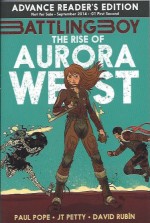
Battling Boy: The Rise of Aurora West (Uncorrected Proof Copy)


By Paul Pope, J.T. Petty & David Rubin (First Second)
ISBN: 978-1-62672-009-1

Don’t you just love comics convention season? Here’s a splendid sneak peak at an upcoming instant classic from a modern master of comics courtesy, I’m assuming, of the publishers promotional outreach budget….

Paul Pope is undoubtedly one of the most creative and visually engaging creators working in comics these days. Since his debut in 1993 he has stunningly combined elements of European and Japanese styles with classical American fictive themes to produce uniquely tweaked tales of science fiction, fantasy, crime, comedy, romance, adventure and even superheroics.

If you’re not a fan yet, check out Sin Titulo, Batman: Year 100, Heavy Liquid, 100%, One Trick Ripoff and other mature reader titles and most especially the previous volume in his occasional series Battling Boy and its delightful supplement The Death of Haggard West…

His latest venture is aimed a general readership – Hey, Kids, This Means You! – and features a world so very similar to our own but with one big, dangerous difference…

Arcopolis City would be the perfect place to bring up kids but for one thing. Ghastly devils roam at night, causing chaos in their unrelenting quest to steal all the children.

Even the daylight hours are becoming increasingly fraught as a seemingly endless succession of horrendous behemoths and leviathans incessantly carve a swathe of mindless destruction through the bright, breezy thoroughfares…

They aren’t the worst however. The true threat is the hidden gangs of extremely smart monsters led by the likes of the sinister Sadisto who acts as a vile capo of a hellish alien underworld…

The situation only began to turn around after bemused junior deity Battling Boy was unceremoniously dumped in the harassed metropolis by his tough-love war-god dad, but this electrifying yarn is a prequel to that particular saga.

The Rise of Aurora West is set in the months before the evocative advent of the juvenile saviour, when all that stood between the howling night-haunters and their preferred prey was an aging “Science Hero” and his highly-trained but understandably cautious, rather pessimistic, teenaged daughter…

Haggard West has battled the terrors ever since they first appeared; initially beside his wife and – now that she’s old enough – his daughter Aurora.

The girl’s life is a whirl of energetic physical practice, martial arts training, detective tuition and (to maintain a safe cover) school at the prestigious St. Ignomious Prep, but she can’t help but dwell on the facts that the never-ending crusade has already deprived her of a mother and is killing her dad in slow, painful increments…

This particular evening father and sidekick are stalking a pack of hooded horrors intent on securing some strange device for disreputable squid-witch Medula. Unfortunately, after a blistering battle, the majority of the monsters make their escape with the enigmatic doodad, leaving the senior Science Hero to painfully question an unlucky captive…

It knows nothing valuable but before expiring it scrawls a strange symbol in the dirt – one which has a shocking effect on Aurora…

Back home, as formidable housekeeper, medic and trainer Mrs. Grately ministers to the battered senior West, Aurora cannot get the symbol out of her mind. Driven by instinct and distant memory she heads for the library and finds an old long-forgotten scrawl she scratched on a wall when she was only three years old. It is the same sign…

Grately fills in the details. It was a time when the monsters were only just beginning to appear and the defacing took place due to the suggestion of the toddler’s imaginary friend Mr. Wurple.

With breathtaking clarity Aurora recalls everything: the conversations with the silly phantom and how he vanished a year later… on the night the monsters killed her mother…

Agitated and obsessed, the teenager goes into a frenzy of research, tracing the symbol to an archaeological trip her family took to see the Sphinx when she was barely walking and talking. With growing horror she recalls how she stumbled upon a secret entrance into the edifice and how her parents discovered the strange mummy of an ancient hero who had died fighting monsters thousands of years ago…

She also remembers with shock how she was approached by a bizarre energy creature who begged her not to tell her folks he was there and realises that Mr. Wurple was real. Moreover ever since he “left”, Arcopolis has been a city under siege…

And thus begins the coming-of-age epic as the unsure girl becomes a resolute and dedicated hero determined to solve the disturbing enigma of her insidious imaginary companion whilst attempting to make amends for all the horrors and tragedies she might very well have unleashed on her home town, friends and family…

Scripted by Pope and J.T. Petty (Bloody Chester) with stunning art by Spanish cartoonist and illustrator David Rubin, this is a superb and moving sidebar yarn, packed with clever intoxicating mystery, astounding action, tense suspense and beguiling characters that will delight older kids, and reads even better if you’re their adult keeper or guardian.

© 2014 by Paul Pope. All rights reserved.

Battling Boy: The Rise of Aurora West will be published on September 30th 2014.

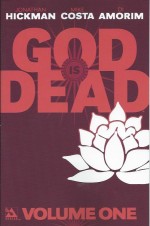
God is Dead Volume 1


By Jonathan Hickman, Mike Costa, Di Amorim & Rafael Ortiz (Avatar Press)
ISBN: 978-1-59291-229-2

Launched in September 2013, Jonathan Hickman and Mike Costa’s God is Dead spectacularly began extrapolating on the age-old question “What if God(s) were real?” in a wry and deliciously dark summer blockbuster style.

Now the first six issues, illustrated by Di Amorim and others, have been collected into a bombastic bludgeoning bible of senses-shattering Apocalyptic apocrypha that begins one day in May 2015 when the pantheons of ancient Egypt, Greece, Viking Scandinavia, the Mayans and Hindu India all explosively return: shattering monuments, landscapes and nations whilst slaughtering millions of mortals, faithful and disbelievers alike…

Within two months the ineffable gods have fully re-established themselves, pushing rational, scientific mankind to the brink of extinction, reclaiming their old places of worship and terrified congregations of adherents.

On the run from the new faithful, Dr. Sebastian Reed is rescued from certain death by the stunning Gaby and joins The Collective, an underground think tank of fugitive scientists, even as the Gods savagely revel in their bloody return to power and glory.

In a secret bunker the suicide of the American President leaves an obsessively aggressive General in charge of the US military. He has no intention of letting any primitive usurper run roughshod over the Greatest Nation on Earth…

As rationalist deep thinkers and innocuous PhDs Thomas Mims, Airic Johnson and Henry Rhodes welcome the fresh recruit, in the heavens Odin convenes a grand congress to settle the final disposition of the mortal world and all its potential worshippers…

The fable resumes as the American Army goes nuclear. However, although the strike vaporises an army of mortal converts, it cannot harm sublime Quetzalcoatl and merely provokes a punishing response from the assembled and arrogant Lords of the Air.

Far beneath the earth the scientists are engaged in heated debate over the nature of their enemies. Eventually they agree that they have insufficient data and resolve to capture one of the returned gods…

In America resistance ends when the common soldiery convert to the Mayan religion and sacrifice their stubborn atheist general, but this only leads to greater strife as the Pantheons, with humanity subdued, now turn on each other. Gods are not creatures willing to share or be long bound by pacts and treaties…

Over the Himalayas Gaby and her security consultant dad Duke are ferrying the test tube jockeys when their irreplaceable jet is downed by a monstrous dragon even as, in newly holy sites around the globe, the war of the gods gorily eliminates one greedy pantheon after another.

It’s a blessed circumstance for the surviving scientists who find an immolated Hindu deity and promptly harvest the carcass for investigation and experimentation.

With mythological monsters increasingly repopulating the world, the gaggle of geniuses rapidly reverse-engineer the godly genetic soup and decide to make their own deities: Gods of Science to take back the world for rational men…

The first attempt is an unmitigated catastrophe, savagely eviscerating one of the boffins before Duke manages to kill it. Terrified but undaunted, Gaby leads the way to the next, inevitable step: human trials using what they have gleaned to transform themselves…

Up above the god-war is almost over and Odin, Thor and Loki turn their vastly depleted forces towards Mount Olympus and a showdown with Zeus who has until now kept out of the devastating internecine conflict.

The sole divine survivor of that staggering clash – now omnipotent on Earth – then discerns the experiment of the mortal inventors and flashes to their secret lab.

He is too late. The end results of the religion of rationality have already travelled to Olympus and when the ancient frustrated arrogant all-father returns, he is confronted by a triumvirate of new gods born of needles and serums, ready to finally decide who will rule the world…

That astoundingly vicious clash is then followed by a portentous Interlude (by Costa & Rafael Ortiz) which follows that oriental dragon into previously unseen China to meet entrepreneurial Sammi whose future seems ‘Gloriously Bright’, after which the newly re-emergent gods of that ‘Middle Kingdom’ have their own crucial confrontation with the golden Wyrm of the Heavens…

With additional art by Jacen Burroughs and Hickman, God is Dead provides a brutally engaging, uncompromising, brilliantly vicarious dark-edged romp to satisfy any action-loving adult’s need for comics carnage and breathtaking big-concept storytelling.
© 2014 Avatar Press Inc. God is Dead and all related properties ™ & © 2014 Jonathan Hickman and Avatar Press Inc.

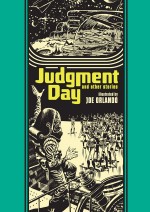
Judgment Day and Other Stories


Illustrated by Joe Orlando, written by Al Feldstein & Jack Oleck with Ray Bradbury, Otto Binder & Bill Gaines (Fantagraphics Books)
ISBN: 978-1-60699-727-7

During an era of traditionally genre-inspired entertainments, EC Comics excelled in tales that both epitomised and revolutionised the hallowed, hoary themes such standard story categories utilised.

The company had started publishing in 1944 when comicbook pioneer Max Gaines – presumably seeing the writing on the wall – sold the superhero properties of his All-American Comics company to half-sister National/DC, retaining only Picture Stories from the Bible.

His high-minded plan was to produce a line of Educational Comics with schools and church groups as the major target market. He augmented his flagship title with Picture Stories from American History, Picture Stories from Science and Picture Stories from World History but the worthy projects were all failing when he died in a boating accident in 1947.

As detailed in the comprehensive closing feature of this superb graphic compilation (‘Crime, Horror, Terror, Gore, Depravity, Disrespect for Established Authority – and Science Fiction Too: the Ups and Downs of EC Comics’ by author, critic and fan Ted White) his son was rapidly dragged into the company by Business Manager and unsung hero Sol Cohen who held the company together until the initially unwilling Bill Gaines abandoned his dreams of being a chemistry teacher and quickly refashioned the ailing enterprise into Entertaining Comics…

After a few tentative false starts and abortive experiments copying industry fashions, young Bill began to closely collaborate with multi-talented associate Al Feldstein, who promptly graduated from creating teen comedies and westerns into becoming Gaines’ editorial supervisor and co-conspirator.

As they began collaboratively plotting the bulk of EC’s stories together, they changed tack, moving in a boldly impressive new direction. Their publishing strategy, utilising the most gifted illustrators in the field, was to tell a “New Trend” of stories aimed at older and more discerning readers, not the mythical semi-literate 8-year-old all comicbooks ostensibly targeted.

From 1950 to 1955 EC was the most innovative and influential publisher in America, dominating the genres of crime, horror, war and science fiction and even creating an entirely new beast: the satirical comicbook…

Feldstein had started life as a comedy cartoonist and, after creator/editor Harvey Kurtzman departed in 1956, Al became Editor of Mad magazine for the next three decades …

This ninth volume of the Fantagraphics EC Library gathers a mind-boggling selection of science fiction tales – mostly co-plotted by sci-fi fan and companion-in-crime (and Horror and Comedy and…) Gaines – all illuminated by the company’s most successful alumnus: a legendary, chameleonic artist, illustrator, editor and latterly discoverer of new talent who went on to impact the burgeoning comics industry over and over again.

The Amazing work of Joe Orlando (1927-1998) has been gathered here in a fabulous bible of iconic graphic futurism: a lavish monochrome hardcover edition packed with supplementary features and dissertations; beginning with historian and educator Bill Mason’s informative and laudatory essay ‘Orlando Ascendant’.

What follows is a spectacular beguiling, amazing and frequently wryly hilarious panoply of fantastic wonders, opening with an adaptation of one of Ray Bradbury’s most famous short stories taken from his Martian Chronicles cycle. Bradbury – a huge fan of comics – had, after a tricky start (involving an unsanctioned adaptation of one of his works), struck a deal with EC that saw a number of his horror, crime and science fantasy tales transformed into quite remarkable pieces of mature strip magic.

The eerily poignant and disturbing yarn ‘The Long Years!’ was adapted by Feldstein for Weird Science #17, (January/February 1953) and detailed how a relief ship to the Red Planet found an old man and his young family. …Or rather the perfect thinking facsimiles he had built after they had died decades previously. In that same month Weird Fantasy #17 featured an all-original Feldstein/Gaines yarn.

‘In the Beginning…’ was a delightfully convoluted time-paradox tale which took flight after Earth explorers landed on a mysterious tenth planet in the solar system, after which

‘Infiltration’ (Shock SupenStories #7, February/March 1953) highlighted Cold War paranoia and repression as a plucky young woman takes up her post in Washington DC and uncovers evidence of alien enemies entrenched in the corridors of power.

Wry irony underpinned the tale of a greedy TV repairman who stumbled upon a crashedUFO and sought to make his fortune by patenting some of the unique components in   ‘Dissassembled!’ (Weird Science #18, March/April 1953), whilst simultaneously, in Weird Fantasy #18, ‘Judgment Day!’ took a powerful poke at America’s institutionalised bigotry and racism with the allegorical tale of an Earthman visiting a colony of robots who had devised a uniquely oppressive form of apartheid.

The stunningly effective story was reprinted in Incredible Science Fiction #33 (January/February 1956) as Gaines & Feldstein’s last sally and parting shot against the repressive, ever-more censorious Comics Code Authority before shutting down EC’s comicbook division for good…

‘Keyed Up!’ from Weird Science #19, May/June 1953 detailed how a drunken spacer who had accidentally killed most of his fellows came a cropper after trying to bury the evidence, whilst that month in sister publication Weird Fantasy #19 ‘Time for a Change!’ saw explorers on Pluto lethally succumb to the tempo and dangers of local rotational conditioners before ‘The Meddlers!’ (Shock SupenStories #9, June/July 1953) revealed how small-town suspicion and hostility turned a scientist into a pariah, a corpse and eventually the doom of scenic Millville…

Gaines and Feldstein were as much satirists, reformers and social commentators as entertainers and never missed an opportunity to turn a harsh spotlight on stupidity, cupidity, prejudice and injustice. They struck gold with ‘The Reformers’ (Weird Science #20, July/August 1953), which outrageously lampooned interfering star-roving blue-stocking do-gooders who discovered a planet they simply couldn’t find fault with… no matter how infernally hard they tried.

More importantly this also gave the phenomenally gifted humorist Orlando a rare opportunity to apply his subtler gifts of character nuance and comic timing.

Totalitarianism came under the hammer with ‘The Automaton’ (Weird Fantasy #20, July/August 1953) as a rebellious individual who refused to acknowledge that he was “property of the State” killed himself. Over and over and over and over again…

‘Home Run!’ (Shock SuspenStories #10 August/September 1953) saw a creature trapped on Earth go to extraordinary measures to return to Mars whilst Weird Science #21 (September/October 1953) played with the plot of the Ugly Duckling for the cruel fantasy ‘The Ugly One’.

An invisible, untouchable intruder wreaked havoc with a band of stellar prospectors in the chilling ‘My Home…’ (Weird Fantasy #21, September/October 1953), before Bradbury’s deeply moving family fable ‘Outcast of the Stars’ (Weird Science #22 November/December 1953) confirms Orlando’s artistic star quality with the subtly uplifting tale of a poor man who gives his children the most magnificent gift of all time…

In a genre where flash and dazzle were the norm, the illustrator’s deft ability to portray the subtler shades of being merely human regularly took the readers’ breath away…

Alien archaeologists reconstructed a shocking surprise when they reached Earth and reconstructed ‘The Fossil’ (Weird Fantasy #22 November/December 1953) and ‘Fair Trade’ (Weird Science Fantasy #23, Spring 1954) explored the ever-present prospect of atomic Armageddon before Feldstein adroitly adapted another pulp sci-fi author’s masterwork in ‘The Teacher from Mars’ (Weird Science Fantasy #23 June 1954).

Otto Binder had two writing careers. As Eando Binder he crafted superb short stories and classic space novels whilst as comicbook scripter using his given name he revolutionised superhero sagas as chief writer on Fawcett’s Captain Marvel, assorted icons of the Superman Family and a host of others.

Amongst the legion of publishers he worked for was EC Comics, but he had no part in the adaptation of his deeply moving tale of an alien educator facing intolerance from his human students. The magic comes purely from Feldstein’s sensitive adaptation and Orlando’s passionate drawing.

Weird Science Fantasy #25 (September 1954) offered a gem of existentialist philosophy in ‘Harvest’ wherein a robotic farmer questions his never-ending task… until he finally meets the things he’s been growing his crops for, after which Jack Oleck concocts a brace of clever yarns beginning with ‘Conditioned Reflex’ (Incredible Science Fiction #30 July/August 1955) which tells a brilliantly conceived shaggy-dog story about alien invasion and the perils of smoking before ‘Fallen Idol!’ (Incredible Science Fiction #32 November/December 1955) takes us to a post-atomic World of Tomorrow wherein a bold raid on a fallen metropolis promises to change the lives of the barbaric humans and their ambitious leader forever…

The last three stories in this titanic tome are adaptations of Binder’s astoundingly popular pulp sci-fi series starring “Human Robot” Adam Link: ten novellas written between 1939 and 1942.

As detailed in prose introductory briefing Adam Link: Behind the Scenes, the first three prose thrillers were adapted by Feldstein and Orlando at the end of the publisher’s struggle against comics censorship. Orlando returned to the feature a decade later when EC-influenced Creepy revived Adam Link, with Binder himself on the scripts. (Another graphic novel collection, another time, perhaps…?)

Here however the wonderment commences with ‘I, Robot’ (yep, Isaac Asimov didn’t coin the phrase, and was forced to use it on his own anthology of robot tales in 1950) from Weird Science Fantasy #27 (January/February 1955) which saw an erudite, sensitive mechanical man commit his origins to paper whilst waiting for a mob of outraged humans to come and destroy him…

The story continued in ‘The Trial of Adam Link’ in issue #28 (March/April) as crusading

lawyer Thomas Link struggles to clear the robot of a murder charge and win for him the right to be called human before the sequence concludes with ‘Adam Link in Business’ (Weird Science Fantasy #29 May/June 1955) as the enfranchised automaton struggles to find his place in society and is struck low by the emotion of love…

Throughout this collection, encompassing monstrous pride, overweening prejudice, terrifying power and fallen glories, Joe Orlando’s sly and subversive artistry always captured the frailties and nobility of Man and the crazy, deadly and ironically cruel, funny nature of the universe that awaited him. These stories are wonderful, subtle and entrancing and, adding final weight to the proceedings, is S.C. Ringgenberg’s biography of artistic renaissance man ‘Joe Orlando’, the aforementioned history of EC and a comprehensively illuminating ‘Behind the Panels: Creator Biographies’ feature by Arthur Lortie, Tom Spurgeon and Janice Lee.

The short, sweet but severely limited output of EC has been reprinted ad infinitum in the decades since the company died. These astounding stories and art not only changed comics but also infected the larger world through film and television and via the millions of dedicated devotees still addicted to New Trend tales.

However, the most influential stories are somehow the ones least known these days.

Judgment Day is a mind-bending, eye-popping paean of praise to the sheer ability of a master of the comic art and offers a fabulously engaging introduction for every lucky stargazer fan encountering the material for the very first time.

Whether you are an aging fear aficionado or callow contemporary convert, this is a book you must not miss…

Judgment Day and Other Stories © 2014 Fantagraphics Books, Inc. All comics stories © 2014 William M. Gaines Agent, Inc., reprinted with permission. All other material © 2014 the respective creators and owners.

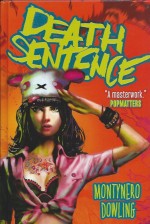
Death Sentence


By Montynero & Mike Dowling (Titan Comics)
ISBN: 978-1-78276-008-5

For most of us Sex Sells.

If that’s not you and you’re easily shocked or offended, stop Right Here, Right Now and come back for a less grown up review tomorrow…

As for the salacious, tawdry, vulgar rest of humanity, however, fornication is a force that cannot be resisted and we’re always gagging for it.

One outrageous potential result of that inescapable biological imperative was recently examined and scathingly lampooned in a dark and decadent fable from scripter, artist and games designer Montynero and sublime illustrator Mike Dowling. Death Sentence – after an initial and truncated appearance in Clint Magazine in 2012 – was retooled and completed in a breakthrough 6-issue miniseries which took the comics world by storm when it was released in October 2013.

Now the entire sordid episode has been compiled – along with a scintillating selection of irresistible extras – in a stout and sturdy hardcover collection that promises to be one of the most talked about books of the year…

The author’s own Introduction kicks everything off (and is complemented by another from Rob Williams) before the seductively apocalyptic tale begins with ‘I Wanna Be Adored’ wherein frustrated artist Verity Fette is getting some very distressing news in a Camden doctor’s surgery.

She’s just been diagnosed with G+: a new, universally fatal sexually transmitted disease that has a rather peculiar side-effect.

Although this STI kills in six months, for the length of that time the victim “suffers” from increased vigour, stamina, sex drive and even develops some form of super power…

Over in Primrose Hill, disgraced, shambolic and rapidly fading rock star Daniel Waissel AKA Weasel awakes from another unspecified period of debauched excess and tries to make sense of what his A&R man Russ is saying.

Apparently having G+ might be the only thing to revive his failing career and, if his power is music-related, perhaps he can still get all six of the albums he’s contracted for finished before he joins all the other dead legends going out in a blaze of lucrative glory…

Whilst Verity is quitting her meaningless job, over the river in a South Bank TV studio comedian, media darling, affirmed libertine and G+ carrier David “Monty” Montgomery is charmingly, charismatically, shockingly titillating the nation again; avowing that his final months on Earth won’t alter his pleasure-seeking behaviour or sensuous attitudes…

Later, Weasel’s powers at last manifest when a couple of irate drug dealers turn up, wanting payment for the prodigious amount of pharmaceuticals the creatively blocked musician has consumed, but neither he nor the other two G+ sufferers are aware that a shady government agency is keeping tabs on them.

Unfortunately, when the spooks decide to “acquire” Verity the result is spectacular and very messy…

Determined to keep the populace in the dark, the Department of National Security goes into utter bastard mode: blaming the gory fiasco on fictitious terrorists whilst covertly hunting the terrified ‘Dissolved Girl’ through the seedy streets of London.

Weasel is – as always – an emotional wreck, avoiding decisions – or making rock & roll – via a constant flurry of sex and drugs. His wake-up call comes when he realises his new normal has ended his latest bedmate in a most unsavoury manner…

Monty, however, is completely in control: aware of what he’s doing and not about to let a few interfering coppers get in his way.

Appalled and guilt-ridden, Verity regains consciousness on a remote Scottish island, where a very nice old lady makes her an intriguing offer before inviting the still-frustrated artist into the huge secret base beneath the heather…

‘Royals‘ finds bored and increasingly irresistibly Monty pondering how to top his already prodigious and unsurpassed career of licentious excess before heading off to Buckingham Palace…

North of the border Verity is beguiled by talk of a cure and agrees to let Dr. Lunn train her in the use of her rapidly-expanding abilities whilst on a quiet London street fugitive Weasel sneaks into the bedroom of his son.

Leaving Mickey with his mother might well be only good thing he’s ever done in his whole wasted life…

This sentimental act is a big blunder though, as a flotilla of copters leads a blistering military ambush which, after a spectacular chase, finally leads to the capture of the musical rebel without a clue…

When he arrives on the island, the nice doctors are keen on helping Weasel learn about himself and sexy fellow inmate Verity. They happily provide space, time, tuition, medical grade drugs…

Down South, Monty, having crowned himself King of Britain, is barely able to contain his self-absorbed glee. ‘In the City’ sees him really stretching himself, and after a psionic flexing of his mental muscle, bloodily destroying a division of the army as well as the ruling elite of Britain, he declares London a city free from all laws.

Influenced as much by a sense of wild liberty as Monty’s surging mental influence, the population descends into gory debauchery, prompting the American President and NATO to take matters into their own hand before the seditious super-maniac works himself up into becoming a global threat…

In Scotland Dr. Lunn is helpless to prevent the DNS frantically turning her research subjects into weapons to use against the rogue G+ victim who has turned London into a sex-fuelled charnel house. Their main concern is to end the affair before the full NATO fleet steaming ominously towards Britain takes the matter into their own terrified, remorseless, thermonuclear hands…

‘This Woman’s Work’ ratchets up the tension as Monty increasingly opts for slaughter over sex whilst Verity and Weasel have no choice but to grudgingly accept that they might be the only way to stop him. The crisis then reaches a catastrophic climax in ‘To the End’…but not in a way you’d suspect or be comfortable with…

Each chapter is bolstered by a series of faux news articles and public service features ranging from ‘Pop goes the Weasel’ to a medical advice website page for potential G+ sufferers, and this lewdly lavish hardback tome also includes a fifteen-strong covers-&-variants gallery, a fulsome, informative and frequently hilarious ‘Death Sentence Commentary’ from Montynero and Mike Dowling, and more.

Bold, slick, immensely engrossing and intoxicatingly enjoyable, Death Sentence is a black, uproarious fairytale for adults that blends superhero tropes with outrageous cheek, deliriously shocking situations and in-your-face irreverence, making it one of the most notable and unmissable comics tales of the last half century…

Buy it, read it and spread it around to everyone…

Death Sentence ™ and © 2014 Montynero, Mike Dowling and Titan Comics. All rights reserved.

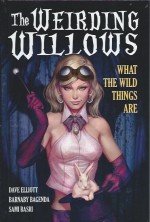
The Weirding Willows volume 1: What the Wild Things Are


By Dave Elliott, Barnaby Bagenda, Sami Basri & various (Atomeka/Titan Comics)
ISBN: 987-1-78276-035-1

Phillip Jose Farmer’s Tarzan Alive (1972) and Doc Savage: His Apocalyptic Life (1973) are probably the earliest modern examples of our current fascination with concatenating assorted literary icons and fictive childhood companions into heroic associations and fantasy brotherhoods, but as fantasy consumers we’ve always wanted our idols to clash or team up.

So many comics from Scarlet in Gaslight (Sherlock Holmes and Dracula) to Planetary (pulp vigilantes and other companies’ superheroes cheekily retooled) to the magnificent League of Extraordinary Gentlemen (everybody you’ve ever heard of and some you haven’t) and an uncountable number of TV shows, books and movies have mined this boundless seam of entertainment gold.

The Weirding Willows by Dave Elliott, Barnaby Bagenda, Sami Basri and an army of colourists continues that topical trend; recombining the innocent headliners of many a beloved British children’s book into a slick, harsh, creepily adult reconfiguration…

One cautionary note: as with every entry into this amalgamating sub-genre, if you are a literary purist you are going to hate this – or indeed any – contemporarily-toned, edgily in-your-face interpretation. Nothing I can say will change your mind, so don’t bother.

There are plenty of other graphic novels and albums around that will better suit your temperament. Please try one of those…

The series launched in the latest iteration of anthology title A1 and this collection of first story-arc What the Wild Things Are also includes a whole new chapter exclusive to this lush and beguiling hardback compilation.

Rural, bucolic Willow Weir is a quintessentially English hamlet with a big secret. The riverside association of houses and farms intersects a number of portals to numerous other Realms and Dimensions, and things strange and uncanny are often seen – if not discussed. The human folk who abide there are not so simple and frequently as odd as the creatures that roam the wild woods and harmless-seeming riverbanks…

Following author Elliott’s Introduction a handy map offers the geographical lowdown on the green and pleasantly deceptive land before the tale unfolds with ‘A Wicked Witch This Way Comes’ wherein we meet worldly wise teen totty Alice Moreau, a girl greatly at odds with her father’s scientific preoccupations.

Dad and daughter reside in the house abandoned by Professor Donald H. Lambert when he rode his time machine into the future, and the abrasive single parent soon filled the vacant dwelling with an assortment of animals for his experiments.

This particular morning he is dickering with Dr. Henry Jekyll who has provided formal introduction for a green-bedecked dowager temptress named Margareete Marche; a traveller from a distant land who wishes to commission the radical surgeon to construct for her an army of winged monkeys…

Insolent Alice isn’t impressed: she’s far more concerned that sheep are going missing from nasty Farmer McGregor‘s spread. Naturally darling Daddy is the prime suspect. There’s no love lost between father and daughter, ever since she followed a rabbit through a portal to Wonderland and told her father all about it. He didn’t believe a word and has mocked her ever since…

The unpleasant confrontation with McGregor is cut short when a trio of talking rabbits summon her away to deal with another crisis. She doesn’t get far, though, as Montgomery Doolittle arrives with a barge full of fresh beasts for the operating table…

The cargo has also drawn a new player to the dell of domesticity. This black-maned wild child is desperate to rescue his beloved companions Baloo and Bagheera from the clutches of the obnoxious white man who can talk to animals…

‘If You Go Down to the Woods Today…’ sees Alice finally follow her bunny buddies as enraged Mowgli tries – and fails – to free his wild brothers: becoming instead more prospective raw material for Doctor Moreau. As Alice slips away no one pays any attention to a bizarrely grinning cat named Cheshire, and her own attentions are soon fully occupied by the rampages of an extremely angry example of the surgical efforts of an earlier modern Prometheus…

‘The Prisoner of Doctor Moreau’ finds Mowgli imprisoned with an exotic young woman named Kamaria, as across the river Alice brokers a peace between the rabbit race and Frankenstein’s Monster. As usual he has been gravely misunderstood: his frantic acts were merely the result of extreme concern for a lost companion.

Rosalind had gone missing and he has tracked her through a portal from Pellucidar – the world at the Earth’s Core – and is quite concerned. So is everybody else when they learn that Rosalind is a dinosaur…

‘What Lies Beneath Badger’s House’ introduces badger Victor Stoker, toad Dudley Cook, mole Morris Moore & ratty Terry James as well as a sinister hidden city deep down under Badger’s house, whilst in Moreau’s cellar laboratory the Cheshire Cat gives Mowgli some dangerous advice.

Meanwhile, the multi-species search party have found Rosalind on McGregor’s Farm, ferociously guarding a clutch of recently laid eggs…

That discovery only leads to tragedy as the obnoxious smallholder shoots Rosalind and claims the eggs for himself in ‘Here There Be Dragons!’ Thankfully Alice quickly deals with the farmer before monstrous Damon can get his second-hand hands on him…

Things take an even stranger turn when Victor, Morris, Dudley and Terry turn up. The Badger seems to know an awful lot about the experiments of the long-dead Dr. Frankenstein…

Night comes on and, in Moreau’s cellar as the full moon shines down on Kamaria, she begins to change and howl…

At a loss, Alice brings the whole menagerie back to her place in ‘What the Wild Things Are!’, much to the angry astonishment of her father, and at least has the satisfaction of proving that her “childish ramblings” were all true, all along…

However, when the rampant Kamaria werewolf tumultuously breaks out, strange alliances are quickly formed before the whole lethally helter-skelter hurly-burly is unconventionally settled in the low-key conclusion ‘Worlds Within Worlds’.

In the aftermath Alice at last finds time to renew an old acquaintanceship with a four-armed green man from another world…

Each chapter is concluded with an excerpt from The Weirding Willows Field Guide, detailing pertinent facts and shameful secrets about Alice, Philippe Moreau, Monty Doolittle, Damon Frankenstein, Victor Stoker, Dudley Cook, Morris Moore & Terry James, Margareete Marche, Dr. Henry Jekyll & Edward Hyde, Mowgli, The Worriers Three (talking rabbits Benjamin Buckle, Peter Pipp & Hoetoe Darwin), Professor Donald H. Lambert and enigmatic, formidable bunny-with-a-secret Norman Pipp, and the tome terminates with the author’s afterword ‘Inspirations’ and some informative creator ‘Biographies’.

Magnificently, mesmerisingly illustrated, this is a visual feast no fan of fantastic fantasy mash-ups will want to miss…

The Weirding Willows © 2014 Dave Elliott. ATOMEKA © 2014 Dave Elliott & Garry Leach. Atomeka Press, all contents copyright their respective creators.

Snowpiecer: The Escape


By Jacques Lob & Jean-Marc Rochette translated by Virginie Selavy (Titan Comics)
ISBN: 978-1-78276-143-3

All science fiction is social commentary and, no matter when, where or how set, holds up a mirror to the concerns of the time of its creation. Many stories – in whatever medium – can go on to reshape the culture that spawned them.

There’s a reason why the Soviets proscribed many types of popular writing but actively encouraged (certain flavours of) science fiction. 20,000 Leagues Under the Sea, Metropolis, 1984, Solaris, Star Trek, Alien and so many others escaped the ghetto of mere genre to change the cognitive landscape of the world, and hundreds more such groundbreaking and worthy efforts would do the same if we could get enough people to read or see them.

And most importantly, when done well and with honesty, such stories are also incredibly entertaining.

All over the world comics have always looked to the stars and voyaged to the future. Europe especially has long been producing spectacularly gripping and enthralling “Worlds of If…” and Franco-Belgian graphic storytelling in particular abounds with undiscovered treasures.

For every Blake & Mortimer or Barbarella, Valérian & Laureline, Airtight Garage, Chimpanzee Complex or Gods in Chaos there is an impossible hidden wealth of others, all perched tantalisingly out of reach for everybody unable or unwilling to read nothing but English.

To coincide with the release of spectacular summer blockbuster movie Snowpiercer, Titan Comics have released an economical paperback edition of another long-overlooked masterpiece. The book – a stunning example of bleak Cold War paranoid fantasy – is also electronically accessible to iPhone, iPad, Web, Android and Kindle consumers.

The original mesmerising monochrome adventure, written by Jacques Lob (Ténébrax, Submerman, Superdupont) and rendered by painter/illustrator Jean-Marc Rochette (Le Dépoteur de Chrysanthèmes, Les Aventures Psychotiques de Napoléon et Bonaparte), was first serialised in 1982 in À Suivre and collected two years later as Le Transperceneige, and like most landmark yarns has a driving central conceit which is simple, brilliant and awesome.

In the future life is harsh, oppressive and ferociously claustrophobic. When eternal winter descended upon the Earth, fugitive remnants of humanity boarded a vast vacation super-train and began an eternal circumambulation of the iceball planet on railway tracks originally designed to offer the idle rich the ultimate pleasure cruise.

Thanks to lax security, as the locomotive started its unceasing circuit of the globe, gangs of destitutes boarded the vehicle, but were forced by the military contingent into the last of the 1001 cars pulled by the modern miracle of engineering.

Now decades later, the self-contained and self-sustaining Engine hurtles through unending polar gloom in a perpetual loop, carrying within a raw, fragmented and declining microcosm of the society that was lost to the new ice age…

All contact with the Tail-enders of the “Third Class” has been suspended ever since they tried to break through to the better conditions of the middle and front carriages. Their “Wild Rush” was repelled by armed guards and the survivors – who recall the terrifying event as “the Massacre” – were kicked back to their rolling slums and sealed in to die…

The story proper begins as Lieutenant Zayim is called to an incident in a toilet. Somehow an individual has survived the -30 degree chill and monstrous acceleration, climbing along the outside of the train to smash his way into a centre carriage.

Normally the importunate refugee would be killed and ejected but the stunned officer receives instruction from his Colonel that the indigent – named Proloff – is to be interviewed by the leaders up in First Class.

Before that, however, the invader must be quarantined as the carriage doctor has no idea what contagions must proliferate in the squalor of the rear. But whilst Proloff is isolated, idealistic young activist Adeline Belleau forces her way into the carriage.

She is with a humanitarian Aid Group agitating to integrate the abandoned Tail-enders with the rest of the train, but is unceremoniously confined with the intruder and suffers the same appalling indignities as her unfortunate client…

After a “night” in custody Proloff and Adeline are escorted by Sergeant Briscard and his squad through the strange and terrifying semi-autonomous carriages: each a disparate region of the ever-rolling city, contributing something to the survival of all.

Travelling through each car during their slow walk, Proloff observes how humanity has uniquely adapted on the journey to nowhere, but that each tiny kingdom is filled with people scared, damaged and increasingly dangerous.

In one car they are even attacked by bandits…

The invader also begins to glean certain facts: a religion has grown that worships the unlimited life-bestowing power of Saint Loco, rumours that the train is inexorably slowing down, reports that a plague has begun in the carriage he broke into. Even Adeline has picked up a cold from somewhere…

As they slowly approach the front, Proloff and Adeline grow closer, uniting against the antipathy of the incrementally better off passengers who all want the Powers-That-Be to jettison the dragging, superfluous end carriages packed with filthy Tail-enders…

When they at last reach the luxurious “Golden Cars” the outcasts are interviewed by military Top Brass and the President himself.

He confirms that the train is indeed losing speed and that the furthest carriages will be ditched, but asks Proloff to act as an emissary, facilitating the dispersal of the human dregs throughout the rest of the train.

Billeted with Al, the timidly innocuous Train Archivist, Historian and Librarian, Proloff quickly confirms his suspicion that he is being played. Whilst deftly avoiding the grilling regarding conditions at the train’s tail, he swaps some theories about how the ice age really began and just how coincidentally lucky it was that this prototype vacation super-train was set up, ready and waiting to save the rich and powerful… and only accidentally and unwillingly a selection of the rest of humanity…

Stoically taking in the decadent debauchery of the First Class cars, Proloff is ready to die before going back, and when word of plague and revolution provokes an attack by the paranoid autocrats, he and Adeline decide to move even further forward, to see the mighty Engine before they die.

What they find there changes everything for everyone, forever…

This incisive exploration of a delicately balanced ostensibly stable society in crisis is a sparkling allegory and punishing metaphor, playing Hell and poverty at the bottom against wealth in Heaven at the top, all seen through the eyes of a rebel who rejects both options in favour of a personal destiny, and is long overdue for the kind of recognition bestowed on that hallowed list of SF greats cited above.

Dark, brooding, manic and compulsive, Snowpiercer is a must-see masterpiece no fantasy fan can afford to miss.

Transperceneige/Snowpiercer and all contents are ™ and © 2013 Casterman.

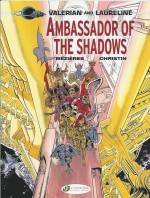
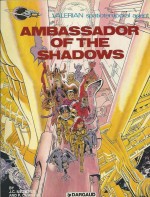
Valerian and Laureline book 6: Ambassador of the Shadows


By Méziéres & Christin, with colours by E. Tranlé and translated by Jerome Saincantin (Cinebook)
ISBN: 978-1-84918-178-5   (Dargaud edition) 2-205-06949-7

Valérian and Laureline is the most influential science fiction comics series ever drawn, an innovation-packed big ideas drama stuffed with wry comment and sardonic sideswipes at contemporary mores and prejudices.

Although to a large extent those venerable strips defined and later re-defined the medium itself, anybody who has seen a Star Wars movie or that franchise’s numerous homages, pastiches and rip-offs has been exposed to many doses of Jean-Claude Méziéres & Pierre Christin’s brilliant imaginings uniquely innovative, grungy, lived-in authentic futurism and light-hearted swashbuckling rollercoaster romps of Méziéres & Christin than any other cartoon spacer.

Valérian: Spatio-Temporal Agent debuted in Pilote #420 (November 9th 1967) and was an instant hit. It gradually evolved into Valérian and Laureline as the feisty sidekick developed into the equal partner – if not scene stealing star – in a light-hearted, fantastically imaginative time-travelling, space-warping fantasy stuffed with wry, satirical, humanist action and political commentary.

At first Valerian was an affable, capable but unimaginative by-the-book space cop tasked with protecting the official universal chronology by counteracting paradoxes caused by incautious time-travellers.

When Valérian travelled to 11th century France in debut tale ‘Les Mauvais Rêves (‘Bad Dreams’ and still not translated into English yet), he was rescued from doom by a fiery, capable young woman named Laureline. He brought her back to the 28th century super-citadel and administrative capital of the Terran Empire, Galaxity. The indomitable female firebrand trained as a Spatiotemporal operative and began accompanying him on all his missions.

Ambassador of the Shadows originally ran in Pilote from July to October 1975 and finds the wide-ranging Spatiotemporal agents assigned to an arrogant and obnoxious Terran diplomat transferring to the cosmically cosmopolitan space edifice known as Point Central.

Over the eons many races and species have converged there for commerce and social intercourse by the simple expedient of bolting their own prefabricated constructed segment to the colossal, continually expanding hodge-podge whole…

With no central authority, different species take turns presiding over the amassed multitudes via the immense Hall of Screens. However, no decent species would ever leave its own tailor-made environment…

And now it is Earth’s turn to take the lead but, as they vector in for landing, the pompous martinet they are escorting informs Valerian and Laureline of a slight modification in their orders. They are still to the Ambassador’s bodyguards but must stay extra vigilant as Earth is going to uses its term in office to bring “order and discipline” to the lackadaisical way the universe is run.

The assembled races will be invited to join a federation run – and policed – by Earth. …And just to make sure, there’s a Terran space fleet of 10, 000 warships manoeuvring just out of Point Central’s  sensor range…

Laureline is outraged but like Valerian can do nothing except acquiesce. For her pains she is put in charge of the mission’s funds – a Grumpy Transmuter from Bluxte – which can mass-excrete any currency or object of trade or barter swallowed by its always scowling other end…

All kitted-out, the trio and the living cash-machine spacewalk to Point Central but before the mission can begin an alien ambush occurs. Mystery warriors using Xoxos cocoon guns inundate the attending officers and dignitaries and only Valerian escapes plastic entombment.

As the raiders make off with the Ambassador, the Spatiotemporal Agent gives chase but is easily captured and dragged off too…

By the time Laureline breaks loose they are long gone and she is left to pick up the pieces with stiff-necked human bureaucrat Colonel Diol, Under Chief of Protocol.

Determined but with little to go on, she is cautiously optimistic when a trio of aliens come knocking. Ignoring Diol’s protest at the shocking impropriety she invites the scurrilous Shingouz into the Earth Segment. They are mercenary information brokers and claim to have been invited by the Ambassador before his abduction…

From them – and thanks to the pained efforts of the Grumpy Transmuter – she purchases a few hints and allegations as well as a map of Point Central which might lead to Earth’s secret allies in the cosmopolis…

With the constantly bleating Diol reluctantly in tow, Laureline begins a quest through the underbelly of the station, seeing for the first time the mute but ubiquitous Zools: a much ignored under-race which has been maintaining Point Central for millennia.

The Earthlings’ perambulations take them to the centaur-like Kamuniks: barbaric feudal mercenaries allied to Galaxity and appreciative of humanity’s martial prowess, and over a lavish feast – liberally augmented by another painfully exotic payment courtesy of the overworked Transmuter – the warriors steer Laureline towards potential suspects the Bagulins: low grade muscle-for-hire who frequent the tawdry red-light sector run by The Suffuss…

Despite Diol’s nigh-apoplexy the adamant and inquisitive Laureline follows the trail to the sin segment where she experiences the particular talents of the hosts: amorphous shapeshifters who can make any carnal dream come literally true.

Well into overtime now, the exhausted Grumpy buys the help of one Suffuss who smuggles the junior Spatiotemporal operative into a Bagulin party and the next link in the chain…

And so it goes as, with occasional prodding from the Shingouz, Laureline gets ever-closer to the enigmatic beings truly pulling all the strings on Point Central whilst elsewhere Valerian frees the Ambassador from a bizarre and ethereal captivity only to find the doctrinaire war-maker is undergoing a strange change of heart.

Seemingly landing their deserted ship on a paradisiacal “world with no name” they bask in an idyllic paradise and converse with noble primitives who have an uncanny aura of great power.

These beings built the first section of Point Central and ruled the universe before withdrawing from mundane material affairs, but they still maintain a watch over their creation from the shadows and won’t let any race or species to dominate or conquer their pan-galactic melting pot of space…

In a more physical portion of reality Laureline follows her final clues and reaches the strange central area where Val and the Ambassador lie dazed and confused. By the time they all return to the Earth Segment a few major changes have taken place in the governance of the immense star station but, oddly, the Ambassador doesn’t seem to mind…

Ambassador of the Shadows was the first Valerian tale to make it into English, appearing as a serial in the American Heavy Metal magazine from January to April 1984 (volume 4, #10 to Volume 5, #1).

Socially aware and ethically crusading, this is one of the smartest, most beguilingly cynical comics tales to catch the 1970s wave of political awareness and still ranks amongst the very best to explore the social aspects and iniquities of colonialism.

And of course there’s the usual glorious blend of astounding action, imaginative imagery and fantastic creatures to leaven the morality play with space-operatic fun-filled, visually breathtaking and stunningly ingenious wide-eyed wonderment…

Between 1981 and 1985, Dargaud-Canada and Dargaud-USA published a quartet of these albums in English (with a limited UK imprint from Hodder-Dargaud) under the umbrella title Valerian: Spatiotemporal Agent and this tale was the fourth release, translated then by L. Mitchell.

Although this modern Cinebook release boasts far better print and colour values plus a more fluid translation, total completists might also be interested in tracking down the 20th century edition too as it boasts a foreword by comics god Will Eisner, full creator biographies and a fascinating, insightful illustrated overview by French science fiction author and editor Daniel Riche…

© Dargaud Paris, 1975 Christin, Méziéres & Tran-Lệ. All rights reserved. English translation © 2012 Cinebook Ltd.

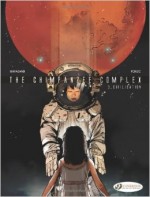
The Chimpanzee Complex volume 3: Civilisation


By Richard Marazano & Jean-Michel Ponzio, translated by Jerome Saincantin (Cinebook)
ISBN: 978-1-84918-043-6

French comics creators excel at challenging, mind-blowing, compelling science fiction. Whether boisterous, mind-boggling space opera like Valerian and Laureline, surreal meta-spiritual exploration such as Moebius’ Airtight Garage or the tense, tech-heavy veritas of Orbital, our Gallic cousins always got it: the genre is not about tech or monsters; it’s about people encountering new and uncanny ideas…

Prolific, multi-award winning Richard Marazano was born in Fontenay-aux-Roses in 1971. He initially pursued a career in science before switching to Fine Arts courses in Angoulême and debuted in bande dessinée in the mid 1990s. Although an extremely impressive artist and colourist when illustrating his own stories (Le Bataillon des Lâches, Le Syndrome d’Abel), he is best known for his collaborations with other artists such as Michel Durand (Cuervos), Marcelo Frusin (L’Expédition) and Xavier Delaporte (Chaabi) to name but a few.

His partnerships with artist Jean-Michel Ponzio are especially fruitful and rewarding. As well as Le Complexe du Chimpanzé – the trilogy under discussion here – the daring duo have also produced the taut, intricate social futurism of Genetiksâ„¢ and high-flying paranoiac cautionary tale Le Protocole Pélican.

Jean-Michel Ponzio was born in Marignane and, after a period of scholastic pick-&-mix during the 1980s, began working as a filmmaker and animator for the advertising industry. He moved into movies, designing backgrounds and settings; listing Fight Club and Batman and Robin among his many subtle successes.

In 2000 he started moonlighting as an illustrator of book covers and edged into comics four years later, creating the art for Laurent Genfort’s T’ien Keou, before writing and illustrating Kybrilon for publisher Soliel in 2005.

This led to a tidal wave of bande dessinée assignments before he began his association with Marazano in 2007. He’s still very, very busy and his stunning combination of photorealist painting, 3D design and rotoscoping techniques grace and enhance a multitude of comics from authors as varied as Richard Malka to Janhel.

Perhaps still the very best of these talented individuals’ joint efforts is The Chimpanzee Complex trilogy which concludes its English translation here with Civilisation…

When, six and a half decades after it first returned, the Apollo 11 Command Module splashed down in the Indian Ocean in February 2035, redundant NASA astronaut Helen Freeman was pressed into the top-secret investigation of the incredible passengers, deserting once again her troubled and too-often neglected daughter Sofia.

Neil Armstrong and Buzz Aldrin were the first men to walk on the moon, and nobody – including them – had any idea where they’d been for sixty-five years. For the baffled spacers it was only days since their mission began…

On learning how history had already recorded their triumphant return and unremarkable deaths years later, the legends went ballistic: exhibiting what Freeman knew as the traumatic shock response peculiar to space voyagers categorised by NASA as “the Chimpanzee Complex”…

They had no knowledge of “their” missing third astronaut Michael Collins (if he ever existed). Nobody could explain what they might be and no test science could devise was able to disprove or corroborate their incredible story…

Compelled to work under Military Spook Konrad Stealberg, Freeman’s subsequent interviews uncovered even more questions but no answers. Then one day the enigma-nauts began exhibiting memory gaps.

Whilst her best friend – NASA bureaucrat Robert Conway – left to look after her increasingly intransigent daughter, Helen and Konrad’s team were presented with another insoluble mystery when the astronauts suddenly expired: becoming decades-old corpses overnight…

Soon Helen was reluctantly piloting a mission to the moon in the mothballed but hastily reconditioned shuttle originally designed for Mars – until budget cuts scotched the project. Her trusted comrades and fellow unemployed astronauts Kurt, Alex and Aleksa were just as delighted to be back in space, but as apprehensive as Helen over the military presence and top-secret paraphernalia piled aboard.

They were even less sanguine when Stealberg and his creepy elite commandos replaced the regular crew.

En route they discovered the secret history of the 1960s Space Race: America’s black ops space program and the USSR’s clandestine and apparently failed mission to Mars.

Even bigger shocks materialised on the moon when they found the pressure-suited corpses of Aldrin and Armstrong deep in a concealed fissure. In orbit above them a vintage Command Module was intercepted by their own shuttle.

The relic contained Collins’ corpse and a decades-old Russian distress call the pilot had recorded. The message had been sent by Commies from Mars…

NASA never had an American monopoly on spaceflight: the military had run a covert, parallel program from the very start, funded by pirating portions of NASA’s budget at the personal instigation of ex-Nazi rocket pioneer Werner von Braun…

Moreover, the 66-year old Russian distress message in the capsule’s primitive computers proved the Soviets had also been far more committed to space exploration than history recorded – and just as secretive as the USA…

Mid-flight Stealberg took over, unveiling interplanetary hibernation chambers and turning the now-militarised mission towards the Red Planet. Amidst fears of what awaited them, Helen fell into cold sleep, agonising that she had again abandoned and betrayed Sophia …

When they arrived they only found greater mysteries. The Soviet attempt had been a success and a thriving base at the pole welcomed the Americans. Nothing made sense though. The Russians believed they had been there for twelve years – not six and a half decades – and mission commander Yuri Gagarin (whose death in had been faked in 1968 to facilitate his smooth transition to commander of their Mars-shot) was obsessed with a bizarre scientific hoodoo he called “probability of presence”.

His ruminations on Heisenberg’s Uncertainty Principle and whether such a subatomic phenomenon could apply to larger constructs (like human beings) in a constant and simultaneous state of being and non-being was a truly disturbing idea, but Helen had no time to debate it or their shared regrets about their abandoned Earthbound children as the other Cosmonauts had insanely decide to destroy their own base…

As she returned to the greenhouse module, Konrad presented an even more pressing problem. He had discovered Gagarin’s sixty-years-dead corpse…

As colonists Vladimir and Borislav set fire to the base modules, the Americans retreated to their vehicle, dragging the hysterical Helen, who had promised her very much alive Yuri a ride home…

The tension peaked when they got back to the orbiting Shuttle: Paul had vanished without a trace. Thoroughly rattled, Konrad ordered an immediate return to Earth, with increased watches for every day of the trip.

By May 2036, on Earth Cooper and Sophia both eagerly await Helen’s return at Cape Canaveral. However as the Shuttle approached it suddenly vanished from the tracking systems. Aboard ship Helen and Kurt saw their home planet disappear. Helpless, unable to brake and with no world in view, they rejoined the others in cold-sleep, not knowing when they would reawaken or if they’d still be in the solar system when they did.

Helen’s last conscious thoughts were of the daughter she might never see again…

The epic conclusion picks up in the Great Unknown as hibernation ends after seventy years. Only Helen and Aleksa are still alive; all the other cryo-capsules having failed at some indeterminate time.

With only finite resources and dwindling power, Helen consoles herself by catching up on messages beamed in hope and anticipation by Robbie Cooper, but is roused from her fatalistic depression by Aleksa who has made a shocking discovery.

Seeing one of the EVA suits missing, he at first believed their comrade Alex had committed suicide by walking out of the airlock. Then he saw the impossibly huge unidentified space vessel and called Helen…

Suiting up and arming themselves, they cross to the ship, Helen further encumbered by a laptop with all the messages – read and unread – from Robert stored on it. They have no idea when Alex left, or if she even tried to reach the UFO.

However as it is their only hope of survival, they make a leap into the void and after great struggle find themselves in a vast and terrifying mechanical chamber of disturbing proportions.

Alex’s abandoned gear is on the floor. She had clearly camped there for some time before vanishing into the dark, dusty cavernous interior…

Whilst they rest and consider their next move, Helen watches the last message Robbie sent from Earth. It is sixty-seven years old…

Later, Helen freaks out when they find Alex’s empty suit until Aleksa does the unthinkable and opens his own EVA garb. The enigma ship has warmth and a breathable atmosphere…

And then something pushes part of the vessel over on them…

The pair narrowly escape harm and cautiously explore the vessel, but after splitting up Aleksa is attacked again. When terrified Helen finds him he is hugging the crazed, decrepit, wizened but still alive Alex.

Mute but still vital she leads them through vaulting passageways to what they can only assume is a skeleton. A really, really big one…

Outside a viewing portal, Mars spins by above them. It’s as if they’ve come home …

However fast or far or forward humanity travels, their fears and foibles go with them and before long distrust and dread spark a final confrontation in the uncanny construct. Thus only one person makes an implausible, inexplicable escape back to Earth…

It’s 2097 and as a long-missing craft splashes down in the ocean to begin the circle anew, it becomes clear that some mysteries, like some philosophies and some family bonds, remain ineffably beyond the sphere of rational thinking…

Bold, challenging and enticingly human, this astonishing science mystery dances and darts adroitly between beguiling metaphysics and hard-wired mortal passions, easily encompassing our species’ inbuilt inescapable isolation, wide-eyed wonderment, hunger to know more and the terror of finding out, with Marazano’s pared-to-the-bone script brought to hyper-life with stunning clarity by Ponzio to produce a timeless fusion of passion, paranoia and familial fulfilment.

Do you read me? Do read The Chimpanzee Complex.

© Darguad, Paris, 2008 by Marazano& Ponzio. All rights reserved. English translation © 2010 Cinebook Ltd.

Vreckless Vrestlers #1


By Lukasz Kowalczuk, translated by Aneta Kaczmarek (Vreckless Comics!)
No ISBN

I started out a little bit after the last Ice Age, making minicomics, collaborating on fanzines and concocting stripzines with fellow outcasts and comics addicts. Even today, seeing the raw stuff of creativity in hand-crafted paper pamphlets still gets me going in ways that threatens my tired old heart…

Thus whilst this place is generally all about big old fancy books and such, when Vreckless Vrestlers #1 arrived in my reviews pile I just couldn’t resist spreading the word…

Concocted and crafted by Polish cartoonist Lukasz Kowalczuk, the narrative concept is breathtakingly simple and irresistibly compelling: a temporally-transcendent fight-promoter is abducting the greatest warriors from all time and space to fight in his Professional Interdimensional Wrestling League – brutal gladiatorial contests with only “One Rule – No Rules!”…

This particular 20 page, 210 x 150mm flip-book fight-fest features a mutant mash-up starring Crimean Crab vs. The Eye on one side whilst the obverse highlights another blistering battle in Vegan Cat vs. Flatwoods Monster…

Complete with combat stats for each contestant, these are manic, eccentric all-out clashes riotously reminiscent of Johnny Ryan’s Prison Pit, unmarred by subplot or subtext, delivering lots of spectacular primal monster-hitting-monster action with oodles of juicy, oozy, gory sound effects and no tedious dialogue or badinage to slow down the horrific bone-crushing action…

Each black-&-white issue (limited to print runs of 200 in English and Polish) comes with all sorts of extras like promo cards, collectible stickers – and mini-album – and can be obtained by contacting www.vrecklessvrestlers.tumblr.com, www.fb.com/vrestlers or Lk@tzzad.pl.

Daft, thrilling, madcap and wonderful, if you need a little break, or contusion, or abrasion, this might be the very remedy…

…And if you’re irresistibly wedded to the future, Vreckless Vrestlers is also available on ComiXology and at Streets of Beige so there’s no reason to grab a ringside seat in the comfort of your own cosy crash-pad, dude……

© 2014 Lukasz Kowalczuk. All rights reserved.

The Chimpanzee Complex volume 2: The Sons of Ares


By Richard Marazano & Jean-Michel Ponzio, translated by Jerome Saincantin (Cinebook)
ISBN: 978-1-84918-015-3

Cinebook began publishing The Chimpanzee Complex in 2009 (and we reviewed it here) with the beguiling and enigmatic ‘Paradox’ which introduced the world of tomorrow to a bizarre and baffling cosmic conundrum.

When, six and a half decades after it first returned, the Apollo 11 Command Module splashed down in the Indian Ocean in February 2035, redundant NASA astronaut Helen Freeman was dragooned into joining a top-secret investigation of the incredible passengers, leaving behind in Florida her troubled and too-often neglected daughter Sofia.

Legendary heroes Neil Armstrong and Buzz Aldrin were the first men to walk on the moon, and nobody – including them – had any idea where they’d been for sixty-five years. For the baffled starmen it was only days since their mission began…

On learning that history recorded their triumphant return and unremarkable deaths years later they went ballistic: exhibiting what Freeman described as the traumatic shock response peculiar to space voyagers categorised by NASA as “the Chimpanzee Complex”…

The spacers don’t know what happened to “their” third astronaut Michael Collins (if he ever existed). Three heroes landed to be fêted by the world in 1969, but now two of them sit as prisoners in a world that terrified them.

Nobody can explain who or what they might be and no tests science can devise are sufficient to disprove their incredible story…

Compelled to work under Presidential favourite and Top Brass Military Spook Konrad Stealberg, Freeman uncovered even more questions but no answers in her subsequent interviews, until the enigma-nauts finally began to exhibit gaps in memory.

As her best friend NASA bureaucrat Robert Conway struggled to look after the increasingly wayward Sofia, Konrad’s questioning team were presented with another shocking mystery after Armstrong and Aldrin suddenly expired: somehow becoming deteriorated cadavers overnight…

Soon Helen was (only partially) reluctantly piloting a mission to the moon in the mothballed and hastily reconditioned shuttle meant for Mars until budget cuts scotched the project. Her trusted comrades and fellow unemployed astronauts Kurt, Alex and Aleksa were just as delighted to be back in space, but as unhappy and apprehensive as Helen with the military presence and top-secret paraphernalia piled aboard. They were even less sanguine when Stealberg and his creepy elite commandos replaced the regular crew.

En route they discovered the secret history of the 1960s Space Race: America’s black ops space program and the USSR’s clandestine and apparently failed mission to Mars.

Even bigger shocks materialised on the lunar surface when the modern astronauts found the pressure-suited corpses of Aldrin and Armstrong deep in a concealed fissure even as, high above, a vintage Command Module was intercepted by their converted shuttle.

The stellar relic contained Collins’ corpse and an intercepted, decades-old Russian distress call the mission pilot had recorded. The message had been sent by Commies from Mars…

It transpired that NASA has never had the American monopoly on spaceflight: the military had been running a clandestine, parallel program from the very start, funded by siphoning a portion of NASA’s operating budget at the personal instigation of ex-Nazi rocket pioneer Werner von Braun…

Moreover, the 66-year old Russian distress message in the capsule’s primitive computers proved that the Soviets had also been far more committed to space exploration than history books had recorded…

Stealberg took charge, unveiling interplanetary hibernation chambers and turning the now-militarised shuttle-mission towards the Red Planet. Amidst fears of what awaited them, Helen fell into cold sleep, agonising that she had again abandoned and betrayed Sophia as her ship slowly voyaged to Mars and an appointment with the truth, whatever it might be…

The drama recommences in The Sons of Ares as, in October 2035, an increasingly off-the-rails Sophia argues and acts out with Robert Conway whilst in interplanetary space the fourth month of the journey finds American astronauts Paul Dupree and Mark Lawrence taking their boring turn awake for monitor duty whilst their comrades endure resource-saving but life-shortening hibernation…

The monotony is suddenly broken by a freak radiation storm and only one of the terrified explorers makes it to the ship’s shielded area in time…

In Florida Robert is acutely conscious of his failings as a surrogate parent to Sophia, but Helen is blissfully unaware of the personal crisis when the slumbering crew rouse from cold sleep to find Paul insane and Mark missing…

In reporting the situation to Earth, Helen again misses – or perhaps avoids – a chance to speak to Sophia who is gradually coming to terms with the possibility that she might never see her mother again…

As the shuttle at last establishes Mars orbit, Paul is locked up for his own safety and the suspicious voyagers’ peace of mind. Konrad then shares the intel gathered by his agents on Earth whilst they slept. The Soviet clandestine Cosmonaut project began in 1963, headed by space pioneer Yuri Gagarin – whose death had been faked to facilitate his smooth transition to commander of their Mars shot.

Expecting a monumental propaganda coup, the Kremlin simply said nothing when contact was lost with Gagarin’s mission, preferring stolid rhetoric to incontrovertible proof of failure. Now with so many inexplicable events inevitably leading to the Red Planet, Stealberg expects Helen and her team to find all the answers with the Russians’ bodies on the dust surface.

He couldn’t be more wrong…

Locating a base at the polar cap, Konrad dispatches the heavily armed crew to the site even as on Earth, Sophia runs away from home. However even whilst experiencing her greatest desire – walking on another world – Helen can’t help but worry about Paul, doped up and locked into the isolation chamber of the otherwise empty Shuttle…

Whilst Robert frantically searches for Sophia on Earth, the astronauts are astounded to discover the primitive landing site and corpses they expected are, in actuality, a thriving, efficient facility, stuffed with botanical wonders and manned by the very strong and vital cosmonauts who had landed there in the1960s.

After an initial exchange of hostilities – and gunfire – friendly contact is established and another incredible saga unfolds. Russians Vladimir and Borislav have lost all sense of time in the “twelve years” since they landed and Commander Gargarin, having discovered a strange tunnel in a Martian glacier, has been absent for most of that period. They only know he’s still alive because food keeps vanishing…

Stealberg, seeing uncomfortable similarities in the agelessness of the cosmonauts and the duplicate Armstrong and Aldrin on Earth, sedates the Russians, who constantly ramble about the nature of reality, but Helen’s interest is piqued and, with Kurt’s assistance, she sneaks off into the glacier tunnel to find Gagarin…

When she succeeds it only leads to more baffling conundrums. The First Man in Space perpetually stares into the unyielding ice-wall, seemingly unsurprised by Helen’s reports on the Apollo returnees, the impossible time-differentials and the fall of the Soviet Union.

He merely ruminates on Heisenberg’s Uncertainty Principle, and whether such a subatomic phenomenon could apply to larger constructs – such as human beings – in a constant and simultaneous state of being and non-being: a “probability of presence”…

They also talk about children they will probably never see again…

As Helen returns to the greenhouse module, the Russians are planning more armed resistance but Stealberg has an even more pressing problem. Much to Helen’s astonished disbelief, he’s found Gagarin’s sixty-years-dead corpse…

As Vladimir and Borislav attack, setting fire to the modules, the Americans fall back to their vehicle, dragging the hysterical Helen, who had promised her very much alive Yuri Gagarin a ride home…

The tension increases when they re-enter the orbiting Shuttle: Paul has vanished and no trace can be found of him. Thoroughly rattled, Konrad orders an immediate return to Earth, with increased watches for every day of the trip.

May 2036: on Earth Robert has tracked down Sophia and they both eagerly await Helen’s return at Cape Canaveral. However as the Shuttle nears Earth it suddenly vanishes from all tracking systems. Aboard the vessel Helen and Kurt experience the horror of seeing their home planet vanish. Unable to brake the shuttle and with no world in view, they rejoin the others in cold sleep, not knowing when they will next awaken or even if they will still be in their solar system when they do.

Helen’s last conscious thoughts are of the daughter she may never see again…

This astounding hard-science mystery tale steps boldly and confidently into the realm of chilling metaphysics, as the human wide-eyed wonderment gives way to uncanny uncertainty if not outright terror, as Marazano’s pared-down-to-the-bone script is realised with stunning clarity by Ponzio to produce a soaring amalgam of passion, intrigue, and paranoia.

The Chimpanzee Complex is a tale no lover of fantasy and suspense must miss.
© Darguad, Paris, 2008 by Marazano& Ponzio. All rights reserved. English translation © 2009 Cinebook Ltd.