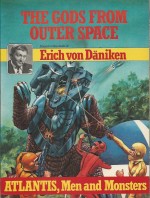
The Gods from Outer Space: Descent in the Andes


Inspired by the works of Erich von Däniken and freely interpreted by Alfred Górny, Arnold Mostowicz & Rosińskiego Bogusław Polch and translated from the German edition by Michael Heron (Methuen)
ISBNs: 0-416 87-150-X

In the West, Poland isn’t known for generating graphic novels or albums, although there has always been a thriving comics culture and many Polish creators have found fame in far-off lands.

As far as I can glean, this pithy, quirky science fiction speculation is the first of only four volumes to make a break across the borders and only then because of the notorious celebrity name attached to the project…

Once upon a time the ludicrous theories of Swiss author, convicted conman and fraudster Erich Anton Paul von Däniken captured the public imagination with his postulate that aliens had visited Earth in human prehistory and reshaped the destiny of our ancient ancestors.

Although mostly discredited these days, that tantalising kernel of an idea still persists in many places; and how different life might be if the imaginative and inventive writer had simply done what he should have with such a great notion and just made a cracking science fiction epic out of his “researches”…

Happily others have done just that and the result is a quirky yet enticing intergalactic generational saga that resulted in a mini-phenomenon in Poland which spread, despite it being the height of the Cold War, through Germany and thus on to a number of other nations in at least a dozen different languages.

In 1977, Alfred Górny, a publisher in the People’s Republic of Poland specialising in sports and tourism, contacted his counterparts at West German non-fiction outfit Econ Verlag with a proposition for creating a new and mutually profitable cartoon album series.

Górny wanted to produce the series in Poland and had lined up the superb Grzegorz RosiÅ„ski to draw it. Unfortunately the artist quit before the job began, instead accepting the job of illustrating sci fi barbarian series Thorgal for Jean Van Hamme in the prestigious French comic Tintin, after which the nation’s most prolific and popular comics artist, Jerzy Wróblewski (producer of over sixty albums and series including ‘Risk’, ‘Underground Front’ and ‘Captain Zbik’ between 1959 and his death in 1991: sadly there’s little chance of any of us seeing those state-sponsored Cold War classics these days, though) stepped in before dropping out.

Górny and scripter Arnold Mostowicz then settled on newcomer RosiÅ„skiego BogusÅ‚aw Polch – who later won a measure of international renown for sci fi/political/private eye thriller Funky Koval – to delineate their epic, if meandering, saga of alien civil war, primeval strife and the birth and destruction of a primordial lost civilisation as well as most of our world’s myths, legends and religions.

When finances and resources in the Warsaw Pact nation began to evaporate, Econ Verlag took on the international syndication responsibilities and the infamous strip took on a life of its own.

The result was eight original albums. ‘LÄ…dowanie w Andach’ (Landing in the Andes), ‘Ludzie i potwory’ (Men and Monsters), ‘Walka o planetÄ™’ (The struggle for the planet), ‘Bunt Olbrzymów’ (Giants’ Mutiny); ‘ZagÅ‚ada Wielkiej Wyspy’ (Great Island’s Doom), ‘Planeta pod kontrolÄ…’ (The Planet Under Control), ‘Tajemnica Piramidy’ (The Mystery of the Pyramid) and ‘Ostatni Rozkaz’ (the Last Command). The series was even rebound in two huge compilation volumes for Polish consumption: true collector’s items these days…

In 1978 British publisher Methuen Children’s Books (who also published Herge’s Tintin at the time) picked up the English language rights for the first four books and released them – complete with spurious fringe-science trimmings – to a largely unimpressed public.

Now, with time having stripped away the ludicrous faux facts and messianic furore underpinning the tales, I want to examine what is actually a pretty impressive and entertaining piece of speculative fiction dressed in a workmanlike and rather enthralling no-nonsense art style that will delight fans of illustrated storytelling…

The adventure begins millennia ago with Descent in the Andes, as a colossal flying saucer carrying hundreds of scientists from Delos in the Sagittarius Nebula establishes orbit above Earth.

The crewmen are all amnesiac, having had their memories wiped to better survive the rigours of a nine-year hibernation. Greeted by mission leader Ais and her subordinates Chat and Roub – an “Academy of Wise Rulers” – the space voyagers are swiftly re-educated; re-learning that the Great Brain of Delos has dispatched them all to find a new world, since their home planet is on the verge of annihilation. Moreover, although the voyagers have slept for nearly a decade, on Delos a thousand years have passed…

After a heated but fruitless debate about the possibilities of returning home, the men resolve to carry out their mission and colonise the blue planet below, using their incredible science to create a sub-species of themselves able to thrive on the alien world and propagate the culture and civilisation of Delos.

Once that is achieved the great ship will move on, finding more suitable worlds and repeating the procedure…

The Earth is a wilderness with abundant flora and fauna, teeming with potentially hostile micro-organisms, but the first explorers to make planet-fall discover that the true threat comes from lethal apex predators. Moreover, one of the apelike indigenous species has begun to make and master stone tools…

Tensions are high on the orbiting ship and Chat and Roub are increasingly at odds. Soon after a first land-base is established, the latter foments mutiny and forcibly attempts to make Ais his bed-mate. Not for the first time, the commander ponders the Great Brain’s wisdom in placing only one woman on the ship…

The colonists decide to create a labour force by domesticating the smart apes and chief scientist Zan discovers that they possess a close affinity to Delosian biology. With a little tinkering perhaps the primitives will be able to continue the legacy of Delos…

The mission begins to further unravel when the lonely, over-worked crewmen discover the primitives’ skill in fermenting alcohol and lapse into undisciplined fighting and cross-species fraternisation…

When Ais steps down hard on the drunken malcontents, Roub, who advocates scrubbing the mission and moving permanently to the welcoming world below, sees his chance to further undermine her. A crisis breaks when the fuel for the aerosondes – planetary transport shuttles – mysteriously runs critically low. Chat discovers and kills a saboteur at work and denounces Roub, but before they can come to blows a startling message announces the arrival of a second ship from Delos…

Meanwhile Zan’s experiments on the native females have concluded and his findings indicate that for the mission to succeed he will have to directly reconfigure the ape-beings’ genetic make-up, a step Ais is reluctant to consider…

As she and Chat supervise the construction of a vast landing field and base in a desolate mountainous region, complete with huge landing symbols carved directly into the terrain, Roub, determined to stay and control the new world, foments open rebellion. Intent on destroying the orbiting ship and forcing his people to settle on Earth, Roub rockets into space, with the determined Ais in hot pursuit. An horrific duel ensues and, driving him off the vessel, she follows the traitor back to Earth where Chat tracks him to his final fate in the deadly beast-filled jungles…

The colonists’ troubles are not over. The second expedition, under the command of Beroub, had set up operations on a far-distant continent, but when he unexpectedly arrives at the Nazca base, the leader of the back-up colony is dying from some unknown contagion. As Ais and Zan prepare to investigate, the master scientist notices that the natives are terrified, fleeing from some unseen, unsuspected phenomenon.

Hypothesising the worst, the troubled technologist swiftly tricks Chat into returning to the orbiting saucer in the last working aerosonde, as Ais and Zan take wing in a jet-powered aeroglider piloted by Beraud’s pilot Eness, just as the ground erupts in a devastating volcanic eruption…

The entire colony is wiped out, Chat is trapped in space and Zan and Ais have no choice but to head for unknown peril on the distant continent dubbed Atlantis…

To Be Continued…

There’s a bucket-load of plot and plenty of action packed into this colourful, oversized (292x219mm) 52 page tome, and the comfortingly clunky but exceedingly effective art by Polch is beguilingly seductive and something no traditional science fiction connoisseur could resist. Maybe it’s time to revive this lost series and even go looking for a few more of those embargoed comics classics from the Land of the White Eagle…
© 1978 Econ Verlag GmbH, Dusseldorf. English translation © 1978 Methuen Children’s Books, Ltd.

Suburban Nightmares: the Science Experiment


By Larry Hancock, Michael Cherkas, John van Bruggen & various (NBM)
ISBN: 978-0-91834-880-7

The huge outpouring of new comics which derived from the birth of American comicbooks’ Direct Sales revolution produced a plethora of innovative titles and creators – and, let’s be fair here – a host of appalling, derivative, knocked-off, banged-out plain and simple tat too.

Happily it’s my party and I choose to focus on the good and even great stuff…

The 1980s were an immensely fertile time for English-language comics-creators. In America an entire new industry had started with the birth of dedicated comics shops and, as innovation-geared specialist retail outlets sprung up all over the country, operated by fans for fans, new publishers began to experiment with format and content, whilst eager readers celebrated the happy coincidence that everybody seemed to have a bit of extra cash to play with.

Consequently those new publishers were soon aggressively competing for the attention and cash of punters who had grown resigned to getting their on-going picture stories from DC, Marvel, Archie and/or Harvey Comics. European and Japanese material began creeping in and by 1983 a host of young companies such as WaRP Graphics, Pacific, Eclipse, Capital, Now, Comico, Dark Horse, First and many others had established themselves and were making impressive inroads.

New talent, established stars and fresh ideas all found a thriving forum to try something a little different both in terms of content and format. Even smaller companies and foreign outfits had a fair shot at the big time and a lot of great material came – and, almost universally, as quickly went – without getting the attention or success they warranted.

Most importantly, by avoiding the traditional family sales points such as newsstands, more mature material could be produced: not just increasingly violent and with nudity but also far more political and intellectually challenging too.

Moreover, much of the “kid’s stuff” stigma had finally dissipated and America was catching up to the rest of the world in acknowledging that sequential narrative might just be a for-real actual art-form, so the door was wide open for gosh-darned foreigners to make a few waves too…

One of the most critically acclaimed and just plain fun features came from semi-Canadian outfit Renegade Press which, spun out by a torturous and litigious process from Dave Sim’s Canadian Aardvark-Vanaheim publishing outfit, set up shop in the USA and began publishing at the very start of the black and white comics bubble in 1984, picking up a surprisingly strong line of creator-based properties and some genuinely remarkable and impressive new series such as Ms. Tree, Journey: The Adventures of Wolverine MacAlistaire, Normalman, Flaming Carrot, the first iteration of Al Davison’s stunning Spiral Cage and the compulsive, stylish Cold War, flying-saucer paranoia-driven series The Silent Invasion amongst many others.

This stunningly stylish saga – which I simply must get around to soon – welded 1950s homeland terrors (invasion by Reds, invasion by aliens, invasion by new ideas…) with film noir and 20-20 hindsight and was a truly fresh and enticing concept in the Reagan-era Eighties, but of equal if not greater interest was the inclusion of ancillary back-up tales utilising the same milieu and themes which proved popular enough to springboard into their own short-lived title…

This first superbly oversized monochrome tome – a whopping 280 x 205mm – gathers that stand-alone material from The Silent Invasion and Suburban Nightmares with the three creators Larry Hancock, Michael Cherkas, John van Bruggen, and a few invited guests, playfully swapping jobs and pilfering/homaging other stylisations and forms to produce a delightful wealth of twisted tales and shocking stories that will, even now, astound fans of many classic genres such as sci-fi, horror, conspiracy theory, crime, romance and even comedy…

The 1950s in American was a hugely iconic and paradoxical time. Incredible scientific and cultural advancements and great wealth inexplicably arose amidst an atmosphere of immense social, racial, sexual and political repression with an increasingly paranoid populace seeing conspiracy and subversive attacks in every shadow and corner of the rest of the world.

Such an insular melting pot couldn’t help but be fertile soil for imaginative outsiders to craft truly incisive and evocative tales, especially when wedded to the nation’s fantastic –and ongoing – obsessions with rogue science, flying saucers, gangsterism and espionage…

In 1983 the temptation was clearly too much for the USA’s less panicky northern neighbours, and Hancock, Cherkas & Van Bruggen brilliantly mined the era for these stunning, stylish and clever yarns, subsequently pulling off the impossible trick of re-capturing a fleeting zeitgeist…

The macabre, mirth, mood and menace commences with the eponymous 4-part thriller ‘The Science Experiment’ (script by Hancock, pencils Van Bruggen, inks and letters from Cherkas) set in the early boom years of the 1950s, wherein an idyllic new town built on the edge of an operational government atomic bomb testing site slowly reveals its terrible dark secret…

In ‘Welcome to Green Valley’ the latest ultra-modern planned community in Nevada accepts new school science teacher Sam Donaldson and his wife Ruth with open arms. They’re the perfect nuclear family with son Rusty already making friends at Hoover High and another baby on the way. Soon they’re all getting on famously with everybody – or at least the adults are…

However, soon after flirtatious neighbour Theresa Morrow confides to Ruth that she’s also expecting, the poor thing has a minor fall. When the concerned Donaldsons warn the doctor, they receive the tragic but impossible news that Theresa has inexplicably died, but was “never pregnant”…

In the shadow of a fresh mushroom cloud, ‘An Ill Wind blows in Green Valley’ sees bereft Barry Morrow turning to drink whilst Sam meets Hospital administrator Dr. Stewart Carver; a keen fan and follower of the regular nuclear spectacle occurring fifty miles outside his office window…

Still unsettled, Sam checks out a few books about radiation from the local library, unaware that by doing so he’s made it onto a very special and secret list…

His concern increases when he inadvertently learns that his predecessor at Hoover High consulted the same tomes before mysteriously quitting and disappearing, but it’s Principal Daniels who panics when Donaldson finds that some of old Charlie Simmer‘s notes and school journals are languishing in a box at school secretary Madge‘s house…

Too busy and wrapped up to help his son Rusty with his science project, Sam goes to Madge’s house only to find she’s been burgled. Although the place has been ransacked the only thing missing is Simmer’s journals, but before he can process it all, Barry attacks Sam, accusing Donaldson of having had an affair with Theresa…

‘Dark Secrets of Green Valley’ finds Sam barracked by Principal Daniels, another atomic apologist who can’t contemplate any thought that radioactive fallout might be harmful. Whilst Ruth is having an ante-natal check-up, Carver confronts Sam and accuses him of scaremongering, confiding also that the hospital has been running a government-sponsored survey into radiation for years and that the atomic tests are categorically harmless…

Sam is unconvinced, especially as he has noticed how few young children live in the bustling town. Dwelling on the fact that the Hospital’s huge maternity unit has only one baby in it, he leaves with Ruth but all such thoughts are driven from him when Barry tries to run them down in the parking lot…

Horrific answers are forthcoming in the shocking conclusion when the now rational and repentant Barry meets the Sam and discloses his own part in a shocking conspiracy to cover-up what radiation does to foetuses and the outrageous and draconian steps taken by a panicking government desperate not to lose face…especially after spending so much money building the perfect City of Tomorrow…

The mysteriously low conception rate is explained at last but when Sam points out how Barry is still deluding himself and underestimating the lengths Carver has gone to, ‘The Fate of Green Valley’ inevitably culminates in a welter of blood and death…

After the compelling tension and trauma of the title tale, ‘Be Home Before it gets Dark!’ (scripted by Hancock and printed from Van Bruggen’s unlinked pencils) switches tone if not time-period as a little lad desperate to prove his bravery stays out late with the big kids and learns that sometimes there really are monsters in the night, after which ‘Buster Takes a Nap’ describes the problems that occur when a provident, prudent and friendly family promise too many friends and neighbours a place in their brand new bomb shelter. Of course they’ll never really have to honour those pledges, will they…?

‘The Inheritance’, with Cherkas tackling all the art chores, recounts a little boy’s tale about the scary man next door. We all know about those grouches; shouting, cursing, destroying kid’s toys and digging the gardens in the middle of the night, but this one was really mean. Perhaps that’s why so many kids ran away from home and were never seen again…

Stanley Morrison was ‘Just another Joe’ (script by Hancock, pencils Van Bruggen, inks Cherkas); a decent, loyal American in suburban Apple Hill who sold insurance and spent his spare time denouncing colleagues and neighbours to the FBI for un-American activities. It was mere coincidence that they all just happened to be more successful or popular than him. Of course, a guy like that is really hard to live with, but his long-suffering wife was a decent, loyal American too…

Veteran inker Bob Smith joined Van Bruggen & Hancock for the paranoid tribute to the earth-shattering advent of Rock ‘n’ Roll as Mrs. Ellen Nelson ruminates on why her son is acting so weird. What makes him hide in his room for hours at a time? It might be Martian abduction, atomic mutation, government meddling, commie mind-manipulation or something even worse ‘For all we Know’…

Bob Nevin always took the 7:13 train to his job in the city but his tidy, happy life began to instantly and inexplicably unravel the day he caught ‘The Seven-Thirty-Three’ in a surreal and chilling homage to the Twilight Zone pencilled by Cherkas and inked by Van Bruggen, whilst the edgily sardonic ‘Suburban Blight’ saw the illustrators trade places to recount the all-out war between a man and the dandelions that desecrated his otherwise perfect lawn before this splendid initial collection concludes with the Hancock & Cherkas fantasy ‘June 1953’ wherein diligent and hard-working Larry Hillman doesn’t come home one night…

When he turns up the next day Larry is a changed man. Now happy, calm and friendly, he quits his job, ignores all his responsibilities and begs his family to come with him when the aliens who abducted him return in a month to take them all to the perfect world of Alpha Centauri…

Crafted in a boldly adventurous range of visual styles and long-overdue for a modern revival, these beguiling and enthralling Suburban Nightmares are an unforgettable gateway to a eerily familiar yet comfortably exotic era and one no fan of thriller fiction can afford to ignore.
Suburban Nightmares: the Science Experiment ©1990 Michael Cherkas, Larry Hancock and John van Bruggen. Other stories © 1986, 1987, 1988 Michael Cherkas, Larry Hancock and John van Bruggen. All rights reserved. NBM Publishing

Video Clips


By Liberatore & various (Catalan Communications)
ISBN: 978-0-87416-015-4
(1985) ISBN-10: 0874160154 Dimensions: 8.5 x 0.2 x 11 inches

Italian arts superstar Gaetano “Tanino” Liberatore was born in 1953 in Quadri in the province of Chieti. He went to school in Pescara and studied architecture at the University of Rome before moving into the world of work as an advertising illustrator in 1975.

He first met iconoclastic writer, artist and publisher Stefano Tamburini in 1978 and with strident activist cartoonist Andrea Pazienza, they created ‘Rankxerox’ for the magazine Cannibale. The character evolved and moved to Il Male and eventually Frigidaire, fully realised now as the RanXerox we know today.

Liberatore was rapidly developing as both artist and writer, with strips ‘Bordello’ and ‘Client’ appearing in Il Male, but when the new, Tamburini-scripted syndicated RanXerox became a star of French magazine L’Écho des Savanes in 1981, Tanino moved to Paris and began working simultaneously on short complete tales for the more prestigious Gallic market in such magazines as Tranfert, Métal Hurlant, À Suivre and Chic. A shocking hit in the US Heavy Metal magazine, RanXerox then led to Liberatore jumping the pond and producing material for Twisted Tales and men’s magazine Hustler.

Some of those aforementioned short fiction pieces comprise the contents of this bleakly disturbing, ultra-violent yet oddly philosophical exploration of the consuming effects of media and fashion.

When his great collaborator Tamburini died in 1986, Liberatore quit comics for nearly a decade. Returning to straight commercial illustration, he worked in movies and designed book and record covers. Eventually, comics captured his attention again, and he produced two new RanXerox tales in 1993 and 1996 (with Jean-Luc Fromental and Alain Chabat), and a piece in Batman Black and White, assorted covers, and illustrated Pierre Pelot and Yves Coppens’s mass-market paperback ‘Le Rêve de Lucy’. As the Nineties closed, he finally came storming back in stunning style with the brilliant, award-winning Lucy L’Espoir in 2007, in which he and writer Patrick Norbert freely adapted a life-story for the famous prehistoric humanoid Australopithecus Afarensis remains found by anthropologists Coppens, Donald Johanson and Maurice Taieb.

Still available but desperately in need of a modern re-release, Video Clips gathers seven short, sweet and sour, vitriolic, challenging thrillers by the stylishly abrasive young Liberatore beginning with the self-authored ‘Real Vision’ in which a young celebrity-fuelled punk commits atrocious acts of violence on a mother and child simply to commit “suicide by television” after which the Tamburini-penned ‘Earth versus Saturn’ turns a wickedly sardonic eye on movie mania as a scout party for invading aliens picks the wrong bar to begin their fact finding mission. Of course, it would have helped if they hadn’t used thirties movies stars as templates for their temporary Earth-bodies…

He also scripted ‘E.M.P.S.: Erotic Management for People’s Socialism’ – an outrageous spoof of psychology, political correctness and sexual repression in a hilarious and shocking science fiction setting, whilst the deeply disturbing ‘Shut-In’ by Bruce Jones might be familiar to older American readers as it first appeared in Twisted Tales #7, detailing the saucy, savage hidden hi-jinks of a babysitter and her abusive jock boyfriend as they mischievously tend to a stroke-paralysed senior citizen one night – and of course there’s a superb sting in this tale…

‘Bololy Folly’ is another Tamburini psycho-thriller as the latest technology to tame “wild chromosomes” and bad behaviour cataclysmically comes a-cropper on live television whilst ‘Watch Out for Hot Flashes’ – scripted by the enigmatic G. Setbon – offers a more traditional tale as the world’s greatest fashion model offers an exclusive chance to the photographers who made her famous. Sadly she’s the one doing the shooting but her murderous motives simply defy all logic…

This powerfully compelling collection ends with another Tamburini tale as ‘Tiamotti’ describes the trials of three bomb-making anarchists as they try to defeat a security system which can read their minds and deliver a fusillade of withering gunfire in the blink of an eye…

Crafted in a range of palettes from tension-wracked monochrome line-art to tantalising tonal washes, and even including three lush full-colour paint jobs, this sexy, severe and staggeringly violent tome is a superb introduction to the graphic genius and brutal worlds of Liberatore: places no adult fan of sequential narrative can see without being changed forever…
Art © 1985 Gaetano Liberatore. All stories © 1985 their respective authors. English language edition © 1985 Catalan Communications, All rights reserved.

Rebel


By Pepe Moreno & others (Catalan Communications/IDW)
ISBN: 978-0-87416-020-8 (1986)      978-1-60010-495-4 (2009)

Born in 1954, Spanish creator Pepe Moreno began his comics career, illustrating for horror and adventure anthologies and children’s papers such as S.O.S., Pumby and Pulgarcito, Star and Bliz.

He moved to America in 1977, briefly working for Jim Warren’s Creepy, Eerie 1984/1994 and Vampirella titles, as well as humour magazine National Lampoon before gravitating to Heavy Metal where his short, uncompromising post-punk strips (collected in the album Zeppelin) caught the attention of Epic Illustrated editor Archie Goodwin.

The breakthrough strip Generation Zero led to the graphic novel Rebel, as well as successor’s Joe’s Air Force and Gene Kong, but ever-restless, Moreno’s growing fascination with technology led him first into animation (Tiger Sharks, Thunder Cats and Silver Hawks) and eventually into the budding, formative field of computer illustration, resulting in a return to comics for the high-profile computer-generated futuristic Batman thriller Digital Justice.

He created an early CD-ROM thriller with Hellcab in 1993 and, these days, spends most of his time working in high-end video games.

Imagined and executed in the politically contentious and conservative mid-Eighties when dystopian dreams of fallen empires abounded and post-apocalyptic survivalism was the prevailing zeitgeist, Rebel – conceived and illustrated by the Spaniard and scripted by English-speakers Robb Hingley, Pete Ciccone & Kenny Sylvester (with an additional tip of the hat to Charis Moe) depicted, in a blaze of pop-art style and colour a future that never came…

2002AD: when Rockabilly gangs, Mohawks, Asian Zeros, Skinheads and a dozen other fashion-punks tribes warred and raced weaponised Hot-rods amidst the fallen skyscrapers of New York, whilst the authorities in absentia used their draconian Sanitation Police to cleanse the streets of young scum…

After a second Civil War and the fall of American civilisation, “decent” men and women retreated to purpose-built Cosmo City and left the Big Apple to rot. Now, decades later, gangs scavenge the shambles for food, tech and fuel for their hybridised, customised vehicles whilst the new civilisation’s fascistic forces attempt to re-establish order. However Sanitation Police commander Major Kessler, working closely with decadent Skinhead overlord Doll, is hiding a dark secret: every deviant captured either ends up a gladiator in slave games or spare-parts for a thriving organ-legging racket to extend the worthless lives of the elite of Cosmo…

After another destructive drag race through the streets, a number of gangers are arrested under the spurious “Social Hygiene Act” but a hidden sniper quickly and efficiently despatches the smugly murderous cops. The grateful bad boys have been saved by a legendary urban warrior – Rebel…

The mystery man has built a close-knit team from his base in Brooklyn and, when a supply run to scavenge food, fuel and beer leads to a pitched street battle with rival Black Knights, the scabrous Doll points out the hero to his paymaster with a scheme to end the charismatic leader’s resistance.

Kessler, however, recognises an old friend and deduces Rebel’s true identity…

Even as the assorted gangs fruitlessly and perpetually battle each other, Rebel is trying to organise a concerted resistance to the Cosmo City invaders. As well he might, since years ago when they were an honest army of liberation, he was one of their greatest soldiers.

Once the war was over and the victors became as bad as the oppressors they had overturned, the disillusioned and dangerous Lt. Lawrence disappeared and Rebel was born…

As Kessler organises a massive armed response in New York to ferret out the traitor, Rebel springs a brilliant tactical attack and decimates the Sanitation Police forces. In the aftermath, subversives from Cosmo approach him, begging the forgotten warrior to return and overturn the corrupt government of the austere super-city…

However, when the troubled Rebel returns to his Brooklyn base, he finds a scene of torture and carnage. Doll and his savage minions have destroyed the citadel and taken Lawrence’s lover Lori hostage.

Chained naked to the spire of the single remaining tower of the ancient World Trade Center, she is helpless, tantalising bait which Rebel cannot resist. Even so, not only must the living legend storm a tower filled with brutal thugs who hate his guts, but unknown to all, Kessler has engaged an entire division of helicopter gunships to eradicate the inspirational leader’s threat forever…

But the Rebel has a plan. A bold, spectacular impossibly dangerous plan…

Mythical, ultra-violent and rather nonsensical in strictly logical terms, Rebel is a powerful and exuberant paean to the fashions, memes and visual tropes of that tumultuous era, moulding social fantasy and grinding realpolitik into a graphic rollercoaster ride that combines the grimy meta-reality of Mad Max and Escape from New York with the gaudy, glitzy flourish of Xanadu and the dour stylish pessimism of Brazil.

In 2009 IDW and Digital Fusion released a remastered and expanded edition in a reduced page size (260x165mm as opposed to the original’s 269x208mm album format) with computer-enhanced colour that sadly sacrificed much of the vivid, pinball and poster hues which made the original such a quirky treat, but as both are still readily available online, one quick look at the teaser art for each should enable you to pay your money and make your preferred taste choice…
© 1986 Pepe Moreno. English language edition © 1986 Catalan Communications. All rights reserved.

Star Trek the Manga volume 1: Shinsei Shinsei (“New Lives/New Stars”)


By Chris Dows, Joshua Ortega, Jim Alexander, Mike W. Barr, Rob Tokar, Makoto Nakatsuka, Gregory Giovanni Johnson, Michael Shelfer, Jeong Mo Yang & EJ Su (Tokyopop)
ISBN: 978-1-59816-744-3

Whilst the stellar Star Trek brand and franchise might not have actually reached any new worlds yet, it certainly has permeated every civilisation here on Earth, with daily live-action and animated screen appearances appearing somewhere on the planet almost every hour and comics iterations generated in a host of countries long lying fallow and unseen.

If only somebody could sort out the legal and logistical hassles so we could see again the stunning UK strips which appeared in Joe 90, TV21, TV Comic and Valiant from such fabulous creators as Angus Allan, Harry Lindfield, Mike Noble, Alan Willow, Ron Turner, Jim Baikie, Harold Johns, Carlos Pino, Vicente Alcázar, John Stokes and others, I could die a happy boy…

In 2006, to celebrate the 45th anniversary of the phenomenon, and capitalising on the global boom in Japanese styled comics, Tokyopop began releasing a series of all new manga adventures starring the indomitable crew of the Starship Enterprise as they boldly went all over the universe, courtesy of a serried band of international comics creators…

This initial monochrome masterpiece kicks off with ‘Side Effects’ by Chris Dows & Makoto Nakatsuka, and finds Captain Kirk, Science Officer Spock, Dr. McCoy and Ensign Pavel Chekov investigating a derelict ship which houses unsuspected horrors. Aboard the aged vessel are bodies from many species, displaying the hideous evidence of ruthless biological and mechanical augmentation…

When they release an exotic woman who appears to be the only survivor, she attacks them and infects Chekov with a virulent mutagenic virus whilst the other “corpses” revive and converge on them…

Although they beam back to the relative safety of the Enterprise, when a colossal vessel emerges from a wormhole, the derelict and Federation ship are swiftly snagged in a tractor beam and pulled into the time-dilation field of a Black Hole, seemingly harnessed to a ramshackle space-station.

Lost in space and time, Kirk beams a party over to the satellite in search of a cure for the disease ravaging Chekov, only to find the same unstoppable woman devastating the equally-infected remnants of an ancient civilisation who have sheltered aboard the station for centuries. Chief scientist Mynzek has been seeking a cure for untold ages, experimenting on volunteers and captives alike, but with success in his grasp at last, his latest subject has returned with vengeance in mind and her own all-assimilating agenda…

With resistance futile and the station rapidly self-destructing, Spock manages to secure a blood-sample to save Chekov, and the Enterprise quickly hurtles back through the wormhole and to the 23rd century, utterly unaware of the universal threat that will grow over the millennia from the last gasp of a desperate, dying civilisation and its first cyborg queen…

‘Anything But Alone’, by Joshua Ortega & Gregory Giovanni Johnson, sees the Enterprise orbiting an unknown world in response to a mysterious signal. Beaming down, Kirk, Spock and McCoy discover the thriving survivors of a long dead civilisation, maintained by miraculous nano-machines which can construct anything the people could possibly need. However the gracious, welcoming, childless citizens of Ximega II are concealing a tragic secret which only head scientist Prekraft seems willing to reveal. Moreover, he seems to going crazy with loneliness…

”Til Death’ (Mike W. Barr & Jeong Mo Yang) opens with Captain Kirk performing one of his more pleasant duties by officiating at the wedding of crewmembers Becky Randall and Tom Markham whilst the Enterprise scans a long-dead planet. However when dormant automated systems begin firing on the ship from separate locations, the survey mission switches to investigation mode and two landing parties beam down to find the shattered remnants of a civilisation which clearly self-destructed.

Retrieving twin sarcophagi which have somehow survived the holocaust, the explorers return to the Federation vessel, but soon inexplicable events begin to disrupt the ordered running of the ship and discipline of the crew…

The elaborate electronic coffins had each contained a withered husk and, momentarily forgotten as friends and lovers increasingly turn on each other, power is leeched from ship’s systems to rejuvenate the interred aliens. Soon the telepathic tyrants Faron and Nadira are fully restored and ready to finally end the hate-fuelled gender-war which pitted male against female and eradicated all life on their world. How lucky that there are so many men and women on the ship to act as their drones. But how unfortunate that one is a coldly dispassionate telepathic half-breed whose best friend is the most stubborn man in the galaxy…

A diplomatic mission to end an interplanetary conflict sees the Enterprise acting as a cargo courier, shuttling peace-making gifts between warring worlds. But whilst the entrancing emotion-reactive screen entitled The Weave by its Xoxxan craftsmen delights and beguiles all who regard it, the cutely appealing sacred animal ‘Oban’ genetically  recreated by the Xanvians conceals a monstrous and deadly secret which only becomes apparent when an unfortunate accident releases a mind-boggling, indestructible horror on the ship…

Faced with the prospect of renewed war, Kirk and Spock must determine if a maverick dissident, a duplicitous government or an impossible freak occurrence has endangered the tenuous peace process in a compelling political thriller by Jim Alexander & Michael Shelfer.

The manga action ends in classic style with ‘Orphans’, by Rob Tokar & E.J. Su, as the Enterprise performs escort duty for a peaceful space-faring race plagued by piracy. However the Lowarians and James T. Kirk have sadly underestimated the determination of the Haarkos, whose one-man raider-craft were shaped like humanoid robot-knights – complete with gigantic, lethal swords and shields…

When the battle-crazed mecha attack the starship, the lead pilot loses her life and another is captured before the Enterprise’s superior firepower drives off the rest of the pack, leaving Kirk with the impossible task of trying to reason with a merciless, ten-year old boy-soldier trained to kill from infancy.

If Kirk cannot find a way to reason with the honour-obsessed, battle-hardened warrior Xill he may have no choice but to exterminate all of these brutal, suicidal children who are as much victims as the race they now prey upon…

This particular edition (there are three counting a Diamond Distributor Exclusive and a Convention Special Exclusive) also includes the moving short-story ‘First, Do No Harm’ (by Dayton Ward & Kevin Dillmore from the prose Star Trek anthology Constellations) which details an unpleasant and unwelcome mission to extract rogue doctor Revati Jendra from the closed, primitive world of Grennai.

The fugitive medic’s actions contravene the Prime Directive and daily endanger the social development of the entire planet, even though she perfectly blends in with the natives and saves lives in a manner no patient would ever suspect as being beyond planetary norms…

However, as her close friend of twenty years, Leonard McCoy knows that there must be a damned good reason for her actions, whilst Kirk and Spock are more concerned by Starfleet’s suspicious wall of “classified” and “top security” roadblocks surrounding every aspect of her first expedition to Grennai decades ago…

Full of the verve, sparkle and wide-eyed enthusiasm of the original TV show, these continuing adventures are a real treat, and even if the manga visuals are a bit of a shock at first, you’ll soon adapt and surely settle in for another splendid ride on the timeless rollercoaster ride that is Star Trek…
™, ® & © 2006 CBS Studios Inc. All rights reserved.

Shade the Changing Man: the American Scream


By Peter Milligan, Chris Bachalo, Mark Pennington (Vertigo)
ISBN: 978-1-84023-716-0 (1990)      978-1401200466 (2009 edition)

Even before DC hived off its “Mature Readers” sophisticated horror/hero series to become the backbone of the self-sustaining Vertigo line in 1993, the company had begun to differentiate between standard all-ages superhero sagas, new stand-alone concepts like Gilgamesh II, Skreemer, Haywire or World Without End and edgy, off-the-wall, quasi-costumed fantasy and supernatural suspense titles as Doom Patrol, Black Orchid, Animal Man, Sandman, Hellblazer and Swamp Thing. Perhaps the most radical and challenging was a darkly psychedelic reworking of Steve Ditko’s lost masterpiece of modern paranoia Shade the Changing Man. 

In the original 1977 series Rac Shade was a secret observer from the other-dimensional realm of Meta-Zone, who was framed and went rogue; using stolen technology to combat a wave of insanity that emanated from “the Area of Madness” within the Zero-Zone which separated his world from ours. The madness threatened both universes and Shade was determined to stop it, despite the best efforts of sinister self-serving forces from Earth and Meta determined to destroy him.

When Peter Milligan, Chris Bachalo & Mark Pennington began to rework the character much of the Ditko concept remained but was brutally tweaked for the far more cynical and worldly readers of the Blank Generation…

This initial collection re-presents the first six issues of the new Shade from July-December 1980 and introduces deeply disturbed Kathy George, patiently awaiting the final sanction on spree-killer Troy Grenzer. Years ago the unrepentant psychopath butchered her parents and almost her too, and when her black boyfriend tackled the knife-wielding manic the Louisiana police shot her saviour instead of the white assailant…

Now in the final hours before Grenzer finally sits in the electric chair on ‘Execution Day’ Kathy is experiencing wild hallucinations. That’s nothing new: following the deaths of everyone she’d ever loved, Kathy was committed to an asylum until her inheritance ran out and she was released, apparently “too poor to be crazy” anymore.

Becoming a thief and a grifter, she wandered America until a radio report informed her that Grenzer was about to be put to death and Kathy inexplicably found herself heading back to Louisiana…

On Death Row things weren’t going according to plan. Bizarre lights, strange visions and electrical phenomena interrupted the execution and, as a fantastic reality-warping explosion occurred, Grenzer’s body vanished…

On a hillside overlooking the prison Kathy was pursued by an animated electric chair and Troy Grenzer materialised in her car – only he claimed not to be the serial killer but Rac Shade, a secret agent from another dimension who had left his own body in an otherworldly Area of Madness and mentally occupied the now-vacant corpse of the serial killer.

It wasn’t the craziest thing Kathy had ever heard and even if it wasn’t true at least she had a chance to personally kill the man who had destroyed her life…

As the drove away together insane things kept happening and Shade explained that his journey had caused a rupture in the fabric of the universes – a trauma in Reality…

Slowly acclimatising, Shade explains that his original body is clad in experimental technology and this “M-Vest” connects his subconscious to the chaos of the Madness zone. His job was to come here and stop a plague of materialised insanity threatening both worlds, but he’s actually given it easier access to ours…

After a climactic struggle with her own ghosts and traumas, Kathy reluctantly agreed to help the semi-amnesiac Shade in his mission…

Meanwhile at the Famhouse Mental Hospital uncanny events were culminating in a ghastly reordering of people and matter itself: a horrific nigh-sentient phenomenon dubbed “the American Scream” had broken through from somewhere else and threatened all life and rationality on Earth.

With casual daydreams, flights of fantasy and vicious whims increasingly given substance and solidity, the government, well aware of the crisis, dispatched Federal Agents Stringer and Conner to investigate…

The quest proper began as the fugitives from justice trolled through the hinterlands of American Culture and its Collective Unconscious, ending up in Dallas where obsessed author Duane Trilby, determined to discover ‘Who Shot JFK?’, found himself conversing with the tarnished martyr himself as the murdered president returned to the scene of the crime and the city started to literally unravel, with a giant idolatrous bust of the victim bursting through the tarmac of Dealey Plaza, incessantly screaming for answers…

The chaos affected Shade, and the last vestiges of Grenzer’s personality kept repossessing the body they shared, determined to at last add Kathy to his tally of victims, whilst Agents Stringer and Conner, convinced that she is connected to Grenzer’s abrupt disappearance from his own execution, followed her to Texas…

With madness rampant, Shade and Kathy were drawn into Trilby’s materialisation of events, becoming JFK and Jackie, inexorably heading toward death in that open-topped car…

The measured insanity continued in ‘All the President’s Assassins!’ as Trilby saved Shade/JFK and slowly revealed his own personal tragedy: one which drove him to solve an impossible conundrum and avoid an agonising admission.

All the while the Metan’s consciousness was being dragged into a succession of traumatised participants and realised that he must defeat this outbreak of the American Scream quickly or surely fragment and die…

Escaping into his own past on Meta in ‘Mad, Bad and Dangerous to Know’, Shade physically re-experienced his early life whilst in Dallas Stringer and Conner apprehended Kathy. A lovelorn, impressionable poet, young dropout Rac Shade was tricked into becoming an agent and sent to Earth because it was apparently the source of devastating waves of insanity plaguing Meta, but he was sucked into the Area of Madness and met the American Scream face to face…

Falling back to Earth, Rac freed Kathy and they fled, arriving in Los Angeles in time to struggle with the dark underbelly of the film industry as it came to murderous, sadistic life and began stalking the stars and moguls who created the vicious yet glorious land of dreams.

First singled out were the cast and crew of in-production zombie epic “Hollywood Monsters’, who endured shame and career destruction as impossible film-clips of their deepest secrets and darkest transgression became to appear. Soon after, the mutilations and deaths began, before a psychedelic crescendo was reached in ‘Hollywood Babble On II’ with Shade and Kathy fighting their way through a physically realised and highly biased history of Tinsel Town triumphs and travesties, before seizing control of the noxious narrative and beating the Madness at its own game…

Darkly ironic, blackly comedic, gripping and dripping with razor-edged social commentary, Shade the Changing Man adds a sparkling brew of sardonic wit to the horror and action staples of the medium and remains one of the most challenging and intriguing series in comics.
© 2003, 2009 DC Comics. All Rights Reserved.

Valerian and Laureline book 3: the Land Without Stars


By Méziéres & Christin, with colours by E. Tranlé and translated by Jerome Saincantin (Cinebook)
ISBN: 978-1-84918-087-0   (Dargaud edition) 2-205-06573-4

Valérian is the most influential science fiction comics series ever drawn – and yes, that includes even Buck Rogers, Flash Gordon, Dan Dare and Judge Dredd.

Although to a large extent those venerable strips defined and later re-defined the medium itself, anybody who has seen a Star Wars movie has been exposed to doses of Jean-Claude Méziéres & Pierre Christin’s brilliant imaginings which the filmic phenomenon has shamelessly plundered for decades: everything from the character and look of alien races and cultures to the design of the Millennium Falcon and even Leia‘s Slave Girl outfit …

Simply put, more carbon-based lifeforms have experienced and marvelled at the uniquely innovative, grungy, lived-in tech realism and light-hearted swashbuckling rollercoaster romps of Méziéres & Christin than any other cartoon spacer.

The groundbreaking series followed a Franco-Belgian mini-boom in fantasy fiction triggered by Jean-Claude Forest’s 1962 creation Barbarella. Valérian: Spatio-Temporal Agent launched in the November 9th, 1967 edition of Pilote (#420) and was an instant hit. In combination with Greg & Eddy Paape’s Luc Orient and Philippe Druillet’s Lone Sloane, Valérian‘s hot public reception led to the creation of dedicated adult graphic sci-fi magazine Métal Hurlant in 1977.

Valérian and Laureline (as the series eventually became) is a light-hearted, wildly imaginative time-travelling, space-warping fantasy teeming with wry, satirical, humanist action and political commentary, starring – in the early days at least – an affable, capable, unimaginative and by-the-book cop tasked with protecting the official universal chronology by counteracting paradoxes caused by casual time-travellers.

When Valérian travelled to 11th century France in the initial tale ‘Les Mauvais Rêves (‘Bad Dreams’ and still not translated to English yet) he was rescued from doom by a fiery, capable young woman named Laureline whom he brought back to the 28th century super-citadel and administrative capital of the Terran Empire, Galaxity. The indomitable lass subsequently trained as a Spatio-Temporal operative and began accompanying him on his missions.

Every subsequent Valérian adventure until the 13th was initially serialised weekly in Pilote until the conclusion of ‘The Rage of Hypsis’ after which the mind-boggling yarns were only published as all-new complete graphic novels, until the whole spectacular saga resolved and ended in 2010.

The Land Without Stars originally ran in Pilote #570-592 (October 8th 1970 to March 11th 1971) and followed the Spatio-Temporal agents as they went about a tedious pro forma inspection of a cluster of new Terran colonies in the Ukbar star-sytem at the very edge of inter-galactic space…

However the mission soon goes awry when a wandering world is detected on a collision course with the system and Valerian, still suffering the effects of too much local alcoholic “diplomatic protocol” decides that they should investigate at close quarters…

Despite being pickled, the lead agent lands with his long-suffering assistant on the runaway planet and discovers that the celestial maverick is hollow. Moreover, a thriving ancient culture or three dwell there, utterly unaware that they are not the only beings in all of creation…

Typically however of sentient beings everywhere, two of the civilisations are locked in a millennia old war, armed and supplied by the third…

After an accident wrecks their exploratory scout ship Valerian and Laureline deduce that the constant warfare originally caused the hollow world to tumble unchecked through space and will eventually cause its complete destruction, so in short order the professional meddlers split up to infiltrate the warring nations of Malka and Valsennar.

However they are in for a surprise since both city-states are divided on gender grounds, with Malka home to prodigious warrior women who subjugate their effete and feeble males whilst the aristocratically foppish but deadly dandies of Valsennar delight in beautiful, proficient and lethally lovely ladies – but only as compliant servants…

The highly trained Galaxity operatives quickly rise in the ranks of each court – from slaves and toys to perfectly placed, trusted servants – and soon have ample opportunity to change the nature of the doomed civilisations within the collision-course world, after which the heroes even concoct a canny and cunning method of spectacularly ceasing the planet’s random perambulations; giving it a stable orbit and new lease on life…

All in a days work, naturally, although it did take a few months to sort out: still what’s time to a couple of brilliant Spatio-Temporal agents?

Happily, this mind-boggling forty-year old social and sexual satire is packed with astounding action, imaginative imagery and fantastic creatures to provide zest to a plot that has since become rather overused – sure proof of the quality of this delightful, so-often imitated original yarn – but as always the space-opera is fun-filled, witty, visually breathtaking and stunningly ingenious.  Drenched in wickedly wide-eyed wonderment, science fiction sagas have never been better than this.

Between 1981-1985 Dargaud-Canada and Dargaud-USA published a quartet of these albums in English (with a limited British imprint from Hodder-Dargaud in the UK) under the umbrella title Valerian: Spatiotemporal Agent and this tale, then called World Without Stars, was the second release, translated then by L. Mitchell.

Although this modern Cinebook release boasts improved print and colour values and a far better and more fluid translation, interested completists might also want to track down the 20th century releases for the added text features ‘Valerian: Graphic Renaissance’ by acclaimed SF author William Rotsler, the appreciation ‘In Science Fiction’s Net’ by French genre writer/illustrator Jean-Pierre Andrevon and the extensive biographies and work check-lists of creators Pierre Christin & Claude Méziéres…

© Dargaud Paris, 1972 Christin, Méziéres & Tran-Lệ. All rights reserved. English translation © 2012 Cinebook Ltd.

Mutant World


By Richard Corben & Jan Strnad & various (Fantagor Press)
No ISBN: ASIN: B000EIU99A

Richard Corben is one of America’s most influential and gifted creators of graphic narrative: an animator, illustrator, publisher and cartoonist who began surfing the tumultuous wave of independent counterculture commix of the 1960s and 1970s and became a major international force in pictorial storytelling with his own unmistakable style and vision.

He is renowned for his mastery of airbrush and captivatingly excessive anatomical stylisation, all couched in an infamous predilection for delightfully wicked, darkly comedic horror and beguiling eroticism which permeates his horror, fantasy and science fiction tales.

Always garnering huge support and acclaim in Europe, he was regularly collected in luxurious albums (such as this Spanish-sponsored tome from Catalan Communications) even as he fell out of favour – and print – in his own country.

Post-Apocalyptic worlds figure prominently in Corben’s back-catalogue and the lighter side of Armageddon features heavily in this raucous and subversively black collection of vignettes from the artist and his long-term collaborator Jan Strnad. The story collected here was originally serialised in Heavy Metal magazine – albeit rather severely over-edited – and this collection restores the original text and intent.

After explanatory introductions from both Corben and Strnad, the hilarious horrors begin with a ‘prolog’ which introduces the shattered New World and its most sympathetic survivor: a mightily-thewed but intellectually challenged goof dubbed “Dimento”…

In the glowing rubble of civilisation hunger is everywhere and almost everything left alive wants to eat everything else, but when Dimento attacks a beautiful woman’s horse, she talks him out of his planned meal and stirs other longings in his simplistic, child-like heart. In gratitude for his forbearance, the buxom Julie directs him to stash of giant eggs, but en route he encounters mean old mutant bullies Zug, Dimlit and Weasel who waylay him and steal his meal.

It’s a theft one of the deformed bandits doesn’t live to regret…

The bound and gagged Dimento is still not safe however and is soon grabbed by yet another mutant predator and dragged off to be consumed. The child-like colossus is then saved by a warrior-priest who bears an uncanny resemblance to the hapless half-wit. Taken under the priest’s wing, Dimento becomes his beast of burden as Father Dove leaves the city for the trackless deserts that surround it. When sudden death comes for the violence-obsessed cleric the once-again solitary simpleton heads back to the destroyed cityscape he knows best…

Soon he has lost the food he “inherited” from Father Dove to weaker but smarter scavengers and when he sees again his beloved Julie she promptly betrays him to a ravaging gang to save her own unblemished skin…

After a Herculean effort the mighty waif breaks free and the marauders take out their anger and frustration on her. Unable to stand the sound of her screams the heartbroken Dimento rushes back to save her…

Unknown to everybody on the surface human civilisation did not end when The War began and observers from below constantly monitor the devastated world above. When one of them, Max, breaks protocol and attempts to save the dying woman, it opens the doors to a technological hell where callous geneticists dabble with the last of mankind’s children, creating a stream of monsters and rejects in their attempts to reshape humanity for the ruined new world…

As the origins of Dove, Dimento and many others are revealed, the terrified and confused man-child lashes out with unexpected savagery…

This spectacular Ragnarok fable also contains eight beautiful new pages to complete and conclude the poignant, savage and twisted love story of a mysteriously capable, simple survivor in a world he was literally born to inherit…

Explosively violent, trenchant, doom-laden, erotically charged and brutally funny, this seminal saga perfectly captured the tone of the times as the last days of Mutually-Assured-Destruction Cold War politics staggered to a close, and Strnad’s taut dialogue exemplifies the “just bomb us and get it over with” attitude that gripped a generation of kids fed up with waiting for the Big One. Moreover, Corben’s sublime acumen in depicting humanity’s primal drives in ludicrous extremis has never been better exemplified than here.

This marvellously mordant book is a tale no comics or fantasy fan should be without.
© 1982 Richard Corben and Jan Strnad. All rights reserved.

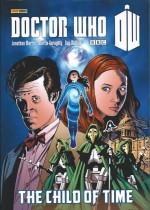
Doctor Who Graphic Novels volume 13: The Crimson Hand


By Dan McDaid, Martin Geraghty, Mike Collins & various (Panini Books)
ISBN: 978-1-84653-451-5

Doctor Who launched on television in the first episode of ‘An Unearthly Child’ on November 23rd 1963. Less than a year later his decades-long run in TV Comic began with issue #674 and the premier instalment of ‘The Klepton Parasites’. On 11th October 1979 (although adhering to the US off-sale cover-dating system so it says 17th) Marvel’s UK subsidiary  launched Doctor Who Weekly, which became a monthly magazine in September 1980 (#44) and has been with us under various names ever since.

All of which only goes to prove that the Time Lord is a comic hero with an impressive pedigree…

Marvel/Panini is in the ongoing process of collecting every strip from its archive in a uniform series of over-sized graphic albums, each concentrating on a particular incarnation of the deathless wanderer. This particular one gathers stories from issues Doctor Who Magazine or DWM #394, The Doctor Who Storybook 2010 and DWM #400-420, (originally published between 2008 and 2010): all featuring the escapades of the David Tennant incarnation of the far-flung Time Lord.

This is actually the third – and final – collection of strips featuring the Tenth Doctor and whether that statement made any sense to you largely depends on whether you are an old fan, a new convert or even a complete beginner.

None of which is relevant if all you want is a darn good read. All the creators involved have managed the ultimate ‘Ask’ of any strip creator – to produce engaging, thrilling, fun strips that can be equally enjoyed by the merest beginner and the most slavishly dedicated fan.

After an effusive introduction from series re-creator Russell T. Davies, the full-colour graphic grandeur begins with a one-off romp from 2008 entitled ‘Hotel Historia’ by writer/artist Dan McDaid, wherein the Good Doctor fetches up in a spectacular resort for time-travellers and first encounters the pushy and obnoxious corporate raider Majenta Pryce and uses her shoddy and slipshod time-technology to counter a threat from the chronal brigands known as the Graxnix.

This is riotously followed by a delightful clash with ‘Space Vikings’ (by Jonathan Morris, Rob Davis & Ian Culbard, from the 2010 Christmas Doctor Who Storybook) wherein the slave-taking star-rovers prove to be far less than they at first appear…

The main body of stories here formed something of an experiment as DWM #400-420 were designed as an extended story-arc leading up to the big change on television where Matt Smith would replace Tennant as “the Eleventh Doctor”.

Therefore McDaid was tasked with scripting the entire 21 issue run and began by reintroducing scurrilous money-mad chancer Majenta Pryce in ‘Thinktwice’ (#400-402, illustrated by Martin Geraghty & David A. Roach); an intergalactic penal institution with some decidedly off-kilter ideas on reforming prisoners.

Pryce is a prisoner but has amnesia. So does her cellmate Zed and in fact, most of the convicts aboard. The supposedly cushy debtor’s prison is in fact a horror-house of psychological abuse where suicide is endemic, maintained by the creepy Warden Gripton who is messing with the inmates’ memories to satisfy the hungers of something he calls “memeovax”…

Luckily the new prison doctor “John Smith” is a dab hand with the Sonic screwdriver…

With her memory far from restored the wickedly entrepreneurial Majenta becomes the unlikeliest of Companions as she demands that the “legally liable” Doctor makes restitution for all the trouble he’s caused by ferrying her to the planet Panacea where she can be properly cured. As we all know however, the Tardis goes where She wants and at Her own pace…

‘The Stockbridge Child’ (#403-405 with art from Mike Collins & Roach) deposits the unhappy partners to that peaceful English village where three different incarnations of the Time Lord have encountered incredible alien incursions. When the Doctor is reunited with outcast skywatcher Maxwell Edison they uncover at last the ancient horror beneath the hamlet which as made the place such a magnet for madness and monsters before finally despatching the brooding anti-dimensional threat of the Lokhus…

Meanwhile Majenta’s big secret hasn’t forgotten her and is rapidly closing in…

DWM #406-407 featured ‘Mortal Beloved’, illustrated by Sean Longcroft, wherein the Doctor and “Madge” arrive at a decrepit asteroid mansion on the edge of the biggest storm in creation. Amidst the flotsam and jetsam lurk poignant clues to Pryce’s past as tantalisingly revealed by the robots and holograms left to run the place after a far younger Majenta jilted brilliant playboy industrialist Wesley Sparks. Of course, after such an immense length of time even the most devoted of loves and programs could falter, doubt and even hate…

‘The Age of Ice’ (#408-411, by McDaid, Geraghty & Roach) brought the Last Time Lord and Lost Executive to Sydney Harbour and a fond reunion with Earth Defence Force UNIT, just as time-distortions began dumping dinosaurs in the sunny streets and crystalline knowledge stealers The Skith once more attempted to assimilate all the Doctor’s vast experience. Majenta too found an old friend in the shape of her long-lost junior associate Fanson who admitted he had wiped her memory. When he became part of the huge body-count before revealing why, Madge thought she would lose what was left of her mind…

‘The Deep Hereafter’ (#412, by Rob Davis with above-and-beyond calligraphy from faithful letterer Roger Langridge) is a scintillating space detective story, pastiching the classic Will Eisner Spirit Sunday sections, but still succeeds in advancing the overarching plot as Madge and the Doctor complete the last case of piscine P.I. Johnny Seaview and chase down the threat of the reality warping World Bomb whilst ‘Onomatopoeia’ in #413 (Collins & Roach) pits the reluctant pair against space-rats and out-of-control pest prevention systems in a clever and heart-warming fable told almost exclusively without dialogue.

The superb ‘Ghosts of the Northern Line’ (#414-415) follows with guest-artist Paul Grist working his compositional magic in a chilling yarn of murderous phantoms slaughtering tube passengers in present day London. Obviously they can’t be spirits so what is the true cause of the apparitions? This yarns leads directly into the big payoff as they assemble forces of galactic Law and Order suddenly show up to arrest Majenta, plunging the voyagers into a spectacular epic as the stroppy impresario at last regains her memory and acquires the power to reshape all of reality as part of the cosmic consortium known and feared as ‘The Crimson Hand’ (DWM #416-420, by McDaid, Geraghty & Roach.

This blockbuster rollercoaster epic perfectly ends the saga of Majenta Pryce and signs off the Tenth Doctor in suitable style, but dedicated fans still have a plethora of added value bonuses in the wonderful text section at the back, which includes a commentary from editor Tom Spilsbury, the origins of the saga from McDaid, Doctor Who Story Notes, the Majenta Pryce “Pitch” and an annotated story background, section: all copiously illustrated with behind-the-scenes photos, sketches and production art.

We’ve all got our little joys and hidden passions. Sometimes they overlap and magic is made. This is a superb set of comic strips, starring an undeniable bulwark of British Fantasy. If you’re a fan of only one, this book might make you an addict to both. The Crimson Hand is a fabulous book for casual readers, a fine shelf addition for devotees of the show and a perfect opportunity to cross-promote our particular art-form to anyone minded to give comics another go…

All Doctor Who material © BBCtv.  Doctor Who logo © BBC 2009. Tardis image © BBC 1963. Doctor Who, the Tardis and all logos are trade marks of the British broadcasting corporation and are used under licence. © Marvel. Published 2012 by Panini Publishing, Ltd. All rights reserved.

The Venus Wars Volume 1


By Yoshikazu Yasuhiko, translated by Adam Gleason & Toren Smith (Dark Horse)
ISBN: 978-1-87857-462-6

It’s been a while since I reviewed anything manga so here’s a rather lost classic we Westerners first saw, courtesy of Dark Horse Comics, before it made the jump to a big book edition just as the graphic novel market was finally coming into its own in 1993.

Of course, I’m no expert, so these will be thoughts restricted to the simple perspective of an interested casual collector, and measured against all other illustrated stories and not simply other manga/anime works. There are plenty of specialist sites to cater for that and they’re there at the touch of a search engine…

Vinasu Senki or The Venus Wars first appeared in Comic Nora, published by electronics specialist company Gakken between 1987 and 1990. In 1989 creator Yasuhiko Yoshikazu, who had learned his craft under “God of Manga” Osamu Tezuka and is equally celebrated for his animated movies as his comics output (Space Cruiser Yamato, Gundam, Crusher Joe, Joan, Dirty Pair, Arion, Jesus, Neo Devilman and dozens more) turned the bombs, bullets and bikes epic into a stunning amine feature and oversaw its conversion to a successful computer game to supplement the four collected comic volumes.

Reprinted in the larger American graphic book standard (258x168mm) this monochrome mini-masterpiece begins in 2003 when a vast meteoric ball of ice crashes into the planet Venus and subsequently renders the place nominally habitable.

By 2083 – or Venusian year 72 – the two competing colonial nations of Aphrodia and Ishtar are days way from war. The Ishtarians are coldly calculating aggressors whose resources have long been concentrated into building a force of super-massive “Octopus Tanks” while the complacent Aphrodians seemingly do nothing to redress the situation.

All, that is, except Major Sims who is talent-scouting at the local Battle-bike stadium. These potentially lethal motorised gladiatorial contests are where young and restless teen rebels burn off their aggressions, but Sims sees them as a proving ground for his secret weapon against Ishtar’s mechanised might.

As the blistering high-speed duels continue Sims has his eye on fullback Ken Seno, a manic daredevil who clearly doesn’t care whether he lives or dies…

When the games end the Major offers the kid a chance to ride a one-ton armed and armoured super-cycle which he thinks will counter Ishtar’s advantage with nothing but speed and rocketry…

Of course Ken’s rowdy team-mates are not keen to lose their star rider and besotted groupie Maggie is terrified that her bad-boy might leave without ever realising she loves him, but the lure of that mega-bike is irresistible to the aimless youth…

When a ship from Earth arrives carrying military observers, government arbiters and the enigmatic Helen Macluth, Sims is wary, but too soon events overtake them all when Ishtar suddenly attacks Aphrodia’s capital Io City with a division of Octopus Tanks.

Ken has joined the biker elite “Hound Unit”, but his training has run into a few snags, the worst being snotty rival Kurtz, who seems to be his better in every aspect – and an arrogant rat to boot…

Macluth is injured and subsequently detained by the Aphrodians, but as the Ishtarian attack continues, hardly slowed by Sims’ super-bike squads, the government falls and radical cult leader Ayraht Akhbar seizes control of Io’s military. In the ensuing chaos Ken’s old Battle-bike team-mate Miranda and her friends break the Earthling out and they all flee the city together as a mass civilian evacuation begins…

Meanwhile Sims’ command has been usurped by Akhbar’s Mesada zealots whose insane methods seem certain to lose the war, even though the Ishtarian military command is on the verge of implosion itself with rival generals seeking to wrest supreme control away from the War’s original architects…

When the inflammatory and outspoken Ken is tortured and incarcerated by the newly-appointed Mesada commandant it sparks a mutiny amongst the Hound riders and they break him out of solitary, just as the Ishtarians begin their major offensive.

And somewhere in the hinterlands Helen Macluth wonders if she is the only person who knows or cares that the terra-forming miracle which transformed Venus and made human colonisation possible has begun to reverse itself…

Rocket-paced, with spectacularly violent action; blending bleak, cynical philosophy with trenchant human-scaled drama and politics, all whilst finding room for the odd soupcon of humour and romance, The Venus Wars was one of the best future-war thrillers to ever come out of Japan and is one of Yoshikazu Yasuhiko’s most impressive epics.

This is a series every comics and science fiction fan will love to read.
Original story & art © 1991 Yoshikazu Yasuhiko and Gakken. English translation © 1991 Studio Proteus & Dark Horse Comics, Inc. All Rights reserved.