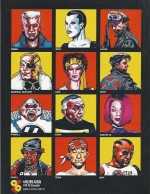


Axa Adult Fantasy Color Album


By Enrique Badia Romero & Donne Avenell (Ken Pierce Books/Eclipse Comics)
ISBN: 0-912277-27-0

Axa ran in The Sun Monday to Saturday from 1978 to her abrupt cancellation in 1986 – a victim of political and editorial intrigue which saw the strip cancelled in the middle of a story – and other than the First American Edition series from strip historian Ken Pierce and this colour collection, has never been graced with a definitive collection. It should be noted also that at the time of these books she was still being published with great success and to popular acclaim.

In those days in Britain it often appeared that the only place where truly affirmative female role-models appeared to be taken seriously were the cartoon sections, but even there the likes of Modesty Blaise, Danielle, Scarth, Amanda and all the other capable ladies who walked all over the oppressor gender, both humorously and in straight adventure scenarios, lost clothes and shed undies repeatedly, continuously, frivolously and in the manner they always had…

Nobody complained (no one important or who was ever taken seriously): it was just tradition and the idiom of the medium… and besides, artists have always liked to draw bare-naked ladies as much as blokes liked to see them and it was even “educational” for the kiddies – who could buy any newspaper in any shop without interference, even if they couldn’t get into cinemas to view Staying Alive, Octopussy or Return of the Jedi without an accompanying adult…

Enrique Badía Romero’s career began in his native Spain in 1953, where he produced everything from westerns, sports, war stories and trading cards, mostly in conjunction with his brother Jorge, eventually forming his own publishing house. “Enric” began working for the higher-paying UK market in the 1960s on strips such as ‘Cathy and Wendy’, ‘Isometrics’ and ‘Cassius Clay’ before successfully assuming the drawing duties on the high-profile Modesty Blaise adventure-serial in 1970 (see Modesty Blaise: The Hell Makers and Modesty Blaise: The Green Eyed Monster), only leaving when this enticing new prospect appeared.

Tough’n’sexy take-charge chicks were a comic-strip standard by the time the Star Wars phenomenon reinvigorated interest in science fiction and the infallible old standby of scantily-clad, curvy amazons in post-apocalyptic wonderlands never had greater sales-appeal than when The Sun – Britain’s best-selling tabloid – hired Romero and Donne Avenell to produce a new fantasy feature for their already well-stacked cartoon section.

This beautifully illustrated but oddly out of kilter collection doesn’t bear much similarity in terms of tone or format to the (ostensibly) family-oriented daily strip, and features none of the regular supporting cast such as long-suffering lover Matt or robotic companion Mark 10, which leads me to suspect it was created independently for the European market, perhaps as a Sunday page in Romero’s homeland of Spain or elsewhere where attitudes and mores are more liberal.

Certainly in the early 1980s Axa appeared in the French adult bande dessinee magazine Charlie Mensuel which reprinted many classic newspaper strips from around the world and after that closed in the Swedish publication Magnum.

Whatever their origin the tales collected here are far stronger and more explicitly sexual in nature; occasionally coming close to being mere macho rape-fantasies, so please be warned if such content, no matter how winningly illustrated, might offend…

The eponymous heroine was raised in a stultifying, antiseptic and emotionless domed city: a bastion of technological advancement in a world destroyed by war, pollution and far worse. Chafing at the constricting life of the loveless living dead, Axa broke out and, ancient sword in hand, chose to roam the shattered Earth searching for something real and true and free…

This slim oversized tome opens with Axa crossing a trackless wasteland under a scorching sun until she finds a hidden grotto beneath a ruined building. The coolly sensual hidden pool is a welcome delight but harbours a ghastly monster and mutant voyeur…

Captured by the hideously scarred human degenerate Axa discovers his gentle nature but is soon abducted by his far-less sympathetic brethren who attempt to use her as a brood mare for their next generation, until fate, her newfound friend and that ever-present long-sword combine to effect her escape…

Resuming her aimless explorations, Axa then encounters a coastal village but is almost killed by a pack of wild dogs. Her desperate flight takes her to a lighthouse on the promontory above the deserted town where ruggedly handsome Juame and his teenaged daughter Maria have been trapped for months.

Soon the sexual tension between Axa and Jaume culminates in the only way it can and Maria is driven mad by a jealousy she can barely comprehend. When a roving band of vicious post-apocalyptic Hell’s Angels hits town hungry for slaughter and kicks, the conflicted teen opens the tower doors for them…

The brutes casually murder her father and are intent on adding her and Axa to their string of human playthings, but when a terrific storm hits Axa breaks loose and becomes the bloody tool of harsh, uncompromising and final fate…

This incarnation of the warrior wanderer is certainly harder-hitting and more visceral than the British strip version and has little of the feature’s sly, dry humour, but art-lovers cannot fail to be impressed by Romero’s vibrant mixed-media illustration and imaginative, liberating page compositions.

Lush, lavish, luxurious and strictly for adventure-loving adults, there’s still a tantalising promise of a major motion picture and above all else Axa is long overdue for a definitive collection. Where is that bold publisher looking for the next big thing…?
Axa ©1985 Enrique Badía Romero. Previously ©1983, 1984 in Spanish.  Express Newspapers, Ltd.

A Matter of Time


By Juan Gimenez (Catalan Communications)
ISBN: 978-0-87416-012-3, Del Rey edition (2005):  978-0-34548-314-0

Juan Antonio Giménez López was born in Mendoza, Argentina in 1943 and after studying industrial design attended the Academy of Fine Arts in Barcelona. Hugely influenced by Hugo Pratt and Francisco Solano López, Gimenez broke into the comics field with stories for Argentine magazines Record and Colomba before beginning his long association with European comics in such publications as Spain’s Zona 84, Comix International and 1994, France’s Metal Hurlant and Italy’s Lanciostory, L’Eternauta  and Skorpio, before gaining global fame with his scintillant Metabarons series produced in collaboration with Alejandro Jodorowsky.

His preferred metier is adult tales of science fiction and/or combat and Gimenez is an accredited expert on all things avionic or to do with war in the air.

In 1985 Catalan Communications collected a selection of time-travel related short stories (many of which had appeared in the American magazine Heavy Metal) usually known as the Time Paradox Tales into one glorious baroque and stunningly beautiful fantasy anthology with dark, sardonic and sublimely lyrical overtones of classic 2000AD Future Shocks or Twisted Times “sting-in-the-tale” stories…

Following a expansive and lavishly illustrated critique from Carlos Gimenez (no relation) the elegantly lush procession of exotic, eccentric eight-page excitements begins with ‘DIY’ wherein a father and son meddle with the wrong home-computer program and dad ends up a terrified touchline visitor at some of the most dangerous moments of all time and space, after which ‘Tridisex’ details the horrific fate of a couple of salacious chronal researchers who land in the right place at the right time but at the wrong size…

‘Express’ sees a dedicated time-assassin dispatched into the past to unwittingly murder himself whilst ‘Entropy’ details a tragic timeslip which causes the greatest combat aircraft of two eras to experience the closest of encounters.

‘8½’ explores the secret advantage of the fastest gunslinger of the Wild West and recounts the fate of the time-tourist who rooted for him whilst a tragic synchronicity-loop and incomprehensible paradox at last explains the great leap forward of an ancient civilisation in ‘Chronology’…

‘Residue’ takes the exercise in futility that is war to its inescapable conclusion in a lustrous four-page paean to technological advantage, bringing this magnificent artistic treat to a close on the darkest of downbeats…

Gritty, witty and ever so pretty, A Matter of Time is pure speculative gold: old-fashioned, cutting edge fantasy fun and entertainment with a satirical edge and its tongue firmly in its cheek. Perfume for the eyes so breathe deeply and jump aboard.
© 1982-1985 Juan Gimenez. English translation © 1985 Catalan Communications. All rights reserved.
Hewligan’s Haircut


By Peter Milligan & Jamie Hewlett (Fleetway Publishing/Rebellion)
ISBN: 978-1-85386-246-5, Rebellion HC 978-1-90426-506-1, SC 978-1-90673-598-2

Since its inception in 1977 the weekly science fiction anthology comic 2000AD has been a cornucopia of thrills, chills, laughs and anarchic, mind-boggling wonderment as well as springboard for two generations of highly impressive creators.

Beside such “A-List” serial celebrities as Judge Dredd, Slaine, Rogue Trooper and their ilk, the quirky, quintessentially British phenomenon has played host to a vast selection of intriguing yarns with much less general appeal and far more discerning tastes.

Or, to put it bluntly, strips with as many foes as friends amongst the rabidly passionate audience.

Just one such was this outrageously tongue-in-cheek, fantastically surreal and absurdist love story from the era of Rave Parties and Acid Houses from Peter Milligan and Tank Girl co-creator Jamie Hewlett which originally ran in #700-711 of the Galaxy’s Greatest Comic, from 13th October to December 1st 1990.

The story is told in “Eight Partings”, commencing in black and white with the introduction of style-starved psychiatric patient Hewligan, about to be booted out of Five Seasons Mental Hospital.

In ‘Donald, Where’s Your Troosers?’ the hapless innocent spruces up his copious coiffure and accidentally carves a transcendental cosmic symbol into his bedraggled barnet. Suddenly everything that previously made no sense in his bemused and befuddled life instantly makes even less – but now it’s all in full, effulgent dayglo colour…

‘Under a Bridge with Dick and Harry’ finds the latest victim of “Don’t Care in the Community” undergoing even crazier visions and hallucinations than the ones which got him sectioned in the first place and also the subject of a bizarre police – and animated everyday objects – manhunt, until a wall tells him of a safe haven in ‘Don’t Put your Daughter on the Stage Mrs. Worthington’…

Giving Consensual Reality the old heave-ho, the tonsorial target meets the effervescent trans-dimensional gamin and pulchritudinous know-it-all Scarlett O’Gasometer, who offers companionship and the secret of what’s really going on. Still pursued by every cliché in British popular life the pair soon fall victim to a barrage of Art Attacks (Cubism and Warholian Pop) from unsanctioned Pirate Dimensions in ‘A Man , A Plan, Canal Panama’ but as Scarlet reveals the true nature of Everything and the pair leak into cult TV shows in ‘Oh Danny Boy Oh Danny Boy!’ Hewligan begins to understand why his entire life has been plagued with odd voices and images of giant stone heads…

The dashing due take a bus to Easter Island where ‘I Know a Fat Old Pleeceman’ finds them in a position to save all creation in ‘Roget’s Thesaurus’ before the sweet sorrowful monochrome parting of ‘The Psychedelic Experience’ wraps it all up with one last surprise…

Light, frothy, multi-layered with cultural time-bombs and snarky asides; this is a fun-filled, occasionally over-clever, but always magically rendered and intoxicatingly arch, quest-fable that no jaded Fantasy Fashionista or cultural gadabout could resist. However there’s not a tremendous amount of gore, smut or gratuitous violence but I suppose you can’t have everything…

This a gloriously silly piece of pure contemporary Albion perfectly captures a unique period in time and offers a pungent and memorable dose of New Age Nostalgia and there shouldn’t be any trouble finding this is tall, slim tale since it was re-released in a collectors hardback in 2003 and a paperback edition in 2010 by current 2000AD custodians Rebellion.

Coo! What larks…
© 1991 2000AD Books, A division of Fleetway Publications. © 2003, 2011 Rebellion A/S. All rights reserved.

Storm: The Deep World

By Don Lawrence & Saul Dunn (British European Associated Publishers)
No ISBN
Storm: The Last Fighter & Storm: The Pirates of Pandarve
By Don Lawrence & Martin Lodewijk (Titan Books)
ISBN: 978-0-90761-077-9 and 978-1-85286-083-7

Don Lawrence, one of our greatest comics artists, is rightly revered for his stunning painted artwork on the legendary British weekly strip The Trigan Empire – which was the only reason most kids read the venerable knowledge-dispensing illustrated weekly Look and Learn – but his last and greatest work is largely unknown in the country of his birth. Over the years a number of publishers have attempted to sell a mass-market English-language edition of the Dutch-published science fiction serial Storm with little success, leaving only truly dedicated fans to purchase beautiful but painfully expensive limited-edition, leather-bound, hardback deluxe collectors compendiums.

Nevertheless, to my knowledge three softcover albums were released in the 1980s and still turn up occasionally so it’s worth keeping your eyes open for a stunning fantasy treat…

The concept was first conceived by Martin Lodewijk/Vince Wernham and Laurence in 1976 as a vehicle for the character Commander Grek but declined by Dutch publisher Oberon. Reworked by science fiction author Philip Dunn (who scripted the initial episode using the pseudonym Saul Dunn) with time-lost Terran astronaut Storm as the lead, the series was far more welcome, resulting in nine albums between 1978-1982, scripted by Martin Lodewijk, Dick Matena, Kelvin Gosnell and Lawrence himself, all fondly designated as the Chronicles of Deep World.

The rejected Commander Grek tale was eventually reworked into the continuity as episode 0 and after the series was rebooted Lawrence & Lodewijk produced a further 17 tales – “The Chronicles of Pandarve” – until the artist tragically lost much of his sight and was forced to retire in 1995.

In 1987 Titan Books took up the challenge of popularising the saga – a massive hit in Germany and the Netherlands, with editions also published in French, Italian, Spanish, Portuguese, Polish, Danish, Finnish, Greek, Croatian, Serbian, Bosnian and Indonesian – but gave up after two volumes…

Storm continued throughout Europe and is still being published today with Dick Matena, Romano Molenaar & Jorg De Vos handling the art.

The first epic, The Deep World by Lawrence and Dunn, was translated and released by British European Associated Publisher in 1982 and told in stunning, luxurious, fully-painted detail the story of astronaut explorer Storm, despatched by United Nations scientists in the 21st century to fly through the mysterious Red Spot of Jupiter. Unfortunately the valiant spaceman is trapped in those cyclonic crimson winds and propelled uncounted millennia into the future.

Dazed, lost and baffled by the seeming disappearance of the Red Spot, Storm spends a year flying back to Earth and discovers a world utterly transformed. His home world has become an icy wasteland, a Snowball Earth, but his desperate investigations uncover even more incredible secrets.

The oceans are gone and civilisation – such as it is – has relocated to the ancient sea floors. As he slowly makes his way down the miles of craggy dry depths, Storm is attacked by bandits who steal his space suit and survival kit, despite his violent resistance. Now clad only in the furs of the attacker he killed, Storm follows and encounters a fantastic planet of incredible jungles and bizarre beasts ruled by barbarian warlord Ghast.

Despite looking like a primitive thug Ghast is no fool: he knows the wearer of the strange clothes must be a commodity of great value and imprisons the wanderer in his dungeons where Storm meets a red-haired beauty called Carrots (alternatively Redhair and Ember) who is part of a secret tribe of knowledge-hoarders opposed to Ghast’s rule.

When her fellows rescue Carrots they take Storm with them and their leader Kiley reveals startling familiarity with the Astronaut’s story and equipment…

Taken to the subterranean land of Tome and a lost sub-surface sea, Storm is unaware that Ghast has tracked them deep below the surface of the Deep World. When they encounter a fantastic survivor from the age of technology and learn the secret history of Earth, Ghast refuses to accept what he sees and triggers a catastrophic explosion and flood…

The Last Fighter (Lawrence & Lodewijk) took up the tale with Storm and Carrots – now permanently dubbed Ember – washed ashore in a mountainous region which was once the Bahamas, where they are captured by slavers in a travelling circus/gladiator show.

Even held by deadly living insectoid shackles the bellicose Storm is a constant problem and when he acts up too openly in front of paying customers he finds himself made one city’s champion in a contest to capture the Throne of the Gods.

If he rebels Ember will be fed to a giant monster…

Competing against a number of other champions, Storm must invade the “Palace of Death”, sit on “The Throne” and win “The Powers” for his city…

He complies and undertakes the lethal quest and discovers a huge, unexpected advantage: he is the only man alive who recognises the Palace as a crashed starship with all its deadly automatic defences activated and the throne as a captain’s command chair. Of course, that’s no real help when battling through the colossal booby-trapped corridors of the vast vessel to the off-switch, nor proof against the weapons of his rival champions or the schemes of the corrupt organisers of the contest…

After this Titan jumped immediately to the tenth tale, The Pirates of Pandarve, which saw an abrupt transition in the series as, after ages wandering the Deep World of Old Earth, Storm and Ember were suddenly catapulted into a universe of cosmic strangeness. Pandarve is a multiversal junction point where the laws of physics vary from moment to moment; a place of many worlds and planetoids with only localised gravity fields, circling an immense super-planet, all existing in a breathable atmosphere envelope instead of a special vacuum.

The pocket universe is ruled by power-mad dictator called Marduk, Theocrat of Pandarve – a man obsessed with temporal energy- whose long-range scanners detect an incredible chronal anomaly on Earth. Determined to possess the phenomenon at all costs, Marduk rips open the gateway of the multiverse and teleports Storm and the hapless collateral casualty Ember to Pandarve…

At that moment rebels attack the Theocrat’s citadel, disrupting the process and his targets materialise in space hundreds of miles above planet Pandave, shocked, terrified yet somehow still alive. Floating helplessly, the pair are rescued by an old man in a sailing boat hunting a space whale, but tragically when the monumental beast attacks Ember is lost…

When Storm and old man Rann reach his home asteroid they find a scene of devastation and the hunter’s daughter abducted by the bloodthirsty marauders of Vertiga Bas. The traumatised elder is saved from suicide by the time-lost Earthman and, believing Ember dead, they determine to pursue the pirates and rescue the stolen child.

Meanwhile, Ember has been picked up by Marduk’s men…

The searchers reach the outlaw habitat where Storm rescues Rann’s daughter in a truly unique manner, but soon falls foul of the Buccaneer city’s unique laws.

Condemned to the water-mines Storm’s last sight is of Ember, broadcast around the pocket universe as Marduk’s next bride…

The tragic hero has no idea that’s it’s all a ploy by the Theocrat to entrap the Anomaly…

In the mines Storm chafes under the trauma and pressure, his only friend the huge warrior called Nomad. With no real hope of success they begin to plan escape and revolution…

And that’s where, after a spectacular battle the magic, mayhem and majesty ends, with a freed Storm searching for his red-headed paramour in a scintillating, cliffhanging promise of more to come…

Those English-language hardback collectors editions were released way back in 2004, and now retail for astonishing amounts of money so surely it’s time for another go at a mass-market competitively priced run?

© 1982 Oberon bv – Haarlem – Netherlands – Don Lawrence/Philip Dunn.

© 1987 Oberon BV/Don Lawrence and Martin Lodewijk. UK edition © 1987 Titan Books, Ltd.

© 1987 Oberon BV/Don Lawrence and Martin Lodewijk. UK edition © 1989 Titan Books, Ltd.

Captain Eo – Eclipse 3-D special

(The official 3-D comic book adaptation of the George Lucas 3-D musical motion picture directed by Francis Coppola)

By Tom Yeates (Eclipse)
No ISBN; ASIN: B00071AU66

With all this foofaraw and tarradiddle about 3D at the moment I thought I’d shamelessly cash in by reminding fans about the multi-dimensional comics venture Eclipse, Disney, the King of Pop and an absolute swarm of high-profile creative types worked on in this weird but undeniably spectacular item from the 1980s.

Speaking charitably, this is a comics adaptation of the 17-minute science fiction film designed to be shown in “4-D” (then cutting edge stereoscopic cinematography combined with in-theatre special effects such as teeth-rattling rigged seats, smoke, lasers and explosions) at Disney theme-parks around the world.

However, what you had in those theatres and pre-Imax venues (the film ran from 1986 into the 1990s and was briefly reinstated when Michael Jackson died in 2009) is a straight but incredibly expensive (apparently $30 million to produce at a cost-per-screen-minute of $1.76m) music video: a puff-piece, song-and-dance mini-musical designed to emulate and recapture the buzz the Thriller promo generated around the world – complete with a brace of songs and killer formation dance numbers – substituting star-ships for graveyards and cute aliens for zombies.

The film’s creative credits are formidable: produced by George Lucas, it was choreographed by Jeffrey Hornaday and Jackson, photographed by Peter Anderson, produced by Rusty Lemorande and written by Lemorande, Lucas & Francis Ford Coppola, who directed. Anjelica Huston played the villain…

Let’s talk about the 30-page comic…

The less than stellar Captain Eo and his anthropomorphically engaging crew of robots and cuddly extraterrestrials are tasked with delivering a gift to the ghastly tyrant Supreme Leader on her dystopian hell-world, a task complicated by their chummy ineptitude and her tendency to turn all visitors into trash cans and torture projects…

When Eo and Co. are seized, the ultra-cool hipster sees something decent buried within the evil queen and after defeating her Whip Warriors in highly stylised combat transforms her into a thing of serene beauty with the redemptive power of a perfectly choreographed interpretative rock-dance number…

Tom Yeates’ staggeringly beautiful art makes the very best of the weak story and derivative characters – even if he did have to draw an entire seven-page big musical closer – and whether you see the 3D package formatted by the genre’s guru Ray Zone as the blockbusting 432x282mm (or 17inches by 11 for all you Imperial Stormtroopers out there) tabloid format available at the theme parks and theatres or the regulation comicbook issue distributed to stores, if you can work the glasses you’re in for a visual treat of mind-blowing proportions. There was talk of a straight, monochrome non-3D version too but if it exists I’ve never seen it.

Gloriously flamboyant, massively OTT, but as great a piece of drawing as came out of the over-egged Eighties, Captain Eo is a truly intriguing book that might just grab any jaded reader who thinks there’s nothing new or different left to see…
Published by Eclipse Comics August 1987. Captain Eo ™ and © 1987 The Walt Disney Company. All rights reserved.

Space Clusters – DC Graphic Novel #7


By Arthur Byron Cover & Alex Niño (DC Comics)
ISBN: 978-0-930289-14-0

During the 1980s DC, like many publishers large and small galvanised by fresh print-formats and price-tags, attempted to free comics narrative from its previous constraints of size and format as well as content.

Graphic novels were still an unproven quantity in America and Big Guns DC and Marvel as well as angelic upstarts First and Comico adopted a kind of scattershot “suck it and see” attitude, although all parties were apparently content on switching decided on the now extinct (more’s the pity) 8½ by 11 inch European Album page format.

Whereas the House of Ideas had a solid publishing plan that didn’t stray too far from their usual periodical product, DC looked to expand or overlap markets by creating “boutique” imprints such as the Science Fiction Graphic Novel line (adapting classic short stories and novellas into highly experimental graphic narratives) and the plain old catch-all – if unimaginative – DC Graphic Novel Series. Often, at least in sequential narrative terms, there’s not much discernible difference between the two.

However, as this is a place to review and promote graphic novels, please be assured that this is one that works excessively well; evocative, bold and beautifully realised.

To accompany such venerable in-house landmarks as Jack Kirby’s Hunger Dogs and licensed material like Star Raiders and Warlords, the company commissioned all-new tales such as the spectacular and unique and eons-spanning cosmic fantasy of the Space Clusters.

Scripted by author Arthur Byron Cover (Autumn Angels, An East Wind Coming) the true lure here is the lavish full-colour illustration of the most stylish and uncompromisingly impressive artists of the 1970s Filipino invasion – Alex Niño.

The artist was born in 1940, son of and later assistant to a professional photographer. He studied medicine at University of Manila but dropped out in 1959 to pursue his dream of being a comics artist.

He apprenticed with Jess Jodloman and worked on a number of successful features before following Tony DeZuniga in the first wave of Islands artists to work for DC, Marvel and Warren. A stand-alone stylist even amongst his talented confederates, Niño started on DC’s anthology mystery series such as House of Mystery, House of Secrets, Forbidden Tales of Dark Mansion, Secrets of Sinister House, Weird War Tales, Weird Mystery Tales and The Witching Hour before moving into series such as Korak, Son of Tarzan, Space Voyagers and period Caribbean pirate Captain Fear which he co-created with Robert Kanigher.

His Marvel work included adaptations for their own “illustrated Classics” line and landmark interpretations of Ellison’s ‘“Repent Harlequin!” Said the Ticktockman’ and Moorcock’s ‘Behold the Man’ for Unknown Worlds of Science Fiction as well as the stunning Savage Sword of Conan classic ‘People of the Dark’ and miscellaneous inking work in the superhero titles.

He found his fullest expression in Warren Publishing’s mature-oriented magazines Creepy, Eerie, Vampirella and the outrageously over-the-top sci-fi title 1984/1994 before largely leaving the industry for Hollywood design work, although a stint on Archie’s The Comet and Shield/Steel Sterling and DC’s Thriller and Omega Men were fairly impressive swan-songs. He also worked for a variety of smaller companies during the 1980s Independents boom and curious true-fans should try to track down his one-man band Alex Niño’s Nightmare #1 featuring translated Filipino material, published in 1989 by Innovation.

He has since occasionally returned to comics in such titles as Dark Horse Presents, Shaman, John Jakes’ Mullkon Empire, Savage Sword of Conan and God the Dyslexic Dog.

With overtones of Les Miserables and The Forever War, the saga begins here as beloved rogue and man of the people Ethan Dayak is finally cornered by dedicated Earth cop Lieutenant Kara Basuto of the Terran Interplanetary Corps on a far-flung alien world.

She has pursued the smuggler of decadent art across the universe at sub-light speeds for eighty years, aging only when she hits a new planet and emerges from suspended animation.

Kara is cold, fanatical and dedicated whilst Dayak is an affable, personable and loving man every race and sentient species he encounters instantly adores…

During their latest confrontation Ethan again escapes, thanks to the intervention of his latest paramour, causing the increasingly remorseless Basuto to finally cross the line and kill civilians…

Crushed, defeated and despondent Dayak sets course for the edge of the galaxy, intending to sleep his way to infinity but even this does not deter Basuto who implacably follows.

Time becomes nothing and eventually both fall into the event horizon of a Black Hole where something incredible happens: both are transformed into supernal, sentient energy phenomena, still trapped in their course of flight and relentless pursuit…

However here at the end of space and time a mighty new race populates the universe and how these ancient new gods deal with the last life of the cosmos makes for a powerful and beguiling drama no fan of the genre will want to miss, especially as the expanded page size and enhanced colour palette give Niño ample opportunity to let his fantastic imagination run wild.

It’s an inexpressible pity they’re all currently out of print and this is an experiment the company should seriously consider resuming. Moreover, as I’ve stated before: these DC Science Fiction graphic novels would make an irresistible “Absolute” compilation…
© 1986 DC Comics Inc. All rights reserved.

Cyberpunk book 1 & 2


By Scot Rockwell, Darryl Banks & Doug Talalla (Innovation)
ASIN: B005KDE9UO & B000GG0BBQ

One of the most ambitious and intriguing cash-ins on the 1990s literary phenomenon dubbed “Cyberpunk” was this challenging and potentially excellent yarn crafted very much in the manner of William Gibson’s Neuromancer which never had the time, editorial support or fanbase to develop into what it could and should have been. The story debuted as a brace of 2-issue miniseries in 1989 before being collected in colourful but exceedingly thin tomes.

It all begins in the near future with ‘Bad Dreams’ as freelance ICEbreaker Topo AKA “the Mole” attempts to infiltrate street-gang the Plastiques before returning his addicted consciousness to the shared cyberspace arena of the “Playing Field”.

Topo despises his meat body and would spend eternity in the neural universe if possible, but when his crusading lover and occasional employer is abducted by her latest target, Roi of Quondam Mechanics the Mole needs the assistance of tech-broker Alma Matrix to balance the scales and even the odds…

Probing the Corporation’s datastore in his avatar-form proves disastrous, but Topo survives and returns to his meat-form changed on a core level into something new and with very dangerous knowledge, leading to a fantastic showdown with Roi in an apocalyptic Playing Field which is catastrophically self-destructing all around them…

Book Two ‘The Masks of Time’ opens three years later as Juno allies with a streetgang called the Hotboys to track down her missing partner Topo who has vanished into cyberspace, obsessed with exploring the farthest frontiers of the digital universe and finding at last the mythical semi-mystical “Edge” of existence.

The rescue mission is doomed from the start. The Hotboys have their own agenda, Juno is unsure of her motives and Topo, deeper than any mind has ever delved, has encountered “Cyberghosts” who reveal a whole new reality…

When Alma Matrix is attacked and forced to intervene in Topo’s extended cerebral suicide, events take a extreme turn and the Mole’s gradual apotheosis resumes; culminating in a spectacular, radical denouement which offers the best available ‘Solace’ for all the conflicted players involved…

Although plainly derivative this smart little sci fi thriller offered a classy introduction to the sub-genre for comics fans and still holds the attention better than most related works, in comics or prose. The painted art ranges from excellent to murkily average but works well within the tale’s multi-level conception and I would certainly look favourably on a “twenty-five years later” sequel should one ever be mooted…
Cyberpunk, Topo, Juno and all other prominent characters and distinctive likenesses are ™ 1989 Scott Rockwell. Story © 1989 Scott Rockwell. Art (Book 1) © 1989 Darryl Banks, (Book 2) © 1990 Doug Tallala All rights reserved.

Out of this World Volume 1


By Raymond Everett Kinstler & various (Malibu)
No ISBN

A little while ago I reviewed the mind-boggling, intellectually challenging science fiction yarns of DC’s Strange Adventures and made a rather offhand remark about the other end of the genre-spectrum then extant.

Whilst Julie Schwartz and his band of writers (many full-time SF authors recruited during the Editor’s early days as a literary agent) pushed conceptual envelopes and opened doors of wonder, another strand focusing on sheer adventure offered the trappings of the form in racy, hard-bitten tales with rocket-ships replacing speeding Sedans or charging steeds, blasters substituting for gats or six-guns, aliens taking the place of Commies, Injuns or mobster-mooks and yes, lots of scantily clad babes in torn clothes or fetching ensembles comprising filmy underwear and large glass domes on their immaculately coiffed, pretty little heads…

These terrifically tacky tales of space sensationalism from another age are a delicious forbidden and oh, so guilty pleasure, thus there’s no real literary justification for today’s featured item, just old fashioned fun and some extremely enticing artwork.

These pre-code tales from minor publishers of the early 1950s are sheer, rockets-roaring, Thud and Blunder classics and might be missing a few technical truths and sensible science facts, but in terms of pulse-pounding excitement and masterful illustration they’re the real deal…

Collected from Avon’s Strange Worlds #9, Strange Planets #16 (an I.W. reprint of Strange Worlds #6), Harvey Comics’ Tomb of Terror #6 and S.P.M’s Weird Tales of the Future #1, the material within is pretty much the best the sub-genre has to offer and opens with the Everett Raymond Kinstler illustrated ‘Ransom – One Million Decimars!’ (Strange Worlds #9, November 1952) as hard-boiled space-cop Mike Grant hunted down the interplanetary mobster who had kidnapped the daughter of Earth’s President…

The same issue also provided the utterly anonymous ‘World of the Monster Brain!’ with its tale of the overthrow of a transdimensional tyrant as well as the thoroughly cathartic save-the-world thriller ‘Radium Monsters’ which looks like early Frank Springer to me…

Extraordinary special Agent Kenton of the Star Patrol spectacularly tackled ‘The Monster-Men of Space!’ in another Kinstler classic from Strange Planets #16 whilst  ‘The Survivors!’ (Tomb of Terror #6 1952, with art tantalisingly reminiscent of Joe Certa) pitted hunk and hot babe against hairy horrors in a post-Armageddon yarn, after which the manic tragedy of ‘The Man Who Owned the Earth’ (Strange Planets #16) was followed by the concluding classic of unwanted immorality in ‘Ten Thousand Years Old!’

This cheap and cheerful black and white compilation, coyly contained behind a cracking Bruce Timm cover, cuts straight to the magnificently cheesy pulp pulchritude pull of this kind of fantasy and although hard to find, difficult to justify, and perhaps a stretch to accept from our advanced perspective here in the future, these stories and their hugely successful ilk were inarguably a vital stepping stone to our modern industry. There is a serious lesson here about acknowledging the ability of comics to appeal to older readers from a time when all the experts would have the public believe that comics were made by conmen and shysters for kiddies, morons and slackers.

Certainly there are also a lot of cheap laughs and guilty gratification to be found in these undeniably effective little tales. This book and the era it came from are worthy of far greater coverage than has been previously experienced but no true devotee should readily ignore this stuff.

© 1989 Malibu Graphics, Inc. All Rights Reserved.

Showcase Presents Strange Adventures volume 1


By John Broome, Otto Binder, Edmond Hamilton, Joe Samachson, Gardner Fox, Carmine Infantino, Gil Kane, Sid Greene & various (DC Comics)
ISBN13: 978-1-4012-1544-6

As the 1940s closed, masked mystery-men dwindled in popularity and the American comicbook industry found new heroes. Classical genre titles flourished; anthologies dedicated to crime, war, westerns and horror, were augmented by newer fads like funny animal, romance and especially science fiction which in 1950 finally escaped its glorious thud and blunder/ray guns/bikini babes in giant fishbowl helmets pulp roots (as perfectly epitomised in the uniquely wonderful Golden Age icon Planet Comics) with the introduction of Strange Adventures.

Packed with short adventures from jobbing SF writers and a plethora of new heroes such as Chris KL99, Captain Comet, the Atomic Knights and others, the magnificent monthly compendium (which was supplemented a year later with sister-title Mystery in Space) introduced wide-eyed youngsters to a fantastic but intrinsically rationalist universe and the wonders it might conceal…

This spectacular and economical monochrome collection features stories from the inception of the self-regulatory Comics Code (issues #54-73, covering March 1955 to October 1956) right up to the start of the Silver Age when superheroes began to successfully reappear, offering wide-eyed technological wonderment and the sure and certain knowledge that there were many and varied somethings “Out There”.

On a thematic note: a general but by no means concrete rule of thumb was that Strange Adventures generally occurred on Earth or were at least Earth-adjacent whilst as the name suggests Mystery in Space offered readers the run of the rest of the universe…

Moreover many of the plots, gimmicks, maguffins and even art were recycled for the later technologically-based Silver Age superhero revivals…

This mind-blowing, physics-challenging monochrome colossus opens with the March 1955 issue and four classic vignettes, beginning with ‘The Electric Man!’ by John Broome & Sy Barry, wherein a geologist in search of new power sources accidentally unleashes destructive voltaic beings from the centre of the Earth. As always – and in the grand tradition of legendary pulp sci-fi editor John Campbell – human ingenuity and decency generally solves the assorted crises efficiently and expeditiously…

‘The World’s Mightiest Weakling!’ from Otto Binder, Carmine Infantino & Bernard Sachs offered a charming yet impossible conundrum when a puny stripling gained incomprehensible mass and density during the course of an experiment, whilst ‘Interplanetary Camera!’ (Binder, Gil Kane & Sachs) gave a photographer a glimpse of the unknown when he found an alien image recorder and uncovered a plot to destroy Earth. The issue concluded with another Binder blinder in the taut thriller ‘The Robot Dragnet!’ illustrated by Harry Sharp & Joe Giella, with a rip-roaring romp of rampaging robotic rage.

This tale was actually the sequel to an earlier yarn but sufficiently and cleverly recapped so that there’s no confusion or loss of comprehensibility…

Issue #55 led with ‘The Gorilla who Challenged the World’ by Edmond Hamilton & Barry, wherein an ape’s intellect was scientifically enhanced to the point where he became a menace to all mankind. So great was his threat that this tale also was carried over to the next issue…

During this period editors were baffled by a bizarre truism: every issue of any title which featured gorillas on the cover always produced increased sales. Little wonder then that so many DC comics had hairy headliners…

‘Movie Men from Mars!’ (Hamilton, Sharp & Giella) found our world the unwilling location for cinematographers from the Red Planet. Unfortunately they were making a disaster movie…

‘A World Destroyed!’ by Joe Kubert offered a fanciful but gripping explanation for how the asteroid belts between Mars and Jupiter were formed and the cataclysm theme continued in ‘The Day the Sun Exploded!’ with Broome, Kane & Sachs depicting a desperate dash by scientists to save Earth from melting, after which Sid Gerson, Murphy Anderson & Giella revealed the baffling puzzle of ‘The Invisible Spaceman!’

Strange Adventures #56 opened whimsically with ‘The Fish-Men of Earth!’ (Broome, Infantino & Sachs) as air density went temporarily askew thanks to invading aliens, ‘Explorers of the Crystal Moon!‘ (Broome, Sharp & Sachs) found a little boy going for a secret solar safari with visiting extraterrestrials, and artist Paul Paxton inadvertently became ‘The Sculptor Who Saved the World!’ when future-men asked him to make some highly specific pieces for them. A fast-paced yarn by Broome, Kane & Giella saw penitent Dr. Jonas Mills correct his evolutionary error by finally defeating his mutated gorilla in the concluding part of the simian saga ‘The Jungle Emperor!’ by Hamilton & Barry.

Broome, Sid Greene & Sachs’ ‘The Spy from Saturn!’ opened issue #57 with a Terran scientist replaced by a perfect impostor, whilst ‘The Moonman and the Meteor!’ (Bill Finger & Barry) found millionaires and aliens trying to buy or inveigle a fallen star from a humble amateur astronomer for the best and worst of reasons, after which Binder, Kane & Giella proffered ‘The Riddle of Animal “X”’ when a small boy found a pet like no other creature on Earth, before ‘Spaceship Under the Earth!’ (Broome, Infantino & Giella) revealed an incredible ancient find to a Uranium prospector and some fugitive convicts desperate enough to try any means of escape…

Issue #58 began with a police chief’s frantic search for a superhuman felon in ‘I Hunted the Radium Man!’ (Dave Wood & Infantino) whilst ‘Prisoner of Two Worlds!’ by Finger & Barry saw the long awaited return of genius detective Darwin Jones of the Department of Scientific Investigation.

Although an anthology of short stories Strange Adventures featured a number of memorable returning characters and concepts such as Star Hawkins or Space Museum during its run. Jones debuted in the very first issue, solving fringe science dilemmas for the Federal Government and making thirteen appearances over as many years. In this third adventure he assisted alien peace-officers in preventing a visiting extraterrestrial from taking a commonplace earth object back to his homeworld where it would be a ghastly terror-weapon…

‘Dream-Journey Through Space!’ (Broome, Kane & Sachs) saw an ordinary human plucked from Earth to rescue an ancient civilisation from destruction and a humble but cunning ventriloquist save our world from invasion by invincible aliens in Finger, Greene & Giella’s ‘The Invisible Masters of Earth!’

A young married couple had to find a way to prove they weren’t animals on ‘The Ark from Planet X’ (Broome, Greene & Giella) which opened #59, whilst ‘The Super-Athletes from Outer Space!’ came to our world to train in a heavier gravity environment and found the galaxy’s greatest sports-coach in a charming tale by Binder, Kane & Sachs.

Ed “France” Herron & Infantino then explored the domino theory of cause and effect in ‘Legacy from the Future!’ before Broome & Barry delved into ancient history and doomsday weaponry to discover the secret of our solar system and ‘The World that Vanished!’

Strange Adventures #60 featured a light-hearted time-travel teaser by Broome, Jerry Grandenetti & Giella when historians gathered together famous historic personages from ‘Across the Ages!’ but ‘The Man Who Remembered 100,000 Years Ago!’ (Binder, Kane & Sachs) was a terse, tense thriller as lightning provoked ancestral memories of a previous civilisation just in time for a scientist to cancel the self-same experiment which had eradicated them…

Broome, Greene & Sachs then followed the life of a foundling boy who turned out to be an ‘Orphan of the Stars!’ and the issue ended with a future-set thriller where schoolboy Ted Carter won a place on a multi-species outing to the ‘World at the Edge of the Universe!’ (Binder & Barry).

In #61, ‘The Mirages from Space!’ (Binder, Kane & Sachs) were a portal into a fantastic other world and the secret of Earth’s ultimate salvation; ‘The Thermometer Man’ by Binder, Greene & Giella saw an scientist striving to save a stranded Neptunian from melting in the scorching hell of our world and a lighthouse keeper was forced to play smart to counter a Plutonian invasion with ‘The Strange Thinking-Cap of Willie Jones!’ (Herron & Barry) before Binder, Greene & Giella’s ‘The Amazing Two-Time Inventions’ found an amateur inventor making fortuitous contact with his counterparts in 3000AD…

Strange Adventures #62 introduced ‘The Fireproof Man’ (Broome, Infantino & Sachs) whose equally astounding dog foiled an alien invasion whilst an ordinary handyman fell into another dimension to become a messiah and ‘The Emperor of Planet X’ (Broome, Greene & Giella). Binder, Kane & Giella then reported an abortive ‘Invasion from Inner Space!’ before ‘The Watchdogs of the Universe!’ recruited their first human agent in a tantalising tale by Binder, Greene & Giella.

‘I Was the Man in the Moon!’ by Joe Samachson, Grandenetti & Giella started #63 with an intriguing puzzler as an ordinary Joe awoke to find aliens had inexplicably re-sculpted the lunar surface with his face whilst a Native American forest ranger was the planet’s only hope of translating an alien warning in The Sign Language of Space!’ (Binder, Greene & Giella).

‘Strange Journey to Earth!’ by Jerry Coleman & Kane Giella saw an ordinary school teacher deduce an alien’s odd actions and save the world and the issue ended in ‘Catastrophe County, U.S.A.!’ where Hamilton, Greene & Giella introduced scientists to the Government’s vast outdoor natural disaster lab…

Sales-boosting simians were back in #64 as Finger, Infantino & Sachs introduced hostile ‘Gorillas in Space!’ who were anything but, whilst a first contact misunderstanding resulted in terror and near-death for an Earth explorer lost in ‘The Maze of Mars’ (Binder, Greene & Sachs) after which a technological Indiana Jones became ‘The Man Who Discovered the West Pole!’ (Binder, Kane & Giella) and Samachson & Grandenetti crafted a canny tale of planetary peril in ‘The Earth-Drowners!’

In #65 (February 1956) ‘The Prisoner from Pluto!’ by Binder, Greene & Giella, featured an alien trying to warn Earth of imminent Saturnian attack and forced to extreme measures to accomplish his mission whilst a different kind of cultural upheaval was referenced in the quaint but clever tale of ‘The Rock-and-Roll Kid from Mars!’ by Samachson, Kane & Giella. A stage mentalist outfoxed genuine telepaths in ‘War of the Mind Readers!’ by Binder, Infantino & Sachs and a biologist turned temporary superhero to foil an alien attack in ‘The Man who Grew Wings!’ by Binder, Greene & Giella to end the issue.

Issue #66 opened with Broome & Infantino’s tale of ‘The Human Battery!’ as an undercover cop suddenly developed an incredible power, a guy in a diner mistakenly picked up ‘The Flying Raincoat!’ (Samachson, Greene & Giella) and accidentally averted an insidious clandestine invasion of our world before Binder, Kane & Sachs had Darwin Jones solve the ‘Strange Secret of the Time Capsule!’ and the metamorphic ‘Man of a Thousand Shapes!’ (Samachson, Infantino & Sachs) proved to be a being with a few secrets of his own…

Broome, Kane & Giella’s ‘The Martian Masquerader!’ in Strange Adventures #67 played clever games as editor Julie Schwartz (aka “Mr. Black”) was approached by an alien in need of assistance in tracking down an ET terrorist whilst Hamilton, Greene & Giella honed in on a subatomic scientist desperate to find his infinitesimal homeworld in ‘Search for a Lost World!’

‘The Talking Flower!’ in chemist Willie Pickens’ buttonhole was a lost alien who helped him save the world in Samachson, Infantino & Sachs’ charming romance but the time travelling travails experienced by archaeologist Roger Thorn after he discovered the ‘Gateway Through the Ages!’ (Hamilton, Greene & Giella) led only to danger and hard-earned knowledge.

Issue #68 opened with ‘The Man who Couldn’t Drown!’ (Broome, Infantino & Sachs): a tale of genetic throwbacks and unfathomable mystery whilst a ‘Strange Gift from Space!’ (Samachson, Greene & Giella) led to a safer planet for all, after which a chance chemical discovery produced a happy salvation in ‘The Balloons That Lifted a City!’ (Samachson, Kane & Giella) and a common thief got in way over his head when he robbed a laboratory in Samachson, Greene Sachs’ witty ‘The Game of Science!’

In #69 a time-traveller voyaged into pre-history and helped the dawning humans overcome ‘The Gorilla Conquest of Earth’ (Broome, Kane & Sachs) whilst the arrival of ‘The Museum from Mars’ (Gardner Fox, Greene & Giella) offered almost irresistible temptation and deadly danger to humanity and ‘The Man with Four Minds!’ (Hamilton & Infantino) saw a man with too much knowledge and power eschew it all for normality before ‘The Human Homing Pigeon!’ (Samachson, Greene & Giella) burned out his own unique gift in the service of his fellows…

The Triple Life of Dr. Pluto!’ by Broome, Greene & Giella in #70 dealt with the dangers of a human duplicating ray and Darwin Jones was faced with a deadly puzzle when warring aliens both claimed to be our friends and ‘Earth’s Secret Weapon!’ (Samachson, Kane & Giella). An early computer fell into the hands of a petty thief with outrageous consequences in ‘The Mechanical Mastermind!’ by Samachson & Infantino whilst the ‘Menace of the Martian Bubble!’ (Broome, Greene & Giella) was foiled by a purely human mind and the skills of a stage magician.

Issue #71 featured ‘Zero Hour for Earth!’ (Broome & Barry) as a scientist at world’s end sent a time twisting thought-message back to change future history, whilst invisible thieves of the planet’s fissionable resources were thwarted by a scientist with a unique visual impairment in ‘Raiders from the Ultra-Violet!’ by Binder, Greene & Giella, after which writer Ray Hollis saw a star fall and encountered ‘The Living Meteor!’ (Fox, Kane & Sachs) and a guy with a weight problem discovered he had become ‘The Man Who Ate Sunshine!’ in a clever conundrum from Samachson, Grandenetti & Giella.

Strange Adventures #72 began with a fabulous, self-evident spectacular in ‘The Skyscraper that Came to Life!’ by Broome, Greene & Giella, whilst a shooting star revealed an ancient ‘Puzzle from Planet X!’ which promised friendship or doom in a classy yarn from Hamilton, Greene & Sachs, after which ‘The Time-Wise Thief!’ (Gerson & John Giunta) provided a salutary moral for a bandit with too much technology and temptation before ‘The Man Who Lived Nine Lifetimes!’ (Binder, Kane & Giella) was aroused from a sleep of ages to save us all from robot invasion…

The initial flight of fantasy concludes with the contents of issue #73, beginning with ‘The Amazing Rain of Gems!’ by Broome, Greene & Giella wherein a sentient jewel almost beguiles the entire world, humans are hijacked to attend a ‘Science-Fiction Convention on Mars’ (Fox, Kane & Giella), ‘The Man With Future-Vision!’ (Fox, Infantino & Sachs) discovers that knowing what’s coming isn’t necessarily enough, and the imaginative inspiration ends with a clever time-paradox fable in Hamilton, Greene & Giella’s ‘Reverse Rescue of Earth!’

Conceived and edited by the brilliant Julie Schwartz and starring the cream of the era’s writers and artists, Strange Adventures set the standard for mind-boggling all-ages fantasy fiction. With stunning, evocative covers from such stellar art luminaries as Murphy Anderson, Carmine Infantino, Gil Kane and Ruben Moreira, this titanic tome is a perfect portal to other worlds and, in many ways, far better times.

If you dream in steel and plastic and are still wondering why you don’t own a personal jet-pack yet, this volume might go some way to assuaging that unquenchable fire for the stars…
© 1955, 1956, 2008 DC Comics. All Rights Reserved.

William Gibson’s Neuromancer – a Marvel Graphic Novel


By Tom de Haven and Bruce Jensen (Marvel/Epic)
ISBN: 0-87135-574-4

Even during the burgeoning comics boomtimes of the 1980s when the most inane, insane or banal illustrated material seemed capable of achieving a measure of success and acclaim, occasionally books everybody “knew” would be huge hits somehow failed to score or survive.

Perhaps the most surprising of these was a high-profile graphic adaptation of William Gibson’s landmark first novel, which looked great, triumphantly rode the zeitgeist of the era (in fact it created it) and was massively anticipated by avid readers within the industry and beyond it…

At this time Marvel led the field of high-quality original graphic novels: offering Marvel Universe tales, series launches, creator-owned properties, movie adaptations and licensed assets in lavishly expansive packages (square-ish pages of 285 x 220mm rather than the customary 258 x 168mm) which felt and looked instantly superior to the gaudily standard flimsy comicbook pamphlets – irrespective of how good, bad or incomprehensible the contents proved to be…

With the Gibson-minted term “Cyberspace” (first coined in his 1982 short story ‘Burning Chrome’ – as well as the acronym “ICE”: Intrusion Countermeasures Electronics) on everyone’s mind and the suddenly legitimised literary Noir sub-genre of Cyberpunk revolutionising film and comicbooks, Marvel’s Epic imprint released the first two chapters of the multi-award winning Neuromancer in an effective and challenging 48 page adaptation by author and screenwriter Tom de Haven (It’s Superman!, Galaxy Rangers), illustrated by bookcover illustrator Bruce Jensen.

This slim introductory teaser tome comprises ‘Chiba City Blues’ and ‘The Shopping Expedition’ describing a frantic and terrifying dystopian future where life is cheap, drugs are everywhere, money is everything and human bodies are merely the basic canvas for electronic or mechanical augmentations.

Those with any imagination, hope or human potential spend all the time they can in the omni-pervasive wonder-world of cyberspace where anything is possible and escape is always tantalising close… just like death.

Burned out hacker-hustler Case is on a downward spiral. He used to be a top “Cowboy”, hired to break data security and steal for the Big Boys. His major mistake was keeping some for himself and getting caught…

Instead of killing him, his “clients” took away his talent with chemicals and surgery and then let him loose to die slowly and very publicly by inches over years…

Now his trials are almost at an end: someone in the vast under-city is hunting him and all the derelict’s remaining connections are turning their backs on him…

When he is finally cornered by the deeply disturbing augmented assassin Mollie Millions (who first debuted in Gibson’s 1981 short story Johnny Mnemonic) Case’s life changes forever – but not necessarily for the better…

Mollie’s boss Armitage needs the world’s greatest hacker to crack an impossible data store and in return he’s prepared to repair all the cyber-cripple’s neural handicaps. Of course it won’t be pleasant and the boss is going to take a few biological precautions to ensure complete loyalty…

Addictively desperate to return to Cyberspace the hobbled hacker agrees, but as he undertakes his task he increasingly finds that everyone involved has their own exclusive agenda: even Armitage’s silent partner, the mysterious Artificial Intelligence Wintermute, is playing its own deadly game…

Intriguing and engrossing, this ultimately frustrating artefact isn’t so much my recommendation (although on its own truncated terms its not a bad piece of work and you might just like on its own terms) as a heartfelt wish for a new – and complete – pictorial interpretation and an impassioned plug for the prose novel itself if you still haven’t got around to it…
Introduction © 1989 William Gibson.  © 1989 Byron Preiss Visual Publications, Inc. Original novel Neuromancer © 1984 William Gibson. All rights reserved.