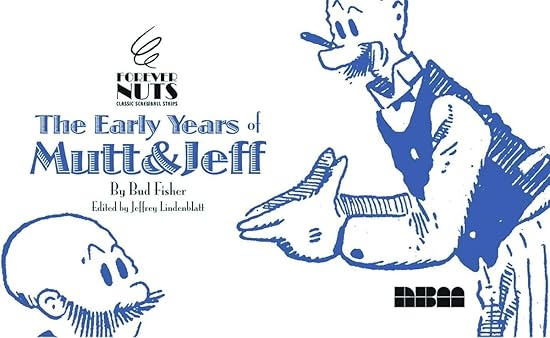
Forever Nuts: The Early Years of Mutt & Jeff (Classic Screwball Strips)


By Bud Fisher, edited by Jeffrey Lindenblatt (NBM)
ISBN 13: 978-1-56163-502-3 (HB)

This book includes Discriminatory Content produced in less enlightened times.

Today in 1954, Bud Fisher died. His landmark strip shaped the way cartoon humour worked for decades. Eerily, on the same day in 1955, Joe Palooka creator Ham Fisher (no relation), also died. There are even fewer collections of his work in print but one day we’ll get to what there is…

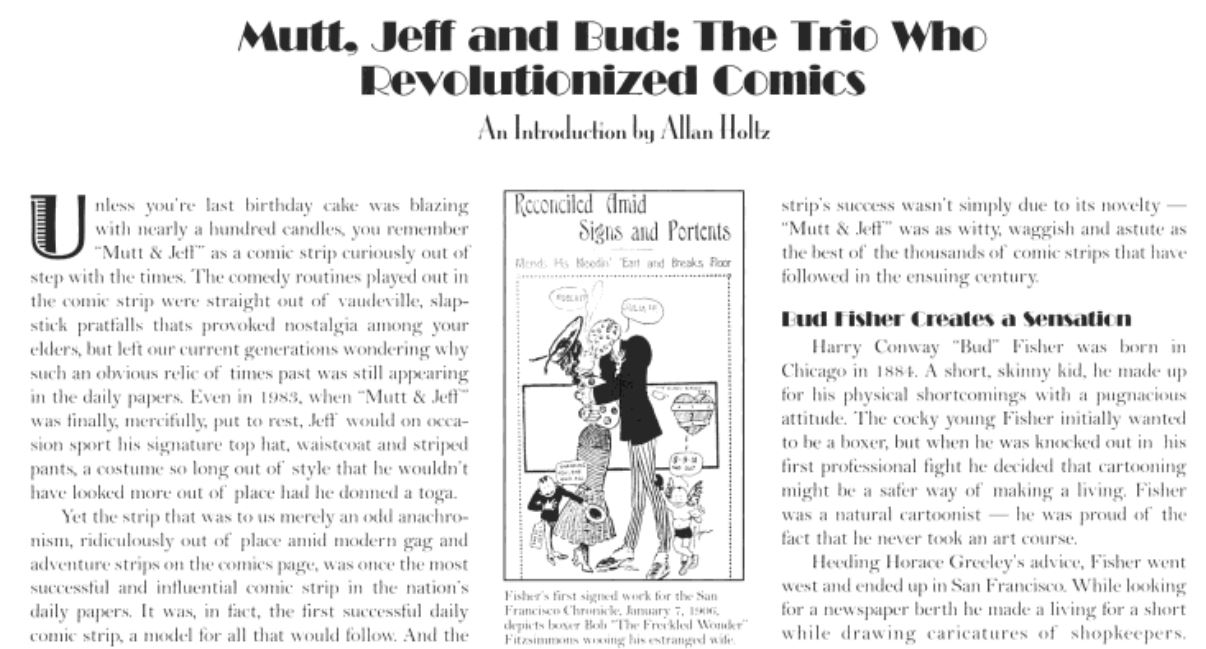
Here’s another wonderful historical treat that’s tragically lost to public gaze, once a welcome addition to a growing pool of classic strips that seemed to finally gain fan traction and be collected into accessible forms for posterity and enjoyment. Bud Fisher’s Mutt & Jeff is arguably the first comic strip to employ day to day carried-over continuity rather than individual escapades on a per diem basis.

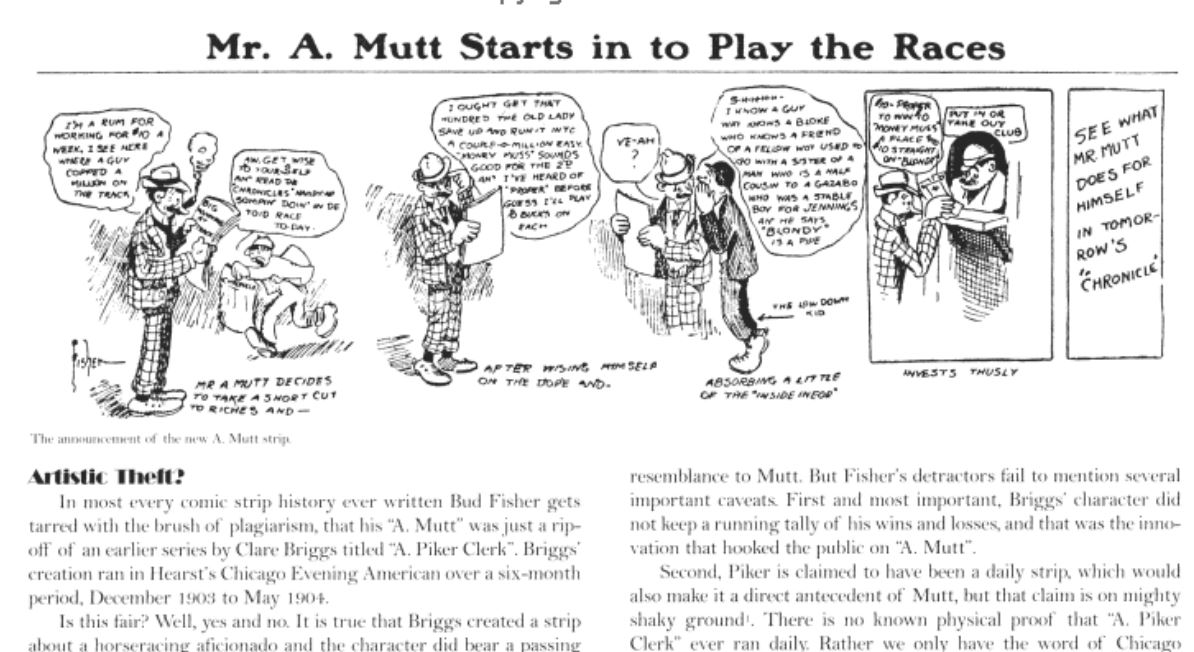
Harry Conway “Bud” Fisher began the strip A. Mutt in 1907 as a topical topper added to the racing pages of the San Francisco Chronicle. The gimmick was to have his cartoon wastrel bet on the runners and riders of that day’s paper, with the results – good or bad – forming the bones of the next day’s strip.

When Fisher’s wittily funny side hustle took off – first at the more cosmopolitan San Francisco Examiner and then into national syndication – such a limited, local maguffin was impossible for a strip now seen all across the continent. Thus a vaudeville style comedy partner and more general topics were added to become the norm. The premise of two ordinary, average – if dumb – Joes remained the strip’s basis until it ultimately folded in 1983.

Although of undoubted historical value, the slapstick roots of these everyman characters meant that gags were its currency, and the sensibilities employed – and appealed to – were often harsh, sexist, and very often quite racist by today’s standards.

Or were they?

Undoubtedly the physical depiction of Negro, Mexican, British, French, Turkish and so many other non-W.A.S.P. Americans never deviated from the graphically stereotypical. Certainly young women were always sexy and older women were grim battle axes, whilst rich people were always fat. But I suspect that that more comedic social shorthand as wilful malice aforethought.

Certainly for every gag that portrayed stupid, slow or cowardly black people there was another when the stereotype outwitted the protagonist. For every dim blonde or dumb Hausfrau there was a female sharpie who made the boys into the goats. Could it be Fisher was just a child of his time, knew his audience and was just going for the laugh wherever it was with no thought of political or social relevance?

Perhaps Fisher or his innumerable and often anonymous ‘ghosts’ (among whom Ed Mack and latterly Al Smith were most prominent) weren’t as evolved as us?

Fisher was a notoriously “absentee” creator who regularly missed deadlines and had a string of substitutes to produce the strip for him once he became comics’ first millionaire. Occasionally he would even suspend the strip entirely. Yet the feature was never discarded by client newspapers who felt it mirrored their readerships. It was just that popular.

This volume assembles strips from 1909-1913 and is certainly not without flaws. Often the heroes are pretty unlikable when they aren’t being winningly daft or actually funny. There are moments of pure racism and sexism, but also uncharacteristic challenges to that woeful status quo of acceptable stereotypes.

One minor technical moan: there’s some unfortunate editing and some strips are repeated, and it’s not that some gags are so old you can’t tell them apart…

I know that last charge isn’t true. Despite the implications of the somewhat apologist introduction from historian Allen Holtz, Mutt & Jeff was a huge multimedia hit for nearly 80 years and they are still household names today. Moreover, read in context and on their own terms, they are still brilliantly hilarious slapstick gag strips. If you’re prepared to read with an open mind you might be pleasantly surprised.
No © invoked. Any helpful suggestions?

Superman: The Golden Age Dailies 1944 to 1947 (volume 2)


By Alvin Schwartz, Wayne Boring & the Superman Studio (IDW/Library of American Comics)
ISBN: 978-1-68405-197-7 (HB)

This book includes Discriminatory Content produced in less enlightened times.

The American comic book industry – if it still existed at all – would be utterly unrecognisable without Superman. Jerry Siegel & Joe Shuster’s unprecedented invention was first fervidly adopted by a desperate and joy-starved generation, and gave birth to a genre if not an actual art form. Spawning an army of imitators and variations within three years of his 1938 debut, the intoxicating blend of breakneck, breathtaking action and wish-fulfilment epitomising the early Man of Steel grew to encompass cops-&-robbers crimebusting, socially reforming dramas, sci fi fantasy, whimsical comedy and, once the war in Europe and the East sucked in America, patriotic relevance for a host of gods, heroes and monsters, all dedicated to profit through exuberant, eye-popping excess and vigorous, dashing derring-do.

From the outset, in comic book terms Superman was master of the world. Moreover, whilst transforming the shape of the fledgling funnybook biz, the Man of Tomorrow irresistibly expanded into all areas of the entertainment media. Although we all think of the Cleveland boys’ iconic invention as epitome and acme of comics creation, the truth is that very soon after his springtime debut in Action Comics #1 the Man of Steel was a fictional multimedia monolith in the same league as Popeye, Tarzan, Sherlock Holmes and Mickey Mouse. We parochial and possessive comics fans too often regard our purest and most powerful icons in purely graphic narrative terms, but the likes of Batman, Spider-Man, Avengers and their hyperkinetic kind long ago outgrew four-colour origins to become fully mythologized modern media creatures familiar in mass markets, across all platforms and age ranges…

In the last century and even more so in this one, far more people have seen and heard the Man of Steel than have ever read his comic books. These globally syndicated newspaper strips alone were enjoyed by countless millions, and by the time his 20th anniversary rolled around, at the very start of what we call the Silver Age of Comics, he had been a thrice-weekly radio serial star, headlined 17 astounding animated cartoons, become a novel attraction (written by George Lowther) and helmed two feature films. He had then seamlessly segued into the next Big Thing – television. His first smash 8-season live-action show was but the first of many, making Superman a perennial sure-fire success for toys, games, food, puzzle and apparel manufacturers all over the planet.

Although pretty much a spent force these days, for the majority of the previous century the newspaper comic strip was the Holy Grail all American cartoonists and graphic narrative storytellers hungered for. Syndicated across the country – and often the world – a strip feature could be seen by millions if not billions of readers and was generally accepted as a more mature and sophisticated form of literature than comic books. It also – at the start! – paid better, and rightly so. Some of the most enduring, entertaining characters and concepts of all time were devised to lure readers from one particular paper to another and many of the best became cornerstones of a global culture. Mutt and Jeff, Flash Gordon, Dick Tracy, Buck Rogers, Charlie Brown and so many more escaped humble, tawdry newsprint origins to become meta-real: existing in the minds of earthlings from Albuquerque to Zanzibar. Most still do…

The daily Superman newspaper strip launched on 16th January 1939, swiftly augmented by a full-colour Sunday page from November 5th of that year. Originally crafted by luminaries like Siegel & Shuster and their studio (Paul Cassidy, Leo Nowak, Dennis Neville, John Sikela, Ed Dobrotka, Paul J. Lauretta & Wayne Boring), the mammoth task soon required additional talents like strip veteran Jack Burnley and writers including Whitney Ellsworth, Jack Schiff & Alvin Schwartz. The McClure Syndicate feature ran continuously until May 1966, appearing, at its peak, in over 300 daily and 90 Sunday newspapers: a combined average readership of more than 20 million. Eventually, Win Mortimer & Curt Swan joined the unflagging Boring & Stan Kaye, whilst Bill Finger and Siegel also provided stories, telling serial tales largely divorced from comic book continuity throughout years when superheroes were scarcely seen.

This second volume of the Library of American Comics collection continues the vast reprint program begun in the Sterling/Kitchen Sink softcover editions which ceased production in 1999. All of that material – and these books too – are long overdue for re-release and digital editions. Here, however, the never-ending battle resumes with Siegel & Shuster and their helpers ceding control to new creators, but still addressing the World War the USA was close to ending. These sorties in “the never-ending battle” occur over episodes #31-46, pages #1815 through 2594, and publication dates October 30th 1944 to April 26 1947.

We open with an Introduction by Sidney Friefertig, discussing the changes from conflict to reconstruction and sharing why and how the strip aroused the ire of military intelligence and the FBI after casually stepping on the toes of the ultra-top-secret Manhattan Project. All they had wanted was to explore how atomic energy might affect the Action Ace. Also in review is the Man of Tomorrow’s post-war evolution via new scribe (and later poet, novelist and essayist) Alvin Schwartz (1916-2011) in the ever-evolving social stewpot of Metropolis and an increasingly smaller world.

With the majority of material credited to Schwartz (Batman, Wonder Woman, Aquaman, Tomahawk, Newsboy Legion, Slam Bradley, House of Mystery, A Date With Judy, Buzzy, Bizarro) and increasingly the sole province of artist Wayne Boring, the compilation kicks off with Episode 31 (strips #1815-1844 as seen between October 30th and December 2nd 1944) and the dilemma of ‘Superman’s Secret Revealed!’ as “World’s Richest Girl” Aline Wail announces her betrothal to the Man of Steel. Nobody is more despondent than Lois Lane or more surprised than Clark Kent, but by the time this genuine teletype typo is spotted, the story has gone global and Aline’s actual fiancé Aubrey Jones has been outed by frantic reporters – including Lois – as the superhero; thanks to a concatenation of accidents and misconceptions…

Sadly, inveterate gambler Aubrey needs to keep the deception going if he’s to pay off his bookies, and plans to cash in by suing Lois and the Daily Planet, until the real Superman steps in to divert and dispel the mounting media madness…

‘Lois Lane, Millionaire’ (strips #1845-1904, December 4th 1944 – February 10th 1945) then details how a murderous lawyer Homer G. Clutch and his virtual slave Mortimer attempt to procure the feisty journalist’s unsuspected inheritance of $3,000,000 from recently departed Grand-uncle Phineas Lane. Of course, to get the cash, Lois must marry within 10 days of receiving the official letter of notification, and account executor Clutch has many ways of intercepting the pay-out. Moreover, when Clark breaks the story, his scoop makes Lois the target of every other chancer and ne’er-do-well in town. They also all make it onto Clutch’s to-do list before Superman – and ironical fate – end Lane’s dreams of idle indolence…

Mundane crime gives way to wild fantasy next as ‘The Obnoxious Ogies’ (#1905-1946, February 12th – March 31st 1945) are annoying heard but not seen. When the invisible fairy pranksters attach themselves to Superman they make his life – and Clark’s – a cacophony of chaos until the Metropolis Marvel concocts something even these puckish pranksters cannot cope with…

Spanning April 2nd to June 23rd, strips #1947-2018 reveal ‘The Science of Superman’ as intractable intransigent physics Professor Ebenezer Duste refuses student Gil Gilmore his degree because the callow youth used clearly fictious examples of a Man of Tomorrow’s power set in his thesis. With his future career and current romance endangered the kid enlists Superman himself but even he cannot convince the sage of his authenticity, until at the height of a spiralling campaign of bizarre stunts, Duste finally finds his opinions shaken by attentive widow Prunella Busby who has her own way of winning an argument…

When a Daily Planet cooking contest prize goes to elderly spinsters Annabelle and Amelia, they parlay the reception into a longed-for meeting with Superman, inadvertently drawing the cataclysmic attention of Extra-Dimensional prankster Mr. Mxyztplk in ‘A Recipe for Disaster’ (June 25th – August 25th, strips #2019-2072)

Eager to impress, the sprite embarks on a career as a chef to win their attention/annoy the pants off his arch enemy and scare all Metropolis witless. It takes all Superman’s ingenuity and large helping of cunning from the old biddies before the Myxy can be convinced to go home again…

Lois finally finds herself ‘Engaged to Superman’ (#2073-2138, August 27th – November 10th) but when she insists that Clark be Best Man it triggers a wave of popular resentment among the city’s women, who protest in the streets and literally strike a blow for romance. As if that weren’t bad enough, mob chief Gaunt suspends all operations until after the wedding, planning to curb Superman’s anti-crime activities by threatening his bride. First, though, he has to marry Lois and the unhappy couple keep postponing the big day…

Domestic screwball comedy gives way to more traditional dramatic fare when Superman must save the Daily Planet – and Clark’s reputation – after a disgruntled employee publishes implausible predictions that Superman must make come true in ‘Phoney Prophecies’ (#2139-2198, November 12th 1945 to January 19th 1946) after which ‘Lois Lane, Editor’ (January 21st – April 6th, strips #2199-2264) confirms her courage, capability and ingenuity when high powered crooks seek to end her crusading crime reporting by seeking to buy her off with a major promotion. However, staunch and valiant, Miss Lane subverts the plot and makes The Daily Sphere a certified success before exposing the villains and negotiating a most rewarding return to the Planet…

A fantastic crimewave heralds the return of super-science bandit Lex Luthor (AKA Dr. Phineas Hackensack) between April 8th and June 1st (#2265-2312) as the villain unleashes ‘The Red Plague’ as a means of getting Superman into his lab and subjecting to a battery of horrific tests all designed to end his life. When all else fails he turns the Man of Steel into a living atomic bomb but once again tastes bitter defeat, after which ‘The Golden Scam’ (June 3rd – July 20th, #2313-2354) sees super conman J. Phineas Foxtrap gulled by his own greed and lose another fortune after selling fake gold bars to suckers with Superman’s approval. Of course, thanks to maverick atomic boffin Dr. Al Kemist, this time the ingots are completely genuine and vile trickster gets a taste of his own medicine…

In ‘Labors of Love’ (#2355-2378; July 22nd to August 17th) Superman again resolves to propose to Lois, but his heartfelt efforts are continually sabotaged by Mr. Mxyztplk, who spitefully decides that she’s actually the only girl in creation fit to be his mate. Cue crazed chaos, calamity and just a little carnage….

The trend towards whimsy and intellectual challenges continued when Lois is ordered to edit the Planet’s “Advice to the Lovelorn” column. She consequently asks our hero to cure a lazy dockside bum of being old, useless and unemployed in ‘Superman Finds a Job’ (#2379-2432; August 19th – October 2nd. He triumphs by inspiring aging wastrel Sam Brodie to discover his true calling and at last take the wrinkly hand of not-so-patient lady love Miss Tillie Crockett, but it’s a close call and takes all his super-wits and a lot of dumb luck…

Pure wickedness informs ‘The Prankster’s Peculiar Premonitions’ (#2433-2462; October 21st – November 23rd) as the lethal Joker-wannabe feigns clairvoyance and prophecy to humiliate Superman and plunder the city, before a war of aerial signwriters breaks out in ‘Sky Pirates’ (November 25th 1946 to January 4th 1947 and instalments #2463-2498) with a rogue pilot instigating a cunning crime wave of the air.

‘Portrait of a Crime’ (January 6th – February 8th; #2499-2528) introduces devious painter Pierre Laguerre who seeks to remove the Man of Steel from action by the strangest of methods, prior to the book concluding on a potent note of social relevancy.

‘Juvenile Delinquency’ (#2529-2594; February 10th to April 26th 1947) finds privileged brat Stanton Gladstone team up with dead-end kid Nicky Darrow to run wild, have fun and teach their respective families a lesson in parenting. However, rowdy rebellion escalates to felony and possibly murder when veteran criminals lead by top thug Big Jim step in to exploit the situation. Now Superman must not only punish the irredeemably wicked but save what remains of the boys’ tarnished innocence…

These yarns offer timeless wonders and mesmerising excitement for lovers of action and fantasy. The raw-boned early Superman is beyond compare and if you can handle the warts of the era or just crave simpler stories from less angst-wracked times, the adventures gathered here are ideal comics reading, and this a book you simply must see.
© 2018 DC Comics. All rights reserved. Superman and all related names, characters and elements are ™ DC Comics.

Gomer Goof volume 12: Twenty-One Goof Salute!


By Franquin, translated by Jerome Saincantin (Cinebook)
ISBN: 978-1-80044-161-3 (PB Album/Digital edition)

This book includes Discriminatory Content produced during less enlightened times and some used for dramatic and comedic effect.

Born in Etterbeek, Belgium on January 3rd 1924, André Franquin began his astounding career in the golden age of European cartooning. In 1946, as assistant to Joseph “Jijé” Gillain on top strip Spirou, he inherited sole control of the keynote feature, going on to create countless unforgettable characters like Fantasio and The Marsupilami. Over two decades Franquin made the strip purely his, expanding its scope and horizons, as co-stars Spirou & Fantasio – with hairy Greek Chorus Spip the squirrel – became globetrotting troubleshooters visiting exotic places, exposing crimes, exploring the incredible and clashing with bizarre, eccentric arch-enemies. Throughout all that, Fantasio remained a full-fledged – albeit entirely fictional – reporter for Le Journal de Spirou, popping back to base between assignments. Regrettably, ensconced there like a splinter under a fingernail was an arrogant, accident-prone office junior tasked with minor jobs and general dogs-bodying. He was Gaston Lagaffe; Franquin’s other immortal – or peut-être unkillable? – conception…

There’s a hoary tradition of comics personalising fictitiously back-office creatives and the arcane processes they indulge in, whether it’s Marvel’s Bullpen or DC Thomson’s lugubrious Editor and underlings at The Beano and Dandy; it’s a truly international practise. Somehow though, after debuting in LJdS #985 (February 28th 1957), the affable dimwit grew – like one of his own monstrous DIY projects – beyond control. Whether guesting in Spirou’s romps or his own strips/faux reports on the editorial pages Lagaffe became one of the most popular and ubiquitous components of the comic he was supposed to paste up.

In initial cameos or occasional asides on text pages, the well-meaning foul-up and ostensible studio gofer Gaston lurked and lounged amidst a crowd of diligent toilers until the workshy slacker employed as a general assistant at LJdS’s head office became a solid immovable fixture. Ultimately the scruffy bit-player inevitably stumbled into his own star feature…

In terms of schtick and delivery, older readers will recognise favourite beats and elements of well-intentioned helpfulness wedded to irrepressible self-delusion as seen in Benny Hill or Jacques Tati vehicles and recognise recurring riffs from Only Fools and Horses and Mr Bean. It’s blunt-force slapstick, using paralysing puns, fantastic ingenuity and inspired invention to mug smugness, puncture pomposity, lampoon the status quoi? (and that’s British punning, see?) and ensure no good deed goes noticed, rewarded or unpunished…

As previously stated, Gaston/Gomer can be seen (if you’re very quick or extremely patient) toiling at Le Journal de Spirou’s editorial offices. At first he reported to Fantasio, but as pressure of work took the hero away, the Goof instead complicated the lives of office manager Léon Prunelle and other harassed and bewildered staffers, all whilst effectively ignoring any tasks he’s paid to actually handle. These notionally include page paste-up, posting packages, filing, clean-up, collecting stuff inbound from off-site and editing readers’ letters – the reason why fans’ requests and suggestions are never acknowledged or answered…

Gomer is lazy, hyperkinetic, opinionated, ever-ravenous, impetuous, underfed, forgetful and eternally hungry: a passionate sports fan, self-proclaimed musician maestro and animal lover whose most manic moments all stem from cutting work corners, stashing or consuming contraband nosh in the office or inventing the Next Big Thing. This situation leads to constant clashes with colleagues and draws in notionally unaffiliated bystanders like increasingly manic traffic cop Longsnoot and fireman Captain Morwater, plus ordinary passers-by who should know by now to keep away from this street.

Through it all, the obtuse office oaf remains affable, easy-going and incorrigible. Only three questions matter: why everyone keeps giving him one last chance, what does gentle, lovelorn Miss Jeanne see in the self-opinionated idiot, and will perpetually-outraged and accidentally abused capitalist financier De Mesmaeker ever get his perennial, pestiferous contracts signed?

Gathering material created between 1980-1982, Gaston – La saga des gaffe became the 14th European album, and the last to use originated material solely by the increasingly troubled genius. Released in translation, it’s Cinebook 12th compilation, offering non-stop, all-Franquin gags and wry observations in formats ranging from single tier and half pagers to extended multi-page yarns.

There’s a preponderance of bitter and bizarre clashes with hard-pressed, long suffering traffic cop Longsnoot (AKA Joseph Longtarin in European editions) that has become known as the “Parking Meter War”, as their protracted clash of ideologies and nerves seemingly reflected Franquin’s mounting ecological concerns and increasingly fraught emotional state and declining mental health.

Here, many strips indulge that struggle via clashes with forces of authority, revealed via encounters with polluters, open support of Greenpeace, advocacy of urban “greening” projects and even anti-military, pro “Save the Whales” episodes, which never forget to be funny as well as trenchant.

The simmering duel with the rulers of the road peaks over many car-based clashes as a cold war involving the million-&-one things that can be done with (and to) parking meters goes into overdrive. This all culminates in the Goof’s invention of mobile dummy replicas of the despised coin collecting taxation-tools, programable roving units and prophetically realistic wandering self-driving robots like those terrorising us all right now…

Other riffs revisited include rare moments of paradise with inexplicably besotted paramour Miss Jeanne, more nigh-deadly diversions with his menagerie (Cheese the mouse, goldfish Bubelle, an adopted feral cat and a black-headed gull) and Gomer’s growing tendency to insomnia or nightmares with real world consequences…

As ever, the forward-looking Goof is blind to the problems his antiquated automobile causes, despite numerous attempts to soup up, cleanse, modify and mollify the motorised atrocity he calls his. The decrepit, dilapidated Fiat 509 is only fit for assisted dying, and here the ultimate improvements are beta-tested, as the boy genius trials super-elastic seat belts and his electric, (barely) roadworthy mobile bedstead – to the shock, awe and horror of all that see it…

Naturally, many moments of chaos still occur at work (if and when he gets there): incidents involving “improved” fire suppression systems, coatracks, photocopiers, recycling schemes and especially the untapped potential of the studio’s new computers…

Our well-meaning, overconfident, overly-helpful know-it-all hindrance invents more stuff making office life unnecessarily dangerous, and continues his pioneering and perilous attempts to befriend and boost fauna and flora alike and improve the modern mechanised world, but this doesn’t leave much time for recreation. Still, there’s time to “master” kitchen bicycle trials and haul out the truly terrifying old Brontosaurophone/Goofophone, and Gomer does make a new enemy after a protracted dispute with the office plumber – an old lag who knows a blowhard meddler when he sees one…

At least lovely Miss Jeanne and forever faithful pal/accomplice Jules-from-Smith’s-across-the-street are still keenly appreciative of his efforts to improve the world, even if it seems at the cost of a few paltry lives, much municipal and private property, the wellbeing of long-suffering Prunelle and eternally frustrated De Mesmaeker

Dipped in dark mordant wit, but still the funniest French comic ever, isn’t it time you quit being so serious and started Goofing around?
© Dupuis, Dargaud-Lombard s.a. 2009 by Franquin. All rights reserved. English translation © 2025 Cinebook Ltd.

Lucky Luke volume 56: Under a Western Sky


By Morris, translated by Jerome Saincantin (Cinebook)
ISBN: 978-1-84918-273-7 (Album PB/Digital edition)

This book includes Discriminatory Content produced in less enlightened times.

Lucky Luke was created in 1946 by Belgian animator, illustrator and cartoonist Maurice de Bévère (AKA “Morris”). For years we believed it was for Le Journal de Spirou Christmas Annual (L’Almanach Spirou 1947), before being launched into his first weekly adventure ‘Arizona 1880’ on December 7th 1946. However, eventually it came to light that the strip actually debuted in the multinational weekly comic mid-year, but sans a title banner and only in the French-language edition.

Doughty, rangy, and dashingly dependable, the cowboy is an implacably even-tempered do-gooder who can “draw faster than his own shadow”, amiably ambling around the mythic, cinematically realised Old West, enjoying light-hearted adventures on his petulant, stingingly sarcastic wonder-horse Jolly Jumper. From that natal moment, his exploits in Le Journal de Spirou – and, from 1967, in rival periodical Pilote – have made the sharpshooter a legend of stories across all media and monument of merchandising.

Working solo with occasional script assistance from his brother Louis, Morris produced 10 albums worth of affectionate and thrilling sagebrush parody before formally uniting with René Goscinny, who became regular wordslinger with Des rails sur la Prairie (Rails on the Prairie), commencing in LJdS on August 25th 1955.

They literarily rode together on another 44 albums whilst Luke attained dizzying heights of superstardom. The partnership strengthened as the six-gun straightshooter switched teams, transferring to Goscinny’s own magazine Pilote with La Diligence (The Stagecoach). When Goscinny died, Morris continued both singly and with fresh collaborators. The dream team’s last ride was 1986’s La Ballade des Dalton et autres histoires/The Ballad Of The Daltons and Other Stories.

Eventually Morris invited an inspired band of legacy creators to step in: luminaries including Achdé & Laurent Gerra, Benacquista & Pennac, Xavier Fauche, Jean Léturgie, Jacques Pessis and more, all taking their own shots at the lovable lone rider. Morris died in 2001, having drawn fully 70 adventures, plus an assortment of sidebar and spin-off sagebrush sagas. Since 2016 Julien Berjeaut, AKA Jul (Silex and the City) has tackled the tall tale telling…

Lucky is one of the top-ranked comic characters in the world, having generated 94 albums (if you count spin-off series like Kid Lucky and Ran-Tan-Plan, and numerous artist’s specials) Sales are well north of 300 million in 33 languages and all that renown has translated into a mountain of merchandise, toys, games, animated cartoons, TV shows and live-action movies and even commemorative exhibitions. No theme park yet, but you never know…

Our taciturn trailblazer’s travails draw on western history as much as movie mythology and regularly interacts with historical/mythological figures, as well as even odder fictional folk as authors explore and refine key themes of classic cowboy films – as well as some uniquely European notions and interpretations. As previously hinted, the happy wanderer is not averse to being a figure of political change and Weapon of Mass Satire… but not in this primal, heavily cartoon-short-influenced outing…

We Brits first encountered Lucky Luke in the late 1950s, syndicated to weekly comic Film Fun, and again in 1967 in Giggle, where he blazed trails as Buck Bingo. This collection re-presents the contents of the fourth European album, released in 1952 as Sous le ciel de l’Ouest. Under a Western Sky gathers three short strip serials and opens with ‘The Return of Trigger Joe’ (originally Le Retour de Joe la Gachette, running in LJdS #602-618 between October 27th and 1949-February 16th 1950. Here the lonesome wanderer meets another prairie nomad who’s his match in all cowboy disciplines, and becomes a rather ruthless competitor when they both sign up for the Nugget Gulch horse race. John “The Philanthropist” Smith believes he’s a shoo-in since he’s riding the stolen Jolly Jumper, but the rogue hasn’t counted on Luke’s close relationship with the wonder horse.

Once that scheme fails – but not before extended and manic slapstick shenanigans in the race scenes which also include the usual cinematic cohort of clowns, cheats and chancers – Smith falls back on his old ways as veteran bank robber Trigger Joe. However, his pilfering the prize money only leads to disaster when Lucky trails him deep into the searing desert, and displays an uncanny grasp of a craven villain’s psychology…

Next up is ‘Round Up Days’ which ran in LJdS #619-629 from February 23rd to May 4th 1950 as Jours de round-up. It sees Lucky actually working as a cowboy, hiring on for a cattle round-up (lots of rodeo style comedy here!) before encountering rustlers and cleaning up cow town Bottleneck City…

Closing the proceedings, Le Grand combat (LJdS #630-646; May 11th – August 31st 1950) becomes ‘The Big Fight’ and sees Luke briefly adopt a two-fisted simpleton with the strength of Hercules and a sweetheart in need of marrying and providing for: schooling him in the arts of pugilism for a prize-fight against infamous Killer Kelly. Things go pretty well until bookmaker Slats “Slippery” Nelson attempts to fix the outcome. Thankfully, Lucky is his match in cunning and a faster gun than the gambler’s hirelings and the result is a cartoonishly violent romp celebrating a series of riffs on boxing movies as well as cowboy antics…

These prototypical formative forays of the indomitable hero offer grand joys in the wry tradition of near-contemporary cinema classics like Destry Rides Again or Laurel & Hardy’s Way Out West – perfectly understandable as Morris was a devout fan of the immortal bumblers and their gentle but astonishingly imaginative action-slapstick capers. Superbly executed by a master storyteller, these tales are a wonderful introduction to a unique genre for modern kids who might have missed the allure of a Wild West that never was…
Original edition © Dupuis 1952 by Morris. © Lucky Comics. English translation © 2015 Cinebook Ltd.

Roy Crane’s Captain Easy, Soldier of Fortune: The Complete Sunday Newspaper Strips volume 4 (1941-1942)


By Roy Crane with Leslie Turner (Fantagraphics Books)
ISBN: 978-1-60699-677-5 (Tabloid HB)

This book includes Discriminatory Content produced in less enlightened times

The fourth and final collection of Roy Crane’s groundbreaking, trailblazing Sunday strip completes a quartet of comics compilations no lover of high adventure, action comedy and visual narrative excellence should be without.

Our industry and art form evolved from phenomenally popular newspaper strips born of the first four decades of the 20th century: monolithically powerful circulation-boosting features which could, until relatively recently, dictate success or failure in America’s cutthroat newspaper business. The daily cartoon stories were immensely addictive and thus regarded as invaluable by publishers who used them as a sales weapon to ensure consumer loyalty, increase sales and maximise profits. Many a pen-pushing scribbler became a millionaire thanks to their ability to draw pictures and spin a yarn…

With hundreds of 24-hour TV channels, streaming services, games and apps on demand now, it’s impossible for us to grasp the overwhelming allure of the comic strip in America and the wider world. From the Great Depression to the end of World War II, with no domestic television, radio coverage far from comprehensive and movie-shows a weekly treat at best for most, entertainment was generally garnered from those ubiquitous newspaper comic sections. Funny Pages were a universally shared, communal recreation for millions. Entire families were well-served by an astounding variety of features of spectacular graphic and narrative quality.

From the outset humour was paramount – that’s why they’re called “Comics” – but eventually anarchic baggy-pants clowning, cruelly raucous, racially stereotyped accent humour and gag-&-stunt cartoons palled, evolving into a thoroughly unique entertainment hybrid that was all about the dynamics of panels and pages. At the forefront of the transformation was Roy Crane’s Wash Tubbs. It utilised a blend of silent movie slapstick, outrageous movie serial antics, fabulous fantasy and old fashioned vaudeville shtick, but also added compellingly witty and authentically true dialogue and a breathtaking sense of day-to-day progression – in short, serial continuity. There were also plenty of lovely women; what we used to call “something for the dads”…

What separated Crane from his close contemporaries and competitors – who were making similar advancements in the new art form – was that he was blending the fun with stirring, contemporary rollercoaster, implausible heroic action…

Washington Tubbs II began as a typical gag-a-day strip on April 21st 1924, bearing marked similarities to confirmed family favourite Harold Teen (by Crane’s pal and contemporary Carl Ed). Young Wash was a short, feisty and fiercely ambitious shop clerk permanently on the lookout for fortune and fame, but cursed with an eye for the ladies. Gradually his peripatetic wanderings moved from embarrassing gaffes towards mock-heroics, into full-blown – but still light-hearted – action and ultimately rip-roaring, decidedly dangerous hazardous trials, ordeals and exploits. This graphic evolution eventually demanded the introduction of a he-man sidekick to handle the fights the kid was getting into but seldom won. Thus enter moody, swashbuckling heroic prototype Captain Easy in the landmark episode for May 6th 1929…

Slap-bang in the middle of a European war, fast-talking, garrulous Tubbs saved a taciturn, down-on-his-luck, enigmatic fellow American from a cell and a perfect partnership was formed. They became inseparable: comrades-in-arms, roving the globe in search of treasure, lambasting louts and fighting thugs to rescue a stunning procession of wondrous women in assorted modes of distress…

The edgily capable, utterly dependable “Southern Gen’leman” was something previously unseen in Funnies: a raw, square-jawed hunk played dead straight rather than as the mock-heroic buffoon/music hall foil cluttering strips like Hairsbreadth Harry or Desperate Desmond. Moreover, Crane’s seductively simple blend of cartoon exuberance, combining faux-straight illustration with “bigfoot” cartooning (here carefully mimicked and even surpassed by his assistant and creative successor Leslie Turner) was a far more accessible and powerful medium for fast-paced adventure story-telling than the beautiful but stagy style favoured by artists like Hal Foster on Tarzan or Prince Valiant and Alex Raymond with Flash Gordon and Jungle Jim. Tubbs & Easy were much closer to the surreal, absurdly action-packed Popeye or V. T. Hamlin’s comedy caveman Alley Oop: full of vim, vigour and vinegar and seldom sombre or serious for long…

The overall effect was electrifying – and a host of young cartoonists used the strip as their bellwether: Floyd Gottfredson, Milton Caniff, Jack Kirby, Will Eisner and especially an impressionably admiring Joe Shuster

After several abortive attempts at a Sunday feature starring his little warrior, Crane eventually settled on the burly sidekick as his potential star and Captain Easy launched on July 30th 1933. The content was unflinching exotic action: blistering two-fisted yarns set before the two buddies’ first meeting.

This fourth and final fabulous volume covers December 22nd 1940 to July 11th 1943, bringing to a close Crane’s association with the strip. He had abandoned the feature to NEA, joining William Randolph Hearst’s King Features to produce Buz Sawyer – a strip he would own and have creative control over. Turner continued both the daily Wash Tubbs and Sunday Captain Easy (with his own assistants) until his retirement in 1969.

This blockbuster collection opens with an Introduction from Michael H. Price tracing potential candidates as basis for the surly Southerner in ‘Roy Crane and the Man Who was Easy’ before the increasingly eccentric and comedic final pages, a goodly proportion of which were produced during the critical period just before America finally entered WWII.

The material is significant for one salient point – Tubbs and especially Easy are scarcely seen after hostilities commenced. The reason was obvious: all true patriots wanted to defend their country and the heroes enlisted…

The hilarious action begins with the reintroduction of comedy foil Lulu Belle: a homely, cigar-chomping hillbilly lady who had been a circus strongwoman and undisputed Female boxing champion for fifteen years. She had married serial bigamist and all-round bounder C. Hollis Wallis before going home heartbroken to her family, but as they just saw her as a meal ticket too, she was overjoyed when Tubbs & Easy wandered by the old homestead.

Soon she was accompanying them to Guatemala, following an out-of-date advert for workers at a wildcat oil field. Arriving eight years too late, the trio are gulled into joining a bandit gang run by savage and sultry Teresa Grande; a Latin spitfire who’s the most dangerous killer in the country. She, however, is smitten with Easy’s manly charms, and redeems herself at terrible cost when her gang try to steal sacred relics from a remote village and its ancient temple.

Homeless and broke as usual, the plucky Americans then walk to the coast and find passage on a ship run an eccentric who keeps pet tigers. The voyage goes as you’d expect and the trio end up shipwrecked somewhere off Cuba, only to be stalked by a wild Wolf Girl: a lost child marooned and grown wild as she matured in the jungle…

After numerous close shaves and hilarious escapades, Easy captures and partially tames the bestial lass, entrusting her to the care of a vacationing American psychologist, whilst Lulu Belle secures a job as cook in a dingy waterfront dive. It’s there that she meets and is romanced by Easy’s brutal arch-enemy Bull Dawson, and inadvertently lures Wash and the Captain aboard the rogue’s ship. Brokering a tenuous peace, she convinces her friend to work on the “reformed” Dawson’s new job: a jungle reclamation project near the Panama Canal. It’s all a big con, though. The treacherous pirate is actually building a secret landing-field for agents of a certain foreign power and when Wash and Easy uncover the truth the fists and fireworks fly…

Returned to the USA, heartbroken, lovelorn Lulu is taken in by the ambitious schemes of a millionaire who somehow finds the unprepossessing lady irresistible. Of course Akron O. Spratly also has plans to boost the war effort by extracting much-needed rubber from frogs…

After much outrageous flummery and hilarious misadventure Lulu is left even sadder, if no wiser, just as the now partially civilised Wolf Girl returns. She has escaped her collegiate captors and is running wild in the big city: her immense physical strength and speed causing much unladylike chaos in Gentlemen’s clubs, the circus, on sports fields and at the Zoo. She also displays amazing talent for acquiring pretty sparkly items like watches and jewellery…

A very different type of girl appears next as obnoxious ten-time married billionaire Horatio Boardman swears off women again and hires Easy to make sure the pledge sticks. Sadly, local mobsters are determined to introduce the World’s Eighth Richest Man to Baby Doll, a sexily appealing ingénue with the rapacious heart of a viper…

That screwball set-up was good for three months-worth of laughs before Lulu again takes centre stage when a boastful beautician is suckered into a bet that he can make any woman so lovely that she will be photographed in the newspapers…

Reduced to simple straight man by Lulu, Easy soon took third place as the boxing broad accidentally acquired a manic and capacious ostrich named Lucille. The big bird’s astounding appetite led to Lulu becoming the indentured slave of a shady farmer who first had her work off the giant’s gannet’s destructive binges and then sold his guilt-wracked toiler on to other men in need of fields ploughed, clothes washed and chores done… until the outraged Easy came back and dealt with the vile trafficker…

Stony broke but free once more, Lulu then roped Easy in on a culinary affair as she opened a diner in the worst place possible, just as her ne’er-do-well family palmed off a young cousin onto her. Augustus Mervin Gasby was a locust in human form, and his astonishing appetite seemed fit to bust the desperate pair… until the former-soldier-of-fortune found something that the shambling oaf could do really well…

A panoply of ludicrous sporting endeavours eventually led Gus into the Navy whilst on the Home Front Easy and Lulu went fishing and subsequently exposed a huge dope-smuggling ring in one of the last rousing adventure episodes, after which the tone switched back to screwball comedy with the re-emergence of C. Hollis Wallis who weaselled into town in search of another woman to marry and fleece. He wasn’t particularly picky and despite Lulu keeping a weather eye – and occasionally a couple of clenched fists – on him, the louse breezed through a few options before settling upon one eminent prospect who lived in a mansion with many oil-wells attached.

He had no idea she was only the cook…

A secondary plot began mid-stream as Zoot-suit gangster William “Trigger Boy” Scramooch got out of the State Pen and moved into Lulu’s boarding house. Ever prey to poor judgement, she took a shine to him whereas for Easy it was disgust at first sight…

Horning in on Wallis’ potential windfall, Trigger Boy planned a kidnap and tricked Lulu into doing his dirty work. Big mistake…

More single page gags follow, including a clever patriotic sequence where Lulu buys a big gas-guzzling automobile and leads the nation by her sacrificial example after which Easy makes his last appearance (28th February 1943) serving to reintroduce another old pal.

Magician, ventriloquist and escapologist Lonny “the Great” Plunkett pops up once more, pranking the cops and again becoming a target of crooks in dire need of illicit safecracking expertise. Lulu is a natural partner for the sharp guy and together they scotch the hoods’ plan, after which romance blooms again when 600-pound gorilla Roy Boy decides only she can be his ideal mate. When he’s frustrated in his amorous endeavours he smashes out of his cage and rampages like a hairy tornado through town…

The comic capers conclude on a high humour note with a return to C. Hollis Wallis’ ongoing marital scam, which escalates into brilliant farce before the loathsome little Lothario gets what’s coming to him…

Ending this final titanic (with pages 380mm high x 270mm wide) luxury hardback tome is a full-colour correction from volume 3, another hand-painted colour-guide strip by Crane and Rick Norwood’s ‘Transition’: an illustrated article explaining just where Tubbs & Easy went when they faded from Turner’s Sunday pages…

Roy Crane’s Captain Easy, Soldier of Fortune: The Complete Sunday Newspaper Strips is a magnificent undertaking: gathering in a wonderfully accessible form one of the most impressive, funny, exciting and influential comic strips of all time, in books that cannot help but inspire awe and affection. Captain Easy is perhaps the most unsung of all great pulp heroes and his spectacular, rip-snorting, pulse-pounding, exotically racy adventures should be just as familiar to lovers of classic adventure as Tintin, Doc Savage, Allan Quatermain, Scrooge McDuck and even Indiana Jones.

These astounding masterpieces are quite unforgettable: fanciful, entertaining and utterly irresistible. How can you possibly pass up the chance to experience the stories that inspired the giants of action adventure?

Captain Easy strips © 2013 United Feature Syndicate, Inc. This edition © 2013 Fantagraphics Books, all other material © the respective copyright holders. All rights reserved.

The Complete Peanuts volume 9: 1967-1968


By Charles M. Schulz (Fantagraphics Books/Canongate Books UK)
ISBN: 978-1-56097-826-8 (US HB) 978-085786-213-6 (UK HB)

This book includes Discriminatory Content produced in less enlightened times.

Peanuts is unequivocally the most important comic strip in the history of graphic narrative. It is also the most deeply personal. Cartoonist Charles M Schulz crafted his moodily hilarious, hysterically introspective, shockingly surreal philosophical epic for half a century: 17,897 strips spanning October 2nd 1950 to February 13th 2000. He died – from complications of cancer – the day before his last strip was printed.

At its height, Peanuts ran in 2,600 newspapers, in 21 languages and75 countries. Many of those venues still run it in perpetual reprints, as they have ever since his death. During his lifetime, book collections, a merchandising mountain and television spin-offs had made the publicity-shy doodler an actual billionaire at a time when that really meant something…

None of that matters. Peanuts – a title Schulz loathed, but one the syndicate forced upon him – changed the way comics strips were received and perceived: proving cartoon comedy could have edges and nuance and meaning as well as soon-forgotten pratfalls and punchlines.

We begin with an effusive foreword from film icon John Waters expressing his utter support of the mighty Lucy Van Pelt and all who sail in range of her, drawing references and similarities to actor/personality Divine I never saw before, but now can’t shift…

Notionally, our focus and point of contact remains quintessential, inspirational loser Charlie Brown who, beside fanciful, high-maintenance mutt Snoopy, remains squarely at odds with a mercurial supporting cast, hanging out doing what at first sight seems to be Kids Stuff and an increasingly hostile universe of perverse happenstance.

Always, gags centre on play, varying degrees of musicality, pranks, interpersonal alignments, the mounting pressures of ever-harder education, mass media lensed through young eyes and a selection of sports in their season, leavened by agonising teasing, aroused and crushed hopes, the making of baffled observations and occasionally acting a bit too much like grown-ups. However, in this tome, themes and tropes that define the entire series (especially in the wake of many animated TV specials) become mantra-like yet endlessly variable, but focus less on Charlie Brown and more on those around him. One deliciously powerful constant that remains and grows more abundant is his inability to fly a kite. Here the war with wind, gravity and landscape reaches absurdist proportions, as a certain tree pursues his adored pastime with vicious violent and malicious venom…

Human interactions still find the boy a pitiable outlier. Mean girl Violet, musical prodigy Schroeder, self-taught psychoanalyst and dictator-in-waiting Lucy, her brilliantly off-kilter little brother Linus and dirt-magnet “Pig-Pen” are fixtures honed to generate joke-routines and gag-sequences around their signature foibles, but some early characters have faded away in favour of fresh attention-attracting players joining the mob. Newcomers sidle in and shuffle off without much flurry or fanfare but in our real world the debut of “Minority” characters José Peron of New Mexico and African American Franklin attracted much attention and drew controversy – because, I guess, there will always be gits and arseholes…

A little girl Lila also debuted, but another white kid wasn’t much of shock to the system, even if she shared a fantastic life-changing secret with Snoopy…

At least the Brown boy’s existential crisis/responsibility vector/little sister Sally has grown enough to become just another trigger for relentless self-excoriation. As she grows, pesters librarians, forms opinions and propounds steadfastly authoritarian views, Charlie is relegated to being her dumber, but eternally protective, big brother…

Resigned to – but far from uncomplaining about – life as a loser in the gunsight of cruel and capricious fate, the boy Brown is helpless meat in the clutches of openly sadistic Lucy. When not sabotaging his efforts to kick a football, she monetises her spiteful verve via a 5¢ walk-in psychoanalysis booth (although supply and demand economics also affects this unshakeable standard), ensuring that whether at play, in sports, kite-flying or just brooding, the round-headed kid truly endures the character-building trials of the damned. She’s so good at it that a certain dog opens up a rival concern…

By this time, the beagle is the true star of the show, with his primary quest for more and better food playing out against an increasingly baroque inner life, wild encounters with birds, skateboarding, dance marathons and skating trysts with a “girl-beagle”, philosophical ruminations, and ever-more-popular catchphrases. Here, the burgeoning whimsy leads to constant glimpses of the dog’s WWI other life, peppered with classic dogfights against the accursed Red Baron, but also focuses on his side hustles: running for civic office, competing as arm wrestler The Masked Marvel and brief but intense time as an Olympic ice skater…

Snoopy also indulges in a protracted period impersonating a vulture, but pickings seem to have been quite slim…

As always, timeless episodes of play, peril, peewee psychoanalysis and personal recrimination are beards for some heavy topics. Rendered in marvellous monochrome, there are crucial character introductions, more plot developments and creation of even more traditions we all revere to this day. Of particular note is confirmation of the soft revolution leaving the wonder beagle and Lucy Van Pelt in the driving/pilot’s seat and head of the table/analyst’s couch…

Health and status became increasingly important at this time and the collection opens with a painfully relevant sequence of gags as Linus and Lucy get their measles vaccinations. It was played for laughs then and all ended well, but the way today’s parental moron sector are playing Russian roulette with kids’ lives is still no bloody joke…

Another trenchant continued gag-series follows Lucy attempts to “cure” Linus of his blanket dependency by playing him off against grandma who will give up smoking if he gives up clutching fabric and sucking thumb…

Snoopy is the only force capable of challenging if not actually countering Lucy. Over these two years, her campaign to curb that weird beagle, cure her brother of his comfort blanket addiction and generally reorder reality to her preferences reaches astounding heights and appalling depths, but the dog keeps trying and scores many minor victories. As always volumes open and close with many strips riffing on snow, food, movie-going and television – or the gang’s responses to it – become ever more pervasive. As aways, Lucy constantly and consistently sucks all the joy out of the white wonder stuff and the astounding variety offered by the goggle-box. Perpetually sabotaged, and facing abuse from every female in their life, Brown and Snoopy endure casual grief from smug, attention-seeking Frieda, championing shallow good looks over substance. Linus is still beguiled by the eerie attractions of his teacher Miss Othmar and Lucy’s amatory ambitions for Schroeder grow ever more chilling and substantive…

Schulz established way points in his year: formally celebrating certain calendar occasions – real or invented – as perennial shared events: Mothers and Fathers’ Days, Fourth of July, National Dog Week strips accompanied in their turn yearly milestones like Christmas, St. Valentine’s Day, Easter, Halloween/Great Pumpkin Day and Beethoven’s Birthday were joined this year by a return to another American ritual as many of the cast return to summer camp. This heralds a greater role for old pal Patricia Reichardt AKA tomboy Peppermint Patty (who debuted in the previous collection on August 22nd 1966); this time around, she becomes a counsellor to younger girls, ousts Charlie Brown from his own baseball team and even replaces him as manager with the beagle…

More endless heartbreak ensues as Charlie Brown fruitlessly pursue his ideal inamorata the “little red-haired girl”: a fascination outrageously exploited by others whenever he doesn’t simply sabotage himself. The poor oaf still has no idea how to respond to closer ties with his dream girl or why even Patty cares…

Sports loom large and terrifying as ever, but star athlete Snoopy is more interested in his new passions than boring old baseball or hockey. Even Lucy finds far more absorbing pastimes but still enjoys crushing the spirits of her teammates in whatever endeavour they are failing at. Anxiety-wracked Brown even steps down from the baseball team to ease his life, but being replaced by Linus only intensifies his woes. It also does nothing to help his kite wielding or paper plane folding…

Linus endures more disappointment in two Great Pumpkin seasons and before you know it, there’s the traditional countdown to Christmas and another year filled with weird, wild and wonderful moments…

Neatly interspersed with the daily doses of gloom, the Sunday page first debuted on January 6th 1952: a standard half-page slot offering more measured fare than the 4-panel dailies. Thwarted ambition, sporting failures, crushing frustration – much of it kite/psychoanalysis related – abound, alternating with Snoopy’s inner life of aviation and war stories, star gazing, shooting the breeze with bird buddies, weather woes and food fiascos. These and other signature sorties across the sabbath indulgences afforded Schulz room to be his most imaginative, whimsical and provocative…

Particular tentpole moments to relish include as always, the sharply-cornered romantic triangle involving Lucy, Schroeder & Beethoven; Snoopy v Lucy deathmatches; Charlie Brown’s food feud with the beagle, and assorted night terrors, Lucy’s unique solutions to complex questions; Valentines’ card coup counting, doggy dreams; the power of television; sporting endeavours; and more…

To wrap it all up, Gary Groth celebrates and deconstructs the man and his work in ‘Charles M. Schulz: 1922 to 2000’, preceded by a copious ‘Index’ offering instant access to favourite scenes you’d like to see again…

Readily available in many formats, this volume guarantees total enjoyment: comedy gold and social glue metamorphosing into an epic of spellbinding graphic mastery that still adds joy to billions of lives, and continues to make new fans and devotees long after its maker’s passing.
The Complete Peanuts: 1967-1968 (Volume Nine) © 2008 Peanuts Worldwide, LLC. The Foreword is © 2008, John Waters. “Charles M. Schulz: 1922 to 2000” © 2008 Gary Groth. All rights reserved.

Famous First Edition C-63: New Fun Comics #1


By Malcolm Wheeler-Nicholson, Charles Flanders, Lloyd Jacquet, Dick Loederer, Adolphe Barreaux, Adolph Shusterman, Joe Archibald, Lyman Anderson, Sheldon Hubert Stark, Lawrence Lariar, Henry Carl Kiefer, Bert Salg/Bertram Nelson, Clem Gretta, Ken Fitch, Jack A. Warren, Bob Weinstein, Tom Cooper, Tom McNamara, John Lindermayer & various (DC Comics)
ISBN: 978-1-7795-0119-6 (HB/Digital edition)

This book includes Discriminatory Content produced in less enlightened times.

Times of hardship and sustained crisis often trigger moments of inspiration and innovation. That’s no panacea for all the hardship that correspondingly accrues but every silver lining brings a crumb of comfort, no? Perhaps we’ll see more clearly in four years’ time…

In 1933, at the height of the Great Depression, print salesman Max “MC” Gaines and editor Harry I. Wildenberg devised promotional premiums for stores to give away: cheaply made small booklets that reprinted some of the era’s hugely popular newspaper strips. By adding a price sticker these freebies were transformed into a mass market fixture as seen in 1934’s newsstand retail release Famous Funnies.

Monumental corporate megalith DC Comics began as National Allied Publications in 1935, another speculative venture conceived by controversial soldier-turned writer Major Malcolm Wheeler-Nicholson. He had been writing military non-fiction and pulp adventure stories when he met Gaines and, fired up, took a shot that the new print vehicle had legs. Backing the belief invention with a shoestring venture, he set about mass-producing the print novelty dubbed comic books.

Wheeler-Nicholson’s bold plan was to sidestep large leasing fees charged for established newspaper strip reprints by filling his books with new material. Moreover, with popular strips in limited supply and/or already optioned, his solution to create new characters in all new stories for an entertainment-hungry readership must have seemed a no-brainer.

Cover-dated February 1935, and looking remarkably like any weekly comic anthology ever since, New Fun: The Big Comic Magazine #1 blended humour with action, intrigue and suspense, combining serialized adventure strips with prose fiction, and features. Tabloid sized, and largely scripted by “The Major”, it was edited by Lloyd Jacquet (who would later helm many of DC’s rapidly proliferating imitators and rivals) with pages filled by untried creators and lesser established cartoonist lights. Issue #6 launched the careers of Jerry Siegel & Joe Shuster with adventurer Henri Duval and supernatural troubleshooter Doctor Occult. Hopefully we closet comics historians will see those collected for the curious one day….

Despite initially tepid sales, the Major persevered, launching New Comics as 1935 closed. The anthology was renamed New Adventure Comics, before settling on Adventure Comics with #32 in 1938. The company was struggling when Wheeler-Nicholson’s main creditors -printer Harry Donenfeld and accountant Jack L. Liebowitz – moved in, taking more active roles in the running of the enterprise. Within two years the commercially unseasoned Wheeler-Nicholson had been forced out by his more adept business partners, just as Wheeler-Nicholson’s final inspiration neared its debut. Detective Comics was a themed anthology of crime thrillers, and when it launched (cover-dated March 1937) it was the hit the company needed. Its success signalled closure of National Allied and birth of Detective Comics Incorporated. Eventually his company grew into monolithic DC (Detective Comics, get it?) Comics. Surviving a myriad of changes and temporary shifts of identity and aims, it’s still with us – albeit primarily as a vehicle for the breakthrough character who debuted in #27 (May 1939). The Major was retained until 1938. Donenfeld and Liebowitz’s acumen ensured the viability of comic books and their editor Vin Sullivan inadvertently changed the direction of history when he commissioned something entirely new and unconventional by Seigel & Shuster for upcoming release Action Comics #1…

Supplemented by a wealth of ancillary articles and essays, the spark of this particular publishing revolutions is re-presented in full facsimile mode after introductory essay ‘The Start of Something Big’ by the legendary Dr Jerry G. Bails, fully supported by ‘A Second Introduction – This One by Roy Thomas’ and a reproduction of a rare insert letter from Lloyd Jaquet that came with some of the earliest copies printed…

Looking remarkably similar in format to any British weekly anthology from the 1930s to the 1970s, the comic had its first feature playing across the cover as Lyman Anderson depicted cowboy Jack Woods imperilled by a rascally bushwhacker.

Edited by Lloyd Jaquet, the inner front cover declaimed ‘New Fun Hello Everybody: Here’s the New Magazine You’ve Been Waiting For!’ before Malcolm Wheeler-Nicholson & Charles Flanders debuted ‘Sandra of the Secret Service’; an elegant socialite in over her head…

The first six single page strips all came with an inbuilt star attraction. As Oswald the Lucky Rabbit an animated lepine tyke had hit cinema screens in 1927, courtesy of bright young men Walt Disney & Ub Iwerks. A year later the creators had been kicked out by Universal Pictures and got revenge by inventing Mickey Mouse. Oswald soldiered on under lesser hands until 1938 and enjoyed a strip of his own. Each 3-panel Oswald The Rabbit “topper” ran under New Fun’s new stuff, forming a sequence about ice skating and probably crafted by Al Stahl, John Lindermayer & Sheldon Hubert Stark.

Teen dating dilemmas plagued ‘Jigger and Ginger’ by Adolph “Schus” Shusterman and PI ‘Barry O’Neill’ (by Lawrence Lariar) faced Tong-&-Triad terrors before Adolphe Barreaux exposed Bobby & Binks to ‘The Magic Crystal of History’ and dumped the inquisitive kids in “4000 BC”, even as deKerosett (Henry Carl Kiefer) blended aviation and Foreign Legion licks in ‘Wing Brady – Soldier of Fortune’.

Oswald bowed out underneath the first instalment of ‘Ivanhoe by Sir Walter Scott’ courtesy of Wheeler-Nicholson & Flanders before Bert (Salg aka Bertram Nelson) enjoyed some judicial japery with ‘Judge Perkins’ before big sky sci fi kicked off in the Flash Gordon manner thanks to ‘Don Drake on the Planet Saro’ “presented” by Clem Gretta (Joseph Clemens Gretter & Ken Fitch) prior to Jack A. Warren introducing comedy cowpuncher ‘Loco Luke in “Nope He Didn’t Get His Man”’ and Wheeler-Nicholson & Flanders – as “Roger Furlong” – switch to illuminated prose to probe the mystery of ‘Spook Ranch’. It goes without saying, I hope, that many of these groundbreaking yarns are initial chapters of serials so don’t get too invested in what going on…

Joe Archibald taps into the varsity sports scene with comedic basketball titan ‘Scrub Hardy’ whereas Lyman Anderson plays deadly serious with the other, lesser kind of football in ‘Jack Andrews All-American Boy’ prior to the opening of a section of ads and features. Sandy beach-based bodybuilding revelations precede a prose vignette on ‘Bathysphere – A Martian Dream’ and segue into Joe Archibald’s ‘Sports’ review, a heads-up of what’s ‘On the Radio’ and ‘In the Movies’ whilst the secrets of ‘Model Aircraft’ and ‘Aviation’ lead to ‘How to Build a Model of Hendrik Hudson’s “Half Moon”’

Comic treats are topped up with Bob Weinstein’s maritime drama ‘Cap’n Erik’ and Tom Cooper taps into frontier history with ‘Buckskin Jim the Trail Blazer’ prior to learning and hobby craft taking over again with ‘Popular Science’, ‘Stamps and Coins’, and something for the little ladies…‘Young Homemakers’.

Tom McNamara heralds another bunch of comics with kiddie caper ‘After School’ and anonymous ‘Cavemen Capers’ take us to Barreaux’s ‘Fun Films 1st Episode: Tad Among the Pirates’ a faux cinema tale inviting readers to grab scissors and make their own stories, before New Fun’s art director Dick Loederer joins the fun with elfin romp ‘Bubby and Beevil’ and provides an untitled bottom strip to literally support a stylish penguin fantasy ‘Pelion and Ossa’ by John Lindermayer. Closing the interior amazement is another “Clem Gretta” wonder – ‘2023 Super-Police’ – leaving ads ‘New easy way to learn aviation’ and a full colour enticement for the ‘Tom Mix’ Ralston Zyp Gun (you absolutely WILL shoot your eye out!) to close the beginning of it all…

Fully supported by detailed biography ‘The Major Who Made Comics’ by granddaughter Nicky Wheeler-Nicholson and comprehensive listing ‘New Fun #1 – the Contributors’ plus reprint series overview ‘A Tabloid Tradition Continued’ and even more memorabilia bits, this is a historical artefact no serious comics fan should be without.
Famous First Edition: New Fun #1, C-63 Compilation and all new material © 2020 DC Comics. © 1935 DC Comics. All Rights Reserved. Biographical Essays © 2019 Nicky Wheeler-Nicholson.

Kill My Mother


By Jules Feiffer (Liveright/W.W. Norton)
ISBN: 978-0-87140-314-8 (HB/Digital edition)

This book includes some Discriminatory Content included for comedic and dramatic effect.

After years as cartoonist, illustrator, pundit and educator, at age 85 Jules Feiffer returned to his primary role of comics storyteller with an intense, sublimely gripping and innovative graphic novel. Spanning 10 turbulent years, Kill My Mother is a supremely classy, passionately heartfelt tribute to Film Noir, Hollywood Babylon, sexual politics and family secrets, blending trappings of Dashiell Hammett with the tone, pacing and spark of Preston Sturges and Billy Wilder to tell an extended story of love, murder, jealousy and revenge.

It all begins in ‘Bay City Blues’. It’s 1933 and times are tough all over. At 15-years old, Annie Hannigan is cutting up, constantly leading poor, gullible sap Artie Folsom into trouble, whilst the mother she despises works all hours for dissolute, dipsomaniac, exceedingly cheap private investigator Neil Hammond. The odd arrangement developed after the shamus agreed to investigate the murder of Elsie Hannigan’s husband, whom he constantly refers to as the wrong sort of honest cop. Events take a dark turn when stylish, exceedingly tall maneater Mae Longo walks in, offering outrageous sums if the gumshoe can track down a certain someone. The photo she gives Hammond shows a woman remarkably similar to his coolly aloof new client…

Eddie “the Dancing Master” Longo is a rising star of the fight game who usually employs shady but capable gorilla Tiny Tim Gaffney to handle the more unsavoury problems in his life but Neil claims to know just how to handle him. In the course of her mean-spirited, casual rebellions, Annie gets poor Artie into real trouble when a shoplifting binge results in pursuit by a store detective far faster than he looks. A very nasty beating is only avoided when an exceptionally tall derelict in an alley lays out the private cop with her carefully concealed baseball bat. The rattled teen takes the tramp back to the dump of an apartment and cleans her up, even as Elsie – very much against her will and better judgement – is dragged by soused-as-ever Neil to the Big Fight to see the Dancing Master.

The escapade almost costs her everything…

Her drunken boss’ plan to draw his tall target out of the woodwork also involves poor Elsie and leads to a lot of pain, trouble and strife, whilst Hammond, clearly a dipsomaniac with a death wish, starts dogging mysterious client Mae instead of doing the job he was hired for.

The result is a murder unsolved and unexplained for a decade…

The concluding half of the story resumes in 1943 with ‘Hooray for Hollywood’ as we return to our cast and find them all greatly advanced. Goonish Artie is a Captain of Marines, successfully battling the Japanese in the Green Hell of the Pacific whilst Annie Hannigan is a writer and media darling. Her sensational hit comedy “Shut Up, Artie” is the most popular radio show in America and is broadcast wherever Yanks are posted. Eddie Longo made the transition to B-Movie star and Ellen, when not babysitting obstreperous grandson Sammy, is Executive Vice President of Pinnacle Studios in charge of Image Security and Maintenance. The scary indigent little Annie met in an alley has also cleaned up and moved on. Now she sings torch songs in the Reno Roost as the enigmatic Lady Veil

Eddy hates his life. The former hard-man boxer is trapped as a song-&-dance hoofer in big, morale-boosting musicals but dreams of major stardom like glamorous He-Man Hugh Patton or even an Academy Award… but is typecast and more under the thumb of the formidable Mae than ever.

The fraught status quo changes after Annie meets the dashing Patton at the Hollywood Canteen, but her romantic elation is crushed soon after, when the sponsors call her in to discuss a crisis. A genuine war hero is suing the show, claiming his life is being made a mockery. Unless she can fix things up with her old pal Artie, the show and her career are over…

Eddie is also near breaking point and Mae calls in thuggish Gaffney as a minder. Events begin to spiral to a shocking conclusion when Longo joins a USO tour to the war-torn Pacific Islands. Patton is going too, and Annie takes the opportunity to join him, as does her mother in the role of “image maintainer”…

The first port of call is Tarawa; the hellhole where Captain Arthur Folsom is almost single-handedly repulsing the Jap advance. On the island, Artie is overseeing the building of a stage for the visiting stars whilst marvelling at the stupidity of putting on a show in a battleground still hotly contested by enemy forces. In the air above him, Ellen has a sharp confrontation with Mae Longo and “bodyguard” Gaffney. The events of ten years ago are still painfully fresh in every participant’s mind. By the time all the players debark on the island, a devious and supposedly foolproof plan to commit another perfect murder has been hatched, using the Japanese as ideal scapegoats. However, an intimate killing is far harder than mass slaughter and the scheme soon starts to unravel…

Complex, beguiling, smartly sophisticated, devastatingly witty and peppered with shockingly casual violence (as every noir thriller must be) this spectacular yarn is packed with twists and surprises, where nobody tells the truth and no one is playing on the side of the angels.

A masterpiece of cool suspense, mature ingenuity and graphic dexterity, Kill My Mother was winner of the Eisner Prize for Best New Graphic Album, took the National Cartoonist Society Reuben Award for Best Graphic Novel 2014 and was named one of the Best Books of the Year by Vanity Fair, Kirkus Reviews and Library Journal. It remains a timeless, hearty slice of bravura storytelling that gets better with every re-reading and a fitting tribute to the talents of one of graphic narrative storytelling’s greatest masters. If you love crime yarns, comic tales, nostalgia and having your intelligence respected, this is the book for you.
© 2014 Liveright Publishing Corporation.

Oh My Goddess! volume 2


By Kosuke Fujishima, original translation by Dana Lewis, Alan Gleason & Toren Smith (Dark Horse Manga)
ISBN: 978-1-59307-457-9 (tankōbon TPB) eISBN: 978-1-62115-756-4

This book includes Discriminatory Content produced in less enlightened times and cultures.

All over the world, college days offer plenty of opportunities for romance, comedy and comics creativity. Apparently manga always gets there first and explores avenues you never even realised existed….

Fujishima Kosuke was born in Chiba, Japan on July 7th 1964, and, after completing High School, got a job as an editor. His plans to be a draughtsman had foundered after failing to secure a requisite apprenticeship, and he instead joined Puff magazine in that administrative role. Life started looking up after he became assistant to manga artist Tatsuya Egawa (Be Free, Golden Boy, Magical Taluluto). Fujishima graduated to his first solo feature in 1986: writing and illustrating police series You’re Under Arrest until 1992. In 1988, he began a consecutive second series: a fantasy comedy that would reshape his life. Despite other series such as Paradise Residence and Toppu GP over intervening decades, Aa! Megami-sama – alternatively translated as Ah! My Goddess and Oh My Goddess! became his signature work and one that has made him a household name in Japan.

The saga began in the September 1988 issue of Kodansha’s seinen (“teen boys/young males”) periodical Monthly Afternoon and ran until April 2014, generating enough material for 48 tankōbon volumes and a supplementary series whilst spawning anime, special editions, TV series, musical albums, games and all the attendant spin-offs and merchandise mega-popularity brings. In 2020 there were 25 million physical copies of the books in circulation and an unguessable number of digital sales. It has won awards, been translated across the globe in print and on screens and has a confirmed place in comics history…

Oh My Goddess! is a particularly fine example of a peculiarly Japanese genre of storytelling combining fantasy with loss of conformity and maxed out embarrassment. In this case, and as seen in volume 1’s opening chapter ‘The Number You Have Dialled is Incorrect’, when nerdy engineering sophomore Keiichi Morisato dials a wrong number one night, he inadvertently connects to the Goddess Technical Help Line.

When captivatingly beautiful and cosmically powerful minor administrative deity Belldandy materialises in his room offering him one wish, he snidely asks that she never leave him. That rash response traps her on Earth, unable even to move very far beyond his physical proximity. Her powers are mighty, but come with many provisos and restrictions. The most immediate and terrible repercussion manifests quickly as he is ejected from his student residence for having a girl in his room…

In a structured society like Japan there’s plenty of scope for comedy when a powerful and beautiful female seemingly dotes on a barely average male, especially as Keiichi’s new girlfriend seems to all observers unwilling to ever leave his side. Captivating Belldandy’s profligate use of divine powers, utter naivety and tendency to attract chaos and calamity make the bonded pair’s search for a new home a fraught exercise, but after a few foredoomed forays the odd couple settle in a temple gifted them by a Buddhist priest. The proximity quandary is settled by Belldandy using her powers to enrol at his school, the Nekomi Institute of Technology. However, the clearly “European” newcomer can’t help but draw unwelcome attention, particularly from Keiichi’s macho, petrolhead fellow students and creepy lecturer Dr. Ozawa. The lifelong rival of Morisato’s favourite teacher “Doc” Kakuta is suspicious when all his students switch to the classes Belldandy audits and he commences a covert campaign to get rid of her…

College is a series of crucial interconnections and – other than Belldandy – Morisato is inexplicably closest to his colleagues in the Nekomi Institute of Technology Motor Club: a gang of overbearing, exploitative, bullying gearhead maniacs who gleefully spend his money, eat his food and get him into trouble. However, the earthbound divinity/clingy girlfriend’s hardwired role is to aid those in need and whenever she detects a problem she addresses it, dragging her poor partner along for the ride…

More trouble materialises as campus queen Sayoko Mishima realises the lovely new lass threatens her social supremacy and so the predatory Mean Girl sets her destructive sights and wealth on stealing Belldandy’s hapless chump of a “boyfriend”. The goddess is fully aware of the interloper’s mystical bad mojo and takes kind, gentle but firm retaliatory action when necessary. Sadly, Sayoko is determined, inspired and relentless.

With chaos following him everywhere, increased angst occurs after Morisato finally finds the nerve to move beyond the painfully platonic life sentence he’s locked into. Of course, books like Going Steady for Dummies get him no closer to even kissing his goddess, and their first stab at an intimate dinner date is a disaster. It’s further compounded when constant financial shortfalls force him to accept his little sister Megumi into his secrets and inner circle. Miss Morisato is a gossip spreader and imaginative tale teller. What family furore she will make of him living with a gorgeous exotic foreigner cannot be imagined. She causes chaos from the start: bearing enough cash to tide them over – but only if Keiichi boards her for a week while she takes some important entrance exams. There’s no way the kid won’t expose Belldandy’s supernatural nature to the world, but what big brother should have fretted over was the actual tests, as Megumi aces her exams and is admitted to Nekomi Tech, right beside him… and his goddess.

This second volume gathers Chapters 10-16 where, having adapted to being inextricably linked to a naïve, beautiful goddess, you’d think life would settle down for our socially inadequate misfit student. However,  things keep getting more complicated for Keiichi. His college society are determined to prove them their dominance: swiping his cash and getting him into trouble. In ‘An Honest Match’ they arbitrarily settle his money woes by signing him up to an art class: one run by scheming Sayoko, who seeks to crush his spirit by making him and Belldandy nude models, exposed to everyone’s judging gaze. The goddess has other ideas…

The impossible romance of that first kiss edges closer to reality on a gentle day out together in ‘This Life is Wonderful’ before manic mundanity returns in ‘Love is the Prize’ as the Nekomi cycle club pressgang Morisato into competing in a dangerous race with rivals of the Ushikubo University Motorcycle Club – with Belldandy as an unofficial prize! – before events precipitate a ‘System Force Down’ on a 4-day Nekomi beach retreat as Belldandy’s powers run amok. Unbeknownst to her, the fault has been divinely manufactured by her wayward, oft-demoted, even more powerful older sister Urd, who uses the crisis to visit Earth and scope out Morisato. Intrigued by what she finds the salacious, sex-obsessed  meddler makes him her pet project, but the scheme backfires and she too ends up stuck in the world of mortals with oh-so-lucky Keiichi in ‘Oh My Older Sister!’

Her bombastic nature erupts to the fore during the Nekomi Campus festival where Urd manipulates events and people to star a war to confirm ‘I’m the Campus Queen’, but she’s met her match in Sayoko, who participates in a cheesy beauty/talent contest and drags poor Belldandy unto the line of fire too. By the time the furore ends it’s the anniversary of Morisato’s careless wish and ‘What Belldandy Wants Most’ finds him – and her – in contemplative mood. Eager as always to advance the relationship he wants to get her a ring, but must first earn enough to buy one. The result is almost constant humiliation and many near-death experiences as he takes a number of jobs to fund the gift, but at least the reward is worth the effort…

To Be Continued…
This mainly monochrome compendium is peppered with brief full colour sections and – as is also traditional – the main story is augmented by mini features. Goddess Side Story ‘Oh My Manga Artist!’ offers 4-panel gag strips ‘The Shield’, ‘The Trap’ and ‘The Paper’, a selection of ‘Letters to the Enchantress’ from the US series’ original comic book incarnation and ‘Editor’s Commentary on Vol. 2’: another expansive collection of factoids detailing significant cultural clues that might bypass most readers.

Decades after it began Oh My Goddess! remains a beguiling, engaging and eminently re-readable confection, at once frothy fun and entrancing drama. Think of it as a Eastern take on Bewitched or I Dream of Genie, especially as the painfully awkward forbidden romance develops: one that both mortal and immortal protagonists are incapable of admitting to. Throw in the required supporting cast of friends, rivals, insaniacs, petrol-heads, weird teachers and interfering entities, and there’s almost too much light-hearted fun to be found in this bright and breezy manga classic.
© 2006 by Kosuke Fujishima. All rights reserved. This English language edition © 2006 Dark Horse Comics, Inc.

Popeye: The E.C. Segar Popeye Sundays volume 4: Swea’Pea and Eugene the Jeep (February 1936 – October 1938)


By Elzie Crisler Segar, with Charles H. “Doc” Winner, Tom, Sims Kayla E. & various (Fantagraphics Books)
ISBN: 979-8-8750-0001-0 (TPB/Digital edition)

This book includes Discriminatory Content produced in less enlightened times.

There is more than one Popeye. If your first thought when you hear the name is the cheerful, indomitable swabby in full Naval whites always biffing a hulking great beardy-bloke and mainlining tinned spinach, that’s okay. The Fleischer Studios and Famous Films animated features have a vivid brilliance and spontaneous energy of their own (even later, watered-down anodyne TV versions have some merit) and they are indeed all based on the grizzled, crusty, foul-mouthed, bulletproof, golden-hearted old swab who shambled his way into a fully cast and firmly established newspaper strip and would not leave. But they are really only the tip of an incredible iceberg of satire, slapstick, virtue, vice and mind-boggling adventure.

Popeye first washed ashore on January 17th 1929: a casual extra in the Thimble Theatre comic feature. That unassuming newspaper strip had launched on 19th December 1919: one of many funnies parodying and burlesquing the era’s silent movie serials. Its more successful forebears included C.W. Kahles’ Hairbreadth Harry and Ed Wheelan’s Midget Movies/ Minute Movies… which Thimble Theatre replaced in William Randolph Hearst’s papers.

All these strips employed a repertory company of characters playing out generic adventures based on those expressive cinema antics. Thimble Theatre’s cast included Nana & Cole Oyl; their gawky, excessively excitable daughter Olive; diminutive-but-pushy son Castor and Olive’s sappy, would-be beau Horace Hamgravy. The feature ticked along nicely for a decade, competent, unassuming and always entertaining, with Castor and Ham Gravy (as he became) stumbling and tumbling through get-rich-quick schemes, frenzied, fear-free adventures and gag situations until September 10th 1928, when explorer uncle Lubry Kent Oyl gave Castor a spoil from his latest exploration of Africa.

It was the most fabulous of all birds – a hand-reared Whiffle Hen – and was the start of something truly groundbreaking…

Whiffle Hens are troublesome, incredibly rare and possessed of fantastic powers, but after months of inspired hokum and slapstick shenanigans, Castor was inclined to keep Bernice – for that was the hen’s name – as a series of increasingly peculiar circumstances brought him into contention with ruthless Mr. Fadewell, world’s greatest gambler and king of gaming resort ‘Dice Island’. Bernice clearly affected and inspired writer/artist E.C. Segar, because his strip increasingly became a playground of frantic, compelling action and comedy during this period. When Castor and Ham discovered everybody wanted the Whiffle Hen because she could bestow infallible good luck, they sailed for Dice Island to win every penny from its lavish casinos. Big sister Olive wanted to come along, but the boys planned to leave her behind once their vessel was ready to sail. It was 16th January 1929…

The next day, in the 108th episode of that extended saga, a bluff, brusquely irascible, ignorant, itinerant and exceeding ugly one-eyed old sailor was hired by the pathetic pair to man the boat they had rented, and the world met one of the most iconic and memorable characters ever conceived. By sheer surly willpower, Popeye won readers’ hearts and minds, his no-nonsense, rough grumbling simplicity and dubious appeal enchanting the public until, by tale’s end, the walk-on had taken up residency. He would quickly make Thimble Theatre his own. The Sailor Man affably steamed onto the full-colour Sunday pages forming the meat of this curated collection.

This paperback prize is the closing quartile of four books designed for swanky slipcases, comprehensively re-presenting Segar’s entire Sunday canon. Spiffy as that sounds, the wondrous stories are also available in digital editions if you want to think of ecology or mitigate the age and frailty of your spinach-deprived “muskles”…

Son of a handyman, Elzie Crisler Segar was born in Chester, Illinois on 8th December 1894. His early life was filled with solid, earnest blue-collar jobs that typified his generation of cartoonists. Young Segar worked as a decorator/house-painter, played drums to accompany vaudeville acts at the local theatre and when the town got a movie house played for the silent films. This allowed him to absorb staging, timing and narrative tricks from close observation of the screen, and these became his greatest assets as a cartoonist. Whilst working as a film projectionist, he decided to draw for his living, and tell his own stories. He was 18 years old.

Like so many of that “can-do” era, Segar studied art via mail order: in this case W.L. Evans’ cartooning correspondence course out of Cleveland, Ohio – from where Jerry Siegel & Joe Shuster would launch Superman upon the world. Segar gravitated to Chicago and was “discovered” by Richard F. Outcault (The Yellow Kid, Buster Brown), arguably the inventor of newspaper comics. Outcault introduced Segar around at the prestigious Chicago Herald and soon – although still wet behind the ears – Segar’s first strip – Charley Chaplin’s Comedy Capers – debuted on March 12th 1916. Two years later, Elzie married Myrtle Johnson and moved to Hearst’s Chicago Evening American to create Looping the Loop. Managing Editor William Curley saw a big future for Segar and promptly packed the newlyweds off to the Manhattan headquarters of the mighty King Features Syndicate. Within a year Elzie was turning Thimble Theatre for The New York Journal. In 1924, Segar created a second daily strip. The 5:15 was a surreal domestic comedy featuring weedy commuter/would-be inventor John Sappo and his formidable, indomitable wife Myrtle

A born storyteller, Segar had from the start an advantage even his beloved cinema couldn’t match. His brilliant ear for dialogue and accent shone out from admittedly rather average melodrama adventure plots, adding lustre to stories and gags he always felt he hadn’t drawn well enough. After a decade or so – and just as cinema caught up with the introduction of “talkies” – he finally discovered a character whose unique sound and individual vocalisations blended with a fantastic, enthralling nature to create a literal superstar…

Incoherent, ignorant, plug-ugly and stingingly sarcastic, Popeye shambled on stage midway through ‘Dice Island’ and once his very minor bit part played out, simply refused to leave. Within a year he was a regular. As circulation skyrocketed, he became the star. In the less than 10 years Segar worked with his iconic matelot (from January 1929 until the artist’s untimely death on 13th October 1938), the auteur built an incredible metaworld of fabulous lands and lost locales, where unique characters undertook fantastic voyages, spawned or overcame astounding scenarios and experienced big, unforgettable thrills as well as the small human dramas we’re all subject to. They also threw punches at the drop of a hat…

This was a serial saga simultaneously extraordinary and mundane, which could be hilarious or terrifying at the same time. For every trip to the rip-roaring Wild West, idyllic atoll or fabulous lost kingdom, there was a sordid brawl between squabbling neighbours, spats between friends or disagreements between sweethearts – any and all usually settled with mightily-swung fists and a sarcastic aside.

Popeye was the first Superman of comics and its ultimate working-class hero, but he was not a comfortable one to idolise. A brutish lout who thought with his fists, lacking respect for authority, he was uneducated, short-tempered and – whenever “hot termaters” batted their eyelashes (or thereabouts) at him – painfully fickle. He was also a worrisome gambling troublemaker who wasn’t welcome in polite society… and wouldn’t want to be. However, the mighty marine marvel might be raw and rough-hewn, but he was always fair and practical, with an innate, unshakable sense of what’s right and what’s not: a joker who wants kids to be themselves – but not necessarily “good” – and a guy who took no guff from anybody. Of course, as his popularity grew, he somewhat mellowed. Always ready to defend the weak and with absolutely no pretensions or aspirations to rise above his fellows, he was and will always be “the best of us”… but the shocking sense of unpredictability, danger and anarchy he initially provided was sorely missed by 1936 – so Segar brought it back again…

This concluding compilation of Segar’s Sunday comics masterpiece spans February 23rd 1936 to October 2nd 1938, with the classic pages and vintage views preceded by another sublimely whimsical cartoon deconstruction, demystification and appreciation. ‘“Gift from Uncle Ben” – An Introduction by Kayla E’ finds creative director/designer/artist Kayla E. (Precious Rubbish, Now: The New Comics Anthology) anticipating and celebrating the legacy of the strip in a captivating “silent” cartoon yarn starring the cast and highlighting the incredible Jeep

Throughout, the weekend wonderment accentuates arcane antics of the star attraction, but increasingly the support cast provide comedy gold via potential straight man Popeye’s interactions with Wimpy, Olive Oyl, our eponymous co-stars and all the rest of Segar’s cast of thousands (of idiots). The humorous antics – in sequences of one-off gags alternating with occasional extended sagas – see the Sailor Man fighting for every iota of attention whilst mournful mooching co-star Wimpy becomes increasingly more ingenious – not to say surreal – in his quest for free meals.

An engaging Micawber-like coward, cad and conman, the insatiable J. Wellington Wimpy debuted on May 3rd 1931 as an unnamed and decidedly partisan referee in one of Popeye’s frequent boxing matches. The scurrilous but polite oaf obviously struck a chord and Segar gradually made him a fixture. Always hungry, keen to take bribes and a cunning coiner of immortal catchphrases like “I would gladly pay you Tuesday for a hamburger today” and “Let’s you and him fight” – he was the perfect foil for a simple action hero and increasingly stole the entire show; just like anything else unless it was firmly nailed down…

When not beating the stuffing out of his opponents or kissing pretty girls, Popeye pursued his flighty, vacillating and irresolute Olive with exceptional verve, if little success, but his life was always made more complicated whenever the unflappable, so-corruptible and adorably contemptible Wimpy made an appearance. He was even an occasional rival suitor, joining returning foils such as long-suffering local charmer Curly as convenient competitors for Olive’s dubious and flighty affections…

Infinitely varying riffs on Olive’s peculiar romantic notions or Wimpy’s attempts to cadge food or money for food were irresistible to the adoring readership, but Segar wisely peppered the Sundays with longer episodic tales, and the weirdest cast in comics then or since. Foils like diner owner Rough House, Alice the Goon and ever-irascible Mr. George W. Geezil perpetually vied for attention with baroque figures like subhuman pal Toar, King Blozo of Spinachovia and the vile Sea Hag, but so many semi-regulars simply defy description.

Eugene the Jeep debuted on March 20th 1936 in the daily strip: a fantastic 4th dimensional beast with incredible powers used by Olive and Wimpy to get very rich, very quickly. They soon lost it all betting on the wrong guy in another of Segar’s classic and hilarious set-piece boxing matches between Popeye and yet another barely-human pugilist. The tales come from an astonishingly fertile period for the strip’s long history. On August 4th, Eugene was instrumental in kicking off another groundbreaking and memorable sequence as the entire ensemble cast took off on a haunted ship to find Popeye’s absentee dad. That memorably riotous tale introduced ancient, antisocial reprobate Poopdeck Pappy and his diminutive hairy sidekick Pooky Jones. The elder mariner was a rough, hard-bitten, grumpy brute quite prepared and even happy to cheat, steal or smack a woman around if she stepped out of line and a visual warning of what might be Popeye’s eventual fate. Once the old goat was firmly established, Segar set Popeye & Olive the Herculean task of civilizing him; a task ongoing to this day…

The full-colour Sunday pages in this volume span February 23rd 1936 to October 13th 1938, opening with uniquely sentimental monster Alice the Goon resurfacing, permanently switching allegiance and becoming nanny to rambunctious tyke Swee’Pea after saving the “infink” from abduction by the sinister oceanic witch. Alice was a regular by the end of April. Her assimilation was part of a series of stand-alone gags revealing Popeye’s violent courtship of Olive and tactics for deterring rivals, counterpointing a stream of pugilistic bouts and reinforcing the gastronomic war of wills between Wimpy and Rough House, with Geezil’s hatred of the moocher also strongly represented week by week.

August 9th saw the Jeep make his spectacular Sunday debut, with a few demonstrations of the fanciful beast’s incredible powers to make money and cause chaos leading to infinitely varying riffs on Olive’s peculiar romantic notions or Wimpy’s attempts to cadge food or money (for food). These incidents were irresistible to the adoring readership, but Segar wisely peppered the Sundays with longer episodic tales, such as the saga of ‘The Terrible Kid Mustard’ (December 27th 1936 – February 28th 1937) and pitting the “sprize-fighting” Sea Salt against another boxer who was as ferociously fuelled by the incredible nourishing power of Spinach… an epic war of nerves that culminated in a ring bout adjudicated by Wimpy and remembered forever…

Another extended endeavour starred the smallest addition to the cast and co-star of this volume. Rambunctious tyke Swee’Pea was never an angel, and when he began stealing jam and framing Eugene (March 7th through 28th) the search for a culprit proved he was also precociously smart too. The impossible task of civilising Poopdeck Pappy also covered many months – with no appreciable or lasting effect – incorporating an outrageous sequence wherein the dastardly dotard becomes scandalously, catastrophically entangled in Popeye’s mechanical automatic diaper-changing machine…

On June 27th Wimpy found the closest thing to true love after meeting Olive’s friend Waneeta: a meek, retiring soul whose father owned 50,000 cows. His ardent pursuit filled many pages over following months, as did the latest scheme of his arch-nemesis Geezil, who bought a cafe/diner with the sole intention of poisoning the constantly cadging conman. Although starring the same characters, Sunday and Daily strips ran separate storylines, offering Segar opportunities to utilise the same good idea in different ways. On September 19th 1937 he began a sequence wherein Swee’Pea’s mother comes back, seeking custody of the boy she had given away. The resultant tug-of-love tale ran to December 5th, displaying genuine warmth and angst amidst the wealth of hilarious stunts by both parties to convince the feisty nipper to pick his preferred parent…

On January 16th 1938, Popeye was approached by scientists who had stumbled upon an incipient Martian invasion. The evil extraterrestrials planned to pit their pet monster against a typical Earthman before committing to the assault, so the wily boffins believed grizzly old pug Popeye was our world’s best bet…

Readers had no idea that the feature’s glory days were ending. Segar’s advancing illness was affecting his output and between December 1937 and August 1938 many pages ran unsigned and were ghosted by Charles H. “Doc” Winner and Tom Sims. When Segar resumed drawing, the gags were funnier than ever (especially a short sequence where Pappy shaves his beard and dyes his hair to impersonate Popeye and woo Olive!), but tragically the long lead-in time necessary to create Sundays only left him time to finish 15 more pages.

The last signed Segar strip was published on October 2nd 1938. He died eleven days later from leukaemia and liver disease.

Popeye and the bizarre, surreally quotidian cast that welcomed and grew up around him are timeless icons of global culture who have grown far beyond their newspaper strip origins. Nevertheless, in one very true sense, with this marvellous yet painfully tragic final volume, the most creative period in the saga of the one true and only Sailor Man closes. His last strips were often augmented or even fully ghosted, but the intent is generally untrammelled, leaving an unparalleled testament to Segar’s incontestable timeless, manic brilliance for us all to enjoy over and over again.

Popeye is four years shy of his centenary and deserves that status as global icon. How many comics characters are still enjoying new adventures 96 years after their first? These volumes are a perfect way to celebrate the genius and mastery of E.C. Segar and his brilliantly flawed superman. These are tales you’ll treasure all of your life and superb books you must not miss. There is more than one Popeye. Most of them are pretty good and some are truly excellent. Don’t you think it’s about time you sampled the original and very best?
Popeye volume 4: Swea’Pea and Eugene the Jeep is copyright © 2024 King Features Syndicate, Inc./™Hearst Holdings, Inc. This edition © 2024 Fantagraphics Books Inc. Segar comic strips provided by Bill Blackbeard and his San Francisco Academy of Comic Art. “Gift from Uncle Ben” © 2024 Kayla E. All rights reserved.